2 Corinthians 13:12

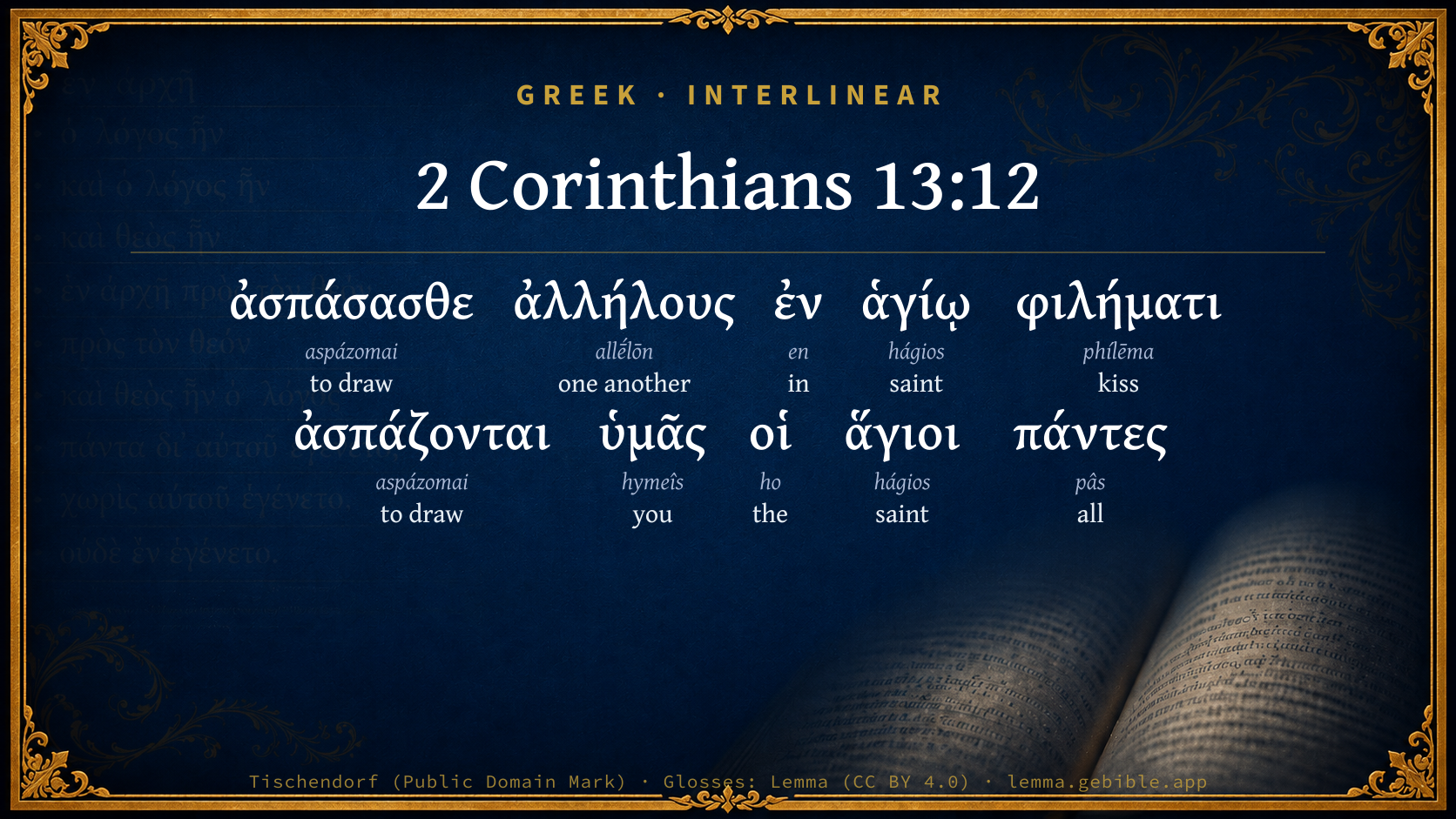
Greek (Tischendorf 8th ed.) 2 Corinthians 13:12 appears in the Greek New Testament. The text above is from the Tischendorf 8th edition. Each word links to its Strong’s number and a concise gloss. Click any word for its full Thayer’s Greek Lexicon entry.
Download image
Cite this verse

2 Corinthians 13:12 (World English Bible). Public Domain. Lemma interlinear Bible study tool, https://lemma.gebible.app/v/2-corinthians/13/12.

Show BibTeX & RIS
BibTeX
RIS
English Translation
Greet one another with a holy kiss.
World English Bible · Public Domain
Download a study sheet

One document with this verse’s original text, its word-by-word gloss line, the meaning frame, cross-references with their text, attributed commentary, and full source and license credits — printable, and it pastes into notes with its structure intact.

This verse Autodidact and up

Study sheet (.html) Plain text (.txt)

A passage Seminary Student

Up to 50 verses in one chapter. A passage sheet keeps up to 6 commentary sources and 12 cross-references per verse, in the order this page ranks them, and says so on the sheet whenever that leaves anything out. Ask for a single verse and you get the Autodidact verse sheet above.

Everything on this page stays free to read, with no account — the sheet is a download of what is already on screen, not access to it.

Want to remove ads? Support Godless Engineer
Compare translations 3

The same verse in 3 English versions, stacked beneath the original-language interlinear above. Click any original word for its lexicon entry.

Each is an independent rendering of the whole verse — the interlinear is not word-aligned to these translations.

Highlighted words mark where these versions differ — a whole-verse word diff, not a word-by-word alignment.

  • World English Bible Public Domain
    Greet one another with a holy kiss.
  • King James Version Public Domain
    Greet one another with an holy kiss.
  • unfoldingWord Literal Text CC BY-SA 4.0
    Greet each other with a holy kiss. All the saints greet you.

unfoldingWord Literal Text — © unfoldingWord, licensed CC BY-SA 4.0. Word-aligned USFM3 via Door43 (git.door43.org/unfoldingWord/en_ult).

Versions to compare (up to 4)

3 of 4 selected

Show all 19 translations

Every available English version of this verse, each an independent rendering of the whole verse.

  • World English Bible Public Domain
    Greet one another with a holy kiss.
  • Berean Standard Bible Public Domain
    Greet one another with a holy kiss.
  • Majority Standard Bible Public Domain
    Greet one another with a holy kiss.
  • King James Version Public Domain
    Greet one another with an holy kiss.
  • American Standard Version (1901) Public Domain
    Salute one another with a holy kiss.
  • Revised Version (1885) Public Domain
    Salute one another with a holy kiss.
  • Geneva Bible (1599) Public Domain
    Greete one another with an holy kisse. All the Saintes salute you.
  • Douay-Rheims (1899) Public Domain
    Salute one another with a holy kiss. All the saints salute you.
  • Young's Literal Translation Public Domain
    salute one another in an holy kiss;
  • Literal Standard Version CC BY-SA 4.0
    Greet one another in a holy kiss.
  • Unlocked Literal Bible CC BY-SA 4.0
    Greet each other with a holy kiss.
  • unfoldingWord Literal Text CC BY-SA 4.0
    Greet each other with a holy kiss. All the saints greet you.
  • Darby Bible Public Domain
    Salute one another with a holy kiss.
  • World Messianic Bible Public Domain
    Greet one another with a holy kiss.
  • Webster's Bible Public Domain
    \\13:13\\All the saints salute you.
  • Free Bible Version CC BY-SA 4.0
    Greet each other with Christian affection.
  • Bible in Basic English Public Domain
    Give one another a holy kiss.
  • Text-Critical English NT CC BY 4.0
    Greet one another with a holy kiss.
  • Tyndale New Testament (1534) Public Domain
    Grete one another in an holy kysse.

Literal Standard Version (2020), Covenant Press — licensed CC BY-SA 4.0. Text via the HelloAO Bible API (eBible.org). Unlocked Literal Bible (unfoldingWord) — licensed CC BY-SA 4.0. Text via the HelloAO Bible API (eBible.org). unfoldingWord Literal Text — © unfoldingWord, licensed CC BY-SA 4.0. Word-aligned USFM3 via Door43 (git.door43.org/unfoldingWord/en_ult). Free Bible Version, Dr. Jonathan Gallagher — licensed CC BY-SA 4.0. Text via the HelloAO Bible API (eBible.org).

Word by word

More ways to search: Search by grammar → Find every occurrence → Compare this word →

Practice this passage: Drill this verse → Learn its vocabulary →

About this verse

These counts appear in no published source. They are computed here, from the morphology-tagged text and Lemma’s own curated glosses. What Lemma adds →

10
words
8
distinct lemmas
Pauline Epistles
section

Notable vocabulary

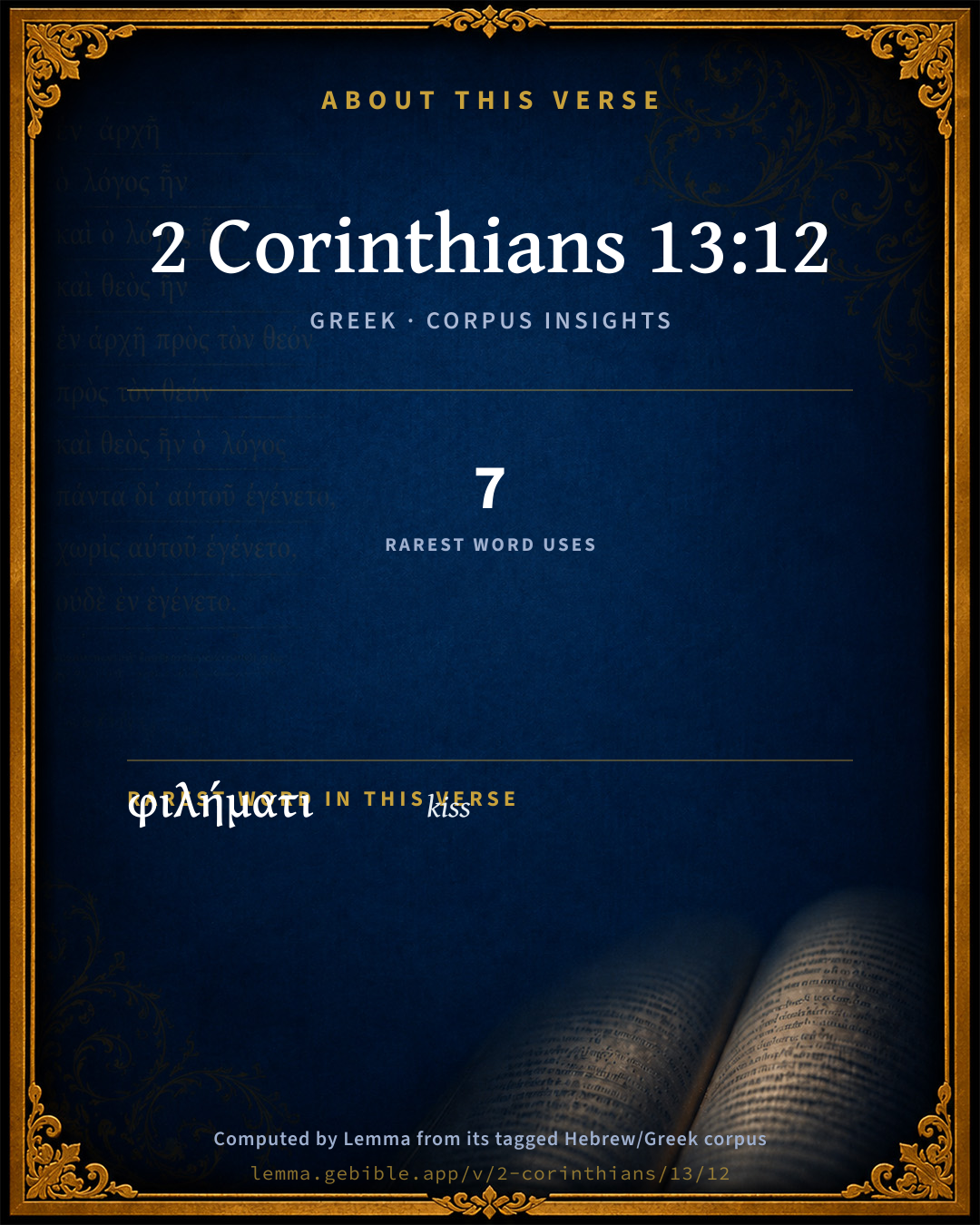
The rarest word here is φιλήματι kiss G5370 — appearing just 7 times in the whole Greek New Testament.

Shared distinctive vocabulary

φιλήματι kiss G5370 occurs in 7 verses of the Greek New Testament. Also found in:

Repetition

Words recur within this verse:

  • ἀσπάσασθε to draw G782 ×2
  • ἁγίῳ saint G40 ×2

Cross-references

4

Topical passages linked to 2 Corinthians 13:12 in the Treasury of Scripture Knowledge — connected by theme and wording, ordered by reader-vote popularity; previews shown in the World English Bible.

  • Romans 16:16 Greet one another with a holy kiss. The assemblies of Christ greet you.
  • 1 Peter 5:14 Greet one another with a kiss of love. Peace be to you all who are in Christ Jesus. Amen.
  • 1 Thessalonians 5:26 Greet all the brothers with a holy kiss.
  • 1 Corinthians 16:20 All the brothers greet you. Greet one another with a holy kiss.

Cross-references courtesy of OpenBible.info (CC BY 4.0).

Commentary

Notes on 2 Corinthians 13:12 from classic Christian and Jewish commentators (each source and its license shown beneath its notes). The classic Christian expositions comment on the surrounding passage and are grouped to its opening verse, so a note may address several verses; the Jewish commentaries on the Tanakh (Rashi and others) are per-verse, so they appear only where the commentator wrote on this verse.

Lemma curates 59 commentaries, every one of them public domain or Creative Commons licensed, each selected and text-cleaned for this edition rather than reprinted as found. About our sources →

Tyndale Open Study Notes

Tyndale Open Resources

13:12-13 a sacred kiss: The kiss was a common Jewish form of salutation, not only a sign of personal affection. Common in the New Testament church (Rom 16:16; 1 Cor 16:20; 1 Thes 5:26; 1 Pet 5:14), it may have a significance in worship services in uniting fellow believers (the “kiss of peace”). The word for sacred (Greek hagiō) is the same word that is translated God’s people (literally the saints; Greek hagioi) in the next sentence. • God’s people here were the believers in the place from which Paul was writing in Macedonia.

Tyndale Open Study Notes — © Tyndale Open Resources, licensed CC BY-SA 4.0. Text via the HelloAO Bible API.

Meyer's Critical & Exegetical Commentary

Heinrich August Wilhelm Meyer

2Co_13:12. As to the saluting by the holy kiss, see on 1Co_16:20.

οἱ ἅγιοι πάντες] namely, at the place and in the vicinity, where Paul was writing, in Macedonia. It was obvious of itself to the readers that they were not saluted by all Christians generally (Theodoret). It by no means follows from this salutation that the Epistle had been publicly read at the place of its composition (possibly Philippi) in the church (Calovius, Osiander), but simply that they knew of the composition of the Epistle. Nor is any special set purpose to be sought as underlying the current designation of Christian ἅγιοι (utpote sanguine Christi lotos et Dei Spiritu regenitos et sanctificatos, Calovius). According to Osiander, the higher value and blessing of the brotherly greeting is meant to be indicated; but comp. 1Co_15:20, οἱ ἀδελφοὶ πάντες.

Paul does not add salutations to individuals by name; these Titus might orally convey, and the apostle himself came, in fact, soon after (Act_20:2).

Meyer — Critical and Exegetical Commentary on the New Testament — English translation by Peter Christie, edited by Frederick Crombie (T&T Clark, 1880) — public domain. Text from a community e-Sword module.

Expositor's Greek Testament

ed. W. Robertson Nicoll

2Co 13:12 . ἀσπάσασθε ἀλλήλ . κ . τ . λ .: salute one another with a holy kiss . This common form of Eastern salutation became at an early date part of the ritual of Christian worship, as indicating the brotherhood of the faithful in the family of God. So early as Justin ( Apol. , i., 65) we read of the “kiss of peace” in the service of the Eucharist. ἀσπάζ . ὑμ . κ . τ . λ .: all the saints, sc. , all from Macedonia where the Apostle was, salute you ( cf. Phi 4:22 ).

The Expositor's Greek Testament, edited by W. Robertson Nicoll (1897–1910) — public domain. Text from a community e-Sword module.

Geneva Bible (1599)

Geneva Bible translators

He saluteth them familiarly, and in conclusion wisheth well unto them.

Geneva Bible (1599) marginal notes — public domain. Text via Bolls.life.

Adam Clarke's Commentary

Verse 12. Greet one another with a holy kiss.] Use every means by which a good understanding may be brought about. Let the spirit of friendship live among you, and encourage its continuance by every friendly act. See Clarke on Ro 16:16.

Adam Clarke's Commentary on the Bible (1810–1826) — public domain. Text from a community e-Sword/MySword module.

Ellicott's Commentary for English Readers

(12) Greet one another with an holy kiss.—The tense of the Greek verb indicates that the Apostle is giving directions, not for a normal and, as it were, liturgical usage, but for a single act. In doing so, he repeats what he had said in 1Co_16:20. The same injunction appears in Rom_16:16; 1Th_5:26. What he meant was that, as the public reading of the Epistle came to a close, the men who listened should embrace each other and kiss each other’s cheeks, in token that all offences were forgotten and forgiven, and that there was nothing but peace and goodwill between them. It was, perhaps, natural, that the counsel should be taken as a rubric, even at the cost of its losing its real significance, and becoming a stereotyped formula. So in the Apostolic Constitutions (possibly of the third century) we find the rubric, “Let the deacons say to all, ‘Salute ye one another with a holy kiss:’ and let the clergy salute the bishop, the men of the laity salute the men, the women the women.” The deacons were to watch that there was no disorder during the act (8:57). In the account given by Justin (Apol. i. 65) it appears as preceding the oblation of the bread and wine for the Eucharistic Feast, as it did in most of the Eastern liturgies, probably as a symbolic act of obedience to the command of Mat_5:24. In the Western Church it came after the consecration of the elements and the Lord’s Prayer. It was intermitted on Good Friday in the African Church (Tertull. De Orat. c. 14) as unsuitable for a day of mourning. It may be noted as the survival of a residuum of the old practice, that when the usage was suppressed by the Western Church, in the thirteenth century, it was replaced by the act of kissing a marble or ivory tablet, on which some sacred subject, such as the Crucifixion, had been carved, which was passed from one to another, and was known as the osculatorium, or “kissing instrument.”

A Bible Commentary for English Readers, edited by Charles John Ellicott (1878–1897) — public domain. Text from a community e-Sword module.

The Cambridge Bible for Schools and Colleges

gen. ed. J. J. S. Perowne

12. Greet one another with a holy kiss] See note on 1Co_16:20.

The Cambridge Bible for Schools and Colleges (gen. ed. J. J. S. Perowne; Cambridge University Press, 1878–1918) — public domain. Text from a community e-Sword module.

John Gill's Exposition

Greet one another with an holy kiss. See Gill on Rom 16:16.

.

2 Corinthians 13:13

co2 13:13

co2 13:13

co2 13:13All the saints salute you. Being all interested in the same divine favour, redeemed by the same blood, and sanctified by the same grace, they have a common concern for each other's welfare; See Gill on Rom 16:16.

John Gill's Exposition of the Whole Bible (1746–1763) — public domain (CC PDM 1.0). Text via the HelloAO Bible API.

Trapp's Complete Commentary

John Trapp

12 Greet one another with an holy kiss.

Ver. 12. With a holy kiss] A custom proper to those times. {See Trapp on "Rom 16:16"} {See Trapp on "1Co 16:20"}

John Trapp, A Commentary or Exposition upon All the Books of the Old and New Testament (1647–1656) — public domain. Text from a community e-Sword module.

Albert Barnes' Notes on the Bible

Greet - Salute; see the note, Rom 16:3.

With an holy kiss - note, Rom 16:16.

Albert Barnes' Notes on the Bible (1834–1885) — public domain. Text from a community e-Sword/MySword module.

Haydock's Catholic Bible Commentary

This was customary with both Jews and Persians, as we learn from Xenophon and Herodotus, and with other oriental nations. And in process of time, from the custom of common life, it was introduced into ecclesiastial assemblies. The ancients were in the habit before they began their meal to embrace each other, to manifest by that sign their mutual cordiality and friendship; then they contributed their alms, that they might give a substantial proof of what was represented by their kiss of charity. (Pastorini)

George Leo Haydock (1774–1849), Haydock's Catholic Family Bible and Commentary, 1859 edition — public domain. Excludes Psalms (Douay-Rheims chapter numbering differs from Protestant) and Deuterocanonical books (Catholic canon only).

Matthew Poole's English Annotations

See Poole on "Rom 16:16". See Poole on "1Co 16:20". It was an ancient custom and of common use, when friends met, for them (as a token of mutual love and friendship) to kiss each other: the Christians used it also at their ecclesiastical assemblings. It must not be looked upon as a precept, obliging all Christians to do the like; but only as directing those that then did use it, to use it innocently, chastely, sincerely, and holily.

Matthew Poole's English Annotations on the Holy Bible (1683–1685) — public domain. Text from a community e-Sword/MySword module.

Whedon's Commentary on the Bible

Daniel D. Whedon

12. Holy kiss—Note, Rom_16:16.

Daniel D. Whedon (gen. ed.), Commentary on the Old and New Testaments (1874–1909) — public domain. Text from a community e-Sword module.

The Pulpit Commentary

Great one another. The verb, being in the aorist, refers to a single act. When the letter had been read in their hearing, they were, in sign of perfect unity and mutual forgiveness, to give one another the kiss of peace. With a holy kiss. (see on 1Co_16:20; comp. 1Pe_5:14)

Vers. 12, 13.

Salutation.

Among the various features which distinguish these apostolic documents from ordinary treatises must be noticed the prominence they attach to social greetings. The personal element mingles very beautifully with the doctrinal and the practical. The apostle"s theme may have been absorbing, but he usually, in bringing an Epistle to its close, refers to the individuals by whom he is himself surrounded his companions and colleagues, and to such as were known to him among the community he is addressing.

I UPON WHAT CHRISTIAN GREETINGS ARE BASED. They differ from common everyday salutations in this, that they are not mere forms, and are not exchanged as a matter of course. They presume a common relation to, a common interest in, the Divine Saviour. The vital union of Christ"s people to himself involves an intercommunion of sympathy amongst themselves.

II IN WHAT CHRISTIAN SALUTATION FINDS EXPRESSION,

1. In words and in messages of spiritual friendship, in the case of thosewho are absent from one another. It is thus proved that distance does not sunder hearts, that the spiritual family, dispersed through many places, is nevertheless but one.

2. In the primitive Churches the Christian greeting took the form of the"holy kiss." In this a common social usage was sanctified by a new and higher meaning. The custom was one which in some Churches was retained for centuries. The kiss of peace, brotherhood, and love was felt to be the appropriate symbol of the new and all-pervading sentiment of Christian kindness.

III WHAT PURPOSES CHRISTIAN GREETINGS SUBSERVE. We may trace several very useful practical ends secured by them.

1. They are evident tokens of the wide diffusion of the Saviour"s spiritualpresence. It is because Christ is with and in his Church that the living members of this Church, pervaded by one Spirit, show true unity and love.

2. They remove the distressing feeling of isolation from which Christ"speople may in many circumstances grievously suffer.

3. They are an anticipation of the confidential and affectionate fellowshipwhich is (next to the presence of the Redeemer) to be expected as the highest joy of the heavenly state. T.

The Pulpit Commentary (1880–1919), ed. H.D.M. Spence-Jones & Joseph S. Exell — public domain. Text from a community e-Sword module.

Burkitt's Expository Notes on the New Testament

William Burkitt

He exhorts them, according to the custom of those eastern countries, to salute one another with a kiss, as a token of mutual and sincere love: And since it was become a practice in sacred meetings and church assemblies, particularly before their receiving the holy communion, to kiss each other, he advises them to use it innocently, chastely; let it not be a wanton, but an holy kiss.

However, afterwards, the piety and purity of the church degenerating and declining, it was laid aside. That which is innocent in itself, and pious in its first intendment, may in time, fall under such abuse, as to cause it wholly to be laid aside.

William Burkitt's Expository Notes on the New Testament (1700–1703) — public domain. Text from a community e-Sword module.

McGarvey & Pendleton's Commentaries

J. W. McGarvey

Salute one another with a holy kiss . [ Rom_16:16 ; 1Co_16:20 ; 1Pe_5:14 . See note on 1Th_5:26 ]

J. W. McGarvey (with Philip Y. Pendleton), Commentaries on the New Testament (The Fourfold Gospel, 1914; Acts; and the epistles) — public domain. Text from a community e-Sword/MySword module.

The People's New Testament

B. W. Johnson

12. Salute one another, etc. See notes on Rom. 16:16, and 1 Cor. 16:20.

B. W. Johnson's The People's New Testament with Notes (1889–1891) — public domain. Electronic text from the Christian Classics Ethereal Library (CCEL) ThML edition.

Cambridge Greek Testament for Schools and Colleges

12. Ἀσπάσασθε. 13. Ἀσπάζονται. These concluding salutations are a feature in all groups of S. Paul’s Epistles; 1Th 5:26; 1Co 16:19-20; Rom 16:3-23; Php 4:21-22; Col 4:10-15; Phm 1:23; Tit 3:15; 2Ti 4:19; 2Ti 4:21.

ἐν ἁγίῳ φιλήματι. This is the right order here (אBDKP), which in some texts (AFGL) has been altered to ἐν φ. ἁγίῳ, to produce agreement with 1Co 16:20; Rom 16:16; 1Th 5:26, where the order ἐν φ. ἁγίῳ is undisputed. After what has just been said respecting the ἀκαθαρσία of many at Corinth (2Co 12:21), the ἁγίῳ is emphasized. S. Peter (1Pe 5:14) says ἐν φ. ἀγάπης. Justin Martyr (Apol. i. 65) says simply φιλήματι. The ἐν marks that, in and by which the salutation was expressed. The kiss was a solemn token of that ἀγάπην ἔχειν ἐν ἀλλήλοις (Joh 13:35), by which Christ’s true disciples were to be known; of τὸ ἀλλήλους ἀγαπᾷν (Rom 13:8), which is the Christian’s ceaseless debt. It was one of the earliest of ritual observances. Tertullian, who calls it osculum pacis, regards it as essential to the perfection of Christian worship. It is signaculum orationis, and quae oratio cum divortio sancti osculi integra? (de Orat. 18). Afterwards he speaks of it simply as pax, and this became a usual name for it in the West, as ἀσπασμός in the East. But in the Church Order known as The Testament of the Lord it is called simply ‘the Peace’ (i. 23, 30, ii. 4, 9). Originally the kiss in public worship was perhaps general; but certainly later, to avoid abuses, the clergy kissed the bishop, laymen kissed laymen, and women women (Const. Apost. ii. 57, viii. 11; Canons of Laodicea, 19; comp. Athenagoras Legat. 32; Clem. Alex. Paed. iii. 11, p. 301, ed. Potter). For details see Suicer s.v.; Smith and Cheetham, D. of Chr. Ant. p. 902.; Scudamore, Notitia Eucharistica, pp. 434–438, 592, 593; Kraus, Real-Enc. der Chr. Alt. p. 543. Conybeare (Expositor, 1894, i. 461) has shown that the ‘kiss of peace’ may have been a custom in the synagogue: there, of course, men would kiss men and women women. Chrysostom explains the kiss by a custom which is probably of later origin, viz. that of kissing the entrances of churches. “We are the temple of Christ. We kiss the porch and entrance of this temple in kissing one another. See now how many kiss the porch of this temple in which we are met, some stooping down on purpose, others touching it with their hand and applying their hand to their mouth.”

Cambridge Greek Testament for Schools and Colleges (Cambridge University Press, 1896; 21 vols, various authors incl. Carr, Maclear, Plummer, Farrar, Lumby, Moule, M. R. James, Simcox) — public domain. Text from a community e-Sword module.

Alford’s Greek Testament

Henry Alford

12.] Concluding greetings.

ἐν ἁγ. φιλ.] See on Rom 16:16.

οἱ ἅγ. πάντες] viz. in the place whence the Epistle was written.

Henry Alford, The Greek Testament (1849–1861) — public domain. Text from a community e-Sword module.

International Critical Commentary

12. Ἀσπάσασθε ἀλλήλους … ἀσπάζονται ὑμᾶς οἱ ἅγιοι πάντες. Salutations at the close of the letter are found in all four groups of the Pauline Epistles; those in 1Co 16:19-21 are specially full; still more so those in Rom 16:3-23. Cf. 1Th 5:26; Col 4:10-15; Phm 1:23; Tit 3:15; 2Ti 4:19-21. Papyri show that such salutations at the close of a letter were a common feature in ordinary correspondence, and ἀσπάζομαι is commonly the verb used. As in 1Co 16:20, the πάντες comes at the end with emphasis. The Apostle is sure that all the Christians with whom he is in touch in Macedonia will desire to “send their love” to their brethren in Corinth.

ἐν ἁγίῳ φιλήματι. We must follow א B D E K P, d e in reading thus here. No doubt the order ἐν φιλ. ἁγίῳ has been adopted in A F G L, f g Vulg. to make this passage agree with 1Co 16:20; 1Th 5:26; Rom 16:16. See the notes on all three of these passages respecting the φίλημα ἅλιον, and also Enc. Bibl. 4254, and Enc. Brit. art. ‘Pax.’ The suggestion that the ‘kiss of concord’ was already an institution in the synagogue has received confirmation from what seem to be Armenian quotations from Philo; and, if that is accepted, the view that the holy kiss in the Christian Church was never promiscuous, is confirmed. That the kiss given to a Rabbi suggested it is less probable. The sexes being separated in the synagogues, the men would kiss men, and the women would kiss women, and Christian assemblies would follow the same practice as a security that the φίλημα was ἅγιον. Nowhere in N.T. is the holy kiss connected with public worship. Justin (Apol. 1:65) connects it with the Eucharist, Tertullian (De Orat. 18) with all prayers, and he seems to imply that the kiss in some cases had become promiscuous; thus (Ad Uxor. 2:4) Quis in carcerem ad osculanda vincula martyris reptare patietur? Jam vero alicui fratrum ad osculum convenire? and (De virg. vel. 14) dum inter amplexus et oscula assidua concalescit. But it is not clear that these passages refer to the liturgical kiss. Express prohibition of the sexes kissing one another in public worship is found in the Apostolic Constitutions (2:57, 8:11). In the East, the kiss seems to have taken place before the consecration of the bread and wine; in the West, after it. Cyril of Jerusalem says of it; “Think not that this kiss ranks with those given in public by common friends. It is not such; this kiss blends souls one with another, and solicits for them entire forgiveness. Therefore this kiss is the sign that our souls are mingled together and have banished all remembrance of wrong (Mat 5:23). The kiss therefore is reconciliation, and for this reason is holy” (Catech. xxiii. 3). The substitution of a ‘pax-bred’ (pax-board), which was kissed first by the clergy and then passed round to the congregation, is said to have been introduced in England by Archbishop Walter of York in 1250 and to have spread to other Churches. Disputes about precedence caused the congregational use of these tablets to be abandoned. The British Museum possesses richly ornamented examples of them. In the Greek Church the ‘holy kiss’ seems to be represented by the priest’s kissing ‘the holy things’ (paten, chalice, and table) and by the deacon’s kissing his orarion, where the figure of the cross is (J. N. W. B. Robertson, The Divine Liturgies, pp. 290-292).

While ἁγίῳ has special point, being added in order to distinguish this kiss from the kisses of ordinary affection or respect, no special meaning is to be found in of οἰ ἅγιοι, as if they were to be distinguished from other believers who were not ἅγιοι. It has the usual meaning of ‘Christians,’ those who by baptism had been ‘consecrated’ to the service of God. Cf. 1:1, 8:4, 9:1, 12; etc. The πάντες comes last with emphasis; but Theodoret exaggerates its meaning when he suggests that St Paul is sending a salutation from the whole of Christendom. All the converts in Macedonia who knew that the Apostle was sending a letter to Corinth wished him to include a kind message from themselves. No salutations to individuals are needed, because St Paul is so soon coming himself.

RV. and AV follow earlier English Versions in taking ἀσπάζονται ὑμᾶς οἱ ἅγιοι πάντες as a separate verse, v. 13, making the benediction which follows it to be v. 14. Gregory (Prolegomena, pp. 173 ff.) has collected a number of instances in which editions differ as to the divisions between verses.

International Critical Commentary — older volumes (1896–1929), various authors — public domain. Text from a community e-Sword module.

Vincent's Word Studies in the New Testament

Marvin R. Vincent

Kiss. In 1Pe 1:14, called the kiss of charity. The practice was maintained chiefly at the celebration of the Eucharist. In the "Apostolic Constitutions" 164 it is enjoined that, before the communion, the clergy kiss the bishop, the laymen amongst each other, and so the women. This latter injunction grew out of the reproach of looseness of manners circulated by the heathen against the Christians. On Good Friday it was omitted in commemoration of Judas ' kiss. In the West the practice survives among the Glassites or Sandemanians. In the Latin Church, after the end of the thirteenth century, there was substituted for it a piece of the altar furniture called a Pax (peace), which was given to the deacon with the words Peace to thee and to the Church. In the East it is continued in the Coptic and Russian Churches.

Marvin R. Vincent, Word Studies in the New Testament (1887–1900) — public domain. Text from a community e-Sword/MySword module.

Lesson kit

Teaching starters — assembled from the data on this page, not authored interpretation. Every prompt links to the verse data it draws on. Edit before teaching.

2 Corinthians, in the Pauline Epistles, opens this verse with 10 words (8 distinct Greek lemmas). Its most distinctive word is phílēma (“kiss”). A historical commentator’s framing appears above. Read the whole chapter for the surrounding context.

Discussion questions

  1. What does “kiss” (phílēma) contribute to the verse as a whole?
  2. How does Luke 7:45, which shares the word «kiss», read alongside this verse?
  3. What does the repetition of “to draw” (2× in this one verse) do in this verse?
  4. These translations render this verse differently. What is at stake in choosing one wording over another?
  5. Compare how Tyndale Open Study Notes and Meyer's Critical & Exegetical Commentary read this verse. Where do they agree or differ?

Things to notice

  • These translations choose different wording for 7 words in this verse.
  • “to draw” occurs 2× in this single verse.
  • 8 distinct Greek lemmas span 10 words in this verse.

Reading settings

Reading text

Shown beneath each verse's original-language words.

Old Testament
Old Testament edition

Read the OT as the Masoretic Hebrew (MT) or the Greek Septuagint (LXX).

English shown for the Greek Septuagint (in the Hebrew ↔ Greek comparison).

Comparing translations? Open the Compare panel on any verse page to stack up to four side by side.