
1 Corinthians 3:17

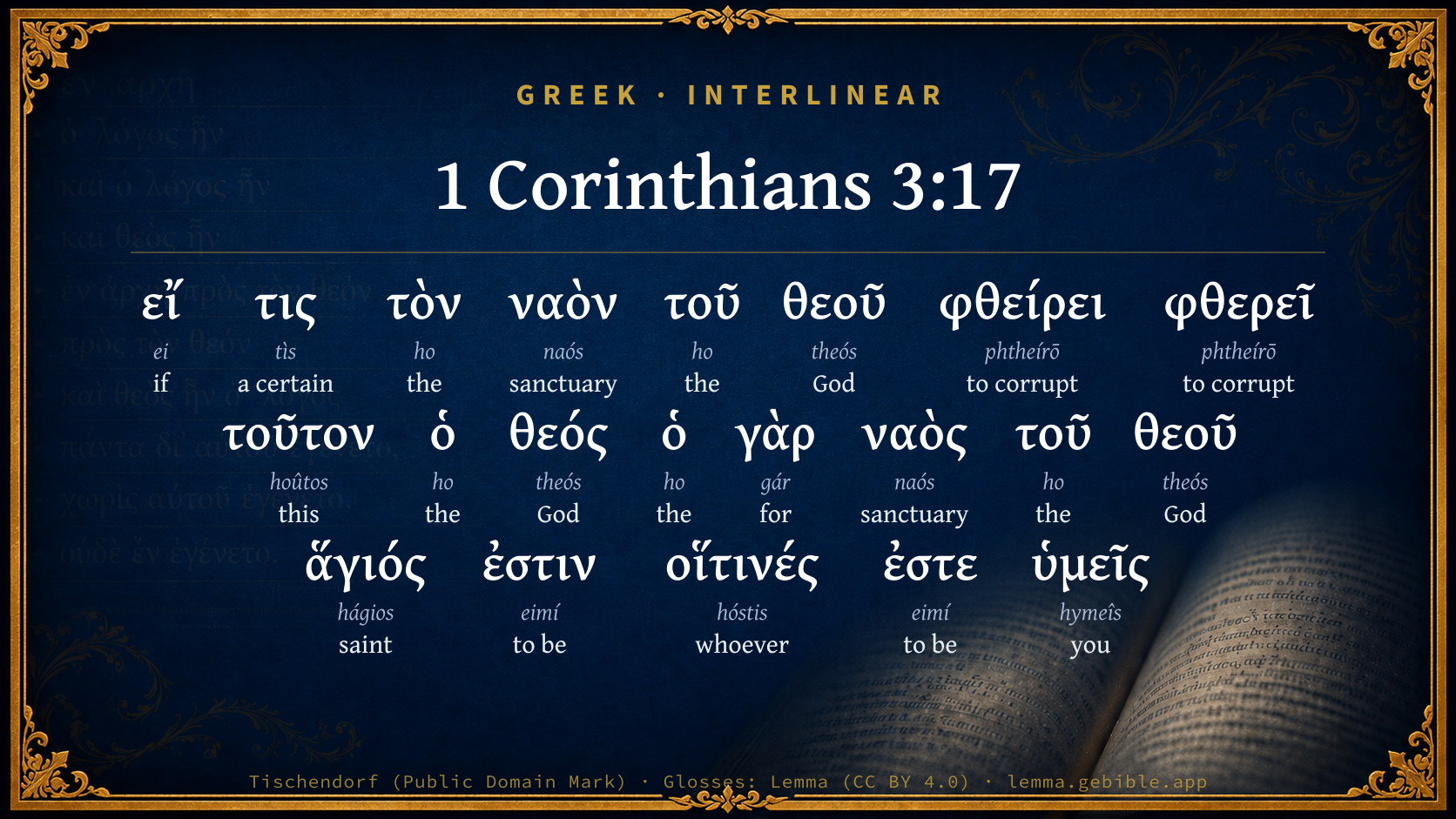
Greek (Tischendorf 8th ed.) 1 Corinthians 3:17 appears in the Greek New Testament. The text above is from the Tischendorf 8th edition. Each word links to its Strong’s number and a concise gloss. Click any word for its full Thayer’s Greek Lexicon entry.
Download image
Cite this verse

1 Corinthians 3:17 (World English Bible). Public Domain. Lemma interlinear Bible study tool, https://lemma.gebible.app/v/1-corinthians/3/17.

Show BibTeX & RIS
BibTeX
RIS
English Translation
If anyone destroys the temple of God, God will destroy him; for God's temple is holy, which you are.
World English Bible · Public Domain
Highlights
  • 1 first appearance in the Greek New Testament
Full analysis ↓
Download a study sheet

One document with this verse’s original text, its word-by-word gloss line, the meaning frame, cross-references with their text, attributed commentary, and full source and license credits — printable, and it pastes into notes with its structure intact.

This verse Autodidact and up

Study sheet (.html) Plain text (.txt)

A passage Seminary Student

Up to 50 verses in one chapter. A passage sheet keeps up to 6 commentary sources and 12 cross-references per verse, in the order this page ranks them, and says so on the sheet whenever that leaves anything out. Ask for a single verse and you get the Autodidact verse sheet above.

Everything on this page stays free to read, with no account — the sheet is a download of what is already on screen, not access to it.

Want to remove ads? Support Godless Engineer
Compare translations 3

The same verse in 3 English versions, stacked beneath the original-language interlinear above. Click any original word for its lexicon entry.

Each is an independent rendering of the whole verse — the interlinear is not word-aligned to these translations.

Highlighted words mark where these versions differ — a whole-verse word diff, not a word-by-word alignment.

  • World English Bible Public Domain
    If anyone destroys the temple of God, God will destroy him; for God's temple is holy, which you are.
  • King James Version Public Domain
    If any man defile the temple of God, him shall God destroy; for the temple of God is holy, which temple ye are.
  • unfoldingWord Literal Text CC BY-SA 4.0
    If anyone destroys the temple of God, God will destroy that. For the temple of God is holy, which you are.

unfoldingWord Literal Text — © unfoldingWord, licensed CC BY-SA 4.0. Word-aligned USFM3 via Door43 (git.door43.org/unfoldingWord/en_ult).

Versions to compare (up to 4)

3 of 4 selected

Show all 19 translations

Every available English version of this verse, each an independent rendering of the whole verse.

  • World English Bible Public Domain
    If anyone destroys the temple of God, God will destroy him; for God's temple is holy, which you are.
  • Berean Standard Bible Public Domain
    If anyone destroys God’s temple, God will destroy him; for God’s temple is holy, and you are that temple.
  • Majority Standard Bible Public Domain
    If anyone destroys God’s temple, God will destroy him; for God’s temple is holy, and you are that temple.
  • King James Version Public Domain
    If any man defile the temple of God, him shall God destroy; for the temple of God is holy, which temple ye are.
  • American Standard Version (1901) Public Domain
    If any man destroyeth the temple of God, him shall God destroy; for the temple of God is holy, and such are ye.
  • Revised Version (1885) Public Domain
    If any man destroyeth the temple of God, him shall God destroy; for the temple of God is holy, which temple ye are.
  • Geneva Bible (1599) Public Domain
    If any man destroy the Temple of God, him shall God destroy: for the Temple of God is holy, which ye are.
  • Douay-Rheims (1899) Public Domain
    But if any man violate the temple of God, him shall God destroy. For the temple of God is holy, which you are.
  • Young's Literal Translation Public Domain
    if any one the sanctuary of God doth waste, him shall God waste; for the sanctuary of God is holy, the which ye are.
  • Literal Standard Version CC BY-SA 4.0
    If anyone ruins the temple of God, God will ruin him; for the temple of God is holy, which you are.
  • Unlocked Literal Bible CC BY-SA 4.0
    If anyone destroys God's temple, God will destroy that person. For God's temple is holy, and so are you.
  • unfoldingWord Literal Text CC BY-SA 4.0
    If anyone destroys the temple of God, God will destroy that. For the temple of God is holy, which you are.
  • Darby Bible Public Domain
    If any one corrupt the temple of God, *him* shall God destroy; for the temple of God is holy, and such are *ye*.
  • World Messianic Bible Public Domain
    If anyone destroys God’s temple, God will destroy him; for God’s temple is holy, which you are.
  • Webster's Bible Public Domain
    If any man defileth the temple of God, him will God destroy: for the temple of God is holy, which temple ye are.
  • Free Bible Version CC BY-SA 4.0
    Anyone who destroys God's temple will be destroyed by God, for God's temple is holy, and you are the temple.
  • Bible in Basic English Public Domain
    If anyone makes the house of God unclean, God will put an end to him; for the house of God is holy, and you are his house.
  • Text-Critical English NT CC BY 4.0
    If anyone destroys the temple of God, God will destroy him. For the temple of God is holy, which is what you are.
  • Tyndale New Testament (1534) Public Domain
    Yf eny man defyle the temple of god him shall god destroye. For the temple of god is holy which temple ye are.

Literal Standard Version (2020), Covenant Press — licensed CC BY-SA 4.0. Text via the HelloAO Bible API (eBible.org). Unlocked Literal Bible (unfoldingWord) — licensed CC BY-SA 4.0. Text via the HelloAO Bible API (eBible.org). unfoldingWord Literal Text — © unfoldingWord, licensed CC BY-SA 4.0. Word-aligned USFM3 via Door43 (git.door43.org/unfoldingWord/en_ult). Free Bible Version, Dr. Jonathan Gallagher — licensed CC BY-SA 4.0. Text via the HelloAO Bible API (eBible.org).

Word by word

More ways to search: Search by grammar → Find every occurrence → Compare this word →

Practice this passage: Drill this verse → Learn its vocabulary →

φθείρει
phtheírō
G5351
“to corrupt”
Verb, Present, Active, Indicative, 3rd person, Singular
Part of Speech
Verb
Tense
Present
Voice
Active
Mood
Indicative
Person
3rd person
Number
Singular
Full Thayer's Definition

Origin: probably strengthened from phthio (to pine or waste)

TDNT: 10:33,1

1. to corrupt, to destroy a. in the opinion of the Jews, the temple was corrupted or "destroyed" when anyone defiled or in the slightest degree damaged anything in it, or if its guardians neglected their duties b. to lead away a Christian church from that state of knowledge and holiness in which it ought to abide c. to be destroyed, to perish d. in an ethical sense, to corrupt, deprave
  1. εἴ ei G1487 “if” Conditional
  2. τις tìs G5100 “a certain” Indefinite pronoun, Nominative, Singular, Masculine
  3. τὸν ho G3588 “the” Article, Accusative, Singular, Masculine
  4. ναὸν naós G3485 “sanctuary” Noun, Accusative, Singular, Masculine
  5. τοῦ ho G3588 “the” Article, Genitive, Singular, Masculine
  6. θεοῦ theós G2316 “God” Noun, Genitive, Singular, Masculine
  7. φθερεῖ phtheírō G5351 “to corrupt” Verb, Future, Active, Indicative, 3rd person, Singular
  8. τοῦτον hoûtos G3778 “this” Demonstrative pronoun, Accusative, Singular, Masculine
  9. ὁ ho G3588 “the” Article, Nominative, Singular, Masculine
  10. θεός theós G2316 “God” Noun, Nominative, Singular, Masculine
  11. ὁ ho G3588 “the” Article, Nominative, Singular, Masculine
  12. γὰρ gár G1063 “for” Conjunction
  13. ναὸς naós G3485 “sanctuary” Noun, Nominative, Singular, Masculine
  14. τοῦ ho G3588 “the” Article, Genitive, Singular, Masculine
  15. θεοῦ theós G2316 “God” Noun, Genitive, Singular, Masculine
  16. ἅγιός hágios G40 “saint” Adjective, Nominative, Singular, Masculine
  17. ἐστιν eimí G1510 “to be” Verb, Present, Active, Indicative, 3rd person, Singular
  18. οἵτινές hóstis G3748 “whoever” Relative pronoun, Nominative, Plural, Masculine
  19. ἐστε eimí G1510 “to be” Verb, Present, Active, Indicative, 2nd person, Plural
  20. ὑμεῖς hymeîs G5210 “you” Personal pronoun, 2nd person, Nominative, Plural

About this verse

These counts appear in no published source. They are computed here, from the morphology-tagged text and Lemma’s own curated glosses. What Lemma adds →

21
words
12
distinct lemmas
Pauline Epistles
section

Notable vocabulary

The rarest word here is φθείρει to corrupt G5351 — appearing just 9 times in the whole Greek New Testament.

First appearance in Scripture

This word makes its first canonical appearance in the Greek New Testament here:

  • φθείρει to corrupt G5351

Shared distinctive vocabulary

φθείρει to corrupt G5351 occurs in 8 verses of the Greek New Testament. Also found in:
Repetition

Words recur within this verse:

  • θεοῦ God G2316 ×3
  • ναὸν sanctuary G3485 ×2
  • φθείρει to corrupt G5351 ×2
  • ἐστιν to be G1510 ×2
  • τὸν the G3588 ×5

Cross-references

17

Topical passages linked to 1 Corinthians 3:17 in the Treasury of Scripture Knowledge — connected by theme and wording, ordered by reader-vote popularity; previews shown in the World English Bible.

  • 1 Corinthians 6:18–20 Flee sexual immorality! "Every sin that a man does is outside the body," but he who commits sexual immorality sins against his own body.
  • Ezekiel 43:12 This is the law of the house: on the top of the mountain the whole limit of it round about shall be most holy. Behold, this is the law of the house.
  • Ezekiel 7:22 My face will I turn also from them, and they shall profane my secret [place]; and robbers shall enter into it, and profane it.
  • Numbers 19:20 But the man who shall be unclean, and shall not purify himself, that soul shall be cut off from the midst of the assembly, because he has defiled the sanctuary of Yahweh: the water for impurity has not been sprinkled on him; he is unclean.
  • Ezekiel 5:11 Therefore, as I live, says the Lord Yahweh, surely, because you have defiled my sanctuary with all your detestable things, and with all your abominations, therefore will I also diminish [you]; neither shall my eye spare, and I also will have no pity.
  • Leviticus 20:3 I also will set my face against that person, and will cut him off from among his people because he has given of his seed to Molech, to defile my sanctuary, and to profane my holy name.
  • Psalms 79:1 God, the nations have come into your inheritance. They have defiled your holy temple. They have laid Jerusalem in heaps.
  • Ezekiel 23:38–39 Moreover this they have done to me: they have defiled my sanctuary in the same day, and have profaned my Sabbaths.
  • Leviticus 15:31 "'Thus you shall separate the children of Israel from their uncleanness, so they will not die in their uncleanness, when they defile my tabernacle that is in their midst.'"
  • Isaiah 64:11 Our holy and our beautiful house, where our fathers praised you, is burned with fire; and all our pleasant places are laid waste.
  • Genesis 28:17 He was afraid, and said, "How dreadful is this place! This is none other than God's house, and this is the gate of heaven."
  • Exodus 3:5 He said, "Don't come close. Take off your sandals from off your feet, for the place you are standing on is holy ground."
  • Psalms 99:9 Exalt Yahweh, our God. Worship at his holy hill, For Yahweh, our God, is holy!
  • 1 Chronicles 29:3 In addition, because I have set my affection on the house of my God, seeing that I have a treasure of my own of gold and silver, I give it to the house of my God, over and above all that I have prepared for the holy house,
  • Psalms 74:3 Lift up your feet to the perpetual ruins, All the evil that the enemy has done in the sanctuary.
  • Psalms 93:5 Your statutes stand firm. Holiness adorns your house, Yahweh, forevermore.
  • Zephaniah 3:4 Her prophets are arrogant and treacherous people. Her priests have profaned the sanctuary. They have done violence to the law.

Cross-references courtesy of OpenBible.info (CC BY 4.0).

Commentary

Notes on 1 Corinthians 3:17 from classic Christian and Jewish commentators (each source and its license shown beneath its notes). The classic Christian expositions comment on the surrounding passage and are grouped to its opening verse, so a note may address several verses; the Jewish commentaries on the Tanakh (Rashi and others) are per-verse, so they appear only where the commentator wrote on this verse.

Lemma curates 59 commentaries, every one of them public domain or Creative Commons licensed, each selected and text-cleaned for this edition rather than reprinted as found. About our sources →

Bengel's Gnomon

Johann Albrecht Bengel

1Co 3:17. Φθείρει, destroys] by schisms according to the wisdom of the world.—φθερεῖ, shall destroy) by a most righteous retaliation in kind [φθερεῖ answering to φθείρει]. There are many punishments, which do not flow from sin by physical connection.—ἅγιος, holy) divine, inviolable.

Bengel's Gnomon of the New Testament — English translation (T&T Clark, Edinburgh, 1860) — public domain. Text from a community e-Sword module.

Meyer's Critical & Exegetical Commentary

Heinrich August Wilhelm Meyer

1Co_3:17. Εἴ τις … ἅγιός ἐστιν] This is spoken of the real temple; the application to the church as the ideal one is not made until the οἵτινές ἐστε ὑμεῖς which follows. It is an anticipation of the course of the argument to understand, as here already meant, the latter New Testament place of the divine presence (Hofmann).

Every Levitical defilement was considered a destroying of the temple, as was every injury to the buildings, and even every act of carelessness in the watching and superintendence of it. See Maimonides, de domo electa, i. 10, vii. 7. Deyling, Obss. II. p. 505 ff.

φθερεῖ] placed immediately after φθείρει at the head of the apodosis, to express with emphasis the adequacy of the recompense. See Kühner, II. p. 626. What φθερεῖ denotes is the temporal destruction, the punishment of death which God will bring upon the destroyer of His temple, as in the LXX. φθείρω is often used of God as inflicting such destruction. Comp Gen_6:13; Mic_2:10; 1Ki_2:27, al[553]

ἅγιος] as the dwelling of God, sacred therefore from all injury, and not to be destroyed without incurring heavy divine penalty.

οἵτινές ἐστε ὑμεῖς] of which character (namely, ἅγιοι) are ye. In this we have the minor proposition of the syllogism contained in 1Co_3:16-17 : Him who destroys Gods temple God will destroy, because the temple is holy; but ye also are holy, as being the spiritual temple; consequently, he who destroys you will be destroyed of God. Paul leaves it to his readers themselves to infer, for their own behoof, that in this reasoning of his he means by the destruction of the (ideal) temple the deterioration of the church on the part of the sectarians, and by the penal destruction which awaits them, their ἀπώλεια at the Messianic judgment (the φθορά of Gal_6:8). It is a mistake (with most commentators, including Luther) to regard οἵτινες as put for οἵ (see the passages where this seems to be the case in Struve, Quaest. Herod. I. p. 2 ff.), and to make it refer to ναὸς τοῦ Θεοῦ: which temple ye are. That would rather yield the inappropriate (see on 1Co_3:16) plural sense: cujusmodi templa vos estis. See Porson and Schaefer, a[554] Eurip. Or. 908. Matthiae, p. 977.

[553] l. and others; and other passages; and other editions.

[554] d refers to the note of the commentator or editor named on the particular passage.

Meyer — Critical and Exegetical Commentary on the New Testament — English translation by Peter Christie, edited by Frederick Crombie (T&T Clark, 1880) — public domain. Text from a community e-Sword module.

Godet's Commentaries

Frédéric Louis Godet

Vv. 17. Again an asyndeton. 1Co 3:16 was the minor of the syllogism of which 1Co 3:17 is the major: “Ye are a temple...; he is destroyed who destroys a temple..., therefore...” The conclusion which is self-evident is understood.

The future φθερεῖ, shall destroy, is no doubt the true reading, though the present φθείρει might also be defended as the present of the idea, and consequently of certain realization. In 1Co 3:15, notwithstanding the loss of the reward (the ζημιοῦσθαι), the salvation of the workman was reserved; here, it is excluded. The punishment increases with the guilt: “As thou has treated the house of God, thou shalt be treated.” The Greco-Lat. reading, αὐτόν, him, emphasizes the identity of the man who has destroyed and who is destroyed. But the Alex. and Byz. reading, τοῦτον, him, this man, is at once better supported and more forcible.

The following proposition gives us to know the wherefore of this severe treatment; the dignity of the building to which this sacrilegious workman does violence. The force of the proof rests on the attribute ἅγιος, holy. What is holy, that is to say, consecrated to God, partakes of the inviolability of God Himself.

The apostle finding it superfluous to enunciate the conclusion in full, contents himself with suggesting it by the last words: “a holy temple, which ye are.” The plural pronoun οἵτινες is a case of attraction from the following ὑμεῖς. This relative pronoun of quality is to be connected not with ναός only, nor with ἅγιος only, but with the entire phrase, ναὸς ἅγιος, holy temple.

To what persons did this warning and threatening apply? Evidently to those who had laboured at Corinth in such a way that they had ended with disorganizing the Church, poisoning its religious and moral life, and compromising the Divine work so happily begun and carried forward in that great city. Here it is, as it seems to me, that we find the full explanation of the end of chap. 2, where Paul spoke of the psychical or natural man, distinguishing him from the yet carnal Christian (1Co 3:1-4). The majority of the Church of Corinth belonged to the second category; but there was certainly a minority in it whom the apostle ranked in the first. It was they whom he had in view in the last two so severe verses of chap. 2: the man who has only his natural understanding; and it is to them he returns in the verses immediately following, where he again, as in chap. 1, puts worldly wisdom on its trial. We have already said: these various passages, as it seems to us, can only concern those of Christ, as they are unmasked in the Second Epistle. But why does the apostle address this warning not to the guilty themselves, but to the Church: “Know ye not that ye are a temple of God,” and all that follows? It is because he wishes to excite the whole Church to a holy indignation, and to call forth within it a vigorous reaction against the authors of these troubles; comp. the appeal to the vigilance of believers, Php 3:2 : “Beware of evil workers.” In the following verses, Paul shows the source of the evil, as he had already pointed it out in chap. 1, in order to open the eyes of both.

Frédéric Louis Godet — Commentaries on Luke, John, Romans, and 1 Corinthians — English translation (T&T Clark, Edinburgh, 1870s–1890s) — public domain. Text from a community e-Sword module.

Hodge's Commentary on Romans, Ephesians & First Corinthians

Charles Hodge

1Co_3:17

If any man defile the temple of God, him shall God destroy: for the temple of God is holy, which (temple) ye are.

The word translated defile in the first clause of this verse, is the same as that rendered destroy in the second clause. It (φθείρω) has the general meaning to bring into a worse state. In the lxx, as well as in the New Testament it means to mar. The passage may, therefore, be rendered, If any man injure the temple of God, him will God injure. The temple cannot be injured with impunity. Under the old dispensation the penalty for defiling the sanctuary was either death, Lev_15:31, or excision from the people, Num_19:20. God is not less jealous of his spiritual temple, than he was of the typical temple, built of wood and stone by the hands of men. Ministers injure the souls of men and injure the church when they preach false doctrine, and therefore they defile the temple of God, and will certainly be punished.

For the temple of God is holy, i.e. sacred; something which cannot be violated with impunity. In this sense every thing consecrated to God is holy, and especially any place or person in which he dwells. Which (temple) ye are. As the word for temple is not in the text (which reads οἵτινές ἐστε ὑμεῖς) the reference may be to the word holy. The temple is holy, which ye also are. The same reason exists why the church cannot be defiled or injured, that there is that the temple could not be profaned. Both are sacred. The view given in our version is commonly preferred.

Charles Hodge — Commentary on Romans (1835), First Corinthians (1857), and Ephesians (1856) — public domain. Text from a community e-Sword module.

Geneva Bible (1599)

Geneva Bible translators

Defileth it, and maketh it unclean, being holy: and surely they do defile it, by Paul’s judgment, which by fleshly eloquence defile the purity of the Gospel.

Geneva Bible (1599) marginal notes — public domain. Text via Bolls.life.

Jamieson, Fausset & Brown

Robert Jamieson, A. R. Fausset & David Brown

If any . . . defile . . . destroy--rather as the Greek verb is the same in both cases, "destroy . . . destroy." God repays in kind by a righteous retaliation. The destroyer shall himself be destroyed. As temporal death was the penalty of marring the material temple (Lev 16:2; Dan 5:2-3, Dan 5:30), so eternal death is the penalty of marring the spiritual temple--the Church. The destroyers here (Co1 3:16-17), are distinct from the unwise or unskilful builders (Co1 3:12, Co1 3:15); the latter held fast the "foundation" (Co1 3:11), and, therefore, though they lose their work of superstructure and the special reward, yet they are themselves saved; the destroyers, on the contrary, assailed with false teaching the foundation, and so subvert the temple itself, and shall therefore be destroyed. (See on Co1 3:10), [ESTIUS and NEANDER]. I think Paul passes here from the teachers to all the members of the Church, who, by profession, are "priests unto God" (Exo 19:6; Pe1 2:9; Rev 1:6). As the Aaronic priests were doomed to die if they violated the old temple (Exo 28:43), so any Christian who violates the sanctity of the spiritual temple, shall perish eternally (Heb 12:14; Heb 10:26, Heb 10:31).

holy--inviolable (Hab 2:20).

which temple ye are--rather, "the which (that is, holy) are ye" [ALFORD], and, therefore, want of holiness on the part of any of you (or, as ESTIUS, "to tamper with the foundation in teaching you") is a violation of the temple, which cannot be let to pass with impunity. GROTIUS supports English Version.

Jamieson, Fausset & Brown — Commentary Critical and Explanatory on the Whole Bible (1871) — public domain (CC PDM 1.0). Text via the HelloAO Bible API.

Adam Clarke's Commentary

Verse 17. If any man defile the temple] This clause is not consistently translated. Ει τις τον ναον του Θεου φθειρει, φθερει τουτον ὁ Θεος. If any man destroy the temple of God, him will God destroy. The verb is the same in both clauses. If any man injure, corrupt, or destroy the Church of God by false doctrine, God will destroy him-will take away his part out of the book of life. This refers to him who wilfully opposes the truth; the erring, mistaken man shall barely escape; but the obstinate opposer shall be destroyed. The former shall be treated leniently; the latter shall have judgment without mercy.

Adam Clarke's Commentary on the Bible (1810–1826) — public domain. Text from a community e-Sword/MySword module.

John Calvin's Commentaries

17. If any man corrupts the temple of God. He subjoins a dreadful threatening — that, as the temple of God ought to be inviolably sacred, that man, whoever he may be, that corrupts it, will not pass with impunity. The kind of profanation of which he now speaks, is, when men intrude themselves, so as to bear rule in the Church in the place of God. For as that faith, which is devoted to the pure doctrine of Christ, is called elsewhere spiritual chastity, (2 Corinthians 11:2,) so it also sanctifies our souls for the right and pure worship of God. For as soon as we are tinctured with the contrivances of men, the temple of God is polluted, as it were, with filth, because the sacrifice of faith, which he claims for himself alone, is in that case offered to creatures.

John Calvin's Commentaries (1540-1563) — public domain. Text from the Calvin Translation Society English edition (1840s-50s) via the Christian Classics Ethereal Library (ccel.org). Calvin's coverage is partial (roughly two-thirds of the Bible); uncommented books and verses are honest gaps, never fabricated. The 19th-century editor's footnotes and remarks are omitted so the notes are faithfully Calvin's own voice.

Ellicott's Commentary for English Readers

(17) If any man defile.—Better, If any man destroy—the opposite of “building up,” which should be the work of the Christian teacher; the architectural image being still in view.

Which temple ye are.—Literally, the which are ye, “which” referring rather to holy than to the temple; the argument being that as they are “holy” by the indwelling of God’s Spirit, therefore they are the temple of God. As God commanded the punishment of death to be inflicted on whoever defiled the actual Temple (see Exo_28:43; Lev_16:2), because it was holy unto the Lord, and His presence dwelt there; so they, having the same Spirit in them, were a temple also holy unto the Lord, and God would not leave him unpunished who destroyed or marred this spiritual temple.

A Bible Commentary for English Readers, edited by Charles John Ellicott (1878–1897) — public domain. Text from a community e-Sword module.

The Cambridge Bible for Schools and Colleges

gen. ed. J. J. S. Perowne

17. If any man defile] Rather, if any man do hurt to the temple of God, to him shall God do hurt. The word is the same in both members of the sentence, and cannot therefore be rendered by the word defile.

which temple ye are] Rather, which (i.e. holy) ye are, or more freely ‘The temple of God is holy, and so are ye.’ The implied syllogism is, The temple is holy; ye are the temple, therefore ye are holy.

The Cambridge Bible for Schools and Colleges (gen. ed. J. J. S. Perowne; Cambridge University Press, 1878–1918) — public domain. Text from a community e-Sword module.

John Gill's Exposition

If any man defile the temple of God,.... By the wisdom of the world, through philosophy, and vain deceit; by bringing in false doctrines, errors, and heresies, and hereby corrupt their minds from the simplicity that is in Christ; and make rents, factions, and divisions among them:

him shall God destroy; body and soul in hell; for as their wicked principles and heretical notions are pernicious to others, they are damnable to themselves, and will bring upon them that judgment which lingereth not, and that damnation which slumbereth not. The false prophet, as well as the beast, and the devil, shall be cast into the lake of fire and brimstone. God is not only an avenger of all immoralities committed against his righteous law, but of all false doctrine and false worship, and of everything that is contrary to the Gospel, and to the order and ordinances of it. The reason of this is,

for the temple of God is holy; alluding to the holiness of Solomon's temple,

"into which a man might not go with his staff, nor with his shoes on, nor with his purse, nor with dust upon his feet, nor might he make it a thoroughfare, and much less spit in it (o).''

And yet, how was it polluted in our Lord's time by the Jews, who made it a den of thieves, instead of an house of prayer?

which temple ye are. This is added for further confirmation, and to assert their holiness in doctrine, worship, and conversation, and to deter the false teachers from making use of any means to corrupt them in either.

(o) Misn. Beracot, c. 9. sect. 5.

John Gill's Exposition of the Whole Bible (1746–1763) — public domain (CC PDM 1.0). Text via the HelloAO Bible API.

Trapp's Complete Commentary

John Trapp

17 If any man defile the temple of God, him shall God destroy; for the temple of God is holy, which temple ye are.

Ver. 17. Which temple ye are] Man is God’s temple; God man’s altar. Demosthenes (contra Aristog.) could say, that man’s heart was God’s best and most stately temple, Iustitia, verecundia, et observantia legum communitum. Justice, respected and heeded, reinforces the law.

John Trapp, A Commentary or Exposition upon All the Books of the Old and New Testament (1647–1656) — public domain. Text from a community e-Sword module.

Albert Barnes' Notes on the Bible

If any man defile ... - Or, “destroy, corrupt” (φθείρει phtheirei). The Greek word is the same in both parts of the sentence. “If any man ‘destroy’ the temple of God, God shall ‘destroy’ him.” This is presented in the form of an adage or proverb. And the truth here stated is based on the fact that the temple of God was inviolable. That temple was holy; and if any man subsequently destroyed it, it might be presumed that God would destroy him. The figurative sense is, “If any man by his doctrines or precepts shall pursue such a course as tends to destroy the church, God shall severely punish him.

For the temple of God is holy - The temple of God is to be regarded as sacred and inviolable. This was unquestionably the common opinion among the Jews respecting the temple at Jerusalem; and it was the common doctrine of the Gentiles respecting their temples. Sacred places were regarded as inviolable; and this general truth Paul applies to the Christian church in general - Locke supposes that Paul had particular reference here to the false teachers in Corinth. But the expression, “if any man,” is equally applicable to all other false teachers as to him.

Which temple ye are - This proves that though Paul regarded them as lamentably corrupt in some respects, he still regarded them as a true church - as a part of the holy temple of God.

Albert Barnes' Notes on the Bible (1834–1885) — public domain. Text from a community e-Sword/MySword module.

Matthew Poole's English Annotations

If any man defile the temple of God, him shall God destroy; the word which we translate defile and destroy (for the Greek word is the same for both) signifieth to violate, corrupt, or destroy. Our translators generally render it corrupt, 1Co 15:33; 2Co 7:2; 1Co 11:3; Eph 4:22; Jud 1:10; Rev 19:2. The people of God, who are here called the temple of God, are defiled, either by imbibing false doctrine, or being tempted to any looseness of life and conversation. Now, (saith the apostle), if any one goes about to do this, which all preachers do who teach any false doctrine, or any principles that lead to a liberty for the flesh, or lead to an ill and scandalous life, God shall destroy those men.

For the temple of God is holy; for as the temple of God of old was a place built and set apart for holy uses, and therefore not without great peril to be abused and profaned; so those that are the people of God, are by God called and set apart in a more immediate, eminent manner for the honour and glory of God, and therefore cannot be debauched or defiled by any as instruments in that action, without exceeding great peril and hazard to them that endeavour and attempt any such thing.

Matthew Poole's English Annotations on the Holy Bible (1683–1685) — public domain. Text from a community e-Sword/MySword module.

Whedon's Commentary on the Bible

Daniel D. Whedon

17. Any man—Note on 1Co_3:12.

Defile—Or destroy, instead of building up, like a wise master builder, 1Co_3:10.

Daniel D. Whedon (gen. ed.), Commentary on the Old and New Testaments (1874–1909) — public domain. Text from a community e-Sword module.

The Pulpit Commentary

If any man defile the temple of God. The verb is the same as in the next clause, and should be rendered, If any man destroy the temple of God; but the word is perhaps too strong, and the word "mar" or "injure" might better convey the meaning (Olshausen). The two verbs are brought into vivid juxtaposition in the original: "God shall ruin the ruiner of his temple." St. Paul was, perhaps, thinking of the penalty of death attached to any one who desecrated the temple of Jerusalem. Inscriptions on the chel, or "middle wall of partition," threatened death to any Gentile who set foot within the sacred enclosure." Which temple ye are; literally, the which are ye; i.e. ye are holy. St. Paul is here referring to the Church of Corinth, and to the false teachers who desecrated it by bringing in "factions of destruction". (2Pe_2:1) Ideally the Church was glorious, "not having spot, or wrinkle, or any such thing". (Eph_5:27)

The Pulpit Commentary (1880–1919), ed. H.D.M. Spence-Jones & Joseph S. Exell — public domain. Text from a community e-Sword module.

John Wesley's Explanatory Notes

If any man destroy the temple of God - Destroy a real Christian, by schisms, or doctrines fundamentally wrong. Him shall God destroy - He shall not be saved at all; not even as through the fire."

John Wesley, Explanatory Notes Upon the Whole Bible (1754–1765) — public domain. Text via the GEBible commentary corpus.

Godbey's Commentary on the New Testament

William B. Godbey

17. “If any one destroy the temple of God, him will God destroy, for the temple of God is holy, which ye are.” There are many ways to destroy soul and body, not only in case of yourself, but others. God claims every human being as his temple. His Son has redeemed every son and daughter of Adam’s race by His precious blood. Hence every word and act, having a sinward tendency, conduces to the destruction of soul and body in Hell. God’s eye is on everyone. He never forgets anything. Millions of people make their living by destroying others, like whales and sharks devouring the finny tribes of the deep. What awful reckonings in the Judgment Day!

William B. Godbey, Commentary on the New Testament (1896–1900) — public domain. Text from a community e-Sword module.

McGarvey & Pendleton's Commentaries

J. W. McGarvey

If any man destroyeth the temple of God, him shall God destroy; for the temple of God is holy, and such are ye . [The factions are here plainly made aware of the magnitude of their sin, and the severity of their punishment. They were destroying the church by their divisions ( Eph_5:27 ), maiming and dismembering it by their discordant factions-- 2Pe_2:1 ]

J. W. McGarvey (with Philip Y. Pendleton), Commentaries on the New Testament (The Fourfold Gospel, 1914; Acts; and the epistles) — public domain. Text from a community e-Sword/MySword module.

Cambridge Greek Testament for Schools and Colleges

17. φθείρει. The A.V. defile is inadmissible here, inasmuch as the same word is used in both members of the sentence. Render, with R.V., destroy. He who persists in a wrong course of action brings destruction upon himself.

οἵτινές ἐστε ὑμεῖς. And such (i. e. holy) are ye, or more freely ‘The temple of God is holy, and so are ye.’ The implied syllogism is, The temple is holy; ye are the temple, therefore ye are holy.

Cambridge Greek Testament for Schools and Colleges (Cambridge University Press, 1896; 21 vols, various authors incl. Carr, Maclear, Plummer, Farrar, Lumby, Moule, M. R. James, Simcox) — public domain. Text from a community e-Sword module.

Alford’s Greek Testament

Henry Alford

17.] φθείρει, [destroys, or] mars, whether as regards its unity and beauty, or its purity and sanctity: here, the meaning is left indefinite, but the latter particulars are certainly hinted at,—by ἅγιος below.

φθερεῖ, either by temporal death (Mey.), as in ch. 11:30; or by spiritual death, which is more probable, seeing that the figurative temple is spoken of, not (as Mey.) the material temple:—and as temporal death was the punishment for defiling the material temple (Exo 28:43.Lev 16:2Lev 16:2 al. fr.), so spiritual death for marring or defiling of God’s spiritual temple.

ἅγιος, the constant epithet of ναός in the O. T., see Psa 5:7; Psa 10:5 (LXX). Hab 2:20, and passim.

οἵτινες, i.e. ἅγιοι, not, ‘which temple are ye,’ which would be tautological after ver. 16, and would hardly be expressed by οἵτινες, ‘ut qui,’ or ‘quales.’ Meyer well remarks, that οἵτινές ἐστε ὑμεῖς is the minor proposition of a syllogism:—‘Whoever mars the temple of God, him will God destroy, because His temple is holy; but ye also, as His ideal temple, are holy:—therefore, whoever mars you, shall be destroyed by God.’

Henry Alford, The Greek Testament (1849–1861) — public domain. Text from a community e-Sword module.

International Critical Commentary

17. εἴ τις …φθείρει … φθερεῖ. The AV. greatly mars the effect by translating the verb first ‘defile’ and then ‘destroy.’ The same verb is purposely used to show the just working of the lex talionis in this case: one destruction is requited by another destruction. The destroyers of the Temple are those who banish the Spirit, an issue to which the dissensions were at least tending. Here the reference is to unchristian faction, which destroyed, by dividing, the unity of the Church: a building shattered into separate parts is a ruin. In 6:19 the thought is of uncleanness in the strict sense. But all sin is a defiling of the Temple and is destructive of its consecrated state.* We have a similar play on words to express a similar resemblance between sin and its punishment in Rom 1:28; καθὼς οὐκ ἐδοκίμασαν τὸν Θεὸν ἔχειν ἐν ἐπιγνώσει, παρέδωκεν αὐτοὺς ὁ Θεὸς εἰς ἀδόκιμον νοῦν. And there is a still closer parallel in Rev 11:18; διαφθεῖραι τοὺς διαφθείροντας τὴν γῆν. Neither φθείρειν nor διαφθείρειν are commonly used of God’s judgments, for which the more usual verb is ἀπολλύειν or ἀπολλύναι: but both here and in Rev 11:18 φθείρειν or διαφθείρειν is preferred, because of its double meaning, ‘corrupt’ and ‘destroy.’ The sinner destroys by corrupting what is holy and good, and for this God destroys him. We have φθείρειν in the sense of corrupt, 15:33; 2Co 11:3; Rev 19:2.

φθερεῖ τοῦτον ὁ Θεός. The Vulgate, like the AV., ignores the telling repetition of the same verb: si quis autem templum Dei violaverit, disperdet illum Deus. Tertullian (Adv. Marc. v. 6) preserves it: si templum Dei quis vitiaverit, vitiabitur, utique a Deo templi; and more literally (De Pudic. 16, 18) vitiabit illum Deus. But neither φθερεῖ here, nor ὄλεθρος in 1Th 5:3, nor ὄλεθρον αἰώνιον in 2Th 1:9, must be pressed to mean annihilation (see on v. 5). Nor, on the other hand, must it be watered down to mean mere physical punishment (cf. 11:30). The exact meaning is nowhere revealed in Scripture; but terrible ruin and eternal loss of some kind seems to be meant. See Beet’s careful examination of these and kindred words, The Last Things, pp. 122 f.

ἅγιός ἐστιν. It is ‘holy,’ and therefore not to be tampered with without grave danger. Both the Tabernacle and the Temple are frequently called ἅγιος, and in the instinct of archaic religion in the O.T. the idea of danger was included in that of ‘holiness.’ See Gray on Num 4:5, Num 4:15, Num 4:19, Num 4:20, and Kirkpatrick on 1Sa 6:20 and 2Sa 6:7; and cf. Lev 10:6, Lev 10:16:2, Lev 10:13.

οἵτινές ἐστε ὑμεῖς. It has been doubted whether ναός or ἅγιος is the antecedent of οἵτινες, but the former is probably right: ‘which temple ye are’ (AV., RV.).* The relative is attracted into the plural of ὑμεῖς. Edwards quotes, τὸν οὐρανόν, οὓς δὴ πόλους καλοῦσιν (Plato, Crat. 405). The meaning seems to be, ‘The temple of God is holy; ye are the temple of God; therefore ye must guard against what violates your consecration.’ As distinct from the simple relative, οἵτινες commonly carries with it the idea of category, of belonging to a class; ‘and this is what ye are,’ ‘and such are ye’: cf. Gal 5:19, where the construction is parallel.

Φθερεῖ (א A B C, d e f g Vulg.) rather than φθείρει (D E F G L P,; Am.) where the difference between Greek and Latin in bilingual MSS. is remarkable: see on v.2. τοῦτον (א B C L P) rather than αὐτόν (A D E F G).

3:18-4:5. Warning Against a More ‘Human’ Estimate

Of the Pastoral Office

Let no one profane God’s Temple by taking on himself to set up party teachers in it. Regard us teachers as simply Christ’s stewards.

18 I am not raising baseless alarms; the danger of a false estimate of oneself is grave. It may easily happen that a man imagines that he is wise in his intercourse with you, with the wisdom of the non-Christian world. Let him become simple enough to accept Christ crucified, which is the way to become really wise. 19 For this world’s wisdom is foolishness in God’s sight, as it stands written in Scripture, Who taketh the wise in their own craftiness; 20 and in another passage, The Lord knoweth the thoughts of the wise that they are vain. 21 If this is so, it is quite wrong for any one to plume himself on the men whom he sets up as leaders. For yours is no party-heritage; it is universal. 22 Paul, Apollos, Kephas, the world, life, death, whatever is, and whatever is to be, all of it belongs to you; 25 but you—you belong to no human leader; you belong to Christ, and Christ to God. Between you and God there is no human leader.

International Critical Commentary — older volumes (1896–1929), various authors — public domain. Text from a community e-Sword module.

Vincent's Word Studies in the New Testament

Marvin R. Vincent

Defile [φθειρει] . Rev., more correctly, destroy. This is the primary and almost universal meaning in classical Greek. In a fragment of Euripides it occurs of dishonoring a female. Sophocles uses it of women pining away in barrenness, and Plutarch of mixing pure colors. The phrase seems to be used here according to the Jewish idea that the temple was destroyed or corrupted by the slightest defilement or damage, or by neglect on the part of its guardians. Ignatius says : "oiJ oijkofqoroi; violators of the house (of God) shall not inherit the kingdom of God" (To the Ephesians, 16.).

Which temple [οιτινες] . Temple is not in the Greek. The double relative which refers to the epithet holy; "of which holy character or class ye are."

Marvin R. Vincent, Word Studies in the New Testament (1887–1900) — public domain. Text from a community e-Sword/MySword module.

Lesson kit

Teaching starters — assembled from the data on this page, not authored interpretation. Every prompt links to the verse data it draws on. Edit before teaching.

1 Corinthians, in the Pauline Epistles, opens this verse with 21 words (12 distinct Greek lemmas). Its most distinctive word is phtheírō (“to corrupt”). A historical commentator’s framing appears above. Read the whole chapter for the surrounding context.

Discussion questions

  1. The word phtheírō carries the sense “to corrupt.” How does it shape the verse?
  2. The word “to corrupt” first appears here in Scripture. What is being introduced at this debut?
  3. 1 Corinthians 15:33 shares the word «to corrupt» with this verse. How do the two illuminate each other?
  4. “God” occurs 3× in this one verse. What is the effect of the repetition?
  5. These translations render this verse differently. What is at stake in choosing one wording over another?
  6. Reading how Bengel's Gnomon and Meyer's Critical & Exegetical Commentary read this verse, where do the two commentators agree and where do they part?

Things to notice

  • 1 word makes its first canonical appearance in Scripture here.
  • These translations choose different wording for 10 words in this verse.
  • “God” occurs 3× in this single verse.
  • 12 distinct Greek lemmas span 21 words in this verse.

Reading settings

Reading text

Shown beneath each verse's original-language words.

Old Testament
Old Testament edition

Read the OT as the Masoretic Hebrew (MT) or the Greek Septuagint (LXX).

English shown for the Greek Septuagint (in the Hebrew ↔ Greek comparison).

Comparing translations? Open the Compare panel on any verse page to stack up to four side by side.