Acts 8:15

Greek (Tischendorf 8th ed.) Acts 8:15 appears in the Greek New Testament. The text above is from the Tischendorf 8th edition. Each word links to its Strong’s number and a concise gloss. Click any word for its full Thayer’s Greek Lexicon entry.
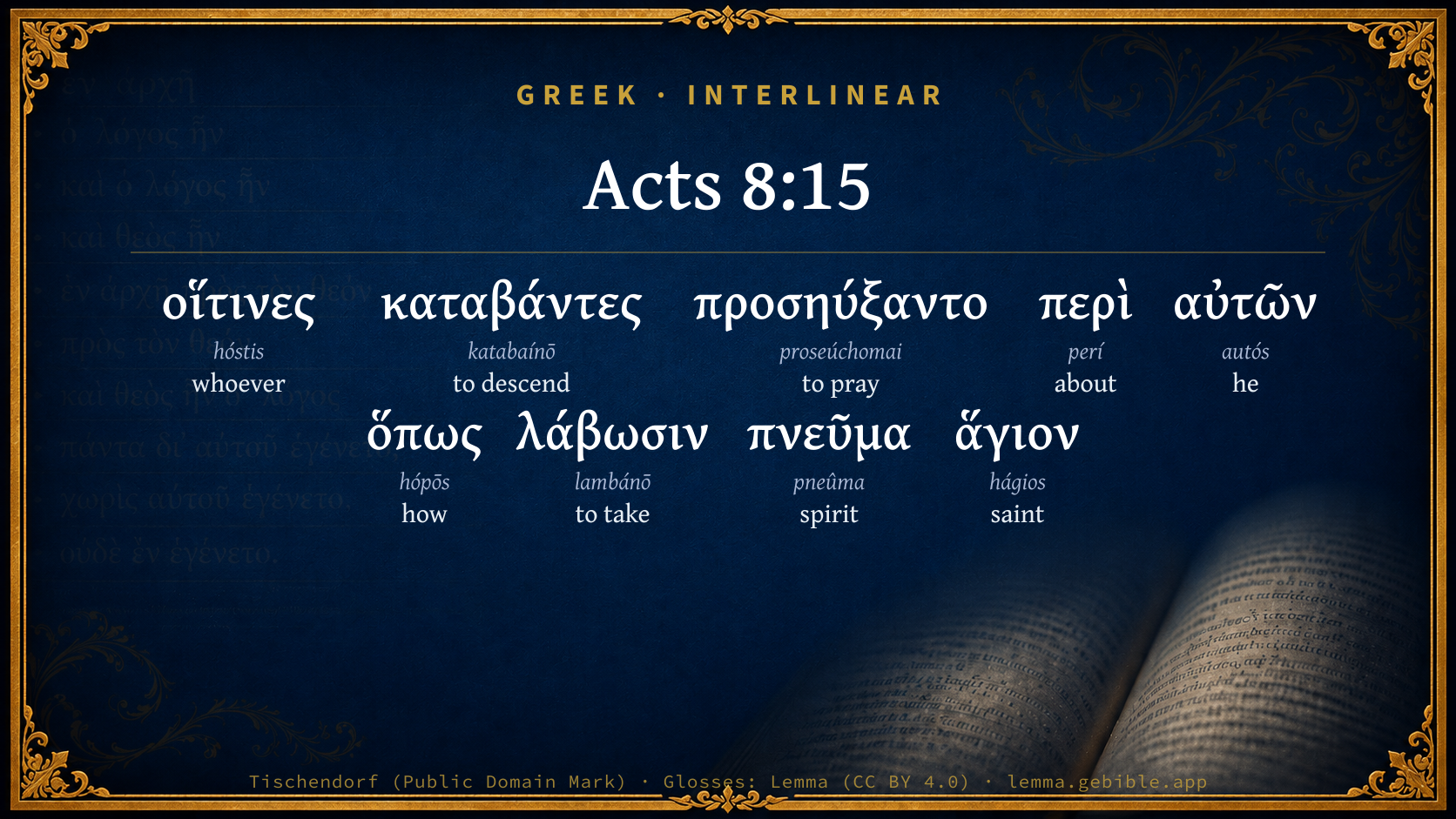
Download image
Cite this verse

Acts 8:15 (World English Bible). Public Domain. Lemma interlinear Bible study tool, https://lemma.gebible.app/v/acts/8/15.

Show BibTeX & RIS
BibTeX
RIS
English Translation
who, when they had come down, prayed for them, that they might receive the Holy Spirit;
World English Bible · Public Domain
Download a study sheet

One document with this verse’s original text, its word-by-word gloss line, the meaning frame, cross-references with their text, attributed commentary, and full source and license credits — printable, and it pastes into notes with its structure intact.

This verse Autodidact and up

Study sheet (.html) Plain text (.txt)

A passage Seminary Student

Up to 50 verses in one chapter. A passage sheet keeps up to 6 commentary sources and 12 cross-references per verse, in the order this page ranks them, and says so on the sheet whenever that leaves anything out. Ask for a single verse and you get the Autodidact verse sheet above.

Everything on this page stays free to read, with no account — the sheet is a download of what is already on screen, not access to it.

Want to remove ads? Support Godless Engineer
Compare translations 3

The same verse in 3 English versions, stacked beneath the original-language interlinear above. Click any original word for its lexicon entry.

Each is an independent rendering of the whole verse — the interlinear is not word-aligned to these translations.

Highlighted words mark where these versions differ — a whole-verse word diff, not a word-by-word alignment.

  • World English Bible Public Domain
    who, when they had come down, prayed for them, that they might receive the Holy Spirit;
  • King James Version Public Domain
    Who, when they were come down, prayed for them, that they might receive the Holy Ghost:
  • unfoldingWord Literal Text CC BY-SA 4.0
    who, having come down, prayed for them, so that they might receive the Holy Spirit.

unfoldingWord Literal Text — © unfoldingWord, licensed CC BY-SA 4.0. Word-aligned USFM3 via Door43 (git.door43.org/unfoldingWord/en_ult).

Versions to compare (up to 4)

3 of 4 selected

Show all 19 translations

Every available English version of this verse, each an independent rendering of the whole verse.

  • World English Bible Public Domain
    who, when they had come down, prayed for them, that they might receive the Holy Spirit;
  • Berean Standard Bible Public Domain
    On their arrival, they prayed for them to receive the Holy Spirit.
  • Majority Standard Bible Public Domain
    On their arrival, they prayed for them to receive the Holy Spirit.
  • King James Version Public Domain
    Who, when they were come down, prayed for them, that they might receive the Holy Ghost:
  • American Standard Version (1901) Public Domain
    who, when they were come down, prayed for them, that they might receive the Holy Spirit:
  • Revised Version (1885) Public Domain
    who, when they were come down, prayed for them, that they might receive the Holy Ghost:
  • Geneva Bible (1599) Public Domain
    Which whe they were come downe, prayed for them, that they might receiue the holy Ghost.
  • Douay-Rheims (1899) Public Domain
    Who, when they were come, prayed for them, that they might receive the Holy Ghost.
  • Young's Literal Translation Public Domain
    who having come down did pray concerning them, that they may receive the Holy Spirit, --
  • Literal Standard Version CC BY-SA 4.0
    who having come down prayed concerning them, that they may receive the Holy Spirit—
  • Unlocked Literal Bible CC BY-SA 4.0
    When they had come down, they prayed for them, that they might receive the Holy Spirit.
  • unfoldingWord Literal Text CC BY-SA 4.0
    who, having come down, prayed for them, so that they might receive the Holy Spirit.
  • Darby Bible Public Domain
    who, having come down, prayed for them that they might receive [the] Holy Spirit;
  • World Messianic Bible Public Domain
    who, when they had come down, prayed for them, that they might receive the Holy Spirit;
  • Webster's Bible Public Domain
    Who, when they had come down, prayed for them that they might receive the Holy Spirit:
  • Free Bible Version CC BY-SA 4.0
    When they arrived they prayed for the converts in Samaria to receive the Holy Spirit.
  • Bible in Basic English Public Domain
    Who, when they came there, made prayer for them, that the Holy Spirit might be given to them:
  • Text-Critical English NT CC BY 4.0
    These two went down and prayed for the Samaritan believers to receive the Holy Spirit,
  • Tyndale New Testament (1534) Public Domain
    which when they were come prayed for the that they myght receave the holy goost

Literal Standard Version (2020), Covenant Press — licensed CC BY-SA 4.0. Text via the HelloAO Bible API (eBible.org). Unlocked Literal Bible (unfoldingWord) — licensed CC BY-SA 4.0. Text via the HelloAO Bible API (eBible.org). unfoldingWord Literal Text — © unfoldingWord, licensed CC BY-SA 4.0. Word-aligned USFM3 via Door43 (git.door43.org/unfoldingWord/en_ult). Free Bible Version, Dr. Jonathan Gallagher — licensed CC BY-SA 4.0. Text via the HelloAO Bible API (eBible.org).

Word by word

More ways to search: Search by grammar → Find every occurrence → Compare this word →

Practice this passage: Drill this verse → Learn its vocabulary →

About this verse

These counts appear in no published source. They are computed here, from the morphology-tagged text and Lemma’s own curated glosses. What Lemma adds →

9
words
9
distinct lemmas
Acts
section

Cross-references

5

Topical passages linked to Acts 8:15 in the Treasury of Scripture Knowledge — connected by theme and wording, ordered by reader-vote popularity; previews shown in the World English Bible.

  • Acts 2:38 Peter said to them, "Repent, and be baptized, everyone of you, in the name of Jesus Christ for the forgiveness of sins, and you will receive the gift of the Holy Spirit.
  • John 16:23–24 "In that day you will ask me no questions. Most assuredly I tell you, whatever you may ask of the Father in my name, he will give it to you.
  • Matthew 18:19 Again, assuredly I tell you, that if two of you will agree on earth concerning anything that they will ask, it will be done for them by my Father who is in heaven.
  • John 14:13–14 Whatever you will ask in my name, that will I do, that the Father may be glorified in the Son.
  • Philippians 1:19 For I know that this will turn out to my salvation, through your supplication and the supply of the Spirit of Jesus Christ,

Cross-references courtesy of OpenBible.info (CC BY 4.0).

Commentary

Notes on Acts 8:15 from classic Christian and Jewish commentators (each source and its license shown beneath its notes). The classic Christian expositions comment on the surrounding passage and are grouped to its opening verse, so a note may address several verses; the Jewish commentaries on the Tanakh (Rashi and others) are per-verse, so they appear only where the commentator wrote on this verse.

Lemma curates 59 commentaries, every one of them public domain or Creative Commons licensed, each selected and text-cleaned for this edition rather than reprinted as found. About our sources →

Bengel's Gnomon

Johann Albrecht Bengel

Act 8:15. Προσηύξατο, prayed) In the ministry of the Gospel prayer has not less power than preaching. He therefore who cannot pray, cannot be a perfect minister. For the things of GOD ought to be laid before men, and the things of men ought to be laid before GOD.

Bengel's Gnomon of the New Testament — English translation (T&T Clark, Edinburgh, 1860) — public domain. Text from a community e-Sword module.

Expositor's Greek Testament

ed. W. Robertson Nicoll

Act 8:15 . οἵτινες : on this form of the relative see Rendall, in loco; Blass however regards it as simply = οἵ , Grammatik , p. 169, cf. Act 12:10 . καταβάντες , cf. Act 24:1 (Luk 2:42 ), Act 11:2 , Act 21:12 ; Act 21:15 . Wendt defends the historical character of this journey to Samaria as against Zeller and Overbeck. προσηύξαντο περὶ : here only with περί ; the verb is characteristic of St. Luke, and he alone has the construction used in this verse, cf. Luk 6:28 , W.H [217] The exact phrase is found in St. Paul’s Epistles four or five times (and once in Hebrews), but often in LXX, and cf. Bar 1:11 ; Bar 1:13 ; Mal 1:6Mal 1:6 ; 2Ma 15:14 . The laying on of hands, as in Act 6:7 and Act 13:3 , is here preceded by prayer, see Hooker, Eccles. Pol. , v., chap. lxvi., 1 4. ὅπως λάβωσι Πν . Ἅγιον : the words express the chief and highest object of the Apostles’ visit: it was not only to ascertain the genuineness of the conversions, or to form a connecting link between the Church of Samaria and that of Jerusalem, although such objects might not have been excluded in dealing with an entirely new and strange state of things the recognition of the Samaritans in a common faith. It has been argued with great force that the expression Holy Spirit is not meant here in its dogmatic Pauline sense; Luke only means to include in it the ecstatic gifts of speaking with tongues and prophecy. This view is held to be supported by ἰδών in Act 8:18 , intimating that outward manifestations which meet the eye must have shown themselves, and by the fact that the same verb, ἐπέπεσε , is used in cases where the results which follow plainly show that the reception of the Holy Ghost meant a manifestation of the outward marvellous signs such as marked the day of Pentecost, Act 10:44 ; Act 10:46 , Act 11:15 ( cf. Act 19:6 ). In the case of these Samaritans no such signs from heaven had followed their baptism, and the Apostles prayed for a conspicuous divine sanction on the reception of the new converts (Wendt, Zöckler, Holtzmann, and see also Hort, Ecclesia , pp. 54, 55). But even supposing that the reception of the Holy Ghost could be thus limited, the gift of tongues was no mere magical power, but the direct result of a super natural Presence and of a special grace of that Presence speaking with tongues, prophesyings, and various gifts, 1Co 14:1 ; 1Co 14:14 ; 1Co 14:37 , were no doubt the outward manifestations, but they could not have been manifested apart from that Presence, and they were outward visible signs or an inward spiritual grace. In a book so marked by the working of the Holy Spirit that it has received the name of the “Gospel of the Spirit” it is difficult to believe that St. Luke can mean to limit the expression λαμβάνειν here and in the following verse to anything less than a bestowal of that divine indwelling of the spirit which makes the Christian the temple of God, and which St. Paul speaks of in the very same terms as a permanent possession, Gal 3:2 , Rom 8:15 (Gore, Church and the Ministry , p. 258). St. Paul’s language, 1Co 12:30 , makes it plain that the advent of the Holy Spirit was not of necessity attested by any peculiar manifestations, nor were these manifestations essential accompaniments of it: “Do all speak with tongues?” he asks, “Are all prophets?” See further on Act 8:17 .

[217] Westcott and Hort’s The New Testament in Greek: Critical Text and Notes.

The Expositor's Greek Testament, edited by W. Robertson Nicoll (1897–1910) — public domain. Text from a community e-Sword module.

Geneva Bible (1599)

Geneva Bible translators

Those excellent gifts, which are necessary, especially for them that were to be appointed rulers and governors of the Church.

Geneva Bible (1599) marginal notes — public domain. Text via Bolls.life.

Jamieson, Fausset & Brown

Robert Jamieson, A. R. Fausset & David Brown

prayed . . . they might receive the Holy Ghost. (For only they were baptized in the name of the Lord Jesus)--As the baptism of adults presupposed "the renewing of the Holy Ghost" (Tit 3:5-7; Co1 12:13), of which the profession of faith had to be taken for evidence, this communication of the Holy Ghost by the laying on of the apostles' hands was clearly a superadded thing; and as it was only occasional, so it was invariably attended with miraculous manifestations (see Act 10:44, where it followed Peter's preaching; and Act 19:1-7, where, as here, it followed the laying on of hands). In the present case an important object was served by it--"the sudden appearance of a body of baptized disciples in Samaria, by the agency of one who was not an apostle, requiring the presence and power of apostles to perform their special part as the divinely appointed founders of the Church" [ALFORD]. Beautiful, too, was the spectacle exhibited of Jew and Samaritan, one in Christ.

Jamieson, Fausset & Brown — Commentary Critical and Explanatory on the Whole Bible (1871) — public domain (CC PDM 1.0). Text via the HelloAO Bible API.

Adam Clarke's Commentary

Verse 15. When they were come down] The very same mode of speaking, in reference to Jerusalem formerly, obtains now in reference to London. The metropolis in both cases is considered as the centre; and all parts, in every direction, no matter how distant, or how situated, are represented as below the metropolis. Hence we so frequently hear of persons going up to Jerusalem: and going down from the same. So in London the people speak of going down to the country; and, in the country, of going up to London. It is necessary to make this remark, lest any person should be led away with the notion that Jerusalem was situated on the highest ground in Palestine. It is a mode of speech which is used to designate a royal or imperial city.

Prayed for them, that they might receive the Holy Ghost.] It seems evident from this case, that even the most holy deacons, though full of the Holy Ghost themselves, could not confer this heavenly gift on others. This was the prerogative of the apostles, and they were only instruments; but they were those alone by which the Lord chose to work. They prayed and laid their hands on the disciples, and God sent down the gift; so, the blessing came from God by the apostles, and not from the apostles to the people. But for what purpose was the Holy Spirit thus given? Certainly not for the sanctification of the souls of the people: this they had on believing in Christ Jesus; and this the apostles never dispensed. It was the miraculous gifts of the Spirit which were thus communicated: the speaking with different tongues, and those extraordinary qualifications which were necessary for the successful preaching of the Gospel; and doubtless many, if not all, of those on whom the apostles laid their hands, were employed more or less in the public work of the Church.

Adam Clarke's Commentary on the Bible (1810–1826) — public domain. Text from a community e-Sword/MySword module.

John Calvin's Commentaries

15. They prayed. Undoubtedly they taught first, for we know that they were no dumb persons; but Luke passeth over that which was common to them and Philip, and declareth only what new thing the Samaritans had by their coming, to wit, that they had the Spirit given them then.

John Calvin's Commentaries (1540-1563) — public domain. Text from the Calvin Translation Society English edition (1840s-50s) via the Christian Classics Ethereal Library (ccel.org). Calvin's coverage is partial (roughly two-thirds of the Bible); uncommented books and verses are honest gaps, never fabricated. The 19th-century editor's footnotes and remarks are omitted so the notes are faithfully Calvin's own voice.

Ellicott's Commentary for English Readers

(15) Prayed for them, that they might receive the Holy Ghost.—The prayer clearly pointed to such a gift of the power of the Spirit as had been bestowed on the Day of Pentecost. It assumed that such gifts had been received by the disciples generally at Jerusalem, and that they were distinct from the new birth of water and the Spirit (Joh_3:5) which was given through baptism. The Apostles looked on the Samaritans as qualified for that higher gift as well as for admission into the kingdom, and it was given to them, and not to Philip in his subordinate position as an evangelist, to be the channels of communicating it.

A Bible Commentary for English Readers, edited by Charles John Ellicott (1878–1897) — public domain. Text from a community e-Sword module.

The Cambridge Bible for Schools and Colleges

gen. ed. J. J. S. Perowne

15. who, when they were come down, &c.] It is clear from the whole history that the special gift of the Holy Ghost, bestowed at this period on the Christian converts in various places, was not given except through the Apostles. The case of Ananias, sent by God’s special command to Saul, differs from all others. Peter could promise it (Act_2:38) to those who should repent and be baptized, but the Samaritan converts whom Philip had made received no share of such powers till the arrival of Peter and John. But the Apostles make it manifest by their prayer that the gift was not theirs either to impart or withhold, but was “of God,” as Peter calls it (Act_8:20).

The Cambridge Bible for Schools and Colleges (gen. ed. J. J. S. Perowne; Cambridge University Press, 1878–1918) — public domain. Text from a community e-Sword module.

John Gill's Exposition

(For as yet he was fallen upon none of them,.... They had received him as a spirit of illumination and sanctification, and as, a spirit of conversion and faith; they had been regenerated, enlightened, and sanctified by him; and were converted by him, and brought to believe in Christ, and live, by faith upon him; they were baptized believers, and no more; as yet, none of them had gifts qualifying them for the ministry; and still less could any of them speak with tongues, or prophesy, or work miracles; the Holy Ghost had not yet descended on them for such purposes:

only they were baptized in the name of the Lord Jesus: all as yet appeared in them was, that they were believers in Christ, and had been baptized in his name, upon a profession of their faith; and more than this they had been called to, or qualified for: the word "only", does not respect the form of baptism, as if they had been baptized only in the name of Christ; whereas they were doubtless baptized in the name of the Father, and of the Son, and of the Holy Ghost; but refers to baptism itself, which was the only ordinance as yet administered to them.

John Gill's Exposition of the Whole Bible (1746–1763) — public domain (CC PDM 1.0). Text via the HelloAO Bible API.

Trapp's Complete Commentary

John Trapp

15 Who, when they were come down, prayed for them, that they might receive the Holy Ghost:

Ver. 15. The Holy Ghost] That is, those extraordinary gifts of tongues, healing, &c.

John Trapp, A Commentary or Exposition upon All the Books of the Old and New Testament (1647–1656) — public domain. Text from a community e-Sword module.

Albert Barnes' Notes on the Bible

Were come down - To Samaria. Jerusalem was generally represented as “up,” or “higher” than the rest of the land, Mat 20:18; Joh 7:8.

Prayed for them - They sought at the hand of God the extraordinary communications of the Holy Spirit. They did not even pretend to have the power of doing it without the aid of God.

That they might receive the Holy Ghost - The main question here is, what was meant by the Holy Spirit? In Act 8:20, it is called “the gift of God.” The following remarks may make this plain:

It was not that gift of the Holy Spirit by which “the soul is converted,” for they had this when they believed, Act 8:6. Everywhere the conversion of the sinner is traced to his influence. Compare Joh 1:13.

(2)It was not the ordinary influences of the Spirit by which “the soul is sanctified”; for sanctification is a progressive work, and this was sudden.

(3)It was something that was discernible by “external effects”; for Simon saw Act 8:18 that this was done by the laying on of hands.

(4)The phrase “the gift of the Holy Spirit,” and “the descent of the Holy Spirit,” signified not merely his “ordinary” influences in converting sinners, but those “extraordinary” influences that attended the first preaching of the gospel - the power of speaking with new tongues Acts 2, the power of working miracles, etc., Act 19:6.

(5)This is further clear from the fact that Simon wished to “purchase” this power, evidently to keep up his influence among the people, and to retain his ascendency as a juggler and sorcerer. But surely Simon would not wish to “purchase” the converting and sanctifying influences of the Holy Spirit; it was the power of working miracles. These things made it clear that by the gift of the Holy Spirit here is meant the power of speaking with new tongues (compare 1 Cor. 14) and the power of working miracles. And it is further clear that “this” passage should not be adduced in favor of “the rite of confirmation” in the Christian church. For, besides the fact that there are now no “apostles,” the thing spoken of here is entirely different from the rite of confirmation. “This” was to confer the extraordinary power of working miracles; “that” is for a different purpose.

If it be asked “why” this power was conferred on the early Christians, it may be replied that it was to furnish striking proof of the truth of the Christian religion; to impress the people, and thus to win them to embrace the gospel. The early church was thus armed with the power of the Holy Spirit; and this extraordinary attestation of God to his message was one cause of the rapid propagation and permanent establishment of the gospel.

Albert Barnes' Notes on the Bible (1834–1885) — public domain. Text from a community e-Sword/MySword module.

Haydock's Catholic Bible Commentary

The Holy Ghost, which the apostles came to give the Samaritan Neophytes, was not the spirit of grace, of justice, and of sanctity, for that they had received at baptism; but the spirit of strength, to confess with confidence and freedom the name of Jesus, and the supernatural and miraculous graces, usually at that time granted to the faithful, by the imposition of hands. Philip did not administer the sacrament, because he could not; he was not a bishop. Hence now in the Church, we see only the chief pastors do it, præcipuos et non alios videmus hoc facere. See St. John Chrysostom, hom. xviii. in Acta. --- There is no mention here, it is true, of unction, but the most venerable antiquity clearly specifies it. St. Cyprian, in the third age [third century], says: "it is moreover necessary, that he who has been baptized, should be anointed, that having received the chrism, that is, the unction, he may be the anointed of God." (Ep. lxx.) --- In the next age [fourth century], St. Pacianus writes: "Do you say that this (the power of remitting sins) was granted only to the apostles? Then I say, that they alone could baptize, and give the Holy Spirit, for to them alone was the command of doing it given. If, therefore, the right of conferring baptism, and of anointing, descended to their successors, to them also has come the power of binding and loosing." (Ep. i. ad Sym. Bibl. Max. T. iv. p. 307)

George Leo Haydock (1774–1849), Haydock's Catholic Family Bible and Commentary, 1859 edition — public domain. Excludes Psalms (Douay-Rheims chapter numbering differs from Protestant) and Deuterocanonical books (Catholic canon only).

Matthew Poole's English Annotations

They; Peter and John.

Prayed for them; in this particular they did not pray for all that believed, amongst whom there were several women, Act 8:12.

That they might receive the Holy Ghost; those extraordinary gifts of tongues, of prophesying of working miracles, &c. See Act 10:45.

Matthew Poole's English Annotations on the Holy Bible (1683–1685) — public domain. Text from a community e-Sword/MySword module.

The Pulpit Commentary

That they might receive the Holy Ghost. Why was it needful that two apostles should come down to Samaria and pray, with laying on of hands, for the newly baptized that they might receive the Holy Ghost? There is no mention of such prayer or such imposition of hands in the case of the first three thousand who were baptized. They were told by St. Peter, "Be baptized every one of you, and ye shall receive the gift of the Holy Ghost", (Act_2:38) and they were baptized, and doubtless did receive the Holy Ghost, Neither is there any mention of such things in the case of the subsequent thousands who were baptized at Jerusalem on the apostles" preaching. Why, then, was it so in Samaria? To answer this question, we must observe the difference in the circumstances. The baptisms at Jerusalem were performed by the apostles themselves. The Holy Ghost was given upon their promise and assurance. But in Samaria the preaching and the baptizing were done by the scattered disciples. There was a danger of many independent bodies springing up, owing no allegiance to the apostles, and cemented by no bonds to the mother Church. But Christ"s Church was to be one many members, but one body. The apostolate was to be the governing power of the whole Church, by the will and ordinance of Christ. Hence there was a manifest reason why, when the gospel spread beyond Judaea, these visible spiritual gifts should be given only through the laying on of the apostles" hands, and by the intervention of their prayers. This had a manifest and striking influence in marking and preserving the unity of the Church, and in marking and maintaining the sovereignty of the apostolic rule. For precisely the same reason has the Catholic and Apostolic Church in all ages (Act_19:5, Act_19:6; Heb_6:2) maintained the rite of confirmation, "after the example of the holy apostles." Besides the other great benefits connected with it, its influence in binding up in the unity of the Church the numerous parishes of the diocese, instead of letting them become independent congregations, is very great. Observe, too, how prayer and the laying on of hands are tied together. Neither is valid without the other. In this case, as at Pentecost, the extraordinary gift of the Holy Ghost was conferred. In confirmation, now that miracles have ceased, it is the ordinary and invisible grace of the Holy Spirit that is to be looked for.

The Pulpit Commentary (1880–1919), ed. H.D.M. Spence-Jones & Joseph S. Exell — public domain. Text from a community e-Sword module.

John Wesley's Explanatory Notes

The Holy Ghost - In his miraculous gifts? Or his sanctifying graces? Probably in both.

John Wesley, Explanatory Notes Upon the Whole Bible (1754–1765) — public domain. Text via the GEBible commentary corpus.

McGarvey & Pendleton's Commentaries

J. W. McGarvey

See notes on verse 14

J. W. McGarvey (with Philip Y. Pendleton), Commentaries on the New Testament (The Fourfold Gospel, 1914; Acts; and the epistles) — public domain. Text from a community e-Sword/MySword module.

The People's New Testament

B. W. Johnson

15–17. Prayed for them. That the Holy Spirit might fall on them. They had been born of water and the Spirit (John 3:5), but had not received that baptism of the Spirit which conferred miraculous powers. This was bestowed by apostolic prayer and the laying on of hands. I suppose, not on all, but on those selected for teachers and preachers among the Samaritans. “The prayer clearly pointed to such a power of the Holy Spirit as had been bestowed on Pentecost.”—Plumptree. “Luke speaks not of the common grace of the Holy Spirit, but of those singular gifts with which God would have certain endowed at the beginning of the gospel.”—Calvin.

Laid … hands on them. “This was part of that miraculous supremacy of the apostles that they could not communicate to any successor.”—Whedon. This reception of the Holy Spirit was manifest in speaking with tongue and other powers.

B. W. Johnson's The People's New Testament with Notes (1889–1891) — public domain. Electronic text from the Christian Classics Ethereal Library (CCEL) ThML edition.

Cambridge Greek Testament for Schools and Colleges

15. καταβάντες, when they were come down. Used often of leaving Jerusalem, the centre of all religious life, to go into other parts. So the contrary verb ἀναβαίνειν is employed (Luk 2:42) to describe the journey to the Holy City.

ὅπως λάβωσι, that they might receive. The subjunctive mood comes after ὅπως even when preceded by a past tense, as here, when the result intended is regarded as something which will surely come to pass. Cf. Act 25:26, προήγαγον αὐτὸν ἐφ’ ὑμῶν … ὄπως σχῶ τί γράψω.

πνεῦμα ἅγιον, the Holy Ghost, or rather (as the word has no article) ‘a gift of the Holy Ghost.’ It is clear from the whole history that special gifts of the Holy Ghost, bestowed at this period on the Christian converts in various places, were not given except through the Apostles. The case of Ananias, sent by God’s special command to Saul, differs from all others. Peter could promise it (Act 2:38) to those who should repent and be baptized, but the Samaritan converts whom Philip had made received no share of such powers till the arrival of Peter and John. But the Apostles make it manifest by their prayer that the gift was not theirs either to impart or withhold, but was ‘of God,’ as Peter calls it (Act 8:20).

Cambridge Greek Testament for Schools and Colleges (Cambridge University Press, 1896; 21 vols, various authors incl. Carr, Maclear, Plummer, Farrar, Lumby, Moule, M. R. James, Simcox) — public domain. Text from a community e-Sword module.

Alford’s Greek Testament

Henry Alford

15. προσηύξ.] So laying on of hands is preceded by prayer, ch. 6:6; 13:3.

Henry Alford, The Greek Testament (1849–1861) — public domain. Text from a community e-Sword module.

Lesson kit

Teaching starters — assembled from the data on this page, not authored interpretation. Every prompt links to the verse data it draws on. Edit before teaching.

Acts, in the Acts, opens this verse with 9 words (9 distinct Greek lemmas). Its most distinctive word is hópōs (“how”). A historical commentator’s framing appears above. Read the whole chapter for the surrounding context.

Discussion questions

  1. The word hópōs carries the sense “how.” How does it shape the verse?
  2. How does Matthew 2:8, which shares the word «how», read alongside this verse?
  3. These translations render this verse differently. What is at stake in choosing one wording over another?
  4. Compare how Bengel's Gnomon and Expositor's Greek Testament read this verse. Where do they agree or differ?

Things to notice

Reading settings

Reading text

Shown beneath each verse's original-language words.

Old Testament
Old Testament edition

Read the OT as the Masoretic Hebrew (MT) or the Greek Septuagint (LXX).

English shown for the Greek Septuagint (in the Hebrew ↔ Greek comparison).

Comparing translations? Open the Compare panel on any verse page to stack up to four side by side.