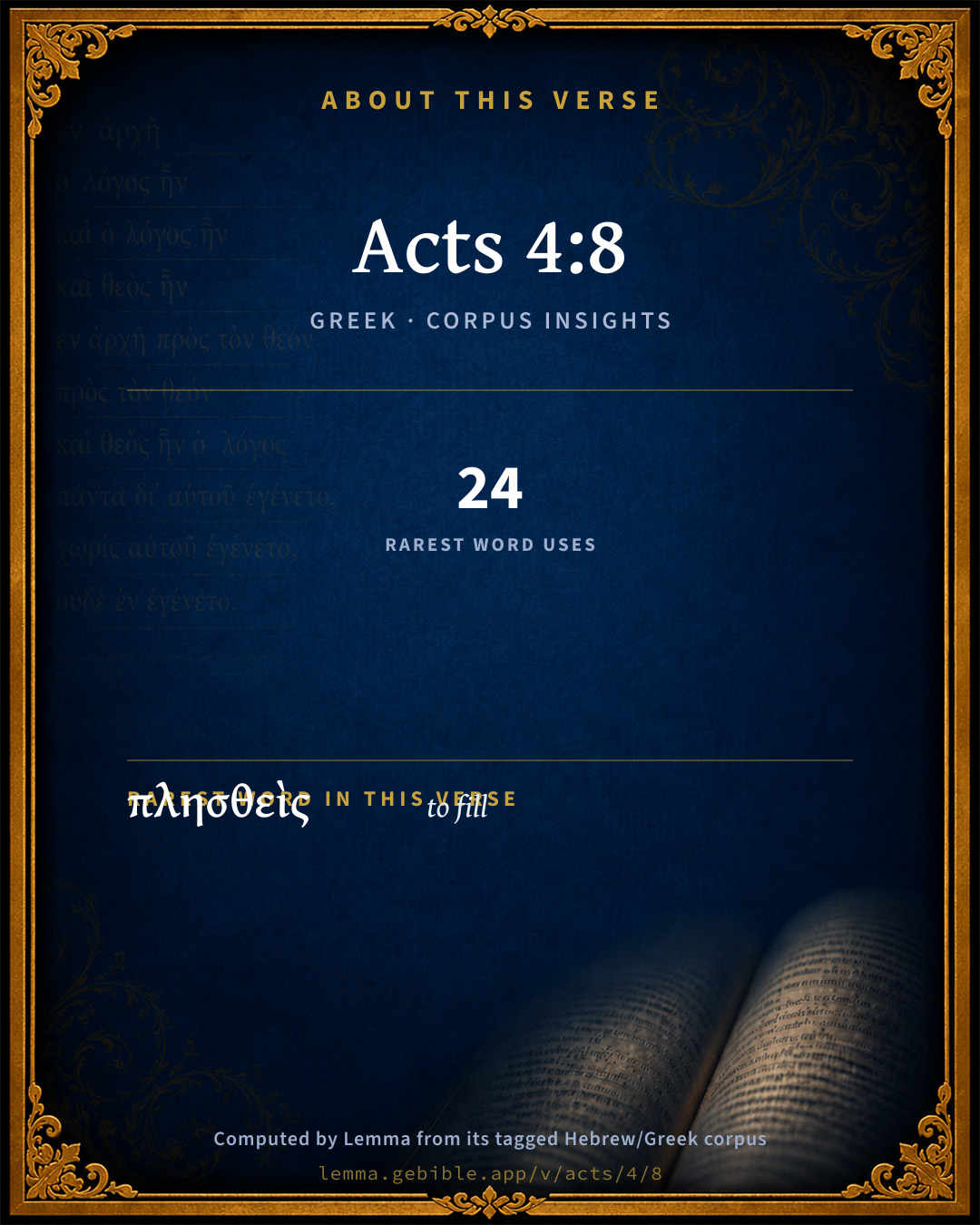
Acts 4:8

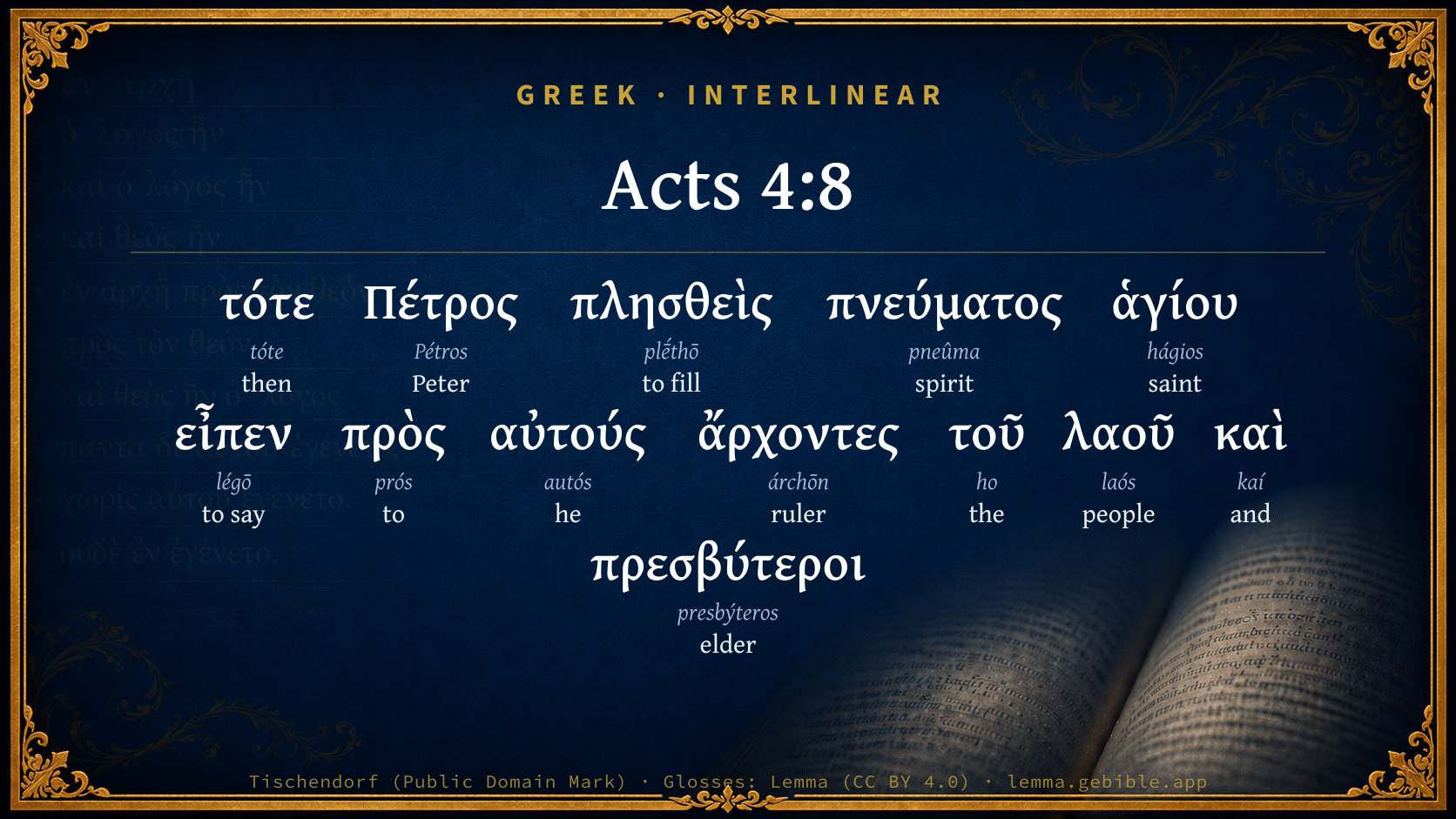
Greek (Tischendorf 8th ed.) Acts 4:8 appears in the Greek New Testament. The text above is from the Tischendorf 8th edition. Each word links to its Strong’s number and a concise gloss. Click any word for its full Thayer’s Greek Lexicon entry.
Download image
Cite this verse

Acts 4:8 (World English Bible). Public Domain. Lemma interlinear Bible study tool, https://lemma.gebible.app/v/acts/4/8.

Show BibTeX & RIS
BibTeX
RIS
English Translation
Then Peter, filled with the Holy Spirit, said to them, "You rulers of the people, and elders of Israel,
World English Bible · Public Domain
Download a study sheet

One document with this verse’s original text, its word-by-word gloss line, the meaning frame, cross-references with their text, attributed commentary, and full source and license credits — printable, and it pastes into notes with its structure intact.

This verse Autodidact and up

Study sheet (.html) Plain text (.txt)

A passage Seminary Student

Up to 50 verses in one chapter. A passage sheet keeps up to 6 commentary sources and 12 cross-references per verse, in the order this page ranks them, and says so on the sheet whenever that leaves anything out. Ask for a single verse and you get the Autodidact verse sheet above.

Everything on this page stays free to read, with no account — the sheet is a download of what is already on screen, not access to it.

Want to remove ads? Support Godless Engineer
Compare translations 3

The same verse in 3 English versions, stacked beneath the original-language interlinear above. Click any original word for its lexicon entry.

Each is an independent rendering of the whole verse — the interlinear is not word-aligned to these translations.

Highlighted words mark where these versions differ — a whole-verse word diff, not a word-by-word alignment.

  • World English Bible Public Domain
    Then Peter, filled with the Holy Spirit, said to them, "You rulers of the people, and elders of Israel,
  • King James Version Public Domain
    Then Peter, filled with the Holy Ghost, said unto them, Ye rulers of the people, and elders of Israel,
  • unfoldingWord Literal Text CC BY-SA 4.0
    Then Peter, filled with the Holy Spirit, said to them, “Rulers of the people and elders,

unfoldingWord Literal Text — © unfoldingWord, licensed CC BY-SA 4.0. Word-aligned USFM3 via Door43 (git.door43.org/unfoldingWord/en_ult).

Versions to compare (up to 4)

3 of 4 selected

Show all 19 translations

Every available English version of this verse, each an independent rendering of the whole verse.

  • World English Bible Public Domain
    Then Peter, filled with the Holy Spirit, said to them, "You rulers of the people, and elders of Israel,
  • Berean Standard Bible Public Domain
    Then Peter, filled with the Holy Spirit, said to them, “Rulers and elders of the people!
  • Majority Standard Bible Public Domain
    Then Peter, filled with the Holy Spirit, said to them, “Rulers and elders of the people of Israel!
  • King James Version Public Domain
    Then Peter, filled with the Holy Ghost, said unto them, Ye rulers of the people, and elders of Israel,
  • American Standard Version (1901) Public Domain
    Then Peter, filled with the Holy Spirit, said unto them, Ye rulers of the people, and elders,
  • Revised Version (1885) Public Domain
    Then Peter, filled with the Holy Ghost, said unto them, Ye rulers of the people, and elders,
  • Geneva Bible (1599) Public Domain
    Then Peter ful of the holy Ghost, said vnto them, Ye rulers of the people, and Elders of Israel,
  • Douay-Rheims (1899) Public Domain
    Then Peter, filled with the Holy Ghost, said to them: Ye princes of the people, and ancients, hear:
  • Young's Literal Translation Public Domain
    Then Peter, having been filled with the Holy Spirit, said unto them: `Rulers of the people, and elders of Israel,
  • Literal Standard Version CC BY-SA 4.0
    Then Peter, having been filled with the Holy Spirit, said to them: “Rulers of the people, and elders of Israel,
  • Unlocked Literal Bible CC BY-SA 4.0
    Then Peter, filled with the Holy Spirit, said to them, “You rulers of the people, and elders,
  • unfoldingWord Literal Text CC BY-SA 4.0
    Then Peter, filled with the Holy Spirit, said to them, “Rulers of the people and elders,
  • Darby Bible Public Domain
    Then Peter, filled with [the] Holy Spirit, said to them, Rulers of the people and elders [of Israel],
  • World Messianic Bible Public Domain
    Then Peter, filled with the Holy Spirit, said to them, “You rulers of the people and elders of Israel,
  • Webster's Bible Public Domain
    Then Peter, filled with the Holy Spirit, said to them, Ye rulers of the people, and elders of Israel,
  • Free Bible Version CC BY-SA 4.0
    Peter, filled with the Holy Spirit, answered them. “Rulers of the people, and elders:
  • Bible in Basic English Public Domain
    Then Peter, being full of the Holy Spirit, said to them, O you rulers of the people and men of authority,
  • Text-Critical English NT CC BY 4.0
    Then Peter, filled with the Holy Spirit, said to them, “Rulers of the people and elders of Israel,
  • Tyndale New Testament (1534) Public Domain
    Then Peter full of the holy goost sayd vnto them: ye rulars of the people and elders of Israel

Literal Standard Version (2020), Covenant Press — licensed CC BY-SA 4.0. Text via the HelloAO Bible API (eBible.org). Unlocked Literal Bible (unfoldingWord) — licensed CC BY-SA 4.0. Text via the HelloAO Bible API (eBible.org). unfoldingWord Literal Text — © unfoldingWord, licensed CC BY-SA 4.0. Word-aligned USFM3 via Door43 (git.door43.org/unfoldingWord/en_ult). Free Bible Version, Dr. Jonathan Gallagher — licensed CC BY-SA 4.0. Text via the HelloAO Bible API (eBible.org).

Word by word

More ways to search: Search by grammar → Find every occurrence → Compare this word →

Practice this passage: Drill this verse → Learn its vocabulary →

πλησθεὶς
plḗthō
G4130
“to fill”
Verb, Aorist, Passive, Participle, Nominative, Singular, Masculine
Part of Speech
Verb
Tense
Aorist
Voice
Passive
Mood
Participle
Case
Nominative
Number
Singular
Gender
Masculine
Full Thayer's Definition

Origin: a prolonged form of a primary pleo pleh'-o (which appears only as an alternate in certain tenses and in the reduplicated form pimplemi)

TDNT: 6:128,*

1. to fill 2. to be fulfilled, to be filled
  1. τότε tóte G5119 “then” Adverb
  2. Πέτρος Pétros G4074 “Peter” Noun, Nominative, Singular, Masculine
  3. πνεύματος pneûma G4151 “spirit” Noun, Genitive, Singular, Neuter
  4. ἁγίου hágios G40 “saint” Adjective, Genitive, Singular, Neuter
  5. εἶπεν légō G3004 “to say” Verb, Aorist, Active, Indicative, 3rd person, Singular
  6. πρὸς prós G4314 “to” Preposition
  7. αὐτούς autós G846 “he” Personal pronoun, Accusative, Plural, Masculine
  8. ἄρχοντες árchōn G758 “ruler” Noun, Vocative, Plural, Masculine
  9. τοῦ ho G3588 “the” Article, Genitive, Singular, Masculine
  10. λαοῦ laós G2992 “people” Noun, Genitive, Singular, Masculine
  11. καὶ kaí G2532 “and” Conjunction
  12. πρεσβύτεροι presbýteros G4245 “elder” Adjective, Vocative, Plural, Masculine, Comparative

About this verse

These counts appear in no published source. They are computed here, from the morphology-tagged text and Lemma’s own curated glosses. What Lemma adds →

13
words
13
distinct lemmas
Acts
section

Notable vocabulary

The rarest word here is πλησθεὶς to fill G4130 — appearing just 24 times in the whole Greek New Testament.

Shared distinctive vocabulary

πλησθεὶς to fill G4130 occurs in 24 verses of the Greek New Testament. Also found in:

Cross-references

8

Topical passages linked to Acts 4:8 in the Treasury of Scripture Knowledge — connected by theme and wording, ordered by reader-vote popularity; previews shown in the World English Bible.

  • Luke 12:11–12 When they bring you before the synagogues, the rulers, and the authorities, don't be anxious how or what you will answer, or what you will say;
  • Matthew 10:19–20 But when they deliver you up, don't be anxious how or what you will say, for it will be given you in that hour what you will say.
  • Luke 21:14–15 Settle it therefore in your hearts not to meditate beforehand how to answer,
  • Acts 2:4 They were all filled with the Holy Spirit, and began to speak with other languages, as the Spirit gave them the ability to speak.
  • Acts 4:31 When they had prayed, the place was shaken where they were gathered together. They were all filled with the Holy Spirit, and they spoke the word of God with boldness.
  • Acts 7:55 But he, being full of the Holy Spirit, looked up steadfastly into heaven, and saw the glory of God, and Jesus standing on the right hand of God,
  • Luke 23:13 Pilate called together the chief priests and the rulers and the people,
  • Acts 4:5 It happened in the morning, that their rulers, elders, and scribes were gathered together in Jerusalem.

Cross-references courtesy of OpenBible.info (CC BY 4.0).

Where the printed editions differ

1 variant

Places in this verse where the major printed Greek editions disagree on the wording in a way that affects the translation — a comparison of editions, not a manuscript-by-manuscript collation. The editions are the modern critical texts (Nestlé-Aland 28/27, SBL, Westcott-Hort, Tregelles, Tyndale House) and the traditional texts behind the KJV (the Textus Receptus and the Byzantine/Majority text). It is not a claim about which reading is original.

  1. Extra text
    τοῦ Ἰσραήλ,

    “<the> of Israel”

    In TRByz Not in NA28NA27TynSBLWHTreg

    τοῦ Ἰσραήλ, (tou Israēl) 'of Israel' is only in traditional manuscripts (TR+Byz)

Textual data: Translators Amalgamated Greek New Testament (STEPBible TAGNT) · CC BY 4.0.

Commentary

Notes on Acts 4:8 from classic Christian and Jewish commentators (each source and its license shown beneath its notes). The classic Christian expositions comment on the surrounding passage and are grouped to its opening verse, so a note may address several verses; the Jewish commentaries on the Tanakh (Rashi and others) are per-verse, so they appear only where the commentator wrote on this verse.

Lemma curates 59 commentaries, every one of them public domain or Creative Commons licensed, each selected and text-cleaned for this edition rather than reprinted as found. About our sources →

Joseph Benson's Commentary

Act 4:8-12. Then Peter, filled with the Holy Ghost — That moment, according to the promise of his now glorified Master, (Mat 10:20; Mar 13:11,) which was upon this occasion remarkably verified; said unto them — With the utmost freedom; Ye rulers of the people, &c. — He gives them the honour due to their office. If we this day be examined — And called to an account as criminals, about the good deed — Greek, ευεργεσια, the good work, or benefit, done to the impotent man, and you want us to declare by what means he is delivered from his calamitous state, and made whole — Σεσωσται, is cured or saved: be it known unto you — Probably the herald of God proclaimed this with a loud voice: that by the name of Jesus, whom ye lately crucified — With all the marks of detestation and contempt, as a criminal worthy of the most infamous death, but whom God raised from the dead — These rulers and elders knew in their own consciences that it was so. And, though they had hired the soldiers to tell a most senseless and incredible tale to the contrary, (Mat 28:12-15,) yet it is observable, they did not, so far as we can know, dare to plead it before Peter and John. Even by him — By his power and goodness; doth this man — Cripple though he was from his mother’s womb, as you well know; stand here before you whole — Perfectly sound and well. This is the stone set at naught of you builders — That is, of you, who by your office should have been, and who professed to be, builders of God’s church, which, through the power of God, is become the head of the corner — To which the whole building owes its strength, its union, and its beauty. See notes on Psa 118:22. Neither is there salvation — Temporal or spiritual; in any other: for there is no other name, &c., whereby we must be saved — The apostle, in this passage, uses a beautiful gradation from the temporal deliverance which had been wrought for the poor cripple, by the power of Christ, to that of a nobler and more important kind, which is wrought by Christ for impotent and sinful souls. He therein follows the admirable custom of his great Lord and Master, who continually took occasion from earthly to speak of heavenly things.

Joseph Benson's Commentary on the Old and New Testaments (1811–1818) — public domain. Text from a community e-Sword module.

Bengel's Gnomon

Johann Albrecht Bengel

Act 4:8. Πλησθεὶς, being filled) at that very moment. The power which was dwelling in him put itself forth. So ch. Act 13:9. As the existing time (exigency) in each instance demands, so GOD moves His instruments. But πλήρης, full, when used, expresses habitual fulness: Act 6:3; Act 6:5, “Stephen—full (πλήρη) of faith and of the Holy Ghost.”—ἄρχοντες, rulers) In the beginning he gives honour to them. But he addresses in a different manner, when they persevere in assailing Christianity, Act 4:19; and again in ch. Act 5:29. Comp. Act 7:2, at the beginning, with Acts 4:51.

Bengel's Gnomon of the New Testament — English translation (T&T Clark, Edinburgh, 1860) — public domain. Text from a community e-Sword module.

Meyer's Critical & Exegetical Commentary

Heinrich August Wilhelm Meyer

Act_4:8-10. Πλησθεὶς πνεύμ. ἁγίου] quite specially, namely, for the present defence. Comp. Act_8:9. Ut praesens quodque tempus poscit, sic Deus organa sua movet, Bengel. See Luk_12:11 f.

εἰ] in the sense of ἐπεί (Bornem. ad Xen. Symp. 4. 3, p. 101; Reissig, Conject. in Aristoph. I. p. 113; Dissen, ad Dem. de cor. p. 195), is here chosen not without rhetorical art. For Peter at once places the nature of the deed, which was denoted by τοῦτο, in its true light, in which it certainly did not appear to be a suitable subject of judicial inquiry, which presupposes a misdeed. If we (ἡμεῖς has the emphasis of surprise) are this day examined in respect of a good deed done to an infirm man (as to the means, namely), whereby he has been delivered.

In ἐπʼ εὐεργεσίᾳ is contained an equally delicate and pointed indication of the unrighteousness of the inquisitorial proceeding.

We are decidedly led to interpret ἐν τίνι as neuter (whereby, comp. Mat_5:13), by the question of the Sanhedrim, Act_4:7, in which no person is named; as well as by the answer of Peter: ἐν τῷ ὀνόματι Ἰ. Χ. κ.τ.λ., Act_4:10, which is to be explained by the uttering the name of Jesus Christ, but not to be taken as equivalent to ἐν ʼΙησοῦ Χριστῷ. Hence the explanation, per quem, cujus ope (Kuinoel, Heinrichs), is to be rejected; but the emphatic ἐν τούτῳ (Act_4:10) is nevertheless to be taken, with Erasmus, as masculine, so that after the twice-repeated ὅν κ.τ.λ. there comes in instead of the ὄνομα ʼΙ. Χ., as the solemnity of the discourse increases (verba ut libera, ita plena gravitatis, Grotius), the concrete Person (on this one it depends, that, etc.), of whom thereupon with οὗτος, Act_4:11, further statements are made.

ὃν ὁ Θεὸς ἤγειρεν ἐκ νεκρ.] a rhetorical asyndeton, strongly bringing out the contrast without μὲν … δέ. See Dissen, Exc. II. ad Pind. p. 275.

οὗτος παρέστηκεν κ.τ.λ.] Thus the man himself who had been cured was called into the Sanhedrim to be confronted with the apostles, and was present; in which case those assembled certainly could not at all reckon beforehand that the sight of the man, along with the παῤῥησία of the apostles (Act_4:13), would subsequently, Act_4:14, frustrate their whole design. This quiet power of the mans immediate presence operated instantaneously; therefore the question, how they could have summoned the man whose very presence must have refuted their accusation (Zeller, comp. Baur), contains an argumentum ex eventu which forms no proper ground for doubting the historical character of the narrative.

Meyer — Critical and Exegetical Commentary on the New Testament — English translation by Peter Christie, edited by Frederick Crombie (T&T Clark, 1880) — public domain. Text from a community e-Sword module.

Expositor's Greek Testament

ed. W. Robertson Nicoll

Act 4:8 . πλησθεὶς πνεύ . ἁγ .: the whole phrase is characteristic of St. Luke, who employs it in the Gospel three times and in Acts five (Friedrich, Lekebusch, Zeller). Acts has sometimes been called the Gospel of the Holy Spirit, and the number of times St. Luke uses the title “Holy Spirit” justifies the name, see above also p. 63. All three expressions, πνεῦμα ἅγιον , τὸ ἅγιον πνεῦμα , and τὸ πνεῦμα τὸ ἅγιον are found in the Gospel and Acts, though much more frequently in the latter, the first expression (in the text) occurring quite double the number of times in Acts as compared with the Gospel, cf. in the LXX, Psa 50 (51):11, Isa 63:10-11 , Wis 1:5 ; Wis 9:17 ; and with 1Co 2:10 ; 1Co 2:12 , cf. Wis 9:17 , and Isa 63:10-11 . On the omission of the article see Simcox, Language of N. T. Greek , p. 49. πλησθεὶς the verb πίμπλημι common both in Gospel and in Acts, only found twice elsewhere in N.T., as against thirteen times in Gospel and nine times in Acts (Friedrich, Lekebusch). The word was also very frequent in LXX, cf. Sir 48:12 , A. The phrase πλησθῆναι πνεύμ . ἁγ . is peculiar to St. Luke, in Gospel three times, Luk 1:15 ; Luk 1:41 ; Luk 1:67 , and Act 2:4 ; Act 4:31 ; Act 9:17 ; Act 13:9 , cf. Luk 12:12 ; Luk 21:14 ; see also Mat 10:20 , Mar 13:11 . St. Peter’s courage in thus openly proclaiming the Crucified for the first time before the rulers of his people might well be significantly emphasised, as in Act 4:13 . St. Chrysostom comments ( Hom. , x.) on the Christian wisdom of St. Peter on this occasion, how full of confidence he is, and yet how he utters not a word of insult, but speaks with all respect.

The Expositor's Greek Testament, edited by W. Robertson Nicoll (1897–1910) — public domain. Text from a community e-Sword module.

Jamieson, Fausset & Brown

Robert Jamieson, A. R. Fausset & David Brown

Then, filled with the Holy Ghost, said--(See Mar 13:11; Luk 21:15).

Jamieson, Fausset & Brown — Commentary Critical and Explanatory on the Whole Bible (1871) — public domain (CC PDM 1.0). Text via the HelloAO Bible API.

Adam Clarke's Commentary

Verse 8. Then Peter, filled with the Holy Ghost] Which guided him into all truth, and raised him far above the fear of man; placing him in a widely different state of mind to that in which he was found when, in the hall of Caiaphas, he denied his Master, through fear of a servant girl. But now was fulfilled the promise of Christ, Mt 10:18-20; And ye shall be brought before governors and kings for my sake; but take no thought how or what ye shall speak; for it is not ye that speak, but the Spirit of your Father that speaketh in you.

Adam Clarke's Commentary on the Bible (1810–1826) — public domain. Text from a community e-Sword/MySword module.

John Calvin's Commentaries

8. Peter, being filled with the Holy Ghost It is not without great cause that Luke addeth this, to the end we may know that Peter spake not with such a majesty of himself. And surely, seeing he had denied his Master, Christ, being afraid at the voice of a silly woman, (Matthew 26:70,) he should have utterly fainted in such an assembly, when he did only behold their pomp, unless he had been upholden by the power of the Spirit. He had great need of wisdom and strength. He excelleth in both these so much, that his answer is indeed divine. He is another manner of man here than he was before. Furthermore, this profiteth us two manner of ways. For this title, or commendation, is of no small force to set forth the doctrine which shall follow immediately, when it is said that it came from the Holy God, [Spirit.] And we are taught to crave at the hands of the Lord the Spirit of wisdom and strength, when we make profession of our faith, to direct our hearts and minds. The fullness of the Spirit is taken for a large and no common measure.

John Calvin's Commentaries (1540-1563) — public domain. Text from the Calvin Translation Society English edition (1840s-50s) via the Christian Classics Ethereal Library (ccel.org). Calvin's coverage is partial (roughly two-thirds of the Bible); uncommented books and verses are honest gaps, never fabricated. The 19th-century editor's footnotes and remarks are omitted so the notes are faithfully Calvin's own voice.

Ellicott's Commentary for English Readers

(8) Then Peter, filled with the Holy Ghost.—The tense implies an immediate sudden inspiration, giving the wisdom and courage and words which were needed at the time. The promises of Mat_10:19-20, Luk_21:14-15, were abundantly fulfilled. The coincidence of names in the juxtaposition of the representatives of the new and the older Israel is striking. On each side there was a John; on each a Cephas, or Caiaphas, the two names possibly coming from the same root, or, at any rate, closely alike in sound. A few weeks back Peter had quailed before the soldiers and servants in the high priest’s palace. Now he stands before the Sanhedrin and speaks, in the language of respect, it is true, but also in that of unflinching boldness. We may, perhaps, trace a greater deference in the language of the Galilean fisherman, “Ye rulers of the people,” than in the “Men and brethren” of St. Paul (Act_23:1; Act_23:6), who was more familiar with the members of the court, and stood in less awe of them.

A Bible Commentary for English Readers, edited by Charles John Ellicott (1878–1897) — public domain. Text from a community e-Sword module.

The Cambridge Bible for Schools and Colleges

gen. ed. J. J. S. Perowne

8. Then Peter, filled with the Holy Ghost] The Spirit of God upon him had changed him “into another man.” Cf. 1Sa_10:6.

said unto them, Ye rulers of the people] For this was the highest judicial tribunal which the Jews had.

and elders of Israel] The best authorities omit of Israel. The council was composed of the chief priests, i.e. the heads of each of the twenty-four classes into which the priests were divided, the scribes, men who were skilled in all the Jewish law, and the elders, grave and learned men chosen to complete the number, which is stated to have been in all seventy-one.

The Cambridge Bible for Schools and Colleges (gen. ed. J. J. S. Perowne; Cambridge University Press, 1878–1918) — public domain. Text from a community e-Sword module.

John Gill's Exposition

Then Peter, filled with the Holy Ghost,.... At that very instant, having received a fresh measure of the gifts and graces of the Spirit, besides what he had poured forth upon him at the day of Pentecost; so that he had great courage and presence of mind, and freedom of speech, as Christ had promised his disciples they should have, when they were brought before governors and magistrates, Mat 10:18. The case was much altered with Peter, he who but a little while ago was frightened by a servant maid, now stands before the Jewish sanhedrim, with undaunted courage and resolution:

and said unto them, ye rulers of the people, and elders of Israel; he addresses them in a very handsome manner, and gives them their proper titles as magistrates; which ought to be done by men and Christians; honour should be given, to whom honour is due: the Vulgate Latin, Syriac, and Ethiopic versions, and some copies, add "hear", which seems very necessary; he called for audience, or desired to be heard a few words, in the defence of himself and fellow apostle, and in answer to their questions.

John Gill's Exposition of the Whole Bible (1746–1763) — public domain (CC PDM 1.0). Text via the HelloAO Bible API.

Trapp's Complete Commentary

John Trapp

8 Then Peter, filled with the Holy Ghost, said unto them, Ye rulers of the people, and elders of Israel,

Ver. 8. Filled with the Holy Ghost] i.e. with wisdom and fortitude, according to Christ’s promise, Mat 10:19-20 Luk 21:15. {See Trapp on "Mat 10:19"} {See Trapp on "Mat 10:20"}

John Trapp, A Commentary or Exposition upon All the Books of the Old and New Testament (1647–1656) — public domain. Text from a community e-Sword module.

Albert Barnes' Notes on the Bible

Filled with the Holy Ghost - See the notes on Act 2:4.

Ye rulers ... - Peter addressed the Sanhedrin with perfect respect. He did not call in question their authority to propose this question. He seemed to regard this as a favorable opportunity to declare the truth and state the evidence of the Christian religion. In this he acted on the principle of the injunction which he himself afterward gave 1Pe 3:15, “Be ready always to give an answer to every man that asketh you a reason of the hope that is in you, with meekness and fear.” Innocence is willing to be questioned; and a believer in the truth will rejoice in any opportunity to state the evidence of what is believed. It is remarkable, also, that this was before the Great Council of the nation - the body that was clothed with the highest authority. Peter could not have forgotten that before this very council, and these very men, his Master had been arraigned and condemned; nor could he have forgotten that in the very room where this same council was convened to try his Lord, he had himself shrunk from an honest avowal of attachment to him, and shamefully and profanely denied him.

That he was now able to stand boldly before this same tribunal evinced a remarkable change in his feelings, and was a most clear and impressive proof of the genuineness of his repentance when he went out and wept bitterly. Compare Luk 22:54-62. And we may remark here, that one of the most clear evidences of the sincerity of repentance is when it leads to a result like this. So deeply was the heart of Peter affected by his sin Luk 22:62, and so genuine was his sorrow, that he doubtless remembered his crime on this occasion, and the memory of it inspired him with boldness. It may be further remarked, that one evidence of the genuineness of repentance is a desire to repair the evil which is done by crime. Peter had done dishonor to his Master and his cause in the presence of the great council of the nation. Nothing, on such an occasion, would be more likely to do injury to the cause than for one of the disciples of the Saviour to deny him - one of his followers to be guilty of profaneness and falsehood. But here was an opportunity, in some degree, at least, to repair the evil. Before the same council, in the same city, and in the presence. of the same people, it is not an unnatural supposition that Peter rejoiced that he might have opportunity to bear his testimony to the divine mission of the Saviour whom he had before denied. By using the customary language of respect applied to the Great Council, Peter also has shown us that it is proper to evince respect for office and for those in power. Religion requires us to render this homage, and to treat men in office with deference, Mat 22:21; Rom 13:7; 1Pe 2:13-17.

Albert Barnes' Notes on the Bible (1834–1885) — public domain. Text from a community e-Sword/MySword module.

Matthew Poole's English Annotations

Filled with the Holy Ghost; guiding and strengthening of him in what he did speak, by which so mightily Peter differed from himself, that though formerly he was afraid of a servant, and denied our Saviour, now he is not afraid before the rulers to confess him.

Rulers of the people, and elders of Israel: see Act 4:5. These were especially the great council, in imitation of the seventy, which Moses appointed by God’s command to help him in the burden of his government, Num 11:16,24.

Matthew Poole's English Annotations on the Holy Bible (1683–1685) — public domain. Text from a community e-Sword/MySword module.

Whedon's Commentary on the Bible

Daniel D. Whedon

8. Filled with the Holy Ghost—The fresh, sanctifying, inspiring, and empowering Spirit of the Pentecost.

Fourth Speech of Peter—that before the Sanhedrin, 8-12.

Peter’s four speeches rise in a climax both of publicity and magnanimous boldness. The first was to the inner circle of the eleven; the second was before the pentecostal assembly; the third was before the Jews in Solomon’s Porch; this last is before the high court of the nation. The first filled up the ranks of the young Church; the second pronounced its manifesto; the third opened its aggressive movement upon Israel; this fourth announces the separation between the now dead Church of the past and the new living Church of the future.

Face to face stand the representatives of obsolete Judaism and those of vital Christianity. Here is commenced the rupture. Here the two begin to branch off, the apparently stronger into weakness and withering; the weaker into growth and power, revealing itself as the actual trunk. Says Wordsworth: “May not Caiaphas and Cephas be from the same root, כיפא? At first Cephas had quailed before Caiaphas, but now that the Holy Ghost is given, Caiaphas cannot resist Cephas, (Act_4:14;) the one falls, the other rises.”

Ye rulers—As secular magistrates whom, in all things unforbidden of God, we are bound to obey.

Elders of Israel—The religious representatives of the old theocracy, who are bound to follow the divine order.

Daniel D. Whedon (gen. ed.), Commentary on the Old and New Testaments (1874–1909) — public domain. Text from a community e-Sword module.

The Pulpit Commentary

Elders for elders of Israel, A.V. and T.R. Filled with the Holy Ghost; in direct fulfillment of the promise (Mar_13:11; Luk_12:12 Luk_21:14, Luk_21:15; comp. Act_7:55) St. Peter addresses them with all respect. (see Mat_23:2)

The Pulpit Commentary (1880–1919), ed. H.D.M. Spence-Jones & Joseph S. Exell — public domain. Text from a community e-Sword module.

John Wesley's Explanatory Notes

Then Peter, filled with the Holy Ghost - That moment. God moves his instruments, not when they please, but just when he sees it needful. Ye rulers - He gives them the honour due to their office.

John Wesley, Explanatory Notes Upon the Whole Bible (1754–1765) — public domain. Text via the GEBible commentary corpus.

Kretzmann's Popular Commentary

Paul E. Kretzmann

Peter’s speech of defense:

v. 8. Then Peter, filled with the Holy Ghost, said unto them, Ye rulers of the people and elders of Israel,

v. 9. if we this day be examined of the good deed done to the impotent man, by what means he is made whole,

v. 10. be it known unto you all and to all the people of Israel that by the name of Jesus Christ of Nazareth, whom ye crucified, whom God raised from the dead, even by Him doth this man stand here before you whole.

v. 11. This is the Stone which was set at naught of you builders, which is become the Head of the corner.

v. 12. Neither is there salvation in any other; for there is none other name under heaven given among men whereby we must be saved.

In the case of Peter it was now fulfilled what Jesus had promised, Luk 12:12. He was filled with the Holy Ghost; the Holy Ghost took charge of his mind and his mouth and directed the action of both. The question of the council had been with reference to the name and authority by which the apostles were acting. Solemnly, emphatically, and boldly addressing them as rulers of the people and elders, Peter makes a confession of his faith and of his ministry. He does not overlook the sneering "you" of the question, but states: If, as is the case, we, upon whom you heap mockery, are examined on account, about, the good deed shown to the sick man. Note the fine bit of oratorical irony in the statement. It reproves the rulers of the Jews for making a crime of acts of kindness and beneficence. Since the members of the council wanted to know in what manner, by what means, or "in whom" this man had been thoroughly healed, it should be known, not only to them all, but also to the entire nation of Israel, that this man was standing, was presented, before them in full health in the name of Jesus Christ of Nazareth whom they had crucified, but whom God had raised from the dead. This was the answer of Peter, a statement which needed no proof; for the judges could not deny that the miracle had actually been performed with the man standing before them. And as for refuting the claim of Peter as to the manner of the miracle, they could not with any degree of probability adduce any other power or name through which such a deed might have been done. And the candidness of Peter is equaled only by his boldness. For he deliberately pushes his advantage farther by holding before the eyes of his judges the passage Psa 118:22, which Jesus, but a short time before, had quoted to a committee of the same Sanhedrin, Mat 21:42; Mar 12:10; Luk 21:17. The rulers of the Jews were like men that tried to build a house, and foolishly rejected the only stone which was available for the corner of the foundation upon which the whole building was to rest. Jesus was the Stone ordained by God as the foundation of His Church. But the Jews had rejected Christ, and thus spoken the judgment upon themselves. In spite of all that Jesus was and will remain the Corner-stone, the very Foundation of the holy temple which He is rearing to Himself. And not only that, but, as Peter joyfully cries out: In none other is there salvation, for there is also none other name under heaven that is given among men in which we must be saved. The salvation earned by Jesus is complete, and it is the only salvation to be found anywhere. His name, the Word of redemption, is given, is proclaimed in the midst of men, in all the world, and whoever will be saved must turn to this one Source and Author of everlasting life. "On the name of Christ I cannot believe in any other pay but that I hear the merit of Christ preached and accept this. Therefore by believing on the name of Christ and not by trust in our works we are saved. For the word ’name’ in this place means the reason by which and on account of which salvation comes. Therefore, to glorify and confess the name of Christ is as much as trusting in Him who alone is and is called Christ, as the cause of my salvation and my treasure, by which I am saved."

Paul E. Kretzmann, Popular Commentary of the Bible (1921–1924) — public domain. Text from a community e-Sword module.

McGarvey & Pendleton's Commentaries

J. W. McGarvey

8-10. They could not, however, have asked a question which suited Peter any better. It left him at liberty to select any thing he had done as the subject of reply, and, therefore, he chose to select that deed, which, of all that had been done, they were most unwilling to hear mentioned. He frames his answer, too, with a more direct reference to the other terms of their question, than they either desired or anticipated. (8) " Then Peter, filled with the Holy Spirit, said to them: Rulers of the people, and elders of Israel, (9) If we are examined this day concerning the good deed done to the impotent man, by what means he had been saved, (10) be it known to you all, and to all the people of Israel, that by the name of Jesus Christ of Nazareth, whom you crucified, whom God raised from the dead, by him doth this man stand before you sound. " This statement needed no proof, for the Sanhedrim could not deny, with the man standing before them, that the miracle had been wrought, nor could they, with plausibility, attribute the deed to any other power or name than that assumed by Peter. To deny that it was a divine power would have been absurd in the estimation of all the people; but to admit that the power was divine, and yet reject the explanation given by those through whom it was exercised, would have been still more absurd.

J. W. McGarvey (with Philip Y. Pendleton), Commentaries on the New Testament (The Fourfold Gospel, 1914; Acts; and the epistles) — public domain. Text from a community e-Sword/MySword module.

The People's New Testament

B. W. Johnson

8. Then Peter, filled with the Holy Spirit. They had been promised the Divine help when put on trial (Matt. 10:19, 20). It was now given. Here was an opportunity to preach Christ to the very body that had sent him to death.

B. W. Johnson's The People's New Testament with Notes (1889–1891) — public domain. Electronic text from the Christian Classics Ethereal Library (CCEL) ThML edition.

unfoldingWord translationNotes

Door43 World Missions Community

Then Peter, filled with the Holy Spirit

This can be stated in active form. See how you translated this in Acts 2:4. AT: "The Holy Spirit filled Peter and he" (See: Active or Passive)

if we this day are being questioned ... by what means was this man made well?

Peter asks this question to clarify that this was the real reason that they were on trial. AT: "You are asking us this day ... by what means we made this man well" (See: Rhetorical Question)

we this day are being questioned

This can be stated in active form. AT: "you are questioning us this day" (See: Active or Passive)

by what means was this man made well

This can be stated in active form. AT: "by what means we have made this man well" (See: Active or Passive)

May this be known to you all and to all the people of Israel

This can be stated in active form. AT: "May all of you and all of the people of Israel know this" (See: Active or Passive)

to you all and to all the people of Israel

"to you who are questioning us and to all the other people of Israel"

in the name of Jesus Christ of Nazareth

Here the word "name" refers to power and authority. AT: "by the power of Jesus Christ of Nazareth" (See: Metonymy)

whom God raised from the dead,

Here to raise up is an idiom for causing someone who has died to become alive again. AT: "whom God caused to live again" (See: Idiom)

translationWords

Peter

filled with the Holy Spirit

works

Israel

Jesus

Nazareth

crucify

God

raise

unfoldingWord translationNotes — © Distant Shores Media and the Door43 World Missions Community, licensed CC BY-SA 4.0. Source: git.door43.org/Door43/en_tn.

Cambridge Greek Testament for Schools and Colleges

8. τοῦ Ἰσραήλ omitted with אAB. The Vulg. also omits, but reads ‘Principes populi et seniores, audite.’

8. πνεύματος ἁγίου. The Spirit of God which had come upon him had changed Peter ‘into another man.’ Cf. 1Sa 10:6.

ἄρχοντες τοῦ λαοῦ. This was the highest tribunal which the Jews possessed.

καὶ πρεσβύτεροι. The council was composed of the chief priests, i.e. the heads of each of the twenty-four classes into which the priests were divided, the scribes, men who were skilled in all the Jewish law, and the elders, grave and learned men chosen to complete the number, which is stated to have been in all seventy-one.

Cambridge Greek Testament for Schools and Colleges (Cambridge University Press, 1896; 21 vols, various authors incl. Carr, Maclear, Plummer, Farrar, Lumby, Moule, M. R. James, Simcox) — public domain. Text from a community e-Sword module.

Alford’s Greek Testament

Henry Alford

8.] πλησθ. πν. ἁγ., i.e. specially, for the occasion.

Henry Alford, The Greek Testament (1849–1861) — public domain. Text from a community e-Sword module.

Lesson kit

Teaching starters — assembled from the data on this page, not authored interpretation. Every prompt links to the verse data it draws on. Edit before teaching.

Acts, in the Acts, opens this verse with 13 words (13 distinct Greek lemmas). Its most distinctive word is plḗthō (“to fill”). A historical commentator’s framing appears above. Read the whole chapter for the surrounding context.

Discussion questions

  1. What does “to fill” (plḗthō) contribute to the verse as a whole?
  2. How does Matthew 22:10, which shares the word «to fill», read alongside this verse?
  3. The translations on this page render this verse differently — a whole-verse word diff, not a word-by-word alignment. What might account for the different wordings?
  4. Compare how Joseph Benson's Commentary and Bengel's Gnomon read this verse. Where do they agree or differ?

Things to notice

Reading settings

Reading text

Shown beneath each verse's original-language words.

Old Testament
Old Testament edition

Read the OT as the Masoretic Hebrew (MT) or the Greek Septuagint (LXX).

English shown for the Greek Septuagint (in the Hebrew ↔ Greek comparison).

Comparing translations? Open the Compare panel on any verse page to stack up to four side by side.