

Ephesians 4:12
Greek (Tischendorf 8th ed.) Ephesians 4:12 appears in the Greek New Testament. The text above is from the Tischendorf 8th edition. Each word links to its Strong’s number and a concise gloss. Click any word for its full Thayer’s Greek Lexicon entry.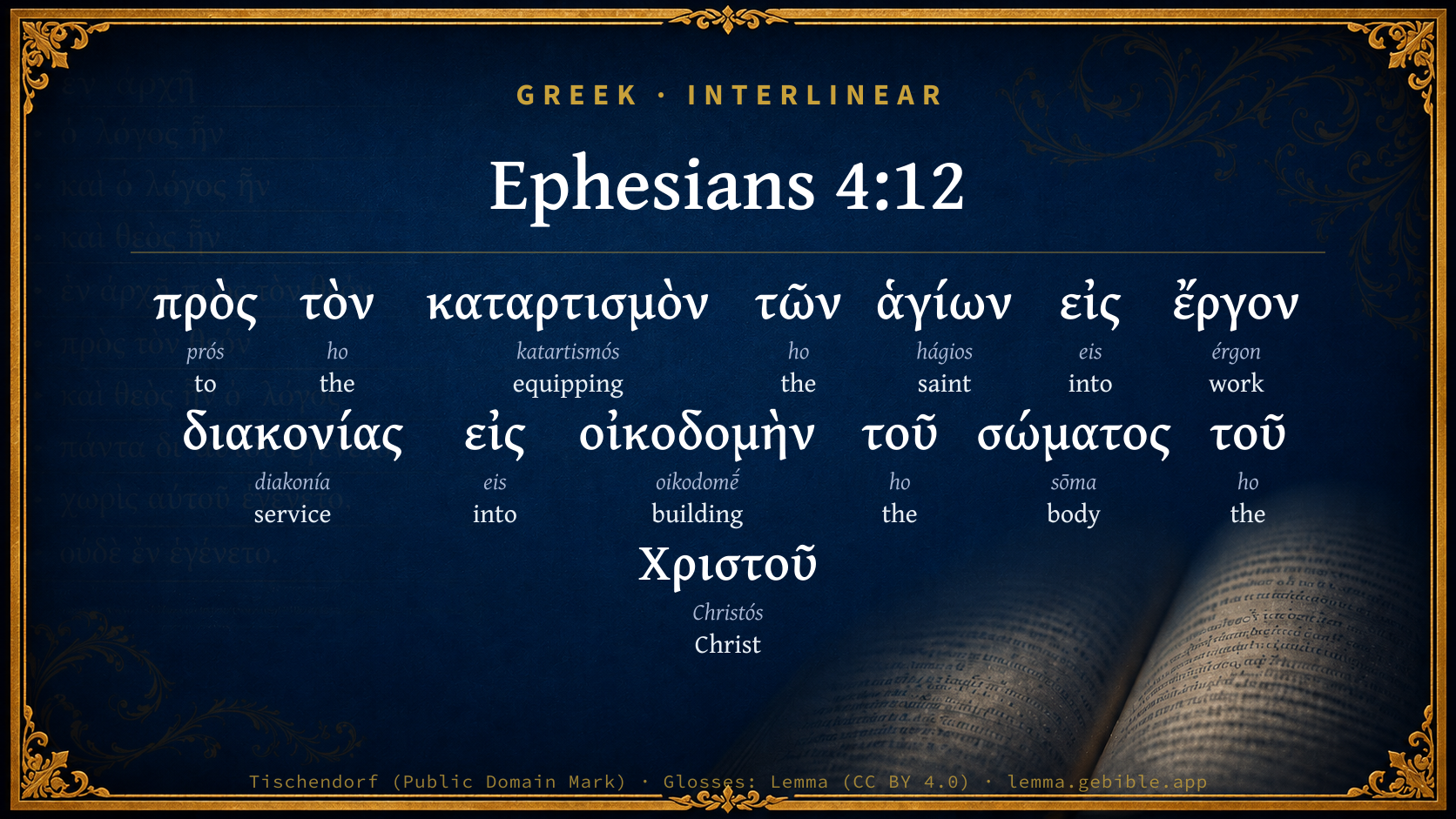
for the perfecting of the saints, to the work of serving, to the building up of the body of Christ;
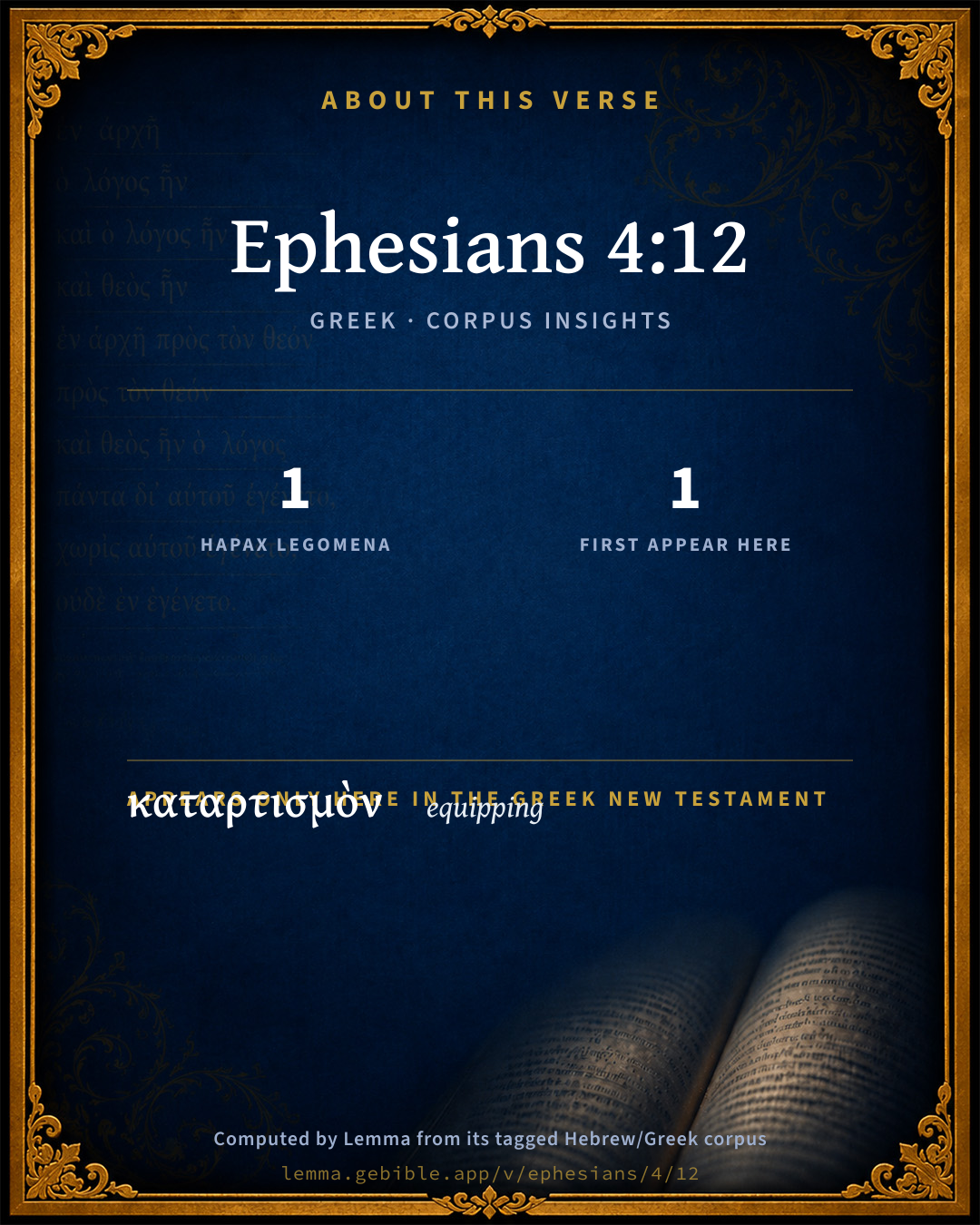
- 1 hapax legomenon — only here in the Greek New Testament
- 1 first appearance in the Greek New Testament
Download a study sheet
One document with this verse’s original text, its word-by-word gloss line, the meaning frame, cross-references with their text, attributed commentary, and full source and license credits — printable, and it pastes into notes with its structure intact.
This verse Autodidact and up
A passage Seminary Student
Up to 50 verses in one chapter. A passage sheet keeps up to 6 commentary sources and 12 cross-references per verse, in the order this page ranks them, and says so on the sheet whenever that leaves anything out. Ask for a single verse and you get the Autodidact verse sheet above.
Everything on this page stays free to read, with no account — the sheet is a download of what is already on screen, not access to it.
Compare translations 3
The same verse in 3 English versions, stacked beneath the original-language interlinear above. Click any original word for its lexicon entry.
Each is an independent rendering of the whole verse — the interlinear is not word-aligned to these translations.
Highlighted words mark where these versions differ — a whole-verse word diff, not a word-by-word alignment.
-
World English Bible Public Domain
for the perfecting of the saints, to the work of serving, to the building up of the body of Christ;
-
King James Version Public Domain
For the perfecting of the saints, for the work of the ministry, for the edifying of the body of Christ:
-
unfoldingWord Literal Text CC BY-SA 4.0
for the equipping of the saints for the work of serving, for building up of the body of Christ,
unfoldingWord Literal Text — © unfoldingWord, licensed CC BY-SA 4.0. Word-aligned USFM3 via Door43 (git.door43.org/unfoldingWord/en_ult).
Show all 19 translations
Every available English version of this verse, each an independent rendering of the whole verse.
-
World English Bible Public Domain
for the perfecting of the saints, to the work of serving, to the building up of the body of Christ;
-
Berean Standard Bible Public Domain
to equip the saints for works of ministry and to build up the body of Christ,
-
Majority Standard Bible Public Domain
to equip the saints for works of ministry and to build up the body of Christ,
-
King James Version Public Domain
For the perfecting of the saints, for the work of the ministry, for the edifying of the body of Christ:
-
American Standard Version (1901) Public Domain
for the perfecting of the saints, unto the work of ministering, unto the building up of the body of Christ:
-
Revised Version (1885) Public Domain
for the perfecting of the saints, unto the work of ministering, unto the building up of the body of Christ:
-
Geneva Bible (1599) Public Domain
For the repairing of the Saintes, for the woorke of the ministerie, and for the edification of the bodie of Christ,
-
Douay-Rheims (1899) Public Domain
For the perfecting of the saints, for the work of the ministry, for the edifying of the body of Christ:
-
Young's Literal Translation Public Domain
unto the perfecting of the saints, for a work of ministration, for a building up of the body of the Christ,
-
Literal Standard Version CC BY-SA 4.0
to the perfecting of the holy ones, for a work of ministry, for a building up of the body of the Christ,
-
Unlocked Literal Bible CC BY-SA 4.0
He gave these offices to equip the saints for the work of service, for the building up of the body of Christ.
-
unfoldingWord Literal Text CC BY-SA 4.0
for the equipping of the saints for the work of serving, for building up of the body of Christ,
-
Darby Bible Public Domain
for the perfecting of the saints; with a view to [the] work of [the] ministry, with a view to the edifying of the body of Christ;
-
World Messianic Bible Public Domain
for the perfecting of the holy ones, to the work of serving, to the building up of the body of Messiah,
-
Webster's Bible Public Domain
For the perfecting of the saints, for the work of the ministry, for the edifying of the body of Christ:
-
Free Bible Version CC BY-SA 4.0
with the purpose of preparing God's people for the work of helping others, to help the body of Christ to grow.
-
Bible in Basic English Public Domain
For the training of the saints as servants in the church, for the building up of the body of Christ:
-
Text-Critical English NT CC BY 4.0
to equip the saints for the work of ministry and to build up the body of Christ,
-
Tyndale New Testament (1534) Public Domain
that the sainctes might have all thinges necessarie to worke and minister with all to the edifyinge of the body of christ
Literal Standard Version (2020), Covenant Press — licensed CC BY-SA 4.0. Text via the HelloAO Bible API (eBible.org). Unlocked Literal Bible (unfoldingWord) — licensed CC BY-SA 4.0. Text via the HelloAO Bible API (eBible.org). unfoldingWord Literal Text — © unfoldingWord, licensed CC BY-SA 4.0. Word-aligned USFM3 via Door43 (git.door43.org/unfoldingWord/en_ult). Free Bible Version, Dr. Jonathan Gallagher — licensed CC BY-SA 4.0. Text via the HelloAO Bible API (eBible.org).
Word by word
More ways to search: Search by grammar → Find every occurrence → Compare this word →
Practice this passage: Drill this verse → Learn its vocabulary →
- Appears 1× in the Greek New Testament
- First appears here
- Part of Speech
- Noun
- Case
- Accusative
- Number
- Singular
- Gender
- Masculine
Full Thayer's Definition
- πρὸς prós G4314 “to” Preposition
- τὸν ho G3588 “the” Article, Accusative, Singular, Masculine
- καταρτισμὸν katartismós G2677 “equipping” Noun, Accusative, Singular, Masculine
- τῶν ho G3588 “the” Article, Genitive, Plural, Masculine
- ἁγίων hágios G40 “saint” Adjective, Genitive, Plural, Masculine
- εἰς eis G1519 “into” Preposition
- ἔργον érgon G2041 “work” Noun, Accusative, Singular, Neuter
- διακονίας diakonía G1248 “service” Noun, Genitive, Singular, Feminine
- εἰς eis G1519 “into” Preposition
- οἰκοδομὴν oikodomḗ G3619 “building” Noun, Accusative, Singular, Feminine
- τοῦ ho G3588 “the” Article, Genitive, Singular, Neuter
- σώματος sōma G4983 “body” Noun, Genitive, Singular, Neuter
- τοῦ ho G3588 “the” Article, Genitive, Singular, Masculine
- Χριστοῦ Christós G5547 “Christ” Noun, Genitive, Singular, Masculine
About this verse
These counts appear in no published source. They are computed here, from the morphology-tagged text and Lemma’s own curated glosses. What Lemma adds →
- 14
- words
- 10
- distinct lemmas
- Pauline Epistles
- section
Notable vocabulary
1 hapax legomenon — a word that appears only here in the entire Greek New Testament:
- καταρτισμὸν equipping G2677
First appearance in Scripture
This word makes its first canonical appearance in the Greek New Testament here:
- καταρτισμὸν equipping G2677
Shared distinctive vocabulary
οἰκοδομὴν building G3619 occurs in 18 verses of the Greek New Testament. Also found in:
Cross-references
39Topical passages linked to Ephesians 4:12 in the Treasury of Scripture Knowledge — connected by theme and wording, ordered by reader-vote popularity; previews shown in the World English Bible.
- 1 Thessalonians 5:11–14 Therefore exhort one another, and build each other up, even as you also do.
- Ephesians 4:16 from whom all the body, being fitted and knit together through that which every joint supplies, according to the working in measure of each individual part, makes the body increase to the building up of itself in love.
- 1 Corinthians 12:27 Now you are the body of Christ, and members individually.
- Romans 15:14 I myself am also persuaded about you, my brothers, that you yourselves are full of goodness, filled with all knowledge, able also to admonish others.
- Romans 14:19 So then, let us follow after things which make for peace, and things by which we may build one another up.
- 1 Corinthians 14:4–5 He who speaks in another language edifies himself, but he who prophesies edifies the assembly.
- 1 Corinthians 14:26 What is it then, brothers? When you come together, each one of you has a psalm, has a teaching, has a revelation, has another language, has an interpretation. Let all things be done to build each other up.
- 1 Corinthians 14:12 So also you, since you are zealous for spiritual gifts, seek that you may abound to the building up of the assembly.
- 1 Timothy 1:12 And I thank him who enabled me, Christ Jesus our Lord, because he counted me faithful, appointing me to service;
- Luke 22:32 but I prayed for you, that your faith wouldn't fail. You, when once you have turned again, establish your brothers."
- Acts 14:22–23 confirming the souls of the disciples, exhorting them to continue in the faith, and that through many afflictions we must enter into the Kingdom of God.
- 2 Corinthians 5:18 But all things are of God, who reconciled us to himself through Jesus Christ, and gave to us the ministry of reconciliation;
- Hebrews 6:1 Therefore leaving the doctrine of the first principles of Christ, let us press on to perfection--not laying again a foundation of repentance from dead works, of faith toward God,
- Acts 9:31 So the assemblies throughout all Judea and Galilee and Samaria had peace, and were built up. They were multiplied, walking in the fear of the Lord and in the comfort of the Holy Spirit.
- 1 Corinthians 4:1–2 So let a man think of us as Christ's servants, and stewards of God's mysteries.
- 2 Corinthians 4:1 Therefore seeing we have this ministry, even as we obtained mercy, we don't faint.
- 2 Corinthians 6:3 We give no occasion of stumbling in anything, that our service may not be blamed,
- Colossians 1:28 whom we proclaim, admonishing every man and teaching every man in all wisdom, that we may present every man perfect in Christ Jesus;
- Hebrews 13:17 Obey your leaders and submit to them, for they watch on behalf of your souls, as those who will give account, that they may do this with joy, and not with groaning, for that would be unprofitable for you.
- John 21:15–17 So when they had eaten their breakfast, Jesus said to Simon Peter, "Simon, son of Jonah, do you love me more than these?" He said to him, "Yes, Lord; you know that I have affection for you." He said to him, "Feed my lambs."
- Acts 11:23 who, when he had come, and had seen the grace of God, was glad. He exhorted them all, that with purpose of heart they should remain near to the Lord.
- Acts 20:24 But these things don't count; nor do I hold my life dear to myself, so that I may finish my race with joy, and the ministry which I received from the Lord Jesus, to fully testify to the Gospel of the grace of God.
- Acts 20:28 Take heed, therefore, to yourselves, and to all the flock, in which the Holy Spirit has made you overseers, to shepherd the assembly of the Lord and God which he purchased with his own blood.
- Romans 12:7 or service, let us give ourselves to service; or he who teaches, to his teaching;
- Romans 15:2 Let each one of us please his neighbor for that which is good, to be building him up.
- Romans 15:29 I know that, when I come to you, I will come in the fullness of the blessing of the Gospel of Christ.
- 1 Corinthians 12:7 But to each one is given the manifestation of the Spirit for the profit of all.
- 1 Corinthians 14:14 For if I pray in another language, my spirit prays, but my understanding is unfruitful.
- 2 Corinthians 3:8 won't service of the Spirit be with much more glory?
- 2 Corinthians 7:1 Having therefore these promises, beloved, let us cleanse ourselves from all defilement of flesh and spirit, perfecting holiness in the fear of God.
- 2 Corinthians 12:19 Again, do you think that we are excusing ourselves to you? In the sight of God we speak in Christ. But all things, beloved, are for your edifying.
- Acts 1:17 For he was numbered with us, and received his portion in this ministry.
- Acts 1:25 to take part in this ministry and apostleship from which Judas fell away, that he might go to his own place."
- Ephesians 1:23 which is his body, the fullness of him who fills all in all.
- Philippians 1:25–26 Having this confidence, I know that I will remain, yes, and remain with you all, for your progress and joy in the faith,
- Philippians 3:12–18 Not that I have already obtained, or am already made perfect; but I press on, if it is so that I may take hold of that for which also I was taken hold of by Christ Jesus.
- Colossians 1:24 Now I rejoice in my sufferings for your sake, and fill up on my part that which is lacking of the afflictions of Christ in my flesh for his body's sake, which is the assembly;
- Colossians 4:17 Tell Archippus, "Take heed to the ministry which you have received in the Lord, that you fulfill it."
- 2 Timothy 4:5 But you be sober in all things, suffer hardship, do the work of an evangelist, and fulfill your ministry.
Cross-references courtesy of OpenBible.info (CC BY 4.0).
Lesson kit
Teaching starters — assembled from the data on this page, not authored interpretation. Every prompt links to the verse data it draws on. Edit before teaching.
Ephesians, in the Pauline Epistles, opens this verse with 14 words (10 distinct Greek lemmas). Its most distinctive word is katartismós (“equipping”). A historical commentator’s framing appears above. Read the whole chapter for the surrounding context.
Discussion questions
- How does “equipping” (katartismós) shape what this verse is saying?
- 1 word here appears nowhere else in the Greek New Testament. Why might the author reach for such rare wording?
- This is the first place “equipping” appears in Scripture (first appears here). What does its debut here establish?
- How does Matthew 24:1, which shares the word «building», read alongside this verse?
- What does the repetition of “into” (2× in this one verse) do in this verse?
- These translations render this verse differently. What is at stake in choosing one wording over another?
- Compare how The Biblical Illustrator and Joseph Benson's Commentary read this verse. Where do they agree or differ?
Things to notice
- 1 word in this verse appears nowhere else in the Greek New Testament.
- 1 word makes its first canonical appearance in Scripture here.
- These translations choose different wording for 7 words in this verse.
- “into” occurs 2× in this single verse.
- 10 distinct Greek lemmas span 14 words in this verse.
Commentary
Notes on Ephesians 4:12 from classic Christian and Jewish commentators (each source and its license shown beneath its notes). The classic Christian expositions comment on the surrounding passage and are grouped to its opening verse, so a note may address several verses; the Jewish commentaries on the Tanakh (Rashi and others) are per-verse, so they appear only where the commentator wrote on this verse.
Lemma curates 59 commentaries, every one of them public domain or Creative Commons licensed, each selected and text-cleaned for this edition rather than reprinted as found. About our sources →
The Biblical Illustrator
Joseph S. Exell
The Biblical Illustrator, edited by Joseph S. Exell (c. 1880s–1900s) — public domain. Text from a community e-Sword module.
Joseph Benson's Commentary
Joseph Benson's Commentary on the Old and New Testaments (1811–1818) — public domain. Text from a community e-Sword module.
Whedon's Commentary on the Bible
Daniel D. Whedon
Daniel D. Whedon (gen. ed.), Commentary on the Old and New Testaments (1874–1909) — public domain. Text from a community e-Sword module.
Tyndale Open Study Notes
Tyndale Open Resources
Tyndale Open Study Notes — © Tyndale Open Resources, licensed CC BY-SA 4.0. Text via the HelloAO Bible API.
Bengel's Gnomon
Johann Albrecht Bengel
Bengel's Gnomon of the New Testament — English translation (T&T Clark, Edinburgh, 1860) — public domain. Text from a community e-Sword module.
Meyer's Critical & Exegetical Commentary
Heinrich August Wilhelm Meyer
Meyer — Critical and Exegetical Commentary on the New Testament — English translation by Peter Christie, edited by Frederick Crombie (T&T Clark, 1880) — public domain. Text from a community e-Sword module.
Expositor's Greek Testament
ed. W. Robertson Nicoll
The Expositor's Greek Testament, edited by W. Robertson Nicoll (1897–1910) — public domain. Text from a community e-Sword module.
Hodge's Commentary on Romans, Ephesians & First Corinthians
Charles Hodge
Charles Hodge — Commentary on Romans (1835), First Corinthians (1857), and Ephesians (1856) — public domain. Text from a community e-Sword module.
Geneva Bible (1599)
Geneva Bible translators
Geneva Bible (1599) marginal notes — public domain. Text via Bolls.life.
Jamieson, Fausset & Brown
Robert Jamieson, A. R. Fausset & David Brown
Jamieson, Fausset & Brown — Commentary Critical and Explanatory on the Whole Bible (1871) — public domain (CC PDM 1.0). Text via the HelloAO Bible API.
Adam Clarke's Commentary
Adam Clarke's Commentary on the Bible (1810–1826) — public domain. Text from a community e-Sword/MySword module.
John Calvin's Commentaries
John Calvin's Commentaries (1540-1563) — public domain. Text from the Calvin Translation Society English edition (1840s-50s) via the Christian Classics Ethereal Library (ccel.org). Calvin's coverage is partial (roughly two-thirds of the Bible); uncommented books and verses are honest gaps, never fabricated. The 19th-century editor's footnotes and remarks are omitted so the notes are faithfully Calvin's own voice.
Ellicott's Commentary for English Readers
A Bible Commentary for English Readers, edited by Charles John Ellicott (1878–1897) — public domain. Text from a community e-Sword module.
The Cambridge Bible for Schools and Colleges
gen. ed. J. J. S. Perowne
The Cambridge Bible for Schools and Colleges (gen. ed. J. J. S. Perowne; Cambridge University Press, 1878–1918) — public domain. Text from a community e-Sword module.
John Gill's Exposition
John Gill's Exposition of the Whole Bible (1746–1763) — public domain (CC PDM 1.0). Text via the HelloAO Bible API.
Trapp's Complete Commentary
John Trapp
John Trapp, A Commentary or Exposition upon All the Books of the Old and New Testament (1647–1656) — public domain. Text from a community e-Sword module.
Albert Barnes' Notes on the Bible
Albert Barnes' Notes on the Bible (1834–1885) — public domain. Text from a community e-Sword/MySword module.
Matthew Poole's English Annotations
Matthew Poole's English Annotations on the Holy Bible (1683–1685) — public domain. Text from a community e-Sword/MySword module.
The Pulpit Commentary
The Pulpit Commentary (1880–1919), ed. H.D.M. Spence-Jones & Joseph S. Exell — public domain. Text from a community e-Sword module.
John Wesley's Explanatory Notes
John Wesley, Explanatory Notes Upon the Whole Bible (1754–1765) — public domain. Text via the GEBible commentary corpus.
Scofield Reference Notes
C. I. Scofield
The Scofield Reference Bible (1917 edition), notes by C. I. Scofield — public domain. Text from a community e-Sword module.
The People's New Testament
B. W. Johnson
B. W. Johnson's The People's New Testament with Notes (1889–1891) — public domain. Electronic text from the Christian Classics Ethereal Library (CCEL) ThML edition.
Cambridge Greek Testament for Schools and Colleges
Cambridge Greek Testament for Schools and Colleges (Cambridge University Press, 1896; 21 vols, various authors incl. Carr, Maclear, Plummer, Farrar, Lumby, Moule, M. R. James, Simcox) — public domain. Text from a community e-Sword module.
International Critical Commentary
International Critical Commentary — older volumes (1896–1929), various authors — public domain. Text from a community e-Sword module.
Vincent's Word Studies in the New Testament
Marvin R. Vincent
Marvin R. Vincent, Word Studies in the New Testament (1887–1900) — public domain. Text from a community e-Sword/MySword module.