Romans 14:17

Greek (Tischendorf 8th ed.) Romans 14:17 appears in the Greek New Testament. The text above is from the Tischendorf 8th edition. Each word links to its Strong’s number and a concise gloss. Click any word for its full Thayer’s Greek Lexicon entry.
Download image
Cite this verse

Romans 14:17 (World English Bible). Public Domain. Lemma interlinear Bible study tool, https://lemma.gebible.app/v/romans/14/17.

Show BibTeX & RIS
BibTeX
RIS
English Translation
for the Kingdom of God is not eating and drinking, but righteousness, peace, and joy in the Holy Spirit.
World English Bible · Public Domain
Download a study sheet

One document with this verse’s original text, its word-by-word gloss line, the meaning frame, cross-references with their text, attributed commentary, and full source and license credits — printable, and it pastes into notes with its structure intact.

This verse Autodidact and up

Study sheet (.html) Plain text (.txt)

A passage Seminary Student

Up to 50 verses in one chapter. A passage sheet keeps up to 6 commentary sources and 12 cross-references per verse, in the order this page ranks them, and says so on the sheet whenever that leaves anything out. Ask for a single verse and you get the Autodidact verse sheet above.

Everything on this page stays free to read, with no account — the sheet is a download of what is already on screen, not access to it.

Want to remove ads? Support Godless Engineer
Compare translations 3

The same verse in 3 English versions, stacked beneath the original-language interlinear above. Click any original word for its lexicon entry.

Each is an independent rendering of the whole verse — the interlinear is not word-aligned to these translations.

Highlighted words mark where these versions differ — a whole-verse word diff, not a word-by-word alignment.

  • World English Bible Public Domain
    for the Kingdom of God is not eating and drinking, but righteousness, peace, and joy in the Holy Spirit.
  • King James Version Public Domain
    For the kingdom of God is not meat and drink; but righteousness, and peace, and joy in the Holy Ghost.
  • unfoldingWord Literal Text CC BY-SA 4.0
    For the kingdom of God is not food and drink, but righteousness and peace and joy in the Holy Spirit.

unfoldingWord Literal Text — © unfoldingWord, licensed CC BY-SA 4.0. Word-aligned USFM3 via Door43 (git.door43.org/unfoldingWord/en_ult).

Versions to compare (up to 4)

3 of 4 selected

Show all 19 translations

Every available English version of this verse, each an independent rendering of the whole verse.

  • World English Bible Public Domain
    for the Kingdom of God is not eating and drinking, but righteousness, peace, and joy in the Holy Spirit.
  • Berean Standard Bible Public Domain
    For the kingdom of God is not a matter of eating and drinking, but of righteousness, peace, and joy in the Holy Spirit.
  • Majority Standard Bible Public Domain
    For the kingdom of God is not a matter of eating and drinking, but of righteousness, peace, and joy in the Holy Spirit.
  • King James Version Public Domain
    For the kingdom of God is not meat and drink; but righteousness, and peace, and joy in the Holy Ghost.
  • American Standard Version (1901) Public Domain
    for the kingdom of God is not eating and drinking, but righteousness and peace and joy in the Holy Spirit.
  • Revised Version (1885) Public Domain
    for the kingdom of God is not eating and drinking, but righteousness and peace and joy in the Holy Ghost.
  • Geneva Bible (1599) Public Domain
    For the kingdome of God, is not meate nor drinke, but righteousnes, and peace, and ioye in the holy Ghost.
  • Douay-Rheims (1899) Public Domain
    For the kingdom of God is not meat and drink; but justice, and peace, and joy in the Holy Ghost.
  • Young's Literal Translation Public Domain
    for the reign of God is not eating and drinking, but righteousness, and peace, and joy in the Holy Spirit;
  • Literal Standard Version CC BY-SA 4.0
    for the Kingdom of God is not eating and drinking, but righteousness, and peace, and joy in the Holy Spirit;
  • Unlocked Literal Bible CC BY-SA 4.0
    For the kingdom of God is not about food and drink, but about righteousness, peace, and joy in the Holy Spirit.
  • unfoldingWord Literal Text CC BY-SA 4.0
    For the kingdom of God is not food and drink, but righteousness and peace and joy in the Holy Spirit.
  • Darby Bible Public Domain
    for the kingdom of God is not eating and drinking, but righteousness, and peace, and joy in [the] Holy Spirit.
  • World Messianic Bible Public Domain
    for God’s Kingdom is not eating and drinking, but righteousness, peace, and joy in the Holy Spirit.
  • Webster's Bible Public Domain
    For the kingdom of God is not food and drink, but righteousness, and peace, and joy in the Holy Spirit.
  • Free Bible Version CC BY-SA 4.0
    for God's kingdom is not about eating and drinking, but about living right, having peace and joy in the Holy Spirit.
  • Bible in Basic English Public Domain
    For the kingdom of God is not food and drink, but righteousness and peace and joy in the Holy Spirit.
  • Text-Critical English NT CC BY 4.0
    For the kingdom of God is not a matter of eating and drinking, but of righteousness, peace, and joy in the Holy Spirit.
  • Tyndale New Testament (1534) Public Domain
    For the kyngdome of God is not meate and drinke: but rightewesnes peace and ioye in the holy goost.

Literal Standard Version (2020), Covenant Press — licensed CC BY-SA 4.0. Text via the HelloAO Bible API (eBible.org). Unlocked Literal Bible (unfoldingWord) — licensed CC BY-SA 4.0. Text via the HelloAO Bible API (eBible.org). unfoldingWord Literal Text — © unfoldingWord, licensed CC BY-SA 4.0. Word-aligned USFM3 via Door43 (git.door43.org/unfoldingWord/en_ult). Free Bible Version, Dr. Jonathan Gallagher — licensed CC BY-SA 4.0. Text via the HelloAO Bible API (eBible.org).

Word by word

More ways to search: Search by grammar → Find every occurrence → Compare this word →

Practice this passage: Drill this verse → Learn its vocabulary →

πόσις
pósis
G4213
“drink”
Noun, Nominative, Singular, Feminine
Part of Speech
Noun
Case
Nominative
Number
Singular
Gender
Feminine
Full Thayer's Definition

Origin: from the alternate of G4095

TDNT: 08:25,8

1. a drinking, drink
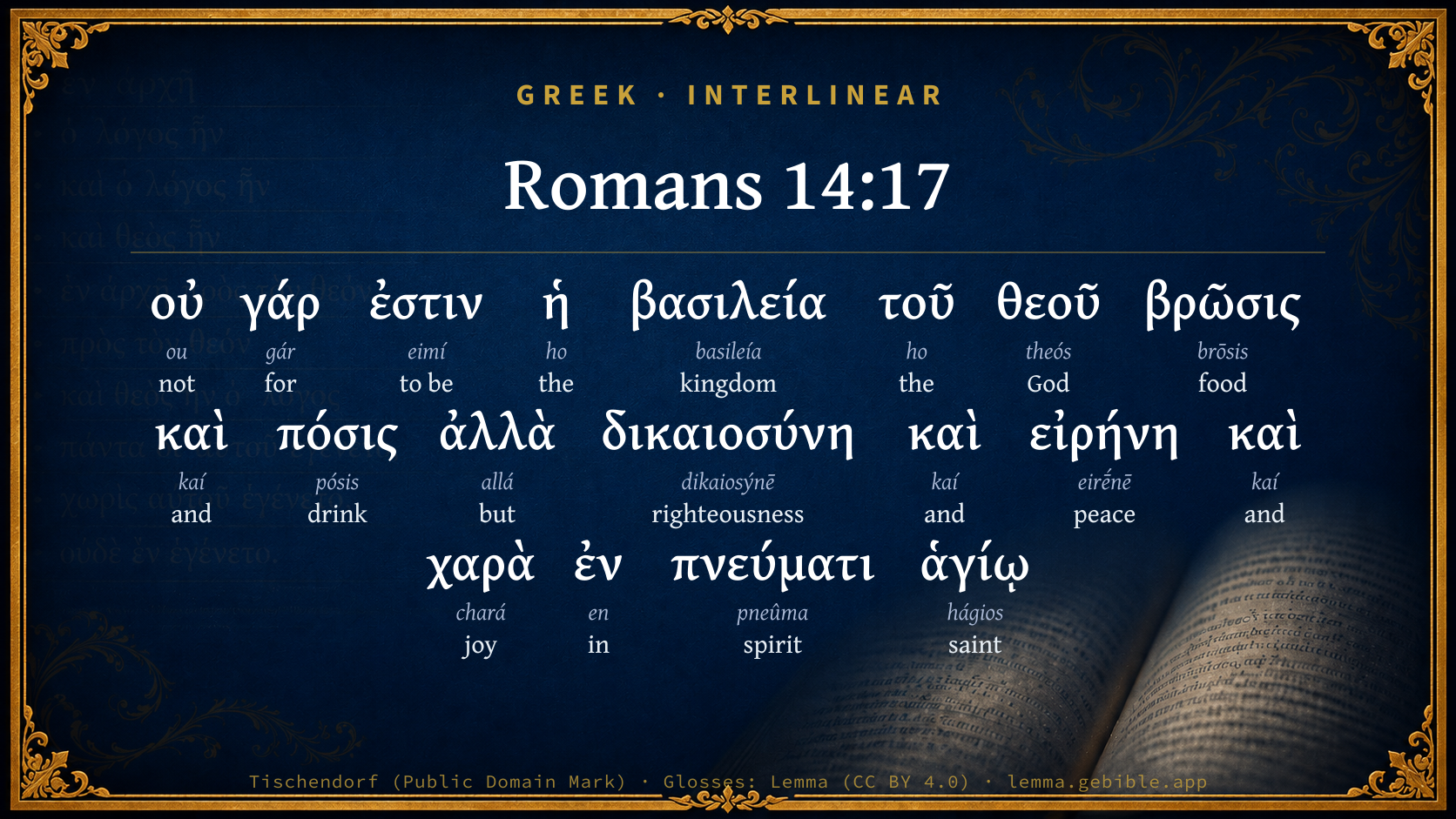
  1. οὐ ou G3756 “not” Particle, Negative
  2. γάρ gár G1063 “for” Conjunction
  3. ἐστιν eimí G1510 “to be” Verb, Present, Active, Indicative, 3rd person, Singular
  4. ἡ ho G3588 “the” Article, Nominative, Singular, Feminine
  5. βασιλεία basileía G932 “kingdom” Noun, Nominative, Singular, Feminine
  6. τοῦ ho G3588 “the” Article, Genitive, Singular, Masculine
  7. θεοῦ theós G2316 “God” Noun, Genitive, Singular, Masculine
  8. βρῶσις brōsis G1035 “food” Noun, Nominative, Singular, Feminine
  9. καὶ kaí G2532 “and” Conjunction
  10. ἀλλὰ allá G235 “but” Conjunction
  11. δικαιοσύνη dikaiosýnē G1343 “righteousness” Noun, Nominative, Singular, Feminine
  12. καὶ kaí G2532 “and” Conjunction
  13. εἰρήνη eirḗnē G1515 “peace” Noun, Nominative, Singular, Feminine
  14. καὶ kaí G2532 “and” Conjunction
  15. χαρὰ chará G5479 “joy” Noun, Nominative, Singular, Feminine
  16. ἐν en G1722 “in” Preposition
  17. πνεύματι pneûma G4151 “spirit” Noun, Dative, Singular, Neuter
  18. ἁγίῳ hágios G40 “saint” Adjective, Dative, Singular, Neuter

About this verse

These counts appear in no published source. They are computed here, from the morphology-tagged text and Lemma’s own curated glosses. What Lemma adds →

19
words
16
distinct lemmas
Pauline Epistles
section

Notable vocabulary

The rarest word here is πόσις drink G4213 — appearing just 3 times in the whole Greek New Testament.

Shared distinctive vocabulary

πόσις drink G4213 occurs in 3 verses of the Greek New Testament. Also found in:

Repetition

Words recur within this verse:

Cross-references

37

Topical passages linked to Romans 14:17 in the Treasury of Scripture Knowledge — connected by theme and wording, ordered by reader-vote popularity; previews shown in the World English Bible.

  • Matthew 6:33 But seek first God's Kingdom, and his righteousness; and all these things will be given to you as well.
  • Romans 15:13 Now may the God of hope fill you with all joy and peace in believing, that you may abound in hope, in the power of the Holy Spirit.
  • 1 Corinthians 4:20 For the Kingdom of God is not in word, but in power.
  • 1 Corinthians 8:8 But food will not commend us to God. For neither, if we don't eat, are we the worse; nor, if we eat, are we the better.
  • Galatians 5:22 But the fruit of the Spirit is love, joy, peace, patience, kindness, goodness, faithfulness,
  • Romans 8:6 For the mind of the flesh is death, but the mind of the Spirit is life and peace;
  • 1 Thessalonians 2:12 to the end that you should walk worthily of God, who calls you into his own Kingdom and glory.
  • Daniel 2:44 In the days of those kings shall the God of heaven set up a kingdom which shall never be destroyed, nor shall the sovereignty of it be left to another people; but it shall break in pieces and consume all these kingdoms, and it shall stand forever.
  • John 3:3 Jesus answered him, "Most assuredly, I tell you, unless one is born anew, he can't see the Kingdom of God."
  • Philippians 3:9 and be found in him, not having a righteousness of my own, that which is of the law, but that which is through faith in Christ, the righteousness which is from God by faith;
  • Luke 17:20–21 Being asked by the Pharisees when the Kingdom of God would come, he answered them, "The Kingdom of God doesn't come with observation;
  • 1 Corinthians 6:9 Or don't you know that the unrighteous will not inherit the Kingdom of God? Don't be deceived. Neither the sexually immoral, nor idolaters, nor adulterers, nor male prostitutes, nor homosexuals,
  • Acts 13:52 The disciples were filled with joy with the Holy Spirit.
  • Isaiah 61:3 to appoint to those who mourn in Zion, to give to them a garland for ashes, the oil of joy for mourning, the garment of praise for the spirit of heaviness; that they may be called trees of righteousness, the planting of Yahweh, that he may be glorified.
  • Philippians 4:7 And the peace of God, which surpasses all understanding, will guard your hearts and your thoughts in Christ Jesus.
  • Romans 5:1–5 Being therefore justified by faith, we have peace with God through our Lord Jesus Christ;
  • John 3:5 Jesus answered, "Most assuredly I tell you, unless one is born of water and spirit, he can't enter into the Kingdom of God!
  • Matthew 3:2 "Repent, for the Kingdom of Heaven is at hand!"
  • Colossians 2:16–17 Let no man therefore judge you in eating, or in drinking, or with respect to a feast day or a new moon or a Sabbath day,
  • 2 Corinthians 5:21 For him who knew no sin he made to be sin on our behalf; so that in him we might become the righteousness of God.
  • Jeremiah 23:5–6 Behold, the days come, says Yahweh, that I will raise to David a righteous Branch, and he shall reign as king and deal wisely, and shall execute justice and righteousness in the land.
  • Philippians 4:4 Rejoice in the Lord always! Again I will say, Rejoice!
  • Colossians 1:11 strengthened with all power, according to the might of his glory, for all endurance and perseverance with joy;
  • John 16:33 I have told you these things, that in me you may have peace. In the world you have oppression; but cheer up! I have overcome the world."
  • Acts 9:31 So the assemblies throughout all Judea and Galilee and Samaria had peace, and were built up. They were multiplied, walking in the fear of the Lord and in the comfort of the Holy Spirit.
  • 1 Corinthians 1:30 But of him, you are in Christ Jesus, who was made to us wisdom from God, and righteousness and sanctification, and redemption:
  • Philippians 2:1 If there is therefore any exhortation in Christ, if any consolation of love, if any fellowship of the Spirit, if any tender mercies and compassion,
  • Philippians 3:3 For we are the circumcision, who worship God in the Spirit, and rejoice in Christ Jesus, and have no confidence in the flesh;
  • 1 Peter 1:8 whom not having known you love; in whom, though now you don't see him, yet believing, you rejoice greatly with joy unspeakable and full of glory--
  • Isaiah 55:12 For you shall go out with joy, and be led forth with peace: the mountains and the hills shall break forth before you into singing; and all the trees of the fields shall clap their hands.
  • 1 Thessalonians 1:6 You became imitators of us, and of the Lord, having received the word in much affliction, with joy of the Holy Spirit,
  • Hebrews 13:9 Don't be carried away by various and strange teachings, for it is good that the heart be established by grace, not by food, through which those who were so occupied were not benefited.
  • Isaiah 45:24 Only in Yahweh, it is said of me, is righteousness and strength; even to him shall men come; and all those who were incensed against him shall be disappointed.
  • Luke 14:15 When one of those who sat at the table with him heard these things, he said to him, "Blessed is he who will feast in the Kingdom of God!"
  • Romans 8:15–16 For you didn't receive the spirit of bondage again to fear, but you received the Spirit of adoption, by whom we cry, "Abba! Father!"
  • Daniel 9:24 Seventy weeks are decreed on your people and on your holy city, to finish disobedience, and to make an end of sins, and to make reconciliation for iniquity, and to bring in everlasting righteousness, and to seal up vision and prophecy, and to anoint the most holy.
  • 2 Peter 1:1 Simon Peter, a servant and apostle of Jesus Christ, to those who have obtained a like precious faith with us in the righteousness of our God and Savior, Jesus Christ:

Cross-references courtesy of OpenBible.info (CC BY 4.0).

Commentary

Notes on Romans 14:17 from classic Christian and Jewish commentators (each source and its license shown beneath its notes). The classic Christian expositions comment on the surrounding passage and are grouped to its opening verse, so a note may address several verses; the Jewish commentaries on the Tanakh (Rashi and others) are per-verse, so they appear only where the commentator wrote on this verse.

Lemma curates 59 commentaries, every one of them public domain or Creative Commons licensed, each selected and text-cleaned for this edition rather than reprinted as found. About our sources →

The Biblical Illustrator

Joseph S. Exell

Rom_14:17-18

For the kingdom of God is not meat and drink.

Gods kingdom

I. The description given of the kingdom of God.

1. The import of the term. Christs spiritual kingdom established on earth--His dominion over His redeemed people, having its seat in the soul, and extending over the entire life. This is a kingdom totally diverse from all others--one not in word or mere outward form, but in soul-subduing, life-transforming power, one that ultimately brings every thought into harmony with Christs holy mind and will.

2. Its peculiar characteristics.

(1) Negatively. It is not meat or drink, i.e., it does not consist in the observance of distinctions between different kinds of food and drink, or in any merely external forms.

(2) Positively. It is--

(a) Holy conformity to God--righteousness.

(b) A mild and gentle demeanour--peace.

(c) Spiritual gladness of heart--joy.

(d) The presence and power of the Holy Spirit as producing all these.

II. The character of the true spiritual service of Christ (Rom_14:18). Observe--

1. The indispensable requisites of Christs service. In order to serve Christ, we must possess and manifest righteousness, and peace and joy, through the power of the Spirit of God. For these things there is, there can be, no substitute. Without that, however great your knowledge and profession and zeal may be, your service is a vain oblation.

2. In what respect Christ is served by these things.

(1) His authority as a Master is acknowledged. Christ has expressly enjoined these things on all His followers.

(a) Be ye therefore perfect.

(b) Learn of Me, for I am meek and lowly in heart.

(c) Ask and ye shall receive, that your joy may be full.

(2) His power as a Saviour is made manifest. These are not the natural product of the human heart. The Lord Jesus is their alone Fountainspring.

(3) His example as a forerunner is imitated. Was not His an example of righteousness, peace, and joy?

(4) Witness is borne to the nature and design of His gospel. Serving Christ in these things, we declare plainly to the world, in a way they can far better understand than by any verbal statement, what Christ has come to do in and for man!

III. The blessed result of that service. There will be--

1. Divine acceptance. The ground of a guilty sinners acceptance before God is exclusively Christs finished work; but our text speaks not of that acceptance, but of the believers acceptance of his Heavenly Father. Gods complacency and delight in a holy life.

2. Human approval. Such a life as that delineated in our text cannot but commend itself even to the world. It is, however, only men of God who can, in the fullest sense of the word, appreciate it. (P. Morison.)

The kingdom of God

consists in--

1. Righteousness in respect to God.

2. Peace with respect to others.

3. Joy in respect to yourself. (T. Robinson, D.D.)

The kingdom of God

A peasant boy was asked, What is the kingdom of God? He paused, and with an expression of seriousness and devotion which I shall never forget, placing his hand on his bosom, he said, It is something here! and then raising his eyes, he added, and something up yonder. (J. Leifchild, D.D.)

The constitution of the kingdom of God

I. Not--

1. Abstinence from earthly pleasure.

2. Observance of external forms.

3. The adoption of a religious deportment.

4. Zeal for orthodoxy.

II. But--

1. Righteousness in faith and life.

2. Peace with God and man.

3. Joy in sorrow and reproach. (J. Lyth, D.D.)

Distinguishing marks of the kingdom of God

Every kingdom is renowned for some distinctive feature. Rome was conspicuous for its warlike propensities. The Grecian States were celebrated for their love of the fine arts. France is eminent for its taste. The American States are famous for their enterprise. But the distinguishing mark of the kingdom of God is righteousness, and peace, and joy in the Holy Ghost.

The inward and spiritual character of the kingdom of God

I. In its privileges. As some painters can produce a striking likeness by a few clear though rapid strokes of the pencil, so is it with this beautiful sketch of the new man.

1. The first lineament is righteousness. By this must be meant an entire justification and freedom from every charge and condemnation which sin might urge, and which Gods broken commands might pass upon the Christian. This is the choicest mercy in the catalogue of mercies. It is--

(1) An enriching mercy, entitling to every good.

(2) A most voluminous mercy, in which there is more than can be counted or imagined.

2. Peace is another lineament. Pardoning love hath subdued enmity against God. Peace hath been made by the blood of the Cross. This is one of the most gracious, as it is one of the most blessed, fruits of the Spirit.

3. Joy. It is the privilege of Gods children to rejoice, as the distinguished objects of His adopting love. And, surely, when the Spirit bears witness with the Christians spirit that he is a child of God, he hath the elements and materials for a holy joy, which the world, with all its pleasures, can never give, and which, with all its enmity, it is impotent to take away.

II. Is its duties.

1. It is righteousness in the Holy Ghost. Not only is the satisfaction of Christs perfect merit imputed to the soul, but the work of his sanctification by the Holy Ghost, making the believer one with Him, is commenced within the heart. Then will conscience be made of every duty towards God and man. Faith is in the soul, as lightning in the air, which purifies; as fire in the metal, which refines. The heart, which heretofore was the thoroughfare of Satan, becomes the enclosure of God.

2. Peace also is a duty to the subjects of the Great Salem; and as wars and fightings come of the lusts of men, so will the disciples of Jesus be self-denying men, in order that they may dwell in peace with Him and with each other.

3. And how shall the Christian manifest his joy as a duty? Even by the holy delight which he takes in that service which is perfect freedom. (R. P. Buddicom, M.A.)

The spirituality of the kingdom of God

These words do not infer that we may eat and drink as we please; the very opposite is implied, namely, that whether we eat or drink, righteousness, peace, and joy in the Holy Ghost should determine our spirit and conduct. The doctrine is, that the kingdom of God is not founded on things outward, or any artificial arrangement of these; but on the absolute difference between right and wrong, happiness and misery; and that, accordingly, its design is to establish virtuous dispositions and holy joys. This doctrine is manifestly in direct antagonism to the tendency at Rome to indulge in disputation about the obligation of existing customs, and needs to be taught in the present day. There is a very general disregard of the spirituality of Christs kingdom, and of the sufficiency of its truths to meet the wants of man. To make the tree good, that its fruit may be good, is a process far too slow and undemonstrative for this enterprising age. Accordingly, we are overwhelmed with improvements, reforms, schemes, societies, and movements, to effect a speedy and decided change. Note--

I. The design of the kingdom--viz., the diffusion of righteousness, peace, and joy.

1. Societies are formed with a leading object in view. Zeal for that object is the distinguishing mark of the members of each society. Diversity of taste and opinion is tolerated so long as it does not interfere with the interests to be promoted. There are religious communities of whose institutions distinctions of meat and drink form an essential part. Such is the general character of Hindooism and Mohammedanism. Such was the general character of Pharisaism. John the Baptist adopted similar means of distinction; he came neither eating nor drinking, nor clothing himself like other men. But Christ, instead of building up such walls of partition, removed them, and strove, by the example of loving, familiar intercourse, to overcome deep-rooted antipathies. Henceforward, righteousness, peace, and joy, are to be the distinguishing tokens of His subjects--not any style of living or appearance peculiar to them as members of a community.

2. Tried by this test, Romanism, and all imitations of it, must stand condemned; but let us apply it to ourselves as members of a Church claiming to be scriptural. We belong to different grades of society, and have different tastes and habits, Hence there is no small risk of uncharitable judgments. Simple tastes and manners to some appear little short of barbarous, and refined tastes and manners to others voluptuous and worldly. How uncalled for these insinuations! To any disposed to make much of outward distinctions, we must ask--

(1) What of righteousness? Is not the first thing desirable--a heart right with God?

(2) What of peace? Is not peace Christs great legacy to His disciples? and peacemaking the duty He has blessed, as peculiarly that of the children of God?

(3) What of joy? Is it not the will of God that we should rise above anxiety and discontent, to grateful, hopeful joy? Murmuring about ourselves or our fellow-Christians is neither right nor profitable.

(4) What of Divine grace as the source of all spiritual excellence? God the Holy Ghost is not to be limited by mans prescription of meats and drinks, days and times, dress and postures.

II. The fitness of the design.

1. It accords with the extent of the kingdom. God, as the rightful sovereign of all men everywhere, commands them to return to their allegiance. The kingdom must therefore include men of all nations. How great the diversity of conditions of existence! And in His wisdom and love God has provided a system adapted to all these conditions. A religion eminently spiritual and practical, having very few and simple ordinances of worship, Christianity belongs specially to no clime, grade, or class.

2. It accords with the number and variety of the enemies to be overcome. Confessedly there is a great deal of irreligion and vice in the world; and no religion is worthy of the name that does not engage its adherents to a course of resolute opposition to these evils. But there is a great deal of sin and misery where these evils are neither seen nor heard. Seemly forms of religion and correct moral deportment have not been sufficient to satisfy the heart and purify the conscience. Churches have been rent, homes made desolate, and hearts broken, by men touching the righteousness which is of the law blameless. We do not need more fasts, zeal for traditions and customs; we need a religion that will strike at the root of all the evil in our nature. This religion we find in Christianity, which obliges us to follow after righteousness, peace, and joy.

3. It accords with the attributes of God; for there is blasphemy in the very supposition that the Divine Being can be satisfied with a religion chiefly ceremonial or outwardly correct. He is a Spirit; and they that worship Him must worship in spirit and in truth.

4. It accords with the character of Christ. How strange that His name should have been given to such systems as have borne it! So far from patronising externalism, He exposed Himself to the wrath of the Ritualists of that day; so far from affecting peculiarity of living, He exposed Himself to the calumny that He was a gluttonous man and a winebibber. Everywhere and always He proclaimed the necessity of a righteousness exceeding that of the scribes and Pharisees. Were He this day amongst us, no word of sympathy would be heard from Him with those who compass sea and land to make one proselyte, and only succeed in perverting his better nature. His sympathy would be with those who assert their freedom from the commandments of men, and who joyfully own their obligation to love and obey their Father which is in heaven.

5. It accords with the destiny of all true subjects of the kingdom. There must be a meetness, as well as a title, belonging to all the heirs of glory. A training of the soul in righteousness, peace, and joy, we can well believe to bring about a meetness for the society of the spirits of the just made perfect; but we are at a loss to conceive how a round of forms and ceremonies, or a careful conformity to usages and example, in matters wholly of this world and of this body, can constitute any such preparation. (W. Limont.)

The kingdom of God is a soul-kingdom

Why was it called a kingdom at all? Well, since a mans disposition is the fountain from which all his enjoyments that are worth having spring in this world, the condition of the soul becomes a kingdom in the sense that it represents to men the idea of felicity. The old notions were that a king was about the happiest man on earth. Hence the phrase, Happy as a king. Therefore in the description of the disposition, which is the soul-kingdom, it is called a kings dominion, or a king-dora. But there is a more important reason--namely, that a king in his kingdom dominates, controls, governs. It is the disposition of men, their character, that controls. Their enjoyment, all their life, depends upon what they are in themselves, and inside of themselves. If a mans soul is one that works itself out in righteousness, in peace, in joy in the Holy Ghost, that is the dominating influence which controls the whole life. Now I aver that men are happy in the exact proportion in which their dispositions are qualified to make happiness. The enjoyment of men is in the ratio in which they have a right inward condition. A man who has right feelings and right dispositions, either finds happiness or makes it. It will happen to a man who is all right in himself. He either finds or makes life a blessing. A man who is in good health, who has a right temperament, all of whose dispositions are noble, and who is hopeful, courageous, and cheerful, loving God and loving men, thanks nobody for making him happy; he is happy of himself. The human soul was just as much made to produce happiness as a music-box was made to produce music. If it be in a right and normal condition, harmonised with God, with the spirit-world, for which we are being trained, and with men, then it is happy. The soul must needs produce its own happiness out of the harmony of its own condition; but men do not believe in this. You will find young men saying, If I were as rich as Vanderbilt, would not I enjoy myself? Do you enjoy yourself now? No--oh, no. Then you would not then. (H. W. Beecher.)

The essentials of Christianity

I. A negative description of the kingdom of god. Meat and drink includes the carnal and sensational in every shape and form. True religion is not--

1. Ceremonial observances. Godliness is at a low ebb when great importance is attached to external rites. Ceremonialism is the respirator worn by a Church when its lungs are too weak to breathe the bracing atmosphere of revealed truth. Consumption has set in, and in time it will die of exhaustion, and be decently buried in tile grave of formality. This was the case with the Jewish Church. The temple services were carried on with regularity and gorgeousness, while the soul of religion was gone.

2. The gratification of the appetites. Pagan converts ran to the other extreme--religion to them was a matter of cookery, confectionery, and stimulants. Previous to their conversion they had been accustomed to associate worship with gluttony, drunkenness, and licentiousness of the lowest type. Their countrymen indulged in the wildest revelries while celebrating the festivities of Bacchus and Venus. What wonder, then, that such should come into the Church, expecting it to furnish them with fresh opportunities to pamper their carnal appetites? They even turned the Lords Supper into a carousal.

3. AEsthetic idealism. Many minds have been so corrupted from the simplicity that is in Christ by what is called higher criticism, as to lose all relish for doing, and they spend their time in dreaming. In this state of mind they devise for themselves an ideal Christ, no more like the real Christ of the gospels than the sensitive plant that grows in the hothouse to the hardy oak whose giant arms defy the storm. To the idealist the Bible is a poetical perfumery to regale the jaded senses, and not the voice of God, saying, This is the way, walk ye in it. The house of prayer is a floral halt, where the roll of music soothes the feelings, and the dim light plays softly on the eye, and fashion displays the contents of its costly wardrobes; and not the house of God, where sincerity agonises and devotion sheds tears of penitence and joy.

II. A positive description of true religion. It consists in--

1. Rightness of motive--Righteousness. One of the old schoolmen has said that manners make the man. That is true as far as society is concerned; but motives make the man in the sight of God; external accomplishments go for nothing if the moving springs of character are crooked and unrighteous. But how are they whose motives are wrong and character corrupt to be made right? For it is written, There is none righteous, no not one. By the deeds of the law there shall no flesh be justified in His sight. But, thank God, there is a way of escape--Being justified freely by His grace through the redemption that is in Christ Jesus. Not by works of righteousness which we have done, etc.

2. Tranquillity of mind--peace--

(1) With God. The old enmity against the Divine character and government is slain, the hostile parties become reconciled, and the peace which passeth all understanding fills the believers mind--For He is our peace, who hath made both one. Tranquillity of mind is simply impossible until this reconciliation is effected. Who can be free from fear whilst the sentence of condemnation, like the sword of Damocles, hangs over his head?

(2) With ourselves. Conscience gives up accusing, the passions are kept under restraint, and the little kingdom within, once in a state of insurrection, becomes quiet and subdued and loyal to the Prince of Peace. But distinguish between a state of indifference and a state of peace. The former resembles the oppressive stillness of the atmosphere before the storm, and the latter the bright sunshine and verdant soil after the storm. Many are lulled to sleep in false security, like the drunkard who slept on the beach fancying himself at home; the advancing tide rudely awoke him to a sense of his danger, but in trying to escape he only went deeper into the water and was swept away by the current. For when they shall say, Peace and safety, then sudden destruction cometh upon them, etc.

3. Jubilation of heart--joy in the Holy Ghost.

(1) Righteousness is the lowest stage in Christian experience; peace is the middle state; joy is the crowning state. Righteousness is the foundation of the temple safe and sound; peace is the superstructures roofed in, affording shelter to the weary, heavy-laden soul; joy is the tower, with a peal of bells giving forth a clear musical expression of the incalculable advantages of a holy life. Or, to change the figure, righteousness is the root of the matter, strong and healthy; peace is the flower, fine and fragrant; joy is the fruit, ripe and delicious.

(2) Many Christians remain throughout life in a state of righteousness--are, indeed, alive unto God through Christ our Lord--but their spiritual life is of the lowest type. Others have advanced a step higher, and have attained to a state of peace. Sovereigns, when first minted, are rung on a sounding-iron, and those that do not give out a clear sound are reckoned dumb, and are sent back to be melted again. The dumb blanks are good gold, but as they lack the ringing sound, they are not allowed to pass into the press-room to receive the last impression of the die. Even so those Christians who have reached a state of peace and never advance further; they are good gold, nevertheless they are dumb blanks, and have need of being re-melted, so as to reach that jubilant state of feeling which breaks out into exultation.

(3) The inspirer of this joy is the Holy Ghost. There is another kind of joy produced by stimulants; it rattles on the tongue, flashes in the eye, leaps in the heart, and breaks out into all kinds of riotous comicalities. All this boisterous gaiety leaves the heart sad and sorrowful, and it ends in gloom and despair. Even in laughter the heart is sorrowful, etc. This joy in the Holy Ghost is--

(a) Demonstrative in its character. The outpouring of the Divine Spirit on the day of Pentecost was a most exciting scene; and during seasons of great awakening this has been repeated.

(b) Permanent. As sorrowful, yet always rejoicing. To possess it is to possess the most precious of treasures, the sweetest of pleasures, and the richest of feasts; it is a constant summer in the soul, and a heaven in miniature. (W. A. Griffiths.)

True religion

I. Negatively. Does not consist--

1. In anything of a mere external kind.

2. In orthodox opinions or right modes of worship.

3. In a system of observance that is either constrained by fear or is employed as a sort of compromise to ward off the Divine displeasure, or made a ground of claim in the way of merit to the Divine favour.

4. In mere temporary feeling, be those feelings of what kind they may.

II. Positively. It does consist in--

1. Righteousness.

(1) Justifying.

(2) Internal.

(3) Practical.

2. Peace.

(1) As opposed to hostility.

(2) As opposed to condemnation.

(3) Internal tranquillity.

3. Joy.

(1) Of faith.

(2) Of love. As implying--

(a) Gratitude.

(b) Complacency.

(3) Of hope. (Josiah Hill.)

Moral goodness, or true religion

is--

I. The reign of God is the soul. The reign--

1. Of reality, in contradistinction to that of appearance.

2. Of spirit, in contradistinction to that of matter.

3. Of love, in contradistinction to that of selfishness.

4. Of the absolute, in contradistinction to the reign of the contingent and fleeting.

II. A spiritual service rendered to Christ (Rom_14:18). Not in meat, drink, and mere ceremonies, but in spiritual exercises. Righteousness, peace, and joy in the Holy Ghost. To serve Christ is the grand end of being; to serve Christ is to serve in the highest sense your own interests, the good of the universe, and the will of God.

III. The highest glory of man. It ensures two things--

1. The favour of God. Acceptable to God. To please God--what is higher than this? To have His smile, to enjoy His friendship and fellowship.

2. The favour of men. Approved of men. Christly goodness commands the involuntary homage of all consciences. (D. Thomas, D.D.)

But righteousness.

Righteousness of life as the fruit of righteousness by faith. Righteousness practised as the effect of righteousness imparted. Righteousness before man as the evidence of righteousness before God. Believers are to be filled with the fruits of righteousness (Php_1:11). Death to sin and life to righteousness fruits of Christs death. (T. Robinson, D.D.)

The kingdom of God righteousness

I. It is based upon righteousness. If we trace earthly kingdoms up to their origin this will scarcely be affirmed of any of them. Whatever may be said about its present procedure, what existing throne has not been erected on the ruin of human rights and liberties? But God reigns by right. We belong to Him as His creatures and His children.

II. Its Monarch is righteous. Many potentates are manifestly unrighteous, and of the very best it can only be affirmed that on the whole they rule righteously. Compassed by infirmity, with the best intentions, they are often betrayed into deeds which charity is compelled to cover. But that astounding fiction when otherwise applied, the king can do no wrong, is absolutely and ever true in regard to God.

III. Its laws are righteous. Of none other can this be said. The best system has some bad laws--legislation, part of which presses inequitably of some portion of the community, and which is endured because of the righteousness of the rest. But Gods laws are all good, and good to all alike.

IV. It aims at the production of righteous character. The best earthly governments are content if the people are contented and law-abiding, i.e., if their subjects are materially prosperous and do not break the law. But the members of Gods kingdom are urged to keep His laws with a view to their own moral perfection and the ultimate moral perfection of the world. Hence the kingdom of the future is to be one wherein dwelleth righteousness, and the people thereof are to be all righteous. (J. W. Burn.)

Peace.--

The kingdom of God a kingdom of peace

This is one of its notable characteristics as pourtrayed in the Bible.

I. Its chief is the prince of peace.

II. Its rule was inaugurated by the proclamation of peace. Peace on earth.

III. Its measures are pacific. Its only wars are against the enemies of peace.

IV. Its subjects are peaceable. Disturbance here is disloyalty and treason.

V. Its universal establishment will secure world-wide peace. Arbitration, treaties, alliances, etc., will only effect partial and temporary peace. (J. W. Burn.)

And joy in the Holy Ghost.--

The kingdom of God a kingdom of joy

I. It was heralded as such. Behold I bring you good tidings of great joy.

II. As SUCH IT PROMOTES THE JOY OF ITS SUBJECTS, Happy are the people whose God is the Lord.

III. Its subjects therefore are commanded to be joyful. Rejoice evermore. (J. W. Burn.)

Joy in the Holy Ghost

1. Not natural, but spiritual.

2. Not imaginary, but real.

3. Not dependent on external circumstances, but upon the revelations of the Spirit to faith.

4. Not transitory, but; permanent.

5. Not extinguished in death, but perfected in heaven. (J. Lyth, D.D.)

Joy

Jesus is the bringer of spiritual spring into the soul. When He comes the time of the singing of birds comes with Him. He is the Sun of Righteousness who turns January into May. Really, we ought to understand that God allows every child of His to make his own almanac. We can have warm weather, and flowers and fruits and bird-songs all the year through if we only live in the rays of Christs countenance. The sorest sorrows of life are of our own making. We shut out Gods larks from our hearts, and bring in the bats and hooting owls of miserable unbelief. These birds of evil omen disappear when the dayspring on high visits our souls. (T. L. Cuyler.)

For he that in these things serveth Christ is acceptable to God, and approved of men.--

The ideal character and service

I. The ideal character.

1. Righteousness. This is characteristic of the man who is right--

(1) With God.

(a) Through justifying faith.

(b) By a sanctified experience.

(2) With man through a dutiful fulfilment of the obligations of every human relationship.

(3) With both in thought, resolve, word, deed.

2. Peace. This marks the man who--

(1) Has made his peace with God.

(2) Is at peace with man.

(3) Has a peaceful mind.

3. Joy. This--

(1) Flows from the other two.

(2) Wells up from a grateful heart.

(3) Streams over in a glad and beneficent life.

II. The ideal service.

1. In these things we serve Christ. Christs work is to make us righteous, etc. We are His workmanship created in Christ Jesus. When we work out what He works in we are workers together with Him and so serve Him. What shall we say about the man who professes to be the servant of Christ, and is unrighteous, quarrelsome, or morose? These characteristics defeat Christs end in the world, and bring dishonour on his Masters name and cause.

2. In these things we are--

(1) Acceptable to God. Because--

(a) They are conformable to His own nature. He is the righteous Father, the God of Peace, the blessed God.

(b) They accomplish His design in creation, providence, and grace.

(2) Approved of men, even when unacceptable in the case of bad men. The natural conscience is compelled even when depraved to silently applaud what is righteous, etc. (J. W. Burn.)

Mens approbation desirable

1. For their own sakes.

2. For the sake of the Master whom we serve.

3. For our own comfort and influence. To please God the surest way to be approved of men. (T. Robinson, D.D.)

Christianity approved

It would not be a fair thing to test a philosophy, or a body of political, or scientific truth, by the conduct and character of the men that professed it; but it is a perfectly fair thing, under certain conditions and in certain limits, to test a system of practical morality, which professes to do certain things with peoples character and conduct, by its professors. It is just as fair, when a creed comes before our notice which assumes to influence mens conduct, to say, Well! I should like to see it working, as it is for any of you mill-owners to say, when man comes to you with a fine invention upon paper, Have you got a working model of it? Has it ever been tried? What have been the results that have been secured by it? Or as it would be to say to anybody that claimed to have got a medicine that will cure consumption, to say,Have you any cases? Can you quote any cures? So when we Christians stand up and say, We have a faith which is able to deaden mens minds to the world; which is able to make them unselfish; which is able to lift them up above cares and sorrows; which is able to take men and transform their whole nature, and put new desires and hopes and joys into them, it is quite fair for the world to say, Have you? Does it? Does it do so with you? Can you produce your lives as working models of Christianity? (A. Maclaren, D.D.)

The Biblical Illustrator, edited by Joseph S. Exell (c. 1880s–1900s) — public domain. Text from a community e-Sword module.

Joseph Benson's Commentary

Rom 14:17-18. For the kingdom of God — Into which we enter by believing in Christ, and becoming his subjects, or which thereby enters into us, and is set up in our hearts, namely, true religion; is not — Does not consist in; meat and drink — Or in any ceremonial observances whatever; but righteousness — The righteousness of faith, love, and obedience; or justification, sanctification, and a holy conduct; see notes on Rom 5:21; Rom 10:4; peace — With God, peace of conscience, and tranquillity of mind, the consequence of these three branches of righteousness; and joy in the Holy Ghost — Joy arising from a sense of the forgiveness of our sins; (Psa 32:1;) and of the favour of God; (Psa 4:6-7;) from a lively hope of the glory of God; (Rom 5:2;) from the testimony of a good conscience; (2Co 1:12;) and from communion with God, and an earnest of our future inheritance in our hearts; (Eph 1:14; Php 2:1.) He that in these things — In this righteousness, peace, and joy in the Holy Ghost; serveth Christ — Lives in obedience to his commands, and dedicates his soul and body, faculties and members, to serve his cause and interest in that line of life to which he believes God hath called him; is acceptable to God — Whether he abstains from the liberties in question, or allows himself in them; and approved of men — Namely, of truly wise and good men; how much soever the ignorant and wicked may censure such a man as an enthusiast, fanatic, or hypocrite, he will not want the approbation of those who are truly enlightened by the truth, and regenerated by the grace of God.

Joseph Benson's Commentary on the Old and New Testaments (1811–1818) — public domain. Text from a community e-Sword module.

Bengel's Gnomon

Johann Albrecht Bengel

Rom 14:17. Ἡ βασιλεί τοῦ Θεοῦ, the kingdom of God) The kingdom of God is, when a man is under the power [influence] of God, so 1Co 4:20.—βρῶσις καὶ πόσις, eating and drinking [not meat and drink, which would be βρωμα, etc.]) It does not consist in the bold and careless use of liberty, for example in relation to meat and drink.—δικαιοσύνη, righteousness) in respect of God. The three points of this definition relate to the sum of the whole epistle in their order. The one peculiar characteristic of faith and life [in the Christian], independently of the article of the sinner’s justification [through faith] is righteousness.—εἰρήνη, peace) in respect of our neighbour; comp. ch. Rom 15:13.—χαρὰ, joy) in respect of ourselves: comp. ch. Rom 15:13.

Bengel's Gnomon of the New Testament — English translation (T&T Clark, Edinburgh, 1860) — public domain. Text from a community e-Sword module.

Meyer's Critical & Exegetical Commentary

Heinrich August Wilhelm Meyer

Rom_14:17. Motive for complying with the μὴ βλασφημ. κ.τ.λ., with reference to the contents of the possible slander.

ἡ βασιλ. τ. Θεοῦ] is not anywhere (comp. on Mat_3:2; Mat_6:10; 1Co_4:20; Col_1:13), and so is not here, anything else than the Messiahs kingdom, the erection of which begins with the Parousia, belonging not to the αἰὼν οὗτος, but to the αἰὼν μέλλων (1Co_6:9-10; 1Co_15:24; 1Co_15:50; Gal_5:21; Eph_5:5; Col_4:11; 1Th_2:12; 2Th_1:5); not therefore the (invisible) church, the regnum gratiae, or the earthly ethical kingdom of God (Reiche, de Wette, Philippi, Lipsius, following older expositors), res Christiana (Baumgarten-Crusius), and the like. The Messianic kingdom is not eating and drinking; i.e., the essential characteristic of this kingdom does not consist in the principle that a man, in order to become a member of it, should eat and drink this or that or everything without distinction, but in the principle that one should be upright, etc. Less accurate, and, although not missing the approximate sense, readily liable to be misunderstood (see Calovius), is the view of the Greek Fathers, Grotius, and many others: the kingdom of God is not obtained through, etc. Comp. on Joh_17:3.

βρῶσις, eating, i.e. actus edendi, different from βρῶμα, food, Rom_14:15 (comp. Tittmann, Synon. p. 159), which distinction Paul always observes (in opposition to Fritzsche); see on Col_2:16.

δικαιοσύνη κ. εἰρήνη] can, according to the entire context (comp. esp. Rom_14:15), and specially according to Rom_14:18 (δουλεύων τῷ Χ.) and Rom_14:19 (τὰ τῆς εἰρήνης), be taken only in the moral sense, and therefore as ethical uprightness and peace (concord) with the brethren; not in the dogmatic sense: righteousness and peace (of reconciliation) with God (Calvin, Calovius, and many others, including Rückert, Tholuck, and Philippi; de Wette blends the two meanings). But that these virtues presuppose faith in Christ as the soil from which they sprang, and as the fundamental principium essendi of the kingdom, is self-evident from the whole connection.

χαρὰ ἐν πνεύμ. ἁγ.] forms one phrase. Comp. 1Th_1:6. It is the holy joyfulness, the morally glad frame of heart which has its causal basis and subsistence in the Holy Spirit, who rules in the Christian; comp. Gal_5:22, also Php_4:4. It is present even in tribulation, 2Co_6:10, and does not yield to death, Php_2:17. The transitive explanation of the joy which the Christian diffuses over others (Grotius, Koppe, Reiche, and others) is supported neither by the simple word nor by N. T. usage elsewhere.

Meyer — Critical and Exegetical Commentary on the New Testament — English translation by Peter Christie, edited by Frederick Crombie (T&T Clark, 1880) — public domain. Text from a community e-Sword module.

Expositor's Greek Testament

ed. W. Robertson Nicoll

Rom 14:17 . Insistence and strife on such matters are inconsistent with Christianity: οὐ γάρ ἐστιν κ . τ . λ . Usually in Paul ἡ βασιλεία τοῦ θεοῦ is transcendent; the kingdom is that which comes with the second advent, and is the inheritance of believers; it is essentially (as it is called in 2Ti 4:18 ) a βασ . ἐπουράνιον . See 1Th 2:12 , 2Th 1:5 , 1Co 6:9 f., 1Co 15:50 , Gal 5:21 . This use of the expression, however, does not exclude another, which is more akin to what we find in the Gospels, and regards the Kingdom of God as in some sense also present: we have examples of this here, and in 1Co 4:20 : perhaps also in Act 20:25 . No doubt for Paul the transcendent associations would always cling to the name, so that we should lose a great deal of what it meant for him if we translated it by “the Christian religion” or any such form of words. It always included the reference to the glory to be revealed. βρῶσις κ . πόσις : eating and drinking the acts, as opposed to βρῶμα , Rom 14:15 , the thing eaten. ἀλλὰ δικαιοσύνη κ . εἰρήνη κ . χαρὰ ἐν πνεύματι ἁγίῳ : are these words ethical or religious? Does δικ . denote “justification,” the right relation of man to God? or “righteousness,” in the sense of just dealing? Is εἰρήνη peace with God, the result of justification (as in Rom 5:1 ), or peace among the members of the Church, the result of consideration for each other? The true answer must be that Paul did not thus distinguish ethical and religious: the words are religious primarily, but the ethical meaning is so far from being excluded by the religious that it is secured by it, and by it alone. That the religious import ought to be put in the forefront is shown by χαρὰ ἐν πν . ἁγ . which is a grace, not a virtue. In comparison with these great spiritual blessings, what Christian could trouble the Church about eating or drinking? For their sake, no self-denial is too great.

The Expositor's Greek Testament, edited by W. Robertson Nicoll (1897–1910) — public domain. Text from a community e-Sword module.

Hodge's Commentary on Romans, Ephesians & First Corinthians

Charles Hodge

Rom_14:17

For the kingdom of God is not meat and drink; but righteousness, and peace, and joy in the Holy Ghost. This is a new reason for forbearance. No principle of duty is sacrificed; nothing essential to religion is disregarded, for religion does not consist in external observances, but in the inward graces of the Spirit. It has already been remarked (Rom_14:4), that with all his desire of peace, no one was more firm and unyielding, when any dereliction of Christian principle was required of him, than the apostle. But the case under consideration is very different. There is no sin in abstaining from certain meats, and therefore, if the good of others require this abstinence, we are bound to exercise it. The phrase, kingdom of God, almost uniformly signifies the kingdom of the Messiah, under some one of its aspects, as consisting of all professing Christians, of all his own people, of glorified believers, or as existing in the heart. It is the spiritual theocracy. The theocracy of the Old Testament was ceremonial and ritual; that of the New is inward and spiritual. Christianity, as we should say, does not consist in things external. Meat and drink, or rather, eating (βρῶσις) and drinking (πόσις.) The distinction between these words and βρῶμα and πόμα, is constantly observed in Pauls epistles. Righteousness, peace, and joy in the Holy Ghost. These words are to be taken in their scriptural sense. Paul does not mean to say, that Christianity consists in morality; that the man who is just, peaceful, and cheerful, is a true Christian. This would be to contradict the whole argument of this epistle. The righteousness, peace, and joy intended, are those of which the Holy Spirit is the author. Righteousness is that which enables us to stand before God, because it satisfies the demands of the law. It is the righteousness of faith, both objective and subjective; peace is the concord between God and the soul, between reason and conscience, between the heart and our fellow men. And the joy is the joy of salvation; that joy which only those who are in the fellowship of the Holy Ghost ever can experience.

Charles Hodge — Commentary on Romans (1835), First Corinthians (1857), and Ephesians (1856) — public domain. Text from a community e-Sword module.

Geneva Bible (1599)

Geneva Bible translators

A general reason, and the ground of all the other arguments: The kingdom of heaven consisteth not in these outward things, but in the study of righteousness, and peace, and comfort of the holy Ghost.

Geneva Bible (1599) marginal notes — public domain. Text via Bolls.life.

Jamieson, Fausset & Brown

Robert Jamieson, A. R. Fausset & David Brown

For the kingdom of God--or, as we should say, Religion; that is, the proper business and blessedness for which Christians are formed into a community of renewed men in thorough subjection to God (compare Co1 4:20).

is not meat and drink--"eating and drinking"

but righteousness, and peace, and joy in the Holy Ghost--a beautiful and comprehensive division of living Christianity. The first--"righteousness"--has respect to God, denoting here "rectitude," in its widest sense (as in Mat 6:33); the second--"peace"--has respect to our neighbors, denoting "concord" among brethren (as is plain from Rom 14:19; compare Eph 4:3; Col 3:14-15); the third--"joy in the Holy Ghost"--has respect to ourselves. This phrase, "joy in the Holy Ghost," represents Christians as so thinking and feeling under the workings of the Holy Ghost, that their joy may be viewed rather as that of the blessed Agent who inspires it than their own (compare Th1 1:6).

Jamieson, Fausset & Brown — Commentary Critical and Explanatory on the Whole Bible (1871) — public domain (CC PDM 1.0). Text via the HelloAO Bible API.

Adam Clarke's Commentary

Verse 17. For the kingdom of God] That holy religion which God has sent from heaven, and which be intends to make the instrument of establishing a counterpart of the kingdom of glory among men: See Clarke on Mt 3:2.

Is not meat and drink] It consists not in these outward and indifferent things. It neither particularly enjoins nor particularly forbids such.

But righteousness] Pardon of sin, and holiness of heart and life.

And peace] In the soul, from a sense of God's mercy; peace regulating, ruling, and harmonizing the heart.

And joy in the Holy Ghost.] Solid spiritual happiness; a joy which springs from a clear sense of God's mercy; the love of God being shed abroad in the heart by the Holy Ghost. In a word, it is happiness brought into the soul by the Holy Spirit, and maintained there by the same influence. This is a genuine counterpart of heaven; righteousness without sin, PEACE without inward disturbance, JOY without any kind of mental agony or distressing fear. See Clarke on Mt 3:2.

Adam Clarke's Commentary on the Bible (1810–1826) — public domain. Text from a community e-Sword/MySword module.

John Calvin's Commentaries

17. For the kingdom of God, etc. He now, on the other hand, teaches us, that we can without loss abstain from the use of our liberty, because the kingdom of God does not consist in such things. Those things indeed, which are necessary either to build up or preserve the kingdom of God, are by no means to be neglected, whatever offenses may hence follow: but if for love’s sake it be lawful to abstain from meat, while God’s honor is uninjured, while Christ’s kingdom suffers no harm, while religion is not hindered, then they are not to be borne with, who for meat’s sake disturb the Church. He uses similar arguments in his first Epistle to the Corinthians:

“Meat,” he says, “for the stomach, and the stomach for meat; but God will destroy both,” (1 Corinthians 6:13:)

again,

“If we eat, we shall not abound,” (1 Corinthians 8:8.)

By these words he meant briefly to show, that meat and drink were things too worthless, that on their account the course of the gospel should be impeded.

But righteousness and peace, etc. He, in passing, has set these in opposition to meat and drink; not for the purpose of enumerating all the things which constitute the kingdom of Christ, but of showing, that it consists of spiritual things. He has at the same time no doubt included in few words a summary of what it is; namely, that we, being well assured, have peace with God, and possess real joy of heart through the Holy Spirit dwelling in us. But as I have said, these few things he has accommodated to his present subject. He indeed who is become partaker of true righteousness, enjoys a great and an invaluable good, even a calm joy of conscience; and he who has peace with God, what can he desire more?

By connecting peace and joy together, he seems to me to express the character of this joy; for however torpid the reprobate may be, or however they may elevate themselves, yet the conscience is not rendered calm and joyful, except when it feels God to be pacified and propitious to it; and there is no solid joy but what proceeds from this peace. And though it was necessary, when mention was made of these things, that the Spirit should have been declared as the author; yet he meant in this place indirectly to oppose the Spirit to external things, that we might know, that the things which belong to the kingdom of God continue complete to us without the use of meats.

John Calvin's Commentaries (1540-1563) — public domain. Text from the Calvin Translation Society English edition (1840s-50s) via the Christian Classics Ethereal Library (ccel.org). Calvin's coverage is partial (roughly two-thirds of the Bible); uncommented books and verses are honest gaps, never fabricated. The 19th-century editor's footnotes and remarks are omitted so the notes are faithfully Calvin's own voice.

Ellicott's Commentary for English Readers

(17) Meat and drink.—Strictly, eating and drinking.

Righteousness, and peace, and joy in the Holy Ghost.—By “righteousness and peace” is not here meant imputed righteousness, or justification and reconciliation with God, but rather the moral condition of righteousness in the Christian himself, and concord with his fellow-men. These are crowned in the confirmed Christian by that feeling of subdued and chastened exultation which is wrought in Him by the presence in his heart or constant influence of the Holy Spirit.

It is remarkable how, with all the wide difference in terminology between the writings of St. Paul and the Gospels, they yet come round to the very same point. The “kingdom of God,” as here described, is exactly what we should gather from the fuller and more detailed sayings of our Lord. “Not that which goeth into the mouth defileth a man;” “The kingdom of God is within you;” “The kingdom of God cometh not with observation;” “If thine eye be single, thy whole body shall be full of light;” “Blessed are they which do hunger and thirst after righteousness;” “Blessed are the peacemakers;” “Rejoice and be exceeding glad.”

It has not been beyond the power of heathen or even Christian philosophers, such, e.g., as Marcus Aurelius, to arrive at the conception of righteousness and peaceableness as duties to be observed and striven after. The peculiarity of Christianity consists in the unity which it gives to these attributes as naturally flowing from a spring of deep religious emotion, and from the finish and perfection which it adds to them by the introduction of that third term, “joy in the Holy Ghost.” Many individuals have shown, and still show, with greater or less approximation, what the Christian type should be, but the great and only perfect Exemplar is Jesus Himself, and that less, perhaps, in the later portion of His career, when He was fulfilling that other side of His mission, to “bear the sins of many” as the Saviour of mankind, than in the earlier untroubled phase which finds expression in the Sermon on the Mount. This is in closest contact with the normal life of men.

A Bible Commentary for English Readers, edited by Charles John Ellicott (1878–1897) — public domain. Text from a community e-Sword module.

The Cambridge Bible for Schools and Colleges

gen. ed. J. J. S. Perowne

17. the kingdom of God] This important phrase occurs elsewhere in St Paul, 1Co_4:20; 1Co_6:9-10; 1Co_15:50; Gal_5:21; Eph_5:5; Col_4:11; 1Th_2:12; 2Th_1:5; 2Ti_4:18. In these passages (as generally in N. T.) the radical meaning of the phrase is always the same—the Reign of God over Redeemed Man, revealed and effectuated by the Gospel. This radical meaning branches into different references; and thus the Kingdom may mean (according to the varying contexts) (1) the state of grace in this life; (2) the state of glory in the life to come; (3) the revealed truths which are the laws and charter of the kingdom; (4) the dignity and privilege (here or hereafter) of the subjects of the kingdom. This latter is the special meaning here. Q. d., “What we gain as the subjects of the Kingdom of God is not freedom to eat what we please, but the possession of righteousness, peace, and joy.”

righteousness, and peace, and joy in the Holy Ghost] In view of the argument of the Epistle it is best to explain these sacred words by ch. Rom_5:1-5. “Righteousness” is the state of the justified in the eye of the Holy Law; “peace” is the reconciliation of God and believing man; “joy in the Holy Ghost” is the blissful realization of this state of peace and mercy, by the hearts in which “the love of God is poured out by the Holy Ghost given unto us.” These Divine gifts stand here in supreme contrast to the petty gains of temporal and bodily freedom of choice and pleasure.

The Cambridge Bible for Schools and Colleges (gen. ed. J. J. S. Perowne; Cambridge University Press, 1878–1918) — public domain. Text from a community e-Sword module.

John Gill's Exposition

For he that in these things serveth Christ,.... That is, in righteousness, peace, and joy in the Holy Ghost; he whose faith is an obedient one, and embraces these things, and from the heart obeys them; who seeks righteousness alone by Christ, and peace and pardon through his blood; who rejoices in Christ Jesus, and puts no trust in the flesh, in moral duties or ceremonial services; and who, from principles of grace, serves Christ in a way of righteousness, wherein he possesses true peace of conscience, and abundance of spiritual joy and comfort: the Alexandrian copy and some others, and the Vulgate Latin version, read, "in this thing"; as if it referred only to the right use of Christian liberty, about things indifferent: such an one

is acceptable to God; in Christ the beloved, in whom he believes, from whom he derives all his peace, joy, and comfort; and whom he serves in righteousness and holiness, and through whom also all his services are acceptable unto God:

and approved of men; of good men, of such that can discern things that differ, and approve those that are excellent; and even of bad men, for such who live honestly and uprightly, who cultivate peace and friendship among men, and carry themselves cheerfully and civilly to all men, cannot but be approved of by the generality of them, though they may dislike them on other accounts.

John Gill's Exposition of the Whole Bible (1746–1763) — public domain (CC PDM 1.0). Text via the HelloAO Bible API.

Trapp's Complete Commentary

John Trapp

17 For the kingdom of God is not meat and drink; but righteousness, and peace, and joy in the Holy Ghost.

Ver. 17. For the kingdom of God, &c.] That was a swinish saying of Epicurus, that eternal life should be nothing else but a continual eating of the fat and drinking of the sweet, even unto an incessant surfeiting and drunkenness, κραιπαλην και μεθην αιωνιον. The Turks to this day promise Paradise to such as die in war for the Mahometan faith, where they shall have delicious fare, pleasant gardens, all sensual delights, eternally to be enjoyed, notwithstanding any former sins. Fit lettuce for such lips.

John Trapp, A Commentary or Exposition upon All the Books of the Old and New Testament (1647–1656) — public domain. Text from a community e-Sword module.

Albert Barnes' Notes on the Bible

For the kingdom of God - For an explanation of this phrase, see the note at Mat 3:2. Here it means that the uniquenesses of the kingdom of God, or of the Church of Christ on earth, do not consist in observing the distinctions between meats and drinks, it was true that by these things the Jews had been particularly characterized, but the Christian church was to be distinguished in a different manner.

Is not - Does not consist in, or is not distinguished by.

Meat and drink - In observing distinctions between different kinds of food, or making such observances a matter of conscience as the Jews did. Moses did not prescribe any particular drink or prohibit any, but the Nazarites abstained from wine and all kinds of strong liquors; and it is not improbable that the Jews had invented some distinctions on this subject which they judged to be of importance. Hence, it is said in Col 2:16, “Let no man judge you in meat or in drink;” compare 1Co 8:8; 1Co 4:20.

But righteousness - This word here means “virtue, integrity,” a faithful discharge of all the duties which we owe to God or to our fellow-men. It means that the Christian must so live as to be appropriately denominated a righteous man, and not a man whose whole attention is absorbed by the mere ceremonies and outward forms of religion. To produce this, we are told, was the main design, and the principal teaching of the gospel; Tit 2:12; Compare Rom 8:13; 1Pe 2:11. Thus, it is said 1Jo 2:29, “Everyone that doeth righteousness is born of God;” 1Jo 3:10, “Whosoever doeth not righteousness is not of God;” compare 1Jo 3:7; 1Co 15:34; 2Co 3:9; 2Co 6:7, 2Co 6:14; Eph 5:9; Eph 6:14; 1Ti 6:11; 1Pe 2:24; Eph 4:24. He that is a righteous man, whose characteristic it is to lead a holy life, is a Christian. If his great aim is to do the will of God, and if he seeks to discharge with fidelity all his duties to God and man, he is renewed. On that righteousness he will not “depend” for salvation Phi 3:8-9, but he will regard this character and this disposition as evidence that he is a Christian, and that the Lord Jesus is made unto him” wisdom, and righteousness, and sanctification, and redemption;” 1Co 1:30.

And peace - This word, in this place, does not refer to the internal “peace” and happiness which the Christian has in his own mind (compare the notes at Rom 5:1); but to peace or concord in opposition to “contention” among brethren. The tendency and design of the kingdom of God is to produce concord and love, and to put an end to alienation and strife. Even though, therefore, there might be ground for the opinions which some cherished in regard to rites, yet it was of more importance to maintain peace than obstinately to press those matters at the expense of strife and contention. That the tendency of the gospel is to promote peace, and to induce people to lay aside all causes of contention and bitter strife, is apparent from the following passages of the New Testament; 1Co 7:15; 1Co 14:33; Gal 5:22; Eph 4:3; 1Th 5:13; 2Ti 2:22; Jam 3:18; Mat 5:9; Eph 4:31-32; Col 3:8; Joh 13:34-35; Joh 17:21-23. This is the second evidence of piety on which Christians should examine their hearts - a disposition to promote the peace of Jerusalem; Psa 122:6; Psa 37:11. A contentious, quarrelsome spirit; a disposition to magnify trifles; to make the Shibboleth of party an occasion of alienation, and heart-burning, and discord; to sow dissensions on account of unimportant points of doctrine or of discipline, is full proof that there is no attachment to Him who is the Prince of peace. Such a disposition does infinite dishonor to the cause of religion, and perhaps has done more to retard its progress than all other causes put together. Contentions commonly arise from some small matter in doctrine, in dress, in ceremonies; and often the smaller the matter the more fierce the controversy, until he spirit of religion disappears, and desolation comes over the face of Zion:

“The Spirit, like a peaceful dove,

Flies from the realms of noise and strife.”

And joy - This refers, doubtless, to the “personal” happiness produced in the mind by the influence of the gospel; see the notes at Rom 5:1-5.

In the Holy Ghost - Produced “by” the Holy Spirit; Rom 5:5; compare Gal 5:22-23.

Albert Barnes' Notes on the Bible (1834–1885) — public domain. Text from a community e-Sword/MySword module.

Haydock's Catholic Bible Commentary

The kingdom of God is not meat, &c. It does not consist of eating, nor in abstaining, both which may be done without sin, but in justice, peace, &c. (Witham)

George Leo Haydock (1774–1849), Haydock's Catholic Family Bible and Commentary, 1859 edition — public domain. Excludes Psalms (Douay-Rheims chapter numbering differs from Protestant) and Deuterocanonical books (Catholic canon only).

Matthew Poole's English Annotations

This verse contains a new argument to persuade Christians not to strive about meats, or such like things; and that is, that the kingdom of God doth not consist in these, but in weightier matters. By the kingdom of God, you may understand the gospel, or true religion and godliness; that kingdom which God erects in the hearts of men, Luk 17:21; 1Co 4:20. When he saith, the kingdom of God is not meat and drink, he means, that it doth not stand or consist therein.

Meat and drink are put by a synecdoche for all things of an indifferent or middle nature; such things as, the apostle elsewhere says, commend us not to God, 1Co 8:8; they are no part of his worship and service; the kingdom of God, or godliness, is not promoted, either by the use or the forbearance thereof: see Gal 5:6; 1Ti 4:8.

But righteousness, and peace, and joy: here he tells you positively wherein the kingdom of God consisteth; not in outward observations, but in inward graces and gracious dispositions. He doth not reckon up all, but contents himself with these three, righteousness, peace, and joy. By righteousness, some understand that which is imputed, of which you read, Rom 4:1-25; others, rather, that which is implanted and inherent; it is the same with holiness, both the habit of it in the heart, and the exercise of it in the life. By peace, some think, he means peace with God, or peace of conscience; others, that he rather means peace with men; or, if you will, peaceableness, or Christian concord and unity. This suits best with what follows, Rom 14:19, and it is often commended to us in Scripture. By joy may be understood that spiritual comfort. which ariseth from a present feeling of the favour of God, or from a well grounded hope of future salvation; as also, the comfort and delight which Chrisiians take in the good alld welfare of each other. He that loveth his brother, rejoiceth in his welfare, 1Co 13:6; and therefore will not offend, or occasion him to sin.

In the Holy Ghost; this is added, to show the efficient cause of these graces, which is the Spirit of God; and to distinguish this righteousness, peace, and joy, from that which is merely civil and carnal.

Matthew Poole's English Annotations on the Holy Bible (1683–1685) — public domain. Text from a community e-Sword/MySword module.

Whedon's Commentary on the Bible

Daniel D. Whedon

17. Kingdom of God—The divine dominion in the soul under Christ.

Not meat—Its essence is not in distinctions of food.

Righteousness—Of heart and life.

Peace—With God, with our neighbour, with ourselves.

Joy—The result of our righteousness and peace. The whole process is beautifully expanded in Rom_6:1-5.

In the Holy Ghost—This clause is to be applied to each of the three.

Daniel D. Whedon (gen. ed.), Commentary on the Old and New Testaments (1874–1909) — public domain. Text from a community e-Sword module.

The Pulpit Commentary

Vers. 17, 18. For the kingdom of God is not eating and drinking, but righteousness and peace and joy in the Holy Ghost. For he that in these things serveth Christ is acceptable to God, and approved of men. The concluding clause here has reference to "let not your good," etc., preceding. It is the practical fruits of faith that commend it to men, as well as being the test of its genuineness before God.

Vers. 17, 18. The kingdom of God.

Christianity furnishes a moral perspective. It throws all things into their proper relations to one another, and elevates those things which are of supreme importance to the loftiest position of eminence. Instead of occupying themselves about outward actions, ceremonial observances, and ritual distinctions, Christians are in this passage recommended to aspire to those virtues which are of highest importance in the sight of God, and which bear the most powerfully upon the welfare of human society.

I CHRISTIANITY CREATES A SPIRITUAL KINGDOM. It is not, like many human religions, a system of regulations as to conduct or observances. It is not "eating and drinking." It is a kingdom conceived in the Divine mind, and worthy of its Divine Author; a kingdom established upon the mediation of a Divine Saviour; a kingdom consisting in the rule of spiritual powers and principles. It is a kingdom over spiritual natures, acting by spiritual agencies, and issuing in spiritual subjection and obedience. At the same time, it is a kingdom whose subjects are governed in their whole life by the power it introduces and applies to the inner nature. It is a kingdom in a measure realized in human society, and destined to be perfected in the glorious future.

III THE SPECIAL CHARACTERS OF THIS KINGDOM.

1. In relation to God righteousness. His law of justice is obeyed. Introduced into right and harmonious relations with the supreme Ruler, the subject of the kingdom practises righteousness in human relationships. Righteousness is what man was made for, or is what the Christian attains to.

2. In relation to men peace. Strife and hatred are the curse of human society. Christianity alone has discovered and applied the principle which remedies this evil. True peace is based on righteousness, on the prevalence of those principles which are in harmony with the nature of God and the constitution of human society.

3. In the heart of the subjectjoy. Cheerfulness, serenity, happiness, these are the portion of the sincere believer in Christ, the loyal subject of Christ. "Rejoice evermore!" is the Christian admonition; "alway rejoicing!" is the Christian motto. The power of the Holy Spirit accounts for this change from the forced gaiety of the worldling, and the cold gloom of the sceptic, to the gladness of him who is at peace with God, and who cherishes a good hope of eternal life.

III THE RESULTS OF THIS KINGDOM. These are very fully stated in ver. 18.

1. Christ is served. If he is the Lord and Head of the kingdom, this must be so. His Name is honoured and his cause promoted where truly Christian virtues prevail.

2. God is pleased. For the purposes of his holy benevolence are fulfilled, and his Son is glorified and his creatures blessed.

3. The approval of men is secured. It cannot be otherwise when dispositions and practices prevail which are corrective of human ills and promotive of human rectitude, concord, and happiness.

Essentials of the kingdom of God.

Differences of opinion respecting festivals to be observed and foods to be abstained from were certain to arise in communities composed of Jews of every sect and Gentiles of every race. And we may be thankful that these differences manifested themselves so early in the primitive Church, since they furnished an occasion for a deliverance by the apostle on such a theme. We are glad to have such a valuable weighty aphorism as that of the text. The apostle"s firmness and meekness equally display themselves. He wants none to suffer bondage, nor yet does he permit their liberty in Christ to be harmful to their brethren, and thus a topic of reproach in the world outside. And he makes the position clear by distinguishing between what is fundamental in religion, and what is temporary, local, and adventitious.

I THE NON-ESSENTIALS OF THE CHRISTIAN LIFE. The "kingdom of God" is a comprehensive phrase, denoting the new sovereignty established by Christ in the hearts of individuals where he rules in power and grace, and likewise embracing the whole company of those throughout the globe who, by personal reception of the truth, have entered into a society with duties and privileges emanating from the Kingship of the Redeemer. The code of life lays down no hard specific rules of abstinence or conformity. "Eating and drinking" are no necessary part of Christian living. It is the spirit in which certain actions are performed or certain privtions submitted to rather than the things themselves which make men Christians. External observances do not constitute religion. They are a visible embodiment of it, but not its vital principle. Let us not set too high an estimate on rites and ceremonies and forms of worship, or we may glorify the husk to the neglect of the kernel, and the shapely bark may conceal a rotten tree. Ordinances of touching, tasting, handling, concern things that perish in the using. Discussions respecting amusements, pleasures, occupations, as to which may lawfully be enjoyed and which not, seldom advance any man"s obedience to Christ; they are the fringe, not the vesture, of religion, and talk concerning them is apt to degenerate into trifling and casuistry. Let each decide for himself with prayerful meditation what his course shall be, and try to secure the best, most lasting possessions. He who is always deliberating about the necessary outworks will never reach the heart of the palace of truth.

II WHEREIN THE KINGDOM OF GOD CONSISTS. Having dismissed the negative aspect of Christianity, the apostle proceeds to set forth the main qualities of the Christian life. These are "righteousness," just, honourable dealing, keeping the commandments of God with a pure conscience, mindful of the claims of God and our neighbours. Also "peace," the tranquillity of the child resting on the Father"s bosom, unruffled by storms without, not over-anxious about daily cares, nor depressed by bereavements or affliction. And "joy," which is peace brimming over into exultation, triumphant like snow brightened by the sunlight, even made rosy by the setting rays. These are spiritual qualities. They are spiritual in source and nature, are "fruits of the indwelling Spirit," are enjoyed and perfected "in the Holy Ghost." Righteousness is not the laborious toil of the legalist; nor is peace the apathy of the stoic or the sleepy contentment of the epicurean; nor is joy the momentary excitement of the sensualist. They are pure inward feelings, springs that flow spontaneously into outward behaviour. They are very practical, dealing not with abstruse or knotty points of conduct, but with qualifications easily understood, and unambiguous as to the method of attainment. It is not holding a certain creed, but cultivating a certain disposition and character. They tend to the harmony and usefulness of the Church. Dissension is impossible where these graces prevail. Unprofitable arguing is abandoned for mutual comfort and service. Engaged upon the higher business of the kingdom, petty details sink into their rightful insignificance, minor matters settle themselves. Would that the Church had attended to this dictum of the apostle, and been ever distinguished by these amiable virtues, instead of one section quarrelling with and persecuting another, making Church history a weariness to read, and confirming rather than quieting the doubts of the sceptical! Volumes of theology are not so powerful to convince of the truth of Christianity as a holy life. Men quickly discriminate between ritualism and religion, and detect the asceticism which mortifies the body, yet nourishes the pride of the soul. S.R.A.

The Pulpit Commentary (1880–1919), ed. H.D.M. Spence-Jones & Joseph S. Exell — public domain. Text from a community e-Sword module.

John Wesley's Explanatory Notes

For the kingdom of God - That is, true religion, does not consist in external observances. But in righteousness - The image of God stamped on the heart; the love of God and man, accompanied with the peace that passeth all understanding, and joy in the Holy Ghost.

John Wesley, Explanatory Notes Upon the Whole Bible (1754–1765) — public domain. Text via the GEBible commentary corpus.

Scofield Reference Notes

C. I. Scofield

kingdom See, Gal 4:9-11; Col 2:20-23. (See Scofield "Mat 6:33").

righteousness (See Scofield "Rom 10:10").

The Scofield Reference Bible (1917 edition), notes by C. I. Scofield — public domain. Text from a community e-Sword module.

Burkitt's Expository Notes on the New Testament

William Burkitt

That is, "The spiritual kingdom of God and Christ in the world consisteth not in these little things of meat and drink, but in righteousness towards God and our neighbour; in peace, that is, in peaceableness of disposition, in Christian love, concord, and unity; and in joy in the Holy Ghost, that is, in the joyful sense of the love of God, shed abroad in the heart by the Holy Ghost. In these things Christianity consists."

Learn hence, That the essence of Christianity, and the life of religion, is far from consisting in little and indifferent things: and therefore for persons to lay a mighty stress upon them one way or the other, is neither wise nor safe.

Learn, 2. That righteousness and holiness, charity and peaceableness, love and joy, and such like fruits of the Holy Spirit; these are the great things wherein Christianity, or the kingdom of Christ, consists, and in which the life and soul of religion is found: The kingdom of God is not meat and drink; but righteousness, and peace, and joy in the Holy Ghost.

William Burkitt's Expository Notes on the New Testament (1700–1703) — public domain. Text from a community e-Sword module.

Godbey's Commentary on the New Testament

William B. Godbey

THE KINGDOM OF GOD A PURE SPIRITUALITY

17. “For the kingdom of God is not meat and drink, but righteousness, peace and joy in the Holy Ghost.” Here you see the pure spirituality of the Lord’s salvation. Temporalities, — e. g., eating, drinking, sacraments, water baptism, church rites, ceremonies and institutions — have nothing to do with your salvation. You receive righteousness, peace and joy in the Holy Ghost in conversion. These graces are made perfect in sanctification when their antagonisms are all eliminated. False religions always magnify temporalities, e. g., church ordinances and good works, and minify the spiritual graces, which are the whole sum and substance of the matter. Nothing else has anything to do with it. Your old body which receives the ordinances and performs the church duties, you leave in the grave, while your naked soul goes to God. Get your soul emptied of sin and filled with the Holy Ghost and you will be ready to meet God, and your body in due time will rise to be glorified.

William B. Godbey, Commentary on the New Testament (1896–1900) — public domain. Text from a community e-Sword module.

McGarvey & Pendleton's Commentaries

J. W. McGarvey

for the kingdom of God is not eating and drinking, but righteousness and peace and joy in the Holy Spirit .

J. W. McGarvey (with Philip Y. Pendleton), Commentaries on the New Testament (The Fourfold Gospel, 1914; Acts; and the epistles) — public domain. Text from a community e-Sword/MySword module.

The People's New Testament

B. W. Johnson

17. For the kingdom of God. Christ's dominion; the church visibly; personally, his sway over your soul. This does not depend on meat and drink. It rises higher than food questions. Personally, its essence is not in external things. It consists of righteousness. Justification; the forgiveness of sins. Peace. Reconciliation to God, and peace of soul as the result. Joy in the Holy Ghost. The rejoicing of those who walk not after the flesh, but after the Spirit. Seek these rather than to eat and drink what you will.

B. W. Johnson's The People's New Testament with Notes (1889–1891) — public domain. Electronic text from the Christian Classics Ethereal Library (CCEL) ThML edition.

Cambridge Greek Testament for Schools and Colleges

17. οὐ γάρ κ.τ.λ. No question of fundamental principle is raised; you may suspend your freedom in such matters: for the fundamental matters are etc.

οὐ γάρ ἐστιν ἡ. β. τ. θ. Cf. Mat 6:31-33, ib[285] Rom 5:3 f. This is one of the clearest particular cases of the influence of the teaching recorded in the Gospels upon S. Paul’s thought and language; cf. S. H. p. 381. Knowling, The witness of the Epistles, p. 312; id. The Testimony of S. Paul to Christ, p. 316 f.

[285] ib. ibidem

ἡ βασιλεία τοῦ θεοῦ. Here and 1Co 4:20 only does S. Paul speak of ‘GOD’s sovereignty’ as a present condition: in other places he speaks of it as a future condition, participation in which is dependent upon character formed in the present life; cf. 1Co 6:9-10; 1Co 15:50; Gal 5:21; Col 4:11 (?); 1Th 2:12, 2Th 1:5. In Col 1:13 the present condition is regarded as the sovereignty of His Son or Christ. The two conceptions are combined in Eph 5:5 and 1Co 15:24; cf. Luk 22:29 f.; Joh 18:36. (Robinson, Eph. p. 117.) On the meaning of the phrase = ‘government or sovereignty of GOD,’ cf. Dalman, The Words of Jesus, E. T., p. 91 f. Dalman, op. cit[286] p. 135, points out “that the phrase (in Jewish literature) never means the locus of the divine sovereignty but the power itself in its present and future manifestations in the teaching of Jesus. The idea is closely connected with the ‘life of the future age,’ and includes comprehensively the blessings of salvation.” The use here regards the effect of GOD’s government as already operative in those that are His and producing in them that condition of life which is a fit preparation for the future life when the ‘sovereignty’ will be fully revealed. For the connexion of ἡ βας. τ. θ. with δικαιοσύνη in S. Paul cf. Sanday, J. T. S., I., p. 481.

[286] op. cit. opus citatum

βρῶσις καὶ πόσις, ‘eating and drinking’; cf. Luk 22:30. The Gospel gives a metaphorical description of the common life of joy and love in the future life. S. Paul here declares that the character of that life does not depend on these external matters but on the moral and spiritual state.

δικαιοσύνη κ.τ.λ. Cf. Psalms 96-99, descriptions of the revealed and established sovereignty of Jehovah and the conditions it brings in; cf. Dalman, op. cit[287], p. 136; cf. also Luk 17:21: and Mat 5:3-12.

[287] op. cit. opus citatum

δικαιοσύνη. Here ‘righteousness,’ as describing the condition of those who do GOD’s will—cf. the negative 1Co 6:9-10; Gal 5:21.

εἰρήνη. Peace with GOD and between man and man; cf. 1Th 5:23 (after 12–22), 2Th 3:16 (after 6–15).

χαρὰ. The natural outcome of righteousness and peace; cf. Rom 15:13; Gal 5:22.

ἐν πνεύματι ἁγίῳ. In the Holy Spirit—inspired by and dependent on Him; cf. Gal. l.c[288], 1Th 1:6.

[288] l.c. locus citatus

Cambridge Greek Testament for Schools and Colleges (Cambridge University Press, 1896; 21 vols, various authors incl. Carr, Maclear, Plummer, Farrar, Lumby, Moule, M. R. James, Simcox) — public domain. Text from a community e-Sword module.

Alford’s Greek Testament

Henry Alford

17.] For it is not worth while to let it be disgraced and become useless for such a trifle; for no part of the advance of Christ’s gospel can be bound up in, or consist in, meat and drink: but in righteousness (ὁ ἐνάρετος βίος, Chrys., but of course to be taken in union with the doctrine of the former part of the Epistle—righteousness by justification,—bringing forth the fruits of faith, which would be hindered by faith itself being disturbed), and peace (ἡ πρὸς τὸν ἀδελφὸν εἰρήνη, ᾗ ἐναντιοῦται αὕτη ἡ φιλονεικία, id.) and joy (ἡ ἐκ τῆς ὁμονοίας χαρά, ἣν ἀναιρεῖ αὕτη ἡ ἐπίπληξις, id.) in the Holy Ghost: in connexion with, under the indwelling and influence of, as χαίρετε ἐν κυρίῳ (Php 4:4) and the expressions ἐν κυρ., ἐν χριστῷ, generally:—not, as De W., ‘joy which has its ground in the Holy Ghost,’ though this is true. So, on the other hand, a man under the influence of, possessed by an evil spirit, is called ἄνθρωπος ἐν πνεύματι ἀκαθάρτῳ, Mar 1:23.

Henry Alford, The Greek Testament (1849–1861) — public domain. Text from a community e-Sword module.

International Critical Commentary

17. Do not lay such stress on this freedom of yours as to cause a breach in the harmony of the Church; for eating and drinking are not the principle of that kingdom which you hope to inherit.

ἡ βασιλεία τοῦ Θεοῦ. An echo of our Lord’s teaching. The phrase is used normally in St. Paul of that Messianic kingdom which is to be the reward and goal of the Christian life; so especially 1Co 6:9, 1Co 6:10, where it is laid down that certain classes shall have no part in it. Hence it comes to mean the principles or ideas on which that kingdom is founded, and which are already exhibited in this world (cf. 1Co 4:20). The term is, of course, derived through the words of Christ from the current Jewish conceptions of an actual earthly kingdom; how far exactly such conceptions have been spiritualized in St. Paul it may be difficult to say.

βρῶσις καὶ πόσις. If, as is probable, the weak brethren are conceived of as having Judaizing tendencies, there is a special point in this expression. ‘If you lay so much stress on eating and drinking as to make a point of indulging in what you will at all costs, you are in danger of falling into the Judaizing course of interpreting the Messianic prophecies literally, and imagining the Messianic kingdom to be one of material plenty’ (Iren. V. xxxiii. 3).

These words are often quoted as condemning any form of scrupulousness concerning eating and drinking; but that is not St. Paul’s idea. He means that ‘eating and drinking’ are in themselves so unimportant that every scruple should be respected, and every form of food willingly given up. They are absolutely insignificant in comparison with ‘righteousness’ and ‘peace’ and ‘joy.’

δικαιοσύνη κ.τ.λ. This passage describes man’s life in the kingdom, and these words denote not the relation of the Christian to God, but his life in relation to others. δικαιοσύνη therefore is not used in its technical sense of the relation between God and man, but means righteousness or just dealing; εἰρήνη is the state of peace with one another which should characterize Christians; χαρά is the joy which comes from the indwelling of the Holy Ghost in the community; cf. Act 2:46 μετελάμβανον τροφῆς ἐν ἀγαλλιάσει καὶ ἀφελότητι καρδίας.

International Critical Commentary — older volumes (1896–1929), various authors — public domain. Text from a community e-Sword module.

Vincent's Word Studies in the New Testament

Marvin R. Vincent

The kingdom of God. See on Luk 6:20, and compare Mt 3:2. "The heavenly sphere of life in which God 's word and Spirit govern, and whose organ on earth is the Church" (Lange). Not the future, messianic kingdom.

Meat and drink [βρωσις και ποσις] . Rev., eating and drinking. Both words, however, occur frequently in the sense of A. V. Meat [βρωμα] , that which is eaten, occurs in ver. 15. The corresponding word for that which is drunk [πωμα] is not found in the New Testament, though poma drink occurs 1Co 10:4; Heb 9:10, and both in classical and New - Testament Greek, posiv the act of drinking is used also for that which is drunk. See Joh 6:55. A somewhat similar interchange of meaning appears in the popular expression, such a thing is good eating; also in the use of living for that by which one lives.

Righteousness [δικαιοσυνη] . On its practical, ethical side, as shown in moral rectitude toward men.

Peace [ειρηνη] . Not peace with God, reconciliation, as ch. 5 1, but mutual concord among Christians.

Joy [χαρα] . Common joy, arising out of the prevalence of rectitude and concord in the Church. The whole chapter is concerned with the mutual relations of Christians, rather than with their relations to God In the Holy Ghost. Most commentators construe this with joy only.

Meyer says it forms one phrase. Compare 1Th 1:6 While this may be correct, I see no objection to construing the words with all these terms. So Godet : "It is this divine guest who, by His presence, produces them in the Church."

Marvin R. Vincent, Word Studies in the New Testament (1887–1900) — public domain. Text from a community e-Sword/MySword module.

Godet's Commentaries

Frédéric Louis Godet

Vv. 17. “For the kingdom of God is not food or drink, but righteousness and peace and joy in the Holy Spirit.”

Nothing could be simpler than the connection of this verse with the preceding. The force from above, which is the essence of the kingdom of God, does not consist in being able to eat or drink more or less freely and regardlessly toward our neighbor, but in realizing in life the three dispositions mentioned, by triumphing over our own tastes and vanity. The three terms: righteousness, peace, joy, ought, according to the context, to be taken in the social sense, which is only an application of their religious sense. Righteousness: moral rectitude whereby we render to our neighbor what is his due—here particularly respect for his convictions. Peace: good harmony between all the members of the church. Joy: that individual and collective exultation which prevails among believers when brotherly communion makes its sweetness felt, and no one is saddened. By such dispositions the soul finds itself raised to a sphere where all sacrifices become easy, and charity reigns without obstacle. Such is the reality of the kingdom of God on the earth. Would it not then be folly to seek it in the inconsiderate use of some meat or drink, at the expense of those the only true blessings?

By the words: in the Holy Spirit, Paul indicates the source of these virtues: it is this divine guest who, by His presence, produces them in the church; the instant He retires grieved, He carries them with Him.

It is incomprehensible how this passage has not succeeded in moving Meyer from the interpretation of the term kingdom of God, which he has adopted once for all in his commentary, applying it invariably to the future Messianic kingdom.

Frédéric Louis Godet — Commentaries on Luke, John, Romans, and 1 Corinthians — English translation (T&T Clark, Edinburgh, 1870s–1890s) — public domain. Text from a community e-Sword module.

Lesson kit

Teaching starters — assembled from the data on this page, not authored interpretation. Every prompt links to the verse data it draws on. Edit before teaching.

Romans, in the Pauline Epistles, opens this verse with 19 words (16 distinct Greek lemmas). Its most distinctive word is pósis (“drink”). A historical commentator’s framing appears above. Read the whole chapter for the surrounding context.

Discussion questions

  1. What does “drink” (pósis) contribute to the verse as a whole?
  2. How does John 6:55, which shares the word «drink», read alongside this verse?
  3. What does the repetition of “and” (3× in this one verse) do in this verse?
  4. These translations render this verse differently; the difference is in the English rendering, not the original. What questions does that raise?
  5. Compare how The Biblical Illustrator and Joseph Benson's Commentary read this verse. Where do they agree or differ?

Things to notice

Reading settings

Reading text

Shown beneath each verse's original-language words.

Old Testament
Old Testament edition

Read the OT as the Masoretic Hebrew (MT) or the Greek Septuagint (LXX).

English shown for the Greek Septuagint (in the Hebrew ↔ Greek comparison).

Comparing translations? Open the Compare panel on any verse page to stack up to four side by side.