Romans 11:16

Greek (Tischendorf 8th ed.) Romans 11:16 appears in the Greek New Testament. The text above is from the Tischendorf 8th edition. Each word links to its Strong’s number and a concise gloss. Click any word for its full Thayer’s Greek Lexicon entry.
Download image
Cite this verse

Romans 11:16 (World English Bible). Public Domain. Lemma interlinear Bible study tool, https://lemma.gebible.app/v/romans/11/16.

Show BibTeX & RIS
BibTeX
RIS
English Translation
If the first fruit is holy, so is the lump. If the root is holy, so are the branches.
World English Bible · Public Domain
Download a study sheet

One document with this verse’s original text, its word-by-word gloss line, the meaning frame, cross-references with their text, attributed commentary, and full source and license credits — printable, and it pastes into notes with its structure intact.

This verse Autodidact and up

Study sheet (.html) Plain text (.txt)

A passage Seminary Student

Up to 50 verses in one chapter. A passage sheet keeps up to 6 commentary sources and 12 cross-references per verse, in the order this page ranks them, and says so on the sheet whenever that leaves anything out. Ask for a single verse and you get the Autodidact verse sheet above.

Everything on this page stays free to read, with no account — the sheet is a download of what is already on screen, not access to it.

Want to remove ads? Support Godless Engineer
Compare translations 3

The same verse in 3 English versions, stacked beneath the original-language interlinear above. Click any original word for its lexicon entry.

Each is an independent rendering of the whole verse — the interlinear is not word-aligned to these translations.

Highlighted words mark where these versions differ — a whole-verse word diff, not a word-by-word alignment.

  • World English Bible Public Domain
    If the first fruit is holy, so is the lump. If the root is holy, so are the branches.
  • King James Version Public Domain
    For if the firstfruit be holy, the lump is also holy: and if the root be holy, so are the branches.
  • unfoldingWord Literal Text CC BY-SA 4.0
    Now if the firstfruits holy, the lump also. And if the root holy, the branches also.

unfoldingWord Literal Text — © unfoldingWord, licensed CC BY-SA 4.0. Word-aligned USFM3 via Door43 (git.door43.org/unfoldingWord/en_ult).

Versions to compare (up to 4)

3 of 4 selected

Show all 19 translations

Every available English version of this verse, each an independent rendering of the whole verse.

  • World English Bible Public Domain
    If the first fruit is holy, so is the lump. If the root is holy, so are the branches.
  • Berean Standard Bible Public Domain
    If the first part of the dough is holy, so is the whole batch; if the root is holy, so are the branches.
  • Majority Standard Bible Public Domain
    If the first part of the dough is holy, so is the whole batch; if the root is holy, so are the branches.
  • King James Version Public Domain
    For if the firstfruit be holy, the lump is also holy: and if the root be holy, so are the branches.
  • American Standard Version (1901) Public Domain
    And if the firstfruit is holy, so is the lump: and if the root is holy, so are the branches.
  • Revised Version (1885) Public Domain
    And if the firstfruit is holy, so is the lump: and if the root is holy, so are the branches.
  • Geneva Bible (1599) Public Domain
    For if the first fruites be holy, so is the whole lumpe: and if the roote be holy, so are the branches.
  • Douay-Rheims (1899) Public Domain
    For if the firstfruit be holy, so is the lump also: and if the root be holy, so are the branches.
  • Young's Literal Translation Public Domain
    and if the first-fruit `is' holy, the lump also; and if the root `is' holy, the branches also.
  • Literal Standard Version CC BY-SA 4.0
    And if the first-fruit [is] holy, the lump also; and if the root [is] holy, the branches also.
  • Unlocked Literal Bible CC BY-SA 4.0
    If the firstfruits are reserved, so is the lump of dough. If the root is reserved, so are the branches.
  • unfoldingWord Literal Text CC BY-SA 4.0
    Now if the firstfruits holy, the lump also. And if the root holy, the branches also.
  • Darby Bible Public Domain
    Now if the first-fruit [be] holy, the lump also; and if the root [be] holy, the branches also.
  • World Messianic Bible Public Domain
    If the first fruit is holy, so is the lump. If the root is holy, so are the branches.
  • Webster's Bible Public Domain
    For if the first fruit is holy, the lump is also holy: and if the root is holy, so are the branches.
  • Free Bible Version CC BY-SA 4.0
    If the first part of the bread dough given as an offering is holy, then so is all the rest; if the roots of a tree are holy, then so are the branches.
  • Bible in Basic English Public Domain
    And if the first-fruit is holy, so is the mass: and if the root is holy, so are the branches.
  • Text-Critical English NT CC BY 4.0
    If the dough offered as firstfruits is holy, so is the whole lump; and if the root is holy, so are the branches.
  • Tyndale New Testament (1534) Public Domain
    For yf one pece be holy the whole heepe is holy. And yf the rote be holy the braunches are holy also.

Literal Standard Version (2020), Covenant Press — licensed CC BY-SA 4.0. Text via the HelloAO Bible API (eBible.org). Unlocked Literal Bible (unfoldingWord) — licensed CC BY-SA 4.0. Text via the HelloAO Bible API (eBible.org). unfoldingWord Literal Text — © unfoldingWord, licensed CC BY-SA 4.0. Word-aligned USFM3 via Door43 (git.door43.org/unfoldingWord/en_ult). Free Bible Version, Dr. Jonathan Gallagher — licensed CC BY-SA 4.0. Text via the HelloAO Bible API (eBible.org).

Word by word

More ways to search: Search by grammar → Find every occurrence → Compare this word →

Practice this passage: Drill this verse → Learn its vocabulary →

φύραμα
phýrama
G5445
“lump”
Noun, Nominative, Singular, Neuter
Part of Speech
Noun
Case
Nominative
Number
Singular
Gender
Neuter
Full Thayer's Definition

Origin: from a prolonged form of phuro (to mix a liquid with a solid, perhaps akin to G5453 through the idea of swelling in bulk), mean to knead

TDNT: None

1. any substance mixed with water and kneaded 2. a mass, a lump a. of dough b. of clay
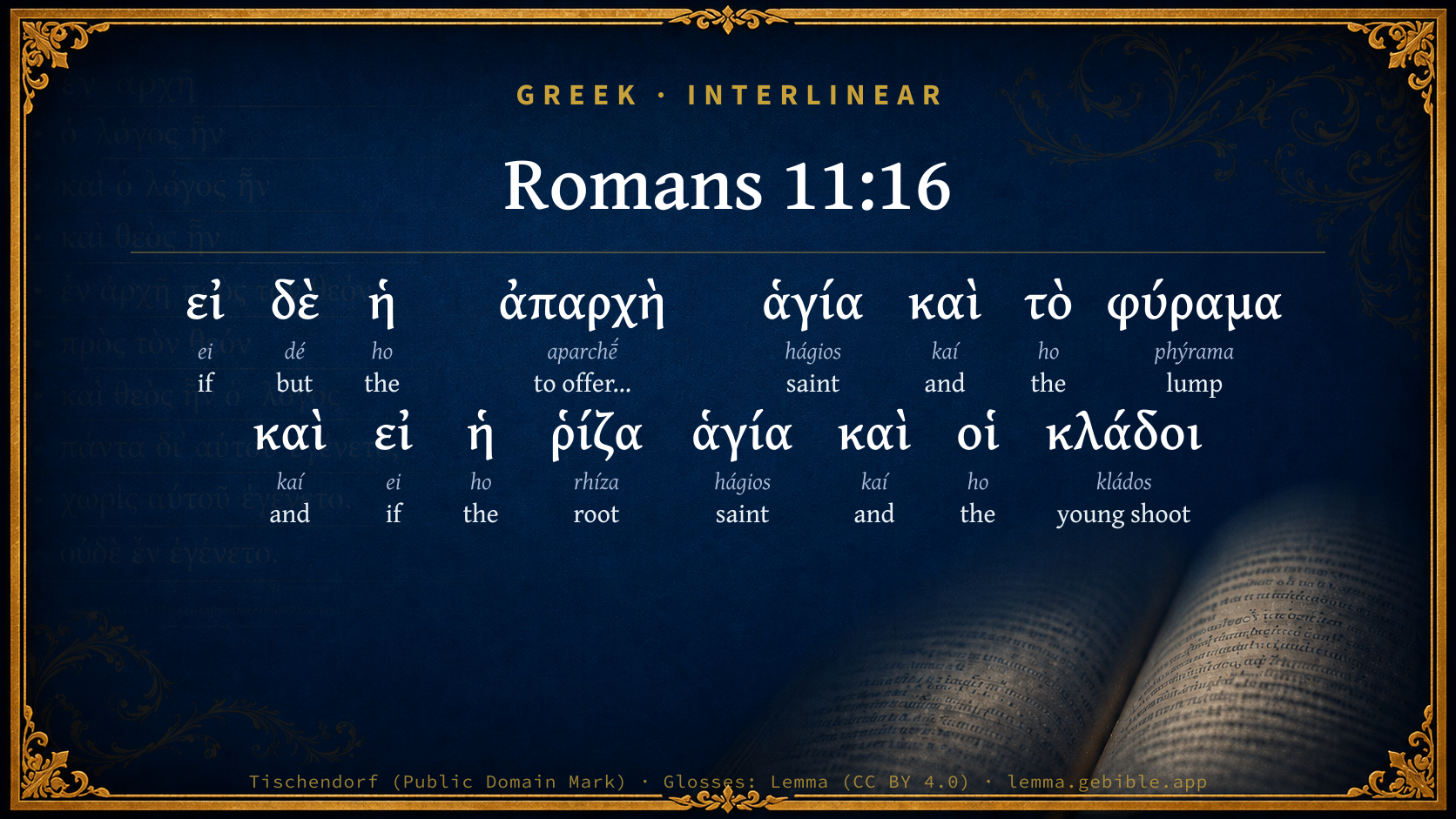
  1. εἰ ei G1487 “if” Conditional
  2. δὲ dé G1161 “but” Conjunction
  3. ἡ ho G3588 “the” Article, Nominative, Singular, Feminine
  4. ἀπαρχὴ aparchḗ G536 “to offer firstfruits” Noun, Nominative, Singular, Feminine
  5. ἁγία hágios G40 “saint” Adjective, Nominative, Singular, Feminine
  6. καὶ kaí G2532 “and” Conjunction
  7. τὸ ho G3588 “the” Article, Nominative, Singular, Neuter
  8. καὶ kaí G2532 “and” Conjunction
  9. εἰ ei G1487 “if” Conditional
  10. ἡ ho G3588 “the” Article, Nominative, Singular, Feminine
  11. ῥίζα rhíza G4491 “root” Noun, Nominative, Singular, Feminine
  12. ἁγία hágios G40 “saint” Adjective, Nominative, Singular, Feminine
  13. καὶ kaí G2532 “and” Conjunction
  14. οἱ ho G3588 “the” Article, Nominative, Plural, Masculine
  15. κλάδοι kládos G2798 “young shoot” Noun, Nominative, Plural, Masculine

About this verse

These counts appear in no published source. They are computed here, from the morphology-tagged text and Lemma’s own curated glosses. What Lemma adds →

16
words
9
distinct lemmas
Pauline Epistles
section

Notable vocabulary

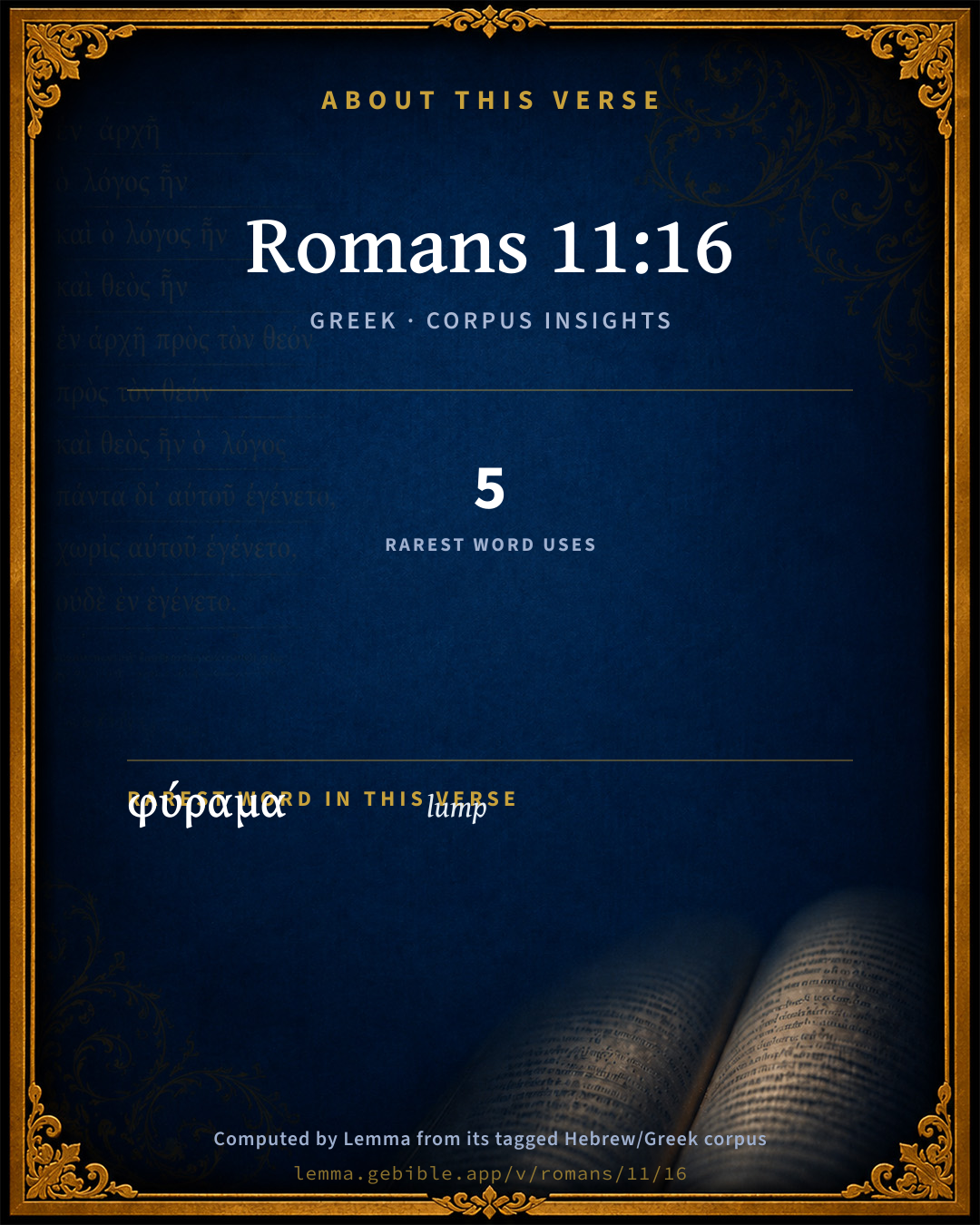
The rarest word here is φύραμα lump G5445 — appearing just 5 times in the whole Greek New Testament.

Shared distinctive vocabulary

φύραμα lump G5445 occurs in 5 verses of the Greek New Testament. Also found in:

Repetition

Words recur within this verse:

Cross-references

15

Topical passages linked to Romans 11:16 in the Treasury of Scripture Knowledge — connected by theme and wording, ordered by reader-vote popularity; previews shown in the World English Bible.

  • Proverbs 3:9 Honor Yahweh with your substance, With the first fruits of all your increase:
  • Ezekiel 44:30 The first of all the first fruits of every thing, and every offering of everything, of all your offerings, shall be for the priest: you shall also give to the priests the first of your dough, to cause a blessing to rest on your house.
  • James 1:18 Of his own will he brought us forth by the word of truth, that we should be a kind of first fruits of his creatures.
  • Leviticus 23:10 "Speak to the children of Israel, and tell them, 'When you have come into the land which I give to you, and shall reap its the harvest, then you shall bring the sheaf of the first fruits of your harvest to the priest:
  • Numbers 15:17–21 Yahweh spoke to Moses, saying,
  • Jeremiah 2:21 Yet I had planted you a noble vine, wholly a right seed: how then are you turned into the degenerate branches of a foreign vine to me?
  • Romans 11:17 But if some of the branches were broken off, and you, being a wild olive, were grafted in among them, and became partaker with them of the root and of the richness of the olive tree;
  • Genesis 17:7 I will establish my covenant between me and you and your seed after you throughout their generations for an everlasting covenant, to be a God to you and to your seed after you.
  • Exodus 23:16 And the feast of harvest, the first fruits of your labors, which you sow in the field: and the feast of harvest, at the end of the year, when you gather in your labors out of the field.
  • Deuteronomy 18:4 The first fruits of your grain, of your new wine, and of your oil, and the first of the fleece of your sheep, shall you give him.
  • Deuteronomy 26:10 Now, behold, I have brought the first of the fruit of the ground, which you, Yahweh, have given me. You shall set it down before Yahweh your God, and worship before Yahweh your God:
  • Exodus 22:29 "You shall not delay to offer from your harvest and from the outflow of your presses. "You shall give the firstborn of your sons to me.
  • Exodus 23:19 The first of the first fruits of your ground you shall bring into the house of Yahweh your God. "You shall not boil a kid in its mother's milk.
  • 1 Corinthians 7:14 For the unbelieving husband is sanctified in the wife, and the unbelieving wife is sanctified in the husband. Otherwise your children would be unclean, but now are they holy.
  • Revelation 14:4 These are those who were not defiled with women, for they are virgins. These are those who follow the Lamb wherever he goes. These were redeemed by Jesus from among men, the first fruits to God and to the Lamb.

Cross-references courtesy of OpenBible.info (CC BY 4.0).

Commentary

Notes on Romans 11:16 from classic Christian and Jewish commentators (each source and its license shown beneath its notes). The classic Christian expositions comment on the surrounding passage and are grouped to its opening verse, so a note may address several verses; the Jewish commentaries on the Tanakh (Rashi and others) are per-verse, so they appear only where the commentator wrote on this verse.

Lemma curates 59 commentaries, every one of them public domain or Creative Commons licensed, each selected and text-cleaned for this edition rather than reprinted as found. About our sources →

Albert Barnes' Notes on the Bible

For if the first-fruit be holy - The word “first-fruit” ἀπαρχή aparchē used here denotes the firstling of fruit or grain which was separated from the mass and presented as an offering to God. The Jews were required to present such a portion of their harvest to God, as an expression of gratitude and of their sense of dependence; Num 15:19-21. Until this was done, it was not lawful to partake of the harvest. The offering of this was regarded as rendering the mass holy, that is, it was lawful then to partake of it. The first-fruits were regarded as among the best portions of the harvest; and it was their duty to devote to God that which would be the best expression of their thanksgiving. This was the general practice in relation to all that the land produced. The expression here, however, has reference to the small portion of dough or kneaded meal that was offered to God; and then the mass or lump φύραμα phurama was left for the use of him who made the offering; Num 15:20.

Be holy - Be set apart, or consecrated to God, as he commanded.

The lump - The mass. It refers here properly to the dough of which a part had been offered. The same was true also in relation to the harvest, after the waive-sheaf had been offered; of the flock, after the first male had been offered, etc.

Is also holy - It is lawful then for the owner to partake of it. The offering of a part has consecrated the whole. By this illustration Paul doubtless means to say that the Jewish nation, as a people, were set apart to the service of God, and were so regarded by him. Some have supposed that by the first-fruit here the apostle intends to refer to the early converts, made to the Christian faith in the first preaching of the gospel. But it is more probable that he refers to the patriarchs, the pious people of old, as the first-fruits of the Jewish nation; see Rom 11:28. By their piety the nation was, in a manner, sanctified, or set apart to the service of God; implying that yet the great mass of them would be reclaimed and saved.

If the root be holy - This figure expresses the same thing as is denoted in the first part of the verse. The root of a tree is the source of nutritious juices necessary for its growth, and gives its character to the tree. If that be sound, pure, vigorous, we expect the same of the branches. A root bears a similar relation to the tree that the first-fruit does to the mass of bread. Perhaps there is allusion here to Jer 11:16, where the Jewish nation is represented under the image of “a green olivetree, fair, and of goodly fruit.” In this place the reference is doubtless to Abraham and the patriarchs, as the root or founders of the Jewish nation. If they were holy, it is to be expected that the distant branches, or descendants, would also be so regarded. The mention of the root and branches of a tree gives the apostle occasion for an illustration of the relation at that time of the Jews and Gentiles to the church of Christ.

Albert Barnes' Notes on the Bible (1834–1885) — public domain. Text from a community e-Sword/MySword module.

Joseph Benson's Commentary

Rom 11:16-17. And their conversion will surely be effected, For if the first- fruit of them, the patriarchs, be holy — He alludes to the waved sheaf, which was said to be holy, because it was accepted of God, in token of his giving the appointed weeks of the harvest: and by the first-fruit, he either means the patriarchs, who were called and separated to the service of God from all the people of the earth; or, as many commentators understand him, the first converts to Christianity from among the Jews, teaching that they were most acceptable to God, as being the first members of the newly- erected Christian church. The lump is also holy — The lump, φυραμα, (which was the meal tempered with water, and kneaded for baking,) here denotes the mass of which the two wave-loaves were made, mentioned Lev 23:17. And as these were offered at the conclusion of the harvest, seven weeks after the offering of the first-fruits, they represented the whole fruits of the earth newly gathered in, as sanctified through that offering for the people’s use, during the following year. By this latter similitude, therefore, the apostle intends the whole mass, or body of the nation, to be hereafter converted, and rendered acceptable to God, as members of his true church. And if the root of them, namely, Abraham, was holy and beloved of God, so are the branches still beloved for the father’s sake, and so will be once more, in his good time, admitted to his favour. There seems here to be an allusion to Jer 2:16, where the Jewish nation, made the visible church of God by virtue of the covenant at Sinai, are represented under the figure of a green olive-tree, of which Abraham was the root, and his descendants by Isaac the branches. Hence the thrusting the Jews out of the covenant of God, is here represented by the breaking off of the branches; and the admission of the Gentiles into that covenant, so as to make them members of God’s church, is set forth under the idea of their being ingrafted into the stock of the green olive-tree; and the advantages which they enjoyed thereby, are expressed by their partaking of the root and fatness of the olive-tree. The expression, a wild olive-tree, means here, a branch of a wild olive-tree, for branches only are ingrafted. The Gentiles are called a wild olive, because God had not cultivated them as he did the Jews, who on that account were called, Rom 11:24, the good or garden olive.

Joseph Benson's Commentary on the Old and New Testaments (1811–1818) — public domain. Text from a community e-Sword module.

Tyndale Open Study Notes

Tyndale Open Resources

11:16 the entire batch of dough is holy because the portion given as an offering is holy: This imagery comes from Num 15:17-21, where God commanded the Israelites to take part of their first batch of dough and set it aside as a gift. God’s promises to and blessings on Abraham, Isaac, and Jacob were like a down payment, guaranteeing the completion of God’s work among his people.

Tyndale Open Study Notes — © Tyndale Open Resources, licensed CC BY-SA 4.0. Text via the HelloAO Bible API.

Bengel's Gnomon

Johann Albrecht Bengel

Rom 11:16. Ἡ ἀπαρχὴ, the first fruits) The patriarchs.—ἁγία, holy) appropriated and acceptable to God.—Comp. Rom 11:15, with 1Ti 4:4-5.—φύραμα, a lump) Num 15:20-21, ἀπαρχὴ φυράματος.—ἡ ῥίζα, the root) the patriarchal stock, considered naturally, as also being regarded as in possession of circumcision and of the promise. In the opinion of Weller, after Orige[122], Christ is the root, the patriarchs also are the branches, from whom the first fruits were derived.

[122] rigen (born about 186 A.D., died 253 A.D., a Greek father: two-thirds of the N. Test. are quoted in his writings). Ed. Vinc. Delarue, Paris. 1733, 1740, 1759.

Bengel's Gnomon of the New Testament — English translation (T&T Clark, Edinburgh, 1860) — public domain. Text from a community e-Sword module.

Meyer's Critical & Exegetical Commentary

Heinrich August Wilhelm Meyer

Rom_11:16. Δέ] continuative; but this πρόσληψις, how well it corresponds to the character of holiness, which has been associated with the people of Israel from its origin till now! The two figures are parallel, and set forth the same thought.

ἀπαρχή] obtains the genitival definition to be mentally supplied with it through τὸ φύραμα, just as in the second clause ἡ ῥίζα is the root of the κλάδοι. The ἀπαρχὴ τοῦ φυράματος is known from Num_15:19-21 to be a designation of the first of the dough; that is, from every baking, when the dough was kneaded, a portion was to be set aside and a cake to be baked therefrom for the priests. See Philo, de sac. hon. II. p. 232; Josephus, Antt. iv. 4. 4; Saalschutz, M. R. p. 347; Keil, Archäol. I. § 71; and the Rabbinical prescriptions in Mischn. Surenh. p. 289 ff. This ἀπαρχή, as the first portion devoted to Jehovah from the whole, was designed to impart the character of its consecration to the remainder of the lump. The article with φύραμα denotes the lump of dough concerned, from which the ἀπαρχή is separated; hence ὅλον did not require to be expressed (in opposition to Hofmanns objection). Grotius and Rosenmüller take τ. φύρ. to be the corn destined for the baking, and ἀπαρχή to be the first-fruits. But (Rom_9:21) φύραμα always denotes a mass mixed (with moisture or otherwise), particularly a kneaded one, and is in the LXX. (Exo_12:34) and in Paul (1Co_5:6-7; Gal_5:9) the standing expression for dough. Estius, Koppe, Köllner, Olshausen, Krehl rightly take it so, but nevertheless understand by ἀπαρχή the sacred first-fruits (comp. Exo_23:10) which were employed for φύραμα. But in that case ἀπαρχή obtains a genitival definition not presented by the text; and this can the less be approved, since ἀπαρχὴ φυράματος, in fact, was the stated expression from Num. l.c. This applies also against Hofmann, who likewise explains the ἀπαρχή as the firstling-sheaf, but considers the φύραμα to be the dough worked up from the harvest-fruit generally.

The figure is correctly interpreted, when by ἡ ἀπαρχή we understand the patriarchs (Abraham, Isaac, and Jacob), and by τὸ φύρ. the whole body of the people, to whom the character of holinessof consecration in property to Godpassed over from the former. With the holiness of the πατέρες, Rom_9:4-13 (in accordance with which we are not here to think of Abraham alone), is given also the holiness of the theocratic people, their posterity, according to the divine right of covenant and promise. Comp. Rom_9:4-5. But this holiness, which Paul looks upon, as respects the national whole, in the light of a character indelebilis, is not the inner moral, but (comp. 1Co_7:14) the theocratic legal holiness (quod juribus ecclesiae et promissis Dei frui possint, Calovius). The expression is taken of the patriarchs by Chrysostom, Oecumenius, Erasmus, Beza, Calvin, Estius, Grotius, Calovius, Bengel, and others, including Koppe, Tholuck, Köllner, Olshausen, Fritzsche, Philippi, Maier, de Wette, Krehl, Umbreit, Ewald, Reithmayr, Hofmann (though the latter thinks only of Abraham). This is correct, because the second figure (εἰ δὲ ῥίζα κ.τ.λ.) is capable of no other interpretation (see below); but to explain the two figures differently, as Toletus and Stolz, Reiche and Rückert, Glöckler, Stengel, Bisping, van Hengel, after Theodore of Mopsuestia and Theodoret, have in manifold ways arbitrarily done, is simply a violation of the parallelism. This holds also against the interpretation of the Jews who have become believing, and of the remaining mass of the people (Ambrosiaster, Pelagius, Anselm, Toletus, Rosenmüller, Stolz, Reiche, Rückert, Bisping).

ἡ ῥίζα and οἱ κλάδοι are the patriarchs and their theocratic bodily descendants, the Jews. As the ἀπαρχή is related to the φύραμα, so is the ῥίζα to the κλάδοι; comp. on the latter, Menander, 711: ἄκαρπός ἐστιν οὗτος ἀπὸ ῥίζης κλάδος. The divergent interpretation, which may deserve to be considered in opposition to this usual one, is, that the ῥίζα is the first primitive or mother church consisting of the believing Jews, and that the κλάδοι are the Jews, in so far as they in virtue of their national position were primarily called thereto. This exposition (substantially in Cornelius a Lapide, Carpzov, Schoettgen; Semler and Ammon suppose οἱ κλάδοι to be the Gentile Christians) is still considered possible by de Wette. It is, however, unsuitable; for the (natural) κλάδοι must have proceeded from the ῥίζα, must have their origin from it (comp. Sir_23:25; Sir_40:15), and the broken-off branches (Rom_11:17) must have earlier belonged to the ῥίζα,which is not the case, if ῥίζα is the Christian mother-church of which they were never κλάδοι. The true theocracy (the olive tree, comp. Jer_11:16; Hos_14:7; Zec_4:11; Neh_8:15) did not begin in the Christian mother-church (as its root), but in the patriarchs, and Christ Himself was κατὰ σάρκα from this sacred root, Mat_1:1 f. In this view it is clear that the unbelieving Jews, in so far as they rejected Christ, ceased thereby to belong to the true people of God, and fell away from their root. They were nowafter the light, and with it judgment, had come into the world (Joh_3:19)broken-off branches, apostate children of Abraham (Joh_8:37; Joh_8:39-40), children of the kingdom who were to be cast out (Mat_8:12). Comp. the figure of the vine in John 15. See also Rom_9:6 ff.

Meyer — Critical and Exegetical Commentary on the New Testament — English translation by Peter Christie, edited by Frederick Crombie (T&T Clark, 1880) — public domain. Text from a community e-Sword module.

Godet's Commentaries

Frédéric Louis Godet

Vv. 16-24.

The apostle proves in this passage the perfect congruity, from the viewpoint of Israelitish antecedents, of the event which he has just announced as the consummation of Israel’s history. Their future restoration is in conformity with the holy character impressed on them from the first; it is therefore not only possible, but morally necessary (Rom 11:16). This thought, he adds, should inspire the Gentiles, on the one hand, with a feeling of profound regard for Israel, even in their lapsed state (Rom 11:17-18); on the other, with a feeling of watchful fear over themselves; for if a judgment of rejection overtook such a people, how much more easily may not the same chastisement descend on them (Rom 11:19-21)! He finishes with a conclusion confirming the principal idea of the passage (Rom 11:22-24).

Vv. 16. “But if the first-fruit be holy, the lump is also holy; and if the root be holy, so are the branches.”

The Jewish people are consecrated to God by their very origin—that is to say, by the call of Abraham, which included theirs (Rom 11:29).

According to Num 15:18-21, every time the Israelites ate of the bread of the land which God had given them, they were first of all to set aside a portion of the dough to make a cake intended for the priests. This cake bore the name of ἀπαρχή, first-fruits; it is to this usage the apostle alludes in the first part of our verse. It has sometimes been alleged that he took the figure used here from the custom of offering in the temple, on the 16th Nisan, on the morrow after the Passover, the sacred sheaf gathered in one of the fields of Jerusalem, as first-fruits and as a consecration of the entire harvest. But the subject in question here is a portion of dough (φύραμα), which necessarily leads to the first meaning. This cake offered to God’s representative impressed the seal of consecration on the entire mass from which it had been taken. What is it that corresponds to this emblem in the apostle’s view? Some answer: the Jews converted in the first times of the church; for they are the pledge of the final conversion of the whole people. But exactly the same thing might be said of the first Gentile converts, as being the pledge of the successive conversion of all the Gentiles. Now, by this figure Paul’s very object is to express a characteristic peculiar to the Jews. Some Fathers (Or., Theod.) apply this emblem to Christ, as assuring the conversion of the people from whom He sprang. But this reasoning would apply equally to Gentile humanity, since Jesus is a man, not only a Jew. We must therefore, with the majority of commentators, take these holy first-fruits as the patriarchs, in whose person all their posterity are radically consecrated to the mission of being the salvation-people; comp. Rom 9:5 and Rom 11:28.

But this figure, by which the entire nation was compared to a lump of dough consecrated to God, did not furnish the apostle with the means of distinguishing between Jews and Jews, between those who had faithfully preserved this national character and those who had obliterated it by their personal unbelief. Thus he is obliged to add a second figure, that he may be able to make the distinction which he must here lay down between those two so different portions of the nation. There is therefore no need to seek a different meaning for the second figure from that of the first.

Origen, again, applies the emblem of the root to Christ, inasmuch as by His heavenly origin He is the true author of the Jewish people; but this notion of Christ’s pre-existence is foreign to the context.

It follows from these two comparisons, that to obtain salvation the Jewish people had only to remain on the soil where they were naturally rooted, while the salvation of the Gentile demands a complete transplantation. Hence a double warning which Paul feels himself forced to give to the latter. And first the warning against indulging pride.

Frédéric Louis Godet — Commentaries on Luke, John, Romans, and 1 Corinthians — English translation (T&T Clark, Edinburgh, 1870s–1890s) — public domain. Text from a community e-Sword module.

Hodge's Commentary on Romans, Ephesians & First Corinthians

Charles Hodge

Rom_11:16

For if the First-fruits be holy, the lump is also holy; and if the root be holy, so also are the branches. Under two striking and appropriate figures, the apostle expresses the general idea, If one portion of the Jewish people is holy, so also is the other. With regard to this interesting passage, the first point to be settled is the allusion in the figurative expression in the first clause. The Jews were commanded to offer a certain portion of all the productions of the earth to God, as an expression of gratitude and acknowledgment of dependence. This offering, called the first-fruits, was to be made first, from the productions in their natural state (Exo_23:19); and, secondly, from the meal, wine, oil, and dough, as prepared for use. Num_15:21, Of the first of your dough ye shall give unto the Lord a heave-offering in all your generations; Neh_10:37; Deu_18:4. If the allusion of the apostle is to the former of these offerings, then the first-fruits must refer to a portion of the harvest or vintage presented to God, and the lump to the residue of the grain or grapes. If the allusion be to the second, then the first-fruits mean the portion of dough offered to God, and the lump the residue of the mass. The latter is undoubtedly most consistent with the meaning of the word (φύραμα) used by the apostle, which can hardly be understood as referring to heaps of grain, or other productions of the earth. In either case, however, the purport of the illustration is the same.

A second question is, Who are intended by the first-fruits and the root, and by the lump and the branches, in these two figures? With respect to this question, the following are the most common and plausible answers:

1. The first-fruits are understood to mean the Jews first converted to the Christian faith, who became, as it were, the root of the Christian church. According to this view of the passage, the apostle designs to say, Since the first converts to the gospel were Jews, it is evident that the nation, as such, is not cast off by God; as a portion of them is holy (or have been accepted of God), so may the residue be.

2. By the first-fruits and the root, may be understood the patriarchs, the forefathers of the Jews; and by the lump and the branches, the residue of the nation, or the Jews as a people. That this latter is the true meaning of the passage seems very evident:

1. Because this interpretation alone preserves the propriety of the figure. How can the unconverted Jews or the Jewish nation be called the branches of the portion that became followers of Christ? The Gentile Christians might be so called, but not the Jewish people, as such. On the other hand, nothing is more natural than to call the ancestors the root, and their descendants the branches.

2. This interpretation best suits the design of the apostle. He wishes to show that the conversion of the Jews, which he had declared to be so desirable for the Gentiles, was a probable event. He proves this by referring to the relation of their ancestors to God. If they were the peculiar people of God, their descendants may be regarded as his also, since the covenant was not with Abraham only, but also with his seed.

3. This is the apostles own explanation in Rom_11:28, where the unconverted Jews, or Hebrew nation, as such, are said to be beloved for the fathers sake.

4. This interpretation alone can be consistently carried through the following verses. The Gentile Christians are not said (Rom_11:17) to be grafted into the stock of the converted Jews, but as branches with them they are united to a common stock. And the stock into which the branches, now broken off, are to be again grafted, is not the Jewish part of the Christian church, but the original family or household of God.

The word (ἅγιος) rendered holy, which properly means clean, is used in two general senses in the Scriptures:

1. Consecrated,

2. Pure.

In the former of these, it is applied, times without number, in the Old Testament, to persons, places, and things considered as peculiarly devoted to the service of God. So the whole people, without reference to their moral character, are called a holy people. So, too, the temple, tabernacle, and all their contents, were called holy, etc. The use of the word in this sense, in reference to places and things, is not unfrequent in the New Testament. Mat_4:5, where Jerusalem is called the holy city, see Mat_7:6; Mat_24:15; Mat_27:53, and often. It is, however, rarely so used in relation to persons. In the vast majority, of instances, when thus applied, it means morally pure; yet in some cases, it signifies devoted to God. Luk_2:23, Every male that openeth the womb shall be called holy unto the Lord. Perhaps, too, in the expressions, the holy prophets, Luk_1:70, and holy apostles, Eph_3:5, the reference is rather to their relation to God, as persons devoted to his service, than to their moral character. In 1Co_7:14, the children of professing Christians are called holy, not in reference to their moral condition, but their relation to the church. In like manner, in this passage, the Jews, as a people, are called holy, because peculiarly consecrated to God, separated from the rest of the world for his service.‹60›

The connection of this verse with the preceding, its import and bearing on the apostles object are therefore clear. The restoration of the Jews, which will be attended with such beneficial results for the whole world, is to be expected, because of their peculiar relation to God as his chosen people. God, in selecting the Hebrew patriarchs, and setting them apart for his service, had reference to their descendants, as well as to themselves; and designed that the Jews, as a people, should, to the latest generations, be specially devoted to himself. They stand now, therefore, and ever have stood, in a relation to God which no other nation over has sustained; and, in consequence of this relation, their restoration to the divine favor is an event in itself probable, and one, which Paul afterwards teaches (Rom_11:25), God has determined to accomplish.

Charles Hodge — Commentary on Romans (1835), First Corinthians (1857), and Ephesians (1856) — public domain. Text from a community e-Sword module.

Geneva Bible (1599)

Geneva Bible translators

He alludeth to the firstfruits of the loaves by the offering whereof all the whole crop of corn was sanctified, and they might vie the rest of the year following with good conscience.

The nation of the Jews being considered in their stock and root, that is, in Abraham, is holy, although that many of the branches be cut off. Therefore in judging of our brethren, we must not stick in their unworthiness, to think that they are at once all cast off, but we ought to consider the root of the Covenant, and rather go back to their ancestors which were faithful, that we may know that the blessing of the Covenant resteth in some of their posterity, as we also find proof hereof in ourselves.

Abraham.

Geneva Bible (1599) marginal notes — public domain. Text via Bolls.life.

Jamieson, Fausset & Brown

Robert Jamieson, A. R. Fausset & David Brown

For--"But"

if the first-fruit be holy, the lump is also holy; and if the root . . . so the branches--The Israelites were required to offer to God the first-fruits of the earth--both in their raw state, in a sheaf of newly reaped grain (Lev 23:10-11), and in their prepared state, made into cakes of dough (Num 15:19-21) --by which the whole produce of that season was regarded as hallowed. It is probable that the latter of these offerings is here intended, as to it the word "lump" best applies; and the argument of the apostle is, that as the separation unto God of Abraham, Isaac, and Jacob, from the rest of mankind, as the parent stem of their race, was as real an offering of first-fruits as that which hallowed the produce of the earth, so, in the divine estimation, it was as real a separation of the mass or "lump" of that nation in all time to God. The figure of the "root" and its "branches" is of like import--the consecration of the one of them extending to the other.

Jamieson, Fausset & Brown — Commentary Critical and Explanatory on the Whole Bible (1871) — public domain (CC PDM 1.0). Text via the HelloAO Bible API.

Adam Clarke's Commentary

Verse 16. For if the first fruit be holy] As the consecrating the first fruits to God was the means of drawing down his blessing upon the rest, so the conversion of Abraham to the true faith, and the several Jews who have now embraced Christianity, are pledges that God will, in process of time, admit the whole Jewish nation into his favour again, so that they shall constitute a part of the visible Church of Christ.

If the root be holy, so are the branches.] The word holy in this verse is to be taken in that sense which it has so frequently in the Old and New Testaments, viz. consecrated, set apart to sacred uses. It must not be forgotten that the first converts to Christ were from among the Jews; these formed the root of the Christian Church: these were holy, αγιοι, consecrated to God, and those who among the Gentiles were converted by their means were also αγιοι, consecrated; but the chief reference is to the ancestors of the Jewish people, Abraham, Isaac, and Jacob; and, as these were devoted to God and received into his covenant, all their posterity, the branches which proceeded from this root, became entitled to the same privileges: and as the root still remains, and the branches also, the descendants from that root still remain: they still have a certain title to the blessings of the covenant; though, because of their obstinate unbelief, these blessings are suspended, as they cannot, even on the ground of the old covenant, enjoy these blessings but through faith: for it was when Abraham believed God that it was accounted to him for righteousness; and thus he became an heir of the righteousness which is by faith.

Adam Clarke's Commentary on the Bible (1810–1826) — public domain. Text from a community e-Sword/MySword module.

John Calvin's Commentaries

16. For if the first-fruits, etc. By comparing the worthiness of the Jews and of the Gentiles, he now takes away pride from the one and pacifies the other, as far as he could; for he shows that the Gentiles, if they pretended any prerogative of honor of their own, did in no respect excel the Jews, nay, that if they came to a contest, they should be left far behind. Let us remember that in this comparison man is not compared with man, but nation with nation. If then a comparison be made between them, they shall be found equal in this respect, that they are both equally the children of Adam; the only difference is that the Jews had been separated from the Gentiles, that they might be a peculiar people to the Lord.

They were then sanctified by the holy covenant, and adorned with peculiar honor, with which God had not at that time favored the Gentiles; but as the efficacy of the covenant appeared then but small, he bids us to look back to Abraham and the patriarchs, in whom the blessing of God was not indeed either empty or void. He hence concludes, that from them an heredity holiness had passed to all their posterity. But this conclusion would not have been right had he spoken of persons, or rather had he not regarded the promise; for when the father is just, he cannot yet transmit his own uprightness to his son: but as the Lord had sanctified Abraham for himself for this end, that his seed might also be holy, and as he thus conferred holiness not only on his person but also on his whole race, the Apostle does not unsuitably draw this conclusion, that all the Jews were sanctified in their father Abraham.

Then to confirm this view, he adduces two similitudes: the one taken from the ceremonies of the law, and the other borrowed from nature. The first-fruits which were offered sanctified the whole lump, in like manner the goodness of the juice diffuses itself from the root to the branches; and posterity hold the same connection with their parents from whom they proceed as the lump has with the first-fruits, and the branches with the tree. It is not then a strange thing that the Jews were sanctified in their father. There is here no difficulty if you understand by holiness the spiritual nobility of the nation, and that indeed not belonging to nature, but what proceeded from the covenant. It may be truly said, I allow, that the Jews were naturally holy, for their adoption was hereditary; but I now speak of our first nature, according to which we are all, as we know, accursed in Adam. Therefore the dignity of an elect people, to speak correctly, is a supernatural privilege.

John Calvin's Commentaries (1540-1563) — public domain. Text from the Calvin Translation Society English edition (1840s-50s) via the Christian Classics Ethereal Library (ccel.org). Calvin's coverage is partial (roughly two-thirds of the Bible); uncommented books and verses are honest gaps, never fabricated. The 19th-century editor's footnotes and remarks are omitted so the notes are faithfully Calvin's own voice.

Ellicott's Commentary for English Readers

(16) And we have the strongest reason for believing in this reconversion of the Jews. Their forefathers were the first recipients of the promise, and what they were it is only natural to hope that their descendants will be. When a piece of dough is taken from the lump to make a consecrated cake, the consecration of the part extends over the whole; and the character which is inherent in the root of a tree shows itself also in the branches. So we may believe that the latter end of Israel will be like its beginning. The consecration that was imparted to it in the founders of the race we may expect to see resumed by their descendants, even though it is for a time interrupted.

The firstfruit . . . the lump.—The allusion here is to the custom, described in Num_15:19-21, of dedicating a portion of the dough to God. The portion thus taken was to be a “heave-offering”—i.e., it was to be “waved,” or “heaved,” before the Lord, and was then given to the priest.

A Bible Commentary for English Readers, edited by Charles John Ellicott (1878–1897) — public domain. Text from a community e-Sword module.

The Cambridge Bible for Schools and Colleges

gen. ed. J. J. S. Perowne

16. For] Lit., and much better, But, or Now. The word marks transition to a new fact in connexion with the “receiving” of Israel; the fact of the peculiar position of Jews with regard to the Divine Promise. The main effect of the following passage, to Rom_11:24, is to prove that the restoration of Jews to the Church of Messiah, so far from being unlikely, is in the nature of the case likely. Their peculiar connexion, by lineal descent, with the Fathers, makes it certain that their return will be as abundantly welcome to their God as the admission of the Gentiles. We might say more welcome, but for the fact that no welcome can be fuller than that which awaits the true believer of whatever nation. But St Paul wishes to meet the rising prejudice (so strong and stubborn in after ages) of Gentile against Jewish believers, by emphasizing the grand fact that the whole Church springs, so to speak, from a Jewish root; and that thus nothing could be, in a certain sense, more natural than the restoration of Jews to the Church. He has also to announce that there is reserved for Israel, in the future, not merely restoration to the Church, but a work of special importance and glory in it for the world.

the firstfruit] The Jewish Patriarchs, but perhaps specially Abraham, who was eminently “holy” in the sense of consecration to the purposes of God.—For the figure here cp. Num_15:21; “Of the first of your dough ye shall offer unto the Lord an heave-offering.” The words just below here point to the idea of “firstfruits” not of grain but of bread.

holy] In the sense indicated in the last note. The Patriarchs were, by the Divine purpose, separated to be special recipients of Divine light, in trust for their descendants and the world. In a sense somewhat similar their descendants, viewed as a nation, are still separated in the Divine purpose to a special work connected with Divine mercy. The reference is not, of course, to a supposed superior personal sanctity of individual Jews as such, (which would be to contradict the whole reasoning of cch. 2, 3, 4,) but to the special purpose towards Israel as a nation, in view of which they are reserved (scattered but never vanishing) for a time of grace.

the root] Here again the figure points to the Patriarchs, and especially to Abraham. (Cp. Isa_51:1-2, for yet another figure, that of the Quarry, with the same reference.) The “root” and “branches” are here brought in to form the main illustration of the passage following as far as Rom_11:25. The passage is one of much importance and some difficulty, and calls for a few preliminary remarks.

The Cambridge Bible for Schools and Colleges (gen. ed. J. J. S. Perowne; Cambridge University Press, 1878–1918) — public domain. Text from a community e-Sword module.

John Gill's Exposition

For if the firstfruit be holy,.... Some by "the firstfruit" and "root" understand Christ, who is sometimes called, "the firstfruits of them that slept", Co1 15:20, and "the root of Jesse and David", Isa 11:10, and indeed of all the righteous; and certain it is, that since he is holy, has all the holiness of his people in him, and is sanctification unto them, they shall be holy likewise; have it imparted to them in this life, and perfected in them in another: but this does not seem to agree with the apostle's argument. Others think that by them are meant the Jewish ancestors, and particularly Abraham, and dream of a holiness derived from him to his natural seed; but if no such holiness was derived from him to his immediate offspring, Ishmael, it can hardly be thought any should be communicated by him to his remote posterity; and to these here designed, at the distance of four or five thousand years from him: but by them are intended the first converts among the Jews, under the Gospel dispensation; it being usual with the apostle to call those persons, that were first converted in any place, the firstfruits of it; see Rom 16:5; These were they who received the firstfruits of the Spirit in Judea, and who first among the Jews hoped and believed in Christ; these were but few in number, as the "firstfruit" is but small in comparison of "the lump", and mean, abject, and despicable, as the "root" under, and in a dry ground is; but yet were pledges and presages of a larger number of souls among that people, to be converted in the latter day: now the apostle's argument is, "if the firstfruit be holy",

the lump is also holy, and if the root be holy, so are the branches; that is, that whereas those persons who were converted among the Jews, however few in number, and despicable in appearance they might be, yet were truly sanctified by the Spirit of God; and as they were, so should the whole body of that people be in the last days, "when holiness shall be upon the horses' bells, and every pot in Judah and Jerusalem shall be holiness unto the Lord of hosts", Zac 14:20, by which metaphorical expressions is meant, that holiness should be common to the whole nation, and all the inhabitants of it, of which the call of some few among them was a pledge and presage. The allusion in the former clause is to the holy offerings of firstfruits to the Lord, the two wave loaves, Lev 23:14, whereby the whole lump was sanctified, for after use throughout the year following; and that in the latter clause, to the holiness of trees; that is, to trees devoted to sacred use or that were planted in a field appropriated thereunto: hence we read (t), that the men of Jericho permitted, or as other exemplars read it, cut down , "branches of holiness", or "holy branches"; and eat fallen fruit on the sabbath day. (u) Bartenora explains these branches, of such that grow upon a tree devoted to holy uses; and Maimonides (w), observes, that they thought it lawful to eat what grew in a holy field.

(t) Misn. Pesachim, c. 4. sect. 8. (u) In Misn. Pesachim. c. 4. sect. 8. (w) In ib.

John Gill's Exposition of the Whole Bible (1746–1763) — public domain (CC PDM 1.0). Text via the HelloAO Bible API.

Trapp's Complete Commentary

John Trapp

16 For if the firstfruit be holy, the lump is also holy: and if the root be holy, so are the branches.

Ver. 16. If the firstfruit be holy] Not with a natural, but a federal holiness, as 1Co 7:14.

John Trapp, A Commentary or Exposition upon All the Books of the Old and New Testament (1647–1656) — public domain. Text from a community e-Sword module.

Haydock's Catholic Bible Commentary

If the first-fruit (see the Greek word) be holy, so also is the mass; so also the rest, the product that follows. He alludes to the offering made by the law of the first-fruit, which was to acknowledge that all good things were from God, and to bring a blessing upon the rest. --- If the root be holy, so are the branches. By the root, says St. John Chrysostom, he understands Abraham, and the patriarchs, from whom all the Jewish nation proceeded, as branches from that root: and these branches are to be esteemed holy, not only because of the root they proceeded from, but also because they worshipped the true God. And if some, or a great part of these branches, have been broken, they may, as it is said, (ver. 23.) be ingrafted again. And you, Gentiles, ought to remember that, you were of yourselves a wild olive-tree: and it is only by the merciful call of God, that you have the happiness to be ingrafted upon the same root of the patriarchs; and so, by imitating the faith of Abraham, are become his spiritual children, and heirs of the promises, and by that means have been made partakers of the root, and of the sap, and fatness of the sweet olive-tree. Remember that you bear not the root, nor were you the root that was holy; but the root beareth you; and that being branches of a wild olive, you ought naturally still to bear bad fruit, though ingrafted on the root of a sweet olive. It is only by the mercies of God, if you bring forth good fruit. Do not then be high-minded, nor boast, but fear, and endeavour to continue in goodness; lest God also spare not you, but cut you off, as unprofitable branches. And let me tell you, as to the Jews, if they abide not still in unbelief, God is able to ingraft them again into their own olive-tree; and it seems more easy, that they, who are naturally branches of the sweet olive-tree, should bring forth good fruit, when they shall be ingrafted in their own olive-tree, being of the race of Abraham, to whom the promises were made. (Witham) --- We see here, that he who standeth by faith, may fall from it; and therefore must live in fear, and not in the vain presumption and security of modern sectaries. (Challoner) --- The apostle here exhorts the converted Gentiles, to fear lest they fall, and bring upon themselves a punishment similar to that of the Jews. The Jews were his chosen people, the children of the alliance; they have now been stripped of all; the same may also happen to you. You may fall into presumption and incredulity; if you remain firm, it is not by you own merits or works, but by faith, the pure gift of God. Neither faith, nor vocation, nor grace, are inadmissible. You may lose all; and therefore ought always to fear and live in humility. If God has not spared the natural branches, fear, lest he should not spare you. (ver. 21.) (Calmet) --- The Gentiles are here admonished not to be proud, nor to glory over the Jews; but to take occasion rather from their fall to fear and to be humble, lest they be cast off. Not that the whole Church of Christ can ever fall from him; having been secured by so many divine promises in holy writ; but that each one in particular may fall; and therefore all in general are to be admonished to beware of that, which may happen to any one in particular. (Challoner)

George Leo Haydock (1774–1849), Haydock's Catholic Family Bible and Commentary, 1859 edition — public domain. Excludes Psalms (Douay-Rheims chapter numbering differs from Protestant) and Deuterocanonical books (Catholic canon only).

Matthew Poole's English Annotations

Here is another argument to prove the Jews are not finally rejected, because of the covenant made with their fathers.

If the first-fruit be holy: some make a difference between the first-fruit, and the root, in the latter part of the verse. By the first-fruit they understand the apostles and other godly Jews, that were at first converted to the Christian faith; and by the root they understand Abraham and the patriarchs. Others take them for the same, and understand Abraham, Isaac, and Jacob, with the rest of the patriarchs, to be both the first-fruit and the root.

The lump is also holy; by lump, and branches, he means the people of the Jews that descended of these holy patriarchs, and spring from them, as branches from a root. The great question is, In what sense they are said to be holy? Or of what holiness doth he speak? It is not meant of inherent, but of federal, or covenant holiness; all in all outward and visible covenant with God, were called holy: see Exo 9:6; Dan 8:24. Many common things are called holy in Scripture, because dedicated to God and to his service; yea, Jerusalem, though a place of great wickedness, is called a holy city, Mat 27:53. In such a sense as this, the Jews are still a holy people; they have an hereditary kind of dedication to God; they have a federal holiness, and relation to God, as being for ever separated to him, in the loins of their progenitors; this can never be wholly forfeited, as being granted to all the posterity of the holy patriarchs: therefore they are called the children of the covenant, which God made with their fathers, Act 3:25; see Act 2:39. So then God will remember in his own time, his covenant with the Jews, the posterity of Abraham, &c., who are beloved for the fathers’ sakes, Rom 11:28. Therefore, in the mean time, they should not look on themselves with desperation; nor should the Gentiles look on them with disdain, as it follows in the next words.

Matthew Poole's English Annotations on the Holy Bible (1683–1685) — public domain. Text from a community e-Sword/MySword module.

Whedon's Commentary on the Bible

Daniel D. Whedon

16-24. The image of the olive tree—It is from its beauty and richness that the apostle selects the olive tree as an emblem of the Church of God. Some of the branches (the apostate Jews) are broken off, and from a wild tree new branches (the believing Gentiles) are grafted into the parent trunk.

But, amid their bloom and flourish, let the new grafts beware of forgetting their parasite position and proudly exulting over the severed branches. The latter were cut off for unbelief, the former may be for their pride—and thus is furnished a striking picture of God’s impartial dealing. How probable that the native branches will yet resume their place!

16. Firstfruit—The first product of the autumn of any kind offered to God was called firstfruit. Here, as the word lump indicates, it means the first dough for baking. In Num_15:20, the Israelites were commanded to offer a cake of their first dough for a heave offering. This ceremony indicated their gratitude to God for his gift of bread. And this first dough so offered was representative of the whole; upon the whole dough was now a consecration by which it could be gratefully and piously eaten, and in that sense holy. Firstfruit and whole lump were all of a piece.

Lump—The entire mass of dough for baking. In the apostle’s figure the Jews were to their first ancestors what the lump was to the first dough, sacredly set apart.

Root and branches are of the same nature. The root is the holy ancestry of the Jews; as branches they remain consecrated. And upon that changeless consecration the apostle bases the assurance of the restoration of the later generations.

Daniel D. Whedon (gen. ed.), Commentary on the Old and New Testaments (1874–1909) — public domain. Text from a community e-Sword module.

The Pulpit Commentary

And if the firstfruit be holy, so also is the lump; and if the root be holy, so also are the branches. By the firstfruit and the root is signified the original stock of Israel, the patriarchs; by the lump and the branches, the subsequent nation through all time. The word aparch , being here connected with furama , may be understood as referring to Num_15:19-22. The people are there enjoined to take of the first dough ( furama) kneaded after harvest a cake for a heave offering, called aparch furamatov (LXX). This consecrated aparch sanctified the whole furama .

The dedication of a part the consecration of the whole.

The reference is to Nu 15, where the ordinance is given that before the Israelites ate of the food of Canaan a portion of the dough should be taken as a cake offering to the priests. This was a recognition of God"s sovereignty, of his care and goodness, and by this acknowledgment the entire food was hallowed.

I THE APPLICATION TO THE APOSTOLIC ARGUMENT CONCERNING THE FUTURE Or ISRAEL. The Jews as a nation seemed cast away, stripped of former privilege and dignity. Yet, since the patriarchs and prophets and priests had been declared holy unto the Lord, and had served him according to his appointment, the remainder of the people must be accounted sacred, and thus the apostle was led to expect the future salvation of Israel when it should turn to the Lord. The inner life of the tree should be restored and invigorated, and then the branches should again acquire beauty and fruitfulness. They were still "beloved for the fathers" sakes.

II THE SAME METAPHOR APPLIES TO THE RELATIONSHIP OF CHRIST TO HIS PEOPLE. His holiness wraps them round. Not only were individual institutions and officers symbolical and prophetical of the Messiah, but the nation as a whole typified the Son of promise. "When Israel was a child, then I loved him, and called my son out of Egypt." This explains many references of Old Testament passages to Christ by the evangelists and apostles. The nation was the "servant" of God, by which title, therefore, Jesus Christ is constantly designated. Israel as a whole was claimed as God"s peculiar possession. By right of redemption, and the death of the firstborn in Egypt, the tribe of Levi was allotted to Jehovah in recognition of his lien upon Israel, and the number of the firstborn over and above the number of that tribe was balanced by a money payment. Yet Israel was "a holy nation unto the Lord," and the service of the priesthood represented, not superseded, the service of the nation. So is Jesus Christ termed the Firstborn from the dead," and the Christian Church is "the general assembly of the Firstborn." Christ sanctified himself for his people, that his merits might attach to them. We talk much today of the solidarity of the race, and this helps us to realize how the leaven leaveneth the lump. Great men are seen to be universal property; the use of their gifts blesseth all mankind. As one takes a common tool and by deft handling convinces us of what it is capable; as one cultivates his estate as a nursery and pattern for all gardens; as another enlarges the domain of science whereby the navigator, the manufacturer, the thinker, and the consumer all reap a benefit; so did our Saviour teach us how much may be made of human life, how grand and pure and beneficent it may become, and by his sacrifice opened the kingdom of heaven to all believers. Well may we rejoice in his work! Our High Priest before the throne sanctifies all who come to God through him. At the jubilee festivities the Queen of Hawaii claimed precedence as a sovereign, and, her credentials being authenticated, her claim was granted; so may we, as the brethren of Christ, lift up our heads, being made "kings and priests unto God." It is our connection with him that ennobles our condition.

III SOME PRACTICAL APPLICATIONS TO CONDUCT AND PROPERTY. To consecrate the heart to God covers all the life, sanctifies all the issues which flow from it. Here is the difference between religion and morality; here is the reason why some of the characters of Scripture are called "saints," in spite of infirmities and lapses. The setting apart of Sunday as the Lord"s day hallows all the week. We are then what we are not able to be at other times, free from secular engagements and absorbed in devotion. And like a garden well watered in the early morn, the busy life retains its vigour and freshness through the heated hours which follow. The dedication of youth is a consecration of the after-life. Youth is like the morning of the day, and should be watered betimes with the dews of prayer. Prayer should be the foundation-stone of each enterprise. "When first thy eyes unveil, give thy soul leave to do the like; give God thy first thoughts then, so shalt thou walk with him all day, and in him sleep." The devotion of a tithe or gift blesses all the increase. The beauty of recurring seasons may fail to arouse because of the very regularity of their succession. Nature"s constant stream of blessings may lull the soul into forgetfulness of the Giver. Hence the rites prescribed to Israel. "The altar unlocks the reaping gate." The first grains feed the altar, the first sickle cuts an offering for God. The common household routine of baking is transfigured by the appropriation of a part of the dough to religious uses. And this, not as a burden, a hateful tax, but a task of love. Not instead of hearty devotion, but as an outward emblem of gratitude. The followers of Christ are to bless the world. They are "begotten through the Word of truth to be a kind of firstfruits of God"s creatures." They are as salt to preserve, as light to illumine. All brought into contact with them should be the better because they were called with a holy calling.

CONCLUSION. The topic reminds us of our certain resurrection to heavenly activity and glory. Christ was the Firstfruits of them that sleep. Sad to us the interval when we see our friends no more; death"s icy hand has grasped them, and the worms do their work. Yet as Christ rose, so shall the seed spring up, we know not how. Death"s seeming triumph is a defeat. They shall be changed and glorified; the crumbling dust shall shine brighter than the noonday sun. S.R.A.

The Pulpit Commentary (1880–1919), ed. H.D.M. Spence-Jones & Joseph S. Exell — public domain. Text from a community e-Sword module.

John Wesley's Explanatory Notes

And this will surely come to pass. For if the first fruits be holy, so is the lump - The consecration of them was esteemed the consecration of all and so the conversion of a few Jews is an earnest of the conversion of all the rest. And if the root be holy - The patriarchs from whom they spring, surely God will at length make their descendants also holy.

John Wesley, Explanatory Notes Upon the Whole Bible (1754–1765) — public domain. Text via the GEBible commentary corpus.

Kretzmann's Popular Commentary

Paul E. Kretzmann

A warning to the Gentile Christians:

v. 16. For if the first-fruit be holy, the lump is also holy; and if the root be holy, so are the branches.

v. 17. And if some of the branches be broken off, and thou, being a wild olive-tree, wert grafted in among them, and with them partakes of the root and fatness of the olive-tree,

v. 18. boast not against the branches. But if thou boast, thou bearest not the root, but the root thee.

v. 19. Thou wilt say, then, The branches were broken off that I might be grafted in.

v. 20. Well; because of unbelief they were broken off, and thou standest by faith. Be not high-minded, but fear;

v. 21. for if God spared not the natural branches, take heed lest He also spare not thee.

v. 22. Behold, therefore, the goodness and severity of God: on them which fell, severity; but toward thee, goodness, if thou continue in His goodness; otherwise thou also shalt be cut off.

v. 23. And they also, if they abide not still in unbelief, shall be grafted in; for God is able to graft them in again.

v. 24. For if thou wert cut out of the olive-tree which is wild by nature, and wert grafted contrary to nature into a good olive-tree, how much more shall these, which be the natural branches, be grafted into their own olive-tree!

The apostle here guards against a danger, namely, that of misunderstanding his previous exposition. For what he had written regarding the fall and the consequent rejection of the Jews might cause such Gentile Christians as were easily guided by their flesh to be filled with pride and over weeningness and to give way to boasting at the expense of the Jews. Paul first of all, by way of introduction, states a general truth: If the first of the dough is holy, then also the entire mass; and if the root is holy, then also the branches. The apostle alludes, in the first half of the sentence, to the fact that the first of the dough, the first dough made out of the flour of every new harvest, had to be given unto the Lord, Num 15:19-21. This first part of the dough and the entire offering became holy by being consecrated to the Lord. The picture in the second part of the sentence has the same meaning: the root being consecrated to God and accepted by Him, the branches will also be acceptable to Him. The root of the true Israel, of the body which is and always will be consecrated to the Lord, are the patriarchs, and the branches are the true spiritual children of the patriarchs, together with some that had the appearance of true branches, but whose deceptive. nature was discovered in time, with the result that they were removed. The olive-tree therefore represents the entire mass of the true spiritual children of Abraham, the holy Christian Church, the communion of saints, of all times. Every person that accepts the Messiah by faith is a branch of this trunk or body, becomes a partaker of the divine promise and blessings.

Keeping well within this picture, the apostle brings out an earnest admonition to every overweening Christian from among the Gentiles: If some of the branches are broken off, and thou, as a wild olive-tree, wert grafted in among them and didst become a joint partaker of the root of the fatness of the olive-tree, then do not boast against the branches. The breaking off of the branches took place at the same time that the twigs of the wild olive-tree were grafted in. The advent of Christ into the world brought on a crisis for all the Jews. A great number of them took offense at the crucified Christ and at the preaching of the Cross, and the result was that they were broken off the tree of the Church and removed. For with the coming of the Messiah the Church of believers had become the Church of Jesus Christ, and every one that did not accept Jesus as the promised Messiah excluded himself from the communion of saints, for the touchstone of faith consisted in applying the Messianic prophecies to Jesus of Nazareth. In the place of such branches, however, that had lost their character and therefore been removed, the Lord grafted in some branches from a wild olive-tree; He called some Gentiles to the fellowship of the saints. They were taken from the midst of the lost and condemned heathen world, they mere received into the communion of the Lord and thus became living members of His congregation. And at the same time they became partakers of all the benefits of salvation, of reconciliation with the Father, of remission of sins, of full and complete justification, of victory over death, and of eternal bliss. The thought which the apostle brings out is this, that the Jews were the original children of God, that they were the first possessors of these advantages and privileges, that to them as to the first the blessings of God in Jesus were revealed, Mat 8:11; Joh 10:16; Eph 2:11 ff. And therefore the Gentile Christian should guard very carefully against boasting at the expense of the Jews, against the very ones that had foolishly neglected to accept the Messiah in the fullness of time, To boast of possessions which have not been merited, but are the gift of free grace, instead of giving all glory to God alone, is always foolish and reprehensible, but to do so at the expense of those that have been rejected because they, in their blindness, excluded themselves from the blessings of the Kingdom, is the very height of blamable behavior.

The apostle, therefore, follows up his warning with an explanation: But if thou should boast (if you cannot resist the temptation to exhibit vainglory), then remember, not thou bearest the root, but the root thee. The root consists of the patriarchs of Israel, they having been made so by God’s Word and promise. And this same strength is keeping the branches alive. The Jews were the channel of blessings to the Gentiles; salvation was from the Jews. Therefore all ungenerous and self-confident boasting on the part of the Gentile Christians and of the Christians of all times should be excluded. And if one of them should want to object in a spirit of the same ungenerous self-complacency: The branches were broken out in order that I might be grafted in; then Paul has the answer: Very well, let that stand, it is true enough that the rejection of the Jews after their repudiation of Christ resulted in the conversion of the Gentiles; but this was not because the heathen were better by nature than the Jews or because the Lord took special pleasure in the Gentiles. Such an inference would be altogether wrong. Not because they were Jews had the Lord rejected them, but through their unbelief, because of their unbelief they were broken off; because they refused to accept the Savior the Lord had rejected them, since faith is the only means by which the relation with God may be maintained. The Gentiles were in a condition of grace and salvation only by faith, the gift of God’s mercy. Instead, then, of boasting, of being proud in their own conceit, of forming an unwarranted estimate of their own importance in the eyes of God, they should fear, Php 2:12-13. For if God did not spare the natural branches, He might not spare thee either. Since the Gentile Christian is in a state of grace only by faith, and since faith excludes boasting, he had better beware lest in his pride he fall away from faith and share the very fate of those whom he was tempted to despise. As a matter of fact, the Jews were more likely to be spared than the Gentiles, all things being equal, since they had so long been connected with Him in a most intimate manner.

The apostle now draws a conclusion from the facts just presented: Behold, therefore, the kindness and the severity of God; upon those that have fallen severity, but upon thee the kindness of God, if thou hold closely to His kindness, since, in the opposite case, thou, too, shalt be cast off, v. 22. In the case of those that have fallen, whose unbelief has excluded them from the grace and the fellowship of God and the saints, the severity of God has been manifested. In His holiness and justice God is obliged to show His displeasure to those that leave the fellowship in which they enjoyed His grace and kindness, by withdrawing from them all His mercy and love. But in the case of the Gentile Christian, God has shown His goodness and kindness in taking him out of the midst of godlessness and enmity toward God and accepting him as a member of His Church. For such a person, therefore, it is a matter of working out his salvation with fear and trembling, of holding fast to the goodness of God, lest he also be cast off by God, Joh 15:1-6. If Christians forget that they owe their state of grace, their membership in the congregation of the Lord, to the kindness and mercy of God only and presume to elevate themselves over others, especially by despising the rejected ones, then they, in turn, deny the kindness of God, lose their faith, and are cast off. In their case they challenge the goodness of God to be turned into severity.

And there is another point which must not be overlooked by the Gentile Christian if he feels presumptive thoughts rising in his heart: But they also, if they do not remain in unbelief, will be grafted in again, for God is fully able to graft them in again, v. 23. Those that are standing today may very easily and quickly fall, especially if thoughts of pride and self-complacency fill their hearts. On the other hand, the mercy of God will quickly turn to those that have fallen if they do not remain in their unbelief, if they have not hardened their hearts to the point of final rejection at the hands of God. If they but heed His call and turn to Jesus as their Savior, God will gladly receive them again as members of His Church and grant them all the rights and privileges of the other believers. And what is more, this event, if considered by itself, is more probable than the calling of the Gentiles. For if thou, cut out of thy natural tree, the wild olive-tree, wert, contrary to thy nature, grafted into the good olive-tree, how much more will those that are branches by nature be grafted into their own olive-tree!

v. 24. The Gentile Christians were the branches from the wild olive-tree, having no natural connection with the good olive tree into which they were grafted; the Jews were the natural branches. Now what is in accordance with nature will happen far more easily than that which is against nature. Therefore the reunion of the Jews with the body of the Church of God, which they have foolishly left, could be accomplished far more easily, according to all probability, than the union of the Gentile Christians with a community with which they never did have anything in common. Not that the Jews, as a race, were more susceptible to the Gospel than the Gentiles; for Jews and Gentiles are alike unfit and unable to save themselves or to perform the slightest meritorious work for their own salvation, a truth which is valid and should be heeded for all times.

Paul E. Kretzmann, Popular Commentary of the Bible (1921–1924) — public domain. Text from a community e-Sword module.

Burkitt's Expository Notes on the New Testament

William Burkitt

Here the apostle produced another argument to prove the universal restoration of the Jews unto the grace and favour of God before the end of the world; and it is drawn from the covenant of God made with Abraham, (as the root of the Jewish nation,) which said, I will be thy God, and the God of thy seed.

Now the argument runs thus: "As the branches follow the nature of the root, so do the Jews follow the condition of Abraham, and the holy patriarchs, with respect to the outward privileges of the covenant. Was the root holy? so are the branches holy; not inherently, but federally holy, being called, consecrated, and separated from the world unto the service of God. If then Almighty God, by entering into covenant with Abraham, hallowed to himself all his posterity, even as the first-fruits hallowed the whole lump; in like manner will God, in his own good time be so mindful of the Jews, the posterity of Aabraham, as to bring them again nigh unto himself in remembrance of his holy covenant; so that they shall be his people, and he will be their God."

Learn hence, That the Jews, though at present cast off by God, are still an holy people, they are under an hereditary dedication to God, they have a federal holiness, as descending from holy progenitors, with respect to whom the love and compassion of God are towards them, and they shall in his own time be called and converted by him. And therefore, in the mean time, the Jews are not to look upon themselves with desperation, nor should the Gentiles look upon them with disdain. The first -fruits being holy, the lump is also holy: the root being holy, so are the branches also.

William Burkitt's Expository Notes on the New Testament (1700–1703) — public domain. Text from a community e-Sword module.

Godbey's Commentary on the New Testament

William B. Godbey

16. “But if the first fruit is holy, so also is the lump; and if the root be holy, so also are the branches.” God’s holy covenant with the patriarchs is as fresh in the divine mind this day as when He first spoke to Abraham in Chaldea.

William B. Godbey, Commentary on the New Testament (1896–1900) — public domain. Text from a community e-Sword module.

McGarvey & Pendleton's Commentaries

J. W. McGarvey

And if the firstfruit is holy, so is the lump: and if the root is holy, so are the branches . [Another parallelism. The apostle demonstrates the same truth, first, from the standpoint of the law of God in the Bible (firstfruit and lump); second, from the law of God in nature (root and tree). As the harvest or raw material of the Jew was regarded as unclean, or ceremonially unholy, and not to be eaten till it was cleansed by the waving of a first-portion, or firstfruit, of it as a heave-offering before the Lord ( Lev_23:9-14 ; Exo_34:26 ); so the meal or prepared material was likewise prescribed until a portion of the first dough was offered as a heave-offering. This offered "firstfruit," or, better, "first-portion" (aparche), made the whole lump (phurama) from which it was taken holy, and thus sanctified all the future meal, of which it was the representative or symbol, so that it could now be used by the owner ( Num_15:19-21 ; Neh_10:37 ). The apostle, then, means that as the patriarchs, Abraham, Isaac and Jacob (called fathers in verse 28), the firstfruit by the revealed law, and the root by the natural law, were holy, so all their descendants as lump and tree were likewise holy. But holiness has two distinct meanings: (1) Purity, moral and spiritual perfection, absolute righteousness--a holiness unto salvation; (2) that which is consecrated or set apart for divine use--a holiness short of salvation. The second meaning is the one intended here. The Jews, being out of Christ, are certainly not holy or righteous unto salvation, Paul being witness; but they have what Gifford styles "this legal and relative holiness of that which has been consecrated to God." In this respect they are still "the holy people" ( Dan_12:7 ), "the chosen people" ( Dan_11:15 ), preserved from fusion with the Gentiles, and ultimately to be restored to their original pre-eminence as leaders in the worship of Jehovah. In short, then, there is no divinely erected barrier rendering them irrevocably unholy, and preventing their conversion. On the contrary, they are pre-eminently susceptible to conversion both by law divine and natural, and only their persistent unbelief prevents their Christianization.]

J. W. McGarvey (with Philip Y. Pendleton), Commentaries on the New Testament (The Fourfold Gospel, 1914; Acts; and the epistles) — public domain. Text from a community e-Sword/MySword module.

The People's New Testament

B. W. Johnson

16–24. For if the first fruit be holy, the lump is also holy. See Numbers 15:18–21. Some explain the first fruits by Abraham and the patriarchs. It probably refers, rather, to the Jewish Christians, “the election by grace” (verse 5). If a portion of the nation has been saved, it is an assurance that the whole nation can be saved. And if the root be holy. The root may refer to Abraham. The figure is that of a tree, with the patriarchs for the root. “Holy” is used in the sense of acceptable to God, a common sense in the Scriptures. In the next verse the figure of the root, the stalk and the tree, is expanded.

B. W. Johnson's The People's New Testament with Notes (1889–1891) — public domain. Electronic text from the Christian Classics Ethereal Library (CCEL) ThML edition.

Cambridge Greek Testament for Schools and Colleges

16. εἰ δὲ ἡ ἀπαρχὴ, κ.τ.λ. The metaphor is from Num 15:20-21. ἁγία in both clauses is used in its technical sense of consecrated to GOD’s use, without immediate reference to the character of the thing or person consecrated: but the consecration shows the true destiny of the thing consecrated. The verse gives the ground for the hope of a πρόσλημψις of Israel. The consecration of the firstfruits, of the root, involves the consecration of the whole organism. It is not annulled by the lapse of some members. New members are brought in by the mercy of GOD; but this does not exclude the possibility of the recall of those who fell away; such is the resourcefulness of the mercies of GOD. Thus ἀπαρχὴ and ῥίζα = the patriarchs (cf. S. H. and Giff.); the φύραμα and the κλαδοὶ = the generality of Israel; those that remain faithful are the true Israel, the remnant on which faithful Gentiles are grafted. So the true life of Israel persists in the Church in Christ. For this use of ἀπαρχή, cf. 1Co 16:15, 2Th 2:13 (v.l.), Jas 1:18, Rev 14:4. The thought is present in Rom 8:19.

Cambridge Greek Testament for Schools and Colleges (Cambridge University Press, 1896; 21 vols, various authors incl. Carr, Maclear, Plummer, Farrar, Lumby, Moule, M. R. James, Simcox) — public domain. Text from a community e-Sword module.

Alford’s Greek Testament

Henry Alford

16-24.] Such a restoration of Israel was to be expected from a consideration of their destination and history. This is set forth in similitudes, that of the root and branches being followed out at some length,—and their own position, as engrafted Gentiles, brought to the mind of the readers. But (a further argument for their restoration following on ἀλλά, ver. 11) if the firstfruit be holy, so also the Iump (not here the firstfruit of the field, as Grot., Rosenm. (nor is φύραμα the cake made by the priests out of the firstfruits which fell to them, Deu 18:4, as Estius, Koppe, Köllner, Olsh., al.);—but the portion of the kneaded lump of dough (φύρω), which was offered as a heave-offering to the Lord, and so sanctified for use the rest: see ref. Num. where the same words occur);—and if the root be holy, so also the branches. Who are the ἀπαρχή and the ῥίζα? First of all, there is no impropriety in the two words applying to the same thing. For though, as Olsh. remarks, the branches being evolved from the root, it rather answers to the φύραμα than to the ἀπαρχή, and, as Rückert, the firstfruit succeeds the lump in time, while the root precedes the branches,—yet, as Thol. replies, the ἁγιότης is the point of comparison, and in ἁγιότης the ἀπαρχή precedes and gives existence to the φύραμα. This being so, (1) the ἀπαρχή and ῥίζα have generally been taken to represent the patriarchs; and I believe rightly (except that perhaps it would be more strictly correct to say, Abraham himself). The ἀγαπητοὶ διὰ τοὺς πατέρας of ver. 28 places this reference almost beyond doubt. Origen explains the ῥίζα to be our Lord. But He is Himself a branch, by descent from Abraham and David (Isa 11:1; Mat 1:1), if genealogically considered; and if mystically, the whole tree (Joh 15:1). De Wette prefers to take as the firstfruit and root, the ideal theocracy founded on the patriarchs,—the true, faithful children of the patriarchs, and as the branches, those united by mere external relationship to these others. This he does, because in the common acceptation, the κλάδοι who are cut off ought to be severed from their physical connexion with Abraham, &c., which they are not. This objection I do not conceive applicable here: because, as we see evidently from ver. 23, the severing and re-engrafting are types, not of genealogical disunion and reunion, but of spiritual. Meanwhile, De W.’s view appears less simple than the ordinary one, which, as I hope to shew, is borne out by the whole passage. (2) Then, who are indicated by the φύραμα and the κλάδοι? Israel, considered as the people of God. The lump, which has received its ἁγιότης from the ἀπαρχή, = Israel, beloved for the fathers’ sakes: the assemblage of branches, evolved from Abraham, and partaking of his holiness. But one thing must be especially borne in mind. As Abraham himself had an outer and an inner life, so have the branches. They have an outer life, derived from Abraham by physical descent. Of this, no cutting off can deprive them. It may be compared to the very organization of the wood itself, which subsists even after its separation from the tree. But they have, while they remain in the tree, an inner life, nourished by the circulating sap, by virtue of which they are constituted living parts of the tree: see our Lord’s parable of the vine and the branches, Joh 15:1 ff. It is of this life, that their severance from the tree deprives them: it is this life, which they will re-acquire if grafted in again.

See a very ingenious but artificial explanation in Olsh., who agrees in the main with De W.:—and the whole question admirably discussed in Tholuck. The ἁγιότης then here spoken of, consists in their dedication to God as a people—in their being physically evolved from a holy root. This peculiar ἁγιότης (see 1Co 7:14, where the children of one Christian parent are similarly called ἅγια) renders their restoration to their own stock a matter, not of wonder and difficulty, but of reasonable hope and probability. I may notice in passing, that those expositors who do not hold a restoration of the Jewish people to national preeminence, find this passage exceedingly in their way, if we may judge by their explanations of this ἁγιότης. E.g. Mr. Ewbank remarks: ‘Holy they are, inasmuch as there is no decree against their restoration to their place of life and fruitfulness.’ Surely this is a new meaning of ‘holy:’ the same would be true of a Hottentot: in his case, too, there is no decree against his reception into a place (and in Mr. E.’s view, the restoration of the Jew is nothing more) of life and fruitfulness in the Church of God.

Henry Alford, The Greek Testament (1849–1861) — public domain. Text from a community e-Sword module.

International Critical Commentary

16. St. Paul gives in this verse the grounds of his confidence in the future of Israel. This is based upon the holiness of the Patriarchs from whom they are descended and the consecration to God which has been the result of this holiness. His argument is expressed in two different metaphors, both of which however have the same purpose.

ἀπαρχὴ … φύραμα. The metaphor in the first part of the verse is taken from Num 15:19, Num 15:20 ‘It shall be, that when ye eat of the bread of the land, ye shall offer up an heave offering unto the Lord. Of the first of your dough (ἀπαρχὴν φυράματος LXX) ye shall offer up a cake for an heave offering: as ye do the heave offering of the threshing floor, so shall ye heave it.’ By the offering of the first-fruits, the whole mass was considered to be consecrated; and so the holiness of the Patriarchs consecrated the whole people from whom they came. That the meaning of the ἀπαρχή is the Patriarchs (and not Christ or the select remnant) is shown by the parallelism with the second half of the verse, and by the explanation of St. Paul’s argument given in ver. 28 ἀγαπητοὶ διὰ τοὺς πατέρας.

ἁγία: ‘consecrated to God as the holy nation’ in the technical sense of ἃγιος, cf. 1:7.

ῥίζα … κλάδοι. The same idea expressed under a different image. Israel the Divine nation is looked upon as a tree; its roots are the Patriarchs; individual Israelites are the branches. As then the Patriarchs are holy, so are the Israelites who belong to the stock of the tree, and are nourished by the sap which flows up to them from those roots.

International Critical Commentary — older volumes (1896–1929), various authors — public domain. Text from a community e-Sword module.

Vincent's Word Studies in the New Testament

Marvin R. Vincent

For [δε] . Better but, or now. A new paragraph begins.

The first - fruit - holy. See on Jas 1:18, Act 26:10. Referring to the patriarchs.

Lump. See on ch. Rom 9:21. The whole body of the people. The apparent confusion of metaphor, first - fruit, lump, is resolved by the fact that first - fruit does not apply exclusively to harvest, but is the general term for the first portion of every thing which was offered to God. The reference here is to Num 14:18 - 21; according to which the Israelites were to set apart a portion of the dough of each baking of bread for a cake for the priests. This was called ajparch, first - fruits.

Root - branches. The same thought under another figure. The second figure is more comprehensive, since it admits an application to the conversion of the Gentiles. 58 The thought of both figures centres in holy. Both the first - fruits and the root represent the patriarchs (or Abraham singly, compare ver. 28). The holiness by call and destination of the nation as represented by its fathers (first - fruits, root) implies their future restoration, the holiness of the lump and branches.

Marvin R. Vincent, Word Studies in the New Testament (1887–1900) — public domain. Text from a community e-Sword/MySword module.

Lesson kit

Teaching starters — assembled from the data on this page, not authored interpretation. Every prompt links to the verse data it draws on. Edit before teaching.

Romans, in the Pauline Epistles, opens this verse with 16 words (9 distinct Greek lemmas). Its most distinctive word is phýrama (“lump”). A historical commentator’s framing appears above. Read the whole chapter for the surrounding context.

Discussion questions

  1. How does “lump” (phýrama) shape what this verse is saying?
  2. How does Romans 9:21, which shares the word «lump», read alongside this verse?
  3. What does the repetition of “saint” (2× in this one verse) do in this verse?
  4. The translations on this page render this verse differently — a whole-verse word diff, not a word-by-word alignment. What might account for the different wordings?
  5. Compare how Albert Barnes' Notes on the Bible and Joseph Benson's Commentary read this verse. Where do they agree or differ?

Things to notice

  • These translations choose different wording for 6 words in this verse.
  • “saint” occurs 2× in this single verse.
  • 9 distinct Greek lemmas span 16 words in this verse.

Reading settings

Reading text

Shown beneath each verse's original-language words.

Old Testament
Old Testament edition

Read the OT as the Masoretic Hebrew (MT) or the Greek Septuagint (LXX).

English shown for the Greek Septuagint (in the Hebrew ↔ Greek comparison).

Comparing translations? Open the Compare panel on any verse page to stack up to four side by side.