1 Thessalonians 5:26

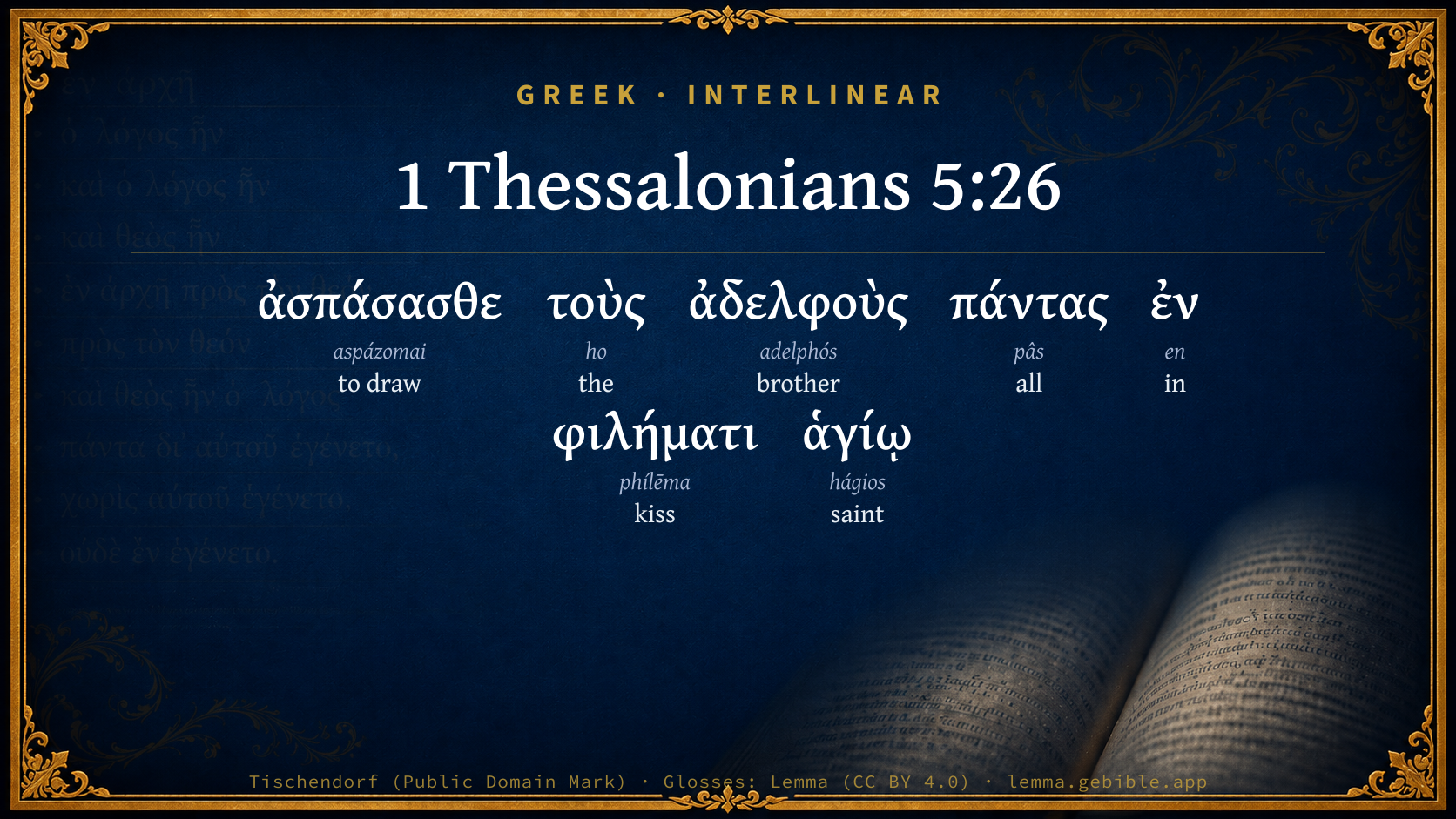
Greek (Tischendorf 8th ed.) 1 Thessalonians 5:26 appears in the Greek New Testament. The text above is from the Tischendorf 8th edition. Each word links to its Strong’s number and a concise gloss. Click any word for its full Thayer’s Greek Lexicon entry.
Download image
Cite this verse

1 Thessalonians 5:26 (World English Bible). Public Domain. Lemma interlinear Bible study tool, https://lemma.gebible.app/v/1-thessalonians/5/26.

Show BibTeX & RIS
BibTeX
RIS
English Translation
Greet all the brothers with a holy kiss.
World English Bible · Public Domain
Download a study sheet

One document with this verse’s original text, its word-by-word gloss line, the meaning frame, cross-references with their text, attributed commentary, and full source and license credits — printable, and it pastes into notes with its structure intact.

This verse Autodidact and up

Study sheet (.html) Plain text (.txt)

A passage Seminary Student

Up to 50 verses in one chapter. A passage sheet keeps up to 6 commentary sources and 12 cross-references per verse, in the order this page ranks them, and says so on the sheet whenever that leaves anything out. Ask for a single verse and you get the Autodidact verse sheet above.

Everything on this page stays free to read, with no account — the sheet is a download of what is already on screen, not access to it.

Want to remove ads? Support Godless Engineer
Compare translations 3

The same verse in 3 English versions, stacked beneath the original-language interlinear above. Click any original word for its lexicon entry.

Each is an independent rendering of the whole verse — the interlinear is not word-aligned to these translations.

Highlighted words mark where these versions differ — a whole-verse word diff, not a word-by-word alignment.

  • World English Bible Public Domain
    Greet all the brothers with a holy kiss.
  • King James Version Public Domain
    Greet all the brethren with an holy kiss.
  • unfoldingWord Literal Text CC BY-SA 4.0
    Greet all the brothers with a holy kiss.

unfoldingWord Literal Text — © unfoldingWord, licensed CC BY-SA 4.0. Word-aligned USFM3 via Door43 (git.door43.org/unfoldingWord/en_ult).

Versions to compare (up to 4)

3 of 4 selected

Show all 19 translations

Every available English version of this verse, each an independent rendering of the whole verse.

  • World English Bible Public Domain
    Greet all the brothers with a holy kiss.
  • Berean Standard Bible Public Domain
    Greet all the brothers with a holy kiss.
  • Majority Standard Bible Public Domain
    Greet all the brothers with a holy kiss.
  • King James Version Public Domain
    Greet all the brethren with an holy kiss.
  • American Standard Version (1901) Public Domain
    Salute all the brethren with a holy kiss.
  • Revised Version (1885) Public Domain
    Salute all the brethren with a holy kiss.
  • Geneva Bible (1599) Public Domain
    Greete all the brethren with an holy kisse.
  • Douay-Rheims (1899) Public Domain
    Salute all the brethren with a holy kiss.
  • Young's Literal Translation Public Domain
    salute all the brethren in an holy kiss;
  • Literal Standard Version CC BY-SA 4.0
    Greet all the brothers with a holy kiss.
  • Unlocked Literal Bible CC BY-SA 4.0
    Greet all the brothers with a holy kiss.
  • unfoldingWord Literal Text CC BY-SA 4.0
    Greet all the brothers with a holy kiss.
  • Darby Bible Public Domain
    Greet all the brethren with a holy kiss.
  • World Messianic Bible Public Domain
    Greet all the brothers with a holy kiss.
  • Webster's Bible Public Domain
    Greet all the brethren with a holy kiss.
  • Free Bible Version CC BY-SA 4.0
    Greet all the believers there affectionately.
  • Bible in Basic English Public Domain
    Give all the brothers a holy kiss.
  • Text-Critical English NT CC BY 4.0
    Greet all the brothers with a holy kiss.
  • Tyndale New Testament (1534) Public Domain
    Grete all the brethren with an holy kysse.

Literal Standard Version (2020), Covenant Press — licensed CC BY-SA 4.0. Text via the HelloAO Bible API (eBible.org). Unlocked Literal Bible (unfoldingWord) — licensed CC BY-SA 4.0. Text via the HelloAO Bible API (eBible.org). unfoldingWord Literal Text — © unfoldingWord, licensed CC BY-SA 4.0. Word-aligned USFM3 via Door43 (git.door43.org/unfoldingWord/en_ult). Free Bible Version, Dr. Jonathan Gallagher — licensed CC BY-SA 4.0. Text via the HelloAO Bible API (eBible.org).

Word by word

More ways to search: Search by grammar → Find every occurrence → Compare this word →

Practice this passage: Drill this verse → Learn its vocabulary →

About this verse

These counts appear in no published source. They are computed here, from the morphology-tagged text and Lemma’s own curated glosses. What Lemma adds →

7
words
7
distinct lemmas
Pauline Epistles
section

Notable vocabulary

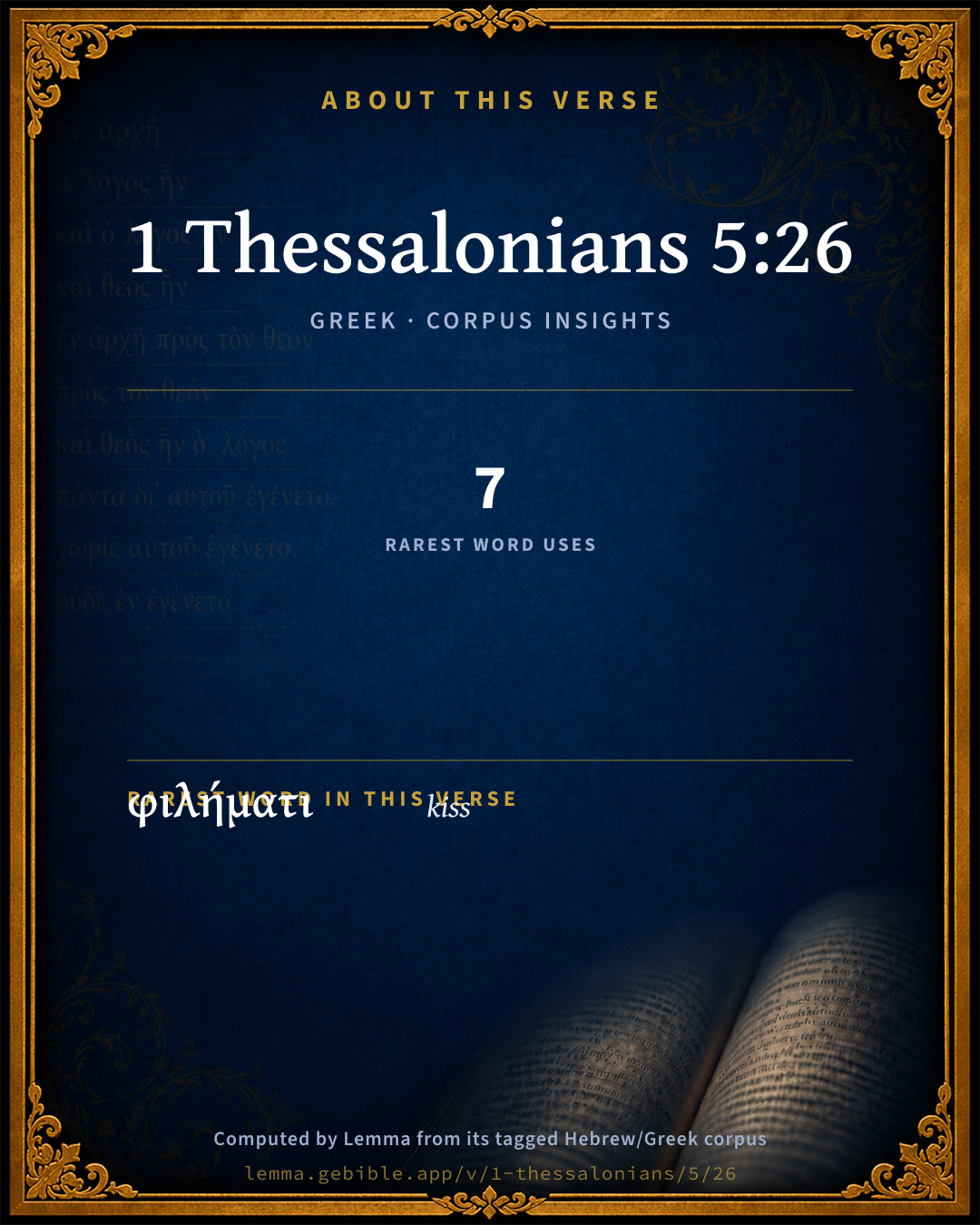
The rarest word here is φιλήματι kiss G5370 — appearing just 7 times in the whole Greek New Testament.

Shared distinctive vocabulary

φιλήματι kiss G5370 occurs in 7 verses of the Greek New Testament. Also found in:

Cross-references

2

Topical passages linked to 1 Thessalonians 5:26 in the Treasury of Scripture Knowledge — connected by theme and wording, ordered by reader-vote popularity; previews shown in the World English Bible.

  • Romans 16:16 Greet one another with a holy kiss. The assemblies of Christ greet you.
  • 1 Corinthians 16:20 All the brothers greet you. Greet one another with a holy kiss.

Cross-references courtesy of OpenBible.info (CC BY 4.0).

Commentary

Notes on 1 Thessalonians 5:26 from classic Christian and Jewish commentators (each source and its license shown beneath its notes). The classic Christian expositions comment on the surrounding passage and are grouped to its opening verse, so a note may address several verses; the Jewish commentaries on the Tanakh (Rashi and others) are per-verse, so they appear only where the commentator wrote on this verse.

Lemma curates 59 commentaries, every one of them public domain or Creative Commons licensed, each selected and text-cleaned for this edition rather than reprinted as found. About our sources →

The Biblical Illustrator

Joseph S. Exell

1Th_5:26

Greet all the brethren with an holy kiss

The holy kiss

This exhortation in various forms is frequent (Rom_16:16; 1Co_16:20; 2Co_13:12; 1Pe_5:14); and it must be borne in mind was addressed to men with respect to men, and to women with respect to women only.

At this time worship would be conducted in accordance with the strict customs of the East, the men being separated from the women. It is still altogether contrary to chastity or good fame for a man and woman to greet one another in public, even though members of the same family. Hence the embarrassment of the disciples (Joh_4:27). Had anything been intended so monstrous to the notions of the Greeks as the fact of all men indiscriminately kissing all women it must have been distinctly stated, and that with restrictions to guard against its abuse. Moreover, had such indiscriminate salutation been allowed it would have formed a damaging charge, sure to have been brought by Pagan and Jewish objectors; but no such charge is discovered in the writings of the early centuries. The custom was practised for a long time. It was called the kiss of greeting, the kiss of peace, sometimes only the peace. One special time when it was employed was during Divine service just before Communion. In the Apostolic Constitutions, a work of the third century, the author says, On the other side let the men sit with all silence and good order; and the women, let them also sit separately, keeping silence Then let the men salute one another, and the women one another with the kiss in the Lord. There are two distinct kinds of kissing--one is that of dependants or suppliants kissing a supreme hand, feet, hem of garment, or dust on which he has trodden. The other is that which takes place between equals. When these are relatives or dear friends each in turn places his head face downwards upon the others left shoulder, and afterwards salutes the right cheek, and then reverses the action (Gen_33:4; Gen_45:14-15! Act_20:37). Between the first and last mentions of this custom stretches a period of more than eighteen hundred years! What wonder, then, that after the lapse of another eighteen hundred years, we find it still the same in the changeless life of Bible Lands! When a kindly, but somewhat more formal and respectful, salutation passes between those of the same rank, they will take hold of each others beards and kiss them, and it is a great insult to take hold of a mans beard for any other purpose (2Sa_20:9-10). There is, however, another common occasion of kissing, viz., between a host and his guests, when one places the right hand upon the others left shoulder and kisses the right cheek, and then the left hand on the right shoulder, kissing the left cheek (2Sa_15:5). For the neglect of this Simon the Pharisee was rebuked (Luk_7:45), by our Lord, committing, as he did, a gross breach of the laws of hospitality. Another formal mode of salutation between equals is to join the right hands; then each kisses his own hand and puts it to his lips and forehead or over his heart. Most probably it was by laying the hand on the shoulder and kissing the cheek that the early Christians saluted one another. It was intended to teach believers of their common brotherhood in Christ, without distinction of caste or rank. It answers exactly to our hearty shaking of the hands. (J. Neil, M. A.)

Fraternal salutation

I. The practice itself. It was an ordinary mode of salutation, and had been practised at all times in eastern countries, sometimes even by men, and that, too, for opposite purposes. Hence Judas, when he wished to betray his Master, he did so with a kiss, testifying his apparent friendship on the one hand, and his abominable treachery on the other. A kiss was the sign of affection; and so by that slight artifice Judas thought to conceal his base purpose. Jesus, with severity, reproached him justly for it: Betrayest thou, He said, the Son of Man with a kiss? As if He had said, Dost thou violate all thy obligations of fidelity to thy Master, and thus deliver Him up to death? The kiss is the outward token of inward affection, but thou dost employ it basely and wickedly, intending to add deceit, disguise, and the prostitution of a mark of esteem to the crime of treason. Every word of Christs reproach must surely have gone to the heart of Judas. The same artifice, however, was frequently resorted to for a like purpose. Take, as proof, that between Joab and Abner (2Sa_3:27).

II. The sanctity of this practice. St. Paul speaks of a holy kiss, to denote that he intended it to be an expression of Christian affection, and so to guard it against all improper familiarity and scandal. Thus he sends a friendly salutation from himself, and Silvanus, and Timotheus; and he would have them signify their mutual love and affection to one another by the kiss of charity. So far this was well; but there are other ways of showing attachment to Christian brethren of a less suspicious and more certain character, such as rejoicing with them when they rejoice, and weeping with them when they weep, bearing their burdens and relieving their wants. This is indeed good and acceptable in the sight of God. (A. Barnes, D. D.)

Christian greeting

Shake hands with somebody as you go out of church. The more of it the better, if it is expressive of real interest and feeling. There may be a great deal of the spirit of the gospel put into a hearty shake of the hand. Think of St. Pauls four times repeated request, Greet one another, after the custom then in common use, and one which is expressive of even warmer feeling than our common one of hand shaking. Why not give your neighbours the benefit of the warm Christian feeling that fills you to your finger tips, and receive the like from them in return? You will both be benefited by it; and the stranger will go away feeling that the church is not, after all, so cold as he had thought it to be.

A smiling greeting

A lady of position and property, anxious about her neighbours, provided religious services for them. She was very deaf--could scarcely hear at all. On one occasion, one of her preachers managed to make her understand him, and at the close of their conversation asked: But what part do you take in the work? Oh, she replied, I smile them in and I smile them out! Very soon the preacher saw the result of her generous, loving sympathy in a multitude of broad-shouldered, hard-fisted men, who entered the place of worship, delighted to get a smile from her as she used to stand in the doorway to receive them. Why do not the working classes attend the house of God? They would, in greater numbers, if self-denying, Christ-loving Christians would smile them in and smile them out. (The Christian.)

The Biblical Illustrator, edited by Joseph S. Exell (c. 1880s–1900s) — public domain. Text from a community e-Sword module.

Tyndale Open Study Notes

Tyndale Open Resources

5:26 a sacred kiss (see also Rom 16:16; 1 Cor 16:20; 2 Cor 13:12; 1 Pet 5:14): Kissing on the cheek or forehead was a common form of greeting that reflected such sentiments as honor, friendship, and love among family members (Mark 14:44-45; Luke 7:36-47; 15:20; Acts 20:37).

Tyndale Open Study Notes — © Tyndale Open Resources, licensed CC BY-SA 4.0. Text via the HelloAO Bible API.

Meyer's Critical & Exegetical Commentary

Heinrich August Wilhelm Meyer

1Th_5:26. Ἀσπάσασθε τοὺς ἀδελφοὺς πάντας] That here individuals[68] are exhorted to salute the other members of the church, whilst in the parallel passages, Rom_16:16, 1Co_16:20, 2Co_13:12, it is ἀσπάσασθε ἀλλήλους, is a proof that this Epistle was to be received by the rulers of the church. (So also Php_4:21.) By them it was to be read to the assembled church (1Th_5:27). Erroneously, because in contradiction with the entire character of the Epistle, Schrader infers from τοὺς ἀδελφοὺς πάντας that the writer of the Epistle wished to impart to it a general destination.

ἐν φιλήματι ἁγίῳ] with a holy kiss. Comp. 1Co_16:20; 2Co_13:12; Rom_16:16; also 1Pe_5:14 (φίλημα ἀγάπης); Constit. ap. ii. 57 (τὸ ἐν κυρίῳ φίλημα); Tertullian, de orat. 14 (osculum pacis). The brotherly kiss, the usual salutation of Christians, proceeded from the custom of antiquity, particularly in the East, to unite a salutation with a kiss. But Paul calls it ἅγιον, as a symbol of the holy Christian fellowship. In the Greek church it is still used at Easter.

[68] Contrary to the sense, Hofmann, whom Riggenbach follows, makes the whole church, the ἀδελφοὶ πάντες, be addressed in ἀσπάσασθε; thus the church is to salute itself.

Meyer — Critical and Exegetical Commentary on the New Testament — English translation by Peter Christie, edited by Frederick Crombie (T&T Clark, 1880) — public domain. Text from a community e-Sword module.

Expositor's Greek Testament

ed. W. Robertson Nicoll

1Th 5:26 . Neither here, nor above at 1Th 5:14 , is there any reason to suppose that Paul turns to address the leaders of the local church (so e.g. , Bornemann, Ellicott, Alford, Askwith, Zimmer, Lightfoot, Weiss, Findlay) as though they were, in the name of the apostle(s), to convey the holy ( i.e. not of convention or human passion) kiss, which betokened mutual affection ( cf. Renan’s S. Paul , 262, DC [34] . i. 935, and E. Bi [35] , 4254) in the early Christian worship. This greeting by proxy is not so natural as the ordinary sense of the words; the substitution of τ . ἀ . π . for the more common ἀλλήλους is intelligible in the light, e.g., cf. Phi 4:21 ; and it would be harsh to postulate so sharp a transition from the general reference of 1Th 5:25 and 1Th 5:28 . Even in 1Th 5:27 it is not necessary to think of the local leaders. While the epistle would naturally be handed to some of them in the first instance, it was addressed to the church; the church owned it and was held responsible for its public reading at the weekly worship. πᾶσιν , like the πάντας of 1Th 5:26 , simply shows Paul’s desire to prevent the church from becoming, on any pretext, a clique or coterie. But the remarkable emphasis of the injunction points to a period when such public reading of an apostolic epistle was not yet a recognised feature in the worship of the churches. Paul lays stress upon the proper use of his epistle, as being meant not for a special set, but for the entire brotherhood ( i.e. , at Thessalonica, not, as Flatt thinks, in Macedonia). See that every member gets a hearing of it at some meeting or other ( ἀναγ ., timeless aor.), and thus knows exactly what has been said. So Apoc. Bar . lxxxvi.: “when therefore ye receive this my epistle, read it in your congregations with care. And meditate thereon, above all on the days of your fasts.”

[34] CG Hastings’ Dictionary of Christ and the Gospels (1907 1908)

[35] Encyclopædia Biblica

The Expositor's Greek Testament, edited by W. Robertson Nicoll (1897–1910) — public domain. Text from a community e-Sword module.

Jamieson, Fausset & Brown

Robert Jamieson, A. R. Fausset & David Brown

Hence it appears this Epistle was first handed to the elders, who communicated it to "the brethren."

holy kiss--pure and chaste. "A kiss of charity" (Pe1 5:14). A token of Christian fellowship in those days (compare Luk 7:45; Act 20:37), as it is a common mode of salutation in many countries. The custom hence arose in the early Church of passing the kiss through the congregation at the holy communion [JUSTIN MARTYR, Apology, 1.65; Apostolic Constitutions, 2.57], the men kissing the men, and the women the women, in the Lord. So in the Syrian Church each takes his neighbor's right hand and gives the salutation, "Peace."

Jamieson, Fausset & Brown — Commentary Critical and Explanatory on the Whole Bible (1871) — public domain (CC PDM 1.0). Text via the HelloAO Bible API.

Adam Clarke's Commentary

Verse 26. Greet all the brethren] See Clarke on Ro 16:16. Instead of all the brethren, the Coptic has, greet one another; a reading not noticed by either Griesbach or Wetstein.

Adam Clarke's Commentary on the Bible (1810–1826) — public domain. Text from a community e-Sword/MySword module.

John Calvin's Commentaries

26 Salute all the brethren with an holy kiss. As to the kiss, it was a customary token of salutation, as has been stated elsewhere. In these words, however, he declares his affection towards all the saints.

John Calvin's Commentaries (1540-1563) — public domain. Text from the Calvin Translation Society English edition (1840s-50s) via the Christian Classics Ethereal Library (ccel.org). Calvin's coverage is partial (roughly two-thirds of the Bible); uncommented books and verses are honest gaps, never fabricated. The 19th-century editor's footnotes and remarks are omitted so the notes are faithfully Calvin's own voice.

Ellicott's Commentary for English Readers

(26) Greet all the brethren.—It is concluded from the manner in which some are told to greet all, instead of all being told to greet one another (as in the parallel passages), that the “brethren” to whom the letter was sent specially were the priesthood of Thessalonica (comp. the next verse). If so, the “holy kiss” had hardly become the fixed Church ceremony which it afterwards was, for the practice (according to the Apostolicqal Constitutions) was for the Church members to pass the kiss from one to another, men kissing men, and women kissing women, not for all the people to be kissed in turn by the priest. This kiss, however, is no doubt intended by St. Paul to be given at a solemn assembly of the Church, i.e., at the Holy Communion, which was the only fixed meeting of the Primitive Church. In the time of St. Cyril of Jerusalem, the kiss was given just before the Sursum Corda. It was not till the thirteenth century that the kissing of the Pax was substituted in the Western Church for the kissing of the brethren. This kiss was to differ from the ordinary Greek salutation, by being distinctly a holy kiss, i.e., a ceremonial, religious kiss.

A Bible Commentary for English Readers, edited by Charles John Ellicott (1878–1897) — public domain. Text from a community e-Sword module.

The Cambridge Bible for Schools and Colleges

gen. ed. J. J. S. Perowne

26. Greet all the brethren with a holy kiss] Better, Salute (R. V.). The kiss, as the common sign of affection amongst kindred and near friends in meeting or parting, was universal in the primitive Christian assemblies, and is still a usage of the Greek and Oriental Churches, especially at Holy Communion. In the West the ceremony gradually died out during the Middle Ages. It was unsuitable to the reserved manners of the Germanic races. The custom was naturally liable to abuse and suspicion, when the simplicity of primitive Christian feeling declined; and it became the subject of numerous regulations in early Councils. The Apostle desires “a holy kiss” to be exchanged by those who heard the Epistle read, as an expression through the Church of his love to each of its members. So in Rom_16:16, after bidding the Church “salute” by name a number of his personal acquaintances, he includes all present at the reading of the letter by saying, “Salute one another with a holy kiss.” The same thing is said in 1Co_16:20, followed by the words, “My love be with you all in Christ Jesus;” also in 2Co_13:12. In 1Pe_5:14 the salutation is called “a kiss of love.”

The Cambridge Bible for Schools and Colleges (gen. ed. J. J. S. Perowne; Cambridge University Press, 1878–1918) — public domain. Text from a community e-Sword module.

Trapp's Complete Commentary

John Trapp

26 Greet all the brethren with an holy kiss.

Ver. 26. With an holy kiss] Our very civilities should savour of sanctity, and our common conversation relish of religion, Zec 14:20-21.

John Trapp, A Commentary or Exposition upon All the Books of the Old and New Testament (1647–1656) — public domain. Text from a community e-Sword module.

Albert Barnes' Notes on the Bible

Greet all the brethren with an holy kiss - see the notes on Rom 16:16.

Albert Barnes' Notes on the Bible (1834–1885) — public domain. Text from a community e-Sword/MySword module.

Matthew Poole's English Annotations

The apostle concludes several of his Epistles with greeting, or salutations, as men usually do at this day; sometimes with salutations from himself alone, sometimes from others, either particular persons, or churches which he sometimes names, as Rom 16:6, &c.; 1Co 16:19; and sometimes commends to the saints their saluting one another, as Rom 16:16; 1Co 16:20; so here in the text. The persons to be saluted are

all the brethren, that is, all believers incorporated into the gospel church, under one common Head and common Father; more particularly, those of this particular church. We call men brethren, sometimes upon a natural, sometimes a civil account; and why not much more upon a spiritual account? And as their love should reach to the brotherhood, 1Pe 2:17, so their salutation should reach all the brethren, poor and rich, high and low, bond and free.

With an holy kiss; ἐν φιλήματι ἁγίῳ. The rite or ceremony of men kissing each other was much used among the Jews, and in the Eastern countries, in their salutations, Gen 27:26; Pro 24:26; Luk 7:45; and thence it came to be practised in the churches of Christ as an outward symbol and token of love and friendship; which is not now practised with us amongst men, but is of the same signification with joining of hands; the uniting of lips or hands together denoting the inward conjunction of the heart. The word in the Greek signifies love or friendship, and is called a kiss of charity, 1Pe 5:14. And though the ceremony is ceased, yet that which it signified is to be preserved in all churches, places, and ages. It was practised in the time of Justin Martyr, Just. Mar. Apolog. 2., and Tertullian, Tertul. de Oratione; and called oscutum pacis, a kiss of peace; and used especially at their meeting together at the Lord’s supper, their love feasts, and other solemn assemblies. It is called a holy kiss, to distinguish it from the treacherous kiss of Judas, or the lustful kiss of the harlot, Pro 7:13. And why it is not used among us now, we need say only, as concerning washing of feet also: We have no such custom, nor the churches of Christ; or, as the apostle speaks, Phi 4:8; Whatsoever things are lovely, and whatsoever things are of good report, & c.

Matthew Poole's English Annotations on the Holy Bible (1683–1685) — public domain. Text from a community e-Sword/MySword module.

Whedon's Commentary on the Bible

Daniel D. Whedon

26. Greet—This and the following verse, it is conjectured, are addressed to the Church officers.

Holy kiss—See note on Rom_16:16.

Daniel D. Whedon (gen. ed.), Commentary on the Old and New Testaments (1874–1909) — public domain. Text from a community e-Sword module.

The Pulpit Commentary

Greet all the brethren with a holy kiss. That certain persons were enjoined to salute the other members of the Church is a proof that the Epistle was given into the hands of the presbyters. The reference is to the mode of salutation in the East. The kiss is called "holy" because it was the symbol of Christian affection. The same exhortation is made in other Epistles. (Rom_16:16; 1Co_16:20; 2Co_13:12)

The Pulpit Commentary (1880–1919), ed. H.D.M. Spence-Jones & Joseph S. Exell — public domain. Text from a community e-Sword module.

Burkitt's Expository Notes on the New Testament

William Burkitt

Our apostle concludes his epistle with salutations to all the brethren and members of the church, without exception, poor and rich, advising them to manifest and testify their affection one to another, by a kiss given to each other, a ceremony of civility much in use in those eastern countries; yet requires, that it should not be a wanton, but a holy kiss: intimating to us, that our civil actions should have a relish and savour of holiness.

Hence it is, that St. Paul is so careful to give particular directions for the right ordering of our speech and discourse in common conversation, that it be grave and savoury, Col 4:6 : of our apparel, that it be such as becomes those that profess the gospel; and here, that our courteous salutations of each other should be chaste and holy, Greet one another with a holy kiss: their kiss of love and peace, must truly signify, what it makes shew of, that neither treachery, nor cruelty, nor hypocrisy, nor lust, may insinuate itself into such a symbol of holy love.

William Burkitt's Expository Notes on the New Testament (1700–1703) — public domain. Text from a community e-Sword module.

McGarvey & Pendleton's Commentaries

J. W. McGarvey

Salute all the brethren with a holy kiss . [In the East, a kiss was and still is a common salutation among kindred and near friends. Paul did not, by this command, create a church ordinance or ceremony; nor did he even create a new custom. He merely injected a spiritual virtue into an old-established, time-honored custom. This custom never prevailed among the nations of the West, and we feel that we obey Paul when we shake hands with holiness; i. e., with cordial sincerity and honest good-will. The Bible was not written as a work on etiquette, nor was it intended in this case that the Syrian and Grecian custom should become universal.]

J. W. McGarvey (with Philip Y. Pendleton), Commentaries on the New Testament (The Fourfold Gospel, 1914; Acts; and the epistles) — public domain. Text from a community e-Sword/MySword module.

The People's New Testament

B. W. Johnson

26. Greet all the brethren with a holy kiss. See notes on Rom. 16:16, and 1 Cor. 16:20.

B. W. Johnson's The People's New Testament with Notes (1889–1891) — public domain. Electronic text from the Christian Classics Ethereal Library (CCEL) ThML edition.

Cambridge Greek Testament for Schools and Colleges

26. Ἀσπάσασθε τοὺς ἀδελφοὺς πάντας ἐν φιλήματι ἁγίῳ. Salute the brothers all in a holy kiss. In 1Pe 5:14 the kiss is defined, by its quality, φίλημα ἀγάπης: love and holiness were identified in the prayer of 1Th 3:12 f. above (see notes); the injunction of the φίλημα is followed by words upon love, and of love, in 1Co 16:20-24; cf. also 2Co 13:11-13. Such love was implied in the fellowship of prayer expressed in the verses just preceding. The “kiss” is ἅγιον as the token of love amongst the ἅγιοι (1Th 3:13, 1Th 4:7 f.); it is called in the Apost. Constitt., ii.57, τὸ ἐν Κυρίῳ φίλημα, and by Tertullian, for the Latin Church, osculum pacis, by St Augustine osculum sanctum. The Apostles wish the φίλημα to be given in conveying their “greeting,” and by way of signifying their love to “all” the Thessalonian believers; its communication in this form pre-supposes, and simultaneously expresses, the mutual love reigning in the Church (1Th 1:3; 2Th 1:3). The direction is presumably given, as Lightfoot and Bornemann point out, to the primary receivers of the Letter—probably the προιστάμενοι, scil. Elders, spoken of in 1Th 5:12 above and addressed in 1Th 5:14 f. (see notes); these are to give the kiss in the name of the writers to the Church at large. Such a salutation they were probably accustomed to bestow at Church gatherings; on the occasion of reading this Letter, it is to be given and received as from Paul and his companions.

The kiss, as the natural sign of affection amongst kindred and near friends in meeting or parting, was common in the primitive Christian assemblies, with their strong sense of fraternity. It is still a usage of the Greek and Oriental Churches at Holy Communion; but the ceremony died out in the West during the Middle Ages, being less suitable to the colder manners of the Germanic races. The custom fell into suspicion as the simplicity of Christian feeling declined; it was the subject of numerous regulations in early Councils. See the article Kiss in the Dict. of Christian Antiquitics, and φίλημα in Suicer’s Thesaurus.

Cambridge Greek Testament for Schools and Colleges (Cambridge University Press, 1896; 21 vols, various authors incl. Carr, Maclear, Plummer, Farrar, Lumby, Moule, M. R. James, Simcox) — public domain. Text from a community e-Sword module.

Alford’s Greek Testament

Henry Alford

26.] From this verse and the following, it would appear that this letter was given into the hands of the elders.

ἐν, simply ‘in,’—the kiss being the vehicle of the salutation: in our idiom, ‘with.’

Henry Alford, The Greek Testament (1849–1861) — public domain. Text from a community e-Sword module.

International Critical Commentary

26. ἀσπάσασθε κτλ The second request takes the form of a salutation characteristic of contemporary epistolary literature. “Because being absent he could not greet them with the kiss, he greets them through others, as when we say: Kiss him for me” (Chrys.). The fact that instead of the expected ἀλλήλου (Rom 16:16, 1Co 16:20, 2Co 13:12; 1Pe 5:14) Paul writes τοὺς ἀδελφοὺς πάντα indicates not that he is turning from the brethren addressed in v. 25 to the workers who take the lead and admonish, but that he is tactfully including in the number of those to be greeted for him not only the workers, the faint-hearted, and the weak, but also the idlers (cf. Php 4:21 ἀσπάσασθε πάντα ἅγιο without exception). The kiss is holy because it is the expression not of romantic but of Christian love (ἐν φιλήματι ἀγάπη 1Pe 5:14).

On the salutation in epistolary literature, see the references given in the note on 1:1. Greetings (ἀσπάζεσθα or ἀσπασμό or both) are found in all Paul’s letters except Gal. and Eph. In Rom 16:16, 2Co 13:12, ἀλλήλου is parallel to οἱ ἅγιοι πάντε, in 1Co 16:20 to οἱ ἀδελφοὶ πάν τε Over against De W., Lün., Ell., Find., Born and others who find the leaders addressed, Hofmann, Wohl., Mill., Dob., Moff. rightly see the brethren as a whole.

φίλημ, apart from the passages noted above, occurs in the Gk. Bib. only Luk 7:45, Luk 7:22:48; Pro 27:6, Son 1:2 (φιλήματ). “In the ancient world one kissed the hand, breast, knee, or foot of a superior, and the cheek of a friend. Herodotus (I, 134) mentions kissing the lips as a custom of the Persians. Possibly from them it came to the Jews” (Toy, ICC on Pro 24:26—the only distinct reference to kissing the lips, since Gen 41:40 (see Skinner, ICC ad loc.) is doubtful). That the “holy kiss” is kissing the lips, or that the kiss was given promiscuously cannot be inferred from our verse (Cheyne in EB 4254, who notes Neil, Kissing: Its Curious Bible Mentions, 1885, 27 ff., 78 ff.). The Jewish and Christian attitude is probably expressed in that of Bunyan (Grace Abounding, 316): “Some indeed have urged the holy kiss, but then I have asked why they made baulks? Why did they salute the most handsome and let the ill-favoured go? Thus how laudable soever such things have been in the eyes of others, they have been unseemly in my sight.” Cheyne states that Conybeare (Exp 1894, 461) “points out two passages in Philo’s quaestiones in Ex. preserved in Armenian, which seem to imply that the “kiss of peace” or “of concord” was a formal institution of the synagogue,”—an opinion which Schultze (article Friedenskuss in Pro_3 VI, 274 f.) thinks possible.—This kiss is mentioned in Justin (Apol. I, 65), ἀλλήλους φιλήματι ἀσπαζόμεθα παυσάμενοι τῶν εὐχῶ It came before the eucharistic prayer and after the other prayers (Tert. de orat. 18; the references in ad uxorem, II, 4 (iam vero alicui fratrum ad osculum convenire) and in de virg. vel. 14 (inter amplexus et oscula assidua) are uncertain, but seem to point to the extension of the custom). It is probable (so Cheyne and Schultze) that the φίλημ was not originally promiscuous, and that the ordinances of the Apostolical Constitutions (II, 57:12, VIII, 11:41) arose in view of the abuse. For the history of the custom in Christian worship, see, in addition to Cheyne and Schultze, the article Kiss in the Dictionary of Christian Antiquities and the note of Robertson and Plummer in ICC on 1Co 16:20.

International Critical Commentary — older volumes (1896–1929), various authors — public domain. Text from a community e-Sword module.

Vincent's Word Studies in the New Testament

Marvin R. Vincent

Kiss. See on 2Co 13:12. Comp. Rom 16:16; 1Co 16:20; 1Pe 5:14.

Marvin R. Vincent, Word Studies in the New Testament (1887–1900) — public domain. Text from a community e-Sword/MySword module.

Lesson kit

Teaching starters — assembled from the data on this page, not authored interpretation. Every prompt links to the verse data it draws on. Edit before teaching.

1 Thessalonians, in the Pauline Epistles, opens this verse with 7 words (7 distinct Greek lemmas). Its most distinctive word is phílēma (“kiss”). A historical commentator’s framing appears above. Read the whole chapter for the surrounding context.

Discussion questions

  1. The word phílēma carries the sense “kiss.” How does it shape the verse?
  2. Luke 7:45 shares the word «kiss» with this verse. How do the two illuminate each other?
  3. These translations render this verse differently; the difference is in the English rendering, not the original. What questions does that raise?
  4. Reading how The Biblical Illustrator and Tyndale Open Study Notes read this verse, where do the two commentators agree and where do they part?

Things to notice

Reading settings

Reading text

Shown beneath each verse's original-language words.

Old Testament
Old Testament edition

Read the OT as the Masoretic Hebrew (MT) or the Greek Septuagint (LXX).

English shown for the Greek Septuagint (in the Hebrew ↔ Greek comparison).

Comparing translations? Open the Compare panel on any verse page to stack up to four side by side.