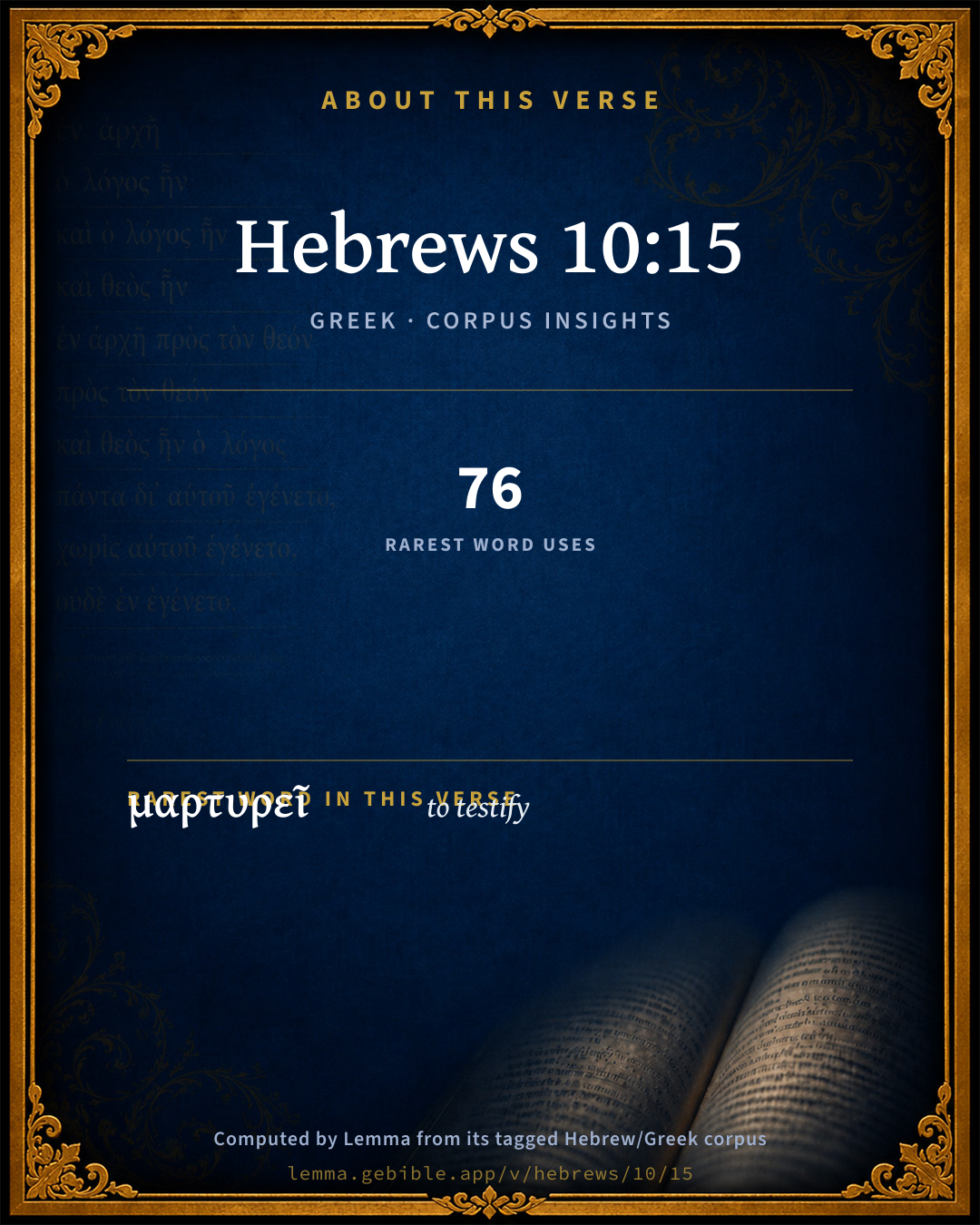
Hebrews 10:15

Greek (Tischendorf 8th ed.) Hebrews 10:15 appears in the Greek New Testament. The text above is from the Tischendorf 8th edition. Each word links to its Strong’s number and a concise gloss. Click any word for its full Thayer’s Greek Lexicon entry.
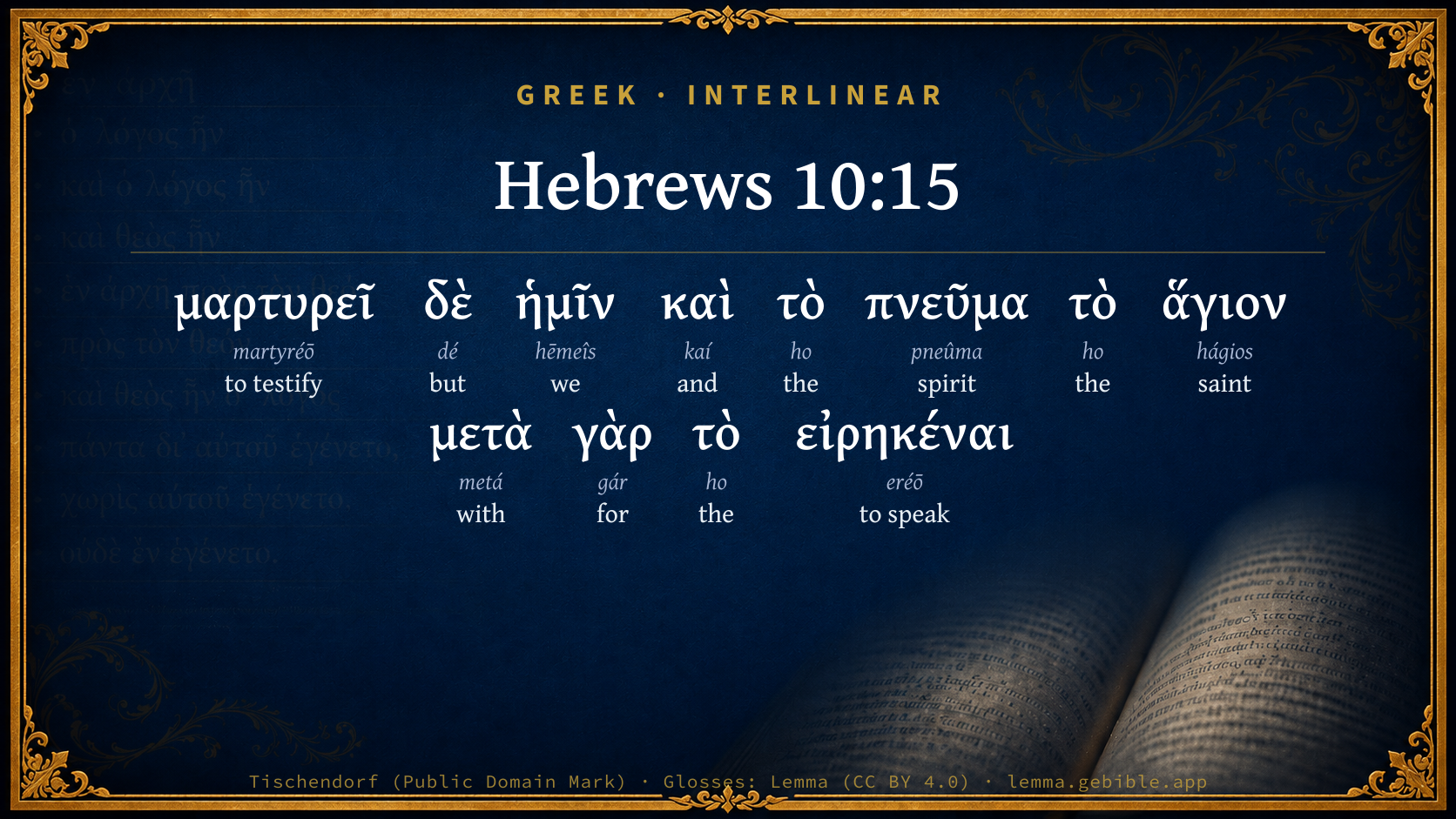
Download image
Cite this verse

Hebrews 10:15 (World English Bible). Public Domain. Lemma interlinear Bible study tool, https://lemma.gebible.app/v/hebrews/10/15.

Show BibTeX & RIS
BibTeX
RIS
English Translation
The Holy Spirit also testifies to us, for after saying,
World English Bible · Public Domain
Download a study sheet

One document with this verse’s original text, its word-by-word gloss line, the meaning frame, cross-references with their text, attributed commentary, and full source and license credits — printable, and it pastes into notes with its structure intact.

This verse Autodidact and up

Study sheet (.html) Plain text (.txt)

A passage Seminary Student

Up to 50 verses in one chapter. A passage sheet keeps up to 6 commentary sources and 12 cross-references per verse, in the order this page ranks them, and says so on the sheet whenever that leaves anything out. Ask for a single verse and you get the Autodidact verse sheet above.

Everything on this page stays free to read, with no account — the sheet is a download of what is already on screen, not access to it.

Want to remove ads? Support Godless Engineer
Compare translations 3

The same verse in 3 English versions, stacked beneath the original-language interlinear above. Click any original word for its lexicon entry.

Each is an independent rendering of the whole verse — the interlinear is not word-aligned to these translations.

Highlighted words mark where these versions differ — a whole-verse word diff, not a word-by-word alignment.

  • World English Bible Public Domain
    The Holy Spirit also testifies to us, for after saying,
  • King James Version Public Domain
    Whereof the Holy Ghost also is a witness to us: for after that he had said before,
  • unfoldingWord Literal Text CC BY-SA 4.0
    And the Holy Spirit also testifies to us, for after having said,

unfoldingWord Literal Text — © unfoldingWord, licensed CC BY-SA 4.0. Word-aligned USFM3 via Door43 (git.door43.org/unfoldingWord/en_ult).

Versions to compare (up to 4)

3 of 4 selected

Show all 19 translations

Every available English version of this verse, each an independent rendering of the whole verse.

  • World English Bible Public Domain
    The Holy Spirit also testifies to us, for after saying,
  • Berean Standard Bible Public Domain
    The Holy Spirit also testifies to us about this. First He says:
  • Majority Standard Bible Public Domain
    The Holy Spirit also testifies to us about this. First He says:
  • King James Version Public Domain
    Whereof the Holy Ghost also is a witness to us: for after that he had said before,
  • American Standard Version (1901) Public Domain
    And the Holy Spirit also beareth witness to us; for after he hath said,
  • Revised Version (1885) Public Domain
    And the Holy Ghost also beareth witness to us: for after he hath said,
  • Geneva Bible (1599) Public Domain
    For the holy Ghost also beareth vs record: for after that he had sayd before,
  • Douay-Rheims (1899) Public Domain
    And the Holy Ghost also doth testify this to us. For after that he said:
  • Young's Literal Translation Public Domain
    and testify to us also doth the Holy Spirit, for after that He hath said before,
  • Literal Standard Version CC BY-SA 4.0
    and the Holy Spirit also testifies to us, for after that He has said before,
  • Unlocked Literal Bible CC BY-SA 4.0
    The Holy Spirit also testifies to us. First he said,
  • unfoldingWord Literal Text CC BY-SA 4.0
    And the Holy Spirit also testifies to us, for after having said,
  • Darby Bible Public Domain
    And the Holy Spirit also bears us witness [of it]; for after what was said:
  • World Messianic Bible Public Domain
    The Holy Spirit also testifies to us, for after saying,
  • Webster's Bible Public Domain
    Of this the Holy Spirit also is a witness to us: for after that he had said before,
  • Free Bible Version CC BY-SA 4.0
    As the Holy Spirit also tells us, for having said,
  • Bible in Basic English Public Domain
    And the Holy Spirit is a witness for us: for after he had said,
  • Text-Critical English NT CC BY 4.0
    The Holy Spirit also testifies to us about this. First he says,
  • Tyndale New Testament (1534) Public Domain
    And the holy goost also beareth vs recorde of this even when he tolde before:

Literal Standard Version (2020), Covenant Press — licensed CC BY-SA 4.0. Text via the HelloAO Bible API (eBible.org). Unlocked Literal Bible (unfoldingWord) — licensed CC BY-SA 4.0. Text via the HelloAO Bible API (eBible.org). unfoldingWord Literal Text — © unfoldingWord, licensed CC BY-SA 4.0. Word-aligned USFM3 via Door43 (git.door43.org/unfoldingWord/en_ult). Free Bible Version, Dr. Jonathan Gallagher — licensed CC BY-SA 4.0. Text via the HelloAO Bible API (eBible.org).

Word by word

More ways to search: Search by grammar → Find every occurrence → Compare this word →

Practice this passage: Drill this verse → Learn its vocabulary →

μαρτυρεῖ
martyréō
G3140
“to testify”
Verb, Present, Active, Indicative, 3rd person, Singular
Part of Speech
Verb
Tense
Present
Voice
Active
Mood
Indicative
Person
3rd person
Number
Singular
Full Thayer's Definition

Origin: from G3144

TDNT: 11:54,6

1. to be a witness, to bear witness, i.e. to affirm that one has seen or heard or experienced something, or that he knows it because taught by divine revelation or inspiration a. to give (not to keep back) testimony b. to utter honourable testimony, give a good report c. conjure, implore
  1. δὲ dé G1161 “but” Conjunction
  2. ἡμῖν hēmeîs G2249 “we” Personal pronoun, 1st person, Dative, Plural
  3. καὶ kaí G2532 “and” Conjunction
  4. τὸ ho G3588 “the” Article, Nominative, Singular, Neuter
  5. πνεῦμα pneûma G4151 “spirit” Noun, Nominative, Singular, Neuter
  6. τὸ ho G3588 “the” Article, Nominative, Singular, Neuter
  7. ἅγιον hágios G40 “saint” Adjective, Nominative, Singular, Neuter
  8. μετὰ metá G3326 “with” Preposition
  9. γὰρ gár G1063 “for” Conjunction
  10. τὸ ho G3588 “the” Article, Accusative, Singular, Neuter
  11. εἰρηκέναι eréō G2046 “to speak” Verb, Perfect, Active, Infinitive

About this verse

These counts appear in no published source. They are computed here, from the morphology-tagged text and Lemma’s own curated glosses. What Lemma adds →

12
words
10
distinct lemmas
General Epistles
section

Repetition

A word recurs within this verse:

Cross-references

17

Topical passages linked to Hebrews 10:15 in the Treasury of Scripture Knowledge — connected by theme and wording, ordered by reader-vote popularity; previews shown in the World English Bible.

  • Hebrews 3:7 Therefore, even as the Holy Spirit says, "Today if you will hear his voice,
  • 2 Peter 1:21 For no prophecy ever came by the will of man: but holy men of God spoke, being moved by the Holy Spirit.
  • Revelation 2:11 He who has an ear, let him hear what the Spirit says to the assemblies. He who overcomes won't be harmed by the second death.
  • Revelation 3:6 He who has an ear, let him hear what the Spirit says to the assemblies.
  • John 15:26 "When the Counselor has come, whom I will send to you from the Father, the Spirit of truth, who proceeds from the Father, he will testify about me.
  • Acts 28:25 When they didn't agree among themselves, they departed after Paul had spoken one word, "The Holy Spirit spoke rightly through Isaiah, the prophet, to our fathers,
  • 2 Samuel 23:2 The Spirit of Yahweh spoke by me, His word was on my tongue.
  • Nehemiah 9:30 Yet many years did you bear with them, and testified against them by your Spirit through your prophets: yet would they not give ear: therefore gave you them into the hand of the peoples of the lands.
  • Hebrews 2:3–4 how will we escape if we neglect so great a salvation-- which at the first having been spoken through the Lord, was confirmed to us by those who heard;
  • Hebrews 9:8 The Holy Spirit is indicating this, that the way into the Holy Place wasn't yet revealed while the first tabernacle was still standing;
  • 1 Peter 1:11–12 searching for who or what kind of time the Spirit of Christ, which was in them, pointed to, when he predicted the sufferings of Christ, and the glories that would follow them.
  • Revelation 2:7 He who has an ear, let him hear what the Spirit says to the assemblies. To him who overcomes I will give to eat of the tree of life, which is in the Paradise of my God.
  • Revelation 2:17 He who has an ear, let him hear what the Spirit says to the assemblies. To him who overcomes, to him I will give of the hidden manna, and I will give him a white stone, and on the stone a new name written, which no one knows but he who receives it.
  • Revelation 2:29 He who has an ear, let him hear what the Spirit says to the assemblies.
  • Revelation 3:13 He who has an ear, let him hear what the Spirit says to the assemblies.
  • Revelation 3:22 He who has an ear, let him hear what the Spirit says to the assemblies."
  • Revelation 19:10 I fell down before his feet to worship him. He said to me, "Look! Don't do it! I am a fellow bondservant with you and with your brothers who hold the testimony of Jesus. Worship God, for the testimony of Jesus is the Spirit of Prophecy."

Cross-references courtesy of OpenBible.info (CC BY 4.0).

Where the printed editions differ

1 variant

Places in this verse where the major printed Greek editions disagree on the wording in a way that affects the translation — a comparison of editions, not a manuscript-by-manuscript collation. The editions are the modern critical texts (Nestlé-Aland 28/27, SBL, Westcott-Hort, Tregelles, Tyndale House) and the traditional texts behind the KJV (the Textus Receptus and the Byzantine/Majority text). It is not a claim about which reading is original.

  1. Different wording
    εἰρηκέναι·

    “to have said:”

    In NA28NA27TynSBLWHTreg Not in TRByz

    προειρηκέναι (proeirēkenai) 'to have predicted' occurs in traditional manuscripts (TR+Byz) instead of εἰρηκέναι· (eirēkenai) 'to have said:' in older manuscripts (NA28+NA27+Tyn+SBL+WH+Treg)

Textual data: Translators Amalgamated Greek New Testament (STEPBible TAGNT) · CC BY 4.0.

Commentary

Notes on Hebrews 10:15 from classic Christian and Jewish commentators (each source and its license shown beneath its notes). The classic Christian expositions comment on the surrounding passage and are grouped to its opening verse, so a note may address several verses; the Jewish commentaries on the Tanakh (Rashi and others) are per-verse, so they appear only where the commentator wrote on this verse.

Lemma curates 59 commentaries, every one of them public domain or Creative Commons licensed, each selected and text-cleaned for this edition rather than reprinted as found. About our sources →

The Biblical Illustrator

Joseph S. Exell

Heb_10:15-18

I will put My laws into their hearts

The Bible written in the mind:

Christianity in human life is better than Christianity in cold ink, because

1.

It contains the Divine things, the other only the symbols.

2. It is the end of culture, the other only the means.

3. It is self-obvious, the other requires explanation.

4. It is imperishable, the other temporary. (Homilist.)

A Saviour such as you need

I. IT IS THIS WHICH CONSTITUTES THE GLORY AND SUPERIORITY OF THE NEW COVENANT OF GRACE--NAMELY, THAT IT GIVES TO ALL WHO ARE INTERESTED IN PERFECT SALVATION. Our text tells us that in two points the old covenant was far behind the new: first, in the matter of sanctification the old covenant did not do what the new one accomplishes, for the new writes Gods law upon our hearts and upon our minds, whereas the old covenant was only written out on tables of stone; and, secondly, the old covenant could not put away the guilt of sin, whereas the new covenant runs on this wise--And their sins and their iniquities will I remember no more.

II. The doctrine, then, is that THERE IS NO MORE SACRIFICE FOR SIN, BECAUSE CHRIST SUPPLIES ALL THAT IS NEEDED.

III. Lastly, does not this doctrine ANSWER A QUESTION that has often been propounded to me, namely, HOW IT IS THAT THERE ARE SO MANY HEARTS WHICH CAN FIND NO PEACE? Some people are always learning, but never coming to the truth. They are good people in many senses, but they cannot be happy. They are always discontented. Now, what do you think is the reason? I am sure it is this, they will not agree that Christ shall be all in all to them. (C. H. Spurgeon.)

God forgives and forgets:

Mother forgives me when Ive been naughty, said a little girl; but I see in her face all day after, though she does not frown, that she remembers what I did in the morning. She cannot forget. God forgives and forgets, for He makes it up altogether.

Blotted out

A little boy was once much puzzled about sins being blotted out, and said: I cannot think what becomes of the sins God forgives, mother. Why, Charlie, can you tell me where are the figures you wrote on your slate yesterday? I washed them all out, mother. And where are they, then? Why, they are nowhere; they are gone, said Charlie. Just so it is with the believers sins--they are gone; blotted out; remembered no more.

The Biblical Illustrator, edited by Joseph S. Exell (c. 1880s–1900s) — public domain. Text from a community e-Sword module.

Tyndale Open Study Notes

Tyndale Open Resources

10:15-17 The author again quotes from Jer 31:33-34 (see Heb 8:7-12) to support the statement in 10:14, that Christ’s one offering under the new covenant has made worshipers perfect forever. • God’s laws have now been placed in their hearts and on their minds. This has internalized the believer’s relationship with God. • I will never again remember their sins and lawless deeds: As the author has shown (9:11–10:14), the superior sacrifice of Christ has made this new covenant reality possible.

Tyndale Open Study Notes — © Tyndale Open Resources, licensed CC BY-SA 4.0. Text via the HelloAO Bible API.

Bengel's Gnomon

Johann Albrecht Bengel

Heb 10:15. Καὶ) also. There is added, not a testimony to the arguments; for the testimonies even preceded the latter; but μαρτυρῶν to μαρτυροῦντας [the Holy Ghost witnessing in addition to those who bear witness]. Paul had given the testimony of the Father to the priesthood of Christ, ch. Heb 5:10, and of the Son, ch. Heb 10:5; now also that of the Holy Spirit: the testimony of each everywhere carrying with it the same conclusion; Heb 10:18. Look back to the General View (Synopsis) of the epistle. And he presently afterwards repeats in his admonition this reference to the Holy Trinity, Heb 10:29, note.—μετὰ, after) The verb φησὶν, says He, is swallowed up in the clause, λέγει Κύριος, saith the Lord, in the following verse. But this μετὰ, after, shows that the forgiveness of sins belongs to the New Testament. Therefore the intermediate words of Jeremiah are not repeated here. The passage in Jer. is quoted Hebrews 8, on account of the word καινὴν, and ch. 10 on account of ἄφεσιν. The appellation of the Spirit of grace is consonant with this: Heb 10:29.

Bengel's Gnomon of the New Testament — English translation (T&T Clark, Edinburgh, 1860) — public domain. Text from a community e-Sword module.

Meyer's Critical & Exegetical Commentary

Heinrich August Wilhelm Meyer

Heb_10:15. Μαρτυρεῖ δὲ ἡμῖν καὶ τὸ πνεῦμα τὸ ἅγιον] Moreover, also, the Holy Ghost bears witness to us.

ἡμῖν] has reference to the Christians generally. Without warrant is it limited by Raphel, Wolf, Baumgarten, and others to the author of the epistle (the Holy Ghost attests my statement).

τὸ πνεῦμα τὸ ἅγιον] for it is the Holy Spirit of God who in the passage indicated speaks by the prophet.

The subject in εἰρηκέναι is God, in that the author makes his own the words λέγει κύριος following in Heb_10:16, although they form an originally constituent part of the citation, in such wise that μετὰ γὰρ τὸ εἰρηκέναι … ἑκείνας forms the former member of the proposition; and to this former member all the rest, from διδοὺς μόμους μου to the end of Heb_10:17, is then opposed by the author as a concluding member, by means of λέγει κύριος. The supposition that the second, or concluding, member of the citation begins only with Heb_10:17, and that thus before this verse a λέγει, an εἶτʼ ἐπιλέγει a τότε εἴρηκεν, or something of the kind is to be supplemented (Primasius, Clarius, Zeger, Schlichting, Jac. Cappellus, Grotius, Limborch, Wolf, Carpzov, Stuart, Heinrichs, Alford, Conybeare, Reuss, Hofmann, and others), is to be rejected,although the main consideration, about which the author is quite specially concerned, follows only in Heb_10:17,because it is opposed to the literary accuracy elsewhere prevailing in the Epistle to the Hebrews. For the same reason, too, the ὕστερον λέγει, which several MSS. (but only among those of late date) and some translations add at the close of Heb_10:16, is to be regarded as a gloss.

Heb_10:15-18. That there is no need of any further expiatory sacrifice, the Scripture also testifies. This Scripture proof the author derives from the declaration, Jer_31:31-34, already adduced at Heb_8:8 ff., in that he here briefly comprehends the same in its two main features.

Meyer — Critical and Exegetical Commentary on the New Testament — English translation by Peter Christie, edited by Frederick Crombie (T&T Clark, 1880) — public domain. Text from a community e-Sword module.

Expositor's Greek Testament

ed. W. Robertson Nicoll

Heb 10:15-18 . Proof from Scripture that the one sacrifice of Christ, the mediator of the new covenant is final.

Heb 10:15 . μαρτυρεῖ δὲ ἡμῖν … “And the Holy Spirit also bears witness to us,” that is, that the one offering of the Son is final, for under the new covenant there is no further remembrance of sins. ἡμῖν is more naturally construed as a dativus commodi than as the object of μαρτυρεῖ . μετὰ γὰρ τὸ εἰρηκέναι . “For after saying …” we expect the apodosis to begin and the sentence to be concluded by an introductory ἔπειτα λέγει or τότε ( cf. Heb 10:9 ), but Heb 10:17 is not so introduced. The sense, however, is unmistakable. After defining the covenant in its inwardness and spirituality ( v . c. Heb 8:10 ), the writer introduces that feature of it which specially serves his present purpose καὶ τῶν ἁμαρτιῶν … οὐ μὴ μνησθήσομαι ἔτι , “And I will never any more remember their sins and their transgressions”. The conclusion is obvious, “But where there is remission of these, there is no longer offering for sin”. For the terms of the new covenant see Heb 8:8-12 . μνησθήσομαι is here used instead of μνησθῶ of LXX and of Heb 8:12 , because the writer emphasises the extension of the forgetting to all futurity.

CHAPS. Heb 10:19 to Heb 12:29 . Exhortation to use the access to God opened by Christ and to maintain faith in Him in spite of all temptation to fall away.

CHAP. Heb 10:19-25 . Exhortation to draw near to God, to hold fast the Christian hope, and to encourage one another.

The Expositor's Greek Testament, edited by W. Robertson Nicoll (1897–1910) — public domain. Text from a community e-Sword module.

Geneva Bible (1599)

Geneva Bible translators

Although there do yet remain in us relics of sin, yet the work of our sanctification which is to be perfected, hangeth upon the selfsame sacrifice which never shall be repeated: and that the Apostle proveth by alledging again the testimonies of Jeremiah, thus, Sin is taken away by the new Testament, seeing the Lord saith that it shall come to pass, that according to the form of it, he will no more remember our sins: Therefore we need now no purging sacrifice to take away that which is already taken away, but we must rather take pains, that we may now through faith be partakers of that sacrifice.

Geneva Bible (1599) marginal notes — public domain. Text via Bolls.life.

Jamieson, Fausset & Brown

Robert Jamieson, A. R. Fausset & David Brown

The Greek, has "moreover," or "now."

is a witness--of the truth which I am setting forth. The Father's witness is given Heb 5:10. The Son's, Heb 10:5. Now is added that of the Holy Spirit, called accordingly "the Spirit of grace," Heb 10:29. The testimony of all Three leads to the same conclusion (Heb 10:18).

for after that he had said before--The conclusion to the sentence is in Heb 10:17, "After He had said before, This is the covenant that I will make with them (with the house of Israel, Heb 8:10; here extended to the spiritual Israel) . . . saith the Lord; I will put (literally, 'giving,' referring to the giving of the law; not now as then, giving into the hands, but giving) My laws into their hearts ('mind,' Heb 8:10) and in their minds ('hearts,' Heb 8:10); I will inscribe (so the Greek) them (here He omits the addition quoted in Heb 8:10-11, I will be to them a God . . . and they shall not teach every man his neighbor . . .), and (that is, after He had said the foregoing, HE THEN ADDS) their sins . . . will I remember no more." The great object of the quotation here is to prove that, there being in the Gospel covenant, "REMISSION of sins" (Heb 10:17), there is no more need of a sacrifice for sins. The object of the same quotation in Heb 8:8-13 is to show that, there being a "NEW covenant," the old is antiquated.

Jamieson, Fausset & Brown — Commentary Critical and Explanatory on the Whole Bible (1871) — public domain (CC PDM 1.0). Text via the HelloAO Bible API.

Adam Clarke's Commentary

Verse 15. The Holy Ghost - is a witness to us] The words are quoted from Jer 31:33-34, and here we are assured that Jeremiah spoke by the inspiration of the Spirit of God.

Had said before] See Heb 8:10; Heb 8:12, and the notes there.

Adam Clarke's Commentary on the Bible (1810–1826) — public domain. Text from a community e-Sword/MySword module.

John Calvin's Commentaries

15. The Holy Ghost also is a witness, etc. This testimony from Jeremiah is not adduced the second time without reason or superfluously. He quoted it before for a different purpose, even to show that it was necessary for the Old Testament to be abrogated, because another, a new one, had been promised, and for this end, to amend the weakness of the old. But he has now another thing in view; for he takes his stand on these words alone, Their iniquities will I remember no more; and hence he concludes, that there is no more need of a sacrifice since sins are blotted out.

This inference may indeed seem not to be well founded; for though formerly there were innumerable promises as to the remission of sins under the Law and in the prophets, yet the Church ceased not to offer sacrifices; hence remission of sins does not exclude sacrifices. But if you consider each particular more closely, you will find that the fathers also had the same promises as to the remission of sins, under the Law, as we have at this day; relying on them, they called on God, and rejoiced in the pardon they obtained. And yet the Prophet, as though he had adduced something new and unheard of before, promises that there would be no remembrance of sins before God under the new covenant. Hence we may conclude, that sins are now remitted in a way different from what they were formerly; but this difference is not in the promise, nor in faith, but in the very price by which remissions is procured. God then does not now remember sins, because an expiation has been made once for all; otherwise what is said by the Prophet would have been to no purpose, that the benefit of the New Testament was to be this — that God would no more remember sins.

Now, since we have come to the close of the discussion respecting the priesthood of Christ, readers must be brief reminded, that the sacrifices of the Law are not more effectually proved here to have been abolished, than the sacrifice of the mass practiced by the Papists is proved to be a vain fiction.

They maintain that their mass is a sacrifice for expiating the sins of the living and of the dead; but the Apostle denies that there is now any place for a sacrifice, even since the time in which the prophecy of Jeremiah has been fulfilled.

They try to make an evasion by saying, that it is not a new sacrifice, or different from that of Christ, but the same; on the contrary, the Apostle contends that the same sacrifice ought not to be repeated, and declares that Christ’s sacrifice is only one, and that it was offered for all; and, further, he often claims for Christ alone the honor of being a priest, so that no one was fit to offer him but himself alone.

The Papists have another evasion, and call their sacrifice bloodless; but the Apostle affirms it as a truth without exception, that death is necessary in order to make a sacrifice.

The Papists attempt to evade again by saying, that the mass is the application of the one sacrifice which Christ has made; but the Apostle teaches us on the contrary, that the sacrifices of the Law were abolished by Christ’s death for this reason, because in them a remembrance of sins was made; it hence appears evident, that this kind of application which they have devised has ceased.

In short, let the Papists twist themselves into any forms they please, they can never escape from the plain arguments of the Apostle, by which it appears clear that their mass abounds in impieties; for first, according to the Apostle’s testimony, Christ alone was fit to offer himself; in the mass he is offered by other hands; — secondly, the Apostle asserts that Christ’s sacrifice was not only one, but was also once offered, so that it is impious to repeat it; but in the mass, however they may prate about the sacrifice, yet it is evidently made every day, and they themselves confess it; — thirdly, the Apostle acknowledges no sacrifice without blood and death; they then chatter in vain, that the sacrifice they offer is bloodless; — fourthly, the Apostle in speaking of obtaining pardon for sins, bids us to flee to that one sacrifice which Christ offered on the cross, and makes this distinction between us and the fathers, that the rite of continually sacrificing was done away by the coming of Christ; but the Papists, in order to make the death of Christ efficacious, require daily applications by means of a sacrifice; so that they calling themselves Christians, differ nothing from the Jews except in the external symbol.

John Calvin's Commentaries (1540-1563) — public domain. Text from the Calvin Translation Society English edition (1840s-50s) via the Christian Classics Ethereal Library (ccel.org). Calvin's coverage is partial (roughly two-thirds of the Bible); uncommented books and verses are honest gaps, never fabricated. The 19th-century editor's footnotes and remarks are omitted so the notes are faithfully Calvin's own voice.

Ellicott's Commentary for English Readers

(15) Whereof.—Better, And the Holy Ghost also beareth witness unto us. The Holy Ghost, speaking in Scripture (Heb_3:7; Heb_9:8)—the Scripture quoted in Heb_8:8-12—beareth witness.

After that he had said before.—Rather, after He hath said. The word “before” is not in the best MSS.

A Bible Commentary for English Readers, edited by Charles John Ellicott (1878–1897) — public domain. Text from a community e-Sword module.

The Cambridge Bible for Schools and Colleges

gen. ed. J. J. S. Perowne

15. Whereof] Rather, “But.”

the Holy Ghost] For “holy men of God spake as they were moved by the Holy Ghost” (2Pe_1:21).

for after that he had said] There is no direct completion of this sentence, but the words “again He saith” are found in some editions before Heb_10:17. They have no manuscript authority, but were added by Dr Paris (from the Philoxenian Syriac) in the margin of the Cambridge Bible of 1762.

The Cambridge Bible for Schools and Colleges (gen. ed. J. J. S. Perowne; Cambridge University Press, 1878–1918) — public domain. Text from a community e-Sword module.

John Gill's Exposition

Wherefore the Holy Ghost also is a witness to us,.... In Jer 31:33. This preface to the following citation shows that the books of the Old Testament are of divine original and authority; that the penmen of them were inspired by the Holy Ghost; that he existed in the times of the Old Testament; that he is truly and properly God, the Lord, or Jehovah, that speaks in the following verses; and that he is a distinct divine Person, and the author of the covenant of grace; and in what he says in that covenant, he bears testimony to the truths before delivered, concerning the insufficiency and abolition of legal sacrifices, and of full and perfect remission of sin, by the blood and sacrifice of Christ:

for after that he had said before; what is expressed in the following verse.

John Gill's Exposition of the Whole Bible (1746–1763) — public domain (CC PDM 1.0). Text via the HelloAO Bible API.

Trapp's Complete Commentary

John Trapp

15 Whereof the Holy Ghost also is a witness to us: for after that he had said before,

Ver. 15. The Holy Ghost also witnesseth] viz. By inspiring the pemnen, 2Ti 3:16, acting and carrying them into all truth, 2Ti 2:25, as it were by a holy violence, φερομενοι.

John Trapp, A Commentary or Exposition upon All the Books of the Old and New Testament (1647–1656) — public domain. Text from a community e-Sword module.

Albert Barnes' Notes on the Bible

Whereof the Holy Ghost is a witness to us - That is, the Holy Spirit is a proof of the truth of the position here laid down - that the one atonement made by the Redeemer lays the foundation for the eternal perfection of all who are sanctified. The witness of the Holy Spirit here referred to is what is furnished in the Scriptures, and not any witness in ourselves. Paul immediately makes his appeal to a passage of the Old Testament, and he thus shows his firm conviction that the Scriptures were inspired by the Holy Spirit.

For after that he had said before - The apostle here appeals to a passage which he had before quoted from Jer 31:33-34; see it explained in the notes on Heb 8:8-12. The object of the quotation in both cases is, to show that the new covenant contemplated the formation of a holy character or a holy people. It was not to set apart a people who should be externally holy only, or be distinguished for conformity to external rites and ceremonies, but who should be holy in heart and in life. There has been some difficulty felt by expositors in ascertaining what corresponds to the expression “after that he had said before,” and some have supposed that the phrase “then he saith” should be understood before Heb 10:17. But probably the apostle means to refer to two distinct parts of the quotation from Jeremiah, the former of which expresses the fact that God meant to make a new covenant with his people, and the latter expresses the nature of that covenant, and it is particularly to the latter that he refers. This is seen more distinctly in the passage in Jeremiah than it is in our translation of the quotation in this Epistle. The meaning is this, “The Holy Spirit first said, this is the covenant that I will make with them:” and having said this, he then added, “After those days, I will put my laws into their hearts, and in their minds will I write them, and their sins and their iniquities will I remember no more.” The first part of it expresses the purpose to form such a covenant; the latter states what that covenant would be. The quotation is not, indeed, literally made, but the sense is retained; compare the notes on Heb 8:8-12. Still, it may be asked, how this quotation proves the point for which it is adduced - that the design of the atonement of Christ was “to perfect forever them that are sanctified?” In regard to this, we may observe:

(1)That it was declared that those who were interested in it would be holy, for the law would be in their hearts and written on their minds; and,

(2)That this would be “entire and perpetual.” Their sins would be “wholly” forgiven; they would never be remembered again - and thus they would be “perfected forever.”

Albert Barnes' Notes on the Bible (1834–1885) — public domain. Text from a community e-Sword/MySword module.

Haydock's Catholic Bible Commentary

The Holy Ghost also doth testify to us, and assures us of this, by the prophet Jeremias, (Chap. xxxi. 33.) in the words above cited, (Chap. viii. ver. 8.) when he promises to give a new testament, and that he will remember no more their sins. --- Now where there is remission of these, there is no more an oblation for sin. That is, there is no need of any other oblation to redeem us from sin, after the price of our redemption from sin is paid. There is no need of any other different oblation; all that is wanting, is the application of the merits and satisfactions of Christ. No need of those sacrifices, which were ordered in the law of Moses. To convince them of this, is the main design of St. Paul in this place. The pretended reformers, from several expressions of St. Paul in this chapter, think they have clear proofs that no sacrifice at all ought to be offered after Christ’s one sacrifice on the cross; and that so many sacrifices and oblations of masses, are both needless and against the doctrine of the apostle, who says, that Christ by one oblation hath perfected for ever them that are sanctified. (ver. 14.) And again, that where there is a remission of sins, now there is no more an oblation for sin. This objection, which is obvious enough, was not first invented by the Calvinists against them they nickname Papists: the same is found in the ancient Fathers; and by their answers, and what they have witnessed concerning the daily sacrifice of the mass, they may find their doctrine of a religion without a continued sacrifice evidently against the doctrine and practice of the Catholic Church from the first ages [centuries] of the Christian religion, till they came to be reformers, not of manners, but of the Catholic belief. Hear St. John Chrysostom (hom. xvii.) in his commentary on this very chapter: "What then, saith he, do not we offer up (or make an oblation) every day? We offer up indeed, but with a remembrance of his death. And this oblation is one, and not many. How is it one, and not many? ...because, as he that is offered many times, and in many places, is the same body, not many and different bodies, so is it one sacrifice. He (Christ) is our high priest, who offered this sacrifice, by which we are cleansed: we now offer up the same....He said: Do this in remembrance of me. We do not offer a different sacrifice, but the very same, as then our high priest." St. John Chrysostom here says, and repeats it over and over again, that we offer up a sacrifice. 2. That we offer it up every day. 3. That the sacrifice which we daily offer is one and the same oblation, one and the same sacrifice, which our high priest, Christ, offered. 4. That in offering this sacrifice, which in all places, and at all times, is the same body of Christ, and the same sacrifice, we do, and offer it, as he commanded us at his last supper, with a remembrance of him. Is this the practice, and is this the doctrine of our dear countrymen, the English Protestants? But at least it is the constant doctrine, as well as practice, of the whole Catholic Church. The council of Trent, as we have already cited the words, (chap. vii.) teacheth the very same as St. John Chrysostom who never says, as some one of late hath pretended, that what we offer is a remembrance only, but is his body and blood, so the sacrifice is to be performed with a remembrance of his benefits and sufferings, by his priests and ministers, but at the same time is a true and propitiatory sacrifice, the priests daily sacrifice, and offer up the same sacrifice, the manner only being different. The sacrifice and mass offered by Peter, is not different in the notion of a sacrifice or oblation from that of Paul, though the priests and their particular actions be different: the same sacrifice, according to the prophecy of Malachias, (chap. i. ver. 11.) shall be offered in all nations to the end of the world. This doctrine and practice is not only witnessed by St. John Chrysostom but generally by the ancient Fathers and interpreters, as we have taken notice in short in the annotations on St. Matthew. See St. Ignatius, in his epistle to the people of Smyrna; St. Justin Martyr, in his dialogue with Tryphon; St. Irenæus, lib. 4. chap. xxxii. and xxxiv.; Tertullian, lib. de Velandis Virg.; Eusebius lib. 1. de demonst. Evang. chap. ult.[last]; St. Jerome, ep. ad Evangelu,; St. Ambrose, in Psalm xxxviii. and on 1 chap. of St. Luke; St. Augustine, lib. 16. de civ. Dei. chap. xxii. lib. cont. Advers. legis chap. 22. and lib. ix. Confess. chap. xii.; St. John Chrysostom, hom. lx ad Pop. Antiochenum et hom. lxxii. in Matt.; The first general council of Nice [Nicaea]. --- But from this one oblation on the cross and remission of sins, obtained by our Saviour Christ, will our adversaries pretend insisting on the bare letter, that Christ has done all for us, and that we need do nothing, unless perhaps endeavour to catch hold of the justifying cloak of Christ’s justice by faith only? At this rate the love of God and of our neighbour, a life of self-denials, such as Christ preached to every one in the gospel, the practices of prayer, fastings, almsdeeds, and all good works, the sacraments instituted by our Saviour Christ may be all safely laid aside; and we may conclude from hence, that all men’s sins are remitted before they are committed. Into what extravagances do men run, when their private spirit pretends to follow the letter of the Holy Scriptures, and when they make their private judgment the supreme guide in matter of divine faith? It is very true, that Christ hath paid the ransom of all our sins, and his satisfactions are infinite; but to partake of the benefit of this general redemption, the merits and satisfaction of Christ are to be applied to our souls, and this by the order of Providence is to be done not only by faith but by other virtues, by good works, by the sacraments, and by repeating the oblation and the same sacrifice, the manner only being different, according to the doctrine and practice of the Catholic Church from the apostle’s time. (Witham) --- Where there is a full remission of sins, as in baptism, there is no more occasion for a sin-offering to be made for such sins already remitted; and as for sins committed afterwards, they can only be remitted in virtue of the one oblation of Christ’s death. (Challoner)

George Leo Haydock (1774–1849), Haydock's Catholic Family Bible and Commentary, 1859 edition — public domain. Excludes Psalms (Douay-Rheims chapter numbering differs from Protestant) and Deuterocanonical books (Catholic canon only).

Matthew Poole's English Annotations

The assumption cleared before, the apostle now proceedeth to prove out of the Old Testament, viz. that God’s purpose was, by Christ’s one sacrifice to take away all sins for ever; therefore there was no need of the repetition of the legal sacrifices.

Whereof the Holy Ghost also is a witness to us: the authority avouched, is the testimony of the Holy Spirit of truth, that cannot deceive nor be deceived in what it witnesseth, but confirms the truth beyond all just ground of doubting, by his amanuensis the prophet Jeremiah, Jer 31:31,33,34; where the person that the prophet styleth Jehovah, is by the apostle declared to be the Holy Ghost; and by it is proved to be the eternal God. He testifieth

to us, the church of God, in the prophet’s time, and to us all called to be members of it to this day.

For after that he had said before: this contains the preface of the Spirit’s testimony, that which he spake before, the covenant, which is his evidence; and this preface is laid down, Jer 31:31. Here they are all the apostle’s words.

Matthew Poole's English Annotations on the Holy Bible (1683–1685) — public domain. Text from a community e-Sword/MySword module.

Whedon's Commentary on the Bible

Daniel D. Whedon

15. And now our writer clenches his argument by recalling the picture of the new dispensation quoted in Heb_8:8-13.

The Holy Ghost— The inspirer of the psalm.

After… had said before—This quotation from the Old Testament is so obscured both by the translation and the division into verses that we translate it thus: For after having (by way of announcement) said, “This is the covenant which I will covenant with them after those days,” the Lord saith, (superadds,) “I will put my laws into their hearts,” etc.

Daniel D. Whedon (gen. ed.), Commentary on the Old and New Testaments (1874–1909) — public domain. Text from a community e-Sword module.

The Pulpit Commentary

Vers. 15-18. And the Holy Ghost also testifieth to us: for after that he hath said, This is the covenant that I will make with them after those days, saith the Lord; I will put my laws into their hearts, and in their minds will I write them; (then saith he), And their sins and iniquities will I remember no more. Now where remission of these is, there is no more offering for sin. The apodosis to "after that he hath said," not distinctly marked in the Greek or in the A.V, is denoted in the above rendering by then saith he" before ver. 17. Another view is that it begins earlier in the sentence, being introduced by "saith the Lord," which occurs in the quotation from Jeremiah. But this is improbable, since

(1) words in the quotation itself could not well be intended to be understood as the quoter"s own;

(2) the quotation down to ver. 17 is continuous, whereas the citation of ver. 17 is in the original passage of Jeremiah separated from the preceding one;

(3) the logical conclusion intended to be drawn requires ver. 17 to be the apodosis. For the writer"s purpose in referring once more to Jeremiah"s prediction of the" new covenant" is to show from it the completeness and finality of Christ"s atonement; and this, he argues, follows from this characteristic of the "new covenant" being added to the previous description of it sins and iniquities will I remember no more."

The Pulpit Commentary (1880–1919), ed. H.D.M. Spence-Jones & Joseph S. Exell — public domain. Text from a community e-Sword module.

John Wesley's Explanatory Notes

In this and the three following verses, the apostle winds up his argument concerning the excellency and perfection of the priesthood and sacrifice of Christ. He had proved this before by a quotation from Jeremiah; which he here repeats, describing the new covenant as now completely ratified, and all the blessings of it secured to us by the one offering of Christ, which renders all other expiatory sacrifices, and any repetition of his own, utterly needless.

John Wesley, Explanatory Notes Upon the Whole Bible (1754–1765) — public domain. Text via the GEBible commentary corpus.

Burkitt's Expository Notes on the New Testament

William Burkitt

Our apostle had asserted the perfection of Christ’s sacrifice in the former verses, he proves it in these by the testimony of the Holy Ghost, recorded, Jer 31:31, where after he had promised a new covenant instead of the old, and had said, This is the covenant I will make with them after these days, namely, when the days of the Old Testament are expired, then he says, I will put my laws into their hearts, and their sins and iniquities will I remember no more.

Now seeing God promiseth, under the new covenant, sanctification and remission of sin to all believers, of which covenant Christ is Mediator, and by whose death the covenant is ratified and confirmed, therefore this one sacrifice once offered up is abundantly sufficient.

And if remission of sins be obtained by Christ’s one sacrifice, there needs no repetition of it, nor any other offering for sin.

Learn hence, That the sacrifice of Christ was of that excellent virtue and transcendent merit, that by once offering it took away sin, all sin, and made it eternally remissible; and upon faith actually and eternally remitted: To what purpose then should then should there be any more offerings for sin? Yea, they who look for and trust to any other, fall into that sin for which there is no remission provided in the covenant, nor shall any other offering be accepted for them forever; for they despise both the wisdom and grace of God, the blood of Christ, and the testimony of the Holy Ghost; whereof there is no remission.

Here now we are come to a full end of the doctrinal part of this epistle, concerning the nature of Christ’s prieathood, the necessity and efficacy of his sacrifice, the power and prevalency of his intercession.

O glorious mysteries; the light of the church of the Gentiles, the glory of the people of Israel, the foundation and bulwark of evangelical faith!

William Burkitt's Expository Notes on the New Testament (1700–1703) — public domain. Text from a community e-Sword module.

The People's New Testament

B. W. Johnson

15–18. Whereof the Holy Ghost is also a witness. It testifies that Christ perfects the sanctified. See, too, that it bears witness in words. He spoke in Jeremiah the prophet.

B. W. Johnson's The People's New Testament with Notes (1889–1891) — public domain. Electronic text from the Christian Classics Ethereal Library (CCEL) ThML edition.

unfoldingWord translationNotes

Door43 World Missions Community

General Information:

This is a quotation from the prophet Jeremiah in the Old Testament.

with them

"with my people"

after those days

"when the time of the first covenant with my people has finished"

I will put my laws in their hearts

Here "hearts" is a metonym for a person's inner being. The phrase "put them in their hearts" is a metaphor for enabling people to obey the law. AT: "I will enable them to obey my laws" (See: Metonymy and Metaphor)

I will write them on their minds

This is a metaphor for causing people to understand the law. AT: "I will enable them to understand my laws" (See: Metaphor)

translationWords

Holy Spirit

testimony

covenant

lord

law

heart

mind

unfoldingWord translationNotes — © Distant Shores Media and the Door43 World Missions Community, licensed CC BY-SA 4.0. Source: git.door43.org/Door43/en_tn.

Cambridge Greek Testament for Schools and Colleges

15. δέ. “But.” The A.V. inserts “whereof” in italics to make the connexion easier.

τὸ πνεῦμα τὸ ἅγιον. “For holy men of God spake as they were moved by the Holy Ghost” (2Pe 1:21).

μετὰ γὰρ τὸ εἰρηκέναι. There is no direct completion of this sentence, but the words “again He saith” are found in some editions before Heb 10:17. They have no manuscript authority, but were added by Dr Paris (from the Philoxenian Syriac) in the margin of the Cambridge Bible of 1762.

Cambridge Greek Testament for Schools and Colleges (Cambridge University Press, 1896; 21 vols, various authors incl. Carr, Maclear, Plummer, Farrar, Lumby, Moule, M. R. James, Simcox) — public domain. Text from a community e-Sword module.

Alford’s Greek Testament

Henry Alford

15-18.] See summary at ver. 1. The prophetic word testifies the same, making absolute and final forgiveness of sins a characteristic of the new covenant.

15.] Moreover the Holy Spirit also testifies to us (Christians in general: and ἡμῖν is the dat. commodi, μαρτυρεῖ being used absolutely—testifies the fact which I am maintaining. Raphel, Wolf, al. regard ἡμῖν as signifying merely the Writer, and take the dat. as in Polyb. xviii. 11. 8, μαρτυρεῖ δὲ τοῖς ἡμετέροις λόγοις … τὸ τέλος τοῦ πολέμου: but the other is far better): for after having said (then the citation proceeds much as in ch. 8:10 ff. with some differences, noticed below. On the common points, see notes there),

Henry Alford, The Greek Testament (1849–1861) — public domain. Text from a community e-Sword module.

Westcott on Hebrews & the Epistles of John

Brooke Foss Westcott

15. μαρτυρεῖ δὲ ἡμῖν καὶ τὸ π. τὸ 4.) Vulg. contestatur nos (O.L. nobis). And the Holy Spirit aleo beareth witness to us Christians and confirms our common faith. Ἡμῖν can also be taken as a dat. comm. ‘for us,’ ‘in our favour,’ in which case μαρτυρεῖ is used absolutely. Tho goneral sonse is the same in both casea, Tho witness of the Holy Spirit in the promise of the New Covenant ig added to the witness of Christ contained in the Psalm. The emphatic position of μαρτυρεῖ seems to mark the anxiety of the writer to convince his readers of the perfect validity of Christ’s claim. The words of the Christ in the Psalm are supported by an independent divine testimony.

1§—17. μετὰ rd elpnxévas...xal τῶν... It is difficult to determine the construction of the whole passage. Some have supposed that the writer uses λέγει Κύριος as part of his own atatement; ‘For after that he hath said...’ the Lord saith ‘I will give...and their sins...will I remembor no moro.’ But the point of the apodosis lies in the declaration of the forgiveness of sina, and the force of this declaration is weakened by the addition of the two preceding lines, which describe the human conditions of the covenant

δ," vg.

16 abry δέ D,* vg.

that have been fulfilled by Ohrist. It is better therefore to suppose that the construction is broken, and that the apodosis begins with v.17. ‘For after that He hath said...write them; then saith Ho, Their sins...’ So Primasius: In soquontibus vorbis defoctus est sontentis satis necessarius, quapropter dicatur ita: Postquam enim dixit Omnipotens Deus per prophotam...statim subintulit: Et peccatum corum non momorabor amplius....

16. Comp. c. viii. 8 ff note. (Jer. xxxi, (xxxviii.) 31 ff.)

For the special phrase τῷ οἴκῳ Ἰσραήλ here the writer substitutes are transposed, and the clause καὶ τῶν ἀνομιῶν αὐτῶν is added.

Brooke Foss Westcott (1825–1901), The Epistle to the Hebrews (1889) and The Epistles of St John (1883) — public domain (pre-1929). Text recovered from Internet Archive / Google Books OCR scans. Westcott’s Gospel of John commentary is not included (its OCR lost the chapter running-heads required for reliable verse-keying). Some Greek quoted in the Hebrews volume is imperfectly rendered by the OCR.

Lesson kit

Teaching starters — assembled from the data on this page, not authored interpretation. Every prompt links to the verse data it draws on. Edit before teaching.

Hebrews, in the General Epistles, opens this verse with 12 words (10 distinct Greek lemmas). Its most distinctive word is martyréō (“to testify”). A historical commentator’s framing appears above. Read the whole chapter for the surrounding context.

Discussion questions

  1. How does “to testify” (martyréō) shape what this verse is saying?
  2. How does Hebrews 3:7, which shares this passage’s theme, read alongside this verse?
  3. What does the repetition of “the” (3× in this one verse) do in this verse?
  4. The translations on this page render this verse differently — a whole-verse word diff, not a word-by-word alignment. What might account for the different wordings?
  5. Compare how The Biblical Illustrator and Tyndale Open Study Notes read this verse. Where do they agree or differ?

Things to notice

Reading settings

Reading text

Shown beneath each verse's original-language words.

Old Testament
Old Testament edition

Read the OT as the Masoretic Hebrew (MT) or the Greek Septuagint (LXX).

English shown for the Greek Septuagint (in the Hebrew ↔ Greek comparison).

Comparing translations? Open the Compare panel on any verse page to stack up to four side by side.