Colossians 1:26

Greek (Tischendorf 8th ed.) Colossians 1:26 appears in the Greek New Testament. The text above is from the Tischendorf 8th edition. Each word links to its Strong’s number and a concise gloss. Click any word for its full Thayer’s Greek Lexicon entry.
Download image
Cite this verse

Colossians 1:26 (World English Bible). Public Domain. Lemma interlinear Bible study tool, https://lemma.gebible.app/v/colossians/1/26.

Show BibTeX & RIS
BibTeX
RIS
English Translation
the mystery which has been hidden for ages and generations. But now it has been revealed to his saints,
World English Bible · Public Domain
Download a study sheet

One document with this verse’s original text, its word-by-word gloss line, the meaning frame, cross-references with their text, attributed commentary, and full source and license credits — printable, and it pastes into notes with its structure intact.

This verse Autodidact and up

Study sheet (.html) Plain text (.txt)

A passage Seminary Student

Up to 50 verses in one chapter. A passage sheet keeps up to 6 commentary sources and 12 cross-references per verse, in the order this page ranks them, and says so on the sheet whenever that leaves anything out. Ask for a single verse and you get the Autodidact verse sheet above.

Everything on this page stays free to read, with no account — the sheet is a download of what is already on screen, not access to it.

Want to remove ads? Support Godless Engineer
Compare translations 3

The same verse in 3 English versions, stacked beneath the original-language interlinear above. Click any original word for its lexicon entry.

Each is an independent rendering of the whole verse — the interlinear is not word-aligned to these translations.

Highlighted words mark where these versions differ — a whole-verse word diff, not a word-by-word alignment.

  • World English Bible Public Domain
    the mystery which has been hidden for ages and generations. But now it has been revealed to his saints,
  • King James Version Public Domain
    Even the mystery which hath been hid from ages and from generations, but now is made manifest to his saints:
  • unfoldingWord Literal Text CC BY-SA 4.0
    the mystery that had been hidden from the ages and from the generations, but now having been revealed to his saints,

unfoldingWord Literal Text — © unfoldingWord, licensed CC BY-SA 4.0. Word-aligned USFM3 via Door43 (git.door43.org/unfoldingWord/en_ult).

Versions to compare (up to 4)

3 of 4 selected

Show all 19 translations

Every available English version of this verse, each an independent rendering of the whole verse.

  • World English Bible Public Domain
    the mystery which has been hidden for ages and generations. But now it has been revealed to his saints,
  • Berean Standard Bible Public Domain
    the mystery that was hidden for ages and generations but is now revealed to His saints.
  • Majority Standard Bible Public Domain
    the mystery that was hidden for ages and generations but is now revealed to His saints.
  • King James Version Public Domain
    Even the mystery which hath been hid from ages and from generations, but now is made manifest to his saints:
  • American Standard Version (1901) Public Domain
    `even' the mystery which hath been hid for ages and generations: but now hath it been manifested to his saints,
  • Revised Version (1885) Public Domain
    even the mystery which hath been hid from all ages and generations: but now hath it been manifested to his saints,
  • Geneva Bible (1599) Public Domain
    Which is the mysterie hid since the world began, and from all ages, but nowe is made manifest to his Saintes,
  • Douay-Rheims (1899) Public Domain
    The mystery which hath been hidden from ages and generations, but now is manifested to his saints,
  • Young's Literal Translation Public Domain
    the secret that hath been hid from the ages and from the generations, but now was manifested to his saints,
  • Literal Standard Version CC BY-SA 4.0
    the secret that has been hid from the ages and from the generations, but now was revealed to His holy ones,
  • Unlocked Literal Bible CC BY-SA 4.0
    This is the secret truth that was hidden for ages and for generations. But now it has been revealed to those who believe in him.
  • unfoldingWord Literal Text CC BY-SA 4.0
    the mystery that had been hidden from the ages and from the generations, but now having been revealed to his saints,
  • Darby Bible Public Domain
    the mystery which [has been] hidden from ages and from generations, but has now been made manifest to his saints;
  • World Messianic Bible Public Domain
    the mystery which has been hidden for ages and generations. But now it has been revealed to his holy ones,
  • Webster's Bible Public Domain
    Even the mystery which hath been hid from ages, and from generations, but now is made manifest to his saints:
  • Free Bible Version CC BY-SA 4.0
    This is the mystery that was hidden down through the ages and for many generations, but it's now been revealed to God's people.
  • Bible in Basic English Public Domain
    The secret which has been kept from all times and generations, but has now been made clear to his saints,
  • Text-Critical English NT CC BY 4.0
    the mystery that has been hidden for ages and generations but has now been revealed to his saints.
  • Tyndale New Testament (1534) Public Domain
    that mistery hid sence the worlde beganne and sence the begynnynge of generacions: but now is opened to his saynctes

Literal Standard Version (2020), Covenant Press — licensed CC BY-SA 4.0. Text via the HelloAO Bible API (eBible.org). Unlocked Literal Bible (unfoldingWord) — licensed CC BY-SA 4.0. Text via the HelloAO Bible API (eBible.org). unfoldingWord Literal Text — © unfoldingWord, licensed CC BY-SA 4.0. Word-aligned USFM3 via Door43 (git.door43.org/unfoldingWord/en_ult). Free Bible Version, Dr. Jonathan Gallagher — licensed CC BY-SA 4.0. Text via the HelloAO Bible API (eBible.org).

Word by word

More ways to search: Search by grammar → Find every occurrence → Compare this word →

Practice this passage: Drill this verse → Learn its vocabulary →

ἀποκεκρυμμένον
apokrýptō
G613
“to hide”
Verb, Perfect, Passive, Participle, Accusative, Singular, Neuter
Part of Speech
Verb
Tense
Perfect
Voice
Passive
Mood
Participle
Case
Accusative
Number
Singular
Gender
Neuter
Full Thayer's Definition

Origin: from G575 and G2928

TDNT: 18:57,5

1. to hide 2. concealing, keeping secret
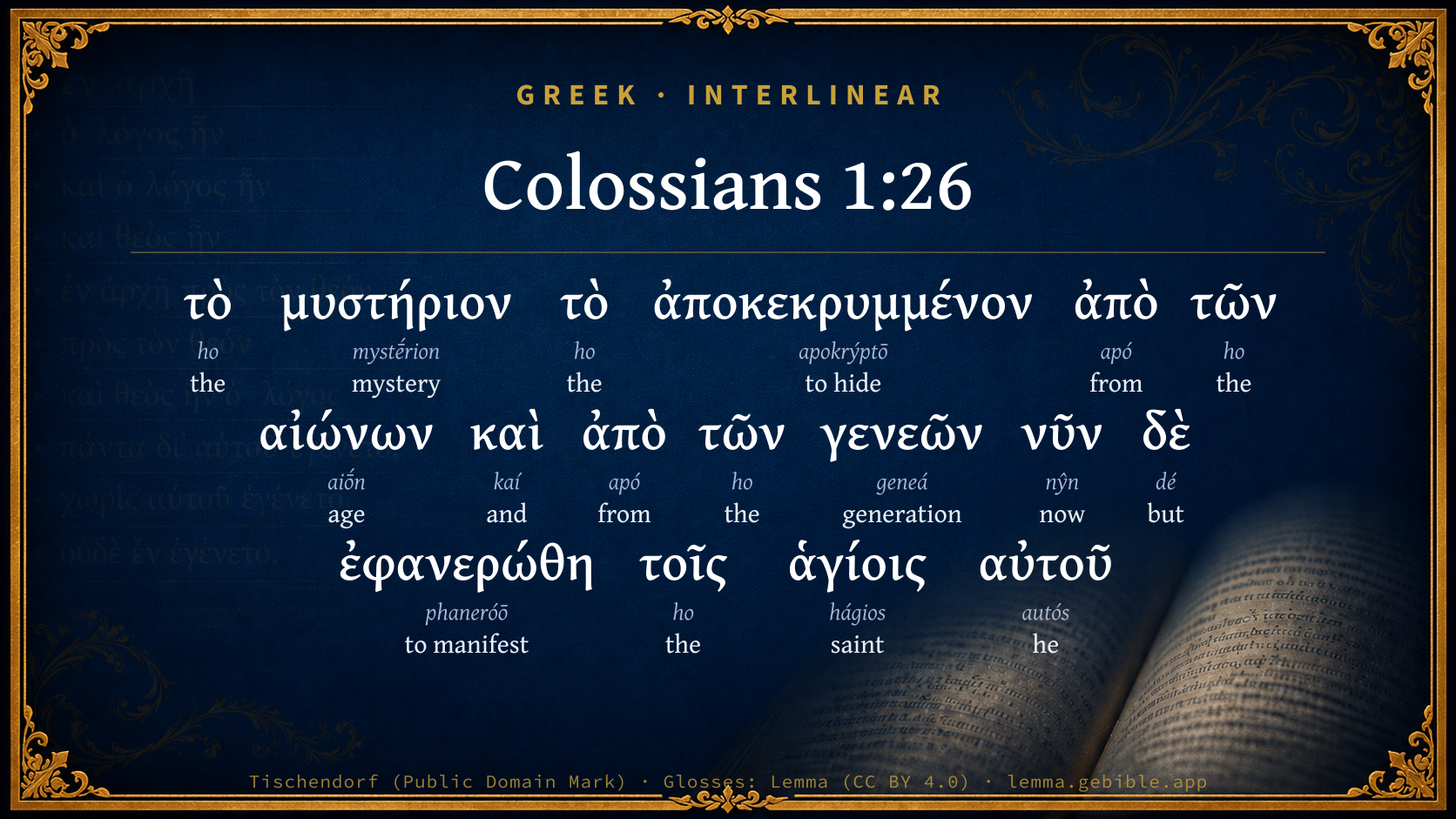
  1. τὸ ho G3588 “the” Article, Accusative, Singular, Neuter
  2. μυστήριον mystḗrion G3466 “mystery” Noun, Accusative, Singular, Neuter
  3. τὸ ho G3588 “the” Article, Accusative, Singular, Neuter
  4. ἀπὸ apó G575 “from” Preposition
  5. τῶν ho G3588 “the” Article, Genitive, Plural, Masculine
  6. αἰώνων aiṓn G165 “age” Noun, Genitive, Plural, Masculine
  7. καὶ kaí G2532 “and” Conjunction
  8. ἀπὸ apó G575 “from” Preposition
  9. τῶν ho G3588 “the” Article, Genitive, Plural, Feminine
  10. γενεῶν geneá G1074 “generation” Noun, Genitive, Plural, Feminine
  11. νῦν nŷn G3568 “now” Adverb
  12. δὲ dé G1161 “but” Conjunction
  13. ἐφανερώθη phaneróō G5319 “to manifest” Verb, Aorist, Passive, Indicative, 3rd person, Singular
  14. τοῖς ho G3588 “the” Article, Dative, Plural, Masculine
  15. ἁγίοις hágios G40 “saint” Adjective, Dative, Plural, Masculine
  16. αὐτοῦ autós G846 “he” Personal pronoun, Genitive, Singular, Masculine

About this verse

These counts appear in no published source. They are computed here, from the morphology-tagged text and Lemma’s own curated glosses. What Lemma adds →

17
words
12
distinct lemmas
Pauline Epistles
section

Notable vocabulary

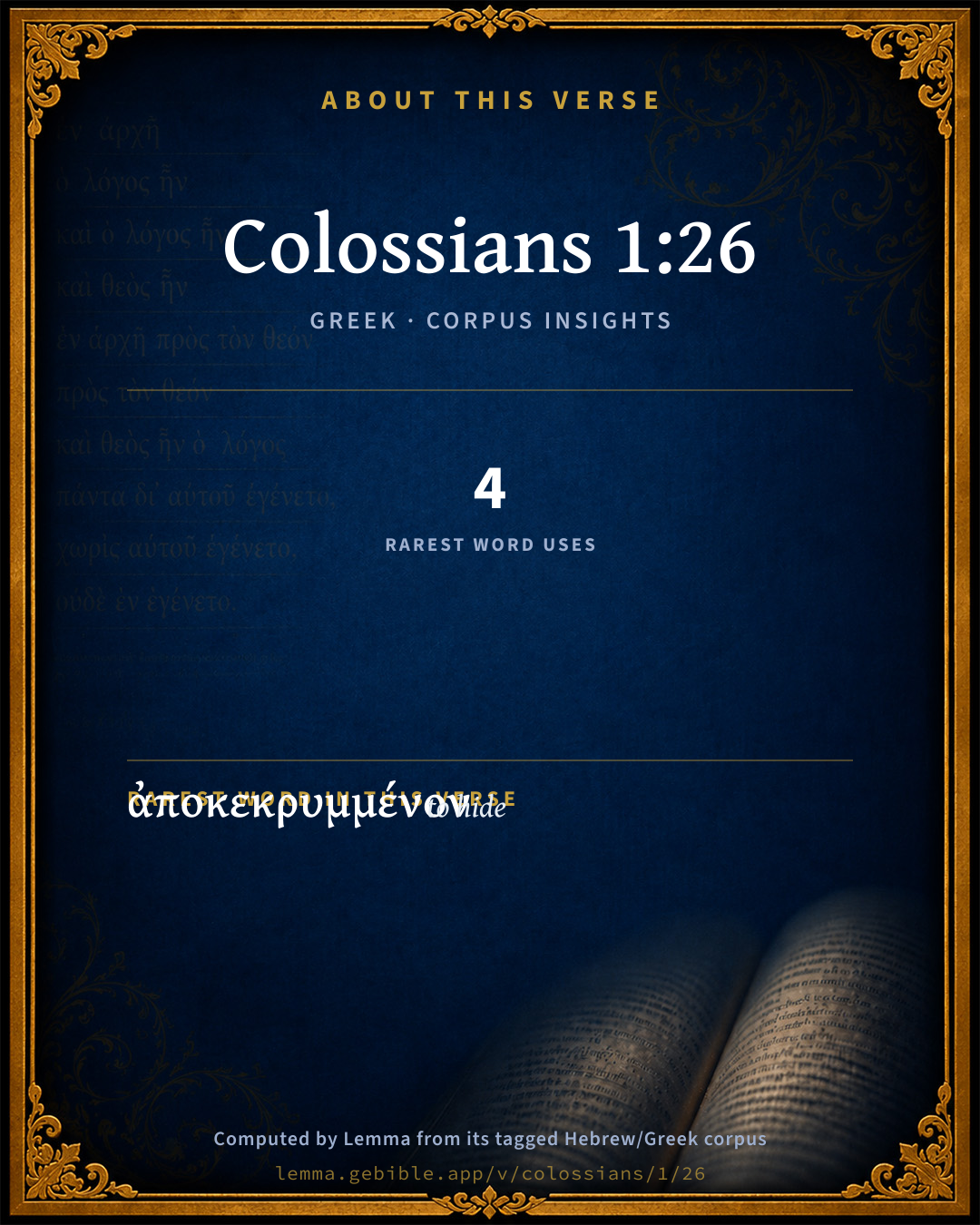
The rarest word here is ἀποκεκρυμμένον to hide G613 — appearing just 4 times in the whole Greek New Testament.

Shared distinctive vocabulary

ἀποκεκρυμμένον to hide G613 occurs in 4 verses of the Greek New Testament. Also found in:

Repetition

Words recur within this verse:

Cross-references

8

Topical passages linked to Colossians 1:26 in the Treasury of Scripture Knowledge — connected by theme and wording, ordered by reader-vote popularity; previews shown in the World English Bible.

  • Luke 8:10 He said, "To you it is given to know the mysteries of the Kingdom of God, but to the rest in parables; that 'seeing they may not see, and hearing they may not understand.'
  • Romans 16:25–26
  • Ephesians 3:3–10 how that by revelation the mystery was made known to me, as I wrote before in few words,
  • Psalms 25:14 The friendship of Yahweh is with those who fear him. He will show them his covenant.
  • Matthew 13:11 He answered them, "To you it is given to know the mysteries of the Kingdom of Heaven, but it is not given to them.
  • Mark 4:11 He said to them, "To you is given the mystery of the Kingdom of God, but to those who are outside, all things are done in parables,
  • 1 Corinthians 2:7 But we speak God's wisdom in a mystery, the wisdom that has been hidden, which God foreordained before the worlds for our glory,
  • 2 Timothy 1:10 but has now been revealed by the appearing of our Savior, Christ Jesus, who abolished death, and brought life and immortality to light through the Gospel.

Cross-references courtesy of OpenBible.info (CC BY 4.0).

Commentary

Notes on Colossians 1:26 from classic Christian and Jewish commentators (each source and its license shown beneath its notes). The classic Christian expositions comment on the surrounding passage and are grouped to its opening verse, so a note may address several verses; the Jewish commentaries on the Tanakh (Rashi and others) are per-verse, so they appear only where the commentator wrote on this verse.

Lemma curates 59 commentaries, every one of them public domain or Creative Commons licensed, each selected and text-cleaned for this edition rather than reprinted as found. About our sources →

The Biblical Illustrator

Joseph S. Exell

Col_1:26

The mystery which hath been hid from ages and from generations.

The gospel mystery

The term mystery, as here used twice, and often in this epistle, does not describe what is essentially incomprehensible, but rather what was hidden and is now revealed. The gospel is a mystery, but a mystery that is to be preached fully, and into which (as the word borrowed from the ancient mysteries in Col_1:28 suggests) every man may be initiated.

I. The gospel a mystery. All religion deals with mystery. Genuine mystery is the stamp of a religious Divinity--false mystery is the counterfeit superstition stamp. In its aspect to wards the vast, the infinite, the Divine, religion must always have some mystery to man.

II. The gospel a mystery that was long secret from man. The secret things belong unto God. There are hidden facts and laws in nature that science has only gradually discovered, or is now only gradually discovering; hidden moral meanings in nature and history that poets sight only can descry, and poets song only describe. There were hidden things in religion that only holy men of old, moved by the Holy Ghost, could reveal.

III. The gospel is a mystery that is now fully revealed. Whatever may have been the guesses of nobler pagans, or the anticipations of patriarchs, or the predictions of prophets, it was only as the pale light of very early dawn upon the hills of antiquity. It was noon when Christ lived, taught, died. The seal was broken, the secret revealed. What secret?

IV. The gospel is the revealed secret of Gods universal redeeming love. Christ is fully proclaimed, and Christ is the mystery. In Him are all the treasures of God stored away.

1. All the mystery is proclaimed in Christ. As the rainbow has all possible colours in its wondrous are, as the fabled music of the spheres has all possible tones in its chord, so in Christ is all the wisdom, righteousness, love of God.

2. All men may receive the blessings of this mystery. Christ, and Christ freely given to the Gentiles, given to be an indwelling power in them, is the great mystery which, as Paul dwelt in it, made Him proclaim it with newer and deepening joy. (U. R. Thomas.)

I. The mystery.

1. The term is borrowed from the ancient systems in which certain rites and doctrines were communicated to the initiated (Php_4:12, and the word perfect, which means initiated, in verse 28). Potentous theories have been spun out of this word. The Greek mysteries implied secrecy; the rites were done in deep obscurity; the esoteric doctrines were muttered in the ear. The Christian mysteries are spoken on the housetop, nor does the word imply anything as to the comprehensibility of the doctrines or facts which are so called.

3. We talk about mysteries, meaning thereby truths that transcend human faculties. But the New Testament mystery may be, and most frequently is, a fact perfectly comprehensible when once spoken. Behold I show you a mystery: we shall not all sleep, etc. There is nothing incomprehensible in that. We should never have known it if we had not been told; but when told it is quite level with our faculties. The word is most frequently used in connection with the notion of declaring. It frequently occurs in this epistle and in the Ephesians, and in every instance but one refers to a fact perfectly plain when once made known--the entrance of the Gentiles into the Church.

4. Then it follows that a steward of the mysteries is simply a man who has truths, formerly unknown but now revealed, in charge to all who will hearken, and neither the claims of a priesthood nor the demand for the unquestioning submission of the intellect have any foundation in this much-abused term.

II. The substance. Of the mystery.

1. The wonderful fact that all barriers were broken down. He saw in that the proof and prophecy of the world-wide destination of the gospel. There is no greater revolution in history than the cutting loose, through Him, of Christianity from Judaism, and widening the Church to the width of the race. No wonder that he was misunderstood and hated by Jewish Christians all his days. He thinks of these once heathens and now Christians at Colossae, and of many another little community in Judea, Asia, Greece, and Italy; and as he thinks of how a solid bond of brotherhood bound them together in spite of their differences of race and culture, the vision of the oneness of mankind in the Cross of Christ shines out before him as no other man had seen it till then.

2. That Christ dwelt in their hearts. That dwelling reveals the exuberant abundance of glory. To Paul the mystery was all running over with riches, and blazing with fresh radiance, and the possession of Christ was a pledge of future blessedness. The closer we keep to Him the clearer will be our vision of that blessedness. Anything seems more credible to a man who has Christ abiding in Him, than that such a trifle as death should have power to end such a union. This hope is offered to all. (A. Maclaren, D. D.)

The mystery manifest

Christ, by His incarnation, answered the vague and unsatisfactory queries of the world.

1. The Second Person of the Godhead was suspected by the ancients to be the active agent of the unknown God. Seneca: Whoever formed the universe, whether the Almighty God Himself, or that incorporeal reason which was the artificer of these vast concerns.

2. The ancients conceived this Second Person to stand to the First in the relation of a word to the thought which it expresses. Zendavesta: O, Ormuzd, what is that great word given by God, that living and powerful word, which existed before the heavens, before the waters, before the earth, before the flocks? Compare Philos Philosophy of the Logos with the Introduction to Johns Gospel.

3. The ancients looked for some incarnation of the Divine Word. Persian Serosch, Hindoo Vishnu. Plato: It is necessary that a Lawgiver be sent from heaven to instruct men; and this Lawgiver must be more than a man. Jewish expectancy.

4. The ancients tried to furnish the ideal of perfect human character--e.g., the ideals of Confucius, Socrates, Seneca. The mythologic personages. Christ appeared manifestly

(1) perfectly a man,

(2) a perfect man, and challenged all moralists. Which of you convinceth Me of sin?

5. The ancients had the idea of atonement. Altars lined the track of history. Christs cry when coming into the world: A body hast thou prepared Me. Lo! I come to do thy will. John the Baptists recognition: Behold the Lamb of God!

6. The ancients tried to demonstrate the perpetuity of human life. Our strongest points in the philosophy of immortality announced by Plato. The mythology of Greeks and Scandinavians. Christs declaration, I am the Resurrection and the Life, demonstrated by His resurrection. (Homiletic Review.)

.

The Biblical Illustrator, edited by Joseph S. Exell (c. 1880s–1900s) — public domain. Text from a community e-Sword module.

Tyndale Open Study Notes

Tyndale Open Resources

1:26 The concept of a secret, hidden at one time and then revealed, is based upon Jewish apocalyptic ideas. Jewish thinkers conceived of God’s entire plan as already existing in heaven, hidden until God should draw back the curtain and reveal it. The Good News, especially for the Gentiles, had been kept secret until it was revealed in Christ.

Tyndale Open Study Notes — © Tyndale Open Resources, licensed CC BY-SA 4.0. Text via the HelloAO Bible API.

Bengel's Gnomon

Johann Albrecht Bengel

Col 1:26. Τὸ μυστήριον, the mystery) A Hendiadys: τὸν λόγον, τὸ μυστήριον, i.e. the word concerning the mystery. The mystery is declared in the following verse, Eph 1:9; Eph 3:9. Glory is the object of the mystery.—ἀποκεκρυμμένον, concealed) So are concealed (ἀπόκρυφοι), ch. Col 2:3.—ἀπὸ τῶν αἰώνων, from the ages) during which the silence had been greater.—ἀπὸ τῶν γενεῶν, from the generations) during which the revelation of other things was gradually made. The ‘Ages’ are to be referred to angels, the ‘generations’ to men.—ἐφανερώθη, has been manifested) the verb again after the participle.—τοῖς ἁγίοις, to His saints) Eph 3:8, note.

Bengel's Gnomon of the New Testament — English translation (T&T Clark, Edinburgh, 1860) — public domain. Text from a community e-Sword module.

Meyer's Critical & Exegetical Commentary

Heinrich August Wilhelm Meyer

Col_1:26. Appositional more precise definition of the λόγος τοῦ Θεοῦ, and that as regards its great contents.

As to τὸ μυστήριον κ.τ.λ., the decree of redemption, hidden from eternity in God, fulfilled through Christ, and made known through the gospel, see on Eph_1:9. It embraces the Gentiles also; and this is a special part of its nature that had been veiled (see Eph_3:5), which, however, is not brought into prominence till Col_1:27. Considering the so frequent treatment of this idea in Pauls writings, and its natural correlation with that of the γνῶσις, an acquaintance with the Gospel of Matthew (Mat_13:11) is not to be inferred here (Holtzmann).[70]

ἀπὸ τῶν αἰώνων κ. ἀπὸ τῶν γενεῶν] This twofold description, as also the repetition of ἀπό, has solemn emphasis: from the ages and from the generations. The article indicates the ages that had existed (since the beginning), and the generations that have lived. As to ἀπὸ τῶν αἰώνων, comp. on Eph_3:9. Paul could not write πρὸ τῶν αἰών., because while the divine decree was formed prior to all time (1Co_2:7; 2Ti_1:9), its concealment is not conceivable before the beginning of the times and generations of mankind, to whom it remained unknown. Expressions such as Rom_16:25, χρόνοις αἰωνίοις,[71] and Tit_1:2 (see Huther in loc.), do not conflict with this view. ἀπὸ τ. γενεῶν does not occur elsewhere in the N. T.; but comp. Act_15:21. The two ideas are not to be regarded as synonymous (in opposition to Huther and others), but are to be kept separate (timesmen).

νυνὶ δὲ ἐφανερώθη] A transition to the finite tense, occasioned by the importance of the contrast. Comp. on Col_1:6. Respecting ΝΥΝΊ, see on Col_1:21. The ΦΑΝΈΡΩΣΙς has taken place differently according to the different subjects; partly by ἀποκάλυψις (Eph_3:5; 1Co_2:10), as in the case of Paul himself (Gal_1:12; Gal_1:15; Eph_3:3); partly by preaching (Col_4:4; Tit_1:3; Rom_16:26); partly by both. The historical realization (de Wette; comp. 2Ti_1:10) was the antecedent of the φανέρωσις, but is not here this latter itself, which is, on the contrary, indicated by ΤΟῖς ἉΓΊΟΙς ΑὐΤΟῦ as a special act of clearly manifesting communication.

τοῖς ἉΓΊΟΙς ΑὐΤΟῦ] i.e. not: to the apostles and prophets of the N. T. (Flatt, Bähr, Böhmer, Steiger, Olshausen, Baumgarten-Crusius, following Estius and. older expositors, and even Theodoret, who, however, includes other Christians also),a view which is quite unjustifiably imported from Eph_3:5,[72] whence also the reading ἀποστόλοις (instead of ἉΓΊΟΙς) in F G has arisen. It refers to the Christians generally. The mystery was indeed announced to all (Col_1:23), but was made manifest only to the believers, who as such are the κλητοὶ ἅγιοι belonging to God, Rom_1:7; Rom_8:30; Rom_9:23 f. Huther wrongly desires to leave ΤΟῖς ἉΓΊΟΙς indefinite, because the μυστήριον, so far as it embraced the Gentiles also, had not come to be known to many Jewish-Christians. But, apart from the fact that the Judaists did not misapprehend the destination of redemption for the Gentiles in itself and generally, but only the direct character of that destination (without a transition through Judaism, Act_15:1, et al.), the ἐφανερώθη τοῖς ἁγίοις αὐτοῦ is in fact a summary assertion, which is to be construed a potiori, and does not cease to be true on account of exceptional cases, in which the result was not actually realized.

[70] Just as little ground is there for tracing κατὰ τὰ ἐντάλματα κ.τ.λ., in Col_2:22, to Mat_15:9; οὐ κρατῶν, in Col_2:19, to Mat_7:3-4; ἀπάτη, in Col_2:8, to Mat_13:22; and in other instances. The author, who manifests so much lively copiousness of language, was certainly not thus confined and dependent in thought and expression.

[71] According to Holtzmann, indeed, p. 309 ff., the close of the Epistle to the Romans is to be held as proceeding from the post-apostolic auctor ad Ephesios,a position which is attempted to be proved by the tones (quite Pauline, however) which Rom_16:15-27 has in common with Col_1:26 f.; Eph_3:20; Eph_3:9-10; Eph_5:21; and in support of it an erroneous interpretation of διὰ γραφῶν προφητικῶν, in Rom_16:26, is invoked.

[72] Holtzmann also, p. 49, would have the apostles thought of first of all. The resemblances to Eph_3:3; Eph_3:5 do not postulate the similarity of the conception throughout. This would assume a mechanical process of thought, which could not be proved.

Meyer — Critical and Exegetical Commentary on the New Testament — English translation by Peter Christie, edited by Frederick Crombie (T&T Clark, 1880) — public domain. Text from a community e-Sword module.

Expositor's Greek Testament

ed. W. Robertson Nicoll

Col 1:26 . Partially parallel to Eph 3:9 . How great the honour conferred on Paul is, appears from the fact that he is entrusted with the duty of declaring the long concealed secret which is the distinguishing mark of his Gospel. τὸμυ μυστήριον . Lightfoot thinks that the term is borrowed by Paul from the Greek mysteries, and that it is intentionally chosen to point the contrast between those secret mysteries and the Gospel which is offered to all. But for the mysteries the plural was employed. And there would be more justification for this Interpretation in Mat 13:11 = Luk 8:10 , where the disciples are told by Jesus that to them it is given to know the mysteries of the kingdom, but not to others. But it will not be seriously supposed that Christ borrowed the term from the Greek mysteries. A mystery is a truth which man cannot know by his natural powers, so that if it is known it must be revealed. τὸ ἀποκεκρυμμένον ἀπὸ τῶν αἰώνων καὶ ἀπὸ τῶν γενεῶν . Usually ἀπὸ is taken as temporal, and this agrees with the fact that similar references in Paul are temporal (1Co 2:7 , Rom 16:25 ), and with the use of ἀπὸ as in ἀπʼ αἰῶνος and ἀπὸ καταβολῆς κόσμου (Mat 25:34 ). ἀπὸ καταβολῆς occurs with κρύπτω (Mat 13:35 ). But elsewhere ἀπὸ after κρύπτω or ἀποκρύπτω ) indicates those from whom a thing is concealed. In favour of this meaning here is the order, for if ἀπὸ τ . αἰ . were temporal ἀπὸ τ γεν . would be included as a matter of course. It has been so taken here, not by Klöpper, who suggests it as possible, but does not accept it, but by Franke. He thinks both are terms for angels, and in itself such a reference is not improbable, for it is through the Church that the principalities and powers come to learn the manifold wisdom of God (Eph 3:9 , where just before the mystery is said to have been concealed ἀπὸ τῶν αἰώνων ). But we have no evidence that γενεαί was ever used in this way, and no parallel for this use of αἰῶνες in N.T. Without identifying the terms with personal existences, we may with Haupt ( cf. also Soden) take αἰῶνες of the ages before the world, and γενεαί of the generations of human history. This will be practically the same as saying that the mystery was concealed from angels and men. This is probably the meaning of Bengel’s note: “Aeones referuntur ad angelos; generationes, ad homines”. Theodoret, followed by Klöpper, thinks that there is a polemical reference here to the antiquity of the Gospel and its consequent superiority to the Law. Abbott thinks the point of the reference to the long concealment and recent disclosure is that the acceptance of the false teaching is thus explained. But the non-polemical character of parallel passages makes these suggestions very uncertain. νῦν δὲ ἐφανερώθη . The construction here changes, and the perfect participle is continued by the aorist indicative (Winer-Moulton, p. 717). The anacoluthon is caused by Paul’s intense joy that the long silence has been broken; he is content with nothing short of a definite statement of the glorious fact νῦν is equally appropriate whether ἀπὸ is temporal or not, for the antithesis of past and present lies in the nature of the case. τοῖς ἁγίοις αὐτοῦ : i.e. , to Christians generally, not to the Jewish Christians (Hofm.), who certainly were not specially enlightened on this matter, nor the Apostles and prophets of the New Covenant, even though in the parallel Eph 3:5 they are chosen for mention, nor the angels, in spite of Eph 3:10 . The words must be taken in their obvious sense.

The Expositor's Greek Testament, edited by W. Robertson Nicoll (1897–1910) — public domain. Text from a community e-Sword module.

Geneva Bible (1599)

Geneva Bible translators

Whom he chose to sanctify unto himself in Christ: moreover he sayeth that the mystery of our redemption was hidden since the world began, except it were revealed unto a few, who also were taught it extraordinarily.

Geneva Bible (1599) marginal notes — public domain. Text via Bolls.life.

Jamieson, Fausset & Brown

Robert Jamieson, A. R. Fausset & David Brown

the mystery--(See on Eph 1:9-10; Eph 3:5-9). The mystery, once hidden, now revealed, is redemption for the whole Gentile world, as well as for the Jews, "Christ in you (Gentiles) the hope of glory" (Col 1:27).

from ages--"from," according to ALFORD, refers to time, not "hidden from": from the time of the ages; still what is meant is that the mystery was hidden from the beings living in those "ages." The "ages" are the vast successive periods marked by successive orders of beings and stages of creation. Greek, "Æons," a word used by the Gnostics for angelic beings emanating from God. The Spirit by Paul presciently, in opposition to Gnostic error already beginning (Col 2:18), teaches, that the mystery of redemption was hidden in God's purposes in Christ, alike from the angelic beings (compare Eph 3:10) of the pre-Adamic "ages," and from the subsequent human "generations." Translate as Greek, "the ages . . . the generations."

made manifest to his saints--to His apostles and prophets primarily (Eph 3:5), and through them to all His saints.

Jamieson, Fausset & Brown — Commentary Critical and Explanatory on the Whole Bible (1871) — public domain (CC PDM 1.0). Text via the HelloAO Bible API.

Adam Clarke's Commentary

Verse 26. The mystery which hath been hid] The mystery is this: that God had designed to grant the Gentiles the same privileges with the Jews, and make them his people who were not his people. That this is what St. Paul means by the mystery, see Eph 3:3, c.

Made manifest to his saints] It is fully known to all who have embraced the doctrine of Christ crucified to all Christians.

Adam Clarke's Commentary on the Bible (1810–1826) — public domain. Text from a community e-Sword/MySword module.

John Calvin's Commentaries

26. Hidden mystery. Here we have a commendation of the gospel — that it is a wonderful secret of God. It is not without good reason that Paul so frequently extols the gospel by bestowing upon it the highest commendations in his power; for he saw that it was

a stumblingblock to the Jews, and foolishness to the Greeks. (1 Corinthians 1:23.)

We see also at this day, in what hatred it is held by hypocrites, and how haughtily it is contemned by the world. Paul, accordingly, with the view of setting aside judgments so unfair and perverse, extols in magnificent terms the dignity of the gospel as often as an opportunity presents itself, and for that purpose he makes use of various arguments, according to the connection of the passage. Here he calls it a sublime secret, which was hid from ages and generations, that is, from the beginning of the world, through so many revolutions of ages. Now, that it is of the gospel that he speaks, is evident from Romans 16:25, Ephesians 3:9, and other similar passages.

The reason, however, why it is so called, is demanded. Some, in consequence of Paul’s making express mention of the calling of the Gentiles, are of opinion, that the sole reason why it is so called is, that the Lord had, in a manner, contrary to all expectation, poured out his grace upon the Gentiles, whom he had appeared to have shut out for ever from participation in eternal life. Any one, however, that will examine the whole passage more narrowly, will perceive that this is the third reason, not the only one, in so far, I mean, as relates to the passage before us, and that other in the Romans, to which I have referred. For the first is — that whereas God had, previously to the advent of Christ, governed his Church under dark coverings, both of words and of ceremonies, he has suddenly shone forth in full brightness by means of the doctrine of the gospel. The second is — that whereas nothing was previously seen but external figures, Christ has been exhibited, bringing with him the full truth, which had lain concealed. The third is, what I have mentioned — that the whole world, which had up to this time been estranged from God, is called to the hope of salvation, and the same inheritance of eternal life is offered to all. An attentive consideration of these things constrains us to reverence and adore this mystery which Paul proclaims, however it may be held in contempt by the world, or even in derision.

Which is now revealed. Lest any one should turn aside to another meaning the term mystery, as though he were speaking of a thing that was still secret and unknown, he adds, that it has now at length been published, that it might be known by mankind. What, therefore, was in its own nature secret, has been made manifest by the will of God. Hence, there is no reason why its obscurity should alarm us, after the revelation that God has made of it. He adds, however, to the saints, for God’s arm has not been revealed to all, (Isaiah 53:1,) that they might understand his counsel.

John Calvin's Commentaries (1540-1563) — public domain. Text from the Calvin Translation Society English edition (1840s-50s) via the Christian Classics Ethereal Library (ccel.org). Calvin's coverage is partial (roughly two-thirds of the Bible); uncommented books and verses are honest gaps, never fabricated. The 19th-century editor's footnotes and remarks are omitted so the notes are faithfully Calvin's own voice.

Ellicott's Commentary for English Readers

(26) The mystery.—On the Scriptural sense of the word “mystery,” and its relation to the modern use of the word, see Note on Eph_1:9. In this passage, perhaps, most of all, it is defined with perfect clearness, as “a secret long hidden, and now revealed.”

A Bible Commentary for English Readers, edited by Charles John Ellicott (1878–1897) — public domain. Text from a community e-Sword module.

The Cambridge Bible for Schools and Colleges

gen. ed. J. J. S. Perowne

26. the mystery] I.e. as always in N.T., a truth undiscoverable except by revelation, a holy secret; whether or no, when revealed, it is what we can or cannot understand. See our note on Eph_1:9. We have this “secret” unveiled and described just below. Lightfoot points out that the Greek word mustêrion, “mystery,” is “not the only term borrowed from the ancient mysteries [rites of special and secret initiation, lying, in a sense, apart from and behind the popular heathen worship] which St Paul employs to describe the teaching of the Gospel.” He gives instances from Col_1:28 below, Php_4:12, and perhaps Eph_1:14. “There is this difference however, that whereas the heathen mysteries were strictly confined to a narrow circle, the Christian mysteries are freely communicated to all. There is therefore an intentional paradox in the employment of the image by St Paul.”—And this may have had regard here to the suggestion by the alien teachers at Colossæ that they had esoteric truths to tell to their disciples.

hid] Cp. esp. 1Co_2:7-10; Eph_3:9. And see for cognate truth Mat_11:25; Luk_10:21.

from ages and from generations] Cp. “from the beginning of the world,” Eph_3:9; where lit., “from the ages.” Here lit., from the ages, &c., or, as well paraphrased in R.V., from all ages, &c. “From” is here a preposition of time; “ever since ages and generations were;” through all developments of the history of intelligent creation, whether longer (“ages,” æons), or more limited (“generations”). See our note on Eph_3:9.

now] “When the fulness of the time was come,” Gal_4:4. Cp. Eph_3:5; Eph_3:9-10.

revealed] Historically, in the Incarnation, Sacrifice, and Triumph of Christ; personally and spiritually (1Co_2:10), by the Holy Ghost dealing with the man.

The Cambridge Bible for Schools and Colleges (gen. ed. J. J. S. Perowne; Cambridge University Press, 1878–1918) — public domain. Text from a community e-Sword module.

John Gill's Exposition

Even the mystery which hath been hid from ages and generations,.... This is said, as explanative of the word of God; signifying that he did not mean the Scriptures in general, which are the word of God, and every part of them; some part of which is historical, another prophetical, another practical, and another doctrinal; nor the law, which also is the word of God, but the Gospel, called "the mystery", as it often is; because it contains things, which, though revealed, are mysteries to a natural man; and even to enlightened persons, who have the clearest view of them, the "modus" of them is not to be accounted for; such as the doctrines of the Trinity, of the union of the two natures in Christ, the incarnation of the Son of God, the union and communion of the church with Christ, the resurrection of the dead, &c. And though perhaps great and special regard may be here had to the calling of the Gentiles, which, though revealed in the prophecies of the Old Testament, was in a great measure hid in them, and not so clearly known in ages and generations past as now, yet the whole may be applied to the Gospel mystery in general; which was first hid in the heart of God, in his thoughts and purposes, in his counsel and covenant, and in his Son, in whom are hid all the treasures of wisdom and knowledge; and then in the ceremonies and shadows of the law, which but few had any insight into, and discerning of; and, during that dispensation, was wholly hid from the Gentiles; and but in part known by the Jews, and but by a few, and comparatively by them very darkly; and not so clearly by the angels themselves, who pry into these mysteries, and now, under the Gospel dispensation, learn from the church the manifold wisdom of God; and indeed it was hidden from all men, Jews and Gentiles, in a state of nature, and even from the wise and prudent of this world:

but now is made manifest to his saints; now under the Gospel dispensation, since the coming of Christ; there is an external revelation of the Gospel by him, more clearly, by whom grace and truth came, called the revelation of Christ; and an internal revelation of it by his Spirit, who is the spirit of wisdom and revelation, in the knowledge of him; which is made to saints, the holy apostles and prophets, who are the saints to whom this faith, and the mystery of it, were first delivered with so much power and evidence; and to all the elect of God, whom he has separated for himself in eternal election; whom Christ has sanctified by his blood, and to whom he is made sanctification; and who are called with an holy calling, have principles of grace and holiness wrought in them by the Spirit of God, and therefore called "his" saints; these have only a spiritual discerning of the Gospel, for the natural man neither knows nor receives it.

John Gill's Exposition of the Whole Bible (1746–1763) — public domain (CC PDM 1.0). Text via the HelloAO Bible API.

Trapp's Complete Commentary

John Trapp

26 Even the mystery which hath been hid from ages and from generations, but now is made manifest to his saints:

Ver. 26. But now is made manifest] God hath now opened his whole heart to his saints, Rev 11:3. {See Trapp on "Rom 7:25"} {See Trapp on "Mat 4:16"}

John Trapp, A Commentary or Exposition upon All the Books of the Old and New Testament (1647–1656) — public domain. Text from a community e-Sword module.

Albert Barnes' Notes on the Bible

Even the mystery - To make that mystery fully known. See this explained in the notes at Eph 3:2-9. The great doctrine that salvation was to be proclaimed to all mankind, Paul says, had been concealed for many generations. Hence, it was called a mystery, or a hidden truth.

But now is made manifest to his saints - It was communicated especially to the apostles who were appointed to proclaim it, and through them to all the saints. Paul says that he regarded himself as specially called to make this truth known, as far as possible, to mankind.

Albert Barnes' Notes on the Bible (1834–1885) — public domain. Text from a community e-Sword/MySword module.

Haydock's Catholic Bible Commentary

The mystery of Christ’s incarnation, which hath been hidden, &c. See Ephesians i. 12. and v. 4, &c. (Witham)

George Leo Haydock (1774–1849), Haydock's Catholic Family Bible and Commentary, 1859 edition — public domain. Excludes Psalms (Douay-Rheims chapter numbering differs from Protestant) and Deuterocanonical books (Catholic canon only).

Matthew Poole's English Annotations

Even the mystery which hath been hid from ages and from generations; viz. that holy secret of godliness, Col 2:2,3; 4:3; Mat 13:11; Rom 16:25,26; 1Co 2:7; Eph 3:3,4,6,8,9,10; see 1Ti 3:16; Rev 14:6; which doth not consist in beggarly elements, Gal 4:9, or vain speculations, which these Colossians are cautioned to avoid, Col 2:8, however varnished; but is to them who are saved, the power of God, Rom 1:16; 1Co 1:18,19, and the wisdom of God, 1Co 1:24, which lay hid in God before the world, 1Co 2:7; 2Ti 1:9; Tit 1:2; 1Pe 1:20; yea, and after God had to our first parents, and so to his people the Jews, given some glimpse of this mystery, which yet the Gentiles of several ages were ignorant of, and many of the Jews, yea, the most knowing of them did not, for many generations, know that the Gentiles without circumcision, &c. were to be admitted into the church, Act 10:28; the prophets were very inquisitive to know the meaning of it, but yet they also were much in the dark, 1Co 2:9; 1Pe 1:10,11; yea, the angels did not know this hidden mystery, till revealed by the church, Eph 1:10.

But now is made manifest to his saints; but now God that revealeth secrets, Dan 2:28, hath opened his bosom counsel about this affair most clearly, so that his glory, by those that really fear him, may be seen with open face as in a glass through Christ, Mat 13:11; Mar 4:11; Joh 8:47; 15:15; Act 16:14; 1Co 2:10,16; 2Co 3:18; all necessary to salvation being made conspicuous and clear to them, 1Pe 2:9.

Matthew Poole's English Annotations on the Holy Bible (1683–1685) — public domain. Text from a community e-Sword/MySword module.

Whedon's Commentary on the Bible

Daniel D. Whedon

26. Mystery—The word used of facts and truths not fully revealed, occurs four times in this epistle, and in that to the Ephesians six times, and always, with a single exception in the latter, with a reference more or less direct to Christ. Here it is the doctrine of salvation through Christ, or, more simply, Christ himself. He had not been revealed to former ages of the world, for they were not prepared to receive a Saviour; and even the angels had not fully comprehended the great plan. Now he is revealed to the apostles, (Eph_3:5,) preached by them, believed in, and thus is made manifest to his saints. Believers know Christ.

Daniel D. Whedon (gen. ed.), Commentary on the Old and New Testaments (1874–1909) — public domain. Text from a community e-Sword module.

The Pulpit Commentary

The mystery which hath been hidden away from the ages and from the generations (Eph_2:2, 3 3:5, 9; Rom_16:25, 26 11:25, 26, 33) The word "mystery" plays a large part in Colossians and Ephesians. It occurs in 1 Corinthians, and twice in the Roman Epistle, written from Corinth. Its use in Rom_16:25 is identical with that of the passage before us. The Greek mysteries were secret religious doctrines and rites made known only to initiated persons, who formed associations statedly assembling at certain sacred spots, of which Eleusis near Athens was the most famous. These systems exercised a vast influence over the Greek mind, and Greek literature is full of allusions to them; but their secret has been well kept, and little is known of their real character. Some of these mystic systems, probably, inculcated doctrines of a purer and more spiritual type than those of the vulgar polytheism. The ascetic and mystical doctrines ascribed to Pythagoras were propagated by secret societies. The language and ideas connected with the mysteries were readily adopted by the Jewish Broad Church of Alexandria, whose endeavour it was to expand Judaism by a symbolical and allegorizing method into a philosophic and universal religious system, and who were compelled to veil their inner doctrine from the eyes of their stricter, unenlightened (or unsophisticated) fellowbelievers. Musthrion appears in the Apocrypha as an epithet of the Divine Wisdom: (RAPC Wis 2:22 8:4; etc.) (Psa_49:4 Psa_78:2 comp. Mat_13:34, Mat_13:35) furnished the Old Testament basis of this usage. (See Philo, "On the Cherubim," "On Fugitives," etc., for the place of mystery in the Alexandrine theology.) St. Paul, writing to men accustomed, either as Greeks or as Hellenistic Jews, to this phraseology, calls the gospel "a mystery," as that which is "hidden from the natural understanding and from the previous searchings of men". (1Co_2:6-16) But in the words that follow he repudiates the notion of any secrecy or exclusiveness in its proclamation; (2Co_3:12-18; 2Co_4:1-6) in his language, "mystery is the correlate of revelation." The thrice-repeated ajpo ("from," "away"), with the double indication of time, "gives a solemn emphasis" (Meyer) to the statement. Ages are successive epochs of time, with their states and conditions; (comp. Gal_1:4) generations are successive races of men, with their traditions and hereditary tendencies. But now it was made manifest to his saints (Col_2:2 Col_4:3; Eph_1:9 Eph_3:5; 1Ti_3:16 1Pe_1:20) The word "reveal" (Eph_3:5; 1Co_2:10) indicates a process, "make manifest" points to the result of this Divine act Rom_16:25, 26: Rom_1:17 with 3:21; see Trench"s "Synonyms"). The transition from the participle in the last clause to the strongly assertive finite verb in this almost disappears in English idiom: comp. vers. 5, 6; (Eph_1:20-22) (Greek) and see Winer"s "N.T. Grammar," p. 717, or A. Buttmann, p. 382. There is also a change of tense: the manifestation is a single, sudden event (aorist), breaking through the long and seemingly final concealment of all previous time (present perfect participle); similarly (Rom_16:25, 26 and 1Pe_1:20 comp. Col_2:14, note) To his sailors; i.e. to the Church at large (ver. 2; Col_3:12) but this implies a spiritual qualification. (1Co_2:14) "His saints" are the recipients; "his holy apostles and prophets, in the Spirit," the organs (Eph_3:5) of this manifestation. The Church had long ago formally accepted this revelation; (Act_11:18) it was St. Paul"s office to make it practically effectual.

The Pulpit Commentary (1880–1919), ed. H.D.M. Spence-Jones & Joseph S. Exell — public domain. Text from a community e-Sword module.

John Wesley's Explanatory Notes

The mystery - Namely, Christ both justifying and sanctifying gentiles, as well as Jews. Which hath been comparatively hid from former ages and past generations of men.

John Wesley, Explanatory Notes Upon the Whole Bible (1754–1765) — public domain. Text via the GEBible commentary corpus.

Scofield Reference Notes

C. I. Scofield

mystery

(See Scofield "Mat 13:11").

The Scofield Reference Bible (1917 edition), notes by C. I. Scofield — public domain. Text from a community e-Sword module.

The People's New Testament

B. W. Johnson

26. Even the mystery. The mystery of the gospel, of salvation through Christ, hidden from past ages, but now revealed to the saints. A mystery, as Paul uses the term, is a thing hidden in the past, but now made known.

B. W. Johnson's The People's New Testament with Notes (1889–1891) — public domain. Electronic text from the Christian Classics Ethereal Library (CCEL) ThML edition.

Cambridge Greek Testament for Schools and Colleges

26. τὸ μυστήριον. In apposition to τὸν λόγ. τ. θ. It is strange that St Paul’s language does not show more certain traces of the influence of terms derived from the many esoteric cults of his day.

Wis 14:15; Wis 14:23 speaks of the origin of the mysteries and 3Ma 2:30 purports to give a decree of Ptolemy IV. Philopator releasing those Jews from disabilities who should be initiated into the (Dionysian) mysteries. But nowhere else, apparently, does the LXX. certainly give this connotation to μυστήριον. Jdt 2:2 relates that Nebuchadnezzar tells his servants τὸ μυστήριον τῆς βουλῆς αὐτοῦ, i.e. the secret plan he had devised, and Dan 2:18-19; Dan 2:27-30; Dan 4:6 speak only of the secret of the vision. Compare also Sir 3:18 (א) and Wis 2:22, the secret counsels of God.

But St Paul’s reference to the “mysteries” is, at best, doubtful. In 1Co 15:51, ἰδοὺ μυστήριον ὑμῖν λέγω, Jülicher “feels that here St Paul is a mystagogue speaking to a circle of mystae” (Encycl. Bibl.), and finds a similar reference in 1Co 14:2; 1Co 13:2; 1Co 4:1, but he has little else to guide him but the word μυστήριον which has, as we have seen, a wider use. Neither in the other passages where it occurs, e.g. here, Col 2:2, Col 4:3, Eph 1:9; Eph 3:3-9, does the context make it certain. On the other hand μεμύημαι (Php 4:12†) is a much more characteristic word and probably does allude to being taught secrets at an initiation. On τέλειον, Col 1:28, see there.

It is hardly necessary to say that μυστήριον never has the common meaning of our English “mystery”—something strange and inexplicable. It always means “a secret,” revealed or not revealed as the case may be. Here the secret is more than the external admission of Gentiles to the faith on an equality with Jews; it includes the wonderful privilege of the presence of Christ in individual believers with its present power and future result. In Eph 3:5-6; Eph 3:8 the thought is verbally limited to the privileges, both external and spiritual, common to Gentile and Jewish believers in the present. On μυστήριον see by all means the full note in J. A. R. Ephesians, pp. 234–240.

τὸ ἀποκεκρυμμένον, “which has been hidden.” Luk 10:21; 1Co 2:7; Eph 3:9†; contrast ἀπόκρυφοι Col 2:3. The participle lays stress on the action and effect of concealment, the adjective on preservation and readiness for use. For the thought, cf. Rom 16:25.

St Paul doubtless says this to bring the Colossians to a due sense of their privileges; cf. Luk 10:24; Mat 13:11.

ἀπὸ τῶν αἰώνων (exact phrase Eph 3:9†) καὶ ἀπὸ τῶν γενεῶν.

ἀπὸ (a) is possibly the ἀπὸ after verbs of concealment (cf. Luk 10:21; Luk 18:34; Luk 19:42, and always in LXX. after ἀποκρύπτω); but (b) is probably strictly temporal, as almost certainly in Eph 3:9; cf. Mat 13:35; 1Co 2:7.

αἰώνων indicates the successive periods of history, either of this world or throughout the universe; γενεῶν the successive sets of men living at one time. For γενεῶν cf. Act 14:16; Eph 3:5.

νῦν δὲ. Compare Col 1:21, note.

ἐφανερώθη. St Paul’s energy lays stress on the νῦν, and this leads to his use of a finite verb instead of the participle expected (cf. Col 1:21).

The change to the aorist suggests the suddenness of the manifestation. We might have expected ἀπεκαλύφθη (Eph 3:5) but the true contrast to secrecy is publicity, which is perhaps the fundamental conception of φανερός and its derivatives.

For its use with μυστήριον cf. also Col 4:4. Compare also Mar 4:22 (|| Luk 8:17). See also Col 3:4.

τοῖς ἁγίοις αὐτοῦ. On ἅγιοις, see Col 1:1; Col 1:22.

Cambridge Greek Testament for Schools and Colleges (Cambridge University Press, 1896; 21 vols, various authors incl. Carr, Maclear, Plummer, Farrar, Lumby, Moule, M. R. James, Simcox) — public domain. Text from a community e-Sword module.

Alford’s Greek Testament

Henry Alford

26.] (namely) the mystery (see on Eph 1:9) which has been hidden from (the time of; ἀπό is temporal, not ‘from’ in the sense of ‘hidden from’) the ages and the generations (before us, or of the world: as many Commentators have remarked, not πρὸ τ. αἰ., which would be ‘from eternity,’ but the expression is historical, and within the limits of our world), but now (in these times) was manifested (historical: at the glorification of Christ and the bestowal of the Spirit. This change of a participial into a direct construction is made when the contrasted clause introduced by it is to be brought into greater prominence than the former one. So Thuc. iv. 100, ἄλλῳ τε τρόπῳ πειράσαντες, καὶ μηχανὴν προσήγαγον, ἥπερ εἷλεν αὐτό, τοιάνδε. Herod. ix. 104, ἄλλας τε κατηγεόμενοί σφι ὁδοὺς—καὶ τέλος αὐτοί σφι ἐγένοντο κτείνοντες πολεμιώτατοι. See Bernhardy, p. 473) to His saints (all believers, not merely as in Eph 3:5, where the reference is different, the Apostles and prophets (see there, and cf. various readings here), as some of the Commentators have explained it (not Thdrt., who expressly says, οἷς ἠβουλήθη ἁγίοις, τουτέστι τοῖς ἀποστόλοις, κ. τοῖς διὰ τούτων πεπιστευκόσι), e.g. Est., Steiger, al., and Olsh., but regarding the Apostles only as the representatives of all believers):

Henry Alford, The Greek Testament (1849–1861) — public domain. Text from a community e-Sword module.

International Critical Commentary

26. τὸ μυστήριον. Lightfoot observes: “This is not the only term borrowed from the ancient mysteries, which St. Paul employs to describe the teaching of the gospel,” and he mentions τέλειον, ver. 28; μεμύημαι, Php 4:12; and (perhaps) σφραγίζεσθαι in Eph 1:14. There is, he says, an intentional paradox in the employment of the image by St. Paul, since the Christian mysteries are not, like the heathen, confined to a narrow circle, but are freely communicated to all. But as μυστήριον in the singular is never used by Greek writers in connexion with the ancient mysteries, and on the other hand appears to have been an ordinary word for “secret” (see note on Eph 1:9), there seems to be no ground for the assumption that the term is borrowed from the “mysteries.” The plural is used thrice only by St. Paul, viz. 1Co 4:1, 1Co 4:13:2, 1Co 4:14:2; but occurs in the Gospels, Mat 13:11; Luk 8:10. As to μεμύημαι, although the verb may have been originally borrowed from the mysteries, St. Paul found it already in use in the sense in which he employs it; cf. Alciphron, ii. 4, κυβεπνᾷν μυηθήσομαι. For τέλειος, see on ver. 28.

τὸ ἀποκεκρυμμένον … νῦν δὲ ἐφανερώθη. These are the two characteristics of a μυστήριον in the N.T. Compare Rom 16:25, μυστηρίου χρόνοις αἰωνίοις σεσιγημένου, φανερωθέντος δὲ νῦν. πρὸ τῶν αἰώνων, used in 1Co 2:7 of God’s purpose, could not properly have been said of its concealment. ἀπὸ τῶν αἰώνων, κ.τ.λ. ἀπό here is of time, being opposed to νῦν. So ἀπʼ αἰῶνος, Act 3:21, Act 15:18. An αἰών includes many γενεαί; compare Eph 3:21. The fact of the long concealment and recent disclosure of the mystery is not without point here; it explains the acceptance of the errors which the apostle is combating.

International Critical Commentary — older volumes (1896–1929), various authors — public domain. Text from a community e-Sword module.

Lightfoot's Colossians and Philemon

J. B. Lightfoot

εἰς ὑμᾶς] ‘to youward,’ i.e. ‘for the benefit of you, the Gentiles’; εἰς ὑμᾶς being connected with τὴν δοθεῖσάν μοι, as in Ephes. iii. 2 τὴν οἰκονομίαν τῆς χάριτος τοῦ Θεοῦ τῆς δοθείσης μοι εἰς ὑμᾶς; comp. Rom. xv. 16 διὰ τὴν χάριν τὴν δοθεῖσάν μοι ὑπὸ τοῦ Θεοῦ εἰς τὸ εἶναί με λειτουργὸν Χριστοῦ Ἰησοῦ εἰς τὰ ἔθνη .

πληρῶσαι] ‘to fulfil,’ i.e. ‘to preach fully,’ ‘to give its complete development to’; as Rom. xv. 19 ὥστε με ἀπὸ Ἰερουσαλὴμ καὶ κύκλῳ μέχρι τοῦ Ἰλλυρικοῦ πεπληρωκέναι τὸ εὐαγγελίον τοῦ Χριστοῦ. Thus ‘the word of God’ here is ‘the Gospel,’ as in most places (1 Cor. xiv. 36, 2 Cor. ii. 17, iv. 2, etc.), though not always (e.g. Rom. ix. 6), in St Paul, as also in the Acts. The other interpretation, ‘to accomplish the promise of God,’ though suggested by such passages as 1 Kings ii. 27 πληρωθῆναι τὸ ῥῆμα Κυρίου, 2 Chron. xxxvi. 21 πληρωθῆναι λόγον Κυρίου, etc., is alien to the context here.

26. τὸ μυστήριον] This is not the only term borrowed from the ancient mysteries, which St Paul employs to describe the teaching of the Gospel. The word τέλειον just below, ver. 28, seems to be an extension of the same metaphor. In Phil. iv. 12 again we have the verb μεμύημαι: and in Ephes. i. 14 σφραγίζεσθαι is perhaps an image derived from the same source. So too the Ephesians are addressed as Παύλου συμμύσται in Ign. Ephes. 12. The Christian teacher is thus regarded as a ἱεροφάντης (see Epict. iii. 21. 13 sq.) who initiates his disciples into the rites. There is this difference however; that, whereas the heathen mysteries were strictly confined to a narrow circle, the Christian mysteries are freely communicated to all. There is therefore an intentional paradox in the employment of the image by St Paul. See the notes on πάντα ἄνθρωπον τέλειον below.

Thus the idea of secresy or reserve disappears when μυστήριον is adopted into the Christian vocabulary by St Paul: and the word signifies simply ‘a truth which was once hidden but now is revealed,’ ‘a truth which without special revelation would have been unknown.’ Of the nature of the truth itself the word says nothing. It may be transcendental, incomprehensible, mystical, mysterious, in the modern sense of the term (1 Cor. xv. 51, Eph. v. 32): but this idea is quite accidental, and must be gathered from the special circumstances of the case, for it cannot be inferred from the word itself. Hence μυστήριον is almost universally found in connexion with words denoting revelation or publication; e.g. ἀποκαλύπτειν, ἀποκάλυψις, Rom. xvi. 25, Ephes. iii. 3, 5, 2 Thess. ii. 7; γνωρίζειν Rom. xvi. 26, Ephes. i. 9, iii. 3, 10, vi. 19; φανεροῦν Col. iv. 3, Rom. xvi. 26, 1 Tim. iii. 16; λαλεῖν iv. 3, 1 Cor. ii. 7, xiv. 2; λέγειν, 1 Cor. xv. 51.

But the one special ‘mystery’ which absorbs St Paul’s thoughts in the Epistles to the Colossians and Ephesians is the free admission of the Gentiles on equal terms to the privileges of the covenant. For this he is a prisoner; this he is bound to proclaim fearlessly (iv. 3, Ephes. vi. 19); this, though hidden from all time, was communicated to him by a special revelation (Ephes. iii. 3 sq.); in this had God most signally displayed the lavish wealth of His goodness (ver. 27, ii. 2 sq., Ephes. i. 6 sq., iii. 8 sq.). In one passage only throughout these two epistles is μυστήριον applied to anything else, Ephes. v. 32. The same idea of the μυστήριον appears very prominently also in the thanksgiving (added apparently later than the rest of the letter) at the end of the Epistle to the Romans, xvi. 25 sq. μυστηρίου ... εἰς ὑπακοὴν πίστεως εἰς πάντα τὰ ἔθνη γνωρισθέντος.

J. B. Lightfoot, St Paul's Epistles to the Colossians and Philemon: a revised text with introductions, notes and dissertations (London: Macmillan, 1875) — public domain. Electronic text from Project Gutenberg (ebook #50857). Covers Colossians and Philemon only (the verse-by-verse notes; introductions and dissertations are omitted); Lightfoot's companion Galatians and Philippians volumes are not included, as the available public-domain scans carry garbled Greek that cannot be faithfully reproduced.

Lesson kit

Teaching starters — assembled from the data on this page, not authored interpretation. Every prompt links to the verse data it draws on. Edit before teaching.

Colossians, in the Pauline Epistles, opens this verse with 17 words (12 distinct Greek lemmas). Its most distinctive word is apokrýptō (“to hide”). A historical commentator’s framing appears above. Read the whole chapter for the surrounding context.

Discussion questions

  1. How does “to hide” (apokrýptō) shape what this verse is saying?
  2. How does Luke 10:21, which shares the word «to hide», read alongside this verse?
  3. What does the repetition of “the” (5× in this one verse) do in this verse?
  4. These translations render this verse differently. What is at stake in choosing one wording over another?
  5. Compare how The Biblical Illustrator and Tyndale Open Study Notes read this verse. Where do they agree or differ?

Things to notice

Reading settings

Reading text

Shown beneath each verse's original-language words.

Old Testament
Old Testament edition

Read the OT as the Masoretic Hebrew (MT) or the Greek Septuagint (LXX).

English shown for the Greek Septuagint (in the Hebrew ↔ Greek comparison).

Comparing translations? Open the Compare panel on any verse page to stack up to four side by side.