
Hebrews 9:12

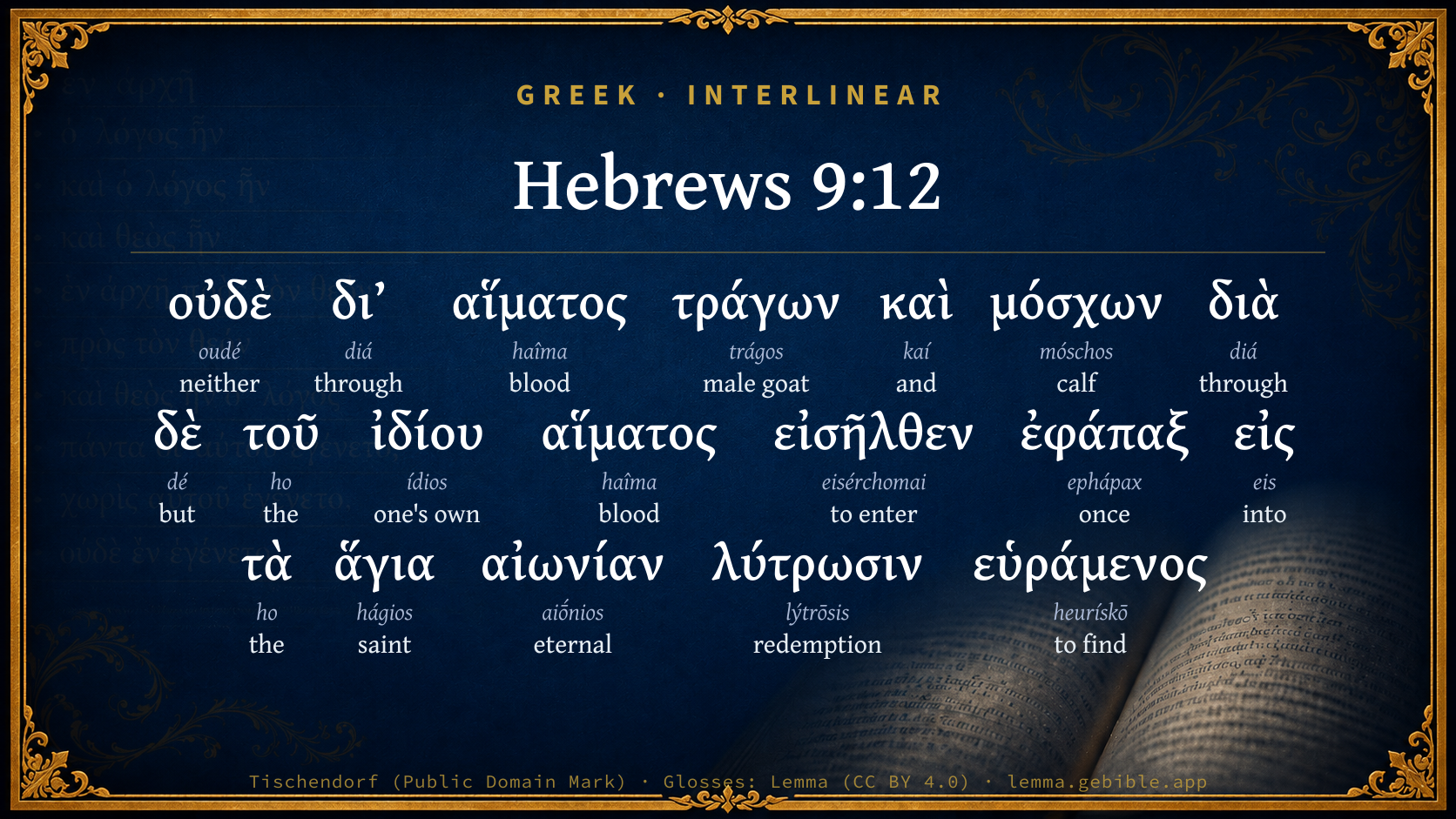
Greek (Tischendorf 8th ed.) Hebrews 9:12 appears in the Greek New Testament. The text above is from the Tischendorf 8th edition. Each word links to its Strong’s number and a concise gloss. Click any word for its full Thayer’s Greek Lexicon entry.
Download image
Cite this verse

Hebrews 9:12 (World English Bible). Public Domain. Lemma interlinear Bible study tool, https://lemma.gebible.app/v/hebrews/9/12.

Show BibTeX & RIS
BibTeX
RIS
English Translation
nor yet through the blood of goats and calves, but through his own blood, entered in once for all into the Holy Place, having obtained eternal redemption.
World English Bible · Public Domain
Highlights
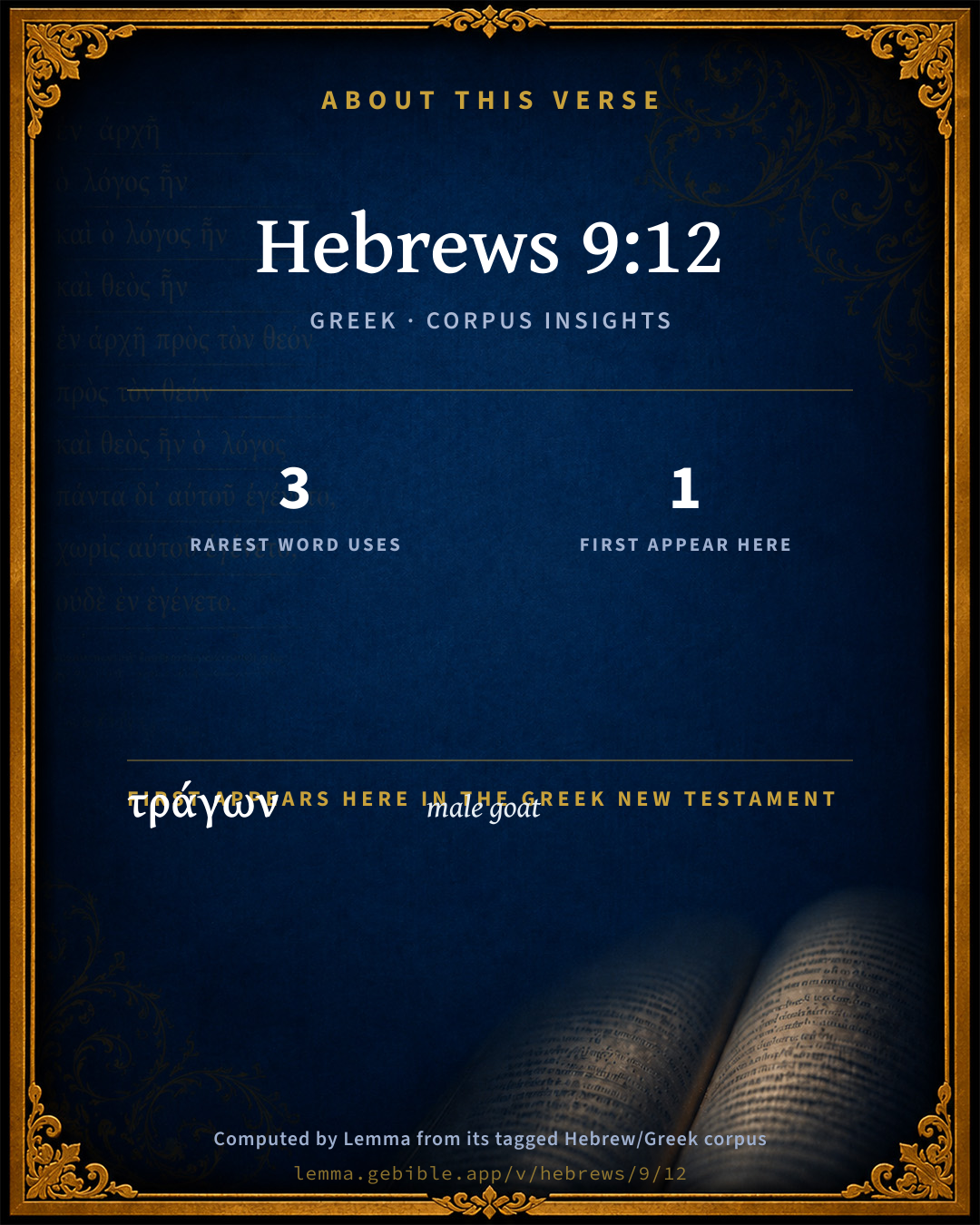
  • 1 first appearance in the Greek New Testament
Full analysis ↓
Download a study sheet

One document with this verse’s original text, its word-by-word gloss line, the meaning frame, cross-references with their text, attributed commentary, and full source and license credits — printable, and it pastes into notes with its structure intact.

This verse Autodidact and up

Study sheet (.html) Plain text (.txt)

A passage Seminary Student

Up to 50 verses in one chapter. A passage sheet keeps up to 6 commentary sources and 12 cross-references per verse, in the order this page ranks them, and says so on the sheet whenever that leaves anything out. Ask for a single verse and you get the Autodidact verse sheet above.

Everything on this page stays free to read, with no account — the sheet is a download of what is already on screen, not access to it.

Want to remove ads? Support Godless Engineer
Compare translations 3

The same verse in 3 English versions, stacked beneath the original-language interlinear above. Click any original word for its lexicon entry.

Each is an independent rendering of the whole verse — the interlinear is not word-aligned to these translations.

Highlighted words mark where these versions differ — a whole-verse word diff, not a word-by-word alignment.

  • World English Bible Public Domain
    nor yet through the blood of goats and calves, but through his own blood, entered in once for all into the Holy Place, having obtained eternal redemption.
  • King James Version Public Domain
    Neither by the blood of goats and calves, but by his own blood he entered in once into the holy place, having obtained eternal redemption for us.
  • unfoldingWord Literal Text CC BY-SA 4.0
    and not by the blood of goats and calves, but by his own blood, he entered into the holy once and never again, having himself obtained eternal redemption.

unfoldingWord Literal Text — © unfoldingWord, licensed CC BY-SA 4.0. Word-aligned USFM3 via Door43 (git.door43.org/unfoldingWord/en_ult).

Versions to compare (up to 4)

3 of 4 selected

Show all 19 translations

Every available English version of this verse, each an independent rendering of the whole verse.

  • World English Bible Public Domain
    nor yet through the blood of goats and calves, but through his own blood, entered in once for all into the Holy Place, having obtained eternal redemption.
  • Berean Standard Bible Public Domain
    He did not enter by the blood of goats and calves, but He entered the Most Holy Place once for all by His own blood, thus securing eternal redemption.
  • Majority Standard Bible Public Domain
    He did not enter by the blood of goats and calves, but He entered the Most Holy Place once for all by His own blood, thus securing eternal redemption.
  • King James Version Public Domain
    Neither by the blood of goats and calves, but by his own blood he entered in once into the holy place, having obtained eternal redemption for us.
  • American Standard Version (1901) Public Domain
    nor yet through the blood of goats and calves, but through his own blood, entered in once for all into the holy place, having obtained eternal redemption.
  • Revised Version (1885) Public Domain
    nor yet through the blood of goats and calves, but through his own blood, entered in once for all into the holy place, having obtained eternal redemption.
  • Geneva Bible (1599) Public Domain
    Neither by the blood of goates and calues: but by his owne blood entred he in once vnto the holy place, and obteined eternall redemption for vs.
  • Douay-Rheims (1899) Public Domain
    Neither by the blood of goats, or of calves, but by his own blood, entered once into the holies, having obtained eternal redemption.
  • Young's Literal Translation Public Domain
    neither through blood of goats and calves, but through his own blood, did enter in once into the holy places, age-during redemption having obtained;
  • Literal Standard Version CC BY-SA 4.0
    neither through blood of goats and calves, but through His own blood, entered in once into the holy places, having obtained continuous redemption;
  • Unlocked Literal Bible CC BY-SA 4.0
    It was not by the blood of goats and calves, but by his own blood that he entered into the most holy place once for all and secured our eternal redemption.
  • unfoldingWord Literal Text CC BY-SA 4.0
    and not by the blood of goats and calves, but by his own blood, he entered into the holy once and never again, having himself obtained eternal redemption.
  • Darby Bible Public Domain
    nor by blood of goats and calves, but by his own blood, has entered in once for all into the [holy of] holies, having found an eternal redemption.
  • World Messianic Bible Public Domain
    nor yet through the blood of goats and calves, but through his own blood, entered in once for all into the Holy Place, having obtained eternal redemption.
  • Webster's Bible Public Domain
    Neither by the blood of goats and calves, but by his own blood; he entered in once into the holy place, having obtained eternal redemption for us.
  • Free Bible Version CC BY-SA 4.0
    He didn't enter through the blood of goats and calves, but through his own blood. He entered once, for all time, into the Most Holy Place, setting us free forever.
  • Bible in Basic English Public Domain
    And has gone once and for ever into the holy place, having got eternal salvation, not through the blood of goats and young oxen, but through his blood.
  • Text-Critical English NT CC BY 4.0
    he entered once for all into the holy places, not by the blood of goats and calves, but by his own blood, thus obtaining eternal redemption.
  • Tyndale New Testament (1534) Public Domain
    nether by the bloud of gotes and calves: but by his awne bloud we entred once for all into the holy place and founde eternall redempcion.

Literal Standard Version (2020), Covenant Press — licensed CC BY-SA 4.0. Text via the HelloAO Bible API (eBible.org). Unlocked Literal Bible (unfoldingWord) — licensed CC BY-SA 4.0. Text via the HelloAO Bible API (eBible.org). unfoldingWord Literal Text — © unfoldingWord, licensed CC BY-SA 4.0. Word-aligned USFM3 via Door43 (git.door43.org/unfoldingWord/en_ult). Free Bible Version, Dr. Jonathan Gallagher — licensed CC BY-SA 4.0. Text via the HelloAO Bible API (eBible.org).

Word by word

More ways to search: Search by grammar → Find every occurrence → Compare this word →

Practice this passage: Drill this verse → Learn its vocabulary →

λύτρωσιν
lýtrōsis
G3085
“redemption”
Noun, Accusative, Singular, Feminine
Part of Speech
Noun
Case
Accusative
Number
Singular
Gender
Feminine
Full Thayer's Definition

Origin: from G3084

TDNT: 09:51,5

1. a ransoming, redemption 2. deliverance, esp. from the penalty of sin
  1. οὐδὲ oudé G3761 “neither” Conjunction, Negative
  2. δι’ diá G1223 “through” Preposition
  3. αἵματος haîma G129 “blood” Noun, Genitive, Singular, Neuter
  4. τράγων trágos G5131 “male goat” Noun, Genitive, Plural, Masculine
  5. καὶ kaí G2532 “and” Conjunction
  6. μόσχων móschos G3448 “calf” Noun, Genitive, Plural, Masculine
  7. διὰ diá G1223 “through” Preposition
  8. δὲ dé G1161 “but” Conjunction
  9. τοῦ ho G3588 “the” Article, Genitive, Singular, Neuter
  10. ἰδίου ídios G2398 “one's own” Adjective, Genitive, Singular, Neuter
  11. αἵματος haîma G129 “blood” Noun, Genitive, Singular, Neuter
  12. εἰσῆλθεν eisérchomai G1525 “to enter” Verb, Aorist, Active, Indicative, 3rd person, Singular
  13. ἐφάπαξ ephápax G2178 “once” Adverb
  14. εἰς eis G1519 “into” Preposition
  15. τὰ ho G3588 “the” Article, Accusative, Plural, Neuter
  16. ἅγια hágios G40 “saint” Adjective, Accusative, Plural, Neuter
  17. αἰωνίαν aiṓnios G166 “eternal” Adjective, Accusative, Singular, Feminine
  18. εὑράμενος heurískō G2147 “to find” Verb, Aorist, Middle, Participle, Nominative, Singular, Masculine

About this verse

These counts appear in no published source. They are computed here, from the morphology-tagged text and Lemma’s own curated glosses. What Lemma adds →

19
words
16
distinct lemmas
General Epistles
section

Notable vocabulary

The rarest word here is λύτρωσιν redemption G3085 — appearing just 3 times in the whole Greek New Testament.

First appearance in Scripture

This word makes its first canonical appearance in the Greek New Testament here:

  • τράγων male goat G5131

Shared distinctive vocabulary

λύτρωσιν redemption G3085 occurs in 3 verses of the Greek New Testament. Also found in:
Repetition

Words recur within this verse:

  • δι’ through G1223 ×2
  • αἵματος blood G129 ×2
  • τοῦ the G3588 ×2

Cross-references

26

Topical passages linked to Hebrews 9:12 in the Treasury of Scripture Knowledge — connected by theme and wording, ordered by reader-vote popularity; previews shown in the World English Bible.

  • Hebrews 10:4 For it is impossible that the blood of bulls and goats should take away sins.
  • 1 Peter 1:18–19 knowing that you were redeemed, not with corruptible things, with silver or gold, from the useless way of life handed down from your fathers,
  • Hebrews 9:15 For this reason he is the mediator of a new covenant, since a death has occurred for the redemption of the transgressions that were under the first covenant, that those who have been called may receive the promise of the eternal inheritance.
  • Ephesians 1:7 in whom we have our redemption through his blood, the forgiveness of our trespasses, according to the riches of his grace,
  • Hebrews 5:9 Having been made perfect, he became to all of those who obey him the author of eternal salvation,
  • Hebrews 9:24–26 For Christ hasn't entered into holy places made with hands, which are representations of the true, but into heaven itself, now to appear in the presence of God for us;
  • Leviticus 9:15 He presented the people's offering, and took the goat of the sin offering which was for the people, and killed it, and offered it for sin, like the first.
  • Galatians 3:13–14 Christ redeemed us from the curse of the law, having become a curse for us. For it is written, "Cursed is everyone who hangs on a tree,"
  • Revelation 1:5 and from Jesus Christ, the faithful witness, the firstborn of the dead, and the ruler of the kings of the earth. To him who loves us, and washed us from our sins by his blood;
  • Hebrews 7:27 who doesn't need, like those high priests, to daily offer up sacrifices, first for his own sins, and then for the sins of the people. For this he did once for all, when he offered up himself.
  • Hebrews 9:28 so Christ also, having been once offered to bear the sins of many, will appear a second time, without sin, to those who are eagerly waiting for him for salvation.
  • Hebrews 10:9–14 then he has said, "Behold, I have come to do your will." He takes away the first, that he may establish the second,
  • Hebrews 10:19 Having therefore, brothers, boldness to enter into the holy place by the blood of Jesus,
  • Zechariah 3:9 For, behold, the stone that I have set before Joshua; on one stone are seven eyes: behold, I will engrave the engraving of it,' says Yahweh of Hosts, 'and I will remove the iniquity of that land in one day.
  • 1 Thessalonians 1:10 and to wait for his Son from heaven, whom he raised from the dead-- Jesus, who delivers us from the wrath to come.
  • Hebrews 1:3 His Son is the radiance of his glory, the very image of his substance, and upholding all things by the word of his power, when he had by himself made purification for our sins, sat down on the right hand of the Majesty on high;
  • Hebrews 9:13 For if the blood of goats and bulls, and the ashes of a heifer sprinkling those who have been defiled, sanctify to the cleanness of the flesh:
  • Daniel 9:24 Seventy weeks are decreed on your people and on your holy city, to finish disobedience, and to make an end of sins, and to make reconciliation for iniquity, and to bring in everlasting righteousness, and to seal up vision and prophecy, and to anoint the most holy.
  • Leviticus 16:5–10 He shall take from the congregation of the children of Israel two male goats for a sin offering, and one ram for a burnt offering
  • Mark 3:29 but whoever may blaspheme against the Holy Spirit never has forgiveness, but is guilty of an eternal sin"
  • Acts 20:28 Take heed, therefore, to yourselves, and to all the flock, in which the Holy Spirit has made you overseers, to shepherd the assembly of the Lord and God which he purchased with his own blood.
  • Colossians 1:14 in whom we have our redemption, the forgiveness of our sins;
  • Leviticus 8:2 "Take Aaron and his sons with him, and the garments, and the anointing oil, and the bull of the sin offering, and the two rams, and the basket of unleavened bread;
  • Titus 2:14 who gave himself for us, that he might redeem us from all iniquity, and purify for himself a people for his own possession, zealous for good works.
  • Revelation 5:9 They sang a new song, saying, "You are worthy to take the book, And to open its seals: For you were killed, And bought us for God with your blood, Out of every tribe, language, people, and nation,
  • Hebrews 9:7 but into the second the high priest alone, once in the year, not without blood, which he offers for himself, and for the errors of the people.

Cross-references courtesy of OpenBible.info (CC BY 4.0).

Commentary

Notes on Hebrews 9:12 from classic Christian and Jewish commentators (each source and its license shown beneath its notes). The classic Christian expositions comment on the surrounding passage and are grouped to its opening verse, so a note may address several verses; the Jewish commentaries on the Tanakh (Rashi and others) are per-verse, so they appear only where the commentator wrote on this verse.

Lemma curates 59 commentaries, every one of them public domain or Creative Commons licensed, each selected and text-cleaned for this edition rather than reprinted as found. About our sources →

Tyndale Open Study Notes

Tyndale Open Resources

9:12 Christ’s offering is superior because it was made with his own blood rather than the blood of goats and calves (e.g., cp. Lev 16:3-5). • Christ’s offering is superior because he entered the Most Holy Place once for all time. Unlike the sacrifices in the old covenant, which had to be made year after year (Heb 10:1), Jesus’ sacrificial death only had to be made once and was decisive in securing our redemption forever.

Tyndale Open Study Notes — © Tyndale Open Resources, licensed CC BY-SA 4.0. Text via the HelloAO Bible API.

Bengel's Gnomon

Johann Albrecht Bengel

Heb 9:12. Τράγων καὶ μόσχων, of goats and calves) One goat and one bullock was sacrificed at one time, Lev 16:9; Lev 16:3: but that particular animal was not by itself better than all the animals of the same species; therefore it is here put in the plural number An additional reason besides, for the plural, was the annual repetition of the sacrifices. פר, LXX., μόσχος, Lev 16:9; Lev 16:3, and elsewhere.—εἰς τὰ ἅγια, into the holy place) into heaven, Heb 9:24. αἰωνίαν, eternal) not merely for a day or a year.—εὑράμενος, having found or obtained) So, I have found a ransom, Job 33:24. The zeal of Him who has found or obtained, as also His fidelity and wisdom, are denoted: the newness and joyousness of the finding or thing found, ch. Heb 10:20. The access of Christ to the Father was arduous; ch. Heb 5:7. No one previously had trodden the way of life; Act 2:28; Joh 3:13. Christ could not but find: but yet to seek was a matter of labour and difficulty.

Bengel's Gnomon of the New Testament — English translation (T&T Clark, Edinburgh, 1860) — public domain. Text from a community e-Sword module.

Meyer's Critical & Exegetical Commentary

Heinrich August Wilhelm Meyer

Heb_9:12. Οὐδέ] nor. Οὐδέ is written by the author, misled by the foregoing notes of negation: οὐ χειροποιήτου and οὐ ταύτης τῆς κτίσεως, whereas, properly, καὶ οὐ ought to have been written, since that which is introduced by οὐδέ is parallel, not to the negative expressions further characterizing the σκηνή, but to the preceding διά.

δἰ αἵματος τράγων καὶ μόσχων] by (by means of) blood of goats and calves, by which the entrance of the earthly high priests into the Most Holy Place was made possible on the great day of atonement. Comp. Lev_16:14-15.

διὰ δὲ τοῦ ἰδίου αἵματος] the Levitical high priest entered the Most Holy Place not merely by means of the blood of animals, he entered at the same time with this blood (Heb_9:7). The author, however, has respect, with reference to the Levitical high priest also, only to the former notion, since only this, and not at the same time the latter, was suitable for application to Christ (Schlichting). If he had desired that the notion of the μετά should also be supplied in thought in our passage (Kurtz), he would have known how to express likewise this somewhat gross material conception (Bleek II.).

ἐφάπαξ] once for all. Corresponds to the following αἰωνίαν.

εἰς τὰ ἅγια] into the inner sanctuary of heaven.

αἰωνίαν λύτρωσιν εὑράμενος] having obtained (by His sacrificial death) eternal redemption. Incorrectly do Ebrard, Delitzsch, Alford, Maier, and Moll take εὑράμενος as something coinciding in point of time with εἰσῆλθεν. If it had been so intended, the participle present would have been placed instead of εὑράμενος.

εὑρίσκεσθαι signifies: to find (for oneself), obtain. The λύτρωσις became Christs peculiar possession, thussince He Himself, as the Sinless One, needed it notto make it over to those who believe in Him.

This λύτρωσις is the ransoming, i.e. redemption from the guilt and punishment of sin, and it is called αἰωνία, eternal, or of indefeasible validity, in opposition to the sacrifices of the O. T. priests, which had to be renewed every year, since they were designed each for the [typical] expiation of the sins of a single year.

The feminine formation αἰωνία in the N. T. only here and 2Th_2:16.

Meyer — Critical and Exegetical Commentary on the New Testament — English translation by Peter Christie, edited by Frederick Crombie (T&T Clark, 1880) — public domain. Text from a community e-Sword module.

Expositor's Greek Testament

ed. W. Robertson Nicoll

Heb 9:12 . οὐδὲ διʼ αἵματος τράγων … Not only was the place of ministry different, the sacrifice offered also was different. “Not without blood,” could the High Priest make his annual entry (Heb 9:7 ), but it was with the blood of a calf for himself and of a he-goat for the people. In LXX of Lev 16 the τράγος is uniformly called χίμαρος but in Aquila’s version τράγος is used in Heb 9:8 and in Symmachus in Heb 9:8 ; Heb 9:10 . διὰ δὲ τοῦ ἰδίου αἵματος , “So only could He enter for us . As the Eternal Son He has a right there; as the High Priest of man, He enters in virtue of the sacrifice of Himself” (Vaughan). ἐφάπαξ , as in Heb 7:27 , in contrast to the ever-recurring annual entrance; and preparing the way for the statement of the last clause, αἰωνίαν λύτρωσιν εὑ ράμενος . Rutherford ( New Phryn. , p. 215) says εὑράμην for εὑρόμην represents a common corruption of late Greek, but Veitch seems to think instances of its occurrence in Attic have been tampered with. See Tholuck in loc .; and Blass, G.G. , p. 45. Probably the aorist participle here expresses the result of the action of the main verb, εἰσῆλθεν . “But it is possible that εἰσῆλθεν is used to describe the whole High Priestly act, including both the entrance into the holy place and the subsequent offering of the blood, and that εὑράμενος is thus a participle of identical action. In either case it should be translated not having obtained as in R.V. but obtaining or and obtained ” (Burton M. & T. , 66). [Weiss accurately “Der nachgestellte Participialsatz drückt aus, was in und mit diesem Eingehen geschah”.] On the use of the Mid. in N.T. see Thayer, s.v . Here it can only mean that Christ obtained salvation by offering Himself. λύτρωσις must, in consistency with the passage, be understood of the deliverance from guilt which enabled the worshipper to enter God’s presence. From this flow all other spiritual blessings. It is here termed αἰωνία in contrast to the deliverance achieved by the Levitical High Priest, which had to be repeated year by year. Christ obtained a redemption which was absolute and for ever valid.

The Expositor's Greek Testament, edited by W. Robertson Nicoll (1897–1910) — public domain. Text from a community e-Sword module.

Geneva Bible (1599)

Geneva Bible translators

Another comparison of the blood of sacrifices with Christ. The Levitical high Priests entering by their holy places into the Sanctuary, offered corruptible blood for one year only: but Christ entering into that holy body of his, entered by it into heaven itself, offering his own most pure blood for an everlasting redemption: For one selfsame Christ answereth both to the high Priest, and the Tabernacle, and the sacrifices, and offering themselves, as the truth to the figures, so that Christ is both the high Priest, and Tabernacle, and Sacrifice, yea, all these both truly, and forever.

For in this yearly sacrifice of reconciliation, there were two kinds of sacrifices, the one a goat, the other a heifer, or calf.

Geneva Bible (1599) marginal notes — public domain. Text via Bolls.life.

Jamieson, Fausset & Brown

Robert Jamieson, A. R. Fausset & David Brown

Neither--"Nor yet."

by--"through"; as the means of His approach.

goats . . . calves--not a bullock, such as the Levitical high priest offered for himself, and a goat for the people, on the day of atonement (Lev 16:6, Lev 16:15), year by year, whence the plural is used, goats . . . calves. Besides the goat offered for the people the blood of which was sprinkled before the mercy seat, the high priest led forth a second goat, namely, the scapegoat; over it he confessed the people's sins, putting them on the head of the goat, which was sent as the sin-bearer into the wilderness out of sight, implying that the atonement effected by the goat sin offering (of which the ceremony of the scapegoat is a part, and not distinct from the sin offering) consisted in the transfer of the people's sins on the goat, and their consequent removal out of sight. The translation of sins on the victim usual in other expiatory sacrifices being omitted in the case of the slain goat, but employed in the case of the goat sent away, proved the two goats were regarded as one offering [ARCHBISHOP MAGEE]. Christ's death is symbolized by the slain goat; His resurrection to life by the living goat sent away. Modern Jews substitute in some places a cock for the goat as an expiation, the sins of the offerers being transferred to the entrails, and exposed on the housetop for the birds to carry out of sight, as the scapegoat did; the Hebrew for "man" and "cock" being similar, gebher [BUXTORF].

by--"through," as the means of His entrance; the key unlocking the heavenly Holy of Holies to Him. The Greek is forcible, "through THE blood of His own" (compare Heb 9:23).

once--"once for all."

having obtained--having thereby obtained; literally, "found for Himself," as a thing of insuperable difficulty to all save Divine Omnipotence, self-devoting zeal, and love, to find. The access of Christ to the Father was arduous (Heb 5:7). None before had trodden the path.

eternal--The entrance of our Redeemer, once for all, into the heavenly holiest place, secures eternal redemption to us; whereas the Jewish high priest's entrance was repeated year by year, and the effect temporary and partial, "On redemption," compare Mat 20:28; Eph 1:7; Col 1:14; Ti1 2:5; Tit 2:14; Pe1 1:19.

Jamieson, Fausset & Brown — Commentary Critical and Explanatory on the Whole Bible (1871) — public domain (CC PDM 1.0). Text via the HelloAO Bible API.

Adam Clarke's Commentary

Verse 12. But by his own blood] Here the redemption of man is attributed to the blood of Christ; and this blood is stated to be shed in a sacrificial way, precisely as the blood of bulls, goats and calves was shed under the law.

Once] Once for all, εφαπαξ, in opposition to the annual entering of the high priest into the holiest, with the blood of the annual victim.

The holy place] Or sanctuary, τα αγια, signifies heaven, into which Jesus entered with his own blood, as the high priest entered into the holy of holies with the blood of the victims which he had sacrificed.

Eternal redemption] αιωνιαν λυτρωσιν. A redemption price which should stand good for ever, when once offered; and an endless redemption from sin, in reference to the pardon of which, and reconciliation to God, there needs no other sacrifice: it is eternal in its merit and efficacy.

Adam Clarke's Commentary on the Bible (1810–1826) — public domain. Text from a community e-Sword/MySword module.

John Calvin's Commentaries

12. Neither by the blood of goats, etc. All these things tend to show that the things of Christ so far excel the shadows of the Law, that they justly reduce them all to nothing. For what is the value of Christ’s blood, if it be deemed no better than the blood of beasts? What sort of expiation was made by his death, if the purgations according to the Law be still retained? As soon then as Christ came forth with the efficacious influence of his death, all the typical observances must necessarily have ceased.

John Calvin's Commentaries (1540-1563) — public domain. Text from the Calvin Translation Society English edition (1840s-50s) via the Christian Classics Ethereal Library (ccel.org). Calvin's coverage is partial (roughly two-thirds of the Bible); uncommented books and verses are honest gaps, never fabricated. The 19th-century editor's footnotes and remarks are omitted so the notes are faithfully Calvin's own voice.

The Cambridge Bible for Schools and Colleges

gen. ed. J. J. S. Perowne

12. neither] “Nor yet.”

by the blood of goats and calves] “by means of the blood of goats and calves,” (this is the order of the words in the best mss.). It is not meant that the sacrifices of the Old Covenant were useless, but only that when they were regarded as meritorious in themselves—apart from the faith, and the grace of God, by which they could be blessed to sincere and humble worshippers—they could neither purge the conscience, nor give access to God. When the Prophets speak of sacrifices with such stern disparagement they are only denouncing the superstition which regarded the mere opus operatum as sufficient apart from repentance and holiness (Hos_6:6; Isa_1:10-17, &c.).

by his own blood] His own blood was the offering by which He was admitted as our High Priest and Eternal Redeemer into the Holy of Holies of God’s immediate presence (Heb_13:20; Rev_5:6).

once] “once for all.”

into the holy place] i.e. into the Holiest, as in Lev_16:3; Lev_16:9.

eternal redemption] i.e. “the forgiveness of sins” (Eph_1:7), and ransom from sinful lives (1Pe_1:18-19) to the service of God (Rev_5:9). It should always be borne in mind that the Scriptural metaphors of Ransom and Propitiation describe the Atonement by its blessed effects as regards man. All speculation as to its bearing on the counsels of God, all attempts to frame a scholastic scheme out of metaphors only intended to indicate a transcendent mystery, by its results for us have led to heresy and error. To whom was the ransom paid? The question is idle, because “ransom” is only a metaphor of our deliverance from slavery. For nearly a thousand years the Church was content with the most erroneous, and almost blasphemous notion that the ransom was paid by God to the devil, which led to still more grievous aberrations. Anselm who exploded this error substituted for it another—the hard forensic notion of indispensable satisfaction. Such terms, like those of “substitution,” “vicarious punishment,” “reconciliation of God to us” (for “of us to God”), have no sanction in Scripture, which only reveals what is necessary for man, and what man can understand, viz. that the love of God in Christ has provided for him a way of escape from ruin, and the forgiveness of sins.

having obtained … for us] The “for us” is rightly supplied; but the middle voice of the verb shews that Christ in His love to us also regarded the redemption as dear to Himself.

The Cambridge Bible for Schools and Colleges (gen. ed. J. J. S. Perowne; Cambridge University Press, 1878–1918) — public domain. Text from a community e-Sword module.

John Gill's Exposition

Neither by the blood of goats and calves,.... With which the high priest entered into the holy place, within the vail, on the day of atonement, Lev 16:14 for Christ was not an high priest of the order of Aaron, nor could the blood of these creatures take away sin, nor would God accept of such sacrifices any longer:

but by his own blood he entered in once into the holy place; which shows the truth of his human nature, and the virtue of its blood, as in union with his divine Person; by which he opened the way into the holiest of all, as the surety of his people, and gives them boldness and liberty to follow him there; he carried his blood not in a basin, as the high priest carried the blood of goats and calves, but in his veins; and by it, having been shed by him, he entered not into the holy place made with hands, but into heaven itself; and that not every year, as the high priest, but "once" for all, having done his work; or as follows,

having obtained eternal redemption; for us, from sin, Satan, the law, and death, to which his people were in bondage, and which he obtained by paying a ransom price for them; which was not corruptible things, as silver and gold but his precious, blood: in the original text it is, "having found eternal redemption"; there seems to be an allusion to Job 33:24. This was what was sought for long ago by the, Old Testament saints, who were wishing, waiting, and longing for this salvation; it is a thing very precious and difficult to find; it is to be had nowhere but in Christ, and when found in him, is matter of great joy to sensible sinners; God found it in him, and found him to be a proper person to effect it; and Christ has found it by being the author of it: this is called an eternal redemption, because it extends to the saints in all ages; backwards and forwards; it includes eternal life and happiness; and such as are sharers in it shall never perish, but shall be saved with an everlasting salvation; it is so called in opposition to the carnal expiations of the high priests, and in distinction from temporal redemptions, deliverances, and salvations. Remarkable is the paraphrase of Jonathan ben Uzziel on Gen 49:18.

"Jacob said, when he saw Gideon the son of Joash, and Samson the son of Manoah, who should be redeemers; not for the redemption of Gideon am I waiting, nor for the redemption of Samson am I looking, for their redemption is a temporal redemption; but for thy redemption am I waiting and looking, O Lord, because thy redemption is , "an everlasting redemption":''

another copy reads, for the redemption of Messiah the son of David; and to the same purpose is the Jerusalem paraphrase on the place; in Talmudic language it would be called (x).

(x) T. Shebuot, fol. 11. 2.

John Gill's Exposition of the Whole Bible (1746–1763) — public domain (CC PDM 1.0). Text via the HelloAO Bible API.

Trapp's Complete Commentary

John Trapp

12 Neither by the blood of goats and calves, but by his own blood he entered in once into the holy place, having obtained eternal redemption for us.

Ver. 12. Neither by the blood of calves] As the Levitical high priest did, Heb 9:7.

Having obtained] Gr. ευρομενος, having found. See Rom 4:1. The Latins also use invenire or acquirere, to find, for to obtain. See also Mat 16:25. Christ overcame by suffering, and by his own blood purchased his Church, as an Aceldama, or field of blood.

John Trapp, A Commentary or Exposition upon All the Books of the Old and New Testament (1647–1656) — public domain. Text from a community e-Sword module.

Albert Barnes' Notes on the Bible

Neither by the blood of goats and calves - The Jewish sacrifice consisted of the shedding of the blood of animals. On the great day of the atonement the high priest took with him into the most holy place:

(1)The blood of a young bullock Lev 16:3, Lev 16:11, which is here called the blood of a “calf,” which he offered for his own sin; and,

(2)The blood of a goat, as a sin-offering for others; Lev 16:9, Lev 16:15. It was “by,” or “by means of” - διὰ dia - blood thus sprinkled on the mercyseat, that the high priest sought the forgiveness of his own sins and the sins of the people.

But by his own blood - That is, by his own blood shed for the remission of sins. The meaning is, that it was in virtue of his own blood, or “by means” of that, that he sought the pardon of his people. That blood was not shed for himself - for he had no sin - and consequently there was a material difference between his offering and that of the Jewish high priest. The difference related to such points as these.

(1)The offering which Christ made was wholly for others; that of the Jewish priest for himself as well as for them.

(2)The blood offered by the Jewish priest was that of animals; that offered by the Saviour was his own.

(3)That offered by the Jewish priest was only an emblem or type - for it could not take away sin; that offered by Christ had a real efficacy, and removes transgression from the soul.

He entered into the holy place - Heaven. The meaning is, that as the Jewish high priest bore the blood of the animal into the Holy of Holies, and sprinkled it there as the means of expiation, so the offering which Christ has to make in heaven, or the consideration on which he pleads for the pardon of his people, is the blood which he shed on Calvary. Having made the atonement, he now pleads the merit of it as a “reason” why sinners should be saved. It is not of course meant that he literally bore his own blood into heaven - as the high priest did the blood of the bullock and the goat into the sanctuary; or that he literally “sprinkled” it on the mercy-seat there, but that that blood, having been shed for sin, is now the ground of his pleading and intercession for the pardon of sin - as the sprinkled blood of the Jewish sacrifice was the ground of the pleading of the Jewish high priest for the pardon of himself and the people.

Having obtained eternal redemption for us - That is, by the shedding of his blood. On the meaning of the word “redemption,” see notes on Gal 3:13. The redemption which the Lord Jesus effected for his people is eternal. It will continue forever. It is not a temporary deliverance leaving the redeemed in danger of falling into sin and ruin, but it makes salvation secure, and in its effects extends through eternity. Who can estimate the extent of that love which purchased for us “such” a redemption? Who can be sufficiently grateful that he is thus redeemed? The doctrine in this verse is, that the blood of Christ is the means of redemption, or atones for sin. In the following verses the apostle shows that it not only makes atonement for sin, but that it is the means of sanctifying or purifying the soul.

Albert Barnes' Notes on the Bible (1834–1885) — public domain. Text from a community e-Sword/MySword module.

Haydock's Catholic Bible Commentary

By the blood of goats, &c. This is another difference and pre-eminence of Christ above the priests of the law of Moses, that they could only offer the blood of beasts; but Christ entered into heaven by the effusion of his own precious blood in his sufferings, and on the cross, by this having found an eternal redemption for mankind, having satisfied for the sins of all men in the sight of God, which the former priests, with all their sacrifices, could not do. (Witham) --- Eternal redemption. By that one sacrifice of his blood, once offered on the cross, Christ our Lord paid and exhibited, once for all, the general price and ransom of all mankind; which no other priest could do. (Challoner) --- The force of the apostle’s reasoning is to convince the Jews of the inefficacy of the legal sacrifices, and of the virtue of the Christian sacrifice.

George Leo Haydock (1774–1849), Haydock's Catholic Family Bible and Commentary, 1859 edition — public domain. Excludes Psalms (Douay-Rheims chapter numbering differs from Protestant) and Deuterocanonical books (Catholic canon only).

Matthew Poole's English Annotations

From his office and sanctuary he proceeds to clear up his service.

Neither by the blood of goats and calves; it was not about weak, typical, vanishing sacrifices, the blood of goats or young bulls, that he was concerned, as the Aaronical priests were, Lev 16:14,15, opened before, Heb 9:7; and this annually on the expiatory day, Lev 16:29,34; which could not satisfy injured justice, nor expiate sin, nor purge nor quiet the conscience of the offender, Heb 10:1-5.

But by his own blood; but with his own pure, precious, and unspotted blood, 1Pe 1:19. Not a drop or few drops must go for it; then what dropped from his body in his agony, from his head pierced by thorns, from his back when whipped, from his hands and feet when nailed on the cross, might have done; but it must be his own life-blood, the blood of the Second Adam dying by it for the first, Rom 5:8-20; Phi 2:6,8. And as it is the blood of Adam, that it may have value enough and worth, it must be the blood of him who is God too, with his own blood, Act 20:28. This price surmounts all treasures, Joh 6:51; 10:11,15.

He entered in once into the holy place; with this blood of the covenant he entered, immediately upon the breathing out of his soul on the cross, (the veil of the temple being rent asunder, and room made for the great High Priest to fulfil his type), into the holy of holiest in heaven, where never angel came, nor any but himself, till his now piercing through, rending the veil, and laying it open, Heb 10:19; compare Isa 57:15; and came with it to God’s throne of justice there, and made the everlasting atonement for sin, and so turned it into a throne of grace, fulfilling his type, and as the high priest did before the sacrifice was burnt or consumed, Lev 16:1-34. For the expiation of sin was not deferred by Christ to his ascension, forty-five days after his death, but was immediately on his giving up the Ghost by him performed; and in this he fulfilled all righteousness, Mat 3:15. This is the

once that he entered heaven for expiation, satisfying the injured justice of God by sin, fulfilled the law, and then publicly appeared at God’s throne, to show all was complete, Luk 23:43,45,46; Joh 19:30. This once he did that which the high priest did annually typify, but could never accomplish for so many hundred years together, Heb 9:26,28; 10:10,12,14. By which it is evident that one, and once, refers to the shedding of his blood as a sacrifice, and presenting of it to the Father, as completing propitiation work at that once for ever.

Having obtained eternal redemption for us; when he with the incense of his merit and prayer to the just and merciful Judge, even God his Father, sued for, found, obtained, and fully received eternal redemption for sinners; i.e. deliverance of their guilty persons from eternal death, full remission of all their sins, Rom 3:25,26, full reconciliation to God, 2Co 5:18,19,21, with an instating them into all spiritual good. This work is styled

eternal, because its virtue is of perpetual continuance, which freeth the duly qualified subjects {Col 1:21,23} from the guilt and punishment of all sins for ever.

Matthew Poole's English Annotations on the Holy Bible (1683–1685) — public domain. Text from a community e-Sword/MySword module.

Whedon's Commentary on the Bible

Daniel D. Whedon

12. Neither by—Rather, through, as noted on last verse. The former is through a space, this through an instrumentality. These two meanings of through are fundamentally one, for the action is viewed as passing through the instrument to its effect.

Goats and calves—The goat and bullock sacrificed on the great day of atonement.

But by his own blood—As the blood is the life, so the shedding of blood is the ritual symbol of death. And the blood of Christ is the visual and verbal symbol of his efficaciously offered life.

The holy place—The place antitypical to the earthly holy of holies, into which the typical high priest annually entered, that is, the highest heavens. But, as in Heb_9:11 it is said that Christ passed through the more perfect tabernacle, (including, of course, the whole tabernacle, both apartments,) and here it is said he entered the most holy, what could this holy be which is reached after passing through the antitypical tabernacle? And Delitzsch answers that it is something above the highest heavens, that is, the heaven of the angels and glorified saints; namely, it is the placeless innermost essence of the infinite God himself. All of which seems a most useless speculation. To pass through a building does not mean, in any language, to pass straight through its rooms, and then straight through its farthest wall into a space outside and beyond. It would be perfectly natural to say that the Jewish high priest passed through the tabernacle to the mercy seat, which stood against the back wall of the rear apartment. And so our High Priest passed through the heavens into the highest heavens.

Having obtained—By the completed offering of his life. But though the work was done, there still was to be its potential presentation in heaven, and its divine acceptance and eternal ratification.

Redemption—Lutrosis, a ransom; for which, in its primary and usual sense, a lutron or ransom price is given. What the ransom price is, is declared by Jesus himself in Mat_20:28, (where see note,) namely, “his life.” And in the present passage the type of the redemption is the sacrificial victim dying in the stead of the sinful offerer. This redemption is eternal, in the endlessness of the deliverance it finally effects; in its non-repetition, being made once for all; and in contrast with the Jewish high priestly atonement which served but for a single year, and so must be persistently repeated.

Daniel D. Whedon (gen. ed.), Commentary on the Old and New Testaments (1874–1909) — public domain. Text from a community e-Sword module.

The Pulpit Commentary

The eternal redemption.

One cannot but be struck with the occurrence three times within four verses of the word "eternal." There is the eternal redemption, the eternal Spirit, the eternal inheritance. The change from the old covenant to the new was also an escape from the temporary to the abiding. In the old covenant there had to be a constant succession of things, each lasting for a little time, and then by the nature of it giving way, and needing something new to fill its place. "Now," the writer of this Epistle seems to say, "all good things have become eternal." And first there is the eternal redemption. By contrast, then, we have to think of

I A REDEMPTION WHICH IS NOT ETERNAL. This idea of redemption and ransom happily an unfamiliar one to us. But there was a time when people perfectly comprehended the continual risk to themselves and their property from the attacks of strong robber-tribes, who would take a man away and keep him in captivity till his friends provided a ransom. And that ransom did only for the special occasion; there might come another captivity which would need its own ransom. So it was with the services of the old covenant. At no time was Israel allowed to think that enough of beasts had been slain on the altar. No sooner was one accumulation of defilement cleansed away than another began to appear. And thus, also, no sooner did the priest wipe away the blood of one beast than he began to make ready for shedding the blood of another. The task was endless, and no satisfaction or peace came out of it, save the satisfaction of knowing that if this redemption had not been attended to, things would have been infinitely worse.

II THE REDEMPTION WHICH IS ETERNAL. Christ entered once for all into the holy place, and there he remains in perpetual and profoundly fruitful mediation between God and man. How different from the Jewish priest, slaying his victim, and then before long asking for another! The whole conditions of sacrifice and obedience are altered. Under the old covenant the people themselves had to provide the sacrifices; but now Jesus comes, providing the sacrifice himself, not asking us to do anything save to accept, humbly and gratefully, the completeness of his own service. We cannot provide an eternal redemption for ourselves. All we can do is to escape for the time, and to-morrow we must face to-morrow"s dangers. What a grand thing to understand in our very hearts that Jesus is emphatically, the Redeemer! We are not ungrateful for the temporary redemptions of life, and the minor redeemers; but we must ever take care lest, in our natural solicitude for these matters, we neglect the eternal redemption and the eternal Redeemer. If we are safe in vital union with him, then what are all other captivities and all other losses? Y.

The Pulpit Commentary (1880–1919), ed. H.D.M. Spence-Jones & Joseph S. Exell — public domain. Text from a community e-Sword module.

John Wesley's Explanatory Notes

The holy place - Heaven. For us - All that believe.

John Wesley, Explanatory Notes Upon the Whole Bible (1754–1765) — public domain. Text via the GEBible commentary corpus.

The People's New Testament

B. W. Johnson

12. By his own blood. The high priest always carried into the Most Holy Place the blood of the atonement, but Christ carried his own blood when he entered the Holy of Holies above. Obtained eternal redemption. By his offering. His ransom was complete, and for all time.

B. W. Johnson's The People's New Testament with Notes (1889–1891) — public domain. Electronic text from the Christian Classics Ethereal Library (CCEL) ThML edition.

Cambridge Greek Testament for Schools and Colleges

12. εὑράμενος. The rarer form, altered by D into εὑρόμενος.

12. οὐδέ. “Nor yet.”

διʼ αἵματος τράγων καὶ μόσχων. “By means of the blood of goats and calves” (this is the order of the words in the best MSS.). It is not meant that the sacrifices of the Old Covenant were useless, but only that when they were regarded as meritorious in themselves—apart from the faith, and the grace of God, by which they could be blessed to sincere and humble worshippers—they could neither purge the conscience, nor give access to God. When the Prophets speak of sacrifices with such stern disparagement they are only denouncing the superstition which regarded the mere opus operatum as sufficient apart from repentance and holiness (Hos 6:6; Isa 1:10-17, &c.).

διὰ δὲ τοῦ ἰδίου αἵματος. His own blood (i.e. His essential life poured out for us) was the offering by which He was admitted as our High Priest and Eternal Redeemer into the Holy of Holies of God’s immediate presence (Heb 13:20; Rev 5:6). Διὰ expresses the means by which Christ entered.

ἐφάπαξ. “Once for all.”

εἰς τὰ ἅγια, i.e. into the Holiest, as in Lev 16:2-3.

αἰωνίαν λύτρωσιν, i.e. the forgiveness of sins (Eph 1:7), and ransom from sinful lives (1Pe 1:18-19) to the service of God (Rev 5:9). It should always be borne in mind that the Scriptural metaphors of Ransom and Propitiation describe the Atonement by its blessed effects as regards man. All speculation as to its bearing on the counsels of God, all attempts to frame a scholastic scheme out of metaphors only intended to indicate a transcendent mystery by its results for us, have led to heresy and error. To whom was the ransom paid? The question is idle, because “ransom” is only a metaphor of our deliverance from slavery. For nearly a thousand years the Church was content with the most erroneous and almost blasphemous notion that the ransom was paid by God to the devil, which led to still more grievous aberrations. Anselm who exploded this error substituted for it another—the hard forensic notion of indispensable satisfaction. Such terms as those of “substitution,” “vicarious punishment,” “reconciliation of God to us” (for “of us to God”), have no sanction in Scripture, which only reveals what is necessary for man, and what man can understand, viz. that the love of God in Christ has provided for him a way of escape from ruin, and the forgiveness of sins.

εὑράμενος. “Having obtained.” The “for us” is rightly supplied in the A.V.; but the middle voice of the verb shews that Christ in His love to us also regarded the redemption as dear to Himself. εὑράμην is the aor. mid. for εὑρόμην. It is also found in Pausanias, and is due to a kind of false analogy with the form of the 1st aor.

Cambridge Greek Testament for Schools and Colleges (Cambridge University Press, 1896; 21 vols, various authors incl. Carr, Maclear, Plummer, Farrar, Lumby, Moule, M. R. James, Simcox) — public domain. Text from a community e-Sword module.

Alford’s Greek Testament

Henry Alford

12.] The fulfilment of these types by Christ. But (the contrast is to the μὴ δυνάμ. and the μέχρι καιρ. above—to the ineffectiveness and the merely provisional nature of the Levitical offerings) Christ (not ‘Jesus’ here: because the Writer will introduce with emphasis that name which carries with it the fulfilment of all type and prophecy. Nor again, ὁ χριστός (παραγεν. δὲ ὁ χρ.), because he will not say that ‘the Messiah’ was come, but will use that well-known name as a personal name belonging to Him whom now all Christians know by it) having appeared (παραγίγνεσθαι is the usual word for appearing or coming forward as a historical person: appearing on the stage of the world: see reff. And it is of this appearance of Christ in history that the word is here used. That appearance was the point of demarcation between prophecy and fulfilment, between the old covenant and the new. So that παραγενόμενος is rather to be taken of the whole accomplished course of Christ summed up in one, than either of His first incarnation upon earth, or of His full inauguration into His Melchisedek High Priesthood in heaven. Chrys., Thl., al. join it so closely to ἀρχιερεὺς τ. μ. ἀγ. as to make that predicatory clause the very object of His παραγενέσθαι: so Thl., οὐκ εἶπε δὲ γειόμενος ἀρχ. ἀλλὰ παραγενόμενος ἀρχ., τουτέστιν εἰς αὐτὸ τοῦτο ἐλθών. οὐ πρότερον παρεγένετο, εἶτα, συμβὰν οὕτω, ἐγένετο ἀρχιερεύς, ἀλλʼ ὁ σκοπὸς τοῦ παραγεγονέναι αὐτὸν εἰς τὴν γῆν ἡ ἀρχιερωσύνη ἦν. Chrys. very similarly, adding, εἰς αὐτὸ τοῦτο ἐλθών, οὐχ ἕτερον διαδεξάμενος· οὐ πρότερον παρεγένετο, καὶ τότε ἐγένετο, ἀλλὰ ἅμα ἦλθε. But there is no need of this. It was not εἰς τὸ εἶναι ἀρχιερέα, but as being ἀρχιερεύς, that Christ παρεγένετο. There is no need for a comma after παραγενόμενος on the rendering above given) as High Priest of the good things to come (the question of the reading has much divided Commentators here. I have had no hesitation in retaining the rec., believing γενομένων to have been either a clerical error, or a correction in the sense given e. g. by Ebrard, who requires a contrast between the mere antitypical and foreshadowed goods of the O. T. and the substantial and fulfilled goods of the N. T. But no such contrast is here to be found. The contrast is between weak rites which could not, and the sacrifice of Christ which can, purify the conscience: the stress of our sentence is not at all on τὰ μέλλοντα or τὰ γενόμενα ἀγαθά, but on χριστός in the first degree, and on παραγενόμενος in the second. ἀρχιερεύς is the office common to both the subjects of comparison. τὰ μέλλοντα ἀγαθά are in this case the blessed promises of the Christian covenant, different, in the very nature of the case, from their μέλλοντα ἀγαθά, but still, in formal expression, a term common to them and us: so that the expression ἀρχιερεὺς τῶν μελλόντων ἀγαθῶν might in its scantiness of sense have been used of a Jewish high priest, just as it is in its fulness of completed sense used of Christ now. Herein I should differ both from Hofmann and Delitzsch, the former of whom (Schriftb. ii. 1. 292) maintains that the difference between the O. T. and the N. T. High Priest is that the one is an ἀρχιερεὺς ἀγαθῶν, which the other was not: and the latter, disputing this distinction, states the difference to be, that the one is an ἀρχ. τῶν μελλόντων ἀγαθῶν, which the other was not. The fact being, that both might be described as ἀρχ. τῶν μελλόντων ἀγαθῶν, but that Christ has by His revelation brought life and immortality to light; so that those words bear another and a more blessed meaning now than they could then: in fact, that, as brought out in ch. 10:1, which is a key-text to open this, the law had σκιὰν τῶν μελλόντων ἀγαθῶν, whereas we have αὐτὴν τὴν εἰκόνα τῶν πραγμάτων. After what has been said, it is hardly necessary to add that I take μέλλοντα as meaning not, which were future ‘respectu legis,’ but which are now future; the κληρονομία ἄφθαρτος of 1Pe 1:4, the ἐλπιζόμενα of our ch. 11:1: see our Writer’s usage in reff. The gen. after ἀρχιερεύς is, as Hofm. and Delitzsch well remark, not an attributive, but an objective one: the μέλλοντα ἀγαθά are the objects and ultimate regard of his High Priesthood), through the greater and more perfect tabernacle, not made with hands, that is, not of this creation (1. How are these words to be constructed? 2. To what tabernacle do they refer? 1. They belong to εἰσῆλθεν below, not to παραγενόμενος ἀρχιερεύς above, as Primasius, Luther, Schulz, al. For in that case, οὐδέ would be left without any preceding member of the negation to follow, or it must be considered as the sequence to οὐ ταύτης τῆς κτίσεως, or to οὐ χειροποιήτου, either of which would be absurd. So likewise recently Hofmann, joining however the whole, down to ἰδίου αἵματος, with the subject ἀρχιερεύς. Of his whole view, I shall treat below. 2. The διὰ is local: as the Jewish high priest passed through the πρώτη σκηνή in entering into the earthly ἅγια, so our High Priest has passed through the μείζων κ. τελειοτέρα σκηνή to enter into the heavenly ἅγια (on the second διὰ, see below). But, this settled, what is this greater and more perfect tabernacle? The Fathers for the most part interpret it of Christ’s body or human nature. So Chrys. (not however excluding the other interpretation, but maintaining that different things are typified by the same types: ὁρᾷς πῶς καὶ σκηνὴν κ. καταπέτασμα κ. οὐρανὸν τὸ σῶμα καλεῖ; … τίνος οὖν ἕνεκεν τοῦτα ποιεῖ; ἡμᾶς διδάξαι βουλόμενος, καθʼ ἕτερον καὶ ἕτερον σημαινόμενον τὸν αὐτὸν λόγον ὄντα. οἷόν τι λέγω, καταπέτασμα ὁ οὐρανός ἐστιν· ὥσπερ γὰρ ἀποτειχίζει τὰ ἅγια καταπέτασμα, καὶ ἡ σὰρξ κρύπτουσα τὴν θεότητα· καὶ σκηνὴ ὁμοίως ἡ σάρξ, ἔχουσα τὴν θεότητα· καὶ σκηνὴ πάλιν ὁ οὐρανός· ἐκεῖ γάρ ἐστιν ἔνδον ὁ ἀρχιερεύς), Thl. (similarly), Thdrt., Œc., Ambros. (on Psa 118), Primas., Clarius, Calvin, Beza, Est., Jac. Cappellus, Grotius, Hammoud, Bengel, al. Ebrard takes it of Christ’s holy life, and τὰ ἅγια of His exaltation; passing, in fact, from reality into symbol: Œcolampadius, Cajetan, Corn. a-Lap., Calov., Wittich, Wolf, al. of the Church on earth: Justiniani and Carpzov (relying on several passages of Philo, where the world is called the temple of God), the whole world: Hofmann, the glorified Body of Christ, which, and not the Body of His flesh, he maintains can alone be said to be οὐ ταύτης τῆς κτίσεως, and in which dwells (Col 2:9) all the fulness of the Godhead bodily. Bleek, De Wette, Lünem., and Stier, the lower region of the heavens, through which Christ passed in ascending to the throne of God: Tholuck, merely a superadded feature, having no representation in reality, but serving only to complete the idea of a heavenly sanctuary. Delitzsch keeps to his interpretation in ch. 8:2 (which see discussed in note there) as against Hofmann. But here, as there, I believe that his and Hofmann’s views run up into one: though perhaps here the weight is on his side, as it was there on Hofmann’s. Hofm.’s reason for joining διὰ τῆς μείζ.… ἰδίου αἵματος, with ἀρχιερεύς, is, that unless it be so joined, the stress laid on εἰσῆλθεν ἐφάπαξ is split up and weakened by the negative and positive qualifications appended to εἰσῆλθεν. But the answer is plain, with Delitzsch, that nothing can be farther from the truth; these qualifications being in fact the very conditions, on which the completeness and finality of that entrance depended. Another of Hofm.’s objections may be as easily answered; viz. that if we join διὰ.… διʼ both with εἰσῆλθεν we must understand the first διὰ local, the second instrumental. But as the preposition in Greek carries both meanings, so does it both in German (durch), and in English (through): and besides, both meanings are, in their inner import, one and the same. The σκηνή here, as in ch. 8:2, is the οὐρανοί (ch. 4:14, διεληλυθότα τούς οὐρανούς) through which Christ passed not only locally, but conditionally, being the abode of blessed spirits and just men made perfect = His mystical Body (see on ch. 8:2: and below, on the other epithets of this tabernacle), and τὰ ἅγια is the ὁ οὐρανὸς αὐτός (ver. 24, εἰσῆλθεν εἰς αὐτὸν τὸν οὐρανόν), the especial abode of the invisible and unapproachable God. As regards the epithets of this σκηνή, first it is distinguished by the art. τῆς, = nearly ἐκείνης τῆς, ‘that tabernacle of which we know.’ Then it is called μείζων, in contrast with the small extent and import of that other, and τελειοτέρα, in contrast with its ineffectiveness and its exclusion from the divine presence: perhaps also with its merely symbolical, and its transitory nature. “The indeterminate οὐ χειροποιήτου, a word of St. Luke in similar connexion. Act 7:48; Act 17:24, is explained by the Writer himself by οὐ ταύτης τῆς κτίσεως, and serves as an apposition to the preceding. That tabernacle is not built by hands of men, but by the Lord Himself, ch. 8:2; it is of His own immediate placing, not belonging to this creation, not only not to this material creation which surrounds us, out of which we get our building materials, but altogether not to this first and present creation: it belongs to the age of the future, to the glorified world.” Delitzsch. The rendering “not of this building,” E. V., also Erasm., Luther, Beza, Wolf, Bengel, Kuinoel, al., is wrong, and misses the idea, giving in fact a tautological explanation for οὐ χειροποιήτου. As to the word χειροποίητος, it is classical, see Herod. ii 140: Thuc. ii. 77: Pausan. Eliac. ii. 19: Polyb. i. 75. 4; iv. 64. 4; and other examples in Bleek), nor yet (οὐδέ, exclusive, but not necessarily climacterical; q. d. ‘no, nor with any of the typical accompaniments of that other tabernacle.’ It is neatly stated by Delitzsch, that οὔτε is the opposite of καί ‘and,’ οὐδέ of καί ‘also’) through (as a medium of preparation and approach. The instrumental sense very nearly approaches the local: so that there need be no scruple about the apparently different senses given to διὰ in the two clauses: see above) blood of goats and calves (the plurals are simply generic: for the portion of the ceremonies of the day of atonement, see ref. Levit.), nay rather (on this strongly contrasting δέ, see note ch. 2:6) through (see above; through, as His medium of entrance: it was as a key opening the holiest to Him) His own blood (not διʼ αἵματος ἰδίου, nor διὰ τοῦ αἵματος τοῦ ἰδίου, but, which is more emphatic than either after the former anarthrous αἵματος, διὰ τοῦ ἰδίου αἵματος—q. d. ‘through that blood of His own.’ St. Luke has used the very same expression in ref. Acts) entered (χριστός above is the emphatic subject of the whole sentence) once for all (see ref.) into the holy places, and obtained (on εὑρίσκω in this sense, see ch. 4:16. The aor. part. is contemporary with the aor. itself εἰσῆλθεν. The redemption was not accomplished when He entered, but accomplished by His entering. And our only way of expressing this contemporaneity in English is by resolving the part. into another aorist with the copula, as in ἀποκριθεὶς εἶπε, and similar cases. Consult the note on ch. 2:10, which is not, however, a strictly parallel case. Here as there, the contemporaneous completion of the two acts must be kept in view, and any such rendering as Ebrard’s, “in bringing about,” carefully avoided. The form of the word, εὑράμενος, is Alexandrine, found also in Philo, but not in Attic Greek: see Lobeck on Phryn. p. 139 f. The middle is of that force which Krüger calls dynamic, Sprachlehre § 52.8. It imports the full casting of oneself into the action: thus in an ordinary case, τοὺς τὸν πόλεμον ποιοῦντας, Isocr., but Ἄγις οὐκ ἐκ παρέργου τὸν πόλεμον ἐποιεῖτο, Thucyd. So that εὑράμενος here gives an energy and full solemnity to the personal agency of our Redeemer in the work of our redemption, which εὑρών would not give) eternal redemption for us (αἰωνίαν, answering to ἐφάπαξ above: as Hofmann remarks, the λύτρωσις is the aim and end of the approach of our High Priest to God: if then this approach has once for all taken place, the λύτρωσις is therewith for ever accomplished. For the fem. form αἰωνίαν, see ref. 2 Thess. It occurs sometimes in the LXX: e. g. Num 25:13: Isa 61:4 al. λύτρωσις (reff.) is used elsewhere by St. Luke only: so also λυτρώτης, Act 7:35. λυτροῦσθαι, Luk 24:21, is also used by St. Paul once, Tit 2:14, and St. Peter, 1Pe 1:18. ἀπολύτρωσις is St. Paul’s word, occurring also in Luk 21:28, and in our ver. 15, and ch. 11:35. In both words, as applied to our final redemption at the coming of Christ, the idea of ransom is rather in the background, and that of deliverance prevails over it: but in both, as applied to the redemption which Christ wrought by His death, the idea of price paid for redemption and redemption by that price, is kept prominent. This may be especially shewn by the two great texts Mat 20:28 (and Mark), ὁ υἱὸς τ. ἀνθ.… ἦλθεν δοῦναι τ. ψυχὴν αὐτοῦ λύτρον ἀντὶ πολλῶν, and 1Ti 2:6, ὁ δοὺς ἑαυτὸν ἀντίλυτρον ὑπὲρ πάντων. The price paid for our redemption is His death (ver. 15) as the sacrifice of Himself, Tit 2:14: 1Ti 2:5 f.,—His blood Eph 1:7, as the sacrifice of His life, Mat 20:28: 1Pe 1:19. And here also it is His blood which is the λύτρον. Delitzsch, from whom the substance of the above is taken, goes on to shew, on the ground of the analogy between Christ and the O. T. high priests who took the blood in before God and sprinkled it on His mercy seat, that it was God to whom this λύτρον was paid, and not, as many of the Fathers held, Satan. See his notes, in his Comm. pp. 386-7. On the matter itself,—the entrance of Christ into the holiest διὰ τοῦ ἰδίου αἵματος, I cannot do better than refer the student to the following pages of Delitzsch, where he has treated at length, and in a most interesting manner, the various hypotheses. I do not sum up the results here, because it is a subject of such peculiar solemnity, that the mind requires its treatment in full, in order to approach it reverently: and such full treatment would far exceed the limits of a general commentary. I have indicated some of the principal lines of hypothesis on ch. 12:24, where the direct mention of the αἷμα ῥαντισμοῦ makes it necessary).

Henry Alford, The Greek Testament (1849–1861) — public domain. Text from a community e-Sword module.

Vincent's Word Studies in the New Testament

Marvin R. Vincent

By the blood of goats and calves [δι αιματος τραγων και μοσχων] . Dia with, as ver. 11. Moscov originally a tender shoot or sprout : then offspring generally. Everywhere in the Bible calf or bullock, and always masculine.

His own blood. The distinction is not between the different bloods, but between the victims. The difference of blood is unimportant. Regarded merely as blood, Christ 's offering is not superior to the Levitical sacrifice. If Christianity gives us only the shedding of blood, even Christ 's blood, it does not give us a real or an efficient atonement. Whatever significance may attach to the blood is derived from something else. See on ver. 14. Once [εφαπαξ] . Rend. once for all.

Having obtained eternal redemption [αιωνιαν λυτρωσιν ευραμενος] . Having found and won by his act of entrance into the heavenly sanctuary. This is better than to explain " entered the sanctuary after having obtained redemption by his life, death, and resurrection "; for the work of redemption is crowned and completed by Christ 's ascension to glory and his ministry in heaven (see Romans 6). Even in the old sanctuary the rite of the Day of Atonement was not complete until the blood had been offered in the sanctuary. Eternal, see or ch. 6 2. Not mere duration is contemplated, but quality; a redemption answering in its quality to that age when all the conditions of time shall be no more : a redemption not ritual, but profoundly ethical and spiritual. Lutrwsin redemption, only here, Luk 1:68; Luk 2:38. See on might redeem, Tit 2:4.

13 - 14. Justifying the preceding words, and answering the question, What has Christ to offer?

Marvin R. Vincent, Word Studies in the New Testament (1887–1900) — public domain. Text from a community e-Sword/MySword module.

Lesson kit

Teaching starters — assembled from the data on this page, not authored interpretation. Every prompt links to the verse data it draws on. Edit before teaching.

Hebrews, in the General Epistles, opens this verse with 19 words (16 distinct Greek lemmas). Its most distinctive word is lýtrōsis (“redemption”). A historical commentator’s framing appears above. Read the whole chapter for the surrounding context.

Discussion questions

  1. The word lýtrōsis carries the sense “redemption.” How does it shape the verse?
  2. The word “male goat” first appears here in Scripture. What is being introduced at this debut?
  3. Luke 1:68 shares the word «redemption» with this verse. How do the two illuminate each other?
  4. “through” occurs 2× in this one verse. What is the effect of the repetition?
  5. These translations render this verse differently; the difference is in the English rendering, not the original. What questions does that raise?
  6. Reading how Tyndale Open Study Notes and Bengel's Gnomon read this verse, where do the two commentators agree and where do they part?

Things to notice

  • 1 word makes its first canonical appearance in Scripture here.
  • These translations choose different wording for 8 words in this verse.
  • “through” occurs 2× in this single verse.
  • 16 distinct Greek lemmas span 19 words in this verse.

Reading settings

Reading text

Shown beneath each verse's original-language words.

Old Testament
Old Testament edition

Read the OT as the Masoretic Hebrew (MT) or the Greek Septuagint (LXX).

English shown for the Greek Septuagint (in the Hebrew ↔ Greek comparison).

Comparing translations? Open the Compare panel on any verse page to stack up to four side by side.