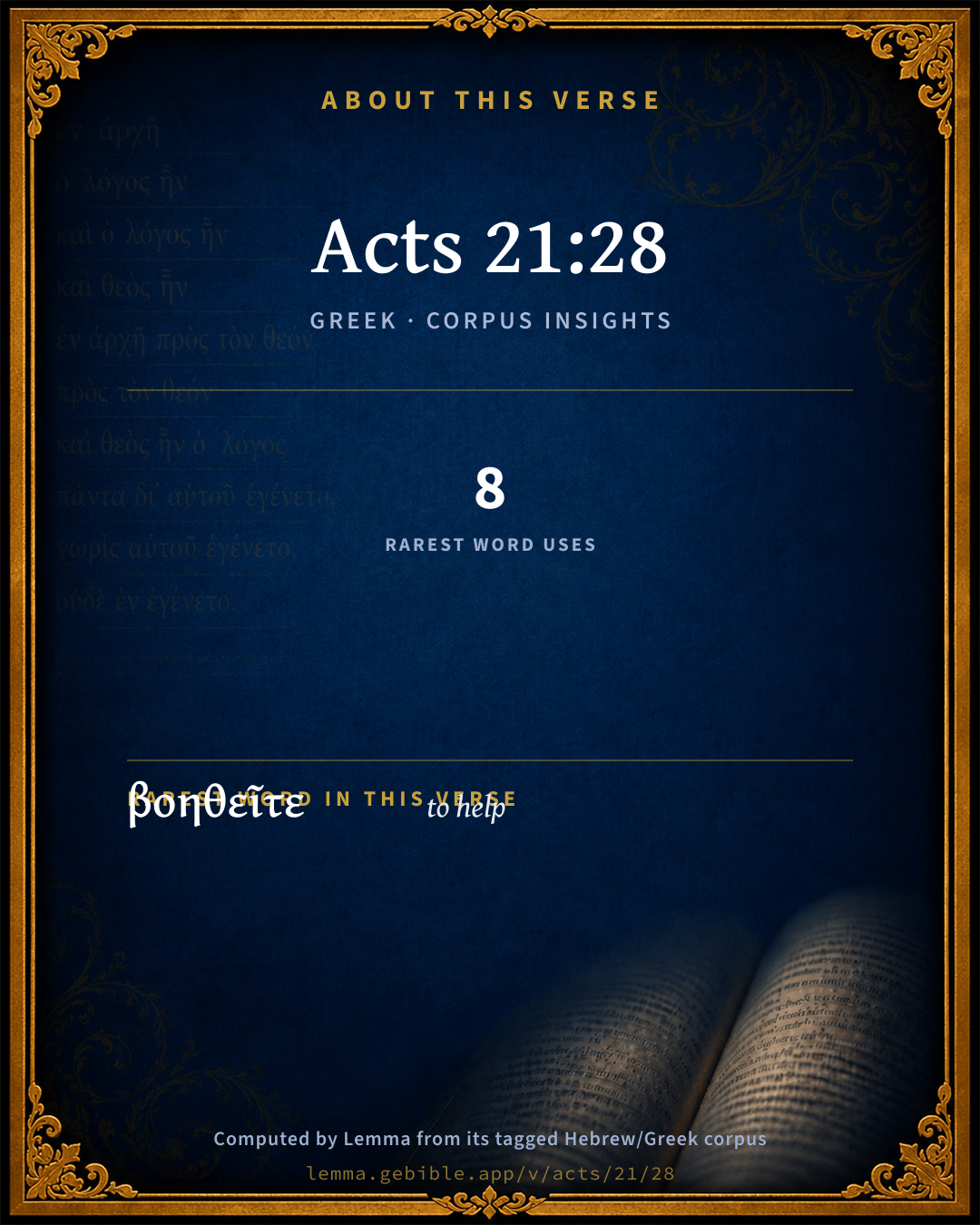
Acts 21:28

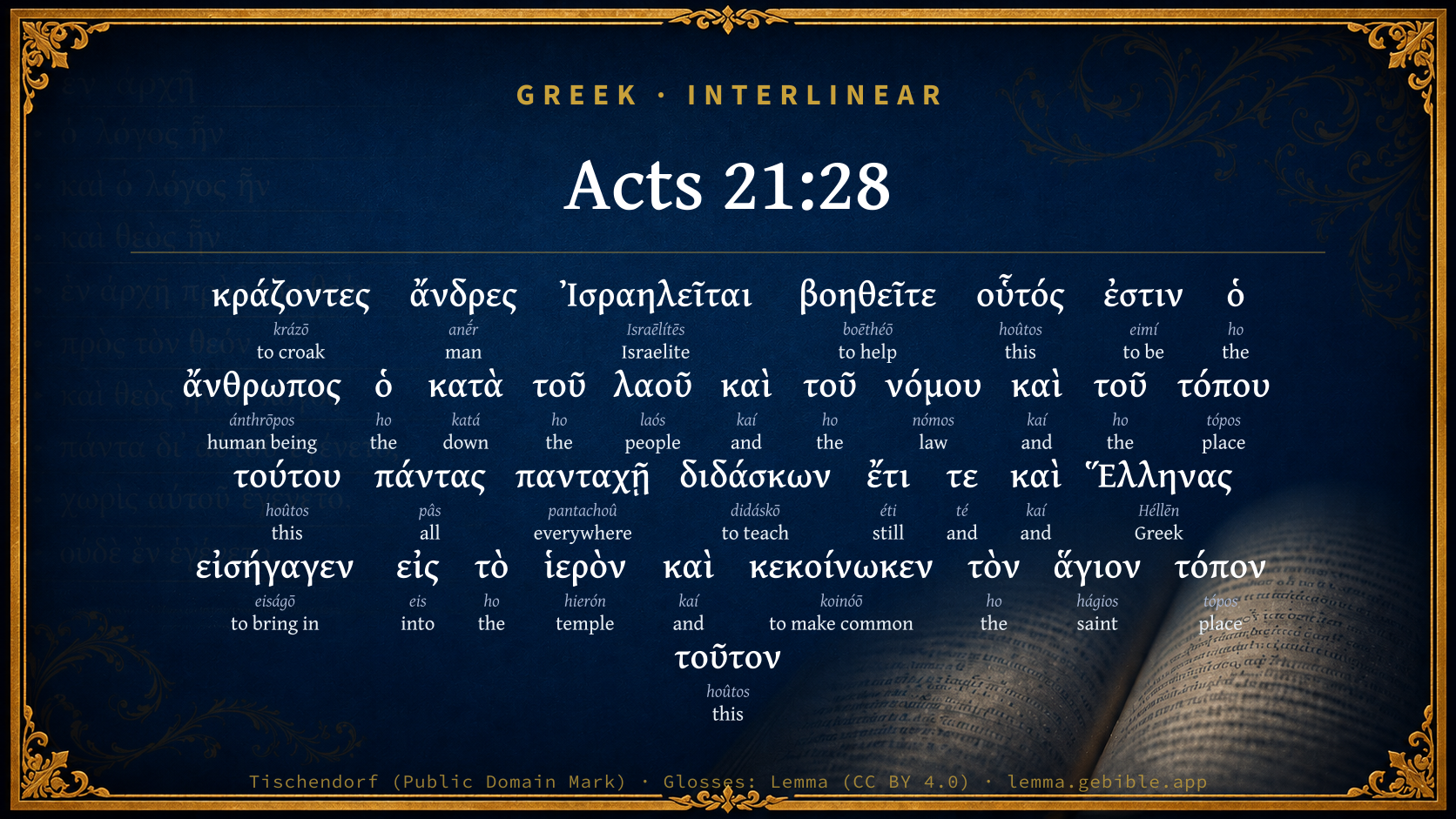
Greek (Tischendorf 8th ed.) Acts 21:28 appears in the Greek New Testament. The text above is from the Tischendorf 8th edition. Each word links to its Strong’s number and a concise gloss. Click any word for its full Thayer’s Greek Lexicon entry.
Download image
Cite this verse

Acts 21:28 (World English Bible). Public Domain. Lemma interlinear Bible study tool, https://lemma.gebible.app/v/acts/21/28.

Show BibTeX & RIS
BibTeX
RIS
English Translation
crying out, "Men of Israel, help! This is the man who teaches all men everywhere against the people, and the law, and this place. Moreover, he also brought Greeks into the temple, and has defiled this holy place!"
World English Bible · Public Domain
Download a study sheet

One document with this verse’s original text, its word-by-word gloss line, the meaning frame, cross-references with their text, attributed commentary, and full source and license credits — printable, and it pastes into notes with its structure intact.

This verse Autodidact and up

Study sheet (.html) Plain text (.txt)

A passage Seminary Student

Up to 50 verses in one chapter. A passage sheet keeps up to 6 commentary sources and 12 cross-references per verse, in the order this page ranks them, and says so on the sheet whenever that leaves anything out. Ask for a single verse and you get the Autodidact verse sheet above.

Everything on this page stays free to read, with no account — the sheet is a download of what is already on screen, not access to it.

Want to remove ads? Support Godless Engineer
Compare translations 3

The same verse in 3 English versions, stacked beneath the original-language interlinear above. Click any original word for its lexicon entry.

Each is an independent rendering of the whole verse — the interlinear is not word-aligned to these translations.

Highlighted words mark where these versions differ — a whole-verse word diff, not a word-by-word alignment.

  • World English Bible Public Domain
    crying out, "Men of Israel, help! This is the man who teaches all men everywhere against the people, and the law, and this place. Moreover, he also brought Greeks into the temple, and has defiled this holy place!"
  • King James Version Public Domain
    Crying out, Men of Israel, help: This is the man, that teacheth all men every where against the people, and the law, and this place: and further brought Greeks also into the temple, and hath polluted this holy place.
  • unfoldingWord Literal Text CC BY-SA 4.0
    shouting, “Men, Israelites, help! This is the man teaching all everywhere against the people and the law and this place. And he has even both brought Greeks into the temple and has defiled this holy place.”

unfoldingWord Literal Text — © unfoldingWord, licensed CC BY-SA 4.0. Word-aligned USFM3 via Door43 (git.door43.org/unfoldingWord/en_ult).

Versions to compare (up to 4)

3 of 4 selected

Show all 19 translations

Every available English version of this verse, each an independent rendering of the whole verse.

  • World English Bible Public Domain
    crying out, "Men of Israel, help! This is the man who teaches all men everywhere against the people, and the law, and this place. Moreover, he also brought Greeks into the temple, and has defiled this holy place!"
  • Berean Standard Bible Public Domain
    crying out, “Men of Israel, help us! This is the man who teaches everywhere against our people and against our law and against this place. Furthermore, he has brought Greeks into the temple and defiled this holy place.”
  • Majority Standard Bible Public Domain
    crying out, “Men of Israel, help us! This is the man who teaches everyone everywhere against our people and against our law and against this place. Furthermore, he has brought Greeks into the temple and defiled this holy place.”
  • King James Version Public Domain
    Crying out, Men of Israel, help: This is the man, that teacheth all men every where against the people, and the law, and this place: and further brought Greeks also into the temple, and hath polluted this holy place.
  • American Standard Version (1901) Public Domain
    crying out, Men of Israel, help: This is the man that teacheth all men everywhere against the people, and the law, and this place; and moreover he brought Greeks also into the temple, and hath defiled this holy place.
  • Revised Version (1885) Public Domain
    crying out, Men of Israel, help: This is the man, that teacheth all men everywhere against the people, and the law, and this place: and moreover he brought Greeks also into the temple, and hath defiled this holy place.
  • Geneva Bible (1599) Public Domain
    Crying, Men of Israel, helpe: this is the man that teacheth all men euery where against the people, and the Lawe, and this place: moreouer, he hath brought Grecians into the Temple, and hath polluted this holy place.
  • Douay-Rheims (1899) Public Domain
    Men of Israel, help: This is the man that teacheth all men every where against the people, and the law, and this place; and moreover hath brought in Gentiles into the temple, and hath violated this holy place.
  • Young's Literal Translation Public Domain
    crying out, `Men, Israelites, help! this is the man who, against the people, and the law, and this place, all everywhere is teaching; and further, also, Greeks he brought into the temple, and hath defiled this holy place;'
  • Literal Standard Version CC BY-SA 4.0
    crying out, “Men, Israelites, help! This is the man who, against the people, and the Law, and this place, is teaching all everywhere; and further, also, he brought Greeks into the temple, and has defiled this holy place”;
  • Unlocked Literal Bible CC BY-SA 4.0
    They were shouting, “Men of Israel, help us. This is the man who teaches all men everywhere things that are against the people, the law, and this place. Besides, he has also brought Greeks into the temple and has defiled this holy place.”
  • unfoldingWord Literal Text CC BY-SA 4.0
    shouting, “Men, Israelites, help! This is the man teaching all everywhere against the people and the law and this place. And he has even both brought Greeks into the temple and has defiled this holy place.”
  • Darby Bible Public Domain
    crying, Israelites, help! this is the man who teaches all everywhere against the people, and the law, and this place, and has brought Greeks too into the temple, and profaned this holy place.
  • World Messianic Bible Public Domain
    crying out, “Men of Israel, help! This is the man who teaches all men everywhere against the people, and the Torah, and this place. Moreover, he also brought Greeks into the temple and has defiled this holy place!”
  • Webster's Bible Public Domain
    Crying out, Men of Israel, help. This is the man that teacheth all men every where against the people, and the law, and this place: and further, hath brought Greeks also into the temple; and hath polluted this holy place.
  • Free Bible Version CC BY-SA 4.0
    “Men of Israel, help!” they shouted. “This is the man who is teaching everyone everywhere to oppose our people, the Law, and the Temple. He's also brought Greeks into the Temple, defiling this holy place.”
  • Bible in Basic English Public Domain
    Crying out, Men of Israel, come to our help: this is the man who is teaching all men everywhere against the people and the law and this place: and in addition, he has taken Greeks into the Temple, and made this holy place unclean.
  • Text-Critical English NT CC BY 4.0
    crying out, “Men of Israel, help us! This is the man who teaches everyone everywhere against our people, our law, and this place. Furthermore, he has even brought Greeks into the inner courts of the temple and has defiled this holy place.”
  • Tyndale New Testament (1534) Public Domain
    cryinge: men of Israel helpe. This is the man that teacheth all men every where agaynst the people and the lawe and this place. Moreover also he hath brought Grekes into the temple and hath polluted this holy place.

Literal Standard Version (2020), Covenant Press — licensed CC BY-SA 4.0. Text via the HelloAO Bible API (eBible.org). Unlocked Literal Bible (unfoldingWord) — licensed CC BY-SA 4.0. Text via the HelloAO Bible API (eBible.org). unfoldingWord Literal Text — © unfoldingWord, licensed CC BY-SA 4.0. Word-aligned USFM3 via Door43 (git.door43.org/unfoldingWord/en_ult). Free Bible Version, Dr. Jonathan Gallagher — licensed CC BY-SA 4.0. Text via the HelloAO Bible API (eBible.org).

Word by word

More ways to search: Search by grammar → Find every occurrence → Compare this word →

Practice this passage: Drill this verse → Learn its vocabulary →

βοηθεῖτε
boēthéō
G997
“to help”
Verb, Present, Active, Imperative, 2nd person, Plural
Part of Speech
Verb
Tense
Present
Voice
Active
Mood
Imperative
Person
2nd person
Number
Plural
Full Thayer's Definition

Origin: from G998

TDNT: 11:28,1

1. to help, succour, bring aid
  1. κράζοντες krázō G2896 “to croak” Verb, Present, Active, Participle, Nominative, Plural, Masculine
  2. ἄνδρες anḗr G435 “man” Noun, Vocative, Plural, Masculine
  3. Ἰσραηλεῖται Israēlítēs G2475 “Israelite” Noun, Vocative, Plural, Masculine
  4. οὗτός hoûtos G3778 “this” Demonstrative pronoun, Nominative, Singular, Masculine
  5. ἐστιν eimí G1510 “to be” Verb, Present, Active, Indicative, 3rd person, Singular
  6. ὁ ho G3588 “the” Article, Nominative, Singular, Masculine
  7. ἄνθρωπος ánthrōpos G444 “human being” Noun, Nominative, Singular, Masculine
  8. ὁ ho G3588 “the” Article, Nominative, Singular, Masculine
  9. κατὰ katá G2596 “down” Preposition
  10. τοῦ ho G3588 “the” Article, Genitive, Singular, Masculine
  11. λαοῦ laós G2992 “people” Noun, Genitive, Singular, Masculine
  12. καὶ kaí G2532 “and” Conjunction
  13. τοῦ ho G3588 “the” Article, Genitive, Singular, Masculine
  14. νόμου nómos G3551 “law” Noun, Genitive, Singular, Masculine
  15. καὶ kaí G2532 “and” Conjunction
  16. τοῦ ho G3588 “the” Article, Genitive, Singular, Masculine
  17. τόπου tópos G5117 “place” Noun, Genitive, Singular, Masculine
  18. τούτου hoûtos G3778 “this” Demonstrative pronoun, Genitive, Singular, Masculine
  19. πάντας pâs G3956 “all” Adjective, Accusative, Plural, Masculine
  20. πανταχῇ pantachoû G3837 “everywhere” Adverb
  21. διδάσκων didáskō G1321 “to teach” Verb, Present, Active, Participle, Nominative, Singular, Masculine
  22. ἔτι éti G2089 “still” Adverb
  23. τε té G5037 “and” Particle
  24. καὶ kaí G2532 “and” Conjunction
  25. Ἕλληνας Héllēn G1672 “Greek” Noun, Accusative, Plural, Masculine
  26. εἰσήγαγεν eiságō G1521 “to bring in” Verb, Aorist, Active, Indicative, 3rd person, Singular
  27. εἰς eis G1519 “into” Preposition
  28. τὸ ho G3588 “the” Article, Accusative, Singular, Neuter
  29. ἱερὸν hierón G2411 “temple” Noun, Accusative, Singular, Neuter
  30. καὶ kaí G2532 “and” Conjunction
  31. κεκοίνωκεν koinóō G2840 “to make common” Verb, Perfect, Active, Indicative, 3rd person, Singular
  32. τὸν ho G3588 “the” Article, Accusative, Singular, Masculine
  33. ἅγιον hágios G40 “saint” Adjective, Accusative, Singular, Masculine
  34. τόπον tópos G5117 “place” Noun, Accusative, Singular, Masculine
  35. τοῦτον hoûtos G3778 “this” Demonstrative pronoun, Accusative, Singular, Masculine

About this verse

These counts appear in no published source. They are computed here, from the morphology-tagged text and Lemma’s own curated glosses. What Lemma adds →

36
words
24
distinct lemmas
Acts
section

Notable vocabulary

The rarest word here is βοηθεῖτε to help G997 — appearing just 8 times in the whole Greek New Testament.

Shared distinctive vocabulary

βοηθεῖτε to help G997 occurs in 8 verses of the Greek New Testament. Also found in:

Repetition

Words recur within this verse:

Cross-references

9

Topical passages linked to Acts 21:28 in the Treasury of Scripture Knowledge — connected by theme and wording, ordered by reader-vote popularity; previews shown in the World English Bible.

  • Acts 24:5–6 For we have found this man to be a plague, an instigator of insurrections among all the Jews throughout the world, and a ringleader of the sect of the Nazarenes.
  • Acts 21:21 They have been informed about you, that you teach all the Jews who are among the Gentiles to forsake Moses, telling them not to circumcise their children neither to walk after the customs.
  • Acts 26:20–21 but declared first to them of Damascus, at Jerusalem, and throughout all the country of Judea, and also to the Gentiles, that they should repent and turn to God, doing works worthy of repentance.
  • Jeremiah 7:4–15 Don't you trust in lying words, saying, The temple of Yahweh, the temple of Yahweh, the temple of Yahweh, are these.
  • Lamentations 1:10 The adversary has spread out his hand on all her pleasant things: For she has seen that the nations are entered into her sanctuary, Concerning whom you did command that they should not enter into your assembly.
  • Matthew 24:15 "When, therefore, you see the abomination of desolation, which was spoken of through Daniel the prophet, standing in the holy place (let the reader understand),
  • Acts 6:13–14 and set up false witnesses who said, "This man never stops speaking blasphemous words against this holy place and the law.
  • Acts 19:26–28 You see and hear, that not at Ephesus alone, but almost throughout all Asia, this Paul has persuaded and turned away many people, saying that they are no gods, that are made with hands.
  • Acts 24:18 amid which certain Jews from Asia found me purified in the temple, not with a mob, nor with turmoil.

Cross-references courtesy of OpenBible.info (CC BY 4.0).

Commentary

Notes on Acts 21:28 from classic Christian and Jewish commentators (each source and its license shown beneath its notes). The classic Christian expositions comment on the surrounding passage and are grouped to its opening verse, so a note may address several verses; the Jewish commentaries on the Tanakh (Rashi and others) are per-verse, so they appear only where the commentator wrote on this verse.

Lemma curates 59 commentaries, every one of them public domain or Creative Commons licensed, each selected and text-cleaned for this edition rather than reprinted as found. About our sources →

Tyndale Open Study Notes

Tyndale Open Resources

21:28-29 Gentiles: It was a crime punishable by death to bring any non-Jew into the Temple precincts beyond the Court of the Gentiles (see also Josephus, War 5.5.2; 6.2.4). The Jews assumed that Paul had violated this sacred law by bringing Trophimus, a Gentile from Ephesus (see also Acts 20:4; 2 Tim 4:20), into the forbidden area.

Tyndale Open Study Notes — © Tyndale Open Resources, licensed CC BY-SA 4.0. Text via the HelloAO Bible API.

Meyer's Critical & Exegetical Commentary

Heinrich August Wilhelm Meyer

Act_21:28-29. Τ. τόπον τοῦτ.] Act_6:14.

ἔτι τε καὶ Ἕλληνας κ.τ.λ.] and, besides, he has also (further, in addition thereto) brought Greeks (Gentiles) into the temple. As to τε καί, see on Act_19:27. That by τὸ ἱερόν we have to understand the court of the Israelites,[129] is self-evident, as the court of the Gentiles was accessible to the Greeks (Lightfoot, ad Matth. p. 58 f.).

Ἕλληνας] the plural of category, which Act_21:29 requires; so spoken with hostile intent.

Act_21:29 is not to be made a parenthesis.

ἦσαν γὰρ προεωρακότες κ.τ.λ.] there were, namely, people, who had before (before they saw the apostle in the temple, Act_21:27) seen Trophimus in the city with him. Observe the correlation in which the προεωρ.[130] stands with θεασάμενοι, and the ἘΝ Τῇ ΠΌΛΕΙ with ἘΝ Τῷ ἹΕΡῷ on the one hand, and with ΕἸς ΤῸ ἹΕΡΌΝ on the other. So much the more erroneous is it to change the definite ΠΡΟ, before, into an indefinite formerly, which Otto, Pastoralbr. p. 284 ff., dates back even four years, namely, to the residence in Jerusalem mentioned in Act_18:22. Beyond doubt the προ does not point back farther than to the time of the present stay in Jerusalem, during which people had seen Trophimus with Paul in the city, before they saw the latter in the temple.

Τρόφιμον τὸν Ἐφέσιον] see Act_20:4. Among those, therefore, who accompanied the apostle ἌΧΡΙ Τῆς ἈΣΊΑς, Trophimus must not have remained behind in Asia, but must have gone on with the apostle to Jerusalem. Comp. on Act_27:2.

ἘΝΌΜΙΖΟΝ] The particular accusation thus rested on a hasty and mistaken inference; it was an erroneous suspicion expressed as a certainty, to which zealotry so easily leads!

ὋΝ ἘΝΌΜΙΖΟΝ ὍΤΙ] comp. Joh_8:54.

[129] On the screen of which were columns, with the warning in Greek and Latin: μὴ δεῖν ἀλλόφυλον ἐντὸς τοῦ ἁγίου προσιέναι, Joseph. Bell. v. 5. 2.

[130] The χρο is not local, as in Act_2:25 (my former interpretation), but, according to the context, temporal. The usus loquendi alone cannot here decide, as it may beyond doubt be urged for either view; see the Lexicons. So also is it with χροϊδεῖν. The Vulgate, Erasmus, Luther, Castalio, Calvin, and others neglect the χρο entirely. Beza correctly renders: antea viderant.

Meyer — Critical and Exegetical Commentary on the New Testament — English translation by Peter Christie, edited by Frederick Crombie (T&T Clark, 1880) — public domain. Text from a community e-Sword module.

Expositor's Greek Testament

ed. W. Robertson Nicoll

Act 21:28 . Ἄνδρες Ἰσ .: the title which would remind them of the special dignity and glory of their nation, of its hopes and obligations. βοηθεῖτε : as if against some outrage, or perhaps as if to apprehend Paul, or to attack him in doing anything to admit the Gentiles, ἔθνη , to God’s fold, St. Paul was exposing himself to the hatred of these unbelievers amongst his countrymen, 1Th 2:16 , Hort, Judaistic Christianity , p. 107. οὖτός : contemptuous. κατὰ τοῦ λαοῦ : the name for Israel, see on Act 4:25 , the same charge in almost the same words had been brought against St. Stephen, Act 6:13 ; “before the Jewish authorities blasphemy was alleged, before the Roman, sedition”. πάντας πανταχοῦ , πανταχῆ or - ῇ , W.H [361] , cf. Act 17:30 , 1Co 4:17 . πανταχῇ : only here. The three words show the exaggerated nature of the charge; on St. Luke’s characteristic use of πᾶς and kindred words see p. 51. ἔτι τε καὶ , connecting thus closely the alleged act of introducing Gentiles into the Temple with the foregoing, as an illustration that Paul did not confine himself to preaching against the Holy Place, but had proceeded to defile it by his action; but cf. Simcox, Language of the N.T. , p. 163, “and further hath brought Greeks also ,” cf. Act 19:27 . Έλληνας : only one man, Trophimus, had been actually seen with Paul, so that we again note the exaggerated charge, and even with regard to Trophimus, ἐνόμιζον , they only conjectured they had no positive proof. κεκοίνωκε : perfect, “sed manet pollutio,” Blass, in loco , see also Gram. , p. 194.

[361] Westcott and Hort’s The New Testament in Greek: Critical Text and Notes.

The Expositor's Greek Testament, edited by W. Robertson Nicoll (1897–1910) — public domain. Text from a community e-Sword module.

Adam Clarke's Commentary

Verse 28. This is the man that teacheth, c.] As much as if they had said: This is the man concerning whom we wrote to you who in every place endeavours to prejudice the Gentiles against the Jews, against the Mosaic law, and against the temple and its services.

Brought Greeks also into the temple] This was a most deliberate and malicious untruth: Paul could accomplish no purpose by bringing any Greek or Gentile into the temple; and their having seen Trophimus, an Ephesian, with him, in the city only, was no ground on which to raise a slander that must so materially affect both their lives. Josephus informs us, War, lib. v. cap. 5, sec. 2, that on the wall which separated the court of the Gentiles from that of the Israelites was an inscription in Greek and Latin letters, which stated that no stranger was permitted to come within the holy place on pain of death. With such a prohibition as this before his eyes, was it likely that St. Paul would enter into the temple in company with an uncircumcised Greek? The calumny refutes itself.

Adam Clarke's Commentary on the Bible (1810–1826) — public domain. Text from a community e-Sword/MySword module.

John Calvin's Commentaries

28. Men of Israel, help. They cry out as if they were in extreme danger, and they call upon all men to help them, as if all religion were in hazard. Whereby we see with what furious hatred they were inflamed against Paul, only because in showing that the full and perfect truth is found in Christ, he taught that the figures of the law had an end. Now, whereas they conceive a false opinion, having seen Trophimus, they do more betray by this headlong lightness how venomous they be. They accuse Paul of sacrilege. Why? because he brought into the temple a man which was uncircumcised. But they laid a most cruel crime to the charge of an innocent through a false opinion. Thus the boldness of those men useth commonly to be preposterous who are carried away with an opinion conceived before. But let us learn by such examples to beware of the distemperature of affections, and not to let light prejudices have the rein, lest we run headlong upon the innocent, being carried with blind force.

John Calvin's Commentaries (1540-1563) — public domain. Text from the Calvin Translation Society English edition (1840s-50s) via the Christian Classics Ethereal Library (ccel.org). Calvin's coverage is partial (roughly two-thirds of the Bible); uncommented books and verses are honest gaps, never fabricated. The 19th-century editor's footnotes and remarks are omitted so the notes are faithfully Calvin's own voice.

The Cambridge Bible for Schools and Colleges

gen. ed. J. J. S. Perowne

28. crying … help] The cry as if an outrage had been committed, and they, the strangers visiting Jerusalem, were the persons who could afford the best testimony to what had been done. For had they not seen and heard Paul in Ephesus and elsewhere?

This … people] They would intimate that he was bringing the whole nation into contempt. The Jews no doubt were treated with contempt among the Gentiles, and to hear that one of their own nation had helped this on would rouse them as much as anything could.

and the law, and this place] How great a change has come over the Apostle since the day when he joined with those who charged Stephen (ch. Act_6:13), with speaking blasphemous words against this holy place (the Temple) and the law. Now a like multitude brings similar charges against him.

and further brought (Rev. Ver. “and moreover he brought”) Greeks also into the temple] There was in the Temple a “court of the Gentiles” but the accusation against the Apostle was, that during his own sojourn in the sacred precincts he had brought his companions into places which were forbidden to them. How unscrupulous their charge was is indicated by the plural “Greeks,” whereas the only person to whom such a term could be applied was Trophimus.

and hath polluted (Rev. Ver. “defiled”) this holy place] They themselves as Jews were in the court allotted to their nation, and which was deemed more sacred than that of the Gentiles. The Greek word is literally “made common,” and carries the thought back to St Peter’s vision, where the Gentiles were figured by the beasts which the Apostle deemed “common or unclean” (Act_10:14).

The Cambridge Bible for Schools and Colleges (gen. ed. J. J. S. Perowne; Cambridge University Press, 1878–1918) — public domain. Text from a community e-Sword module.

John Gill's Exposition

Crying out, men of Israel, help,.... The Arabic and Ethiopic versions read, "help us"; to hold Paul, on whom they had laid their hands, and to assist in beating him: but why such an outcry for help against a single man, and he but little of stature, and weak in body, and so easily held and overpowered? it may be they chose to engage others with them, to give the greater countenance to their actions, and for their own security and protection, should they be opposed or called to an account;

this is the man that teacheth all men everywhere against the people; the people of the Jews, saying that they were not the only people of God; that God was the God of the Gentiles, as well as of the Jews; that God had chosen, and called, and saved some of the one, as well as of the other; that the Gentiles shared in the favour of God, and the blessings of the Messiah; that the Gospel was to be preached to them, and a people taken out of them for his glory; and that the people of the Jews would be rejected for their unbelief and impenitence, and in a little time utterly destroyed as a nation; which, and the like, these Asiatic Jews interpreted as speaking against them; whereas no man had a stronger natural affection for his countrymen, or a more eager and importunate desire for their spiritual and eternal welfare, than the apostle had;

and the law; the law of Moses, both moral and ceremonial; for they not only were displeased with him for asserting the abrogation of the latter, but traduced him as an enemy to the former; representing him as an Antinomian, because he denied justification to be by the works of the law, and asserted Christ to be the end of the law for righteousness; whereas he was so far from making void the law hereby, that he established it, and secured the rights and honours of it; yea, they went further, and represented him as a libertine, saying, let us do evil that good may come; but this was all calumny:

and this place: meaning the temple, in which they then were; the Alexandrian copy reads, "this holy place"; as it is expressed in a following clause; the reason of this charge was, because that he had taught, that the sacrifices of God were the sacrifices of prayer and of praise, and that these were to be offered up in every place; and that divine service and religious worship were not tied to the temple at Jerusalem, but that, agreeably to the doctrine of Christ, men might worship the Father anywhere, and lift up holy hands in every place; and perhaps he might have asserted, that the temple of Jerusalem would be destroyed in a short time, as Christ had predicted:

and further, brought Greeks also unto the temple, and hath polluted this holy place; that part of the temple, which they supposed Paul had brought Greeks or Gentiles into, could not be the most holy place, for into that only the high priest went, once a year; nor that part of the holy place called the court of the priests, for into that only priests went, and other Israelites were not admitted, unless on some particular occasions; as to lay hands on the sacrifice, for the slaying of it, or waving some part of it (x); but it must be either the court of the Israelites, or the court of the women, into which Paul, with the four men that had the vow, entered; and as Dr. Lightfoot thinks, it was the latter; for in, the south east of this court was the Nazarite's chamber, in which they boiled their peace offerings, shaved their heads, and put the hair under the pot (y): now though Gentiles might come into the mountain of the house, which was all the outmost circumambient space within the wall, which encompassed the whole area, yet they might not come into any of these courts, no, nor even into what they call the "Chel"; for they say, that the Chel is more holy than the mountain of the house, because no Gentile, or one defiled with the dead, enters there (z); now the Chel was an enclosure before these courts, and at the entrance into it pillars were erected, and upon them were inscriptions in Greek and Latin, signifying that no strangers should enter into the holy place (a).

(x) Misn. Celim, c. 1. sect. 8. (y) Misn. Middot, c. 2. sect. 5. (z) Misn. Celim, ib. (a) Joseph. Antiqu. l. 15. c. 14. sect. 5.

John Gill's Exposition of the Whole Bible (1746–1763) — public domain (CC PDM 1.0). Text via the HelloAO Bible API.

Trapp's Complete Commentary

John Trapp

28 Crying out, Men of Israel, help: This is the man, that teacheth all men every where against the people, and the law, and this place: and further brought Greeks also into the temple, and hath polluted this holy place.

Ver. 28. Crying, Men of Israel, help, this is the man, &c.] An admirable and graphic description of this tumult; every circumstance set forth to the life as it were. No poet could have done it with more skill and artifice. There is as good rhetoric in the Bible as in any heathen orator whatsoever. It was therefore a foolish and profane fear of Politian, Longolius, Bonamicus, and other Logodaedali, that if they should read the Scriptures, they should mar the purity of their style. "This is the man that teacheth," &c. There is not a true word in all this outcry. So Elias was called a troubler, Luther a trumpeter of rebellion, Melancthon a blasphemer of God and his saints, Calvin a Mahometan, Zanchius an Anabaptist, a Swenckfeldian, Novatian, and what not? Arminius paved his way first by aspersing and sugillating the fame and authority of Calvin, Zuinglius, Beza, Martyr, and other champions of the truth. The Papists reported the Waldenses (those ancient Protestants) to be Manichees, Arians, Catharists, &c., as they do us to be libertines, enthusiasts, atheists, &c. Contra sycophantae morsum non est remedium. They set their mouths against heaven, and their tongue walketh through the earth, Psa 73:9. But God will cut out such false tongues, Psa 12:3, and broil them upon coals of juniper, Psa 120:4.

John Trapp, A Commentary or Exposition upon All the Books of the Old and New Testament (1647–1656) — public domain. Text from a community e-Sword module.

Albert Barnes' Notes on the Bible

Men of Israel - Jews. All who are the friends of the Law of Moses.

This is the man ... - This implies that they had before given information to the Jews at Jerusalem that there was such a man, and they now exulted in the fact that they had found him. They therefore called on all these to aid in securing and punishing him.

That teacheth ... - See the notes on Act 6:13-14.

Against the people - The people of the Jews. That is, they pretended that he taught that the customs and laws of the Jewish nation were not binding, and endeavored to prejudice all people against them.

And the law - The Law of Moses.

And this place - The temple. Everything against the Law would be interpreted also as being against the temple, as most of the ceremonies required in the Law were celebrated there. It is possible also that Paul might have declared that the temple was to be destroyed. Compare Act 6:13-14.

And further, brought Greeks ... - The temple was surrounded by various areas called courts. See the notes on Mat 21:12. The outermost of these courts was called the court of the Gentiles, and into that it was lawful for the Gentiles to enter. But the word “temple” here refers, doubtless, to the parts of the area appropriated especially to the Israelites, and which it was unlawful for a Gentile to enter. These parts are marked “GGGG” in the plan of the temple. See the notes at Mat 21:12.

And hath polluted ... - He has defiled the temple by thus introducing a Gentile. No greater defilement, in their view, could scarcely be conceived. No more effective appeal could be made to the passions of the people than this.

Albert Barnes' Notes on the Bible (1834–1885) — public domain. Text from a community e-Sword/MySword module.

Matthew Poole's English Annotations

Men of Israel; minding them by this compellation, of their being a peculiar people unto God, and that none might be admitted with them in his worship. A charge is laid against St. Paul consisting of divers articles, but all false; for he was a most zealous lover of that people, and taught them nothing but the true use and meaning of the law: but thus they had done to our Saviour, Mat 26:61, and to St. Stephen, Act 6:13.

Into the temple; that is, into the court of the Jews, which is so far unlawful, that they might have killed a Roman if he had come in there; and everyone was warned by an inscription upon the pillars, Mη δειν αλλοφυλον εντος του αγιου παριεναι, That no stranger or foreigner might come into that holy place.

Matthew Poole's English Annotations on the Holy Bible (1683–1685) — public domain. Text from a community e-Sword/MySword module.

Whedon's Commentary on the Bible

Daniel D. Whedon

28. Men of Israel—A popular patriotic war cry.

Brought Greeks—(See note on Joh_2:14.) To the inscription upon the wall of this court Titus, the Roman destroyer of Jerusalem, once made a most indignant reference: Have ye not, O ye accursed, by our permission put up this partition wall before your sanctuary? Have not you been allowed to put up the pillars thereto belonging at due distances, and on it to engrave in Greek, and in your own letters, this prohibition, that no foreigner should go beyond that wall? Have we not given you leave to kill such as go beyond it, though he were a Roman?”—Wars, Act_4:2; Act_4:4.

Daniel D. Whedon (gen. ed.), Commentary on the Old and New Testaments (1874–1909) — public domain. Text from a community e-Sword module.

The Pulpit Commentary

Moreover he for further brought, A.V.; defiled for polluted, A.V. (For the accusation, comp. on. 6:13, and above, ver. 21.) Brought Greeks also, etc. No uncircumcised person might go beyond the court of the Gentiles, which was not in the agion. The iJeron, which is often used in a wider sense of the whole area, is here restricted to the agion. (see Act_3:1, note) But the accusation was utterly false, the offspring of their own fanatical suspicions. Defiled (kekoinwke); literally, made common. (see Act_10:15 Act_11:9)

The Pulpit Commentary (1880–1919), ed. H.D.M. Spence-Jones & Joseph S. Exell — public domain. Text from a community e-Sword module.

John Wesley's Explanatory Notes

Against the people - The Jewish nation; and the law - Of Moses; and this place - The temple. Yea, and hath even brought Greeks into the temple - They might come into the outer court. But they imagined Paul had brought then into the inner temple, and had thereby polluted it.

John Wesley, Explanatory Notes Upon the Whole Bible (1754–1765) — public domain. Text via the GEBible commentary corpus.

McGarvey & Pendleton's Commentaries

J. W. McGarvey

See notes on verse 27

J. W. McGarvey (with Philip Y. Pendleton), Commentaries on the New Testament (The Fourfold Gospel, 1914; Acts; and the epistles) — public domain. Text from a community e-Sword/MySword module.

Cambridge Greek Testament for Schools and Colleges

28. βοηθεῖτε, Help. The cry is as if an outrage had been committed, and they, the strangers visiting Jerusalem, were the persons who could afford the best testimony to what had been done. For had they not seen and heard Paul in Ephesus and elsewhere?

οὗτός ἐστιν ὁ ἄνθρωπος ὁ κατὰ τοῦ λαοῦ κ.τ.λ., this is the man that teacheth all men everywhere against the people. By their language they would intimate that he was bringing the whole nation into contempt. The Jews no doubt were treated with contempt among the Gentiles, and to hear that one of their own nation had helped this on would rouse them as much as anything could.

καὶ τοῦ νόμου καὶ τοῦ τόπου τούτου, and [against] the Law and this place. How great a change has come over the Apostle since the day when he joined with those who charged Stephen (ch. Act 6:13) with speaking blasphemous words against this holy place (the Temple) and the Law. Now a like multitude brings similar charges against him.

ἔτι τε καὶ Ἕλληνας εἰσήγαγεν εἰς τὸ ἱερόν, and moreover he has brought Greeks also into the Temple. On the occurrence of τε καί in the same clause, cf. on Act 19:27. There is no doubt a special emphasis intended to be given to Ἕλληνας in this clause which may explain St Luke’s irregular language.

There was in the Temple a ‘court of the Gentiles,’ but the accusation against St Paul was that, during his own sojourn in the sacred precincts, he had brought his Gentile companions into places which were forbidden to them. How unscrupulous their charge was is indicated by the plural ‘Greeks,’ whereas the only person to whom such a term could be applied was Trophimus.

καὶ κεκοίνωκεν κ.τ.λ., and hath defiled this holy place. They themselves as Jews were in the court allotted to their nation, which was deemed more sacred than that of the Gentiles. The Greek word κεκοίνωκεν is literally ‘hath made common,’ and carries the thought back to St Peter’s vision, where the Gentiles were figured by the beasts which the Apostle deemed ‘common (κοινά) or unclean’ (Act 10:14).

Cambridge Greek Testament for Schools and Colleges (Cambridge University Press, 1896; 21 vols, various authors incl. Carr, Maclear, Plummer, Farrar, Lumby, Moule, M. R. James, Simcox) — public domain. Text from a community e-Sword module.

Alford’s Greek Testament

Henry Alford

28. Ελληνας] The generic plural: only one is intended, see next verse. They meant, into the inner court, which was forbidden to Gentiles.

Henry Alford, The Greek Testament (1849–1861) — public domain. Text from a community e-Sword module.

Vincent's Word Studies in the New Testament

Marvin R. Vincent

This place. The temple. Compare the charge against Stephen, ch. 6 13. Greeks. See on ch. Act 6:1.

Temple [ιερον] . See on Mt 4:5. The Jews evidently meant to create the impression that Paul had introduced Gentiles into the inner court, which was restricted to the Jews. The temple proper was on the highest of a series of terraces which rose from the outer court, or Court of the Gentiles. In this outer court any stranger might worship. Between this and the terraces was a balustrade of stone, with columns at intervals, on which Greek and Latin inscriptions warned all Gentiles against advancing farther on pain of death. Beyond this balustrade rose a flight of fourteen steps to the first platform, on which was the Court of the Women, surrounded by a wall. In this court were the treasury, and various chambers, in one of which the Nazarites performed their vows. It was here that the Asiatic Jews discovered Paul

Marvin R. Vincent, Word Studies in the New Testament (1887–1900) — public domain. Text from a community e-Sword/MySword module.

Lesson kit

Teaching starters — assembled from the data on this page, not authored interpretation. Every prompt links to the verse data it draws on. Edit before teaching.

Acts, in the Acts, opens this verse with 36 words (24 distinct Greek lemmas). Its most distinctive word is boēthéō (“to help”). A historical commentator’s framing appears above. Read the whole chapter for the surrounding context.

Discussion questions

  1. What does “to help” (boēthéō) contribute to the verse as a whole?
  2. Matthew 15:25 shares the word «to help» with this verse. How do the two illuminate each other?
  3. “place” occurs 2× in this one verse. What is the effect of the repetition?
  4. These translations render this verse differently. What is at stake in choosing one wording over another?
  5. Reading how Tyndale Open Study Notes and Meyer's Critical & Exegetical Commentary read this verse, where do the two commentators agree and where do they part?

Things to notice

Reading settings

Reading text

Shown beneath each verse's original-language words.

Old Testament
Old Testament edition

Read the OT as the Masoretic Hebrew (MT) or the Greek Septuagint (LXX).

English shown for the Greek Septuagint (in the Hebrew ↔ Greek comparison).

Comparing translations? Open the Compare panel on any verse page to stack up to four side by side.