
Matthew 4:5

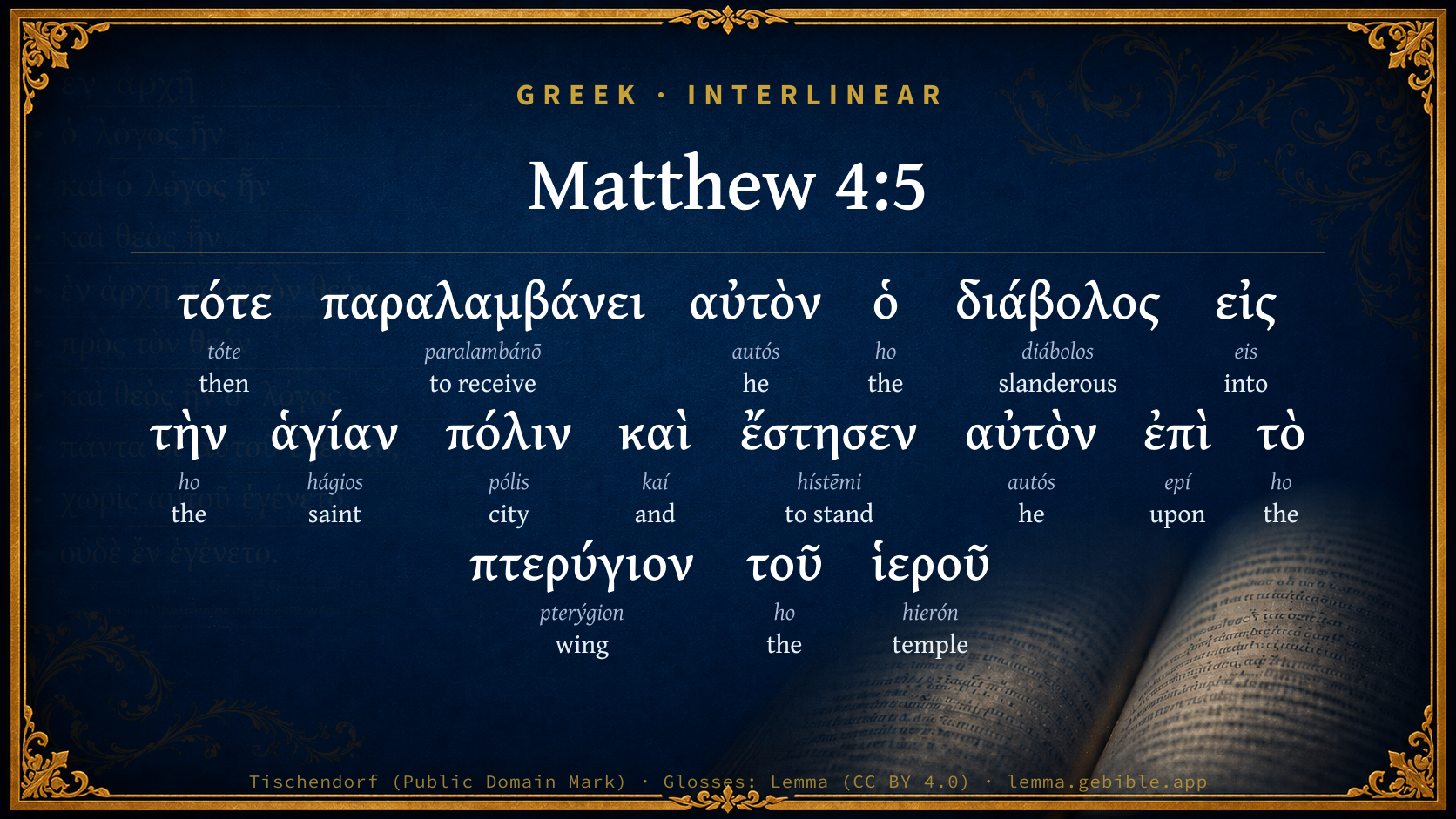
Greek (Tischendorf 8th ed.) Matthew 4:5 appears in the Greek New Testament. The text above is from the Tischendorf 8th edition. Each word links to its Strong’s number and a concise gloss. Click any word for its full Thayer’s Greek Lexicon entry.
Download image
Cite this verse

Matthew 4:5 (World English Bible). Public Domain. Lemma interlinear Bible study tool, https://lemma.gebible.app/v/matthew/4/5.

Show BibTeX & RIS
BibTeX
RIS
English Translation
Then the devil took him into the holy city. He set him on the pinnacle of the temple,
World English Bible · Public Domain
Highlights
  • 2 first appearances in the Greek New Testament
Full analysis ↓
Download a study sheet

One document with this verse’s original text, its word-by-word gloss line, the meaning frame, cross-references with their text, attributed commentary, and full source and license credits — printable, and it pastes into notes with its structure intact.

This verse Autodidact and up

Study sheet (.html) Plain text (.txt)

A passage Seminary Student

Up to 50 verses in one chapter. A passage sheet keeps up to 6 commentary sources and 12 cross-references per verse, in the order this page ranks them, and says so on the sheet whenever that leaves anything out. Ask for a single verse and you get the Autodidact verse sheet above.

Everything on this page stays free to read, with no account — the sheet is a download of what is already on screen, not access to it.

Want to remove ads? Support Godless Engineer
Compare translations 3

The same verse in 3 English versions, stacked beneath the original-language interlinear above. Click any original word for its lexicon entry.

Each is an independent rendering of the whole verse — the interlinear is not word-aligned to these translations.

Highlighted words mark where these versions differ — a whole-verse word diff, not a word-by-word alignment.

  • World English Bible Public Domain
    Then the devil took him into the holy city. He set him on the pinnacle of the temple,
  • King James Version Public Domain
    Then the devil taketh him up into the holy city, and setteth him on a pinnacle of the temple,
  • unfoldingWord Literal Text CC BY-SA 4.0
    Then the devil takes him into the holy city, and he set him on the highest point of the temple,

unfoldingWord Literal Text — © unfoldingWord, licensed CC BY-SA 4.0. Word-aligned USFM3 via Door43 (git.door43.org/unfoldingWord/en_ult).

Versions to compare (up to 4)

3 of 4 selected

Show all 19 translations

Every available English version of this verse, each an independent rendering of the whole verse.

  • World English Bible Public Domain
    Then the devil took him into the holy city. He set him on the pinnacle of the temple,
  • Berean Standard Bible Public Domain
    Then the devil took Him to the holy city and set Him on the pinnacle of the temple.
  • Majority Standard Bible Public Domain
    Then the devil took Him to the holy city and set Him on the pinnacle of the temple.
  • King James Version Public Domain
    Then the devil taketh him up into the holy city, and setteth him on a pinnacle of the temple,
  • American Standard Version (1901) Public Domain
    Then the devil taketh him into the holy city; and he set him on the pinnacle of the temple,
  • Revised Version (1885) Public Domain
    Then the devil taketh him into the holy city; and he set him on the pinnacle of the temple,
  • Geneva Bible (1599) Public Domain
    Then the deuil tooke him vp into the holy Citie, and set him on a pinacle of the temple,
  • Douay-Rheims (1899) Public Domain
    Then the devil took him up into the holy city, and set him upon the pinnacle of the temple,
  • Young's Literal Translation Public Domain
    Then doth the Devil take him to the `holy' city, and doth set him on the pinnacle of the temple,
  • Literal Standard Version CC BY-SA 4.0
    Then the Devil takes Him to the [holy] city, and sets Him on the pinnacle of the temple,
  • Unlocked Literal Bible CC BY-SA 4.0
    Then the devil took him into the holy city and set him on the highest point of the temple building,
  • unfoldingWord Literal Text CC BY-SA 4.0
    Then the devil takes him into the holy city, and he set him on the highest point of the temple,
  • Darby Bible Public Domain
    Then the devil takes him to the holy city, and sets him upon the edge of the temple,
  • World Messianic Bible Public Domain
    Then the devil took him into the holy city. He set him on the pinnacle of the temple,
  • Webster's Bible Public Domain
    Then the devil taketh him up into the holy city, and setteth him on a pinnacle of the temple,
  • Free Bible Version CC BY-SA 4.0
    Then the devil took him to the holy city and placed him on the top of the Temple.
  • Bible in Basic English Public Domain
    Then the Evil One took him to the holy town; and he put him on the highest point of the Temple and said to him,
  • Text-Critical English NT CC BY 4.0
    Then the devil took him to the holy city, set him on the pinnacle of the temple,
  • Tyndale New Testament (1534) Public Domain
    Then the devyll tooke hym vp into the holy cite and set hym on a pynacle of the temple

Literal Standard Version (2020), Covenant Press — licensed CC BY-SA 4.0. Text via the HelloAO Bible API (eBible.org). Unlocked Literal Bible (unfoldingWord) — licensed CC BY-SA 4.0. Text via the HelloAO Bible API (eBible.org). unfoldingWord Literal Text — © unfoldingWord, licensed CC BY-SA 4.0. Word-aligned USFM3 via Door43 (git.door43.org/unfoldingWord/en_ult). Free Bible Version, Dr. Jonathan Gallagher — licensed CC BY-SA 4.0. Text via the HelloAO Bible API (eBible.org).

Word by word

More ways to search: Search by grammar → Find every occurrence → Compare this word →

Practice this passage: Drill this verse → Learn its vocabulary →

πτερύγιον
pterýgion
G4419
“wing”
Noun, Accusative, Singular, Neuter
Part of Speech
Noun
Case
Accusative
Number
Singular
Gender
Neuter
Full Thayer's Definition

Origin: from a presumed derivative of G4420

TDNT: None

1. a wing, a little wing 2. any pointed extremity a. of fins of fishes b. of part of a dress hanging down in the form of a wing c. of the top of the temple at Jerusalem
  1. τότε tóte G5119 “then” Adverb
  2. παραλαμβάνει paralambánō G3880 “to receive” Verb, Present, Active, Indicative, 3rd person, Singular
  3. αὐτὸν autós G846 “he” Personal pronoun, Accusative, Singular, Masculine
  4. ὁ ho G3588 “the” Article, Nominative, Singular, Masculine
  5. διάβολος diábolos G1228 “slanderous” Adjective, Nominative, Singular, Masculine
  6. εἰς eis G1519 “into” Preposition
  7. τὴν ho G3588 “the” Article, Accusative, Singular, Feminine
  8. ἁγίαν hágios G40 “saint” Adjective, Accusative, Singular, Feminine
  9. πόλιν pólis G4172 “city” Noun, Accusative, Singular, Feminine
  10. καὶ kaí G2532 “and” Conjunction
  11. ἔστησεν hístēmi G2476 “to stand” Verb, Aorist, Active, Indicative, 3rd person, Singular
  12. αὐτὸν autós G846 “he” Personal pronoun, Accusative, Singular, Masculine
  13. ἐπὶ epí G1909 “upon” Preposition
  14. τὸ ho G3588 “the” Article, Accusative, Singular, Neuter
  15. τοῦ ho G3588 “the” Article, Genitive, Singular, Neuter
  16. ἱεροῦ hierón G2411 “temple” Noun, Genitive, Singular, Neuter

About this verse

These counts appear in no published source. They are computed here, from the morphology-tagged text and Lemma’s own curated glosses. What Lemma adds →

17
words
13
distinct lemmas
Gospels
section

Notable vocabulary

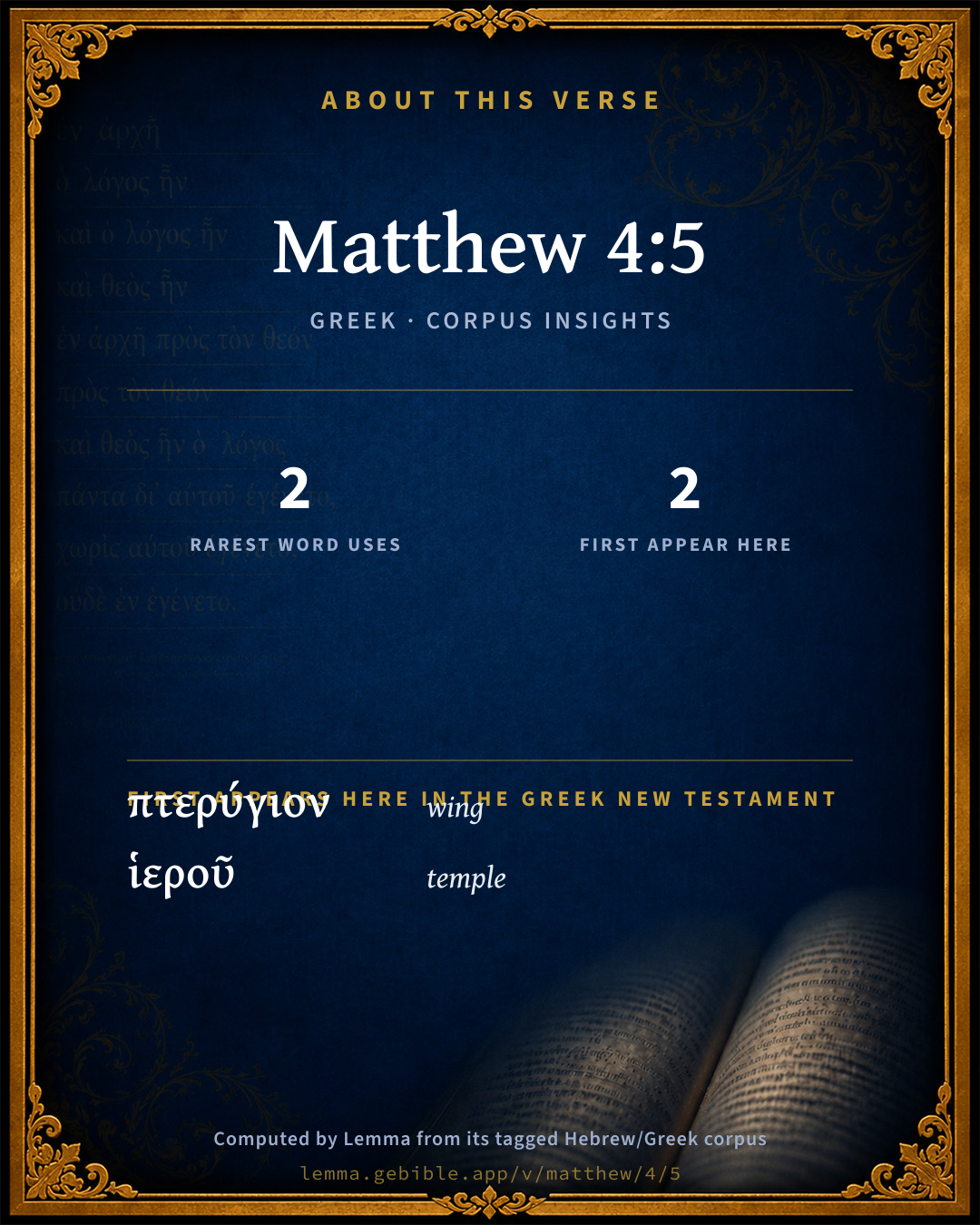
The rarest word here is πτερύγιον wing G4419 — appearing just 2 times in the whole Greek New Testament.

First appearance in Scripture

These words make their first canonical appearance in the Greek New Testament here:

  • πτερύγιον wing G4419
  • ἱεροῦ temple G2411

Shared distinctive vocabulary

πτερύγιον wing G4419 occurs in 2 verses of the Greek New Testament. Also found in:
Repetition

Words recur within this verse:

Cross-references

11

Topical passages linked to Matthew 4:5 in the Treasury of Scripture Knowledge — connected by theme and wording, ordered by reader-vote popularity; previews shown in the World English Bible.

  • Luke 4:9 He led him to Jerusalem, and set him on the pinnacle of the temple, and said to him, "If you are the Son of God, cast yourself down from here,
  • Matthew 27:53 and coming out of the tombs after his resurrection, they entered into the holy city and appeared to many.
  • Revelation 11:2 Leave out the court which is outside of the temple, and don't measure it, for it has been given to the gentiles. They will tread the holy city under foot for forty-two months.
  • Isaiah 48:2 (for they call themselves of the holy city, and stay themselves on the God of Israel; Yahweh of Hosts is his name):
  • Nehemiah 11:1 The princes of the people lived in Jerusalem: the rest of the people also cast lots, to bring one of ten to dwell in Jerusalem the holy city, and nine parts in the [other] cities.
  • Nehemiah 11:18 All the Levites in the holy city were two hundred eighty-four.
  • Isaiah 52:1 Awake, awake, put on your strength, Zion; put on your beautiful garments, Jerusalem, the holy city: for henceforth there shall no more come into you the uncircumcised and the unclean.
  • Daniel 9:16 Lord, according to all your righteousness, let your anger and please let your wrath be turned away from your city Jerusalem, your holy mountain; because for our sins, and for the iniquities of our fathers, Jerusalem and your people are become a reproach to all who are round about us.
  • Daniel 9:24 Seventy weeks are decreed on your people and on your holy city, to finish disobedience, and to make an end of sins, and to make reconciliation for iniquity, and to bring in everlasting righteousness, and to seal up vision and prophecy, and to anoint the most holy.
  • John 19:11 Jesus answered, "You would have no power at all against me, unless it were given to you from above. Therefore he who delivered me to you has greater sin."
  • 2 Chronicles 3:4 The porch that was before [the house], the length of it, according to the breadth of the house, was twenty cubits, and the height one hundred twenty; and he overlaid it within with pure gold.

Cross-references courtesy of OpenBible.info (CC BY 4.0).

Commentary

Notes on Matthew 4:5 from classic Christian and Jewish commentators (each source and its license shown beneath its notes). The classic Christian expositions comment on the surrounding passage and are grouped to its opening verse, so a note may address several verses; the Jewish commentaries on the Tanakh (Rashi and others) are per-verse, so they appear only where the commentator wrote on this verse.

Lemma curates 59 commentaries, every one of them public domain or Creative Commons licensed, each selected and text-cleaned for this edition rather than reprinted as found. About our sources →

The Biblical Illustrator

Joseph S. Exell

Mat_4:5

Pinnacle of the temple.

-Tempted to self-destruction. (Dr. O. Winslow.)

The seceded temptation

I. Satans doubt. If Thou be the Son of God, etc.

II. His purpose. He urged on Christ an act of self-destruction. He was from the beginning the cause of death in all forms.

III. The argument with which he supported it. A quotation from Scripture.

IV. The passion to which he appealed. The pride of the human heart, to display.

V. It was a real temptation; it contanned desire, collision between desire and law, suggestion, and free will. (W. H. Hutchings, M. A.)

Temptations on the pinnacle

I. View the temptation itself.

1. The place of this temptation. It was high; it was holy.

2. The first effort of the devil was to sap the foundations of the Saviours strength with a doubt-If Thou be the Son of God. The point of attack was our Lords Sonship.

3. The cunning tempter has paved the way for the Satanic suggestion, Cast Thyself down.

4. The suggestion was backed up by a text of Scripture. He misquotes the text and omits in all thy ways. God does not promise to keep us in ways of our own choosing.

5. The answer which the Saviour gave.

II. A few considerations deduced from the whole.

1. Jesus was tempted as I am.

2. Jesus was tempted, but Jesus never sinned.

3. Jesus not only did not fall, but He triumphed gloriously. (C. H. Spurgeon.)

The devil may suggest: compel he cannot. (St. Chrysostom.)

It appeals to the trust which had been triumphant over temptation a moment before. Not even trust in God can expect God to save it from the consequences of presumption and disobedience; it must conform to the laws of God.

Subordinate lessons

The apparent teaching of any isolated text of Scripture always needs to be interpreted and limited by the whole of Scripture.

2. There is often the exaggeration and distortion of virtue. Trust becomes presumption. Strike any one note of human goodness and you will be sure to hear its accompanying discord. (G. S. Barrett, B. A.)

Practical reflections

1. No place is so sacred as to be free from the devils intrusion.

2. The difference between Gods miracles and Satans prodigies.

3. How different is the guidance of our Saviour from the guidance of our adversary; He casts down and then lifts up.

4. Ye who dwell in lofty places remark that Satan is ever near to take advantage of your unwatchfulness and give you a shameful fall.

5. The limitation of his power. (L. H. Wiseman.)

Elevation in order to destruction

On the rocky shore of Cornwall you may see the black cormorant seizing its prey, a shell-fish, flying up with it in the air, and then letting it fall upon some rock, that the shell may be broken in pieces. The great destroyer sometimes deals with those who serve him in a similar way. (L. H. Wiseman.)

The Biblical Illustrator, edited by Joseph S. Exell (c. 1880s–1900s) — public domain. Text from a community e-Sword module.

Joseph Benson's Commentary

Mat 4:5-7. Then the devil taketh him up into the holy city — That is, the city Jerusalem, frequently called the holy city in Scripture, see Neh 11:1; Isa 52:1; Dan 9:24; and that with great propriety, as being for ages the place of the special residence of Jehovah. It has been supposed by many, that Satan transported our Lord through the air, but whether he did or not cannot be determined from this passage, the original word, παραλαμβανει, signifying no more than that he took him along with him. And setteth him on a pinnacle of the temple — That is, one of the battlements, for it is not to be supposed that our Lord stood on the point of a spire. The roof of the temple, like that of their houses, was flat, and had a kind of balustrade round it, to prevent people falling off, and somewhere on the edge of this we may suppose that Satan placed Christ, in his attacking him with this temptation. This, in some parts of it, and particularly over the porch, was so exceedingly high that one could hardly bear to look down from it. And saith, If thou be the Son of God, cast thyself down — Thereby to show to all the people about the temple, that thou art indeed the Son of God; which they will fully believe when they shall see thee fly without falling, or fall without being hurt. As in the former assault, Satan tempted Christ to distrust the care of divine providence, so he now tries to persuade him to presume upon it, and to expose himself to danger unnecessarily; nay, in effect, to take the direct course to destroy himself, and try whether God would preserve him as his Son. For it is written, &c. — In the former temptation the devil did not quote Scripture, but having been repelled in that assault by the sword of the Spirit, which is the word of God, he here takes up the same weapon. He shall give his angels charge concerning thee — As if he had said, Since thou trustest so much in providence as to expect to be sustained by it, even without food, now throw thyself down, to give more undoubted evidence of thy dependance upon it: and, as the miracle will be a full proof that thou art the Son of God, and will undeniably convince the people of it, so thou canst have no room to doubt of thy safety, the Scripture having declared that his angels shall take care of thee. Jerome, and many after him, have well observed here, that though Satan quotes Scripture, he does it falsely. He artfully leaves out the words, In all thy ways. To throw himself down, and fly through the air, was none of our Lord’s ways. He had no call, no warrant, from God, to decline the stairs by which he might go down from the top of the temple, and precipitate himself from the battlements thereof. God had never granted, nor even promised to any, the protection of angels in sinful and forbidden ways; nor adjudged that his special providence should watch over and preserve them, who should voluntarily throw themselves into dangers which they might lawfully avoid. Add to this, that Satan seems to mock our Saviour’s true use of Scripture by this abuse of applying it, not to instruct but to deceive, separating the protection of God’s providence from man’s duty, and extending the promise of the former to those who neglected the latter; and putting God upon working a miracle, to declare that which he had already made sufficiently evident. We learn from our Lord’s example here, that it is never right to expose ourselves to unnecessary danger in expectation of an extraordinary deliverance. And we learn, too, that it is not only necessary that we should take the sword of the Spirit, the word of God, and make ourselves familiarly acquainted with it, that we may be furnished for the combat with the prince of darkness, but that we should enter into the design and meaning of it, in order that, if Satan attempt to draw his artillery from thence, we may be able to guard against that most dangerous stratagem, and to answer perverted passages of Holy Writ by others more justly applicable. Jesus said, It is written again — Viz., Deu 6:16, to prevent the ungrateful abuse of such promises as these, Thou shalt not tempt the Lord thy God — By demanding further evidence of what is already made sufficiently plain, as my being the Son of God is, by the miraculous and glorious testimony he has so lately given me. I shall not, therefore, require any more signs to prove it, nor express any doubt of God’s power or goodness toward me; nor shall I act as the Israelites did, when they said, Exo 17:7, Is the Lord among us or not? when he had given them ample proof that he was present with them, and had taken, and would take care of them, and provide for them. It is to be observed that the above precept, respecting tempting God, does not forbid too much, but too little confidence in God, and the calling in question his presence with, and care over his people. But in the general, to make an undue and unwarrantable trial of God, is to tempt him, whether the trial respect his power or goodness. See Num 14:22; Psa 78:18; Isa 7:12; Mat 16:1.

Joseph Benson's Commentary on the Old and New Testaments (1811–1818) — public domain. Text from a community e-Sword module.

Whedon's Commentary on the Bible

Daniel D. Whedon

THE SECOND TEMPTATION, Mat_4:5-7.

5. Taketh him — Many commentators interpret this as merely meaning that Satan induced the Saviour to go with him to the temple. But these same commentators do not maintain that in Mat_4:8 our Lord walked up the exceeding high mountain. And yet the words implying Satan’s control of his person are the stronger in this verse. The devil not only taketh him, but setteth him on a pinnacle of the temple. To suppose that our Lord voluntarily walked from the wilderness, breaks the continuity of the scene, and the unity of place.

Holy city — So called, in spite of many a wickedness, as being the seat of the theocracy. “They call themselves of the holy city,… but not in truth, nor in righteousness.” Isa_48:1-2. Pinnacle — or little wing, as the word means. It was doubtless the summit of the royal gallery built by Herod over the brink of the valley of Kedron, with a dizzy height from summit to bottom of seven hundred feet, down which as any one looked, according to Josephus, “he would become dizzy, his eyes being unable to reach so vast a depth.”

Daniel D. Whedon (gen. ed.), Commentary on the Old and New Testaments (1874–1909) — public domain. Text from a community e-Sword module.

Scofield Reference Notes

C. I. Scofield

holy city

In the N.T. one Greek word, hagios, in its various forms, is rendered, "holy," "holiness," "sanctify," "sanctified," "sanctification." Like the heb. qodesh, it signifies "set apart for God." The important references follow Mat 4:5, marg.

(See Scofield "Mat 4:5")

The Scofield Reference Bible (1917 edition), notes by C. I. Scofield — public domain. Text from a community e-Sword module.

Tyndale Open Study Notes

Tyndale Open Resources

4:5-7 Jesus refused to test God by presuming upon God’s protection.

Tyndale Open Study Notes — © Tyndale Open Resources, licensed CC BY-SA 4.0. Text via the HelloAO Bible API.

Bengel's Gnomon

Johann Albrecht Bengel

Mat 4:5. Τότε, then) St Matthew describes the attempts of Satan in the order of time in which they were made; see Gnomon on Mat 4:8; Mat 4:10: St Luke observes a gradation in the places, and mentions successively (Luk 4:1; Luk 4:5; Luk 4:9) the desert, the mountain, the temple; which change of order, not only harmless but beneficial, is a proof that the one evangelist did not copy from the other. Perhaps, also, the tempter assailed our Lord with something of the third temptation before the second, and appeared in various disguises.—παραλαμβάνει, taketh along with him[138]) An abbreviated mode of expression[139] for he takes and leads. The same word is used with the same force, in Luk 4:8. St Luke, Luk 4:9; Luk 4:5, uses the words ἤγαγεν, led [Him],—ἀναγαγὼν, leading [Him] up. A marvellous power was granted to the tempter, until our Lord says to him, in Mat 4:10, “Depart.” “It is not to be wondered at,” says Gregory, “that Christ should permit Himself to be led about by the Devil, since He permitted Himself to be crucified by the Devil’s members.” Satan tempts everywhere.—Cf. on the change of place, Num 23:13; Num 23:27. Christ was tempted everywhere, in all places where afterwards He was to exercise His office.—εἰς τὴν ἁγίαν πόλιν, into the holy city) where an angelic guard might have seemed especially to be expected.—ἐπὶ upon) Our Lord was as truly on the pinnacle, and on the mountain, as He was in the desert.—πτερύγιον, pinnacle) to which the ascent was far more easy than the descent from it. What this pinnacle was, antiquarians doubt.[140] Christ was tempted by height and depth.

[138] See Blomfield in loc.—(I. B.)

[139] See Appendix on Concisa Oratio.—Ed.

[140] τὸ πτερύγιον. The article τὸ indicates something single of its kind; and, therefore, πτερύγιον cannot mean a porticus or corridor; nor would there be any special eminence in πτερύγιον so understood. It rather signifies the apex of the fastigium, ἀέτωμα, or tympanum of the Temple. Cf. the use of the word (τὸ πτερύγιον τοῦ ιερου), also τοῦ ναοῦ, by Hegesippus (in Euseb. ii. 23, and Routh, R. S. i. 210, 339), in his account of the martyrdom of St James. There, also, it is evidently a pointed eminence; and it would seem that a person there standing, would be visible and audible to a large concourse of people, such as we may suppose collected in the court of the Israelites.”—Wordsworth in loc. “The general opinion, that our Lord was placed on Herod’s royal portico, described Jos. Ant. xv. 11, 5, is probably right. That portico overhung the ravine of Kedron from a dizzy height.”—Alford in loc. Various other suppositions have been speciously supported and illustrated.—(I. B.)

Bengel's Gnomon of the New Testament — English translation (T&T Clark, Edinburgh, 1860) — public domain. Text from a community e-Sword module.

Meyer's Critical & Exegetical Commentary

Heinrich August Wilhelm Meyer

Mat_4:5. Παραλαμβ] he takes Him with him, 1Ma_3:37; 1Ma_4:1, and frequently in Greek writers.

τὴν ἁγίαν πόλιν] עִיר הַקֹּרֶשׁ, Isa_48:2; Isa_52:1; Neh_11:1. Jerusalem, the city of God, on account of the national temple, Mat_5:35, Mat_27:53; Luk_4:9; Sir_36:13; Sir_49:6; Josephus, Antt. iv. 4. 4; Lightfoot, Hor. p. 43; Ottii Spicileg. p. 9. Even at the present day it is called by the Arabs: the place of the Sanctuary, or the Holy City [El Kuds]. Hamelsveld, biol. Geogr. I. p. 204 ff.; Rosenmüller, Morgenl. in loc. The designation has something solemn in contrast to the devil.

ἵστησιν] not auctor erat, ut Christus (with him) illuc se conferret (Kuinoel, Fritzsche), but: he places Him, which implies the involuntary nature of the act on the part of Jesus, and the power on the part of the devil. Comp. Euseb. H. E. ii. 23 : ἔστησαν … τὸν Ἰάκωβον ἐπὶ τὸ πτερύγιον τοῦ ναοῦ. A more precise determination of what is certainly a miraculous occurrence (conceived of by Jerome as a carrying away through the air) is not given in the text, which, however, does not permit us to think of it as something internal taking. place in the condition of a trance (Olshausen). Comp. Act_8:38.

τὸ πτερύγιον τοῦ ἱεροῦ] the little wing of the temple[389] is sought for by many on the temple building itself, so that it is either its battlement (Luther, Beza, Grotius), that is, the parapet surrounding the roof, or the ridge (Fritzsche, Winer), or the gable, pediment (Vulgate: pinnaculum; Paulus, Bleek), the two latter from their wing shape (Λ), or roof generally (Keim, and older expositors. See especially Krebs on the passage), that is indicated. But, apart from this, that the roofing of the temple house, according to Josephus, Antt. v. 5. 6, vi. 5. 1, was furnished on the top with pointed stakes as a protection against birds, and, moreover, on account of the extreme sacredness of the place, would hardly he selected by tradition as the spot where the devil stationed himself, the τοῦ ἱεροῦ is opposed to it, which does not, like ΝΑΌς, designate the main building of the temple, properly speaking, but the whole area of the temple with its buildings. See Tittmann, Synon. p. 178 f. The view, therefore, of those is to be preferred who, with Euth. Zigabenus, Olearins, Reland, Valckenaer, seek the πτερύγιον in an outbuilding of the temple area; where, however, it is again doubtful whether Solomons portico or the στοὰ βασιλική, the former (Josephus, Antt. xx. 9. 7) on the east side, the latter (Josephus, Antt. xv. 11. 5) on the south, both standing on an abrupt precipice, is intended. Wetstein and Michaelis prefer the former; Kuinoel, Bretschneider, B. Crusius, Arnoldi, the latter. In favour of the latter is the description of the giddy look down from this portico given in Josephus: εἴ τις ἀπʼ ἄκρου τοῦ ταύτης τέγους ἄμφω συντιθεὶς τὰ βάθη διοπτεύει, σκοτοδινιᾶν, οὐκ ἐξικνουμένης τῆς ὄψεως εἰς ἀμέτρητον τὸν βυθόν. In Hegesippus, quoted by Eus. ii. 23 (where James preaches downwards from the ΠΤΕΡΎΓΙΟΝ ΤΟῦ ΝΑΟῦ, and the scribes then go up and throw him down), it is not the gable, but the pinnacle, the balustrade of the temple building, which formed a projection (ἀκρωτήριον), that we are to think of. Comp. Hesychius: ΠΤΕΡΎΓΙΟΝ· ἈΚΡΩΤΉΡΙΟΝ. The article denotes that the locality where the occurrence took place was well known.

[389] Amongst the Greeks (Strabo, Plutarch, the Scholiasts), πτερόν, wing, is specially used in an architectural sense. See the Lexica, also Müller, Archäol. § 220. 3. On πτέρυξ in this sense, comp. Poll. vii. 121; on πτερύγιον, Joseph. Antt. xv. 11. 5; on πτέρωμα, Vitruv. iii. 3. 9.

REMARK.

The second temptation in Matthew is the third in Luke. The transposition was made with a view to the order in which the localities succeeded each other. But in a climactic point of view, how inappropriate is the order in which it occurs in Luke, and how appropriate is that in Matthew,[390] whose greater originality must here also be maintained against Schnecken burger and Krafft. The variation itself, however, is not removed by the circumstance that Matthew only continues the narrative with τότε and ΠΆΛΙΝ (Ebrard), but it remains and is unessential.

[390] Luther: At the first temptation, the devil appeared as a black one; at the second, where he puts forth a word of Scripture, a light, white one; at the third, quite as a divinely majestic devil, who comes out straightway, indeed, as if he were God Himself.

Meyer — Critical and Exegetical Commentary on the New Testament — English translation by Peter Christie, edited by Frederick Crombie (T&T Clark, 1880) — public domain. Text from a community e-Sword module.

Expositor's Greek Testament

ed. W. Robertson Nicoll

Mat 4:5-7 . Second temptation . τστε παραλαμ .… τοῦ ἱεροῦ : τότε has the force of “next,” and implies a closer order of sequence than Luke’s καὶ (Mat 4:5 ). παραλαμβάνει , historical present with dramatic effect; seizes hold of Him and carries Him to. τὴν ἁγίαν πόλιν : Jerusalem so named as if with affection ( vide Mat 5:35 and especially Mat 27:53 , where the designation recurs). τὸ πτερύγιον τοῦ ἱεροῦ : some part of the temple bearing the name of “the winglet,” and overhanging a precipice. Commentators busy themselves discussing what precisely and where it was.

The Expositor's Greek Testament, edited by W. Robertson Nicoll (1897–1910) — public domain. Text from a community e-Sword module.

Geneva Bible (1599)

Geneva Bible translators

The battlement wherewith the flat roof of the temple was compassed about, that no man might fall down: as was appointed by the Law, Deut. 22:8.

Geneva Bible (1599) marginal notes — public domain. Text via Bolls.life.

Jamieson, Fausset & Brown

Robert Jamieson, A. R. Fausset & David Brown

Then the devil taketh him up--rather, "conducteth Him."

into the holy city--so called (as in Isa 48:2; Neh 11:1) from its being "the city of the Great King," the seat of the temple, the metropolis of all Jewish worship.

and setteth him on a pinnacle of the temple--rather, "the pinnacle"--a certain well-known projection. Whether this refers to the highest summit of the temple, which bristled with golden spikes [JOSEPHUS, Antiquities, 5.5,6]; or whether it refers to another peak, on Herod's royal portico, overhanging the ravine of Kedron, at the valley of Hinnom--an immense tower built on the very edge of this precipice, from the top of which dizzy height JOSEPHUS says one could not look to the bottom [Antiquities, 15.11,5]--is not certain; but the latter is probably meant.

Jamieson, Fausset & Brown — Commentary Critical and Explanatory on the Whole Bible (1871) — public domain (CC PDM 1.0). Text via the HelloAO Bible API.

Adam Clarke's Commentary

Verse 5. Pinnacle of the temple] It is very likely that this was what was called the στοα βασιλικη, the king's gallery; which, as Josephus says, "deserves to be mentioned among the most magnificent things under the sun: for upon a stupendous depth of a valley, scarcely to be fathomed by the eye of him that stands above, Herod erected a gallery of a vast height, from the top of which if any looked down, he would grow dizzy, his eyes not being able to reach so vast a depth." - Ant. l. xv. c. 14. See Dr. Lightfoot on this place.

Adam Clarke's Commentary on the Bible (1810–1826) — public domain. Text from a community e-Sword/MySword module.

Ellicott's Commentary for English Readers

(5) The order of the last two temptations is different in St. Luke, and the variation is instructive. Either St. Luke’s informant was less accurate than St. Matthew’s, or the impressions left on the minds of those to whom the mystery had been communicated were slightly different. Especially was this likely to be the case, if the trial had been (as the narratives of St. Mark and St. Luke show) protracted, and the temptations therefore recurring. St. Matthew’s order seems, on the whole, the truest, and the “Get thee behind me, Satan,” fits in better with the close of the conflict.

Taketh him up into the holy city.—The use of this term to describe Jerusalem (Luk_4:9) is peculiar to St. Matthew among the Evangelists, and is used again by him in Mat_27:53. St. John uses it in Rev_11:2 of the literal, in Rev_21:2 of the heavenly, Jerusalem. The analogy of Eze_37:1; Eze_40:2, where the prophet is carried from place to place in the vision of God, leads us to think of this “taking” as outside the conditions of local motion. As St. Paul said of like spiritual experiences of his own (2Co_12:2), so we must say of this, Whether it was in the body, or out of the body, we know not, God knoweth.

A pinnacle of the temple.—Better, the pinnacle. The Greek has the article. The Greek word, like “pinnacle” is the diminutive of “wing,” and seems to have been applied to any pointed roof or gable. In this case, looking to the position and structure of the Temple, we may think of the point or parapet of the portico of Herod overlooking the Valley of Jehoshaphat, rising to a dizzy height of 400 cubits above it (Jos. Ant. xv. 11, 5). Our Lord’s earlier visits to Jerusalem must have made the scene familiar to Him. In past years He may have looked down from that portico on the dark gorge beneath. Now a new thought is brought before Him. Shall He test the attestation that He was the beloved Son by throwing himself headlong down? Was there not a seeming warrant for such a trial, the crucial experiment of Sonship? Had not the Psalmist declared of the chosen One of God that His angels should bear Him up? This seems a far truer view than that the point of the temptation lay in the suggestion that He should work a sign or wonder by throwing Himself, in the presence of the people, from the parapet that overlooked the court of the worshippers, and so obtain power and popularity. The answer to the Tempter shows that the suggestion tended, not to vain glory, but to distrust simulating reliance. It is a somewhat curious coincidence that James the Just, the brother of the Lord, is said to have been thrown down from “the pinnacle of the Temple” into one of its courts (Euseb. H. E. ii. 23).

A Bible Commentary for English Readers, edited by Charles John Ellicott (1878–1897) — public domain. Text from a community e-Sword module.

The Cambridge Bible for Schools and Colleges

gen. ed. J. J. S. Perowne

5. taketh him up] The situation of Jerusalem is remarkably high. It was probably the loftiest capital in the ancient world.

the holy city] Jerusalem is so designated by St Matthew alone.

a pinnacle] strictly the pinnacle—pinnacle, lit. ‘a little wing,’ an architectural term for a wing-like projection. The particular pinnacle was probably on the roof of one of the Temple Porches overlooking the deep valley of the Kedron or of Hinnom. Josephus speaking of the “Royal Porch” says “if anyone looked down from the top of the battlements he would be giddy, while his sight could not reach to such an immense depth.” Antiq. xv. 11. 5.

The Cambridge Bible for Schools and Colleges (gen. ed. J. J. S. Perowne; Cambridge University Press, 1878–1918) — public domain. Text from a community e-Sword module.

John Gill's Exposition

And saith unto him, if thou be the Son of God,.... He addresses him after the same manner as before; if, or seeing,

thou art the Son of God, show thyself to be so; give proof of thy sonship before all the priests which are in and about the temple, and before all the inhabitants of Jerusalem;

cast thyself down that is, from the pinnacle of the temple: for since thou art the Son of God, no hurt will come to thee; thou wilt be in the utmost safety; and this will at once be a full demonstration to all the people, that thou art the Son of God: for hither Satan brought him, hoping to have got an advantage of him publicly; otherwise, had his view only been to have got him to cast himself down from any place of eminence, and so to have destroyed himself, he might have set him upon any other precipice; but he chose to have it done in the sight of the people, and in the holy city, and holy place. Let it be observed, that Satan did not offer to cast him down himself; for this was not in his power, nor within his permission, which reached only to tempt; and besides, would not have answered his end; for that would have been his own sin, and not Christ's: accordingly, we may observe, that when he seeks the lives of men, he does not attempt to destroy them himself, but always puts them upon doing it. To proceed, Satan not only argues from his divine power, as the Son of God, that he would be safe in casting himself down; but observing the advantageous use Christ made of the scriptures, transforms himself into an angel of light, and cites scripture too, to encourage him to this action; assuring him of the protection of angels. The passage cited is Psa 91:11 which expresses God's tender care and concern for his people, in charging the angels with the guardianship and preservation of them, in all their ways, that they might be secured from sin and danger. It does not appear that Satan was wrong in the application of this passage to Christ; for since it respects all the righteous in general, why not Christ as man? the head, as well as the members? And certain it is, that angels had the charge of him, did watch over him, and were a guard about him; the angels of God ascended, and descended on him; they were employed in preserving him from Herod's malice in his infancy; they ministered to him here in the wilderness, and attended him in his agony in the garden: but what Satan failed in, and that wilfully, and wickedly, was, in omitting that part of it,

to keep thee in all thy ways; which he saw was contrary to his purpose, and would have spoiled his design at once; and also in urging this passage, which only regards godly persons, in the way of their duty, to countenance actions which are out of the way of a man's calling, or which he is not called unto; and which are contrary to religion, and a tempting God. Satan before tempted Christ to distrust the providence of God, and now he tempts him to presume upon it: in like manner he deals with men, when he argues from the doctrines of predestination and providence to the disuse of means, for their good, either for this life, or that which is to come; and if he tempted the Son of God to destroy himself, it is no wonder that the saints should be sometimes harassed with this temptation.

John Gill's Exposition of the Whole Bible (1746–1763) — public domain (CC PDM 1.0). Text via the HelloAO Bible API.

Trapp's Complete Commentary

John Trapp

5 Then the devil taketh him up into the holy city, and setteth him on a pinnacle of the temple,

Ver. 5. Then the devil taketh him] Not in vision only or imagination, but really and indeed, as he was afterwards apprehended, bound, and crucified by that cursed crew. Spiritual assaults may be beaten back by the shield of faith; bodily admit no such repulse. A daughter of Abraham may be bound by Satan, Luk 13:16, a Mary Magdalene possessed, a Job vexed, a Paul boxed, &c. {κολαφιζη, 2Co 12:7} As for the souls of the saints, they are set safe out of Satan’s scrape; shake his chain at them he may, muster his forces, Rev 12:7, which may band themselves and bend their strength against Michael and his angels, Christ and his members; but they are bounded by God, who hath set his own on a rock that is higher than they, Psa 61:2. So that the floods of temptation (that the serpent casts out of his mouth after them) cannot come so much as to their feet, Psa 32:6. Or if it touch their heel, Gen 3:15, yet it can come no higher. There is no sorcery against Jacob, because God was a unicorn, Num 23:22-23, to take away the venom (saith Balaam the sorcerer); as waters, when the unicorn’s horn hath been in them, are no longer poisonous, but healthful.

Into the holy city] Things are called holy either by nature, as God, who is truly, alway, and only of himself holy; or by separation, or being set apart to a holy use or end; which Origen calleth (Homil. xi., Num.) sancta sanctificata, by accession of external holiness from without: so Jerusalem is here called holy, because the city of God, where he was daily worshipped. And for the same cause was the ground whereon Moses and Joshua trod, called holy ground, and Tabor, the holy Mount, 2Pe 1:18. And when we stand in our churches, saith Chrysostom, we stand in a place of angels and archangels, in the kingdom of God and heaven itself (αυτος ουρανος, Homil. xxxvi., 1Co 11:10), which they that profane, may justly fear to be whipped like dogs out of the heavenly temple, and city too. And surely it were to be wished that such profane Esaus today, as dare prate, or sleep, or laugh, and play the parts of jesters, or do anything else unbeseeming the service of God, would keep themselves from God’s sanctuary, or that we had such porters to keep them out as they had under the law, 2Ch 23:19.

And setteth him upon a pinnacle of the temple] Height of place giveth opportunity of temptation. The longest robe contracts the greatest soil: neither are any in so great danger as those that walk on the tops of pinnacles. Even height itself makes men’s brains to swim: as in Diocletian, who not content to be emperor, would needs be adored as a god; and Caligula, of whom it was said that there was never any better servant than he nor worse lord. Vespasian is reported to have been the only man that ever became better by the empire conferred upon him. Accepto imperio melior factus est. It is both hard and happy not to be made worse by advancement. Τιμη signifies both honour and loss; chabad, heaviness and honour; honoro and onero show that honour goeth not without a burden. Fructus honos oneris, fructus honoris onus. (Cornel. a Lapide in Num 11:11) Pope Plus Quintus said thus of himself, Cum essem religiosus, sperabam bene de salute animae meae; Cardinalis factus extimui; Pontifex creatus, pene despero. When I was first in orders, without any further ecclesiastical dignity, I had some good hopes of my salvation; when I became a cardinal, I had less; since I was made Pope, least of all. The same thoughts of himself had Clement VIII, his immediate successor, saith the same author. ( Non insulse Autor ocul. moral. cap. 12.) Praepositioni quot accident? Unum. Quid? Casus tantum. Quot casus? Duo. Qui? Accusativus, et ablativus. Haec enim Praelatum oportet timere, accusari a crimine, et auferri a regimine, et sic ignominiose cadere.

John Trapp, A Commentary or Exposition upon All the Books of the Old and New Testament (1647–1656) — public domain. Text from a community e-Sword module.

Albert Barnes' Notes on the Bible

Then the devil taketh him up - This does not mean that he bore him through the air; or that he compelled him to go against his will, or that he performed a miracle in any way to place him there. There is no evidence that Satan had power to do any of these things, and the word translated taketh him Up does not imply any such thing. It means to conduct one; to lead one; to attend or accompany one; or to induce one to go. It is used in the following places in the same sense: Num 23:14; “And he (Balak) brought him (Balaam) into the field of Zophim,” etc. That is, he led him, or induced him to go there. Mat 17:1; “and after six days Jesus taketh Peter, James,” etc.; that is, led or conducted them - not by any means implying that he bore them by force. Mat 20:17; “Jesus, going to Jerusalem, took the twelve disciples apart,” etc. See also Mat 26:37; Mat 27:27; Mar 5:40. From these passages, and many more, it appears that all that is meant here is, that Satan conducted Jesus, or accompanied him; but not that this was done against the will of Jesus.

The holy city - Jerusalem, called holy because the temple was there, and because it was the place of religious solemnities.

Setteth him on a pinnacle of the temple - It is not perfectly certain to what part of the temple the sacred writer here refers. It has been supposed by some that he means the roof. But Josephus says that the roof was covered by spikes of gold, to prevent its being polluted by birds; and such a place would have been very inconvenient to stand upon. Others suppose that it was the top of the porch or entrance to the temple. But it is more than probable that the porch leading to the temple was not as high as the main building. It is more probable that he refers to that part of the sacred edifice which was called Solomon’s Porch. The temple was built on the top of Mount Moriah. The temple itself, together with the courts and porches, occupied a large space of ground. See the notes at Mat 21:12. To secure a level spot sufficiently large, it was necessary to put up a high wall on the east. The temple was surrounded with porches or piazzas 50 feet broad and 75 feet high. The porch on the south side was, however, 67 feet broad and 150 high. From the top of this to the bottom of the valley below was more than 700 feet, and Josephus says that one could scarcely look down without dizziness. The word “pinnacle” does not quite express the force of the original. It is a word given usually to birds, and denotes wings, or anything in the form of wings, and was given to the roof of this porch because it resembled a bird dropping its wings. It was on this place, doubtless, that Christ was placed.

Albert Barnes' Notes on the Bible (1834–1885) — public domain. Text from a community e-Sword/MySword module.

Haydock's Catholic Bible Commentary

In the text of St. Luke this temptation is the third: but most commentators follow the order of St. Matthew. In Palestine, all buildings had a flat roof, with a balustrade or a parapet. It was probably upon the parapet that the devil conveyed Jesus. The three temptations comprise the three principal sources of sin: 1. sensuality; 2. pride; and 3. concupiscence. 1st epistle John ii. 16. We may hope to conquer the first by fasting and confidence in divine Providence; the second by humility; the third by despising all sublunary things, as unworthy of a Christian’s solicitude. (Haydock) --- the devil took him, &c.[2] If we ask in what manner this was done, St. Gregory answers, that Christ might permit himself to be taken up, and transported, and nailed to a cross by wicked men, who are members of the devil. Others think the devil only conducted him from place to place. The text of St. Luke favours this exposition, when it is said, the devil led him to Jerusalem, to a high mountain, &c. (Witham)

===============================

[BIBLIOGRAPHY]

Assumpsit, Greek: paralambanei. statuit eum, Greek: istesin. St. Gregory, hom. 16. in Evang. t. 1. page. 1492. Ed. Ben. Quid mirum si se ab illo permisit in montem duci, qui se pertulit etiam a membris illius crucifigi?

====================

George Leo Haydock (1774–1849), Haydock's Catholic Family Bible and Commentary, 1859 edition — public domain. Excludes Psalms (Douay-Rheims chapter numbering differs from Protestant) and Deuterocanonical books (Catholic canon only).

Matthew Poole's English Annotations

By the holy city is meant Jerusalem, once a holy city, Dan 9:24; now, though a most impure and filthy city upon many accounts, yet, upon other accounts still a holy city, being the only city in the world which had then in it the true worship of the true God, and in which God doubtless, who in Ahab’s time had seven thousand in Israel, had many holy people. How the devil took Christ into the holy city is variously argued and judged; the words used in the Greek are such as would incline us to think he was not carried by force, but followed the tempter willingly, and set upon a place on the top of the temple, higher than the other parts of it. The end of his being set there the next verse tells us.

Matthew Poole's English Annotations on the Holy Bible (1683–1685) — public domain. Text from a community e-Sword/MySword module.

The Pulpit Commentary

Then the devil taketh him up. Revised Version omits "up." Matthew (paralambanei , here and ver. 8) lays stress on the companionship, and, in a sense, compulsion; Luke (hgagen , ver. 9; anagagwn , ver. 5), on guidance and locality. Into the holy city (Luke, "into Jerusalem"). From Isa_52:1, the end of which verse, "There shall no more come into thee the uncircumcised and the unclean," heightens the implied contrast of the devil"s presence there. (For the expression, cf. also Mat_27:53 Rev_11:2 Rev_21:2, Rev_21:10; also Heb 11 Heb 12) The name has remained down to the present day (El-Kuds). And setteth; and he set (Revised Version, with manuscripts). The right reading (esthsen , as in Luke) is probably a trace of the basis common to the two records. Possibly, however, it may here be a merely accidental similarity with Luke (who employs the aorist throughout the section), caused by Matthew"s desire to emphasize the momentariness of the devil"s act. Some think that, as at the end of the temptation Christ is in the wilderness, this removal to Jerusalem is solely mental, without any motion of his body. Improbable; for to make such a temptation real, our Lord"s mind must have suffered complete illusion. He must have thought that he was "on the pinnacle." On a (the, Revised Version) pinnacle of the temple (epi to pterugion tou ierou). What is exactly meant by this definite and evidently well-known term is not easy now to determine. "Some understand this of the top or apex of the sanctuary (tou naou) cf. Hegesippus, in Eusebius, "Hist. Ec:," 2:23:11, 12 (Heinichen), where the Jews bid James stand, epi to pterugion tou ierou , and it is afterwards said that they set him epi to pterugion tou naou ; others of the top of Solomon"s porch; and others of the top of the Royal Portico" (Thayer). Of this last Josephus ("Ant.," 15:11. 5) makes special mention, saying, in his exaggerated style, that human sight could not reach from the top of it to the bottom of the ravine on whose edge it stood. Edersheim ("Life," etc., 1:303) thinks that possibly the term means "the extreme corner of the "wing-like" porch, or ulam, which led into the Sanctuary." This last would suit a possible interpretation of Dan_9:27, as referring to a part of the temple under the name of "the pinnacle," which had been used for heathen sacrifices, probably in the worship of the sun. Cf. Revised Version margin there, with the epi to ieron of Theodotion"s version, and also the LXX itself (vide Field"s "Hexapla").

Vers. 5-11. Presumption and ambition.

All three of the temptations of our Lord turned on the abuse of his newly developed Messianic powers; but while the first temptation urged him to use those powers for the satisfaction of a natural appetite common to all men, the other two were concerned directly with his unique position and destiny. The tempter perceives that he has made a mistake in choosing too low a ground on which to approach One so completely emancipated from the dominion of the body as Christ. Therefore he nosy proceeds to ply him with more elaborate motives.

I PRESUMPTION. Note the perseverance of the tempter: foiled in one attack, he immediately makes another. Observe his versatility: seeing that one line of assault is ineffectual, he shifts his basis. Consider the special characteristics of the second temptation.

1. Favourable circumstances. The devil sets Christ on the pinnacle of the temple. That this was probably done in vision, or even only in imagination, does not affect the essential nature of the temptation. Mentally such was the condition of Christ, and the force of any temptation is largely dependent on the state of mind of its victim.

2. A primary doubt. "If thou art the Son of God." This thought, repeated from the first temptation, shows how doubt may be used as a door to sin.

3. A Scripture quotation. Christ had quoted Scripture; the devil can do the same but with a difference. Christ perceived the true meaning of the words he cited, and used them aright; the tempter made an unworthy use of Scripture, and he did it by simply insisting on its literal meaning. A false light on truth may turn it into a lie.

4. A dreadful fascination. Many have felt the impulse to throw themselves down from a cliff or a high building. With Christ this was immensely aggravated by the thought that surely God would not let his Son suffer any harm.

5. A masterly rebuff. Again Jesus quotes from the Old Testament. Scripture must be interpreted by Scripture. One truth cannot be inconsistent with another truth. A Divine promise can never justify what God has forbidden.

6. A vital lesson. There is a limit to the security of faith. It is useless to trust God when we are off the path of duty. We have no right to expect God"s protection in dangers which we manufacture for ourselves, tie who courts temptation invites his own ruin.

II AMBITION. Yet once again the indomitable enemy of souls rallies his shattered forces and hurls them on the Saviour in a last mad assault.

1. An open attack. Disguise is now useless; so Satan scorns any longer to use it. There is a certain fascination in ugliness. If serpents do not glide up to their victims unseen, they approach them most openly, paralyzing them with horror; sin itself has a hideous attractiveness in its naked blackness.

2. A powerful appeal. Christ is to have the world for his possession. He comes to be the King; here is his kingdom, and an easy way of reaching it.

3. A diabolical condition. To worship Satan. This is just to make evil principles the rule of life. Such principles lie very near to the hand of the public man. Macchiavellian politicians cannot see how they are to be avoided. Pander to the passions of men, and you will win their applause that is gaining kingdoms by the worship of the devil.

4. A bold rejection. We need not behave to the tempter with courtesy. It is dangerous to treat with him. "Resist the devil, and he will flee from you." It needs an effort to do this. With Christ it meant the rejection of all worldly success and the deliberate choice of the way of the cross. Yet this choice is rewarded by angel-ministry. W.F.A.

Vers. 5-7. The second ordeal-temptation.

It is very naturally and universally supposed that the three temptations recorded here, as making their assault on Jesus, are typical of those to which human nature is exposed. All are exposed to temptations that come through the body, wide as is their range of variety. And therefore, probably, it was that this kind is exampled in the most generic instance and the simplest one of hunger. According to this very supposable theory, we must expect to find the second temptation addressed to the nature of Jesus one that moves in a higher sphere, and not less generic in its type. It evidently is so. It speaks not to the need of a body, but to the ambition of life, and of a higher sort of life that, in one word, of power. Inadequate as this word is as an exhaustive description, yet perhaps it contains the essence of the matter in hand. Thought, active thought, and the very sense of.energy, beg some exhibition of themselves. And as their first wonder of exercise is over matter, so they postulate some typical instance hereof. No greater discipline, no severer chastisement, occurs in this world to life than its confinedness within the conditions of matter in general, and of the body in particular. And what may be called the mind"s ambition is never more proudly gratified than in some leading instance of victory, or apparent victory, over the usual conditions of matter or of the human body itself. Notice, then

I THE INCIDENCE OF THIS TEMPTATION It may be set forth generally as above. More particularly,

(1) its subtleness;

(2) its special fascination for some temperaments;

(3) its plausibleness, as able to clothe itself with a shadow of greatness, and to redeem itself from the associations of low kinds of desire;

(4) its rapid and imperious habit of growth, may be enlarged upon. The wonderful lessons and examples the life and conduct of Jesus afford as to the safeguards that real power and necessary wielding of it require, may be pointed out.

(1) extremely conspicuous economy of miracle;

(2) his meekness most genuine;

(3) his perpetual resignation of, abnegation of, and even refusal in so many words of the offer of, the forms of power (that tinsel which is in many instances large part of the whole question), that come not merely as the fruit of influence over fellow-men, but of mastery over unconscious matter. Of the vanity of miracle, accordingly, and even of the vanity of might, there was not a trace in Jesus. Satan then aimed this temptation within spiritual domain; within spiritual domain with which it is incontestable Jesus had of necessity great familiarity; and in one of the most seducing forms of it for it was proposed that Jesus should instance himself as at one and the same time subject and object of an unwonted energy; and finally as one authorized to pose as the charmed of angels and the favourite of Heaven. On the other hand, as the combatants in this temptation were only the two, without spectators, we do not think any part of the temptation consisted in the suggestion of a short and royal road to fame, and to the conviction of priests or people in the matter of the Messiahship of Jesus.

Hence his own

II THE AGGRAVATION OF THE ATTACK AS DELIVERED IN QUOTATION OF SACRED, SCRIPTURE PROMISE, AND PROMISE MOST DIFFERENTLY DESIGNED. Dwell on the odiousness of the presumption that wrests sacredest promises to the humble into the suggestion, the justification, the very plea for daring danger on the part of the proud and self-opinionate. Point this same thought by speaking of the deeper meaning of the promise. The angels" charge is to be understood, not merely as sovereign against great and surprising dangers and violent accident, but against the mere hurt of a mere foot against a mere stone. Possibly note should be made also of the supposition that Satan borrowed the idea of couching his language of temptation in Scripture quotation from Christ"s own use of quotation in repelling the first temptation.

III THE REPLY OF JESUS TO THE TEMPTATION.

1. It is a genuine instance of retort.

2. It is pre-eminently short, conclusive, and unchallengeably absolute.

3. It puts for the first time, into words of the most forcible deliverance, the enormity of the act and the sin involved in an illegitimate, whether a careless or a reckless, challenging of the promises of God. These may be challenged, often enough are challenged, by deed rather than word; in the way they are thought of or calculated upon, far more than in the language used with respect to them. And to do these things is to offer "to tempt God." God is not the proper Object of temptation at any time, under any circumstances. Man is the right object of God"s temptations, which are right temptations and useful, and adapted by infinite capability of knowledge and wisdom; but the converse never. B.

Vers. 5, 6. Temptation through human ambitions.

The second temptation was to the sin of presumption, to which sin the ambitious man, who sets an end before him, and means to gain it somehow, is especially exposed. From the tempter"s point of view Jesus was ambitious to be the Messiah, so he tempted him to adopt the most showy and most speedy way of fulfilling his ambitions. "Make a show; the people love a show, and you will gain the end of your ambition at once; everybody will shout that you are Messiah." There is such a thing as a holy ambition, a proper love of admiration, an honourable desire for fame. But all its expressions and actions must be absolutely true and fair. No sincere man will deceive in order to succeed will "do evil that good may come.

I MEN"S AMBITIONS. Every man ought to have his ambition. He ought to mean something in life; he should set an aim before him. No man ever accomplishes anything unless he has ambition. Because the word has been misused is no reason why we should refuse to recognize its possible good use. Ambition may be an inspiring, ennobling force. Using the term in relation to Christ, we may recognize his ambition to save and bless the people of his day, and in the end all humanity. He would be the Messiah they needed.

II MEN"S AMBITIONS PROVING TEMPTATIONS. This they do:

1. When they are simply self-seeking. Low-charactered ambitions are sure to lead men astray. Wealth, pleasure, fame, are sure to affect men"s spirit and conduct; they always deteriorate men when they are made the life-aim.

2. When they set men on unworthy schemes. This was the kind of suggestion made by the tempter to our Lord. "Float down from the corner of the temple; men will think you have come down out of heaven, and accept your Messiahship at once." Ambitions provide perilous temptations when they suggest "schemes" and "dodges" and "deceptions.

III MEN"S TEMPTATIONS THROUGH AMBITIONS MASTERED BY RELIGIOUS PRINCIPLE. This is the force of Christ"s answer. A good man will only gain his ambitions on honest lines. A right-minded man feels that any attempt to deceive man is really that wicked thing, an attempt to get an advantage of God. R.T.

The Pulpit Commentary (1880–1919), ed. H.D.M. Spence-Jones & Joseph S. Exell — public domain. Text from a community e-Sword module.

John Wesley's Explanatory Notes

The holy city - So Jerusalem was commonly called, being the place God had peculiarly chosen for himself. On the battlement of the temple - Probably over the king's gallery, which was of such a prodigious height, that no one could look down from the top of it without making himself giddy.

John Wesley, Explanatory Notes Upon the Whole Bible (1754–1765) — public domain. Text via the GEBible commentary corpus.

Kretzmann's Popular Commentary

Paul E. Kretzmann

Repulsed, but not routed, the devil seeks a new line of attack:

v. 5. Then the devil taketh Him up into the Holy City, and setteth Him on a pinnacle of the Temple,

v. 6a. and saith unto Him, If Thou be the Son of God, cast Thyself down.

His attempt to produce distrust in God’s ability to sustain life under unusual conditions having failed, Satan tries to plant the seed of self-glorification and presumption in the heart of Jesus. He shows greater boldness, taking the Lord to himself as his companion, practically seizing hold of Him, and carrying Him along to Jerusalem, called by the evangelist, as with affection, the Holy City. Here he set Him on the pinnacle of the Temple. This refers either to the southwest corner of the Temple court, where Herod had erected a gallery of great height, from whose dizzy top the depth of the Kidron Valley below was intensified to the eye, in which case the dangerousness of a leap would have given added force to the devil’s urging; or Matthew has in mind the high roof of the Most Holy Place, the highest elevation of the Temple proper. A daring jump, an ostentatious miracle it would have been if Jesus, in the presence of the assembled multitude, had cast Himself down from this prominent point and reached the ground unharmed. By yielding to the devil at this suggestion, He might in an hour have gained more followers than the entire number of disciples amounted to whom He gathered by the laborious method of teaching.

Having been rendered cautious by his first experience, the enemy determined to ward off a second quotation from Scriptures by quoting a passage in his own favor:

v. 6.. for it is written, He shall give His angels charge concerning Thee; and in their hands they shall bear Thee up, lest at any time Thou dash Thy foot against a stone.

The devil truly can quote Scriptures to his purpose, in the manner peculiar to him, with the omission of an essential part. For in the text referred to, Psa 91:11-12, the words, "To keep Thee in all Thy ways," are indispensable for a correct interpretation. It is not in the ways of a man’s own choosing that the protecting hand of God is assured him, but in the ways which agree with the rational order and the laws of the universe.

Paul E. Kretzmann, Popular Commentary of the Bible (1921–1924) — public domain. Text from a community e-Sword module.

Burkitt's Expository Notes on the New Testament

William Burkitt

That is, Satan, by God’s permission, took up his body and carried it in the air, and set it upon one of the battlements of the temple.

Learn hence, 1. What a mighty power evil spirits have over our bodies, if God permits them to excute and exercise their power upon them.

2. That it is owing to the gracious care, and watchful providence of God over us, that we are not hurried away bodily by Satan.

Thanks be to God, though the devil’s malice be infinite, yet his power is limited and bounded: and as he cannot do all the mischief he would to the bodies and souls of men, so he shall not do all he can. Question But why is the holy city and holy temple chosen by Satan to be the scene of this temptation?

Answer I cannot tell, unless he apprehended (as he might) that the holiness of the place would aggravate the sin. No place so sacred, no duty so holy, as to protect us from Satan’s assaults. This enemy pursues us even to the horns of the altar.

Lord! How ought we at all times and in all places, to be upon our watch and guard, especially in thy presence, because then and there Satan is most active and busy, and most desirous to draw us into sin.

William Burkitt's Expository Notes on the New Testament (1700–1703) — public domain. Text from a community e-Sword module.

The People's New Testament

B. W. Johnson

5. Then the devil taketh him into the holy city. What way the devil took him, whether bodily or in spirit, we are not told. On a pinnacle of the temple. The only portion of the temple that seems to answer to the context was the lofty porch overhanging the valley of Kedron. Josephus says that from the roof to the valley below at this point was 300 feet.

B. W. Johnson's The People's New Testament with Notes (1889–1891) — public domain. Electronic text from the Christian Classics Ethereal Library (CCEL) ThML edition.

unfoldingWord translationNotes

Door43 World Missions Community

General Information:

In verse 6, Satan quotes from the Psalms in order to tempt Jesus.

If you are the Son of God, throw yourself down

It is best to assume that Satan knew that Jesus is the Son of God. Possible meanings are 1) this is a temptation to do a miracle for Jesus' own benefit. AT: "Since you are truly the Son of God, you can throw yourself down" or 2) this is a challenge or accusation. AT: "Prove that you are truly the Son of God by throwing yourself down"

the Son of God

This is an important title for Jesus that describes his relationship to God. (See: Translating Son and Father)

throw yourself down

"let yourself fall to the ground" or "jump down"

for it is written

This can be stated in active form. AT: "for the writer wrote in the scriptures" or "for it says in the scriptures" (See: Active or Passive)

'He will command his angels to take care of you,' and

"God will command his angels to take care of you, and" This can be translated with a direct quotation. AT: "God will say to his angels, 'Take care of him,' and" (See: Direct and Indirect Quotations)

They will lift you up

"The angels will hold you"

translationWords

Satan

holy city

temple

Son of God

written

angel

unfoldingWord translationNotes — © Distant Shores Media and the Door43 World Missions Community, licensed CC BY-SA 4.0. Source: git.door43.org/Door43/en_tn.

Cambridge Greek Testament for Schools and Colleges

5. ἔστησεν for ἵστησιν with the four oldest uncials and the cursives 1, 33, 209. The reading of the textus receptus may be due to the present, παραλαμβάνει.

5. ἁγίαν πόλιν. This designation used of the actual Jerusalem by St Matthew alone is transferred to the heavenly Jerusalem, Rev 11:2; Rev 21:2; Rev 22:19.

τὸ πτερύγιον. Not as in A.V. ‘a pinnacle,’ but either (1) ‘the pinnacle,’ or winglike projection (πτερύγιον = ‘a little wing’), i.e. some well-known pinnacle of the Temple, probably on one of the lofty porticoes overlooking the deep Valley of Kidron or Hinnom; or (2) ‘the roof’ of the Temple or one of the porticoes—a sense which πτε ρὸν bears in the classics; cp. Scholiast on Aristoph. Aves 1110. διὰ τὰ ἐν τοῖς ναοῖς ἀετώματα—τὰς γὰρ τῶν ἱερῶν στέγας πτερὰ καὶ ἀετοὺς καλοῦσιν. πτερύγιον itself does not appear to be classical in this sense. Eus. H. E. II. 23 names in the same definite way τὸ πτερ. τοῦ ἱεροῦ.

Cambridge Greek Testament for Schools and Colleges (Cambridge University Press, 1896; 21 vols, various authors incl. Carr, Maclear, Plummer, Farrar, Lumby, Moule, M. R. James, Simcox) — public domain. Text from a community e-Sword module.

Alford’s Greek Testament

Henry Alford

5. τότε παρ.] Power being most probably given to the tempter over the person of our Lord. In St. Luke, this temptation stands third. The real order is evidently that in the text; for otherwise our Lord’s final answer, ver. 10, would not be in its place. It may be observed, that St. Luke makes no assertion as to succession, only introducing each temptation with καί: whereas τότε and πάλιν here seem to mark succession. Bishop Ellicott, for psychological reasons, which must be most untrustworthy when opposed to the express assertion of the sacred text (τότε ἀφίησιν αὐτόν), follows the order in St. Luke. For ἁγ. πόλ. see reff. ἔστησεν—by the same power by which he brought Him.

πτερύγιον] Abundant instances have been produced to shew that πτέρον was applied to a pointed roof or gable. Now the LXX use πτέρυξ and πτερύγιον as synonymous with πτέρον; why may not the same be done in the N.T.? The general opinion, that our Lord was placed on Herod’s royal portico, described in Jos. Antt. xv. 11. 5, is probably right; and the τό is in no way inconsistent with it. That portico overhung the ravine of Kedron from a dizzy height, ὡς, εἴ τις ἀπʼ ἄκρου τοῦ ταύτης τέγους, ἄμφω συντιθεὶς τὰ βάθη, διοπτεύοι, σκοτοδινιᾷν, οὐκ ἐξικνουμένης τῆς ὄψεως εἰς ἀμέτρητον τὸν βυθόν. The argument that it was probably on the other side, next the court, is grounded on the perfectly gratuitous assumption, that an exhibition to the people was intended. There is no authority for this in the text; the temptation being one not of ambition, but of presumption. The inference from Eusebius, who, quoting Hegesippus, (Hist. ii. 23,) describes James the Just as set on and thrown from τὸ πτερύγιον τοῦ ναοῦ, among the people, is not decisive: for this term might embrace either side, as ‘the cornice,’ or ‘the parapet’ would.

Henry Alford, The Greek Testament (1849–1861) — public domain. Text from a community e-Sword module.

International Critical Commentary

5. Then the devil taketh Him into the holy city, and placed Him upon the wing of the temple.] Lk. has: “And he led Him to Jerusalem, and planed Him upon the wing of the temple.”—τὴν ἁγίαν πόλιν] Cf. 27:53, Rev 11:2, 21:2, Rev 11:10, 22:19, Dan 9:24, To 13:9.—πτερύγιον] For the diminutive form, see Blass, p. 63.—παραλαμβάνει] The historic presents here and in the succeeding verses are striking; see Introduction, p. lx.

(X)

International Critical Commentary — older volumes (1896–1929), various authors — public domain. Text from a community e-Sword module.

Vincent's Word Studies in the New Testament

Marvin R. Vincent

Taketh [παραλαμβανει] . The preposition para (with, by the side of), implies taketh along with himself, or conducteth. It is the same word which all three evangelists use of Lord 's taking his chosen apostles to the Mount of Transfiguration (Mt 17:1; Mr 9:2; Luk 9:28).

The holy city. Matthew alone calls Jerusalem by this name, in accordance with the general intent of his gospel to connect the old economy with the new.

Pinnacle of the temple [το πτερυγιον του ιερου] . Pinnacle, from the Latin pinnaculum, a diminutive of pinna or penna (a wing), is a literal translation of pterugion, which is also a diminutive (a little wing or winglet). Nothing in the word compels us to infer that Christ was placed on the top of a tower or spire, which is the popular meaning of pinnacle. The word may be used in the familiar English sense of the wing of a building. Herod 's temple had two wings, the northern and southern, of which the southern was the higher and grander; that being the direction in which the chief enlargement of the temple area made by Herod was practicable. That enlargement, according to Josephus, was effected by building up walls of solid masonry from the valley below. At the extremity of the southern side of the area, was erected the "royal portico," a magnificent colonnade, consisting of a nave and two aisles, running across the entire space from the eastern to the western wall. Josephus further says, that "while the valley of itself was very deep, and its bottom could scarcely be seen when one looked down from above, the additional vastly high elevation of the portico was placed on that height, insomuch that, if any one looked down from the summit of the roof, combining the two altitudes in one stretch of vision, he would be giddy, while his sight could not reach to such an immense depth." This, in comparison with the northern wing, was so emphatically the wing of the temple as to explain the use of the article here, as a well - known locality. The scene of the temptation may have been (for the whole matter is mainly one of conjecture) the roof of his portico, at the southeastern angle, where it joined Solomon 's Porch, and from which the view into the Kedron valley beneath was to the depth of four hundred and fifty feet.

The word temple (iJeron, lit., sacred place) signifies the whole compass of the sacred inclosure, with its porticos, courts, and other subordinate buildings; and should be carefully distinguished from the other word, naov, also rendered temple, which means the temple itself - the "Holy Place" and the "Holy of Holies." When we read, for instance, of Christ teaching in the temple [ιερον] we must refer it to one of the temple - porches. So it is from the iJeron, the court of the Gentiles, that Christ expels the money - changers and cattle - merchants. In Mt 27:51, it is the veil of the naov which is rent; the veil separating the holy place from the holy of holies. In the account of Zacharias entering into the temple of the Lord to burn incense (Luk 1:9), the word is naov, the holy place in which the altar of incense stood. The people were "without," in the fore - courts. In Joh 2:21, the temple of his body, iJeronwould be obviously inappropriate.

Marvin R. Vincent, Word Studies in the New Testament (1887–1900) — public domain. Text from a community e-Sword/MySword module.

Lesson kit

Teaching starters — assembled from the data on this page, not authored interpretation. Every prompt links to the verse data it draws on. Edit before teaching.

Matthew, in the Gospels, opens this verse with 17 words (13 distinct Greek lemmas). Its most distinctive word is pterýgion (“wing”). A historical commentator’s framing appears above. Read the whole chapter for the surrounding context.

Discussion questions

  1. How does “wing” (pterýgion) shape what this verse is saying?
  2. 2 words make their first appearance in Scripture here. What does this debut establish?
  3. How does Luke 4:9, which shares the word «wing», read alongside this verse?
  4. What does the repetition of “the” (4× in this one verse) do in this verse?
  5. These translations render this verse differently; the difference is in the English rendering, not the original. What questions does that raise?
  6. Compare how The Biblical Illustrator and Joseph Benson's Commentary read this verse. Where do they agree or differ?

Things to notice

  • 2 words make their first canonical appearance in Scripture here.
  • These translations choose different wording for 9 words in this verse.
  • “the” occurs 4× in this single verse.
  • 13 distinct Greek lemmas span 17 words in this verse.

Reading settings

Reading text

Shown beneath each verse's original-language words.

Old Testament
Old Testament edition

Read the OT as the Masoretic Hebrew (MT) or the Greek Septuagint (LXX).

English shown for the Greek Septuagint (in the Hebrew ↔ Greek comparison).

Comparing translations? Open the Compare panel on any verse page to stack up to four side by side.