
Acts 7:51

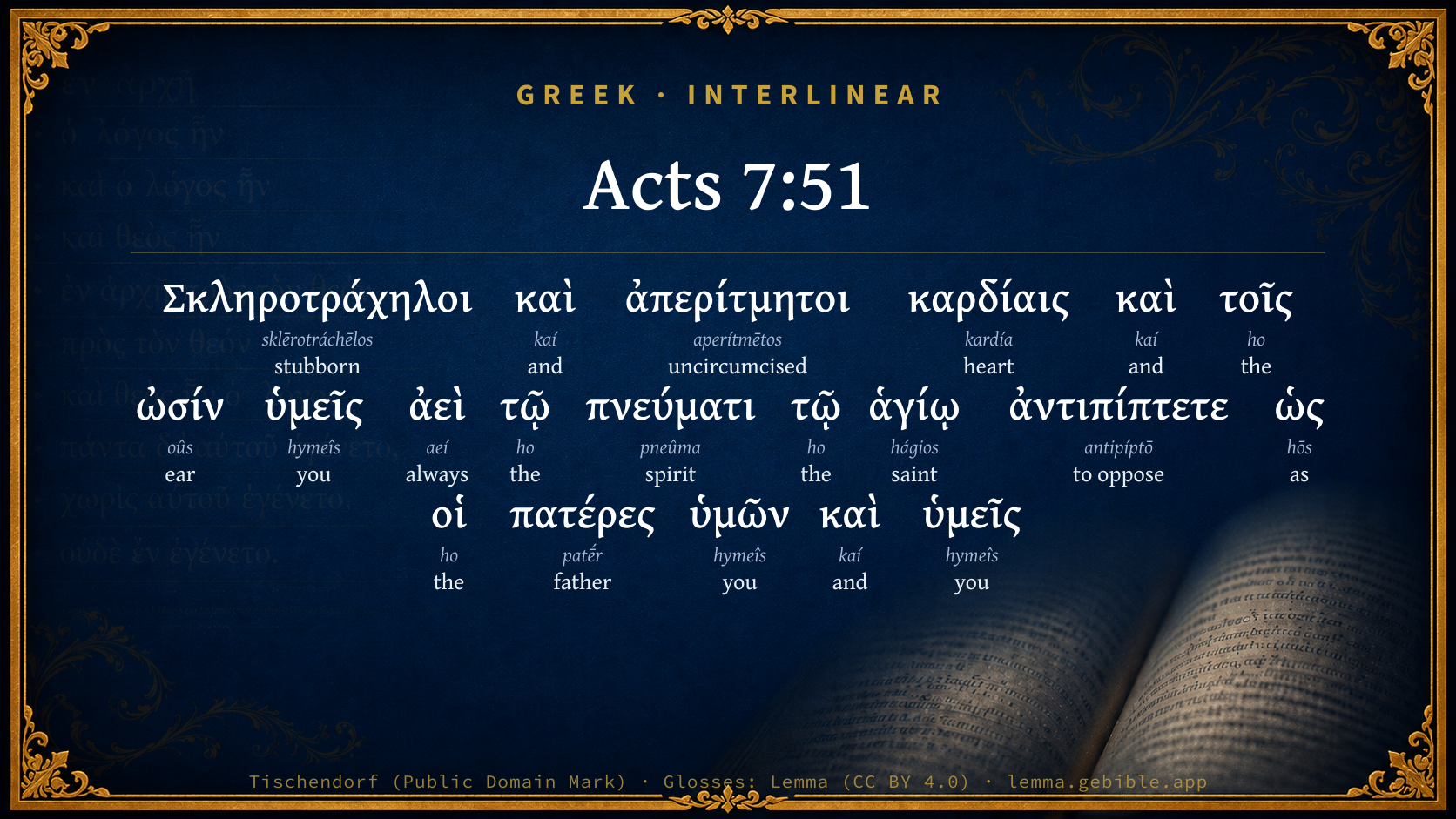
Greek (Tischendorf 8th ed.) Acts 7:51 appears in the Greek New Testament. The text above is from the Tischendorf 8th edition. Each word links to its Strong’s number and a concise gloss. Click any word for its full Thayer’s Greek Lexicon entry.
Download image
Cite this verse

Acts 7:51 (World English Bible). Public Domain. Lemma interlinear Bible study tool, https://lemma.gebible.app/v/acts/7/51.

Show BibTeX & RIS
BibTeX
RIS
English Translation
"You stiff-necked and uncircumcised in heart and ears, you always resist the Holy Spirit! As your fathers did, so you do.
World English Bible · Public Domain
Highlights
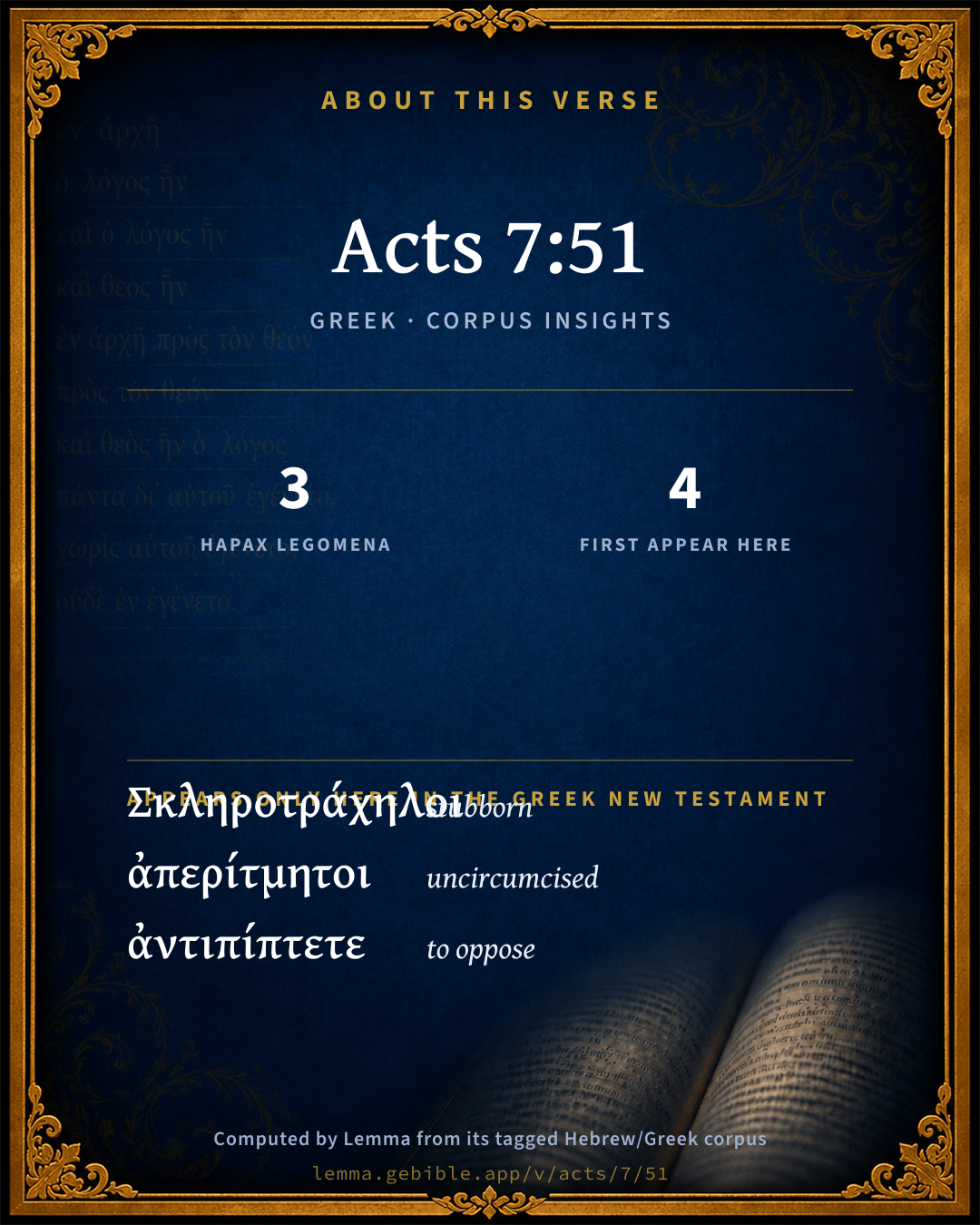
  • 3 hapax legomena — only here in the Greek New Testament
  • 4 first appearances in the Greek New Testament
Full analysis ↓
Download a study sheet

One document with this verse’s original text, its word-by-word gloss line, the meaning frame, cross-references with their text, attributed commentary, and full source and license credits — printable, and it pastes into notes with its structure intact.

This verse Autodidact and up

Study sheet (.html) Plain text (.txt)

A passage Seminary Student

Up to 50 verses in one chapter. A passage sheet keeps up to 6 commentary sources and 12 cross-references per verse, in the order this page ranks them, and says so on the sheet whenever that leaves anything out. Ask for a single verse and you get the Autodidact verse sheet above.

Everything on this page stays free to read, with no account — the sheet is a download of what is already on screen, not access to it.

Want to remove ads? Support Godless Engineer
Compare translations 3

The same verse in 3 English versions, stacked beneath the original-language interlinear above. Click any original word for its lexicon entry.

Each is an independent rendering of the whole verse — the interlinear is not word-aligned to these translations.

Highlighted words mark where these versions differ — a whole-verse word diff, not a word-by-word alignment.

  • World English Bible Public Domain
    "You stiff-necked and uncircumcised in heart and ears, you always resist the Holy Spirit! As your fathers did, so you do.
  • King James Version Public Domain
    Ye stiffnecked and uncircumcised in heart and ears, ye do always resist the Holy Ghost: as your fathers did, so do ye.
  • unfoldingWord Literal Text CC BY-SA 4.0
    O stiff-necked and uncircumcised in heart and ears! You always resist the Holy Spirit! As your fathers, also you.

unfoldingWord Literal Text — © unfoldingWord, licensed CC BY-SA 4.0. Word-aligned USFM3 via Door43 (git.door43.org/unfoldingWord/en_ult).

Versions to compare (up to 4)

3 of 4 selected

Show all 19 translations

Every available English version of this verse, each an independent rendering of the whole verse.

  • World English Bible Public Domain
    "You stiff-necked and uncircumcised in heart and ears, you always resist the Holy Spirit! As your fathers did, so you do.
  • Berean Standard Bible Public Domain
    You stiff-necked people with uncircumcised hearts and ears! You always resist the Holy Spirit, just as your fathers did.
  • Majority Standard Bible Public Domain
    You stiff-necked people with uncircumcised heart and ears! You always resist the Holy Spirit, just as your fathers did.
  • King James Version Public Domain
    Ye stiffnecked and uncircumcised in heart and ears, ye do always resist the Holy Ghost: as your fathers did, so do ye.
  • American Standard Version (1901) Public Domain
    Ye stiffnecked and uncircumcised in heart and ears, ye do always resist the Holy Spirit: as your fathers did, so do ye.
  • Revised Version (1885) Public Domain
    Ye stiffnecked and uncircumcised in heart and ears, ye do always resist the Holy Ghost: as your fathers did, so do ye.
  • Geneva Bible (1599) Public Domain
    Ye stiffenecked and of vncircumcised heartes and eares, ye haue alwayes resisted the holy Ghost: as your fathers did, so do you.
  • Douay-Rheims (1899) Public Domain
    You stiffnecked and uncircumcised in heart and ears, you always resist the Holy Ghost: as your fathers did, so do you also.
  • Young's Literal Translation Public Domain
    `Ye stiff-necked and uncircumcised in heart and in ears! ye do always the Holy Spirit resist; as your fathers -- also ye;
  • Literal Standard Version CC BY-SA 4.0
    You stiff-necked and uncircumcised in heart and in ears! You always resist the Holy Spirit; as your fathers—also you;
  • Unlocked Literal Bible CC BY-SA 4.0
    You people who are stiff-necked and uncircumcised in heart and ears, you always resist the Holy Spirit; you act just as your fathers acted.
  • unfoldingWord Literal Text CC BY-SA 4.0
    O stiff-necked and uncircumcised in heart and ears! You always resist the Holy Spirit! As your fathers, also you.
  • Darby Bible Public Domain
    O stiffnecked and uncircumcised in heart and ears, *ye* do always resist the Holy Spirit; as your fathers, *ye* also.
  • World Messianic Bible Public Domain
    “You stiff-necked and uncircumcised in heart and ears, you always resist the Holy Spirit! As your fathers did, so you do.
  • Webster's Bible Public Domain
    Ye stiff-necked, and uncircumcised in heart and ears, ye do always resist the Holy Spirit: as your fathers did, so do ye.
  • Free Bible Version CC BY-SA 4.0
    You arrogant, hard-hearted people! You never listen! You always fight against the Holy Spirit! You act just like your fathers did!
  • Bible in Basic English Public Domain
    You whose hearts are hard and whose ears are shut to me; you are ever working against the Holy Spirit; as your fathers did, so do you.
  • Text-Critical English NT CC BY 4.0
    “You stiff-necked people, uncircumcised in heart and ears, you always resist the Holy Spirit! As your fathers did, so you do also.
  • Tyndale New Testament (1534) Public Domain
    Ye stiffenecked and of vncircumcised hertes and eares: ye have all wayes resisted the holy goost: as youre fathers dyd so do ye.

Literal Standard Version (2020), Covenant Press — licensed CC BY-SA 4.0. Text via the HelloAO Bible API (eBible.org). Unlocked Literal Bible (unfoldingWord) — licensed CC BY-SA 4.0. Text via the HelloAO Bible API (eBible.org). unfoldingWord Literal Text — © unfoldingWord, licensed CC BY-SA 4.0. Word-aligned USFM3 via Door43 (git.door43.org/unfoldingWord/en_ult). Free Bible Version, Dr. Jonathan Gallagher — licensed CC BY-SA 4.0. Text via the HelloAO Bible API (eBible.org).

Word by word

More ways to search: Search by grammar → Find every occurrence → Compare this word →

Practice this passage: Drill this verse → Learn its vocabulary →

Σκληροτράχηλοι
sklērotráchēlos
G4644
“stubborn”
Adjective, Vocative, Plural, Masculine
Part of Speech
Adjective
Case
Vocative
Number
Plural
Gender
Masculine
Full Thayer's Definition

Origin: from G4642 and G5137

TDNT: 22:09,8

1. stiffnecked 2. stubborn, headstrong, obstinate
  1. καὶ kaí G2532 “and” Conjunction
  2. ἀπερίτμητοι aperítmētos G564 “uncircumcised” Adjective, Vocative, Plural, Masculine
  3. καρδίαις kardía G2588 “heart” Noun, Dative, Plural, Feminine
  4. καὶ kaí G2532 “and” Conjunction
  5. τοῖς ho G3588 “the” Article, Dative, Plural, Neuter
  6. ὠσίν oûs G3775 “ear” Noun, Dative, Plural, Neuter
  7. ὑμεῖς hymeîs G5210 “you” Personal pronoun, 2nd person, Nominative, Plural
  8. ἀεὶ aeí G104 “always” Adverb
  9. τῷ ho G3588 “the” Article, Dative, Singular, Neuter
  10. πνεύματι pneûma G4151 “spirit” Noun, Dative, Singular, Neuter
  11. τῷ ho G3588 “the” Article, Dative, Singular, Neuter
  12. ἁγίῳ hágios G40 “saint” Adjective, Dative, Singular, Neuter
  13. ἀντιπίπτετε antipíptō G496 “to oppose” Verb, Present, Active, Indicative, 2nd person, Plural
  14. ὡς hōs G5613 “as” Adverb
  15. οἱ ho G3588 “the” Article, Nominative, Plural, Masculine
  16. πατέρες patḗr G3962 “father” Noun, Nominative, Plural, Masculine
  17. ὑμῶν hymeîs G5210 “you” Personal pronoun, 2nd person, Genitive, Plural
  18. καὶ kaí G2532 “and” Conjunction
  19. ὑμεῖς hymeîs G5210 “you” Personal pronoun, 2nd person, Nominative, Plural

About this verse

These counts appear in no published source. They are computed here, from the morphology-tagged text and Lemma’s own curated glosses. What Lemma adds →

20
words
13
distinct lemmas
Acts
section

Notable vocabulary

3 hapax legomena — words that appear only here in the entire Greek New Testament:

  • Σκληροτράχηλοι stubborn G4644
  • ἀπερίτμητοι uncircumcised G564
  • ἀντιπίπτετε to oppose G496

First appearance in Scripture

These words make their first canonical appearance in the Greek New Testament here:

  • Σκληροτράχηλοι stubborn G4644
  • ἀπερίτμητοι uncircumcised G564
  • ἀεὶ always G104
  • ἀντιπίπτετε to oppose G496

Shared distinctive vocabulary

ἀεὶ always G104 occurs in 7 verses of the Greek New Testament. Also found in:
Repetition

Words recur within this verse:

Cross-references

36

Topical passages linked to Acts 7:51 in the Treasury of Scripture Knowledge — connected by theme and wording, ordered by reader-vote popularity; previews shown in the World English Bible.

  • Deuteronomy 10:16 Circumcise therefore the foreskin of your heart, and be no more stiff-necked.
  • Isaiah 63:10 But they rebelled, and grieved his holy Spirit: therefore he was turned to be their enemy, [and] himself fought against them.
  • Jeremiah 4:4 Circumcise yourselves to Yahweh, and take away the foreskins of your heart, you men of Judah and inhabitants of Jerusalem; lest my wrath go forth like fire, and burn so that none can quench it, because of the evil of your doings.
  • Ephesians 4:30 Don't grieve the Holy Spirit of God, in whom you were sealed for the day of redemption.
  • Leviticus 26:41 I also walked contrary to them, and brought them into the land of their enemies: if then their uncircumcised heart is humbled, and they then accept the punishment of their iniquity;
  • Philippians 3:3 For we are the circumcision, who worship God in the Spirit, and rejoice in Christ Jesus, and have no confidence in the flesh;
  • Exodus 33:5 Yahweh said to Moses, "Tell the children of Israel, 'You are a stiff-necked people. If I were to go up into your midst for one moment, I would consume you. Therefore now take off your jewelry from you, that I may know what to do to you."
  • Exodus 32:9 Yahweh said to Moses, "I have seen these people, and, behold, they are a stiff-necked people.
  • Exodus 33:3 to a land flowing with milk and honey: for I will not go up in the midst of you, for you are a stiff-necked people, lest I consume you in the way."
  • Jeremiah 6:10 To whom shall I speak and testify, that they may hear? behold, their ear is uncircumcised, and they can't listen: behold, the word of Yahweh is become to them a reproach; they have no delight in it.
  • Acts 6:10 They weren't able to withstand the wisdom and the Spirit by which he spoke.
  • Psalms 78:8 And might not be as their fathers, A stubborn and rebellious generation, A generation that didn't make their hearts loyal, Whose spirit was not steadfast with God.
  • Acts 7:39 to whom our fathers wouldn't be obedient, but rejected him, and turned back in their hearts to Egypt,
  • Romans 2:25 For circumcision indeed profits, if you are a doer of the law, but if you are a transgressor of the law, your circumcision has become uncircumcision.
  • Colossians 2:11 in whom you were also circumcised with a circumcision not made with hands, in the putting off of the body of the sins of the flesh, in the circumcision of Christ;
  • Exodus 34:9 He said, "If now I have found favor in your sight, Lord, please let the Lord go in the midst of us; although this is a stiff-necked people; pardon our iniquity and our sin, and take us for your inheritance."
  • Deuteronomy 31:27 For I know your rebellion, and your stiff neck: behold, while I am yet alive with you this day, you have been rebellious against Yahweh; and how much more after my death?
  • Nehemiah 9:16 But they and our fathers dealt proudly and hardened their neck, and didn't listen to your commandments,
  • Nehemiah 9:30 Yet many years did you bear with them, and testified against them by your Spirit through your prophets: yet would they not give ear: therefore gave you them into the hand of the peoples of the lands.
  • Jeremiah 17:23 But they didn't listen, neither turn their ear, but made their neck stiff, that they might not hear, and might not receive instruction.
  • Ezekiel 2:4 The children are impudent and stiff-hearted: I do sent you to them; and you shall tell them, Thus says the Lord Yahweh.
  • Ezekiel 44:7 in that you have brought in foreigners, uncircumcised in heart and uncircumcised in flesh, to be in my sanctuary, to profane it, even my house, when you offer my bread, the fat and the blood, and they have broken my covenant, [to add] to all your abominations.
  • Ezekiel 44:9 Thus says the Lord Yahweh, No foreigner, uncircumcised in heart and uncircumcised in flesh, shall enter into my sanctuary, of any foreigners who are among the children of Israel.
  • Acts 7:9 "The patriarchs, moved with jealousy against Joseph, sold him into Egypt. God was with him,
  • Acts 7:27 But he who did his neighbor wrong pushed him away, saying, 'Who made you a ruler and a judge over us?
  • Romans 2:28–29 For he is not a Jew who is one outwardly, neither is that circumcision which is outward in the flesh;
  • Deuteronomy 9:6 Know therefore, that Yahweh your God doesn't give you this good land to possess it for your righteousness; for you are a stiff-necked people.
  • Deuteronomy 9:13 Furthermore Yahweh spoke to me, saying, I have seen this people, and, behold, it is a stiff-necked people:
  • Deuteronomy 30:6 Yahweh your God will circumcise your heart, and the heart of your seed, to love Yahweh your God with all your heart, and with all your soul, that you may live.
  • 2 Chronicles 30:8 Now don't you be stiff-necked, as your fathers were; but yield yourselves to Yahweh, and enter into his sanctuary, which he has sanctified forever, and serve Yahweh your God, that his fierce anger may turn away from you.
  • Psalms 75:5 Don't lift up your horn on high. Don't speak with a stiff neck."
  • Isaiah 48:4 Because I knew that you are obstinate, and your neck is an iron sinew, and your brow brass;
  • Jeremiah 9:25–26 Behold, the days come, says Yahweh, that I will punish all those who are circumcised in [their] uncircumcision:
  • Zechariah 7:11–12 But they refused to listen, and turned their backs, and stopped their ears, that they might not hear.
  • Matthew 23:31–33 Therefore you testify to yourselves that you are children of those who killed the prophets.
  • Acts 7:35 "This Moses, whom they refused, saying, 'Who made you a ruler and a judge?'--God has sent him as both a ruler and a deliverer by the hand of the angel who appeared to him in the bush.

Cross-references courtesy of OpenBible.info (CC BY 4.0).

Commentary

Notes on Acts 7:51 from classic Christian and Jewish commentators (each source and its license shown beneath its notes). The classic Christian expositions comment on the surrounding passage and are grouped to its opening verse, so a note may address several verses; the Jewish commentaries on the Tanakh (Rashi and others) are per-verse, so they appear only where the commentator wrote on this verse.

Lemma curates 59 commentaries, every one of them public domain or Creative Commons licensed, each selected and text-cleaned for this edition rather than reprinted as found. About our sources →

Matthew Henry's Commentary

Stephen was going on in his discourse (as it should seem by the thread of it) to show that, as the temple, so the temple-service must come to an end, and it would be the glory of both to give way to that worship of the Father in spirit and in truth which was to be established in the kingdom of the Messiah, stripped of the pompous ceremonies of the old law, and so he was going to apply all this which he had said more closely to his present purpose; but he perceived they could not bear it. They could patiently hear the history of the Old Testament told (it was a piece of learning which they themselves dealt much in); but if Stephen go about to tell them that their power and tyranny must come down, and that the church must be governed by a spirit of holiness and love, and heavenly-mindedness, they will not so much as give him the hearing. It is probable that he perceived this, and that they were going to silence him; and therefore he breaks off abruptly in the midst of his discourse, and by that spirit of wisdom, courage, and power, wherewith he was filled, he sharply rebuked his persecutors, and exposed their true character; for, if they will not admit the testimony of the gospel to them, it shall become a testimony against them.

I. They, like their fathers, were stubborn and wilful, and would not be wrought upon by the various methods God took to reclaim and reform them; they were like their fathers, inflexible both to the word of God and to his providences. 1. They, like their fathers, were stubborn and wilful, and would not be wrought upon by the various methods God took to reclaim and reform them; they were like their fathers, inflexible both to the word of God and to his providences. 1. They were stiff-necked (Act 7:51), and would not submit their necks to the sweet and easy yoke of God's government, nor draw in it, but were like a bullock unaccustomed to the yoke; or they would not bow their heads, no, not to God himself, would not do obeisance to him, would not humble themselves before him. The stiff neck is the same with the hard heart, obstinate and contumacious, and that will not yield - the general character of the Jewish nation, Exo 32:9; Exo 33:3, Exo 33:5; Exo 34:9; Deu 9:6, Deu 9:13; Deu 31:27; Eze 2:4. 2. They were uncircumcised in heart and ears their hearts and ears were not devoted and given up to God, as the body of the people were in profession by the sign of circumcision: "In name and show you are circumcised Jews, but in heart and ears you are still uncircumcised heathens, and pay no more deference to the authority of your God than they do, Jer 9:26. You are under the power of unmortified lusts and corruptions, which stop your ears to the voice of God, and harden your hearts to that which is both most commanding and most affecting." They had not that circumcision made without hands, in putting off the body of the sins of the flesh, Col 2:11.

II. They, like their fathers, were not only not influenced by the methods God took to reform them, but they were enraged and incensed against them: You do always resist the Holy Ghost. 1. They resisted the Holy Ghost speaking to them by the prophets, whom they opposed and contradicted, hated and ridiculed; this seems especially meant here, by the following explication, Which of the prophets have not your fathers persecuted? In persecuting and silencing those that spoke by the inspiration of the Holy Ghost they resisted the Holy Ghost. Their fathers resisted the Holy Ghost in the prophets that God raised up to them, and so did they in Christ's apostles and ministers, who spoke by the same Spirit, and had greater measures of his gifts than the prophets of the Old Testament had, and yet were more resisted. 2. They resisted the Holy Ghost striving with them by their own consciences, and would not comply with the convictions and dictates of them. God's Spirit strove with them as with the old world, but in vain; they resisted him, took part with their corruptions against their convictions, and rebelled against the light. There is that in our sinful hearts that always resists the Holy Ghost, a flesh that lusts against the Spirit, and wars against his motions; but in the hearts of God's elect, when the fulness of time comes, this resistance is overcomer and overpowered, and after a struggle the throne of Christ is set up in the soul, and every thought that had exalted itself against it is brought into captivity to it, Co2 10:4, Co2 10:5. That grace therefore which effects this change might more fitly be called victorious grace than irresistible.

III. They, like their fathers, persecuted and slew those whom God sent unto them to call them to duty, and make them offers of mercy. 1. Their fathers had been the cruel and constant persecutors of the Old Testament prophets (Act 7:51): Which of the prophets have not your fathers persecuted? More or less, one time or other, they had a blow at them all. With regard even to those that lived in the best reigns, when the princes did not persecute them, there was a malignant party in the nation that mocked at them and abused them, and most of them were at last, either by colour of law or popular fury, put to death; and that which aggravated the sin of persecuting the prophets was, that the business of the prophets they were so spiteful at was to show before of the coming of the just One, to give notice of God's kind intentions towards that people, to send the Messiah among them in the fulness of time. Those that were the messengers of such glad tidings should have been courted and caressed, and have had the preferments of the best of benefactors; but, instead of this, they had the treatment of the worst of malefactors. 2. They had been the betrayers and murderers of the just One himself, as Peter had told them, Act 3:14, Act 3:15; Act 5:30. They had hired Judas to betray him, and had in a manner forced Pilate to condemn him; and therefore it is charged upon them that they were his betrayers and murders. Thus they were the genuine seed of those who slew the prophets that foretold his coming, which, by slaying him, they showed they would have done if they had lived then; and thus, as our Saviour had told them, they brought upon themselves the guilt of the blood of all the prophets. To which of the prophets would those have shown any respect who had no regard to the Son of God himself?

IV. They, like their fathers, put contempt upon divine revelation, and would not be guided and governed by it; and this was the aggravation of their sin, that God had given, as to their fathers his law, so to them his gospel, in vain. 1. Their fathers received the law, and did not observe it, Act 7:53. God wrote to them the great things of his law, after he had first spoken them to them; and yet they were counted by them as a strange or foreign thing, which they were no way concerned in. The law is said to be received by the disposition of angels, because angels were employed in the solemnity of giving the law, in the thunderings and lightnings, and the sound of the trumpet. It is said to be ordained by angels (Gal 3:19), God is said to come with ten thousand of his saints to give the law (Deu 33:2), and it was a word spoken by angels, Heb 2:2. This put an honour both upon the law and the Lawgiver, and should increase our veneration for both. But those that thus received the law yet kept it not, but by making the golden calf broke it immediately in a capital instance. 2. They received the gospel now, by the disposition, not of angels, but of the Holy Ghost, - not with the sound of a trumpet, but, which was more strange, in the gift of tongues, and yet they did not embrace it. They would not yield to the plainest demonstrations, any more than their fathers before them did, for they were resolved not to comply with God either in his law or in his gospel.

We have reason to think Stephen had a great deal more to say, and would have said it if they would have suffered him; but they were wicked and unreasonable men with whom he had to do, that could no more hear reason than they could speak it.

Matthew Henry's Commentary on the Whole Bible (1708–1710) — public domain (CC PDM 1.0). Text via the HelloAO Bible API.

The Biblical Illustrator

Joseph S. Exell

Act_7:51-53

Ye stiffnecked and uncircumcised in heart and ears.

Stephens change of tone

I. Justified.

1. This was not the first Christian sermon that the Jews or the Sanhedrin had heard. Otherwise, possibly, such vehement and unsparing denunciations had been out of place. They had already heard of Christ twice from His inspired messengers, and he did not speak till the ecclesiastical rulers had shown a determined animus to put their foot on the gospel. It was to a council who had, and still were, resisting grace that Stephen spoke.

2. Stephen was addressing the authorities, and the tone of Peter towards them had been very different from his tone with the people (Act_3:17; cf Act_4:11; Act_6:30). There was deep reason and equity in this difference. It was the Sanhedrin which had all along fomented the hostility of the people to Christ. The common people heard Christ gladly, and shouted Hosannah; and in the closing scene it was only at the persuasion of the chief priests and elders that they were induced to ask Barabbas and destroy Jesus. They had, no doubt, their full share of guilt, and Peter charges them with being accomplices; but, as at the Fall, God recognises a difference in degree of guilt between man and the serpent, so those who are of the same mind with God draw a distinction between those who sin through weakness, and those who sin of malice prepense. It is against the latter that Stephen hurls his indignant invective.

II. Accounted for.

1. There was the natural friction which his own argument produced in his mind. As he traced the history of his nation, view after view opened upon him of the perversity, bigotry, and wilful opposition to truth which had characterised them at every period. They had only been too consistent in rejecting Divine messengers, and now by their rejection of the love and Spirit of God they had put the finishing stroke upon their sin. This repeated defiance of God galls Him, and kindles His holy indignation.

2. In all probability his quotation from Isaiah, so palpably adverse to their view of the temple, and so impossible to be answered stung them to the quick. This is indicated in the narrative, They while in the act of listening were cut to the heart and kept gnashing upon him with their teeth. It is not difficult to picture the scene. Audible murmurs are heard as Stephen says, The Most High dwelleth not in temples, etc. They make menacing gestures as wild beasts would spring upon their prey. There two scribes, reaching across to one another, have got a scroll between them, in which they are pointing to passages which they think confute him. One finger is on the words, I have hallowed this house, etc.; the fist of the other contracts and is raised towards the prisoner. The young man from the Cicilian synagogue glances to and fro from the accused to Gamaliel. The great doctor had in a previous council made a diversion in favour of the apostles. But on that occasion it appears that the high priest had been under the influence of the Sadducees. Stephens speech brought out into full prominence the anti-Pharisaic element of the gospel. And as he did so the eyes of Saul are turned wistfully to his great authority mutely asking, Will you plead for these Galileans now? And Gamaliels contracted brow answers No. Then catching the symptoms of the storm long brewing, with that, quick apprehension which always characterises an earnest speaker, and seeing in a moment the wicked husbandmen before him, he bursts forth in the words of the text. In the early part of his speech he is cautious, and avoids giving offence; He keeps his mouth, as it were, with a bridle, while the ungodly is in sight. But at last his heart grows hot within him, and while he is musing upon the circumstances he has recited, the fire kindles; and at the last he throws away his caution and speaks in accents of burning indignation. Conclusion: What has been said may read us a needful lesson on the subject of spurious charity. Charity is not uniform suavity under all circumstances; it has in it a stern element of moral indignation which is the salt that keeps it from corruption. Charity never flatters a man in wilful sin, but tells him plainly that continuance means death; just as a surgeon, who desires nothing but the health of his patient, does not hesitate to perform a painful operation. And because heresy is mischievous to souls charity pays it no compliments. If some safeguards are required with perfect righteousness of indignation--

1. Rid the mind of personal resentment.

2. Be sure that it is vital error, and do not confound it with your view of it. (Dean Goulburn.)

Ye do always resist the Holy Ghost.--

Resisting the Holy Ghost

I. The character here given of impenitent and ungodly men.

1. Their leading feature is obduracy, which the Scriptures call hardness of heart. There may be a variety of dispositions, yet all merging in this spirit.

(1) Stiff-neeked means nearly the same as stout-hearted; one who is unyielding and obstinate; who sets at nought the councils of God and follows his own.

(2) Uncircumcised in heart and ears. Circumcision was a rite intended to point out the nature and necessity of spiritual renovation (Deu_10:16-18).

2. The obduracy of an ungodly man may be resolved into--

(1) Sensuality (Deu_21:18-20).

(2) Pride and prejudice (Jer_6:10-13).

(3) Habitual negligence and the spirit of slumber (Isa_66:8; Isa_66:4; Isa_29:9-13).

II. How ungodly men resist the Holy Ghost. That a creature should rise in rebellion against the great Creator might seem incredible, had we not demonstration of the fact. Gamaliel said, If this council, or this work, be of God, ye cannot overthrow it, lest ye haply be found even to fight against God. There are many ways in which men do fight against God; but the most awful is in resisting the Holy Ghost. The Sovereign of the universe maintains a communication with our fallen world by the agency of His Spirit. Now this Divine Spirit is called--

1. The Spirit of Truth. He revealed the will of God to us. When any one opposes Divine truth, he resists the Holy Ghost. The grand doctrines of the gospel are confessedly clear and plain in the Word. How then is it that they are not received? (Isa_30:8-13; Joh_3:19.) To those who prefer agreeable things, which flatter the roving imagination, and the unrenewed heart, a full exhibition of Divine truth, will ever be unwelcome. Herein consists the guilt of obstinate unbelief and impenitence. Hence, too, arises the sophistry which contrives a thousand subtle devices to nullify the Word of God.

2. The spirit of purity. He is the sole source and efficient author of sanctity. He has given a hallowed and peculiar stamp to the various precepts, ordinances, and institutions of true religion. Now, the man who labours to stain this stamp of purity resists the Holy Ghost.

3. The Spirit of Grace. God engaged to pour out the spirit of grace and of supplication. The favour of Jehovah is eminently manifested through the agency of the Holy Ghost. Yet, alas I great numbers resist this Divine Agent of mercy, stifling those convictions which are produced by His power. The truth is heard, but not heeded and applied.

III. The tremendous consequences of resisting the Holy Ghost.

1. Those persons who have long and obstinately opposed truth, are usually given over to a reprobate mind. The light which they have laboured so hard to exclude is withdrawn, and they are enveloped in the thick darkness they love. Compunction of conscience gradually abates till they are past feeling. My Spirit shall not always strive with man, etc. Ephraim is joined to idols, let him alone. For it is impossible for those who were once enlighted, etc.

2. The future punishment of those who have resisted the Holy Ghost will be beyond expression dreadful. Though for a time they may be hardened, so as to have little or no fear, the justice of God is preparing their doom. He that despised Moses law, died without mercy, under two or three witnesses; of how much sorer punishment, etc. Woe unto him that striveth with his Maker! (Essex Congregational Remembrancer.)

Resisting the Holy Ghost

I. The office of the Holy Spirit.

1. Convincing.

2. Entreating.

3. Admonishing.

4. Threatening.

II. The means He uses.

1. The Word.

2. Examples.

3. Conscience.

4. Providential dealings.

III. The modes of resisting Him.

1. Inattention.

2. Procrastination.

3. Contradiction. (W. W. Wythe.)

On resisting the Holy Spirit

To resist the Holy Ghost is a sin of the deepest guilt. It is the basest ingratitude against God; for it is resisting the very means which God of His infinite mercy freely offers for recovering our souls from sin, and bringing us to Christ, our only Saviour. Does it not seem strange that against one so good, so merciful, so willing to help, and comfort us, we should ever be led to commit wilful sin?

1. Christians of the present day approach towards this sin several ways; and first whenever they despise or ridicule things belonging unto God. Should they persevere in these sinful habits, they may in the end lose all reverence for holy things; and then, if, with a soul indifferent to things spiritual, they die, have they a hope that their sin can be forgiven? Like the Pharisees of old, they seemed to have refused the very means by which they might have been brought to Christ.

2. There is another way by which Christians resist the Holy Ghost; and this, in the language of Scripture, is called grieving, or quenching, the Holy Spirit. In one sense every sin wilfully committed against God, every known Christian duty wilfully omitted, is grieving the Holy Spirit. But in a more especial manner Christians grieve the Holy Ghost when they refuse to receive those doctrines of the gospel of Jesus Christ which He hath Himself revealed; when the plain teachings of the Scriptures seem unto them foolishness.

3. Gods Holy Spirit is resisted also by every one who, in direct opposition to conscience, refusing the holy aid which alone could have preserved him, wilfully commits sin, knowingly violates the moral law of God. Such are some of the very awful considerations arising from the subject before us. Warned of the danger, let us watch and pray against it. Let us not resist the Holy Ghost in this our accepted time, and He will fit us for the full enjoyment of the salvation purchased by the blood and secured by the intercession of our Lord and Saviour Jesus Christ. (H. Marriott, M. A.)

Which of the prophets have not your fathers persecuted.--

Devotion to the conventional

I. The rejection of Christ was the national sin of the Jewish people. It was the act of the whole nation, the result of the full development of the then Jewish mode of looking at the world--the spirit of the age.

1. The term, a national sin, wants a clear definition. It is used at present recklessly. Every party declares its opponents guilty of a national sin. But a national sin is not an evil done by any one party to the nation, but an evil done by the nation itself. I might mention courses of political action in which England has persisted for years, through all changes of party, which are of the character of national sins, but I will content myself with saying that one of the worst of national sins is the rejection or neglect of the great men whom God has sent to save or to teach the nation. It is a proof of the perfect culture of a people, when it recognises its great men, puts them forward at once and obeys them.

2. The man of noble genius, the prophet, or whatever else you call him, is the test of the nation. Those are lost who reject him--the whole nation is lost if the whole nation rejects him--for it is not he so much whom it rejects as the saving ideas of which he is the vehicle. The question whether Christ shall be accepted or rejected has again and again been placed before the nations. It was placed most completely before the Jews at the appearance of the perfect Man--is placed before each of us--since He was the representation of that which is noblest in humanity. This passive work was recognised by Simeon when he said, This child is set for the fall and the rising again of many in Israel. It was recognised by Christ Himself when He said, For judgment, i.e. for division, for sifting of the chaff from the wheat, am I come into the world. And so it was, wherever He went He was the touchstone of men. Those who were pure and true-hearted saw Him and loved Him; those who were conscious of their need and sin believed in Him, drank deep of His Spirit, and found redemption and repose. Those who were base or false of heart naturally recoiled from Him, and, to get rid of Him, hanged Him on a tree. In doing so--and this was the deed of the mass of the people--they destroyed their nationality which was hidden in their reception of Christ. In a coincidence with this, the priesthood rejected Christ in words which repudiated their distinct existence as a nation--We have no king but Caesar. He did nothing overt to produce this. He simply lived His life, and it acted on the Jewish world as an electric current upon the water; it separated its elements.

II. The cause of this rejection was primarily devotion to the conventional, which is practically identical with want of individuality, one of the most painful deficiencies in our present society.

1. Now the rectification of that evil lies at the root of Christianity. Christ came to ensure the distinct life, the originality of each man, to rescue men from being mingled up, indistinguishable atoms, with the mass of man.

2. The spirit of the world is in exact opposition to this. Its tendency is to reduce all men and women to one pattern. There must be nothing original in the worlds language, eccentric, erratic. Custom is to be despot. We must all dress in the same way, read the same books, talk of the same things. We do not object to progress, but everybody must be levelled, and then collectively advance; no one must leave the ranks or step to the front.

3. This is the spirit which either cannot see, or, seeing, hates men of genius. They are in conflict with the known and the accredited modes of action. So it comes to pass that they are depreciated and neglected; or, if they are too great and persist, persecuted and killed. And, indeed, it is not difficult to get rid of them, for men of genius cannot breathe in this atmosphere, it kills them. The pitiable thing in English society now is, that it is in danger of becoming of so dreadful a uniformity that no original man can be developed in it at all. This, if anything, will become the ruin of Englands greatness.

4. There is, it is true, a kind of re-action going on at present against this tyranny. Young men and women, weary of monotonous pleasures, are in rebellion, but the whole social condition has been so degraded that they rush into still more artificial and unnatural pleasures and excitements; in endeavouring to become free, they enslave themselves the more.

5. Those who might do much, do little. It is one of the advantages of wealth and high position that those who possess them may initiate the uncustomary without a cry being raised against them. But even with every opportunity, how little imagination do they ever display, how little invention, how little they do to relieve the melancholy uniformity of our pleasures, or the intense joylessness of our work!

6. Now this was precisely the spirit of the Jewish religious world at the time of Christ. Men were bound down to a multitude of fixed rules and maxims;. they were hedged in on all sides. It was the most finished conventionalism of religion, in spite of the different sects, which the world has ever seen. Then came Christ, entirely original, proclaiming new ideas, or, old truths in a new form, overthrowing worn-out ceremonies, denouncing things gray with the dust of ages, letting in the light of truth into the chambers where the priests and lawyers spun their webs of theology to ensnare the free souls of men, trampling down relentlessly the darling customs of the old conservatism, shocking and bewildering the religious society. He did not keep, they said, the Sabbath day. He ate and drank--abominable iniquity!--with publicans and sinners. He allowed a fallen woman to touch Him. Worse still, He did not wash His hands before He ate bread. He did not teach as the scribes did. He did not live the time-honoured and ascetic life of a prophet. He dared to speak against the priesthood and the aristocracy. He came from Nazareth, that was enough; no good could come from Nazareth. He was a carpenters son, and illiterate, and no prophet was made, or could be made, out of such materials. And this man! He dares to disturb us, to contest our maxims, to set at nought our customs, to array Himself against our despotism. Come, let us kill Him; and so they crucified Him. They did not see, the wretched men, that in murdering Him they murdered their nation also.

III. Take the question now out of the realm of thought and history, and apply it practically. Ask yourselves two questions:--

1. What would be the fate of Christ if He were suddenly to appear as a teacher in the middle of London? How would our orthodox religious society and our conventional social world receive Him? Desiring to speak with all reverence, He would horrify the one by His heterodox opinions, the other by His absolute scorn of many of the very palladia of society. Supposing He were to denounce--as He would in no measured terms--our system of caste; attack our most cherished maxims about property and rights; live in opposition to certain social rules, contemn with scorn our accredited hypocrisies; live among us His free, bold, unconventional, outspoken life; how should we receive Him? It is a question which it is worth while that society should ask itself. I trust more would hail His advent than we think. I believe the time is come when men are sick of the tyranny of custom of living in unreality; that they are longing for a new life and a new order of things, for some fresh ideas to come and stir, like the angel, the stagnant pool. I believe there are thousands who would join themselves to Him, thousands of true men from all religious bodies, and from those who are now plentifully sprinkled with the epithets of rationalists, infidels, heretics, and atheists; but there are thousands who call themselves by His name who would neglect or persecute Him, for He Would come among our old conservatisms of religion, our doctrinal systems, superstitions, priesthoods, and ritualisms, as He came of old. If we could accept the revolution He would make, our nation and religion Would be saved, if not it would be enervated by the blow and die. Realising these things, realising Christ speaking to us as He would speak now, we ought to feel our falseness. We may save our nation if we resolve, each one here for himself, to free ourselves from cant, and formalism, and superstition, to step into the clear air of freedom, individuality, truth, and holiness.

2. How far is the spirit of the world preventing you personally from receiving Christ?

(1) Is your sole aim the endeavour to please your party, forfeiting your individuality? Then you cannot receive Christ, for He demands that you should be true to your own soul.

(2) Are you permitting yourself to chime in with the low morality of the day, to accept the common standard, repudiating the desire to be better than your neighbours, and so coming at last to join in the light laugh with which the world treats immoralities of society or trade, or the more flagrant shame, dishonesty, and folly which adorn the turf--Letting evils take their course, till gradually the evils appear to you at first endurable, and then even beautiful, being protected by the deities of custom and fashion, which we enthrone instead of God? Are you drifting into such a state of heart? If so, you cannot expect to be able to receive Christ, for He demands that life should be Godlike; not the prudence of silence about evil, but the imprudence of bold separation from evil.

3. And to come home to the inner spiritual life, is your religion only the creature of custom, not of conviction? Have you received and adopted current opinions because they are current, orthodox because it is the fashion to be orthodox, or heterodox because it is the fashion to be heterodox? How can you receive Christ?--for where He comes He claims reality. Ye must be born again; born out of a dead, Pharisaic, conventional form of religion into a living individual union with the life of God. Two things, then, are laid before you this day--conventional religion, a whited sepulchre; personal religion, a fair temple, whose sure foundations are bound together by the twisted strength of the innermost fibres of the soul. (Stopford A. Brooke, M. A.)

The Biblical Illustrator, edited by Joseph S. Exell (c. 1880s–1900s) — public domain. Text from a community e-Sword module.

Joseph Benson's Commentary

Act 7:51-53. Ye stiff-necked, &c. — Stephen, finding by a confused murmur in the place that they understood whither his discourse tended, and perceiving by the eagerness of their countenances that they would soon interrupt him, applied himself more closely to his persecutors in these remarkable words, which he boldly addressed to them under the influence of the Holy Spirit, by whose direction he spoke; Ye stiff-necked — Inflexible and obstinate sinners, not bowing your necks to God’s yoke; and uncircumcised in heart and ears — So that you will not hearken to instruction, or be seriously affected with it. This they immediately showed. See Act 7:54; Act 7:57. So far were they from receiving the word of God with their hearts, that they would not hear it even with their ears. Ye — And your fathers; ye, as a people, in all ages; resist the Holy Ghost: as your fathers did — In former ages; so do ye now. This is the sum of what he had shown at large. Which of the prophets have not your fathers persecuted? — Some have inferred from this, that many writings, containing the history of these persecutions, have been destroyed by the Jews; but it seems more natural to understand the words in a limited sense, as only intimating that most of the prophets had suffered such unworthy usage. Attempts, however, were sometimes made to cut off all the prophets of the Lord at once. See 1Ki 19:10; 1Ki 19:14; 2Ch 36:16. They have slain them which showed before of the coming of the Just or righteous One — That is, Christ; so called by way of eminence, as being alone perfectly righteous: of whom — When you ought to have heard of him with delight, and to have received him with the most humble reverence and joyful gratitude; you have been now the perfidious betrayers, and cruel murderers. Who have received the law — Delivered from Sinai with astonishing circumstances of solemnity, majesty, and terror, by the disposition, or administration of angels, and have not kept, but continually violated it — When the Son of God gave the law on mount Sinai, he was attended with thousands of angels, Gal 3:19; Psa 68:17. Dr. Doddridge renders the original expression, εις διαταγας αγγελων, through ranks of angels, “marshalled in solemn array upon that grand occasion:” and he thinks it is evident, from Heb 2:2, that God made use of the instrumentality of angels to form the voice heard at that awful time.

Joseph Benson's Commentary on the Old and New Testaments (1811–1818) — public domain. Text from a community e-Sword module.

Tyndale Open Study Notes

Tyndale Open Resources

7:51 Stephen raised the same charge that God had raised against his people in the wilderness: that they were heathen at heart and deaf to the truth, because they were rejecting the gospel and obstinately resisting the Holy Spirit (see Exod 32:9; 33:3; 34:9; Deut 9:6, 13; 31:27; see also Ps 78:8; Zech 7:11-12).

Tyndale Open Study Notes — © Tyndale Open Resources, licensed CC BY-SA 4.0. Text via the HelloAO Bible API.

Bengel's Gnomon

Johann Albrecht Bengel

Act 7:51. Σκληροτράχηλοι, stiff-necked) The heart and tongue are required in confession: the heart, ears, and neck,[55] are required in receiving the truth. Stephen weightily censures the Jews: and yet not too soon; for they had been before affectionately (courteously) invited by the apostles.—ἀπερίτμητοι, uncircumcised) A just reproof: comp. Act 7:8.—τῇ καρδίᾳ, in heart) Such they show themselves in Act 7:54.—τοῖς ὠσὶν, the ears) Such they show themselves in Act 7:57, “They stopped their ears.”—ὑμεῖς, ye) not we, the witnesses of Jesus. He includes the ancient Jews; comp. the end of the ver.—ἀεὶ, always) The sum of his discussion: always, as often soever as ye are called.—τῷ Πνεύματι τῷ Ἁγίῳ, the Holy Spirit) who testifies concerning Jesus, and concerning the whole truth, by the prophets.—ἀντιπίπτετε, set yourselves against) They were altogether differently minded from what is demanded in the second ver. of the same chapter of Isa. (66)—ὡς οἱ πατέρες ὑμῶν, καὶ ὑμεῖς, as your fathers, so ye) Both are explained (illustrated) in Act 7:52.

[55] Eagerly stretched out to hear: comp. καραδοκία.—E. and T.

Bengel's Gnomon of the New Testament — English translation (T&T Clark, Edinburgh, 1860) — public domain. Text from a community e-Sword module.

Meyer's Critical & Exegetical Commentary

Heinrich August Wilhelm Meyer

Act_7:51. The longrestrained direct offensive now breaks out, as is quite in keeping with the position of matters brought to this point.[211] This against Heinrichs, Kuinoel, Olshausen, and others, who quite arbitrarily suppose that after Act_7:50 an interruption took place, either by the shouts of the hearers, or at least by their threatening gestures; as well as against Schwanbeck, p. 252, who sees here an omission of the reporter. Stephen has in Act_7:50 ended his calm and detailed historical narrative. And now it is time that the accused should become the bold accuser, and at length throw in the face of his judges the result, the thoughts forming which were already clearly enough to be inferred from the previous historical course of the speech. Therefore he breaks off his calm, measured discourse, and falls upon his judges with deep moral indignation, like a reproving prophet: Ye stiff-necked! etc.

ἀπεριτμ. τῇ καρδ. κ. τ. ὠσίν] an upbraiding of them with their unconverted carnal character, in severe contrast to the Jewish pride of circumcision. The meaning without figure is: Men whose management of their inner life, and whose spiritual perception, are heathenishly rude, without moral refinement, not open for the influence of the divine Spirit. Comp. Lev_26:41; Deu_10:16; Deu_30:6; Jer_4:4; Jer_6:10; Jer_9:25; Rom_2:25; Rom_2:29; Barnabas, Ep. 9; Philo, de migrat. Abr. I. p. 450; and from the Rabbins, Schoettgen in loc.

ὑμεῖς] with weighty emphasis.

ἈΕΊ] always; even yet at this day!

ὡς οἱ πατέρες ὑμῶν καὶ ὑμεῖς] sc. ἀεὶ τῷ πν. ἁγ. ἀντιπ.; for the fathers are thought of in their resistance to God and to the vehicles of His Spirit, and therefore not the bare ἘΣΤΈ is to be supplied (with Beza and Bornemann in the Sächs. Stud. 1842, p. 72).

The term ἀντιπίπτειν, not occurring elsewhere in the N. T., is here chosen as a strong designation. Comp. Polyb. iii. 19. 5 : ἀντέπεσαν ταῖς σπείραις καταπληκτικῶς. Num_27:14; Herodian. 6:3. 13. Bengel well puts it: in adversum ruitis.

[211] Comp. Baur, I. p. 58, ed. 2; Ewald, p. 213.

Meyer — Critical and Exegetical Commentary on the New Testament — English translation by Peter Christie, edited by Frederick Crombie (T&T Clark, 1880) — public domain. Text from a community e-Sword module.

Expositor's Greek Testament

ed. W. Robertson Nicoll

Act 7:51 . σκληροτράχηλοι καὶ ἀπερίτμητοι τῇ καρδίᾳ , cf. Exo 33:3 ; Exo 33:5 ; Exo 34:9 , Deu 9:6 , Bar 2:30 , etc., Sir 16:11 ( cf. Cicero, Verr. , iii., 95, “tantis cervicibus est”). Both adjectives had been used to describe the sins of Israel in former days. On this reading see above and Wendt, critical note, p. 190, cf. Kennedy, Sources of N. T. Greek , p. 116. For the expression ἀπερ ., cf. Deu 10:16 , Jer 4:4 , and ἀπερ . τὰ ὦτα , Jer 6:10 . In the N.T. cf. Rom 2:25 ; Rom 2:29 (which sounds like another echo of St. Stephen’s teaching), cf. also Epist. Baru. , ix. (Jer 4:4 ). Similar expressions occur in Philo and the Rabbis, and also 1Ma 1:48 ; 1Ma 2:46 , and see further Deissmann, Bibelstudien , pp. 150, 151. Many writers have maintained that St. Stephen’s sharp and abrupt declaration marks the increasing impatience of his hearers at this point, as if the speaker felt that the murmurs of his audience would not allow him much more speech. But on the other hand St. Stephen’s whole speech led up to this point, and his words were not so much an interruption, but a continuance and a summary of what had gone before. No doubt the speech was left unfinished: “cujus cursus ad Iesum tendebat” (Blass); since in His rejection the obstinacy of the people which had marked and marred their history had reached its climax; and the indignant words of St. Stephen bring to mind the indignation of a greater than he against the hyprocrisy and wilfulness of the nation “the wrath of the Lamb” against the Pharisees and the oppressors (Briggs, Messiah of the Apostles , p. 68). ἀεὶ : “summa tractationis semper quotiescumque vocamini” Bengel. ἀντιπίπτετε , cf. Num 27:14 , of Israel striving against God, and also in Polyb. and Plut.

The Expositor's Greek Testament, edited by W. Robertson Nicoll (1897–1910) — public domain. Text from a community e-Sword module.

Geneva Bible (1599)

Geneva Bible translators

They are of uncircumcised hearts, which lie drowned still in the sins of nature, and stick fast in them: for otherwise all the Jews were circumcised as touching the flesh, and therefore there were two kinds of circumcision, Rom. 2:28.

Stephen moved with the zeal of God, at length judgeth his own judges.

Geneva Bible (1599) marginal notes — public domain. Text via Bolls.life.

Jamieson, Fausset & Brown

Robert Jamieson, A. R. Fausset & David Brown

Ye stiffnecked . . . ye do always resist the Holy Ghost, &c.--It has been thought that symptoms of impatience and irritation in the audience induced Stephen to cut short his historical sketch. But as little farther light could have been thrown upon Israel's obstinacy from subsequent periods of the national history on the testimony of their own Scriptures, we should view this as the summing up, the brief import of the whole Israelitish history--grossness of heart, spiritual deafness, continuous resistance of the Holy Ghost, down to the very council before whom Stephen was pleading.

Jamieson, Fausset & Brown — Commentary Critical and Explanatory on the Whole Bible (1871) — public domain (CC PDM 1.0). Text via the HelloAO Bible API.

Adam Clarke's Commentary

Verse 51. Ye stiff-necked] σκληροτραχηλοι. A metaphor taken from untoward oxen, who cannot be broken into the yoke; and whose strong necks cannot be bended to the right or the left.

Uncircumcised in heart and ears] This was a Jewish mode of speech, often used by the prophets. Circumcision was instituted, not only as a sign and seal of the covenant into which the Israelites entered with their Maker, but also as a type of that purity and holiness which the law of God requires; hence there was an excision of what was deemed not only superfluous but also injurious; and by this cutting off, the propensity to that crime which ruins the body, debases the mind, and was generally the forerunner of idolatry, was happily lessened. It would be easy to prove this, were not the subject too delicate. Where the spirit of disobedience was found, where the heart was prone to iniquity, and the ears impatient of reproof and counsel, the person is represented as uncircumcised in those parts, because devoted to iniquity, impatient of reproof, and refusing to obey. In Pirkey Eliezer, chap. 29, "Rabbi Seira said, There are five species of uncircumcision in the world; four in man, and one in trees. Those in man are the following:-

"1. Uncircumcision of the EAR. Behold, their EAR is uncircumcised, and they cannot hearken, Jer 6:10.

"2. The uncircumcision of the LIPS. How shall Pharaoh hear me, who am of uncircumcised LIPS? Ex 6:12.

"3. Uncircumcision of HEART. If then their uncircumcised HEARTS be humbled, Le 26:41.

Circumcise therefore the FORESKIN of your HEART, De 10:16; Jer 4:4.

For all the house of Israel are uncircumcised in the HEART, Jer 9:26.

"4. The uncircumcision of the FLESH. Ye shall circumcise the FLESH of your FORESKIN, c., Ge 17:11."

Ye do always resist the Holy Ghost]

1. Because they were uncircumcised in heart, they always resisted the influences of the Holy Spirit, bringing light and conviction to their minds in consequence of which they became hardened through the deceitfulness of sin, and neither repented at the preaching of John, nor credited the glad tidings told them by Christ and the apostles.

2. Because they were uncircumcised in ears, they would neither hear nor obey Moses, the prophets, Christ, nor the apostles.

As your fathers did, so do ye.] They were disobedient children, of disobedient parents: in all their generations they had been disobedient and perverse. This whole people, as well as this text, are fearful proofs that the Holy Spirit, the almighty energy of the living God, may be resisted and rendered of none effect. This Spirit is not sent to stocks, stones, or machines, but to human beings endued with rational souls; therefore it is not to work on them with that irresistible energy which it must exert on inert matter, in order to conquer the vis inertiae or disposition to abide eternally in a motionless state, which is the state of all inanimate beings; but it works upon understanding, will, judgment, conscience, c., in order to enlighten, convince, and persuade. If, after all, the understanding, the eye of the mind, refuses to behold the light the will determines to remain obstinate; the judgment purposes to draw false inferences; and the conscience hardens itself against every check and remonstrance, (and all this is possible to a rational soul, which must be dealt with in a rational way,) then the Spirit of God, being thus resisted, is grieved, and the sinner is left to reap the fruit of his doings. To force the man to see, feel, repent, believe, and be saved, would be to alter the essential principles of his creation and the nature of mind, and reduce him into the state of a machine, the vis inertiae of which was to be overcome and conducted by a certain quantum of physical force, superior to that resistance which would be the natural effect of the certain quantum of the vis inertiae possessed by the subject on and by which this agent was to operate. Now, man cannot be operated on in this way, because it is contrary to the laws of his creation and nature; nor can the Holy Ghost work on that as a machine which himself has made a free agent. Man therefore may, and generally does, resist the Holy Ghost; and the whole revelation of God bears unequivocal testimony to this most dreadful possibility, and most awful truth. It is trifling with the sacred text to say that resisting the Holy Ghost here means resisting the laws of Moses, the exhortations, threatenings, and promises of the prophets, c. These, it is true, the uncircumcised ear may resist but the uncircumcised heart is that alone to which the Spirit that gave the laws, exhortations, promises, c, speaks; and, as matter resists matter, so spirit resists spirit. These were not only uncircumcised in ear, but uncircumcised also in heart; and therefore they resisted the Holy Ghost, not only in his declarations and institutions, but also in his actual energetic operations upon their minds.

Adam Clarke's Commentary on the Bible (1810–1826) — public domain. Text from a community e-Sword/MySword module.

John Calvin's Commentaries

51. Forasmuch as Stephen doth not expressly answer the points of the accusation, I am of their mind who think that he would have said more, if his oration had not been broken off with some uproar. For we know what a session of judges he had; therefore, no marvel if they enforced him to hold his peace with noise and outcries. And we see, also, that he did use long insinuation of set purpose, that he might tame and appease them who were like brute beasts most cruel; but it is likely that their madness was then incensed, when he proved that they had most wickedly corrupted the law, that the temple was polluted with their superstitions, and that there is nothing sincere amongst them; because, whilst they did stick in bare figures, they did not worship God spiritually, because they did not refer the ceremonies unto the heavenly figure; but though Stephen did not enter the cause straightway, but essayed to make their fierce minds somewhat more gentle by little and little, yet did he reason very fitly, to purge himself of the crime laid to his charge.

These two things, as we have said, were the principal points of the question, that Stephen had blasphemed God and his temple; that he went about to disannul the law. That Stephen might clear himself of both these false slanders, he began at the calling of Abraham, and declareth that the Jews excelled the Gentiles, not of their own nature, not by any right of their own, not by any merits of works, but by a free privilege, because God had adopted them in the person of Abraham. This is also very pertinent to the cause, that the covenant of salvation was made with Abraham before any temple or ceremonies were, yea, before circumcision was appointed. Of which things the Jews did so boast, that they said there was no worship of God without them, neither any holiness. After that he set down how wonderful and manifold the goodness of God was towards Abraham’s stock, and again how wickedly and frowardly they had refused, so much as in them lay, the grace of God; whereby it appeareth that it cannot be ascribed to their own merits that they are counted God’s people, but because God did choose them of his own accord, being unworthy, and did not cease to do them good, though they were most unthankful. Their lofty and proud spirits might by this means have been subdued, tamed, and humbled, that being emptied of that wind of foolish glory they might come unto the Mediator. Thirdly, he declared that the Angel was the governor and chief, in giving the law and delivering the people, and that Moses did so serve in his function, that he taught that there should come other prophets hereafter, who should, notwithstanding, have one which should be the chief of them, that he might make an end of all prophecies, and that he might bring the perfect accomplishment of them all. Whereby it is gathered that those are nothing less than Moses’ disciples, who reject that kind of doctrine which was promised and commended in the law, together with the author thereof.

Last of all, he showeth that all the old worship which was prescribed by Moses is not to be esteemed of itself, but that it ought rather to be referred to another end, because it was made according to the heavenly pattern; and that the Jews have always been wicked interpreters of the law, because they conceived nothing but that which was earthly. Hereby is it proved that there is no injury done to the temple and the law when Christ is made, as it were, the end and truth of both, But because the state of the cause did consist chiefly in this, that the worship of God doth not properly consist in sacrifices and other things, and that all ceremonies did nothing else but shadow Christ, Stephen was purposed to stand upon this point if the Jews would have permitted him; but because, when he was come to the pith of the matter, they cannot abide to hear any more, (they were so incensed with fury,) the application of those things which he had said, unto this cause which he had in hand, is wanting. And he is enforced to use a sharp reprehension for a conclusion, Ye of an hard neck, saith he, (Exodus 32:9; 33:3,5.) We see how soon he is offended with them with an holy zeal, but because he saw that he spake many things to small end, especially before deaf men, he breaketh off his doctrine. This is a metaphor taken from horses or oxen, which Moses useth often, when he will say that his people is a rebellious people, and disobedient to God, and also unruly.

The upbraiding which followeth was of greater force with them. Circumcision was unto them a vail and covering to cover all vices. Therefore, when he calleth them uncircumcised in heart, he doth not only mean that they are rebellious against God and stubborn, but that they were found treacherous and covenant-breakers, even in that sign whereof they did so greatly boast; and so he turneth that back most fitly to their shame, whereof they made boast to their glory. For this is all one, as if he should have said that they had broken the covenant of the Lord, so that their circumcision was void and profane. This speech is taken out of the law and the prophets. For as God hath appointed the sign, so he would have the Jews know to what end they were circumcised; to wit, that they might circumcise their hearts and all their corrupt affections to the Lord, as we read, “And now circumcise your hearts to the Lord,” Wherefore, the letter of circumcision, as Paul calleth it, is a vain visor with God, (Romans 2:28.) So, forasmuch as at this day the spiritual washing is the truth of our baptism, it is to be feared, lest that may well be objected to us, that we are not partakers of baptism, because our souls and flesh are polluted with filthiness.

Ye have always resisted. At the first Stephen vouchsafed to call these men fathers and brethren, against whom he inveigheth thus sharply, Therefore, so long as there remained any hope that they might be made more gentle, he dealt not only friendly with them, but he spake honorably unto them. Now, so soon as he espieth their desperate stubbornness, he doth not only take from them all honor, but lest he should have any fellowship with them, he speaketh unto them as unto men of another kindred. You, saith he, are like to your fathers, who have always rebelled against the Spirit of God. But he himself came of the same fathers; and yet that he may couple himself to Christ, he forgetteth his kindred, inasmuch as it was wicked. And yet for all this, he bindeth them not all in one bundle, as they say, but he speaketh unto the multitude.

And those are said to resist the Spirit who reject him when he speaketh in the prophets. Neither doth he speak in this place of secret revelations, wherewith God inspireth every one, but of the external ministry; which we must note diligently. He purposeth to take from the Jews all color of excuse; and, therefore, he upbraideth unto them, that they had purposely, and not of ignorance, resisted God. Whereby it appeareth what great account the Lord maketh of his word, and how reverently he will have us to receive the same. Therefore, lest, like giants, we make war against God, let us learn to hearken to the ministers by whose mouth he teacheth us.

John Calvin's Commentaries (1540-1563) — public domain. Text from the Calvin Translation Society English edition (1840s-50s) via the Christian Classics Ethereal Library (ccel.org). Calvin's coverage is partial (roughly two-thirds of the Bible); uncommented books and verses are honest gaps, never fabricated. The 19th-century editor's footnotes and remarks are omitted so the notes are faithfully Calvin's own voice.

Ellicott's Commentary for English Readers

(51) Ye stiffnecked and uncircumcised . . .—The sudden change of tone from calm argument to vehement indignation cannot be thought of as spontaneous. The excitement of the Sanhedrin, perhaps of the listening crowd also, at this point, would seem to have become uncontrollable. The accused seemed to them to be repeating his offence with defiant boldness, and loud clamours took the place of whispered murmurs. Both the adjectives had been applied to the sins of the older Israel; “stiffnecked” in Exo_33:3; Exo_33:5; Exo_34:9; “uncircumcised” in Jer_6:10. The actual phrase “uncircumcised in heart” had been used by Ezekiel (Eze_44:7) of “strangers.” It was now applied to those who boasted of their exclusive privileges as Israelites, and it is scarcely possible for us to estimate the sharp incisiveness with which it, or its Aramaic equivalent, must have fallen on the ears of the Sanhedrin. It was to them all, and more than all, that “heretic” and “infidel” have been in the controversies of Christians. Here again, in St. Paul’s “circumcision of the heart” (Rom_2:29), we have another echo from St. Stephen’s speech.

A Bible Commentary for English Readers, edited by Charles John Ellicott (1878–1897) — public domain. Text from a community e-Sword module.

The Cambridge Bible for Schools and Colleges

gen. ed. J. J. S. Perowne

51. Ye stiffnecked] A charge often brought against the Jews in the Old Testament, cp. Exo_32:9; Exo_33:3, &c., so that it is a very suitable expression when Stephen is declaring that the people of his time were “as their fathers.”

and uncircumcised in heart and ears] As the rite of circumcision was the sign of submission to the Jewish religion in its fullest requirements, so the word uncircumcised became a synonym for obstinate resistance to what God had revealed, and the phrase in the text consequently signifies “ye who shut your heart and ears against the truth.” For this metaphorical application cp. Lev_26:41; Deu_10:16; Jer_6:10.

It seems very likely that at this part of his discourse Stephen saw that the language he had been using was distasteful to his audience, and therefore he applied to them words which implied how far they were from being God’s people though they called themselves Israelites. They were in his eyes as those whom they called “sinners of the Gentiles.” (Gal_2:15.)

ye do always resist the Holy Ghost] From the days of Moses, whom their fathers would not obey, down to the days of Jesus, whom they had crucified.

The Cambridge Bible for Schools and Colleges (gen. ed. J. J. S. Perowne; Cambridge University Press, 1878–1918) — public domain. Text from a community e-Sword module.

John Gill's Exposition

Who have received the law, by the disposition of angels,.... Who attended the angel that spake to Moses on Mount Sinai, Act 7:38 who is the head of all principality and power, and whom he might make use of in giving the law to Moses: hence the law is said to be ordained by angels, in the hand of a Mediator, and is called the word spoken by angels, Gal 3:19 and certain it is, that there were great numbers of angels on Mount Sinai, when the law was given, Deu 33:2 And so the Jews say (m), that

"when the holy blessed God descended on Mount Sinai, there came down with him many companies of angels, Michael and his company, and Gabriel and his company''

Indeed they often say (n),

"the law was not given to the ministering angels:''

their meaning is, it was not given to them to observe and keep, because there are some things in it, which do not concern angels; but then it might be given to them to deliver to Moses, who gave it to the Israelites, and so may be said to receive it by the ministration of angels, through the hands of Moses. And now the law being given and received in so grand a manner, was an aggravation of the sin of the Jews in violating it, as it follows:

and have not kept it; but broke it in innumerable instances, and scarce kept it in any; for no man can keep it perfectly.

(m) Debarim Rabba, sect. 2. fol. 237. 3. (n) T. Bab. Beracot, fol. 25. 2. Yoma. fol. 30. 1. Kiddushin, fol. 54. 1.

John Gill's Exposition of the Whole Bible (1746–1763) — public domain (CC PDM 1.0). Text via the HelloAO Bible API.

Trapp's Complete Commentary

John Trapp

51 Ye stiffnecked and uncircumcised in heart and ears, ye do always resist the Holy Ghost: as your fathers did, so do ye.

Ver. 51. Ye stiffnecked, &c.] Henry Lawrence, martyr, being required to put his hand in subscribing to his answers, he wrote these words under the bill of their examination, Ye are all Antichrist, and him ye follow, and here his hand was staid, and sentence read against him.

And uncircumcised in heart] Ye that to your sinews of iron have added brows of brass; to your natural hardness, that which is habitual: being more tough than timber that hath long lain soaking in the water, having brawny breasts and horny heartstrings.

John Trapp, A Commentary or Exposition upon All the Books of the Old and New Testament (1647–1656) — public domain. Text from a community e-Sword module.

Albert Barnes' Notes on the Bible

Ye stiff-necked - The discourse of Stephen has every appearance of having been interrupted by the clamors and opposition of the Sanhedrin. This verse has no immediate connection with what precedes, and appears to have been spoken in the midst of opposition and clamor. If we may conjecture in this case, it would seem that the Jews saw the drift of his argument; that they interrupted him; and that when the tumult had somewhat subsided, he addressed them in the language of this verse, showing them that they sustained a character precisely similar to their rebellious fathers. The word “stiff-necked” is often used in the Old Testament, Exo 32:9; Exo 33:3, Exo 33:5; Exo 34:9; Deu 9:6, Deu 9:13; Deu 10:16, etc. It is a figurative expression taken from oxen that are refractory, and that will not submit to be yoked. Applied to people, it means that they are stubborn, contumacious, and unwilling to submit to the restraints of Law.

Uncircumcised in heart - Circumcision was a sign of being a Jew - of acknowledging the authority of the laws of Moses. It was also emblematic of purity, and of submission to the Law of God. The expression “uncircumcised in heart” denotes those who were not willing to acknowledge that Law, and submit to it. They had hearts filled with vicious and unsubdued affections and desires.

And ears - That is, who are unwilling to “hear” what God says. Compare Lev 26:41; Jer 9:26. See the notes on Rom 2:28-29.

Resist the Holy Ghost - You oppose the message which is brought to you by the authority of God and the inspiration of his Spirit. The message brought by Moses; by the prophets; by the Saviour; and by the apostles - all by the infallible direction of the Holy Spirit - they and their fathers opposed.

As your fathers did ... - As he had specified in Act 7:27, Act 7:35, Act 7:39-43.

Albert Barnes' Notes on the Bible (1834–1885) — public domain. Text from a community e-Sword/MySword module.

Haydock's Catholic Bible Commentary

Ye stiff-necked, and uncircumcised in heart. St. Stephen, inspired by the Holy Ghost, knowing he should die a martyr, boldly reproaches them for persecuting the prophets, for putting to death the just one, that is, the Messias, foretold by the prophets. (Witham) --- Observe the holy indignation of St. Stephen at the obduracy of the incredulous Jews!

George Leo Haydock (1774–1849), Haydock's Catholic Family Bible and Commentary, 1859 edition — public domain. Excludes Psalms (Douay-Rheims chapter numbering differs from Protestant) and Deuterocanonical books (Catholic canon only).

Matthew Poole's English Annotations

Stiff necked; a metaphor taken from heifers that are unaccustomed to the yoke.

Uncircumcised in heart; such as had still depraved affections, which they ought to have put away rather than the foreskin of their flesh; for they were commanded to circumcise their hearts, Deu 10:16, which also God promised to do for his people, Deu 30:6. And St. Paul was not the first who spake of a twofold circumcision, Rom 2:28,29 but God looked always to the inward and spiritual part of his own ordinances, and men’s observance of them.

And ears; such as were not so much as willing to hear and know their duty.

Ye do always resist the Holy Ghost, speaking by his prophets and ministers, and exhorting to true and serious piety: by this St. Stephen would abate their glorying in circumcision, which they so much boasted of,

As your fathers did, so do ye: thus the prophet Ezekiel, Eze 16:44, unto which may be here alluded, As is the mother, so is her daughter.

Matthew Poole's English Annotations on the Holy Bible (1683–1685) — public domain. Text from a community e-Sword/MySword module.

Whedon's Commentary on the Bible

Daniel D. Whedon

51-53. We agree with those commentators who hold that Stephen is here, by some interruption or sign of disapprobation from his audience, turned from his intended train of discourse.

From the four great revolutions in Israel’s past history he has shown negatively that there is no blasphemy in expecting a similar great change to come which should perfect, rather than fundamentally destroy, the previous. Next, following positively the lines of Peter’s argument at Pentecost (Act_2:22-36) and before the Sanhedrin, (Act_3:12-20,) he would bring the affirmative proof from prophecy and living testimony that the new epoch was Christianity and the new personality Jesus-Messiah, and then he would press them to repentance and acceptance of him.

That at the commencement of this paragraph, by the gift of “the discerning of spirits,” he saw in them a complete obduration of heart to their own destruction, was an ample justification of his burning rebukes. The terms are less severe than the Baptist’s “O generation of vipers,” etc., (Mat_3:4,) or our Lord’s “Ye serpents, ye generation of vipers; how can ye escape the damnation of hell?” Hence we see no demand for Kuinoel’s palliation of the martyr’s “bad temper,” drawn from his subsequent noble behaviour.

51. Ye stiffnecked—A customary epithet in Scripture, drawn, probably, from oxen refusing the yoke.

Uncircumcised in heart and ears— Circumcision was the material sign of cutting off our sensual desires and all unholy feelings, so that to be uncircumcised in heart was to be religiously and morally corrupt. The phrase “uncircumcised in ears” is implied in Jer_6:10 : “Behold, their ear is uncircumcised, and they cannot hearken: behold, the word of the Lord is unto them a reproach; they have no delight in it.” Now when we note that in Act_7:57 they stop their ears with many signs of fury, it may easily be believed that they had already given some such tokens that Stephen’s words were a reproach to them.

Ye do always resist… so do ye—These words clearly indicate a present manifestation of their resistance to the Holy Ghost appealing to them through the words of Stephen.

Daniel D. Whedon (gen. ed.), Commentary on the Old and New Testaments (1874–1909) — public domain. Text from a community e-Sword module.

The Pulpit Commentary

Stiffnecked; hard of neck, inflexible. The word sklhrotrachlov only occurs here in the New Testament. But it answers in the LXX to the Hebrew (hard of neck); see Exo_33:3, Exo_33:5, and elsewhere. In applying this expression to his hearers, Stephen was using the identical language of Moses when he conveyed God"s rebuke to them. Considering that they professed to be standing on Moses" side against Stephen, this must have made his words doubly cutting to them. Uncircumcised in heart; ajperitmhtov only occurs here in the New Testament, but it is found in RAPC 2Ma 1:5 2:4-6; and in the LXX of Exo_12:48; Jud_1:14:3; 1Sa_17:26, and elsewhere for the Hebrew lreO. The word, in its application to his Jewish audience, contains a whole volume of rebuke. They prided themselves on their circumcision, they trusted in it as a sure ground of favor in the sight of God; but all the while they were on a level with the heathen whom they despised, and were to be reckoned among the uncircumcised whom they loathed. For they were without the true circumcision, that of the heart.

Here again Stephen was teaching in the exact spirit and even words of Moses and the prophets. See Lev_26:41; Deu_10:16 (where Stephen"s two reproaches occur together) (Jer_9:26; Eze_44:7; and many other passages. Compare the teaching of St. Paul Rom_2:28, Rom_2:29; Php_3:2, 3; Col_2:11; and elsewhere)

Vers. 51-60. Illustrations.

We have some of the best and one of the worst things illustrated in this passage.

I FAITHFULNESS FINDING UTTERANCE IN VEHEMENT REPROACH. (Vers. 51-53.) Stirred (as we suppose) by the impatient interruptions of the senators, who at this point showed themselves unwilling to listen, Stephen rebuked them in the strong and stringent language of the text. They who imagined themselves to be "the cream of the cream," the very best specimens of the holiest people, were setting themselves to resist the gracious dealings of God, who was willing to bless them with his fullest blessing; they were resisting the "Holy Ghost" and injuring, in the worst of all ways, the people they were chosen to serve. Unqualified condemnation is sometimes the duty of the servant of God. Not often, indeed; for usually it is our wisdom and our duty to hold our feelings of indignation in check. But there are times when holy resentment should overflow in words of unmeasured indignation, when we shall not "deliver our soul" unless we denounce the wrong that has been done and warn against the evil which impends.

II SIN IN THE MOMENT OF EXASPERATION. (Vers. 54, 57, 58.) Sometimes sin is checked and cowed by the strong voice of holy censure, and it holds its hand if not its tongue. At other times it is only driven by exasperation to say and do its very worst. So here, it

(1) yielded to frenzy;

(2) proceeded to unmannerly exhibitions of rage gnashed on him with their teeth;" and

(3) ended in brutal and fatal violence "they stoned him." There is something, not only painful and horrible, but also contemptible in this resort to physical violence. It seems to say, "We cannot answer your words; we cannot resist your influence. We will do the only thing we can do; we will break your bones and draw your blood." Such a fearful sight is sin driven to its worst. How needful to keep clear of its dominion!

III DIVINE MANIFESTATIONS IN THE HOUR OF TRIAL. (Vers. 55, 56.) To his devoted servant in this trying hour God vouchsafed an exceptional manifestation of himself, an extraordinary proof of his Divine favor and assurance of support. We do not look for anything of this kind. But to us, if we are true and loyal to our Savior"s cause, when the time of special trial comes, our Lord will grant some tokens of his presence and of his sympathy. He will not leave us alone; he will come to us. And if the heavens be not opened, and if a vision of the Son of man be not granted us, we shall have "the comfort of the Holy Ghost," and the strong inward assurance that he who was with Stephen at this solemn scene is laying beneath us "the everlasting arms.

IV CHRISTIAN MARTYRDOM AND MAGANIMITY. (Vers. 59, 60.) "They stoned Stephen and he cried Lord, lay not this sin to their charge." We can hardly conceive a nobler end than this: a man sealing his testimony to Christian truth, with his life-bleed, and with his last breath praying for mercy to be granted to his murderers. To few of us is it thus given," not only to believe on him, but also to suffer for his sake." But in the course of every Christian life there are offered many opportunities of

(1) showing the martyr spirit, and of

(2) acting in the spirit of large-heartedness. Though we may gain no applause for so doing, and expect no notice to be taken of it by any chronicler, we may remember that "great is our reward in heaven," that we have the approval of the Divine Master, when in any sphere and in any degree we cheerfully "bear his reproach" and show a generous spirit toward those who do us wrong.

V A CHRISTIAN EXODUS. (Vers. 59, 60.) In the midst of such agitating scenes Stephen was perfectly trustful; he said, "Lord Jesus, receive my spirit." In the midst of such tumult he was calm; it seemed natural to the historian to write of his death as if he were going to rest he fell asleep." We often look on to the time of our departure, and perhaps wonder what will be the manner of our "going out into the light." If we nourish our faith in Christ as we have the means of doing, by use of sacred privilege and seizure of manifold opportunity, then when the end shall come, in whatsoever form it may appear, our hearts will be

(1) trustful in our Divine Savior we shall tranquilly resign our spirits to his charge, as into the hands of our Almighty Friend;

(2) peaceful our death will be to us as a pleasant sleep. Weary with the toil and strife of earth, we shall lie down to die as those who commit themselves to the darkness of the night, to the restfulness of the couch, in sweet assurance that the eyes which close on this side the grave will open on the other side, to be filled with the light and to behold the glories of immortality. Live in Christ, and you will die in reverent confidence and unbroken serenity of soul. C.

The Pulpit Commentary (1880–1919), ed. H.D.M. Spence-Jones & Joseph S. Exell — public domain. Text from a community e-Sword module.

John Wesley's Explanatory Notes

Ye stiff necked - Not bowing the neck to God's yoke; and uncircumcised in heart - So they showed themselves, ver. 54; Act vii, 54 and ears - As they showed, ver. 57. Act vii, 57 So far were they from receiving the word of God into their hearts, that they would not hear it even with their ears. Ye - And your fathers, always - As often as ever ye are called, resist the Holy Ghost - Testifying by the prophets of Jesus, and the whole truth. This is the sum of what he had shown at large.

John Wesley, Explanatory Notes Upon the Whole Bible (1754–1765) — public domain. Text via the GEBible commentary corpus.

Kretzmann's Popular Commentary

Paul E. Kretzmann

The peroration:

v. 51. Ye stiff-necked and uncircumcised in heart and ears, ye do always resist the Holy Ghost; as your fathers did, so do ye.

v. 52. Which of the prophets have not your fathers persecuted? And they have slain them which showed before of the coming of the Just One; of whom ye have been now the betrayers and murderers;

v. 53. who have received the Law by the disposition of angels; and have not kept it.

Stephen had now reviewed the whole history of the Jews, showing in what manner they had at all times acted toward the Lord and the leader whom the Lord had given them, relying rather upon outward forms and ceremonies, connected with a visible sanctuary, for a justification before God. Stephen’s just indignation therefore reaches its culmination at this point of his recital. Boldly he tells his judges that they are stiff-necked, obstinate, refractory, unwilling to listen to reason, Exo 33:3-5; Exo 34:9; Deu 9:6. And in addition to that, they are uncircumcised both as regards heart and ears, Lev 26:41; Jer 6:10; Eze 44:7-9. These were severe terms of reproach and contempt, placing the leaders of the Jews in a class with the heathen nations and with the apostate Jews. This severe denunciation Stephen corroborates by the charge that they were always, continually, resisting the Holy Ghost, literally throwing themselves in His way, against Him, thus shutting off the working of His grace in their hearts. The Holy Spirit wanted to convert also these enemies of Christ, He was giving them every evidence of His gracious will toward them by having the Gospel preached before them for such a long time; but they deliberately, willfully, refused to listen to His call. And herein they were following their fathers, of whose disobedience and obstinacy Stephen cited a number of cases. Every one of the ancient prophets the Jews had persecuted in one way or the other, and those that proclaimed in advance concerning the coming of the Righteous One they had killed. The prophets foretold the coming of Jesus Christ, the Just and Holy One, and their reward, at the hand of their countrymen, was death. And the spirit of these ancestors was yet alive, for those that were sitting in the Council to judge the present case had become the betrayers and murderers of this same just and holy Christ. And not only that, but Stephen declared that the very Law which was their boast, which they had received by the disposition of angels, probably in this manner, that the Lord spoke through the mouths of angels in proclaiming the Law on Mount Sinai, this Law they had not kept. Thus Stephen, in a burst of magnificent eloquence, preached the Law to these hardened hypocrites of the Sanhedrin, in order to work in them a true knowledge of their sin which might lead to repentance and faith. Note: The sermon of Stephen admonishes us Christians to be mindful of the great blessings of God under the new dispensation, lest we also become indifferent and then callous, and finally resist the work of the Holy Ghost.

Paul E. Kretzmann, Popular Commentary of the Bible (1921–1924) — public domain. Text from a community e-Sword module.

Burkitt's Expository Notes on the New Testament

William Burkitt

Observe here, 1. How St. Stephen, having finished his general discourse in the foregoing verses to the Jews, comes now to a particular and close application of it to them. All the while he was generally discoursing, they were quiet and still, and made no noise at all; for generals do not affect: but when he came to apply it particularly, and say, "You are the men, ye stiff-necked and uncircumcised in heart, this enrages them, and drives them into the worst kind of madness.

Learn hence, 1. That the efficacy of the word preached lies in a particular and close application of it to every every man’s conscience.

2. That it is ministers great duty not to satisfy themselves with delivering general truths to their people, but they must point at their particular sins (though not at their particular persons) and reprove them for the same, what hazards soever they run, and whatever the event may be. St. Stephen’s close preaching here, and impartial reproving of sin, he saw would cost him his life; but, nothing terrified by his adversaries, he spares not to tell them, the greatest of them, of their faults.

Accordingly, observe, 2. The particular sins which St. Stephen here convict them of and reproves them for:

1. The stoutness, and stubbornness, and stiff-neckedness of their hearts; Ye stiff-necked and uncircumcised in heart: A metaphor taken from a bullock not used to the yoke, who therefore will not submit his neck to bear it. Wicked men are often called children of Belial, because they will not endure the yolk of obedience; but when God comes to put it upon their necks, they lift up their heel against him.

2. He charges them with rebelling against, and resisting the Holy Spirit of God: Ye do always resist the Holy Ghost; That is, both the outward testimony of the Holy Ghost, speaking to them in the ministry of the prophets and apostles, and also the inward operations of the Holy Spirit, in that work of illumination and conviction which they had been under.

3. For their imitating their cruel ancestors, who killed the old prophets and crucified the Lord of life and glory; As your fathers did, so do ye.

4. For their wicked violatoin of the holy law of God, which was given them by the glorious ministry and proclamation of angels: Ye received the law by the disposition of angels: that is, the angels were testes and internuncii, witnesses and messengers betwixt God and Moses, in giving of the law, or Jesus Christ the angel of the covenant, who is God’s messenger, and the angel that appeared to Moses in the bush: He gave the law to Moses, and by Moses to you, which law ye have notwithstanding violated and never kept.

William Burkitt's Expository Notes on the New Testament (1700–1703) — public domain. Text from a community e-Sword module.

Godbey's Commentary on the New Testament

William B. Godbey

STEPHEN’S CULMINATION

51. “Ye stiff-necked and uncircumcised in hearts and ears, ye do always resist the Holy Ghost; as your fathers did, so do ye.

52. “Which one of the prophets did not your fathers persecute? And they slew those proclaiming concerning the coming of the Righteous One, whose betrayers and murderers ye became,

53. “Who received the law in the administrations of angels and kept it not.” If Stephen had been a modest, prudent, courteous preacher, he might have saved his life. On the contrary, he looked the leading preachers of his own fallen church squarely in the face and told them of their pride, carnality and rebellion against the Holy Ghost. A modern wiseacre would say Stephen made a mistake and lost his life. Stephen was guided by the Infallible One. He made no mistake. But those seventy big preachers and church officers to whom he did this straight preaching made the mistake. It was really the opportunity of their lives to hear, receive and obey the truth straight from God. Saul of Tarsus, their heroic leader, was subsequently rescued by a miracle of grace. His comrades were only hardened, so that when he went back, five years subsequently, in the fullness of the Holy Ghost and faithfully preached to them the truth which Stephen had preached and sealed with his blood, he found them so hard and blinded by the devil that they not only rejected him, like Stephen, but determined to kill him, the brethren slipping him away, leading him to Caesarea and sending him off to Tarsus, his native city, and thus saving his life. The argument favors the conclusion that those strong - headed preachers and church officers to whom Stephen did this awful straight and plain preaching, for which they stoned him to death, never did receive the light, but doubtless died in their delusion, believing that they were the true preachers of the gospel, and making their bed in hell. Then was Stephen’s ministry in vain? Would he have better been prudent and saved his life? The truth is never told in vain, since God is preparing to judge the world. When the members of that fallen Sanhedrin, i. e., the preachers and elders, stand before the judgment-bar, God will put Stephen on the witness-block to testify against them. They will go down and he will go up. Behold Stephen standing here, friendless and alone, prosecuted by the preachers and officers of his own church for heresy and disloyalty! He is as bold as Napoleon on the battlefield. Looking them in the face, he tells them the awful truth of their apostasy, carnality, and disharmony with the Holy Ghost, though it costs him his life.

William B. Godbey, Commentary on the New Testament (1896–1900) — public domain. Text from a community e-Sword module.

McGarvey & Pendleton's Commentaries

J. W. McGarvey

51-53. As Joseph, the divinely-selected savior of his brethren, had been sold by those brethren into slavery; and as Moses, divinely selected to deliver Israel from bondage, was at first rejected by them to become a sojourner in Midian, and was then sent back by the God of their fathers to be rejected by them again and again, notwithstanding the most indisputable manifestations of God's presence with him; and as all the prophets had met with a similar fortune, so, now, the final prophet, of whom Moses and all the prophets had spoken, had been rejected and slain by the sons of these persecuting fathers. The combined power of all these facts and analogies is now concentrated in the closing paragraph of the speech, and expressed in these terrific words: (51) " Stiff-necked and uncircumcised in heart and ears, you are always resisting the Holy Spirit. As your fathers did, so do you. (52) Which of the prophets did not your fathers persecute? They murdered those who announced before concerning the coming of the Just One, of whom now you have been the betrayers and murderers; (53) who received the law through the ranks of angels, and have not kept it. "

The pent-up fires which had burned within the breast of Stephen from the beginning of these unjust proceedings, and had given an angelic glow to his features at the beginning of his speech, had been carefully smothered and controlled during the progress of his argument; but now that the restraints of the argument were withdrawn, they had burst forth in these scorching and blazing words.

J. W. McGarvey (with Philip Y. Pendleton), Commentaries on the New Testament (The Fourfold Gospel, 1914; Acts; and the epistles) — public domain. Text from a community e-Sword/MySword module.

The People's New Testament

B. W. Johnson

51. Ye stiffnecked. Stubborn, like the ox which refuses to bend its neck for the yoke. Stephen now makes his direct application. Uncircumcised. Aliens in heart from God. The uncircumcised were aliens from Israel. Stephen told them that spiritually they were heathen. They, like their fathers, resist the Holy Ghost. The will of God.

B. W. Johnson's The People's New Testament with Notes (1889–1891) — public domain. Electronic text from the Christian Classics Ethereal Library (CCEL) ThML edition.

unfoldingWord translationNotes

Door43 World Missions Community

Connecting Statement:

With a sharp rebuke, Stephen finishes his response to the high priest and the council which he began in Acts 7:2.

You people who are stiff-necked

Stephen shifted from identifying with the Jewish leaders to rebuking them.

stiff-necked

This does not mean their necks were stiff but rather that they were "stubborn." (See: Idiom)

uncircumcised in heart and ears

The Jews regarded uncircumcised people as disobedient to God. Stephen uses "hearts and ears" to represent to the Jewish leaders who acted the way Gentiles act when they do not obey or listen to God. AT: "you refuse to obey and hear" (See: Metonymy)

Which of the prophets did your fathers not persecute?

Stephen asked this question to show them that they learned nothing from the errors of their forefathers. AT: "Your forefathers persecuted every prophet!" (See: Rhetorical Question)

Righteous One

This refers to the Christ, the Messiah.

you have now become the betrayers and murderers of him also

"you have also betrayed and murdered him"

murderers of him

"murderers of the Righteous One" or "murderers of the Christ"

the law that angels had established

"the laws that God caused angels to give to our ancestors"

translationWords

people of God

stiff-necked

circumcise

Holy Spirit

ancestor

prophet

persecute

righteous

betray

law

angel

unfoldingWord translationNotes — © Distant Shores Media and the Door43 World Missions Community, licensed CC BY-SA 4.0. Source: git.door43.org/Door43/en_tn.

Cambridge Greek Testament for Schools and Colleges

51. καρδίαις for τῇ καρδίᾳ with אACD. Vulg. ‘cordibus.’

51. σκληροτράχηλοι, Ye stiffnecked. A charge often brought against the Jews in the Old Testament, cf. Exo 32:9; Exo 33:3, &c., so that it is a very suitable expression when Stephen is declaring that the people of his time were ‘as their fathers.’

ἀπερίτμητοι, uncircumcised. As the rite of circumcision was the sign of submission to the Jewish religion in its fullest requirements, so the word uncircumcised became a synonym for obstinate resistance to what God had revealed, and the phrase in the text consequently signifies ‘ye who shut your heart and ears against the truth.’

ἀπερίτμητα τὰ ὦτα occurs Jer 6:10 and ἀπερίτμητοι καρδίας Jer 9:26. Cf. also Lev 26:41; Eze 44:7; Eze 44:9.

It seems very likely that at this part of his discourse Stephen saw that the language he had been using was distasteful to his audience. Observing this effect he proceeds with language which implied how far they were from being God’s people, though they called themselves Israelites. They were in his eyes as those whom they named ‘sinners of the Gentiles.’ (Gal 2:15.)

ἀεί, always. From the days of Moses to whom your fathers would not be obedient, down to the days of Jesus whom ye have crucified.

Cambridge Greek Testament for Schools and Colleges (Cambridge University Press, 1896; 21 vols, various authors incl. Carr, Maclear, Plummer, Farrar, Lumby, Moule, M. R. James, Simcox) — public domain. Text from a community e-Sword module.

Alford’s Greek Testament

Henry Alford

51.] I do not think there is any occasion to suppose an interruption from the audience to have occasioned this outbreak of holy indignation. At each separate recital (vv. 9, 25, 35, 39 ff.) he has dwelt, with continually increasing fervour, on the rebellions against and rejections of God by His people. He has now brought down the history to the establishment of the temple worship. From Solomon’s time to his own, he saw but a succession of apostasies, idolatries, rejection of God’s prophets:—a dark and loathsome catalogue, terminated by the betrayal and murder of the Just One Himself. It is not at all beyond probability, to believe that the zeal of his fervent spirit was by the view of this, the filling up of the measure of their iniquities, kindled into a flame of inspired invective. I find that this is also Neander’s view, in opposition to the generality of Commentators (P. u. L., p.92), as also that of Prof. Hackett, in his commentary on the Acts: and I cannot but think it far the most probable. ἐνταῦθα λοιπὸν καταφορικῶς τῷ λόγῳ κέχρηται. πολλὴ ἦν παῤῥησία μέλλοντος αὐτοῦ ἀποθνήσκειν· καὶ γὰρ καὶ τοῦτο οἶμαι αὐτὸν εἰδέναι, Chrysost.

σκληρ. κ. ἀπερ.] Words and figures familiar to the prophets in speaking of the rebellious Israel: see, besides reff., Deu 9:6, Deu 9:13; Neh 9:16:—Deu 10:16; Deu 30:6 Heb. See also Rom 2:29.

ὠσίν] I should hardly think of any allusion to Psa_40 (39) 6,—because the LXX have rendered ‘mine ears hast thou opened’ by σῶμα κατηρτίσω μοι.

τῷ πν. τ. ἁγ. ἀντ.] Apparently a reference to Isa 63:10. The instances as yet had been confined to οἱ πατ. ὑμ.: now he has arrived at their own times. The two are taken up again in the next verse.

Henry Alford, The Greek Testament (1849–1861) — public domain. Text from a community e-Sword module.

Vincent's Word Studies in the New Testament

Marvin R. Vincent

Stiff - necked and uncircumcised [σκληροτραχηλοι και απεριτμητοι] . Both only here in New Testament.

Resist [αντιπιπτετε] . It is a very strong expression, implying active resistance. Lit., to fall against or upon. Used of falling upon an enemy. Only here in New Testament.

Ye have been [γεγενησθε] . More correctly, as Rev., ye have become.

Marvin R. Vincent, Word Studies in the New Testament (1887–1900) — public domain. Text from a community e-Sword/MySword module.

Lesson kit

Teaching starters — assembled from the data on this page, not authored interpretation. Every prompt links to the verse data it draws on. Edit before teaching.

Acts, in the Acts, opens this verse with 20 words (13 distinct Greek lemmas). Its most distinctive word is sklērotráchēlos (“stubborn”). A historical commentator’s framing appears above. Read the whole chapter for the surrounding context.

Discussion questions

  1. The word sklērotráchēlos carries the sense “stubborn.” How does it shape the verse?
  2. This verse holds 3 words here found nowhere else in the Greek New Testament. What might the rare words draw attention to?
  3. 4 words here appear for the first time in Scripture. What is being introduced at this debut?
  4. 2 Corinthians 4:11 shares the word «always» with this verse. How do the two illuminate each other?
  5. “the” occurs 4× in this one verse. What is the effect of the repetition?
  6. These translations render this verse differently. What is at stake in choosing one wording over another?
  7. Reading how Matthew Henry's Commentary and The Biblical Illustrator read this verse, where do the two commentators agree and where do they part?

Things to notice

  • 3 words in this verse appear nowhere else in the Greek New Testament.
  • 4 words make their first canonical appearance in Scripture here.
  • These translations choose different wording for 9 words in this verse.
  • “the” occurs 4× in this single verse.
  • 13 distinct Greek lemmas span 20 words in this verse.

Reading settings

Reading text

Shown beneath each verse's original-language words.

Old Testament
Old Testament edition

Read the OT as the Masoretic Hebrew (MT) or the Greek Septuagint (LXX).

English shown for the Greek Septuagint (in the Hebrew ↔ Greek comparison).

Comparing translations? Open the Compare panel on any verse page to stack up to four side by side.