Jude 1:14

Greek (Tischendorf 8th ed.) Jude 1:14 appears in the Greek New Testament. The text above is from the Tischendorf 8th edition. Each word links to its Strong’s number and a concise gloss. Click any word for its full Thayer’s Greek Lexicon entry.
Download image
Cite this verse

Jude 1:14 (World English Bible). Public Domain. Lemma interlinear Bible study tool, https://lemma.gebible.app/v/jude/1/14.

Show BibTeX & RIS
BibTeX
RIS
English Translation
About these also Enoch, the seventh from Adam, prophesied, saying, "Behold, the Lord came with ten thousands of his holy ones,
World English Bible · Public Domain
Download a study sheet

One document with this verse’s original text, its word-by-word gloss line, the meaning frame, cross-references with their text, attributed commentary, and full source and license credits — printable, and it pastes into notes with its structure intact.

This verse Autodidact and up

Study sheet (.html) Plain text (.txt)

A passage Seminary Student

Up to 50 verses in one chapter. A passage sheet keeps up to 6 commentary sources and 12 cross-references per verse, in the order this page ranks them, and says so on the sheet whenever that leaves anything out. Ask for a single verse and you get the Autodidact verse sheet above.

Everything on this page stays free to read, with no account — the sheet is a download of what is already on screen, not access to it.

Want to remove ads? Support Godless Engineer
Compare translations 3

The same verse in 3 English versions, stacked beneath the original-language interlinear above. Click any original word for its lexicon entry.

Each is an independent rendering of the whole verse — the interlinear is not word-aligned to these translations.

Highlighted words mark where these versions differ — a whole-verse word diff, not a word-by-word alignment.

  • World English Bible Public Domain
    About these also Enoch, the seventh from Adam, prophesied, saying, "Behold, the Lord came with ten thousands of his holy ones,
  • King James Version Public Domain
    And Enoch also, the seventh from Adam, prophesied of these, saying, Behold, the Lord cometh with ten thousands of his saints,
  • unfoldingWord Literal Text CC BY-SA 4.0
    Now also Enoch, seventh from Adam, prophesied about these ones, saying, “Behold! The Lord came with myriads of his holy ones

unfoldingWord Literal Text — © unfoldingWord, licensed CC BY-SA 4.0. Word-aligned USFM3 via Door43 (git.door43.org/unfoldingWord/en_ult).

Versions to compare (up to 4)

3 of 4 selected

Show all 19 translations

Every available English version of this verse, each an independent rendering of the whole verse.

  • World English Bible Public Domain
    About these also Enoch, the seventh from Adam, prophesied, saying, "Behold, the Lord came with ten thousands of his holy ones,
  • Berean Standard Bible Public Domain
    Enoch, the seventh from Adam, also prophesied about them: “Behold, the Lord is coming with myriads of His holy ones
  • Majority Standard Bible Public Domain
    Enoch, the seventh from Adam, also prophesied about them: “Behold, the Lord is coming with myriads of His holy ones
  • King James Version Public Domain
    And Enoch also, the seventh from Adam, prophesied of these, saying, Behold, the Lord cometh with ten thousands of his saints,
  • American Standard Version (1901) Public Domain
    And to these also Enoch, the seventh from Adam, prophesied, saying, Behold, the Lord came with ten thousands of his holy ones,
  • Revised Version (1885) Public Domain
    And to these also Enoch, the seventh from Adam, prophesied, saying, Behold, the Lord came with ten thousands of his holy ones,
  • Geneva Bible (1599) Public Domain
    And Enoch also the seuenth from Adam, prophecied of such, saying, Beholde, the Lord commeth with thousands of his Saints,
  • Douay-Rheims (1899) Public Domain
    Now of these Enoch also, the seventh from Adam, prophesied, saying: Behold, the Lord cometh with thousands of his saints,
  • Young's Literal Translation Public Domain
    And prophesy also to these did the seventh from Adam -- Enoch -- saying, `Lo, the Lord did come in His saintly myriads,
  • Literal Standard Version CC BY-SA 4.0
    And Enoch, the seventh from Adam, also prophesied to these, saying, “Behold, the LORD has come with myriads of His holy ones,
  • Unlocked Literal Bible CC BY-SA 4.0
    Enoch, the seventh from Adam, prophesied about them, saying, “Look! The Lord is coming with thousands and thousands of his holy ones.
  • unfoldingWord Literal Text CC BY-SA 4.0
    Now also Enoch, seventh from Adam, prophesied about these ones, saying, “Behold! The Lord came with myriads of his holy ones
  • Darby Bible Public Domain
    And Enoch, [the] seventh from Adam, prophesied also as to these, saying, Behold, [the] Lord has come amidst his holy myriads,
  • World Messianic Bible Public Domain
    About these also Enoch, the seventh from Adam, prophesied, saying, “Behold, the Lord came with ten thousands of his holy ones,
  • Webster's Bible Public Domain
    And Enoch also, the seventh from Adam, prophesied of these, saying, Behold, the Lord cometh with ten thousands of his saints,
  • Free Bible Version CC BY-SA 4.0
    Enoch, seven generations on from Adam, spoke prophetically about these people: “Look! The Lord is coming, together with thousands and thousands of his holy ones
  • Bible in Basic English Public Domain
    The prophet Enoch, who was the seventh after Adam, said of these men, The Lord came with tens of thousands of his saints,
  • Text-Critical English NT CC BY 4.0
    Enoch, in the seventh generation from Adam, prophesied about these men, saying, “Behold, the Lord is coming with thousands upon thousands of his holy ones
  • Tyndale New Testament (1534) Public Domain
    Enoch the seventh from Adam prophesied before of suche saying: Beholde the lorde shall come with thousandes of sayntes

Literal Standard Version (2020), Covenant Press — licensed CC BY-SA 4.0. Text via the HelloAO Bible API (eBible.org). Unlocked Literal Bible (unfoldingWord) — licensed CC BY-SA 4.0. Text via the HelloAO Bible API (eBible.org). unfoldingWord Literal Text — © unfoldingWord, licensed CC BY-SA 4.0. Word-aligned USFM3 via Door43 (git.door43.org/unfoldingWord/en_ult). Free Bible Version, Dr. Jonathan Gallagher — licensed CC BY-SA 4.0. Text via the HelloAO Bible API (eBible.org).

Word by word

More ways to search: Search by grammar → Find every occurrence → Compare this word →

Practice this passage: Drill this verse → Learn its vocabulary →

Ἑνὼχ
Enṓch
G1802
“Jared”
Noun, Proper, indeclinable
Part of Speech
Noun · Proper, indeclinable
Full Thayer's Definition

Origin: of hebrew origin H2585

TDNT: 11:16,2

Enoch = "dedicated" 1. the son of Jared and father of Methuselah
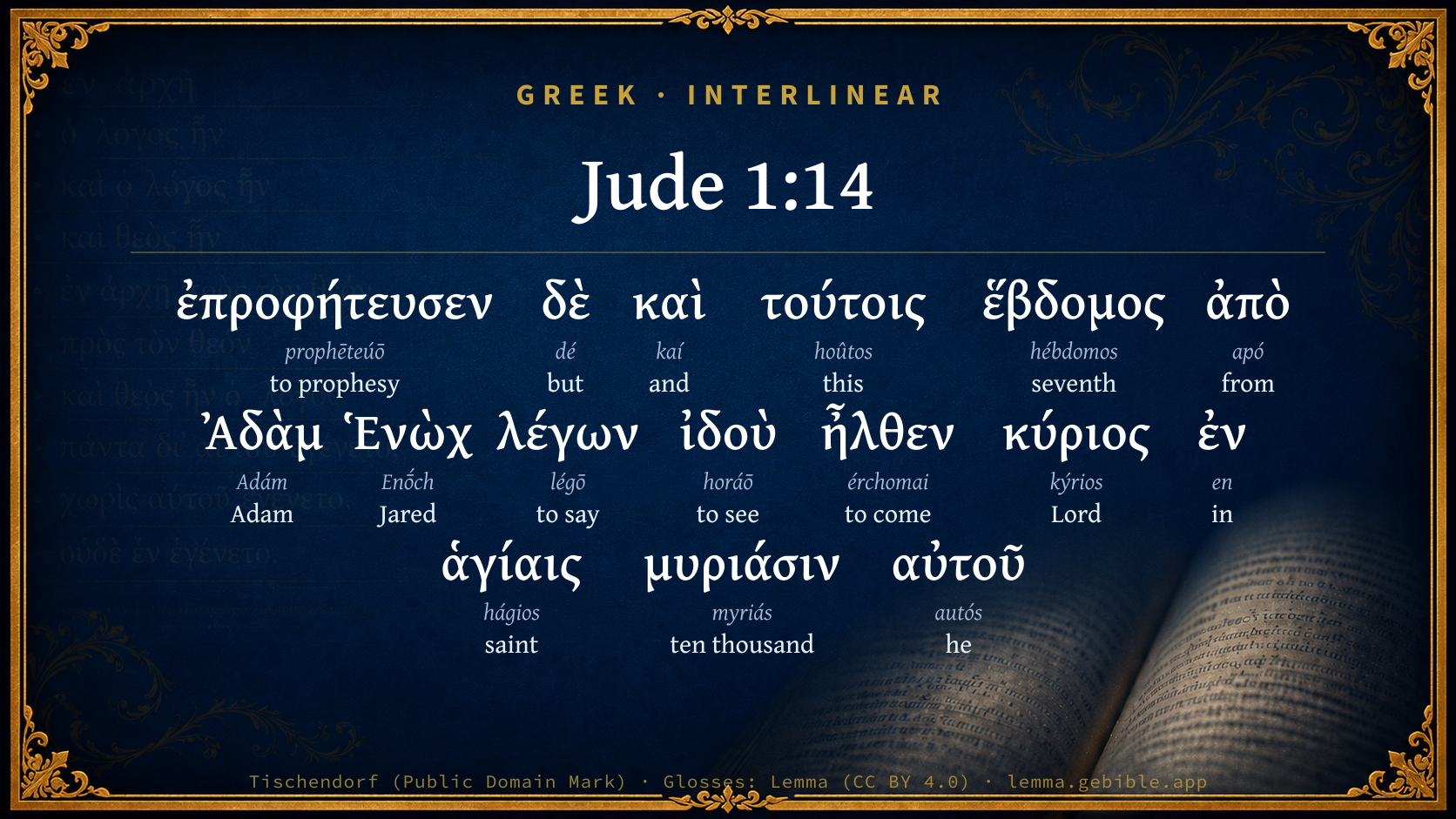
  1. ἐπροφήτευσεν prophēteúō G4395 “to prophesy” Verb, Aorist, Active, Indicative, 3rd person, Singular
  2. δὲ dé G1161 “but” Conjunction
  3. καὶ kaí G2532 “and” Conjunction
  4. τούτοις hoûtos G3778 “this” Demonstrative pronoun, Dative, Plural, Masculine
  5. ἕβδομος hébdomos G1442 “seventh” Adjective, Nominative, Singular, Masculine
  6. ἀπὸ apó G575 “from” Preposition
  7. Ἀδὰμ Adám G76 “Adam” Noun, Proper, indeclinable
  8. λέγων légō G3004 “to say” Verb, Present, Active, Participle, Nominative, Singular, Masculine
  9. ἰδοὺ horáō G3708 “to see” Verb, Aorist, Middle, Imperative, 2nd person, Singular
  10. ἦλθεν érchomai G2064 “to come” Verb, Aorist, Active, Indicative, 3rd person, Singular
  11. κύριος kýrios G2962 “Lord” Noun, Nominative, Singular, Masculine
  12. ἐν en G1722 “in” Preposition
  13. ἁγίαις hágios G40 “saint” Adjective, Dative, Plural, Feminine
  14. μυριάσιν myriás G3461 “ten thousand” Adjective, Dative, Plural, Feminine
  15. αὐτοῦ autós G846 “he” Personal pronoun, Genitive, Singular, Masculine

About this verse

These counts appear in no published source. They are computed here, from the morphology-tagged text and Lemma’s own curated glosses. What Lemma adds →

16
words
16
distinct lemmas
General Epistles
section

Notable vocabulary

The rarest word here is Ἑνὼχ Jared G1802 — appearing just 3 times in the whole Greek New Testament.

Shared distinctive vocabulary

Ἑνὼχ Jared G1802 occurs in 3 verses of the Greek New Testament. Also found in:

Cross-references

15

Topical passages linked to Jude 1:14 in the Treasury of Scripture Knowledge — connected by theme and wording, ordered by reader-vote popularity; previews shown in the World English Bible.

  • Deuteronomy 33:2 He said, Yahweh came from Sinai, Rose from Seir to them; He shined forth from Mount Paran, He came from the ten thousands of holy ones: At his right hand was a fiery law for them.
  • Psalms 50:3–5 Our God comes, and does not keep silent. A fire devours before him. It is very tempestuous around him.
  • 2 Thessalonians 1:7–8 and to give relief to you that are afflicted with us, when the Lord Jesus is revealed from heaven with his mighty angels in flaming fire,
  • Hebrews 11:5–6 By faith, Enoch was taken away, so that he wouldn't see death, and he was not found, because God translated him. For he has had testimony given to him that before his translation he had been well pleasing to God.
  • 1 Thessalonians 3:13 to the end he may establish your hearts blameless in holiness before our God and Father, at the coming of our Lord Jesus with all his saints.
  • Matthew 16:27 For the Son of Man will come in the glory of his Father with his angels, and then he will render to everyone according to his deeds.
  • Matthew 24:30–31 and then the sign of the Son of Man will appear in the sky. Then all the tribes of the earth will mourn, and they will see the Son of Man coming on the clouds of the sky with power and great glory.
  • Matthew 25:31 "But when the Son of Man comes in his glory, and all the holy angels with him, then he will sit on the throne of his glory.
  • Genesis 5:18 Jared lived one hundred sixty-two years, and became the father of Enoch.
  • 1 Chronicles 1:1–3 Adam, Seth, Enosh,
  • Job 19:25–27 But as for me, I know that my Redeemer lives. In the end, he will stand upon the earth.
  • Daniel 7:9–10 I saw until thrones were placed, and one who was ancient of days sat: his clothing was white as snow, and the hair of his head like pure wool; his throne was fiery flames, [and] the wheels of it burning fire.
  • Genesis 5:21–24 Enoch lived sixty-five years, and became the father of Methuselah.
  • Zechariah 14:5 You shall flee by the valley of my mountains; for the valley of the mountains shall reach to Azel; yes, you shall flee, just like you fled from before the earthquake in the days of Uzziah king of Judah. Yahweh my God will come, and all the holy ones with you.
  • Revelation 1:7 Behold, he is coming with the clouds, and every eye will see him, including those who pierced him. All the tribes of the earth will mourn over him. Even so, Amen.

Cross-references courtesy of OpenBible.info (CC BY 4.0).

Commentary

Notes on Jude 1:14 from classic Christian and Jewish commentators (each source and its license shown beneath its notes). The classic Christian expositions comment on the surrounding passage and are grouped to its opening verse, so a note may address several verses; the Jewish commentaries on the Tanakh (Rashi and others) are per-verse, so they appear only where the commentator wrote on this verse.

Lemma curates 59 commentaries, every one of them public domain or Creative Commons licensed, each selected and text-cleaned for this edition rather than reprinted as found. About our sources →

The Cambridge Bible for Schools and Colleges

gen. ed. J. J. S. Perowne

14. And Enoch also, the seventh from Adam, prophesied of these …] The words that follow are almost a verbal quotation from the Apocryphal Book of Enoch. As that work had probably been in existence for a century before St Jude wrote, and was easily accessible, it is more natural to suppose that he quoted here, as in previous instances, what he thought edifying, than to adopt either of the two strained hypotheses, (1) that the writer had received what he quotes through a tradition independent of the Book of Enoch, that tradition having left no trace of itself in any of the writings of the Old Testament, or (2) that he was guided by a special inspiration to set the stamp of authenticity upon the one genuine prophecy which the apocryphal writer had imbedded in a mass of fantastic inventions. On the general question raised by this use of apocryphal material, see the Introduction to this Epistle; and for the history and contents of the Book of Enoch, the Excursus at the end of this volume. In the description of Enoch as the “seventh from Adam” there is probably a mystical symbolism. As being such he became typical of the great Sabbath, the millennium, which, according to Jewish thought, was to close the six thousand years of the world’s work-day history.

Behold, the Lord cometh with ten thousands of his saints] The words appear in the Book of Enoch, as spoken by an angel who interprets a vision which the Patriarch had received as foretelling the judgment of the last day. The latter words run in the Greek literally, with His holy myriads, probably with a reference to Deu_33:2, the “saints” or “holy ones” here being not the disciples of Christ, but the “innumerable company of angels” (Heb_12:22; Psa_68:17).

EXCURSUS ON THE BOOK OF ENOCH

Jdg_1:14.

The history of the book which bears this title is a sufficiently remarkable one. St Jude’s reference to the prophecy of Enoch does not necessarily prove that he was acquainted with the book, but it at least shews the existence of traditions that had gathered round the patriarch’s name. Allusions elsewhere to the fall of the angels (Justin, Apol. ii. 5) or to the work of Enoch in preaching to them (Iren. iv. 6), or to his knowledge of astronomy (Euseb. H. E. vii. 32), in like manner do not indicate more than the widely diffused belief that he represented not only the holiness, but the science of the antediluvian world. The first Church writer who seems really to have known it is Tertullian (De Hab. Mul., c. 3), who, after giving at length the story how the angels that fell were allured by the beauty of the daughters of men, adds that he knows that the Book (scriptura) of Enoch is rejected by some as not being admitted into the Jewish “Storehouse” of holy writings. He meets the supposed objection that such a book was not likely to have survived the deluge by the hypothesis that it might have been committed to the custody of Noah, and been handed down after him from one generation to another, or that he might have been specially inspired, if it had perished, to rewrite it, as Esdras was fabled (2Es_14:38-48) to have re-written the whole Hebrew Canon. He defends his acceptance of it on the grounds (1) that it prophesied of Christ, and (2) that it had been quoted by St Jude. In another passage (de Idol. c. 15) he names Enoch as predicting certain superstitious practices of the heathen, and so as being the most ancient of all prophets. Augustine, on the other hand, adopting the view that the “sons of God” of Genesis 6 were righteous men who fell into the temptation of lust, rejects the book (which he clearly knew) as apocryphal, and while he admits the prophecy quoted by St Jude as authentic, dismisses all the rest as fabulous (De Civ. Dei, xv. 23). After this the book seems to have dropped out of sight, and it is not again referred to by any ecclesiastical writer. Fragments of it were found by Scaliger in the Chronographia of Georgius Syncellus, and printed by him in his notes on Eusebius in 1658. In 1773, however, Bruce, the Abyssinian explorer, brought over three copies which he had found in the course of his travels, and one of these, presented to the Bodleian Library, was translated by Archbishop Lawrence and published in 1821. Another and more fully edited translation was published in German by Dillmann in 1853.

The book thus brought to light after an interval of some fourteen hundred years, bears no certain evidence of date, and has been variously assigned by different scholars, by Ewald to b. c. 144–120, by Dillmann to b. c. 110, while other scholars have been led by its reference to the Messiah to ascribe a post-Christian origin to it. As regards its contents, it is a sufficiently strange farrago. The one passage which specially concerns us is found in c. ii., and is thus rendered by Archbishop Lawrence. It comes as part of the first vision of Enoch: God will be manifested and the mountains shall melt in the flame, and then “Behold he comes with ten thousand of his saints to execute judgment upon them, and to reprove all the carnal for everything which the wicked and ungodly have done and committed against him.” In c. vii., viii. we have the legend of the loves of the angels and the birth of the giants, and the invention of arts and sciences. Then comes a prophecy of the deluge (c. x.), and visions of the city of God (c. xiv.), and the names of the seven angels (c. xx.). He sees the dwelling-place of the dead, both good and evil (c. xxii.), and the tree of life which had been in Eden (c. xxiv.), and a field beyond the Erythraean Sea in which is the tree of knowledge (c. xxxi.). Vision follows upon vision, until in c. xlvi. we have a reproduction of that in Daniel 7. of the Ancient of Days in the Son of Man, who is identified with the Messiah (c. xlvii.), the Chosen One of God. And so the book goes on, leaving on the reader’s mind an impression like that of a delirious dream, with endless repetitions and scarcely the vestige of a plan or purpose. The reader of the English Apocrypha may find the nearest accessible approach to the class of literature which it represents in the Second Book of Esdras, but that, in its profound and plaintive pessimism, has at least the elements of poetry and unity of purpose. The Book of Enoch stands on a far lower level, and belongs to the class of writings in which the decay of Judaism was but too prolific, on which St Paul seems to pass a final sentence when he speaks of them as “old wives’ fables” (1Ti_4:7).

The Cambridge Bible for Schools and Colleges (gen. ed. J. J. S. Perowne; Cambridge University Press, 1878–1918) — public domain. Text from a community e-Sword module.

The Biblical Illustrator

Joseph S. Exell

Jud_1:14-15

And Enoch also, the seventh from Adam, prophesied of these, saying, Behold the Lord cometh.

Enoch, the herald of judgment

The first thing to be considered is, where or whence St. Jude obtained this prediction of Enoch--whether from immediate revelation, or from tradition, or from some book then extant in the Church. There is indeed an apocryphal book, The Book of Enoch, which appears to have been often used by the early Fathers, and to have acquired a great celebrity in the first days of Christianity. For centuries this book was supposed to have been lost, and our only knowledge of it was derived from quotations in other writings. An Ethiopic version was at length discovered in Ethiopia, and brought to England by the well-known traveller, Bruce. In this book there are passages which answer very nearly to the prophecy recorded by St. Jude. It has therefore been a common supposition that the apostle derived from this book the prediction which he ascribes to the patriarch. But the likelihood is that the Book of Enoch was written after the Epistle of St. Jude, so that Jude could not have drawn the prophecy from the book; but, rather, the writer of the book inserted in it the prophecy that he might give to his forgery the appearance of truth. We may believe, therefore, that in all probability Jude was informed of the prediction by immediate revelation. But whatever the source whence the apostle derived it, we may be certain that the prophecy was actually delivered by Enoch. The prophecy may indeed have had a primary reference to the Flood; but it is evident, from the application of the prediction by St. Jude, that Enoch pointed at events, of which the Deluge and its accompaniments were but feeble types. We are expressly informed that Enoch walked with God after he begat Methuselah three hundred years; so that whatever pre-eminence in piety was denoted by walking with God, it is evident that Enoch possessed it from early days, and retained it to the last. He is thus an instance alike of youthful conversion and uniform consistency. Neither was he content, whilst having his conversation in heaven, to allow the wickedness of others to pass unrebuked. Here it is that his prophetic character comes in, and when you couple his preaching with his own translation, you may perceive that, by and through him, was information given to an antediluvian world on points which many have supposed left in impenetrable obscurity. These points are those of a future life, and a retributive economy, which shall decide mens portions in another state of being. Thus was Enoch to the antediluvian world what Elijah was to those who lived beneath the law--a mighty demonstration of another state of being. Who had a right to question that the soul perished not with the body--nay, that even the body was not to lie for ever in the dust, when a patriarch had departed from the world, yielding not to death, and asking not a sepulchre? Already must Christ have virtually accomplished the prophecy, though it had not yet been delivered--Oh! death, I will be thy plague; oh, grave, I will be thy destruction. Already must He have opened the kingdom of heaven to believers, though He had not yet suffered their penalty, nor paid the price of their admission. It seems as though the whole scheme of redemption had been disclosed to mankind; yea, presented as already accomplished in what befel Enoch. The original curse was on body and soul; but when body and soul went up to glory there was given the most convincing demonstration that the curse would be counteracted, or, rather, that it was already removed. And now, if I would know how the gospel was preached to man, in its fulness, before the Flood, and would assure myself that those who perished in the Deluge, perished not without sufficient notice of redemption, and sufficient motive to the practice of piety, I turn my gaze on the ascending patriarch, and I feel that, as he stood upon the cloud and mounted heavenward, he proclaimed to the whole human family the reward of obedience in the restoration to immortality. And I need nothing further to convince me that, in the earliest days, as well as in later, men were instructed to expect eternal life through conformity to the known will of God. (H. Melvill, B. D.)

The judgment

1. Christs second coming is to judgment. When we frustrate the end of His coming as a Redeemer, we make way for the end of His coming as a Judge.

2. When Christ cometh to judgment, one great part of His work will be to convince sinners, and that openly, publicly.

3. Again observe, when Christ hath convinced, He will condemn, and when He hath condemned, He will execute.

4. From that of all their ungodly deeds, etc., observe that the process of the last day chiefly lieth against the ungodly. Ungodliness doth chiefly provoke; for the chiefest part of the law provideth for our duty to God. The dignity of every command is known by the order of it. Now, in the first place, godliness is required, and then righteousness, or a care of moral duties.

5. Once more observe, these ungodly men are the rather judged because they commit sin with an ungodly mind; for so it is in the text, ungodly deeds ungodly committed. A child of God may fall into wickedness, but he doth not commit it wickedly, with a full consent; men are not condemned for infirmities, but iniquities. A godly man doth not so much act sin as he suffereth by it. He doth not pour out his whole heart this way; there are constant dislikes in the soul, which are a restraint to him.

6. From the next clause, and their hard speeches, observe, not only the deeds of ungodly men, but their speeches are brought into judgment. Words do not perish with the breath with which they are uttered; no, they remain upon record, and we are to give an account of them at the last day (Mat_12:36; Jam_2:12).

7. Once more from thence observe, that of all speeches mens hard speeches shall be produced at the day of judgment. Now, what are these hard speeches? I answer--Either such as have anger in them (Pro_4:24); or such as have pride in them, or contempt of others, as when we lessen their abilities, insult over their miseries (Psa_69:26); or triumph over their failings. Again, such as have bitterness and malice in them, as calumnies and reproaches (Psa_64:3-4).

8. The next note is, that of all hard speeches those are the worst which do most directly reflect upon the honour and glory of Christ; for so it is in the text, hard speeches spoken against Him. Now, hard speeches against Christ are either blasphemies against either of His natures, or murmurings against His providence: Your words have been stout against Me (Mal_3:13). When we tax Providence, as if the Lord were blind, careless, unjust, or injurious in His dealings. So also when we speak against His ways, calling zeal fury, strictness a foolish preciseness, and godliness puritanism. O Christians! these hard speeches will cost dear, here or hereafter. (T. Manton.)

The Biblical Illustrator, edited by Joseph S. Exell (c. 1880s–1900s) — public domain. Text from a community e-Sword module.

Joseph Benson's Commentary

Jdg 1:14-15. And Enoch also, the seventh from Adam — Thus described to distinguish him from Enoch the son of Cain, (Gen 4:17,) who was only the third from Adam; so early was the prophecy delivered, referred to Jdg 1:4: prophesied of these — As well as of the antediluvian sinners. The first coming of Christ was revealed to Adam, his second and glorious coming to Enoch, who foretold the things which will conclude the last age of the world. St. Jude might know this either from some ancient book or tradition, or from immediate revelation. In whatever way he knew it, a precious fragment of antediluvian history is thus preserved to us by the special providence of God, who taught the Apostle Jude to distinguish between what was genuine and what was spurious in ancient story. “Though Moses has said nothing concerning Enoch’s prophesying, yet by telling us that he was a person of such piety, as to be translated to heaven in the body without dying, he hath warranted us to believe Jude’s account of him; namely, that God employed him, as he did Noah, in reforming the wicked of the age in which he lived, and that he inspired him to deliver the prophecy of which Jude speaks. Saying, Behold, (as if it were already done!) The Lord cometh with ten thousand of his saints — Or holy ones, namely, angels, with legions of whom his descent for the purpose here mentioned will be attended; to execute judgment — Or to pass sentence, as ποιησαι κρισιν may be rendered; upon all — According to their respective works. Herein Enoch looked beyond the flood: and to convince — Or convict rather, as εξελεγξαι more properly signifies, by witnesses that cannot be confronted; all that are ungodly among them — Among those judged, and upon whom sentence is passed. Of all their ungodly deeds — Their wicked actions; which they have ungodly — Impiously; committed — Being destitute of the fear as well as love of God, and in defiance of his justice and wrath: and of all their hard — Their impious, atheistical, scoffing speeches, which ungodly sinners have spoken against him — Namely, against Christ, as if he were an impostor, who was justly punished with an ignominious death; and against his people, representing them, although the excellent of the earth, of whom the world was not worthy, (Heb 11:38,) as the vilest of men.

Joseph Benson's Commentary on the Old and New Testaments (1811–1818) — public domain. Text from a community e-Sword module.

Tyndale Open Study Notes

Tyndale Open Resources

1:14 she urged him: See study note on Josh 15:18-19.

1:14-15 Enoch was an early descendant of Adam (see Gen 5:18-24; 1 Chr 1:3); the comment in Gen 5:24 apparently means that Enoch did not die but was taken directly to heaven (cp. 2 Kgs 2:1-13; see Heb 11:5). This extraordinary commendation from God and the almost complete silence of Scripture about him make Enoch a fascinating character. There are a number of legends about him in Jewish literature, and at least two books of apocalyptic visions written between the Old Testament and the New Testament are attributed to him (1–2 Enoch).

Tyndale Open Study Notes — © Tyndale Open Resources, licensed CC BY-SA 4.0. Text via the HelloAO Bible API.

Bengel's Gnomon

Johann Albrecht Bengel

Jud 1:14. Προεφήτευσε) acted as prophet.—καὶ τούτοις, even to these) not only respecting these, and not to the antediluvians only; for he says, all: Jud 1:5.—ἕβδομος, the seventh) The antiquity of the prophecy is shown, Jud 1:4; for it appears to have been the earliest respecting the coming of the Judge. There were only five fathers between Enoch and Adam: 1Ch 1:1; and the translation of Enoch took place earlier than A.M. 1000: and this very title is peculiar to Enoch, and of frequent use among the Hebrews. The seventh from Adam, is an expression not without mystery; for in him who is thus described, freedom from death and a sacred number are combined: for every seventh object is most highly valued. The Fragment of Enoch, indeed, relates a tenfold septenary: inasmuch as those ungodly men, who were overwhelmed with the deluge, δεθέντες ἐπὶ ἑβδομήκοντα γενεὰς εἰς τὰς νάπας τῆς γῆς, shall be bound to dark valleys of the earth for seventy generations, even until the day of their judgment. See Heidan. de Orig. Err., p. 174.—ἀπὸ Ἀδὰμ, from Adam) The first coming of Christ was foretold to Adam; the second to Enoch. The seventh from Adam prophesied the things which shall close the seventh age of the world.—Ἐνὼχ, Enoch) Who shall determine, whether St Jude took this also from some ancient book, or from tradition, or from immediate revelation? If from a book, it is however judged to be different from that against which Bangius disputes, in his Treatises on the Origin of Letters, especially p. 94. Comp. Suicer’s Thesaurus, P. i. col. 1131.—Κύριος, the Lord) The name of Jehovah was already known in the time of Enoch.—ἐν ἁγίαις μυριάσιν, amidst holy myriads) of angels: Mat 25:31. A mysterious ellipsis[7] was suitable to those early times.

[7] A mysterious ellipsis: i.e. an ellipsis intentionally hiding the details, not revealing that which we now know, that it shall be with holy myriads of angels.—T.

Bengel's Gnomon of the New Testament — English translation (T&T Clark, Edinburgh, 1860) — public domain. Text from a community e-Sword module.

Meyer's Critical & Exegetical Commentary

Heinrich August Wilhelm Meyer

Jud_1:14-15. The threatening contained in the preceding verses is confirmed by a saying of Enoch.

ἐπροφήτευσε δὲ καὶ τούτοις] καί refers either to τούτοις: of these as well as of others; according to Hofmann, of those who perished in the deluge; or it is designed to render prominent ἐπροφ. τούτοις in reference to what has been before said: yea, Enoch also has prophesied of them. Hofmann, in an entirely unwarrantable manner, maintains that there can be no question that καί puts its emphasis on the word before which it stands.

προφητεύειν generally with περί here construed with the dative, as in Luk_18:31, in reference to these.

ἕβδομος ἀπὸ Ἀδὰμ Ἐνώχ] ἕβδομος has hardly here the mystical meaning which Stier gives it: The seventh from Adam is personally a type of the sanctified of the seventh age of the world, of the seventh millennium, of the great earth Sabbath. Also in the Book of Enoch, he is several times expressly designated as the seventh from Adam (60:8, 93:3); not in order to characterize him as the oldest prophet (Calvin, de Wette, and others), but to mark his importance by the coincidence of the sacred number seven (Wiesinger, Schott). The saying of Enoch here quoted is found, partly verbally, at the beginning of the Book of Enoch (Jud_1:9): And behold He comes with myriads of saints to execute judgment on them, and He will destroy the ungodly and judge all flesh concerning all things which the sinners and ungodly have committed and done against Him.[41] These words are taken from a speech in which an angel interprets a vision which Enoch has seen, and in which he announces to him the future judgment of God.

[41] The passage thus stands in de Sacys version: et venit cum myriadibus sanctorum, ut faciat judicium super eos et perdat impios et litigat cum omnibus carnalibus pro omnibus quae fecerunt et operati sunt contra eum peccatores et impii.

The question, from what source Jude has drawn these words, is very differently answered by expositors. It is most natural to conceive that he has taken them from the Book of Enoch; but then this presupposes that this book, although only according to its groundwork, is of pre-Christian Jewish, and not of Jewish Christian origin, which is also the prevailing opinion of recent critics. Hofmann, who denies the pre-Christian composition of the book, says: Jude has derived it, in a similar manner as the incident between Michael and Satan, from a circle of myths, which has attached itself to Scripture, amplifying its words. Yet, on the other hand, it is to be observed that it is difficult to conceive that oral tradition should preserve such an entire prophetic saying. F. Philippi thinks that Enoch in Gen_5:22 is characterized as a prophet of God, and as such prophesied of the impending deluge; and that Jude, by reason of a deeper understanding of Genesis 5, could add the exposition already become traditionary, and speak of a prophecy of Enoch, the reality of which was confirmed to him by the testimony of the Holy Ghost; or that this prophecy of Enoch was imparted to the disciples by Christ Himself, when the already extant tradition concerning Enoch might have afforded them occasion to ask the Lord about Enoch, perhaps when he was engaged in delivering His eschatological discourses. But both opinions of Philippi evidently rest on suppositions which are by no means probable. As an example of the method by which the older expositors sought to rescue the authenticity of the prophecy, let the exposition of Hornejus suffice: haec quae Judas citat, ab Enocho ita divinitus prophetata esse, dubium non est; sive prophetiam illam ipse alicubi scripsit et scriptura ilia vel per Noam ejus pronepotem in arca, vel in columna aliqua tempore diluvii conservata fuit sive memoria ejus traditione ad posteros propagata, quam postea apocrypho et fabulosa illi libro autor ejus inseruerit, ut totum Enochus scripsisse videretur.

ἐν ἁγίαις μυριάσιν] comp. Zec_14:5; Deu_33:2; Heb_12:22; (μυριάσιν ἀγγέλων) Rev_5:11.

Jud_1:15. ποιῆσαι κρίσιν] see Gen_18:25; Joh_5:27.

τοὺς ἀσεβεῖς] The pronoun αὐτῶν, according to the Rec., would refer to the people of Israel.

ὧν ἠσέβησαν] the same verb in Zep_3:11; 2Pe_2:6; here used as transitive; comp. Winer, p. 209 [E. T. 279]. The frequent repetition of the same idea is to be observed: ἀσεβεῖς, ἀσεβείας, ἠσέβησαν, and finally again ἀσεβεῖς; a strong intensification of ungodliness.

τῶν σκληρῶν] σκληρός, literally, dry, hard, rough; here in an ethical sense, ungodly, not equivalent to surly (Hofmann); in a somewhat different sense, but likewise of sayings, the word is used in Joh_6:60.

κατʼ αὐτοῦ] is by Hofmann in an unnecessary manner attached not only to ἐλάλησαν, but also to ἠσέβησαν, in spite of Zep_3:11, where it is directly connected with ἠσέβησαν, which is not here the case. The sentence emphatically closes with ἁμαρτωλοὶ ἀσεβεῖς, which is not, with Hofmann, to be attracted to what follows.

Meyer — Critical and Exegetical Commentary on the New Testament — English translation by Peter Christie, edited by Frederick Crombie (T&T Clark, 1880) — public domain. Text from a community e-Sword module.

Expositor's Greek Testament

ed. W. Robertson Nicoll

Jud 1:14-16 . The Prophecy of Enoch . The ancient prophecy, to which reference has been already made, was intended for these men as well as for the prophet’s own contemporaries, where he says “The Lord appeared, encompassed by myriads of his holy ones, to execute justice upon all and to convict all the ungodly concerning all their ungodly works, and concerning all the hard things spoken against Him by ungodly sinners”. (Like them) these men are murmurers, complaining of their lot, slaves to their own carnal lusts, while they utter presumptuous words against God, and seek to ingratiate themselves with men for the sake of gain.

Jud 1:14 . ἐπροφήτευσεν δὲ καὶ τούτοις ἕβδομος ἀπὸ Ἀδὰμ Ἑνώχ . “It was for these also (as well as for his own contemporaries) that the prophecy of Enoch was intended, far as he is removed from our time, being actually the sixth (by Hebrew calculation, seventh) descendant from Adam.” For Enoch compare the allusions in Sir 44:16 ; Sir 49:14 , Heb 11:5 , Charles, Introduction to Book of Enoch . The prophecy is contained in En. i. 9 (Greek in Charles, App. C. p. 327), ὅτι ἔρχεται σὺν τοῖς (? ταῖς ) μυριάσιν αὐτοῦ καὶ τοῖς ἁγίοις αὐτοῦ ποιῆσαι κρίσιν κατα πάντων , καὶ ἀπολέσει τοὺς ἀσεβεῖς καὶ ἐλέγξει πᾶσαν σάρκα περὶ πάντων ἔργων αὐτῶν ὧν ἠσέβησαν κατʼ αὐτοῦ ἁμαρτωλοὶ ἀσεβεῖς . The phrase ἕβδομος ἀπὸ Ἀδάμ is also found in En. lx. 8, “My grandfather was taken up, the seventh from Adam,” ib. xciii. 3, “And Enoch began to recount from the books and spake: I was born the seventh in the first week, while judgment and righteousness still tarried; and after me there will arise in the second week great wickedness,” where Charles refers to Jubilees , 7. The genealogical order, as given in Gen 5:4-20 , is (1) Adam, (2) Seth, (3) Enos, (4) Cainan, (5) Mahalaleel, (6) Jared, (7) Enoch. It is probably the sacredness of the number 7 which led the Jewish writers to lay stress upon it in Enoch’s case.

ἰδοὺ ἦλθεν Κύριος ἐν ἁγίαις μυριάσιν αὐτοῦ . Charles’ translation from the Aethiopic is “And lo! He comes with ten thousands of his holy ones to execute judgment upon them, and He will destroy the ungodly and will convict all flesh of all that the sinners and ungodly have wrought and ungodly committed against Him”. For μυριάσιν ἀγγέλων cf. Heb 12:22 , Psa 68:17 , Deu 33:2 . For the use of ἐν denoting accompanying circumstances see Blass, Gr. N. T. tr. p. 118, and Luk 14:31 , εἰ δυνατός ἐστιν ἐν δέκα χιλιάσιν ἀπαντῆσαι τῷ μετὰ εἴκοσι χιλιάδων ἐρχομένῳ ἐπʼ αὐτόν . The aorist here is the preterite of prophetic vision, as when Micaiah says, “I saw all Israel scattered,” cf. Rev 10:7 ; Rev 14:8 .

The Expositor's Greek Testament, edited by W. Robertson Nicoll (1897–1910) — public domain. Text from a community e-Sword module.

Geneva Bible (1599)

Geneva Bible translators

The present time for the time to come.

Geneva Bible (1599) marginal notes — public domain. Text via Bolls.life.

Jamieson, Fausset & Brown

Robert Jamieson, A. R. Fausset & David Brown

See Introduction on the source whence Jude derived this prophecy of Enoch. The Holy Spirit, by Jude, has sealed the truth of this much of the matter contained in the book of Enoch, though probably that book, as well as Jude, derived it from tradition (compare Note, see on Jde 1:9). There are reasons given by some for thinking the book of Enoch copied from Jude rather than vice versa. It is striking how, from the first, prophecy hastened towards its consummation. The earliest prophecies of the Redeemer dwell on His second coming in glory, rather than His first coming in lowliness (compare Gen 3:15 with Rom 16:20). Enoch, in his translation without death, illustrated that truth which he all his life preached to the unbelieving world, the certainty of the Lord's coming, and the resurrection of the dead, as the only effectual antidote to their skepticism and self-wise confidence in nature's permanence.

And Enoch--Greek, "Moreover, also Enoch," &c.

seventh from Adam--Seven is the sacred number. In Enoch, freedom from death and the sacred number are combined: for every seventh object is most highly valued. Jude thus shows the antiquity of the prophecies. Compare Note, see on Jde 1:4, "of old." There were only five fathers between Enoch and Adam. The seventh from Adam prophesied the things which shall close the seventh age of the world [BENGEL].

of these--in relation to these. The reference of his prophecies was not to the antediluvians alone, but to all the ungodly (Jde 1:15). His prophecy applied primarily indeed to the flood, but ultimately to the final judgment.

cometh--literally, "came." Prophecy regards the future as certain as if it were past.

saints--Holy angels (compare Deu 33:2; Dan 7:10; Zac 14:5; Mat 25:31; Heb 12:22).

Jamieson, Fausset & Brown — Commentary Critical and Explanatory on the Whole Bible (1871) — public domain (CC PDM 1.0). Text via the HelloAO Bible API.

Adam Clarke's Commentary

Verse 14. Enoch also, the seventh from Adam] He was the seventh patriarch, and is distinguished thus from Enoch, son of Cain, who was but the third from Adam; this appears plainly from the genealogy, 1Ch 1:1: Adams Seth, Enosh, Kenan, Mahalaleel, Jered, Henoch or Enoch, c. Of the book of Enoch, from which this prophecy is thought to have been taken, much has been said but as the work is apocryphal, and of no authority, I shall not burden my page with extracts. See the preface.

Perhaps the word προεφητευσε, prophesied, means no more than preached, spoke, made declarations, c., concerning these things and persons for doubtless he reproved the ungodliness of his own times. It is certain that a book of Enoch was known in the earliest ages of the primitive Church, and is quoted by Origen and Tertullian; and is mentioned by St. Jerome in the Apostolical Constitutions, by Nicephorus, Athanasius, and probably by St. Augustine. See Suicer's Thesaurus, vol. i., col. 1131. Such a work is still extant among the Abyssinians.

Ten thousand of his saints] This seems to be taken from Da 7:10.

Adam Clarke's Commentary on the Bible (1810–1826) — public domain. Text from a community e-Sword/MySword module.

John Calvin's Commentaries

14. And Enoch also. I rather think that this prophecy was unwritten, than that it was taken from an apocryphal book; for it may have been delivered down by memory to posterity by the ancients. Were any one to ask, that since similar sentences occur in many parts of Scripture, why did he not quote a testimony written by one of the prophets? the answer is obvious, that he wished to repeat from the oldest antiquity what the Spirit had pronounced respecting them: and this is what the words intimate; for he says expressly that he was the seventh from Adam, in order to commend the antiquity of the prophecy, because it existed in the world before the flood.

But I have said that this prophecy was known to the Jews by being reported; but if any one thinks otherwise, I will not contend with him, nor, indeed, respecting the epistle itself, whether it be that of Jude or of some other. In things doubtful, I only follow what seems probable.

Behold, the Lord cometh, or came. The past tense, after the manner of the prophets, is used for the future. He says, that the Lord would come with ten thousand of his saints; and by saints he means the faithful as well as angels; for both will adorn the tribunal of Christ, when he shall descend to judge the world. He says, ten thousand, as Daniel also mentions myriads of angels, (Daniel 7:10;) in order that, the multitude of the ungodly may not, like a violent sea, overwhelm the children of God; but that they may think of this, that the Lord will sometime collect his own people, a part of whom are dwelling in heaven, unseen by us, and a part are hid under a great mass of chaff.

John Calvin's Commentaries (1540-1563) — public domain. Text from the Calvin Translation Society English edition (1840s-50s) via the Christian Classics Ethereal Library (ccel.org). Calvin's coverage is partial (roughly two-thirds of the Bible); uncommented books and verses are honest gaps, never fabricated. The 19th-century editor's footnotes and remarks are omitted so the notes are faithfully Calvin's own voice.

John Gill's Exposition

And Enoch also, the seventh from Adam,.... This was Enoch the son of Jared; his name signifies one "instructed", or "trained up"; as he doubtless was by his father, in the true religion, in the nurture and admonition of the Lord; and was one that had much communion with God; he walked with him, and was translated by him, body and soul, to heaven, and did not see death; Gen 5:18; he is said to be "the seventh from Adam"; not the seventh man from him that was born into the world, for there were no doubt thousands born before him; but he was, as the Jews express it (f), , "the seventh generation" from him; and they have an observation (g), that all sevenths are always beloved by God; the seventh in lands, and the seventh in generations; Adam, Seth, Enos, Cainan, Mahalaleel, Jared, Enoch, as it is written, Gen 5:24; and this is said partly to distinguish him from others of the same name, and particularly from Enoch the son of Cain, the third: from Adam in his line, as this was the seventh from Adam in the line of Seth; and partly to observe the antiquity of the following prophecy of his: for it is said, he

prophesied of these; of these false teachers, and such as they; what would be their sad state and condition at the second coming of Christ to judgment: that he had a spirit of prophecy is evident from the name he gave to his son Methuselah, which signifies, "when he dies is the emission", or the sending out of the waters of the flood, which came to pass the very year he did die. The Arabic writers (h) call him Edris the prophet; and the Jews say (i), that he was in a higher degree than Moses or Elias; they also call (k) him Metatron, the great scribe, a name which they sometimes give to the angel that went before the children of Israel in the wilderness, and which seems to belong to the Messiah: that Enoch wrote a prophecy, and left it behind him in writing, does not appear from hence, or elsewhere; the Jews, in some of their writings, do cite and make mention of the book of Enoch; and there is a fragment now which bears his name, but is a spurious piece, and has nothing like this prophecy in it; wherefore Jude took this not from a book called the "Apocalypse of Enoch", but from tradition; this prophecy being handed down from age to age; and was in full credit with the Jews, and therefore the apostle very appropriately produces it; or rather he had it by divine inspiration, and is as follows:

saying, behold, the Lord cometh with ten thousand of his saints; by the "Lord" is meant the Lord Jesus Christ, who is ordained the Judge of quick and dead, and for which he is richly qualified, being omniscient and omnipotent, and faithful and righteous, and who will certainly come again to judge the world in righteousness; for not of his first coming, which was not to judge and condemn, but to seek and save, but of his second coming at the last day is this to be understood; and this is expressed in the present tense, "cometh", in the manner of the prophets, who speak of things future as if they already were, as Isaiah does of the incarnation, sufferings, and death of Christ, and to awaken the attention of persons to it, as if it was near at hand, as also to signify the certainty of it: and when he comes, he will be attended "with ten thousand of his saints": meaning either the souls of glorified saints, even all of them, Th1 3:13, which will come with Christ, and meet the living ones, and be reunited to their own bodies, which will then be raised; or else the holy angels, as in Deu 33:2; and so some copies and the Arabic version read; which will be both for the showing forth of his glory and majesty, and for service in gathering his elect together, as well as for terror to the wicked; and a "behold" is prefixed to all this, to denote the certainty of Christ's coming, and the importance and wonderfulness of it: the ends of his coming follow,

(f) Juchasin, fol. 5. 2. Ganz. Tzemach David, par. 1. fol. 5. 1. (g) Vajikra Rabba, sect. 29. fol. 170. 1. (h) Elmacinus, p. 10. apud Hottinger. Smegma Orient. p. 240. (i) Shalshelet Hakabala, fol. 1, 2. (k) Targum Jon. in Gen. v. 24. Tosephot in T. Bab. Yebamot, fol. 16. 2. Juchasin, fol. 5. 2.

John Gill's Exposition of the Whole Bible (1746–1763) — public domain (CC PDM 1.0). Text via the HelloAO Bible API.

Albert Barnes' Notes on the Bible

And Enoch also, the seventh from Adam - The seventh in the direct line of descent from Adam. The line of descent is Adam, Seth, Enos, Cainan, Mahaleel, Jared, Enoch; see Gen 5:3, following. On the character of Enoch, see the notes at Heb 11:5.

Prophesied of these - Uttered prophecies applicable to these men, or respecting just such men as these. It is not necessarily meant that he had these men specifically in his eye; but all that is fairly implied is, that his predictions were descriptive of them. There is no mention made in the writings of Moses of the fact that Enoch was a prophet; but nothing is more probable in itself, and there is no absurdity in supposing that a true prophecy, though unrecorded, might be handed down by tradition. See the 2Ti 3:8 note; Jud 1:9 note. The source from which Jude derived this passage respecting the prophecy of Enoch is unknown. Amidst the multitude of traditions, however, handed down by the Jews from a remote antiquity, though many of them were false, and many of a trifling character, it is reasonable to presume that some of them were true and were of importance. No man can prove that the one before us is not of that character; no one can show that an inspired writer might not be led to make the selection of a true prophecy from a mass of traditions; and as the prophecy before us is one that would be every way worthy of a prophet, and worthy to be preserved, its quotation furnishes no argument against the inspiration of Jude. There is no clear evidence that he quoted it from any book extant in his time.

There is, indeed, now an apocryphal writing called “the Book of Enoch,” containing a prediction strongly resembling this, but there is no certain proof that it existed so early as the time of Jude, nor, if it did, is it absolutely certain that he quoted from it. Both Jude and the author of that book may have quoted a common tradition of their time, for there can be no doubt that the passage referred to was handed down by tradition. The passage as found in “the Book of Enoch” is in these words: “Behold he comes with ten thousand of his saints, to execute judgment upon them, and destroy the wicked, and reprove all the carnal, for everything which the sinful and ungodly have done and committed against him,” chapter ii. Bib. Repository, vol. xv. p. 86. If the Book of Enoch was written after the time of Jude, it is natural to suppose that the prophecy referred to by him, and handed down by tradition, would be inserted in it. This book was discovered in an AEthiopic version, and was published with a translation by Dr. Laurence of Oxford, in 1821, and republished in 1832. A full account of it and its contents may be seen in an article by Prof. Stuart in the Bib. Repository for January 1840, pp. 86-137.

The Lord cometh - That is, the Lord will come. See the notes at 1Co 16:22. It would seem from this to have been an early doctrine that the Lord would “descend” to the earth for judgment.

With ten thousand of his saints - Or, “of his holy ones.” The word “saints” we now apply commonly to “redeemed” saints, or to Christians. The original word is, however, applicable to all who are “holy,” angels as well as men. The common representation in the Scriptures is, that he would come attended by the angels Mat 25:31, and there is doubtless allusion here to such beings. It is a common representation in the Old Testament also that God, when he manifests himself, is accompanied by great numbers of heavenly beings. See Psa 68:17; Deu 33:2.

Albert Barnes' Notes on the Bible (1834–1885) — public domain. Text from a community e-Sword/MySword module.

Haydock's Catholic Bible Commentary

Enoch, &c. Though the ancient writers mention an apocryphal book of Enoch’s prophesies, yet St. Jude might know by tradition, or by the Spirit of God, what Enoch truly prophesied concerning God’s coming with thousands of his saints, to judge, condemn, and punish the wicked for their impieties and blasphemies. (Witham) --- Prophesied. This prophecy was either known by tradition, or from some book that is since lost. (Challoner)

George Leo Haydock (1774–1849), Haydock's Catholic Family Bible and Commentary, 1859 edition — public domain. Excludes Psalms (Douay-Rheims chapter numbering differs from Protestant) and Deuterocanonical books (Catholic canon only).

Matthew Poole's English Annotations

And Enoch also, the seventh from Adam; either to distinguish him from Enoch the son of Cain, or to show the antiquity of the prophecy.

Prophesied; he doth not say wrote, and therefore from hence it cannot be proved that there was any such book as Enoch’s prophecies, received by the Jews as canonical Scripture; but rather some prophecy of his delivered to them by tradition, to which here the apostle refers, as a thing known among them; and so argues against these heretics from their own concession, as Jud 1:9. So here; q. d. These men own the prophecy of Enoch, that the Lord comes to judgment, &c., and they themselves are in the number of those ungodly ones, and they to whom the prophecy is to be applied.

Of these; not that he did directly and expressly prophesy of them in particular; but that his prophecy of the destruction of the world for the same kind of crimes whereof they were guilty, did reach them, and so he foretold what should befall them as well as others.

With ten thousand; innumerable multitudes; a definite for an indefinite.

Of his saints; holy angels, Mat 16:27; Dan 7:10; Zec 14:5; 2Th 1:7; Rev 5:11. Believers likewise may be here included, as attendants upon Christ when he comes to judgment.

Matthew Poole's English Annotations on the Holy Bible (1683–1685) — public domain. Text from a community e-Sword/MySword module.

Whedon's Commentary on the Bible

Daniel D. Whedon

14. Prophesied—This word stands, in the Greek, with its particle but, the first word of the sentence; the place of emphasis. The emphasis implies that not only were these characters typified by the above-named very ancient examples, but they were prophesied of by a most ancient holy seer. Also, in the English, seems by its position to mean that Enoch, in addition to others, so prophesied; whereas it really means, that prophecy was by him added to the above types. Read, But prophesied, also, in regard to these, the seventh one from Adam, Enoch.

Seventh—Including both Adam and Enoch, there were seven persons in line. There is a week, usually of days; also sometimes, a week of things; and here, a week of persons, with holy Enoch, for its holy sabbath. “The number seven was esteemed, in the ancient world, as an important signature pointing to the sacred and mystery. The fact that after sin and death had freely exerted their unhappy power during the first six generations, in the seventh generation mankind appeared in the person of one man in a state of high completeness and blessed freedom from death, has a kind of prophetico-symbolical significance, and intimates that mankind in general, after having fully completed its course and fought its battle under the oppression of sin and death, through six long world-periods, shall appear in the seventh world-period in a state of high completeness, in a more divine life and more blessed freedom from death. The seventh world-period is the kingdom of God on earth. To Adam, the first, was revealed and promised the appearance and advent of the Lord, as a Helper and Saviour; to Enoch, the seventh from Adam, was revealed the last advent of the same Lord, Helper, and Saviour as a Judge and Avenger, and he was the first prophet who spoke and taught this among men.”—Wordsworth.

Of these—The wickedness of these men placed them within the comprehension of Enoch’s prophecy. They put themselves into the class of characters for all whom the predictions were truly intended. Through long ages the prediction extended so as to reach them; and even to reach all such impenitent transgressors, from Enoch to the present day and to the second coming of Christ.

Daniel D. Whedon (gen. ed.), Commentary on the Old and New Testaments (1874–1909) — public domain. Text from a community e-Sword module.

The Pulpit Commentary

Vers. 14, 15. And Enoch also, the seventh from Adam, prophesied of these. The Revisers render it, and to these also Enoch... prophesied. In the apocryphal writing from which the passage is taken Enoch is styled, as here, "the seventh from Adam." Seven occurs in Scripture as a sacred symbolical number. Its introduction here, therefore, is very generally understood to claim a peculiar authority and finality for the prophecy emitted by Enoch. But it may be intended simply to mark the high antiquity of the prophecy, and its connection with the man who was distinguished from others of the same name mentioned in the oldest Scriptures (Gen_4:17 Gen_25:4 Gen_46:9) by his exceptional nearness to God. Saying, Behold the Lord cometh (literally, came) with ten thousands of his saints, to execute judgment upon all, and to convince (that is, to convict) all that are ungodly among them of all their ungodly deeds which they have ungodly committed, and of all their hard speeches (or, with the Revised Version, all the hard things) which ungodly sinners have spoken against him. The "ten thousands of his saints" is better rendered "ten thousands of his holy ones," or, as the Revised Version gives it in the margin, "his holy myriads." For the "holy ones" here intended are the angels. The mention of this retinue of Jehovah is in accordance with the Hebrew idea which appears in such passages as Deu_33:2, 3 Dan_7:10 Zec_14:5 (where the better reading is, "and the holy ones with him"); and appears again in the New Testament. (Mat_25:31 2Th_1:7, etc.) The clause, "among them," which might limit the ungodly to those in Israel, is omitted by the best authorities. The epithet "hard," which is applied to the "speeches," means hard in the sense of "harsh," not in the sense of "difficult to understand." It is the "churlish" which is applied to Nabal. (1Sa_25:3) In the original the whole emphasis of the sentence is on the "ungodly sinners," which words are thrown forward to the close, thus: "all the hard things which they uttered against him these impious sinners!" Near the beginning of that remarkable specimen of ancient apocalyptic literature, the Book of Enoch (chapter 1:9), we find these words, "And behold, he comes with myriads of the holy, to pass judgment upon them, and will destroy the impious, and will call to account all flesh for everything the sinners and the impious have done and committed against him" (Schodde"s rendering). This is the passage which Jude quotes. He does so, however, with some modification; for the original, as we now have it, does not contain any reference to the "hard speeches" of the men of impiety. The book itself has had a singular history. Some acquaintance with it is discovered as early as the "Epistle of Barnabas," the "Book of Jubilees," and the "Testament of the Twelve Patriarchs." It was freely used by the Fathers of the first five centuries. Though never formally recognized as canonical, it was in great esteem, largely accepted as a record of revelations, and regarded as the work of Enoch. It disappeared after Augustine"s time, the only traces of its existence being some references to it in the writings of Syncellus and Nicephorus. From this time (about A.D. 800) it was entirely lost sight of till rather more than a century ago, when the Abyssinian Church was discovered to possess an Ethiopic version of it. The well-known traveler, Bruce, obtained three copies of this version in 1773, and in 1821 an English translation was published by Archbishop Laurence. This was followed by a German translation by Hoffmann in 1833. The Ethiopic text itself was first issued by Archbishop Laurence in 1838, and afterwards in most scholarly fashion by Dillmann, in 1851, who also published a new German translation with important emendations in 1853. Since then much attention has been paid to the book. Within the last few years a corrected edition of Laurence"s English translation has been published by the author of the "Evolution of Christianity" (Kegan Paul and Co., 1881); while another edition, with an English translation and important explanatory matter, has been issued by Professor Schodde of Ohio (Andover, 1882). An attempt has been made by some to bring the composition of the book down to Christian times, so that Enoch should quote Jude, not Jude Enoch. But there is every reason to believe that it belongs to the second century B.C. Certain portions of the book, however, are of later date. For it isscarcely possible to deny that it is the work of more than one hand. The original seems to have been written in Hebrew or Aramaic. We cannot be far astray, therefore, in accepting it as the composition of a Jew of Palestine dating between B.C. 166 and 110. It professes to give a series of revelations or visions received by Enoch, in which the fall of the angels, the punishment of unrighteous men, the reward of the godly, the coming of Messiah, the mystery of the world-weeks, and the secrets of the kingdom of nature, as well as those of the kingdom of grace, are shown him. That such a book should have been ascribed to Enoch is not strange. It was suggested by the account which is given of him in Gen_5:21-24. "The statements there left ample room," as Dr. Schodde well remarks, "for a vivid imagination to supply unwritten history, while antiquity and piety made Enoch a welcome name to give force and authority to a book, and the "walking with God" of Enoch, and his translation to heaven, which correct exegesis has always read in this passage, founded his claim of having enjoyed close communion with God and having possessed superhuman knowledge.

Vers. 14-19. Future judgment an anticipation of nature and a truth of revelation.

"To execute judgment upon all," etc. Its declared era is the Lord"s advent; its declared functions are those of correction and retribution. "Great swelling words the natural language of the errorist and the deceiver. "Very many such words are recorded in Church history, and that, too, as spoken in justification of unbridled lust. Some of the more openly abominable belong to the Gnostic and other antinomian heretics of early times, when men were taught that by faith and what was called knowledge they were raised above all restraints of law and obligations of morality became, in fact, incapable of sin, and especially so superior to matter and all material influences that no degradation or pollution of the body could possibly affect them in any way whatever, any more than the ocean is defiled by what you throw into it. The later centuries also supply abundant illustrations of the text, as in the arrogant pretensions of popery, the extravagances of the libertines in the Reformation, and the Mormon and "free love" and spiritualistic ravings of our own day" (Lillie). "Mockers the class most impervious to grace, the most hopeless to reclaim. The rise of such is the most deadly symptom of evil in the Church. But the sins of discontent with providence, immoral license, swelling vanity, cringing servility, and malignant scoffing are near of kin. "The lack of the Spirit" is the last word in the description of impiety. The grace of that Spirit is the sole guarantee of the higher life. The loss of that Spirit is the way of death.

Vers. 14, 15. An ancient prophecy of judgment against the wicked.

I THE PROPHET. "And to these also Enoch, the seventh from Adam, prophesied.

1. He was a preeminently holy man, who was translated to heaven without dying.

2. His descent is here mentioned,

(1) partly to indicate the antiquity of his prophecy, as going back to the first days of man on earth;

(2) partly to distinguish him from Enoch the son of Cain;

(3) partly also to show the zeal of Enoch against wickedness in those early times. He was the seventh from Adam, reckoning by generations.

II HIS PROPHECY. It is the coming of Christ to judgment. "Behold, the Lord came with ten thousands of his holy ones." We have here the historic tense of prophecy.

1. The Lord comes from heaven. "The Lord himself shall descend from heaven" to judge the world.

2. It will be in the end of the world, in a day utterly unknown to man or angel.

3. He will be accompanied by ten thousands of his saints, who will sit with him as assessors. (1Co_6:3) "The saints shall appear with him in glory." They are called his saints, because they are so by redemption and by service.

4. This second advent is to execute judgment and convict the ungodly.

(1) The last judgment is to be regarded as a matter of the greatest certainty.

(2) It is foolish to expect an escape from judgment through secrecy.

(3) Words will be judged as well as deeds. "All the hard things which ungodly sinners have spoken against him." Sinners reproach, mock, and condemn the just. The piety of the just does not exempt them from severe aspersions. Christ regards the words spoken against his disciples as spoken against himself.

(4) The judgment will take account of the manner or motive of transgression. "Works of ungodliness which they have ungodly wrought.

(a) The wicked devise mischief. (Pro_6:14)

(b) They delight and take pleasure in it. (Pro_10:30)

(c) They persist in transgression in the teeth of all warnings.

(d) Their sin does not spring from mere infirmity like the sin of the righteous.

(5) The true interest as well as the highest wisdom of the sinner is to make a friend of the Lord against the day of judgment. T.C.

The Pulpit Commentary (1880–1919), ed. H.D.M. Spence-Jones & Joseph S. Exell — public domain. Text from a community e-Sword module.

John Wesley's Explanatory Notes

And of these also - As well as the antediluvian sinners Enoch - So early was the prophecy referred to, ver. 4. The seventh from Adam - There were only five of the fathers between Adam and Enoch, 1 Chron. i, 1-3. The first coming of Christ was revealed to Adam; his second, glorious coming, to Enoch; and the seventh from Adam foretold the things which will conclude the seventh age of the world. St. Jude might know this either from some ancient book, or tradition, or immediate Revelation. Behold - As if it were already done, the Lord cometh!

John Wesley, Explanatory Notes Upon the Whole Bible (1754–1765) — public domain. Text via the GEBible commentary corpus.

Kretzmann's Popular Commentary

Paul E. Kretzmann

God’s coming judgment upon the false teachers:

v. 14. And Enoch also, the seventh. from Adam, prophesied of these, saying, Behold, the Lord cometh with. ten thousands of His saints

v. 15. to execute judgment upon all, and to convince all that are ungodly among them of all their ungodly deeds which they have ungodly committed, and of all their hard speeches which ungodly sinners have spoken against Him.

v. 16.These are murmurers, complainers, walking after their own lusts; and their mouth speaketh great, swelling words, having men’s persons in admiration because of advantage.

The apostle here introduces a quotation: But there prophesied also for these the seventh from Adam, Enoch, saying, Behold, the Lord came with myriad saints to execute judgment upon all and to convict all the godless of all their works of godlessness which they godlessly committed, and of all their violent speeches which the godless sinners spoke against Him. Note the repetition of the same word, godlessness, ungodliness, impiousness, since the apostle aims to drive home the heinousness of the transgression. His quotation, ascribed by himself to Enoch, the seventh patriarch in line from Adam, may without hesitation be considered as having been taken from the apocryphal Book of Enoch; for the possibility of the Lord’s having acknowledged a fact recorded in an apocryphal book is not excluded. Still it may also have been transmitted to the apostles in some other manner, very likely by the Lord Himself, in one of His discourses on the end of the world, Mat 24:3-26; Luk 21:5-36. At such a time Jude also was told what Enoch had prophesied concerning the Deluge and the Last Judgment. With myriads of holy ones, angels, Heb 12:22; Mat 25:31, the Lord will return on the last day. All men will then have to appear before His judgment seat to render an account of all that they committed in this life, Rom 14:10-12. Then will the unbelievers and all those that did not really accept Christ and cling to Him in faith be convicted of their lack of belief, as shown in their works of ungodliness and in the proud and hard words which they spoke against the great God. In the case of the unbelievers, not only of those professedly so, but also of the hypocrites, every evil word and every wicked work are charged against them, and they will have to bear the punishment of all their guilt.

That the apostle applies the entire prophecy of Enoch to the false prophets against whom he is issuing his warning is evident from the next words: These are discontented murmurers, walking according to their own desires, and their mouth speaks arrogant things, flatterers to men’s faces for the sake of advantage. These characteristics are found in many false teachers even today. They are always grumbling and murmuring and complaining, discontented with God and the world, always bemoaning their fate. And yet they desire to walk only after their own lusts and desires, the satisfaction of their carnal appetites being the highest aim of their existence. The false teachers also were noted for their boastfulness, for their arrogant praise of themselves, of their own abilities and accomplishments. But when it suited their purpose and they hoped to have some advantage for themselves, no one could have excelled them in the abjectness of their flattery to the faces of men. "All the flatterers of the rich are of this kind; and especially those who profess to be ministers of the Gospel, and who, for the sake of a more advantageous settlement or living will soothe the rich even in their sins’. " (Clarke.)

Paul E. Kretzmann, Popular Commentary of the Bible (1921–1924) — public domain. Text from a community e-Sword module.

Burkitt's Expository Notes on the New Testament

William Burkitt

The apostle having described the sin of the seducers in the former verses, declares the certainty of their destruction in the verses now before us; assuring us that Enoch of old, by the spirit of prophecy, did foretell the sins of such persons, and their condemnation also at the general judgment upon the ungodly in general, and on such as speak contumeliously of him and his in particular.

Here note, 1. That the doctrine of the day of judgment is very ancient, foretold by the prophets from the beginning. Man was made an accountable creature, capable of rendering an account of his actions and the sentence of death, denounced in paradise against him for his sin, did necessarily imply it; the drowning of the world, and burning of Sodom, were both types and forerunners of it: though there are Atheists upon earth that do not believe a future judgment to come, there are none in hell: feeling and experience must teach some men that which the Spirit, scripture, reason, and conscience, could never learn them. Enoch prophesied, saying, Behold, the Lord cometh.

Note, 2. How Enoch here prefixeth a note of incitement to his prophecy, Behold, the Lord cometh to judgment! implying, that great is our natural backwardness to believe and mind the coming of Christ to judgment; and intimating, that we should always realize the day of our Lord to ourselves, and represent it to our thoughts as certain, and near at hand.

Note, 3. How royally attended Christ will come to judgment: Behold, he cometh with ten thousand of his saints. Christ will be attended only with holy ones at the last day; such as meet him now in purity, shall meet him then in peace. How cheerfully then may saints think of the last judgment, and observe the number of his attendants! Not a few saints, but ten thousand of them. Rev 5:11 They are called a number which no man can number. This is a comfort against the paucity and small number of those that are now upright with God; in heaven we shall have company enough: God’s family when it comes together, will be very numerous, or rather innumerable, Heb 12:23.

Observe, 4. The work of Christ at the day of judgment, namely, to convince and judge. Conscience shall then have an exact view of all that sinners did and said: sin will find them out, and testify against them at Christ’s tribunal; and whom conscience has convinced, Christ will condemn, and whom he has condemned, he will execute.

Observe, 5. The persons whom Christ will convince and judge, the ungodly. The process of the last day lies chiefly, though not only, against the ungodly; these shall not stand in the judgment, because ungodliness doth chiefly provoke; not but that unrighteousness will then be condemned also, Rom 1:18, and sinners sent to hell for neglecting the duties of the second table no less than the first.

Observe, 6. That not only the deeds of ungodly men, but their words, especially their hard speeches against God and his children, shall be brought into judgment. A wicked tongue is a rugged tongue; it speaks words sharper than swords: pray we for wisdom to make as good an use of the reproaching tongue of an enemy, as of the reproving tongue of a friend; that the sword of the tongue may let out the corruption that is in our hearts, and do us good against the will, and contrary to the intention, of our enemy.

William Burkitt's Expository Notes on the New Testament (1700–1703) — public domain. Text from a community e-Sword module.

Godbey's Commentary on the New Testament

William B. Godbey

14. Satan is the great deceiver. He calls preachers and manipulates them from first to last, clothed as an angel of light, passing himself for God. I know the counterfeit preachers, like the members, are honest, but deceived by Satan and led captive at his will. When we make the slightest compromise, we are on a downward trend, and in danger of landing in hell. So magnitudinous is this great problem of the counterfeit preachers that Enoch before the flood saw them in his prophetic visions.

William B. Godbey, Commentary on the New Testament (1896–1900) — public domain. Text from a community e-Sword module.

The People's New Testament

B. W. Johnson

14, 15. And Enoch also. This prophecy of the holiest man of the antediluvian world might have been preserved by tradition. It is found in the Book of Enoch, a work long lost, but recovered in modern times in Abyssinia, supposed to have been composed the century before Christ. Wherever Jude met it, he was familiar with the prophecy. The seventh from Adam. To the Jew there was a sacredness in seven. Prophesied of these. These blasphemers. The prophecy is quoted.

B. W. Johnson's The People's New Testament with Notes (1889–1891) — public domain. Electronic text from the Christian Classics Ethereal Library (CCEL) ThML edition.

unfoldingWord translationNotes

Door43 World Missions Community

the seventh from Adam

If Adam is counted as the first generation of mankind, Enoch is the seventh. If Adam's son is counted as the first, Enoch is sixth in line.

Look

"Listen" or "Pay attention to this important thing I am going to say"

to execute judgment on

"to make judgment on" or "to judge"

grumblers, complainers

People who do not want to obey and speak against godly authority. "Grumblers" tend to speak quietly, while "complainers" speak openly.

loud boasters

People who praise themselves so that others can hear.

flatter others

"give false praise to others"

translationWords

Enoch

Adam

lord

judge

godly

sin

evil

unfoldingWord translationNotes — © Distant Shores Media and the Door43 World Missions Community, licensed CC BY-SA 4.0. Source: git.door43.org/Door43/en_tn.

Cambridge Greek Testament for Schools and Colleges

14, 15. On the quotation from Enoch see Introd. p. xlvi.

Cambridge Greek Testament for Schools and Colleges (Cambridge University Press, 1896; 21 vols, various authors incl. Carr, Maclear, Plummer, Farrar, Lumby, Moule, M. R. James, Simcox) — public domain. Text from a community e-Sword module.

International Critical Commentary

14. προεφήτευσε δὲ καὶ τούτοις. “But Enoch prophesied to these men also”; his words strike them as well as others.

ἕβδομος ἀπὸ Ἀδάμ. Gen_5.; Enoch lx. 8, xciii. 3; Book of Jubilees, 7. The quotation which follows is a combination of passages from Enoch. “And, lo, He comes with ten thousand of His holy ones to execute judgment upon them; and He will destroy the ungodly, and will convict all flesh of all that the sinners and ungodly have wrought and ungodly committed against Him,” 1:9; “Ye have slanderously spoken proud and hard words with your impure mouths against His greatness,” 5:4; cf. also 27:2: the translation here given is that of Mr. Charles.

The earlier Fathers regarded this passage as showing that Enoch was inspired; Clement of Alexandria, Adumb, in Ep. Judae, “his verbis prophetiam comprobat”; Tertullian, de cultu fem. i. 3, “eo accedit quod Enoch apud Judam apostolum testimonium possidet.” In the time of Jerome many viewed it as a proof that Jude was not inspired, de uir. ill. 4, “et quia de libro Enoch, qui apocryphus est, in ea assumit testimonium a plerisque reiicitur.” Augustine still held the more ancient and liberal view, de ciuitate dei, xv. 23, “scripsisse quidem nonnulla diuina Enoch illum septimum ab Adam negare non possumus, cum hoc in epistula canonica Judas apostolus dicat.”

After inserting this passage from Enoch, which speaks so distinctly of the coming of the Lord to judgment, St. Jude may have felt that no more remained to be said on this point; and this may have been the chief reason why he omitted the third chapter of 2 Peter.

International Critical Commentary — older volumes (1896–1929), various authors — public domain. Text from a community e-Sword module.

Vincent's Word Studies in the New Testament

Marvin R. Vincent

Enoch prophesied. This is the second of the apocryphal passages referred to in notes on ver. 9. It is quoted from the apocryphal book of Enoch, directly, or from a tradition based upon it. The passage in Enoch is as follows : "Behold he comes with ten thousands of his saints, to execute judgment upon them, and to destroy the wicked, and to strive (at law) with all the carnal for everything which the sinful and ungodly have done and committed against him." The Book of Enoch, which was known to the fathers of the second century, was lost for some centuries with the exception of a few fragments, and was found entire in a copy of the Ethiopic Bible, in 1773, by Bruce. It became known to modern students through a translation from this into English by Archbishop Lawrence, in 1821. It was probably written in Hebrew. It consists of revelations purporting to have been given to Enoch and Noah, and its object is to vindicate the ways of divine providence, to set forth the retribution reserved for sinners, angelic or human, and "to repeat in every form the great principle that the world - natural, moral, and spiritual - is under the immediate government of God." Besides an introduction it embraces five parts :

1. A narrative of the fall of the angels, and of a tour of Enoch in company with an angel through heaven and earth, and of the mysteries seen by him.

2. Parables concerning the kingdom of God, the Messiah, and the Messianic future.

3. Astronomical and physical matter; attempting to reduce the images of the Old Testament to a physical system.

4. Two visions, representing symbolically the history of the world to the Messianic completion.

5. Exhortations of Enoch to Methuselah and his descendants. The book shows no Christian influence, is highly moral in tone, and imitates the Old Testament myths.

With ten thousands of his saints (ejn ajgiaiv muriasin). Lit., in or among holy myriads. Compare Deu 33:2; Zec 14:5.

Ungodly [ασεβεις] - ungodly deeds (ergwn ajsebeiav, lit., works of ungodliness) which they have ungodly committed [ησεβησαν] , and of all their hard speeches which ungodly [ασεβεις] sinners, etc. The evident play upon the word ungodly can be rendered but clumsily into English. Rev., translates, All the ungodly, of all their works of ungodliness which they have ungodly wrought, and of all the hard things which ungodly sinners have spoken against him. The words ungodly sinners are placed in an unusual position, at the end of the sentence, for emphasis; ungodliness being the key - note of the writer's thought.

Hard [των σκληρων] . Speeches is supplied. Lit., hard things. So Rev. The railing, gainsaying; the profane and vain babblings (2Ti 2:16). Compare Joh 6:60, a hard saying, where the word means not abusive but difficult. In Jas 3:4, rough, used of the winds. In Act 26:14, of Saul of Tarsus; "hard to kick against the pricks."

Marvin R. Vincent, Word Studies in the New Testament (1887–1900) — public domain. Text from a community e-Sword/MySword module.

Lesson kit

Teaching starters — assembled from the data on this page, not authored interpretation. Every prompt links to the verse data it draws on. Edit before teaching.

Jude, in the General Epistles, opens this verse with 16 words (16 distinct Greek lemmas). Its most distinctive word is Enṓch (“Jared”). A historical commentator’s framing appears above. Read the whole chapter for the surrounding context.

Discussion questions

  1. How does “Jared” (Enṓch) shape what this verse is saying?
  2. Luke 3:37 shares the word «Jared» with this verse. How do the two illuminate each other?
  3. These translations render this verse differently; the difference is in the English rendering, not the original. What questions does that raise?
  4. Reading how The Cambridge Bible for Schools and Colleges and The Biblical Illustrator read this verse, where do the two commentators agree and where do they part?

Things to notice

Reading settings

Reading text

Shown beneath each verse's original-language words.

Old Testament
Old Testament edition

Read the OT as the Masoretic Hebrew (MT) or the Greek Septuagint (LXX).

English shown for the Greek Septuagint (in the Hebrew ↔ Greek comparison).

Comparing translations? Open the Compare panel on any verse page to stack up to four side by side.