
Romans 16:15

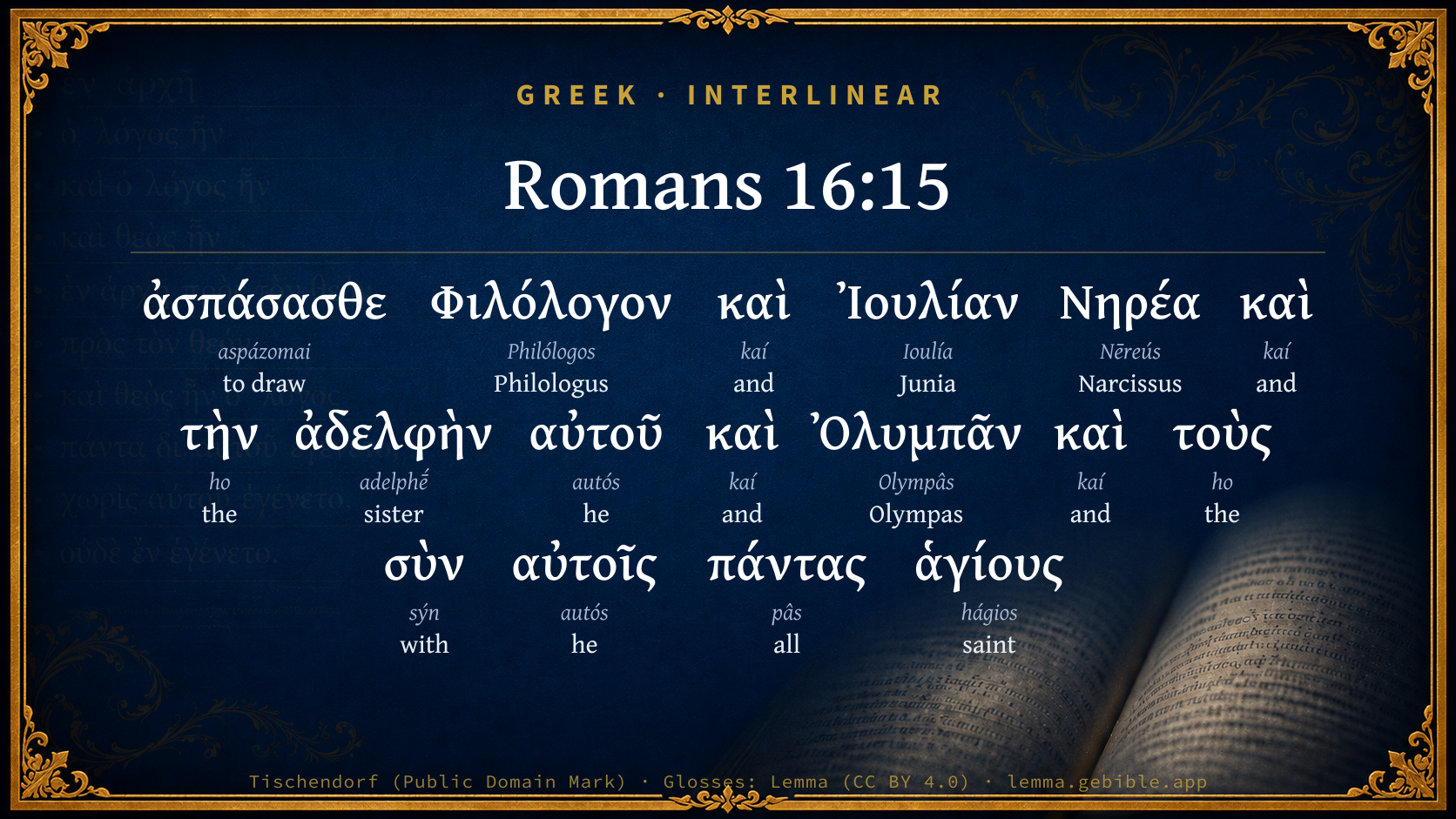
Greek (Tischendorf 8th ed.) Romans 16:15 appears in the Greek New Testament. The text above is from the Tischendorf 8th edition. Each word links to its Strong’s number and a concise gloss. Click any word for its full Thayer’s Greek Lexicon entry.
Download image
Cite this verse

Romans 16:15 (World English Bible). Public Domain. Lemma interlinear Bible study tool, https://lemma.gebible.app/v/romans/16/15.

Show BibTeX & RIS
BibTeX
RIS
English Translation
Greet Philologus and Julia, Nereus and his sister, and Olympas, and all the saints who are with them.
World English Bible · Public Domain
Highlights
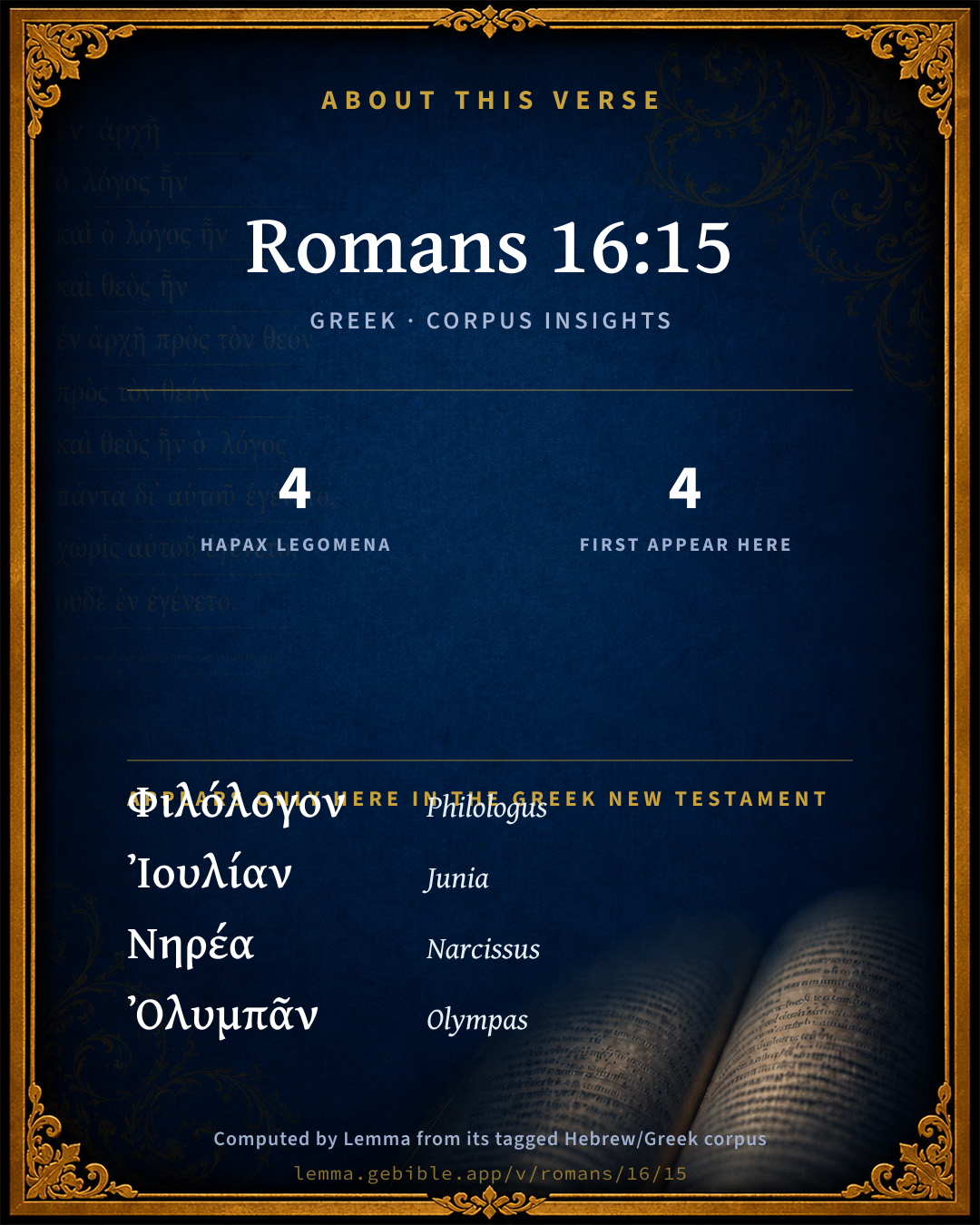
  • 4 hapax legomena — only here in the Greek New Testament
  • 4 first appearances in the Greek New Testament
Full analysis ↓
Download a study sheet

One document with this verse’s original text, its word-by-word gloss line, the meaning frame, cross-references with their text, attributed commentary, and full source and license credits — printable, and it pastes into notes with its structure intact.

This verse Autodidact and up

Study sheet (.html) Plain text (.txt)

A passage Seminary Student

Up to 50 verses in one chapter. A passage sheet keeps up to 6 commentary sources and 12 cross-references per verse, in the order this page ranks them, and says so on the sheet whenever that leaves anything out. Ask for a single verse and you get the Autodidact verse sheet above.

Everything on this page stays free to read, with no account — the sheet is a download of what is already on screen, not access to it.

Want to remove ads? Support Godless Engineer
Compare translations 3

The same verse in 3 English versions, stacked beneath the original-language interlinear above. Click any original word for its lexicon entry.

Each is an independent rendering of the whole verse — the interlinear is not word-aligned to these translations.

Highlighted words mark where these versions differ — a whole-verse word diff, not a word-by-word alignment.

  • World English Bible Public Domain
    Greet Philologus and Julia, Nereus and his sister, and Olympas, and all the saints who are with them.
  • King James Version Public Domain
    Salute Philologus, and Julia, Nereus, and his sister, and Olympas, and all the saints which are with them.
  • unfoldingWord Literal Text CC BY-SA 4.0
    Greet Philologus and Julia, Nereus and his sister, and Olympas, and all the saints with them.

unfoldingWord Literal Text — © unfoldingWord, licensed CC BY-SA 4.0. Word-aligned USFM3 via Door43 (git.door43.org/unfoldingWord/en_ult).

Versions to compare (up to 4)

3 of 4 selected

Show all 19 translations

Every available English version of this verse, each an independent rendering of the whole verse.

  • World English Bible Public Domain
    Greet Philologus and Julia, Nereus and his sister, and Olympas, and all the saints who are with them.
  • Berean Standard Bible Public Domain
    Greet Philologus and Julia, Nereus and his sister, and Olympas and all the saints with them.
  • Majority Standard Bible Public Domain
    Greet Philologus and Julia, Nereus and his sister, and Olympas and all the saints with them.
  • King James Version Public Domain
    Salute Philologus, and Julia, Nereus, and his sister, and Olympas, and all the saints which are with them.
  • American Standard Version (1901) Public Domain
    Salute Philologus and Julia, Nereus and his sister, and Olympas, and all the saints that are with them.
  • Revised Version (1885) Public Domain
    Salute Philologus and Julia, Nereus and his sister, and Olympas, and all the saints that are with them.
  • Geneva Bible (1599) Public Domain
    Salute Philologus and Iulias, Nereas, and his sister, and Olympas, and all the Saintes which are with them.
  • Douay-Rheims (1899) Public Domain
    Salute Philologus and Julia, Nereus and his sister, and Olympias; and all the saints that are with them.
  • Young's Literal Translation Public Domain
    salute Philologus, and Julias, Nereus, and his sister, and Olympas, and all the saints with them;
  • Literal Standard Version CC BY-SA 4.0
    greet Philologus, and Julias, Nereus, and his sister, and Olympas, and all the holy ones with them;
  • Unlocked Literal Bible CC BY-SA 4.0
    Greet Philologus and Julia, Nereus and his sister, and Olympas, and all the believers who are with them.
  • unfoldingWord Literal Text CC BY-SA 4.0
    Greet Philologus and Julia, Nereus and his sister, and Olympas, and all the saints with them.
  • Darby Bible Public Domain
    Salute Philologus, and Julia, Nereus, and his sister, and Olympas, and all the saints with them.
  • World Messianic Bible Public Domain
    Greet Philologus and Julia, Nereus and his sister, and Olympas, and all the holy ones who are with them.
  • Webster's Bible Public Domain
    Salute Philologus, and Julia, Nereus, and his sister, and Olympas, and all the saints who are with them.
  • Free Bible Version CC BY-SA 4.0
    Best wishes to Philologus and Julia, Nereus and his sister, Olympas, and to all the believers with them.
  • Bible in Basic English Public Domain
    Give my love to Philologus and Julia, Nereus and his sister, and Olympas, and all the saints who are with them.
  • Text-Critical English NT CC BY 4.0
    Greet Philologus and Julia, Nereus and his sister, and Olympas and all the saints who are with them.
  • Tyndale New Testament (1534) Public Domain
    Salute Philologus and Iulia, Nereus and his sister, and Olimpha and all the saynctes which are with them.

Literal Standard Version (2020), Covenant Press — licensed CC BY-SA 4.0. Text via the HelloAO Bible API (eBible.org). Unlocked Literal Bible (unfoldingWord) — licensed CC BY-SA 4.0. Text via the HelloAO Bible API (eBible.org). unfoldingWord Literal Text — © unfoldingWord, licensed CC BY-SA 4.0. Word-aligned USFM3 via Door43 (git.door43.org/unfoldingWord/en_ult). Free Bible Version, Dr. Jonathan Gallagher — licensed CC BY-SA 4.0. Text via the HelloAO Bible API (eBible.org).

Word by word

More ways to search: Search by grammar → Find every occurrence → Compare this word →

Practice this passage: Drill this verse → Learn its vocabulary →

Φιλόλογον
Philólogos
G5378
“Philologus”
Noun, Accusative, Singular, Masculine
Part of Speech
Noun
Case
Accusative
Number
Singular
Gender
Masculine
Full Thayer's Definition

Origin: from G5384 and G3056

TDNT: None

Philologus = "lover of the Word" 1. a Christian Paul greets in his epistle to Romans
  1. ἀσπάσασθε aspázomai G782 “to draw” Verb, Aorist, Middle deponent, Imperative, 2nd person, Plural
  2. καὶ kaí G2532 “and” Conjunction
  3. Ἰουλίαν Ioulía G2456 “Junia” Noun, Accusative, Singular, Feminine
  4. Νηρέα Nēreús G3517 “Narcissus” Noun, Accusative, Singular, Masculine
  5. καὶ kaí G2532 “and” Conjunction
  6. τὴν ho G3588 “the” Article, Accusative, Singular, Feminine
  7. ἀδελφὴν adelphḗ G79 “sister” Noun, Accusative, Singular, Feminine
  8. αὐτοῦ autós G846 “he” Personal pronoun, Genitive, Singular, Masculine
  9. καὶ kaí G2532 “and” Conjunction
  10. Ὀλυμπᾶν Olympâs G3652 “Olympas” Noun, Accusative, Singular, Masculine
  11. καὶ kaí G2532 “and” Conjunction
  12. τοὺς ho G3588 “the” Article, Accusative, Plural, Masculine
  13. σὺν sýn G4862 “with” Preposition
  14. αὐτοῖς autós G846 “he” Personal pronoun, Dative, Plural, Masculine
  15. πάντας pâs G3956 “all” Adjective, Accusative, Plural, Masculine
  16. ἁγίους hágios G40 “saint” Adjective, Accusative, Plural, Masculine

About this verse

These counts appear in no published source. They are computed here, from the morphology-tagged text and Lemma’s own curated glosses. What Lemma adds →

17
words
12
distinct lemmas
Pauline Epistles
section

Notable vocabulary

4 hapax legomena — words that appear only here in the entire Greek New Testament:

  • Φιλόλογον Philologus G5378
  • Ἰουλίαν Junia G2456
  • Νηρέα Narcissus G3517
  • Ὀλυμπᾶν Olympas G3652

First appearance in Scripture

These words make their first canonical appearance in the Greek New Testament here:

  • Φιλόλογον Philologus G5378
  • Ἰουλίαν Junia G2456
  • Νηρέα Narcissus G3517
  • Ὀλυμπᾶν Olympas G3652

Shared distinctive vocabulary

ἀδελφὴν sister G79 occurs in 26 verses of the Greek New Testament. Also found in:
Repetition

Words recur within this verse:

  • καὶ and G2532 ×4
  • τὴν the G3588 ×2
  • αὐτοῦ he G846 ×2

Cross-references

6

Topical passages linked to Romans 16:15 in the Treasury of Scripture Knowledge — connected by theme and wording, ordered by reader-vote popularity; previews shown in the World English Bible.

  • Romans 16:2 that you receive her in the Lord, in a way worthy of the saints, and that you assist her in whatever matter she may need from you, for she herself also has been a helper of many, and of my own self.
  • Romans 1:7 to all who are in Rome, beloved of God, called to be saints: Grace to you and peace from God our Father and the Lord Jesus Christ.
  • Isaiah 60:21 Your people also shall be all righteous; they shall inherit the land forever, the branch of my planting, the work of my hands, that I may be glorified.
  • Romans 16:14 Greet Asyncritus, Phlegon, Hermes, Patrobas, Hermas, and the brothers who are with them.
  • Ephesians 1:1 Paul, an apostle of Christ Jesus through the will of God, to the saints who are at Ephesus, and the faithful in Christ Jesus:
  • 1 Peter 1:2 according to the foreknowledge of God the Father, in sanctification of the Spirit, that you may obey Jesus Christ and be sprinkled in his blood: Grace to you and peace be multiplied.

Cross-references courtesy of OpenBible.info (CC BY 4.0).

Commentary

Notes on Romans 16:15 from classic Christian and Jewish commentators (each source and its license shown beneath its notes). The classic Christian expositions comment on the surrounding passage and are grouped to its opening verse, so a note may address several verses; the Jewish commentaries on the Tanakh (Rashi and others) are per-verse, so they appear only where the commentator wrote on this verse.

Lemma curates 59 commentaries, every one of them public domain or Creative Commons licensed, each selected and text-cleaned for this edition rather than reprinted as found. About our sources →

Expositor's Greek Testament

ed. W. Robertson Nicoll

Rom 16:15 . Philologus and Julia, as connected here, were probably husband and wife; or, as in the next pair, brother and sister. Both, especially the latter, are among the commonest slave names. There are Acts of Nereus and Achilleus in the Acta Sanctorum connected with the early Roman Church. “The sister’s name is not given, but one Nereis was a member of the [imperial] household about this time, as appears from an inscription already quoted” (Lightfoot, loc. cit. , p. 177). Olympas is a contraction of Olympiodorus. τοὺς σὺν αὐτοῖς πάντας ἁγίους : see on last verse. The πάντας may suggest that a larger number of persons is to be included here.

The Expositor's Greek Testament, edited by W. Robertson Nicoll (1897–1910) — public domain. Text from a community e-Sword module.

Adam Clarke's Commentary

Verse 15. Salute Philologus, c.] Of these several persons, though much has been conjectured, nothing certain is known. Even the names of some are so ambiguous that we know not whether they were men or women. They were persons well known to St. Paul, and undoubtedly were such as had gone from different places where the apostle had preached to sojourn or settle at Rome. One thing we may remark, that there is no mention of St. Peter, who, according to the Roman and papistical catalogue of bishops, must have been at Rome at this time if he were not now at Rome, the foundation stone of Rome's ascendancy, of Peter's supremacy, and of the uninterrupted succession, is taken away, and the whole fabric falls to the ground. But if Peter were at Rome at this time, Paul would have sent his salutations to him in the first place; and if Peter were there, he must have been there, according to the papistical doctrine, as bishop and vicar of Jesus Christ; but if he were there, is it likely that he should have been passed by, while Andronicus and Junia are mentioned as of note among the apostles, Ro 16:7, and that St. Paul should call on the people to remedy the disorders that had crept in among themselves; should not these directions have been given to Peter, the head of the Church? And if there were a Church, in the papistical sense of the word, founded there, of which Peter was the head, is it likely that that Church should be in the house of Priscilla and Aquila, Ro 16:5. But it is a loss of time to refute such ridiculous and groundless pretensions. It is very likely that Peter, so far from being universal bishop at Rome, never saw the city in his life.

Adam Clarke's Commentary on the Bible (1810–1826) — public domain. Text from a community e-Sword/MySword module.

The Cambridge Bible for Schools and Colleges

gen. ed. J. J. S. Perowne

15. Philologus] A Greek name.

Julia] Possibly the wife of Philologus.—The name may (as in the case of Junia: see note on Rom_16:7;) be really Julias, i.e., Julianus; a masculine name. But the mention just after of “Nereus and his sister” weighs, however lightly, in the other direction. So Meyer.

Nereus] A Greek name; that of a minor sea-god, tutelar of the Mediterranean under Poseidon. See second note on Rom_16:1.

Olympas] A Greek masculine name.

the saints which are with them] See last note on Rom_16:14.

At the close of this long roll of names we cannot but remark on it as a noble and beautiful illustration of the “family-affection of Christianity.” It is often observed that a peculiar charm attaches to successions of names,

“Lancelot, or Pelleas, or Pellenore;”

and such a rhythmical charm is not absent here. But far above it is the charm of the pure intense spiritual intimacy of hearts, an intimacy created by the possession of “one Lord, one Hope,” and which with the advent of the Gospel touched the weary world as a new and unknown visitor from heaven. We might quote many parallels from later Christian literature; but one will be enough—the dying farewell to his flock of a man who had no small measure of the holy love and zeal of St Paul—Felix Neff, the “Apostle of the Hautes Alpes.” Two days before his death (April, 1829,) “being scarcely able to see, he traced the following lines at different intervals, in large and irregular characters, which filled a page: ‘Adieu, dear friend André Blanc; Antoine Blanc; the Pelissiers, whom I dearly love; François Dumont and his wife; Isaac and his wife; Aimé Deslois; Emilie Bonnet, &c., &c., Alexandrine, and their mother—all, all the brethren and sisters at Mens—Adieu, adieu. I am departing to our Father (je monte vers notre Père) in perfect peace.—Victory, victory, victory, by Jesus Christ.—Felix Neff.’ ” (Vie, Toulouse, 1875.)

The Cambridge Bible for Schools and Colleges (gen. ed. J. J. S. Perowne; Cambridge University Press, 1878–1918) — public domain. Text from a community e-Sword module.

John Gill's Exposition

Salute one another with an holy kiss,.... Christian salutation is a wishing all temporal, spiritual, and eternal happiness, to one another; and which, as it should be mutual, should be also hearty and sincere, and this is meant by the "holy kiss"; the allusion is to a common custom in most nations, used by friends at meeting or parting, to kiss each other, in token of their hearty love, and sincere affection and friendship for each other; and is called "holy", to distinguish it from an unchaste and lascivious one; and from an hypocritical and deceitful one, such an one as Joab gave to Amasa, when, inquiring of his health, he took him by the beard to kiss him, and stabbed him under the fifth rib, Sa2 20:9; and as Judas, who cried, hail master, to Christ, and kissed him, and betrayed him into the hands of his enemies, Mat 26:49. I say, it is an allusion to this custom, for it is only an allusion; the apostle did not mean that any outward action should be made use of, only that their Christian salutations should not be mere complaisance, or expressed by bare words, and outward gestures and actions, either of the hand or mouth; but that they should spring from real love and true friendship, and be without dissimulation, hearty and sincere:

the churches of Christ salute you. The Vulgate Latin, Syriac, Arabic, and Ethiopic versions read, "all the churches"; that is, in Greece, or in the neighbourhood where the apostle was, and who might know of his writing to this church, and thereby send their Christian salutations to it; or if they did not know of his writing, yet as he knew their sincere affections, and hearty good will to this church, and the members of it, he in their names sent greetings to them: this shows the communion of churches, and how they ought to wish and sincerely desire each other's welfare.

John Gill's Exposition of the Whole Bible (1746–1763) — public domain (CC PDM 1.0). Text via the HelloAO Bible API.

Trapp's Complete Commentary

John Trapp

15 Salute Philologus, and Julia, Nereus, and his sister, and Olympas, and all the saints which are with them.

Ver. 15. And Olympas] Viri, nomen, non mulieris. The name not of a woman, but of a man, saith Beza.

John Trapp, A Commentary or Exposition upon All the Books of the Old and New Testament (1647–1656) — public domain. Text from a community e-Sword module.

Matthew Poole's English Annotations

Julia; probably the wife of Philologus.

Olympas; this is thought to be the name of a man, rather than of a woman.

All the saints which are with them; that are in their several families: see Rom 16:14. There were, doubtless, many more Christians in the church of Rome, but either they were of no great note, or else not known to the apostle: and indeed it is matter of admiration, that he, who was never at Rome, should know the name and proper characters of so many there. And because he sendeth salutations to so many brethren at Rome, and makes no mention of Peter, it may be rationally inferred, that Peter was not there at the writing of this Epistle. It is questionable whether ever he were there at all; but it is without question, that he came not thither in the beginning of Claudius’s reign, and in the forty-fifth year of our Lord, as the Romanists report; nor was he bishop there for the space of five and twenty years, as they affirm.

Matthew Poole's English Annotations on the Holy Bible (1683–1685) — public domain. Text from a community e-Sword/MySword module.

Whedon's Commentary on the Bible

Daniel D. Whedon

15. We have here two couplets, probably of husband and wife and of brother and sister, heading another Church group.

Daniel D. Whedon (gen. ed.), Commentary on the Old and New Testaments (1874–1909) — public domain. Text from a community e-Sword module.

John Wesley's Explanatory Notes

Salute all the saints - Had St. Peter been then at Rome, St. Paul would doubtless have saluted him by name; since no one in this numerous catalogue was of an eminence comparable to his. But if he was not then at Rome, the whole Roman tradition, with regard to the succession of their bishops, fails in the most fundamental article.

John Wesley, Explanatory Notes Upon the Whole Bible (1754–1765) — public domain. Text via the GEBible commentary corpus.

McGarvey & Pendleton's Commentaries

J. W. McGarvey

Salute Philologus and Julia, Nereus and his sister, and Olympas, and all the saints that are with them . [These apostolic salutations are addressed to twenty-five individuals. Not a large group for one as widely known as Paul in a city as large as Rome, yet when we consider the limited circulation of news and the meager means of communication afforded in that day, it shows the deep affection of the apostle that he knew the whereabouts of so many of his brethren. Note also the women workers named in this small group. It was evidently only to Corinth, and not to Rome, that Paul wrote, "Let your women keep silence"-- 1Co_14:34 ; comp Phi_4:3 ]

J. W. McGarvey (with Philip Y. Pendleton), Commentaries on the New Testament (The Fourfold Gospel, 1914; Acts; and the epistles) — public domain. Text from a community e-Sword/MySword module.

The People's New Testament

B. W. Johnson

15. And all the saints which are with them. Probably another household church, which met with those just named.

B. W. Johnson's The People's New Testament with Notes (1889–1891) — public domain. Electronic text from the Christian Classics Ethereal Library (CCEL) ThML edition.

unfoldingWord translationNotes

Door43 World Missions Community

Philologus ... Nereus ... Olympas

These are men's names. (See: How to Translate Names and Translate Unknowns)

Julia

The name of a woman. Julia was probably the wife of Philologus. (See: How to Translate Names and Translate Unknowns)

a holy kiss

an expression of affection for fellow believers

All the churches of Christ greet you

Here Paul speaks in a general manner concerning the churches of Christ. AT: "The believers in all the churches in this area send their greetings to you" (See: Hyperbole and Generalization)

translationWords

believe

holy

kiss

church

Christ

unfoldingWord translationNotes — © Distant Shores Media and the Door43 World Missions Community, licensed CC BY-SA 4.0. Source: git.door43.org/Door43/en_tn.

Cambridge Greek Testament for Schools and Colleges

15. Φιλόλογον. The name may suggest the occupation, in the secretariat or the record department; cf. Lft, op. cit[326] p. 177 n. 1.

[326] op. cit. opus citatum

Ἰουλίαν. Very common, and esp. in the imperial household.

Νηρέα. Cf. S. H. on the association of this, name with the early history of the Roman Church.

Ὀλυμπᾶν = Olympiodorus.

Cambridge Greek Testament for Schools and Colleges (Cambridge University Press, 1896; 21 vols, various authors incl. Carr, Maclear, Plummer, Farrar, Lumby, Moule, M. R. James, Simcox) — public domain. Text from a community e-Sword module.

International Critical Commentary

15. φιλόλογος. A common slave name. Numerous instances are quoted from inscriptions of the imperial household: C.I.L. vi. 4116 dama ∙ liviae ∙ l ∙ cas … | phoebvs ∙ philologi | quoted by Lft. from Gorius, Mon. Liv. p. 168; he also quotes Murat. p. 1586. 3, p. 2043. 2; Grut. p. 630. 1. He is generally supposed to be the brother or the husband of Julia, in the latter case Nereus, his sister Nerias, and Olympas may be their children.

Ἰουλίαν. Probably the commonest of all Roman female names, certainly the commonest among slaves in the imperial household. The following inscription is interesting: C.I.L. vi. 20416 d. m. | ivliae nerei ∙ f ∙ | clavdiae. The name Julia Tryphosa occurs 20715-7 in one case apparently in a Christian inscription.

Νηρέα. This name is found in inscriptions of the imperial household, C. I. L. vi. 4344 nerevs ∙ nat ∙ german | pevcennvs ∙ germanici | anvs ∙ neronis ∙ caesaris. It is best known in the Roman Church in connexion with the Acts of Nereus and Achilleus, the eunuch chamberlains of Domitilla (see Acta Sanctorum May. iii. p. 2; Texte und Untersuchungen, Band xi. Heft 2). These names were, however, older than that legend, as seems to be shown by the inscription of Damasus (Bull. Arch. Christ. 1874, p. 20 sq.; C. Ins. Christ. ii. p. 31) which represents them as soldiers. The origin of the legend was probably that in the catacomb of Domitilla and near to her tomb, appeared these two names very prominently; this became the groundwork for the later romance. An inscription of Achilleus has been found in the cemetery of Domitilla on a stone column with a corresponding column which may have borne the name of Nereus: both date from the fourth or fifth century (Bull. Arch. Christ. 1875, p. 8 sq.). These of course are later commemorations of earlier martyrs, and it may well be that the name of Nereus was in an early inscription (like that of Ampliatus above). In any case the name is one connected with the early history of the Roman Church; and the fact that Nereus is combined with Achilleus, a name which does not appear in the Romans, suggests that the origin of the legend was archaeological, and that it was not derived from this Epistle (Lightfoot, Clement. i. p. 51; Lipsius Apokr. Apgesch. ii. 106 ff.).

Ὀλυμπᾶς: an abbreviated form like several in this list, apparently for Ὀλυμπιόδωρος.

International Critical Commentary — older volumes (1896–1929), various authors — public domain. Text from a community e-Sword module.

Godet's Commentaries

Frédéric Louis Godet

Vv. 15. Julia (for such is the true reading) is undoubtedly the wife of Philologus.

Frédéric Louis Godet — Commentaries on Luke, John, Romans, and 1 Corinthians — English translation (T&T Clark, Edinburgh, 1870s–1890s) — public domain. Text from a community e-Sword module.

Hodge's Commentary on Romans, Ephesians & First Corinthians

Charles Hodge

Rom_16:8-15

My beloved in the Lord. The preposition in (ἐν), here, as frequently elsewhere, points out the relation or respect in which the word, to which it refers is to be understood; brother beloved, both in the flesh and in the Lord (Phm_1:16), both in reference to our external relations, and our relation to the Lord. And thus in the following, Rom_16:9, our helper in Christ, i.e. as it regards Christ; Rom_16:10, approved in Christ, i.e. in his relation to Christ; an approved or tried Christian; Rom_16:12, who labor in the Lord; and, which labored much in the Lord, i.e. who, as it regards the Lord, labored much; it was a Christian or religious service. The names, Tryphena, Tryphosa, and Persis, all are feminine. The last is commonly supposed to indicate the native country of the person who bore it, as it was not unusual to name persons from the place of their origin, as Mysa, Syria, Lydia, Andria, etc.; such names, however, soon became common, and were given without any reference to the birthplace of those who received them. Chosen in the Lord, i.e. not one chosen by the Lord; chosen, (i.e., approved, precious; see 1Pe_2:4,) in his relation to the Lord, as a Christian. It is not merely elect in Christ, that is, chosen to eternal life, for this could be said of every Christian; but Rufus is here designated as a chosen man, as a distinguished Christian. It is worth noticing, that at Rome, as at Corinth, few of the great or learned seem to have been called. These salutations are all addressed to men not distinguished for their rank or official dignity. Mylius, as quoted by Calov, says: Notanda hic fidelium istorum conditio: nemo hic nominatur consul, nemo quaestor aut dictator insignitur, minime omnium episcopatuum et cardinalatuum dignitate hic personant: sed operarum, laborum, captivitate titulis plerique notantur. Ita verum etiam in Romana ecclesia fuit olim, quod apostouls scribit, non multi potentis, non multi nobiles, sed stuta mundi electa sunt a Deo. Papatus autem Caesarei, qualis adjuvante diabolo, in perniciem religionis, posteris saeculis Romae involuit, ne umbra quidem apostolorum aetate istic fuit: tantum abest, ut ille originem ab apostolis ipsis traxerit.

Charles Hodge — Commentary on Romans (1835), First Corinthians (1857), and Ephesians (1856) — public domain. Text from a community e-Sword module.

Lesson kit

Teaching starters — assembled from the data on this page, not authored interpretation. Every prompt links to the verse data it draws on. Edit before teaching.

Romans, in the Pauline Epistles, opens this verse with 17 words (12 distinct Greek lemmas). Its most distinctive word is Philólogos (“Philologus”). A historical commentator’s framing appears above. Read the whole chapter for the surrounding context.

Discussion questions

  1. What does “Philologus” (Philólogos) contribute to the verse as a whole?
  2. 4 words here appear nowhere else in the Greek New Testament. Why might the author reach for such rare wording?
  3. 4 words make their first appearance in Scripture here. What does this debut establish?
  4. How does Matthew 12:50, which shares the word «sister», read alongside this verse?
  5. What does the repetition of “and” (4× in this one verse) do in this verse?
  6. These translations render this verse differently. What is at stake in choosing one wording over another?
  7. Compare how Expositor's Greek Testament and Adam Clarke's Commentary read this verse. Where do they agree or differ?

Things to notice

  • 4 words in this verse appear nowhere else in the Greek New Testament.
  • 4 words make their first canonical appearance in Scripture here.
  • These translations choose different wording for 4 words in this verse.
  • “and” occurs 4× in this single verse.
  • 12 distinct Greek lemmas span 17 words in this verse.

Reading settings

Reading text

Shown beneath each verse's original-language words.

Old Testament
Old Testament edition

Read the OT as the Masoretic Hebrew (MT) or the Greek Septuagint (LXX).

English shown for the Greek Septuagint (in the Hebrew ↔ Greek comparison).

Comparing translations? Open the Compare panel on any verse page to stack up to four side by side.