2 Corinthians 9:12

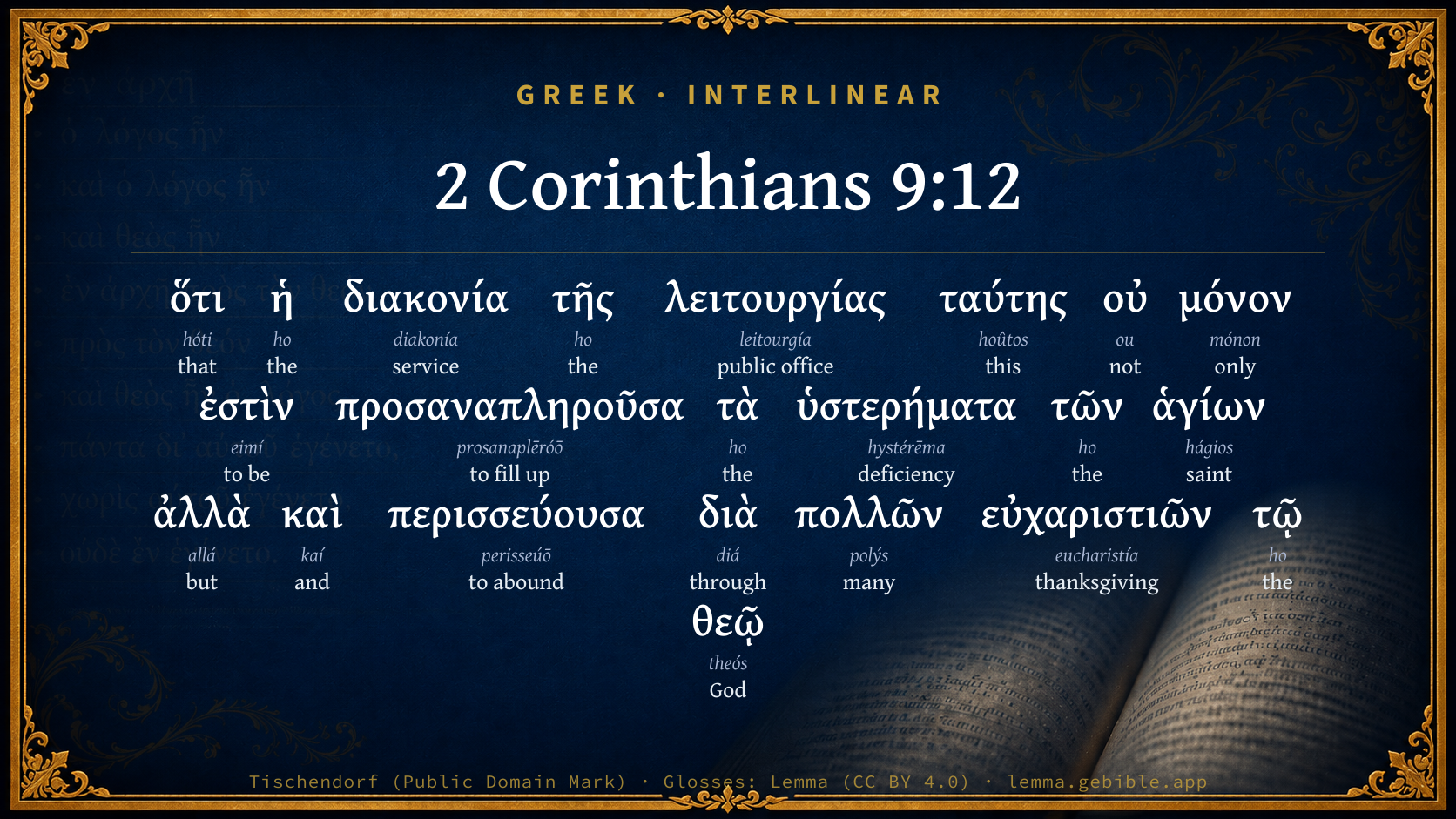
Greek (Tischendorf 8th ed.) 2 Corinthians 9:12 appears in the Greek New Testament. The text above is from the Tischendorf 8th edition. Each word links to its Strong’s number and a concise gloss. Click any word for its full Thayer’s Greek Lexicon entry.
Download image
Cite this verse

2 Corinthians 9:12 (World English Bible). Public Domain. Lemma interlinear Bible study tool, https://lemma.gebible.app/v/2-corinthians/9/12.

Show BibTeX & RIS
BibTeX
RIS
English Translation
For this service of giving that you perform not only makes up for lack among the saints, but abounds also through many givings of thanks to God;
World English Bible · Public Domain
Highlights
  • 1 first appearance in the Greek New Testament
Full analysis ↓
Download a study sheet

One document with this verse’s original text, its word-by-word gloss line, the meaning frame, cross-references with their text, attributed commentary, and full source and license credits — printable, and it pastes into notes with its structure intact.

This verse Autodidact and up

Study sheet (.html) Plain text (.txt)

A passage Seminary Student

Up to 50 verses in one chapter. A passage sheet keeps up to 6 commentary sources and 12 cross-references per verse, in the order this page ranks them, and says so on the sheet whenever that leaves anything out. Ask for a single verse and you get the Autodidact verse sheet above.

Everything on this page stays free to read, with no account — the sheet is a download of what is already on screen, not access to it.

Want to remove ads? Support Godless Engineer
Compare translations 3

The same verse in 3 English versions, stacked beneath the original-language interlinear above. Click any original word for its lexicon entry.

Each is an independent rendering of the whole verse — the interlinear is not word-aligned to these translations.

Highlighted words mark where these versions differ — a whole-verse word diff, not a word-by-word alignment.

  • World English Bible Public Domain
    For this service of giving that you perform not only makes up for lack among the saints, but abounds also through many givings of thanks to God;
  • King James Version Public Domain
    For the administration of this service not only supplieth the want of the saints, but is abundant also by many thanksgivings unto God;
  • unfoldingWord Literal Text CC BY-SA 4.0
    because the ministry of this service not only is fully supplying the needs of the saints but is also abounding with many thanksgivings to God.

unfoldingWord Literal Text — © unfoldingWord, licensed CC BY-SA 4.0. Word-aligned USFM3 via Door43 (git.door43.org/unfoldingWord/en_ult).

Versions to compare (up to 4)

3 of 4 selected

Show all 19 translations

Every available English version of this verse, each an independent rendering of the whole verse.

  • World English Bible Public Domain
    For this service of giving that you perform not only makes up for lack among the saints, but abounds also through many givings of thanks to God;
  • Berean Standard Bible Public Domain
    For this ministry of service is not only supplying the needs of the saints, but is also overflowing in many expressions of thanksgiving to God.
  • Majority Standard Bible Public Domain
    For this ministry of service is not only supplying the needs of the saints, but is also overflowing in many expressions of thanksgiving to God.
  • King James Version Public Domain
    For the administration of this service not only supplieth the want of the saints, but is abundant also by many thanksgivings unto God;
  • American Standard Version (1901) Public Domain
    For the ministration of this service not only filleth up the measure of the wants of the saints, but aboundeth also through many thanksgivings unto God;
  • Revised Version (1885) Public Domain
    For the ministration of this service not only filleth up the measure of the wants of the saints, but aboundeth also through many thanksgivings unto God;
  • Geneva Bible (1599) Public Domain
    For the ministration of this seruice not onely supplieth the necessities of the Saintes, but also aboundantly causeth many to giue thankes to God,
  • Douay-Rheims (1899) Public Domain
    Because the administration of this office doth not only supply the want of the saints, but aboundeth also by many thanksgivings in the Lord,
  • Young's Literal Translation Public Domain
    because the ministration of this service not only is supplying the wants of the saints, but is also abounding through many thanksgivings to God,
  • Literal Standard Version CC BY-SA 4.0
    because the ministry of this service not only is supplying the wants of the holy ones, but is also abounding through many thanksgivings to God,
  • Unlocked Literal Bible CC BY-SA 4.0
    For carrying out this service not only meets the needs of the saints but is also overflowing into many acts of thanksgiving to God.
  • unfoldingWord Literal Text CC BY-SA 4.0
    because the ministry of this service not only is fully supplying the needs of the saints but is also abounding with many thanksgivings to God.
  • Darby Bible Public Domain
    Because the ministration of this service is not only filling up the measure of what is lacking to the saints, but also abounding by many thanksgivings to God;
  • World Messianic Bible Public Domain
    For this service of giving that you perform not only makes up for lack among the holy ones, but abounds also through much giving of thanks to God,
  • Webster's Bible Public Domain
    For the administration of this service not only supplieth the want of the saints, but is abundant also by many thanksgivings to God;
  • Free Bible Version CC BY-SA 4.0
    When you serve in this way, not only are the needs of God's people met, but also many will give grateful thanks to God.
  • Bible in Basic English Public Domain
    For this work of giving not only takes care of the needs of the saints, but is the cause of much praise to God;
  • Text-Critical English NT CC BY 4.0
    For this ministry of giving is not only providing for the needs of the saints in Jerusalem but is also abounding through many thanksgivings to God.
  • Tyndale New Testament (1534) Public Domain
    For the office of this ministracion not only supplieth the nede of the sayntes: but also is aboundaunt herein that for this laudable ministrynge thankes myght be geven to god of many

Literal Standard Version (2020), Covenant Press — licensed CC BY-SA 4.0. Text via the HelloAO Bible API (eBible.org). Unlocked Literal Bible (unfoldingWord) — licensed CC BY-SA 4.0. Text via the HelloAO Bible API (eBible.org). unfoldingWord Literal Text — © unfoldingWord, licensed CC BY-SA 4.0. Word-aligned USFM3 via Door43 (git.door43.org/unfoldingWord/en_ult). Free Bible Version, Dr. Jonathan Gallagher — licensed CC BY-SA 4.0. Text via the HelloAO Bible API (eBible.org).

Word by word

More ways to search: Search by grammar → Find every occurrence → Compare this word →

Practice this passage: Drill this verse → Learn its vocabulary →

προσαναπληροῦσα
prosanaplēróō
G4322
“to fill up”
Verb, Present, Active, Participle, Nominative, Singular, Feminine
Part of Speech
Verb
Tense
Present
Voice
Active
Mood
Participle
Case
Nominative
Number
Singular
Gender
Feminine
Full Thayer's Definition

Origin: from G4314 and G378

TDNT: None

1. to fill up by adding to
  1. ὅτι hóti G3754 “that” Conjunction
  2. ἡ ho G3588 “the” Article, Nominative, Singular, Feminine
  3. διακονία diakonía G1248 “service” Noun, Nominative, Singular, Feminine
  4. τῆς ho G3588 “the” Article, Genitive, Singular, Feminine
  5. λειτουργίας leitourgía G3009 “public office” Noun, Genitive, Singular, Feminine
  6. ταύτης hoûtos G3778 “this” Demonstrative pronoun, Genitive, Singular, Feminine
  7. οὐ ou G3756 “not” Particle, Negative
  8. μόνον mónon G3440 “only” Adverb
  9. ἐστὶν eimí G1510 “to be” Verb, Present, Active, Indicative, 3rd person, Singular
  10. τὰ ho G3588 “the” Article, Accusative, Plural, Neuter
  11. ὑστερήματα hystérēma G5303 “deficiency” Noun, Accusative, Plural, Neuter
  12. τῶν ho G3588 “the” Article, Genitive, Plural, Masculine
  13. ἁγίων hágios G40 “saint” Adjective, Genitive, Plural, Masculine
  14. ἀλλὰ allá G235 “but” Conjunction
  15. καὶ kaí G2532 “and” Conjunction
  16. περισσεύουσα perisseúō G4052 “to abound” Verb, Present, Active, Participle, Nominative, Singular, Feminine
  17. διὰ diá G1223 “through” Preposition
  18. πολλῶν polýs G4183 “many” Adjective, Genitive, Plural, Feminine
  19. εὐχαριστιῶν eucharistía G2169 “thanksgiving” Noun, Genitive, Plural, Feminine
  20. τῷ ho G3588 “the” Article, Dative, Singular, Masculine
  21. θεῷ theós G2316 “God” Noun, Dative, Singular, Masculine

About this verse

These counts appear in no published source. They are computed here, from the morphology-tagged text and Lemma’s own curated glosses. What Lemma adds →

22
words
18
distinct lemmas
Pauline Epistles
section

Notable vocabulary

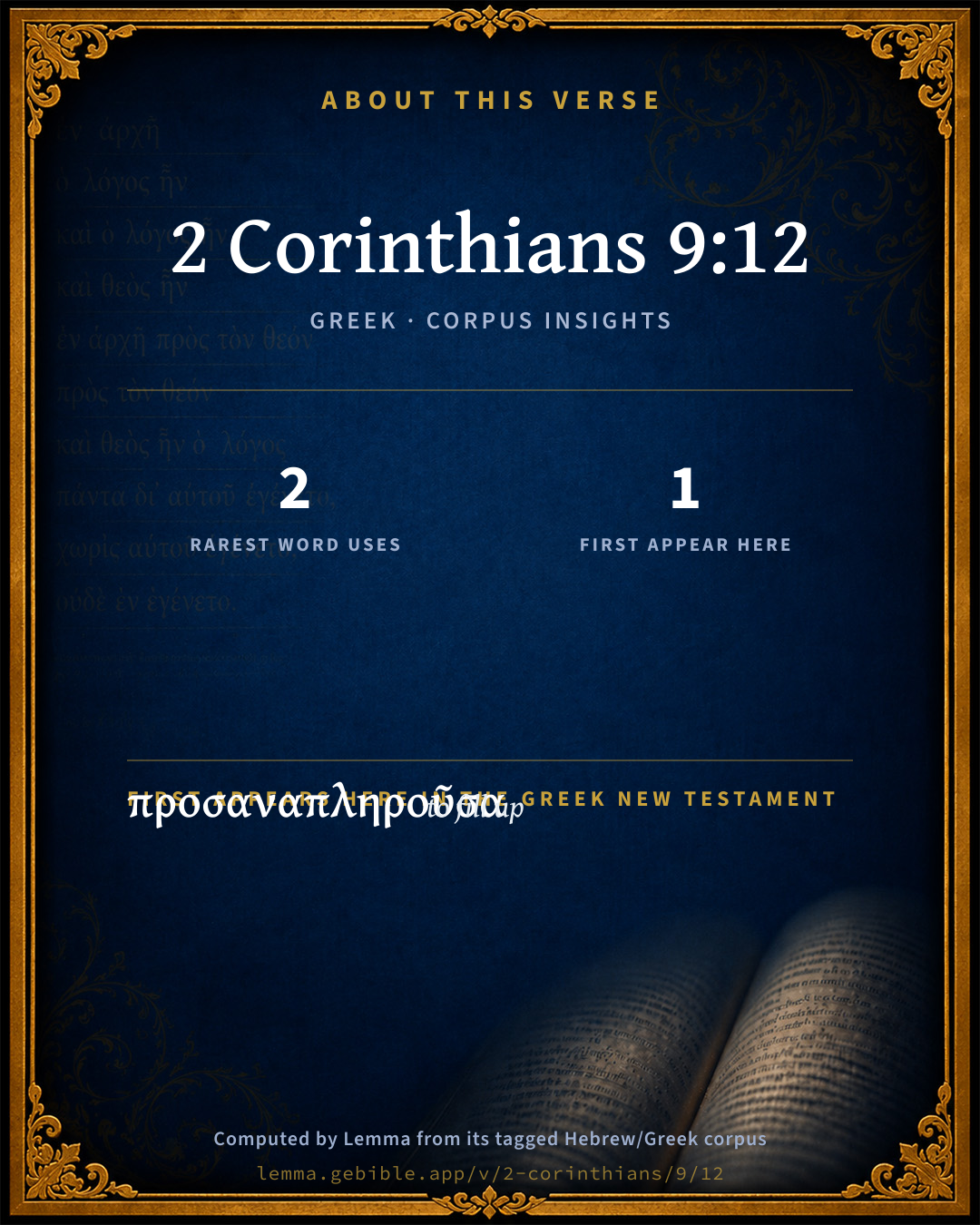
The rarest word here is προσαναπληροῦσα to fill up G4322 — appearing just 2 times in the whole Greek New Testament.

First appearance in Scripture

This word makes its first canonical appearance in the Greek New Testament here:

  • προσαναπληροῦσα to fill up G4322

Shared distinctive vocabulary

προσαναπληροῦσα to fill up G4322 occurs in 2 verses of the Greek New Testament. Also found in:

Repetition

A word recurs within this verse:

Cross-references

9

Topical passages linked to 2 Corinthians 9:12 in the Treasury of Scripture Knowledge — connected by theme and wording, ordered by reader-vote popularity; previews shown in the World English Bible.

  • 2 Corinthians 8:14–15 but for equality. Your abundance at this present time supplies their lack, that their abundance also may become a supply for your lack; that there may be equality.
  • Philemon 1:4–7 I thank my God always, making mention of you in my prayers,
  • Philippians 2:25 But I counted it necessary to send to you Epaphroditus, my brother, fellow worker, fellow soldier, and your apostle and minister to my need;
  • James 2:14–16 What good is it, my brothers, if a man says he has faith, but has no works? Can faith save him?
  • 1 John 3:17 But whoever has the world's goods, and sees his brother in need, and closes his heart of compassion against him, how does the love of God remain in him?
  • 2 Corinthians 8:4 begging us with much entreaty to receive this grace and the fellowship in the service to the saints.
  • Philippians 4:18–19 But I have all things, and abound. I am filled, having received from Epaphroditus the things that came from you, a sweet-smelling fragrance, an acceptable and well-pleasing sacrifice to God.
  • 2 Corinthians 1:11 you also helping together on our behalf by your supplication; that, for the gift bestowed on us by means of many, thanks may be given by many persons on your behalf.
  • 2 Corinthians 9:1 It is indeed unnecessary for me to write to you concerning the service to the saints,

Cross-references courtesy of OpenBible.info (CC BY 4.0).

Commentary

Notes on 2 Corinthians 9:12 from classic Christian and Jewish commentators (each source and its license shown beneath its notes). The classic Christian expositions comment on the surrounding passage and are grouped to its opening verse, so a note may address several verses; the Jewish commentaries on the Tanakh (Rashi and others) are per-verse, so they appear only where the commentator wrote on this verse.

Lemma curates 59 commentaries, every one of them public domain or Creative Commons licensed, each selected and text-cleaned for this edition rather than reprinted as found. About our sources →

Whedon's Commentary on the Bible

Daniel D. Whedon

f. By the gratitude of the benefitted parties, 2Co_9:12-15.

12. Administration of this service—The bestowment of this public benefaction.

Not only—Literally, Not only is filling up the deficiencies of the saints, but is causing to abound thanksgiving, through many, to God.

Daniel D. Whedon (gen. ed.), Commentary on the Old and New Testaments (1874–1909) — public domain. Text from a community e-Sword module.

Bengel's Gnomon

Johann Albrecht Bengel

2Co 9:12. Ἡ διακονία τῆς λειτουργίας ταύτης) the administration of this service, a becoming appellation. λειτουργία is the function itself, [service to be discharged,] διακονία, the act.—προσαναπληροῦσα, still further supplies [supplies in addition]) a double compound. Their wants were also supplied from other quarters.—πολλῶν, by many) feminine [not “thanksgivings of many.”]

Bengel's Gnomon of the New Testament — English translation (T&T Clark, Edinburgh, 1860) — public domain. Text from a community e-Sword module.

Meyer's Critical & Exegetical Commentary

Heinrich August Wilhelm Meyer

2Co_9:12. Confirmation of what was just said ἥτις κατεργάζεται κ.τ.λ. by the particular circumstances of the present collection.[291]

ἡ διακονία τῆς λειτουργ. ταύτης] i.e. the service, which you render by this λειτουργία. And the work of collection is called λειτουργία, in so far as it was to be regarded, according to its destined consecration to God, as a priestly bringing of offering (going to the benefit of the receivers). Comp. on Php_2:17; Php_2:25; Rom_13:6; Rom_15:16. Most others take ἡ διακονία of the service of the apostle, who took charge of the collection (τὴν λειτουργίαν ταύτην). But this is at variance with 2Co_9:13, where τῆς διακονίας ταύτης is manifestly equivalent to τῆς διακονίας τῆς λειτ. ταύτ., and must be understood of the service rendered by the contributors. Hence the activity of those conveying it is not even to be understood as included here (Hofmann).

οὐ μόνον κ.τ.λ.] The emphasis lies on προσαναπληρ. and περισσ., in which case the expression with ἐστι denotes how the διακονία is as regards its efficacy, not simply what it effects (this would be the simple present of the verb). The service, etc., has not only the supplementing quality, in that it makes up for what the saints lack, but also an abounding, exceedingly blissful quality, in that it calls forth many thanksgivings towards God. Others, like Piscator and Flatt, connect περισσεύουσα τῷ θεῷ: it contributes much to glorify God; comp. Hofmann: it makes for God a rich produce. Against linguistic usage, since περισσεύει μοί τι means: I have abundance or superfluity in something (Thuc. ii. 65. 9; Dion. Hal. iii. 11; Tob_4:16; Joh_6:13; Luk_9:17; comp. Luk_12:15; Mar_12:44). There must have been used εἰς θεόν or εἰς τὴν δόξαν τοῦ θεοῦ (Rom_5:15; 2Co_4:15).

On προσαναπληρόω, to fill by adding to, comp. 2Co_11:9; Plat. Men. p. 84 D; Diod. v. 71; Athen. 14, p. 654 D; Wis_19:4.

[291] Nowhere has Paul expressed with so deep fervour and so much fulness as here the blissful influence, which his collecting among the Greeks for the Jews was to have on the quickening of the religious fellowship between them.

Meyer — Critical and Exegetical Commentary on the New Testament — English translation by Peter Christie, edited by Frederick Crombie (T&T Clark, 1880) — public domain. Text from a community e-Sword module.

Expositor's Greek Testament

ed. W. Robertson Nicoll

2Co 9:12-15 . LIBERAL GIVING WILL CALL FORTH THE BLESSINGS OF THE RECIPIENTS.

2Co 9:12 . ὅτι ἡ διακ . τῆς λειτ . κ . τ . λ .: for the ministration of this service ( λειτουργία , which originally stood for any public service, came to be restricted to the service of God; λειτουργέω is used in Rom 15:27 of this very contribution; cf. Num 8:22 , Heb 8:6 ; Heb 9:21 ) is not only filling up (note the constr. ἐστι with a participle) the wants of the saints, but is abounding also through many thanksgivings unto God ( cf. 2Co 4:15 ).

The Expositor's Greek Testament, edited by W. Robertson Nicoll (1897–1910) — public domain. Text from a community e-Sword module.

Geneva Bible (1599)

Geneva Bible translators

Another excellent and double fruit of liberality towards the Saints, is this: that it giveth occasion to praise God, and that our faith is also thereby made manifest.

Geneva Bible (1599) marginal notes — public domain. Text via Bolls.life.

Jamieson, Fausset & Brown

Robert Jamieson, A. R. Fausset & David Brown

Greek, "The ministration of this public service (on your part) is not only still further supplying the wants of the saints (besides the supplies from other quarters), but is abounding also (namely, in respect to relieving the necessities of others in poverty) through many thanksgivings to God."

Jamieson, Fausset & Brown — Commentary Critical and Explanatory on the Whole Bible (1871) — public domain (CC PDM 1.0). Text via the HelloAO Bible API.

Adam Clarke's Commentary

Verse 12. For the administration of this service] The poor are relieved, see the hand of God in this relief, and give God the glory of his grace.

Adam Clarke's Commentary on the Bible (1810–1826) — public domain. Text from a community e-Sword/MySword module.

John Calvin's Commentaries

By the term administration, he means what he had undertaken at the request of the Churches. Now what we render functionem (service), is in the Greek λειτουργία term that sometimes denotes a sacrifice, sometimes any office that is publicly assigned. Either of them will suit this passage well. For on the one hand, it is no unusual thing for alms to be termed sacrifices; and, on the other hand, as on occasion of offices being distributed among citizens, no one grudges to undertake the duty that has been assigned him, so in the Church, imparting to others ought to be looked upon as a necessary duty. The Corinthians, therefore, and others, by assisting the brethren at Jerusalem, presented a sacrifice to God, or they discharged a service that was proper, and one which they were bound to fulfill. Paul was the minister of that sacrifice, but the term ministry, or service, may also be viewed as referring to the Corinthians. It is, however, of no particular importance.

John Calvin's Commentaries (1540-1563) — public domain. Text from the Calvin Translation Society English edition (1840s-50s) via the Christian Classics Ethereal Library (ccel.org). Calvin's coverage is partial (roughly two-thirds of the Bible); uncommented books and verses are honest gaps, never fabricated. The 19th-century editor's footnotes and remarks are omitted so the notes are faithfully Calvin's own voice.

Ellicott's Commentary for English Readers

(12) For the administration of this service.—The latter word (leitourgia) has, like that for “ministering” in 2Co_9:10, an interesting history. In classical Greek it stands for any public service rendered to the State. In the LXX. version it, and its cognate verb and adjective, are used almost exclusively of the ritual and sacrificial services of the Tabernacle and the Temple, as, e.g., in Num_4:25; 1Ch_11:13; 1Ch_26:30; and in this sense it appears in Luk_1:23; Heb_8:6; Heb_9:21; and with the same shade of meaning, used figuratively, in Php_2:17. That meaning survives in the ecclesiastical term “liturgy,” applied, as it was at first, exclusively to the service of the celebration of the Lord’s Supper. Here, probably, the thought is implied that a large and liberal gift to Christ’s poor, and for His sake, is the most acceptable of all forms of “service” in the liturgical sense of that word. So understood it implies the same truth as that stated in Jas_1:27.

Not only supplieth the want of the saints.—Literally, fills up the things that were lacking. The wants of the “saints,” i.e., the disciples of Jerusalem, were, we must remember, very urgent. They had never quite recovered from the pressure of the famine foretold by Agabus (Act_11:28), and the lavish generosity of the first days of the Church (Act_2:44-45; Act_4:32) had naturally exhausted its resources.

But is abundant also by many thanksgivings unto God.—More accurately, overflows, by means of many thanksgivings, to God: the latter noun standing in a closer connection with the verb than the English version suggests. Some of the better MSS. give, to Christ.

A Bible Commentary for English Readers, edited by Charles John Ellicott (1878–1897) — public domain. Text from a community e-Sword module.

The Cambridge Bible for Schools and Colleges

gen. ed. J. J. S. Perowne

12. For the administration of this service] Literally, For the ministry (see note on 2Co_9:1) of this public service (the mynysterie of this public office, Wiclif; the office of this ministration, Tyndale). The word translated service means any public work. “The λειτουργοὶ,” says Potter in his Grecian Antiquities, “were persons of considerable estates, who were ordered to perform some public duty or to supply the commonwealth with necessaries at their own expenses.” See also Smith’s Dictionary of Antiquities, Art. Liturgia. Hence comes our word Liturgy, which originally signified any public function, but afterwards became restrained to the Holy Communion only. See, for the word, Luk_1:23; Php_2:17; Php_2:30; Heb_8:6; Heb_9:21. The verb derived from the same source is used of the public services of the Church in Act_13:2; Heb_10:11. In Rom_15:27 it is used in the same sense as here.

is abundant] Rather, exceedeth, or aboundeth. See note on ‘exceeding joyful,’ ch. 2Co_7:4; also ch. 2Co_1:11, 2Co_4:15.

by many thanksgivings] Cf. ch. 2Co_1:11, 2Co_4:15.

The Cambridge Bible for Schools and Colleges (gen. ed. J. J. S. Perowne; Cambridge University Press, 1878–1918) — public domain. Text from a community e-Sword module.

John Gill's Exposition

For the administration of this service,.... Not only by the Corinthians, and others, in giving and collecting, but by the apostles in ministering and distributing their contributions to the poor saints, produced these two very good effects: for it

not only supplieth the wants of the saints; makes up their deficiencies, relieves their necessities, and furnishes them with what is comfortable and refreshing to them under their many sorrowful circumstances, which is answering a very valuable end:

but is abundant also by many thanks givings to God; it has over and above this excellency in it, or its excellent use is enhanced, and abundantly appears by this consideration; that many precious souls are sent hereby to the throne of grace to give thanks to God, who put it into the hearts of the apostles to move the churches on their behalf, and who wrought upon them so cheerfully and largely to contribute to their necessities.

John Gill's Exposition of the Whole Bible (1746–1763) — public domain (CC PDM 1.0). Text via the HelloAO Bible API.

Albert Barnes' Notes on the Bible

For the administration of this service - The distribution of this proof of your liberality. The word “service” here, says Doddridge, intimates that this was to be regarded not merely as an act of humanity, but religion.

The want of the saints - Of the poor Christians in Judea on whose behalf it was contributed.

But is abundant also by many thanksgivings unto God - Will abound unto God in producing thanksgivings. The result will be that it will produce abundant thanksgiving in their hearts to God.

Albert Barnes' Notes on the Bible (1834–1885) — public domain. Text from a community e-Sword/MySword module.

Matthew Poole's English Annotations

No than ought to live to himself; the two great ends of every Christian’s life ought to be, the glory of God, and the good of others, especially such as belong to the household of faith. This service (saith the apostle) serveth both those ends:

1. It supplieth the neccessities of the saints; and:

2. It causeth thanksgivings to God by many persons, and upon many accounts; which he further openeth in the following verses.

Matthew Poole's English Annotations on the Holy Bible (1683–1685) — public domain. Text from a community e-Sword/MySword module.

The Pulpit Commentary

For the administration of this service. The word "liturgy," here rendered "service," is used in the same connection in Rom_15:27. Generally it means "religious service" (Act_13:6; Php_2:17; Heb_10:11) Here it more resembles its classic sense of "a public office discharged for the good of the state," such as undertaking the office of a choragus (see ver. 10). Not only. St. Paul is anxious to emphasize the religious side of the contribution fully as much as its philanthropic object. Is abundant. It overflows as it were in the form of thanksgivings to Galatians

The Pulpit Commentary (1880–1919), ed. H.D.M. Spence-Jones & Joseph S. Exell — public domain. Text from a community e-Sword module.

Kretzmann's Popular Commentary

Paul E. Kretzmann

Liberal giving brings the blessings of the recipients:

v. 12. For the administration of this service not only supplieth the want of the saints, but is abundant also by many thanksgivings unto God,

v. 13. whiles by the experiment of this ministration they glorify God for your professed subjection unto the Gospel of Christ, and for your liberal distribution unto them and unto all men,

v. 14. and by their prayer for you, which long after you for the exceeding grace of God in you.

v. 15. Thanks be unto God for His unspeakable Gift!

Paul here adds a final motive for their cheerful contribution, namely, that of the material and moral benefits which the brethren at Jerusalem would derive there from. The word which the apostle uses for service is that which is otherwise used for the forms of Christian worship. By taking part in this collection according to the manner as outlined by him, the Corinthians would actually be active in the public worship of God, in their ministration for the Christian community at Jerusalem. They would not only be supplying or filling up the needs of the saints by giving them what they needed for their sustenance, but their service would also abound through many thanksgivings to God. The poor at Jerusalem would have reasons for a twofold thanksgiving to God: for the material aid which they would receive, and for the spirit which would thereby be manifested by the brethren at a distance. The latter point is emphasized by the apostle: Inasmuch as they glorify God through the proof afforded by this ministry of the obedience which flows from your confession of the Gospel of Christ. The receipt of this most welcome aid from the brethren at a distance would necessarily convince the Christians at Jerusalem of the fact that the former had in truth become obedient to the Gospel, that their faith in Jesus Christ was working in them the true fruits of love, of which fact their act of charity was a confession. It was a real obedience to the Gospel which the members of the Asian, Macedonian, and Achaian congregations professed by their act of charity, by the liberality of their contribution toward the poor in Jerusalem and to all; it showed the existence of a real communion of faith and spiritual interests, which was active in such a splendid manner, wherever the need of help became known. In other words: "They who receive such a proof as this ministration gives, will give glory to God for your obedience to the confession you have made with respect to the Gospel of Christ, and for the common fellowship with them and with all Christians which your single-hearted liberality displays."

That the sense of fellowship would be strengthened by the presentation of this collection is a fact which Paul also does not overlook: While they also, with prayers for you, in your behalf, long after you on account of the surpassing grace of God upon you. The thankfulness of the Christians at Jerusalem would cause them to ask God’s blessings upon these friends in the distant countries, of whose love they had such abundant evidence. And, incidentally, they would yearn with an affection intensified by this display of love for those benefactors in whom the rich working of God’s grace had shown such extraordinary results. It is ever thus: When Christians send the free gifts of their love for the alleviation of the hardships and troubles of fellow-believers at a distance, the latter will be united with them in spirit more closely than before, mutual affection will be strengthened, mutual prayers will become more fervent. Continents and oceans may separate Christians, but the consciousness of the same faith, the same lore, as evidenced by some token of fellowship, will unite their hearts more closely than by the closest earthly relationship.

As Paul contemplates this wonderful result of the divine grace in the congregation at Corinth, there arises from the depth of his soul an outburst of holy thankfulness: Thanks be to God for His unspeakable Gift! If it had not been for the Gospel of Jesus Christ and His redemption, such a result would not have been possible in this congregation, which, a few short years before, had not even heard of the poor believers in Judea. But the miraculous gift of Christ Himself, Joh 3:16; Isa 9:6, and of salvation in Him had worked this transformation in the hearts of the Corinthian Christians, had wrought this thankful appreciation which bore such rich fruit in their lives, which made them so willing to give evidence of their faith by the gifts of their hands. The same power is at work in the Christian Church today and should at all times be duly acknowledged in adoring gratefulness.

Summary

Paul reminds the Corinthians of their willingness to contribute their share of the collection, which has acted as a stimulus to others; he urges them to have their contribution ready by the time of his arrival in Corinth; he reminds them of the fact that liberal giving is blessed, and calls forth the blessing of the recipients.

Paul E. Kretzmann, Popular Commentary of the Bible (1921–1924) — public domain. Text from a community e-Sword module.

Burkitt's Expository Notes on the New Testament

William Burkitt

Still our apostle proceeds, by way of motive, farther to excite and stir up the Corinthians to this charitable contribution, from sundry considerations; namely,

1st. That it would be a very seasonable supply to the church’s wants, who were at this time in great want of it: Now, the seasonableness of any mercy, adds greatly to the worth and value, to the pleasure and sweetness of it.

2ndly, That it would occasion repeated praises and incessant thanksgivings to God, for many persons, and upon many accounts.

3rdly, This distribution of yours, says the apostle, will be a convincing experiment, evidence and demonstration of your professed subjection to the gospel, and that your faith is not barren and ineffectual. No better evidence of our real; subjection to the gospel of Christ, than a cheerful compliance, not with the cheap, but with the costly duties of Christianity.

Lastly, For your alms, you will engage a stock of prayers going for you: This will procure, yea, provoke them to pray night and day for you, nay, not only engage prayer for you, but it will also draw forth their love and fervent affection towards you, make them very desirous of your acquaintance, having received such an experiment of the grace of God that is in you.

William Burkitt's Expository Notes on the New Testament (1700–1703) — public domain. Text from a community e-Sword module.

McGarvey & Pendleton's Commentaries

J. W. McGarvey

For the ministration of this service not only filleth up the measure of the wants of the saints, but aboundeth also through many thanksgivings unto God ;

J. W. McGarvey (with Philip Y. Pendleton), Commentaries on the New Testament (The Fourfold Gospel, 1914; Acts; and the epistles) — public domain. Text from a community e-Sword/MySword module.

The People's New Testament

B. W. Johnson

12. For the administration of the service. Two things result from the bountiful giving. (1) The wants of the saints are supplied. (2) Their thanksgiving for the relief glorifies God.

B. W. Johnson's The People's New Testament with Notes (1889–1891) — public domain. Electronic text from the Christian Classics Ethereal Library (CCEL) ThML edition.

unfoldingWord translationNotes

Door43 World Missions Community

For carrying out this service

Here the word "service" refers to Paul and his companions bringing the contribution to the believers in Jerusalem. AT: "For our carrying out this service for the believers in Jerusalem" (See: Assumed Knowledge and Implicit Information)

but is also overflowing into many acts of thanksgiving to God

Paul speaks of the Corinthian believers' act of service as if it were a liquid of which there is more than a container can hold. AT: "It also causes many deeds for which people will thank God" (See: Metaphor)

Because of your being tested and proved by this service

This can be stated in active form. AT: "Because this service has tested and proven you" (See: Active or Passive)

you will also glorify God by obedience ... by the generosity of your gift to them and to everyone

Paul says that the Corinthians will glorify God both by being faithful to Jesus and by giving generously to other believers who have need.

for his inexpressible gift

"for his gift, which words cannot describe." Possible meanings are 1) that this gift refers to "the very great grace" that God has given to the Corinthians, which has led them to be so generous or 2) that this gift refers to Jesus Christ, whom God gave to all believers.

translationWords

servant

believe

God

test

glory

obey

confess

good news

Christ

gift

pray

grace

unfoldingWord translationNotes — © Distant Shores Media and the Door43 World Missions Community, licensed CC BY-SA 4.0. Source: git.door43.org/Door43/en_tn.

Cambridge Greek Testament for Schools and Colleges

12. ὅτι ἡ διακονία τῆς λειτουργίας ταύτης κ.τ.λ. This explains how the relief fund has this religious side: because the ministration of this public service is not only filling up the measure of the wants of the saints, but also is abounding through many thanksgivings to God. The use of διακονία in this connexion (comp. 2Co 9:1, 2Co 8:4) should be compared with Act 11:29; Act 12:25, where it is used of Barnabas and Saul carrying help from Antioch to those suffering from famine in Judea; also with Rom 15:31, where the variant δωροφορία (BDG, d e) is correct as a gloss. On διακονία and διάκονος see Hort, The Christian Ecclesia, pp. 202 ff. The use of λειτουργία here is close to the original use, viz. of the ‘aids’ which wealthy Athenians had to render to the State, e.g. supplying choruses for plays, equipping men-of-war, &c. This was a ‘service to the public,’ or a ‘public service.’ Among the Jews λειτουραγία meant priestly ministrations (Luk 1:23; Heb 8:6; Heb 9:21; Numbers and Chronicles passim). Among Christians it was used specially of the eucharist, but also of public worship generally; and ‘liturgy’ is derived directly from it. See D. of Chr. Ant. vol. II. pp. 1018 ff., and Lightfoot’s notes on Php 2:17; Php 2:30. Comp. the use of λειτουργεῖν in Rom 15:27. Here the genitive is of apposition, and the διακονία which is λειτουργία refers, not to the ministration of the Apostle and his fellows, but to that of the Corinthians, as appears from 2Co 9:13. S. Paul is anxious to stir them up to a bountiful contribution rather than to call attention to his own share in the work.

προσαναπληροῦσα. Filling up in addition to what had been done before, supplementing other kinds of assistance. The Corinthian contribution would be an additional supply; comp. 2Co 11:9; in Plat. Meno 84 D the compound is used of filling up in addition the vacant part of a geometrical figure. For ὑστέρημα comp. 2Co 8:13-14; Luk 21:4: τῷ θεῷ with περισσεύουσα rather than εὐχαριστιῶν.

Cambridge Greek Testament for Schools and Colleges (Cambridge University Press, 1896; 21 vols, various authors incl. Carr, Maclear, Plummer, Farrar, Lumby, Moule, M. R. James, Simcox) — public domain. Text from a community e-Sword module.

Alford’s Greek Testament

Henry Alford

12.] Explanation of the last clause. Because the ministration (not on our part who distribute, though it might at first sight seem so: the next verse decides διακονία to mean, ‘your administering by contribution,’ as in ver. 1) of this public service (λειτ. here seems to approach more nearly to its proper sense, serving the public by furnishing the means of outfit for some necessary purpose) not only serves the end of supplying by its help the wants of the saints, but of abounding (περισς. may be transitive as in ver. 8, not only filling up, but ‘causing to overflow,’ what were ὑστερήματα. But the usual intransitive sense is preferable. The emphasis is on προσαναπλ. and περισσεύουσα) by means of many thanksgivings to God (τῷ θεῷ with εὐχαρ., as in ver. 11, not with περισσεύουσα, which would not, as Meyer observes, give the sense of abounding towards God,—this would be εἰς τ. θεόν, see Rom 5:15, or εἰς τ. δόξαν τ. θεοῦ, as in ch. 4:15,—but the objection able one of περισσεύει μοί τι, as Joh 6:13; Luk 9:17);

Henry Alford, The Greek Testament (1849–1861) — public domain. Text from a community e-Sword module.

International Critical Commentary

12. ὅτι ἡ διακονία τῆς λειτουργίας ταύτης. ‘Because the ministration of this public service not only helps to fill up the wants of the saints, but it also is abounding through many thanksgivings to God.’ ‘The ministration of this public service’ means ‘the ministering which you render to others by undertaking a work of general benevolence.’ The genitive is epexegetic. When Barnabas and Saul take relief from Antioch to Jerusalem in the famine-year, it is called διακονία (Act 11:29, Act 12:25). Λειτουργια is used here in a sense closely akin to its classical meaning of the ‘aids’ which wealthy citizens had to render to the public in financing choruses for dramas (see on v. 10), fitting out triremes, training gymnasts, etc. These publica munera were enforced by law, but St Paul uses the word of voluntary service. The Jews gave the term a religious meaning,* ‘the public ministrations of priests (Heb 8:6, Heb 8:9:21; Luk 1:23; and often in Num. and Chron.) and of Levites’ (Exo 38:19) [38:21]; cf. 1Ch 16:4, 1Ch 16:37. “The words λειτουργός, -εῖν, -ία, are used in the Apostolic writings of services rendered to God and to man, and that in the widest relations of social life” (Westcott, Hebrews, p. 231). See on Rom 15:27, where the verb is used of this very contribution; also Lightfoot on Php 2:17, Php 2:30. The διακονία here is not the administration of the fund by St Paul (that is a subordinate detail), but the service of the Corinthians in raising the fund. What Athenian citizens who had the means were made to do, Gentile Christians will be glad to do, in order to render service to society and to God. Christians, a little later, gave these words a special religious meaning in connexion with the Eucharist, while retaining the Jewish usage respecting public worship of any kind. It is doubtful whether here any idea of ‘sacrifice’ ought to be included. See on v. 10.

προσαναπληροῦσα. ‘Filling up in addition,’ ‘helping to fill’; cf. 11:9. The Corinthians were not the only contributors.

τῷ Θεῷ. As in v. 11, this comes at the end with special force. There it seems to belong to εὐχαριστίαν rather than to κατεργάζεται; and that is in favour of taking it with εὐχαριστιῶν here; but there is no certainty in either case. It may belong to εὐχ in either case or in neither. If taken with the verb, it is a dat. comm. ‘for God,’ and in that sense St Paul would perhaps rather have said εἰς τὴν δόξαν τοῦ Θεοῦ (4:15); see also 1Co 10:31, Rom 15:7. To take τῷ Θεῷ with εὐχαριστίαν does not destroy the antithesis between προσαναπληροῦσα and περισσευοῦσα, nor that between τῶν ἁγίων and τῷ Θεῷ. B has τῷ Χριστῷ hhere for τῷ Θεῷ. Πολλῶν may be ‘of many people,’ but ‘many thanksgivings’ is simpler, per multas gratiarum actiones (Vulg.).

International Critical Commentary — older volumes (1896–1929), various authors — public domain. Text from a community e-Sword module.

Vincent's Word Studies in the New Testament

Marvin R. Vincent

Service [λειτουργιας] . Also rendered ministry or ministration (A. V. and Rev.), as Luk 1:23; Heb 8:6; Heb 9:21. See on Luk 1:23. The word is used of this same contribution, Rom 14:7.

Supplieth [εστιν προσαναπληρουσα] . Lit., fills up by adding to. Only here and ch. 11 9. Supplementing what the saints lack.

Through many thanksgivings. The need of the poor is filled, like an empty vessel, to the brim, and the supply overflows in the thanksgiving which it calls out. Thus christian beneficence does a double work, in giving relief and in generating thankfulness.

Marvin R. Vincent, Word Studies in the New Testament (1887–1900) — public domain. Text from a community e-Sword/MySword module.

Lesson kit

Teaching starters — assembled from the data on this page, not authored interpretation. Every prompt links to the verse data it draws on. Edit before teaching.

2 Corinthians, in the Pauline Epistles, opens this verse with 22 words (18 distinct Greek lemmas). Its most distinctive word is prosanaplēróō (“to fill up”). A historical commentator’s framing appears above. Read the whole chapter for the surrounding context.

Discussion questions

  1. The word prosanaplēróō carries the sense “to fill up.” How does it shape the verse?
  2. The word “to fill up” first appears here in Scripture. What is being introduced at this debut?
  3. 2 Corinthians 11:9 shares the word «to fill up» with this verse. How do the two illuminate each other?
  4. “the” occurs 5× in this one verse. What is the effect of the repetition?
  5. The translations on this page render this verse differently — a whole-verse word diff, not a word-by-word alignment. What might account for the different wordings?
  6. Reading how Whedon's Commentary on the Bible and Bengel's Gnomon read this verse, where do the two commentators agree and where do they part?

Things to notice

  • 1 word makes its first canonical appearance in Scripture here.
  • These translations choose different wording for 22 words in this verse.
  • “the” occurs 5× in this single verse.
  • 18 distinct Greek lemmas span 22 words in this verse.

Reading settings

Reading text

Shown beneath each verse's original-language words.

Old Testament
Old Testament edition

Read the OT as the Masoretic Hebrew (MT) or the Greek Septuagint (LXX).

English shown for the Greek Septuagint (in the Hebrew ↔ Greek comparison).

Comparing translations? Open the Compare panel on any verse page to stack up to four side by side.