

Acts 21:11
Greek (Tischendorf 8th ed.) Acts 21:11 appears in the Greek New Testament. The text above is from the Tischendorf 8th edition. Each word links to its Strong’s number and a concise gloss. Click any word for its full Thayer’s Greek Lexicon entry.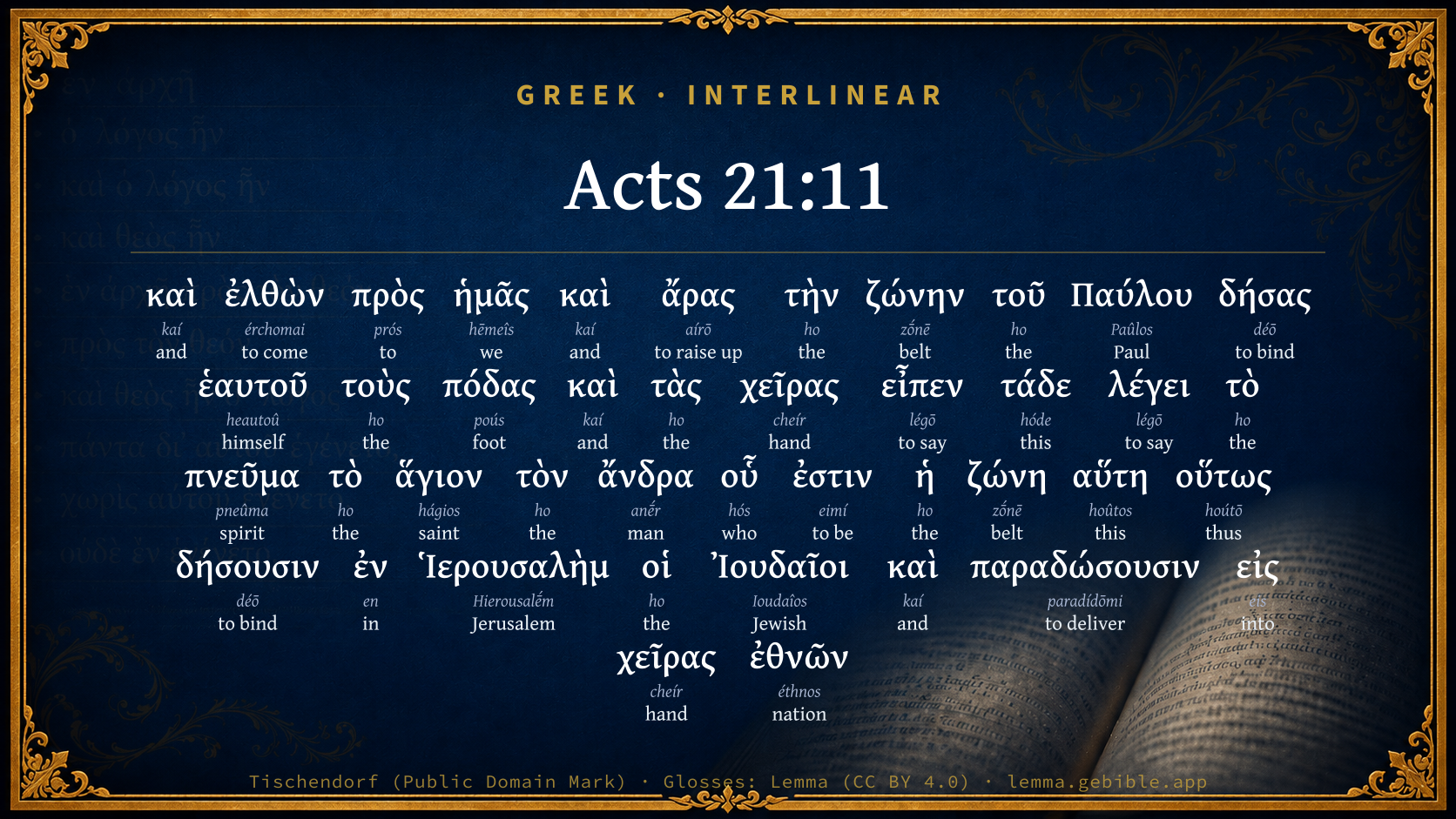
Coming to us, and taking Paul's belt, he bound his own feet and hands, and said, "Thus says the Holy Spirit: 'So will the Jews at Jerusalem bind the man who owns this belt, and will deliver him into the hands of the Gentiles.'"
Download a study sheet
One document with this verse’s original text, its word-by-word gloss line, the meaning frame, cross-references with their text, attributed commentary, and full source and license credits — printable, and it pastes into notes with its structure intact.
This verse Autodidact and up
A passage Seminary Student
Up to 50 verses in one chapter. A passage sheet keeps up to 6 commentary sources and 12 cross-references per verse, in the order this page ranks them, and says so on the sheet whenever that leaves anything out. Ask for a single verse and you get the Autodidact verse sheet above.
Everything on this page stays free to read, with no account — the sheet is a download of what is already on screen, not access to it.
Compare translations 3
The same verse in 3 English versions, stacked beneath the original-language interlinear above. Click any original word for its lexicon entry.
Each is an independent rendering of the whole verse — the interlinear is not word-aligned to these translations.
Highlighted words mark where these versions differ — a whole-verse word diff, not a word-by-word alignment.
-
World English Bible Public Domain
Coming to us, and taking Paul's belt, he bound his own feet and hands, and said, "Thus says the Holy Spirit: 'So will the Jews at Jerusalem bind the man who owns this belt, and will deliver him into the hands of the Gentiles.'"
-
King James Version Public Domain
And when he was come unto us, he took Paul's girdle, and bound his own hands and feet, and said, Thus saith the Holy Ghost, So shall the Jews at Jerusalem bind the man that owneth this girdle, and shall deliver him into the hands of the Gentiles.
-
unfoldingWord Literal Text CC BY-SA 4.0
And having come to us and having taken the belt of Paul, having bound his own feet and hands, he said, “The Holy Spirit says these things: ‘Thus will the Jews in Jerusalem bind the man of whom is this belt, and they will deliver him into the hands of the Gentiles.’”
unfoldingWord Literal Text — © unfoldingWord, licensed CC BY-SA 4.0. Word-aligned USFM3 via Door43 (git.door43.org/unfoldingWord/en_ult).
Show all 19 translations
Every available English version of this verse, each an independent rendering of the whole verse.
-
World English Bible Public Domain
Coming to us, and taking Paul's belt, he bound his own feet and hands, and said, "Thus says the Holy Spirit: 'So will the Jews at Jerusalem bind the man who owns this belt, and will deliver him into the hands of the Gentiles.'"
-
Berean Standard Bible Public Domain
Coming over to us, he took Paul’s belt, bound his own feet and hands, and said, “The Holy Spirit says: ‘In this way the Jews of Jerusalem will bind the owner of this belt and hand him over to the Gentiles.’”
-
Majority Standard Bible Public Domain
Coming over to us, he took Paul’s belt, bound his own feet and hands, and said, “The Holy Spirit says: ‘In this way the Jews of Jerusalem will bind the owner of this belt and hand him over to the Gentiles.’”
-
King James Version Public Domain
And when he was come unto us, he took Paul's girdle, and bound his own hands and feet, and said, Thus saith the Holy Ghost, So shall the Jews at Jerusalem bind the man that owneth this girdle, and shall deliver him into the hands of the Gentiles.
-
American Standard Version (1901) Public Domain
And coming to us, and taking Paul's girdle, he bound his own feet and hands, and said, Thus saith the Holy Spirit, So shall the Jews at Jerusalem bind the man that owneth this girdle, and shall deliver him into the hands of the Gentiles.
-
Revised Version (1885) Public Domain
And coming to us, and taking Paul’s girdle, he bound his own feet and hands, and said, Thus saith the Holy Ghost, So shall the Jews at Jerusalem bind the man that owneth this girdle, and shall deliver him into the hands of the Gentiles.
-
Geneva Bible (1599) Public Domain
And when he was come vnto vs, he tooke Pauls girdle, and bound his owne hands and feete, and sayd, Thus sayth the holy Ghost, So shall the Iewes at Hierusalem binde the man that oweth this girdle, and shall deliuer him into the hands of the Gentiles.
-
Douay-Rheims (1899) Public Domain
Who, when he was come to us, took Paul's girdle: and binding his own feet and hands, he said: Thus saith the Holy Ghost: The man whose girdle this is, the Jews shall bind in this manner in Jerusalem, and shall deliver him into the hands of the Gentiles.
-
Young's Literal Translation Public Domain
and he having come unto us, and having taken up the girdle of Paul, having bound also his own hands and feet, said, `Thus saith the Holy Spirit, The man whose is this girdle -- so shall the Jews in Jerusalem bind, and they shall deliver `him' up to the hands of nations.'
-
Literal Standard Version CC BY-SA 4.0
and he having come to us, and having taken up the girdle of Paul, having also bound his own hands and feet, said, “Thus says the Holy Spirit: The man whose is this girdle—so will the Jews in Jerusalem bind, and they will deliver [him] up into the hands of nations.”
-
Unlocked Literal Bible CC BY-SA 4.0
He came to us and took Paul's belt. With it he tied his own feet and hands and said, “Thus says the Holy Spirit, 'So shall the Jews in Jerusalem tie up the man who owns this belt, and they will hand him over into the hands of the Gentiles.'”
-
unfoldingWord Literal Text CC BY-SA 4.0
And having come to us and having taken the belt of Paul, having bound his own feet and hands, he said, “The Holy Spirit says these things: ‘Thus will the Jews in Jerusalem bind the man of whom is this belt, and they will deliver him into the hands of the Gentiles.’”
-
Darby Bible Public Domain
and coming to us and taking the girdle of Paul, and having bound his own hands and feet, said, Thus saith the Holy Spirit, The man whose this girdle is shall the Jews thus bind in Jerusalem, and deliver him up into the hands of [the] Gentiles.
-
World Messianic Bible Public Domain
Coming to us and taking Paul’s belt, he bound his own feet and hands, and said, “The Holy Spirit says: ‘So the Judeans at Jerusalem will bind the man who owns this belt, and will deliver him into the hands of the Gentiles.’”
-
Webster's Bible Public Domain
And when he had come to us, he took Paul's girdle, and bound his own hands and feet, and said, Thus saith the Holy Spirit, So will the Jews at Jerusalem bind the man that owneth this girdle, and will deliver him into the hands of the Gentiles.
-
Free Bible Version CC BY-SA 4.0
Approaching us, he took Paul's belt, and bound his own hands and feet. Then he said, “The Holy Spirit says, ‘This is how the Jews in Jerusalem will bind the man who owns this belt, and will hand him over to the foreigners.’”
-
Bible in Basic English Public Domain
And he came to us, and took the band of Paul's clothing, and putting it round his feet and hands, said, The Holy Spirit says these words, So will the Jews do to the man who is the owner of this band, and they will give him up into the hands of the Gentiles.
-
Text-Critical English NT CC BY 4.0
He came to us and took Paul's belt, and binding his own feet and hands, he said, “Thus says the Holy Spirit, ‘In this way the Jews in Jerusalem will bind the man who owns this belt and deliver him into the hands of the Gentiles.’ ”
-
Tyndale New Testament (1534) Public Domain
When he was come vnto vs he toke Pauls gerdell and bounde his hondes and fete and sayde: thus saith the holy goost: so shall the Iewes at Ierusalem bynde the man that oweth this gerdell and shall delyver him into the hondes of the gentyls.
Literal Standard Version (2020), Covenant Press — licensed CC BY-SA 4.0. Text via the HelloAO Bible API (eBible.org). Unlocked Literal Bible (unfoldingWord) — licensed CC BY-SA 4.0. Text via the HelloAO Bible API (eBible.org). unfoldingWord Literal Text — © unfoldingWord, licensed CC BY-SA 4.0. Word-aligned USFM3 via Door43 (git.door43.org/unfoldingWord/en_ult). Free Bible Version, Dr. Jonathan Gallagher — licensed CC BY-SA 4.0. Text via the HelloAO Bible API (eBible.org).
Word by word
More ways to search: Search by grammar → Find every occurrence → Compare this word →
Practice this passage: Drill this verse → Learn its vocabulary →
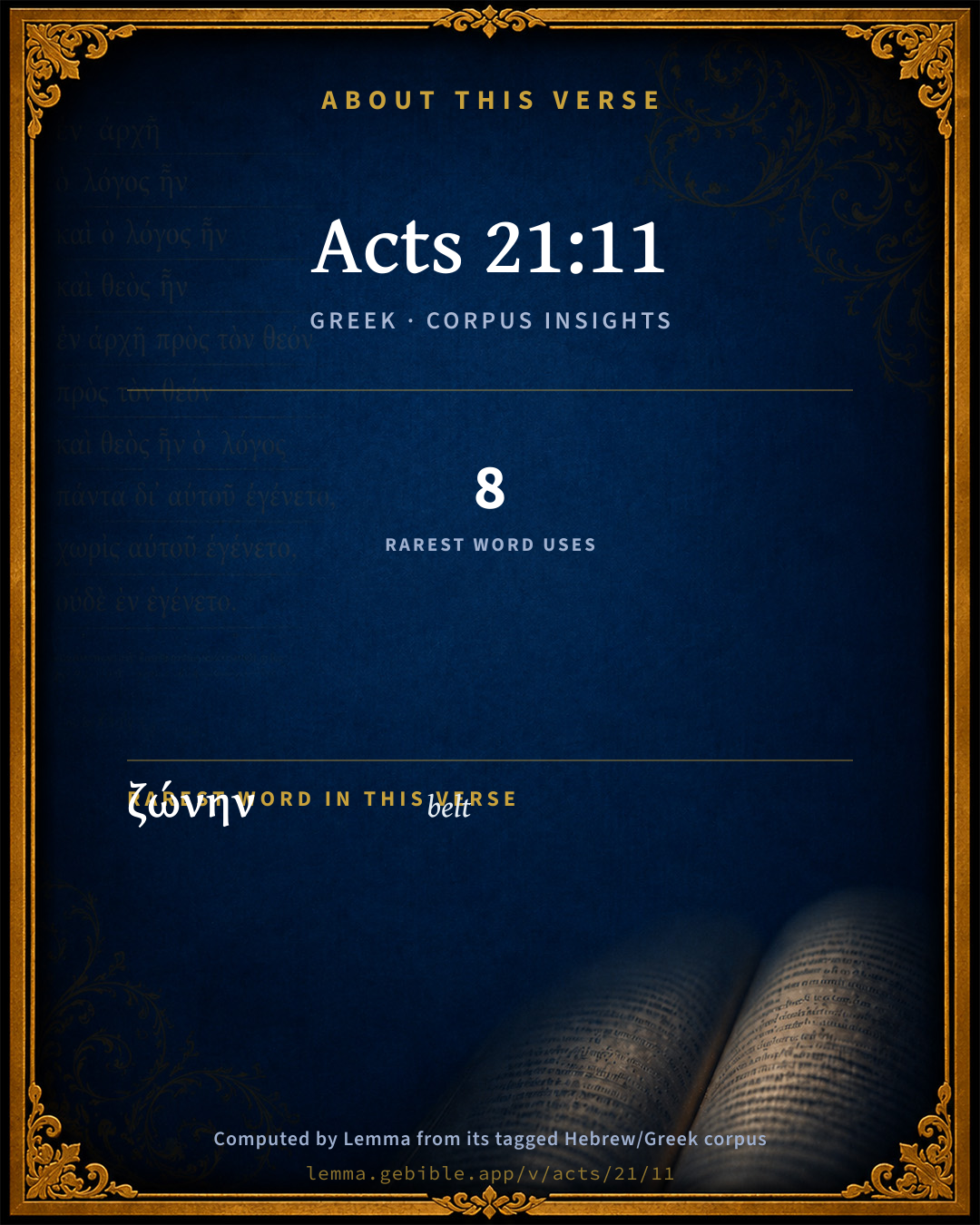
- Appears 8× in the Greek New Testament
- First appears at Matthew 3:4
- Part of Speech
- Noun
- Case
- Accusative
- Number
- Singular
- Gender
- Feminine
Full Thayer's Definition
- καὶ kaí G2532 “and” Conjunction
- ἐλθὼν érchomai G2064 “to come” Verb, Aorist, Active, Participle, Nominative, Singular, Masculine
- πρὸς prós G4314 “to” Preposition
- ἡμᾶς hēmeîs G2249 “we” Personal pronoun, 1st person, Accusative, Plural
- καὶ kaí G2532 “and” Conjunction
- ἄρας aírō G142 “to raise up” Verb, Aorist, Active, Participle, Nominative, Singular, Masculine
- τὴν ho G3588 “the” Article, Accusative, Singular, Feminine
- ζώνην zṓnē G2223 “belt” Noun, Accusative, Singular, Feminine
- τοῦ ho G3588 “the” Article, Genitive, Singular, Masculine
- Παύλου Paûlos G3972 “Paul” Noun, Genitive, Singular, Masculine
- δήσας déō G1210 “to bind” Verb, Aorist, Active, Participle, Nominative, Singular, Masculine
- ἑαυτοῦ heautoû G1438 “himself” Reflexive pronoun, 3rd person, Genitive, Singular, Masculine
- τοὺς ho G3588 “the” Article, Accusative, Plural, Masculine
- πόδας poús G4228 “foot” Noun, Accusative, Plural, Masculine
- καὶ kaí G2532 “and” Conjunction
- τὰς ho G3588 “the” Article, Accusative, Plural, Feminine
- χεῖρας cheír G5495 “hand” Noun, Accusative, Plural, Feminine
- εἶπεν légō G3004 “to say” Verb, Aorist, Active, Indicative, 3rd person, Singular
- τάδε hóde G3592 “this” Demonstrative pronoun, Accusative, Plural, Neuter
- λέγει légō G3004 “to say” Verb, Present, Active, Indicative, 3rd person, Singular
- τὸ ho G3588 “the” Article, Nominative, Singular, Neuter
- πνεῦμα pneûma G4151 “spirit” Noun, Nominative, Singular, Neuter
- τὸ ho G3588 “the” Article, Nominative, Singular, Neuter
- ἅγιον hágios G40 “saint” Adjective, Nominative, Singular, Neuter
- τὸν ho G3588 “the” Article, Accusative, Singular, Masculine
- ἄνδρα anḗr G435 “man” Noun, Accusative, Singular, Masculine
- οὗ hós G3739 “who” Relative pronoun, Genitive, Singular, Masculine
- ἐστιν eimí G1510 “to be” Verb, Present, Active, Indicative, 3rd person, Singular
- ἡ ho G3588 “the” Article, Nominative, Singular, Feminine
- ζώνη zṓnē G2223 “belt” Noun, Nominative, Singular, Feminine
- αὕτη hoûtos G3778 “this” Demonstrative pronoun, Nominative, Singular, Feminine
- οὕτως hoútō G3779 “thus” Adverb
- δήσουσιν déō G1210 “to bind” Verb, Future, Active, Indicative, 3rd person, Plural
- ἐν en G1722 “in” Preposition
- Ἱερουσαλὴμ Hierousalḗm G2419 “Jerusalem” Noun, Proper, indeclinable
- οἱ ho G3588 “the” Article, Nominative, Plural, Masculine
- Ἰουδαῖοι Ioudaîos G2453 “Jewish” Adjective, Nominative, Plural, Masculine
- καὶ kaí G2532 “and” Conjunction
- παραδώσουσιν paradídōmi G3860 “to deliver” Verb, Future, Active, Indicative, 3rd person, Plural
- εἰς eis G1519 “into” Preposition
- χεῖρας cheír G5495 “hand” Noun, Accusative, Plural, Feminine
- ἐθνῶν éthnos G1484 “nation” Noun, Genitive, Plural, Neuter
About this verse
These counts appear in no published source. They are computed here, from the morphology-tagged text and Lemma’s own curated glosses. What Lemma adds →
- 42
- words
- 27
- distinct lemmas
- Acts
- section
Cross-references
28Topical passages linked to Acts 21:11 in the Treasury of Scripture Knowledge — connected by theme and wording, ordered by reader-vote popularity; previews shown in the World English Bible.
- Acts 21:33 Then the commanding officer came near, arrested him, commanded him to be bound with two chains, and inquired who he was and what he had done.
- 1 Samuel 15:27–28 As Samuel turned about to go away, [Saul] laid hold on the skirt of his robe, and it tore.
- Jeremiah 13:1–11 Thus says Yahweh to me, Go, and buy you a linen belt, and put it on your loins, and don't put it in water.
- 1 Kings 11:29–31 It happened at that time, when Jeroboam went out of Jerusalem, that the prophet Ahijah the Shilonite found him in the way; now [Ahijah] had clad himself with a new garment; and they two were alone in the field.
- 1 Kings 22:11 Zedekiah the son of Chenaanah made him horns of iron, and said, Thus says Yahweh, With these shall you push the Syrians, until they be consumed.
- 2 Kings 13:15–19 Elisha said to him, Take bow and arrows; and he took to him bow and arrows.
- Jeremiah 19:10–11 Then shall you break the bottle in the sight of the men who go with you,
- Ezekiel 24:19–25 The people said to me, Won't you tell us what these things are to us, that you do so?
- Acts 20:23 except that the Holy Spirit testifies in every city, saying that bonds and afflictions wait for me.
- Hosea 12:10 I have also spoken to the prophets, And I have multiplied visions; And by the ministry of the prophets I have used parables.
- Matthew 20:18–19 "Behold, we are going up to Jerusalem, and the Son of Man will be delivered to the chief priests and scribes, and they will condemn him to death,
- Matthew 27:1–2 Now when morning had come, all the chief priests and the elders of the people took counsel against Jesus to put him to death:
- Acts 9:16 For I will show him how many things he must suffer for my name's sake."
- Acts 13:2 As they served the Lord and fasted, the Holy Spirit said, "Separate Barnabas and Saul for me, for the work to which I have called them."
- Acts 16:6 When they had gone through the region of Phrygia and Galatia, they were forbidden by the Holy Spirit to speak the word in Asia.
- Acts 22:25 When they had tied him up with thongs, Paul asked the centurion who stood by, "Is it lawful for you to scourge a man who is a Roman, and not found guilty?"
- Acts 24:27 But when two years were fulfilled, Felix was succeeded by Porcius Festus, and desiring to gain favor with the Jews, Felix left Paul in bonds.
- Acts 26:29 Paul said, "I pray to God, that whether with little or with much, not only you, but also all that hear me this day, might become such as I am, except for these bonds."
- Acts 28:17 It happened that after three days Paul called together those who were the leaders of the Jews. When they had come together, he said to them, "I, brothers, though I had done nothing against the people, or the customs of our fathers, still was delivered prisoner from Jerusalem into the hands of the Romans,
- Acts 28:20 For this cause therefore I asked to see you and to speak with you. For because of the hope of Israel I am bound with this chain."
- Acts 28:25 When they didn't agree among themselves, they departed after Paul had spoken one word, "The Holy Spirit spoke rightly through Isaiah, the prophet, to our fathers,
- Ephesians 3:1 For this cause I, Paul, am the prisoner of Christ Jesus on behalf of you Gentiles,
- Ephesians 4:1 I therefore, the prisoner in the Lord, beg you to walk worthily of the calling with which you were called,
- Ephesians 6:20 for which I am an ambassador in chains; that in it I may speak boldly, as I ought to speak.
- 2 Timothy 2:9 in which I suffer hardship to the point of chains as a criminal. But God's word isn't chained.
- Hebrews 3:7 Therefore, even as the Holy Spirit says, "Today if you will hear his voice,
- Hebrews 10:34 For you both had compassion on me in my chains, and joyfully accepted the plundering of your possessions, knowing that you have for yourselves a better possession and an enduring one in the heavens.
- 1 Peter 1:12 To them it was revealed, that not to themselves, but to you, did they minister these things, which now have been announced to you through those who preached the Gospel to you by the Holy Spirit sent out from heaven; which things angels desire to look into.
Cross-references courtesy of OpenBible.info (CC BY 4.0).
Lesson kit
Teaching starters — assembled from the data on this page, not authored interpretation. Every prompt links to the verse data it draws on. Edit before teaching.
Acts, in the Acts, opens this verse with 42 words (27 distinct Greek lemmas). Its most distinctive word is zṓnē (“belt”). A historical commentator’s framing appears above. Read the whole chapter for the surrounding context.
Discussion questions
- How does “belt” (zṓnē) shape what this verse is saying?
- Matthew 3:4 shares the word «belt» with this verse. How do the two illuminate each other?
- “belt” occurs 2× in this one verse. What is the effect of the repetition?
- The translations on this page render this verse differently — a whole-verse word diff, not a word-by-word alignment. What might account for the different wordings?
- Reading how Tyndale Open Study Notes and Bengel's Gnomon read this verse, where do the two commentators agree and where do they part?
Things to notice
- These translations choose different wording for 21 words in this verse.
- “belt” occurs 2× in this single verse.
- 27 distinct Greek lemmas span 42 words in this verse.
Commentary
Notes on Acts 21:11 from classic Christian and Jewish commentators (each source and its license shown beneath its notes). The classic Christian expositions comment on the surrounding passage and are grouped to its opening verse, so a note may address several verses; the Jewish commentaries on the Tanakh (Rashi and others) are per-verse, so they appear only where the commentator wrote on this verse.
Lemma curates 59 commentaries, every one of them public domain or Creative Commons licensed, each selected and text-cleaned for this edition rather than reprinted as found. About our sources →
Tyndale Open Study Notes
Tyndale Open Resources
Tyndale Open Study Notes — © Tyndale Open Resources, licensed CC BY-SA 4.0. Text via the HelloAO Bible API.
Bengel's Gnomon
Johann Albrecht Bengel
Bengel's Gnomon of the New Testament — English translation (T&T Clark, Edinburgh, 1860) — public domain. Text from a community e-Sword module.
Expositor's Greek Testament
ed. W. Robertson Nicoll
The Expositor's Greek Testament, edited by W. Robertson Nicoll (1897–1910) — public domain. Text from a community e-Sword module.
Jamieson, Fausset & Brown
Robert Jamieson, A. R. Fausset & David Brown
Jamieson, Fausset & Brown — Commentary Critical and Explanatory on the Whole Bible (1871) — public domain (CC PDM 1.0). Text via the HelloAO Bible API.
Adam Clarke's Commentary
Adam Clarke's Commentary on the Bible (1810–1826) — public domain. Text from a community e-Sword/MySword module.
Ellicott's Commentary for English Readers
A Bible Commentary for English Readers, edited by Charles John Ellicott (1878–1897) — public domain. Text from a community e-Sword module.
The Cambridge Bible for Schools and Colleges
gen. ed. J. J. S. Perowne
The Cambridge Bible for Schools and Colleges (gen. ed. J. J. S. Perowne; Cambridge University Press, 1878–1918) — public domain. Text from a community e-Sword module.
John Gill's Exposition
John Gill's Exposition of the Whole Bible (1746–1763) — public domain (CC PDM 1.0). Text via the HelloAO Bible API.
Trapp's Complete Commentary
John Trapp
John Trapp, A Commentary or Exposition upon All the Books of the Old and New Testament (1647–1656) — public domain. Text from a community e-Sword module.
Albert Barnes' Notes on the Bible
Albert Barnes' Notes on the Bible (1834–1885) — public domain. Text from a community e-Sword/MySword module.
Matthew Poole's English Annotations
Matthew Poole's English Annotations on the Holy Bible (1683–1685) — public domain. Text from a community e-Sword/MySword module.
Whedon's Commentary on the Bible
Daniel D. Whedon
Daniel D. Whedon (gen. ed.), Commentary on the Old and New Testaments (1874–1909) — public domain. Text from a community e-Sword module.
The Pulpit Commentary
The Pulpit Commentary (1880–1919), ed. H.D.M. Spence-Jones & Joseph S. Exell — public domain. Text from a community e-Sword module.
John Wesley's Explanatory Notes
John Wesley, Explanatory Notes Upon the Whole Bible (1754–1765) — public domain. Text via the GEBible commentary corpus.
McGarvey & Pendleton's Commentaries
J. W. McGarvey
J. W. McGarvey (with Philip Y. Pendleton), Commentaries on the New Testament (The Fourfold Gospel, 1914; Acts; and the epistles) — public domain. Text from a community e-Sword/MySword module.
Cambridge Greek Testament for Schools and Colleges
Cambridge Greek Testament for Schools and Colleges (Cambridge University Press, 1896; 21 vols, various authors incl. Carr, Maclear, Plummer, Farrar, Lumby, Moule, M. R. James, Simcox) — public domain. Text from a community e-Sword module.
Alford’s Greek Testament
Henry Alford
Henry Alford, The Greek Testament (1849–1861) — public domain. Text from a community e-Sword module.
Vincent's Word Studies in the New Testament
Marvin R. Vincent
Marvin R. Vincent, Word Studies in the New Testament (1887–1900) — public domain. Text from a community e-Sword/MySword module.