

Jude 1:3
Greek (Tischendorf 8th ed.) Jude 1:3 appears in the Greek New Testament. The text above is from the Tischendorf 8th edition. Each word links to its Strong’s number and a concise gloss. Click any word for its full Thayer’s Greek Lexicon entry.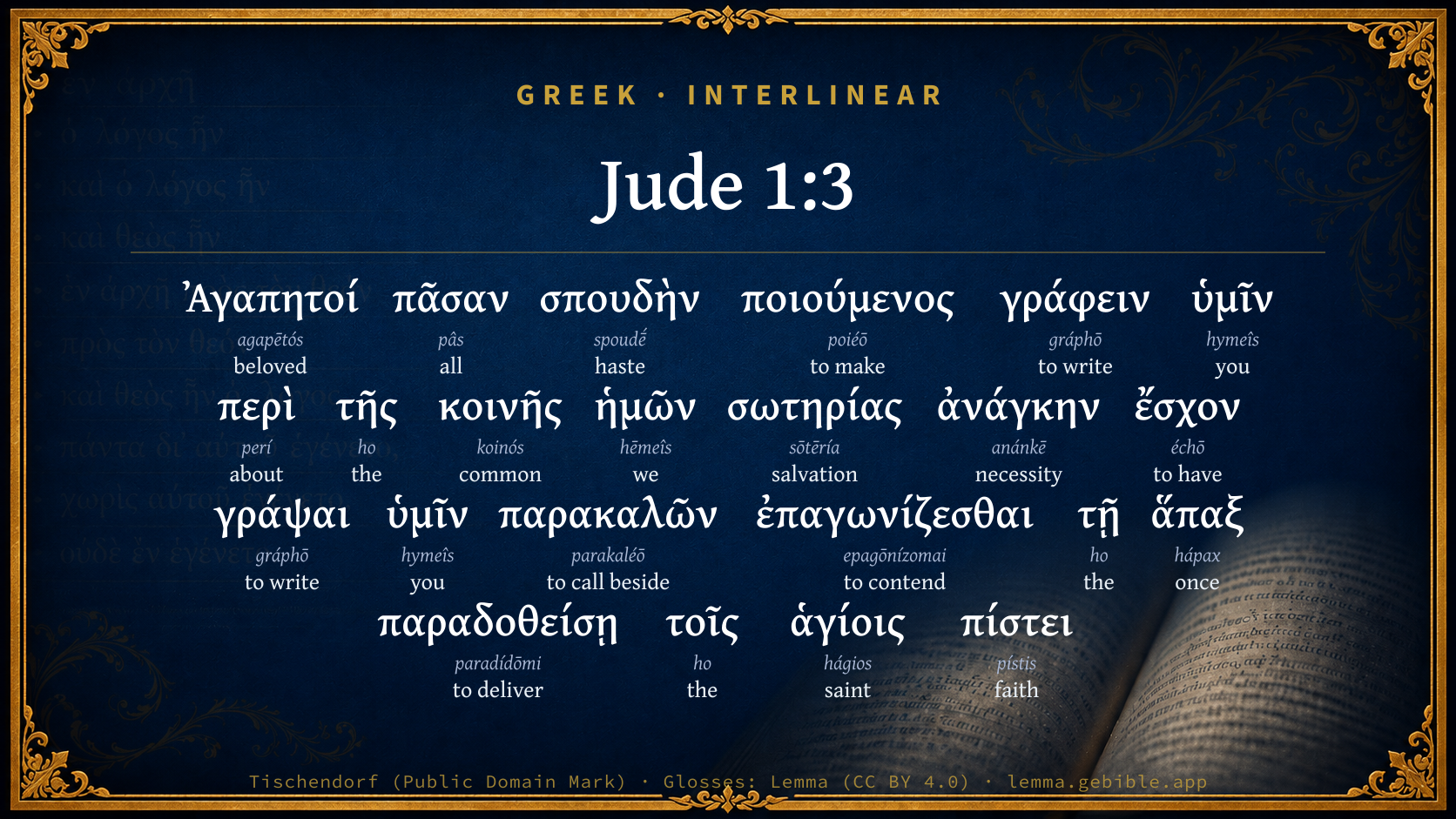
Beloved, while I was very eager to write to you about our common salvation, I was constrained to write to you exhorting you to contend earnestly for the faith which was once for all delivered to the saints.
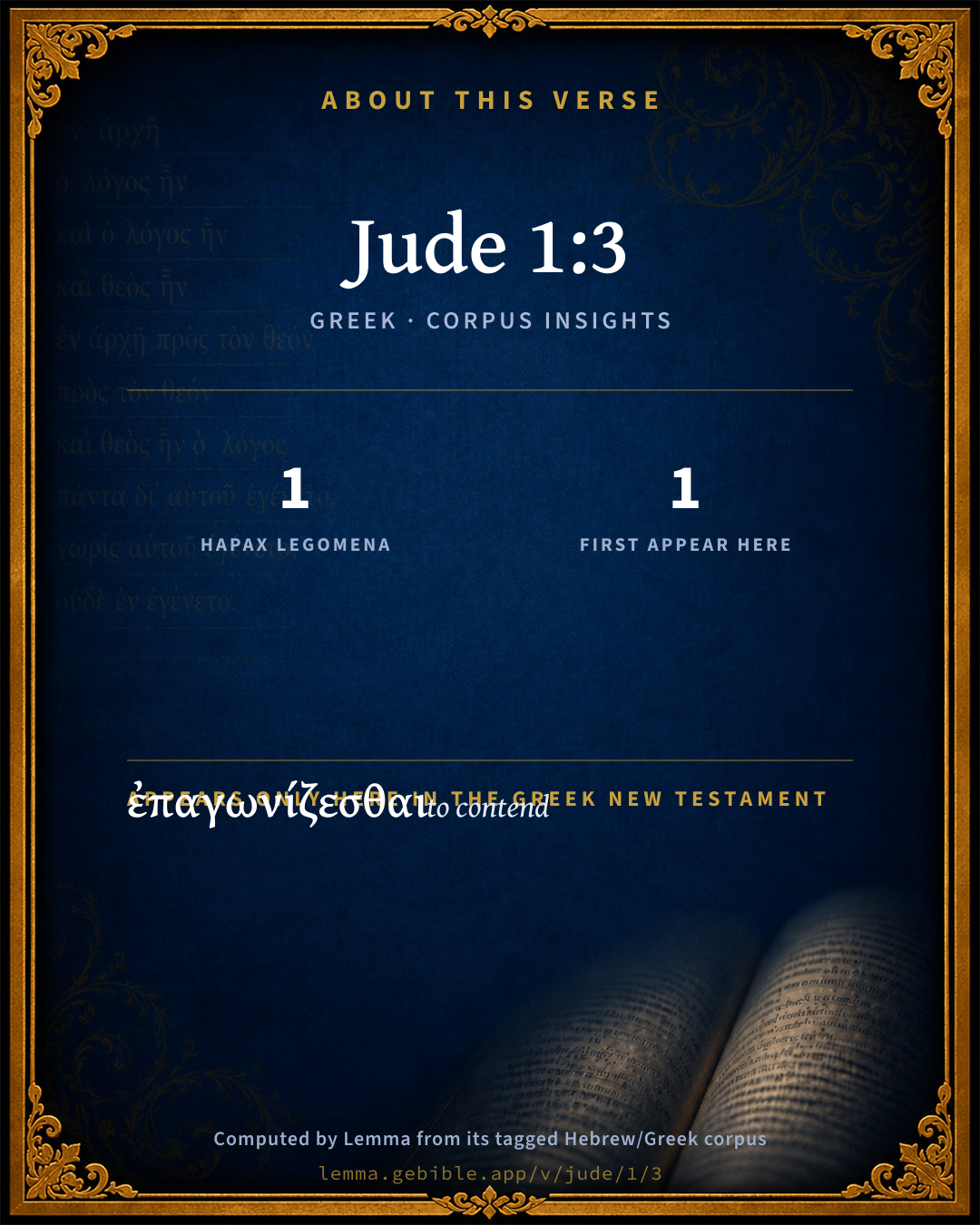
- 1 hapax legomenon — only here in the Greek New Testament
- 1 first appearance in the Greek New Testament
Download a study sheet
One document with this verse’s original text, its word-by-word gloss line, the meaning frame, cross-references with their text, attributed commentary, and full source and license credits — printable, and it pastes into notes with its structure intact.
This verse Autodidact and up
A passage Seminary Student
Up to 50 verses in one chapter. A passage sheet keeps up to 6 commentary sources and 12 cross-references per verse, in the order this page ranks them, and says so on the sheet whenever that leaves anything out. Ask for a single verse and you get the Autodidact verse sheet above.
Everything on this page stays free to read, with no account — the sheet is a download of what is already on screen, not access to it.
Compare translations 3
The same verse in 3 English versions, stacked beneath the original-language interlinear above. Click any original word for its lexicon entry.
Each is an independent rendering of the whole verse — the interlinear is not word-aligned to these translations.
Highlighted words mark where these versions differ — a whole-verse word diff, not a word-by-word alignment.
-
World English Bible Public Domain
Beloved, while I was very eager to write to you about our common salvation, I was constrained to write to you exhorting you to contend earnestly for the faith which was once for all delivered to the saints.
-
King James Version Public Domain
Beloved, when I gave all diligence to write unto you of the common salvation, it was needful for me to write unto you, and exhort you that ye should earnestly contend for the faith which was once delivered unto the saints.
-
unfoldingWord Literal Text CC BY-SA 4.0
Beloved ones, making every effort to write to you about our common salvation, I have a necessity to write to you, exhorting to contend for the faith delivered once for all to the saints.
unfoldingWord Literal Text — © unfoldingWord, licensed CC BY-SA 4.0. Word-aligned USFM3 via Door43 (git.door43.org/unfoldingWord/en_ult).
Show all 19 translations
Every available English version of this verse, each an independent rendering of the whole verse.
-
World English Bible Public Domain
Beloved, while I was very eager to write to you about our common salvation, I was constrained to write to you exhorting you to contend earnestly for the faith which was once for all delivered to the saints.
-
Berean Standard Bible Public Domain
Beloved, although I made every effort to write to you about the salvation we share, I felt it necessary to write and urge you to contend earnestly for the faith entrusted once for all to the saints.
-
Majority Standard Bible Public Domain
Beloved, although I made every effort to write to you about the salvation we share, I felt it necessary to write and urge you to contend earnestly for the faith entrusted once for all to the saints.
-
King James Version Public Domain
Beloved, when I gave all diligence to write unto you of the common salvation, it was needful for me to write unto you, and exhort you that ye should earnestly contend for the faith which was once delivered unto the saints.
-
American Standard Version (1901) Public Domain
Beloved, while I was giving all diligence to write unto you of our common salvation, I was constrained to write unto you exhorting you to contend earnestly for the faith which was once for all delivered unto the saints.
-
Revised Version (1885) Public Domain
Beloved, while I was giving all diligence to write unto you of our common salvation, I was constrained to write unto you exhorting you to contend earnestly for the faith which was once for all delivered unto the saints.
-
Geneva Bible (1599) Public Domain
Beloued, when I gaue al diligece to write vnto you of the common saluation, it was needful for me to write vnto you to exhort you, that yee should earnestly contend for the maintenace of ye faith, which was once giuen vnto the Saintes.
-
Douay-Rheims (1899) Public Domain
Dearly beloved, taking all care to write unto you concerning your common salvation, I was under a necessity to write unto you: to beseech you to contend earnestly for the faith once delivered to the saints.
-
Young's Literal Translation Public Domain
Beloved, all diligence using to write to you concerning the common salvation, I had necessity to write to you, exhorting to agonize for the faith once delivered to the saints,
-
Literal Standard Version CC BY-SA 4.0
Beloved, using all diligence to write to you concerning our common salvation, I had necessity to write to you, exhorting [you] to fight for the faith once delivered to the holy ones,
-
Unlocked Literal Bible CC BY-SA 4.0
Beloved, while I was making every effort to write to you about our common salvation, I had to write to you to exhort you to struggle earnestly for the faith that was entrusted once for all to the holy people.
-
unfoldingWord Literal Text CC BY-SA 4.0
Beloved ones, making every effort to write to you about our common salvation, I have a necessity to write to you, exhorting to contend for the faith delivered once for all to the saints.
-
Darby Bible Public Domain
Beloved, using all diligence to write to you of our common salvation, I have been obliged to write to you exhorting [you] to contend earnestly for the faith once delivered to the saints.
-
World Messianic Bible Public Domain
Beloved, while I was very eager to write to you about our common salvation, I was constrained to write to you exhorting you to contend earnestly for the faith which was once for all delivered to the holy ones.
-
Webster's Bible Public Domain
Beloved, when I gave all diligence to write to you concerning the common salvation, it was needful for me to write to you, and exhort you that ye should earnestly contend for the faith, which was once delivered to the saints.
-
Free Bible Version CC BY-SA 4.0
My friends, I was already looking forward to writing to you about the salvation that we share. But now I need to write urgently to you and encourage you to vigorously defend the truth about God, given once and for all time to God's holy people.
-
Bible in Basic English Public Domain
My loved ones, while my thoughts were full of a letter which I was going to send you about our common salvation, it was necessary for me to send you one requesting you with all my heart to go on fighting strongly for the faith which has been given to the saints once and for ever.
-
Text-Critical English NT CC BY 4.0
Beloved, although I was quite eager to write to you about our common salvation, I found it necessary to write to you and urge you to contend for the faith that was once for all delivered to the saints.
-
Tyndale New Testament (1534) Public Domain
Beloved when I gave all diligence to write vnto you of the commen saluacion: it was nedfull for me to wryte vnto you to exhorte you that ye shuld continually laboure in the fayth which was once geve vnto the sayntes
Literal Standard Version (2020), Covenant Press — licensed CC BY-SA 4.0. Text via the HelloAO Bible API (eBible.org). Unlocked Literal Bible (unfoldingWord) — licensed CC BY-SA 4.0. Text via the HelloAO Bible API (eBible.org). unfoldingWord Literal Text — © unfoldingWord, licensed CC BY-SA 4.0. Word-aligned USFM3 via Door43 (git.door43.org/unfoldingWord/en_ult). Free Bible Version, Dr. Jonathan Gallagher — licensed CC BY-SA 4.0. Text via the HelloAO Bible API (eBible.org).
Word by word
More ways to search: Search by grammar → Find every occurrence → Compare this word →
Practice this passage: Drill this verse → Learn its vocabulary →
- Appears 1× in the Greek New Testament
- First appears here
- Part of Speech
- Verb
- Tense
- Present
- Voice
- Middle or Passive deponent
- Mood
- Infinitive
Full Thayer's Definition
- Ἀγαπητοί agapētós G27 “beloved” Adjective, Vocative, Plural, Masculine
- πᾶσαν pâs G3956 “all” Adjective, Accusative, Singular, Feminine
- σπουδὴν spoudḗ G4710 “haste” Noun, Accusative, Singular, Feminine
- ποιούμενος poiéō G4160 “to make” Verb, Present, Middle, Participle, Nominative, Singular, Masculine
- γράφειν gráphō G1125 “to write” Verb, Present, Active, Infinitive
- ὑμῖν hymeîs G5210 “you” Personal pronoun, 2nd person, Dative, Plural
- περὶ perí G4012 “about” Preposition
- τῆς ho G3588 “the” Article, Genitive, Singular, Feminine
- κοινῆς koinós G2839 “common” Adjective, Genitive, Singular, Feminine
- ἡμῶν hēmeîs G2249 “we” Personal pronoun, 1st person, Genitive, Plural
- σωτηρίας sōtēría G4991 “salvation” Noun, Genitive, Singular, Feminine
- ἀνάγκην anánkē G318 “necessity” Noun, Accusative, Singular, Feminine
- ἔσχον échō G2192 “to have” Verb, Aorist, Active, Indicative, 1st person, Singular
- γράψαι gráphō G1125 “to write” Verb, Aorist, Active, Infinitive
- ὑμῖν hymeîs G5210 “you” Personal pronoun, 2nd person, Dative, Plural
- παρακαλῶν parakaléō G3870 “to call beside” Verb, Present, Active, Participle, Nominative, Singular, Masculine
- ἐπαγωνίζεσθαι epagōnízomai G1864 “to contend” Verb, Present, Middle or Passive deponent, Infinitive
- τῇ ho G3588 “the” Article, Dative, Singular, Feminine
- ἅπαξ hápax G530 “once” Adverb
- παραδοθείσῃ paradídōmi G3860 “to deliver” Verb, Aorist, Passive, Participle, Dative, Singular, Feminine
- τοῖς ho G3588 “the” Article, Dative, Plural, Masculine
- ἁγίοις hágios G40 “saint” Adjective, Dative, Plural, Masculine
- πίστει pístis G4102 “faith” Noun, Dative, Singular, Feminine
About this verse
These counts appear in no published source. They are computed here, from the morphology-tagged text and Lemma’s own curated glosses. What Lemma adds →
- 23
- words
- 19
- distinct lemmas
- General Epistles
- section
Notable vocabulary
1 hapax legomenon — a word that appears only here in the entire Greek New Testament:
- ἐπαγωνίζεσθαι to contend G1864
First appearance in Scripture
This word makes its first canonical appearance in the Greek New Testament here:
- ἐπαγωνίζεσθαι to contend G1864
Shared distinctive vocabulary
σπουδὴν haste G4710 occurs in 12 verses of the Greek New Testament. Also found in:
Cross-references
39Topical passages linked to Jude 1:3 in the Treasury of Scripture Knowledge — connected by theme and wording, ordered by reader-vote popularity; previews shown in the World English Bible.
- 1 Timothy 6:12 Fight the good fight of faith. Lay hold of the eternal life to which you were called, and you confessed the good confession in the sight of many witnesses.
- Philippians 1:27 Only let your manner of life be worthy of the Gospel of Christ, that, whether I come and see you or am absent, I may hear of your state, that you stand firm in one spirit, with one soul striving for the faith of the Gospel;
- Jude 1:20 But you, beloved, keep building up yourselves on your most holy faith, praying in the Holy Spirit.
- 2 Timothy 1:13 Hold the pattern of sound words which you have heard from me, in faith and love which is in Christ Jesus.
- Titus 1:4 to Titus, my true child according to a common faith: Grace, mercy, and peace from God the Father and the Lord Jesus Christ our Savior.
- 2 Timothy 4:7–8 I have fought the good fight. I have finished the course. I have kept the faith.
- Revelation 12:11 They overcame him because of the Lamb's blood, and because of the word of their testimony. They didn't love their life, even to death.
- Revelation 2:10 Don't be afraid of the things which you are about to suffer. Behold, the devil is about to throw some of you into prison, that you may be tested; and you will have oppression for ten days. Be faithful to death, and I will give you the crown of life.
- 1 Timothy 1:18 This charge I commit to you, my child Timothy, according to the prophecies which led the way to you, that by them you may wage the good warfare;
- Galatians 2:5 to whom we gave no place in the way of subjection, not for an hour, that the truth of the Gospel might continue with you.
- Deuteronomy 9:10 Yahweh delivered to me the two tables of stone written with the finger of God; and on them [was written] according to all the words, which Yahweh spoke with you on the mountain out of the midst of the fire in the day of the assembly.
- Acts 4:12 There is salvation in none other, for neither is there any other name under heaven, that is given among men, by which we must be saved!"
- Hebrews 13:22 But I exhort you, brothers, endure the word of exhortation, for I have written to you in few words.
- Isaiah 45:22 Look to me, and be you saved, all the ends of the earth; for I am God, and there is none else.
- Acts 9:22 But Saul increased more in strength, and confounded the Jews who lived at Damascus, proving that this is the Christ.
- Acts 13:46–47 Paul and Barnabas spoke out boldly, and said, "It was necessary that God's word should be spoken to you first. Since indeed you thrust it from you, and judge yourselves unworthy of eternal life, behold, we turn to the Gentiles.
- Acts 18:28 for he powerfully refuted the Jews, publicly showing by the Scriptures that Jesus was the Christ.
- 1 Corinthians 15:3 For I delivered to you first of all that which I also received: that Christ died for our sins according to the Scriptures,
- Romans 15:15–16 But I write the more boldly to you in part, as reminding you, because of the grace that was given to me by God,
- 1 Thessalonians 2:2 but having suffered before and been shamefully treated, as you know, at Philippi, we grew bold in our God to tell you the Gospel of God in much conflict.
- Isaiah 45:17 [But] Israel shall be saved by Yahweh with an everlasting salvation: you shall not be disappointed nor confounded world without end.
- Jeremiah 9:3 They bend their tongue, [as it were] their bow, for falsehood; and they are grown strong in the land, but not for truth: for they proceed from evil to evil, and they don't know me, says Yahweh.
- Acts 6:8–10 Stephen, full of faith and power, performed great wonders and signs among the people.
- Acts 17:3 explaining and demonstrating that the Christ had to suffer and rise again from the dead, and saying, "This Jesus, whom I proclaim to you, is the Christ."
- Acts 18:4–6 He reasoned in the synagogue every Sabbath, and persuaded Jews and Greeks.
- Acts 20:27 for I didn't shrink from declaring to you the whole counsel of God.
- Acts 28:28 "Be it known therefore to you, that the salvation of God is sent to the Gentiles. They will also listen."
- Galatians 6:11 See with what large letters I write to you with my own hand.
- Ephesians 1:1 Paul, an apostle of Christ Jesus through the will of God, to the saints who are at Ephesus, and the faithful in Christ Jesus:
- 1 Peter 5:12 Through Silvanus, our faithful brother, as I consider him, I have written to you briefly, exhorting, and testifying that this is the true grace of God in which you stand.
- 2 Peter 1:1 Simon Peter, a servant and apostle of Jesus Christ, to those who have obtained a like precious faith with us in the righteousness of our God and Savior, Jesus Christ:
- 2 Peter 1:12–15 Therefore I will not be negligent to remind you of these things, though you know them, and are established in the present truth.
- 2 Peter 3:1–2 This is now, beloved, the second letter that I have written to you; and in both of them I stir up your sincere mind by reminding you;
- Deuteronomy 21:9 So shall you put away the innocent blood from the midst of you, when you shall do that which is right in the eyes of Yahweh.
- Nehemiah 13:25 I contended with them, and cursed them, and struck certain of them, and plucked off their hair, and made them swear by God, [saying], You shall not give your daughters to their sons, nor take their daughters for your sons, or for yourselves.
- Galatians 3:28 There is neither Jew nor Greek, there is neither slave nor free man, there is neither male nor female; for you are all one in Christ Jesus.
- Philippians 1:1 Paul and Timothy, servants of Jesus Christ; To all the saints in Christ Jesus who are at Philippi, with the overseers and deacons:
- Colossians 1:2 to the saints and faithful brothers in Christ at Colossae: Grace to you and peace from God our Father, and the Lord Jesus Christ.
- Jude 1:17 But you, beloved, remember the words which have been spoken before by the apostles of our Lord Jesus Christ.
Cross-references courtesy of OpenBible.info (CC BY 4.0).
Where the printed editions differ
1 variantPlaces in this verse where the major printed Greek editions disagree on the wording in a way that affects the translation — a comparison of editions, not a manuscript-by-manuscript collation. The editions are the modern critical texts (Nestlé-Aland 28/27, SBL, Westcott-Hort, Tregelles, Tyndale House) and the traditional texts behind the KJV (the Textus Receptus and the Byzantine/Majority text). It is not a claim about which reading is original.
-
Extra text
ἡμῶν
“of us”
In NA28NA27TynSBLWHTreg Not in TRByzἡμῶν (hēmōn) 'of us' is only in older manuscripts (NA28+NA27+Tyn+SBL+WH+Treg)
Textual data: Translators Amalgamated Greek New Testament (STEPBible TAGNT) · CC BY 4.0.
Lesson kit
Teaching starters — assembled from the data on this page, not authored interpretation. Every prompt links to the verse data it draws on. Edit before teaching.
Jude, in the General Epistles, opens this verse with 23 words (19 distinct Greek lemmas). Its most distinctive word is epagōnízomai (“to contend”). A historical commentator’s framing appears above. Read the whole chapter for the surrounding context.
Discussion questions
- How does “to contend” (epagōnízomai) shape what this verse is saying?
- This verse holds 1 word here found nowhere else in the Greek New Testament. What might the rare word draw attention to?
- The word “to contend” first appears here in Scripture. What is being introduced at this debut?
- Mark 6:25 shares the word «haste» with this verse. How do the two illuminate each other?
- “to write” occurs 2× in this one verse. What is the effect of the repetition?
- These translations render this verse differently; the difference is in the English rendering, not the original. What questions does that raise?
- Reading how Ellicott's Commentary for English Readers and The Biblical Illustrator read this verse, where do the two commentators agree and where do they part?
Things to notice
- 1 word in this verse appears nowhere else in the Greek New Testament.
- 1 word makes its first canonical appearance in Scripture here.
- These translations choose different wording for 21 words in this verse.
- “to write” occurs 2× in this single verse.
- 19 distinct Greek lemmas span 23 words in this verse.
Commentary
Notes on Jude 1:3 from classic Christian and Jewish commentators (each source and its license shown beneath its notes). The classic Christian expositions comment on the surrounding passage and are grouped to its opening verse, so a note may address several verses; the Jewish commentaries on the Tanakh (Rashi and others) are per-verse, so they appear only where the commentator wrote on this verse.
Lemma curates 59 commentaries, every one of them public domain or Creative Commons licensed, each selected and text-cleaned for this edition rather than reprinted as found. About our sources →
Ellicott's Commentary for English Readers
A Bible Commentary for English Readers, edited by Charles John Ellicott (1878–1897) — public domain. Text from a community e-Sword module.
The Biblical Illustrator
Joseph S. Exell
The Biblical Illustrator, edited by Joseph S. Exell (c. 1880s–1900s) — public domain. Text from a community e-Sword module.
Joseph Benson's Commentary
Joseph Benson's Commentary on the Old and New Testaments (1811–1818) — public domain. Text from a community e-Sword module.
The Preacher's Complete Homiletical Commentary
Joseph S. Exell (gen. ed.)
The Preacher's Complete Homiletical Commentary (gen. ed. Joseph S. Exell; Funk & Wagnalls, c. 1892) — public domain (pre-1929). A full-Bible homiletical/sermon-outline anthology covering 65 of 66 books (2 John is absent from the source module). Text from a community e-Sword module.
MacLaren's Expositions of Holy Scripture
Alexander MacLaren
Alexander MacLaren, Expositions of Holy Scripture (1904–1910) — public domain. Text from a community e-Sword module.
The Expositor's Bible
William Robertson Nicoll, ed., The Expositor's Bible (London: Hodder & Stoughton, 1887–1910) — public domain. 65 of 66 books (1 Corinthians is not separately keyed, as that volume carries no machine-parseable verse references); section-level commentary keyed to the opening verse. Introductory and overview sections not keyed to a specific passage are excluded.
Tyndale Open Study Notes
Tyndale Open Resources
Tyndale Open Study Notes — © Tyndale Open Resources, licensed CC BY-SA 4.0. Text via the HelloAO Bible API.
Bengel's Gnomon
Johann Albrecht Bengel
Bengel's Gnomon of the New Testament — English translation (T&T Clark, Edinburgh, 1860) — public domain. Text from a community e-Sword module.
Meyer's Critical & Exegetical Commentary
Heinrich August Wilhelm Meyer
Meyer — Critical and Exegetical Commentary on the New Testament — English translation by Peter Christie, edited by Frederick Crombie (T&T Clark, 1880) — public domain. Text from a community e-Sword module.
Expositor's Greek Testament
ed. W. Robertson Nicoll
The Expositor's Greek Testament, edited by W. Robertson Nicoll (1897–1910) — public domain. Text from a community e-Sword module.
Geneva Bible (1599)
Geneva Bible translators
Geneva Bible (1599) marginal notes — public domain. Text via Bolls.life.
Matthew Henry's Commentary
Matthew Henry's Commentary on the Whole Bible (1708–1710) — public domain (CC PDM 1.0). Text via the HelloAO Bible API.
Jamieson, Fausset & Brown
Robert Jamieson, A. R. Fausset & David Brown
Jamieson, Fausset & Brown — Commentary Critical and Explanatory on the Whole Bible (1871) — public domain (CC PDM 1.0). Text via the HelloAO Bible API.
Adam Clarke's Commentary
Adam Clarke's Commentary on the Bible (1810–1826) — public domain. Text from a community e-Sword/MySword module.
John Calvin's Commentaries
John Calvin's Commentaries (1540-1563) — public domain. Text from the Calvin Translation Society English edition (1840s-50s) via the Christian Classics Ethereal Library (ccel.org). Calvin's coverage is partial (roughly two-thirds of the Bible); uncommented books and verses are honest gaps, never fabricated. The 19th-century editor's footnotes and remarks are omitted so the notes are faithfully Calvin's own voice.
The Cambridge Bible for Schools and Colleges
gen. ed. J. J. S. Perowne
The Cambridge Bible for Schools and Colleges (gen. ed. J. J. S. Perowne; Cambridge University Press, 1878–1918) — public domain. Text from a community e-Sword module.
Albert Barnes' Notes on the Bible
Albert Barnes' Notes on the Bible (1834–1885) — public domain. Text from a community e-Sword/MySword module.
Haydock's Catholic Bible Commentary
George Leo Haydock (1774–1849), Haydock's Catholic Family Bible and Commentary, 1859 edition — public domain. Excludes Psalms (Douay-Rheims chapter numbering differs from Protestant) and Deuterocanonical books (Catholic canon only).
Matthew Poole's English Annotations
Matthew Poole's English Annotations on the Holy Bible (1683–1685) — public domain. Text from a community e-Sword/MySword module.
Whedon's Commentary on the Bible
Daniel D. Whedon
Daniel D. Whedon (gen. ed.), Commentary on the Old and New Testaments (1874–1909) — public domain. Text from a community e-Sword module.
The Pulpit Commentary
The Pulpit Commentary (1880–1919), ed. H.D.M. Spence-Jones & Joseph S. Exell — public domain. Text from a community e-Sword module.
John Wesley's Explanatory Notes
John Wesley, Explanatory Notes Upon the Whole Bible (1754–1765) — public domain. Text via the GEBible commentary corpus.
Scofield Reference Notes
C. I. Scofield
The Scofield Reference Bible (1917 edition), notes by C. I. Scofield — public domain. Text from a community e-Sword module.
Kretzmann's Popular Commentary
Paul E. Kretzmann
Paul E. Kretzmann, Popular Commentary of the Bible (1921–1924) — public domain. Text from a community e-Sword module.
Burkitt's Expository Notes on the New Testament
William Burkitt
William Burkitt's Expository Notes on the New Testament (1700–1703) — public domain. Text from a community e-Sword module.
Godbey's Commentary on the New Testament
William B. Godbey
William B. Godbey, Commentary on the New Testament (1896–1900) — public domain. Text from a community e-Sword module.
The People's New Testament
B. W. Johnson
B. W. Johnson's The People's New Testament with Notes (1889–1891) — public domain. Electronic text from the Christian Classics Ethereal Library (CCEL) ThML edition.
unfoldingWord translationNotes
Door43 World Missions Community
unfoldingWord translationNotes — © Distant Shores Media and the Door43 World Missions Community, licensed CC BY-SA 4.0. Source: git.door43.org/Door43/en_tn.
Cambridge Greek Testament for Schools and Colleges
Cambridge Greek Testament for Schools and Colleges (Cambridge University Press, 1896; 21 vols, various authors incl. Carr, Maclear, Plummer, Farrar, Lumby, Moule, M. R. James, Simcox) — public domain. Text from a community e-Sword module.
Alford’s Greek Testament
Henry Alford
Henry Alford, The Greek Testament (1849–1861) — public domain. Text from a community e-Sword module.
International Critical Commentary
International Critical Commentary — older volumes (1896–1929), various authors — public domain. Text from a community e-Sword module.
Vincent's Word Studies in the New Testament
Marvin R. Vincent
Marvin R. Vincent, Word Studies in the New Testament (1887–1900) — public domain. Text from a community e-Sword/MySword module.