1 Thessalonians 3:13

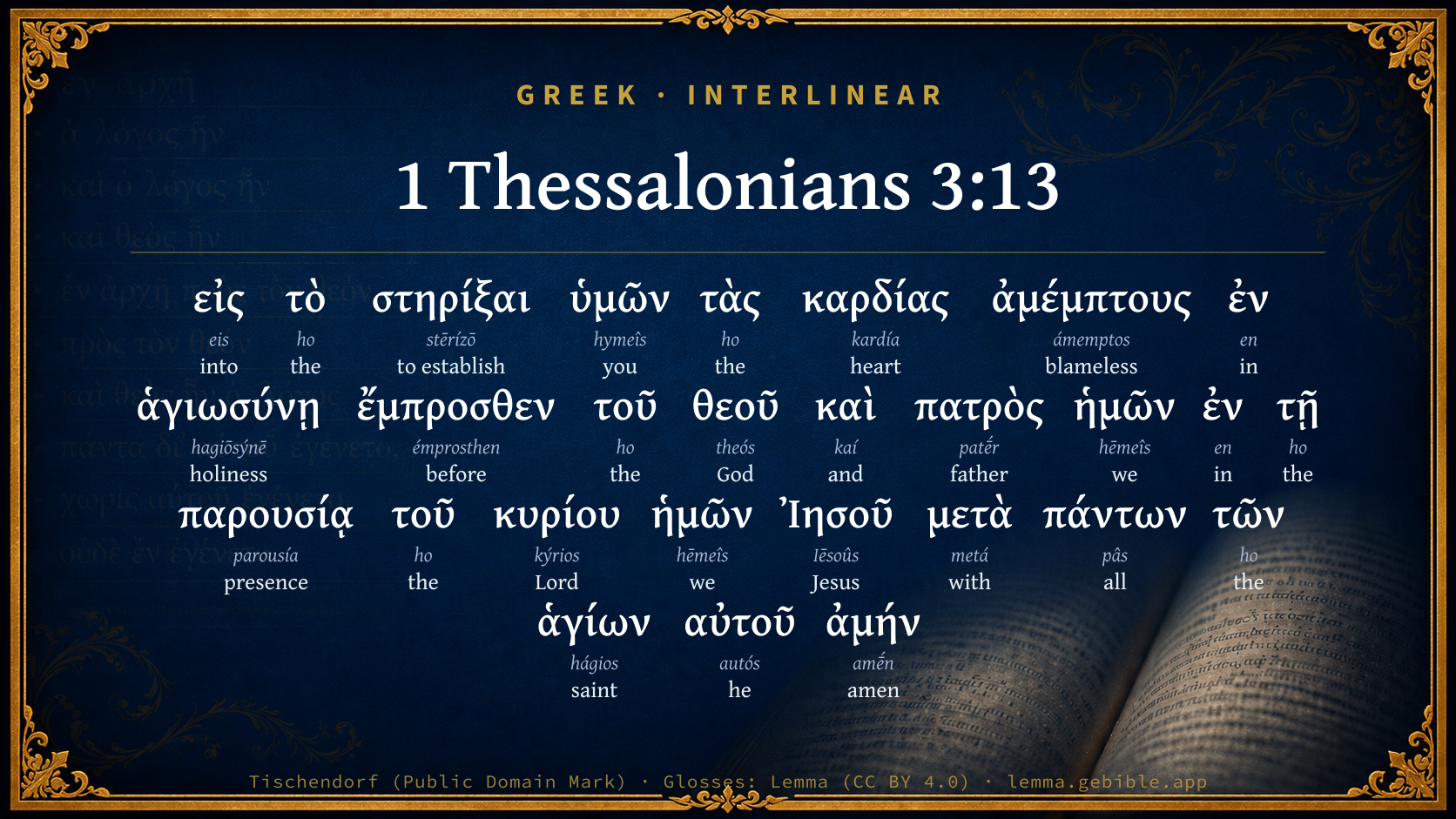
Greek (Tischendorf 8th ed.) 1 Thessalonians 3:13 appears in the Greek New Testament. The text above is from the Tischendorf 8th edition. Each word links to its Strong’s number and a concise gloss. Click any word for its full Thayer’s Greek Lexicon entry.
Download image
Cite this verse

1 Thessalonians 3:13 (World English Bible). Public Domain. Lemma interlinear Bible study tool, https://lemma.gebible.app/v/1-thessalonians/3/13.

Show BibTeX & RIS
BibTeX
RIS
English Translation
to the end he may establish your hearts blameless in holiness before our God and Father, at the coming of our Lord Jesus with all his saints.
World English Bible · Public Domain
Download a study sheet

One document with this verse’s original text, its word-by-word gloss line, the meaning frame, cross-references with their text, attributed commentary, and full source and license credits — printable, and it pastes into notes with its structure intact.

This verse Autodidact and up

Study sheet (.html) Plain text (.txt)

A passage Seminary Student

Up to 50 verses in one chapter. A passage sheet keeps up to 6 commentary sources and 12 cross-references per verse, in the order this page ranks them, and says so on the sheet whenever that leaves anything out. Ask for a single verse and you get the Autodidact verse sheet above.

Everything on this page stays free to read, with no account — the sheet is a download of what is already on screen, not access to it.

Want to remove ads? Support Godless Engineer
Compare translations 3

The same verse in 3 English versions, stacked beneath the original-language interlinear above. Click any original word for its lexicon entry.

Each is an independent rendering of the whole verse — the interlinear is not word-aligned to these translations.

Highlighted words mark where these versions differ — a whole-verse word diff, not a word-by-word alignment.

  • World English Bible Public Domain
    to the end he may establish your hearts blameless in holiness before our God and Father, at the coming of our Lord Jesus with all his saints.
  • King James Version Public Domain
    To the end he may stablish your hearts unblameable in holiness before God, even our Father, at the coming of our Lord Jesus Christ with all his saints.
  • unfoldingWord Literal Text CC BY-SA 4.0
    to strengthen your hearts, blameless in holiness before our God and Father, at the coming of our Lord Jesus with all his saints. Amen!

unfoldingWord Literal Text — © unfoldingWord, licensed CC BY-SA 4.0. Word-aligned USFM3 via Door43 (git.door43.org/unfoldingWord/en_ult).

Versions to compare (up to 4)

3 of 4 selected

Show all 19 translations

Every available English version of this verse, each an independent rendering of the whole verse.

  • World English Bible Public Domain
    to the end he may establish your hearts blameless in holiness before our God and Father, at the coming of our Lord Jesus with all his saints.
  • Berean Standard Bible Public Domain
    so that He may establish your hearts in blamelessness and holiness before our God and Father at the coming of our Lord Jesus with all His saints. Amen.
  • Majority Standard Bible Public Domain
    so that He may establish your hearts in blamelessness and holiness before our God and Father at the coming of our Lord Jesus Christ with all His saints.
  • King James Version Public Domain
    To the end he may stablish your hearts unblameable in holiness before God, even our Father, at the coming of our Lord Jesus Christ with all his saints.
  • American Standard Version (1901) Public Domain
    to the end he may establish your hearts unblameable in holiness before our God and Father, at the coming of our Lord Jesus with all his saints.
  • Revised Version (1885) Public Domain
    to the end he may stablish your hearts unblameable in holiness before our God and Father, at the coming of our Lord Jesus with all his saints.
  • Geneva Bible (1599) Public Domain
    To make your hearts stable and vnblameable in holines before God euen our Father, at the comming of our Lord Iesus Christ with all his Saints.
  • Douay-Rheims (1899) Public Domain
    To confirm your hearts without blame, in holiness, before God and our Father, at the coming of our Lord Jesus Christ, with all his saints. Amen.
  • Young's Literal Translation Public Domain
    to the establishing your hearts blameless in sanctification before our God and Father, in the presence of our Lord Jesus Christ with all His saints.
  • Literal Standard Version CC BY-SA 4.0
    in order to have established your hearts, blameless in sanctification before our God and Father, at the coming of our Lord Jesus Christ with all His holy ones.
  • Unlocked Literal Bible CC BY-SA 4.0
    May he strengthen your hearts, so that they will be blameless in holiness before our God and Father, at the coming of our Lord Jesus with all his saints.
  • unfoldingWord Literal Text CC BY-SA 4.0
    to strengthen your hearts, blameless in holiness before our God and Father, at the coming of our Lord Jesus with all his saints. Amen!
  • Darby Bible Public Domain
    in order to the confirming of your hearts unblamable in holiness before our God and Father at the coming of our Lord Jesus with all his saints.
  • World Messianic Bible Public Domain
    to the end he may establish your hearts blameless in holiness before our God and Father at the coming of our Lord Yeshua with all his holy ones.
  • Webster's Bible Public Domain
    To the end he may establish your hearts unblamable in holiness before God, even our Father, at the coming of our Lord Jesus Christ with all his saints.
  • Free Bible Version CC BY-SA 4.0
    In this way may the Lord strengthen you so you may stand with minds that are holy and blameless before our God and Father at the coming of our Lord Jesus with all his holy ones.
  • Bible in Basic English Public Domain
    So that your hearts may be strong and free from all sin before our God and Father, at the coming of our Lord Jesus with all his saints.
  • Text-Critical English NT CC BY 4.0
    And may he strengthen your hearts to be blameless in holiness in the presence of our God and Father when our Lord Jesus Christ comes with all his saints.
  • Tyndale New Testament (1534) Public Domain
    to make youre hertes stable and vnblameable in holynes before God oure father at the commynge of oure Lorde Iesus Christ with all his sainctes.

Literal Standard Version (2020), Covenant Press — licensed CC BY-SA 4.0. Text via the HelloAO Bible API (eBible.org). Unlocked Literal Bible (unfoldingWord) — licensed CC BY-SA 4.0. Text via the HelloAO Bible API (eBible.org). unfoldingWord Literal Text — © unfoldingWord, licensed CC BY-SA 4.0. Word-aligned USFM3 via Door43 (git.door43.org/unfoldingWord/en_ult). Free Bible Version, Dr. Jonathan Gallagher — licensed CC BY-SA 4.0. Text via the HelloAO Bible API (eBible.org).

Word by word

More ways to search: Search by grammar → Find every occurrence → Compare this word →

Practice this passage: Drill this verse → Learn its vocabulary →

ἁγιωσύνῃ
hagiōsýnē
G42
“holiness”
Noun, Dative, Singular, Feminine
Part of Speech
Noun
Case
Dative
Number
Singular
Gender
Feminine
Full Thayer's Definition

Origin: from G40

TDNT: 02:54,1

1. majesty, holiness 2. moral purity
  1. εἰς eis G1519 “into” Preposition
  2. τὸ ho G3588 “the” Article, Accusative, Singular, Neuter
  3. στηρίξαι stērízō G4741 “to establish” Verb, Aorist, Active, Infinitive
  4. ὑμῶν hymeîs G5210 “you” Personal pronoun, 2nd person, Genitive, Plural
  5. τὰς ho G3588 “the” Article, Accusative, Plural, Feminine
  6. καρδίας kardía G2588 “heart” Noun, Accusative, Plural, Feminine
  7. ἀμέμπτους ámemptos G273 “blameless” Adjective, Accusative, Plural, Feminine
  8. ἐν en G1722 “in” Preposition
  9. ἔμπροσθεν émprosthen G1715 “before” Preposition
  10. τοῦ ho G3588 “the” Article, Genitive, Singular, Masculine
  11. θεοῦ theós G2316 “God” Noun, Genitive, Singular, Masculine
  12. καὶ kaí G2532 “and” Conjunction
  13. πατρὸς patḗr G3962 “father” Noun, Genitive, Singular, Masculine
  14. ἡμῶν hēmeîs G2249 “we” Personal pronoun, 1st person, Genitive, Plural
  15. ἐν en G1722 “in” Preposition
  16. τῇ ho G3588 “the” Article, Dative, Singular, Feminine
  17. παρουσίᾳ parousía G3952 “presence” Noun, Dative, Singular, Feminine
  18. τοῦ ho G3588 “the” Article, Genitive, Singular, Masculine
  19. κυρίου kýrios G2962 “Lord” Noun, Genitive, Singular, Masculine
  20. ἡμῶν hēmeîs G2249 “we” Personal pronoun, 1st person, Genitive, Plural
  21. Ἰησοῦ Iēsoûs G2424 “Jesus” Noun, Genitive, Singular, Masculine
  22. μετὰ metá G3326 “with” Preposition
  23. πάντων pâs G3956 “all” Adjective, Genitive, Plural, Masculine
  24. τῶν ho G3588 “the” Article, Genitive, Plural, Masculine
  25. ἁγίων hágios G40 “saint” Adjective, Genitive, Plural, Masculine
  26. αὐτοῦ autós G846 “he” Personal pronoun, Genitive, Singular, Masculine
  27. ἀμήν amḗn G281 “amen” Hebrew transliteration

About this verse

These counts appear in no published source. They are computed here, from the morphology-tagged text and Lemma’s own curated glosses. What Lemma adds →

28
words
21
distinct lemmas
Pauline Epistles
section

Notable vocabulary

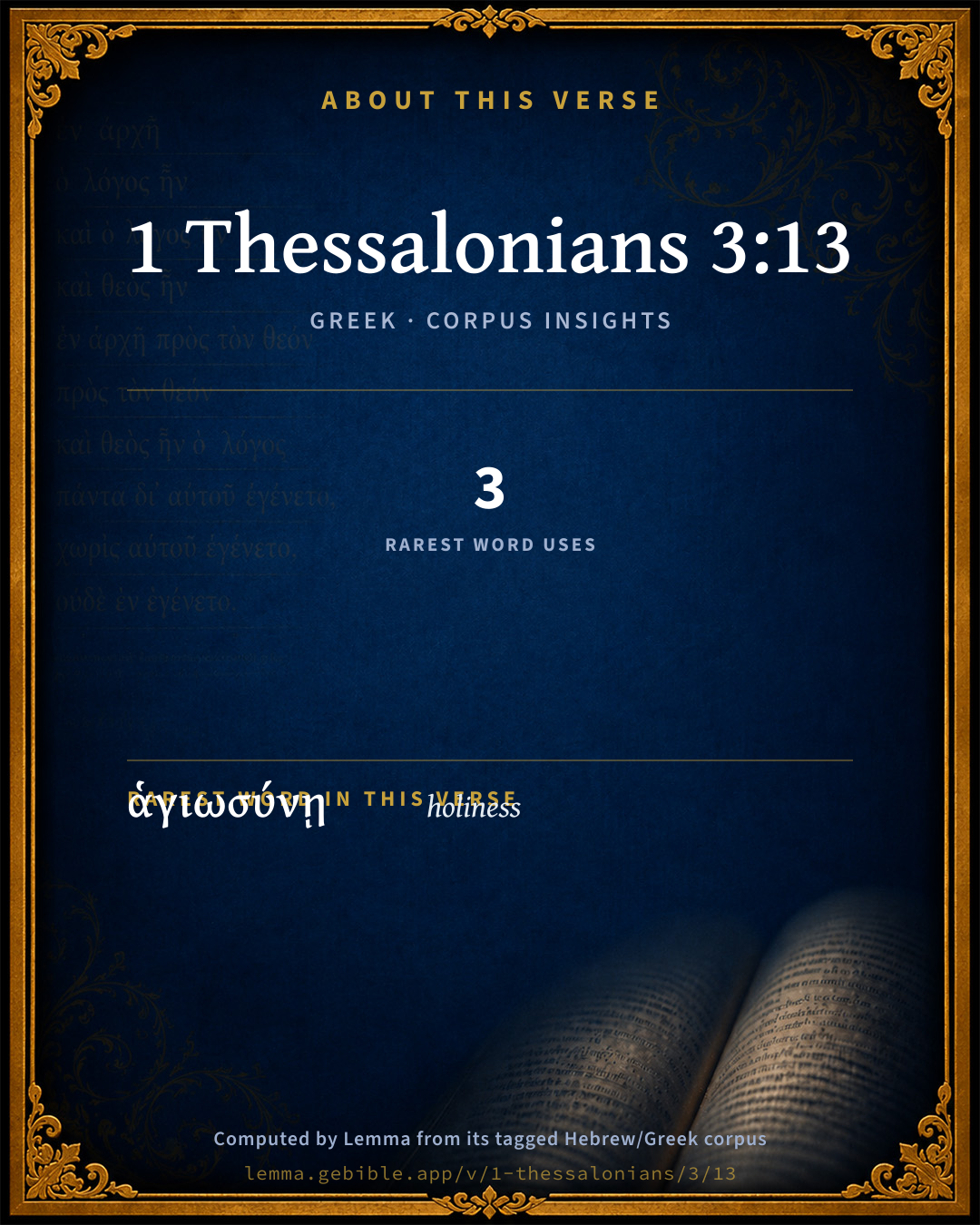
The rarest word here is ἁγιωσύνῃ holiness G42 — appearing just 3 times in the whole Greek New Testament.

Shared distinctive vocabulary

ἁγιωσύνῃ holiness G42 occurs in 3 verses of the Greek New Testament. Also found in:

Repetition

Words recur within this verse:

Cross-references

20

Topical passages linked to 1 Thessalonians 3:13 in the Treasury of Scripture Knowledge — connected by theme and wording, ordered by reader-vote popularity; previews shown in the World English Bible.

  • Colossians 1:22 yet now he has reconciled in the body of his flesh through death, to present you holy and without blemish and blameless before him,
  • 1 Thessalonians 5:23 May the God of peace himself sanctify you completely. May your whole spirit, soul, and body be preserved blameless at the coming of our Lord Jesus Christ.
  • Ephesians 5:27 that he might present the assembly to himself gloriously, not having spot or wrinkle or any such thing; but that it should be holy and without blemish.
  • 1 Thessalonians 2:19 For what is our hope, or joy, or crown of rejoicing? Isn't it even you, before our Lord Jesus at his coming?
  • 1 Corinthians 1:7–8 so that you come behind in no gift; waiting for the revelation of our Lord Jesus Christ;
  • Jude 1:14 About these also Enoch, the seventh from Adam, prophesied, saying, "Behold, the Lord came with ten thousands of his holy ones,
  • 1 Thessalonians 4:15 For this we tell you by the word of the Lord, that we who are alive, who are left to the coming of the Lord, will in no way precede those who have fallen asleep.
  • Jude 1:24 Now to him who is able to keep them from stumbling, and to present you faultless before the presence of his glory in great joy,
  • Zechariah 14:5 You shall flee by the valley of my mountains; for the valley of the mountains shall reach to Azel; yes, you shall flee, just like you fled from before the earthquake in the days of Uzziah king of Judah. Yahweh my God will come, and all the holy ones with you.
  • 1 Thessalonians 3:11 Now may our God and Father himself, and our Lord Jesus Christ, direct our way to you;
  • Deuteronomy 33:2 He said, Yahweh came from Sinai, Rose from Seir to them; He shined forth from Mount Paran, He came from the ten thousands of holy ones: At his right hand was a fiery law for them.
  • Philippians 1:10 so that you may approve the things that are excellent; that you may be sincere and without offense to the day of Christ;
  • Romans 16:25
  • 1 Corinthians 15:23 But each in his own order: Christ the first fruits, then those who are Christ's, at his coming.
  • 2 Thessalonians 1:10 when he comes to be glorified in his saints, and to be admired among all those who have believed (because our testimony to you was believed) in that day.
  • 2 Thessalonians 2:1 Now, brothers, concerning the coming of our Lord Jesus Christ, and our gathering together to him, we ask you
  • 2 Thessalonians 2:16–17 Now our Lord Jesus Christ himself, and God our Father, who loved us and gave us eternal comfort and good hope through grace,
  • 1 Peter 5:10 But may the God of all grace, who called you to his eternal glory by Christ Jesus, after you have suffered a little while, perfect, establish, strengthen, and settle you.
  • 1 John 3:20–21 because if our heart condemns us, God is greater than our heart, and knows all things.
  • Romans 14:4 Who are you who judge another's servant? To his own lord he stands or falls. Yes, he will be made to stand, for God has power to make him stand.

Cross-references courtesy of OpenBible.info (CC BY 4.0).

Where the printed editions differ

2 variants

Places in this verse where the major printed Greek editions disagree on the wording in a way that affects the translation — a comparison of editions, not a manuscript-by-manuscript collation. The editions are the modern critical texts (Nestlé-Aland 28/27, SBL, Westcott-Hort, Tregelles, Tyndale House) and the traditional texts behind the KJV (the Textus Receptus and the Byzantine/Majority text). It is not a claim about which reading is original.

  1. Extra text
    Χριστοῦ

    “Christ”

    In TRByz Not in NA28NA27TynSBLWHTreg

    Χριστοῦ (Christou) 'Christ' is only in traditional manuscripts (TR+Byz)

  2. Extra text
    ἀμήν.

    “Amen.”

    In NA28NA27 Not in TynSBLWHTregTRByz

    ἀμήν.¶ (amēn) 'Amen.' is only in older manuscripts (NA28+NA27)

Textual data: Translators Amalgamated Greek New Testament (STEPBible TAGNT) · CC BY 4.0.

Commentary

Notes on 1 Thessalonians 3:13 from classic Christian and Jewish commentators (each source and its license shown beneath its notes). The classic Christian expositions comment on the surrounding passage and are grouped to its opening verse, so a note may address several verses; the Jewish commentaries on the Tanakh (Rashi and others) are per-verse, so they appear only where the commentator wrote on this verse.

Lemma curates 59 commentaries, every one of them public domain or Creative Commons licensed, each selected and text-cleaned for this edition rather than reprinted as found. About our sources →

Tyndale Open Study Notes

Tyndale Open Resources

3:13 In the final part of this prayer (3:11-13), Paul prays that their hearts—their conduct and moral resolve (Matt 5:8; Acts 15:9; Heb 10:22)—might be strong, blameless, and holy. • When Jesus comes, he will be accompanied by all his holy people, possibly a reference to angels (Deut 33:2; Ps 89:5, 7; Dan 4:13; 8:13; Matt 13:41; Mark 8:38; 13:26-27; 2 Thes 1:7).

Tyndale Open Study Notes — © Tyndale Open Resources, licensed CC BY-SA 4.0. Text via the HelloAO Bible API.

Bengel's Gnomon

Johann Albrecht Bengel

1Th 3:13. Μετὰ, with) Construe with ἐν τῇ παρουσίᾳ, at the coming; comp. 2Th 1:7.—πάντων τῶν ἁγίων, with all the saints) This phrase comprehends angels and the elect of the earth.—αὐτοῦ, His) Christ’s, Act 9:13.

—————

Bengel's Gnomon of the New Testament — English translation (T&T Clark, Edinburgh, 1860) — public domain. Text from a community e-Sword module.

Meyer's Critical & Exegetical Commentary

Heinrich August Wilhelm Meyer

1Th_3:13. The final aim is derived from the wish, 1Th_3:12, because love is the fulfilling of the law (Rom_13:10), and the band of perfection (Col_3:14).

εἰς τὸ στηρίξαι] not so that (Pelt, Baumgarten-Crusius); also, not so much as καὶ στηρίξαι (Koppe), by which the words would only annex a new wish to the preceding. It is designed to introduce a majus, a greater, specifying the higher or final aim to which πλεονάζειν and περισσεύειν are to conduct. But the subject in στηρίξαι is not τὴν ἀγάπην (Oecumenius), but τὸν κύριον (which, however, is not, with Theophylact and Schrader, to be converted into the idea τὸ πνεῦμα), or, with the contingent spuriousness of ὁ κύριος in 1Th_3:12 : God and Christ, 1Th_3:11.

στηρίξαι denotes confirming, strengthening generally, not confirming in the faith (Flatt, Pelt), against which is the context.

τὰς καρδίας] Chrysostom: οὐκ εἶπεν ὑμᾶς στηρίξαι, ἀλλὰ τὰς καρδίας ὑμῶν. Ἐκ γὰρ τῆς καρδίας ἐξέρχονται διαλογισμοὶ πονηροί.

ἀμέμπτους] proleptic: so that you will be blameless. Comp. 1Co_1:8; Php_3:21 (according to the correct reading); Winer, p. 549 [E. T. 779]; Kühner, II. p. 121.

ἐν ἁγιωσύνῃ] belongs not to στηρίξαι, but to ἀμέμπτους, specifying the sphere in which the blamelessness is to be shown. The expression denotes the condition of holiness, comp. Rom_1:4; 2Co_7:1; erroneously Koppe: alias ἁγιασμός, and Olshausen: ἁγιωσύνη is the process of becoming holy, the result of which is ἁγιασμός.

ἔμπροσθεν τοῦ Θεοῦ] before God, according to His judgment, His judicial sentence, belongs neither to ἁγιωσύνῃ (Koppe, Pelt), nor to ἀμέμπτους (de Wette, Koch), but to the whole ἀμέμπτους ἐν ἁγιωσύνῃ.

μετὰ πάντων τῶν ἁγίων αὐτοῦ] Flatt, with whom Hofmann, in his Schriftbeweis, II. 2, ed. 1, p. 595, agrees (he construes the passage differently in ed. 2, p. 649, and in his H. Schr. N. T., without altering his interpretation of οἱ ἅγιοι), unites the clause with ἀμέμπτους ἐν ἁγιωσύνῃ: in order that ye may appear blameless on that day with all who are consecrated to God, who are the genuine members of His people, who truly honour God and Christ. So also Musculus; and also Benson and Olshausen (comp. also Bouman, Chartae theol. I. p. 81 ff.), although they do not construe with Musculus and Flatt, understand by ἅγιοι the earlier perfected believers. But the difficulty which impelled Flatt to this interpretation (and in which Schrader finds even an objection against the authenticity of the Epistle), namely, that ἅγιοι in the New Testament never denotes the angels when it is by itself, that is, without the addition of ἄγγελοι, vanishes, as(1) The advent is considered as glorified by the appearance of angels; comp. 2Th_1:7; Mat_16:27; Mat_25:31; Mar_8:38; Luk_9:26. (2) In the Old Testament without any further addition קְדֹשִׁים, and in the LXX. οἱ ἅγιοι, is a designation of the angels; comp. e.g. Zec_14:5; Dan_4:10; and therefore this current designation cannot surprise us in Paul. Also, what Hofmann in the above-mentioned place urges in favour of Flatts interpretation is without force. For to the probability of the three prepositions ἔμπροσθεν, ἐν, and μετά being used in a similar connection, is opposed the greater naturalness and easiness of the connection of μετὰ πάντων τῶν ἁγίων αὐτοῦ with the directly preceding ἐν τῇ παρουσίᾳ τοῦ κυρίου ἡμῶν Ἰησοῦ. And that also the connection supports Flatts explanation, since the brotherly love in which the Thessalonians are to grow finds its suitable reward in sharing at length the blessed fellowship of all the saints of God, so that hereby is already introduced what the apostle has particularly to teach the Christians of Thessalonica for their comfort, that those believers who fell asleep before the Advent of the Lord will not be wanting at it, can only be maintained without arbitrariness, if not only the explanation in 1Th_4:1-12, but the section 1Th_4:13 ff., be directly joined to 1Th_3:13; and then this section would be introduced with Οὐ θέλομεν γὰρ ὑμᾶς ἀγνοεῖν, instead of with Οὐ θέλομεν δὲ ὑμᾶς ἀγνοεῖν.

Moreover, the concluding word αὐτοῦ is more correctly referred to τοῦ Θεοῦ, than, with Pelt, Riggenbach, and others, to τοῦ κυρίου ἡμῶν Ἰησοῦ.

Meyer — Critical and Exegetical Commentary on the New Testament — English translation by Peter Christie, edited by Frederick Crombie (T&T Clark, 1880) — public domain. Text from a community e-Sword module.

Cambridge Greek Testament for Schools and Colleges

13. αμεμπ-τως, for -τους, BL: perhaps due to 1Th 2:10, 1Th 5:23. See Expository Note.

αγιοσυνῃ: this unusual spelling in B*DG—a frequent itacism (ο for ω). So DG in 2Co 7:1.

The closing αμην (WH, margin) is found in א*AD 37 43 d e vg cop: a strong combination of evidence; and transcriptional probability tells in support of the reading, for the “Amen” would seem premature in the middle of the Epistle. “Videtur αμην hoc loco offendisse” (Tisch.). BG and the Syrian witnesses, with some Latins, omit.

13. εἰς τὸ στηρίξαι ὑμῶν τὰς καρδίας ἀμέμπτους ἐν ἁγιωσύνῃ κ.τ.λ., to the end He may establish your hearts, (made) unblamable in holiness, &c.: the ultimate end (see note on εἰς τό with infin. 1Th 3:10) of the prayer for increased love in 1Th 3:12; such love will lead to confidence of heart in view of the coming of Christ in judgement. A like connexion of thought appears in 1Jn 3:18-21; 1Jn 4:16 f.: “Herein is love made perfect with us, that we may have boldness in the day of judgement.… Perfect love casts out fear.” The prayer for improved faith (1Th 3:10), leads to prayer for increased love (1Th 3:12), and now for assured hope (cf. 1Th 1:3). “Love” prepares for judgement as it imparts “holiness”; in this Christian perfection lies (see 1Th 5:23). Love and holiness are associated in the apostolic prayer, as (with reversed order) in the apostolic homily of 1Th 4:1-12. Ἀμέμπτους is attached, proleptically, as an objective complement to στηρίξαι τὰς καρδίας ὑμῶν, “found unblamable”: cf. for the construction, 1Co 1:8; Php 3:21 (σύμμορφον). Clearly some of those addressed in the exhortations immediately following (1Th 4:1-8) were not yet ἄμεμπτοι ἐν ἁγιωσύνῃ, as they must be ἐν τῇ παρουσίᾳ.

ἀμέμπτους … ἔμπροσθεν τοῦ θεοῦ καὶ πατρὸς ἡμῶν imports freedom from blame in God’s eyes, before whom believers in Christ will be presented at His coming: see Col 1:22; Col 1:28; 1Co 15:24; and cf. Php 2:15; Eph 1:4; 1Co 1:8; 2Pe 3:14. “Our God and Father” listens to the Apostles’ prayers for the welfare of His chosen (1Th 3:11; 1Th 1:4), and will delight hereafter to recognize them as His holy children. While ἁγιότης (2Co 1:12; Heb 12:10) denotes the abstract quality of “holiness,” ἁγιασμός the process, and then the result, of “making holy” (1Th 4:3; frequent in St Paul), ἁγιωσύνη is the state or condition of the ἅγιος (see note on this word below): cf. Rom 1:4; 2Co 7:1. This holy state is that toward which the love now vigorously active in the Thessalonians must grow and tend, so that their holiness may at Christ’s coming win God’s approval, the anticipation of which will give them a calm strength of heart in prospect of that tremendous advent (cf. 1Th 1:10; 2Th 1:7 ff.).

On στηρίζω, see note to 1Th 3:2. The phrase στηρίζειν καρδίαν is found in Jas 5:8, and in the O.T. (LXX) in Psa 103:15; Sir 6:37: it means not the strengthening of character, but the giving of conscious security, of a steady, settled assurance—the opposite of the condition deprecated in 1Th 3:3, or in 2Th 2:2. On καρδία, see note to 1Th 2:17.

The last clause, ἐν τῇ παρουσίᾳ κ.τ.λ., might be attached grammatically to στηρίξαι, as by Bornemann, the whole sentence being thus rendered: “so as to give you steadfast hearts—hearts unblamable in holiness before our God and Father—in the coming of our Lord Jesus Christ with all His saints”; the words implying that the desired assurance is to be realized at the hour of the Lord’s appearing. But this is somewhat forced in construction; and the στηρίζειν thought of in 1Th 3:2, as in 2Th 2:17, relates to no future and prospective assurance of heart, but to that which is needed now, in the midst of present trials and alarms (1Th 3:3 ff.; 2Th 2:2, &c.). “The coming” of the Judge will reveal the blamelessness in question—ἀμέμπτους … ἐν τῇ παρουσίᾳ (cf. Rom 8:18 f.; 1Co 3:13; 1Co 4:5; 2Co 5:10; Col 3:4), unblamable … in the appearing, &c.; but the holy character then disclosed exists already in the saints, who thus prepared joyfully await their Lord’s return (see Luk 12:35-46). St Paul was sensible of such readiness in his own case (2Co 1:12; Php 1:19-21; 2Ti 4:7 f.; cf. 2Pe 3:14). The παρουσία is the goal of all Christian expectation in the N.T.—the crisis at which character is assayed, and destiny decided; see, in particular, 2Th 1:5-12; 2Th 2:13 f.; and our Lord’s parables of the Wedding Feast and Robe, and of the Lighted or Unlit Lamps (Mat 22:11-13; Mat 25:1-13).

That “our Lord Jesus comes (attended) with all His saints”—μετὰ πάντων τῶν ἁγίων αὐτοῦ—is explained in 1Th 4:14-16. These are not the “angels” of 2Th 1:7 (see note); οἱ ἅγιοι denotes always with St Paul holy men (2Th 1:10, and passim): here the holy dead, who will “rise first” and whom “God will bring with Him”—with Jesus—when He returns to His people upon earth. To be fit for this meeting (ἡμῶν ἐπισυναγωγή, 2Th 2:1), Christians must be “blameless in holiness”; only the holy can join the holy. Hofmann, and a few others, connect μετὰ τῶν ἁγίων with ἀμέμπτους ἐν ἁγιωσύνῃ instead of παρουσίᾳ—“blameless in holiness … along with His holy ones”; but this construction appears artificial, and misses the thought developed in 1Th 4:13-18, which is already in the writer’s mind, viz. that Christ will be attended in His παρουσία by the sainted Christian dead. For the word παρουσία, see note on 1Th 2:19; and for the name “Lord Jesus,” see 1Th 2:15; 1Th 2:19.

Cambridge Greek Testament for Schools and Colleges (Cambridge University Press, 1896; 21 vols, various authors incl. Carr, Maclear, Plummer, Farrar, Lumby, Moule, M. R. James, Simcox) — public domain. Text from a community e-Sword module.

Jamieson, Fausset & Brown

Robert Jamieson, A. R. Fausset & David Brown

your hearts--which are naturally the spring and seat of unholiness.

before God, even our Father--rather, "before Him who is at once God and our Father." Before not merely men, but Him who will not be deceived by the mere show of holiness, that is, may your holiness be such as will stand His searching scrutiny.

coming--Greek, "presence," or "arrival."

with all his saints--including both the holy angels and the holy elect of men (Th1 4:14; Dan 7:10; Zac 14:5; Mat 25:31; Th2 1:7). The saints are "His" (Act 9:13). We must have "holiness" if we are to be numbered with His holy ones or "saints." On "unblameable," compare Rev 14:5. This verse (compare Th1 3:12) shows that "love" is the spring of true "holiness" (Mat 5:44-48; Rom 13:10; Col 3:14). God is He who really "stablishes"; Timothy and other ministers are but instruments (Th1 3:2) in "stablishing."

Next: 1 Thessalonians Chapter 4

Jamieson, Fausset & Brown — Commentary Critical and Explanatory on the Whole Bible (1871) — public domain (CC PDM 1.0). Text via the HelloAO Bible API.

Adam Clarke's Commentary

Verse 13. To the end he may establish your hearts] Without love to God and man, there can be no establishment in the religion of Christ. It is love that produces both solidity and continuance. And, as love is the fulfilling of the law, he who is filled with love is unblamable in holiness: for he who has the love of God in him is a partaker of the Divine nature, for God is love.

At the coming of our Lord] God is coming to judge the world; every hour that passes on in the general lapse of time is advancing his approach; whatsoever he does is in reference to this great event: and whatsoever we do should be in reference to the same. But who in that great day shall give up his accounts with joy? That person only whose heart is established in holiness before God; i.e., so as to bear the eye and strict scrutiny of his Judge. Reader, lay this to heart, for thou knowest not what a moment may bring forth. When thy soul departs from thy body it will be the coming of the Lord to thee.

Adam Clarke's Commentary on the Bible (1810–1826) — public domain. Text from a community e-Sword/MySword module.

John Calvin's Commentaries

13 That he may confirm your hearts. He employs the term hearts here to mean conscience, or the innermost part of the soul; for he means that a man is acceptable to God only when he brings holiness of heart; that is, not merely external, but also internal. But it is asked, whether by means of holiness we stand at God’s judgment-seat, for if so, to what purpose is remission of sins? Yet Paul’s words seem to imply this — that their consciences might be irreproveable in holiness. I answer, that Paul does not exclude remission of sins, through which it comes that our holiness, which is otherwise mixed up with many pollutions, bears God’s eye, for faith, by which God is pacified towards us, so as to pardon our faults, precedes everything else, as the foundation comes before the building. Paul, however, does not teach us what or how great the holiness of believers may be, but desires that it may be increased, until it attain its perfection. On this account he says — at the coming of our Lord, meaning that the completion of those things, which the Lord now begins in us, is delayed till that time.

With all his saints. This clause may be explained in two ways, either as meaning that the Thessalonians, with all saints, may have pure hearts at Christ’s coming, or that Christ will come with all his saints. While I adopt this second meaning, in so far as concerns the construction of the words, I have at the same time no doubt that Paul employed the term saints for the purpose of admonishing us that we are called by Christ for this end—that we may be gathered with all his saints. For this consideration ought to whet our desire for holiness.

John Calvin's Commentaries (1540-1563) — public domain. Text from the Calvin Translation Society English edition (1840s-50s) via the Christian Classics Ethereal Library (ccel.org). Calvin's coverage is partial (roughly two-thirds of the Bible); uncommented books and verses are honest gaps, never fabricated. The 19th-century editor's footnotes and remarks are omitted so the notes are faithfully Calvin's own voice.

Ellicott's Commentary for English Readers

(13) To the end.—A beautiful connection of thought. Perfect and settled sanctification in the eyes of God is the object in view, and the means by which it is to be attained is growing and overflowing love toward mankind. (See Col_3:14.) St. Paul is already thinking, probably, how he shall treat the subject of chastity in the next chapter. (See Note on 1Th_4:6.)

Before God . . . at the coming.—The hearts are to be unblamably holy before God—not only all through life, but also at the Judgment Day, when Jesus Christ is to judge us in the Father’s presence. Though He has “committed all judgment unto the Son” (Joh_5:22), yet the judgment is His own, and the Son is the agent by whom He judges, just as He is the agent by whom He creates (see Act_17:31): therefore in that day it is in the Father’s sight rather than in the Son’s (though there can be no divergence between Them) that we are to be able to clear ourselves.

With all his saints—i.e., attended by them:-

“Thousand, thousand saints attending,

Swell the triumph of His train.”

The word might possibly be stretched to include the holy angels (Deu_33:2; Dan_4:13, et al.); but here we may more probably suppose that St. Paul is anticipating his teaching of 1Th_4:14, and besides, the Greek seems almost to indicate that these “saints” are to be assessors in the judgment—an honour to be given only to holy men. (Comp. Luk_22:30; Joh_5:28; 1Co_6:3, et al.)

A Bible Commentary for English Readers, edited by Charles John Ellicott (1878–1897) — public domain. Text from a community e-Sword module.

The Cambridge Bible for Schools and Colleges

gen. ed. J. J. S. Perowne

13. to the end he may stablish your hearts] On “stablish” see note to 1Th_3:2; and on “hearts,” ch. 1Th_2:4; comp. also 2Th_2:17.

This is an O.T. phrase, found in Psa_104:15, “Bread that strengtheneth (Greek, stablisheth) man’s heart”; and Psa_112:8, “His heart is established, he shall not be afraid.” The only N.T. parallel is in Jas_5:8, “Be patient; stablish your hearts; for the coming of the Lord is at hand.” In all these places it signifies the imparting of conscious strength; and denotes here, therefore, not so much a making firm or steadfast in character, but giving a firm confidence, a steadfast and assured heart (contrast the language of 2Th_2:2). This would be the effect of the abounding love prayed for in the last verse. The Apostle’s thought runs in the same groove as St John’s in 1Jn_3:18-21 and 1Jn_4:16-17, “Herein is love made perfect with us, that we may have boldness in the day of judgement.… Perfect love casteth out fear.” The Church was living in the expectation of Christ’s speedy return to judgement, a prospect before which the heart naturally quails; in order to “assure their hearts before Him,” the Thessalonian believers must increase and abound in love. “Love” is the one thing that “never faileth” (1Co_13:8). Ch. 1Th_4:13; 1Th_4:18, and 1Th_5:14 show that courage and joyous confidence in Christ were wanting in some members of this Church.

The words unblameable in holiness form, then, a secondary predicate of the sentence: “to the end He may establish your hearts, making them unblameable,” or “so as to be unblameable in holiness before our God,” &c. The clause appears to be proleptic, or anticipatory (comp. 1Co_1:8; Php_3:21). Similarly in ch. 1Th_5:23 the keeping of “spirit, soul and body” prayed for belongs to the present, but unblameably carries our thoughts at once to “the coming of our Lord Jesus Christ” (see note). We take the Apostle’s thought, amplified, to be this: “May the Lord make you to abound in love … so that you may have the confidence and strength of heart in which abiding you will be found blameless in holiness before God at Christ’s coming.” This blamelessness will be manifest at the coming of the Judge; but it is imparted already, and belongs to those whose hearts are filled with love to their fellow-men, and so with confidence toward God (comp. again 1Jn_4:16-17); in which confidence they anticipate the day when they shall be found “holy and without blemish before Him.” This assurance of heart resembles St Paul’s, expressed in 2Co_1:12 : “Our glorying is this, the testimony of our conscience that in holiness and sincerity of God we have behaved ourselves in the world.” Such confidence must always be guarded by strict self-scrutiny and absolute dependence upon Christ. It was encouragement, however, rather than caution that St Paul’s readers just now required (see 1Th_3:2). This verse and the last set forth Christian perfection in its twofold aspect, as constituted at once by an unbounded love to men and a blameless consecration to God.

On “holiness” see notes to ch. 1Th_4:3; 1Th_4:7, also 1Th_2:10.

This “blamelessness” of the Thessalonians will be approved before our God and Father, Who listens to the Apostle’s prayers and thanksgivings and witnesses his joy on their account (1Th_3:9, ch. 1Th_1:3), and delights to see the good pleasure of His will accomplished in His children. He, the Trier of hearts (ch. 1Th_2:4), permits them now through Christ, and will surely permit them hereafter to stand in His presence with hearts unafraid—in the coming of our Lord Jesus with all His saints.

This is the goal of the Apostle’s prayers and labours for the Church (comp. ch. 1Th_2:19; 1Th_5:23; 2Th_1:11-12); and the aim of the hopes and strivings of the Thessalonian believers (ch. 1Th_1:3; 1Th_1:10; 1Th_4:13; 1Th_5:11; 2Th_1:5, &c.). He prays that they may be able with good right to look forward confidently toward that Day, trusting not to be “ashamed before Him at His coming” (1Jn_2:28; 1Jn_3:3). On the title “Lord Jesus” see notes to 1Th_3:11, and ch. 1Th_2:15; 1Th_2:19; and on “coming” (parousia), ch. 1Th_2:19.

Observe that “the Lord” (Christ) is the Agent of all that is set forth in 1Th_3:12-13. Christ fills His people’s hearts with love and sanctifies them by His Spirit, so that at the last He may present them to the Father as His joy and crown. Then He will be “glorified in His saints, and admired in all them that believed” (2Th_1:10-12).

His saints (or holy ones) are those, “unblameable in holiness,” whom Christ will acknowledge and associate with Himself at His coming. These last words have been shaping the Apostle’s prayer all along. To those who possess abundantly the spirit of love (1Th_3:12) the hope is given of being found amongst the “holy ones,” approved by God, who will attend the Lord Jesus on His glorious return to earth. Christ will not then be solitary, but will have a vast retinue of “the saints,” visible in forms of splendour like His own (Php_3:20-21) and “with Him in glory” (Col_3:4). For this association of the returning Saviour and His saints, see further ch. 1Th_4:14; 1Th_4:17, and notes; 1Th_5:10; and 2Th_2:1, “The coming of our Lord Jesus Christ, and our gathering together unto Him.”

The Cambridge Bible for Schools and Colleges (gen. ed. J. J. S. Perowne; Cambridge University Press, 1878–1918) — public domain. Text from a community e-Sword module.

John Gill's Exposition

To the end he may stablish your hearts,.... Which are very unstable and inconstant in their frames, and in the exercise of grace, and have need to be established in the love of God, against the fears of men, the frowns of the world, the temptations of Satan, and in, and with the doctrines of grace; See Gill on Th1 3:2,

unblamable in holiness before God, even our Father. There is no holiness in men naturally; what is in them without the grace of God is only a show; true holiness is from the Spirit of God; and this is a stable thing in itself, and can never be removed or taken away; but the acts of it, through the prevalence of corruption, the force of Satan's temptations, and the snares of the world, are fickle and inconstant; and the saints need to be established in the discharge of duty, as well as in the exercise of grace: and whereas the apostle prays, that they might be "unblamable in holiness", the Alexandrian copy reads, "in righteousness" so one of Stephens's; it must be observed, that no man is perfectly holy in this life; no man is without sin in himself, or lives without the commission of it; holiness in the best is imperfect; no man, as yet, is in himself sanctified wholly; there is no unblamable holiness but in Christ; and in him the saints are without spot and blemish, who is their sanctification and their righteousness; but in themselves they are full of spots and stains; yet through the grace of God their hearts may be so established with principles of holiness, and they may be so assisted in the acts of it daily, as to give no just cause of blame to men, and so to behave as to approve themselves "before God", who sees the heart, and knows from what principles all actions flow: and this the apostle desires may be at the coming of our Lord Jesus; or unto the coming of him, as in Th1 5:23 Either at death, when he comes into his garden, and gathers his lilies, and takes his to himself to be for ever with him; or at the day of judgment, when he comes to judge the quick and dead; and which coming of his is certain, and will be quickly and suddenly, and with great glory and power: and, as it is here added,

with all his saints; meaning either his holy angels, or rather the souls of his people, whom he will bring with him, and will raise their dead bodies, and reunite them to their souls, when they shall be for ever with him; and then shall they be unblamable in holiness, both in soul and body, and shall be presented by him, first to himself, and then to his Father, faultless, and without spot, or wrinkle, or any such thing. The Vulgate Latin, Arabic, and Ethiopic versions add, "Amen"; and so does Beza's ancient copy, and the Alexandrian manuscript.

Next: 1 Thessalonians Chapter 4

John Gill's Exposition of the Whole Bible (1746–1763) — public domain (CC PDM 1.0). Text via the HelloAO Bible API.

Trapp's Complete Commentary

John Trapp

13 To the end he may stablish your hearts unblameable in holiness before God, even our Father, at the coming of our Lord Jesus Christ with all his saints.

Ver. 13. To the end he may stablish] Love is of a ferruminating, establishing property. That grace will not hang together, nor hold out, that is severed from charity.

John Trapp, A Commentary or Exposition upon All the Books of the Old and New Testament (1647–1656) — public domain. Text from a community e-Sword module.

Albert Barnes' Notes on the Bible

To the end he may stablish your hearts - That is, “may the Lord cause you to increase in love 1Th 3:12, in order that you may be established, and be without blame in the day of judgment.” The idea is, that if charity were diffused through their hearts, they would abound in every virtue, and would be at length found blameless.

Unblameable - See the 1Th 1:10 note; Phi 2:15; Phi 3:6 notes; Heb 8:7 note; compare Luk 1:6; 1Th 5:23. The meaning is, so that there could be no “charge” or “accusation” against them.

In holiness - Not in outward conduct merely, or the observance of rites and forms of religion, but in purity of heart.

At the coming of our Lord Jesus Christ - To judge the world; notes, 1Th 1:10. As we are to appear before him, we should so live that our Judge will find nothing in us to be blamed.

With all his saints - With all his “holy ones” - τῶν ἁγίων tōn hagiōn. The word includes his “angels,” who will come with him Mat 25:31, and all the redeemed, who will then surround him. The idea is, that before that holy assemblage it is desirable that we should be prepared to appear blameless. We should be fitted to be welcomed to the “goodly fellowship” of the angels, and to be regarded as worthy to be numbered with the redeemed who” have washed their robes and have made them pure in the blood of the Lamb.” When we come to appear amidst that vast assemblage of holy beings, the honors of the world will appear to be small things; the wealth of the earth will appear worthless, and all the pleasures of this life beneath our notice. Happy will they be who are prepared for the solemnities of that day, and who shall have led such a life of holy love - of pure devotion to the Redeemer - of deadness to the world - and of zeal in the cause of pure religion of universal justice, fidelity, honesty, and truth, as to be without reproach, and to meet with the approbation of their Lord.

Albert Barnes' Notes on the Bible (1834–1885) — public domain. Text from a community e-Sword/MySword module.

Matthew Poole's English Annotations

These words some refer only to the verse immediately preceding: by increasing and abounding in love, their hearts would be established unblamable in holiness. Which is true, for that holiness is justly to be suspected, at least is to be blamed, which is without love to men. And love itself is a great part of holiness; and who will blame holiness when it shines forth in love? Yea, it will be unblamable before God and men. And when God doth cause a people to increase in love, he doth hereby establish them in holiness that is unblamable; where love is wanting the heart is not established. The hypocrite will fall off in an hour of temptation, because he wants love; and though he may for a while make a fair show before men, yet he is not unblamable before God, who searcheth the heart: neither will he be found so at the appearance of Jesus Christ; which the apostle prays for here with respect to these Thessalonians, that they might be established in holiness until the coming of Christ; or that they might be found unblameable in holiness at his coming. Whereby the apostle signifies there is yet another coming of Christ, when there will a strict trial pass upon men, and therefore the saints should labour to be then found unblamable, or without spot and blemish, as 2Pe 3:14.

At the coming of our Lord Jesus Christ with all his saints; whereof he gives a particular account in the next chapter. Others carry this verse as referring also to 1Th 3:10, where he desired to see their face to perfect their faith, that both by their faith and love they might be established unblamable in holiness.

Matthew Poole's English Annotations on the Holy Bible (1683–1685) — public domain. Text from a community e-Sword/MySword module.

Whedon's Commentary on the Bible

Daniel D. Whedon

13. Unblameable in holiness—Not as Olshausen interprets, that holiness which consists in Christ in us, invisible here but made visible hereafter; nor in the perfect keeping of the Christless law; but in a personal holiness wrought in us by Christ, whereby we are enabled so to avoid sin and so to live in a perfect repentance for all infirmities as to receive the ever continuing, forgiving power of Christ’s blood, and a continuous uncondemning acceptance with God.

At the coming—And this personal holiness, wrought by the cross of Christ, can stand scrutiny at the throne of Christ. He who is in perpetual forgiveness of us here, will not condemn us there. Since he will see that all our blamelessness, though attained by us, is wrought by him.

With all his saints—Bringing their blessed spirits from Paradise to the resurrection scene. But in the Old Testament, as Olshausen remarks, the term for saints, holy ones, “undeniably means angels, as in Psa_89:7; Zec_14:5; Dan_8:13; Dan_9:20. Besides, angels are named as accompanying Christ in his advent. Mat_16:27; Mat_25:31; 2Th_1:7; Jud_1:14.”

Daniel D. Whedon (gen. ed.), Commentary on the Old and New Testaments (1874–1909) — public domain. Text from a community e-Sword module.

The Pulpit Commentary

To the end (in order that) he may establish your hearts unblamable in holiness before God. In the sight of God, in his judgment who searcheth the hearts. The words, "before God," are to be conjoined neither with "holiness" nor with "unblamable," but with the whole phrase, "unblamable in holiness." Even our Father, at the coming of our Lord Jesus Christ; at the second advent. With all his saints. By "saints" or "holy ones" are by some understood the angels who shall accompany Christ to judgment; but although the term "saints" is used of the angels in the Old Testament, it is never so employed in the New. The word seems to denote those holy men who have died in the Lord and who shall be raised at the advent, and accompany Christ to the judgment.

The ultimate end of the Christian dispensation.

The establishment of believers in holiness before God at the advent of Christ is the ultimate design of Christianity. Or, as Paul elsewhere expresses the same truth, "Christ loved the Church, and gave himself for it; that he might sanctify and cleanse it with the washing of water by the Word, that he might present it to himself a glorious Church, not having spot, or wrinkle, or any such thing; but that it should be holy and without blemish". (Eph_5:26, Eph_5:27) And again, "That ye may be blameless in the day of our Lord Jesus Christ". (1Co_1:8) What a glorious consummation! What a perfection of holiness! When faith and love will both be perfect; when all that is lacking in our faith will be supplied; and all that is defective in our love will be remedied; and when the whole Church will be presented faultless and blameless before God; when sin and moral imperfection will be forever excluded! Divine culture.

God is carrying on a process of culture with his people, training, educating, and forming them according to his own ideal of humanity. To ignore this process while admitting the merciful kindness of God in other respects is to take a low view both of providence and of Christianity. To recognize it is to do much towards lightening the burdens and the mystery of all this unintelligible life. For pain, temptation, and disappointment can be better borne when we know that the end of God"s dealings with us is not our enjoyment of present ease, but our education in character.

I THE SUBJECT OF DIVINE CULTURE. "Your hearts." The education that secures good habits is a shallow training if it leaves the source and spring of conduct untouched. It may drill; it cannot discipline. Neither is the mere infusion of knowledge, nor even this with the addition of the cultivation of taste and the development of mental energy, the great requisite in God"s culture. He aims at renewing and purifying the heart. He is not satisfied with decorous conduct as a mask for a corrupt heart. But, having secured purity of heart, he knows that right conduct will follow. Moreover, if the external act may appear to men questionable, God, reading the heart, accounts his people blameless when the motive is good.

II THE CHARACTER MOULDED UNDER DIVINE CULTURE. Unblamable in holiness.

1. It is holiness. God does not satisfy himself with the forgiveness of the past; we should not be satisfied with that. He aims at the real and positive holiness of his people. Holiness is more than dutifulness, more than virtue. It includes these human types of goodness, but it goes beyond them. It goes down to thought, affection, and conduct, seeking clean hands and a pure heart. It rises to the character of God himself. Holiness is godlike goodness, as virtue is human goodness.

2. This holiness is to be unblamable. It is to be perfect. It is to stand the test of a searching scrutiny. Yet it is not a barren negative purity. For we may be blamed for sins of omission as much as for sins of transgression. It is the unprofitable servant who is cast into the outer darkness. To be unblamable we must faithfully discharge our trust.

III THE STANDARD AIMED AT IN DIVINE CULTURE. The holiness is to be unblamable before our God and Father at the coming of our Lord Jesus with all his saints.

1. God is satisfied with no less holiness than such as is pure in Ms own sight. Our standard is low because our conscience is corrupt. The height of God"s aim is only to be measured by the loftiness of his own character, Nevertheless, be it remembered God will expect no more of us than is humanly possible. The gardener aims at producing a perfect flower up to

2. his own ideal, but still only up to his own ideal of what a flower should be; he does not seek in it the properties of animal or man.

3. The test is to be applied at the coming of Christ with his saints. They come to judge the world.

IV THE STABILITY SECURED BY DIVINE CULTURE. Stablish your hearts." High culture often produces a result which is brief in proportion to its excellence. The forced hot-house flower soon fades. Knowledge acquired simply to meet an examination is quickly forgotten. This is not education. God aims at more than the momentary elevation of rare seasons of grace. He will have a firm and lasting character a spiritual life which is also an eternal life.

V THE MEANS EMPLOYED FOR DIVINE CULTURE. Ver. 12 describes this. It is an increasing and abounding love. Holiness springs from love. They greatly err who seek it in the lonely and chill altitudes of an inhuman saintliness. By mutual Christian love, and by a broad, practical love of mankind, we are trained in the purity which may be at last quite blameless, even in the sight of God. W.F.A.

The Pulpit Commentary (1880–1919), ed. H.D.M. Spence-Jones & Joseph S. Exell — public domain. Text from a community e-Sword module.

John Wesley's Explanatory Notes

With all his, Christ's, saints - Both angels and men.

John Wesley, Explanatory Notes Upon the Whole Bible (1754–1765) — public domain. Text via the GEBible commentary corpus.

Burkitt's Expository Notes on the New Testament

William Burkitt

Here a particular and special reason is assigned, why he prayed so fervently for their abounding in love, namely, in order to their establishment in faith and holiness; teaching us, that as true love evidences the co-existence of all graces, so it gives stability and establishment to all graces.

Learn hence, 1. That growth in grace is accompanied with stability both in faith and holiness.

2. That a general and abounding charity, being that by which we become most like unto God, tends exceedingly to our establishment in all grace, and renders us unblameable before God, at the appearance of Christ.

Learn, 3. That there will be no possibility of appearing unblameable before Christ at his coming, without the love and practice of universal holiness in our Christian course.

Learn, 4. That the perfecting of a saint’s graces, and rendering him altogether unblameable, without spot or imperfection in grace and holiness, is reserved till Christ’s coming. Then, and not till then, shall our holiness be perfected, our love improved to a seraphim’s likeness, all burning; then shall we obey with vigour, praise with cheerfulness, delight in God above measure, fear him without torment, trust him without despondency, serve him without lassitude and weariness, without interruption or distraction, and be perfectly like unto him, as well in holiness as in happiness, as well in purity as in immortality.

Come, then, Lord, down to me, Or take me up to thee.

William Burkitt's Expository Notes on the New Testament (1700–1703) — public domain. Text from a community e-Sword module.

McGarvey & Pendleton's Commentaries

J. W. McGarvey

to the end he may establish your hearts unblamable in holiness before our God and Father, at the coming of our Lord Jesus with all his saints . [The "you" of verse 12 is emphatic, and stands in contrast with "our" of verse 11, as though Paul said "the Lord direct our way to you, but whether he does so or not, may he prosper you, causing your love to grow and abound, even as we grow in love toward you, that by love (though ye may lack somewhat of instruction) ye may be so established that no one can lay anything to your charge when the Lord Jesus comes." The Epistles to the Thessalonians have many such brief prayers ( 1Th_3:11 ; 1Th_5:23 ; 2Th_1:11 ; 2Th_2:16 ; 2Th_3:5-16 ). In verse 11, and also at 2 Thess 2:16-17; while we have God and Jesus for nominatives, yet the accompanying verb is in the singular, thus showing the oneness or unity of God. The love which Paul here asks for is Christian love. "This," says Theophylact, "is the character of divine love to comprehend all; whereas human love hath respect to one man, and not to another." Since the word "saints" (literally, holy ones) is used in the Old Testament to include angels, it is likely that they are included here, for Paul's words are, no doubt, an indirect quotation of Zec_14:5 ]

J. W. McGarvey (with Philip Y. Pendleton), Commentaries on the New Testament (The Fourfold Gospel, 1914; Acts; and the epistles) — public domain. Text from a community e-Sword/MySword module.

The People's New Testament

B. W. Johnson

13. To the end he may stablish your hearts. Love shed abroad in their hearts would have this effect, and fit them for every duty and trial. He that loveth supremely fulfill the whole law.

B. W. Johnson's The People's New Testament with Notes (1889–1891) — public domain. Electronic text from the Christian Classics Ethereal Library (CCEL) ThML edition.

Alford’s Greek Testament

Henry Alford

13.] εἰς τὸ στηρίξαι—the further and higher aim of πλεον. κ. περισσ.—in order to confirm (i.e. εἰς τὸ τὸν κύριον στηρίξαι—‘in order that He may confirm’) your hearts (not merely ὑμᾶς: ἐκ γὰρ τῆς καρδίας ἐξέρχονται διαλογισμοὶ πονηροί, Chrys.) unblameable (i.e. so as to be unblameable: cf. reff. and εἰσόκε θερμὰ λοῦτρα θερμήνῃ, Il. ξ. 6,—εὔφημον, ὦ τάλαινα, κοίμησον στόμα, Æsch. Ag. 1258,—τῶν σῶν ἀδέρκτων ὀμμάτων τητώμενος, Soph. Œd. Col. 1200) in holiness (belongs to ἀμέμπτ.,—the sphere in which the blamelessness is to be shewn:—not to στηρίξαι) before (Him who is) God and our Father (or our God and Father. This ensures the genuineness of this absence of blame in holiness: that it should be not only before men, but also before God), at (in) the coming, &c.

ἁγίων—we need not enter into any question whether these are angels, or saints properly so called: the expression is an O. T. one,—Zach. 14:5, LXX,—and was probably meant by St. Paul to include both. Certainly (2Th 1:7. Mat 25:31, al.) He will be accompanied with the angels: but also with the spirits of the just, cf. ch. 4:14.

Henry Alford, The Greek Testament (1849–1861) — public domain. Text from a community e-Sword module.

International Critical Commentary

13. εἰς τὸ στηρίξαι κτλ. The purpose of the prayer (εἰς το; cf. Rom 15:13) for love is that Christ (τὸν κύριο is the subject of στηρίξα) may strengthen not their faith (v. 2) but their hearts, their inward purposes and desires, with the result that these hearts may be blameless (cf. 2:10) in the realm of holiness. The point appears to be that without the strong foundation of love the will might exploit itself in conduct not becoming to the ἅγιο, that is, specifically, as 4:3-8 suggests, in impurity. ἁγιωσύν denotes not the quality (ἁγιότη), or the process (ἁγιασμό), but the state of being ἅγιο, that is, separate from the world and consecrated to God both in body and in soul (5:23).

Some comm. (e. g. Flatt, Pelt, Find., Dob.), influenced doubtless by v. 2, where, however, the στηρίξα is specifically stated to be ὑπὲρ τῆς πίστεως ὑμῶ, are inclined to think of the strengthening of faith to meet trails, a strengthening resulting in holiness. στηρίζειν καρδία (II 2:17, Psa 111:8, Sir. 6:37, 22:16, Jas 5:8) differs from στηρίζειν ὑμᾶ (v. 2) only in the expressed emphasis upon the inner life; cf. παρακαλεῖ with ὑμᾶ (v. 2) and with καρδία (II 2:17). There is no indication here of fear as the opposite of στηρίζειν καρδία (sir. 22:16, Psa 111:8) or of the thought of perfect love castig out fear (1Jn 4:17 ff.). ἀμέμπτου agrees with καρδία; to be supplied is either ὥστε αὐτὰς εἶνα or εἰς τὸ εἶναι αὐτά; cf. ὁλοτελεῖ (5:23), ἀνεγκλήτου (1Co 1:8) or σύμμορφο (Php 3:21). The reading ἀμέμπτω (Bl et al.; cf. 2:10, 5:23) is due either to the verb or to a difference of spelling (Zim). ἁγιότη is rare in Gk. Bib. (2Co 1:12, Heb 12:10, Heb 12:2 Mac. 15:2); ἁγιωσύν in more frequent (Rom 1:4, 2Co 7:1, 2Co 7:2 Mal 3:12, Psa 29:5, Psa 95:6, Psa 96:12, Psa 144:5); and ἁγιασμό (4:3, 4, 7, II 2:13) is still more frequent (about ten times in Lxx and ten times in N. T.; cf. Rom 6:19, etc.). BDEGF read ἁγιοσύνῃ א and the corrected B ἁγιωσύνῃ, “the usual change of and ” (Weiss); but A has δικαιοσύνῃ On the idea of holiness, see SH on Rom 1:7 and Skinner and Stevens in HDB II, respectively, 394 ff. and 399 ff.

ἔμπροσθεν κτλ. Only those whose love inspires purposes that are blameless in the sphere of holiness will find the day of the Lord a day not of warth (1:10, 2:16) but of salvation (5:9). In the light of v. 9, the reference might seem to be (cf. Chrys.) to a holiness not in the sight of men but “before our God and Father” (see on 1:3); but in view of the next prepositional phrase, “in the coming of our Lord Jesus” (cf. 2:19), it is evident that the day of the Lord is in mind when all must come before the βῆμ of Christ (2Co 5:10) or God (Rom 14:10) or both, when the same Father who demands holy love will test the hearts to see if they are free from blame in the realm of holiness.

μετὰ πάντων τῶν ἁγίων αὐτου. “With all his holy ones.” Whether ἅγιο refers to angels or to saints is uncertain. (1) In favour of “angels” is the immediate connection with παρουσίᾳ, the time when Christ comes down from heaven at the voice of an archangel (4:16), μετʼ ἀγγέλων δυνάμεως αὐτου (II 1:7). The picture of the accompanying retinue of angels is similar to that in Mar 8:38, Mat 25:31 and Jud 1:14 = Enoch (Gk.) 1:9. the αὐτου, as Mat 16:27, Mat 24:31 suggest, refers to Christ. Paul may have had in mind Zec 14:5: ἥξει ὁ κύριος μου καὶ πάντες οἱ ἅγιοι μετʼ αὐτου (2) In favour of “saints” is the usage of the N. T. where, apart from this passage, ἅγιο = “saints”; the fact that πάντες οἱἅγιο is a common turn in Paul (cf. οἱ ἅγιοι αὐτου Col 1:26); and possibly the fact that Did. 16:7 interprets Zec 14:5 of the saints. In this case, because of the difficulty of conceiving the surviving saints coming with the Lord at his Parousia, and because of the difficulty, due to πάντε, of contrasting the departed and the living saints, it is necessary to place the scene implied by μετὰ πάντων κτλ not immediately at the Parousia, as the present context seems to suggest, but later, namely, at the judgment, when Christ comes with all his consecrated ones, now glorified, ἔμπροσθεν τοῦ βήματο

(1) In favour of “angels” are Grot., Hammond, De W. Lün., Edward Robinson (Lex. 1850), Schmiedel, Dob., Moff., Dibelius, and others; cf,. Ascen. Isa. 4:14 (with Charles’s note) and Ps. Sol. 17:49 (with note of Ryle and James). (2) In favour of “saints” are, in addition to those who unnaturally construe μετὰ τῶν κτλ closely with στηρίξα (Estius, Flatt, Hofmann, Wohl., et al.), Calv., Find., Briggs (Messiah of the Apostles, 85), Vincent, and others. (3) Still others (e. g. Bengel, Ell., Lillie, Lft., Mill.) include both angels and glorified men.—It is uncertain whether ἀμή (אAD) is original (Zim) or a liturgical addition (cf. Weiss, 104). WH. retain it in Paul only Rom 15:33, Rom 16:27, Gal 6:18; Rom 1:25, Rom 9:5, Rom 11:36, Gal 1:5, Eph 3:21, Php 4:20. In the N. T., apart from the unique usage in the words of Jesus (where a single amen in the Synoptic Gospels and a double amen in John begins the utterance), ἀμή as in the O. T. is used at the end of a sentence. In the Lxx, however, ἀμή is rare (e.g. 1Ch 16:36, 1Ch 16:1 Esd. 9:47, Neh 5:13, Neh 8:6, Tob. 8:8, 14:15, 3 Mac. 7:23, 4 Mac. 18:24); γένοιτ and ἀληθῶ also translate אמן (cf. the various renderings of Luke, ἀληθῶς, ἐπʼ ἀληθείας, πλήν, ναι, etc.). On the meaning of amen, see Massie in HDB I, 80 f. and H. W. Hogg in EB 136 f.

B B (e a p r). Cod. Vaticanus, saec. iv, now in the Vatican Library. Photographic reproduction by Cozza-Luzi, Rome, 1889, and by the Milan firm of Hoepli, 1904. Contains I and II complete.

Zim F. Zimmer, Der Text der Thessalonicherbriefe (1893).

Weiss B. Weiss in TU. XIV, 3 (1896).

BMT E. D. Burton, Syntax of the Moods and Tenses in N. T. Greek (18983).

Bl F. Blass, Grammatik des neutestamentlichen Griechisch (1896, 19022).

Moult James Hope Moulton, A Grammar of N. T. Greek, I (1906).

Wohl Wohlenberg.

Lft Lightfoot.

GMT W. W. Goodwin, Syntax of the Moods and Tenses of the Greek Verb (1890).

אԠא (e a p r). Cod. Sinaiticus, saec. iv, now at St. Petersburg. Edited by Tischendorf, its discoverer, in 1862. Photographic reproduction by H. and K. Lake, Oxford, 1911. Contains I and II complete.

P P (a p r). Cod. Porphyrianus, saec. ix, now at St. Petersburg. Edited by Tischendorf (1865). Contains I and II except I 3:5 μηκετι—ημεις οι 4:17.

A A (e a p r). Cod. Alexandrinus, saec. v, now in the British Museum. Edited by Woide in 1786. Facsimile by E. M. Thompson, 1879. Contains I and II complete.

D D (p). Cod. Claromontanus, saec. vi, Graeco-Latin, now in the National library at Paris. Edited by Tischendorf in 1852. Contains I and II complete.

G G (p). Cod. Boernerianus, saec. ix, now in the Royal Library at Dresden. “It is closely related to F, according to some the archetype of F” (Souter). Edited by Matthaei, 1791. Im Lichtdruck nachgebildet, Leipzig (Hiersemann), 1909. Contains I and II complete.

F F (p). Cod. Augiensis, saec. ix, Graeco-Latin, now in the Library of Trinity College, Cambridge. An exact transcript by Scrivener, 1859. Contains I and II complete.

Lxx The Old Testament in Greek (ed. H. B. Swete, 1887-94).

Dob Ernst von Dobschütz,

Mill George Milligan.

Ambst Ambrosiaster.

Chrys Chrysostom.

Calv Calvin.

Find G. G. Findlay.

Vulg Vulgate.

K K (a p). Cod. Mosquensis, saec. ix, now at Moscow. Collated by Matthaei, 1782. Contains I and II complete.

L L (a p). Cod. Angelicus, saec. ix, now in the Angelican Library at Rome. Collated among others by Tischendorf (1843) and Tregelles (1845). Contains I and II complete.

Pesh Syriac Vulgate.

Lün Lünemann.

Born Bornemann.

Ell Ellicott.

Thay Joseph Henry Thayer, Greek-English Lexicon of the N. T. (1889).

ZNW Preuschen’s Zeitschrift für die neutestamentliche Wissenschaft.

Exp. Times The Expository Times (Edinburgh; ed. J. Hastings).

TS Texts and Studies (Cambridge).

Lillie John Lillie, Epistles of Paul to the Thessalonians, Translated from the Greek, with Notes (1856).

Grot Hugo de Groot (Grotius).

Kennedy, Sources of N. T. Greek (1895).

E E Cod. Sangermanensis, saec. ix, now at St. Petersburg. A copy of D.

Ruther W. G. Rutherford, St. Paul’s Epistles to the Thess. and Corinthians. A New Translation (1908).

Ephr Ephraem Syrus.

SH Comm. on Romans in ICC. by W. Sanday an A. C. Headlam.

HDB Hastings’ Dictionary of the Bible (1898-1904).

De W De Wette.

Moff James Moffatt.

Vincent M. R. Vincent, Word Studies in the N. T., vol. IV, 1900.

WH The New Testament in the Original Greek (1881; I, Text, II, Introduction and Appendix).

EB The Encyclopædia Biblica (London, 1899-1903; ed. J. S. Black and T. K. Cheyne).

International Critical Commentary — older volumes (1896–1929), various authors — public domain. Text from a community e-Sword module.

Vincent's Word Studies in the New Testament

Marvin R. Vincent

With all his saints [μετα παντων των αγιων αυτου] . Saints is often explained as angels; but the meaning is the holy and glorified people of God. OiJ agioi is uniformly used of these in N. T. and never of angels unless joined with aggeloi. See Luk 9:26; Mr 8:38; Act 10:22. It is doubtful if oiJ agioi is used of angels in LXX Zec 14:5, which is confidently cited as an instance, is quoted at the conclusion of the Didache (xvi. 7), clearly with the sense of glorified believers. %Agioi aggeloi appears Tob. 11 14; 12 15; Job 5:1. Angels has no connection with anything in this Epistle, but glorified believers is closely connected with the matter which was troubling the Thessalonians. See ch. 1Th 4:13. This does not exclude the attendance of angels on the Lord 's coming (see Mr 8:38; Luk 9:26), but when Paul speaks of such attendance, as 2Th 1:7, he says, with the angels [αγγελων] of his power.

Marvin R. Vincent, Word Studies in the New Testament (1887–1900) — public domain. Text from a community e-Sword/MySword module.

Lesson kit

Teaching starters — assembled from the data on this page, not authored interpretation. Every prompt links to the verse data it draws on. Edit before teaching.

1 Thessalonians, in the Pauline Epistles, opens this verse with 28 words (21 distinct Greek lemmas). Its most distinctive word is hagiōsýnē (“holiness”). A historical commentator’s framing appears above. Read the whole chapter for the surrounding context.

Discussion questions

  1. What does “holiness” (hagiōsýnē) contribute to the verse as a whole?
  2. Romans 1:4 shares the word «holiness» with this verse. How do the two illuminate each other?
  3. “the” occurs 6× in this one verse. What is the effect of the repetition?
  4. These translations render this verse differently. What is at stake in choosing one wording over another?
  5. Reading how Tyndale Open Study Notes and Bengel's Gnomon read this verse, where do the two commentators agree and where do they part?

Things to notice

Reading settings

Reading text

Shown beneath each verse's original-language words.

Old Testament
Old Testament edition

Read the OT as the Masoretic Hebrew (MT) or the Greek Septuagint (LXX).

English shown for the Greek Septuagint (in the Hebrew ↔ Greek comparison).

Comparing translations? Open the Compare panel on any verse page to stack up to four side by side.