Acts 10:47

Greek (Tischendorf 8th ed.) Acts 10:47 appears in the Greek New Testament. The text above is from the Tischendorf 8th edition. Each word links to its Strong’s number and a concise gloss. Click any word for its full Thayer’s Greek Lexicon entry.
Download image
Cite this verse

Acts 10:47 (World English Bible). Public Domain. Lemma interlinear Bible study tool, https://lemma.gebible.app/v/acts/10/47.

Show BibTeX & RIS
BibTeX
RIS
English Translation
"Can any man forbid the water, that these who have received the Holy Spirit as well as we should not be baptized?"
World English Bible · Public Domain
Download a study sheet

One document with this verse’s original text, its word-by-word gloss line, the meaning frame, cross-references with their text, attributed commentary, and full source and license credits — printable, and it pastes into notes with its structure intact.

This verse Autodidact and up

Study sheet (.html) Plain text (.txt)

A passage Seminary Student

Up to 50 verses in one chapter. A passage sheet keeps up to 6 commentary sources and 12 cross-references per verse, in the order this page ranks them, and says so on the sheet whenever that leaves anything out. Ask for a single verse and you get the Autodidact verse sheet above.

Everything on this page stays free to read, with no account — the sheet is a download of what is already on screen, not access to it.

Want to remove ads? Support Godless Engineer
Compare translations 3

The same verse in 3 English versions, stacked beneath the original-language interlinear above. Click any original word for its lexicon entry.

Each is an independent rendering of the whole verse — the interlinear is not word-aligned to these translations.

Highlighted words mark where these versions differ — a whole-verse word diff, not a word-by-word alignment.

  • World English Bible Public Domain
    "Can any man forbid the water, that these who have received the Holy Spirit as well as we should not be baptized?"
  • King James Version Public Domain
    Can any man forbid water, that these should not be baptized, which have received the Holy Ghost as well as we?
  • unfoldingWord Literal Text CC BY-SA 4.0
    “No one is able to withhold water, is he, so that these are not baptized who have received the Holy Spirit as we also?”

unfoldingWord Literal Text — © unfoldingWord, licensed CC BY-SA 4.0. Word-aligned USFM3 via Door43 (git.door43.org/unfoldingWord/en_ult).

Versions to compare (up to 4)

3 of 4 selected

Show all 19 translations

Every available English version of this verse, each an independent rendering of the whole verse.

  • World English Bible Public Domain
    "Can any man forbid the water, that these who have received the Holy Spirit as well as we should not be baptized?"
  • Berean Standard Bible Public Domain
    “Can anyone withhold the water to baptize these people? They have received the Holy Spirit just as we have!”
  • Majority Standard Bible Public Domain
    “Can anyone withhold the water to baptize these people? They have received the Holy Spirit just as we have!”
  • King James Version Public Domain
    Can any man forbid water, that these should not be baptized, which have received the Holy Ghost as well as we?
  • American Standard Version (1901) Public Domain
    Can any man forbid the water, that these should not be baptized, who have received the Holy Spirit as well as we?
  • Revised Version (1885) Public Domain
    Can any man forbid the water, that these should not be baptized, which have received the Holy Ghost as well as we?
  • Geneva Bible (1599) Public Domain
    Can any man forbid water, that these should not be baptized, which haue receiued the holy Ghost, as well as we?
  • Douay-Rheims (1899) Public Domain
    Then Peter answered: Can any man forbid water, that these should not be baptized, who have received the Holy Ghost, as well as we?
  • Young's Literal Translation Public Domain
    Then answered Peter, `The water is any one able to forbid, that these may not be baptized, who the Holy Spirit did receive -- even as also we?'
  • Literal Standard Version CC BY-SA 4.0
    Then Peter answered, “Is anyone able to forbid the water, that these may not be immersed, who received the Holy Spirit—even as us also?”
  • Unlocked Literal Bible CC BY-SA 4.0
    “Can anyone keep water from these people so they should not be baptized, these people who have received the Holy Spirit as well as we?”
  • unfoldingWord Literal Text CC BY-SA 4.0
    “No one is able to withhold water, is he, so that these are not baptized who have received the Holy Spirit as we also?”
  • Darby Bible Public Domain
    Can any one forbid water that these should not be baptised, who have received the Holy Spirit as we also [did]?
  • World Messianic Bible Public Domain
    “Can anyone forbid these people from being immersed with water? They have received the Holy Spirit just like us.”
  • Webster's Bible Public Domain
    Can any man forbid water, that these should not be baptized, who have received the Holy Spirit as well as we?
  • Free Bible Version CC BY-SA 4.0
    Then Peter asked, “Is anybody going to prevent them being baptized in water, since they have received the Holy Spirit just as we have?”
  • Bible in Basic English Public Domain
    Will any man say that these may not have baptism who have been given the Holy Spirit as we have?
  • Text-Critical English NT CC BY 4.0
    “Can anyone withhold water for baptizing these people who have received the Holy Spirit just as we have?”
  • Tyndale New Testament (1534) Public Domain
    can eny man forbyd water that these shuld not be baptised which have receaved the holy goost as well as we?

Literal Standard Version (2020), Covenant Press — licensed CC BY-SA 4.0. Text via the HelloAO Bible API (eBible.org). Unlocked Literal Bible (unfoldingWord) — licensed CC BY-SA 4.0. Text via the HelloAO Bible API (eBible.org). unfoldingWord Literal Text — © unfoldingWord, licensed CC BY-SA 4.0. Word-aligned USFM3 via Door43 (git.door43.org/unfoldingWord/en_ult). Free Bible Version, Dr. Jonathan Gallagher — licensed CC BY-SA 4.0. Text via the HelloAO Bible API (eBible.org).

Word by word

More ways to search: Search by grammar → Find every occurrence → Compare this word →

Practice this passage: Drill this verse → Learn its vocabulary →

μήτι
mḗti
G3385
“whether”
Particle, Interrogative
Part of Speech
Particle
Degree
Interrogative
Full Thayer's Definition

Origin: from G3361 and the neuter of G5100

TDNT: None

1. whether, at all, perchance
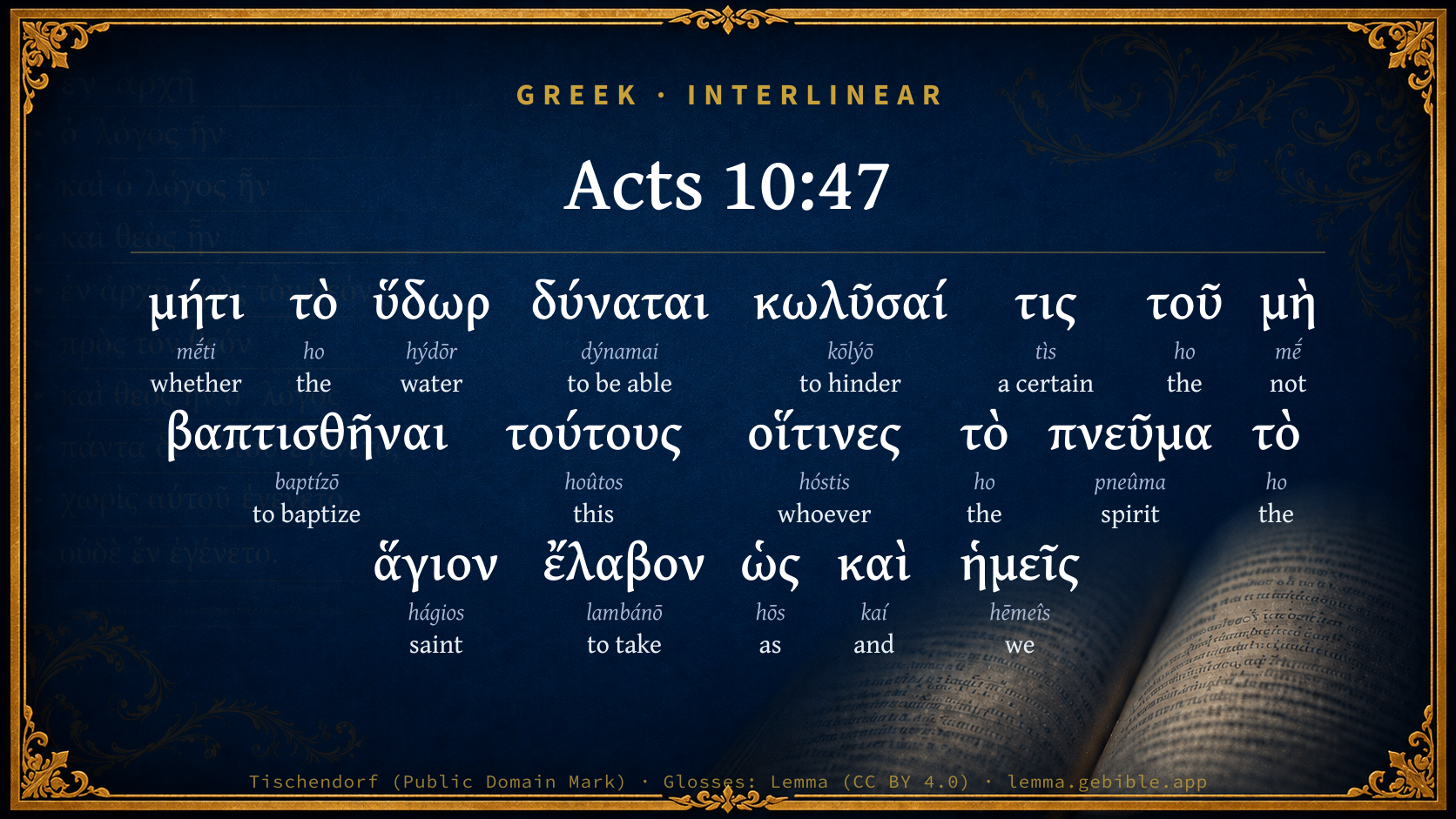
  1. τὸ ho G3588 “the” Article, Accusative, Singular, Neuter
  2. ὕδωρ hýdōr G5204 “water” Noun, Accusative, Singular, Neuter
  3. δύναται dýnamai G1410 “to be able” Verb, Present, Middle or Passive deponent, Indicative, 3rd person, Singular
  4. κωλῦσαί kōlýō G2967 “to hinder” Verb, Aorist, Active, Infinitive
  5. τις tìs G5100 “a certain” Indefinite pronoun, Nominative, Singular, Masculine
  6. τοῦ ho G3588 “the” Article, Genitive, Singular, Neuter
  7. μὴ mḗ G3361 “not” Particle, Negative
  8. βαπτισθῆναι baptízō G907 “to baptize” Verb, Aorist, Passive, Infinitive
  9. τούτους hoûtos G3778 “this” Demonstrative pronoun, Accusative, Plural, Masculine
  10. οἵτινες hóstis G3748 “whoever” Relative pronoun, Nominative, Plural, Masculine
  11. τὸ ho G3588 “the” Article, Accusative, Singular, Neuter
  12. πνεῦμα pneûma G4151 “spirit” Noun, Accusative, Singular, Neuter
  13. τὸ ho G3588 “the” Article, Accusative, Singular, Neuter
  14. ἅγιον hágios G40 “saint” Adjective, Accusative, Singular, Neuter
  15. ἔλαβον lambánō G2983 “to take” Verb, Aorist, Active, Indicative, 3rd person, Plural
  16. ὡς hōs G5613 “as” Adverb
  17. καὶ kaí G2532 “and” Conjunction
  18. ἡμεῖς hēmeîs G2249 “we” Personal pronoun, 1st person, Nominative, Plural

About this verse

These counts appear in no published source. They are computed here, from the morphology-tagged text and Lemma’s own curated glosses. What Lemma adds →

19
words
16
distinct lemmas
Acts
section

Notable vocabulary

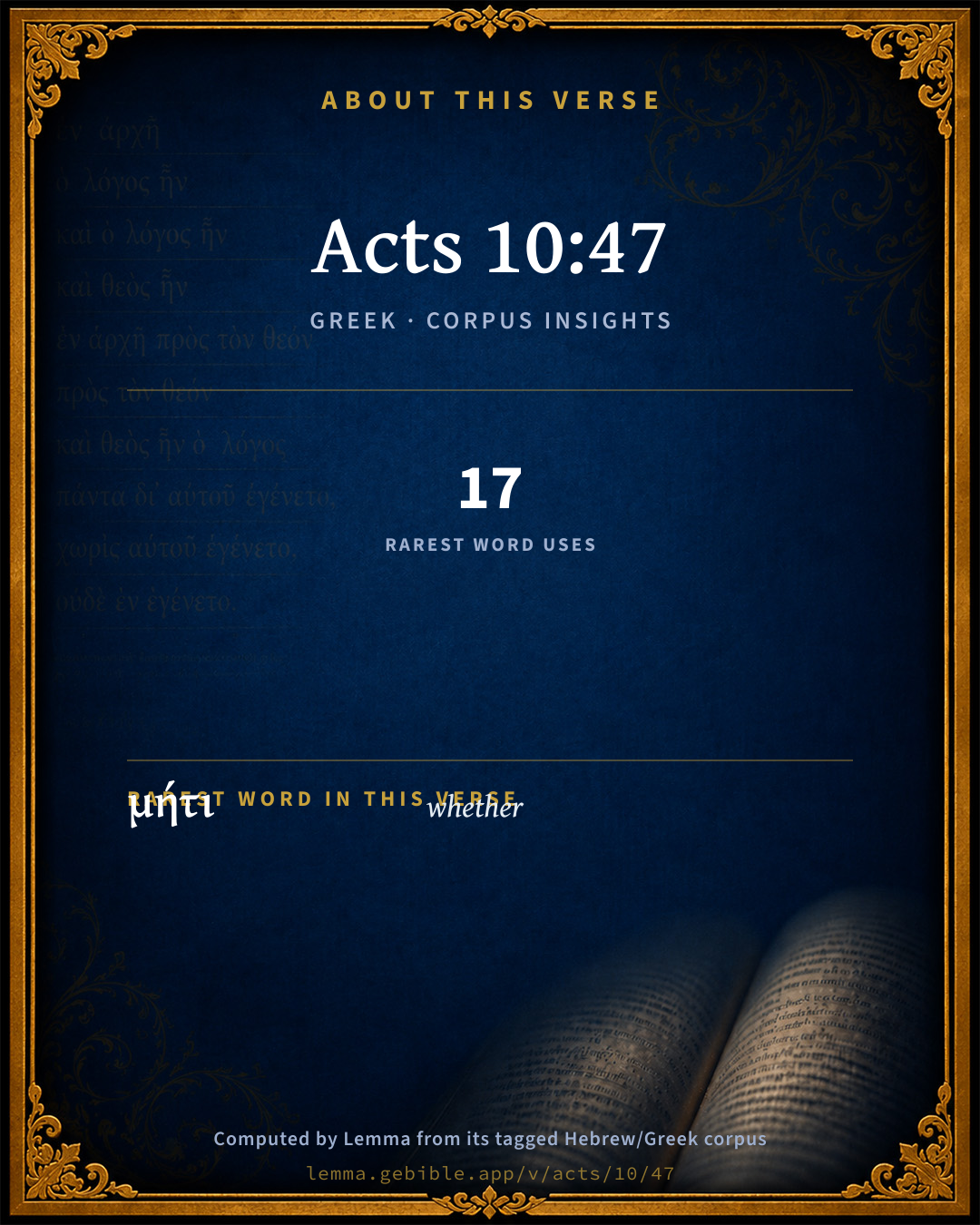
The rarest word here is μήτι whether G3385 — appearing just 17 times in the whole Greek New Testament.

Shared distinctive vocabulary

μήτι whether G3385 occurs in 17 verses of the Greek New Testament. Also found in:

Repetition

A word recurs within this verse:

Cross-references

8

Topical passages linked to Acts 10:47 in the Treasury of Scripture Knowledge — connected by theme and wording, ordered by reader-vote popularity; previews shown in the World English Bible.

  • Acts 8:36 As they went on the way, they came to some water, and the eunuch said, "Behold, here is water. What is keeping me from being baptized?"
  • Acts 11:15–17 As I began to speak, the Holy Spirit fell on them, even as on us at the beginning.
  • Romans 10:12 For there is no distinction between Jew and Greek; for the same Lord is Lord of all, and is rich to all who call on him.
  • Acts 15:8–9 God, who knows the heart, testified about them, giving them the Holy Spirit, just like he did to us.
  • Genesis 17:24–26 Abraham was ninety-nine years old, when he was circumcised in the flesh of his foreskin.
  • Acts 2:4 They were all filled with the Holy Spirit, and began to speak with other languages, as the Spirit gave them the ability to speak.
  • Acts 8:12 But when they believed Philip preaching good news concerning the Kingdom of God and the name of Jesus Christ, they were baptized, both men and women.
  • Romans 4:11 He received the sign of circumcision, a seal of the righteousness of the faith which he had while he was in uncircumcision, that he might be the father of all those who believe, though they be in uncircumcision, that righteousness might also be accounted to them.

Cross-references courtesy of OpenBible.info (CC BY 4.0).

Commentary

Notes on Acts 10:47 from classic Christian and Jewish commentators (each source and its license shown beneath its notes). The classic Christian expositions comment on the surrounding passage and are grouped to its opening verse, so a note may address several verses; the Jewish commentaries on the Tanakh (Rashi and others) are per-verse, so they appear only where the commentator wrote on this verse.

Lemma curates 59 commentaries, every one of them public domain or Creative Commons licensed, each selected and text-cleaned for this edition rather than reprinted as found. About our sources →

Joseph Benson's Commentary

Act 10:47-48. Can any man forbid water, that these should not be baptized, &c. — Peter, yielding to the force of evidence, however contrary to his former prejudices, with great propriety asks this question. He does not say, They have the baptism of the Spirit, therefore they do not need baptism with water. But just the contrary: If they have received the Spirit, then baptize them with water. How easily is this question decided, if we will take the word of God for our guide! Either men have revived the Holy Ghost, or not. If they have not, Repent, saith God, and be baptized, and ye shall receive the gift of the Holy Ghost. If they have, if they are already baptized with the Holy Ghost, then who can forbid water? As none of the brethren that came with him pretended to object any thing against it, he commanded them to be baptized — Immediately; choosing to make use of the ministry of his brethren in performing that rite, rather than to do it with his own hands, that by this means the expression of their consent might be the more explicit; in the name of the Lord — Which implies the Father, who anointed him, and the Spirit, with which he was anointed to his office. But as these Gentiles had before believed in God the Father, and could not but now believe in the Holy Ghost, under whose powerful influence they were at this very time, there was the less need of taking notice, that they were baptized into the belief and profession of the sacred Three; though doubtless the apostles generally administered the ordinance in that very form which Christ himself had prescribed.

Joseph Benson's Commentary on the Old and New Testaments (1811–1818) — public domain. Text from a community e-Sword module.

Bengel's Gnomon

Johann Albrecht Bengel

Act 10:47. Τὸ ὓδωρ, water) He uses the term water for baptism by ταπείνωσις (less expressed than is implied). When the greater thing has been given, that which is less is added by the giver, and is not despised by the receiver. He does not say, They now already have the Spirit; therefore they can do without the water. They are not circumcised, and yet they are baptized. Therefore the footing on which baptism stands is much higher; comp. ch. Act 15:8-9, which passage shows they were not to be circumcised; and yet Peter considered that they ought to be baptized.—κωλῦσαι, forbid) ch. Act 11:17.—τὶς, any one) either I or any of the brethren.

Προσέταξε, He commanded) He did not baptize with his own hands; there were others present to whom that office could be becomingly delegated; Act 10:45. Comp. 1Co 1:17, [Act 10:15, “Lest any should say, I baptized in my own name.”]—Κυρίου, of the Lord) Christ Jesus.—ἐπιμεῖναι) to tarry longer,—ἡμέρας τινὰς, some days) Golden days.[65]

[65] Bengel, J. A. (1860). Vol. 2: Gnomon of the New Testament (M. E. Bengel & J. C. F. Steudel, Ed.) (A. R. Fausset, Trans.) (510–610). Edinburgh: T&T Clark.

Bengel's Gnomon of the New Testament — English translation (T&T Clark, Edinburgh, 1860) — public domain. Text from a community e-Sword module.

Meyer's Critical & Exegetical Commentary

Heinrich August Wilhelm Meyer

Act_10:47-48. Can any one, then, withhold the water, in order that these be not baptized? The water is in this animated language conceived as the element offering itself for the baptism. So urgent now appeared the necessity for completing on the human side the divine work that had miraculously emerged. Bengel, moreover, well remarks: Non dicit: jam habent Spiritum, ergo aqua carere possunt. The conjunction of water and Spirit could not but obtain its necessary recognition.

τοῦ μὴ βαπτ. τούτ.] genitive according to the construction κωλύειν τινά τινος, and μή after verbs of hindering, as in Act_14:18.

καθὼς καὶ ἡμεῖς] as also we, the recipients of the Spirit of Pentecost. This refers to the prominent and peculiar character of the enraptured speaking, by which the fact then occurring showed itself as of a similar kind to that which happened on Pentecost (Act_11:15). But καθὼς καὶ ἡμεῖς cannot be held as a proof that by γλώσσαις λαλεῖν is to be understood a speaking in foreign languages (in opposition to Baumgarten, who thinks that he sees in our passage the connecting link between the miracle of Pentecost and the speaking with tongues in the Corinthian church), for it rather shows the essential identity of the Pentecostal event with the later speaking with tongues, and points back from the mouth of the apostle to the historical form of that event, when it had not yet been transformed by tradition into a speaking of languages.

προσέταξέ] The personal performance of baptism did not necessarily belong to the destined functions of the apostolic office. See on 1Co_1:17.

ἐν τῷ ὀνομ. τοῦ κυρ.] belongs to βαπτισθ., but leaves untouched the words with which the baptism was performed. As, namely, the name of Jesus Christ is the spiritual basis of the being baptized (see on Act_2:38, comp. Act_8:35 f.) and the end to which it refers (Act_19:5), so it is also conceived as the entire holy sphere, in which it is accomplished, and out of which it cannot take place.

ἐπιμεῖναι] to remain. And he remained and had fellowship at table with them, Act_11:3. So much the more surprising is his ὑπόκρισις at Antioch, Gal_2:11 ff.

Meyer — Critical and Exegetical Commentary on the New Testament — English translation by Peter Christie, edited by Frederick Crombie (T&T Clark, 1880) — public domain. Text from a community e-Sword module.

Expositor's Greek Testament

ed. W. Robertson Nicoll

Act 10:47 . μήτι τὸ ὕ .… τοῦ μὴ βαπτισθῆναι , cf. Act 14:18 : on construction, Burton, p. 159; so also in LXX and classical Greek, Blass, Gram. , p. 230; Viteau, Le Grec du N. T. , p. 172 (1893). οἵτινες , quippe qui , so Blass in this passage. τὸ ὕδωρ : “the water” R.V., not simply “water” as A.V., as Bengel admirably says, “Non dicit: jam habent Spiritum, ergo aqua carere possunt”. In baptism both the water and the Spirit were required, Act 11:16 . The greater had been bestowed; could the lesser be withheld? See the striking passage in Moberly, Ministerial Priesthood , p. 108, on the fact that Cornelius and his companions, even after they had first received the presence of the Holy Ghost, were nevertheless ordered to be baptised.

The Expositor's Greek Testament, edited by W. Robertson Nicoll (1897–1910) — public domain. Text from a community e-Sword module.

Geneva Bible (1599)

Geneva Bible translators

Baptism doth not sanctify or make them holy which receive it, but sealeth up and confirmeth their sanctification.

Geneva Bible (1599) marginal notes — public domain. Text via Bolls.life.

Jamieson, Fausset & Brown

Robert Jamieson, A. R. Fausset & David Brown

which have received the Holy Ghost as well as we--and are thus, in all that is essential to salvation, on a level with ourselves.

Jamieson, Fausset & Brown — Commentary Critical and Explanatory on the Whole Bible (1871) — public domain (CC PDM 1.0). Text via the HelloAO Bible API.

Adam Clarke's Commentary

Verse 47. Can any man forbid water] These had evidently received the Holy Ghost, and consequently were become members of the mystical body of Christ; and yet St. Peter requires that they shall receive baptism by water, that they might become members of the Christian Church. In other cases, they received baptism first, and the Spirit afterwards by the imposition of hands: see Ac 19:4-6, where the disciples who had received only the baptism of John were baptized again with water in the name of the Lord Jesus; and, after even this, the apostles prayed, and laid their hands on them, before they were made partakers of the Holy Ghost. So we find that Jesus Christ had his water baptism as well as John; and that even he who gave the baptism of the Holy Ghost required the administration of water baptism also. Therefore the baptism of the Spirit did not supersede the baptism by water; nor indeed can it; as baptism, as well as the supper of our Lord, were intended, not only to be means of grace, but standing, irrefragable proofs of the truth of Christianity.

Adam Clarke's Commentary on the Bible (1810–1826) — public domain. Text from a community e-Sword/MySword module.

John Calvin's Commentaries

47. Peter answered. Peter reasoneth from the thing to the sign; for, seeing that baptism is an addition or appurtenance of the spiritual grace, he which hath received the Spirit is also apt [fit] to receive baptism; and this is the (most) lawful order, that the minister admit those unto the receiving of the outward sign whom God hath testified to be his children by the mark and pledge of his Spirit; so that faith and doctrine are first. And whereas unlearned men infer thereupon that infants are not to be baptized, it is without all reason. I grant that those who are strangers from the Church must be taught before the sign of adoption be given them; but I say, that the children of the faithful which are born in the Church are from their mother’s womb of the household of the kingdom of God. Yea, the argument which they use preposterously against us do I turn back [retort] upon themselves; for, seeing that God hath adopted the children of the faithful before they be born, I conclude thereupon that they are not to be defrauded of the outward sign; otherwise men shall presume to take that from them which God hath granted them. As touching the manifest grace of the Spirit, there is no absurdity therein, if it follow after baptism in them.

And as this testimony maketh nothing for maintenance of their error, so it doth strongly refute the error of the Papists, who tie the grace of the Spirit to the signs, and think that the same is fet [fetched] from heaven with enchantments, as those witches did think that they did pull down the moon with their charms. But forasmuch as Luke saith that these had the Holy Ghost given them who were not as yet baptized, he showeth that the Spirit is not included in baptism. Lastly, we must note that the apostles were content with water alone when as they did baptize, and would to God this plainness had been retained amongst their posterity, and that they had not gathered here and there divers trifles, whereof baptism is filth in Popery. They think that the worthiness of baptism is adorned with oil, salt, spittle, wax-candles, whereas they are rather filthy pollutions which corrupt the pure and natural [genuine] institution of Christ.

John Calvin's Commentaries (1540-1563) — public domain. Text from the Calvin Translation Society English edition (1840s-50s) via the Christian Classics Ethereal Library (ccel.org). Calvin's coverage is partial (roughly two-thirds of the Bible); uncommented books and verses are honest gaps, never fabricated. The 19th-century editor's footnotes and remarks are omitted so the notes are faithfully Calvin's own voice.

Ellicott's Commentary for English Readers

(47) Can any man forbid water . . .—The question was an appeal to the voice of reason. Could the outward sign be refused, when thus the inward and spiritual grace had been so manifestly bestowed? Ordinarily, as in the case of the Samaritans (Act_8:15-17), the gift of spiritual powers followed, by the subsequent act of laying on of hands, on the grace given in baptism. Now even that gift had been anticipated, and all that remained was the outward act of incorporation with the society which owned Christ as its Head. While the history thus bore its witness that the gifts of God may flow through other channels than the outward forms which Christ had appointed, it testified no less clearly that no spiritual gifts, however marvellous, superseded the necessity of obedience to the law of Christ which had appointed those outward forms. The exceptional gift was bestowed, in this instance, to remove the scruples which “those of the circumcision” might otherwise have felt as to admitting Gentiles, as such, to baptism; and having served that purpose, as a crucial instance, was never afterwards, so far as we know, repeated under like conditions.

A Bible Commentary for English Readers, edited by Charles John Ellicott (1878–1897) — public domain. Text from a community e-Sword module.

The Cambridge Bible for Schools and Colleges

gen. ed. J. J. S. Perowne

47. Can any man forbid water, &c.] Though the gift of the Spirit has been made so apparent, yet St Peter does not omit the outward sign which Christ had ordained (Mat_28:19) for the admission of members into His Church.

as well as we] Thus does he recognize that God had chosen Gentiles as well as Jews, and given the same grace to each.

The Cambridge Bible for Schools and Colleges (gen. ed. J. J. S. Perowne; Cambridge University Press, 1878–1918) — public domain. Text from a community e-Sword module.

John Gill's Exposition

Can any man forbid water,.... The use of his river, or bath, or what conveniency he may have for baptizing persons: which shows, that it required a place of some quantity of water, sufficient for baptism by immersion, otherwise it would not be in the power of any man to hinder them having a little water, to be sprinkled or poured on the face: unless rather by water should be meant baptism itself; and then the sense is, who can forbid these persons the ordinance of baptism, or deny the administration of it to them? for such who have the Spirit of Christ, are openly Christ's, and therefore have a right to his ordinances; such, being enlightened by him, are able to see to the end of the ordinance; and to such only can it be of use, and they only can please God in it: nor should it be forbidden them; this is to withstand God, act contrary to the commission of Christ, and resist the Holy Ghost; no, not though Gentiles: converted Gentiles, have as good a right as any to this ordinance; descent from Abraham gives no right to it; there is no difference among men under the Gospel dispensation; Christ's commission reaches both to Jews and Gentiles; and there is but one baptism for both.

That these should not be baptized; though they are uncircumcised Gentiles:

which have received the Holy Ghost as well as we; the extraordinary gifts of the Spirit; though, no doubt also, they had received the Spirit, as a spirit of illumination and conviction, as a spirit of regeneration, sanctification, and conversion, and as a spirit of faith and adoption, and as a witness, earnest, and pledge of future glory: and receiving him supposes, that they were without him before, and that he is a gift of God's free grace unto them; and which is no other than the baptism of the Spirit, and is a necessary pre-requisite to water baptism; and they that have the one, are right subjects of the other; nor ought it to be denied them. From hence it appears that water baptism is an ordinance of Christ, to be continued under the Gospel dispensation; it was not only what was practised in the times of John and of Christ, but what was practised by the apostles after the ascension of Christ, in compliance with the commission he gave, which could have respect to no other baptism; since the apostles were not capable of baptizing with any other, not with the baptism of the Spirit: and it is certain from hence, and by other instances, that they did baptize in water; and from the apostle's question it seems, that it must be by immersion in water, as before observed; and from what follows it is clear, that such who are partakers of the Holy Spirit and his grace, are the proper subjects of it.

John Gill's Exposition of the Whole Bible (1746–1763) — public domain (CC PDM 1.0). Text via the HelloAO Bible API.

Trapp's Complete Commentary

John Trapp

47 Can any man forbid water, that these should not be baptized, which have received the Holy Ghost as well as we?

Ver. 47. Can forbid water] Plain water, without oil, salt, spittle, cream, or other popish additaments.

John Trapp, A Commentary or Exposition upon All the Books of the Old and New Testament (1647–1656) — public domain. Text from a community e-Sword module.

Albert Barnes' Notes on the Bible

Can any man forbid water ... - They have shown that they are favored in the same way as the Jewish converts. God has manifested himself to them as he did to the Jews on the day of Pentecost. Is it not clear, therefore, that they are entitled to the privilege of Christian baptism? The expression used here is one that would naturally refer to water as being brought; that is, to a small quantity; and would seem to imply that they were baptized, not by immersion, but by pouring or sprinkling.

Albert Barnes' Notes on the Bible (1834–1885) — public domain. Text from a community e-Sword/MySword module.

Haydock's Catholic Bible Commentary

Can any man forbid water? &c. or doubt that these, on whom the Holy Ghost hath descended, may be made members of the Christian Church, by baptism, as Christ ordained? (Witham) --- Such may be the grace of God occasionally towards men, and such their great charity and contrition, that they may have remission, justification, and sanctification, before the external sacraments of baptism, confirmation, and penance be received; as we see in this example: where, at Peter’s preaching, they all received the Holy Ghost before any sacrament. But here we also learn one necessary lesson, that such, notwithstanding, must needs receive the sacraments appointed by Christ, which whosoever contemneth, can never be justified. (St. Augustine, sup. Levit. q. 84. T. 4.)

George Leo Haydock (1774–1849), Haydock's Catholic Family Bible and Commentary, 1859 edition — public domain. Excludes Psalms (Douay-Rheims chapter numbering differs from Protestant) and Deuterocanonical books (Catholic canon only).

Matthew Poole's English Annotations

This question, as Act 8:36, is without question, and denies that any can forbid water, that is, in order to baptize such as these. As if the apostle had argued thus: They that have the grace signified or promised, have a right unto the seal of the promise: but these Gentiles have the grace signified or promised in baptism; they had the inward part, and therefore the outward part could not be denied unto them. He that hath the inheritance, may claim the writings, wax, and parchment that belong unto it.

Matthew Poole's English Annotations on the Holy Bible (1683–1685) — public domain. Text from a community e-Sword/MySword module.

Whedon's Commentary on the Bible

Daniel D. Whedon

47. Forbid water—Forbid the water to be applied in cleansing symbol upon the person; not forbid the person to be applied to the water.

Have received the Holy Ghost—As they have received the reality so they should receive the symbol. Such was Peter’s reasoning. He did not, like a Quaker, reason that because they had the reality they did not need the symbol.

Daniel D. Whedon (gen. ed.), Commentary on the Old and New Testaments (1874–1909) — public domain. Text from a community e-Sword module.

The Pulpit Commentary

The water for water, A.V. They actually had the Spirit, which God himself supplied; could any one object to their having the water also, which was the part of the sacrament which it rested with man to supply, in order to complete the new birth? (Joh_3:5)

The Pulpit Commentary (1880–1919), ed. H.D.M. Spence-Jones & Joseph S. Exell — public domain. Text from a community e-Sword module.

John Wesley's Explanatory Notes

Can any man forbid water, that these should not be baptized, who have received the Holy Ghost? - He does not say they have the baptism of the Spirit; therefore they do not need baptism with water. But just the contrary: if they have received the Spirit, then baptize them with water. How easily is this question decided, if we will take the word of God for our rule! Either men have received the Holy Ghost or not. If they have not, Repent, saith God, and be baptized, and ye shall receive the gift of the Holy Ghost. If they have, if they are already baptized with the Holy Ghost, then who can forbid water?

John Wesley, Explanatory Notes Upon the Whole Bible (1754–1765) — public domain. Text via the GEBible commentary corpus.

McGarvey & Pendleton's Commentaries

J. W. McGarvey

47, 48. The true explanation of this unusual circumstance is given in the following words, together with Peter's own explanation of it in the eleventh chapter: " Then Peter answered, (47) Can any man forbid water, that these should not be immersed, who have received the Holy Spirit as well as we? (48) And he commanded them to be immersed in the name of the Lord. Then they requested him to remain some days. " The use that Peter made of it expresses the design of its occurrence. That use was to remove all possible objection to the immersion of the parties. In any other case which had occurred, or which occurred after this, no such objection could have existed. The very fact, therefore, which led to this unusual occurrence, was an exceptional circumstance, which furnishes the strongest proof that this case is not a precedent for imitation in this particular.

Before he was interrupted, Peter had already proceeded so far with his discourse as to reach the subject of faith, and of remission of sins, and immersion must have been the next word upon his lips, if he had proceeded after the model of his sermon on Pentecost. The interruption, therefore, did not break the thread of his discourse, but enabled him to proceed with greater confidence to the very conclusion which he had intended. He first appeals to the brethren, to know if any objection yet lingered in their minds, and finding none, he commanded them to be immersed in the name of the Lord.

Let us now recall the fact that Cornelius had been directed to send for Peter to hear "words by which he and all his family might be saved." Peter has come, and delivered his message. He has told him of Christ, in whom the man now believes. He has commanded him to be immersed, and it has been done. This is the whole story of the conversion. When it was accomplished, the painful anxiety which he must have experienced during the last four days was removed, and his present happiness is indicated by the cordiality with which he invited Peter to remain with him some days.

We now have three individual cases of conversion before us, each detailed with great minuteness. In some particulars they are precisely alike; in others, they are quite different. But they are all three genuine cases of conversion; and, therefore, the points in which they differ are not essential to conversion, but are accidental circumstances arising from the peculiarities of the individual case. Now, in order that we may learn what is essential to conversion, and what among all the cases on record, are accidental circumstances, we must be guided by the following rule. Whatever is common to all cases is necessary to a scriptural conversion; but whatever we find in one case which certainly did not occur in all others, is a peculiarity of the individual cases in which it occurs. The points in which all the recorded cases agree are the points in which all subsequent conversions must agree with them. The points in which they differ are points in which subsequent conversions may differ from them. In order to determine that certain features are not essential, it is only necessary to find cases in which they do not occur. In order to determine that any one is essential, we must find it in all cases, or find it prescribed in some general law expressly designed to govern all cases.

While the three cases already before us are fresh in the memory, and before points of difference become multiplied by additional cases, so as to confuse the understanding, we propose to institute a comparison between them, in the light of the rule just prescribed. Leaving out of view the difference in character, occupation, and social position, of the eunuch, Saul, and Cornelius, which show only that the gospel is adapted to all men without regard to previous character or position, we will only notice those differences which might form the ground of erroneous conclusions. First, then, in the cases of the eunuch and Cornelius, there was the visible appearance of an angel; and many converts of modern times have related, as part of their experience in conversion, similar apparitions. But there certainly was not in Saul's case the appearance of an angel; therefore, such an appearance is not necessary to conversion. Second, The Lord himself appeared to Saul and conversed with him; but he certainly did not to either the eunuch or Cornelius. It is not necessary, then, to see the Lord. Third, Saul mourned and prayed for three days after he believed, and before he was immersed; but Cornelius and the eunuch did not; therefore, protracted sorrow and prayer are not necessary to conversion. Fourth, Cornelius was immersed in the Spirit, but Saul and the eunuch were not; therefore, immersion in the Spirit is not essential, but a circumstance arising from the peculiarity of a single case.

The points in which these cases agree are chiefly these: they all heard the gospel preached, with miraculous evidence to sustain it; they all believed what they heard; they were all commanded to be immersed; they were all immersed; and after immersion they were all happy. If, then, we do not hereafter encounter recorded cases from which some of these items are certainly absent, we must conclude that at least all of these are necessary to scriptural conversion. When other cases are before us, we will institute further and more complete comparisons.

We would be glad to know more of the history of Cornelius, so as to determine how far, even in times of peace, the profession of arms is compatible with the faithful service of the Prince of Peace. He is the only soldier of whose conversion we have an account in the New Testament, and of his subsequent career we know nothing. Whether, amid the scenes of blood and desolation not many years after most wickedly visited upon Judea by the army in which he was an officer, he resigned his office, or made shipwreck of the faith, we can not know till the great day. Let it be noted, however, that his is an instance of a soldier becoming a Christian, not of a Christian becoming a soldier. It furnishes a precedent for the former, but not for the latter. Whether Peter instructed him to resign his position in the army or not, is to be determined not by the silence of the historian in reference to it, but by first determining whether military service is compatible with the moral teachings of the New Testament. If Jesus and the apostles had been, for more than thirty years previous to the publication of Acts, teaching that Christians should not take the sword, it was not at all necessary for Luke to say that Peter so instructed Cornelius.

J. W. McGarvey (with Philip Y. Pendleton), Commentaries on the New Testament (The Fourfold Gospel, 1914; Acts; and the epistles) — public domain. Text from a community e-Sword/MySword module.

The People's New Testament

B. W. Johnson

47. Can any man forbid water, that these should not be baptized? Peter's scruples were overcome. He was now satisfied that the gospel was for Gentiles as well as Jews. God had made no difference in the baptism of the Holy Spirit. He asks his Jewish brethren if any man can give a reason why they should not be baptized. Wesley says: “How easily is the question decided if we take the word of God for our rule. Either men have received the Holy Spirit, or not. If they have not, then Repent, saith God, and be baptized, and ye shall receive the gift of the Holy Spirit. If they have been baptized with the Holy Spirit, then who can forbid water?”

B. W. Johnson's The People's New Testament with Notes (1889–1891) — public domain. Electronic text from the Christian Classics Ethereal Library (CCEL) ThML edition.

Cambridge Greek Testament for Schools and Colleges

47. μήτι τὸ ὕδωρ δύναται κωλῦσαί τις τοῦ μὴ βαπτισθῆναι τούτους; can any man forbid water, that these should not be baptized? Here is another instance of the genitival infinitive so common in N.T. Greek. But here, as κωλύειν may have a genitive of the thing from which any one is hindered, the construction offers less difficulty. The μὴ before βαπτισθῆναι is an instance of the Greek fondness for doubling negative ideas. Cf. Eur. Phoeniss. 1268 κωλύειν τινὰ μὴ θανεῖν, where the negative only renders emphatic the sense of the verb.

Though the gift of the Spirit has been made so apparent, yet St Peter does not omit the outward sign which Christ had ordained (Mat 28:19) for the admission of members into His Church.

ὡς καὶ ἡμεῖς, as well as we. And in precisely the same kind of manifestation.

Cambridge Greek Testament for Schools and Colleges (Cambridge University Press, 1896; 21 vols, various authors incl. Carr, Maclear, Plummer, Farrar, Lumby, Moule, M. R. James, Simcox) — public domain. Text from a community e-Sword module.

Alford’s Greek Testament

Henry Alford

47.] One great end of the unexpected effusion of the Holy Spirit was entirely to preclude the question which otherwise could not but have arisen, ‘Must not these men be circumcised before baptism?’

τὸ ὕδωρ … τὸ πνεῦμα] The two great parts of full and complete baptism: the latter infinitely greater than, but not superseding the necessity of, the former. The article should here certainly be expressed: Can any forbid the water to these who have received the spirit?

The expression κωλῦσαι, used with τὸ ὕδ., is interesting, as shewing that the practice was to bring the water to the candidates, not the candidates to the water. This, which would be implied by the word under any circumstances, is rendered certain, when we remember that they were assembled in the house.

Henry Alford, The Greek Testament (1849–1861) — public domain. Text from a community e-Sword module.

Vincent's Word Studies in the New Testament

Marvin R. Vincent

Water [το υδωρ] . Note the article : the water; co - ordinating the water with the Spirit (see 1Jo 5:8), and designating water as the recognized and customary element of baptism.

Marvin R. Vincent, Word Studies in the New Testament (1887–1900) — public domain. Text from a community e-Sword/MySword module.

Lesson kit

Teaching starters — assembled from the data on this page, not authored interpretation. Every prompt links to the verse data it draws on. Edit before teaching.

Acts, in the Acts, opens this verse with 19 words (16 distinct Greek lemmas). Its most distinctive word is mḗti (“whether”). A historical commentator’s framing appears above. Read the whole chapter for the surrounding context.

Discussion questions

  1. The word mḗti carries the sense “whether.” How does it shape the verse?
  2. How does Matthew 7:16, which shares the word «whether», read alongside this verse?
  3. What does the repetition of “the” (4× in this one verse) do in this verse?
  4. These translations render this verse differently. What is at stake in choosing one wording over another?
  5. Compare how Joseph Benson's Commentary and Bengel's Gnomon read this verse. Where do they agree or differ?

Things to notice

Reading settings

Reading text

Shown beneath each verse's original-language words.

Old Testament
Old Testament edition

Read the OT as the Masoretic Hebrew (MT) or the Greek Septuagint (LXX).

English shown for the Greek Septuagint (in the Hebrew ↔ Greek comparison).

Comparing translations? Open the Compare panel on any verse page to stack up to four side by side.