
Mark 1:24

Greek (Tischendorf 8th ed.) Mark 1:24 appears in the Greek New Testament. The text above is from the Tischendorf 8th edition. Each word links to its Strong’s number and a concise gloss. Click any word for its full Thayer’s Greek Lexicon entry.
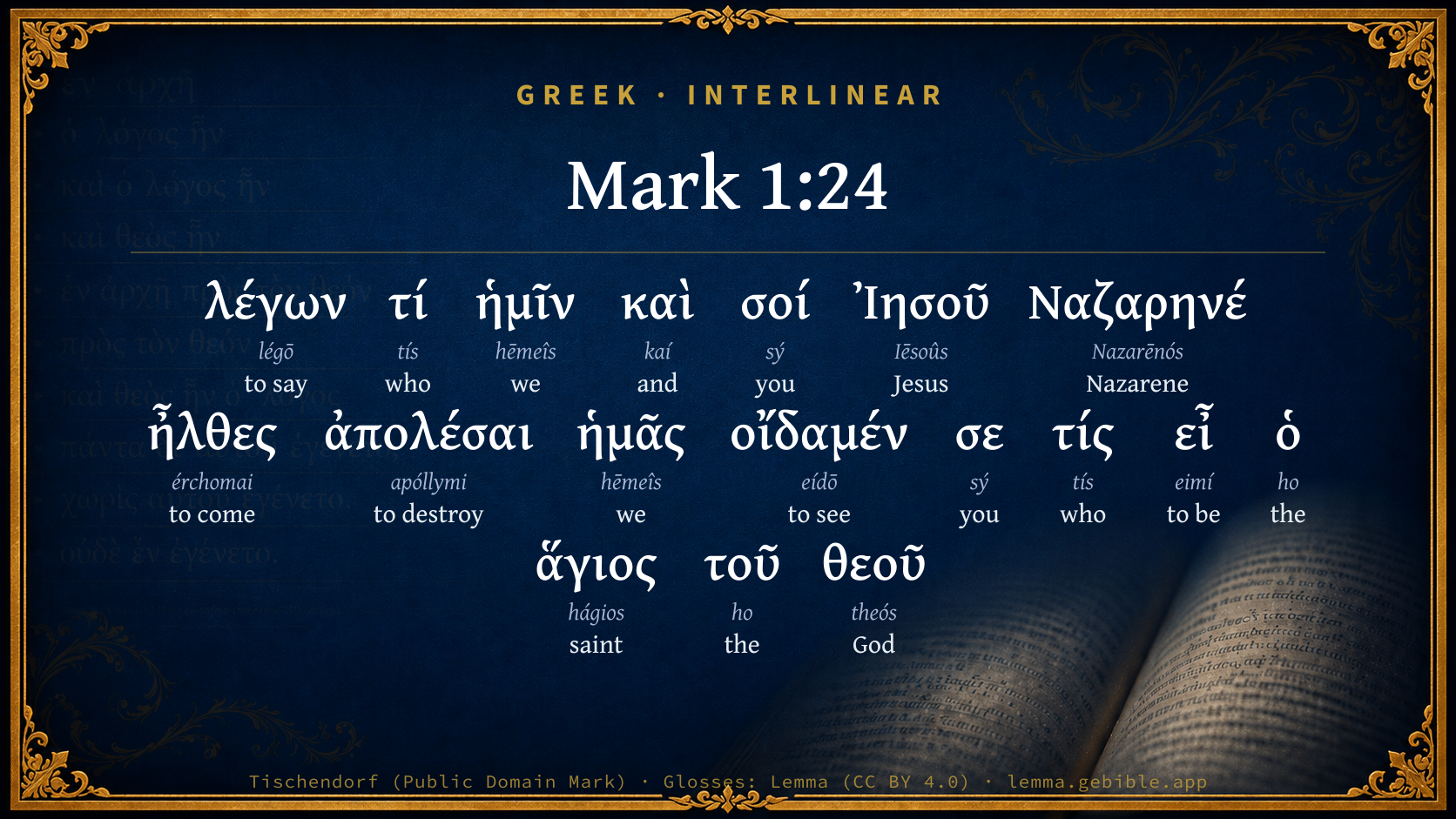
Download image
Cite this verse

Mark 1:24 (World English Bible). Public Domain. Lemma interlinear Bible study tool, https://lemma.gebible.app/v/mark/1/24.

Show BibTeX & RIS
BibTeX
RIS
English Translation
saying, "Ha! What do we have to do with you, Jesus, you Nazarene? Have you come to destroy us? I know you who you are: the Holy One of God!"
World English Bible · Public Domain
Highlights
  • 1 first appearance in the Greek New Testament
Full analysis ↓
Download a study sheet

One document with this verse’s original text, its word-by-word gloss line, the meaning frame, cross-references with their text, attributed commentary, and full source and license credits — printable, and it pastes into notes with its structure intact.

This verse Autodidact and up

Study sheet (.html) Plain text (.txt)

A passage Seminary Student

Up to 50 verses in one chapter. A passage sheet keeps up to 6 commentary sources and 12 cross-references per verse, in the order this page ranks them, and says so on the sheet whenever that leaves anything out. Ask for a single verse and you get the Autodidact verse sheet above.

Everything on this page stays free to read, with no account — the sheet is a download of what is already on screen, not access to it.

Want to remove ads? Support Godless Engineer
Compare translations 3

The same verse in 3 English versions, stacked beneath the original-language interlinear above. Click any original word for its lexicon entry.

Each is an independent rendering of the whole verse — the interlinear is not word-aligned to these translations.

Highlighted words mark where these versions differ — a whole-verse word diff, not a word-by-word alignment.

  • World English Bible Public Domain
    saying, "Ha! What do we have to do with you, Jesus, you Nazarene? Have you come to destroy us? I know you who you are: the Holy One of God!"
  • King James Version Public Domain
    Saying, Let us alone; what have we to do with thee, thou Jesus of Nazareth? art thou come to destroy us? I know thee who thou art, the Holy One of God.
  • unfoldingWord Literal Text CC BY-SA 4.0
    saying, “What to us and to you, Jesus of Nazareth? Have you come to destroy us? I know who you are—the Holy One of God!”

unfoldingWord Literal Text — © unfoldingWord, licensed CC BY-SA 4.0. Word-aligned USFM3 via Door43 (git.door43.org/unfoldingWord/en_ult).

Versions to compare (up to 4)

3 of 4 selected

Show all 19 translations

Every available English version of this verse, each an independent rendering of the whole verse.

  • World English Bible Public Domain
    saying, "Ha! What do we have to do with you, Jesus, you Nazarene? Have you come to destroy us? I know you who you are: the Holy One of God!"
  • Berean Standard Bible Public Domain
    “What do You want with us, Jesus of Nazareth? Have You come to destroy us? I know who You are—the Holy One of God!”
  • Majority Standard Bible Public Domain
    “Let us alone! What do You want with us, Jesus of Nazareth? Have You come to destroy us? I know who You are—the Holy One of God!”
  • King James Version Public Domain
    Saying, Let us alone; what have we to do with thee, thou Jesus of Nazareth? art thou come to destroy us? I know thee who thou art, the Holy One of God.
  • American Standard Version (1901) Public Domain
    saying, What have we to do with thee, Jesus thou Nazarene? art thou come to destroy us? I know thee who thou art, the Holy One of God.
  • Revised Version (1885) Public Domain
    saying, What have we to do with thee, thou Jesus of Nazareth? art thou come to destroy us? I know thee who thou art, the Holy One of God.
  • Geneva Bible (1599) Public Domain
    Saying, Ah, what haue we to do with thee, O Iesus of Nazareth? Art thou come to destroy vs? I knowe thee what thou art, euen that holy one of God.
  • Douay-Rheims (1899) Public Domain
    Saying: What have we to do with thee, Jesus of Nazareth? art thou come to destroy us? I know who thou art, the Holy One of God.
  • Young's Literal Translation Public Domain
    saying, `Away! what -- to us and to thee, Jesus the Nazarene? thou didst come to destroy us; I have known thee who thou art -- the Holy One of God.'
  • Literal Standard Version CC BY-SA 4.0
    saying, “What [regards] us and You, Jesus the Nazarene? You came to destroy us; I have known You, who You are—the Holy One of God.”
  • Unlocked Literal Bible CC BY-SA 4.0
    saying, “What do we have to do with you, Jesus of Nazareth? Have you come to destroy us? I know who you are. You are the Holy One of God!”
  • unfoldingWord Literal Text CC BY-SA 4.0
    saying, “What to us and to you, Jesus of Nazareth? Have you come to destroy us? I know who you are—the Holy One of God!”
  • Darby Bible Public Domain
    saying, Eh! what have we to do with thee, Jesus, Nazarene? Art thou come to destroy us? I know thee who thou art, the holy one of God.
  • World Messianic Bible Public Domain
    saying, “Ha! What do we have to do with you, Yeshua, you Nazarene? Have you come to destroy us? I know who you are: the Holy One of God!”
  • Webster's Bible Public Domain
    Saying, Let us alone; what have we to do with thee, thou Jesus of Nazareth? art thou come to destroy us? I know thee who thou art, the Holy One of God.
  • Free Bible Version CC BY-SA 4.0
    “Jesus of Nazareth, why are you bothering us? Have you come to destroy us? I know who you are! You're God's Holy One!”
  • Bible in Basic English Public Domain
    Saying, What have we to do with you, Jesus of Nazareth? have you come to put an end to us? I see well who you are, the Holy One of God.
  • Text-Critical English NT CC BY 4.0
    “ Leave us alone! What do yoʋ have to do with us, Jesus of Nazareth? Have yoʋ come to destroy us? I know who yoʋ are—the Holy One of God.”
  • Tyndale New Testament (1534) Public Domain
    sayinge: let be: what have we to do with the thou Iesus of Nazareth? Arte thou come to destroye vs? I knowe the what thou arte euen that holy of god.

Literal Standard Version (2020), Covenant Press — licensed CC BY-SA 4.0. Text via the HelloAO Bible API (eBible.org). Unlocked Literal Bible (unfoldingWord) — licensed CC BY-SA 4.0. Text via the HelloAO Bible API (eBible.org). unfoldingWord Literal Text — © unfoldingWord, licensed CC BY-SA 4.0. Word-aligned USFM3 via Door43 (git.door43.org/unfoldingWord/en_ult). Free Bible Version, Dr. Jonathan Gallagher — licensed CC BY-SA 4.0. Text via the HelloAO Bible API (eBible.org).

Word by word

More ways to search: Search by grammar → Find every occurrence → Compare this word →

Practice this passage: Drill this verse → Learn its vocabulary →

Ναζαρηνέ
Nazarēnós
G3479
“Nazarene”
Noun, Vocative, Singular, Masculine
Part of Speech
Noun
Case
Vocative
Number
Singular
Gender
Masculine
Full Thayer's Definition

Origin: from G3478

TDNT: 18:34,6

1. a resident of Nazareth
  1. λέγων légō G3004 “to say” Verb, Present, Active, Participle, Nominative, Singular, Masculine
  2. τί tís G5101 “who” Interrogative pronoun, Nominative, Singular, Neuter
  3. ἡμῖν hēmeîs G2249 “we” Personal pronoun, 1st person, Dative, Plural
  4. καὶ kaí G2532 “and” Conjunction
  5. σοί sý G4771 “you” Personal pronoun, 2nd person, Dative, Singular
  6. Ἰησοῦ Iēsoûs G2424 “Jesus” Noun, Vocative, Singular, Masculine
  7. ἦλθες érchomai G2064 “to come” Verb, Aorist, Active, Indicative, 2nd person, Singular
  8. ἀπολέσαι apóllymi G622 “to destroy” Verb, Aorist, Active, Infinitive
  9. ἡμᾶς hēmeîs G2249 “we” Personal pronoun, 1st person, Accusative, Plural
  10. οἴδαμέν eídō G1492 “to see” Verb, Perfect, Active, Indicative, 1st person, Plural
  11. σε sý G4771 “you” Personal pronoun, 2nd person, Accusative, Singular
  12. τίς tís G5101 “who” Interrogative pronoun, Nominative, Singular, Masculine
  13. εἶ eimí G1510 “to be” Verb, Present, Active, Indicative, 2nd person, Singular
  14. ὁ ho G3588 “the” Article, Nominative, Singular, Masculine
  15. ἅγιος hágios G40 “saint” Adjective, Nominative, Singular, Masculine
  16. τοῦ ho G3588 “the” Article, Genitive, Singular, Masculine
  17. θεοῦ theós G2316 “God” Noun, Genitive, Singular, Masculine

About this verse

These counts appear in no published source. They are computed here, from the morphology-tagged text and Lemma’s own curated glosses. What Lemma adds →

18
words
14
distinct lemmas
Gospels
section

Notable vocabulary

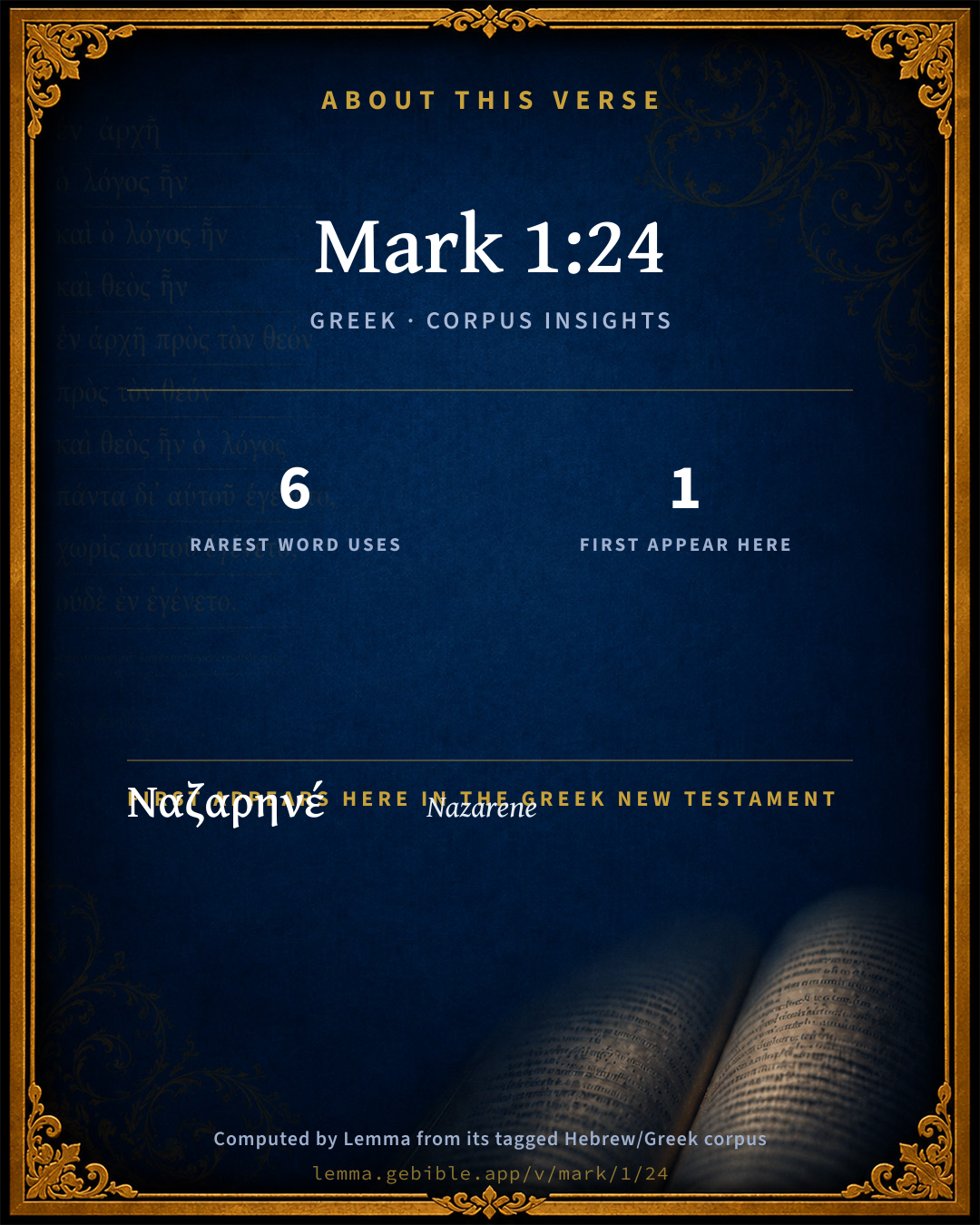
The rarest word here is Ναζαρηνέ Nazarene G3479 — appearing just 6 times in the whole Greek New Testament.

First appearance in Scripture

This word makes its first canonical appearance in the Greek New Testament here:

  • Ναζαρηνέ Nazarene G3479

Shared distinctive vocabulary

Ναζαρηνέ Nazarene G3479 occurs in 6 verses of the Greek New Testament. Also found in:
Repetition

Words recur within this verse:

Cross-references

18

Topical passages linked to Mark 1:24 in the Treasury of Scripture Knowledge — connected by theme and wording, ordered by reader-vote popularity; previews shown in the World English Bible.

  • Matthew 8:29 Behold, they cried out, saying, "What do we have to do with you, Jesus, Son of God? Have you come here to torment us before the time?"
  • James 2:19 You believe that God is one. You do well. The demons also believe, and shudder.
  • Luke 4:34 saying, "Ah! what have we to do with you, Jesus of Nazareth? Have you come to destroy us? I know you who you are: the Holy One of God!"
  • Acts 3:14 But you denied the Holy and Righteous One, and asked for a murderer to be granted to you,
  • Revelation 3:7 "To the angel of the assembly in Philadelphia write: "He who is holy, he who is true, he who has the key of David, he who opens and no one can shut, and who shuts and no one opens, says these things:
  • Mark 5:7 and crying out with a loud voice, he said, "What have I to do with you, Jesus, you Son of the Most High God? I adjure you by God, don't torment me."
  • Luke 8:28 When he saw Jesus, he cried out, and fell down before him, and with a loud voice said, "What do I have to do with you, Jesus, you Son of the Most High God? I beg you, don't torment me!"
  • Acts 2:27 Because you will not leave my soul in Hades, Neither will you allow your Holy One to see decay.
  • Psalms 16:10 For you will not leave my soul in Sheol, Neither will you allow your holy one to see corruption.
  • Psalms 89:18–19 For our shield belongs to Yahweh; Our king to the Holy One of Israel.
  • Luke 1:35 The angel answered her, "The Holy Spirit will come on you, and the power of the Most High will overshadow you. Therefore also the holy one who is born from you will be called the Son of God.
  • John 6:69 We have come to believe and know that you are the Christ, the Son of the living God."
  • Luke 24:19 He said to them, "What things?" They said to him, "The things concerning Jesus, the Nazarene, who was a prophet mighty in deed and word before God and all the people;
  • Acts 4:27 For truly, in this city against your holy servant, Jesus, whom you anointed, both Herod and Pontius Pilate, with the Gentiles and the people of Israel, were gathered together
  • Acts 24:5 For we have found this man to be a plague, an instigator of insurrections among all the Jews throughout the world, and a ringleader of the sect of the Nazarenes.
  • Exodus 14:12 Isn't this the word that we spoke to you in Egypt, saying, 'Leave us alone, that we may serve the Egyptians?' For it were better for us to serve the Egyptians, than that we should die in the wilderness."
  • Matthew 2:23 and came and lived in a city called Nazareth; that it might be fulfilled which was spoken through the prophets: "He will be called a Nazarene."
  • Luke 8:37 All the people of the surrounding country of the Gadarenes asked him to depart from them, for they were very much afraid. He entered into the boat, and returned.

Cross-references courtesy of OpenBible.info (CC BY 4.0).

Where the printed editions differ

1 variant

Places in this verse where the major printed Greek editions disagree on the wording in a way that affects the translation — a comparison of editions, not a manuscript-by-manuscript collation. The editions are the modern critical texts (Nestlé-Aland 28/27, SBL, Westcott-Hort, Tregelles, Tyndale House) and the traditional texts behind the KJV (the Textus Receptus and the Byzantine/Majority text). It is not a claim about which reading is original.

  1. Extra text
    ἔα

    “ha”

    In TRByz Not in NA28NA27TynSBLWHTreg

    ἔα (ea) 'ha' is only in traditional manuscripts (TR+Byz)

Textual data: Translators Amalgamated Greek New Testament (STEPBible TAGNT) · CC BY 4.0.

Commentary

Notes on Mark 1:24 from classic Christian and Jewish commentators (each source and its license shown beneath its notes). The classic Christian expositions comment on the surrounding passage and are grouped to its opening verse, so a note may address several verses; the Jewish commentaries on the Tanakh (Rashi and others) are per-verse, so they appear only where the commentator wrote on this verse.

Lemma curates 59 commentaries, every one of them public domain or Creative Commons licensed, each selected and text-cleaned for this edition rather than reprinted as found. About our sources →

The Biblical Illustrator

Joseph S. Exell

Mar_1:24

Let us alone; what have we to do with Thee?

The happiness of heaven can only be appreciated by the holy

Even supposing a man of unholy life were suffered to enter heaven, he would not be happy there; so that it would be no mercy to permit him to enter. For heaven, it is plain from Scripture, is not a place where many different and discordant pursuits can be carried on at once, as is the case in this world. Here every man can do his own pleasure, but there he must do Gods pleasure. It would be presumption to attempt to determine the employments of that eternal life which good men are to pass in Gods presence, or to deny that that state which eye hath not seen, nor ear heard, nor mind conceived, may comprise an infinite variety of pursuits and occupations. Still, so far we are distinctly told that that future life will be spent in Gods presence, in a sense which does not apply to our present life; so that it may best be described as an endless and uninterrupted worship. Heaven, then, is not like this world; I will say what it is much more like-a church. For in a place of worship no language of this world is heard; there are no schemes brought forward for temporal objects, great or small; no information how to strengthen our worldly interests, extend our influence, or establish our credit. These things, indeed, may be right in their way, so that we do not set our hearts upon them; still, I repeat, it is certain that we hear nothing of them in a church. Here we hear solely and entirely of God. We praise Him, worship Him, sing to Him, thank Him, confess to Him, give ourselves up to Him, and ask His blessing. And, therefore, a church is like heaven; viz., because both in the one and the other there is one single sovereign subject-religion-brought before us. Supposing, then, instead of it being said that no irreligious man could serve and attend on God in heaven, we were told that no irreligious man could worship or spiritually see Him in church, should we not at once perceive the meaning of the doctrine? viz., that were a man to come hither, who had suffered his mind to grow up in its own way, as nature or chance determined, without any deliberate habitual effort after truth and purity, he would find no real pleasure here, but would soon get weary of the place; because, in this house of God, he would hear only of that one subject which he cared little or nothing about, and nothing at all of those things which excited his hopes and fears, his sympathies and energies. If then a man without religion (supposing it possible) were admitted into heaven, doubtless he would sustain a great disappointment. Before, indeed, he fancied that he could be happy there; but when he arrived there, he would find no discourse but that which he had shunned on earth, no pursuits but those he had disliked or despised, nothing which bound him to aught else in the universe, and made him feel at home, nothing which he could enter into and rest upon. He would perceive himself to be an isolated being, cut away by supreme power from those objects which were still entwined around his heart, Nay, he would be in the presence of that Supreme Power, whom he never on earth could bring himself steadily to think upon, and whom now he regarded only as the Destroyer of all that was precious and dear to him. Ah! he could not bear the face of the living God; the Holy God would be no object of joy to him. Let us alone! What have we to do with Thee? is the sole thought and desire of unclean souls, even while they acknowledge His Majesty. None but the holy can look upon the Holy One; without holiness no man can endure to see the Lord. (J. H. Newman, D. D.)

The Holy One of God

Some rest in praising the sermon and speaking fair to the preacher. The devil here did as much to Christ, to be rid of him. (Trapp.)

Jesus rebuking the unclean spirit

Is Satan bigger than me, father? asked a child. Yes, replied the father. Than you? Yes. Than Jesus? No. Then, replied the child, I dont fear him. (Anonymous.)

Jesus not wanted

There are those who are possessed by the devil of drunkenness, or of lust, or of foul language, or of dishonesty, and they profess not to believe in Jesus and the gospel; but it is not they do not believe, they are afraid to believe. The man who is killing himself by excess, is told by the doctor that he must change his life, or die. He laughs at the advice, and declares that he does not believe it. But he does believe it, only he is afraid to think of it. So it is with many who are styled unbelievers. I have heard of a man who said to Gods priest who visited him-We dont want God in this house. There are many such houses, places of business and private homes, where, if people spoke all their mind, they would say, Let us alone; what have we to do with Thee, Thou Jesus of Nazareth? We dont want God in this house. It is an awful thought, my brothers, that sometimes God takes us at our word. It is written, Ephraim is joined to his idols, let him alone. Alas for those who find in the hour of sickness, and of sorrow, and of death, that God has left them alone! I wonder how many times that man in the Gospel had attended the services of the synagogue before the day when Jesus healed him. Probably he was a regular worshipper there, but he brought his unclean spirit with him. That is just what so many people do now. They come to the church, or attend their meeting house, and go through the outward forms of religion, but the unclean spirit goes with them. Satan has shut the door of their heart, and no holy word, no pure thought, no tender feeling of remorse and penitence can enter in. This is why so many of our religious services bear no fruit. (H. J. Wilmot Buxton, M. A.)

The Biblical Illustrator, edited by Joseph S. Exell (c. 1880s–1900s) — public domain. Text from a community e-Sword module.

Bengel's Gnomon

Johann Albrecht Bengel

Mar 1:24. Ἔα, permit) that is, permit us to speak, [but Engl. Vers., Let us alone]: Luk 4:34; Luk 4:41.—τὶ, what) A most miserable state; that he should desire not to have anything to do with Jesus [comp. Rev 6:15].—Ναζαρηνὲ, of Nazareth) It is probable that the great Enemy had very closely observed what Jesus did at Nazareth during His youth.—ἀπολέσαι, to destroy) well said! comp. 1Jn 3:8.—ἡμᾶς, us)[12] The demons have a common cause among them [one common interest].—οἶδα, I know) He does not say, we know. He speaks of himself, not of the rest. The demons who were in those possessed, seem to have perceived sooner than the rest who Jesus was [yea, sooner even than most of the men with whom He walked at that time.—Harm., p. 256].

[12] The mark of interrogation after this word ought to be removed.—Not. Crit. Both Lachm. and Tischend. retain it.—ED.

Bengel's Gnomon of the New Testament — English translation (T&T Clark, Edinburgh, 1860) — public domain. Text from a community e-Sword module.

Expositor's Greek Testament

ed. W. Robertson Nicoll

Mar 1:24 . τί ἡμῖν καὶ σοί , what to us and to Thee. The diseased man speaks for the demon in him, and the demon speaks for the fraternity as all having one interest. For the phrase used in a similar sense vide 1Ki 17:18 . Ναζαρηνέ : first certain intimation ( cf. Mar 1:9 ) that Jesus belonged to Nazareth. The corresponding adjective in Matthew is Ναζωραῖος (Mar 2:23 ). ἦλθες ἀ . ἡ . may be either a question or an assertion, the sense of the whole passage being: Thou art come to destroy us, for I know well who Thou art the Holy One of God (Fritzsche). The epithet, ἅγιος , applied to Jesus is in antithesis to ἀκαθάρτῳ .

The Expositor's Greek Testament, edited by W. Robertson Nicoll (1897–1910) — public domain. Text from a community e-Sword module.

Geneva Bible (1599)

Geneva Bible translators

He was born in Bethlehem, but through the error of the people, he was called a Nazarene, because he was brought up in Nazareth.

He alludeth to that name that was written in the golden plate which the high Priest wore, Exod. 28:36.

Geneva Bible (1599) marginal notes — public domain. Text via Bolls.life.

Jamieson, Fausset & Brown

Robert Jamieson, A. R. Fausset & David Brown

Saying, Let us alone--or rather, perhaps, "ah!" expressive of mingled astonishment and terror.

what have we to do with thee--an expression of frequent occurrence in the Old Testament (Kg1 17:18; Kg2 3:13; Ch2 35:21, &c.). It denotes entire separation of interests:--that is, "Thou and we have nothing in common; we want not Thee; what wouldst Thou with us?" For the analogous application of it by our Lord to His mother, see on Joh 2:4.

thou Jesus of Nazareth--"Jesus, Nazarene!" an epithet originally given to express contempt, but soon adopted as the current designation by those who held our Lord in honor (Luk 18:37; Mar 16:6; Act 2:22).

art thou come to destroy us?--In the case of the Gadarene demoniac the question was, "Art Thou come hither to torment us before the time?" (Mat 8:29). Themselves tormentors and destroyers of their victims, they discern in Jesus their own destined tormentor and destroyer, anticipating and dreading what they know and feel to be awaiting them! Conscious, too, that their power was but permitted and temporary, and perceiving in Him, perhaps, the woman's Seed that was to bruise the head and destroy the works of the devil, they regard His approach to them on this occasion as a signal to let go their grasp of this miserable victim.

I know thee who thou art, the Holy One of God--This and other even more glorious testimonies to our Lord were given, as we know, with no good will, but in hope that, by the acceptance of them, He might appear to the people to be in league with evil spirits--a calumny which His enemies were ready enough to throw out against Him. But a Wiser than either was here, who invariably rejected and silenced the testimonies that came to Him from beneath, and thus was able to rebut the imputations of His enemies against Him (Mat 12:24-30). The expression, "Holy One of God," seems evidently taken from that Messianic Psalm (Psa 16:10), in which He is styled "Thine Holy One."

Jamieson, Fausset & Brown — Commentary Critical and Explanatory on the Whole Bible (1871) — public domain (CC PDM 1.0). Text via the HelloAO Bible API.

Adam Clarke's Commentary

Verse 24. What have we to do with thee] Or, What is it to us and to thee? or, What business hast thou with us? That this is the meaning of the original, τιημινκαισοι, Kypke has sufficiently shown. There is a phrase exactly like it in 2Sa 16:10. What have I to do with you, ye sons of Zeruiah? מה לי ולכם בני צרויה ma li v'lacem beney Tseruiah, What business have ye with me, or, Why do ye trouble me, ye sons of Tseruiah? The Septuagint translate the Hebrew just as the evangelist does here, τι εμοι και ὑμιν; it is the same idiom in both places, as there can be no doubt that the demoniac spoke in Hebrew, or in the Chaldeo-Syriac dialect of that language, which was then common in Judea. See Clarke on Mt 8:29.

Art thou come to destroy us?] We may suppose this spirit to have felt and spoken thus: "Is this the time of which it hath been predicted, that in it the Messiah should destroy all that power which we have usurped and exercised over the bodies and souls of men? Alas! it is so. I now plainly see who thou art - the Holy One of God, who art come to destroy unholiness, in which we have our residence, and through which we have our reign in the souls of men." An unholy spirit is the only place where Satan can have his full operation, and show forth the plenitude of his destroying power.

Adam Clarke's Commentary on the Bible (1810–1826) — public domain. Text from a community e-Sword/MySword module.

Ellicott's Commentary for English Readers

(24) What have we to do with thee?—The cry is identical with that of the Gadarene demoniacs (Mat_8:29). Here, as there, the possessed man has a preternatural intuition of our Lord’s greatness.

The Holy One of God.—The name occurs, as applied to Christ, only here, in the parallel passage of Luk_4:34, and in the better MSS. of Joh_6:69. It probably had its origin in the Messianic application of “Thy Holy One” in Psa_16:10. Its strict meaning is “the Holy One whom God owns as such,” who has attained, i.e., the highest form of holiness.

A Bible Commentary for English Readers, edited by Charles John Ellicott (1878–1897) — public domain. Text from a community e-Sword module.

The Cambridge Bible for Schools and Colleges

gen. ed. J. J. S. Perowne

24. Let us alone] Many MSS. omit the Greek word thus translated. Even if genuine, it appears to be rather an exclamation of horror = the Latin vah! heu! It is not the man who cries out so much as the Evil Spirit which had usurped dominion over him.

Jesus of Nazareth] As the angels had in songs of rapture recognised their King (Luk_2:13-14), so the evil spirits instantly recognise Him, but with cries of despair. They evince no hope and no submission, only inveterate hostility. They believe and tremble (Jas_2:19). Man alone recognises not the “King in His beauty” (Isa_33:17). “He was in the world and the world was made by Him,” and yet “the world knew Him not” (Joh_1:10).

The Cambridge Bible for Schools and Colleges (gen. ed. J. J. S. Perowne; Cambridge University Press, 1878–1918) — public domain. Text from a community e-Sword module.

John Gill's Exposition

Saying, let us alone, &c. Meaning with himself, the rest of the unclean spirits, that had possessed the bodies of men in Galilee, and in all Judea; knowing that Christ had power to dislodge them, and fearing he would, entreats him he would let them alone, quietly to dwell in their beloved habitations:

what have we to do with thee? They had nothing to do with Christ, as a Saviour; they had no interest in him, nor in his redemption, but he had something to do with them, to show his power over them, and to deliver men out of their hands:

thou Jesus of Nazareth: calling him so, from the place where he was educated, and had lived the greatest part of his life, though he knew he was born at Bethlehem; but this he said, according to the common notion of the people, and it being the usual appellation of him:

art thou come to destroy us? not to annihilate them, but either to turn them out of the bodies of men, which to them was a sort of a destruction of them, and was really a destroying that power, which they had for some time exercised over men; or to shut them up in the prison of hell, and inflict that full punishment on them, which is in reserve for them:

I know thee who thou art, the Holy One of God: he whom God had called his Holy One, Psa 16:10, and who is so, both in his divine nature, as the Son of God, the Holy One of Israel; and as the Son of man, being the holy thing born of the virgin, and is without the least stain of original sin, or blemish of actual transgression; and also as the mediator, whom the Father has sanctified and sent into the world, the true Messiah; and all this the devil knew from his wonderful incarnation, by the voice from heaven at his baptism, from the conquest over him in the wilderness, and by the miracles he had already wrought: in the high priest's mitre was written, , which may be rendered, "the Holy One of the Lord": the high priest was an eminent type of him.

John Gill's Exposition of the Whole Bible (1746–1763) — public domain (CC PDM 1.0). Text via the HelloAO Bible API.

Trapp's Complete Commentary

John Trapp

24 Saying, Let us alone; what have we to do with thee, thou Jesus of Nazareth? art thou come to destroy us? I know thee who thou art, the Holy One of God.

Ver. 24. What have we to do with thee?] Not to do with Christ, and yet vex a servant of Christ? Could the devil so mistake him, whom he confessed? It is an idle misprision, to sever the sense of an injury done to any of the members, from the head.

Thou Jesus of Nazareth] Though the devils confessed Christ to be the Holy One of God, yet they call him Jesus of Nazareth; to nourish the error of the multitude that thought he was born there, and so not the Messiah. Neither did the devil’s cunning fail him herein, as appears, Joh 7:44.

Art thou come to destroy us?] Before the time: such is the infinite goodness of God that he respites even wicked men and spirits the utmost of their torments.

I know thee who thou art] This he spake, not to honour Christ, but to denigrate him, as commended by so lying a spirit. Laudari ab illaudalo, non est laus, saith Seneca.

The Holy One of God] Some rest in praising the sermon, and speaking fair to the preacher. The devil here did as much to Christ, to be rid of him. So did Herod, Mar 6:20.

John Trapp, A Commentary or Exposition upon All the Books of the Old and New Testament (1647–1656) — public domain. Text from a community e-Sword module.

Haydock's Catholic Bible Commentary

The Greek text has here the same as in Luke iv. 34, Let us alone. (Bible de Vence) --- I know who thou art. It is a common opinion, that the devil did not know for certain that Jesus was the true Son of God. Yet St. Mark’s words, both in this and ver. 34, seem to signify he did know it. (Witham)

George Leo Haydock (1774–1849), Haydock's Catholic Family Bible and Commentary, 1859 edition — public domain. Excludes Psalms (Douay-Rheims chapter numbering differs from Protestant) and Deuterocanonical books (Catholic canon only).

Whedon's Commentary on the Bible

Daniel D. Whedon

24. Let us alone — The original word is perhaps a mere interjection, Ea! Yet probably this interjection is derived from the Greek verb signifying let alone. What have we to do with thee — What business have we with each other?

Art thou come to destroy us? — So the Gergesene demoniacs say, “Art thou come hither to torment us before the time?” Mat_8:29. From which we infer that the demons live in fearful anticipation of the day when they shall be destroyed by being subjected to torment which they do not now endure. The time is coming when they shall be cast into the bottomless pit. Rev_20:10. And they are now reserved in chains of darkness unto the judgment of the great day. I know thee who thou art — So also in Mat_8:29, the two demons recognise him in his divine and adjudging character. So in Act_16:16-18, the girl possessed with the spirit of Python or Apollo proclaims the apostles to be the servants of the Most High. The apostle, like the Saviour, repudiated the testimony of such witnesses, for reasons perhaps apparent from our note on the next verse. See note on Mar_5:2.

Daniel D. Whedon (gen. ed.), Commentary on the Old and New Testaments (1874–1909) — public domain. Text from a community e-Sword module.

The Pulpit Commentary

The expression, Ea , incorrectly rendered Let us alone, has not sufficient authority to be retained here, though it is rightly retained in the parallel passage in St. Luke, (Luk_4:34) where it is rendered in the Revised Version "Ah!" or "Ha!" If rendered, "Let us alone," or "Let alone," it must be assumed to be the imperative of eaw . It will be observed that this cry of the unclean spirit is spontaneous, before our Lord has addressed him. In real truth, the preaching of Jesus has already thrown the whole world of evil spirits into a state of excitement and alarm. The powers of darkness are beginning to tremble. They resent this intrusion into their domain. They feel that One greater than Satan has appeared, and they ask, What have we to do with thee? Wherein have we injured thee, that thou shouldest seek to drive us out of our possession? We have nothing to do with thee, thou Holy One of God; but we have a right to take possession of sinners. Beds says that the evil spirits, perceiving that "our Lord had come into the world, believed that they were about at once to be judged. They knew that dispossession would be their entrance upon a condition of torment, and therefore it is that they deprecate it." I know thee who thou art, the Holy One of God. St. Mark is very careful to bring out the hidden knowledge possessed by evil spirits, which enabled them at once to recognize the personality of Jesus. (see Mar_1:34 3:11) It was given to them by him who has supreme power over the spiritual as well as the material world, to know as much as he saw fit that they should know; and he was pleased to make known as much as was needful. "But he made himself known to them, not as he makes himself known to the holy angels, who know him as the Word of God, and rejoice in his eternity, of which they partake. To the evil spirits he made himself known only so far as was requisite to strike with terror the beings from whose tyranny he was about to free those who were predestinated unto his kingdom and the glory of it" (see St. Augustine, "City of God," bk. 9:

Christ and the demons.

I THE FEELINGS THE QUESTION BETRAYED.

1. A sense of inevitable relation. His presence at once discovers them; there is no escape when he is near. Their true character is more strongly and unmistakably manifested, as darkness is revealed by light. A positive sense of relation to his person and work is called forth. How far may this have been a witness within themselves personally in their own individual consciousness? how far a merely constitutional instinct? how far due to connection with the personality of the possessed? That it was beyond their own control is evident. They were unwilling witnesses to his power, and their obedience was not due to loyalty or attachment. So whenever the truth is manifested, it addresses an instinct in intelligent nature which cannot be wholly indifferent to it.

2. Conscious unlikeness and antagonis m. Being what they were, they could not acquiesce in what he was or did. His presence was judgment and torture to them. They had the keenest perception of his purity and sinlessness, without being attracted by it; on the contrary, their opposition was only the more excited and extreme. The opposition was that of hell and heaven in their essential principles.

3. Fear and apprehension. A moral awe and dread attended the consciousness of such holiness, the awe which moral authority inspires. It is akin to what is felt towards God. But there was also "a fearful looking for of judgment and fiery indignation." Their empire was not only in jeopardy, it was already doomed. And they must stand or fall together "Art thou come to destroy us?" How? By dismissing them to Hades. "But even in Hades Christ does not leave their empire to the demons. Thus it was by the destruction of their empire generally. Certainly it was by dismissing them to the Gehenna of torment (according to which the expression in Matthew, (Mat_8:29) the Hades of torment, is to be explained)" (Meyer). In this the sinner is one with the demon.

II THE ANSWER IT IMPLIED. The possessed one who asked the question knew it had but one answer. Christ had nothing whatever to do with the demons, and they had nothing whatever to do with him. They had nothing to do with him:

1. As agents and representative of evil. At a later date he could say, "The prince of the world cometh: and he hath nothing in me". (Joh_14:30) None had ever convinced him of evil. So from the mouth of the demons themselves was the great calumny, afterwards so diligently promulgated, "He hath Beelzebub, and, By the prince of the devils casteth he out the devils", (Mar_3:22) answered by anticipation. There is no key that will unlock the mystery of his devoted life save that of simplicity of purpose and infinite love.

2. As moral beings. There was the clearest knowledge of his character and dignity. "The demons who were in those possessed seem to have perceived sooner than the rest who Jesus was (yea, sooner even than most of the men with whom he walked at that time)" (Bengel). "The Holy One of God" (cf. Psalm 16) was Christ"s "concealed designation," a Messianic identification which implied spiritual insight or knowledge. (Joh_6:69 Joh_10:36 Rev_3:7) Knowledge without love How fruitless! They knew him as the Holy One of God, but not as their Saviour. Belief and obedience, but no salvation! So near, yet so far! How was this?

(1) Because there was no inward loving acceptance of him as their moral ruler.

(2) This was probably due to the utter corruption of their moral nature. They had become wholly evil, even whilst they perceived the uselessness and misery of sin. They knew the good, but had lost the power to will it. Even to this may any moral being come who continues in sin, or rather continues out of Christ. There is no tenderness in Christ"s tone to the demons, only rebuke. A day is coming when the blasphemer, the hypocrite, the liar too, will be silenced. It is from such a fate that Christ would save us whilst yet it might be said of us, "And this is life eternal, that they should know thee, the only true God, and him whom thou didst send, even Jesus Christ". M. (Joh_17:3)

The Pulpit Commentary (1880–1919), ed. H.D.M. Spence-Jones & Joseph S. Exell — public domain. Text from a community e-Sword module.

The People's New Testament

B. W. Johnson

24. What have we to do with thee? A common Jewish way of saying, “Do not trouble us.” Art thou come to destroy us? An admission that Christ came to destroy the devil and his works. I know thee. The demon made a better confession that most of the Jews.

B. W. Johnson's The People's New Testament with Notes (1889–1891) — public domain. Electronic text from the Christian Classics Ethereal Library (CCEL) ThML edition.

Cambridge Greek Testament for Schools and Colleges

24. Ἔα ([148]3[149][150][151][152][153][154]) is an interpolation from Luk 4:34; [155][156][157][158] Latt. Syr-Sin. Syr-Pesh. Memph. omit.

[148] Codex Sinaiticus. 4th cent. Discovered by Tischendorf in 1859 at the Monastery of St Katharine on Mount Sinai. Now at St Petersburg. The whole Gospel, ending at Mar 16:8. Photographic facsimile, 1911.

[149] Codex Alexandrinus. 5th cent. Brought by Cyril Lucar, Patriarch of Constantinople, from Alexandria, and afterwards presented by him to King Charles I. in 1628. In the British Museum. The whole Gospel. Photographic facsimile, 1879.

[150] Codex Ephraemi. 5th cent. A palimpsest: the original writing has been partially rubbed out, and the works of Ephraem the Syrian have been written over it; but a great deal of the original writing has been recovered; of Mark we have Mar 1:17 to Mar 6:31, Mar 8:5 to Mar 12:29, Mar 13:19 to Mar 16:20. In the National Library at Paris.

[151] Codex Regius. 8th cent. An important witness. At Paris. Contains Mar 1:1 to Mar 10:15; Mar 10:30 to Mar 15:1; Mar 15:20 to Mar 16:20, but the shorter ending is inserted between Mar 16:8 and Mar 16:9, showing that the scribe preferred it to the longer one.

[152] Codex Oxoniensis. 9th cent. Contains Mark, except Mar 3:35 to Mar 6:20.

[153] Codex Sangallensis. 9th or 10th cent. Contains the Gospels nearly complete, with an interlinear Latin translation. The text of Mark is specially good, agreeing often with CL. At St Gall.

[154] Codex Petropolitanus. 9th cent. Gospels almost complete. Mar 16:18-20 is in a later hand.

[155] Codex Sinaiticus. 4th cent. Discovered by Tischendorf in 1859 at the Monastery of St Katharine on Mount Sinai. Now at St Petersburg. The whole Gospel, ending at Mar 16:8. Photographic facsimile, 1911.

[156] An asterisk denotes that the word is not found elsewhere in N.T., and such words are included in the index, even if there is no note on them in the commentary.

[157] Codex Vaticanus. 4th cent., but perhaps a little later than א. In the Vatican Library almost since its foundation by Pope Nicolas V., and one of its greatest treasures. The whole Gospel, ending at Mar 16:8. Photographic facsimile, 1889.

[158] Codex Bezae. 6th cent. Has a Latin translation (d) side by side with the Greek text, and the two do not quite always agree. Presented by Beza to the University Library of Cambridge in 1581. Remarkable for its frequent divergences from other texts. Contains Mark, except Mar 16:15-20, which has been added by a later hand. Photographic facsimile, 1899.

24. Τί ἡμῖν καὶ σοί; Lit. “What is there that belongs to us and to Thee?” i.e. “What hast Thou to do with us?” Only one unclean spirit is mentioned, but it recognizes in Christ a power hostile to the whole class of demons. The man with the Legion (Mar 5:7) begins with the same cry. Like Peter’s Ἔξελθε ἀπʼ ἐμοῦ (Luk 5:8), it expresses consciousness of the incompatibility of perfect purity with sin. The form of expression is found in LXX. (Jos 22:24; Jdg 11:12; 2Sa 16:10) and in class. Grk (Demosth., Aristoph., and often in Arrian, Epict.). Cf. 2Co 6:14, and the proverb τί κοινὸν λύρᾳ καὶ ὄνῳ (Lucian, De merc. cond. 25).

Ναζαρηνέ. This is Mk’s form; Mt. and Jn have Ναζωραῖος. Lk. has both forms in his Gospel, in Acts always Ναζωραῖος (seven times).

ἦλθες ἀπολέσαι ἡμᾶς; Didst Thou come to destroy us? Τί ἐμοὶ καὶ σοί; in 1Ki 17:18, is followed by a similar question, εἰσῆλθες πρὸς μέ … θανατῶσαι τὸν υἱόν μου; and here the sentence is probably interrogative (A.V., R.V.). But this and Luk 4:34 should be treated alike. Ναζαρηνέ might suggest that ἦλθες means “Didst Thou come from Nazareth?” But the plur. ἡμᾶς points the other way, “Didst Thou come into the world?” This is confirmed by what follows; but the thought that the Saviour ought not to destroy would be clearer if ὁ σωτὴρ τοῦ κόσμου (Joh 4:42) stood in place of ὁ ἅγιος τ. θ. Cf. Joh 6:69; Act 2:27; Act 4:27. “Let us alone” (A.V.) is an interpolation; see crit. note. Cf. Jas 2:19, τὰ δαιμόνια πιστεύουσιν καὶ φρίσσουσιν. Praesentia Salvatoris tormenta sunt daemonum (Bede). Lucian points out that in these cases the afflicted person is silent and the demon speaks (Philops. 16), and that the afflicted person is specially irate with a doctor who tries to heal him (Abdicat. 6).

οἶδά σε. The distinction between οἶδα and γινώσκω is not rigidly observed, the latter being sometimes used of God’s knowing (Joh 10:15) and οἶδα of knowledge gained by experience (Mar 10:42); but here οἶδα is quite in place; the demon knew instinctively the absolute holiness of Jesus.

ὁ ἅγιος τ. θ. As in Peter’s confession (Joh 6:69; cf. Joh 10:36; 1Jn 2:20). Here was One who fulfilled the ideal of complete consecration to God. Aaron is ὁ ἅγιος Κυρίου (Psa 105:16) as being consecrated and set apart for the service of Jehovah. The confession of the unclean spirits in Mar 3:11 is more definite; they know Him to be the Son of God.

Cambridge Greek Testament for Schools and Colleges (Cambridge University Press, 1896; 21 vols, various authors incl. Carr, Maclear, Plummer, Farrar, Lumby, Moule, M. R. James, Simcox) — public domain. Text from a community e-Sword module.

Alford’s Greek Testament

Henry Alford

24. Ναζ.] We may observe that this epithet often occurs under strong contrast to His Majesty and glory; as here, and ch. 16:6, and Act 2:22-24; Act 22:8; and, we may add, Joh 19:19.

ἡμᾶς, generic: “communem inter se causam habent dæmonia,” Bengel.

Henry Alford, The Greek Testament (1849–1861) — public domain. Text from a community e-Sword module.

International Critical Commentary

24. καὶ ἀνέκραξε—and he cried out.2 (Ἔα) τί ἡμῖν καί σοι;—What to us and to thee, literally. What have we in common which gives you the right to interfere with us?

Omit Ἔα Tisch. Treg. WH. RV. א* BD 157, Latt. Pesh. Memph. etc.

ἦλθες ἀπολέσαι ἡμᾶς;—did you come to destroy us? The demons were afraid that Jesus was not only going to cast them out, but to remand them to the torments of Gehenna. See Mat 8:29, Luk 8:31. οἶδά σε τίς εἶ—I know thee who thou art. The change from the plural ἡμῖν, to us, to the sing. οἶδα, I know, simply brings us back to the person speaking for himself, whereas in the ἡμῖν, the demon speaks for his class. The question is, what have we demons to do with you? The statement of the demoniac, I know thee, is inspired by the demon, and is so explained in v. 34.

οἴδαμεν is substituted for οἶδα by Tisch. Treg. marg. WH. marg. א L Δ Memph. etc. A probable emendation to make this agree with the plur. ἡμῖν.

ὁ ἅγιος τοῦ Θεοῦ—the holy one of God. The one consecrated to God, and employed in his service.3 See J. 10:36. It gives here the reason why the demon feared that a part of Jesus’ mission (ἦλθες) was to dismiss them to their place.

International Critical Commentary — older volumes (1896–1929), various authors — public domain. Text from a community e-Sword module.

Vincent's Word Studies in the New Testament

Marvin R. Vincent

Us

Me and those like me. “The demons,” says Bengel, “make common cause.”

The Holy One of God

The demon names him as giving to the destruction the impress of hopeless certainty.

Marvin R. Vincent, Word Studies in the New Testament (1887–1900) — public domain. Text from a community e-Sword/MySword module.

Lesson kit

Teaching starters — assembled from the data on this page, not authored interpretation. Every prompt links to the verse data it draws on. Edit before teaching.

Mark, in the Gospels, opens this verse with 18 words (14 distinct Greek lemmas). Its most distinctive word is Nazarēnós (“Nazarene”). A historical commentator’s framing appears above. Read the whole chapter for the surrounding context.

Discussion questions

  1. The word Nazarēnós carries the sense “Nazarene.” How does it shape the verse?
  2. The word “Nazarene” first appears here in Scripture. What is being introduced at this debut?
  3. Mark 10:47 shares the word «Nazarene» with this verse. How do the two illuminate each other?
  4. “who” occurs 2× in this one verse. What is the effect of the repetition?
  5. These translations render this verse differently; the difference is in the English rendering, not the original. What questions does that raise?
  6. Reading how The Biblical Illustrator and Bengel's Gnomon read this verse, where do the two commentators agree and where do they part?

Things to notice

  • 1 word makes its first canonical appearance in Scripture here.
  • These translations choose different wording for 9 words in this verse.
  • “who” occurs 2× in this single verse.
  • 14 distinct Greek lemmas span 18 words in this verse.

Reading settings

Reading text

Shown beneath each verse's original-language words.

Old Testament
Old Testament edition

Read the OT as the Masoretic Hebrew (MT) or the Greek Septuagint (LXX).

English shown for the Greek Septuagint (in the Hebrew ↔ Greek comparison).

Comparing translations? Open the Compare panel on any verse page to stack up to four side by side.