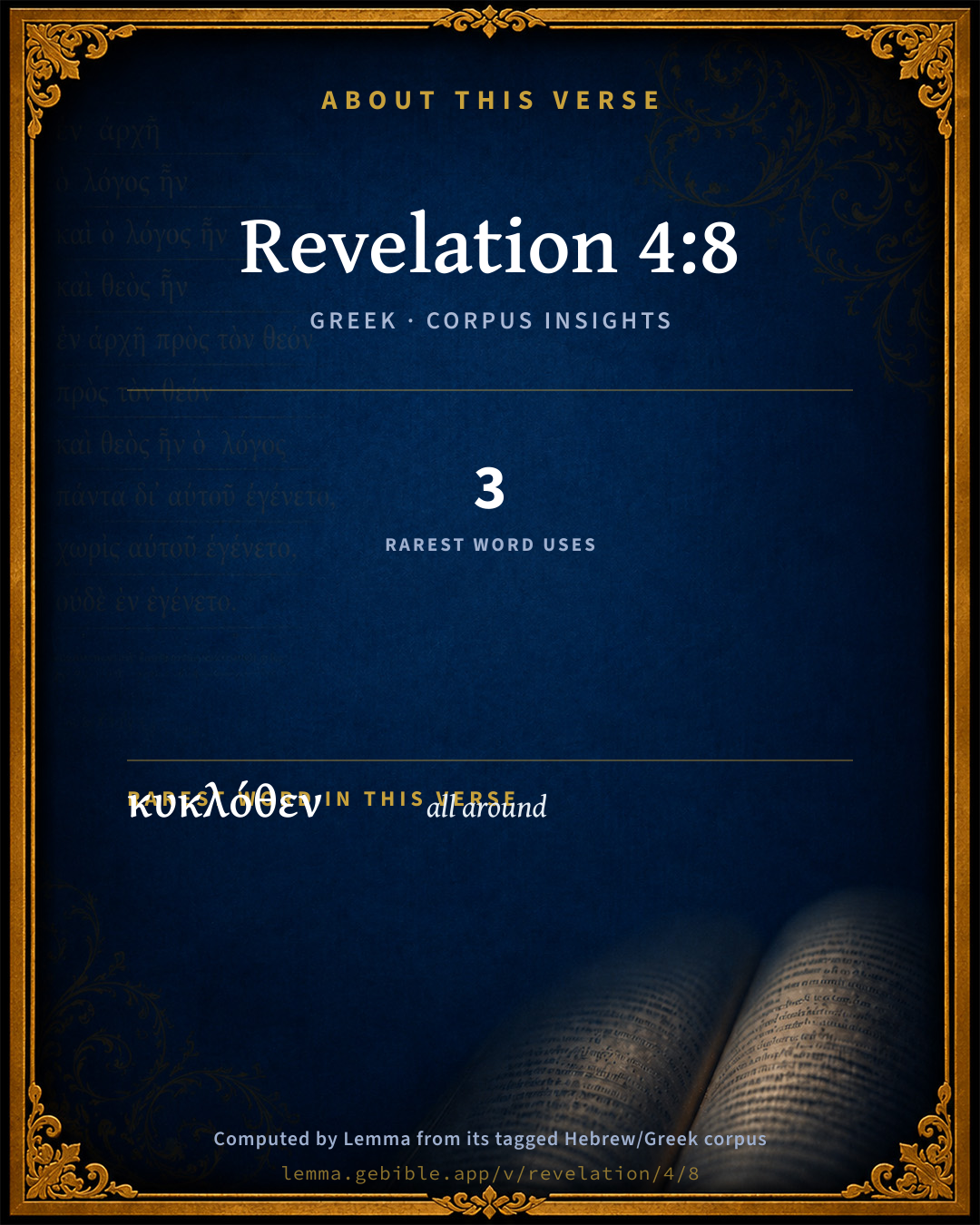
Revelation 4:8

Greek (Tischendorf 8th ed.) Revelation 4:8 appears in the Greek New Testament. The text above is from the Tischendorf 8th edition. Each word links to its Strong’s number and a concise gloss. Click any word for its full Thayer’s Greek Lexicon entry.
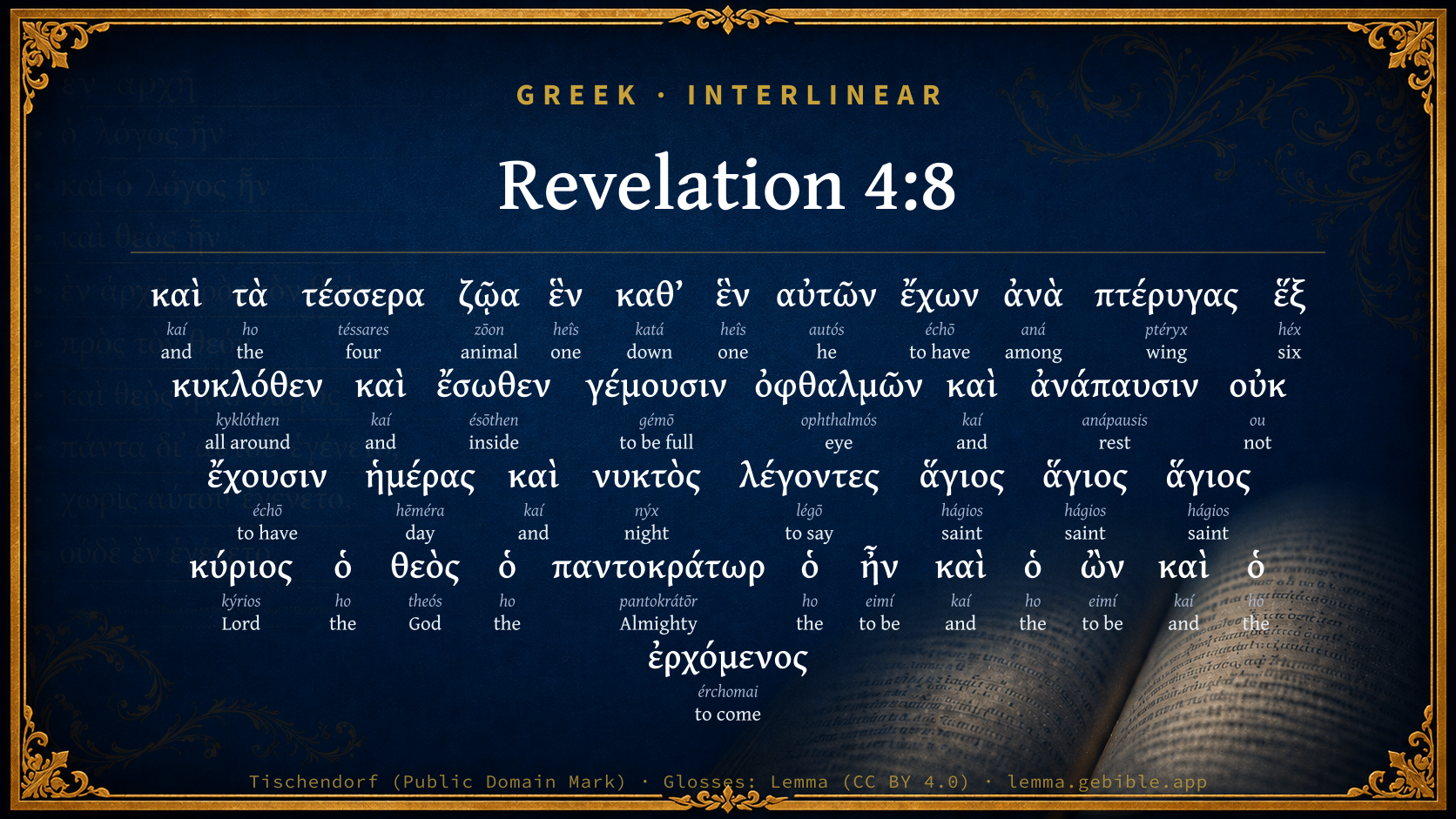
Download image
Cite this verse

Revelation 4:8 (World English Bible). Public Domain. Lemma interlinear Bible study tool, https://lemma.gebible.app/v/revelation/4/8.

Show BibTeX & RIS
BibTeX
RIS
English Translation
The four living creatures, each one of them having six wings, are full of eyes around about and within. They have no rest day and night, saying, "Holy, holy, holy, holy, holy, holy, holy, holy, holy is the Lord God, the Almighty, who was and who is and who is to come!"
World English Bible · Public Domain
Download a study sheet

One document with this verse’s original text, its word-by-word gloss line, the meaning frame, cross-references with their text, attributed commentary, and full source and license credits — printable, and it pastes into notes with its structure intact.

This verse Autodidact and up

Study sheet (.html) Plain text (.txt)

A passage Seminary Student

Up to 50 verses in one chapter. A passage sheet keeps up to 6 commentary sources and 12 cross-references per verse, in the order this page ranks them, and says so on the sheet whenever that leaves anything out. Ask for a single verse and you get the Autodidact verse sheet above.

Everything on this page stays free to read, with no account — the sheet is a download of what is already on screen, not access to it.

Want to remove ads? Support Godless Engineer
Compare translations 3

The same verse in 3 English versions, stacked beneath the original-language interlinear above. Click any original word for its lexicon entry.

Each is an independent rendering of the whole verse — the interlinear is not word-aligned to these translations.

Highlighted words mark where these versions differ — a whole-verse word diff, not a word-by-word alignment.

  • World English Bible Public Domain
    The four living creatures, each one of them having six wings, are full of eyes around about and within. They have no rest day and night, saying, "Holy, holy, holy, holy, holy, holy, holy, holy, holy is the Lord God, the Almighty, who was and who is and who is to come!"
  • King James Version Public Domain
    And the four beasts had each of them six wings about him; and they were full of eyes within: and they rest not day and night, saying, Holy, holy, holy, LORD God Almighty, which was, and is, and is to come.
  • unfoldingWord Literal Text CC BY-SA 4.0
    And the four living creatures, each one of them having six wings apiece, being full of eyes around and underneath, indeed do not have rest night and day, saying, “Holy, holy, holy, Lord God, the Ruler of All, the one having been and the one being and the one coming.”

unfoldingWord Literal Text — © unfoldingWord, licensed CC BY-SA 4.0. Word-aligned USFM3 via Door43 (git.door43.org/unfoldingWord/en_ult).

Versions to compare (up to 4)

3 of 4 selected

Show all 19 translations

Every available English version of this verse, each an independent rendering of the whole verse.

  • World English Bible Public Domain
    The four living creatures, each one of them having six wings, are full of eyes around about and within. They have no rest day and night, saying, "Holy, holy, holy, holy, holy, holy, holy, holy, holy is the Lord God, the Almighty, who was and who is and who is to come!"
  • Berean Standard Bible Public Domain
    And each of the four living creatures had six wings and was covered with eyes all around and within. Day and night they never stop saying: “Holy, Holy, Holy, is the Lord God Almighty, who was and is and is to come!”
  • Majority Standard Bible Public Domain
    And each of the four living creatures had six wings and was covered with eyes all around and within. Day and night they never stop saying: “Holy, Holy, Holy, is the Lord God Almighty, who was and is and is to come!”
  • King James Version Public Domain
    And the four beasts had each of them six wings about him; and they were full of eyes within: and they rest not day and night, saying, Holy, holy, holy, LORD God Almighty, which was, and is, and is to come.
  • American Standard Version (1901) Public Domain
    and the four living creatures, having each one of them six wings, are full of eyes round about and within: and they have no rest day and night, saying, Holy, holy, holy, `is' the Lord God, the Almighty, who was and who is and who is to come.
  • Revised Version (1885) Public Domain
    And the four living creatures, having each one of them six wings, are full of eyes round about and within: and they have no rest day and night, saying, Holy, holy, holy, is the Lord God, the Almighty, which was and which is and which is to come.
  • Geneva Bible (1599) Public Domain
    And the foure beasts had eche one of them sixe wings about him, and they were full of eyes within, and they ceased not day nor night, saying, Holy, holy, holy Lord God almighty, Which Was, and Which Is, and Which Is to come.
  • Douay-Rheims (1899) Public Domain
    And the four living creatures had each of them six wings; and round about and within they are full of eyes. And they rested not day and night, saying: Holy, holy, holy, Lord God Almighty, who was, and who is, and who is to come.
  • Young's Literal Translation Public Domain
    And the four living creatures, each by itself severally, had six wings, around and within `are' full of eyes, and rest they have not day and night, saying, `Holy, holy, holy, Lord God Almighty, who was, and who is, and who is coming;'
  • Literal Standard Version CC BY-SA 4.0
    And the four living creatures, one by one of them had six wings respectively, around and within [are] full of eyes, and they have no rest day and night, saying, “HOLY, HOLY, HOLY, the LORD God, the Almighty, who was, and who is, and who is coming”;
  • Unlocked Literal Bible CC BY-SA 4.0
    The four living creatures each had six wings, full of eyes on top and underneath. Night and day they do not stop saying, “Holy, holy, holy is the Lord God Almighty who was, and who is, and who is to come.”
  • unfoldingWord Literal Text CC BY-SA 4.0
    And the four living creatures, each one of them having six wings apiece, being full of eyes around and underneath, indeed do not have rest night and day, saying, “Holy, holy, holy, Lord God, the Ruler of All, the one having been and the one being and the one coming.”
  • Darby Bible Public Domain
    And the four living creatures, each one of them having respectively six wings; round and within they are full of eyes; and they cease not day and night saying, Holy, holy, holy, Lord God Almighty, who was, and who is, and who is to come.
  • World Messianic Bible Public Domain
    The four living creatures, each one of them having six wings, are full of eyes around and within. They have no rest day and night, saying, “Holy, holy, holy is the Lord God, the Almighty, who was and who is and who is to come!”
  • Webster's Bible Public Domain
    And the four living beings had each of them six wings about him; and they were full of eyes within: and they rest not day and night, saying, Holy, holy, holy, Lord God Almighty, who was, and is, and is to come.
  • Free Bible Version CC BY-SA 4.0
    The four living creatures each had six wings also covered with eyes. Day and night they never stop saying, “Holy, holy, holy is the All-powerful Lord God, who was, who is, and who is to come.”
  • Bible in Basic English Public Domain
    And the four beasts, having every one of them six wings, are full of eyes round about and inside: and without resting day and night, they say, Holy, holy, holy, Lord God, Ruler of all, who was and is and is to come.
  • Text-Critical English NT CC BY 4.0
    Each of the four living creatures had six wings and was covered with eyes all around and within. Day and night they never stop saying, “Holy, holy, holy, is the Lord God Almighty, who was and who is and who is to come.”
  • Tyndale New Testament (1534) Public Domain
    And the iiii. bestes had eche one of them vi. wynges aboute him and they were full of eyes with in. And they had noo reste daye nether nyght sayinge: holy holy holy lorde god almyghty which was and is and is to come.

Literal Standard Version (2020), Covenant Press — licensed CC BY-SA 4.0. Text via the HelloAO Bible API (eBible.org). Unlocked Literal Bible (unfoldingWord) — licensed CC BY-SA 4.0. Text via the HelloAO Bible API (eBible.org). unfoldingWord Literal Text — © unfoldingWord, licensed CC BY-SA 4.0. Word-aligned USFM3 via Door43 (git.door43.org/unfoldingWord/en_ult). Free Bible Version, Dr. Jonathan Gallagher — licensed CC BY-SA 4.0. Text via the HelloAO Bible API (eBible.org).

Word by word

More ways to search: Search by grammar → Find every occurrence → Compare this word →

Practice this passage: Drill this verse → Learn its vocabulary →

κυκλόθεν
kyklóthen
G2943
“all around”
Adverb
Part of Speech
Adverb
Full Thayer's Definition

Origin: from the same as G2945

TDNT: None

1. round about, from all sides, all around
  1. καὶ kaí G2532 “and” Conjunction
  2. τὰ ho G3588 “the” Article, Nominative, Plural, Neuter
  3. τέσσερα téssares G5064 “four” Adjective, Nominative, Plural, Neuter
  4. ζῷα zōon G2226 “animal” Noun, Nominative, Plural, Neuter
  5. ἓν heîs G1520 “one” Adjective, Nominative, Singular, Neuter
  6. καθ’ katá G2596 “down” Preposition
  7. ἓν heîs G1520 “one” Adjective, Accusative, Singular, Neuter
  8. αὐτῶν autós G846 “he” Personal pronoun, Genitive, Plural, Neuter
  9. ἔχων échō G2192 “to have” Verb, Present, Active, Participle, Nominative, Singular, Masculine
  10. ἀνὰ aná G303 “among” Preposition
  11. πτέρυγας ptéryx G4420 “wing” Noun, Accusative, Plural, Feminine
  12. ἕξ héx G1803 “six” Adjective, Numeral (indeclinable)
  13. καὶ kaí G2532 “and” Conjunction
  14. ἔσωθεν ésōthen G2081 “inside” Adverb
  15. γέμουσιν gémō G1073 “to be full” Verb, Present, Active, Indicative, 3rd person, Plural
  16. ὀφθαλμῶν ophthalmós G3788 “eye” Noun, Genitive, Plural, Masculine
  17. καὶ kaí G2532 “and” Conjunction
  18. ἀνάπαυσιν anápausis G372 “rest” Noun, Accusative, Singular, Feminine
  19. οὐκ ou G3756 “not” Particle, Negative
  20. ἔχουσιν échō G2192 “to have” Verb, Present, Active, Indicative, 3rd person, Plural
  21. ἡμέρας hēméra G2250 “day” Noun, Genitive, Singular, Feminine
  22. καὶ kaí G2532 “and” Conjunction
  23. νυκτὸς nýx G3571 “night” Noun, Genitive, Singular, Feminine
  24. λέγοντες légō G3004 “to say” Verb, Present, Active, Participle, Nominative, Plural, Masculine
  25. ἅγιος hágios G40 “saint” Adjective, Nominative, Singular, Masculine
  26. ἅγιος hágios G40 “saint” Adjective, Nominative, Singular, Masculine
  27. ἅγιος hágios G40 “saint” Adjective, Nominative, Singular, Masculine
  28. κύριος kýrios G2962 “Lord” Noun, Nominative, Singular, Masculine
  29. ὁ ho G3588 “the” Article, Nominative, Singular, Masculine
  30. θεὸς theós G2316 “God” Noun, Nominative, Singular, Masculine
  31. ὁ ho G3588 “the” Article, Nominative, Singular, Masculine
  32. παντοκράτωρ pantokrátōr G3841 “Almighty” Noun, Nominative, Singular, Masculine
  33. ὁ ho G3588 “the” Article, Nominative, Singular, Masculine
  34. ἦν eimí G1510 “to be” Verb, Imperfect, Active, Indicative, 3rd person, Singular
  35. καὶ kaí G2532 “and” Conjunction
  36. ὁ ho G3588 “the” Article, Nominative, Singular, Masculine
  37. ὢν eimí G1510 “to be” Verb, Present, Active, Participle, Nominative, Singular, Masculine
  38. καὶ kaí G2532 “and” Conjunction
  39. ὁ ho G3588 “the” Article, Nominative, Singular, Masculine
  40. ἐρχόμενος érchomai G2064 “to come” Verb, Present, Middle or Passive deponent, Participle, Nominative, Singular, Masculine

About this verse

These counts appear in no published source. They are computed here, from the morphology-tagged text and Lemma’s own curated glosses. What Lemma adds →

41
words
26
distinct lemmas
Revelation
section

Notable vocabulary

The rarest word here is κυκλόθεν all around G2943 — appearing just 3 times in the whole Greek New Testament.

Shared distinctive vocabulary

κυκλόθεν all around G2943 occurs in 3 verses of the Greek New Testament. Also found in:

Repetition

Words recur within this verse:

Cross-references

25

Topical passages linked to Revelation 4:8 in the Treasury of Scripture Knowledge — connected by theme and wording, ordered by reader-vote popularity; previews shown in the World English Bible.

  • Isaiah 6:2–13 Above him stood the seraphim. Each one had six wings. With two he covered his face. With two he covered his feet. With two he flew.
  • Revelation 1:8 "I am the Alpha and the Omega," says the Lord God, "who is and who was and who is to come, the Almighty."
  • Hebrews 13:8 Jesus Christ is the same yesterday, today, and forever.
  • Exodus 15:11 Who is like you, Yahweh, among the gods? Who is like you, glorious in holiness, Fearful in praises, doing wonders?
  • Revelation 4:6 Before the throne was something like a sea of glass, similar to crystal. In the midst of the throne, and around the throne were four living creatures full of eyes before and behind.
  • Ezekiel 10:21–22 Every one had four faces, and every one four wings; and the likeness of the hands of a man was under their wings.
  • Revelation 15:3 They sang the song of Moses, the servant of God, and the song of the Lamb, saying, "Great and marvelous are your works, Lord God, the Almighty; Righteous and true are your ways, you King of the nations.
  • Revelation 16:7 I heard the altar saying, "Yes, Lord God, the Almighty, true and righteous are your judgments."
  • Psalms 91:1 He who dwells in the secret place of the Most High Will rest in the shadow of the Almighty.
  • Ezekiel 1:6 Everyone had four faces, and everyone of them had four wings.
  • Revelation 11:17 saying: "We give you thanks, Lord God, the Almighty, the one who is and who was; because you have taken your great power, and reigned.
  • Genesis 17:1 When Abram was ninety-nine years old, Yahweh appeared to Abram, and said to him, "I am God Almighty. Walk before me, and be blameless.
  • Revelation 3:7 "To the angel of the assembly in Philadelphia write: "He who is holy, he who is true, he who has the key of David, he who opens and no one can shut, and who shuts and no one opens, says these things:
  • Revelation 7:15 Therefore they are before the throne of God, they serve him day and night in his temple. He who sits on the throne will spread his tent over them.
  • Isaiah 62:6–7 I have set watchmen on your walls, Jerusalem; they shall never hold their peace day nor night: you who call on Yahweh, take no rest,
  • Revelation 1:4 John, to the seven assemblies that are in Asia: Grace to you and peace, from God, who is and who was and who is to come; and from the seven Spirits who are before his throne;
  • Revelation 19:15 Out of his mouth proceeds a sharp, double-edged sword, that with it he should strike the nations. He will rule them with a rod of iron. He treads the winepress of the fierceness of the wrath of God, the Almighty.
  • Revelation 21:22 I saw no temple in it, for the Lord God, the Almighty, and the Lamb, are its temple.
  • 2 Corinthians 6:18 I will be to you a Father. You will be to me sons and daughters,' says the Lord Almighty."
  • Revelation 4:4 Around the throne were twenty-four thrones. On the thrones were twenty-four elders sitting, dressed in white garments, with crowns of gold on their heads.
  • Isaiah 13:6 Wail; for the day of Yahweh is at hand; as destruction from the Almighty shall it come.
  • Isaiah 62:1 For Zion's sake will I not hold my peace, and for Jerusalem's sake I will not rest, until her righteousness go forth as brightness, and her salvation as a lamp that burns.
  • Joel 1:15 Alas for the day! For the day of Yahweh is at hand, And it will come as destruction from the Almighty.
  • 1 Thessalonians 2:9 For you remember, brothers, our labor and travail; for working night and day, that we might not burden any of you, we preached to you the Gospel of God.
  • 2 Thessalonians 3:8–9 neither did we eat bread from anyone's hand without paying for it, but in labor and travail worked night and day, that we might not burden any of you;

Cross-references courtesy of OpenBible.info (CC BY 4.0).

Commentary

Notes on Revelation 4:8 from classic Christian and Jewish commentators (each source and its license shown beneath its notes). The classic Christian expositions comment on the surrounding passage and are grouped to its opening verse, so a note may address several verses; the Jewish commentaries on the Tanakh (Rashi and others) are per-verse, so they appear only where the commentator wrote on this verse.

Lemma curates 59 commentaries, every one of them public domain or Creative Commons licensed, each selected and text-cleaned for this edition rather than reprinted as found. About our sources →

Joseph Benson's Commentary

Rev 4:8. And the four living creatures — With an allusion to the seraphim represented in Isaiah’s vision; had each of them six wings about him — Which they used in part to express their reverence and humility, and in part to show readiness and expedition in performing the orders and commands of God. See on Isa 6:2-3. And they were full of eyes within — Bengelius reads κυκλοθεν και εσωθεν γεμουσιν οφθαλμων, round about and within they are full of eyes: round about signifying their attention to and knowledge of the state of the world and church in general; or rather, perhaps, their vigilance and circumspection, their attention to their duty to God and man, and their watchful observance of the designs, wiles, devices, and various motions and snares of their spiritual enemies; and they are said to be full of eyes within, to signify their self-knowledge, their diligent attention to the state of their own hearts, and the various workings of their passions and appetites, their affections and thoughts. And they rest not — O happy unrest! day and night — They are incessant in the spiritual worship, adoration, and praise of him who is a Spirit; and at all proper opportunities they unite in acts of solemn and external worship; saying — With their lips, as well as in their hearts; Holy, holy, holy, Lord God Almighty, which ever was, and now is, and is still to come — Or, for ever will be; the one true God, the everlasting Lord, the Supreme Governor of all beings.

There are two words in the original very different from each other, both which we translate holy. The one, οσιος, means properly, merciful: but the other, αγιος, which occurs here, implies much more. “This holiness is the sum of all the praise which is given to the Almighty Creator, for all that he does and reveals concerning himself, till the new song brings with it new matter of glory. This word properly signifies separated. And when God is termed holy, it denotes that excellence which is altogether peculiar to himself; and the glory flowing from all his attributes conjoined, shining forth from all his works, and darkening all things besides itself, whereby he is, and eternally remains, in an incomprehensible manner, separate, and at a distance, not only from all that is impure, but likewise from all that is created. God is separate from all things. He is, and works from himself, out of himself, in himself, through himself, for himself. Therefore he is the First and the Last, the only One, and the Eternal; living and happy, endless and unchangeable, almighty, omniscient, wise and true, just and faithful, gracious and merciful. When God is spoken of, he is often named, The Holy One. And as God swears by his name, so he does also by his holiness, that is, by himself. This holiness is often styled glory; often his holiness and glory are celebrated together, Lev 10:3; Isa 6:4. For holiness is covered glory, and glory is uncovered holiness. The Scripture speaks abundantly of the holiness and glory of the Father, the Son, and the Holy Ghost. And hereby is the mystery of the Holy Trinity eminently confirmed. That is also termed holy, which is consecrated to him, and for that end separated from other things. And so is that wherein we may be like God, or united to him. In the hymn resembling this, recorded by Isaiah, (Rev 6:3,) is added, The whole earth is full of his glory. But this is deferred in the Revelation, till the glory of the Lord (his enemies being destroyed) fills the earth.” — Wesley.

Joseph Benson's Commentary on the Old and New Testaments (1811–1818) — public domain. Text from a community e-Sword module.

Tyndale Open Study Notes

Tyndale Open Resources

4:8 day and night: The four beings ceaselessly praised God’s basic characteristics: his holiness, his power (the Almighty), and his eternity (see study note on 1:4). • Holy, holy, holy comes from Isa 6:3 and is the highest worship affirmation in Scripture. To double something makes it emphatic; to triple it makes it ultimate.

Tyndale Open Study Notes — © Tyndale Open Resources, licensed CC BY-SA 4.0. Text via the HelloAO Bible API.

Bengel's Gnomon

Johann Albrecht Bengel

Rev 4:8. Ἔχον) Εἶχον, Er. (without the sanction of the other copies of Andreas) and Bar. L.; ἔσχον, Hunt. The ἀνὰ is thought by Wolf to require the plural form of the verb: the singular however occurs, Rev 21:21. The others, with great agreement, have ἔχον or εἶχον.[60]–[61] γέμουσις[62] ὀφθαλμῶν) Uffenb., a recent book indeed, has γέμουσιν ὀφθαλμούς; but that this was the reading of others also, you may collect from And. I., who substitutes ἔχοντα ὀφθαλμούς. The same Uff., Rev 4:6, has also γέμοντα ὀφθαλμούς. Perhaps more MSS. have the same variety, which may have been overlooked by collators. The verb γέμω is found with a genitive and accusative together, ch. Rev 17:4.—ἅγιος, ἅγιος, ἅγιος, holy, holy, holy) Some copyists wrote this nine times, in accordance with the liturgical custom of the Greeks; but John, as Isaiah, wrote it three times. And in John the four beasts raise this cry to Him that sits upon the throne, that is, the Father, from whose right hand the Lamb, that is, Christ, takes the book which is sealed with seven seals. The Τρισάγιον, as the Greeks term it, occurs also in Psalms 99, where, on the announcement of His Majesty which is about to display itself, of His Justice which already displays itself, and of His Mercy displayed in time past, there resound three addresses on the subject of His Holiness. And, as in that instance, so this Apocalyptic Τρισάγιον also in the text itself, points out its own meaning in relation to itself:

[60] A has ἔχων: so Lachm. and Tiseh. B, ἔχον. Rec. Text, εἶχον; so Vulg. “habebant.” Either of the former, as being the more difficult, is less likely to have come from transcribers.—E.

[61] κυκλόθεν, about) This is to be referred not to the wings, but to the eyes.—V. g.

[62] So AB Vulg.; but Rec. Text, without good authority, γέμοντα.—E.

Holy, He who was:

Holy, He who is:

Holy, He who is to come.

He showed Himself as an object of holy worship, in the creation of all things: He shows Himself further more fully as an object of holy worship, in the governing of all things: He will in the highest degree show Himself an object of holy worship, in the consummation of all things. From Him, and through Him, and to Him are all things: to Him be glory to all ages. Castellio is not inconsistent with those things which we said on the subject of Holiness in the German Notes; for, according to his explanation, קדוש is Augustus, as T. L. Bunemann observes in the Index of the Bible of Castellio.

In a similar hymn, Isa 6:3, there is added, THE EARTH is full of His glory. But in the Apocalypse this is deferred, until the glory of THE LORD fills the earth, His enemies having been destroyed. See ch. Rev 5:10, Rev 11:16-18, Rev 19:2. By the use of which passages, we collect, that the four beasts are more occupied, while the action is in heaven; the elders, while it is extended to the earth.

Bengel's Gnomon of the New Testament — English translation (T&T Clark, Edinburgh, 1860) — public domain. Text from a community e-Sword module.

Meyer's Critical & Exegetical Commentary

Heinrich August Wilhelm Meyer

Rev_4:8. The four beings, having each six wings,[1792] are all around and within full of eyes. Concerning the composition ἛΝ ΚΑΘʼ. ἛΝ, cf. Mar_14:19; Joh_8:9; Rom_12:15; Winer, p. 234. Concerning the distributive ἈΝΆ, cf. Joh_2:6; Winer, p. 372.

The ΚΥΚΛΌΘΕΝ belongs not to what precedes,[1793] but with ἜΣΩΘΕΝ to ΓΈΜΟΥΣΙΝ. Yet the ΚΥΚΛΌΘΕΝ is not equivalent to the ἜΜΠΡΟΣΘΕΝ, Rev_4:6, so that the ἜΣΩΘΕΝ corresponds to the ὍΠΙΣΘΕΝ;[1794] but rather the ΚΥΚΛΌΘΕΝ properly comprises already both of those statements, while only with reference to the wings mentioned is it still expressly remarked that within, i e., on the inner side of the wings, under themnot only round about the entire outside of the body (ΚΥΚΛ.)all is full of eyes.[1795] It results also from this determination of ΚΥΚΛ. and ἜΣΩΘΕΝ, that the declaration ΓΕΜ. ὈΦΘΑΛΜ. is repeated, because this is to be extended particularly[1796] to the wings.[1797] At the same time the adding of what follows, ΚΑῚ ἈΝΆΠΑΥΣΙΝ

ἘΡΧΌΜΕΝΟς, reveals the meaning first of the fulness of eyes, and then of the four beings in general. Ceaselessly, day and night, they exclaim, Holy, etc.

The masc. ΛΈΓΟΝΤΕς, in the same loose wav as Rev_4:1.

The ἩΜ. Κ. ΝΥΚΤ. can in no way suggest that at the throne of God there is no change of day and night, and still less dare the explanation be made: Though there be on earth, here or there, day or night.[1798]

The uninterrupted hymn of praise of the four beings sounds like that of the seraphim in Isa_6:3; but since, instead of the close found there (ΠΛΉΡΗς ΠᾶΣΑ Ἡ Γῆς ΔΌΞΗς ΑὙΤΟῦ), it is said here Ὁ ἨΝ ΚΑῚ Ὁ ΚΑῚ Ὁ ἘΡΧΌΜΕΝΟς, there is found[1799] in the praise of these four beings a particular factor, which already in Rev_1:8 sounds forth like a keynote in a judgment of God which is highly significant to the whole. The thrice holy Lord God, at the same time, is also the Eternal One who is to come. These words of praise from the mouth of the four beings agree perfectly with the manifestation of the Enthroned One,[1800] as this itself agrees with his own words;[1801] and in all the living divine, foundation of the entire Apocalyptic prophecy is indicated, because God comesin a personal way, as the prophet saysas surely as he is the Holy, Almighty, Eternal One, endowed with complete living energy.

Only now can the question be answered, as to what these beings are, and what their special characteristics signify. Undoubtedly these four ΖῶΑ[1802] are not actual beasts who serve only to support the throne of God, as in Persian and Indian sculptures massive forms of beasts are seen supporting a throne;[1803] for ΖῶΟΝ is not ΘΗΡΊΟΝ,[1804] and concerning the four beings as supporting the throne, the text does not say a word.

Almost all the explanations of older times depend upon mere surmises, as, that the four beings are meant to designate: the Four Evangelists, and that, too, so that, according to Augustine,[1805] the lion represents Matthew, the man Mark, the ox Luke, and the eagle John;[1806] the four cardinal virtues;[1807] the four mysteries of faith, viz., Christs incarnation, passion, resurrection, ascension;[1808] the four patriarchal churches;[1809] the four apostles or apostolic men, who were then at Jerusalem as standard-bearers of Christs camp;[1810] all the doctors of the Church,[1811] etc. It is further a perversion to regard the four beings as angels, from whom they are expressly distinguished in Rev_5:8; Rev_5:11, Rev_7:11.[1812] According to their form, they are essentially identical with the cherubim of the O. T.; so they have also their symbolical meaning. The question is whether they represent powers of God employed in the creation,[1813] or creation itself.[1814] The former interpretation is carried to such extent by Ebrard, that the lion is regarded as designating the consuming and destroying, the bullock the nourishing, man the thinking and caring, and the eagle, which soars victoriously above all, the preserving and rejuvenating power in nature. This is indeed ingenious, but is forced. It is in itself peculiar, and entirely unbiblical, to form the powers of God into definite symbolical beings, and the idea is entirely inadmissible, to regard powers so formed as proclaiming the praise of God: but, on the other hand, it is perfectly natural for the works to proclaim the praise of the Creator,[1815] and for these, especially the entire living creation, to be represented by definite, concrete forms. The creatures at the basis of the O. T. cherubic forms most simply offer themselves as such representatives of the entire living creation. The correct point of view is already stated in the rabbinical sentence:[1816] There are four holding the chief place in the world,among creatures, man; among birds, the eagle; among cattle, the ox; among beasts, the lion. That these four are intended to represent the entire living creation, is indicated by the significant number four itself;[1817] and to object against it, that besides the fish, etc., are not represented, is pointless.[1818] Entirely irrelevant, however, to the proper meaning of the symbol, is the succession of lion, ox, etc., which John, after remodelling in general the Ezekiel cherubic forms, unintentionally changed; the idea also is arbitrary, that the four beings in John, just as in Ezekiel, must have had altogether human bodies, since man is exalted above other creatures.[1819] This allusion is introduced here without sufficient reason, as the subject has to do simply with the entirety of the living creation as such. Incorrect, besides, is the interpretation of the eyes, wherewith the four beings are covered, by saying that the entire living creation is spiritualized,[1820] which follows at least from Rev_5:6. The context itself shows, on the other hand, that the eyes are to be regarded as signs of the constant wakefulness day and night, belonging to the ceaseless praise of God.[1821] Finally, the six wings which John has derived for his beings from the six seraphim (Isaiah 6), we cannot well understand here otherwise than as there. They designate not the collective significance of the four beings,[1822] but serve as a figurative representation of the unconditionally dependent and ministerial relation in which the creature stands, and is recognized as standing, to its Creator. Thus Bengel:[1823] So that with two they covered their faces, with two their feet, and with two flew: whereby then the three chief virtues were indicated, viz., reverence or respect, as they do not boldly look; humility, as they hide themselves before that brilliancy; and obedience, to execute commands.

The essential idea delineated in the images of the ΖῶΑ (cherubim) may be expressed in words as Psa_103:22 : All the works of God (in all places),as they, at least with respect to earthly living creatures, are represented in the beings, and that, too, four beings,are to praise God in all places of his dominion. For, that he, as unconditioned Lord of his creatures, is honored with all humility and obedience, is seen in that they hide themselves, and are ready to serve his will. Yet there is also placed in the mouth of the representatives of the creatures an express ascription of praise to the holy, almighty Lord, and that, too, as the innumerable, ever-wakeful eyes show, one that is perpetual (Rev_4:8). [See Note XLIV., p. 203.]

[1792] Cf. Rev_5:8, Rev_19:4, where the beasts fall down, which cannot be thought of if two of them were four-footed.

[1793] Luther.

[1794] Within, towards the throne.

[1795] Züll., De Wette.

[1796] De Wette.

[1797] Cf. Eze_10:12.

[1798] Beng.

[1799] As it corresponds with the pragmatic relation of the entire presentation, ch. 4 [and 5], to the entire contents of the Apoc.

[1800] Rev_4:2 sqq.

[1801] Rev_1:8.

[1802] חַיוֹת, Ezekiel 1. Cf. especially Eze_1:20, where all four חַיוֹת are designated as one חַיָה; here the LXX., incorrectly, ζωή.

[1803] Eichh., Ew.

[1804] Wis_7:20.

[1805] De Cons. Evang., 16.

[1806] Cf. Victor, Primas, Beda, Andr. Even Ebrard attributes some truth to such forced interpretation.

[1807] Andr., Areth.

[1808] Aretius after Augustine, Ansbertus.

[1809] N. de Lyra: Jerusalem (where the church began, is the first beast, Act_5:29 furnishing an example of its lion-like spirit), Antioch, Alexandria, and Constantinople. The six wings are the natural law, the Mosaic law, the oracles of the prophets, the gospel of counsels, the doctrine of the apostles, the statutes of general councils. The station of the Romish Church, which is naturally already, in N. de Lyra, the head of all, C. a Lap. describes by adding that the throne of God is the cathedra Romana, on which sits the vicar of Christ.

[1810] Grot., who regards them as Peter, James, Matthew, and Paul; the eyes are colors, and designate the multiform gifts of God.

[1811] The doctors of theology. Calov.; Cf. Vitr., etc.

[1812] Cf. Vitr. and Hengstenb., vs. Laun., C. a Lap., Beng., etc.

[1813] Ebrard, etc.

[1814] Herder, De Wette, Rinck, Hengstenb.

[1815] Cf. Psa_19:2 sqq., Psa. 103:22, 148.

[1816] Schemoth, Rabba 23, fol. 122, 4, b. Schöttg. Cf. also Beng.

[1817] Beng., Hengstenb.

[1818] Ebrard.

[1819] The human type must preponderate in the personification of every thing living; the rest must be content with the representation of their faces (Hengstenb.).

[1820] Hengstenb.

[1821] De Wette. Cf. Rinck, etc.

[1822] Rinck, who mentions that the entire number of wings, four times six, is equal the number of elders.

[1823] Cf. also Hengstenb.

NOTES BY THE AMERICAN EDITOR

XLIV. Rev_4:6-8. τέσσερα ζῷα

Cf. Cremer (Lexicon): Properly, a living creature, which also occurs elsewhere also in profane Greek, where ζῶον, a post-Homeric word, generally signifies living creature, and only in special instances a beast; θηρίον = animal, as embracing all living beings, must be retained in the Revelation, where four ζῶα are represented as being between Gods throne and those of the elders which surround it, the description given of which (Rev_4:6-8) resembles that of the הַיוֹת in Eze_1:5 sqq.; the cherubim in Ezekiel 10 (cf. Psa_18:1; Psa_99:1; Psa_80:2; 1Sa_4:4; 2Sa_6:2; 2Ki_19:15). They are named living creatures here and in Ezekiel 1, on account of the life which is their main feature. They are usually the signs and tokens of majesty, of the sublime majesty of God, both in his covenant relation, and in his relation to the world (for the latter, see Psa_99:1); and therefore it is that they are assigned so prominent a place, though no active part in the final scenes of sacred history (Rev_6:1-7). The appearance of four represents the concentration of all created life in this world, the original abode of which, Paradise, when life had fallen to sin and death, was given over to the cherubim. They do not, like the angels, fulfil the purposes of God in relation to men; they are distinct from the angels (Rev_5:11). We are thus led to conclude that they materially represent the ideal pattern of the true relation of creation to its God. Oehler (O. T. Theology, p. 260): It is the cherubim, as Schultz well expresses it, which at one and the same time proclaim and veil his presence. The lion and the bull are, as is well known, symbols of power and strength; man and the eagle are symbols of wisdom and omniscience; the latter attribute is expressed also in the later form of the symbol by the multitude of eyes. The continual mobility of the ζῶα (Rev_4:8) signifies the never-resting quickness of the Divine operations; this is probably symbolized also by the wheels in Ezekiel 1. The number four is the signature of all-sidedness (towards the four quarters of heaven). Thus Jehovah is acknowledged as the God who rules the world on all sides in power, wisdom, and omniscience. Instead of natural powers working unconsciously, is placed the all-embracing, conscious activity of the living God.

Meyer — Critical and Exegetical Commentary on the New Testament — English translation by Peter Christie, edited by Frederick Crombie (T&T Clark, 1880) — public domain. Text from a community e-Sword module.

Expositor's Greek Testament

ed. W. Robertson Nicoll

Rev 4:8 . A description of the sounds and songs of heaven follows the picture of its sights. γέμουσιν , either with τὰ τ . ζ . ( ἔχων for once a real participle) or an asyndeton (if ἔχων here, as elsewhere in the Apocalypse, must be supplied with a copula). κυκλ . κ . ἐ . = “round their bodies and on the inside” ( i.e. , underneath their wings). For the ceaseless praise, which resembles that of Nin-ib, the Assyrian deity, cf. on Rev 4:7 and Rev 4:11 , also Enoch xxxix. 12 (the trisagion sung by the sleepless ones, i.e. , angels), Slav, En. 17, and Test. Lev 3Lev 3 (where endless praise is the function of denizens in the fourth heaven). The first line of the hymn is Isaianic, the second ( ὁ ἦν κ . τ . λ .) is characteristic of the Apocalypse. In En. xli. 7 the sun and moon in their orbits “give thanks and praise and rest not; for to them their thanksgiving is rest”. In the Apocalypse, however, the phenomena of nature are generally the objects or the scourges of the divine wrath. The precedence of ὁ ἦν over ὁ ὤν may be due to the emphasis of the context upon (Rev 4:11 ) the definite creative action of God. Since the πρεσβύτεροι worship God as the eternal (Rev 4:10 ), while the ζῷα acknowledge him as the ἅγιος , the latter epithet probably retains its O.T. sense, i.e. , absolute life and majestic power (Rev 16:5 ). The trisagion occurs in the Babylonian recension (Rev 4:3 .) of the Shmone-Esreh, among the daily prayers of the Jewish community. See further Encycl. Rel. and Ethics , i. 117, 118.

The Expositor's Greek Testament, edited by W. Robertson Nicoll (1897–1910) — public domain. Text from a community e-Sword module.

Geneva Bible (1599)

Geneva Bible translators

Every beast had six wings.

By events, in that for all the causes before mentioned God is glorified both of Angels, as holy, Judge, omnipotent, eternal and immutable, verse 8, and also after their example he is glorified of holy men (verse 9) in sign and in speech, verses 10, 11.

Geneva Bible (1599) marginal notes — public domain. Text via Bolls.life.

Matthew Henry's Commentary

We have considered the sights that the apostle saw in heaven: now let us observe the songs that he heard, for there is in heaven not only that to be seen which will highly please a sanctified eye, but there is that to be heard which will greatly delight a sanctified ear. This is true concerning the church of Christ here, which is a heaven upon earth, and it will be eminently so in the church made perfect in the heaven of heavens.

I. He heard the song of the four living creatures, of the ministers of the church, which refers to the prophet Isaiah's vision, Isa 6:1-13. And here, 1. They adore one God, and one only, the Lord God Almighty, unchangeable and everlasting. 2. They adore three holies in this one God, the Holy Father, the Holy Son, and the Holy Spirit; and these are one infinitely holy and eternal Being, who sits upon the throne, and lives for ever and ever. In this glory the prophet saw Christ, and spoke of him.

II. He heard the adorations of the four-and-twenty elders, that is, of the Christian people represented by them; the ministers led, and the people followed, in the praises of God, Rev 4:10, Rev 4:11. Here observe,

1. The object of their worship, the same with that which the ministers adored: Him that sat on the throne, the eternal everliving God. The true church of God has one and the same object of worship. Two different objects of worship, either co-ordinate or sub-ordinate, would confound the worship and divide the worshippers. It is unlawful to join in divine worship with those who either mistake or multiply the object. There is but one God, and he alone, as God, is worshipped by the church on earth and in heaven.

2. The acts of adoration. (1.) They fell down before him that sat on the throne; they discovered the most profound humility, reverence, and godly fear. (2.) They cast their crowns before the throne; they gave God the glory of the holiness wherewith he had crowned their souls on earth and the honour and happiness with which he crowns them in heaven. They owe all their graces and all their glories to him, and acknowledge that his crown is infinitely more glorious than theirs, and that it is their glory to be glorifying God.

3. The words of adoration: they said, Thou art worthy, O Lord, to receive glory, and honour, and power, Rev 4:11. Observe, (1.) They do not say, We give thee glory, and honour, and power; for what can any creature pretend to give unto God? But they say, thou art worthy to receive glory. (2.) In this they tacitly acknowledge that God is exalted far above all blessing and praise. He was worthy to receive glory, but they were not worthy to praise, nor able to do it according to his infinite excellences.

4. We have the ground and reason of their adoration, which is threefold: - (1.) He is the Creator of all things, the first cause; and none but the Creator of all things should be adored; no made thing can be the object of religious worship. (2.) He is the preserver of all things, and his preservation is a continual creation; they are created still by the sustaining power of God. All beings but God are dependent upon the will and power of God, and no dependent being must be set up as an object of religious worship. It is the part of the best dependent beings to be worshippers, not to be worshipped. (3.) He is the final cause of all things: For thy pleasure they are and were created. It was his will and pleasure to create all things; he was not put upon it by the will of another; there is no such thing as a subordinate creator, that acts under and by the will and power of another; and, if there were, he ought not to be worshipped. As God made all things at his pleasure, so he made them for his pleasure, to deal with them as he pleases and to glorify himself by them one way or other. Though he delights not in the death of sinners, but rather that they should turn and live, yet he hath made all things for himself, Pro 16:4. Now if these be true and sufficient grounds for religious worship, as they are proper to God alone, Christ must needs be God, one with the Father and Spirit, and be worshipped as such; for we find the same causality ascribed to him. Col 1:16, Col 1:17, All things were created by him and for him, and he is before all things, and by him all things consist.

Matthew Henry's Commentary on the Whole Bible (1708–1710) — public domain (CC PDM 1.0). Text via the HelloAO Bible API.

Jamieson, Fausset & Brown

Robert Jamieson, A. R. Fausset & David Brown

about him--Greek, "round about him." ALFORD connects this with the following sentence: "All round and within (their wings) they are (so two oldest manuscripts, A, B, and Vulgate read) full of eyes." John's object is to show that the six wings in each did not interfere with that which he had before declared, namely, that they were "full of eyes before and behind." The eyes were round the outside of each wing, and up the inside of each when half expanded, and of the part of body in that inward recess.

rest not--literally, "have no rest." How awfully different the reason why the worshippers of the beast "have no rest day nor night," namely, "their torment for ever and ever."

Holy, holy, holy--The "tris-hagion" of the Greek liturgies. In Isa 6:3, as here, it occurs; also Psa 99:3, Psa 99:5, Psa 99:9, where He is praised as "holy," (1) on account of His majesty (Rev 4:1) about to display itself; (2) His justice (Rev 4:4) already displaying itself; (3) His mercy (Rev 4:6-8) which displayed itself in times past. So here "Holy," as He "who was"; "Holy," as He "who is": "Holy," as He "who is to come." He showed Himself an object of holy worship in the past creation of all things: more fully He shows Himself so in governing all things: He will, in the highest degree, show Himself so in the consummation of all things. "Of (from) Him, through Him, and to Him, are all things: to whom be glory for ever. Amen." In Isa 6:3 there is added, "the whole EARTH is full of His glory." But in Revelation this is deferred until the glory of THE LORD fills the earth, His enemies having been destroyed [BENGEL].

Almighty--answering to "Lord of hosts" (Sabaoth), Isa 6:3.

The cherubim here have six wings, like the seraphim in Isa 6:2; whereas the cherubim in Eze 1:6 had four wings each. They are called by the same name, "living creatures." But whereas in Ezekiel each living creature has all four faces, here the four belong severally one to each. See on Eze 1:6. The four living creatures answer by contrast to the four world powers represented by four beasts. The Fathers identified them with the four Gospels, Matthew the lion, Mark the ox, Luke the man, John the eagle: these symbols, thus viewed, express not the personal character of the Evangelists, but the manifold aspect of Christ in relation to the world (four being the number significant of world-wide extension, for example, the four quarters of the world) presented by them severally: the lion expressing royalty, as Matthew gives prominence to this feature of Christ; the ox, laborious endurance, Christ's prominent characteristic in Mark; man, brotherly sympathy with the whole race of man, Christ's prominent feature in Luke; the eagle, soaring majesty, prominent in John's description of Christ as the Divine Word. But here the context best suits the view which regards the four living creatures as representing the redeemed election-Church in its relation of ministering king-priests to God, and ministers of blessing to the redeemed earth, and the nations on it, and the animal creation, in which man stands at the head of all, the lion at the head of wild beasts, the ox at the head of tame beasts, the eagle at the head of birds and of the creatures of the waters. Compare Rev 5:8-10, "Thou hast redeemed us by Thy blood out of every kindred . . . and hast made us unto our God kings and priests: and we shall reign on the earth"; and Rev 20:4, the partakers with Christ of the first resurrection, who conjointly with Him reign over the redeemed nations that are in the flesh. Compare as to the happy and willing subjection of the lower animal world, Isa 11:6-8; Isa 65:25; Eze 34:25; Hos 2:18. Jewish tradition says the "four standards" under which Israel encamped in the wilderness, to the east, Judah, to the north, Dan, to the west, Ephraim, to the south, Reuben, were respectively a lion, an eagle, an ox, and a man, while in the midst was the tabernacle containing the Shekinah symbol of the Divine Presence. Thus we have "the picture of that blessed period when--the earth having been fitted for being the kingdom of the Father--the court of heaven will be transferred to earth, and the 'tabernacle of God shall be with men' (Rev 21:3), and the whole world will be subject to a never-ending theocracy" (compare DE BURGH, Exposition of Revelation). The point of union between the two views given above is: Christ is the perfect realization of the ideal of man; Christ is presented in His fourfold aspect in the four Gospels respectively. The redeemed election-Church similarly, when in and through Christ (with whom she shall reign) she realizes the ideal of man, shall combine in herself human perfections having a fourfold aspect: (1) kingly righteousness with hatred of evil and judicial equity, answering to the "lion"; (2) laborious diligence in every duty, the "ox"; (3) human sympathy, the "man"; (4) the contemplation of heavenly truth, the "eagle." As the high-soaring intelligence, the eagle, forms the contrasted complement to practical labor, the ox bound to the soil; so holy judicial vengeance against evil, the lion springing suddenly and terribly on the doomed, forms the contrasted complement to human sympathy, the man. In Isa 6:2 we read, "Each had six wings: with twain he covered his face (in reverence, as not presuming to lift up his face to God), with twain he covered his feet (in humility, as not worthy to stand in God's holy presence), and with twain he did fly [in obedient readiness to do instantly God's command]."

Jamieson, Fausset & Brown — Commentary Critical and Explanatory on the Whole Bible (1871) — public domain (CC PDM 1.0). Text via the HelloAO Bible API.

Adam Clarke's Commentary

Verse 8. The four beasts had each of them six wings] I have already observed, in the preface to this book, that the phraseology is rabbinical; I might have added, and the imagery also. We have almost a counterpart of this description in Pirkey Elieser. chap. 4. I shall give the substance of this from Schoettgen. "Four troops of ministering angels praise the holy blessed God: the first is Michael, at the right hand; the next is Gabriel, at the left; the third is Uriel, before; and the fourth is Raphael, behind him. The shechinah of the holy, blessed God is in the midst, and he himself sits upon a throne high and elevated, hanging in the air; and his magnificence is as amber חשמל , (chashmal,) in the midst of the fire, Eze 1:4, On his head is placed a crown and a diadem, with the incommunicable name (יהוה Yehovah) inscribed on the front of it. His eyes go throughout the whole earth; a part of them is fire, and a part of them hail. At his right hand stands Life, and at his left hand Death; and he has a fiery sceptre in his hand. Before him is the veil spread, that veil which is between the temple and the holy of holies; and seven angels minister before him within that veil: the veil and his footstool are like fire and lightning; and under the throne of glory there is a shining like fire and sapphire, and about his throne are justice and judgment.

"The place of the throne are the seven clouds of glory; and the chariot wheels, and the cherub, and the living creatures which give glory before his face. The throne is in similitude like sapphire; and at the four feet of it are four living creatures, each of which has four faces and four wings. When God speaks from the east, then it is from between the two cherubim with the face of a MAN; when he speaks from the south, then it is from between the two cherubim with the face of a LION; when from the west, then it is from between the two cherubim with the face of an OX; and when from the north, then it is from between the two cherubim with the face of an EAGLE.

"And the living creatures stand before the throne of glory; and they stand in fear, in trembling, in horror, and in great agitation; and from this agitation a stream of fire flows before them. Of the two seraphim one stands at the right hand of the holy blessed God, and one stands at the left; and each has six wings: with two they cover their face lest they should see the face of the shechina; with two they cover their feet lest they should find out the footstool of the shechinah; and with two they fly, and sanctify his great name. And they answer each other, saying Holy, holy, holy, Lord God of hosts; the whole earth is full of his glory. And the living creatures stand near his glory, yet they do not know the place of his glory; but wheresoever his glory is, they cry out and say, Blessed be the glory of the Lord in his place."

In Shemoth Rabba, sec. 23, fol. 122, 4, Rabbi Abin says: "There are four which have principality in this world: among intellectual creatures, MAN; among birds, the EAGLE; among cattle, the OX; and among wild beasts, the LION: each of these has a kingdom and a certain magnificence, and they are placed under the throne of glory, Eze 1:10, to show that no creature is to exalt itself in this world, and that the kingdom of God is over all." These creatures may be considered the representatives of the whole creation.

Adam Clarke's Commentary on the Bible (1810–1826) — public domain. Text from a community e-Sword/MySword module.

Ellicott's Commentary for English Readers

(8) And the four beasts (or, living beings) had each of them (literally, one by one of them) six wings about him; and they were full of (or, teeming with) eyes.—The last verse spoke of the living beings teeming with eyes; this tells us that neither the dropping nor the raising of their wings hindered their view.

And they rest not day and night, saying, Holy, holy, holy, Lord God Almightly, which was, and is, and is to come.—The resemblance to Isaiah’s vision (Rev_6:1-4) may remind us that the voice of God’s creation has in every age proclaimed His eternal holiness. The word “holy” is repeated eight times in the Sinaitic version. The “six wings” are taken to express reverence, for with twain (Isa_6:2) he covered his face; humility, for with twain he covered his feet; and obedience, for with twain he did fly. Some have understood these living beings to betoken rather the creative power of God than the actual creation. There is much to be said for this; but the analogy of the passage suits better the view here adopted. The twenty-four elders represent, not the regenerating power of God, but the regenerate Church. The new creation in Christ Jesus join in praise with all created things. The doxology in Rev_4:11 favours the interpretation, “Thou hast created all things.”

A Bible Commentary for English Readers, edited by Charles John Ellicott (1878–1897) — public domain. Text from a community e-Sword module.

The Cambridge Bible for Schools and Colleges

gen. ed. J. J. S. Perowne

8. And the four beasts &c.] Render, And the four living creatures, having each of them six wings, are full of eyes round about and within:” i.e. the statement of Rev_4:6, that they are “full of eyes before and behind,” is extended to tell us that they are covered with eyes, not only on the parts ordinarily visible, but when they spread their wings (and the Eagle at least was in the attitude of flight) it is seen that the inside of the wings, and the parts beneath it, are full of eyes too.

they rest not] Lit. have no rest. The order of words in the original makes it doubtful whether “day and night” should be connected with these words or with “saying:” but Rev_14:11 (where the same words occur in a very different sense) proves that the A. V. is right. There is some resemblance between this place and Enoch xxxix. 11, where Isa_6:3 is referred to, much as here: it is hardly likely that St John had the passage from Enoch in his mind.

Holy, holy, holy] Isa_6:3. It will be observed that “Almighty” represents the Hebrew [God] “of Hosts:” see on Rev_1:8.

which was, &c.] Rev_1:4.

The Cambridge Bible for Schools and Colleges (gen. ed. J. J. S. Perowne; Cambridge University Press, 1878–1918) — public domain. Text from a community e-Sword module.

John Gill's Exposition

And the four beasts had each of them six wings about him,.... As the seraphim in Isa 6:2 with two of which they might cover their faces as they did, testifying thereby their reverence of God, when in his presence; and with the other two cover their feet, signifying their sense of their sinfulness, weakness, and imperfection, in their conversation, even in their best works, and in the ministry of the word; and with the other two fly about, as denoting their readiness to minister the word and ordinances, to visit the members of the church, and do all good offices of love and service to them that lie in their power:

and they were full of eyes within; to look into the sin and corruption of their own hearts, which is a means of keeping them humble amidst all their attainments, gifts, and graces, and of qualifying them to speak aptly of the cases of others; and they have eyes within, to look into and consult their own experience; for besides the word of God, which lies before them, they have a testimony in themselves of the truth of the doctrines of the Gospel, which they do well to attend unto; and they have these inward eyes to look into that treasure which God has put into their earthen vessels, in order to bring out of it things new and old.

And they rest not day and night; they give up themselves to the ministry of the word, and prayer; are wholly in these things, meditate on the word continually, and preach the Gospel in season, and out of season:

saying, Holy, holy, holy, Lord God Almighty, which was, and is, and is to come; living under a continual sense of the holiness of God, Father, Son, and Spirit; and how necessary holiness is in themselves, who bear the vessels of the Lord, and in the churches and house of God; taking care that all their doctrines are according to godliness, and serve to promote holiness of life and conversation; and also under a sense of the power of God, and of their need of it, to carry them through their work, and make their ministry successful; and of the eternity and immutability of God, which is a wonderful support unto them amidst all the difficulties and troubles that attend them. The word "holy" is three times used here, as by the seraphim in Isa 6:3; and in some copies it is repeated six times, and in others nine times, as in the Complutensian edition.

John Gill's Exposition of the Whole Bible (1746–1763) — public domain (CC PDM 1.0). Text via the HelloAO Bible API.

Albert Barnes' Notes on the Bible

And the four beasts had each of them six wings about him - An emblem common to them all, denoting that, in reference to each and all the things here symbolized, there was one common characteristic - that in heaven there is the utmost promptness in executing the divine commands. Compare Isa 6:2; Psa 18:10; Psa 104:3; Jer 48:40. No mention is made of the manner in which these wings were arranged, and conjecture in regard to that is vain. The seraphim, as seen by Isaiah, had each one six wings, with two of which the face was covered, to denote profound reverence; with two the feet, or lower parts - emblematic of modesty; and with two they flew - emblematic of their celerity in executing the commands of God, Isa 6:2. Perhaps without impropriety we may suppose that, in regard to these living beings seen by John, two of the wings of each were employed, as in Isaiah, to cover the face - token of profound reverence; and that the remainder were employed in flight denoting the rapidity with which the divine commands are executed. Mercury, the messenger of Jupiter among the pagan, was represented with wings, and nothing is more common in the paintings and basreliefs of antiquity than such representations.

And they were full of eyes within - Prof. Stuart more correctly renders this, “around and within are full of eyes”; connecting the word “around” (“about”), not with the wings, as in our version, but with the eyes. The meaning is, that the portions of the beasts that were visible from the outside of the throne, and the portions under or within the throne, were covered with eyes. The obvious design of this is to mark the universal vigilance of divine providence.

And they rest not - Margin, have no rest. That is, they are constantly employed; there is no intermission. The meaning, as above explained, is, that the works and ways of God are constantly bringing praise to him.

Day and night - Continually. They who are employed day and night fill up the whole time - for this is all.

Saying, Holy, holy, holy - For the meaning of this, see the notes on Isa 6:3.

Lord God Almighty - Isaiah Isa 6:3 expresses it, “Yahweh of hosts.” The reference is to the true God, and the epithet Almighty is one that is often given him. It is especially appropriate here, as there were to be, as the sequel shows, remarkable exhibitions of power in executing the purposes described in this book.

Which was, and is, and is to come - Who is eternal - existing in all past time; existing now; and to continue to exist forever. See the notes on Rev 1:4.

Albert Barnes' Notes on the Bible (1834–1885) — public domain. Text from a community e-Sword/MySword module.

Haydock's Catholic Bible Commentary

Each of them six wings. See the like visions, Ezechiel i. 4; Isaias vi. 2. These signify their swiftness in executing God’s just commands. --- Full of eyes: a symbol of knowledge and watchfulness. --- They rested not day and night. There is no night in heaven; but hereby is signified, that they praised God without intermission for all eternity, saying: Thou art worthy, O Lord, our[2] God, &c. (Witham) --- They repeat the word holy three times, probably in honour of the blessed Trinity. And the four and twenty elders prostrate before the throne, in token of their acknowledging all their happiness and pre-eminence to be his gift. (Walmesley)

===============================

[BIBLIOGRAPHY]

Dignus est, Domine Deus. God is wanting in many copies, but Dr. Wells restored it as the true reading.

====================

George Leo Haydock (1774–1849), Haydock's Catholic Family Bible and Commentary, 1859 edition — public domain. Excludes Psalms (Douay-Rheims chapter numbering differs from Protestant) and Deuterocanonical books (Catholic canon only).

Matthew Poole's English Annotations

And the four beasts had each of them six wings about him: the seraphims in Isaiah’s vision, Rev 6:2, had so; there their use is declared, —with twain he covered his face, with twain his feet, and with twain he did fly. If we understand all the wings here for flight, they signify the readiness of God’s ministers to move every way that God will send them: if we understand them as interpreted by Isa 6:2, they signify their various graces, their fear, dread, and reverence of God; their humility and modesty; their agility, or readiness to obey all the commands of God.

And they were full of eyes within: this denotes that large measure of knowledge, and diligence, and watchfulness, which should be in a minister of Christ.

And they rest not day and night, saying, Holy, holy, holy, Lord God Almighty: this was the song of the seraphims, Isa 6:3, and shows how much it should be the care of ministers to make God known in all his attributes, his holiness especially, and his power.

Which was, and is, and is to come; and his eternity and simplicity, as he is the same yesterday, to-day, and for ever, without variableness or shadow of change.

Matthew Poole's English Annotations on the Holy Bible (1683–1685) — public domain. Text from a community e-Sword/MySword module.

Whedon's Commentary on the Bible

Daniel D. Whedon

8. Six wings—Like the seraphim of Isa_6:2; which with two of their wings covered the face in reverence before Jehovah; with two, their feet, as a decorum; and with the intermediate two they flew. John, however, makes no such distinction; the six wings apparently symbolize intense activity in obeying the behests of the Creator.

About him—A period should be put after wings, closing the sentence. Him should be struck out, and the reading should be: around and within (the wings) they (the cherubim) were full of eyes. In Rev_4:6, their bodies were described as full of eyes before and behind. Here they are described as to their wings; which wings were also full of eyes; both around, that is, on their outer side, and within, that is, on their inner side, coming in contact with the body when closed, and revealed to John’s eye when expanded. So are these cherubim most swift, as is symbolized by their six wings; and most divinely perceptive, both in their nature, as symbolized by their many-eyed bodies, and in their activities, as symbolized by their many-eyed wings. These living beings represent, not merely the animal kingdom, but also the very structure of the earth, and all things known under physical philosophy. This is shown by their number four, which refers to the cardinal points, and so to the physical system. The term ζωον implies that the whole mundane system is, as Hengstenberg terms it, “inspirited.” The Spirit of God is the soul of nature. The whole is impregnate with his all-wise power, and is thereby enabled to move by the law of its true development. Each and every particle of matter thereby sees, with divine eyes, which way to move to incorporate itself into an organism; and so physiology and generative races are possible. Each chemical element sees how to act to carry out God’s prescribed affinities, and with all its six wings hasten to be in exact time. And so it is that matter and motion, under rule of intelligence, form a systematic universe.

The living beings and the elders are here both present at the throne in this day of the divine levee, because the purpose of the day is to unfold the future of both the living world and the living Church. And to the eye and ear of faith, the creation and the Church are a perpetual choir, offering an endless anthem to the Creator.

They rest not—A faulty translation, as suggesting weariness in the truly tireless. The literal Greek is, they have no cessation—no pause in their movements, no silence of their hymn. Day and night creation moves in rhythmic measures, and day and night the universal Church rolls up its trisagion.

Saying—It may seem strange to some that it is not the Church, but creation, that first offers its praise to God. Not so thought the psalmist, (<19E510>Psa_145:10,) “All thy works shall praise thee, O Lord; and thy saints shall bless thee.” There is a desperate pessimism at present infecting our age, which finds in creation no proof of the goodness of God. The blessed faith of our Bible teaches a more benign philosophy. It holds that this is, on the whole, the best possible system, and beholds the world rejoicing in its existence and blessing its Creator. The permission of moral evil, and the partial production of natural evil, are methods and means of producing a higher result than could have existed without them.

Holy, holy, holy—This trine ascription (called the trisagion, or thrice-holy) is based on Isa_6:3, but carried out to a New Testament and trinitarian completeness. The trinality is emphasized by the thrice-three of the entire verse. Stuart remarks that he would not “rest” or “risk” a leading doctrine on this verse. But there is no “risk” in corroborating the proof of the trinity derived from a whole body of texts, making three a number for the divine by this, which is perhaps a crowning instance.

The word holy, thrice uttered, cannot well be applied to the three persons severally, as is shown by the fact that the second and third three in the verse cannot. It is the repetition of intensity. The divine holiness, omnipotence, and eternity, are sublimely recognised by the creational representatives.

Daniel D. Whedon (gen. ed.), Commentary on the Old and New Testaments (1874–1909) — public domain. Text from a community e-Sword module.

The Pulpit Commentary

And the four beasts had each of them six wings about him; and they were full of eyes within. The stop should probably be after wings: are full of eyes about and within. In Isa_6:2 we have "six wings; with twain he covered his face, and with twain he covered his feet, and with twain he did fly." These actions appear to indicate reverence, humility, obedience. The eyes denote ceaseless activity. And they rest not day and night, saying. In the Authorized Version "day and night" is attached to "rest not." but probably should be taken with "saying," for, if connected with the negative phrase, "nor" would be more likely to occur than "and.

But the point is practically immaterial, since the sense of the passage is the same in both readings. These representatives of life display the characteristics of life in its fullest energy. They have no part in anything which savours of death no stillness, rest, or sleep. Holy, holy, holy. The thrice-repeated "holy" has very generally been held to indicate the Trinity of the Godhead. Such is evidently the intention of the English Church in ordering this passage to be read in the Epistle for Trinity Sunday. This ascription of praise is often, though wrongly, spoken of as the "Trisagion. Lord God Almighty. "Almighty" is pantokratwr , the "All-Ruler," not pantodunamov , the "All-Powerful." The former, as Bishop Pearson says, embraces the latter. Which was, and is, and is to come. This phrase is no doubt intended to attribute to God the quality of eternal existence. But it may also symbolize three aspects or departments of God"s dealings with mankind: the creation, which has been effected by the Father; the redemption, which is now occurring by the intercession of the Son; and the final perfect sanctification by the Holy Ghost.

The Pulpit Commentary (1880–1919), ed. H.D.M. Spence-Jones & Joseph S. Exell — public domain. Text from a community e-Sword module.

John Wesley's Explanatory Notes

Each of them hath six wings - As had each of the seraphim in Isaiah's vision. "Two covered his face," in token of humility and reverence: "two his feet," perhaps in token of readiness and diligence for executing divine commissions. Round about and within they are full of eyes. Round about - To see everything which is farther off from the throne than they are themselves. And within - On the inner part of the circle which they make with one another. First, they look from the center to the circumference, then from the circumference to the center. And they rest not - O happy unrest! Day and night - As we speak on earth. But there is no night in heaven. And say, Holy, holy, holy - Is the Three-One God. There are two words in the original, very different from each other; both which we translate holy. The one means properly merciful; but the other, which occurs here, implies much more. This holiness is the sum of all praise, which is given to the almighty Creator, for all that he does and reveals concerning himself, till the new song brings with it new matter of glory. This word properly signifies separated, both in Hebrew and other languages. And when God is termed holy, it denotes that excellence which is altogether peculiar to himself; and the glory flowing from all his attributes conjoined, shining forth from all his works, and darkening all things besides itself, whereby he is, and eternally remains, in an incomprehensible manner separate and at a distance, not only from all that is impure, but likewise from all that is created. God is separate from all things. He is, and works from himself, out of himself, in himself, through himself, for himself. Therefore, he is the first and the last, the only one and the Eternal, living and happy, endless and unchangeable, almighty, omniscient, wise and true, just and faithful, gracious and merciful. Hence it is, that holy and holiness mean the same as God and Godhead: and as we say of a king, "His Majesty;" so the scripture says of God, "His Holiness," Heb. xii, 10. The Holy Spirit is the Spirit of God. When God is spoken of, he is often named "the Holy One:" and as God swears by his name, so he does also by his holiness; that is, by himself. This holiness is often styled glory: often his holiness and glory are celebrated together, Lev. x, 3; Isaiah vi, 3. For holiness is covered glory, and glory is uncovered holiness. The scripture speaks abundantly of the holiness and glory of the Father, the Son, and the Holy Ghost. And hereby is the mystery of the Holy Trinity eminently confirmed. That is also termed holy which is consecrated to him, and for that end separated from other things: and so is that wherein we may be like God, or united to him. In the hymn resembling this, recorded by Isaiah, Isaiah vi, 3, is added, "The whole earth is full of his glory." But this is deferred in the Revelation, till the glory of the Lord (his enemies being destroyed) fills the earth.

John Wesley, Explanatory Notes Upon the Whole Bible (1754–1765) — public domain. Text via the GEBible commentary corpus.

Scofield Reference Notes

C. I. Scofield

beasts

beasts living creatures. (See Scofield "Eze 1:5")

God Almighty Jehovah of hosts. Isa 6:3

The Scofield Reference Bible (1917 edition), notes by C. I. Scofield — public domain. Text from a community e-Sword module.

The People's New Testament

B. W. Johnson

8. The four living creatures. Their common characteristics are now pointed out. All have six wings; they are full of eyes, and they all unite in a ceaseless cry of praise to God. Full of eyes within. They were full of eyes before and behind, and when the wings were lifted John saw that they were full of eyes within also. The eyes, sleepless, possibly symbolize never resting, wakeful activity. They have no rest. They never rest from praising the Lord.

B. W. Johnson's The People's New Testament with Notes (1889–1891) — public domain. Electronic text from the Christian Classics Ethereal Library (CCEL) ThML edition.

Cambridge Greek Testament for Schools and Colleges

8. ἕν καθ ̓ ἓν αὐτῶν. With AP (B2 omits αὐτῶν); Text. Rec[165] ἓν καθ ̓ ἑαντό.

[165] Rec. Textus Receptus as printed by Scrivener.

ἔχων. With A1; Text. Rec[166] εἶχον with א Primas[167] Vg[168]; B2 reads ἔχον; P ἔχοντα.

[166] Rec. Textus Receptus as printed by Scrivener.

[167] Primasius, edited by Haussleiter.

[168] Vulgate.

γέμουσιν. Text. Rec[169] reads γέμοντα with 1.

[169] Rec. Textus Receptus as printed by Scrivener.

8. καὶ τὸ τέσσερα ζῷα.… Render, “And the four living creatures, having each of them six wings apiece, are full of eyes round about and within”; i. e. the statement of Rev 4:6, that they are “full of eyes before and behind,” is extended to tell us that they are covered with eyes, not only on the parts ordinarily visible; but that when they spread their wings (and the Eagle at least was in the attitude of flight) it is seen that the inside of the wings, and the parts beneath, are full of eyes too.

ἀνάπαυσιν οὐκ ἔχουσιν. The order of words makes it doubtful whether ἡμέρας καὶ νυκτὸς should be connected with these words or with λέγοντες: but Rev 14:11 (where the same words occur in a very different sense) proves that the former view is right. There is some resemblance between this place and Enoch xxxix. 11, where Isa 6:3 is referred to, much as here: it is hardly likely that St John had the passage from Enoch in his mind.

ἅγιος ἅγιος ἄγιος. Isa 6:3. It will be observed that “Almighty” represents the Heb. “[God] of Hosts”: see on Rev 1:8.

ὁ ἦν καὶ ὁ ὤν κ.τ.λ. Cf. Rev 1:4.

Cambridge Greek Testament for Schools and Colleges (Cambridge University Press, 1896; 21 vols, various authors incl. Carr, Maclear, Plummer, Farrar, Lumby, Moule, M. R. James, Simcox) — public domain. Text from a community e-Sword module.

Vincent's Word Studies in the New Testament

Marvin R. Vincent

Had [ειχον] . The best texts read ecwn having, the participle in the singular number agreeing with each one.

Each of them [εν καθ εαυτο] . Lit., one by himself. The best texts read en kaq en one by one or every one. Compare Mr 14:19.

Six wings. Compare Isa 6:2. Dante pictures his Lucifer, who is the incarnation of demoniac animalism, with three heads and six wings. " Underneath each came forth two mighty wrings, Such as befitting were so great a bird; Sails of the sea I never saw so large.

No feathers had they, but as of a bat Their fashion was; and he was waving them, so that three winds proceeded forth therefrom.

Thereby Cocytus wholly was congealed. "" Inferno," 34, 46 - 52.

Dean Plumptre remarks that the six wings seem the only survival of the higher than angelic state from which Lucifer had fallen.

About him [κυκλοθεν] . The best texts place the comma after ex six instead of after kukloqen around, and connect kukloqen with the succeeding clause, rendering, are full of eyes round about and within. So Rev.

They were full [γεμοντα] . Read gemousin are full.

Round about and within. Around and inside each wing, and on the part of the body beneath it.

They rest not (ajnapausin oujk ecousin). Lit., they have no rest. So Rev. See on give rest, Mt 11:28; and resteth, 1Pe 4:14. Holy, etc. Compare Isa 6:3, which is the original of the formula known as the Trisagion (thrice holy), used in the ancient liturgies. In the Apostolic Constitutions it runs : "Holy, holy, holy Lord God of Hosts ! Heaven and earth are full of Thy glory, who art blessed forever, Amen." Afterwards it was sung in the form "Holy God, holy Mighty, holy Immortal, have mercy upon us." So in the Alexandrian liturgy, or liturgy of St. Mark. Priest. "To Thee we send up glory and giving of thanks, and the hymn of the Trisagion, Father, Son, and Holy Ghost, now and ever and to ages of ages. People. Amen ! Holy God, holy Mighty, Holy and Immortal, have mercy upon us." In the liturgy of Chrysostom the choir sing the Trisagion five times, and in the meantime the priest says secretly the prayer of the Trisagion. "God which art holy and restest in the holies, who art hymned with the voice of the Trisagion by the Seraphim, and glorified by the Cherubim, and adored by all the heavenly powers! Thou who didst from nothing call all things into being; who didst make man after Thine image and likeness, and didst adorn him with all Thy graces; who givest to him that seeketh wisdom and understanding, and passest not by the sinner, but dost give repentance unto salvation; who has vouchsafed that we, Thy humble and unworthy servants, should stand, even at this time, before the glory of Thy holy altar, and should pay to Thee the worship and praise that is meet; - receive, Lord, out of the mouth of sinners, the hymn of the Trisagion, and visit us in Thy goodness. Forgive us every offense, voluntary and involuntary. Sanctify our souls and bodies, and grant that we may serve Thee in holiness all the days of our life; through the intercession of the holy Mother of God, and all the saints who have pleased Thee since the beginning of the world. (Aloud.) For holy art Thou, one God and to Thee."

According to an unreliable tradition this formula was received during an earthquake at Constantinople, in the reign of Theodosius 2, through a boy who was caught up into the sky and heard it from the angels. The earliest testimonies to the existence of, the Trisagion date from the fifth century or the latter part of the fourth. Later, the words were added, "that was crucified for us," in order to oppose the heresy of the Theopaschites (Qeov God, pascw to suffer) who held that God had suffered and been crucified. To this was added later the words "Christ our king :" the whole reading, "Holy God, holy Mighty, holy Immortal, Christ our king that was crucified for us, have mercy on us." The formula thus entered into the controversy with the Monophysites, who claimed that Christ had but one composite nature. Dante introduces it into his "Paradiso."

"The One and Two and Three who ever liveth And reigneth ever in Three and Two and One, Not circumscribed and all things circumscribing, Three several times was chanted by each one Among those spirits, with such melody That for all merit it were just reward." " Paradiso, " 14, 28 - 33.

"When I was silent, sweetest song did flow Through all the heaven, and my lady too With them cried holy, holy, holy!" " Paradiso, " 26, 67 - 69.

The interpretations of the symbols of the four living creatures are, of course, numerous and varied. Some of them are : the four Evangelists or Gospels; the four elements; the four cardinal virtues; the four faculties or powers of the human soul; the Lord in the fourfold great events of redemption; the four patriarchal churches; the four great apostles, the doctors of the Church; the four principal angels, etc. The best modern interpreters explain the four forms as representing animated nature - "man with his train of dependent beings brought near to God, and made partakers of redemption, thus fulfilling the language of St. Paul, that 'the creation itself also shall be delivered from the bondage of corruption into the liberty of the glory of the children of God '" (Rom 8:21; Milligan). D?ieck says : "The essential idea which is symbolized in the figures of the four living creatures may be expressed in such words as those of Psa 103:22." Full of eyes, they are ever on the alert to perceive the manifestations of divine glory. Covering their faces and feet with their wings (Isa 6:2), they manifest their reverence and humility. Flying, they are prompt for ministry. "We thus have the throne of God surrounded by His Church and His animated world; the former represented by the twenty - four elders, the latter by the four living beings" (Alford). Which is to come [ο ερχομενος] . Lit., which cometh or is coming.

Marvin R. Vincent, Word Studies in the New Testament (1887–1900) — public domain. Text from a community e-Sword/MySword module.

Lesson kit

Teaching starters — assembled from the data on this page, not authored interpretation. Every prompt links to the verse data it draws on. Edit before teaching.

Revelation, in the Revelation, opens this verse with 41 words (26 distinct Greek lemmas). Its most distinctive word is kyklóthen (“all around”). A historical commentator’s framing appears above. Read the whole chapter for the surrounding context.

Discussion questions

  1. The word kyklóthen carries the sense “all around.” How does it shape the verse?
  2. How does Revelation 4:3, which shares the word «all around», read alongside this verse?
  3. What does the repetition of “saint” (3× in this one verse) do in this verse?
  4. These translations render this verse differently. What is at stake in choosing one wording over another?
  5. Compare how Joseph Benson's Commentary and Tyndale Open Study Notes read this verse. Where do they agree or differ?

Things to notice

Reading settings

Reading text

Shown beneath each verse's original-language words.

Old Testament
Old Testament edition

Read the OT as the Masoretic Hebrew (MT) or the Greek Septuagint (LXX).

English shown for the Greek Septuagint (in the Hebrew ↔ Greek comparison).

Comparing translations? Open the Compare panel on any verse page to stack up to four side by side.