
Romans 15:16

Greek (Tischendorf 8th ed.) Romans 15:16 appears in the Greek New Testament. The text above is from the Tischendorf 8th edition. Each word links to its Strong’s number and a concise gloss. Click any word for its full Thayer’s Greek Lexicon entry.
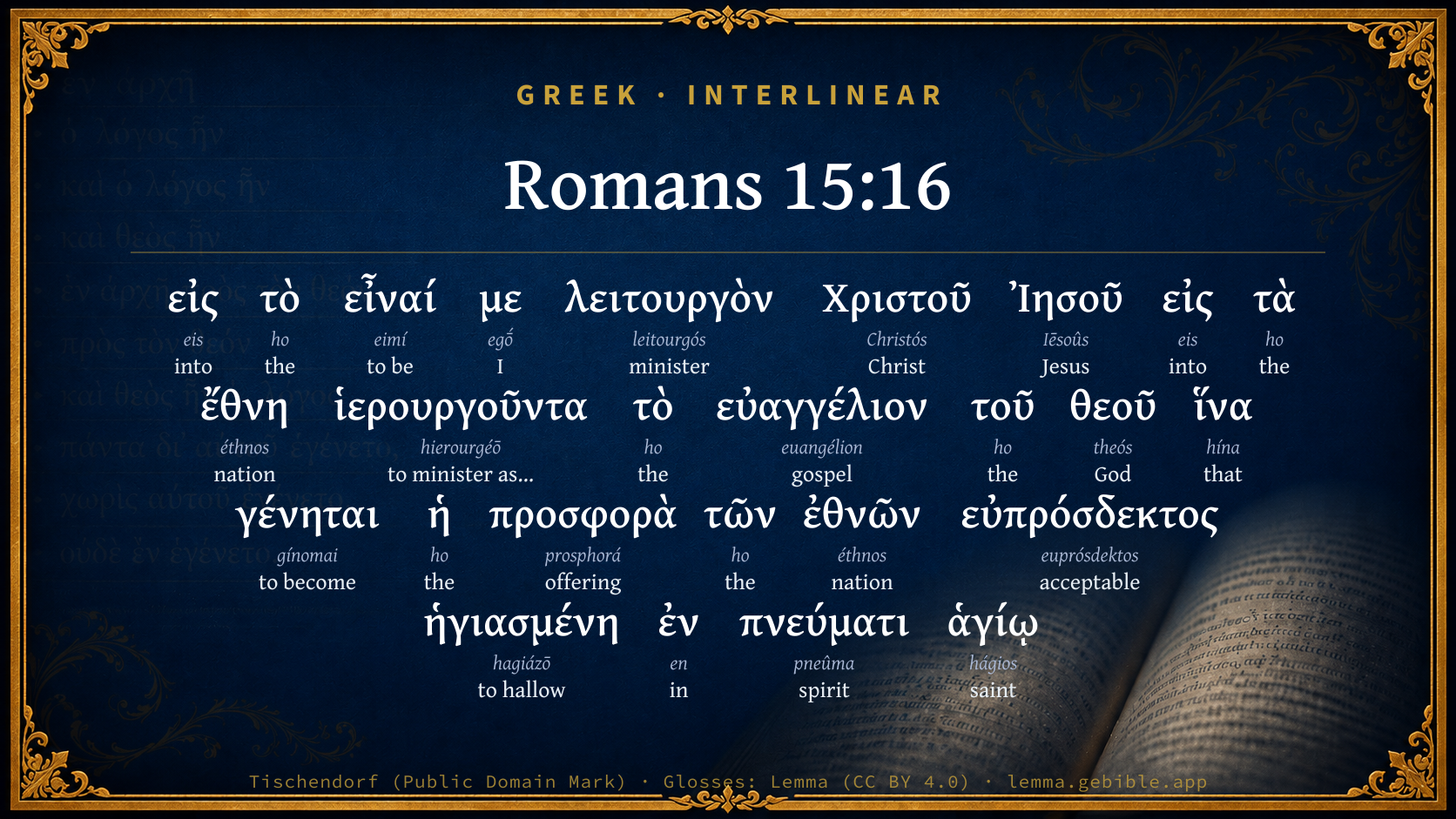
Download image
Cite this verse

Romans 15:16 (World English Bible). Public Domain. Lemma interlinear Bible study tool, https://lemma.gebible.app/v/romans/15/16.

Show BibTeX & RIS
BibTeX
RIS
English Translation
that I should be a servant of Christ Jesus to the Gentiles, ministering as a priest the Gospel of God, that the offering up of the Gentiles might be made acceptable, sanctified by the Holy Spirit.
World English Bible · Public Domain
Highlights
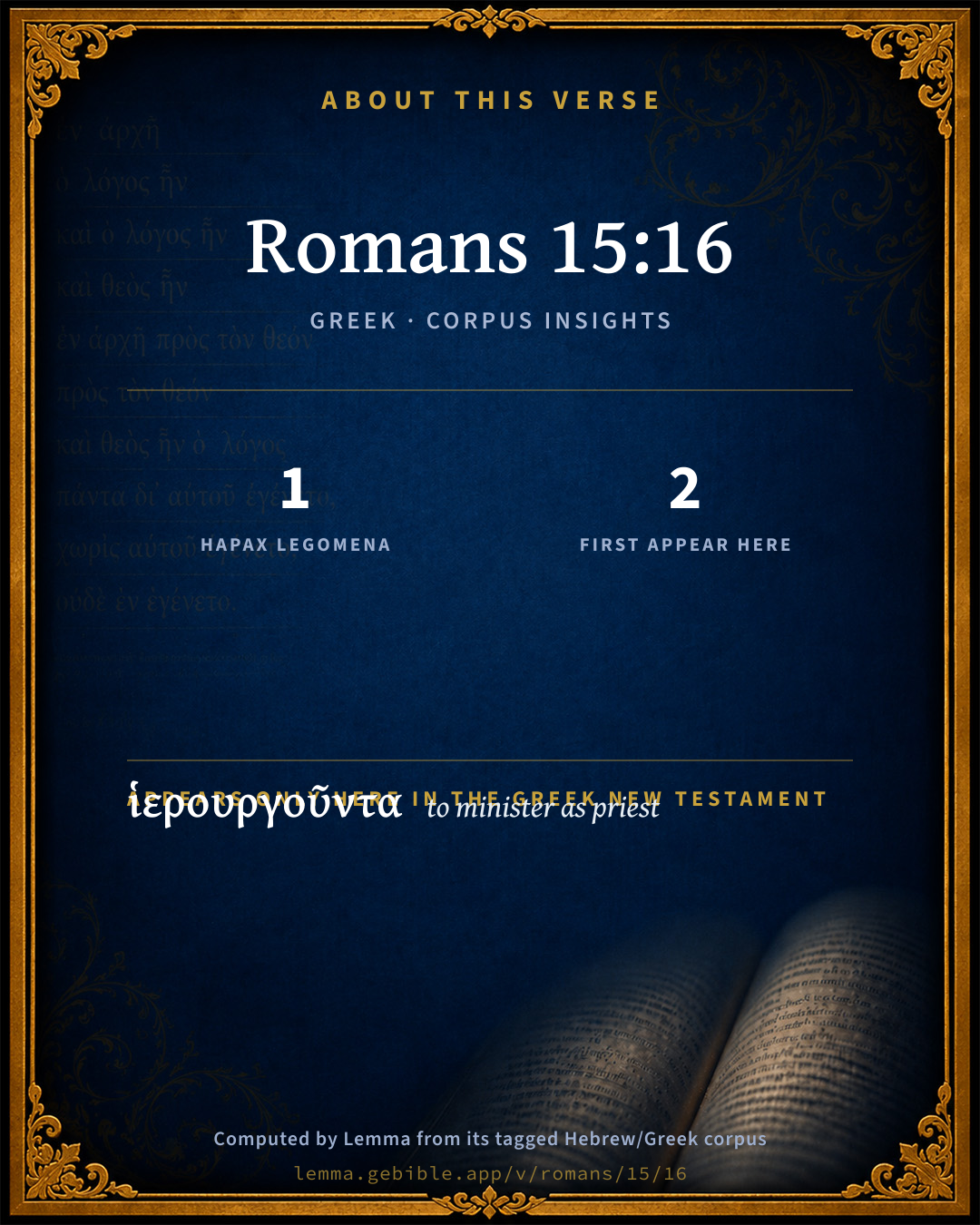
  • 1 hapax legomenon — only here in the Greek New Testament
  • 2 first appearances in the Greek New Testament
Full analysis ↓
Download a study sheet

One document with this verse’s original text, its word-by-word gloss line, the meaning frame, cross-references with their text, attributed commentary, and full source and license credits — printable, and it pastes into notes with its structure intact.

This verse Autodidact and up

Study sheet (.html) Plain text (.txt)

A passage Seminary Student

Up to 50 verses in one chapter. A passage sheet keeps up to 6 commentary sources and 12 cross-references per verse, in the order this page ranks them, and says so on the sheet whenever that leaves anything out. Ask for a single verse and you get the Autodidact verse sheet above.

Everything on this page stays free to read, with no account — the sheet is a download of what is already on screen, not access to it.

Want to remove ads? Support Godless Engineer
Compare translations 3

The same verse in 3 English versions, stacked beneath the original-language interlinear above. Click any original word for its lexicon entry.

Each is an independent rendering of the whole verse — the interlinear is not word-aligned to these translations.

Highlighted words mark where these versions differ — a whole-verse word diff, not a word-by-word alignment.

  • World English Bible Public Domain
    that I should be a servant of Christ Jesus to the Gentiles, ministering as a priest the Gospel of God, that the offering up of the Gentiles might be made acceptable, sanctified by the Holy Spirit.
  • King James Version Public Domain
    That I should be the minister of Jesus Christ to the Gentiles, ministering the gospel of God, that the offering up of the Gentiles might be acceptable, being sanctified by the Holy Ghost.
  • unfoldingWord Literal Text CC BY-SA 4.0
    in order for me to be a servant of Christ Jesus to the Gentiles, serving as a priest the gospel of God so that the offering of the Gentiles might become well-pleasing, sanctified by the Holy Spirit.

unfoldingWord Literal Text — © unfoldingWord, licensed CC BY-SA 4.0. Word-aligned USFM3 via Door43 (git.door43.org/unfoldingWord/en_ult).

Versions to compare (up to 4)

3 of 4 selected

Show all 19 translations

Every available English version of this verse, each an independent rendering of the whole verse.

  • World English Bible Public Domain
    that I should be a servant of Christ Jesus to the Gentiles, ministering as a priest the Gospel of God, that the offering up of the Gentiles might be made acceptable, sanctified by the Holy Spirit.
  • Berean Standard Bible Public Domain
    to be a minister of Christ Jesus to the Gentiles in the priestly service of the gospel of God, so that the Gentiles might become an offering acceptable to God, sanctified by the Holy Spirit.
  • Majority Standard Bible Public Domain
    to be a minister of Jesus Christ to the Gentiles in the priestly service of the gospel of God, so that the Gentiles might become an offering acceptable to God, sanctified by the Holy Spirit.
  • King James Version Public Domain
    That I should be the minister of Jesus Christ to the Gentiles, ministering the gospel of God, that the offering up of the Gentiles might be acceptable, being sanctified by the Holy Ghost.
  • American Standard Version (1901) Public Domain
    that I should be a minister of Christ Jesus unto the Gentiles, ministering the gospel of God, that the offering up of the Gentiles might be made acceptable, being sanctified by the Holy Spirit.
  • Revised Version (1885) Public Domain
    that I should be a minister of Christ Jesus unto the Gentiles, ministering the gospel of God, that the offering up of the Gentiles might be made acceptable, being sanctified by the Holy Ghost.
  • Geneva Bible (1599) Public Domain
    That I should be the minister of Iesus Christ toward the Gentiles, ministring the Gospel of God, that the offering vp of the Gentiles might be acceptable, being sanctified by the holy Ghost.
  • Douay-Rheims (1899) Public Domain
    That I should be the minister of Christ Jesus among the Gentiles; sanctifying the gospel of God, that the oblation of the Gentiles may be made acceptable and sanctified in the Holy Ghost.
  • Young's Literal Translation Public Domain
    for my being a servant of Jesus Christ to the nations, acting as priest in the good news of God, that the offering up of the nations may become acceptable, sanctified by the Holy Spirit.
  • Literal Standard Version CC BY-SA 4.0
    for my being a servant of Jesus Christ to the nations, acting as priest in the good news of God, that the offering up of the nations may become acceptable, sanctified by the Holy Spirit.
  • Unlocked Literal Bible CC BY-SA 4.0
    This gift was that I should be a servant of Christ Jesus sent to the Gentiles, to offer as a priest the gospel of God. I should do this so that the offering of the Gentiles might become acceptable, consecrated by the Holy Spirit.
  • unfoldingWord Literal Text CC BY-SA 4.0
    in order for me to be a servant of Christ Jesus to the Gentiles, serving as a priest the gospel of God so that the offering of the Gentiles might become well-pleasing, sanctified by the Holy Spirit.
  • Darby Bible Public Domain
    for me to be minister of Christ Jesus to the nations, carrying on as a sacrificial service the [message of] glad tidings of God, in order that the offering up of the nations might be acceptable, sanctified by [the] Holy Spirit.
  • World Messianic Bible Public Domain
    that I should be a servant of Messiah Yeshua to the Gentiles, serving as a priest of the Good News of God, that the offering up of the Gentiles might be made acceptable, sanctified by the Holy Spirit.
  • Webster's Bible Public Domain
    That I should be the minister of Jesus Christ to the Gentiles, ministering the gospel of God, that the offering up of the Gentiles might be acceptable, being sanctified by the Holy Spirit.
  • Free Bible Version CC BY-SA 4.0
    to be a minister of Christ Jesus to the foreigners, like a priest sharing God's good news, so that they could become an acceptable offering, made holy by the Holy Spirit.
  • Bible in Basic English Public Domain
    To be a servant of Christ Jesus to the Gentiles, doing the work of a priest in the good news of God, so that the offering of the Gentiles might be pleasing to God, being made holy by the Holy Spirit.
  • Text-Critical English NT CC BY 4.0
    to be a minister of Jesus Christ to the Gentiles in the priestly service of the gospel of God, so that the Gentiles might become an acceptable offering, sanctified by the Holy Spirit.
  • Tyndale New Testament (1534) Public Domain
    that I shuld be the minister of Iesu Christ amonge the gentyls and shuld minister the gladde tydynges of God that the gentyls myght be an acceptable offerynge sanctyfied by the holy goost.

Literal Standard Version (2020), Covenant Press — licensed CC BY-SA 4.0. Text via the HelloAO Bible API (eBible.org). Unlocked Literal Bible (unfoldingWord) — licensed CC BY-SA 4.0. Text via the HelloAO Bible API (eBible.org). unfoldingWord Literal Text — © unfoldingWord, licensed CC BY-SA 4.0. Word-aligned USFM3 via Door43 (git.door43.org/unfoldingWord/en_ult). Free Bible Version, Dr. Jonathan Gallagher — licensed CC BY-SA 4.0. Text via the HelloAO Bible API (eBible.org).

Word by word

More ways to search: Search by grammar → Find every occurrence → Compare this word →

Practice this passage: Drill this verse → Learn its vocabulary →

ἱερουργοῦντα
hierourgéō
G2418
“to minister as priest”
Verb, Present, Active, Participle, Accusative, Singular, Masculine
Part of Speech
Verb
Tense
Present
Voice
Active
Mood
Participle
Case
Accusative
Number
Singular
Gender
Masculine
Full Thayer's Definition

Origin: from a compound of G2411 and the base of G2041

TDNT: 07:11,3

1. to minister in the manner of a priest, minister in priestly service a. of those who defend the sanctity of the law by undergoing a violent death b. of the preaching of the gospel
  1. εἰς eis G1519 “into” Preposition
  2. τὸ ho G3588 “the” Article, Accusative, Singular, Neuter
  3. εἶναί eimí G1510 “to be” Verb, Present, Active, Infinitive
  4. με egṓ G1473 “I” Personal pronoun, 1st person, Accusative, Singular
  5. λειτουργὸν leitourgós G3011 “minister” Noun, Accusative, Singular, Masculine
  6. Χριστοῦ Christós G5547 “Christ” Noun, Genitive, Singular, Masculine
  7. Ἰησοῦ Iēsoûs G2424 “Jesus” Noun, Genitive, Singular, Masculine
  8. εἰς eis G1519 “into” Preposition
  9. τὰ ho G3588 “the” Article, Accusative, Plural, Neuter
  10. ἔθνη éthnos G1484 “nation” Noun, Accusative, Plural, Neuter
  11. τὸ ho G3588 “the” Article, Accusative, Singular, Neuter
  12. εὐαγγέλιον euangélion G2098 “gospel” Noun, Accusative, Singular, Neuter
  13. τοῦ ho G3588 “the” Article, Genitive, Singular, Masculine
  14. θεοῦ theós G2316 “God” Noun, Genitive, Singular, Masculine
  15. ἵνα hína G2443 “that” Conjunction
  16. γένηται gínomai G1096 “to become” Verb, Aorist, Middle deponent, Subjunctive, 3rd person, Singular
  17. ἡ ho G3588 “the” Article, Nominative, Singular, Feminine
  18. προσφορὰ prosphorá G4376 “offering” Noun, Nominative, Singular, Feminine
  19. τῶν ho G3588 “the” Article, Genitive, Plural, Neuter
  20. ἐθνῶν éthnos G1484 “nation” Noun, Genitive, Plural, Neuter
  21. εὐπρόσδεκτος euprósdektos G2144 “acceptable” Adjective, Nominative, Singular, Feminine
  22. ἡγιασμένη hagiázō G37 “to hallow” Verb, Perfect, Passive, Participle, Nominative, Singular, Feminine
  23. ἐν en G1722 “in” Preposition
  24. πνεύματι pneûma G4151 “spirit” Noun, Dative, Singular, Neuter
  25. ἁγίῳ hágios G40 “saint” Adjective, Dative, Singular, Neuter

About this verse

These counts appear in no published source. They are computed here, from the morphology-tagged text and Lemma’s own curated glosses. What Lemma adds →

26
words
19
distinct lemmas
Pauline Epistles
section

Notable vocabulary

1 hapax legomenon — a word that appears only here in the entire Greek New Testament:

  • ἱερουργοῦντα to minister as priest G2418

First appearance in Scripture

These words make their first canonical appearance in the Greek New Testament here:

  • ἱερουργοῦντα to minister as priest G2418
  • εὐπρόσδεκτος acceptable G2144

Shared distinctive vocabulary

λειτουργὸν minister G3011 occurs in 5 verses of the Greek New Testament. Also found in:
Repetition

Words recur within this verse:

Cross-references

35

Topical passages linked to Romans 15:16 in the Treasury of Scripture Knowledge — connected by theme and wording, ordered by reader-vote popularity; previews shown in the World English Bible.

  • Romans 11:13 For I speak to you who are Gentiles. Since then as I am an apostle to Gentiles, I glorify my ministry;
  • Romans 1:1 Paul, a servant of Jesus Christ, called to be an apostle, set apart for the Gospel of God,
  • Acts 9:15 But the Lord said to him, "Go your way, for he is my chosen vessel to bear my name before the nations and kings, and the children of Israel.
  • Philippians 2:17 Yes, and if I am poured out on the sacrifice and service of your faith, I rejoice, and rejoice with you all.
  • 1 Timothy 1:11 according to the Gospel of the glory of the blessed God, which was committed to my trust.
  • 2 Timothy 1:11 For this, I was appointed as a preacher, an apostle, and a teacher of the Gentiles.
  • Isaiah 66:19–20 I will set a sign among them, and I will send such as escape of them to the nations, to Tarshish, Pul, and Lud, who draw the bow, to Tubal and Javan, to the isles afar off, who have not heard my fame, neither have seen my glory; and they shall declare my glory among the nations.
  • Acts 20:24 But these things don't count; nor do I hold my life dear to myself, so that I may finish my race with joy, and the ministry which I received from the Lord Jesus, to fully testify to the Gospel of the grace of God.
  • Romans 15:18 For I will not dare to speak of any things except those which Christ worked through me, for the obedience of the Gentiles, by word and deed,
  • Romans 12:1–2 Therefore I urge you, brothers, by the mercies of God, to present your bodies a living sacrifice, holy, acceptable to God, which is your spiritual service.
  • 1 Timothy 2:7 to which I was appointed a preacher and an apostle (I am telling the truth in Christ, not lying), a teacher of the Gentiles in faith and truth.
  • Hebrews 13:16 But don't forget to be doing good and sharing, for with such sacrifices God is well pleased.
  • Romans 8:26–27 In the same way, the Spirit also helps our weaknesses, for we don't know how to pray as we ought. But the Spirit himself makes intercession for us with groanings which can't be uttered.
  • 1 Corinthians 4:1 So let a man think of us as Christ's servants, and stewards of God's mysteries.
  • 2 Corinthians 5:20 We are therefore ambassadors on behalf of Christ, as though God were entreating by us. We beg you on behalf of Christ, be reconciled to God.
  • Acts 13:2 As they served the Lord and fasted, the Holy Spirit said, "Separate Barnabas and Saul for me, for the work to which I have called them."
  • Acts 20:32 Now, brothers, I entrust you to God, and to the word of his grace, which is able to build up, and to give you the inheritance among all those who are sanctified.
  • Acts 22:21 "He said to me, 'Depart, for I will send you out far from here to the Gentiles.'"
  • Acts 26:17–18 delivering you from the people, and from the Gentiles, to whom I send you,
  • Romans 5:5 and hope doesn't disappoint us, because God's love has been poured out into our hearts through the Holy Spirit who was given to us.
  • Romans 15:29 I know that, when I come to you, I will come in the fullness of the blessing of the Gospel of Christ.
  • 1 Corinthians 3:5 Who then is Apollos, and who is Paul, but servants through whom you believed; and each as the Lord gave to him?
  • 1 Corinthians 6:19 Or don't you know that your body is a temple of the Holy Spirit which is in you, which you have from God? You are not your own,
  • 2 Corinthians 8:5 This was not as we had hoped, but first they gave their own selves to the Lord, and to us through the will of God.
  • 2 Corinthians 11:23 Are they servants of Christ? (I speak as one beside himself) I am more so; in labors more abundantly, in prisons more abundantly, in stripes above measure, in deaths often.
  • Galatians 2:7–8 but to the contrary, when they saw that I had been entrusted with the Gospel for the uncircumcision, even as Peter with the Gospel for the circumcision
  • Galatians 3:5 He therefore who supplies the Spirit to you, and works miracles among you, does he do it by the works of the law, or by hearing of faith?
  • Ephesians 2:18 For through him we both have our access in one Spirit to the Father.
  • Ephesians 2:22–3:1 in whom you also are built together for a habitation of God in the Spirit.
  • Philippians 4:18 But I have all things, and abound. I am filled, having received from Epaphroditus the things that came from you, a sweet-smelling fragrance, an acceptable and well-pleasing sacrifice to God.
  • 1 Thessalonians 2:2 but having suffered before and been shamefully treated, as you know, at Philippi, we grew bold in our God to tell you the Gospel of God in much conflict.
  • 1 Thessalonians 2:9 For you remember, brothers, our labor and travail; for working night and day, that we might not burden any of you, we preached to you the Gospel of God.
  • 1 Thessalonians 5:23 May the God of peace himself sanctify you completely. May your whole spirit, soul, and body be preserved blameless at the coming of our Lord Jesus Christ.
  • 1 Peter 1:12 To them it was revealed, that not to themselves, but to you, did they minister these things, which now have been announced to you through those who preached the Gospel to you by the Holy Spirit sent out from heaven; which things angels desire to look into.
  • 1 Peter 2:5 You also, as living stones, are built up as a spiritual house, to be a holy priesthood, to offer up spiritual sacrifices, acceptable to God through Jesus Christ.

Cross-references courtesy of OpenBible.info (CC BY 4.0).

Commentary

Notes on Romans 15:16 from classic Christian and Jewish commentators (each source and its license shown beneath its notes). The classic Christian expositions comment on the surrounding passage and are grouped to its opening verse, so a note may address several verses; the Jewish commentaries on the Tanakh (Rashi and others) are per-verse, so they appear only where the commentator wrote on this verse.

Lemma curates 59 commentaries, every one of them public domain or Creative Commons licensed, each selected and text-cleaned for this edition rather than reprinted as found. About our sources →

Tyndale Open Study Notes

Tyndale Open Resources

15:16 special messenger: The Greek word (leitourgos, “servant” or “minister”) could refer to almost any kind of servant, but Jews often applied the word to priests. Paul probably chose this word to emphasize the priestly nature of his ministry. • to you Gentiles: Paul stresses the Gentile flavor of the church in Rome (see also 1:6-7). This does not mean that there were no Jews in the church (see 16:3-16), but Gentiles had become the majority. • present you as an acceptable offering to God: Paul was fulfilling Isa 66:19-20.

Tyndale Open Study Notes — © Tyndale Open Resources, licensed CC BY-SA 4.0. Text via the HelloAO Bible API.

Bengel's Gnomon

Johann Albrecht Bengel

Rom 15:16. Λειτουργὸν, ἱερουργοῦντα, προσφορὰ) This is allegorical. Jesus is the priest; Paul the servant of the priest; the Gentiles themselves are the oblation: ch. Rom 12:1; Isa 60:7; Isa 66:20: and that oblation is very acceptable, because it is sanctified (Joh 17:19), along with [as well as] its gifts [i.e. their contribution to the saints at Jerusalem is also acceptable, Rom 15:26], Rom 15:31.—ἐν πνεύματι ἁγίῳ, in the Holy Spirit) whom the Gentiles receive by the Gospel of God.

Bengel's Gnomon of the New Testament — English translation (T&T Clark, Edinburgh, 1860) — public domain. Text from a community e-Sword module.

Meyer's Critical & Exegetical Commentary

Heinrich August Wilhelm Meyer

Rom_15:16. Εἰς τὸ εἶναι κ.τ.λ.] Specification of the object aimed at in τὴν δοθεῖσάν μοι ὑπὸ τ. Θεοῦ.

λειτουργόν] Comp. on Rom_13:6. Paul sets forth the service of his apostolic office, in the consciousness of its hallowed dignity, not merely as a public οἰκονομία (Ewald: steward of the people), but as a priestly service of offering, in which Ἰησοῦ Χ. expresses the λειτουργός as ordained by Christ. That Christ should be conceived of as He to whom the offering is presented (Reiche), is contrary to the conception of offering, which always refers to God as the receiver of it. Comp. Rom_12:1; Eph_5:2, Php_2:17. But neither is Christ to be conceived of (as by Bengel and Rückert) as high priest (a conception not of Paul, but rather of the Epistle to the Hebrews, and applying to Christ as the sole Atoner, in which case the idea of inferior priests is out of place), but as Lord and Ruler of the church, who has appointed His apostle, Rom_1:5. Lucht oddly thinks that the writer did not venture to call Paul, in consequence of his disputed position, ἀπόστολος, but only λειτουργός.

εἰς τὰ ἔθνη] in reference to the Gentiles; for these, as converted by the apostle, are to form the offering to be presented.

In the sequel, ἱερουργοῦντα τὸ εὐαγγ. τ. Θεοῦ contains the more precise explanation of λειτουργ. Ἰ. Χ., and ἵνα γένηται ἡ προσφορὰ τῶν ἐθνῶν κ.τ.λ. that of εἰς τὰ ἔθνη; hence the latter belongs not to ἱερουργ. (Th. Schott, Hofmann), but to what precedes, and is not (with Buttmann) to be omitted on the authority of B.

ἱερουργ. τὸ εὐαγγ. τ. Θεοῦ] in priestly fashion administering the gospel of God, i.e. administrans evang. a Deo missum hominibus, eoque ministerio velut sacerdotio fungens, Estius; comp. Chrysostom, Erasmus, and most older interpreters, also Rückert, Tholuck, Fritzsche, de Wette, Philippi. This usage of ἱερουργ. is confirmed by passages like Herodian. v. 3. 16; Joseph. Antt. vi. 6. 2; also by 4Ma_7:8, where ἰδίῳ αἵματι is to be connected with ἱερουργοῦντας τὸν νόμον (in opposition to Hofmann, who will not admit the priestly notion in the word), not with ὑπερασπίζοντας (see Grimm, Handb. p. 329 f.); comp. Suicer, Thes. s.v.; Kypke in loc.; also ἱερουργός, Callim. fr. 450; ἱερούργημα, Joseph. Antt. viii. 4. 5; ἱερουργία, 4Ma_4:1; Plat. Legg. p. 774 E; Pollux, i. 29. Without warrant, Hofmann insists on adhering to the conception of. administering holy service. The gospel is not indeed the offering (Luther and others), which is presented, but the divine institute, which is administeredis in priestly fashion servedby the presenting of the offering. As to εὐαγγ. Θεοῦ, see on Rom_1:1.

ἡ προσφορὰ τῶν ἐθνῶν] the offering of the Gentiles, i.e. the offering which the Gentiles are, Heb_10:10; Eph_5:2. The Gentiles converted, and through the Spirit consecrated as Gods property, are the offering which Paul, as the priest of Jesus Christ, has brought to God. Observe, however, the stress laid on the prefixed γένηται: in order that there may prosper (see on this use of γίνεσθαι as regards offerings, Kühner, ad Xen. Anab. vi. 4. 9), in accordance with which εὐπρόσδ. is then attributive (as well-pleasing), and ἁγιασμ. ἐ. πν. ἁγ. is subordinated to the latter as its ground: sanctified through the Holy Spirit, which is received through the gospel in baptism, Gal_3:2; Gal_3:5; Tit_3:5; Eph_5:26. A contrast to the ceremonial consecration of the Levitical offerings. Comp. Rom_12:1.

Meyer — Critical and Exegetical Commentary on the New Testament — English translation by Peter Christie, edited by Frederick Crombie (T&T Clark, 1880) — public domain. Text from a community e-Sword module.

Godet's Commentaries

Frédéric Louis Godet

Vv. 16. “That I should be a minister of Jesus Christ to the Gentiles, ministering as a priest in the gospel of God, that the offering of the Gentiles might be made acceptable, being sanctified by the Holy Spirit.”

The grace of apostleship had been given to Paul for the accomplishment of a sublime task. The word λειτουργός denotes a public functionary. In this case the function involved is nothing less than presenting to God the Gentile world as an offering which may be acceptable to Him. This world-wide service to which Jesus Christ Himself had called St. Paul was not only that of a preacher, it had a priestly character. This is certainly what is expressed by the term ἱερουργεῖν (see Meyer): “to offer as a priest;” not that the preacher of the gospel is in any sense a mediator who comes between God and the believer; but his function does not consist in simple teaching; each time it is an act of consecration whereby the messenger of salvation offers to God his own person as well as the persons of all his hearers. We know how Paul prayed constantly for the churches which he had already founded (comp. Rom 1:8-10, and the beginning of all the Epistles), and we can thus imagine what the work of their founding was. Thus was his whole apostolate a priestly function. In the expression: “to fulfil sacerdotally (minister) the gospel of God,” we must understand, here as elsewhere (see on Rom 1:8), by “the gospel,” not the contents, but the act of preaching.

The end of this priestly office confided to the apostle is to transform the world of the Gentiles into an offering well-pleasing to God. Comp. Php 2:17.—Τῶν ἐθνῶν, of the Gentiles, is a genitive of apposition: the offering which consists of the persons of the Gentiles. The verb γένηται, might be (become), indicates progress; this progress does not consist only in the growing extension of the work; but also, and especially, as is shown by the following words, in the transformation of those who are its subjects: being sanctified by the Holy Spirit. The word of salvation received with faith must be sealed in the heart by power from on high, that the soul may be truly gained, and that it may belong to God; comp. Eph 1:13. The apostle probably alludes to the Levitical ordinance, according to which the sprinkling of salt over the meat-offering was the condition of its acceptance on the part of God.

If it is true, according to the natural meaning of these Rom 15:14-16, that the apostle justifies his Epistle to the Romans by his commission to be the apostle of the Gentiles, it clearly follows that the majority of the Christians of Rome were of Gentile origin. The defenders of the Jewish-Christian composition of this church have had to seek to parry this decisive blow. They have tried to do so in two ways. Mangold explains these verses in this sense: “I have required, as apostle of the Gentiles, to express myself more than once in this letter more forcibly than seemed fitting in addressing Jewish-Christians like you; but I had to uphold the rights of those of whom God made me the apostle.” But what is there to give us the right to restrict the application of the word τολμηρότερον, more boldly, to a few passages of the Epistle relative to the calling of the Gentiles? This expression bears on the character of the entire writing as a doctrinal composition; this is shown by the connection of Rom 15:15 with Rom 15:14. Filled with knowledge, as the Romans were, they seemed to have no need of this complete instruction. Then the description of Paul’s apostolate, from Rom 15:16 to Rom 15:20, proves that we have here the positive indication of the motive which led him to write this Epistle, and not only the justification of some passages of his letter. Weizsäcker correctly observes that the apostle explains his letter by the duty which his task of providing for the edification of the Gentiles imposed on him, and not by the right which he has to uphold their cause before Jewish-Christians.

Volkmar, who pursues the same object as Mangold, has attempted another explanation: “I do not forget, Paul would say, that I am only the apostle of the Gentiles, and I have no thought, in writing you as I do, to intrude on a church which does not belong to me, since it is of Jewish-Christian origin; and that is the very reason which has prevented me hitherto from visiting you, for my intention is not to build on a foundation laid by another; but now that I have no more place in the countries of the east, I am about to proceed to Spain, and I shall see you in passing” (Rom 15:17-24). This construction is ingenious, but impossible. The διὰ τὴν χάριν, “because of the grace given unto me,” depending on ἔγραψα, I have written unto you, is absolutely opposed to it; and in what follows the apostle does not for a moment say that he has not yet visited Rome because of the Judeo-Christian character of the church, but that he has not done so because he was still detained in the east by nearer duties. Whether the founders of the church of Rome were or were not Judeo-Christians, whether the believers gathered in by them were or were not of this character, the apostle makes no allusion to this side of the question; a proof that it was not this which concerned his inference.

Lucht has attempted to find a proof of unauthenticity in the absence of the title apostle, Rom 15:16. The forger sought, he holds, by avoiding this title, to spare the susceptibilities of the Jewish-Christians of Rome. But, answers Hilgenfeld, “If the word is not there, the thing is.” And, in fact, Rom 15:16 is nothing else than the paraphrase of the term: apostle of the Gentiles. And if Paul has here preferred the paraphrase to the title itself, it is because it was much more suitable than the latter to explain the course which he had followed in writing such a letter to this church which he had not founded, and which he did not even yet know.

As to this mission to the Gentile world with which he has been invested, God has crowned it with such successes that it is now finished in the east, and that it only remains to the apostle to continue it in the west, which will lead him next to Rome. Such are the contents of the following verses, Rom 15:17-24, the somewhat free connection of which with what precedes is not hard to understand.

Frédéric Louis Godet — Commentaries on Luke, John, Romans, and 1 Corinthians — English translation (T&T Clark, Edinburgh, 1870s–1890s) — public domain. Text from a community e-Sword module.

Hodge's Commentary on Romans, Ephesians & First Corinthians

Charles Hodge

Rom_15:16

That I should be the minister of Jesus Christ to the Gentiles; λειτουργὸν εἰς τὰ ἔθνα, a minister for, or in reference to the Gentiles. This is the explanation of the grace given to him of God; it was the favor of being a minister of Jesus Christ to the Gentiles. Compare Eph_3:8, Unto me, who am less than the least of all saints, is this grace given, that I should preach among the Gentiles the unsearchable riches of Christ. The word (λειτουργός) rendered minister, means a public officer or servant; see Rom_13:6, where it is applied to the civil magistrate. It is, however, very frequently used (as is also the corresponding verb) of those who exercised the office of a priest, Deu_10:8; Heb_10:11. As the whole of this verse is figurative, Paul no doubt had this force of the word in his mind, when he called himself a minister, a sacred officer of Jesus Christ; not a priest, in the proper sense of the term, for the ministers of the gospel are never so called in the New Testament, but merely in a figurative sense. The sacrifice which they offer are the people, whom they are instrumental in bringing unto God.

Ministering the gospel of God, that the offering up of the Gentiles might be acceptable; being sanctified by the Holy Ghost. This is the apostles explanation of the preceding clause. He was appointed a minister of Christ to administer, or to act the part of a priest in reference to the gospel, that is, to present the Gentiles as a holy sacrifice to God. Paul, therefore, no more calls himself a priest in the strict sense of the term, than he calls the Gentiles a sacrifice in the literal meaning of that word. The expression, (ἱερουργοῦντα τὸ εὐαγγέλιον) rendered ministering the gospel, is peculiar, and has been variously explained. Erasmus translates it sacrificans evangelium, presenting the gospel as a sacrifice; Calvin, consecrans evangelium, which he explains, performing the sacred mysteries of the gospel. The general meaning of the phrase probably is, acting the part of a priest in reference to the gospel. Compare 2 Macc. 4:7, 8, ἱερουργεῖν τὸν νόμον.

The sense is the same, if the word (εὐαγγέλιον) gospel be made to depend on a word understood, and the whole sentence be resolved thus, That I should be a preacher of the gospel (εἰς τὸ εἶναί με κηρύσσοντα τὸ εὐαγγέλιον) to the Gentiles, a ministering priest (i.e., a minister acting the part of a priest,) of Jesus Christ, Wahls Clavis, p. 740. Paul thus acted the part of a priest that the offering of the Gentiles might be acceptable. The word (προσφορά) offering sometimes means the act of oblation, sometimes the thing offered. Our translators have taken it here in the former sense; but this is not so suitable to the figure or the context. It was not Pauls act that was to be acceptable, or which was sanctified by the Holy Spirit. The latter sense of the word, therefore, is to be preferred; and the meaning is, That the Gentiles, as a sacrifice, might be acceptable; see Rom_12:1; Phi_2:17; 2Ti_4:6. Being sanctified by the Holy Ghost. As the sacrifices were purified by water and other means, when prepared for the altar, so we are made fit for the service of God, rendered holy or acceptable, by the influences of the Holy Spirit. This is an idea which Paul never omits; when speaking of the success of his labors, or of the efficacy of the gospel, he is careful that this success should not be ascribed to the instruments, but to the real author. In this beautiful passage we see the nature of the only priesthood which belongs to the Christian ministry. It is not their office to make atonement for sin, or to offer a propitiatory sacrifice to God, but by the preaching of the gospel to bring men, by the influence of the Holy Spirit, to offer themselves as a living sacrifice, holy and acceptable to God. It is well worthy of remark, that amidst the numerous designations of the ministers of the gospel in the New Testament, intended to set forth the nature of their office, they are never officially called priests. This is the only passage in which the term is even figuratively applied to them, and that under circumstances which render its misapprehension impossible. They are not mediators between God and man; they do not offer propitiatory sacrifices. Their only priesthood, as Theophylact says, is the preaching of the gospel, (αὕτη γάρ μοι ἱερωσύνη τὸ καταγγέλλειν τὸ εὐαγγέλιον,) and their offerings are redeemed and sanctified men, saved by their instrumentality. Et sane hoc est Christiani pastoris sacerdotium, homines in evangelii obedientiam subigendo veluti Deo immolare; non autem, quod superciliose hactenus Papistae jactarunt, oblatione Christi homines reconciliare Deo. Neque tamen ecclesiasticos pastores simpliciter hic vocat sacerdotes, tanquam perpetuo titulo; sed quum dignitatem efficaciamque ministerii vellet commendare Paulus, hac metaphora per occasionem usus est. Calvin.

Charles Hodge — Commentary on Romans (1835), First Corinthians (1857), and Ephesians (1856) — public domain. Text from a community e-Sword module.

Geneva Bible (1599)

Geneva Bible translators

By the offering up of the Gentiles, he meaneth the Gentiles themselves, whom he offered to God as a sacrifice.

Geneva Bible (1599) marginal notes — public domain. Text via Bolls.life.

Jamieson, Fausset & Brown

Robert Jamieson, A. R. Fausset & David Brown

that I should be the--rather, "a"

minister--The word here used is commonly employed to express the office of the priesthood, from which accordingly the figurative language of the rest of the verse is taken.

of Jesus Christ--"Christ Jesus," according to the true reading.

to the Gentiles--a further proof that the Epistle was addressed to a Gentile church. (See on Rom 1:13).

ministering the gospel of God--As the word here is a still more priestly one, it should be rendered, "ministering as a priest in the Gospel of God."

that the offering up of the Gentiles--as an oblation to God, in their converted character.

might be acceptable, being sanctified by the Holy Ghost--the end to which the ancient offerings typically looked.

Jamieson, Fausset & Brown — Commentary Critical and Explanatory on the Whole Bible (1871) — public domain (CC PDM 1.0). Text via the HelloAO Bible API.

Adam Clarke's Commentary

Verse 16. Ministering the Gospel of God] ιερουργουντα, Acting as a priest. Here is a plain allusion, says Dr. Whitby, to the Jewish sacrifices offered by the priest, and sanctified or made acceptable by the libamen offered with them; for he compares himself, in preaching the Gospel, to the priest performing his sacred functions-preparing his sacrifice to be offered. The Gentiles, converted by him and dedicated to the service of God, are his sacrifices and oblation. The Holy Spirit is the libamen poured upon this sacrifice, by which it was sanctified and rendered acceptable to God. The words of Isaiah, Isa 66:20, And they shall bring all your brethren for an OFFERING unto the Lord, out of all NATIONS, might have suggested the above idea to the mind of the apostle.

Adam Clarke's Commentary on the Bible (1810–1826) — public domain. Text from a community e-Sword/MySword module.

John Calvin's Commentaries

16. Consecrating the gospel, etc. This rendering I prefer to that which Erasmus in the first place adopts, that is, “Administering;” for nothing is more certain than that Paul here alludes to the holy mysteries which were performed by the priest. He then makes himself a chief priest or a priest in the ministration of the gospel, to offer up as a sacrifice the people whom he gained for God, and in this manner he labored in the holy mysteries of the gospel. And doubtless this is the priesthood of the Christian pastor, that is, to sacrifice men, as it were, to God, by bringing them to obey the gospel, and not, as the Papists have hitherto haughtily vaunted, by offering up Christ to reconcile men to God. He does not, however, give here the name of priests to the pastors of the Church simply as a perpetual title, but intending to commend the honor and power of the ministry, Paul availed himself of the opportunity of using this metaphor. Let then the preachers of the gospel have this end in view while discharging their office, even to offer up to God souls purified by faith.

What Erasmus afterwards puts down as being more correct, “sacrificing the gospel,” is not only improper but obscures also the meaning; for the gospel is, on the contrary, like a sword, by which the minister sacrifices men as victims to God.

He adds that such sacrifices are acceptable to God; which is not only a commendation of the ministry, but also a singular consolation to those who surrender themselves to be thus consecrated. Now as the ancient victims were dedicated to God, having been externally sanctified and washed, so these victims are consecrated to the Lord by the Spirit of holiness, through whose power, inwardly working in them, they are separated from this world. For though the purity of the soul proceeds from faith in the word, yet as the voice of man is in itself inefficacious and lifeless, the work of cleansing really and properly belongs to the Spirit.

John Calvin's Commentaries (1540-1563) — public domain. Text from the Calvin Translation Society English edition (1840s-50s) via the Christian Classics Ethereal Library (ccel.org). Calvin's coverage is partial (roughly two-thirds of the Bible); uncommented books and verses are honest gaps, never fabricated. The 19th-century editor's footnotes and remarks are omitted so the notes are faithfully Calvin's own voice.

Ellicott's Commentary for English Readers

(16) Minister . . . ministering.—These are two different words in the Greek, but allied in their signification. Both refer originally to the liturgical service of the Temple; the first to the whole of the functions both of the priests and Levites, the second to the special function of the priests in the offering of sacrifice. St. Paul is a “minister of Jesus Christ;” i.e., his sacred office was given to him by Christ; it was Christ who appointed and ordained him to it; and his special duty as a priest of the gospel was to see that the Church of the Gentiles, whom it fell to him to present as a sacrifice to God, should be fit for such a sacrifice, made holy by the indwelling Spirit, and therefore acceptable to Him to whom it was offered.

To the Gentiles.—Strictly, in reference to the Gentiles. The branch, or department of the Christian ministry specially allotted to St. Paul was the evangelisation of the Gentiles.

Ministering the gospel of God.—Serving the gospel of God as a priest stands at the altar in the service of the tabernacle. The offering which the priest is thus to present is the Gentile Church.

The offering up of the Gentiles.—Not “that which the Gentiles offer,” but “the offering which the Gentiles are;” the sacrifice which they themselves form and constitute.

Sanctified by the Holy Ghost.—Rather, consecrated in the Holy Ghost. The sanctifying influence of the Holy Ghost overshadows, as it were, the Church, encloses and embraces it on every side.

A Bible Commentary for English Readers, edited by Charles John Ellicott (1878–1897) — public domain. Text from a community e-Sword module.

The Cambridge Bible for Schools and Colleges

gen. ed. J. J. S. Perowne

16. the minister] The Gr. word (not the same as that in e.g. Rom_15:8,) is the original of our word liturgy; and is the same as in Rom_13:6; Php_2:25; Heb_1:7; Heb_8:2; &c. The word in Biblical Greek has a frequent sacerdotal reference; which is certainly present here, as the rest of the verse shews. For the word rendered “ministering” just below is lit. “doing priest’s-work with;” and it is followed, in the next clause, by “the offering-up of the Gentiles.” The whole passage is strikingly pictorial and figurative; representing the Gospel as the sacerdotal rule; the Apostle as the sacrificing priest; and the converts from heathenism as the victims of the sacrifice. A passage of somewhat similar imagery is Php_2:17, where the Gr. of “service” is kindred to the Gr. of “minister” here. There (in Bp Lightfoot’s words) “the Philippians are the priests; their faith (or their good works springing from their faith) is the sacrifice; St Paul’s life-blood the accompanying libation.”

It is clear that the Apostle here speaks of himself as a Sacrificer in a sense wholly figurative; and this passage and Rom_1:9 (where see note,) are the only examples of his application of the sacrificial idea, in even a figurative sense, to himself. Dr Hodge remarks that we here see the true nature of the priesthood which belongs to the Christian ministry: “It is by the preaching of the Gospel to bring men to offer themselves as a living sacrifice, holy and acceptable to God.” See Rom_12:1.

the offering up of the Gentiles] i.e. the offering which consists of the Gentiles; the Gentiles, as “yielding themselves to God” to be His dedicated servants. For the phraseology, cp. Heb_10:10.

being sanctified by the Holy Ghost] Lit. having been sanctified in the Holy Ghost. His Divine grace was, so to speak, the water in which the sacrifice was washed; it alone made the self-dedication real, and therefore acceptable.

The Cambridge Bible for Schools and Colleges (gen. ed. J. J. S. Perowne; Cambridge University Press, 1878–1918) — public domain. Text from a community e-Sword module.

John Gill's Exposition

I have therefore whereof I may glory,.... Not in himself, for he that taught others not to glory in men, would not glory in himself; not in his carnal descent and fleshly privileges; nor in his knowledge of, and compliance with, the ceremonies of the law; nor in his legal, moral, and civil righteousness before God; nor in his gifts and attainments, as merited and procured by himself; nor in his labours in the ministry, and the success of it, as of himself: but

through Jesus Christ; or "in Jesus Christ", as read the Vulgate Latin, Syriac, and Arabic versions; in what Christ was unto him, wisdom, righteousness, sanctification, and redemption: he could boast of what he had from him, and through him, even of all spiritual blessings in him; and of a large measure of grace he had received from him; and of great and eminent gifts Christ had bestowed on him; he gloried in his cross, and boasted of a crucified Jesus, whom others despised; and whom he made the subject of his ministry, and took delight in preaching: and freely owned that all he did was through Christ strengthening him; and that all his success in his work was owing to him, and of this he had to glory: and which was

in those things which pertain to God; not "with God", as the Syriac reads it; for though in some cases it may be lawful to glory before men, yet not before God, or in his presence: nor is it anything a man may glory in, not in his own things, but in the things of God; in things relating to the Gospel of God, to the pure preaching of it, to the furtherance and spread of it, and the recommending of it to others; to the worship and ordinances of God, and a spiritual attendance on them; to the grace of God, and the magnifying of that in the business of salvation; and to the glory of God, which ought to be the chief end of all actions, natural, moral, and religious, and whether private or public. The apostle has chiefly reference to his ministerial function, and the things of God relating to that, in which he was employed; see Heb 5:1.

John Gill's Exposition of the Whole Bible (1746–1763) — public domain (CC PDM 1.0). Text via the HelloAO Bible API.

Trapp's Complete Commentary

John Trapp

16 That I should be the minister of Jesus Christ to the Gentiles, ministering the gospel of God, that the offering up of the Gentiles might be acceptable, being sanctified by the Holy Ghost.

Ver. 16. Ministering the gospel] Serving about holy things or doing sacred offices, as the priests under the law, to whom the apostle all along this verse alludes in an elegant allegory, ιερουργουντα λειτουργον; the ministry is a divine and heavenly function. All other callings are for the world, and draw to the world; but this, both in the preparation and execution, draweth to God, keepeth us with God, and to be ever mindful of the things of God.

John Trapp, A Commentary or Exposition upon All the Books of the Old and New Testament (1647–1656) — public domain. Text from a community e-Sword module.

Albert Barnes' Notes on the Bible

The minister - λειτουργὸν leitourgon. This is not the word which is commonly translated “minister” διάκονος diakonos. This word is properly appropriated to those who minister in public offices or the affairs of the state. In the New Testament it is applied mainly to the Levitical priesthood, who ministered and served at the altar; Heb 11:11. It is however applied to the ministers of the New Testament, as discharging “substantially” the same offices toward the church which were discharged by the Levitical priesthood; that is, as engaged in promoting the welfare of the church, occupied in holy things, etc.; Act 13:2, “as they “ministered” to the Lord and fasted,” etc. It is still used in a larger sense in Rom 15:27; 2Co 9:12.

To the Gentiles - Compare Rom 1:5; Act 9:15.

Ministering - ἱερουργοῦντα hierourgounta. Performing the function of a priest in respect to the gospel of God. The office of a “priest” was to offer sacrifice. Paul here retains the “language,” though without affirming or implying that the ministers of the New Testament were literally “priests” to offer sacrifice. The word used here occurs nowhere else in the New Testament. Its meaning here is to be determined from the connection. The question is, What is the “sacrifice” of which he speaks? It is the “offering up” - the sacrifice of the Gentiles. The Jewish sacrifices were abolished. The Messiah had fulfilled the design of their appointment, and they were to be done away. (See the Epistle to the Hebrews.) There was to be no further “literal” sacrifice. But now the “offerings” of the Gentiles were to be as acceptable as had been the offerings of the Jews. God made no distinction; and in speaking of these offerings, Paul used “figurative” language drawn from the Jewish rites. But assuredly he did not mean that the offerings of the Gentiles were “literal” sacrifices to expiate sins; nor did he mean that there was to be an order of men who were to be called “priests” under the New Testament. If this passage “did” prove that, it would prove that it should be confined to the “apostles,” for it is of them only that he uses it. The meaning is this: “Acting in the Christian church substantially as the priests did among the Jews; that is, endeavoring to secure the acceptableness of the offerings which the Gentiles make to God.”

That the offering up - The word here rendered “offering up” προσφορά prosphora commonly means “a sacrifice” or an “expiatory” offering, and is applied to Jewish sacrifices; Act 21:26; Act 24:17. It is also applied to the sacrifice which was made by our Lord Jesus Christ when he offered himself on the cross for the sins of people; Eph 5:2; Heb 10:10. It does not always mean “bloody” sacrifices, but is used to denote “any” offering to God; Heb 10:5, Heb 10:8,Heb 10:14, Heb 10:18. Hence, it is used in this large sense to denote the “offering” which the Gentiles who were converted to Christianity made of themselves; their “devoting” or dedicating themselves to God. The “language” is derived from the customs of the Jews; and the apostle represents himself “figuratively” as a priest presenting this offering to God.

Might be acceptable - Or, approved by God. This was in accordance with the prediction in Isa 66:20, “They shall bring all your brethren for an offering unto the Lord out of all nations,” etc. This does not mean that it was by any merit of the apostle that this offering was to be rendered “acceptable”; but that he was appointed to prepare the way, so that “their” offering, as well as that of the “Jews,” might come up before God.

Being sanctified - That is, “the offering” being sanctified, or made holy. The sacrifice was “prepared” or made fit “to be” an offering, among the Jews, by salt, oil, or frankincense, according to the nature of the sacrifice; Lev 6:14, etc. In allusion to this, the apostle says that the offering of the Gentiles was rendered “holy,” or fit to be offered, by the converting and purifying influences of the Holy Spirit. They were prepared, not by salt and frankincense, but by the cleansing influences of God’s Spirit. The same idea, substantially, is expressed by the apostle Peter in Act 10:46; Act 11:17.

Albert Barnes' Notes on the Bible (1834–1885) — public domain. Text from a community e-Sword/MySword module.

Matthew Poole's English Annotations

He proceeds to speak more particularly of his office and calling, which he had mentioned more generally in the foregoing words.

The minister of Jesus Christ to the Gentiles: see the notes on Rom 11:13. See also Gal 2:7,8; 2Ti 1:11.

Ministering the gospel of God; i.e. preaching of it. Some read it consecrating, or working, in the holy service of the gospel of God. It is an allusion to the work or office of the priests under the law. The Jews and Gentiles, they both boasted of their priesthood and sacrifices: the apostle therefore showeth, that its ministry was far more excellent, being not occupied in sacrificing of beasts, but in offering up living men to be a holy sacrifice to God.

That the offering up of the Gentiles might be acceptable: some understand it actively, that the Gentiles might, offer up themselves, as it is in Rom 12:1; or that they might offer up acceptable sacrifices to God, according to Mal 1:11. But it is better understood passively, that the apostle, converting them by his ministry, might present or offer them to God, as an acceptable oblation: see Isa 66:20.

Being sanctified by the Holy Ghost; not by any priest on earth, but even by the Holy Ghost himself; as the oblations of old had their external and legal purifyings, so this oblation is purified or

sanctified by the Holy Ghost.

Matthew Poole's English Annotations on the Holy Bible (1683–1685) — public domain. Text from a community e-Sword/MySword module.

Whedon's Commentary on the Bible

Daniel D. Whedon

16. The minister—Rather, the priest. Being a different Greek word from that rendered minister in Rom_15:8 and elsewhere, it should have been differently rendered. By a grand figure the apostle here makes himself a priest under Christ the high priest, to perform a sacrifice in which the offering to God is the Gentile nations. There is a difference, important to be noticed, between a priest and a minister. A priest is a sacrificer and offerer of victims upon an altar; a minister of the New Testament is purely a preacher and a servitor for the spiritual interests of the people. The Church of Rome, which makes the appalling claim to sacrifice the real body of Christ on the altar in the mass, claims also that her minister is a priest. Whereas Protestantism maintains that Christ, having offered the final sacrifice once for all, (Heb_10:10,) is the sole and eternal priest of the new covenant. Yet as consecrating themselves a living sacrifice unto God the entire Church is in a figure not only a chosen generation, but a royal priesthood. (1Pe_2:9.)

To the Gentiles—As the twelve were specifically the apostles of the twelve tribes, so it is the stupendous mission of this one minister to be the apostle of all the nations of the earth. The bridge from one to the other is his living person. At the thought his imagination kindles as he seems to himself to be approaching the altar on which he shall consecrate the Gentile world through Christ to the living God.

Sanctified by the Holy Ghost— The victim upon the Jewish altar was fitted for the offering by salt or oil or frankincense. But this living offering is consecrated by the power of the Holy Spirit.

Daniel D. Whedon (gen. ed.), Commentary on the Old and New Testaments (1874–1909) — public domain. Text from a community e-Sword module.

The Pulpit Commentary

That I should be the minister (leitourgon) of Jesus Christ unto the Gentiles, ministering (leitourgounta) the gospel of God, that the offering up of the Gentiles might be acceptable, being sanctified in the Holy Ghost. As to the words leitourgo and leutourgein , see on Rom_13:6; and on latreuw, latreia on Rom_1:9 and Rom_12:1. Here they are evidently used in their sacrificial meaning, but applied metaphorically; the "acceptable offering" which Paul offers to God is that of the Gentiles whom he brings to the faith. "The preaching of the gospel he calls a sacrificial service (ierourgian), and genuine faith an acceptable offering" (Theodoret). "This is my priesthood, to preach and to proclaim" (Chrysostom); cf. Php_2:17.

The Pulpit Commentary (1880–1919), ed. H.D.M. Spence-Jones & Joseph S. Exell — public domain. Text from a community e-Sword module.

John Wesley's Explanatory Notes

The offering up of the gentiles - As living sacrifices.

John Wesley, Explanatory Notes Upon the Whole Bible (1754–1765) — public domain. Text via the GEBible commentary corpus.

Godbey's Commentary on the New Testament

William B. Godbey

16. “That I am the minister of Christ unto the Gentiles, preaching the gospel of God in order that the offering of the Gentiles may be well pleasing, having been sanctified by the Holy Spirit.” Paul is very particular here to remind them of his calling and apostolical authority in behalf of the Gentiles, Jesus in His glory having appeared to him a second time while he was praying in the temple at Jerusalem during his first visit to the holy metropolis after his conversion (Act 23:17), and notifying him that his own consanguinity will not receive his message, and at the same time commissioning him to the great Gentile world. Paul is powerful and emphatic in all of his deliverances on sanctification, here positively specifying that the only way the Gentiles can be well pleasing to God is through the sanctification of the Holy Ghost, thus emphasizing and enforcing this great climacteric truth everywhere recognizable in God’s Word, showing up the fact that none can stand with impunity before the divine majesty, till thoroughly expurgated from all sin actual and original, and through the complete sanctification of the Holy Spirit delivered from all the penal consequences of transgression.

William B. Godbey, Commentary on the New Testament (1896–1900) — public domain. Text from a community e-Sword module.

McGarvey & Pendleton's Commentaries

J. W. McGarvey

that I should be a minister of Christ Jesus unto the Gentiles [I have not carefully weighed my words as a stranger should, but have used some measure of boldness because it is my duty to so speak as your apostle commissioned by God's grace. "As though he said, 'I did not snatch the honor for myself, nor rush upon it first, but God laid this upon me, and that by way of grace, not a setting apart a worthy person to this office. Be not therefore offended, for it is not I that rise up against you, but God that has laid this upon me'"-Chrysostom], ministering [Greek, "ministering in sacrifice." He speaks in metaphor, assuming to himself the office of priest] the gospel of God, that the offering up of the Gentiles might be made acceptable, being sanctified by the Holy Spirit . [Christians are nowhere in the New Testament spoken of as literal priests, yet the idea of priestly sacrifice is forcefully used in a figurative way. (Comp. Rom_12:1 ; Phi_2:17 ) Paul here speaks of himself metaphorically as a priest, not of the Levitical order with its material temple and tangible altar, but as pertaining to the gospel with its spiritual cleansing in Christ. As priests offered many offerings at the great festivals, so Paul, as apostle to the Gentiles, came before God in the festal hour or time of the glad tidings or the gospel of salvation, with the multitudinous offering of the myriads of the Gentiles. As carnal offerings were first cleansed by water before being offered, so these Gentiles, as victims of grace, were first made acceptable offerings by being cleansed by the outpouring of the Holy Spirit, after which they offered themselves as daily sacrifices. Compare his metaphor to that used by Isaiah in describing the final gathering of Israel ( Isa_66:19-20 ). At Rom_12:1 the apostle began by exhorting members of the Roman church to offer themselves as living sacrifices. He then proceeded to elaborate the things wherein self-sacrifice was demanded of them. Now in the verse before us he presents himself as a priest presiding officially over their sacrifice and presenting it to God, which was, figuratively speaking, his duty as apostle to the Gentiles.]

J. W. McGarvey (with Philip Y. Pendleton), Commentaries on the New Testament (The Fourfold Gospel, 1914; Acts; and the epistles) — public domain. Text from a community e-Sword/MySword module.

The People's New Testament

B. W. Johnson

16. That I should be a minister to the Gentiles. This is the grace just referred to. Ministering. The Greek reads, “Ministering in sacrifice.” The figure is that of Paul, as a priest, bringing the converted Gentiles as offerings, which are placed upon the altar of God and dedicated to his service. This offering, the Gentiles, is made acceptable through the gospel, they being sanctified, set apart, by the Holy Spirit. See Rom. 8:1, 2.

B. W. Johnson's The People's New Testament with Notes (1889–1891) — public domain. Electronic text from the Christian Classics Ethereal Library (CCEL) ThML edition.

Cambridge Greek Testament for Schools and Colleges

16. λειτουργὸν Χρ. Ἰης. Cf. Rom 13:6 n.; cf. Php 2:25 (ὑμῶν—λειτουργὸν τῆς χρείας μου = εἰς ἐμέ); Christ Himself is a λειτουργός, Heb 8:2; cf. S. Paul 2Co 9:12; the Philippians Php 2:17; Php 2:30; cf. here Rom 15:27; 2Co 9:12; angels Heb 1:7: in a more special sense Luk 1:23; Act 13:2; Heb 9:21; Heb 10:11. The classical meaning of a public service performed to the community still colours the word. S. Paul adds here the name of the authority, who orders the performance, and the persons to whose benefit it is directed. As compared with διάκονος the public and representative character is emphasised. The Ecclesiastical usage for services of public worship is to be interpreted by rather than to interpret the wider use. Here the context gives it the specially religious sense.

εἰς τὰ ἔθνη with λ.; cf. πρός με Php 2:30.

ἱερουργοῦντα. Only here in N.T. 4Ma 7:8 (Sixtine edtn; Sw. δημιουργοῦντες) with τὸν νόμον, but the doubt as to text makes this passage useless. Subst. 4Ma 3:20 = sacrifice. The verb is rare and late. It is used (1) abs. = to act as priest in sacrifice: (2) with accus. when the object is the victim sacrificed; and in the pass. of victims. It is very difficult to apply this sense here; τὸ εὐ τ. θ. can hardly be the matter offered as a victim; the next clause shows that the matter of the offering is the Gentiles or the consecrated lives which they bring: and this agrees with the other uses of sacrificial terms by S. Paul (θυσία Rom 12:1 n.; cf. Hort, 1Pe 2:5, λειτουργία Php 2:17). As however ἱερουργεῖν prop. = to be a ἱερουργός, the transitive use must be secondary: and we may perhaps take it here as abs. and τὸ εὐαγ. as an accus. of reference = exercising a priesthood in reference to the Gospel of GOD. So Lid., S. H. alibi ἱ. then specialises the meaning of λειτουργόν, and τὸ εὐαγ. describes the rule or standard of this priesthood, in contrast with the priesthood of the law; cf. Heb 7:28. So Rutherford tr. “discharging priestly duties of the Gospel of GOD.” The accus. With the verb would then correspond to the gen. with the subst. μυστηρίων ἱερουργός qu. from Galen. See Field, ad loc[302]

[302] ad loc. ad locum

ἵνα depends on the whole preceding clause λ. Χρ. Ἰ. ἱ.…

ἡ προσφορὰ τῶν ἐθνῶν, for the gen. cf. Heb 10:10 only. In προσφορὰ and προσφέρειν the dominant notion is of ‘approach to GOD,’ the offering symbolising the approach of the offerer to GOD’s presence; cf. Westcott, Heb 10:10; Hort, 1 Pet. ii. 5, p. 111a. The gen. is probably therefore objective. The Gentiles are the offering which S. Paul as Gospel-priest brings to God; this is the matter of the ministry which he exercises under Christ Jesus.

εὐπρόσδεκτος; cf. 1Pe 2:5 = δεκτὸς, Php 4:18; εἰς ὀσμὴν εὐωδίας, Eph 5:2 (cf. 2Co 2:14 f.); τῷ θεῷ εὐάρεστον, Rom 12:1.

ἡγιασμένη ἐν πν. ἁγ. gives the ground of acceptability; cf. πνευματικός, 1Pe 2:5.

Cambridge Greek Testament for Schools and Colleges (Cambridge University Press, 1896; 21 vols, various authors incl. Carr, Maclear, Plummer, Farrar, Lumby, Moule, M. R. James, Simcox) — public domain. Text from a community e-Sword module.

Alford’s Greek Testament

Henry Alford

16.] That I might be (εἰς τό gives the purpose of the grace being given, not of the ἔγραψα) a ministering priest of Christ Jesus for (in reference to) the Gentiles, ministering in the Gospel of God (ἱερουργοῦντα, προσφέροντα θυσίαν, : but the εὐαγγέλ. τ. θεοῦ is not the θυσία, but signifies that wherein, in behoof of which, the ἱερουργεῖν took place: so Josephus, de Macc. § 7, speaking of the martyrs for the law, says, τοιούτους δεῖ εἶναι τοὺς ἱερουργοῦντας τὸν νόμον ἰδίῳ αἵματι, καὶ γενναίῳ ἱδρῶτι τοῖς μέχρι θανάτου πάθεσιν ὑπερασπίζοντας), that the offering [up] of the Gentiles (gen. of apposition: the Gentiles themselves are the offering; so Theophyl. αὕτη μοι ἱερωσύνη, τὸ καταγγέλλειν εὐαγγέλιον. μάχαιραν ἔχω τὸν λόγον· θυσία ἐστὲ ὑμεῖς) may be acceptable, sanctified by the Holy Ghost. The language is evidently figurative, and can by no possibility be taken as a sanction for any view of the Christian minister as a sacrificing priest, otherwise than according to that figure—viz. that he offers to God the acceptable sacrifice of those who by his means believe on Christ. “Facit se antistitem vel sacerdotem in Evangelii ministerio, qui populum, quem Deo acquirit, in sacrificium offerat, atque hoc modo sacris Evangelii mysteriis operetur. Et sane hoc est Christiani pas-toris sacerdotium, homines in Evangelii obedientiam subigendo veluti Deo immolare: non, quod superciliose hactenus Papistæ jactarunt, oblatione homines reconciliare Deo. Neque tamen ecclesiasticos pastores simpliciter hic vocat Sacerdotes, tanquam perpetuo titulo: sed quum dignitatem efficaciamque ministerii vellet commendare Paulus, hac metaphora per occasionem est usus. Hic ergo finis sit Evangelii præconibus in suo munere, animas fide purificatas Deo offerre.” Calvin.

Henry Alford, The Greek Testament (1849–1861) — public domain. Text from a community e-Sword module.

International Critical Commentary

16. λειτουργόν seems to be used definitely and technically as in the LXX of a priest. See esp. 2 Esdras 20:36 (Neh 10:37) τοῖς ἱερεῦσι τοῖς λειτουργοῦσιν ἐν οἴκῳ Θεοῦ ἡμῶν. So in Heb 8:2 of our Lord, who is ἀρχιερεύς and τῶν ἁγίων λειτουργός: see the note on 1:9. Generally in the LXX the word seems used of the Levites as opposed to the priests as in 2 Esdras 20:39 (Neh. 10:40) καὶ οἱ ἱερεῖς καὶ οἱ λειτουργοί, but there is no such idea here.

ἱερουργοῦντα, ‘being the sacrificing priest of the Gospel of God.’ St. Paul is standing at the altar as priest of the Gospel, and the offering which he makes is the Gentile Church.

ἱερουργεῖν means (1) to ‘perform a sacred function,’ hence (2) especially to ‘sacrifice’; and so τὰ ἱερουργήθεντα means ‘the slain victims’ and then (3) to be a priest, to be one who performs sacred functions. Its construction is two-fold: (1) it may take the accusative of the thing sacrificed; so Bas. in Ps. cxv καὶ ἱερουργήσω σοι τὴν τῆς αἰνέσεως θυσίαν; or (2) ἱερουργεῖν τι may be put for ἱερουργόν τινος εἶναι (Galen, de Theriaca μυστηρίων ἱερουργόν), so 4 Macc. 7:8 (v. l.) τοὺς ἱερουργοῦντας τὸν νόμον: Greg. Naz. ἱερουργεῖν σωτηρίαν τινός (see Fri. ad loc. from whom this note is taken).

ἡ προσφορά. With this use of sacrificial language, cf. 12:1, 2. The sacrifices offered by the priest of the New Covenant were not the dumb animals as the old law commanded, but human beings, the great body of the Gentile Churches. Unlike the old sacrifices which were no longer pleasing to the Lord, these were acceptable (εὐπρόσδεκτος, 1Pe 2:5). Those were animals without spot or blemish; these are made a pure and acceptable offering by the Holy Spirit which dwells in them (cf. 8:9, 11).

For the construction of προσφορά cf. Heb 10:10 π. τοῦ σώματος Ἰ. Χρ.

International Critical Commentary — older volumes (1896–1929), various authors — public domain. Text from a community e-Sword module.

Vincent's Word Studies in the New Testament

Marvin R. Vincent

Minister [λειτουργον] . See on ch. Rom 13:6.

Ministering [ιερουργουντα] . Only here in the New Testament. Lit., ministering as a priest.

Offering up [προσφορα] . Lit., the bringing to, i e., to the altar. Compare doeth service, Joh 16:2.

Marvin R. Vincent, Word Studies in the New Testament (1887–1900) — public domain. Text from a community e-Sword/MySword module.

Lesson kit

Teaching starters — assembled from the data on this page, not authored interpretation. Every prompt links to the verse data it draws on. Edit before teaching.

Romans, in the Pauline Epistles, opens this verse with 26 words (19 distinct Greek lemmas). Its most distinctive word is hierourgéō (“to minister as priest”). A historical commentator’s framing appears above. Read the whole chapter for the surrounding context.

Discussion questions

  1. The word hierourgéō carries the sense “to minister as priest.” How does it shape the verse?
  2. 1 word here appears nowhere else in the Greek New Testament. Why might the author reach for such rare wording?
  3. 2 words make their first appearance in Scripture here. What does this debut establish?
  4. How does Romans 13:6, which shares the word «minister», read alongside this verse?
  5. What does the repetition of “into” (2× in this one verse) do in this verse?
  6. The translations on this page render this verse differently — a whole-verse word diff, not a word-by-word alignment. What might account for the different wordings?
  7. Compare how Tyndale Open Study Notes and Bengel's Gnomon read this verse. Where do they agree or differ?

Things to notice

  • 1 word in this verse appears nowhere else in the Greek New Testament.
  • 2 words make their first canonical appearance in Scripture here.
  • These translations choose different wording for 17 words in this verse.
  • “into” occurs 2× in this single verse.
  • 19 distinct Greek lemmas span 26 words in this verse.

Reading settings

Reading text

Shown beneath each verse's original-language words.

Old Testament
Old Testament edition

Read the OT as the Masoretic Hebrew (MT) or the Greek Septuagint (LXX).

English shown for the Greek Septuagint (in the Hebrew ↔ Greek comparison).

Comparing translations? Open the Compare panel on any verse page to stack up to four side by side.