Acts 15:8

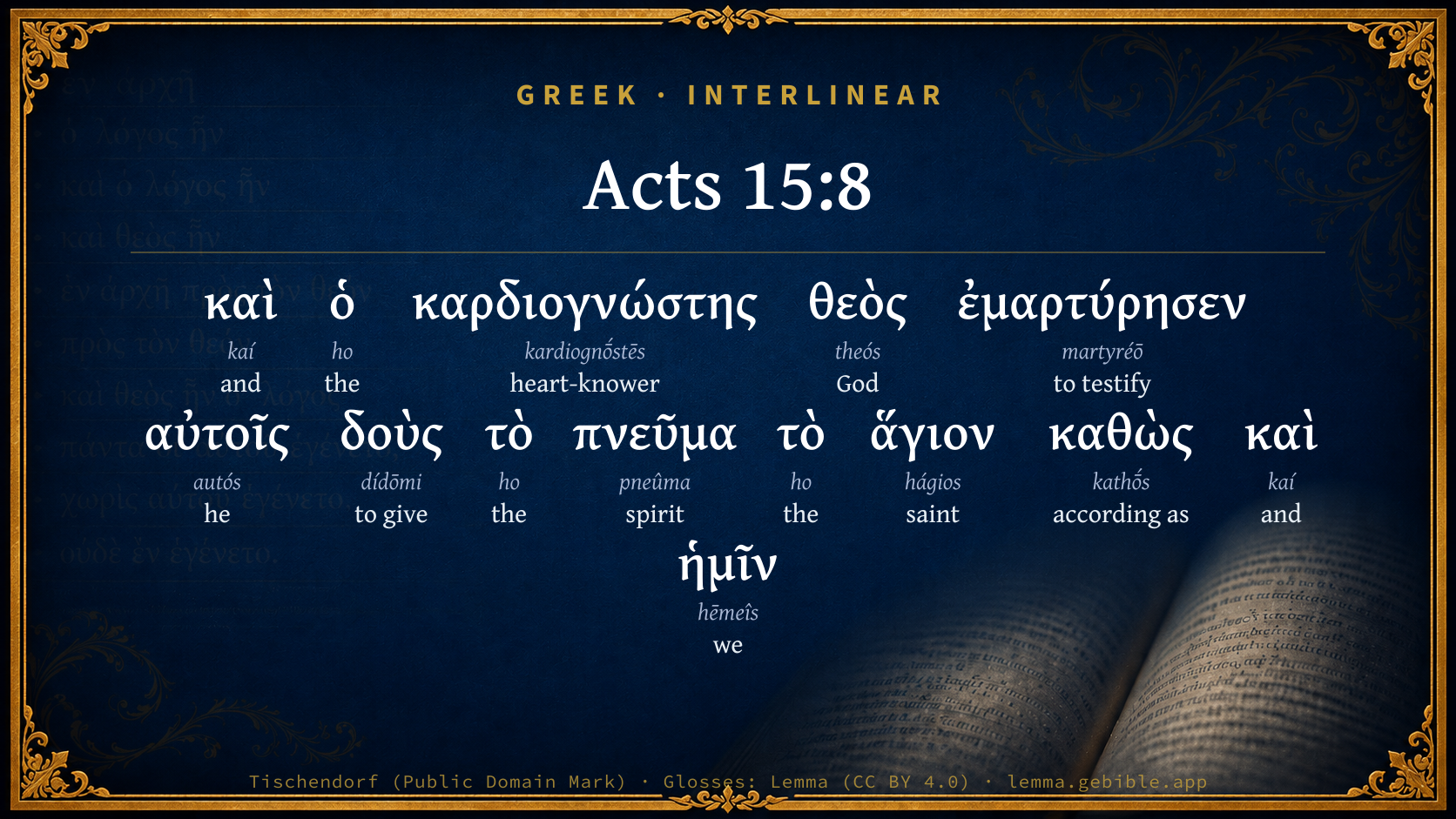
Greek (Tischendorf 8th ed.) Acts 15:8 appears in the Greek New Testament. The text above is from the Tischendorf 8th edition. Each word links to its Strong’s number and a concise gloss. Click any word for its full Thayer’s Greek Lexicon entry.
Download image
Cite this verse

Acts 15:8 (World English Bible). Public Domain. Lemma interlinear Bible study tool, https://lemma.gebible.app/v/acts/15/8.

Show BibTeX & RIS
BibTeX
RIS
English Translation
God, who knows the heart, testified about them, giving them the Holy Spirit, just like he did to us.
World English Bible · Public Domain
Download a study sheet

One document with this verse’s original text, its word-by-word gloss line, the meaning frame, cross-references with their text, attributed commentary, and full source and license credits — printable, and it pastes into notes with its structure intact.

This verse Autodidact and up

Study sheet (.html) Plain text (.txt)

A passage Seminary Student

Up to 50 verses in one chapter. A passage sheet keeps up to 6 commentary sources and 12 cross-references per verse, in the order this page ranks them, and says so on the sheet whenever that leaves anything out. Ask for a single verse and you get the Autodidact verse sheet above.

Everything on this page stays free to read, with no account — the sheet is a download of what is already on screen, not access to it.

Want to remove ads? Support Godless Engineer
Compare translations 3

The same verse in 3 English versions, stacked beneath the original-language interlinear above. Click any original word for its lexicon entry.

Each is an independent rendering of the whole verse — the interlinear is not word-aligned to these translations.

Highlighted words mark where these versions differ — a whole-verse word diff, not a word-by-word alignment.

  • World English Bible Public Domain
    God, who knows the heart, testified about them, giving them the Holy Spirit, just like he did to us.
  • King James Version Public Domain
    And God, which knoweth the hearts, bare them witness, giving them the Holy Ghost, even as he did unto us;
  • unfoldingWord Literal Text CC BY-SA 4.0
    And God, the heart-knower, testified to them, giving them the Holy Spirit, just as also to us;

unfoldingWord Literal Text — © unfoldingWord, licensed CC BY-SA 4.0. Word-aligned USFM3 via Door43 (git.door43.org/unfoldingWord/en_ult).

Versions to compare (up to 4)

3 of 4 selected

Show all 19 translations

Every available English version of this verse, each an independent rendering of the whole verse.

  • World English Bible Public Domain
    God, who knows the heart, testified about them, giving them the Holy Spirit, just like he did to us.
  • Berean Standard Bible Public Domain
    And God, who knows the heart, showed His approval by giving the Holy Spirit to them, just as He did to us.
  • Majority Standard Bible Public Domain
    And God, who knows the heart, showed His approval by giving the Holy Spirit to them, just as He did to us.
  • King James Version Public Domain
    And God, which knoweth the hearts, bare them witness, giving them the Holy Ghost, even as he did unto us;
  • American Standard Version (1901) Public Domain
    And God, who knoweth the heart, bare them witness, giving them the Holy Spirit, even as he did unto us;
  • Revised Version (1885) Public Domain
    And God, which knoweth the heart, bare them witness, giving them the Holy Ghost, even as he did unto us;
  • Geneva Bible (1599) Public Domain
    And God which knoweth the heartes, bare them witnesse, in giuing vnto them ye holy Ghost euen as he did vnto vs.
  • Douay-Rheims (1899) Public Domain
    And God, who knoweth the hearts, gave testimony, giving unto them the Holy Ghost, as well as to us;
  • Young's Literal Translation Public Domain
    and the heart-knowing God did bare them testimony, having given to them the Holy Spirit, even as also to us,
  • Literal Standard Version CC BY-SA 4.0
    and the heart-knowing God bore them testimony, having given to them the Holy Spirit, even as also to us,
  • Unlocked Literal Bible CC BY-SA 4.0
    God, who knows the heart, witnesses to them, giving them the Holy Spirit, just as he did to us;
  • unfoldingWord Literal Text CC BY-SA 4.0
    And God, the heart-knower, testified to them, giving them the Holy Spirit, just as also to us;
  • Darby Bible Public Domain
    And the heart-knowing God bore them witness, giving [them] the Holy Spirit as to us also,
  • World Messianic Bible Public Domain
    God, who knows the heart, testified about them, giving them the Holy Spirit, just like he did to us.
  • Webster's Bible Public Domain
    And God, who knoweth the hearts, bore them witness, giving to them the Holy Spirit, even as he did to us:
  • Free Bible Version CC BY-SA 4.0
    God, who knows what we're thinking, has shown that he accepts them, giving them the Holy Spirit just as he did to us.
  • Bible in Basic English Public Domain
    And God, the searcher of hearts, was a witness to them, giving them the Holy Spirit even as he did to us;
  • Text-Critical English NT CC BY 4.0
    And God, who knows the heart, testified to them by giving them the Holy Spirit, just as he did to us.
  • Tyndale New Testament (1534) Public Domain
    And God which knoweth the herte bare them witnes and gave vnto them the holy goost even as he dyd vnto vs

Literal Standard Version (2020), Covenant Press — licensed CC BY-SA 4.0. Text via the HelloAO Bible API (eBible.org). Unlocked Literal Bible (unfoldingWord) — licensed CC BY-SA 4.0. Text via the HelloAO Bible API (eBible.org). unfoldingWord Literal Text — © unfoldingWord, licensed CC BY-SA 4.0. Word-aligned USFM3 via Door43 (git.door43.org/unfoldingWord/en_ult). Free Bible Version, Dr. Jonathan Gallagher — licensed CC BY-SA 4.0. Text via the HelloAO Bible API (eBible.org).

Word by word

More ways to search: Search by grammar → Find every occurrence → Compare this word →

Practice this passage: Drill this verse → Learn its vocabulary →

καρδιογνώστης
kardiognṓstēs
G2589
“heart-knower”
Noun, Nominative, Singular, Masculine
Part of Speech
Noun
Case
Nominative
Number
Singular
Gender
Masculine
Full Thayer's Definition

Origin: from G2588 and G1097

TDNT: 13:13,4

1. knower of the hearts
  1. καὶ kaí G2532 “and” Conjunction
  2. ὁ ho G3588 “the” Article, Nominative, Singular, Masculine
  3. θεὸς theós G2316 “God” Noun, Nominative, Singular, Masculine
  4. ἐμαρτύρησεν martyréō G3140 “to testify” Verb, Aorist, Active, Indicative, 3rd person, Singular
  5. αὐτοῖς autós G846 “he” Personal pronoun, Dative, Plural, Masculine
  6. δοὺς dídōmi G1325 “to give” Verb, Aorist, Active, Participle, Nominative, Singular, Masculine
  7. τὸ ho G3588 “the” Article, Accusative, Singular, Neuter
  8. πνεῦμα pneûma G4151 “spirit” Noun, Accusative, Singular, Neuter
  9. τὸ ho G3588 “the” Article, Accusative, Singular, Neuter
  10. ἅγιον hágios G40 “saint” Adjective, Accusative, Singular, Neuter
  11. καθὼς kathṓs G2531 “according as” Adverb
  12. καὶ kaí G2532 “and” Conjunction
  13. ἡμῖν hēmeîs G2249 “we” Personal pronoun, 1st person, Dative, Plural

About this verse

These counts appear in no published source. They are computed here, from the morphology-tagged text and Lemma’s own curated glosses. What Lemma adds →

14
words
11
distinct lemmas
Acts
section

Notable vocabulary

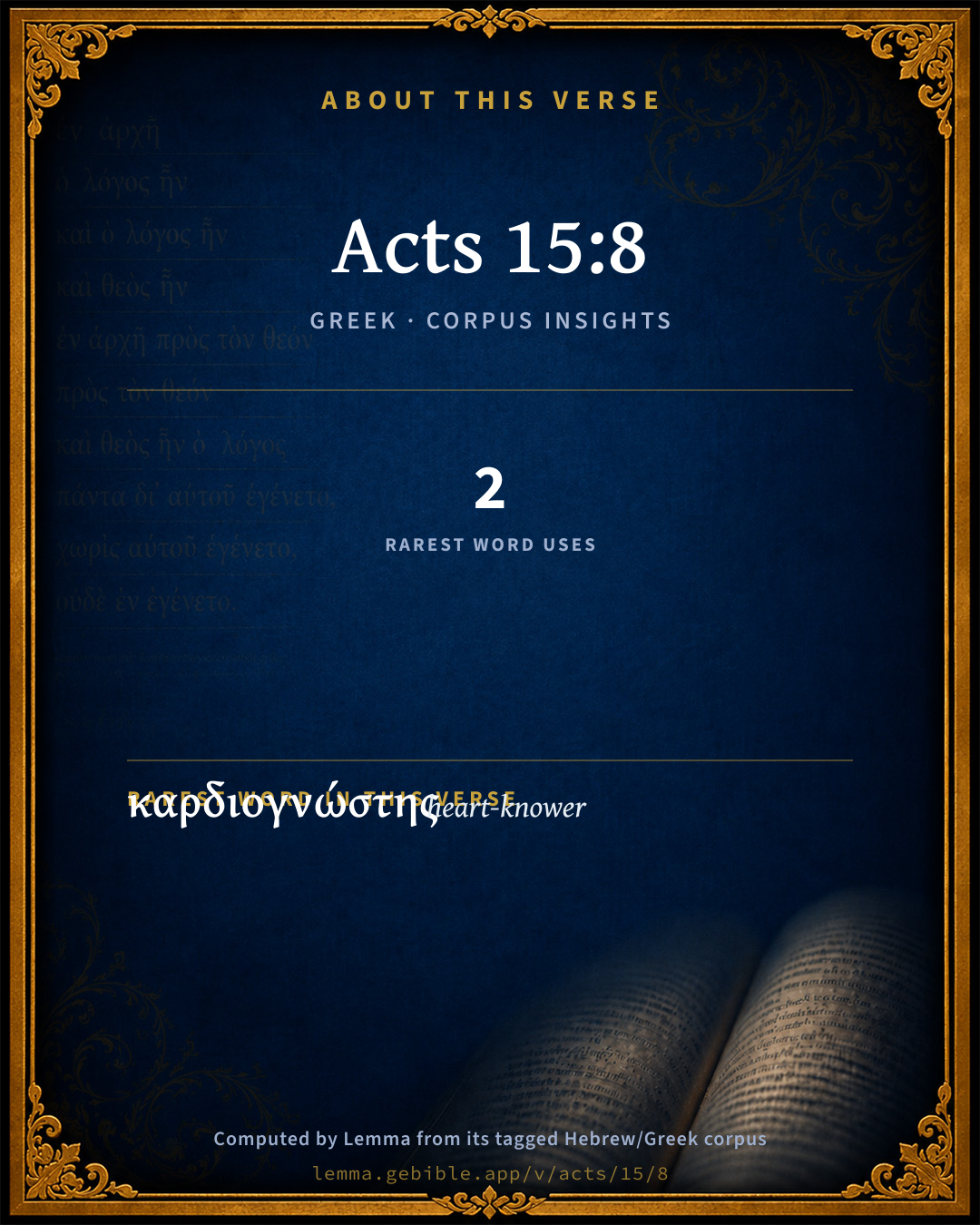
The rarest word here is καρδιογνώστης heart-knower G2589 — appearing just 2 times in the whole Greek New Testament.

Shared distinctive vocabulary

καρδιογνώστης heart-knower G2589 occurs in 2 verses of the Greek New Testament. Also found in:

Repetition

Words recur within this verse:

Cross-references

22

Topical passages linked to Acts 15:8 in the Treasury of Scripture Knowledge — connected by theme and wording, ordered by reader-vote popularity; previews shown in the World English Bible.

  • Acts 1:24 They prayed, and said, "You, Lord, who know the hearts of all men, show which one of these two you have chosen
  • Acts 10:47 "Can any man forbid the water, that these who have received the Holy Spirit as well as we should not be baptized?"
  • Acts 2:4 They were all filled with the Holy Spirit, and began to speak with other languages, as the Spirit gave them the ability to speak.
  • Acts 14:3 Therefore they stayed there a long time, speaking boldly in the Lord, who testified to the word of his grace, granting signs and wonders to be done by their hands.
  • Hebrews 4:13 There is no creature that is hidden from his sight, but all things are naked and laid open before the eyes of him with whom we have to do.
  • 1 Samuel 16:7 But Yahweh said to Samuel, "Don't look on his face, or on the height of his stature; because I have rejected him: for [Yahweh sees] not as man sees; for man looks at the outward appearance, but Yahweh looks at the heart."
  • 1 Kings 8:39 then hear in heaven, your dwelling-place, and forgive, and do, and render to every man according to all his ways, whose heart you know; (for you, even you only, know the hearts of all the children of men;)
  • 1 Chronicles 28:9 You, Solomon my son, know the God of your father, and serve him with a perfect heart and with a willing mind; for Yahweh searches all hearts, and understands all the imaginations of the thoughts: if you seek him, he will be found of you; but if you forsake him, he will cast you off forever.
  • Psalms 44:21 Won't God search this out? For he knows the secrets of the heart.
  • Psalms 139:1–2 Yahweh, you have searched me, And you know me.
  • Jeremiah 11:20 But, Yahweh of Hosts, who judge righteously, who try the heart and the mind, I shall see your vengeance on them; for to you have I revealed my cause.
  • Jeremiah 17:10 I, Yahweh, search the mind, I try the heart, even to give every man according to his ways, according to the fruit of his doings.
  • Jeremiah 20:12 But, Yahweh of Hosts, who tests the righteous, who sees the heart and the mind, let me see your vengeance on them; for to you have I revealed my cause.
  • John 2:24–25 But Jesus didn't trust himself to them, because he knew everyone,
  • John 5:37 The Father himself, who sent me, has testified about me. You have neither heard his voice at any time, nor seen his form.
  • John 21:17 He said to him the third time, "Simon, son of Jonah, do you have affection for me?" Peter was grieved because he asked him the third time, "Do you have affection for me?" He said to him, "Lord, you know everything. You know that I have affection for you." Jesus said to him, "Feed my sheep.
  • Acts 4:31 When they had prayed, the place was shaken where they were gathered together. They were all filled with the Holy Spirit, and they spoke the word of God with boldness.
  • Acts 10:44–45 While Peter was still speaking these words, the Holy Spirit fell on all those who heard the word.
  • Acts 11:15–17 As I began to speak, the Holy Spirit fell on them, even as on us at the beginning.
  • Hebrews 2:4 God also bearing witness with them, both by signs and wonders, and by various works of power, and by gifts of the Holy Spirit, according to his own will?
  • Revelation 2:23 I will kill her children with Death, and all the assemblies will know that I am he who searches the minds and hearts. I will give to each one of you according to your deeds.
  • 1 Chronicles 29:17 I know also, my God, that you try the heart, and have pleasure in uprightness. As for me, in the uprightness of my heart I have willingly offered all these things: and now have I seen with joy your people, that are present here, offer willingly to you.

Cross-references courtesy of OpenBible.info (CC BY 4.0).

Commentary

Notes on Acts 15:8 from classic Christian and Jewish commentators (each source and its license shown beneath its notes). The classic Christian expositions comment on the surrounding passage and are grouped to its opening verse, so a note may address several verses; the Jewish commentaries on the Tanakh (Rashi and others) are per-verse, so they appear only where the commentator wrote on this verse.

Lemma curates 59 commentaries, every one of them public domain or Creative Commons licensed, each selected and text-cleaned for this edition rather than reprinted as found. About our sources →

The Biblical Illustrator

Joseph S. Exell

Act_15:8-9

God, which knoweth the hearts, bare them witness.

Gods sovereignty

It is the sovereigns stamp which settles the question as to the right of a coin to be counted current among loyal subjects of that sovereign. When God puts His stamp of approval on a man, or on a woman, or on a movement, that fact ought to weigh beyond any individual opinion as to the original propriety of such an approval. It may seem to us that the elder and more imposing Eliab is far better suited to the kingship than the youthful rustic David; but when God decides in favour of the latter, it is time for us to reverse our opinion on this point. So, also, as to preachers and methods of preaching, as to denominational peculiarities and modes of working, as to special agents and agencies in Christian endeavour; not what we thought God would approve, but what we find God has approved, ought to weigh most with us in deciding the question of our accepting or belittling that instrumentality or undertaking. Gamaliels warning is as timely for our day as it was for his, in many a matter of treating Christian work and Christian workers. In opposing those who claim to stand for God, while they differ with us, we may be found to be fighting against God. (H. C. Trumbull, D. D.)

Purifying their hearts by faith.--

Purity of heart

I. Its nature.

1. By the heart we must understand the inner, as opposed to the outer, man--the spirit and not the flesh. Circumcision--indeed any external ceremony, even Christian baptism can only affect the outer man. The text, therefore, in opposition to mere ceremonial purity speaks of purity of heart.

2. It is implied that the heart of man is by nature impure (Rom_1:28-32). Perish then the delusion that the human heart is good!

3. It is to the purification of the heart that the text calls attention. Things are commonly said to be pure when they are simple and unmixed; and purity of heart implies sincerity and simplicity, as opposed to the base mixtures of hypocrisy and deceit The work of Christian purity is commenced in regeneration There is a new creation: old things are passed away; behold all things are become new. There are new views, principles, feelings. But these things are at first immature (1Jn_2:13). The law of progress is stamped on the whole economy of Christianity. Perfect purity is the goal at which it aims. This implies--

(1) A complete deliverance from sin--its pollution and power. This is obviously implied in the word pure. And here arises the difficulty, whether a perfectly pure state of heart is possible in the present life. Many contend only for the subjugation of sin, and not for its destruction, affirming that whilst the spirit remains in the flesh sin must remain in the spirit. But this is to ascribe some moral power to the flesh which it does not possess; sin is spiritual (Mar_7:21-22). Now Divine grace either can or cannot counteract this fearful state of things. If it cannot, then the work of human redemption, professedly effected by the death of the Lord Jesus Christ, was inadequate. But if the grace of God can counteract the influence of sin, the question is settled. For this purpose the Son of God was manifested, that He might destroy the works of the devil. Christ loved the Church … that He might present it to Himself a glorious Church, not having spot, or wrinkle, or any such thing; but that it should be holy and without blemish. The blood of Jesus Christ cleanseth from all sin. But, say some, the work cannot be completed till death. Now, if this mean by death, it destroys itself, for death is an enemy whose office is simply to separate the soul from the body; if it mean at death, it may soon be exposed--for if Divine grace can purify the heart a moment before death, why not an hour? why not a month? why not a year? why not twenty, or even fifty years? why not now?

(2) And because all sin is destroyed, love fills the heart. Hence obedience results from purity; this is the love of God, that we keep His commandments. Every spring of feeling, and all the arcana of thought are sanctified by its magic touch. The wandering eye, the listening ear, the loquacious tongue, the busy hands, the willing feet are all actuated by the ruling principle of love to God.

II. Its author. The Holy Ghost, as Peter elsewhere says. Ye have purified your souls in obeying the truth through the Spirit. The Holy Spirit first convinces of the necessity of purity; for it is by His inward illumination that we discover the corrupt state of the heart. If we welcome this discovery we shall sorrow for and hate this indwelling sin. The same Spirit will create a strong desire for deliverance, which if cherished will express itself in earnest, wrestling prayer. This will be followed by the encouraging excitement of humble hope, and the filial confidence that the desire shall be granted. Whoever thus cooperates with the Holy Spirit, the Divine Author of purity of heart, will eventually be brought to the exercise of that faith which casts out sin and purifies the heart. The reason that so few Christians obtain this great salvation will now be manifest. They do not obey the truth, whereas the law of the Spirit is that we are sanctified through the truth. Ye have purified your souls, in obeying the truth through the Spirit.

III. Its means. By faith. All salvation is obtained by faith.

1. Its warrant is the promises, (see Eze_36:25-29; Deu_30:6; 2Co_6:16). These are the believers fulcrum. They do actually supply to him what Archimedes once boasted as his only deficiency to rival Omnipotence. Give me a place on which to stand and I will move the world. But the promises of God supply the believer with a fulcrum by which he may move both earth and heaven.

2. The object of faith is the precious blood of Christ (Act_26:17-18).

IV. Its scope. It is offered to all. Whatever differences or distinctions men may make, God makes none. There is no difference with respect to--

1. Our need of this great change. Throughout the world human nature is the same. There is none righteous, no, not one.

2. The mode of purification. In every case it is by faith. (H. J. Booth.)

Faith purifying the heart from

I. Pride.

1. This is setting up the honour of self above the honour of God. It is self-worship, and refuses to recognise any righteousness but self-righteousness.

2. What is the very prime object of faith! What do I receive into my heart if I realise Christs work for me? Is it not this, that the mighty God, He who is greater than the greatest, higher than the highest, laid aside all His glory, and came down into the very depth of humiliation for me? If I live Christ, how can I worship self? When faith has once entered, what room is there for pride? Where is the boasted glory of man before the Eternal Word, who became flesh, and by the very hiding of His glory manifested it--through Him humiliation entered into His exaltation? Where is human merit, when once the fulness of the rich stream of Gods unmerited grace is shed over the soul? No; the life of faith is the death of pride.

3. But does faith substitute nothing for self thus dethroned? Far from this. With the sense of a mans own worthlessness comes the sense of his Redeemers worth--comes love to God, the true answer and return of Gods love to him. This last, faith apprehends; that other, faith renders. The humility of those who are born of the Spirit is exactly in proportion to their appropriation of the work of Christ. As He increases in a mans esteem, self decreases. And thus humility is the true work of faith.

II. Covetousness--the inordinate valuing of created objects--the esteeming self not by self alone, but by the things wherewith self is surrounded and enriched.

1. We have in man all degrees of this sin, from the ambition which grasps empires to the miserly greed which hoards the farthing. And the secret of the sin is the same throughout all--the creature, not the Creator; my own possessions, not Gods gifts; my position my promotion, my increased income--not my stewardship before God; it is in every case a direct consequence of the substitution of self for Him.

2. And in every case faith in Christ is as directly opposed to it. If my inner regards are really fixed on Him who gave all He had, yea, Himself, for me, where is there room in me for covetous desires? Will not he whose life is hid with Christ in God be laying up treasures in heaven rather than on earth--be enriching his home rather than his tent in the wilderness?

III. Self-indulgence--the love of pleasure--the inordinate valuing of our own delights in created objects. How does faith deal with this all but universal tendency? Who is its object? Is it not He who has solemnly told us that none can be His disciple without daily self-denial? Can a man be justified by faith in Him and disregard these His words? Understand me: the Christian who lives by faith in Christ can and does enjoy life in the best and highest sense; but he cannot be a seeker of pleasure--cannot surrender his noble privilege of self-denial for the bondage in which he sees the children of the world fettered. (Dean Afford.)

Faith purifying the heart

Peter was enabled through his experience to answer those who said that unless a man was circumcised he could not be saved. There is nothing like practical work for Christ to teach us Christs truth. For the most part heretics are a set of theorisers. They do nothing, and then criticise those who are doing hard and successful service. Give a man practical work for Jesus and keep him at it, and he will, like Peter, learn as he goes on, and, like a river, filter as he flows. Peter could not continue to believe in restricting the gospel to the Jews after the conversion of Cornelius. His actual service refined his theory. If those who ruled botanical science never saw a flower, would you wonder if they ran into gross heterodoxies of belief? Let us consider the point upon which Peters argument depends.

I. The agent of heart purification--faith. There was nothing but faith in the case of Cornelius, faith born of hearing, and resting alone on Jesus.

1. Faith purified directly, not by month after month of contemplation; for, to the astonishment of the circumcised believers, the Holy Ghost fell upon them there and then.

2. Water baptism did not aid therein. The Lord will not permit us to mix up even His own ordinances with the work of His Spirit in purifying the heart by faith alone, and God forbid we ever should fall into such an error.

3. Do not, then, be looking for pure hearts within yourselves before you come to Christ by faith. Do not look for the fruits before you have the roots, but look by faith to the great Purifier, however impure you feel your heart to be.

II. The secret of its power. Believing other things does not purify the soul; why does believing the gospel? I answer, because--

1. God works by it (Act_15:8). You know the old story of the sword of Scanderbeg, with which he used to cleave men in twain from the crown of the head downwards. As one looked at it he declared that he saw nothing about it to make it so fatal a weapon; but the other replied, You should have seen the arm which was wont to wield it. Now faith looked at of itself appears to be contemptible; but who shall resist the everlasting Arm that wields it? This greater than Hercules careth little for the weakness of the instrument; but, behold, He cleanseth the Augean stable of our nature with no other agency than childlike faith.

2. God is at work in the heart by His Holy Spirit. Now, the Holy Spirit comes as a heavenly fire to consume sin, as a flowing stream to cleanse away evil, and as a rushing mighty wind to chase away all that is foul and polluted in the stagnant air of the soul. The Holy Spirit is the Spirit of holiness, and as He always dwells with faith, being its Author, its Strengthener and Guardian, where faith comes the heart will speedily be purified.

III. The seat of its action--the heart. Faith changes the current of our love, and alters the motive which sways us: this is what is meant by purifying the heart. It makes us love that which is good and right, and moves us with motives free from self and sin: this is a great work indeed. Hence the change which faith produces is--

1. Radical and deep. It is a small matter to wash the outside of the cup and of the platter.

2. Thorough and complete. Rend your hearts and not your garments. Faith lays the axe at the root, and heals the stream at the fountain head.

3. Operative throughout the whole life. A diseased heart means a sickly man all over. Neither can you have the heart right without its telling upon the entire nature.

4. Permanent. Restrain appetites which still remain, and the dog returns to his vomit; purify externals and leave the nature untouched, and the sow that was washed goes back to her wallowing in the mire.

5. Acceptable with God, who searcheth the heart. Man judgeth according to the outward appearance, but God looketh at the heart.

IV. The mode of its operation.

1. Faith believes in sin as sin, and sees the horror of it as an offence against a holy and gracious God.

2. Faith delights to set Christ before the heart and to make it gaze upon His side pierced by sin, and therefore hates the sin which slew its best Friend.

3. Faith delighteth much in the Person of Christ, and therefore she sets before the soul His incomparable loveliness, as the well-beloved of saints. Thus is enkindled a vehement flame of love to Him, and this becomes a powerful purifier, for you cannot love Christ and love sin.

4. Faith has a wonderful art of realising her gracious privileges. What manner of persons then ought you to be?

5. Faith has yet further a wondrous power of bringing near the things to come. What could more effectually purify the heart than the vision of heaven which faith presents to us?

6. Power is gained by faith through pleading the promises of God. Sin shall not have dominion over you, for ye are not under the law, but under grace.

7. Faith daringly lays hold upon the power of God Himself. How she smites the Philistines then!

8. Faith brings us real power to conquer sin by applying the blood of Christ. The blood of Jesus is the life of faith and the death of sin. All the saints overcome through the blood of the Lamb.

9. Faith gives us power against sin by mixing herself with all gospel ordinances--with hearing, communions, prayer, Bible study. Faith will enable you to draw nourishment out of ordinances, and make you vigorous against sin. 10. Faith rouses the new man to intense resistance of sin. (C. H. Spurgeon.)

The Biblical Illustrator, edited by Joseph S. Exell (c. 1880s–1900s) — public domain. Text from a community e-Sword module.

Bengel's Gnomon

Johann Albrecht Bengel

Act 15:8. Ὁ καρδιογνώστης, who knoweth the hearts) who looks to the heart, not to the flesh.—ἐμαρτύρησεν αὐτοῖς, bare them witness) Two verbs, each with a participle: ἐμαρτύρησε, δούς· καὶ οὐδὲν διέκρινε, καθαρίσας. Αὐτοῖς, the Dative, as ch. Act 10:43.—αὐτοῖς, to them) He testified, by giving them the Holy Spirit, that they are pleasing to Him: Gal 3:5.

Bengel's Gnomon of the New Testament — English translation (T&T Clark, Edinburgh, 1860) — public domain. Text from a community e-Sword module.

Meyer's Critical & Exegetical Commentary

Heinrich August Wilhelm Meyer

Act_15:8-10. God who knows the heart, who thus could not be deceived in the matter (comp. Act_1:24), has, in reference to this their admission effected by my instrumentality into the fellowship of the gospel and of faith (Act_15:7), done two things. He has (a) positively borne matter-of-fact witness for them (to their qualification for admission) by His giving to them the Holy Spirit, as to us (comp. Act_10:44, Act_11:15 ff.); and (b) negatively, He made in no way distinction between us and them, after He by faith, of which He made them partakers through the gospel, had purified their hearts. God would have made such a distinction, if, after this ethical[26] purification of the heart effected by faith, He had now required of them, for their Christian standing, something else, namely, circumcision and other works of the law; but faith, by which He had morally purified their inner life, was to Him the sole requisite for their Christian standing without distinction, as also with us. Observe on (a), that δοὺς αὐτοῖς κ.τ.λ. is contemporaneous with ἐμαρτύρησεν, expressing, namely, the mode of it; and on (b), that τ. π. καθαρίσας is previous to the οὐδὲν διέκρινε. This is evident from the course of the speech, as the faith must have been already present before the communication of the Spirit (comp. Act_11:17).

Act_15:10. Accordingly as the matter now stands (νῦν οὖν).

ΤΊ ΠΕΙΡΆΖΕΤΕ ΤῸΝ ΘΕΌΝ;] i.e. why do ye put it to the test, whether God will abandon His attestation of non-observance already given to the Gentiles, or assert His punitive power against human resistance? Apostrophe ad Pharisäos et severus elenchus, Bengel.

ἐπιθεῖναι] with the design to impose, etc.

ζυγόν] comp. Gal_5:1, and Chrysostom in loc.: τῷ τοῦ ζυγοῦ ὀνόματι τὸ βαρὺ τοῦ πράγματος (of the complete observance of the law) ΑὐΤΟῖς ἘΝΔΕΊΚΝΥΤΑΙ. Contrast to this yoke: Mat_11:29-30.

οἱ πατέρες ἡμ.] since the time of Moses.

[26] Weiss, Petr. Lehrbegr. p. 321, thinks that it is in the ceremonial sense, so that the idea only allusively passes over into that of ethical cleansing. But τὰς καρδίας points only to the moral sphere. Comp. Weiss himself, p. 274 f. This moral cleansing presupposes, moreover, the reconciliation appropriated by faith; see 1Pe_1:18.

Meyer — Critical and Exegetical Commentary on the New Testament — English translation by Peter Christie, edited by Frederick Crombie (T&T Clark, 1880) — public domain. Text from a community e-Sword module.

Expositor's Greek Testament

ed. W. Robertson Nicoll

Act 15:8 . ὁ καρδιογνώστης , Act 1:24 , where the same word is used by St. Peter; cf. Jer 17:10 . ἐτάζων καρδίας , and cf. St. Peter’s words in Act 10:34 . καθὼς καὶ ἡμῖν , Act 10:44 , Act 11:15 .

The Expositor's Greek Testament, edited by W. Robertson Nicoll (1897–1910) — public domain. Text from a community e-Sword module.

Jamieson, Fausset & Brown

Robert Jamieson, A. R. Fausset & David Brown

God, which knoweth the hearts--implying that the real question for admission to full standing in the visible Church is the state of the heart. Hence, though that cannot be known by men, no principle of admission to church privileges which reverses this can be sound.

Jamieson, Fausset & Brown — Commentary Critical and Explanatory on the Whole Bible (1871) — public domain (CC PDM 1.0). Text via the HelloAO Bible API.

Adam Clarke's Commentary

Verse 8. And God which knoweth the hearts] Ο καρδιογνωϚης Θεος. We had this epithet of the Divine Being once before; see Ac 1:24, and the note there: it occurs no where else in the New Testament.

Bare them witness] Considered them as proper or fit to receive the Gospel of Christ. It is properly remarked by learned men, that μαρτυρειν τινι, to bear witness to any person, signifies to approve, to testify in behalf of. Here it signifies that, as God evidently sent the Gospel to the Gentiles, and, by the preaching of it, conveyed the Holy Spirit to them who believed, and as he can make no improper judgment of any who knows all hearts and their secrets, therefore what he had done was right: he saw that it was time for them to receive the Gospel; and he saw that they might be safely trusted with this heavenly deposit; and the experience of eighteen hundred years has justified the conduct of God.

Adam Clarke's Commentary on the Bible (1810–1826) — public domain. Text from a community e-Sword/MySword module.

Ellicott's Commentary for English Readers

(8) God which knoweth the hearts.—We note the recurrence of the epithet as characteristic of St. Peter. (See Note on Act_1:24.)

A Bible Commentary for English Readers, edited by Charles John Ellicott (1878–1897) — public domain. Text from a community e-Sword module.

The Cambridge Bible for Schools and Colleges

gen. ed. J. J. S. Perowne

8. which knoweth the hearts] The word is only here and in Act_1:24, and on both occasions it is St Peter who uses it. Such witness could admit of no appeal; and God had put the uncircumcised on the same level with the circumcised by giving to them the same gifts of the Spirit.

The Cambridge Bible for Schools and Colleges (gen. ed. J. J. S. Perowne; Cambridge University Press, 1878–1918) — public domain. Text from a community e-Sword module.

John Gill's Exposition

And God which knoweth the hearts,.... Of all men; he being omniscient, the searcher of the hearts, and the trier of the reins of the children of men, knew with what sincerity Cornelius sent for Peter; and with what vehement desire and longing expectation he and his family and friends waited for his coming; and with what earnestness, diligence, and affection they attended to what he said:

bore them witness, giving them the Holy Ghost, even as he did unto us; God bore a testimony, and showed his well pleasedness in the whole of this affair, by bestowing upon them not only the regenerating and sanctifying grace of the Spirit; but his extraordinary gifts, such as speaking with divers tongues, even in like manner as these were bestowed on the apostles themselves, on the day of Pentecost, though they were uncircumcised persons; for the drift of Peter's oration is to show, that circumcision was not necessary to salvation.

John Gill's Exposition of the Whole Bible (1746–1763) — public domain (CC PDM 1.0). Text via the HelloAO Bible API.

Albert Barnes' Notes on the Bible

And God, which knoweth the hearts - Act 1:24. God thus knew whether they were true converts or not, and gave a demonstration that he acknowledged them as his.

Giving them the Holy Ghost ... - Act 10:45-46.

Albert Barnes' Notes on the Bible (1834–1885) — public domain. Text from a community e-Sword/MySword module.

Matthew Poole's English Annotations

Which knoweth the hearts; God knew the desires of the Gentiles, that they did sincerely desire to please God, and to see this salvation. This great attribute David improved, 1Ch 29:17, and highly recommended his son Solomon to consider of, 1Ch 28:9; which, if believed, would make us also to serve God with a perfect heart and a willing mind. Giving them the Holy Ghost; God himself was a witness for these Gentiles beyond all exception, when he gave them the ordinary and extraordinary gifts of the Holy Ghost; by which he testified, that they belonged to Christ, whose Spirit this was. Thus the testimony of Jesus is the spirit of prophecy, Rev 19:10; and the Spirit, according to our Saviour’s promise, Joh 15:26, doth testify of him.

Matthew Poole's English Annotations on the Holy Bible (1683–1685) — public domain. Text from a community e-Sword/MySword module.

The Pulpit Commentary

Heart for hearts, A.V. (kardiognwsthv). Bare them witness; i.e. set the mark of his approval upon them, vouched for their sincerity (see the use of the verb marturew in Luk_4:22; Joh_3:26; Act_6:3 Act_10:22, etc.)

The Pulpit Commentary (1880–1919), ed. H.D.M. Spence-Jones & Joseph S. Exell — public domain. Text from a community e-Sword module.

John Wesley's Explanatory Notes

God bare them witness - That he had accepted them, by giving them the Holy Ghost.

John Wesley, Explanatory Notes Upon the Whole Bible (1754–1765) — public domain. Text via the GEBible commentary corpus.

McGarvey & Pendleton's Commentaries

J. W. McGarvey

See notes on verse 7

J. W. McGarvey (with Philip Y. Pendleton), Commentaries on the New Testament (The Fourfold Gospel, 1914; Acts; and the epistles) — public domain. Text from a community e-Sword/MySword module.

Cambridge Greek Testament for Schools and Colleges

8. αὐτοῖς after δοὺς omitted with אAB. Vulg. only represents the pronoun once, though having ‘dans illis.’

8. ὁ καρδιογνώστης, which knoweth the hearts. καρδιογνώστης is only here and in Act 1:24, and on both occasions it is St Peter who uses it. Such a witness could admit of no appeal. God himself had put the uncircumcised on the same level with the circumcised by giving to them the same gifts of the Spirit.

Cambridge Greek Testament for Schools and Colleges (Cambridge University Press, 1896; 21 vols, various authors incl. Carr, Maclear, Plummer, Farrar, Lumby, Moule, M. R. James, Simcox) — public domain. Text from a community e-Sword module.

Vincent's Word Studies in the New Testament

Marvin R. Vincent

Which knoweth the heart [καρδιογνωστης] . Only here and ch. 1 24.

Marvin R. Vincent, Word Studies in the New Testament (1887–1900) — public domain. Text from a community e-Sword/MySword module.

Lesson kit

Teaching starters — assembled from the data on this page, not authored interpretation. Every prompt links to the verse data it draws on. Edit before teaching.

Acts, in the Acts, opens this verse with 14 words (11 distinct Greek lemmas). Its most distinctive word is kardiognṓstēs (“heart-knower”). A historical commentator’s framing appears above. Read the whole chapter for the surrounding context.

Discussion questions

  1. How does “heart-knower” (kardiognṓstēs) shape what this verse is saying?
  2. How does Acts 1:24, which shares the word «heart-knower», read alongside this verse?
  3. What does the repetition of “the” (3× in this one verse) do in this verse?
  4. These translations render this verse differently. What is at stake in choosing one wording over another?
  5. Compare how The Biblical Illustrator and Bengel's Gnomon read this verse. Where do they agree or differ?

Things to notice

Reading settings

Reading text

Shown beneath each verse's original-language words.

Old Testament
Old Testament edition

Read the OT as the Masoretic Hebrew (MT) or the Greek Septuagint (LXX).

English shown for the Greek Septuagint (in the Hebrew ↔ Greek comparison).

Comparing translations? Open the Compare panel on any verse page to stack up to four side by side.