2 Peter 3:2

Greek (Tischendorf 8th ed.) 2 Peter 3:2 appears in the Greek New Testament. The text above is from the Tischendorf 8th edition. Each word links to its Strong’s number and a concise gloss. Click any word for its full Thayer’s Greek Lexicon entry.
Download image
Cite this verse

2 Peter 3:2 (World English Bible). Public Domain. Lemma interlinear Bible study tool, https://lemma.gebible.app/v/2-peter/3/2.

Show BibTeX & RIS
BibTeX
RIS
English Translation
that you should remember the words which were spoken before by the holy prophets, and the commandments of us, the apostles of the Lord and Savior:
World English Bible · Public Domain
Download a study sheet

One document with this verse’s original text, its word-by-word gloss line, the meaning frame, cross-references with their text, attributed commentary, and full source and license credits — printable, and it pastes into notes with its structure intact.

This verse Autodidact and up

Study sheet (.html) Plain text (.txt)

A passage Seminary Student

Up to 50 verses in one chapter. A passage sheet keeps up to 6 commentary sources and 12 cross-references per verse, in the order this page ranks them, and says so on the sheet whenever that leaves anything out. Ask for a single verse and you get the Autodidact verse sheet above.

Everything on this page stays free to read, with no account — the sheet is a download of what is already on screen, not access to it.

Want to remove ads? Support Godless Engineer
Compare translations 3

The same verse in 3 English versions, stacked beneath the original-language interlinear above. Click any original word for its lexicon entry.

Each is an independent rendering of the whole verse — the interlinear is not word-aligned to these translations.

Highlighted words mark where these versions differ — a whole-verse word diff, not a word-by-word alignment.

  • World English Bible Public Domain
    that you should remember the words which were spoken before by the holy prophets, and the commandments of us, the apostles of the Lord and Savior:
  • King James Version Public Domain
    That ye may be mindful of the words which were spoken before by the holy prophets, and of the commandment of us the apostles of the Lord and Saviour:
  • unfoldingWord Literal Text CC BY-SA 4.0
    to remember the words spoken previously by the holy prophets and the command of the Lord and Savior through your apostles,

unfoldingWord Literal Text — © unfoldingWord, licensed CC BY-SA 4.0. Word-aligned USFM3 via Door43 (git.door43.org/unfoldingWord/en_ult).

Versions to compare (up to 4)

3 of 4 selected

Show all 19 translations

Every available English version of this verse, each an independent rendering of the whole verse.

  • World English Bible Public Domain
    that you should remember the words which were spoken before by the holy prophets, and the commandments of us, the apostles of the Lord and Savior:
  • Berean Standard Bible Public Domain
    by recalling what was foretold by the holy prophets and commanded by our Lord and Savior through your apostles.
  • Majority Standard Bible Public Domain
    by recalling what was foretold by the holy prophets and commanded by our Lord and Savior through your apostles.
  • King James Version Public Domain
    That ye may be mindful of the words which were spoken before by the holy prophets, and of the commandment of us the apostles of the Lord and Saviour:
  • American Standard Version (1901) Public Domain
    that ye should remember the words which were spoken before by the holy prophets, and the commandments of the Lord and Saviour through your apostles:
  • Revised Version (1885) Public Domain
    that ye should remember the words which were spoken before by the holy prophets, and the commandment of the Lord and Saviour through your apostles:
  • Geneva Bible (1599) Public Domain
    To call to remembrance the wordes, which were tolde before of the holy Prophetes, and also the commandement of vs the Apostles of the Lord and Sauiour.
  • Douay-Rheims (1899) Public Domain
    That you may be mindful of those words which I told you before from the holy prophets, and of your apostles, of the precepts of the Lord and Saviour.
  • Young's Literal Translation Public Domain
    to be mindful of the sayings said before by the holy prophets, and of the command of us the apostles of the Lord and Saviour,
  • Literal Standard Version CC BY-SA 4.0
    to be mindful of the sayings said before by the holy prophets, and of the command of us the apostles of the LORD and Savior,
  • Unlocked Literal Bible CC BY-SA 4.0
    so that you will recall the words spoken in the past by the holy prophets and the command of our Lord and Savior given through your apostles.
  • unfoldingWord Literal Text CC BY-SA 4.0
    to remember the words spoken previously by the holy prophets and the command of the Lord and Savior through your apostles,
  • Darby Bible Public Domain
    to be mindful of the words spoken before by the holy prophets, and of the commandment of the Lord and Saviour by your apostles;
  • World Messianic Bible Public Domain
    that you should remember the words which were spoken before by the holy prophets and the commandment of us, the emissaries of the Lord and Savior,
  • Webster's Bible Public Domain
    That ye may be mindful of the words which were spoken before by the holy prophets, and of the commandment of us the apostles of the Lord and Savior:
  • Free Bible Version CC BY-SA 4.0
    Remember the words spoken in the past by the holy prophets, and what the Lord and Savior commanded through your apostles.
  • Bible in Basic English Public Domain
    So that you may keep in mind the words of the holy prophets in the past, and the law of the Lord and Saviour which was given to you by his Apostles.
  • Text-Critical English NT CC BY 4.0
    so that you remember the words spoken in the past by the holy prophets and the commandment of our Lord and Savior given through your apostles.
  • Tyndale New Testament (1534) Public Domain
    to call to remembraunce the wordes which were tolde before of the holy prophetes and also the commaundement of vs the apostles of the lorde and saveour.

Literal Standard Version (2020), Covenant Press — licensed CC BY-SA 4.0. Text via the HelloAO Bible API (eBible.org). Unlocked Literal Bible (unfoldingWord) — licensed CC BY-SA 4.0. Text via the HelloAO Bible API (eBible.org). unfoldingWord Literal Text — © unfoldingWord, licensed CC BY-SA 4.0. Word-aligned USFM3 via Door43 (git.door43.org/unfoldingWord/en_ult). Free Bible Version, Dr. Jonathan Gallagher — licensed CC BY-SA 4.0. Text via the HelloAO Bible API (eBible.org).

Word by word

More ways to search: Search by grammar → Find every occurrence → Compare this word →

Practice this passage: Drill this verse → Learn its vocabulary →

προειρημένων
prolégō
G4302
“to predict”
Verb, Perfect, Passive, Participle, Genitive, Plural, Masculine
Part of Speech
Verb
Tense
Perfect
Voice
Passive
Mood
Participle
Case
Genitive
Number
Plural
Gender
Masculine
Full Thayer's Definition

Origin: from G4253 and G3004

TDNT: None

1. to say beforehand, to predict
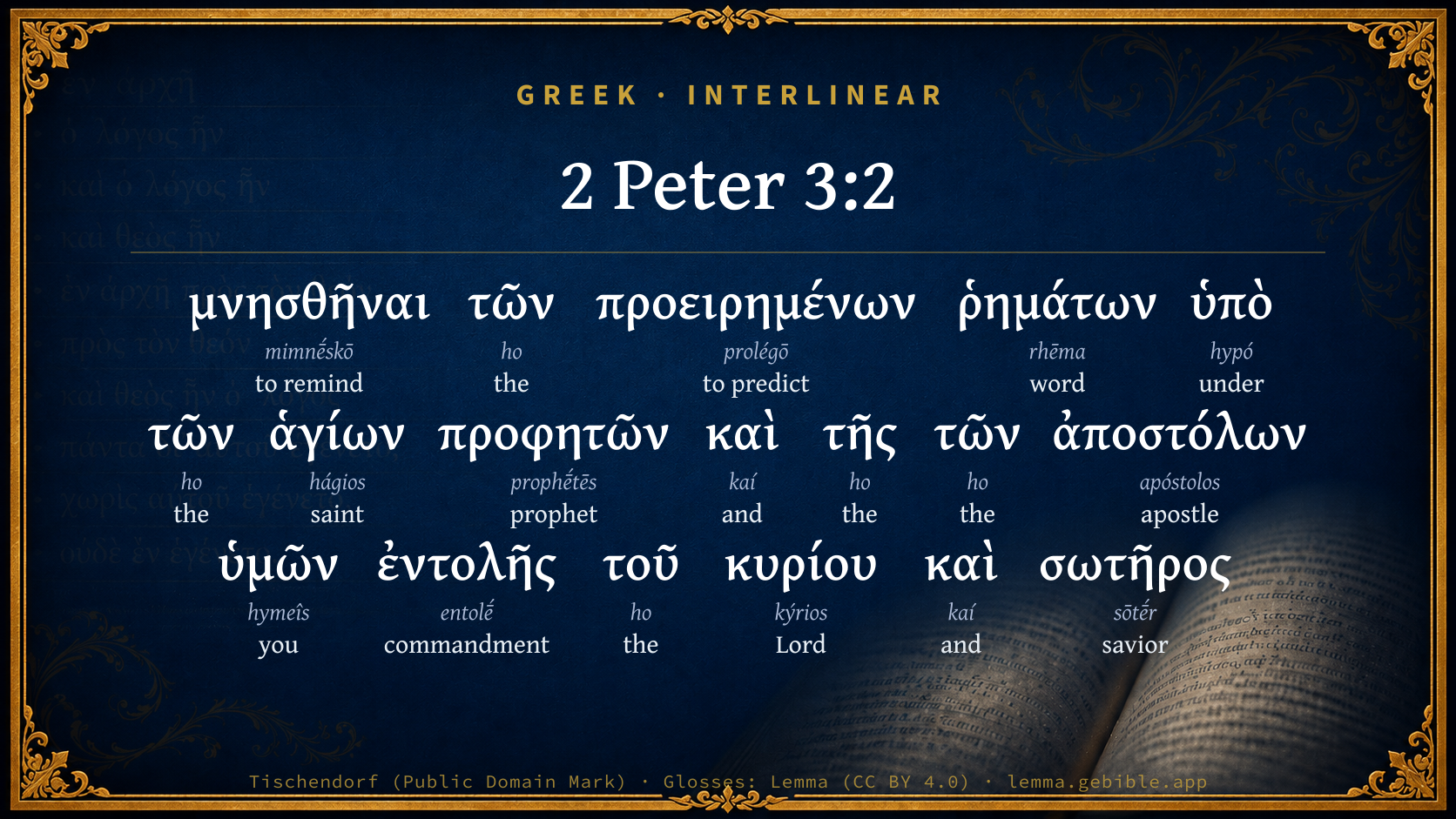
  1. μνησθῆναι mimnḗskō G3403 “to remind” Verb, Aorist, Passive, Infinitive
  2. τῶν ho G3588 “the” Article, Genitive, Plural, Masculine
  3. ῥημάτων rhēma G4487 “word” Noun, Genitive, Plural, Neuter
  4. ὑπὸ hypó G5259 “under” Preposition
  5. τῶν ho G3588 “the” Article, Genitive, Plural, Masculine
  6. ἁγίων hágios G40 “saint” Adjective, Genitive, Plural, Masculine
  7. προφητῶν prophḗtēs G4396 “prophet” Noun, Genitive, Plural, Masculine
  8. καὶ kaí G2532 “and” Conjunction
  9. τῆς ho G3588 “the” Article, Genitive, Singular, Feminine
  10. τῶν ho G3588 “the” Article, Genitive, Plural, Masculine
  11. ἀποστόλων apóstolos G652 “apostle” Noun, Genitive, Plural, Masculine
  12. ὑμῶν hymeîs G5210 “you” Personal pronoun, 2nd person, Genitive, Plural
  13. ἐντολῆς entolḗ G1785 “commandment” Noun, Genitive, Singular, Feminine
  14. τοῦ ho G3588 “the” Article, Genitive, Singular, Masculine
  15. κυρίου kýrios G2962 “Lord” Noun, Genitive, Singular, Masculine
  16. καὶ kaí G2532 “and” Conjunction
  17. σωτῆρος sōtḗr G4990 “savior” Noun, Genitive, Singular, Masculine

About this verse

These counts appear in no published source. They are computed here, from the morphology-tagged text and Lemma’s own curated glosses. What Lemma adds →

18
words
13
distinct lemmas
General Epistles
section

Notable vocabulary

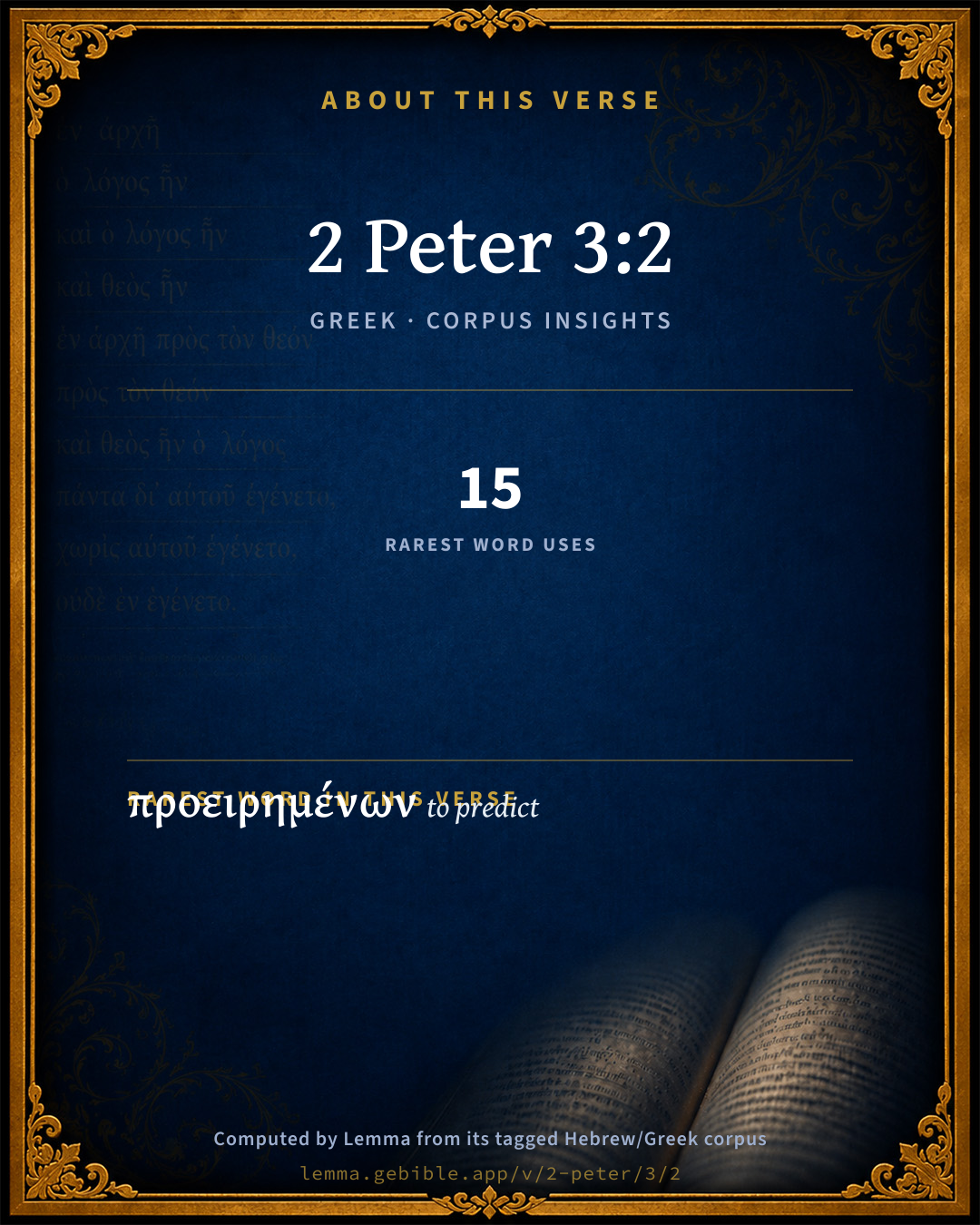
The rarest word here is προειρημένων to predict G4302 — appearing just 15 times in the whole Greek New Testament.

Shared distinctive vocabulary

προειρημένων to predict G4302 occurs in 13 verses of the Greek New Testament. Also found in:

Repetition

Words recur within this verse:

Cross-references

16

Topical passages linked to 2 Peter 3:2 in the Treasury of Scripture Knowledge — connected by theme and wording, ordered by reader-vote popularity; previews shown in the World English Bible.

  • Jude 1:17 But you, beloved, remember the words which have been spoken before by the apostles of our Lord Jesus Christ.
  • Luke 1:70 (As he spoke by the mouth of his holy prophets who have been from of old),
  • 2 Peter 2:21 For it would be better for them not to have known the way of righteousness, than, after knowing it, to turn back from the holy commandment delivered to them.
  • Luke 24:44 He said to them, "This is what I told you, while I was still with you, that all things which are written in the law of Moses, the prophets, and the psalms, concerning me must be fulfilled."
  • 1 Peter 1:10–12 Concerning this salvation, the prophets sought and searched diligently, who prophesied of the grace that would come to you,
  • 2 Peter 1:19–21 We have the more sure word of prophecy; whereunto you do well that you take heed, as to a lamp shining in a dark place, until the day dawns, and the day star arises in your hearts:
  • Luke 24:27 Beginning from Moses and from all the prophets, he explained to them in all the Scriptures the things concerning himself.
  • Acts 3:18 But the things which God announced by the mouth of all his prophets, that Christ should suffer, he thus fulfilled.
  • Acts 3:21 whom heaven must receive until the times of restoration of all things, which God spoke long ago by the mouth of his holy prophets.
  • Acts 3:24–26 Yes, and all the prophets from Samuel and those who followed after, as many as have spoken, they also told of these days.
  • Acts 10:43 All the prophets testify about him, that through his name everyone who believes in him will receive remission of sins."
  • Acts 28:23 When they had appointed him a day, many people came to him at his lodging. He explained to them, testifying about the Kingdom of God, and persuading them concerning Jesus, both from the law of Moses and from the prophets, from morning until evening.
  • Ephesians 2:20 being built on the foundation of the apostles and prophets, Christ Jesus himself being the chief cornerstone;
  • Revelation 19:10 I fell down before his feet to worship him. He said to me, "Look! Don't do it! I am a fellow bondservant with you and with your brothers who hold the testimony of Jesus. Worship God, for the testimony of Jesus is the Spirit of Prophecy."
  • 2 Peter 3:15 Regard the patience of our Lord as salvation; even as our beloved brother Paul also, according to the wisdom given to him, wrote to you;
  • 1 John 4:6 We are of God. He who knows God listens to us. He who is not of God doesn't listen to us. By this we know the spirit of truth, and the spirit of error.

Cross-references courtesy of OpenBible.info (CC BY 4.0).

Where the printed editions differ

1 variant

Places in this verse where the major printed Greek editions disagree on the wording in a way that affects the translation — a comparison of editions, not a manuscript-by-manuscript collation. The editions are the modern critical texts (Nestlé-Aland 28/27, SBL, Westcott-Hort, Tregelles, Tyndale House) and the traditional texts behind the KJV (the Textus Receptus and the Byzantine/Majority text). It is not a claim about which reading is original.

  1. Different wording
    ὑμῶν

    “of you”

    In NA28NA27TynSBLWHTregByz Not in TR

    ἡμῶν (hēmōn) 'of us' occurs in traditional manuscripts (TR) instead of ὑμῶν (humōn) 'of you ' in older manuscripts (NA28+NA27+Tyn+SBL+WH+Treg+Byz)

Textual data: Translators Amalgamated Greek New Testament (STEPBible TAGNT) · CC BY 4.0.

Commentary

Notes on 2 Peter 3:2 from classic Christian and Jewish commentators (each source and its license shown beneath its notes). The classic Christian expositions comment on the surrounding passage and are grouped to its opening verse, so a note may address several verses; the Jewish commentaries on the Tanakh (Rashi and others) are per-verse, so they appear only where the commentator wrote on this verse.

Lemma curates 59 commentaries, every one of them public domain or Creative Commons licensed, each selected and text-cleaned for this edition rather than reprinted as found. About our sources →

Tyndale Open Study Notes

Tyndale Open Resources

3:2 The holy prophets of the Old Testament predicted the day of the Lord, when God would judge his enemies (see study note on 1:19). • what our Lord and Savior commanded: Jesus had taught the church through the apostles.

Tyndale Open Study Notes — © Tyndale Open Resources, licensed CC BY-SA 4.0. Text via the HelloAO Bible API.

Bengel's Gnomon

Johann Albrecht Bengel

2Pe 3:2. Προφητῶν, by prophets) Jud 1:14.—τῶν ἀποστόλων, ἡμῶν, of us, the apostles) In apposition, as Act 10:41. Others read, τῶν ἀποστόλων ὑμῶν,[14] of your apostles; who live among you at the present time, in antithesis to the ancient prophets. Comp. the apostle of the Gentiles, Rom 11:13.—τοῦ Κυρίου, of the Lord) This is to be taken with the apostles.

[14] ABC Vulg. read ὑμῶν: Rec. Text, with cursive MSS. of later date, ἡμῶν.—E.

Bengel's Gnomon of the New Testament — English translation (T&T Clark, Edinburgh, 1860) — public domain. Text from a community e-Sword module.

Meyer's Critical & Exegetical Commentary

Heinrich August Wilhelm Meyer

2Pe_3:2. Cf. Jud_1:17; in Jude mention is not made of the apostles, but only of the prophets.

μνησθῆναι] Infin. of purpose: in order that ye may remember, equivalent to εἰς τὸ μνησθῆναι (Vorstius).

τῶν προειρημένων ῥημάτων ὑπὸ τῶν ἁγίων προφητῶν] This applies evidently to the Old Testament prophets; and with especial reference to the prophecies which relate to the παρουσία of Christ (cf. 2Pe_3:4 and chap. 2Pe_1:19).[84] The Vulg. wrongly translates: ut memores sitis eorum quae praedixi verborum a sanctis prophetis (or sanctorum prophetarum).

καὶ τῆς τῶν ἀποστόλων ὑμῶν ἐντολῆς τοῦ κυρίου καὶ σωτῆρος] On the commonly accepted reading ἡμῶν, a double interpretation has been given; some, making ἡμῶν depend on ἐντολῆς, for the most part regard τῶν ἀποστόλων as in apposition to ἡμῶν, thus: of our, the apostles, command (Luther: the commandment of us, who are the apostles of the Lord; thus, too, Calvin, Hornejus, Wolf, Pott, Dietlein, etc.); whilst Bengel more correctly takes ἡμῶν as in apposition to ἀποστόλων, as in Act_10:41 : μάρτυσι … ἡμῖν; for otherwise ἡμῶν must have stood before ἀποστόλων; cf. also 1Co_1:18. Others, again, hold that ἡμῶν is dependent on ἀποστόλων; thus de Wette: the commandment of our apostles of the Lord, i.e. of the apostles who have preached to us, and are sent from the Lord. But against this interpretation is the circumstance, that whilst he elsewhere in the epistle designates himself as an apostle, the author of the epistle would thus make a distinction between himself and the apostles.[85] On the true reading: ὑμῶν, the gen. τοῦ κυρίου does not, as was for the most part formerly assumed, depend on ἀποστόλων, but on ἐντολῆς (Brückner, Wiesinger, Schott, Steinfass); either in the sense: the commandment … of the Lord of the apostles, i.e. the commandment of the Lord, which the apostles have proclaimed; or: τοῦ κυρίου is added by way of supplement to ἐντολ., and the expression is to be left as it stands originally: your command of the apostles, of the Lord, i.e. which the Lord has given (Brückner; thus also Wiesinger, Schott); the latter is to be preferred. No doubt the parallel passage in Jude runs: ὑπὸ τῶν ἀποστόλων τοῦ κυρίου ἡμῶν; but the whole epistle, and especially this passage of it, shows that the author of our epistle, even if he had Judes composition before him, in no way bound himself slavishly to individual expressions in it. According to Wiesinger, Schott, Steinfass, by the ἀπ. ὑμ. Paul and his fellow-labourers are meant; this, too, is more probable than that the apostle included himself among them.

By ἐντολή is here, as little as in chap. 2Pe_2:21, to be understood the gospel or the Christian religion (or, as Dietlein thinks: the announcement, i.e. the historical proclamation, of those predictions of the prophets, partly fulfilled, partly yet unfulfilled, which was entrusted to the apostles); but ἐντολή means here, as it always does, the commandment; according to de Wette: the commandment to guard against the false teachers, after 1Ti_4:1 ff. But it is more appropriate, and more in harmony with the connection of thought, to understand by it the command to lead a Christian life, in expectation of the second coming of Christ (Wiesinger, Schott, Brückner); cf. chap. 2Pe_2:22, 2Pe_1:5 ff., 2Pe_3:12.

[84] Of course τὰ προειρημένα ῥήματα does not mean what has been said before, but the words aforetime spoken, and Hofmann did not require to insist upon it; the more so that the contrary is not asserted in the commentaries against which his argument is directed.

[85] De Wette thinks, indeed, that here the non-apostolic writer has involuntarily betrayed himself; but, as Stier justly observes, it can indeed hardly be supposed that the writer should have so grossly failed to keep up the part which he had distinctly assumed.

Meyer — Critical and Exegetical Commentary on the New Testament — English translation by Peter Christie, edited by Frederick Crombie (T&T Clark, 1880) — public domain. Text from a community e-Sword module.

Expositor's Greek Testament

ed. W. Robertson Nicoll

2Pe 3:2 . Borrowed from Jud 1:17 . μνησθῆναι : epexegetical infinitive. See grammatical note. καὶ τῆς τῶν ἀποστόλων , κ . τ . λ . Double possessive genitive “of the Lord’s command delivered by your apostles”. Chase ( op. cit. p. 811 a) suggests that διά should be inserted after τῆς , and compares the title of the Didache, διδαχὴ κυρίου διὰ τῶν δώδεκα ἀποστόλων τοῖς ἔθνεσιν . ἐντολή = teaching of our Lord on the fulfilment of the moral law, cf. 2Pe 2:21 , Joh 12:50 . ἀποστόλων : Are the Twelve meant? cf. Introd. pp. 103 4. Probably ἀπ . signifies just those from whom they received the first knowledge of the gospel, accredited missionaries of the Church. The word is used of Epaphroditus, Phi 2:25 , and of other than apostles, 2Co 8:23 .

The Expositor's Greek Testament, edited by W. Robertson Nicoll (1897–1910) — public domain. Text from a community e-Sword module.

Jamieson, Fausset & Brown

Robert Jamieson, A. R. Fausset & David Brown

prophets--of the Old Testament.

of us--The oldest manuscripts and Vulgate read, "And of the commandment of the Lord and Saviour (declared) by YOUR apostles" (so "apostle of the Gentiles," Rom 11:13) --the apostles who live among you in the present time, in contrast to the Old Testament "prophets."

Jamieson, Fausset & Brown — Commentary Critical and Explanatory on the Whole Bible (1871) — public domain (CC PDM 1.0). Text via the HelloAO Bible API.

John Calvin's Commentaries

2. That ye may be mindful. By these words he intimates that we have enough in the writings of the prophets, and in the gospel, to stir us up, provided we be as diligent as it behoves us, in meditating on them; and that our minds sometimes contract a rust, or become bedimmed through darkness, is owing to our sloth. That God may then continually shine upon us, we must devote ourselves to that study: let our faith at the same time acquiesce in witnesses so certain and credible. For when we have the prophets and apostles agreeing with us, nay, as the ministers of our faith, and God as the author, and angels as approvers, there is no reason that the ungodly, all united, should move us from our position. By the commandment of the apostles he means the whole doctrine in which they had instructed the faithful.

John Calvin's Commentaries (1540-1563) — public domain. Text from the Calvin Translation Society English edition (1840s-50s) via the Christian Classics Ethereal Library (ccel.org). Calvin's coverage is partial (roughly two-thirds of the Bible); uncommented books and verses are honest gaps, never fabricated. The 19th-century editor's footnotes and remarks are omitted so the notes are faithfully Calvin's own voice.

Ellicott's Commentary for English Readers

(2) By the holy prophets.—Appealed to before in 2Pe_1:19. (Comp. Jud_1:17.) The coherence of the Epistle as a whole comes out strongly in this last chapter: 2Pe_3:1 recalls 2Pe_1:12-13; 2Pe_3:17 recalls 2Pe_1:10-12; 2Pe_3:18 recalls 2Pe_1:5-8. In this verse the Apostle commends the warnings of the Old Testament and the New Testament, as to the coming of Christ, to Christians throughout all ages.

The commandment of us the apostles of the Lord.—“Of us” is, beyond all doubt, a false reading; it should be “of you,” or “your.” The Greek is somewhat awkward, owing to the number of genitives, but the order of the words is conclusive as to the meaning—the commandment of your Apostles (or rather) of the Lord and Saviour. The commandment is at once a commandment of the Apostles and of the Lord. “The Apostles of the Lord” must not be taken together, as in our version. The expression “your Apostles” may be taken as a mark of genuineness rather than of the contrary. It is at least not improbable that a true Apostle, having once stated his credentials (2Pe_1:1), would sink his own personality in the group of his colleagues from a feeling of humility and of delicacy towards those whom he was addressing, especially when they owed their Christianity mainly to other Apostles than himself. It is not improbable that a writer personating an Apostle would have insisted on his assumed personality and personal authority here.

What commandment is meant? Surely not the whole Christian law; but either the command to beware of false teachers (Mat_7:15; Mat_24:5; Mat_24:11; Mar_13:22; Rom_16:17; Eph_5:6; 2Ti_4:3), or, more probably, what is the main subject of this Epistle, to be ready for Christ’s coming (Mat_24:36-39; Mar_13:35-37; Luk_12:40; 1Th_5:2-4).

A Bible Commentary for English Readers, edited by Charles John Ellicott (1878–1897) — public domain. Text from a community e-Sword module.

The Cambridge Bible for Schools and Colleges

gen. ed. J. J. S. Perowne

2. the words which were spoken before by the holy prophets] The conjunction of “prophets” and “apostles” here is so entirely after the pattern of the like combination in Eph_2:20; Eph_3:5; Eph_4:11, that there can scarcely be a doubt that the writer meant at least to include the New Testament prophets who had spoken of the coming of the Lord, and whose predictions were now derided.

the commandment of us the apostles of the Lord and Saviour] The better MSS., with an overwhelming weight of authority, give of your Apostles. It is obvious that the reading thus supported gives a special interest to the words. They are a distinct recognition like that in 1Pe_5:12, and here in 2Pe_3:15, of the Apostleship of St Paul and his fellow-workers. The Asiatic Churches were to remember his commandment (such, for example, as the rule of life in Ephesians 4-6.), and to fashion their lives accordingly.

The Cambridge Bible for Schools and Colleges (gen. ed. J. J. S. Perowne; Cambridge University Press, 1878–1918) — public domain. Text from a community e-Sword module.

John Gill's Exposition

That ye may be mindful,.... This is an explanation of the above mentioned end of his writing this and the other epistle; which was, that those saints might be mindful of two things more especially:

of the words which were spoken before by the holy prophets; that is, the prophets of the Old Testament, who were holy men of God, and therefore their words are to be regarded, and retained in memory; the Gospel itself was spoken by them, and so was Christ, and the things relating to his person and offices, and to his incarnation, sufferings, and death, and the glory that should follow; and indeed the apostles said no other than what they did, only more clearly and expressly; and particularly many things, were said by them concerning the second coming of Christ to judge the world, and destroy it, and to prepare new heavens and a new earth for his people, which is what the apostle has chiefly in view; see Jde 1:14;

and of the commandment of us the apostles of the Lord and Saviour; that is, Jesus Christ, as Jde 1:17 expresses it, and the Ethiopic version adds here; and which likewise, and also the Syriac version, and some ancient copies, read, "our Lord and Saviour", and omit the us before the apostles; by whom are meant the twelve apostles of Christ, of which Peter was one, and therefore says, "us the apostles"; though the Vulgate Latin and Arabic versions, and the Complutensian edition, read "your apostles", and so the Alexandrian copy; but the former is the received reading: now "the commandment" of these intends either the Gospel in general, so called because it was the commandment of our Lord to his apostles to preach it; and therefore the word "commandment", in the original, stands between "us the apostles", and "the Lord and Saviour", as being the commandment of the one to the other; unless it can be thought any regard is had to the new commandment of love, or that of faith, inculcated both by Christ and his apostles; Joh 13:34; or rather, particularly the instructions, directions, and predictions of the apostles concerning the second coming of Christ, and what should go before it, as appears from the following words, and the parallel place in Jde 1:17, the words of the prophets and apostles being here put together, show the agreement there is between them, and what regard is to be had to each of them, and to anything and every thing in which they agree.

John Gill's Exposition of the Whole Bible (1746–1763) — public domain (CC PDM 1.0). Text via the HelloAO Bible API.

Trapp's Complete Commentary

John Trapp

2 That ye may be mindful of the words which were spoken before by the holy prophets, and of the commandment of us the apostles of the Lord and Saviour:

Ver. 2. Mindful of the words] {See Trapp on "1Co 15:2"} Run to this armoury of the Scriptures for weapons against seducers and epicures.

John Trapp, A Commentary or Exposition upon All the Books of the Old and New Testament (1647–1656) — public domain. Text from a community e-Sword module.

Albert Barnes' Notes on the Bible

That ye may be mindful of the words - Of the doctrines, the truths; the prophetic statements. Jude Jud 1:18 says that it had been foretold by the apostles, that in the last days there would be scoffers. Peter refers to the instructions of the apostles and prophets in general, though evidently designing that his remarks should bear particularly on the fact that there would be scoffers.

Which were spoken before by the holy prophets - The predictions of the prophets before the advent of the Saviour, respecting his character and work. Peter had before appealed to them 2Pe 1:19-21, as furnishing important evidence in regard to the truth of the Christian religion, and valuable instruction in reference to its nature. See the notes at that passage. Many of the most important doctrines respecting the kingdom of the Messiah are stated as clearly in the Old Testament as in the New Testament (compare Isa 53:1-12), and the prophecies therefore deserve to be studied as an important part of divine revelation. It should be added here, however, that when Peter wrote there was this special reason why he referred to the prophets, that the canon of the New Testament was not then completed, and he could not make his appeal to that. To some parts of the writings of Paul he could and did appeal 2Pe 3:15-16, but probably a very small part of what is now the New Testament was known to those to whom this epistle was addressed.

And of the commandment of us the apostles of the Lord and Saviour - As being equally entitled with the prophets to state and enforce the doctrines and duties of religion. It may be observed, that no man would have used this language who did not regard himself and his fellow apostles as inspired, and as on a level with the prophets.

Albert Barnes' Notes on the Bible (1834–1885) — public domain. Text from a community e-Sword/MySword module.

Matthew Poole's English Annotations

The words which were spoken before by the holy prophets; the word of prophecy, 2Pe 1:19; he joins the prophets and apostles together, as concurring in their doctrine, and so useth it as an argument to persuade them to constancy in the faith of the gospel, that what the apostles preached to them was confirmed by what the prophets under the Old Testament had taught before, Act 26:22; Eph 2:20.

And of the commandment of us; by this he means the whole doctrine of the gospel preached by him and the other apostles: see 2Pe 2:21; 1Jo 3:23.

The apostles of the Lord and Saviour; who was the author of this commandment, and the principal in giving it, and from whom the apostles received it, who were but ministers and instruments in delivering it to others.

Matthew Poole's English Annotations on the Holy Bible (1683–1685) — public domain. Text from a community e-Sword/MySword module.

Whedon's Commentary on the Bible

Daniel D. Whedon

2. The holy prophets—Of the Old Testament, whose predictions of a day of judgment all culminate in the one final day.

The apostles—Literal Greek, your apostles of the Lord and Saviour. These are your apostles as sent to you, and Christ’s, as sent by him. The model comprehensive prediction is that of Matthew 24, 25, on which see our notes.

Daniel D. Whedon (gen. ed.), Commentary on the Old and New Testaments (1874–1909) — public domain. Text from a community e-Sword module.

The Pulpit Commentary

That ye may be mindful of the words which were spoken before by the holy prophets. "That ye may be mindful" is represented by one word in the Greek (mnhsqhnai); compare the exact parallel in Luk_1:72. Great stress is laid on the word of prophecy in both Epistles. (1Pe_1:10-12 and 2Pe_1:19) And of the commandment of us the apostles of the Lord and Saviour; rather, as in the Revised Version, and the commandment of the Lord and Saviour through your apostles. All the best manuscripts read uJmwn here. It is a remarkable expression; but Christ"s apostles can be rightly called the apostles of those to whom they are sent, as being their teachers, sent to them for their benefit; just as the angels of God are called also the angels of Christ"s little (Mat_18:10) Compare also "the angels of the seven Churches" in the Revelation. St. Peter shows an intimate knowledge of several of St. Paul"s Epistles, and of that of St. James; he is writing to the Churches addressed in his First Epistle, most of which were founded by St. Paul or his companions. We must therefore understand this passage, as well as verse 15 of this chapter, as a distinct recognition of the apostleship of St. Paul. The translation of the Authorized Version, "the apostles of the Lord and Saviour," involves a violent disturbance of the order; it seems best to make both genitives depend on "commandment:" "your apostles" commandment of the Lord;" the first genitive being that of announcement, the second of origin. The commandment was announced by the apostles, but it was the Lord"s commandment. (For the double genitive, comp. Jam_2:1 and Act_5:32. For the whole verse, see the parallel passage in Jud_1:17) That ye may be mindful of the words which were spoken before by the holy prophets. "That ye may be mindful" is represented by one word in the Greek (mnhsqhnai); compare the exact parallel in Luk_1:72. Great stress is laid on the word of prophecy in both Epistles. (1Pe_1:10-12 and 2Pe_1:19) And of the commandment of us the apostles of the Lord and Saviour; rather, as in the Revised Version, and the commandment of the Lord and Saviour through your apostles. All the best manuscripts read uJmwn here. It is a remarkable expression; but Christ"s apostles can be rightly called the apostles of those to whom they are sent, as being their teachers, sent to them for their benefit; just as the angels of God are called also the angels of Christ"s little (Mat_18:10) Compare also "the angels of the seven Churches" in the Revelation. St. Peter shows an intimate knowledge of several of St. Paul"s Epistles, and of that of St. James; he is writing to the Churches addressed in his First Epistle, most of which were founded by St. Paul or his companions. We must therefore understand this passage, as well as verse 15 of this chapter, as a distinct recognition of the apostleship of St. Paul. The translation of the Authorized Version, "the apostles of the Lord and Saviour," involves a violent disturbance of the order; it seems best to make both genitives depend on "commandment:" "your apostles" commandment of the Lord;" the first genitive being that of announcement, the second of origin. The commandment was announced by the apostles, but it was the Lord"s commandment. (For the double genitive, comp. Jam_2:1 and Act_5:32. For the whole verse, see the parallel passage in Jud_1:17)

The Pulpit Commentary (1880–1919), ed. H.D.M. Spence-Jones & Joseph S. Exell — public domain. Text from a community e-Sword module.

John Wesley's Explanatory Notes

Be the more mindful thereof, because ye know scoffers will come first - Before the Lord comes. Walking after their own evil desires - Here is the origin of the error, the root of libertinism. Do we not see this eminently fulfilled?

John Wesley, Explanatory Notes Upon the Whole Bible (1754–1765) — public domain. Text via the GEBible commentary corpus.

Scofield Reference Notes

C. I. Scofield

Saviour

(See Scofield "Rom 1:16").

The Scofield Reference Bible (1917 edition), notes by C. I. Scofield — public domain. Text from a community e-Sword module.

The People's New Testament

B. W. Johnson

2. That ye be mindful of the words. Both of what was spoken by the prophets in the Old Testament, and of what the apostles have now spoken. Us the apostles. The Twelve, and Paul, who is alluded to in verse 15.

B. W. Johnson's The People's New Testament with Notes (1889–1891) — public domain. Electronic text from the Christian Classics Ethereal Library (CCEL) ThML edition.

Cambridge Greek Testament for Schools and Colleges

2. μνησθῆναι κ.τ.λ. He is specially anxious to hold his readers fast to their first beliefs in view of the new false teaching.

ἁγίων προφητῶν as in the Benedictus, Luk 1:70.

καὶ τῆς τῶν ἀποστόλων ὑμῶν ἐντολῆς τ. κυρ. κ. σωτῆρος. The array of genitives has its awkwardness, but is not obscure.

τῶν ἀποστόλων ὑμῶν: ἡμῶν (a very natural alteration) is read by some cursives, but no uncials. “The preachers who evangelized you,” not necessarily the Twelve, may be meant; but this is one of the phrases which suggest that the Epistle belongs to the sub-apostolic age.

Cambridge Greek Testament for Schools and Colleges (Cambridge University Press, 1896; 21 vols, various authors incl. Carr, Maclear, Plummer, Farrar, Lumby, Moule, M. R. James, Simcox) — public domain. Text from a community e-Sword module.

Alford’s Greek Testament

Henry Alford

2.] that ye should remember (= εἰς τὸ μνησθῆναι:—compare the infinitives ποιῆσαι and μνησθῆναι abruptly introduced in a similar manner in Luk 1:72) the words spoken before by the holy prophets (i. e. the O. T. prophets, as referred to above ch. 1:19 ff. The vulg. has curiously misrendered: “eorum quæ prædixi verborum a sanctis prophetis”), and the commandment of the Lord and Saviour given by your apostles (as commonly taken, this sentence is made to contain a violent inversion, τοῦ κυρ. κ. σωτ. being taken out of its place after ἐντολῆς and attached to τῶν ἀποστόλ. ὑμῶν. Any how, the construction is harsh, the double gen. being unavoidable: but it is surely much better to take ἐντολῆς in its most obvious connexion, and make τῶν ἀποστόλων ὑμῶν the second genitive—the command originating in our Lord, and given you by the Apostles who preached to you: τῶν ἀπ. ὑμῶν meaning “your Apostles” as we call St. Paul ἀπόστολον ἐθνῶν. It is quite impossible that ἡμῶν can stand: and difficult, even if it did, to render as E. V. “of us the Apostles.” It is obvious, from the constant independence even in very similar sentences, of the two Epistles, that the place in St. Jude, where it stands ὑπὸ τῶν ἀποστόλων τοῦ κυρ. ἡμ. Ἰης. χριστοῦ, is no guide here, nor reason why the same words should be joined together):—

Henry Alford, The Greek Testament (1849–1861) — public domain. Text from a community e-Sword module.

Lesson kit

Teaching starters — assembled from the data on this page, not authored interpretation. Every prompt links to the verse data it draws on. Edit before teaching.

2 Peter, in the General Epistles, opens this verse with 18 words (13 distinct Greek lemmas). Its most distinctive word is prolégō (“to predict”). A historical commentator’s framing appears above. Read the whole chapter for the surrounding context.

Discussion questions

  1. How does “to predict” (prolégō) shape what this verse is saying?
  2. How does Matthew 24:25, which shares the word «to predict», read alongside this verse?
  3. What does the repetition of “the” (5× in this one verse) do in this verse?
  4. The translations on this page render this verse differently — a whole-verse word diff, not a word-by-word alignment. What might account for the different wordings?
  5. Compare how Tyndale Open Study Notes and Bengel's Gnomon read this verse. Where do they agree or differ?

Things to notice

Reading settings

Reading text

Shown beneath each verse's original-language words.

Old Testament
Old Testament edition

Read the OT as the Masoretic Hebrew (MT) or the Greek Septuagint (LXX).

English shown for the Greek Septuagint (in the Hebrew ↔ Greek comparison).

Comparing translations? Open the Compare panel on any verse page to stack up to four side by side.