Acts 11:16

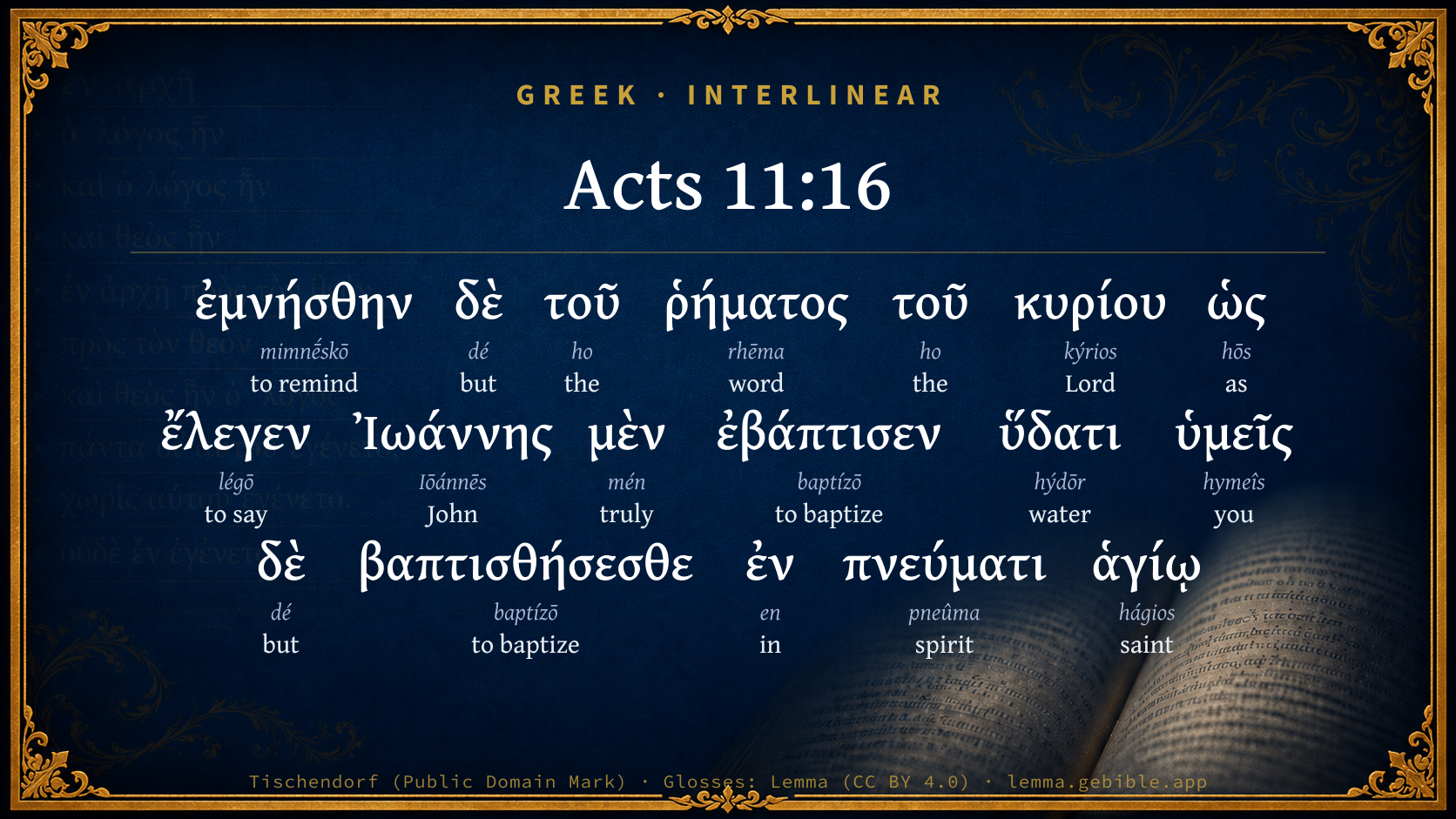
Greek (Tischendorf 8th ed.) Acts 11:16 appears in the Greek New Testament. The text above is from the Tischendorf 8th edition. Each word links to its Strong’s number and a concise gloss. Click any word for its full Thayer’s Greek Lexicon entry.
Download image
Cite this verse

Acts 11:16 (World English Bible). Public Domain. Lemma interlinear Bible study tool, https://lemma.gebible.app/v/acts/11/16.

Show BibTeX & RIS
BibTeX
RIS
English Translation
I remembered the word of the Lord, how he said, 'John indeed baptized in water, but you will be baptized in the Holy Spirit.'
World English Bible · Public Domain
Download a study sheet

One document with this verse’s original text, its word-by-word gloss line, the meaning frame, cross-references with their text, attributed commentary, and full source and license credits — printable, and it pastes into notes with its structure intact.

This verse Autodidact and up

Study sheet (.html) Plain text (.txt)

A passage Seminary Student

Up to 50 verses in one chapter. A passage sheet keeps up to 6 commentary sources and 12 cross-references per verse, in the order this page ranks them, and says so on the sheet whenever that leaves anything out. Ask for a single verse and you get the Autodidact verse sheet above.

Everything on this page stays free to read, with no account — the sheet is a download of what is already on screen, not access to it.

Want to remove ads? Support Godless Engineer
Compare translations 3

The same verse in 3 English versions, stacked beneath the original-language interlinear above. Click any original word for its lexicon entry.

Each is an independent rendering of the whole verse — the interlinear is not word-aligned to these translations.

Highlighted words mark where these versions differ — a whole-verse word diff, not a word-by-word alignment.

  • World English Bible Public Domain
    I remembered the word of the Lord, how he said, 'John indeed baptized in water, but you will be baptized in the Holy Spirit.'
  • King James Version Public Domain
    Then remembered I the word of the Lord, how that he said, John indeed baptized with water; but ye shall be baptized with the Holy Ghost.
  • unfoldingWord Literal Text CC BY-SA 4.0
    Then I remembered the word of the Lord, how he was saying, ‘John indeed baptized with water; but you will be baptized in the Holy Spirit.’

unfoldingWord Literal Text — © unfoldingWord, licensed CC BY-SA 4.0. Word-aligned USFM3 via Door43 (git.door43.org/unfoldingWord/en_ult).

Versions to compare (up to 4)

3 of 4 selected

Show all 19 translations

Every available English version of this verse, each an independent rendering of the whole verse.

  • World English Bible Public Domain
    I remembered the word of the Lord, how he said, 'John indeed baptized in water, but you will be baptized in the Holy Spirit.'
  • Berean Standard Bible Public Domain
    Then I remembered the word of the Lord, as He used to say, ‘John baptized with water, but you will be baptized with the Holy Spirit.’
  • Majority Standard Bible Public Domain
    Then I remembered the word of the Lord, how He said, ‘John baptized with water, but you will be baptized with the Holy Spirit.’
  • King James Version Public Domain
    Then remembered I the word of the Lord, how that he said, John indeed baptized with water; but ye shall be baptized with the Holy Ghost.
  • American Standard Version (1901) Public Domain
    And I remembered the word of the Lord, how he said, John indeed baptized with water; but ye shall be baptized in the Holy Spirit.
  • Revised Version (1885) Public Domain
    And I remembered the word of the Lord, how that he said, John indeed baptized with water; but ye shall be baptized with the Holy Ghost.
  • Geneva Bible (1599) Public Domain
    Then I remembred the word of the Lord, howe he said, Iohn baptized with water, but ye shalbe baptized with the holy Ghost.
  • Douay-Rheims (1899) Public Domain
    And I remembered the word of the Lord, how that he said: John indeed baptized with water, but you shall be baptized with the Holy Ghost.
  • Young's Literal Translation Public Domain
    and I remembered the saying of the Lord, how he said, John indeed did baptize with water, and ye shall be baptized with the Holy Spirit;
  • Literal Standard Version CC BY-SA 4.0
    and I remembered the saying of the LORD, how He said, John indeed immersed in water, but you will be immersed in the Holy Spirit;
  • Unlocked Literal Bible CC BY-SA 4.0
    I remembered the words of the Lord, how he said, “John indeed baptized with water; but you shall be baptized in the Holy Spirit.”
  • unfoldingWord Literal Text CC BY-SA 4.0
    Then I remembered the word of the Lord, how he was saying, ‘John indeed baptized with water; but you will be baptized in the Holy Spirit.’
  • Darby Bible Public Domain
    And I remembered the word of the Lord, how he said, John baptised with water, but *ye* shall be baptised with [the] Holy Spirit.
  • World Messianic Bible Public Domain
    I remembered the word of the Lord, how he said, ‘Yochanan indeed immersed in water, but you will be immersed in the Holy Spirit.’
  • Webster's Bible Public Domain
    Then I remembered the word of the Lord, how he said, John indeed baptized with water; but ye shall be baptized with the Holy Spirit.
  • Free Bible Version CC BY-SA 4.0
    Then I remembered what the Lord said, ‘John baptized with water, but you will be baptized with the Holy Spirit.’
  • Bible in Basic English Public Domain
    And the words of the Lord came into my mind, how he said, The baptism of John was with water, but you will have baptism with the Holy Spirit.
  • Text-Critical English NT CC BY 4.0
    Then I remembered what the Lord had said: ‘John baptized with water, but you will be baptized with the Holy Spirit.’
  • Tyndale New Testament (1534) Public Domain
    Then came to my remembraunce the wordes of the Lorde how he sayde: Iohn baptised with water but ye shalbe baptysed with the holy goost.

Literal Standard Version (2020), Covenant Press — licensed CC BY-SA 4.0. Text via the HelloAO Bible API (eBible.org). Unlocked Literal Bible (unfoldingWord) — licensed CC BY-SA 4.0. Text via the HelloAO Bible API (eBible.org). unfoldingWord Literal Text — © unfoldingWord, licensed CC BY-SA 4.0. Word-aligned USFM3 via Door43 (git.door43.org/unfoldingWord/en_ult). Free Bible Version, Dr. Jonathan Gallagher — licensed CC BY-SA 4.0. Text via the HelloAO Bible API (eBible.org).

Word by word

More ways to search: Search by grammar → Find every occurrence → Compare this word →

Practice this passage: Drill this verse → Learn its vocabulary →

ἐμνήσθην
mimnḗskō
G3403
“to remind”
Verb, Aorist, Passive, Indicative, 1st person, Singular
Part of Speech
Verb
Tense
Aorist
Voice
Passive
Mood
Indicative
Person
1st person
Number
Singular
Full Thayer's Definition

Origin: a prolonged form of G3415 (from which some of the tenses are borrowed)

TDNT: None

1. to remind a. to be recalled or to return to one's mind, to remind one's self of, to remember b. to be recalled to mind, to be remembered, had in remembrance c. to remember a thing d. be mindful of
  1. δὲ dé G1161 “but” Conjunction
  2. τοῦ ho G3588 “the” Article, Genitive, Singular, Neuter
  3. ῥήματος rhēma G4487 “word” Noun, Genitive, Singular, Neuter
  4. τοῦ ho G3588 “the” Article, Genitive, Singular, Masculine
  5. κυρίου kýrios G2962 “Lord” Noun, Genitive, Singular, Masculine
  6. ὡς hōs G5613 “as” Adverb
  7. ἔλεγεν légō G3004 “to say” Verb, Imperfect, Active, Indicative, 3rd person, Singular
  8. Ἰωάννης Iōánnēs G2491 “John” Noun, Nominative, Singular, Masculine
  9. μὲν mén G3303 “truly” Particle
  10. ἐβάπτισεν baptízō G907 “to baptize” Verb, Aorist, Active, Indicative, 3rd person, Singular
  11. ὕδατι hýdōr G5204 “water” Noun, Dative, Singular, Neuter
  12. ὑμεῖς hymeîs G5210 “you” Personal pronoun, 2nd person, Nominative, Plural
  13. δὲ dé G1161 “but” Conjunction
  14. βαπτισθήσεσθε baptízō G907 “to baptize” Verb, Future, Passive, Indicative, 2nd person, Plural
  15. ἐν en G1722 “in” Preposition
  16. πνεύματι pneûma G4151 “spirit” Noun, Dative, Singular, Neuter
  17. ἁγίῳ hágios G40 “saint” Adjective, Dative, Singular, Neuter

About this verse

These counts appear in no published source. They are computed here, from the morphology-tagged text and Lemma’s own curated glosses. What Lemma adds →

18
words
15
distinct lemmas
Acts
section

Notable vocabulary

The rarest word here is ἐμνήσθην to remind G3403 — appearing just 23 times in the whole Greek New Testament.

Shared distinctive vocabulary

ἐμνήσθην to remind G3403 occurs in 23 verses of the Greek New Testament. Also found in:

Repetition

Words recur within this verse:

  • ἐβάπτισεν to baptize G907 ×2
  • δὲ but G1161 ×2
  • τοῦ the G3588 ×2

Cross-references

19

Topical passages linked to Acts 11:16 in the Treasury of Scripture Knowledge — connected by theme and wording, ordered by reader-vote popularity; previews shown in the World English Bible.

  • Acts 1:5 For John indeed baptized in water, but you will be baptized in the Holy Spirit not many days from now."
  • Mark 1:8 I baptized you in water, but he will baptize you in the Holy Spirit."
  • Proverbs 1:23 Turn at my reproof. Behold, I will pour out my spirit on you. I will make known my words to you.
  • Matthew 3:11 I indeed baptize you in water for repentance, but he who comes after me is mightier than I, whose shoes I am not worthy to carry. He will baptize you in the Holy Spirit.
  • Luke 3:16 John answered them all, "I indeed baptize you with water, but he comes who is mightier than I, the latchet of whose sandals I am not worthy to loosen. He will baptize you in the Holy Spirit and fire,
  • John 14:26 But the Counselor, the Holy Spirit, whom the Father will send in my name, he will teach you all things, and will remind you of all that I said to you.
  • 1 Corinthians 12:13 For in one Spirit we were all baptized into one body, whether Jews or Greeks, whether bond or free; and were all given to drink into one Spirit.
  • Ezekiel 36:25 I will sprinkle clean water on you, and you shall be clean: from all your filthiness, and from all your idols, will I cleanse you.
  • Joel 2:28 "It will happen afterward, that I will pour out my Spirit on all flesh; And your sons and your daughters will prophesy. Your old men will dream dreams. Your young men will see visions.
  • Joel 3:18 It will happen in that day, That the mountains will drop down sweet wine, The hills will flow with milk, All the brooks of Judah will flow with waters; And a fountain will come forth from the house of Yahweh, And will water the valley of Shittim.
  • John 1:26 John answered them, "I baptize in water, but among you stands one whom you don't know.
  • John 1:33 I didn't recognize him, but he who sent me to baptize in water, he said to me, 'On whomever you will see the Spirit descending, and remaining on him, the same is he who baptizes in the Holy Spirit.'
  • John 16:4 But I have told you these things, so that when the time comes, you may remember that I told you about them. I didn't tell you these things from the beginning, because I was with you.
  • Acts 19:2–4 He said to them, "Did you receive the Holy Spirit when you believed?" They said to him, "No, we haven't even heard that there is a Holy Spirit."
  • Acts 20:35 In all things I gave you an example, that so laboring you ought to help the weak, and to remember the words of the Lord Jesus, that he himself said, 'It is more blessed to give than to receive.'"
  • Isaiah 44:3–5 For I will pour water on him who is thirsty, and streams on the dry ground; I will pour my Spirit on your seed, and my blessing on your offspring:
  • Luke 24:8 They remembered his words,
  • Titus 3:5–6 not by works of righteousness, which we did ourselves, but according to his mercy, he saved us, through the washing of regeneration and renewing by the Holy Spirit,
  • 2 Peter 3:1 This is now, beloved, the second letter that I have written to you; and in both of them I stir up your sincere mind by reminding you;

Cross-references courtesy of OpenBible.info (CC BY 4.0).

Commentary

Notes on Acts 11:16 from classic Christian and Jewish commentators (each source and its license shown beneath its notes). The classic Christian expositions comment on the surrounding passage and are grouped to its opening verse, so a note may address several verses; the Jewish commentaries on the Tanakh (Rashi and others) are per-verse, so they appear only where the commentator wrote on this verse.

Lemma curates 59 commentaries, every one of them public domain or Creative Commons licensed, each selected and text-cleaned for this edition rather than reprinted as found. About our sources →

Joseph Benson's Commentary

Act 11:16-18. Then remembered I the word of the Lord — This descent of the Holy Ghost on them, as on us at the beginning of our public ministry, was such an extraordinary occurrence, that I immediately called to mind, and could not but reflect on, the word of the Lord, as then remarkably verified; how he said — Just before his ascension, (Act 1:5,) Ye shall be baptized with the Holy Ghost — For this pouring forth of the Spirit upon them appeared to be a wonderful accomplishment of that prediction. Forasmuch then as God — The sovereign dispenser of his own favours; gave them the like gift as he did unto us who believed — That is, because we believed, not because we were circumcised, was the Holy Ghost given to us. What was I that I should withstand — Greek, δυνατος κωλυσαι, that I should be able to prohibit, God — From conferring such a gift upon them; or should presume to oppose myself against his wise and gracious pleasure? They had inquired only concerning his eating with the Gentiles, but he satisfies them likewise concerning his baptizing them; and shows that he had done right in going to Cornelius, not only by the command of God, but also by the event, the descent of the Holy Ghost. And who are we, that we should withstand God? — Particularly by laying down rules of Christian communion, which exclude any whom he has admitted into the church of the firstborn, from worshipping God together. O that all church governors would consider how bold a usurpation this is on the authority of the supreme Lord of the church! O that the sin of thus withstanding God may not be laid to the charge of those who, perhaps with a good intention, but in an over-fondness for their own forms, have done it, and are continually doing it! When they heard these things, they held their peace — Being thoroughly satisfied for the present, till the controversy was renewed by some fierce zealots, Act 15:1-5; and glorified God — For so wonderful a manifestation of his grace; saying, Then hath God also to the Gentiles — The poor, ignorant, uncircumcised, despised, idolatrous Gentiles; granted repentance unto life — Has not only made them overtures of it, but has graciously wrought it in some of their hearts. Here, it is plain, they speak of those to whom this repentance was granted, as persons who before, according to their apprehension, were in a state of spiritual death; in which condition, it is probable, they had thought all uncircumcised persons to be: and, without doubt, they must mean to include the idolatrous Gentiles among the rest, as those who were most evidently and certainly so. Observe, reader, true repentance is a change from spiritual death to spiritual life, and leads to life everlasting.

Joseph Benson's Commentary on the Old and New Testaments (1811–1818) — public domain. Text from a community e-Sword module.

Bengel's Gnomon

Johann Albrecht Bengel

Act 11:16. Ἐμνήσθην, I remembered) Comp. Joh 14:26, as to the Paraclete being about to bring all things to the remembrance of the disciples. In the words of Christ there were the seeds of the whole course of the Gospel.

Bengel's Gnomon of the New Testament — English translation (T&T Clark, Edinburgh, 1860) — public domain. Text from a community e-Sword module.

Expositor's Greek Testament

ed. W. Robertson Nicoll

Act 11:16 . Words not found in the Gospels, but in Act 1:5 , quoted here with the omission of οὐ μετὰ πολλὰς ταύτας ἡμέρας , showing that St. Peter regarded the baptism of the Holy Ghost received by Cornelius as equally decisive of the Spirit’s presence as the bestowal upon himself and others at Pentecost. ὡς ἔλεγεν : not merely pleonastic, cf. Luk 22:61 ; Winer-Moulton, lxv., 1 a , Wendt, Felten.

The Expositor's Greek Testament, edited by W. Robertson Nicoll (1897–1910) — public domain. Text from a community e-Sword module.

Jamieson, Fausset & Brown

Robert Jamieson, A. R. Fausset & David Brown

Then remembered I the word . . . John . . . baptized with water; but ye shall be baptized with the Holy Ghost. Forasmuch then, &c.--that is, "Since God Himself has put them on a level with ourselves, by bestowing on them what the Lord Jesus pronounced the higher baptism of the Holy Ghost, would it not have been to withstand God if I had withheld from them the lower baptism of water, and kept aloof from them as still 'unclean?'"

Jamieson, Fausset & Brown — Commentary Critical and Explanatory on the Whole Bible (1871) — public domain (CC PDM 1.0). Text via the HelloAO Bible API.

Adam Clarke's Commentary

Verse 16. Ye shall be baptized with the Holy Ghost.] These words are very remarkable. The words of our Lord, as quoted Ac 1:5, to which St. Peter refers here, have been supposed by many to be referred to the apostles alone; but here it is evident that St. Peter believed they were a promise made to all Christians, i.e. to all, whether Jews or Gentiles, who should believe on Jesus Christ. Therefore, when he saw that the Holy Ghost fell upon those Gentiles, he considered it a fulfilment of our Lord's promise: ye, that is, all that will believe on me, shall be baptized with the Holy Ghost-not many days hence, i.e. in a short time this Spirit shall be given, which is to abide with you for ever. Hence we learn that the promise of the Holy Spirit is given to the whole body of Christians-to all that believe on Christ as dying for their sins, and rising for their justification.

Adam Clarke's Commentary on the Bible (1810–1826) — public domain. Text from a community e-Sword/MySword module.

John Calvin's Commentaries

16. I remembered the word of the Lord. We have sufficiently declared in the first chapter, that when Christ uttered that sentence, he did not make a comparison between two baptisms; but that he intended to declare what difference there was between him and John, (Acts 1:5.) For, as we distinguish the sign from his [its] truth, so it is good to distinguish the minister from the author, lest mortal man challenge that which is proper to God. Man hath the sign in his hand; it is Christ alone which watereth and regenerateth. For it skilleth much whither men’s minds be directed in seeking the graces of God, because they shall not receive one drop without Christ. Therefore, there is this general difference between Christ and all the ministers of the Church, because they give the external sign of water, but he fulfilleth and performeth the effect of the sign by the power of his Spirit. The readers were to be admonished of this thing again in this place, because many do falsely infer that John’s baptism and ours are not all one, whilst that Christ, challenging to himself the Spirit, doth leave nothing for John save water alone.

But if any man trusting to this testimony do make baptism a cold spectacle, and void of all grace of the Spirit, he shall be also greatly deceived. For the Holy Scripture useth to speak two manner of ways of the sacraments. For because Christ is not unfaithful in his promises, he doth not suffer that to be vain which he doth institute; but when as the Scripture doth attribute to baptism strength to wash and regenerate, it ascribeth all this to Christ, and doth only teach what he worketh by his Spirit by the hand of man and the visible sign. Where Christ is thus joined with the minister, and the efficacy of the Spirit with the sign, there is so much attributed to the sacraments as is needful, (Titus 3:5;) but that conjunction must not be so confused, but that men’s minds, being drawn from mortal and frail things, and things like to themselves, and from the elements of the world, they must learn to seek for salvation at Christ’s hand, and to look unto the power of his Spirit alone; because he misseth the mark of faith, whosoever turneth aside even but a little from the Spirit unto the signs; and he is a sacrilegious person who taketh even but an inch of Christ’s praise, that be may deck man therewith. And we must also remember that Christ did comprehend under the word Spirit, not only the gift of tongues, and such like things, but all the whole grace of our renewing; but because these gifts were an excellent argument of Christ’s power, this sentence may well be applied unto them. I will make this more plain; seeing that Christ did bestow upon the apostles the visible graces of the Spirit, he did plainly declare that the Spirit was in his hand; so that by this means he did testify, that he is the alone author of cleanness, righteousness, and of the whole regeneration. And Peter applieth it unto his purpose thus, that forasmuch as Christ did go before, carrying with him the force of baptism, it became him to follow with the addition, that is, the outward sign of water.

John Calvin's Commentaries (1540-1563) — public domain. Text from the Calvin Translation Society English edition (1840s-50s) via the Christian Classics Ethereal Library (ccel.org). Calvin's coverage is partial (roughly two-thirds of the Bible); uncommented books and verses are honest gaps, never fabricated. The 19th-century editor's footnotes and remarks are omitted so the notes are faithfully Calvin's own voice.

Ellicott's Commentary for English Readers

(16) Then remembered I the word of the Lord.—The special promise referred to was that recorded in Act_1:5. Then it had seemed to refer only to the disciples, and the Day of Pentecost had appeared to bring a complete fulfilment of it. Now Peter had learnt to see that it had a wider range, that the gift might be bestowed on those who were not of Israel, and who were not called to come outwardly within the covenant of Israel. If the baptism of the Holy Ghost had been thus given to them it implied, as the greater includes the less, that they were admissible to the baptism of water.

A Bible Commentary for English Readers, edited by Charles John Ellicott (1878–1897) — public domain. Text from a community e-Sword module.

The Cambridge Bible for Schools and Colleges

gen. ed. J. J. S. Perowne

16. the word of the Lord] Recorded above, Act_1:5.

The Cambridge Bible for Schools and Colleges (gen. ed. J. J. S. Perowne; Cambridge University Press, 1878–1918) — public domain. Text from a community e-Sword module.

John Gill's Exposition

Forasmuch then as God gave them the like gift,.... Of the Spirit, of speaking with divers tongues:

as he did unto us; the apostles: who believed on the Lord Jesus Christ: which clause stands either connected with "us" the apostles, and so is descriptive of them who first believed in Christ, and became followers of him; or with "them" the Gentiles, as the Syriac version renders it, "if therefore God gave that gift equally to these Gentiles which believed on our Lord Jesus Christ, as unto us"; for it seems most likely, that faith in Christ came by hearing Peter's discourse, before the extraordinary gifts of the Spirit fell upon them:

what was I that I could withstand God? or hinder the baptism of these persons in water, whom God baptized with the Holy Ghost, and who believed in Christ Jesus: from whence it appears that the Spirit of God is a gift, which he bestows on whomsoever he pleases, without any desert of man's, and that both in his extraordinary operations, and in the common influences of his grace; for it is equally the gift of God to believe in Christ, which is a grace of the Spirit, as it was to speak with divers tongues; and these, though they did not always go together, yet here they did, as on the apostles, so on Cornelius and his house: and hence they became qualified for the ordinance of baptism; not by the extraordinary gifts of the Spirit, but by his special grace; the extraordinary gifts were partly to confirm the Gospel preached unto them by Peter; and partly to assure him that he was right in going in to the Gentiles, and preaching to them; and to encourage him to baptize these persons who appeared to have also the grace of the Spirit, and to have believed in Christ; as well as to fit them, at least some of them, for public work and service: and now faith in Christ being a pre-requisite to baptism, and it being the will of Christ, and what he gave in commission to his disciples to baptize such as believed in him, and these being apparently such; to have refused to administer baptism to them, would have been acting contrary to the commission of Christ, a withstanding the will of God, and opposing the grace of the Spirit of God.

John Gill's Exposition of the Whole Bible (1746–1763) — public domain (CC PDM 1.0). Text via the HelloAO Bible API.

Trapp's Complete Commentary

John Trapp

6 Upon the which when I had fastened mine eyes, I considered, and saw fourfooted beasts of the earth, and wild beasts, and creeping things, and fowls of the air.

7 And I heard a voice saying unto me, Arise, Peter; slay and eat.

8 But I said, Not so, Lord: for nothing common or unclean hath at any time entered into my mouth.

9 But the voice answered me again from heaven, What God hath cleansed, that call not thou common.

10 And this was done three times: and all were drawn up again into heaven.

11 And, behold, immediately there were three men already come unto the house where I was, sent from Caesarea unto me.

12 And the Spirit bade me go with them, nothing doubting. Moreover these six brethren accompanied me, and we entered into the man’s house:

13 And he shewed us how he had seen an angel in his house, which stood and said unto him, Send men to Joppa, and call for Simon, whose surname is Peter;

14 Who shall tell thee words, whereby thou and all thy house shall be saved.

15 And as I began to speak, the Holy Ghost fell on them, as on us at the beginning.

16 Then remembered I the word of the Lord, how that he said, John indeed baptized with water; but ye shall be baptized with the Holy Ghost.

Ver. 16. Then remembered I] Very seasonably; the Holy Spirit suggesting, as a remembrancer; like as the evil spirit did to those cankered kill-Christs, Mat 27:63.

John Trapp, A Commentary or Exposition upon All the Books of the Old and New Testament (1647–1656) — public domain. Text from a community e-Sword module.

Albert Barnes' Notes on the Bible

The word of the Lord - See the notes on Act 1:5.

Albert Barnes' Notes on the Bible (1834–1885) — public domain. Text from a community e-Sword/MySword module.

Matthew Poole's English Annotations

Of the Lord; of Christ, who is every where so called.

He said; but these words seem rather spoken by St. John himself. Mat 3:11; Mar 1:8; which makes no difference; for, first, Whatsoever a disciple of Christ says in his name, it is as if it were spoken by himself:

He that heareth not, heareth me. But, secondly, Though this was spoken by the Baptist, it was spoken by our Saviour also, Act 1:5.

John indeed baptized with water; but ye shall be baptized with the Holy Ghost; by which the great difference is implied between outward baptism (administered by whomsoever, though the Baptist himself) and the inward baptism of the Holy Ghost, which, as fire, separates powerfully the scum and dross of sin from us.

With the Holy Ghost; the extraordinary gifts of the Spirit.

Matthew Poole's English Annotations on the Holy Bible (1683–1685) — public domain. Text from a community e-Sword/MySword module.

Whedon's Commentary on the Bible

Daniel D. Whedon

16. Then remembered I—With a fuller realization than ever before.

Baptized… water… Holy Ghost—This text fully proves that baptism with the Spirit is not figurative, but literal. The Spirit is as true and a far more real substance and nature than water. The water is the shadow, the figure, the picture, of which the Spirit is the original. And the picture must conform to the original. The outpouring of the Spirit must be shadowed by the outpouring of water. Immersion is no figure of such an original.

Daniel D. Whedon (gen. ed.), Commentary on the Old and New Testaments (1874–1909) — public domain. Text from a community e-Sword module.

The Pulpit Commentary

And I remembered for then remembered I, A.V. This is a new incident not mentioned in Acts 10. The reference is to Act_1:5. This saying of the Lord being thus referred to by Peter looks as if Peter might have furnished many of the particulars in the first twelve chapters to Luke.

Well-stored memories.

A topic suggested by the expression of St. Peter, "Then remembered I the word of the Lord." Some explanation may be given of "memory" as a distinct mental faculty, but the one on which the acquisition and increase of knowledge greatly depend. A faculty capable of culture, bat taking different features in different individuals. Some have verbal memories, others memory for principles. Some have trained memories in particular subjects, but little power to retain general knowledge. Formal aids to memory are suggested, but its true culture lies in its use. As a mental faculty, it comes under Christian sanctifying, as well as into Christian use.

In ordinary education attention is paid to the training of this power, and in the Divine culture attention to it is equally needed. It may even be said of our Lord"s preparation of his apostles for their work, that he stored their memories with his words and his works, so that there might be the material on which the Holy Spirit could hereafter work," bringing all things up into remembrance" on fitting occasions. Consider

I STORING MEMORIES. Illustrate what anxious work this is to the parent, the school teacher, and the professor. Due effort is made to ensure

(1) adequate stores;

(2) well-arranged stores;

(3) clearly apprehended stores;

(4) moral stores.

Two things are found necessary to the holding of things in memory

(1) they must be clearly apprehended;

(2) they must be sufficiently repeated.

It is found that we hold things in measures of safety dependent on the amount of attention which we have given to them. Apply these principles to the storing of our memories with religious facts and principles; dwelling on the importance of requiring the young to learn the Scriptures, of demanding from our Christian teachers clearness of statement and efficient repetition; showing that, as in St. Peter"s case, a man only has the right truth or principle at command, on occasions of need, if these have previously been lodged in the memory. The skill with which our Lord, in his time of temptation, fetched the right weapons from the Scripture armory with which to defeat and silence his foe, reveals to us the fact that his memory had been well stored with Scripture during his childhood and youth. The duty of seeing that our own mind is well furnished, and that the minds of those directly under our influence are well furnished, with Scripture facts and truths and principles, should be earnestly pressed. We can do no better service to the young than to fill up their thoughts and hearts with "thoughts of Christ and things Divine.

II KEEPING MEMORY-STORES. There is one great law which applies to the efficient retention of any kind of knowledge we may have. It is that we keep adding more stores of the same kind. We virtually lose out of memory facts relating to botany or astronomy unless we keep on adding to them new botanical or astronomical facts. And the same law applies to religious things they will fade down and seem to die out of memory unless we constantly add to them. We retain by increasing. Show how this should be a powerful motive urging us to keep up our daily soul-culture, our reading of the Word, our meditations in the Divine truth, our attendance on the means of grace. We cannot keep what we have unless we set ourselves in the way to get more.

III USING MEMORY-STORES. Just this St. Peter does in connection with our text. Something occurred which suggested a sentence his Lord had once employed. He hardly knew that he had put it among his memory-stores, but he had been attentive to every word that fell from his Master"s lips, and they came up before him at the moment when he could use them wisely. We often think that there must be much more in our memories than can ever be of service to us, and we even think that it is useless to teach the young so much of Scripture and of Catechism and of hymns. But no man can foretell what situations unfolding life may make for him, or what moral demands it will present. Take any life, and it will be found full of surprises, and it is a very great thing to ensure that we are reasonably prepared for all possible situations. St. Peter could not have imagined himself in the house of Cornelius and set upon using that particular sentence. So we shall find, as life progresses, that

(1) occasions come for the use of our memory-stores;

(2) circumstances help to recall them; and

(3) God"s Spirit brings them up before us, and aids us in finding their proper application and use.

The well-furnished godly memory is no accident. It is a part of the Christian culture, and therefore, for ourselves and for those on whom we are called to exert our influence, we come under solemn and weighty responsibilities. An interesting illustration of the use of a godly memory in time of pressure and need is found in Ezr_8:21-23, where Ezra"s remembrance of God"s promises to and gracious ways with his people in the olden time, gave him strength for an arduous and perilous undertaking. R.T.

The Pulpit Commentary (1880–1919), ed. H.D.M. Spence-Jones & Joseph S. Exell — public domain. Text from a community e-Sword module.

Kretzmann's Popular Commentary

Paul E. Kretzmann

The conclusion of Peter:

v. 16. Then remembered I the word of the Lord how that He said, John indeed baptized with water, but ye shall be baptized with the Holy Ghost.

v. 17. Forasmuch, then, as God gave them the like gift as He did unto us, who believed on the Lord Jesus Christ, what was I that I could withstand God?

v. 18. When they heard these things, they held their peace, and glorified God, saying, Then hath God also to the Gentiles granted repentance unto life.

Peter himself, as he here reminds his critics, had had serious scruples about the entire matter; but the succession of events could not have been the result of chance happening. And his last doubts were removed as he, at the great climax, beheld the working of the Holy Ghost in just the same way as he himself had experienced it on the great Pentecost. He had remembered the word of the Lord, the saying in which He had given the promise: John indeed baptized with water, but ye shall be baptized with the Holy Ghost, chap. 1:5. Peter does not selfishly limit this promise to the inner circle of the disciples, nor to the Jews alone, but wants it applied now wherever the evidence shows it as finding its application. Since God now gave the very same gift to them as He had given to the apostles, not on the basis of circumcision or uncircumcision, but on the basis of faith in the Lord Jesus Christ, who was Peter and how could he have summoned power to hinder God? How would he have been able to withstand God, even if he had persisted in his scruples and doubts? It is the living God that directs and governs His Christian Church, showing the way in which His servants should walk. He Himself makes a pathway for His Word, that it may grow and bear fruit in abundance. And this fact the Christians at Jerusalem were now obliged to acknowledge. They held their peace, they were quiet and satisfied; they had no more objections to offer. They were rather constrained to give continuous glory and praise to God in confessing: So, then, also to the Gentiles God has granted repentance unto life. So the critics not only tacitly withdrew all that they had said in reproach of Peter, but also proclaimed the praises of God with enthusiasm. They were satisfied at once, and they continued their thanks and praises to God. Repentance, followed by faith in Christ, is the way to eternal life, God’s free gift. And all Christians will properly rejoice if God grants many sinners repentance unto life. It is unfortunate that this happy state of affairs did not continue, Act 15:5.

Paul E. Kretzmann, Popular Commentary of the Bible (1921–1924) — public domain. Text from a community e-Sword module.

McGarvey & Pendleton's Commentaries

J. W. McGarvey

See notes one verse 4

J. W. McGarvey (with Philip Y. Pendleton), Commentaries on the New Testament (The Fourfold Gospel, 1914; Acts; and the epistles) — public domain. Text from a community e-Sword/MySword module.

Cambridge Greek Testament for Schools and Colleges

16. τοῦ ῥήματος τοῦ κυρίου, the word of the Lord; recorded above Act 1:5. The ὡς ἔλεγεν which follows is inserted to introduce the exact words of Christ.

Cambridge Greek Testament for Schools and Colleges (Cambridge University Press, 1896; 21 vols, various authors incl. Carr, Maclear, Plummer, Farrar, Lumby, Moule, M. R. James, Simcox) — public domain. Text from a community e-Sword module.

Alford’s Greek Testament

Henry Alford

16.] ch. 1:5. This prophecy of the Lord was spoken to his assembled followers, and promised to them that baptism which was the completion and aim of the inferior baptism by water administered to them by John. Now, God had Himself, by pouring out on the Gentiles the Holy Spirit, included them in the number of these ὑμεῖς, and pronounced them to be members of the church of believers in Christ, and partakers of the Holy Ghost, the end of baptism. This (in all its blessed consequences, = the gift of μετάνοια, εἰς ζωήν, see on ver. 18) was (ver. 17) the ἴση δωρεά bestowed on them: and, this having been bestowed,—to refuse the symbolic and subordinate ordinance,—or to regard them any longer as strangers from the covenant of promise, would have been, so far as in him lay, κωλῦσαι τὸν θεόν.

Henry Alford, The Greek Testament (1849–1861) — public domain. Text from a community e-Sword module.

Lesson kit

Teaching starters — assembled from the data on this page, not authored interpretation. Every prompt links to the verse data it draws on. Edit before teaching.

Acts, in the Acts, opens this verse with 18 words (15 distinct Greek lemmas). Its most distinctive word is mimnḗskō (“to remind”). A historical commentator’s framing appears above. Read the whole chapter for the surrounding context.

Discussion questions

  1. How does “to remind” (mimnḗskō) shape what this verse is saying?
  2. Matthew 5:23 shares the word «to remind» with this verse. How do the two illuminate each other?
  3. “to baptize” occurs 2× in this one verse. What is the effect of the repetition?
  4. These translations render this verse differently; the difference is in the English rendering, not the original. What questions does that raise?
  5. Reading how Joseph Benson's Commentary and Bengel's Gnomon read this verse, where do the two commentators agree and where do they part?

Things to notice

  • These translations choose different wording for 7 words in this verse.
  • “to baptize” occurs 2× in this single verse.
  • 15 distinct Greek lemmas span 18 words in this verse.

Reading settings

Reading text

Shown beneath each verse's original-language words.

Old Testament
Old Testament edition

Read the OT as the Masoretic Hebrew (MT) or the Greek Septuagint (LXX).

English shown for the Greek Septuagint (in the Hebrew ↔ Greek comparison).

Comparing translations? Open the Compare panel on any verse page to stack up to four side by side.