John 20:22

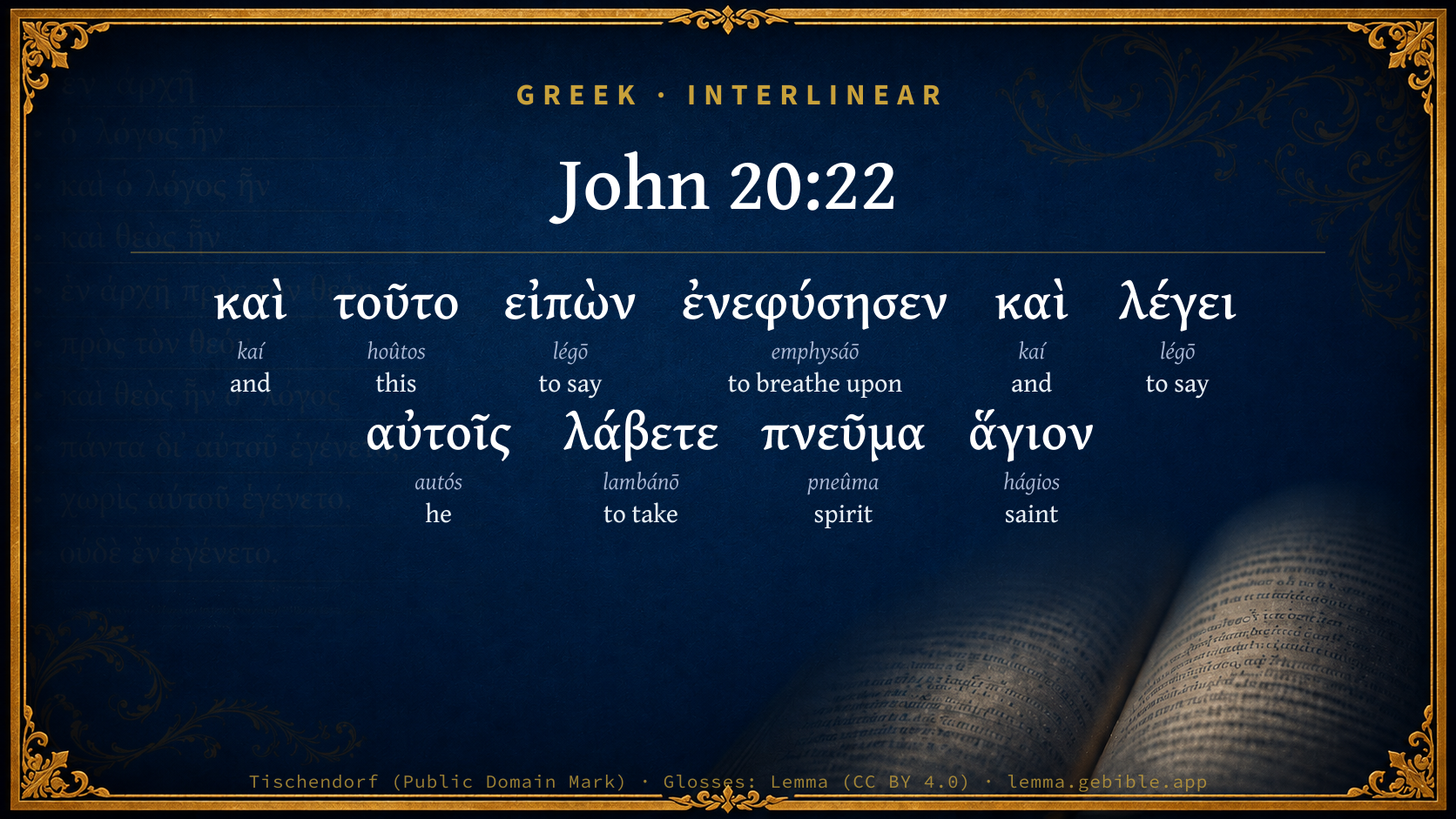
Greek (Tischendorf 8th ed.) John 20:22 appears in the Greek New Testament. The text above is from the Tischendorf 8th edition. Each word links to its Strong’s number and a concise gloss. Click any word for its full Thayer’s Greek Lexicon entry.
Download image
Cite this verse

John 20:22 (World English Bible). Public Domain. Lemma interlinear Bible study tool, https://lemma.gebible.app/v/john/20/22.

Show BibTeX & RIS
BibTeX
RIS
English Translation
When he had said this, he breathed on them, and said to them, "Receive the Holy Spirit!
World English Bible · Public Domain
Highlights
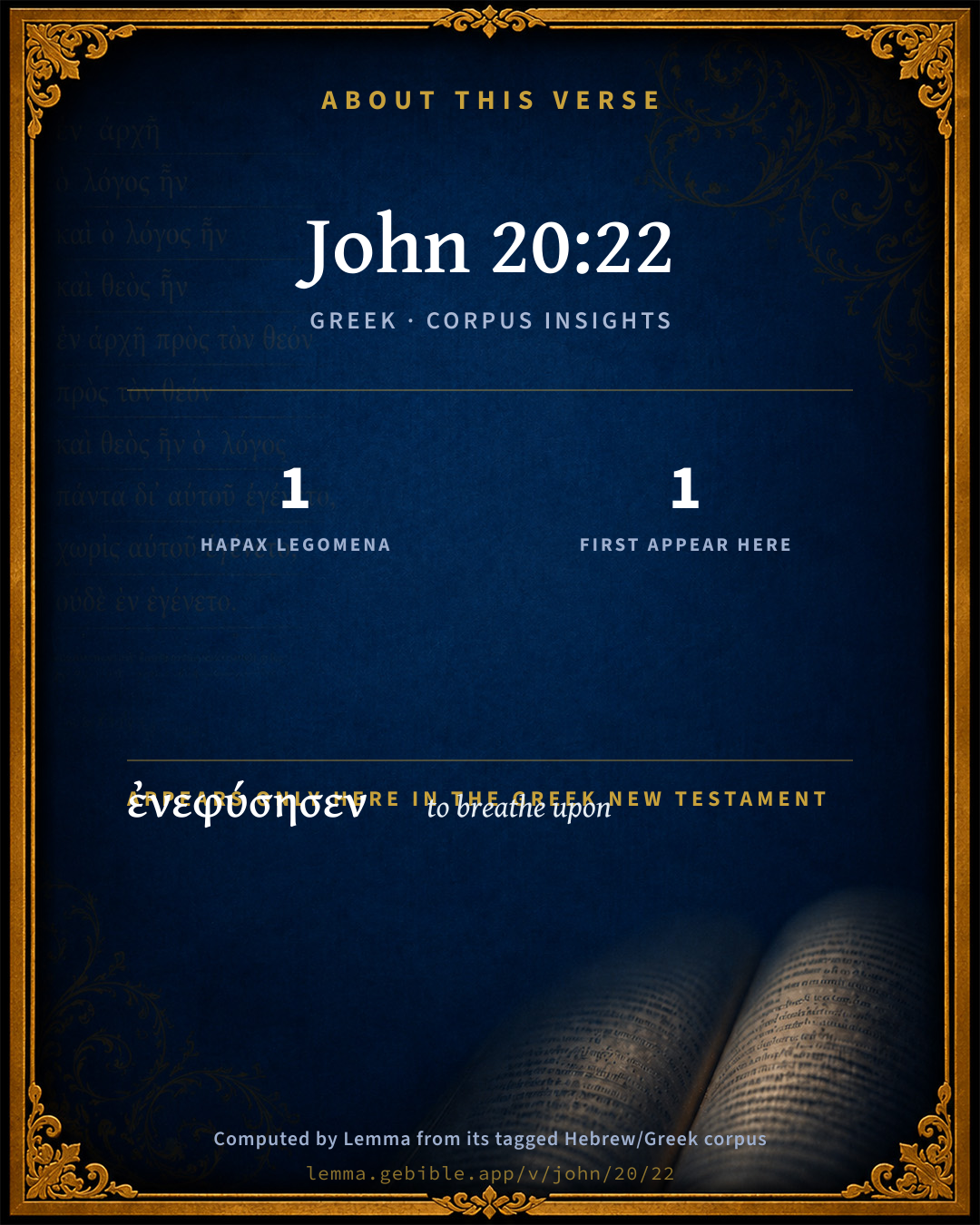
  • 1 hapax legomenon — only here in the Greek New Testament
  • 1 first appearance in the Greek New Testament
Full analysis ↓
Download a study sheet

One document with this verse’s original text, its word-by-word gloss line, the meaning frame, cross-references with their text, attributed commentary, and full source and license credits — printable, and it pastes into notes with its structure intact.

This verse Autodidact and up

Study sheet (.html) Plain text (.txt)

A passage Seminary Student

Up to 50 verses in one chapter. A passage sheet keeps up to 6 commentary sources and 12 cross-references per verse, in the order this page ranks them, and says so on the sheet whenever that leaves anything out. Ask for a single verse and you get the Autodidact verse sheet above.

Everything on this page stays free to read, with no account — the sheet is a download of what is already on screen, not access to it.

Want to remove ads? Support Godless Engineer
Compare translations 3

The same verse in 3 English versions, stacked beneath the original-language interlinear above. Click any original word for its lexicon entry.

Each is an independent rendering of the whole verse — the interlinear is not word-aligned to these translations.

Highlighted words mark where these versions differ — a whole-verse word diff, not a word-by-word alignment.

  • World English Bible Public Domain
    When he had said this, he breathed on them, and said to them, "Receive the Holy Spirit!
  • King James Version Public Domain
    And when he had said this, he breathed on them, and saith unto them, Receive ye the Holy Ghost:
  • unfoldingWord Literal Text CC BY-SA 4.0
    And having said this, he breathed on and says to them, “Receive the Holy Spirit.

unfoldingWord Literal Text — © unfoldingWord, licensed CC BY-SA 4.0. Word-aligned USFM3 via Door43 (git.door43.org/unfoldingWord/en_ult).

Versions to compare (up to 4)

3 of 4 selected

Show all 19 translations

Every available English version of this verse, each an independent rendering of the whole verse.

  • World English Bible Public Domain
    When he had said this, he breathed on them, and said to them, "Receive the Holy Spirit!
  • Berean Standard Bible Public Domain
    When He had said this, He breathed on them and said, “Receive the Holy Spirit.
  • Majority Standard Bible Public Domain
    When He had said this, He breathed on them and said, “Receive the Holy Spirit.
  • King James Version Public Domain
    And when he had said this, he breathed on them, and saith unto them, Receive ye the Holy Ghost:
  • American Standard Version (1901) Public Domain
    And when he had said this, he breathed on them, and saith unto them, Receive ye the Holy Spirit:
  • Revised Version (1885) Public Domain
    And when he had said this, he breathed on them, and saith unto them, Receive ye the Holy Ghost:
  • Geneva Bible (1599) Public Domain
    And when he had saide that, he breathed on them, and saide vnto them, Receiue the holy Ghost.
  • Douay-Rheims (1899) Public Domain
    When he had said this, he breathed on them; and he said to them: Receive ye the Holy Ghost.
  • Young's Literal Translation Public Domain
    and this having said, he breathed on `them', and saith to them, `Receive the Holy Spirit;
  • Literal Standard Version CC BY-SA 4.0
    having said this, He breathed on [them], and says to them, “Receive the Holy Spirit;
  • Unlocked Literal Bible CC BY-SA 4.0
    When Jesus had said this, he breathed on them and said to them, “Receive the Holy Spirit.
  • unfoldingWord Literal Text CC BY-SA 4.0
    And having said this, he breathed on and says to them, “Receive the Holy Spirit.
  • Darby Bible Public Domain
    And having said this, he breathed into [them], and says to them, Receive [the] Holy Spirit:
  • World Messianic Bible Public Domain
    When he had said this, he breathed on them, and said to them, “Receive the Holy Spirit!
  • Webster's Bible Public Domain
    And when he had said this, he breathed on them, and saith to them, Receive ye the Holy Spirit.
  • Free Bible Version CC BY-SA 4.0
    Saying this, he breathed on them, and told them, “Receive the Holy Spirit.
  • Bible in Basic English Public Domain
    And when he had said this, breathing on them, he said to them, Let the Holy Spirit come on you:
  • Text-Critical English NT CC BY 4.0
    After saying this, he breathed on them and said to them, “Receive the Holy Spirit.
  • Tyndale New Testament (1534) Public Domain
    And when he had sayde that he brethed on them and sayde vnto the: Receave the holy goost.

Literal Standard Version (2020), Covenant Press — licensed CC BY-SA 4.0. Text via the HelloAO Bible API (eBible.org). Unlocked Literal Bible (unfoldingWord) — licensed CC BY-SA 4.0. Text via the HelloAO Bible API (eBible.org). unfoldingWord Literal Text — © unfoldingWord, licensed CC BY-SA 4.0. Word-aligned USFM3 via Door43 (git.door43.org/unfoldingWord/en_ult). Free Bible Version, Dr. Jonathan Gallagher — licensed CC BY-SA 4.0. Text via the HelloAO Bible API (eBible.org).

Word by word

More ways to search: Search by grammar → Find every occurrence → Compare this word →

Practice this passage: Drill this verse → Learn its vocabulary →

ἐνεφύσησεν
emphysáō
G1720
“to breathe upon”
Verb, Aorist, Active, Indicative, 3rd person, Singular
Part of Speech
Verb
Tense
Aorist
Voice
Active
Mood
Indicative
Person
3rd person
Number
Singular
Full Thayer's Definition

Origin: from G1722 and phusao (to puff) [cf G5453 ]

TDNT: 10:56,2

1. to blow or breathe upon This word used only once by the LXX translators in Gen 2:7 where Godbreathed on Adam and he became a living soul. Just as the originalcreation was completed by an act of God, so to the new creation wascompleted by an act from the Head of the new creation. (AWP Jo 20:22 )
  1. καὶ kaí G2532 “and” Conjunction
  2. τοῦτο hoûtos G3778 “this” Demonstrative pronoun, Accusative, Singular, Neuter
  3. εἰπὼν légō G3004 “to say” Verb, Aorist, Active, Participle, Nominative, Singular, Masculine
  4. καὶ kaí G2532 “and” Conjunction
  5. λέγει légō G3004 “to say” Verb, Present, Active, Indicative, 3rd person, Singular
  6. αὐτοῖς autós G846 “he” Personal pronoun, Dative, Plural, Masculine
  7. λάβετε lambánō G2983 “to take” Verb, Aorist, Active, Imperative, 2nd person, Plural
  8. πνεῦμα pneûma G4151 “spirit” Noun, Accusative, Singular, Neuter
  9. ἅγιον hágios G40 “saint” Adjective, Accusative, Singular, Neuter

About this verse

These counts appear in no published source. They are computed here, from the morphology-tagged text and Lemma’s own curated glosses. What Lemma adds →

10
words
8
distinct lemmas
Gospels
section

Notable vocabulary

1 hapax legomenon — a word that appears only here in the entire Greek New Testament:

  • ἐνεφύσησεν to breathe upon G1720

First appearance in Scripture

This word makes its first canonical appearance in the Greek New Testament here:

  • ἐνεφύσησεν to breathe upon G1720

Repetition

Words recur within this verse:

  • εἰπὼν to say G3004 ×2
  • καὶ and G2532 ×2

Cross-references

15

Topical passages linked to John 20:22 in the Treasury of Scripture Knowledge — connected by theme and wording, ordered by reader-vote popularity; previews shown in the World English Bible.

  • Job 33:4 The Spirit of God has made me, And the breath of the Almighty gives me life.
  • Genesis 2:7 Yahweh God formed man from the dust of the ground, and breathed into his nostrils the breath of life; and man became a living soul.
  • John 7:39 But he said this about the Spirit, which those believing in him were to receive. For the Holy Spirit was not yet given, because Jesus wasn't yet glorified.
  • Acts 2:38 Peter said to them, "Repent, and be baptized, everyone of you, in the name of Jesus Christ for the forgiveness of sins, and you will receive the gift of the Holy Spirit.
  • Acts 8:15 who, when they had come down, prayed for them, that they might receive the Holy Spirit;
  • Psalms 33:6 By Yahweh's word the heavens were made; All their host by the breath of his mouth.
  • Ezekiel 37:9 Then said he to me, Prophesy to the wind, prophesy, son of man, and tell the wind, Thus says the Lord Yahweh: Come from the four winds, breath, and breathe on these slain, that they may live.
  • Acts 19:2 He said to them, "Did you receive the Holy Spirit when you believed?" They said to him, "No, we haven't even heard that there is a Holy Spirit."
  • Acts 4:8 Then Peter, filled with the Holy Spirit, said to them, "You rulers of the people, and elders of Israel,
  • John 14:16 I will pray to the Father, and he will give you another Counselor, that he may be with you forever,--
  • Acts 2:4 They were all filled with the Holy Spirit, and began to speak with other languages, as the Spirit gave them the ability to speak.
  • John 15:26 "When the Counselor has come, whom I will send to you from the Father, the Spirit of truth, who proceeds from the Father, he will testify about me.
  • Acts 10:47 "Can any man forbid the water, that these who have received the Holy Spirit as well as we should not be baptized?"
  • Galatians 3:2 I just want to learn this from you. Did you receive the Spirit by the works of the law, or by hearing of faith?
  • John 16:7 Nevertheless I tell you the truth: It is to your advantage that I go away, for if I don't go away, the Counselor won't come to you. But if I go, I will send him to you.

Cross-references courtesy of OpenBible.info (CC BY 4.0).

Commentary

Notes on John 20:22 from classic Christian and Jewish commentators (each source and its license shown beneath its notes). The classic Christian expositions comment on the surrounding passage and are grouped to its opening verse, so a note may address several verses; the Jewish commentaries on the Tanakh (Rashi and others) are per-verse, so they appear only where the commentator wrote on this verse.

Lemma curates 59 commentaries, every one of them public domain or Creative Commons licensed, each selected and text-cleaned for this edition rather than reprinted as found. About our sources →

Tyndale Open Study Notes

Tyndale Open Resources

20:22 Jesus commissioned the disciples and then empowered them with the Holy Spirit. The Spirit had not been given previously because Jesus had not yet been glorified (7:39). The glorified Jesus, resplendent in his resurrected body, poured the Spirit on his followers. This gift fulfilled many promises that the Spirit would be sent (14:16, 26; 15:26; 16:7, 13). It foreshadows the arrival of the Spirit’s empowering presence at Pentecost (Acts 1:4-5; 2:1-47).

Tyndale Open Study Notes — © Tyndale Open Resources, licensed CC BY-SA 4.0. Text via the HelloAO Bible API.

Bengel's Gnomon

Johann Albrecht Bengel

Joh 20:22. Καὶ) and forthwith.—ἐνεφύσησε, He breathed upon them) infusing into them a new vigour of life. This was more removed from them, than had he kissed them, and yet it was altogether efficacious. After His resurrection He did not touch mortals, although He allowed His disciples to handle His person. So Eze 37:9, ἐλθὲ τὸ πνεῦμα, καὶ ἐμφύσησον εἰς τοὺς νεκροὺς τούτους, καὶ ζησάτωσαν, “Come thou breath, and breathe upon these dead, and let them live.—καὶ λέγει, and He saith) Even as ye receive the breath (afflatus) from My mouth, saith He, so from My fulness, receive ye the Holy Spirit. [Which no doubt they had had previously: but which they received afterwards in larger measure. The breathing upon them in this place stands midway between both bestowals of the Spirit.—V. g.]—πνεῦμα ἅγιον, the Holy Spirit) under Whose guidance ye may discharge the duties of your mission: Act 13:9, “Saul (who also is Paul) filled with the Holy Ghost.” This was an earnest of Pentecost.

Bengel's Gnomon of the New Testament — English translation (T&T Clark, Edinburgh, 1860) — public domain. Text from a community e-Sword module.

Jamieson, Fausset & Brown

Robert Jamieson, A. R. Fausset & David Brown

he breathed on them--a symbolical conveyance to them of the Spirit.

and saith, Receive ye the Holy Ghost--an earnest and first-fruits of the more copious Pentecostal effusion.

Jamieson, Fausset & Brown — Commentary Critical and Explanatory on the Whole Bible (1871) — public domain (CC PDM 1.0). Text via the HelloAO Bible API.

Adam Clarke's Commentary

Verse 22. He breathed on them] Intimating, by this, that they were to be made new men, in order to be properly qualified for the work to which he had called them; for in this breathing he evidently alluded to the first creation of man, when God breathed into him the breath of lives, and he became a living soul: the breath or Spirit of God (רוח אלהים ruach Elohim) being the grand principle and cause of his spiritual and Divine life.

Receive ye the Holy Ghost] From this act of our Lord, the influences of the Holy Spirit on the souls of men have been termed his inspiration; from in, into, and spiro, I breathe. Every word of Christ which is received in the heart by faith comes accompanied by this Divine breathing; and, without this, there is neither light nor life. Just as Adam was before God breathed the quickening spirit into him, so is every human soul till it receives this inspiration. Nothing is seen, known, discerned, or felt of God, but through this. To every private Christian this is essentially requisite; and no man ever did or ever can preach the Gospel of God, so as to convince and convert sinners, without it. "There are many (says pious Quesnel) who extol the dignity of the apostolic mission, and compare that of bishops and pastors with that of Christ; but with what shame and fear ought they to be filled, if they do but compare the life and deportment of Christ with the lives and conversation of those who glory in being made partakers of his mission. They may depend on it that, if sent at all, they are only sent on the same conditions, and for the same end, namely-to preach the truth, and to establish the kingdom of God, by opposing the corruption of the world; and by acting and suffering to the end, for the advancement of the glory of God. That person is no other than a monster in the Church who, by his sacred office, should be a dispenser of the Spirit, and who, by the corruption of his own heart, and by a disorderly, worldly, voluptuous, and scandalous life, is, at the same time, a member and instrument of the devil."

Adam Clarke's Commentary on the Bible (1810–1826) — public domain. Text from a community e-Sword/MySword module.

John Calvin's Commentaries

22. He breathed on them. Not one of the sons of men is qualified for discharging so difficult an office, and, therefore, Christ prepares the Apostles for it by the grace of his Spirit. And, indeed, to govern the Church of God, to carry the embassy of eternal salvation, to erect the kingdom of God on earth, and to raise men to heaven, is a task far beyond human capacity. We need not be astonished, therefore, that no man is found qualified unless he be inspired by the Holy Spirit; for no man can speak a word concerning Christ unless the Spirit guide his tongue, (1 Corinthians 12:3;) so far is it from being true that there is any man who is competent to discharge faithfully and honestly all the duties of so excellent an office. Again, it is the glory of Christ alone to form those whom he appoints to be teachers of his Church; for the reason why the fullness of the Spirit has been poured out upon him is, that he may bestow it upon each person according to a certain measure.

Receive ye the Holy Spirit. Though he continues to be the only Shepherd of his Church, he must necessarily display the power of his Spirit in the ministers whose agency he employs; and this also he testified by the outward symbol, when he breathed on the Apostles; for this would not be applicable, if the Spirit did not proceed from him. So much the more detestable is the sacrilege of the Papists, who seize and claim for themselves the honor which belongs to the Son of God, for their mitred bishops, when they make priests, have the effrontery to boast of breathing the Holy Spirit on them. But the fact plainly shows how different their stinking breath is from the Divine breathing of Christ; for what else is it that they do than to change horses into asses? Besides, not only does Christ communicate to his disciples the Spirit which he has received, but he bestows it as his own, as the Spirit which he has in common with the Father. Consequently, all those who boast of giving the Spirit by breathing lay claim to the glory of Divinity.

It ought to be observed, that those whom Christ calls to the pastoral office he likewise adorns with the necessary gifts, that they may be qualified for discharging the office, or, at least, may not come to it empty and unprovided. And if this be true, there is no difficulty in refuting the foolish boasting of the Papists, who, while they employ lofty terms of commendation in extolling their hierarchy, cannot show a single spark of the Holy Spirit in their bishops. They wish us to believe that they are the lawful pastors of the Church, and, in like manner, that they are the apostles and vicars of Christ, while it is evident that they are utterly destitute of the grace of the Holy Spirit. A sure criterion is here laid down for judging of the calling of those who govern the Church of God; and that criterion is, if we see that they have received the Holy Spirit

What Christ chiefly, however, intended by it was, to uphold the dignity of the rank of the Apostles; for it was reasonable that those, who had been chosen to be the earliest and most distinguished preachers of the Gospel, should possess uncommon authority. But if Christ, at that time, bestowed the Spirit on the Apostles by breathing, it may be thought that it was superfluous to send the Holy Spirit afterwards. I reply, the Spirit was given to the Apostles on this occasion in such a manner, that they were only sprinkled by his grace, but were not filled with full power; for, when the Spirit appeared on them in tongues of fire, (Acts 2:3,) they were entirely renewed. And, indeed, he did not appoint them to be heralds of his Gospel, so as to send them forth immediately to the work, but ordered them to take repose, as we read elsewhere,

Remain ye in the city of Jerusalem till ye are endued with power from on high, (Luke 24:49.)

And if we take all things properly into consideration, we shall conclude, not that he furnishes them with necessary gifts for present use, but that he appoints them to be the organs of his Spirit for the future; and, therefore, this breathing ought to be understood as referring chiefly to that magnificent act of sending the Spirit which he had so often promised.

Although Christ might have bestowed grace on his Apostles by a secret inspiration, he chose to add a visible breathing in order to confirm them more fully. Christ took this outward emblem from the ordinary manner of speaking in the Scriptures, which very frequently compare the Spirit to wind; a comparison which we briefly accounted for in the exposition of the Third Chapter of this Gospel But let the reader observe, that with the visible and outward sign the word is also joined; for this is the source from which the sacraments derive their efficacy; not that the efficacy of the Holy Spirit is contained in the word which sounds in our ears, but because the effect of all those things which believers receive from the sacraments depends on the testimony of the word. Christ breathes on the Apostles: they receive not only the breathing, but also the Spirit. And why, but because Christ promises to them?

In like manner, in baptism we put on Christ, (Galatians 3:27,) we are washed by his blood, (Revelation 1:5,) our old man is crucified, (Romans 6:6,) in order that the righteousness of God may reign in us. In the Holy Supper we are spiritually fed with the flesh and blood of Christ. Whence do they derive so great efficacy but from the promise of Christ, who does and accomplishes by his Holy Spirit what he declares by his word? Let us therefore learn, that all the sacraments which men have contrived are nothing else than absolute mockeries or frivolous amusements, because the signs can have no truth unless they be accompanied by the word of the Lord. Now, since we never sport in this manner with sacred things, without wickedly pouring contempt on God and ruining souls, we ought to be most carefully on our guard against those stratagems of Satan.

If it be objected, that we ought not to blame the Popish bishops, when by breathing they consecrate their priests, because in those cases the word of Christ accompanies the sign, the answer is obvious. In the first place, Christ did not speak to the Apostles so as to appoint a perpetual sacrament in the Church, but intended to declare once what we said a little ago, that the Spirit proceeds from no other than from himself alone. Secondly, he never appoints men to an office without at the same time communicating strength to his ministers, and furnishing them with ability. I do not mention that in Popery the priests are ordained for a totally different, or rather a contrary purpose; namely, to murder Christ daily, while the disciples were made Apostles in order to slay men by the sword of the Gospel. Yet we ought also to believe that it is Christ alone who gives all the blessings which he represents and promises by outward signs; for he does not bid the Apostles receive the Holy Spirit from the outward breathing, but from himself.

John Calvin's Commentaries (1540-1563) — public domain. Text from the Calvin Translation Society English edition (1840s-50s) via the Christian Classics Ethereal Library (ccel.org). Calvin's coverage is partial (roughly two-thirds of the Bible); uncommented books and verses are honest gaps, never fabricated. The 19th-century editor's footnotes and remarks are omitted so the notes are faithfully Calvin's own voice.

The Cambridge Bible for Schools and Colleges

gen. ed. J. J. S. Perowne

22. he breathed on them] The very same Greek verb (here only in N.T.) is used by the LXX. in Gen_2:7 (Wis_15:11) of breathing life into Adam. This Gospel of the new Creation looks back at its close, as at its beginning (Joh_1:1), to the first Creation.

We are probably to regard the breath here not merely as the emblem of the Spirit (Joh_3:8), but as the means by which the Spirit was imparted to them. ‘Receive ye,’ combined with the action of breathing, implies this. This is all the more clear in the Greek, because pneuma means both ‘breath’ and ‘spirit,’ a point which cannot be preserved in English; but at least ‘Spirit’ is better than ‘Ghost’ We have here, therefore, an anticipation and earnest of Pentecost; just as Christ’s bodily return from the grave and temporary manifestation to them was an anticipation of His spiritual return and abiding Presence with them ‘even unto the end of the world.’

Receive ye] Or, take ye, implying that the recipient may welcome or reject the gift: he is not a mere passive receptacle. It is the very word used for ‘Take’ (Mat_26:26; Mar_14:22; Luk_22:17) in the account of the institution of the Eucharist; which somewhat confirms the view that here, as there, there is an outward sign and vehicle of an inward spiritual grace. The expression still more plainly implies that some gift was offered and bestowed then and there: it is an unnatural wresting of plain language to make ‘Take ye’ a mere promise. There was therefore a Paschal as distinct from a Pentecostal gift of the Holy Spirit, the one preparatory to the other. It should be noticed that ‘Holy Ghost’ is without the definite article in the Greek, and this seems to imply that the gift is not made in all its fulness. See on Joh_14:26, where both substantive and adjective have the article.

The Cambridge Bible for Schools and Colleges (gen. ed. J. J. S. Perowne; Cambridge University Press, 1878–1918) — public domain. Text from a community e-Sword module.

John Gill's Exposition

And when he had said this,.... That is, declared he sent them forth in like manner as his Father sent him:

he breathed on them; in allusion to God's breathing the breath of life into man, at his creation; or rather, to the Spirit himself, who is the breath of God, and proceeds from him, as from the Father; and who breathes both upon persons in regeneration, and in qualifying for ministerial service, at the instance and influence of Christ: and such an opinion the Jews have of the Spirit of the Messiah, who say (p), that

"the Spirit went from between the wings of the cherubim, "and breathed upon him" (Menasseh) by the decree, or order of the word of the Lord.''

And saith unto them, receive ye the Holy Ghost; meaning not the grace of the Holy Ghost in regeneration, which they had received already; but the gifts of the Spirit, to qualify them for the work he now sent them to do, and which were not now actually bestowed; but this breathing on them, and the words that attended it, were a symbol, pledge, and confirmation, of what they were to receive on the day of Pentecost: hence it appears, that it is the Spirit of God, who, by his gifts and grace, makes and qualifies men to be ministers of the Gospel; and our Lord by this action, and these words, gives a very considerable proof of his deity: the Papists show their impudence and wickedness, in imitating Christ by their insufflations, or breathing on men; pretending thereby to convey the Holy Spirit to them.

(p) Targum in 2 Chron. xxxiii. 13.

John Gill's Exposition of the Whole Bible (1746–1763) — public domain (CC PDM 1.0). Text via the HelloAO Bible API.

Trapp's Complete Commentary

John Trapp

22 And when he had said this, he breathed on them, and saith unto them, Receive ye the Holy Ghost:

Ver. 22. He breathed on them, and saith, &c.] Otherwise, who had been sufficient for these things? The ministry is a burden to be trembled at by the angels themselves, saith Chrysostom. {a} Father Latimer, when at the coming in of the six articles, he, to keep a good conscience, resigned up his bishopric, putting off his rochet, he suddenly, gave a skip in the floor for joy, feeling his shoulders so light, and being discharged, as he said, of such a heavy burden. Now the Spirit where he is bestowed by Christ, heaves at one end (as St Paul’s word imports) and takes off the brunt of the business from us. He oils our wheels, and makes us drive merrily. He helps our infirmities, (Rom 8:26; αντιλαμβανεσθαι, Est manus proprium , So said Galenus) edgeth our spirits, steeleth our laces, filleth us with matter, furnisheth us with words, doth all our work for us. When I first came into this city (said Calvin, upon his death bed, in his speech to his fellow ministers) I found all out of frame, and met with many malicious opposites. But our Lord Christ so settled and strengthened me, who by nature (to speak truth) am easily daunted, ut nullis illorum conatibus cesserim, that I stoutly withstood them.

{a} Onus ipsis etiam Angelis tremendum.

John Trapp, A Commentary or Exposition upon All the Books of the Old and New Testament (1647–1656) — public domain. Text from a community e-Sword module.

Albert Barnes' Notes on the Bible

He breathed on them - It was customary for the prophets to use some significant act to represent the nature of their message. See Jer. 13; Jer. 18, etc. In this case the act of breathing was used to represent the nature of the influence that would come upon them, and the source of that influence. When man was created, God breathed into him the breath of life, Gen 2:7. The word rendered “spirit” in the Scriptures denotes wind, air, breath, as well as Spirit. Hence, the operations of the Holy Spirit are compared to the wind, Joh 3:8; Act 2:2.

Receive ye the Holy Ghost - His breathing on them was a certain sign or pledge that they would be endowed with the influences of the Holy Spirit. Compare Act 1:4; John 2.

Albert Barnes' Notes on the Bible (1834–1885) — public domain. Text from a community e-Sword/MySword module.

Haydock's Catholic Bible Commentary

Receive ye the Holy Ghost. It was said, (John vii. 39.) that the Spirit was not yet given, because Jesus was not glorified. The sense must need be, that the holy Spirit was not given in that solemn manner, nor with so large an effusion of spiritual gifts and graces, till the day of Pentecost, after Christ’s ascension: but the just, at all times, from the beginning of the world, were sanctified by the grace of the Holy Ghost, as no doubt the apostles were, before this time. Now at this present, he gave them the power of forgiving sins. (Witham) --- Some say, that our Saviour did not then confer the Holy Ghost on his disciples, but only prepared them for the receiving of the Holy Ghost. But surely we may understand, that even then they received some portion of spiritual grace, the power, not indeed of raising the dead, and working other miracles, but of forgiving sins. (St. John Chrysostom, hom. lxxxv. in Joan.) --- St. Cyril of Alexandria, speaking of the remission of sins, promised in this text, asks, "How then, or why, did Christ impart to his disciples a power, which belongs to the divine Spirit, should likewise possess the power of forgiving sins, and of retaining such as they judged expedient; that Holy Spirit, according to his good pleasure, forgiving and retaining, through the ministry of men." (In Joan. lib. xii. chap. 1.)

George Leo Haydock (1774–1849), Haydock's Catholic Family Bible and Commentary, 1859 edition — public domain. Excludes Psalms (Douay-Rheims chapter numbering differs from Protestant) and Deuterocanonical books (Catholic canon only).

Matthew Poole's English Annotations

The apostles could not but be apprehensive how great a work their Lord had laid upon them, in sending them as his Father had sent him, to carry the gospel over the world; Who (said Paul afterward) is sufficient for these things? Our Lord therefore fortifies them with an earnest of that more plentiful effusion of the Spirit, which they afterward received in the days of Pentecost. They before this had received the Spirit as a Spirit of sanctification, and had received a power to work miracles. They did not till after this receive the gift of tongues, &c. But he here assures them of the presence of the Holy Spirit with them, in their more ordinary ministry, in instructing and governing the church. This conferring of the Spirit upon them he confirms to them by breathing, as an exterior sign or symbol. The name, Spirit, signifieth a breath; and it is said, that in the creation God breathed into Adam the breath of life. Christ breatheth into his apostles the Holy Spirit; thereby showing, that the Holy Spirit proceedeth, as from the Father, so also from him; as the breath of a man proceedeth from him. He also useth words, expounding his action in breathing, and carrying with them an authority, which being once spoken, the thing was done.

Matthew Poole's English Annotations on the Holy Bible (1683–1685) — public domain. Text from a community e-Sword/MySword module.

Whedon's Commentary on the Bible

Daniel D. Whedon

22. Receive ye the Holy Ghost—This was not that full bestowment of the Holy Spirit, which was received at the Pentecost, by which miraculous powers were conferred for the government of the Church after the departure of Jesus.

Daniel D. Whedon (gen. ed.), Commentary on the Old and New Testaments (1874–1909) — public domain. Text from a community e-Sword module.

The Pulpit Commentary

Vers. 22, 23. And when he had said this, he breathed upon them, and saith to them, Receive ye (the) Holy Spirit. The word enefushsen is not elsewhere used in the New Testament, but is used by the LXX in Gen_2:7 to describe the essential distinction between the living soul of Adam and the living soul of all other animals. Man"s life was no evolution of the life in other creatures, or consequence of pre-existent properties in the dust of the ground. A direct volition of the Almighty conferred upon humanity the life of the flesh. So here the second Adam, the life-giving Spirit, (1Co_15:45) was represented as visibly and sensibly conferring on those whom he now sends forth to complete the mission of his grace the Divine life which would make them new creatures, and bestow on them power to generate the same spirit in others. They will have power to do this by bearing testimony to that which they see and know to be the fact of the ease. The celebrated passage (Joh_7:39) which asserts the "glorification" of Jesus to be the condition of the mission of the Comforter (cf. Joh_16:7) makes the bestowment of the Spirit on this occasion a proof that the glorification had already begun. Has he not already said to Mary, "I am ascending to my Father"? So now he implies that the. time will come when, though he is sending his disciples forth from his immediate corporeal presence, they will touch him by other faculties than eye, or ear, or hand. He is about to leave them for seven days; they are to learn the reality of his spiritual presence by an earnest of Pentecost, by such a gift of the Spirit that they will recognize, in the rushing mighty wind, the presence of the same uplifting, revealing, supernatural Energy. It is urged by Hofmann, Luthardt, Gess, Moulton, and to some extent Westcott and Coder, that the absence of the article must be represented in the translation, that we have here either "a holy spirit," or an energy, an impersonal force of Spirit, or "a gift of the Holy Spirit," an effusion of Holy Spirit, and not "the Spirit of the Father and Son," not the fullness of the Holy Ghost, not the realization of the Divine indwelling, only an earnest of the sublime reality, a symbolic expression of the promise of the Father. Godet says, "This communication is to the Resurrection what Pentecost will be to the Ascension. As by Pentecost he will initiate them into his ascension, so now he associates them with the life of the Resurrection." This last may be perfectly true; yet Pneuma Agion , with or without article, is "the Holy Spirit". (cf. Rom_8:4 Gal_5:16) Meyer says, "The idea of an intermediate Holy Spirit, distinct from the Holy Spirit, lies outside of Scripture." Nor can we minimize the full force of labete , which emphasizes the special action of Christ, by which he communicated to this first gathering of the Church the sense of his Divine presence, the gift of spiritual insight, the God-consciousness, the experience of two worlds, the unity and community of life with himself, which has been augmenting in positive realization, in vivid proofs, in mighty powers, from that hour to this. Whosoever enters into the sphere of that Divine breath becomes "alive unto God;" his faith is invincible; he comes to know that which passes current experience. This was the beginning of the supernatural life which makes Christian consciousness unique among religious experiences. From that hour the holy world and kingdom in which Christ rules has been an objective fact. It lies far beyond the ken of science, and cannot find any place in a sensational philosophy, because it is not a universal experience. It will become so. The further revelations of the Lord all contributed to create the conviction, and Pentecost sealed it to the world. It is desirable to remember (cf. Luk_24:33, etc.) that not merely the eleven apostles received this Divine girl but all the others who had gathered together with them. This circumstance must be held to govern to some extent the solemn and mysterious privilege which appears to follow the Divine bestowment of the Holy Spirit. We cannot divide the company into two parts, one of which received the Holy Spirit, and the other which did not receive him; one of which became conscious of the Divine reality, and the other not. The women who had been the first witnesses and proclaimers of the resurrection-life of the Lord could not have been deprived of this sublime privilege. To the little society of believers, before long to swell to a company of a hundred and twenty, was this great grace given, and to the new fellowship of faith was the high privilege vouchsafed; for he continued, Whosesoever sins ye (remit) forgive, they are forgivenunto them absolutely forgiven by God; for who can forgive sins but God only, and the Son of man who had and exercised the power on earth to forgive sins?and whosesoever sins ye retain, they are retained. The history of the interpretation of this remarkable passage is given at length in Herzog"s "Real Encycl.," art. "Schliisselgewelt," by Stein. The patristic, scholastic, Tridentine," Reformation doctrines are very carefully treated. The decrees of the Council of Trent, session 16 co. 1-6, show that every form in which apostolic custom, reformed theology, and modern exegesis have solved the problem of their meaning, was repudiated and anathematized by the Church of Rome, and that the function of forgiving or retaining sin was reserved for the priesthood alone, whether in respect of venial or mortal sin (see " Ecclesia: Church Problems considered in a Series of Essays," article by the present writer "On Forgiveness and Absolution of Sins"). It is impossible to sever this passage from those passages in Mat_16:19 where Peter"s confession of the Messiahship draws forth from the Lord the extraordinary benediction and privilege, "Whatsoever thou shalt bind on earth shall be bound in heaven, and whatsoever thou shall loose on earth shall be loosed in heaven." Lightfoot and Sch have shown, by numerous quotations from the Talmud, that the phrases "bind" and "loose" are repeatedly used by the rabbis to denote the declaration of what is binding and what is immaterial in ethic and religions life. Thus say they, "The school of Hillel binds, the school of Schammai looses or declares indifferent, this or that regulation." We know that it was given to Peter, by the conference upon him of the powers of the Holy Ghost, to declare the terms of admission and exclusion from the kingdom of God. Thus Act_2:37-39 Act_3:19 Act_5:1-11 Act_8:20-24 Act_10:34-48 Act_11:17 Act_15:8, etc. Now, we find James in the same assembly proceeding still further than Simon Peter (James, who was not even one of the twelve disciples); and Paul repeatedly, in the Acts and in his Epistles, declaring by Divine inspiration the duties, the privileges, the ideas, the redeeming principles, of the kingdom of God, "binding and loosing," in the full confidence that he was the minister and mouthpiece of Jesus Christ. This is not remarkable, because we find that the identical privilege which was in Matthew 16. described as a privilege of Peter is in Mat_18:15-19 conferred, not merely on Peter, but on the whole Church, and still more explicitly upon any two who should agree as touching the forgiveness of a brother, to ask the Father in heaven for this great boon. This privilege is based on the ground that "where two or three are gathered together" in Christ"s Name, there, says he, "am I in the midst of them." If the offending brother had refused all repentance and neglected to hear the judgment of the Church, this prayer cannot be urged. Peter then seeks for further information, "How oft shall my brother sin against me, and I forgive him? until seven times?" In answer to this question Christ reminded Peter of the Father"s boundless love, and made it the pattern of human forgiveness; and the whole question of the forgiveness of injuries is shown to be closely associated with this binding and loosing power, this anticipation, this discovery of the will of the Father, this acquisition of the truth in answer to earnest prayer. Prayer is, as we have seen in numberless places, the rising up of human desires into the very purposes and grace of God, not a change wrought by us in the mind and will of God God forbid that we should ever, to our contusion, secure such a result as that! but it is in essence a change wrought by God in us, helping us to say, "Thy will be done!" Let it be borne m mind that this privilege of learning and uttering in our prayers the forgiving love of God, upon the conditions of repentance and faith and a forgiving spirit, is not confined to Peter, but conferred on all the disciples, nay, upon any two of them who should agree to pray with the sinning brother for forgiveness. This great law of love, prayer, and forgiveness was doubtless given for all time. Our Lord, in this repetition of a promise made on an earlier occasion, emits all reference to the binding in heaven of what is bound on earth. Yet he does not repeal the promise, but rather specifies the occasions on which the disciples would find that most frequently they would have to exercise it. Whosesoever sins ye, etc. It is as much as to say Announce boldly remission of sins on conditions of faith and repentance (Luk_24:47) "to all nations, beginning at Jerusalem." Your forgiveness even of my murderers, your forgiveness of Samaritans and publicans, of chief priests and Pharisees, of Greeks and Jews, of those that stone you and persecute you; as well as your announcement of the infinite compassion of God, shall be justified and ratified in heaven. This has been the divinest function of the Church and of the disciples of Christ ever since. There is no case that we can find in the New Testament in which the apostles as an order of men, or the ministers of the Church as such, assumed in any other way the power of personally forgiving, in the stead of God, the specific sins of any individuals. We cannot here trace the matter into the controversies that have arisen as to the power of a specially ordered ministry to absolve personally individual sinners from the consequences of their sin against God. Spiritual communion with Christ, personal reception from Christ himself of his own Spirit, is the highest guarantee of power to proclaim with emancipating effect the amnesty of love, or to utter with subduing might the terrors of the Lord.

The Pulpit Commentary (1880–1919), ed. H.D.M. Spence-Jones & Joseph S. Exell — public domain. Text from a community e-Sword module.

John Wesley's Explanatory Notes

He breathed on them - New life and vigour, and saith, as ye receive this breath out of my mouth, so receive ye the Spirit out of my fulness: the Holy Ghost influencing you in a peculiar manner, to fit you for your great embassy. This was an earnest of pentecost.

John Wesley, Explanatory Notes Upon the Whole Bible (1754–1765) — public domain. Text via the GEBible commentary corpus.

Cambridge Greek Testament for Schools and Colleges

22. ἐνεφύσησεν. The very same verb (here only in N.T.) is used by the LXX. in Gen 2:7 (Wis 15:11) of breathing life into Adam. This Gospel of the new creation looks back at its close, as at its beginning (Joh 1:1), to the first Creation.

We are probably to regard the breath here not merely as the emblem of the Spirit (Joh 3:8), but as the means by which the Spirit was imparted to them. ‘Receive ye,’ combined with the action of breathing, implies this. This is all the more clear in the Greek, because πνεῦμα means both ‘breath’ and ‘spirit,’ a point which cannot be preserved in English; but at least ‘Spirit’ is better than ‘Ghost.’ We have here, therefore, an anticipation and earnest of Pentecost; just as Christ’s bodily return from the grave and temporary manifestation to them was an anticipation of His spiritual return and abiding Presence with them ‘even unto the end of the world.’ Verus homo, qui spirare, verus Deus, qui Spiritum potuit donare (S. Anselm).

λάβετε. Take ye, implying that the recipient may welcome or reject the gift: he is not a mere passive receptacle. It is the very word used for ‘Take’ (Mat 26:26; Mar 14:22; Luk 22:17) in the account of the institution of the Eucharist; which somewhat confirms the view that here, as there, there is an outward sign and vehicle of an inward spiritual grace. The expression still more plainly implies that some gift was offered and bestowed then and there: it is wresting plain language to make ‘Take ye’ a mere promise. There was therefore a Paschal as distinct from a Pentecostal gift of the Holy Spirit, the one preparatory to the other. It should be noticed that πνεῦμα ἄγιον is without the article, and this seems to imply that the gift is not made in all its fulness. see on Joh 14:26, where both substantive and adjective have the article.

Cambridge Greek Testament for Schools and Colleges (Cambridge University Press, 1896; 21 vols, various authors incl. Carr, Maclear, Plummer, Farrar, Lumby, Moule, M. R. James, Simcox) — public domain. Text from a community e-Sword module.

Alford’s Greek Testament

Henry Alford

22.] To understand this verse as the outpouring of the Spirit, the fulfilment of the promise of the Comforter, is against all consistency, and most against John himself: see ch. 16:7, and ch. 7:39. To understand it rightly, we have merely to recur to that great key to the meaning of so many dark passages of Scripture, the manifold and gradual unfolding of promise and prophecy in their fulfilment. The presence of the Lord among them now was a slight and temporary fulfilment of His promise of returning to them; and so the imparting of the Spirit now, was a symbol and foretaste of that which they should receive at Pentecost:—just as, to mount a step higher, that itself, in its present abiding with us, is but the first-fruits and pledge (Rom 8:23: 2Co 1:22) of the fulness which we shall hereafter inherit. “The relation of this saying to the effusion of the Spirit is the same which chap. 3 bears to Baptism, chap. 6 to the Lord’s Supper, chap. 17:1 to the Ascension, &c.” (Luthardt.) Further: this giving of the Spirit was not the Spirit’s personal imparting of Himself to them, but only a partial instilling of His influence. He proceeds forth in His work (as in His essence) from the Father and the Son: this breathing of His influence was an imparting of Him from the Son in His risen Body, but that Body had not yet been received up, without which union of the God-manhood of the Son to the glory of the Father the Holy Spirit would not come.

What was now conferred is plain from our ver. 23—by which authority to discern spirits and pronounce on them is re-assured (see Mat 18:18)—and from Luke, ver. 45, by which a discerning of the mind of the Spirit is given to them. We find instances of both these gifts being exercised by Peter in Act_1, in his assertion of the sense of Scripture, and his judgment of Judas. Both these however were only temporary and imperfect.

That no formal gifts of Apostleship were now formally conferred, is plain by the absence of Thomas, who in that case would be no apostle in the same sense in which the rest were.

ἐνεφύσησεν (see reff.) was the word expressing the act of God in the original infusion of the spirit of life into man. This act is now by God incarnate repeated, sacramentally (see λάβετε, Mat 26:26 ), representing the infusion of the new life, of which He is become by His glorified Humanity the source to his members: see Job 33:4: Psa 33:6: 1Co 15:45.

Henry Alford, The Greek Testament (1849–1861) — public domain. Text from a community e-Sword module.

International Critical Commentary

22. καὶ τοῦτο εἰπὼν ἐνεφύσησεν κτλ. “He breathed upon them.” ἐμφυσᾶν does not occur again in N.T., but it is the verb used Gen 2:7 (cf. Wisd. 15:11) of God “breathing” into Adam’s nostrils the breath of life. So in Eze 37:9 “breathe on these slain that they may live” is addressed to the life-giving Spirit. Milligan quotes a parallel from a second or third-century papyrus, ὁ ἑνφυσήσας πνεῦμα ἀνθρώποις εἰς ζωήν.

The language of this verse goes back to Gen 2:7, it being implied that as the life of Adam was due to the “breath” of God, so the gift of spiritual life to the apostles was imparted by the “breath” of Christ. (Cf. 1Co 15:45.) The Johannine doctrine is that this quickening power of His spirit could not be released until the “glorification,” i.e. the death, of Jesus (see on 7:37-39); and in strict accordance with this, Jn. represents the Spirit as given and received on the day of His Resurrection. It is not that we have here a foretaste, as it were, of a fuller outpouring of the Spirit which was manifested at Pentecost (arrha Pentecostes, as Bengel calls it); but that, for Jn., the action and the words of Jesus here are a complete fulfilment of the promise of the Paraclete. As has been said on 16:23 (where see note), there is nothing in the Fourth Gospel inconsistent with the story of the Pentecostal effusion (Act 2:1f.); but for Jn. the critical day, when the Spirit was not only promised, but given, is not Pentecost (as with Lk.) but the day of the Resurrection. We cannot distinguish here, any more than at 7:39, between πνεῦμα and τὸ πνεῦμα.

Λάβετε πνεῦμα ἃγιον. The gift is freely offered, but that it may be “received” demands a responsive effort on the part of him to whom it is offered. Cf. τὸ πνεῦμα … ὃ ὁ κόσμος οὐ δύναται λαβεῖν (14:17). An unspiritual man could not assimilate the gift. Λάβετε, τοῦτό ἐστιν τὸ σῶμά μου (Mar 14:22) does not mean that the sacramental gift can operate automatically, but that it is offered freely. So in the Acts (8:15, 17, 19, 10:47) λαμβάνειν πνεῦμα ἃγιον occurs several times, but always the “taking” implies a certain disposition on the part of him who takes.

For πνεῦμα ἃγιον, see on 14:26.

International Critical Commentary — older volumes (1896–1929), various authors — public domain. Text from a community e-Sword module.

Vincent's Word Studies in the New Testament

Marvin R. Vincent

Breathed on them [ενεφυσησεν] . Only here in the New Testament. The act was symbolic, after the manner of the Hebrew prophets. Compare Eze 37:5.

The Holy Ghost. The article is wanting. The gift bestowed was not that of the personal Holy Spirit, but rather an earnest of that gift; an effusion of the Spirit.

Marvin R. Vincent, Word Studies in the New Testament (1887–1900) — public domain. Text from a community e-Sword/MySword module.

Godet's Commentaries

Frédéric Louis Godet

Ver. 22. The endowment in view of this sending.—As there is properly only one mission, there is also only one force for fulfilling it—that of Jesus, which He communicates through His Spirit.

The words: Having said this, serve, like Joh 20:20, to connect the following act with the preceding words. There are two extreme opinions as to the value of the act described in this verse. According to Baur, Hilgenfeld and Keim, the evangelist transfers to this day Pentecost as well as the ascension (Joh 20:17). But the: I ascend of Joh 20:17 could not have been accomplished in the course of this day; for Joh 20:20 proves that Jesus did not yet have His glorified body. But it is from the Father that He is to send the Spirit (Joh 7:39, Joh 16:7). Moreover, the absence of the article before πνεῦμα ἅγιον, Holy Spirit, shows that the question here is not yet of the sending of the Paraclete promised in chs. 14-16. Hence others— Chrysostom, Grotius, Tholuck —have concluded that there was a purely symbolic act here, a sensible pledge of the future sending of the Spirit. But this sense is incompatible with the imperative λάβετε, receive! You shall receive would be necessary. This expression implies a present communication. The question here is neither of a simple promise nor of the full outpouring of the Spirit. Raised Himself to a stage of higher life, Jesus raises them, as far as He can do so, to His new position. He associates them in His state as raised from the dead, just as later, through Pentecost, He will make them participate in His state as one glorified. He communicates to them the peace of adoption and the understanding of the Scriptures (Luk 24:45); He puts their will in unison with His own, that they may be prepared for the common work (Joh 20:21).

Some commentators— Reuss, for example—see here an allusion to Gen 2:7 : “The Lord breathed into the nostrils (of man) a breath of life.” But the thought of Jesus seems to me to refer rather to the future than to the past. This preparatory communication will necessarily make them understand, when the wind of the Spirit shall blow, that this wind is nothing else than the personal breath of their invisible Master.

Frédéric Louis Godet — Commentaries on Luke, John, Romans, and 1 Corinthians — English translation (T&T Clark, Edinburgh, 1870s–1890s) — public domain. Text from a community e-Sword module.

Lesson kit

Teaching starters — assembled from the data on this page, not authored interpretation. Every prompt links to the verse data it draws on. Edit before teaching.

John, in the Gospels, opens this verse with 10 words (8 distinct Greek lemmas). Its most distinctive word is emphysáō (“to breathe upon”). A historical commentator’s framing appears above. Read the whole chapter for the surrounding context.

Discussion questions

  1. How does “to breathe upon” (emphysáō) shape what this verse is saying?
  2. 1 word here appears nowhere else in the Greek New Testament. Why might the author reach for such rare wording?
  3. This is the first place “to breathe upon” appears in Scripture (first appears here). What does its debut here establish?
  4. How does Job 33:4, which shares this passage’s theme, read alongside this verse?
  5. What does the repetition of “to say” (2× in this one verse) do in this verse?
  6. These translations render this verse differently. What is at stake in choosing one wording over another?
  7. Compare how Tyndale Open Study Notes and Bengel's Gnomon read this verse. Where do they agree or differ?

Things to notice

  • 1 word in this verse appears nowhere else in the Greek New Testament.
  • 1 word makes its first canonical appearance in Scripture here.
  • These translations choose different wording for 6 words in this verse.
  • “to say” occurs 2× in this single verse.
  • 8 distinct Greek lemmas span 10 words in this verse.

Reading settings

Reading text

Shown beneath each verse's original-language words.

Old Testament
Old Testament edition

Read the OT as the Masoretic Hebrew (MT) or the Greek Septuagint (LXX).

English shown for the Greek Septuagint (in the Hebrew ↔ Greek comparison).

Comparing translations? Open the Compare panel on any verse page to stack up to four side by side.