
Romans 16:2

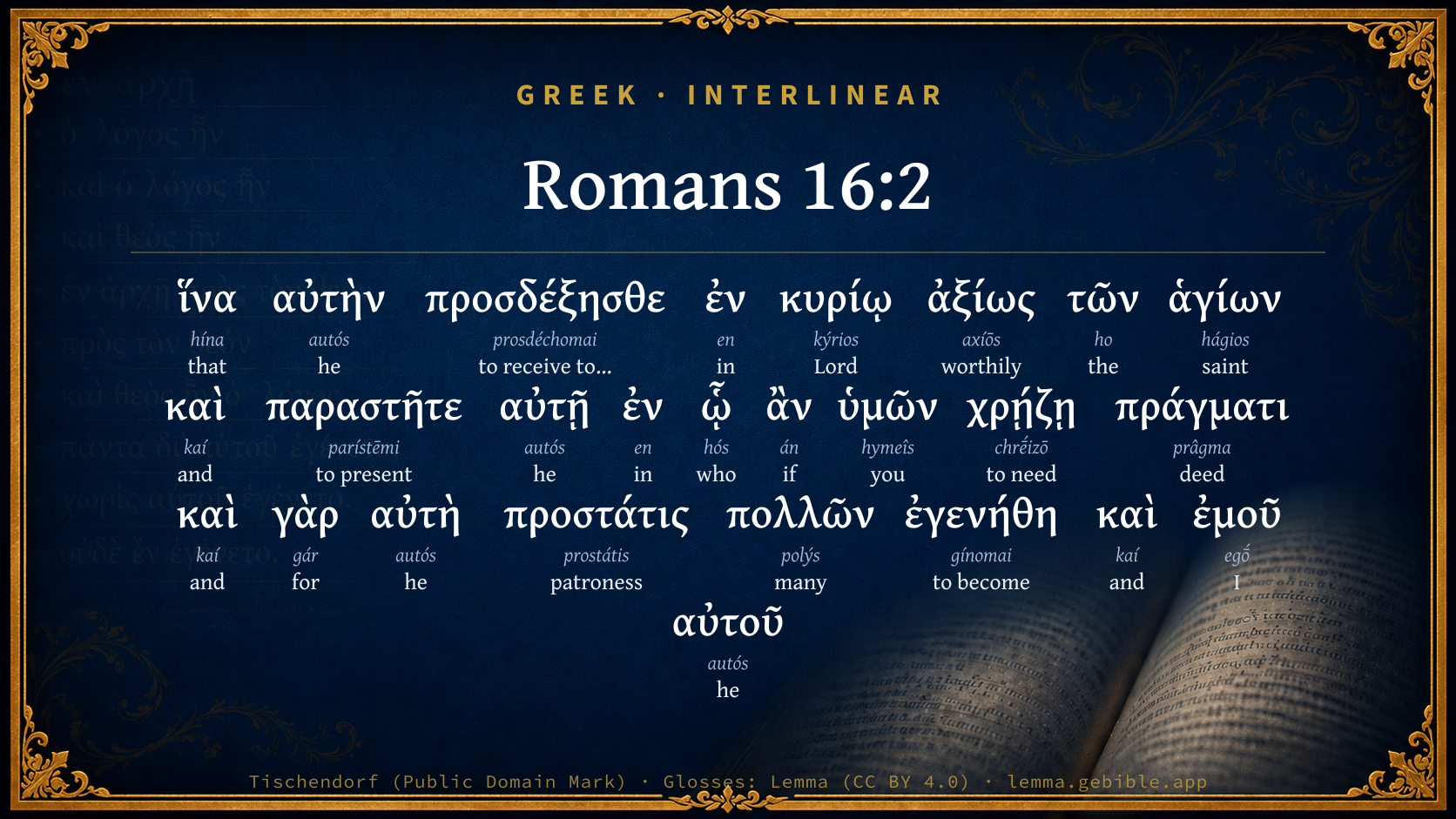
Greek (Tischendorf 8th ed.) Romans 16:2 appears in the Greek New Testament. The text above is from the Tischendorf 8th edition. Each word links to its Strong’s number and a concise gloss. Click any word for its full Thayer’s Greek Lexicon entry.
Download image
Cite this verse

Romans 16:2 (World English Bible). Public Domain. Lemma interlinear Bible study tool, https://lemma.gebible.app/v/romans/16/2.

Show BibTeX & RIS
BibTeX
RIS
English Translation
that you receive her in the Lord, in a way worthy of the saints, and that you assist her in whatever matter she may need from you, for she herself also has been a helper of many, and of my own self.
World English Bible · Public Domain
Highlights
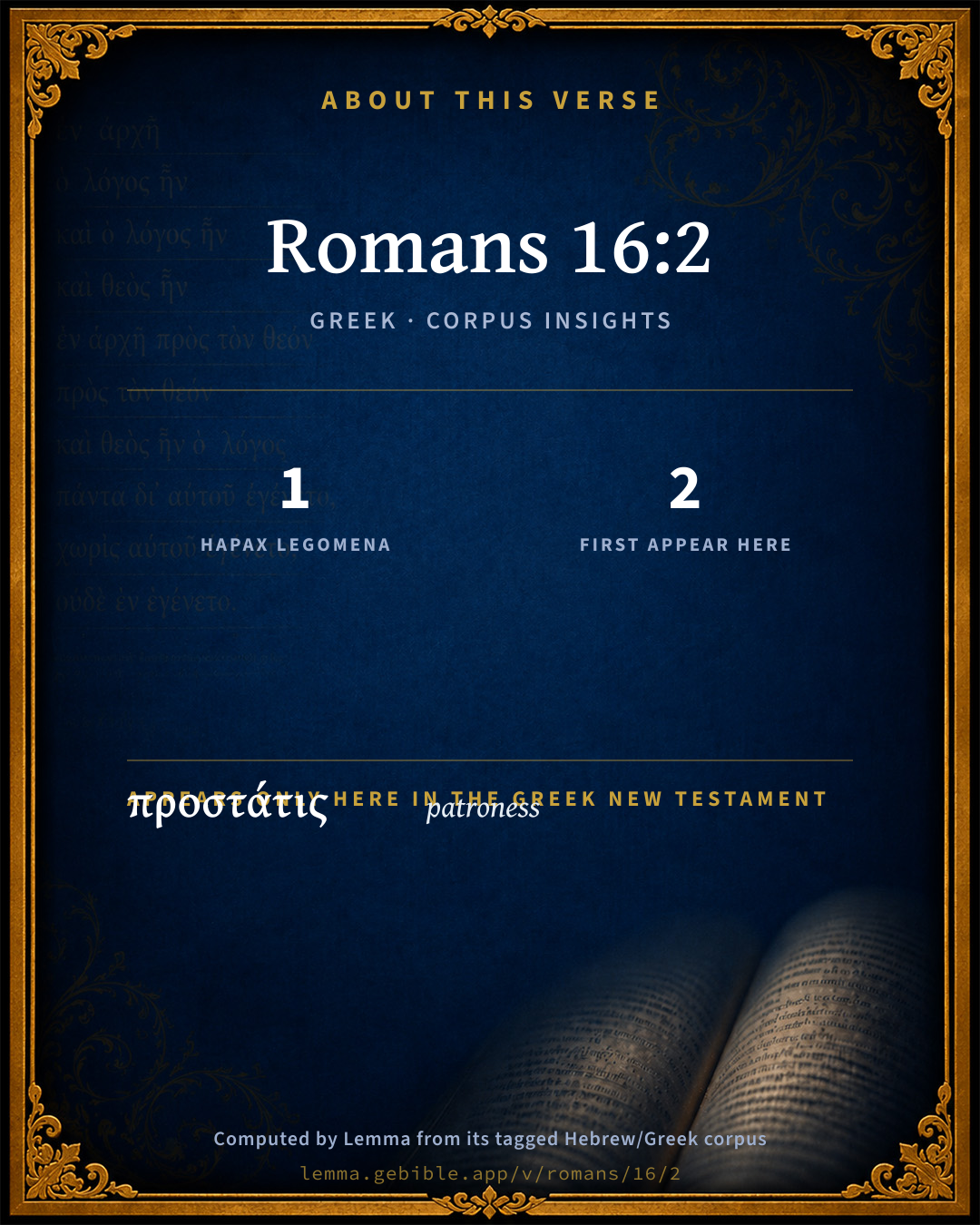
  • 1 hapax legomenon — only here in the Greek New Testament
  • 2 first appearances in the Greek New Testament
Full analysis ↓
Download a study sheet

One document with this verse’s original text, its word-by-word gloss line, the meaning frame, cross-references with their text, attributed commentary, and full source and license credits — printable, and it pastes into notes with its structure intact.

This verse Autodidact and up

Study sheet (.html) Plain text (.txt)

A passage Seminary Student

Up to 50 verses in one chapter. A passage sheet keeps up to 6 commentary sources and 12 cross-references per verse, in the order this page ranks them, and says so on the sheet whenever that leaves anything out. Ask for a single verse and you get the Autodidact verse sheet above.

Everything on this page stays free to read, with no account — the sheet is a download of what is already on screen, not access to it.

Want to remove ads? Support Godless Engineer
Compare translations 3

The same verse in 3 English versions, stacked beneath the original-language interlinear above. Click any original word for its lexicon entry.

Each is an independent rendering of the whole verse — the interlinear is not word-aligned to these translations.

Highlighted words mark where these versions differ — a whole-verse word diff, not a word-by-word alignment.

  • World English Bible Public Domain
    that you receive her in the Lord, in a way worthy of the saints, and that you assist her in whatever matter she may need from you, for she herself also has been a helper of many, and of my own self.
  • King James Version Public Domain
    That ye receive her in the Lord, as becometh saints, and that ye assist her in whatsoever business she hath need of you: for she hath been a succourer of many, and of myself also.
  • unfoldingWord Literal Text CC BY-SA 4.0
    in order that you might welcome her in the Lord, in a manner worthy of the saints, and might stand by her in whatever matter she might have need of you. For she has also become a benefactor of many, and of myself as well.

unfoldingWord Literal Text — © unfoldingWord, licensed CC BY-SA 4.0. Word-aligned USFM3 via Door43 (git.door43.org/unfoldingWord/en_ult).

Versions to compare (up to 4)

3 of 4 selected

Show all 19 translations

Every available English version of this verse, each an independent rendering of the whole verse.

  • World English Bible Public Domain
    that you receive her in the Lord, in a way worthy of the saints, and that you assist her in whatever matter she may need from you, for she herself also has been a helper of many, and of my own self.
  • Berean Standard Bible Public Domain
    Welcome her in the Lord in a manner worthy of the saints, and assist her with anything she may need from you. For she has been a great help to many people, including me.
  • Majority Standard Bible Public Domain
    Welcome her in the Lord in a manner worthy of the saints, and assist her with anything she may need from you. For she has been a great help to many people, including me.
  • King James Version Public Domain
    That ye receive her in the Lord, as becometh saints, and that ye assist her in whatsoever business she hath need of you: for she hath been a succourer of many, and of myself also.
  • American Standard Version (1901) Public Domain
    that ye receive her in the Lord, worthily of the saints, and that ye assist her in whatsoever matter she may have need of you: for she herself also hath been a helper of many, and of mine own self.
  • Revised Version (1885) Public Domain
    that ye receive her in the Lord, worthily of the saints, and that ye assist her in whatsoever matter she may have need of you: for she herself also hath been a succourer of many, and of mine own self.
  • Geneva Bible (1599) Public Domain
    That ye receiue her in the Lord, as it becommeth Saintes, and that ye assist her in whatsoeuer businesse she needeth of your ayde: for she hath giuen hospitalitie vnto many, and to me also.
  • Douay-Rheims (1899) Public Domain
    That you receive her in the Lord as becometh saints; and that you assist her in whatsoever business she shall have need of you. For she also hath assisted many, and myself also.
  • Young's Literal Translation Public Domain
    that ye may receive her in the Lord, as doth become saints, and may assist her in whatever matter she may have need of you -- for she also became a leader of many, and of myself.
  • Literal Standard Version CC BY-SA 4.0
    that you may receive her in the LORD, worthily of the holy ones, and may assist her in whatever matter she may have need of you, for she also became a leader of many, and of myself.
  • Unlocked Literal Bible CC BY-SA 4.0
    in order that you may receive her in the Lord. Do this in a manner worthy of the saints, and stand by her in whatever matter she may have need of you. For she herself as well has become a helper of many, and of myself as well.
  • unfoldingWord Literal Text CC BY-SA 4.0
    in order that you might welcome her in the Lord, in a manner worthy of the saints, and might stand by her in whatever matter she might have need of you. For she has also become a benefactor of many, and of myself as well.
  • Darby Bible Public Domain
    that ye may receive her in [the] Lord worthily of saints, and that ye may assist her in whatever matter she has need of you; for *she* also has been a helper of many, and of myself.
  • World Messianic Bible Public Domain
    that you receive her in the Lord in a way worthy of the holy ones, and that you assist her in whatever matter she may need from you, for she herself also has been a helper of many, and of my own self.
  • Webster's Bible Public Domain
    That ye receive her in the Lord, as it becometh saints, and that ye assist her in whatever business she hath need of you: for she hath been a succorer of many, and of myself also.
  • Free Bible Version CC BY-SA 4.0
    Please welcome her in the Lord, as believers should, and help her in whatever way she needs, because she has been a great help to many people, myself included.
  • Bible in Basic English Public Domain
    That you will take her in kindly, after the way of the saints, as one who is the Lord's, and give her help in anything in which she may have need of you: because she has been a help to a great number and to myself.
  • Text-Critical English NT CC BY 4.0
    and I ask you to receive her in the Lord in a manner worthy of the saints and to assist her in whatever matter she may have need of you, for she has been a benefactor of many, including me.
  • Tyndale New Testament (1534) Public Domain
    that ye receave her in the Lorde as it becommeth saynctes and that ye assist her in whatsoever busynes she neadeth of youre ayde. For she hath suckered many and myne awne selfe also.

Literal Standard Version (2020), Covenant Press — licensed CC BY-SA 4.0. Text via the HelloAO Bible API (eBible.org). Unlocked Literal Bible (unfoldingWord) — licensed CC BY-SA 4.0. Text via the HelloAO Bible API (eBible.org). unfoldingWord Literal Text — © unfoldingWord, licensed CC BY-SA 4.0. Word-aligned USFM3 via Door43 (git.door43.org/unfoldingWord/en_ult). Free Bible Version, Dr. Jonathan Gallagher — licensed CC BY-SA 4.0. Text via the HelloAO Bible API (eBible.org).

Word by word

More ways to search: Search by grammar → Find every occurrence → Compare this word →

Practice this passage: Drill this verse → Learn its vocabulary →

προστάτις
prostátis
G4368
“patroness”
Noun, Nominative, Singular, Feminine
Part of Speech
Noun
Case
Nominative
Number
Singular
Gender
Feminine
Full Thayer's Definition

Origin: from a derivative of G4291

TDNT: None

1. a woman set over others 2. a female guardian, protectress, patroness, caring for the affairs of others and aiding them with her resources
  1. ἵνα hína G2443 “that” Conjunction
  2. αὐτὴν autós G846 “he” Personal pronoun, Accusative, Singular, Feminine
  3. προσδέξησθε prosdéchomai G4327 “to receive to oneself” Verb, Aorist, Middle deponent, Subjunctive, 2nd person, Plural
  4. ἐν en G1722 “in” Preposition
  5. κυρίῳ kýrios G2962 “Lord” Noun, Dative, Singular, Masculine
  6. ἀξίως axíōs G516 “worthily” Adverb
  7. τῶν ho G3588 “the” Article, Genitive, Plural, Masculine
  8. ἁγίων hágios G40 “saint” Adjective, Genitive, Plural, Masculine
  9. καὶ kaí G2532 “and” Conjunction
  10. παραστῆτε parístēmi G3936 “to present” Verb, Aorist, Active, Subjunctive, 2nd person, Plural
  11. αὐτῇ autós G846 “he” Personal pronoun, Dative, Singular, Feminine
  12. ἐν en G1722 “in” Preposition
  13. ᾧ hós G3739 “who” Relative pronoun, Dative, Singular, Neuter
  14. ἂν án G302 “if” Particle
  15. ὑμῶν hymeîs G5210 “you” Personal pronoun, 2nd person, Genitive, Plural
  16. χρῄζῃ chrḗizō G5535 “to need” Verb, Present, Active, Subjunctive, 3rd person, Singular
  17. πράγματι prâgma G4229 “deed” Noun, Dative, Singular, Neuter
  18. καὶ kaí G2532 “and” Conjunction
  19. γὰρ gár G1063 “for” Conjunction
  20. αὐτὴ autós G846 “he” Personal pronoun, Nominative, Singular, Feminine
  21. πολλῶν polýs G4183 “many” Adjective, Genitive, Plural, Masculine
  22. ἐγενήθη gínomai G1096 “to become” Verb, Aorist, Passive deponent, Indicative, 3rd person, Singular
  23. καὶ kaí G2532 “and” Conjunction
  24. ἐμοῦ egṓ G1473 “I” Personal pronoun, 1st person, Genitive, Singular
  25. αὐτοῦ autós G846 “he” Personal pronoun, Genitive, Singular, Masculine

About this verse

These counts appear in no published source. They are computed here, from the morphology-tagged text and Lemma’s own curated glosses. What Lemma adds →

26
words
20
distinct lemmas
Pauline Epistles
section

Notable vocabulary

1 hapax legomenon — a word that appears only here in the entire Greek New Testament:

  • προστάτις patroness G4368

First appearance in Scripture

These words make their first canonical appearance in the Greek New Testament here:

  • ἀξίως worthily G516
  • προστάτις patroness G4368

Shared distinctive vocabulary

χρῄζῃ to need G5535 occurs in 5 verses of the Greek New Testament. Also found in:
Repetition

Words recur within this verse:

Cross-references

22

Topical passages linked to Romans 16:2 in the Treasury of Scripture Knowledge — connected by theme and wording, ordered by reader-vote popularity; previews shown in the World English Bible.

  • Philippians 2:29 Receive him therefore in the Lord with all joy, and hold such in honor,
  • Philippians 1:27 Only let your manner of life be worthy of the Gospel of Christ, that, whether I come and see you or am absent, I may hear of your state, that you stand firm in one spirit, with one soul striving for the faith of the Gospel;
  • Matthew 10:40–42 He who receives you receives me, and he who receives me receives him who sent me.
  • Matthew 25:40 "The King will answer them, 'Most assuredly I tell you, inasmuch as you did it to one of the least of these my brothers, you did it to me.'
  • Acts 9:36 Now there was at Joppa a certain disciple named Tabitha, which when translated, means Dorcas. This woman was full of good works and acts of mercy which she did.
  • Acts 9:39 Peter got up and went with them. When he had come, they brought him into the upper chamber. All the widows stood by him weeping, and showing the coats and garments which Dorcas had made while she was with them.
  • Acts 9:41 He gave her his hand, and raised her up. Calling the saints and widows, he presented her alive.
  • Romans 15:7 Therefore receive one another, even as Christ also received you, to the glory of God.
  • Romans 16:3–4 Greet Prisca and Aquila, my fellow workers in Christ Jesus,
  • Romans 16:6 Greet Mary, who labored much for us.
  • Romans 16:9 Greet Urbanus, our fellow worker in Christ, and Stachys, my beloved.
  • Romans 16:23 Gaius, my host and host of the whole assembly, greets you. Erastus, the treasurer of the city, greets you, as does Quartus, the brother.
  • Ephesians 5:3 But sexual immorality, and all uncleanness, or covetousness, let it not even be mentioned among you, as becomes saints;
  • Colossians 4:10 Aristarchus, my fellow prisoner greets you, and Mark, the cousin of Barnabas (concerning whom you received commandments, "if he comes to you, receive him"),
  • 1 Timothy 2:10 but (which becomes women professing godliness) with good works.
  • 2 Timothy 1:18 (the Lord grant to him to find the Lord's mercy in that day); and in how many things he served at Ephesus, you know very well.
  • Titus 2:3 and that older women likewise be reverent in behavior, not slanderers nor enslaved to much wine, teachers of that which is good;
  • Philemon 1:12 I am sending him back. Therefore receive him, that is, my own heart,
  • Philemon 1:17 If then you count me a partner, receive him as you would receive me.
  • 2 John 1:10 If anyone comes to you, and doesn't bring this teaching, don't receive him into your house, and don't welcome him,
  • Philippians 4:14–19 However you did well that you shared in my affliction.
  • 3 John 1:5–10 Beloved, you do a faithful work in whatever you accomplish for those who are brothers and strangers.

Cross-references courtesy of OpenBible.info (CC BY 4.0).

Commentary

Notes on Romans 16:2 from classic Christian and Jewish commentators (each source and its license shown beneath its notes). The classic Christian expositions comment on the surrounding passage and are grouped to its opening verse, so a note may address several verses; the Jewish commentaries on the Tanakh (Rashi and others) are per-verse, so they appear only where the commentator wrote on this verse.

Lemma curates 59 commentaries, every one of them public domain or Creative Commons licensed, each selected and text-cleaned for this edition rather than reprinted as found. About our sources →

Tyndale Open Study Notes

Tyndale Open Resources

16:2 she has been helpful to many: This phrase indicates the ancient role of the patron, a wealthy person who used influence and money to help people and causes. Phoebe was apparently a woman of wealth and influence who used her resources to help missionaries such as Paul.

Tyndale Open Study Notes — © Tyndale Open Resources, licensed CC BY-SA 4.0. Text via the HelloAO Bible API.

Bengel's Gnomon

Johann Albrecht Bengel

Rom 16:2. Ἐν Κυρίῳ, in the Lord) There is very frequent mention of the Lord, Christ, in this chapter: In the Lord: at the present day we say, in a Christian manner [as Christians]. The phrase is peculiar to Paul, but often used.—καὶ γὰρ, for even) a strong argument, 1Co 16:15-16; Php 2:29. There is an all-embracing [comprehensive] relationship among believers: Phœbe is recommended to the Romans for acts of kindness, which she had done far from Rome.—προστάτις, a succourer) We may believe, that Phœbe was wealthy, but she did not shrink by subterfuges from the duty of ministering, in the case of strangers, the needy, etc.; nor did she regard in the case of [on the part of] her fellow-citizens, who were wholly intent on self-interest, the opinion entertained of her bad economy.—πολλῶν, of many) Believers ought to return a favour not only to him, who has been of service to themselves, but also to him, who has been of service to others.

Bengel's Gnomon of the New Testament — English translation (T&T Clark, Edinburgh, 1860) — public domain. Text from a community e-Sword module.

Hodge's Commentary on Romans, Ephesians & First Corinthians

Charles Hodge

Rom_16:2

That ye receive her in the Lord. The words in the Lord, may be connected either with receive, receive her in a religious manner, and from religious motives; or with the pronoun, her in the Lord, her as a Christian. The apostle presents two considerations to enforce this exhortation; first, regard for their Christian character; and, secondly, the service which Phebe had rendered to others. As becometh saints; this expression at once describes the manner in which they ought to receive her, and suggests the motive for so doing. The words ἀξίως τῶν ἁγίων may mean, as it becomes Christians to receive their brethren, or, sicut sanctos excipi oportet, as saints ought to be received. In the former case, ἁγὶων (saints) are those who received, and in the latter, those who are received. And that ye assist her in whatsoever business she hath need of you. They were not only to receive her with courtesy and affection, but to aid her in any way in which she required their assistance. The words (ἐν ᾧ ἂν πράγματι) in whatsoever business, are to be taken very generally, in whatever matter, or in whatever respect. For she hath been a succorer of many, and of myself also. The word (προστάτις) succorer, means a patroness, a benefactor; it is a highly honorable title. As she had so frequently aided others, it was but reasonable that she should be assisted.

Charles Hodge — Commentary on Romans (1835), First Corinthians (1857), and Ephesians (1856) — public domain. Text from a community e-Sword module.

Geneva Bible (1599)

Geneva Bible translators

For Christ’s sake, which is proper to the Christians, for the heathen Philosophers have resemblances of the same virtues.

Geneva Bible (1599) marginal notes — public domain. Text via Bolls.life.

Jamieson, Fausset & Brown

Robert Jamieson, A. R. Fausset & David Brown

Receive her in the Lord--that is, as a genuine disciple of the Lord Jesus.

as--"so as"

becometh saints--so as saints should receive saints.

assist her in whatsoever business she hath--"may have"

need of you--some private business of her own.

for she hath been a succourer of many, and of myself also--(See Psa 41:1-3; Ti2 1:16-18).

Jamieson, Fausset & Brown — Commentary Critical and Explanatory on the Whole Bible (1871) — public domain (CC PDM 1.0). Text via the HelloAO Bible API.

Adam Clarke's Commentary

Verse 2. Succourer of many] One who probably entertained the apostles and preachers who came to minister at Cenchrea, and who was remarkable for entertaining strangers. See Clarke on Ro 12:8.

Adam Clarke's Commentary on the Bible (1810–1826) — public domain. Text from a community e-Sword/MySword module.

Ellicott's Commentary for English Readers

(2) In the Lord.—With the consciousness that you are performing a Christian act, subject to all those serious obligations implied in the name.

As becometh saints.—As Christians ought to receive a fellow-Christian.

Succourer.—Patroness or protectress, in the exercise of her office as deaconess.

Of myself also.—Perhaps in illness.

A Bible Commentary for English Readers, edited by Charles John Ellicott (1878–1897) — public domain. Text from a community e-Sword module.

The Cambridge Bible for Schools and Colleges

gen. ed. J. J. S. Perowne

2. in the Lord, as becometh saints] With all the attention and delicacy due from Christians to a Christian woman.

assist her] Lit. (in the lit sense of “assist,”) stand by her. What Phœbe’s business at Rome was, is quite unknown to us. It may have concerned property, and involved enquiries and directions about law. Or it may have been (though less probably) religious business.

a succourer] Lit. a champion; one who stands before another. The word conveys a graceful allusion to the request that they would “stand by” Phœbe: she had “stood before” many a needing and suffering Christian.

of myself also] Very probably at some time of illness, such as that other time which apparently delayed him in Galatia, on his first visit there, and called out the sympathetic love of the Galatians. (Gal_4:13-15; where read, “on account of weakness of the flesh;” i.e. “because of illness”).

The Cambridge Bible for Schools and Colleges (gen. ed. J. J. S. Perowne; Cambridge University Press, 1878–1918) — public domain. Text from a community e-Sword module.

John Gill's Exposition

That ye receive her in the Lord,.... This is one thing he recommends her to them for, that they would receive her in a kind and friendly manner into their houses, and into their hearts' love and affections; admit her to their private meetings, and into church fellowship with them, and that as one that was in the Lord, and belonged to him; and also in his name, and for his sake:

as becometh saints; that is, both that they would treat her with that humanity, courteousness, Christian affection, and respect, as became them who were saints by calling and profession; and that they would use her as being one of the saints, a godly, holy person, and as such an one ought to be used, by virtue of the communion of saints:

and that ye assist her in whatsoever business she hath need of you: what her business was at Rome is not known; whether it was only to visit the saints; or whether it was to have a cause tried in any court of judicature there; or whether she came upon worldly business, as Lydia of Thyatira was at Philippi to sell her purple, when the Apostle Paul was there, it matters not: whatever assistance they could give her, either by directing her where the saints lived; or by giving her proper counsel and advice; or helping her forward in her worldly affairs; or whatever she was concerned in, this is desired; and is another thing for which the apostle recommends her to them, adding this reason,

for she hath been a succourer of many; or "a patroness of many" of the saints in necessity and distress. The word that is here used, is, as Harpocratian says (k) the name by which such were called by the Athenians, , "that were over the sojourners", who had the care and direction of them. And such was this woman to the poor saints in Cenchrea, and the strangers that came thither; not as being in such an office by the order and appointment of the church, but what she cheerfully and voluntarily took up herself and performed at her own expense, otherwise there would not be so much in the character as to deserve such peculiar notice, nor she be so worthy of praise and commendation: moreover, the apostle observes, that he also partook of her succour and assistance,

and of myself also; which would hardly have been the case had she been one that had only the care of the poor sisters of the church, which was the office of the deaconess: but she being a rich generous woman, and the apostle having shared in her bounty, gratefully acknowledges it; and he the rather mentions it, as knowing it would the more endear her to the saints at Rome, who would take more notice of her for the respect she had shown to him.

(k) Lexic. decem Orator. p. 255.

John Gill's Exposition of the Whole Bible (1746–1763) — public domain (CC PDM 1.0). Text via the HelloAO Bible API.

Trapp's Complete Commentary

John Trapp

2 That ye receive her in the Lord, as becometh saints, and that ye assist her in whatsoever business she hath need of you: for she hath been a succourer of many, and of myself also.

Ver. 2. As becometh saints] Who are great princes, states, in all lands, Psa 45:1-17, and to be observed accordingly, even worthy of God, 3Jn 1:6.

John Trapp, A Commentary or Exposition upon All the Books of the Old and New Testament (1647–1656) — public domain. Text from a community e-Sword module.

Albert Barnes' Notes on the Bible

That ye receive her ... - That you acknowledge her as being in the Lord, or as being a servant of the Lord; that is, as a Christian; compare Rom 14:3; Phi 2:29.

As becometh saints - As it is proper that Christians should treat their brethren.

She hath been a succourer of many - The word used here προστάτις prostatis, means properly “a patron, a help,” and was applied by the Greeks to one who “presided” over an assembly; to one who became “a patron” of others; who aided or defended them in their cause; and especially to one who undertook to manage the cause of “strangers” and foreigners before the courts. It was, therefore, an honorable appellation. Applied to Phebe, it means probably that she had shown great kindness in various ways to the apostle, and to other Christians; probably by receiving them into her house; by administering to the sick, etc. Such persons have a claim on the respect and Christian attentions of others.

Albert Barnes' Notes on the Bible (1834–1885) — public domain. Text from a community e-Sword/MySword module.

Matthew Poole's English Annotations

Receive her in the Lord; i.e. in the Lord’s name, or for the Lord’s sake: see Mat 18:5. Or else it is as if he had said: Receive her Christianly.

As becometh saints; as it is fit that saints should be rcceived, or as it is fit for them, who profess themselves to be saints, to receive one another.

That ye assist her in whatsoever business she hath need of you; that you stand by her, and afford her your counsel, or any other assistance. She might have some business in the emperor’s court, by reason of fraud, oppression, or some unjust vexations; and there might be those amongst them that could stand her in some stead. There were Christians of Caesar’s household, Phi 4:22.

For she hath been a succourer of many, and of myself also: the word signifieth a patroness. She had been hospitable to many, and in particular, to the apostle himself. This showeth she was a woman of some account: it was but equal that the saints at Rome should assist her, who had been assistant unto so many others.

Matthew Poole's English Annotations on the Holy Bible (1683–1685) — public domain. Text from a community e-Sword/MySword module.

Whedon's Commentary on the Bible

Daniel D. Whedon

2. As becometh saints—He puts them upon their Christian honour.

Business—Her private affairs at Rome, in which her benefactions to Christians entitled her to every assistance from Christians.

Succourer— Apparently she was a lady of wealth, a housekeeper, and probably a widow. Hence she was an entertainer and patroness of her fellow Christians.

That Phebe was not merely a servitor, doing menial work, but an official, appears from the patronizing character which Paul assigns her. Hence when, no later than A.D. 104, we find that Pliny writes that he selected two females “who were called (ministroe) ministresses” for torture to extract information against Christians, we see no reason to doubt that we have here the apostolic origin of a female deaconship. The separation of the sexes might in Greek and Roman sections require this office, not only in regard to temporalities, but in regard to more spiritual offices for the female part of the Church. The apostolic Church admitted a woman’s social prayer, with covered head, (1Co_11:4; 1Co_11:13;) it admitted prophetesses, (preacheresses,) (1Co_11:9,) and it admitted deaconesses. But it seems to show no eldresses and no bishopesses.

Daniel D. Whedon (gen. ed.), Commentary on the Old and New Testaments (1874–1909) — public domain. Text from a community e-Sword module.

John Wesley's Explanatory Notes

In the Lord - That is, for the Lord's sake, and in a Christian manner. St. Paul seems fond of this expression.

John Wesley, Explanatory Notes Upon the Whole Bible (1754–1765) — public domain. Text via the GEBible commentary corpus.

McGarvey & Pendleton's Commentaries

J. W. McGarvey

that ye receive her in the Lord [i. e., as Christians should receive a Christian], worthily of the saints, and that ye assist her in whatsoever matter she may have need of you [what Phoebe's business was is unknown]: for she herself also hath been a helper of many, and of mine own self . [In the Greek there is a play upon words here: "Help her, for she is a helper." She probably helped the apostle during his stay in Cenchreæ-- Act_18:18 ]

J. W. McGarvey (with Philip Y. Pendleton), Commentaries on the New Testament (The Fourfold Gospel, 1914; Acts; and the epistles) — public domain. Text from a community e-Sword/MySword module.

The People's New Testament

B. W. Johnson

2. That ye receive her in the Lord. Give her a Christian welcome. And that ye assist her. The term used in the Greek is a legal one; hence it is supposed that some kind of legal business called her to Rome. She hath been a succorer of many. This would result from her office as a deaconess. Among those ministered to was the apostle himself.

B. W. Johnson's The People's New Testament with Notes (1889–1891) — public domain. Electronic text from the Christian Classics Ethereal Library (CCEL) ThML edition.

Cambridge Greek Testament for Schools and Colleges

2. προσδέξησθε. Luk 15:2; Php 2:29.

ἀξίως τῶν ἁγίων. In a manner worthy of the saints—as saints should.

παραστῆτε, help; cf. 2Ti 4:17.

ἐν ᾧ ἂν κ.τ.λ. This suggests that Phoebe was going to Rome on her own business, and that S. Paul used the opportunity of sending his letter.

προστάτις. Only here in N.T.; cf. προΐστασθαι, Rom 12:8; 1Th 5:12; 1Ti 5:17; cf. Witkowski, Ep. Priv. 48. 9, ib[316] 9. 4, ‘protectress.’ A word used technically to mean the representative or patron; but here to describe the way in which Phoebe ‘looked after’ any who wanted her help.

[316] ib. ibidem

Cambridge Greek Testament for Schools and Colleges (Cambridge University Press, 1896; 21 vols, various authors incl. Carr, Maclear, Plummer, Farrar, Lumby, Moule, M. R. James, Simcox) — public domain. Text from a community e-Sword module.

Alford’s Greek Testament

Henry Alford

2.] ἐν κυρίῳ, in a Christian manner,—as mindful of your common Lord: ἀξίως τ. ἁγίων, ‘in a manner worthy of saints;’ i.e. ‘as saints ought to do,’—refers to προσδέξησθε, and therefore to their conduct to her;—not, ‘as saints ought to be received.’

παραστῆτε] Her business at Rome may have been such as to require the help of those resident there.

προστάτις πολλῶν] This may refer to a part of the deaconess’s office, the attending on the poor and sick of her own sex.

κ. ἐμοῦ αὐτοῦ] when and where, we know not. It is not improbable that she may have been, like Lydia, one whose heart the Lord opened at the first preaching of Paul, and whose house was his lodging.

Henry Alford, The Greek Testament (1849–1861) — public domain. Text from a community e-Sword module.

International Critical Commentary

2. ἀξίως τῶν ἁγίων, ‘in a manner worthy of the saints,’ i. e. ‘of the Church.’ Not only to provide for her wants, but to admit her to every spiritual privilege as ‘in the Lord.’

προστάτις, a ‘succourer’ or ‘helper’; this almost technical word is suggested by παραστῆτε. It is the feminine form of προστάτης, used like the Latin patronus for the legal representative of the foreigner. In Jewish communities it meant the legal representative of wealthy patron: see Schürer, Die Gemeinde-Verfassung, &c., Ins. 31: ενθαδε κειτε | γαιχ προχτατηχ | οχιοχ εζηχεν | ετη οβ εν ειρη | κοιμηχιχ χοψ, cf. also C.I.G. 5361. We also find the word used of an office-bearer in a heathen religious association, see Foucart, Associations Religieuses, p. 202, Ins. 20, line 34 (= C.I.G. 126) δοκιμαζέτω δὲ ὁ προστάτης καὶ ὁ ἀρχιερανιστὴς καὶ ὁ γραμματεὺς καὶ οἱ ταμίαι καὶ σύνδικοι. Here the expression suggests that Phoebe was a person of some wealth and position who was thus able to act as patroness of a small and struggling community.

2. If the involved construction were the only difficulty caused by reading ᾧ, it would probably be right to retain it. But there are others more serious. How are the words διὰ Ἰ. Χ. to be taken? and what does ᾧ refer to?

(1) Grammatically the simplest solution is to suppose, with Lid., that ᾧ refers to Christ, and that St. Paul has changed the construction owing to the words διὰ Ἰ. Χ. He had intended to finish ‘to the only wise God through Christ Jesus be Glory,’ as in Jud 1:25 μόνῳ Θεῷ σωτῆρι ἡμῶν, διὰ Ἰ. Χ. τοῦ Κυρίου ἡμῶν, δόξα, μεγαλωσύνη, κ.τ.λ., but the words Ἰησοῦ Χριστοῦ remind him that it is through the work of Christ that all this scheme has been developed; he therefore ascribes to Him the glory. This is the only possible construction if ᾧ be read, but it can hardly be correct; and that not because we can assert that on a priori grounds a doxology cannot be addressed to the Son, but because such a doxology would not be in place here. The whole purpose of these concluding verses is an ascription of praise to Him who is the only wise God.

(2) For this reason most commentators attempt to refer the ᾧ to Θεῷ. This in itself is not difficult: it resembles what is the probable construction in 1Pe 4:11, and perhaps in Heb 13:21. But then διὰ Ἰ. Χ. becomes very difficult. To take it with σοφῷ would be impossible, and to transfer it into the relative clause would be insufferably harsh.

There is no doubt therefore that it is by far the easiest course to omit ᾧ. We have however the alternative of supposing that it is a blunder made by St. Paul’s secretary in the original letter. We have seen that some such hypothesis may explain the impossible reading in 4:12.

εἰς τοὺς αἰῶνας should be read with B C L, Harcl., Chrys. Cyr. Theodrt. τῶν αἰώνων was added in א A D E P, Vulg. Pesh. Boh., Orig.-lat. &c., owing to the influence of 1Ti 1:17.

The doxology sums up all the great ideas of the Epistle. The power of the Gospel which St. Paul was commissioned to preach; the revelation in it of the eternal purpose of God; its contents, faith; its sphere, all the nations of the earth; its author, the one wise God, whose wisdom is thus vindicated—all these thoughts had been continually dwelt on. And so at the end feeling how unfit a conclusion would be the jarring note of vv. 17-20, and wishing to ‘restore to the Epistle at its close its former serene loftiness,’ the Apostle adds these verses, writing them perhaps with his own hand in those large bold letters which seem to have formed a sort of authentication of his Epistles (Gal 6:11), and thus gives an eloquent conclusion to his great argument.

&c. always qualify the word which precedes, not that which follows:

C.I.G. Corpus Inscriptionum Graecarum.

אԠCod. Sinaiticus

B Cod. Vaticanus

P Cod. Porphyrianus

Boh. Bohairic.

A Cod. Alexandrinus

C Cod. Ephraemi Rescriptus

D Cod. Claromontanus

E Cod. Sangermanensis

F Cod. Augiensis

G Cod. Boernerianus

Vulg. Vulgate.

Syrr. Syriac.

C.I.L. Corpus Inscriptionum Latinarum.

Arm. Armenian.

Aeth. Ethiopic.

Orig.-lat. Latin Version of Origen

L Cod. Angelicus

Chrys. Chrysostom.

Theodrt. Theodoret.

RV. Revised Version.

Lft. Lightfoot.

Jos. Josephus.

Tert. Tertullian.

Sedul. Sedulius.

codd. codices.

Harcl. Harclean.

Pesh. Peshitto.

Tisch. Tischendorf.

Lid. Liddon.

International Critical Commentary — older volumes (1896–1929), various authors — public domain. Text from a community e-Sword module.

Vincent's Word Studies in the New Testament

Marvin R. Vincent

Assist [παραστητι] . See on Act 1:3 It is used as a legal term, of presenting culprits or witnesses in a court of justice. Compare prove, Act 24:13. From this, and from the term prostativ succorer, it has been inferred that Phoebe was going to Rome on private legal business (see Conybeare and Howson). This is a mere fancy.

Succorer [προστατις] . Only here in the New Testament. The word means patroness. It may refer to her official duties. The word is an honorable one, and accords with her official position.

Marvin R. Vincent, Word Studies in the New Testament (1887–1900) — public domain. Text from a community e-Sword/MySword module.

Lesson kit

Teaching starters — assembled from the data on this page, not authored interpretation. Every prompt links to the verse data it draws on. Edit before teaching.

Romans, in the Pauline Epistles, opens this verse with 26 words (20 distinct Greek lemmas). Its most distinctive word is prostátis (“patroness”). A historical commentator’s framing appears above. Read the whole chapter for the surrounding context.

Discussion questions

  1. How does “patroness” (prostátis) shape what this verse is saying?
  2. 1 word here appears nowhere else in the Greek New Testament. Why might the author reach for such rare wording?
  3. 2 words make their first appearance in Scripture here. What does this debut establish?
  4. How does Matthew 6:32, which shares the word «to need», read alongside this verse?
  5. What does the repetition of “he” (4× in this one verse) do in this verse?
  6. The translations on this page render this verse differently — a whole-verse word diff, not a word-by-word alignment. What might account for the different wordings?
  7. Compare how Tyndale Open Study Notes and Bengel's Gnomon read this verse. Where do they agree or differ?

Things to notice

  • 1 word in this verse appears nowhere else in the Greek New Testament.
  • 2 words make their first canonical appearance in Scripture here.
  • These translations choose different wording for 27 words in this verse.
  • “he” occurs 4× in this single verse.
  • 20 distinct Greek lemmas span 26 words in this verse.

Reading settings

Reading text

Shown beneath each verse's original-language words.

Old Testament
Old Testament edition

Read the OT as the Masoretic Hebrew (MT) or the Greek Septuagint (LXX).

English shown for the Greek Septuagint (in the Hebrew ↔ Greek comparison).

Comparing translations? Open the Compare panel on any verse page to stack up to four side by side.