
Ephesians 3:18

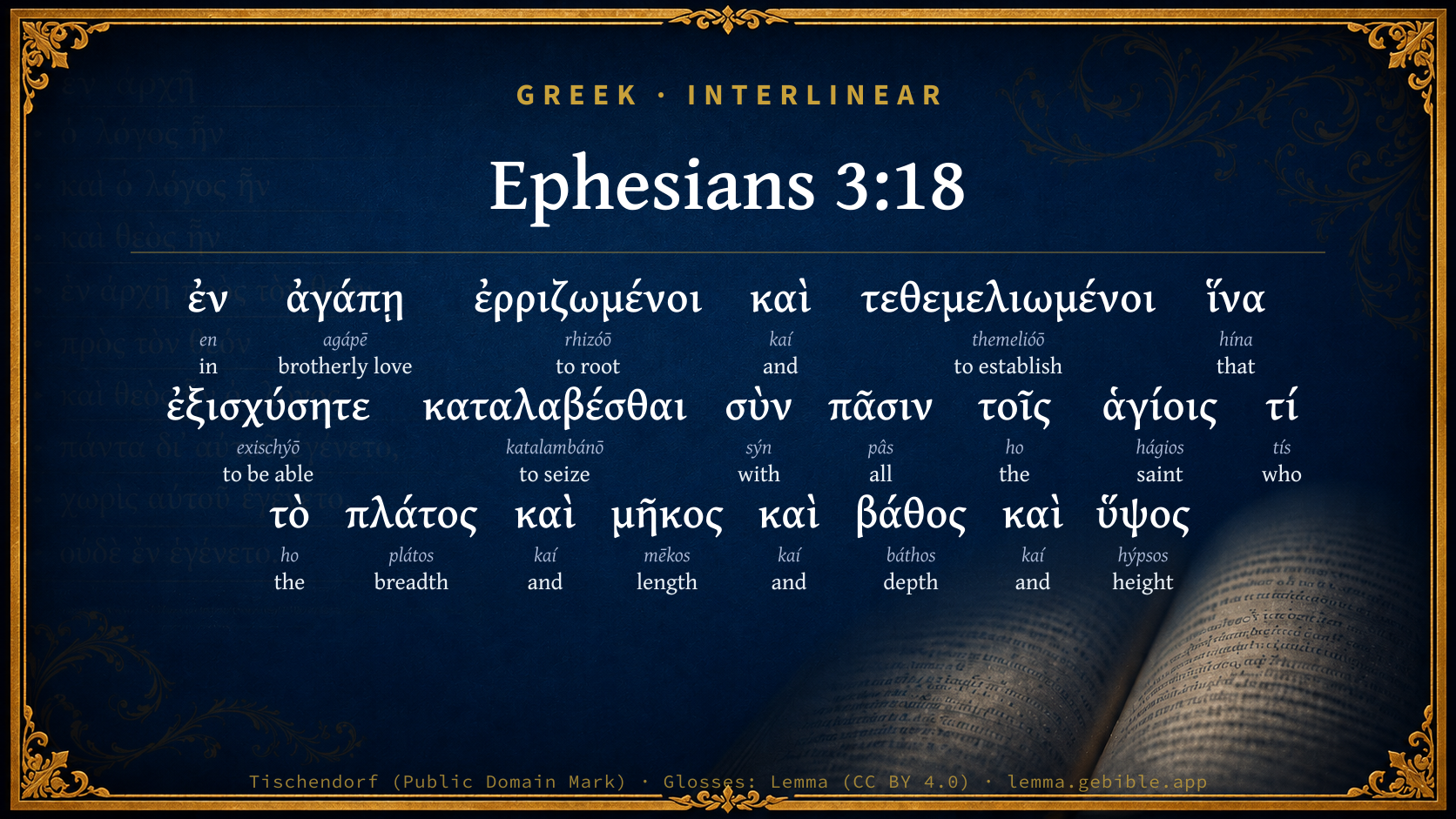
Greek (Tischendorf 8th ed.) Ephesians 3:18 appears in the Greek New Testament. The text above is from the Tischendorf 8th edition. Each word links to its Strong’s number and a concise gloss. Click any word for its full Thayer’s Greek Lexicon entry.
Download image
Cite this verse

Ephesians 3:18 (World English Bible). Public Domain. Lemma interlinear Bible study tool, https://lemma.gebible.app/v/ephesians/3/18.

Show BibTeX & RIS
BibTeX
RIS
English Translation
may be strengthened to comprehend with all the saints what is the breadth and length and height and depth,
World English Bible · Public Domain
Highlights
  • 1 hapax legomenon — only here in the Greek New Testament
  • 4 first appearances in the Greek New Testament
Full analysis ↓
Download a study sheet

One document with this verse’s original text, its word-by-word gloss line, the meaning frame, cross-references with their text, attributed commentary, and full source and license credits — printable, and it pastes into notes with its structure intact.

This verse Autodidact and up

Study sheet (.html) Plain text (.txt)

A passage Seminary Student

Up to 50 verses in one chapter. A passage sheet keeps up to 6 commentary sources and 12 cross-references per verse, in the order this page ranks them, and says so on the sheet whenever that leaves anything out. Ask for a single verse and you get the Autodidact verse sheet above.

Everything on this page stays free to read, with no account — the sheet is a download of what is already on screen, not access to it.

Want to remove ads? Support Godless Engineer
Compare translations 3

The same verse in 3 English versions, stacked beneath the original-language interlinear above. Click any original word for its lexicon entry.

Each is an independent rendering of the whole verse — the interlinear is not word-aligned to these translations.

Highlighted words mark where these versions differ — a whole-verse word diff, not a word-by-word alignment.

  • World English Bible Public Domain
    may be strengthened to comprehend with all the saints what is the breadth and length and height and depth,
  • King James Version Public Domain
    May be able to comprehend with all saints what is the breadth, and length, and depth, and height;
  • unfoldingWord Literal Text CC BY-SA 4.0
    so that you may be fully able to comprehend, along with all the saints, what the width and length and height and depth,

unfoldingWord Literal Text — © unfoldingWord, licensed CC BY-SA 4.0. Word-aligned USFM3 via Door43 (git.door43.org/unfoldingWord/en_ult).

Versions to compare (up to 4)

3 of 4 selected

Show all 19 translations

Every available English version of this verse, each an independent rendering of the whole verse.

  • World English Bible Public Domain
    may be strengthened to comprehend with all the saints what is the breadth and length and height and depth,
  • Berean Standard Bible Public Domain
    will have power, together with all the saints, to comprehend the length and width and height and depth
  • Majority Standard Bible Public Domain
    will have power, together with all the saints, to comprehend the length and width and depth and height
  • King James Version Public Domain
    May be able to comprehend with all saints what is the breadth, and length, and depth, and height;
  • American Standard Version (1901) Public Domain
    may be strong to apprehend with all the saints what is the breadth and length and height and depth,
  • Revised Version (1885) Public Domain
    may be strong to apprehend with all the saints what is the breadth and length and height and depth,
  • Geneva Bible (1599) Public Domain
    That ye, being rooted and grounded in loue, may be able to comprehend with al Saints, what is the breadth, and length, and depth, and height:
  • Douay-Rheims (1899) Public Domain
    You may be able to comprehend, with all the saints, what is the breadth, and length, and height, and depth:
  • Young's Literal Translation Public Domain
    that ye may be in strength to comprehend, with all the saints, what `is' the breadth, and length, and depth, and height,
  • Literal Standard Version CC BY-SA 4.0
    that you may be in strength to comprehend, with all the holy ones, what [is] the breadth, and length, and depth, and height,
  • Unlocked Literal Bible CC BY-SA 4.0
    May you have strength so you can understand, along with all the believers, what is the width, the length, the height, and the depth,
  • unfoldingWord Literal Text CC BY-SA 4.0
    so that you may be fully able to comprehend, along with all the saints, what the width and length and height and depth,
  • Darby Bible Public Domain
    in order that ye may be fully able to apprehend with all the saints what [is] the breadth and length and depth and height;
  • World Messianic Bible Public Domain
    may be strengthened to comprehend with all the holy ones what is the width and length and height and depth,
  • Webster's Bible Public Domain
    May be able to comprehend with all saints what is the breadth, and length, and depth, and highth.
  • Free Bible Version CC BY-SA 4.0
    you may have the power to comprehend with all God's people the breadth and length and height and depth of Christ's love.
  • Bible in Basic English Public Domain
    May have strength to see with all the saints how wide and long and high and deep it is,
  • Text-Critical English NT CC BY 4.0
    as you are being rooted and grounded in love. I pray that you may be able to fully comprehend, together with all the saints, how wide and long and deep and high
  • Tyndale New Testament (1534) Public Domain
    myght be able to comprehende with all sayntes what ys that bredth and length deepth and heyth:

Literal Standard Version (2020), Covenant Press — licensed CC BY-SA 4.0. Text via the HelloAO Bible API (eBible.org). Unlocked Literal Bible (unfoldingWord) — licensed CC BY-SA 4.0. Text via the HelloAO Bible API (eBible.org). unfoldingWord Literal Text — © unfoldingWord, licensed CC BY-SA 4.0. Word-aligned USFM3 via Door43 (git.door43.org/unfoldingWord/en_ult). Free Bible Version, Dr. Jonathan Gallagher — licensed CC BY-SA 4.0. Text via the HelloAO Bible API (eBible.org).

Word by word

More ways to search: Search by grammar → Find every occurrence → Compare this word →

Practice this passage: Drill this verse → Learn its vocabulary →

ἐξισχύσητε
exischýō
G1840
“to be able”
Verb, Aorist, Active, Subjunctive, 2nd person, Plural
Part of Speech
Verb
Tense
Aorist
Voice
Active
Mood
Subjunctive
Person
2nd person
Number
Plural
Full Thayer's Definition

Origin: from G1537 and G2480

TDNT: None

1. to be eminently able, able, to have full strength
  1. ἐν en G1722 “in” Preposition
  2. ἀγάπῃ agápē G26 “brotherly love” Noun, Dative, Singular, Feminine
  3. ἐρριζωμένοι rhizóō G4492 “to root” Verb, Perfect, Passive, Participle, Nominative, Plural, Masculine
  4. καὶ kaí G2532 “and” Conjunction
  5. τεθεμελιωμένοι themelióō G2311 “to establish” Verb, Perfect, Passive, Participle, Nominative, Plural, Masculine
  6. ἵνα hína G2443 “that” Conjunction
  7. καταλαβέσθαι katalambánō G2638 “to seize” Verb, Aorist, Middle, Infinitive
  8. σὺν sýn G4862 “with” Preposition
  9. πᾶσιν pâs G3956 “all” Adjective, Dative, Plural, Masculine
  10. τοῖς ho G3588 “the” Article, Dative, Plural, Masculine
  11. ἁγίοις hágios G40 “saint” Adjective, Dative, Plural, Masculine
  12. τί tís G5101 “who” Interrogative pronoun, Nominative, Singular, Neuter
  13. τὸ ho G3588 “the” Article, Nominative, Singular, Neuter
  14. πλάτος plátos G4114 “breadth” Noun, Nominative, Singular, Neuter
  15. καὶ kaí G2532 “and” Conjunction
  16. μῆκος mēkos G3372 “length” Noun, Nominative, Singular, Neuter
  17. καὶ kaí G2532 “and” Conjunction
  18. βάθος báthos G899 “depth” Noun, Nominative, Singular, Neuter
  19. καὶ kaí G2532 “and” Conjunction
  20. ὕψος hýpsos G5311 “height” Noun, Nominative, Singular, Neuter

About this verse

These counts appear in no published source. They are computed here, from the morphology-tagged text and Lemma’s own curated glosses. What Lemma adds →

21
words
17
distinct lemmas
Pauline Epistles
section

Notable vocabulary

1 hapax legomenon — a word that appears only here in the entire Greek New Testament:

  • ἐξισχύσητε to be able G1840

First appearance in Scripture

These words make their first canonical appearance in the Greek New Testament here:

  • ἐρριζωμένοι to root G4492
  • ἐξισχύσητε to be able G1840
  • πλάτος breadth G4114
  • μῆκος length G3372

Shared distinctive vocabulary

ἐρριζωμένοι to root G4492 occurs in 2 verses of the Greek New Testament. Also found in:
Repetition

Words recur within this verse:

Cross-references

28

Topical passages linked to Ephesians 3:18 in the Treasury of Scripture Knowledge — connected by theme and wording, ordered by reader-vote popularity; previews shown in the World English Bible.

  • Psalms 103:11–12 For as the heavens are high above the earth, So great is his loving kindness toward those who fear him.
  • Job 11:7–9 "Can you fathom the mystery of God? Or can you probe the limits of the Almighty?
  • Ephesians 1:18–23 having the eyes of your hearts enlightened, that you may know what is the hope of his calling, and what are the riches of the glory of his inheritance in the saints,
  • John 15:13 Greater love has no one than this, that someone lay down his life for his friends.
  • Psalms 103:17 But Yahweh's loving kindness is from everlasting to everlasting with those who fear him, His righteousness to children's children;
  • Ephesians 3:19 and to know Christ's love which surpasses knowledge, that you may be filled with all the fullness of God.
  • Isaiah 55:9 For as the heavens are higher than the earth, so are my ways higher than your ways, and my thoughts than your thoughts.
  • Galatians 2:20 I have been crucified with Christ, and it is no longer I that live, but Christ living in me. That life which I now live in the flesh, I live by faith in the Son of God, who loved me, and gave himself up for me.
  • Philippians 2:5–8 Have this in your mind, which was also in Christ Jesus,
  • Psalms 145:10 All your works will give thanks to you, Yahweh. Your saints will extol you.
  • Ephesians 1:15 For this cause I also, having heard of the faith in the Lord Jesus which is among you, and the love which you have toward all the saints,
  • 1 Timothy 1:14–16 The grace of our Lord abounded exceedingly with faith and love which is in Christ Jesus.
  • Titus 2:13–14 looking for the blessed hope and appearing of the glory of our great God and Savior, Jesus Christ;
  • Romans 10:11–12 For the Scripture says, "Whoever believes in him will not be disappointed."
  • Galatians 3:13 Christ redeemed us from the curse of the law, having become a curse for us. For it is written, "Cursed is everyone who hangs on a tree,"
  • Revelation 3:21 He who overcomes, I will give to him to sit down with me on my throne, as I also overcame, and sat down with my Father on his throne.
  • Psalms 139:6 This knowledge is beyond me. It's lofty. I can't attain it.
  • Ephesians 1:10 to an administration of the fullness of the times, to sum up all things in Christ, the things in the heavens, and the things on the earth, in him;
  • Philippians 3:8–10 Yes most assuredly, and I count all things to be loss for the excellency of the knowledge of Christ Jesus, my Lord, for whom I suffered the loss of all things, and count them nothing but refuse, that I may gain Christ
  • 2 Chronicles 6:41 Now therefore arise, Yahweh God, into your resting-place, you, and the ark of your strength: let your priests, Yahweh God, be clothed with salvation, and let your saints rejoice in goodness.
  • Psalms 132:9 Let your priest be clothed with righteousness. Let your saints shout for joy!"
  • Romans 10:3 For being ignorant of God's righteousness, and seeking to establish their own righteousness, they didn't subject themselves to the righteousness of God.
  • Colossians 1:4 having heard of your faith in Christ Jesus, and of the love which you have toward all the saints,
  • 1 Timothy 3:16 Without controversy, the mystery of godliness is great: God was revealed in the flesh, Justified in the spirit, Seen by angels, Preached among the nations, Believed on in the world, And received up in glory.
  • Deuteronomy 33:2–3 He said, Yahweh came from Sinai, Rose from Seir to them; He shined forth from Mount Paran, He came from the ten thousands of holy ones: At his right hand was a fiery law for them.
  • Psalms 116:15 Precious in the sight of Yahweh is the death of his saints.
  • Zechariah 14:5 You shall flee by the valley of my mountains; for the valley of the mountains shall reach to Azel; yes, you shall flee, just like you fled from before the earthquake in the days of Uzziah king of Judah. Yahweh my God will come, and all the holy ones with you.
  • 2 Corinthians 13:13 All the saints greet you.

Cross-references courtesy of OpenBible.info (CC BY 4.0).

Commentary

Notes on Ephesians 3:18 from classic Christian and Jewish commentators (each source and its license shown beneath its notes). The classic Christian expositions comment on the surrounding passage and are grouped to its opening verse, so a note may address several verses; the Jewish commentaries on the Tanakh (Rashi and others) are per-verse, so they appear only where the commentator wrote on this verse.

Lemma curates 59 commentaries, every one of them public domain or Creative Commons licensed, each selected and text-cleaned for this edition rather than reprinted as found. About our sources →

The Biblical Illustrator

Joseph S. Exell

Eph_3:18

May be able to comprehend with all saints what is the breadth, and length, and depth, and height.

Spiritual perception

From Divine love, as the root and ground of the souls life, comes all spiritual perception. I say spiritual, as distinct from intellectual, perception. Paul says: You will net be able to comprehend the love of Christ, unless you are first rooted and grounded in it. A spiritual understanding is the opened flower of the Divine love root. Light is loves first-born child. Before one can enjoy the light of the world, he must be born of the worlds love. And before we can be light in the Lord, we must be in the Lord, having a root and ground in us derived from Himself. Any such knowledge as the natural understanding is capable of deriving from the words of Scripture is by no means spiritual knowledge. In order to spiritual knowledge, the light of the knowledge of the glory of God in the face of Jesus Christ, must as really shine into our hearts, as, in order to behold objects of nature, the light of the sun must shine into our eyes. If Christ dwell in your hearts by faith, you will be rooted and grounded in love, and as a consequence, you will be able to comprehend spiritual things. Love, then, according to our apostle, is the ground and mother of the perceptive faculty. Without fire there can be no effulgence, or radiance. As is the fire, will be the radiance. The source of mental illumination is the Son of God in the heart. (J. Pulsford.)

Comprehending Christs love

I. The dimensions of this love.

1. The breadth is seen in reaching out Divine mercy to sinners who are far off from God (Isa_65:1; Isa_45:22).

2. The length of this love reaches from eternity to eternity (Jer_31:3; Jer_32:40).

3. The depth of this love is seen in raising sinners from condemnation and hell (Psa_40:2-3; 1Co_6:9-11).

4. The height of this love consists in making sinners heirs of God, and bringing them finally to glory (2Ti_4:6-8).

II. What the apostle meant, desiring the Ephesians might comprehend it. May be able to comprehend with all saints.

1. That they might form correct views of the freeness of Gods love (2Ti_1:9).

2. That they might comprehend the perpetuity of it (Joh_13:1; Psa_89:33).

3. That they might exhibit the effects of it in its constraining influence and constant peace (Rom_5:1-5).

III. For what purpose he expresses this desire. That ye might be filled, etc.

1. That they might be able rightly to value it (Php_3:8-9).

2. That they might depend upon it (Jam_1:17).

3. That they might honour it (Gal_6:14).

4. It is inexpressible love. (T. B. Baker.)

The vastness of the Divine love

These terms were not, perhaps, intended to convey each of them a distinct idea, but generally to represent the vastness of the Divine love; yet we may make use of these various expressions to classify what we have to say on the matter.

1. The breadth suggests to us the extent of that love, the vastness of the field for which it is designed and for which it provides. God loves all His creatures--not one is excluded.

2. The length may suggest the duration of His love. It is not a thing of today, suddenly conceived, and that may be suddenly laid aside; it is from eternity, and had its birth before the foundations of the earth were laid. Look back, and back, and back, and you shall not see its commencement! Look forward, and forward, and forward, and you shall never see the termination of it, for it is also to everlasting. Through the whole of your journey, however long continued it may be, you shall find His love with you.

3. And the depth. Oh, how low has God come with that wondrous love of His! How He stooped to our low estate. From what depths has He sought to rescue His wayward, erring children.

4. And the height. He who ascended is the same also who descended; therefore, God hath highly exalted Him. He is high upon the throne of universal empire; and He says, Father, I will that they also whom Thou hast given Me, be with Me where I am. In the same height of glory to which He Himself has gone; to the same height as that throne on which He reigns; to that height of glory He purposes to bring us--a height to which no weapon can reach--a height at which there can be no sin--a height from which every step may be a stepping stone to higher glories. As the lark soars and sings, and soars and sings, so shall we; but not as the lark, which soars aloft, but ever comes back to earth. (Newman Halt, LL. B.)

Comprehension of Gods immeasurable love

Well may St. Paul add, to comprehend with all saints. No single mind is equal to this study. One mighty intellect of Newton may sketch the plan of the solar system; one Laplace may demonstrate its permanent equilibrium; one Herschel map out the nebulae of the southern sky; one Dalton unfold the laws of atomic combination; one Darwin assign the clue to the partial unfolding of the mystery of successive lives in nature. But no single soul is capable of comprehending the love of Christ, for the vision and experience of each is limited, and in morals we are members one of another. God has gifts which He bestows on the solitary students of Divine truth, and gifts which He bestows on His solitary petitioners in the closet or under, the fig tree. But, in general, the law of understanding the love of Christ is united study, united work, united conference, united prayer. In our spiritual being we are wonderfully dependent on each other, so that the gifted thinker freezes in solitude while companies of earnest and humble supplicants attain by their communion the vision and the faculty Divine. Forsake not the assembling of yourselves together, as the manner of some is, for where two or three are gathered together in My name, there am I in the midst of them. The whole Church is a spiritual organism which is requisite for the comprehension of love Divine in its fulness. A few rays may fall on the individual eye: still more, when Churches meet to praise and pray even in a splintered and divided Christendom: but when the relics of eighteen hundred years of conflict, and ecclesiastical pride and sectarian contention, are cast aside and forgotten, and the one Church of God becomes visibly one on earth and consciously one in every place, then there will break upon the countless millions of eyes which will gaze upward every morning on the Sun of Righteousness, with one heart and one soul, a flood of sunshine, an effulgence of answering glory, which will consecrate the earth, and prove it to be the gate of heaven. (E. White.)

The paradox of loves measure

Of what? There can, I think, be no doubt as to the answer. The next clause is evidently the continuation of the idea begun in that of our text, and it runs: and to know the love of Christ which passeth knowledge. It is the immeasurable measure, then; the boundless bounds and dimensions of the love of Christ which fires the apostles thoughts here. Of course, he had no separate idea in his mind attaching to each of these measures of magnitude, but he gathered them all together simply to express the one thought of the greatness of Christs love. Depth and height are the same dimension measured from opposite ends. The one begins at the top and goes down, the other begins at the bottom and goes up, but the surface is the same in either case. So we have the three dimensions of a solid here--breadth, length, and depth. And I suppose that I may venture to use these expressions with a somewhat different purpose from that for which the apostle employs them: and to see in each of them a separate and blessed aspect of the love of God in Jesus Christ our Lord.

I. What, then, is the breadth of that love? It is as broad as humanity. As all the stars lie in the firmament, so all creatures rest in the heaven of His love. Mankind has many common characteristics. We all suffer, we all sin, we all hunger, we all aspire; and, blessed be God! we all occupy precisely the same relation to the love, the Divine love, which lies in Jesus Christ. There are no step-children in His great family, and none of them receive a more grudging or a less ample share of His love and goodness than every other. Broad as the race, and curtaining it over as some great tent may enclose on a festal day a whole tribe, the breadth of Christs love is the breadth of humanity. And this broad love, broad as humanity, is not shallow because it is broad. Our human affections are too often like the estuary of some great stream which runs deep and mighty as long as it is held within narrow banks, but as soon as it widens becomes slow, and powerless, and shallow. The intensity of human affection varies inversely as its extension. A universal philanthropy is a passionless sentiment. But Christs love is deep though it be wide, and suffers no diminution because it is shared amongst a multitude. There are two ways of arguing about the love of Christ, both of them valid, and both of them needing to be employed by us. We have a right to say, He loves all, therefore He loves me. And we have a right to say, He loves me, therefore He loves all. For surely the love that has stooped to me can never pass by any human soul. What is the breadth of the love of Christ? It is broad as mankind, it is narrow as myself.

II. Then, in the next place, what is the length of the love of Christ? If we are to think of Him only as a man, however exalted and however perfect, you and I have nothing in the world to do with His love. When He was here on earth it may have been sent down the generations in some vague, pale way, as the shadowy ghost of love may rise in the heart of a great statesman or philanthropist for generations yet unborn, which he dimly sees will be affected by his sacrifice and service. But we do not call that love. Such a poor, pale; Shadowy thing has no right to the warm, throbbing name; has no right to demand from us any answering thrill of affection; and unless you think of Jesus Christ as something more and other than the purest and the loftiest benevolence that ever dwelt in human form, I know of no intelligible sense in which the length of His love can be stretched to touch you. And if we content ourselves with that altogether inadequate and lame conception of Him and of His nature, of course there is no present bond between any man upon earth and Him, and it is absurd to talk about His present love as extending in any way to me. But we have to believe, rising to the full height of the Christian conception of the nature and person of Christ, that when He was here on earth the Divine that dwelt in Him so informed and inspired the human as that the love of His mans heart was able to grasp the whole, and to separate the individuals that should make up the race till the end of time; so as that you and I, looking back over all the centuries, and asking ourselves what is the length of the love of Christ, can say, It stretches over all the years, and it reached then as it reaches now to touch me, upon whom the ends of the earth have come. Its length is conterminous with the duration of humanity here or yonder. There is another measure of the length of the love of Christ. Master! How often shall my brother sin against me, and I forgive him? I say not unto thee until seven times, but until seventy times seven. So said the Christ, multiplying perfection into itself twice--two sevens and a ten--in order to express the idea of boundlessness. And the law that He laid down for His servant is the law that binds Himself. What is the length of the love of Christ? Here is one measure of it, howsoever long drawn out my sin may be, it stretches beyond this; and the while line of His love runs out into infinity, far beyond the point where the black line of my sin stops. Anything short of eternal patience would have been long ago exhausted by your sins and mine, and our brethrens. But the pitying Christ, the eternal Lover of all wandering souls, looks down from heaven upon every one of us; goes with us in all our wanderings, bears with us in all our sins, in all our transgressions still is gracious. The length of the love of Christ is the length of eternity, and out-measures all human sin.

III. Then again, what is the depth of that love? Depth and height, as I said at the beginning of these remarks, are but two ways of expressing the same dimension; the one we begin at the top and measure down, the other we begin at the bottom and measure up. The top is the Throne; and the downward measure, how is it to be stated? In what terms of distance are we to express it? How far is it from the Throne of the Universe to the manger at Bethlehem, and the Cross at Calvary, and the sepulchre in the garden? That is the depth of the love of Christ. Howsoever far may be the distance from that loftiness of co-equal Divinity in the bosom of the Father, and radiant with glory, to the lowliness of the form of a servant, and the sorrows, limitations, rejections, pains and final death--that is the measure of the depth of Christs love. As if some planet were to burst from its track and plunge downwards in amongst the mists and the narrowness of our earthly atmosphere, so we can estimate the depth of the love of Christ by saying He came from above, He tabernacled with us. A well known modern scientist has hazarded the speculation that the origin of life on this planet has been the falling upon it of the fragment of a meteor or an aerolite, from some other system, with a speck of organic life upon it, from which all has developed. Whatever may be the case in regard of the physical life, that is absolutely true in the case of spiritual life. It all comes because this heaven-descended Christ has come down the long staircase of Incarnation, and has brought with Him into the clouds and oppressions of our terrestrial atmosphere a germ of life which He has planted in the heart of the race, there to spread forever. That is the measure of the depth of the love of Christ. And there is another way to measure it. My sins are deep, my helpless miseries are deep, but they are shallow as compared with the love that goes down beneath all sin, that is deeper than all sorrow, that is deeper than all necessity, that shrinks from no degradation, that turns away from no squalor, that abhors no wickedness so as to avert its face from it. The purest passion of human benevolence cannot but sometimes be aware of disgust mingling with its pity and its efforts, but Christs love comes down, howsoever far in the abyss of degradation any human soul has descended, beneath it are the everlasting arms, and beneath it is Christs love. When a coal pit gets blocked up by some explosion no brave rescuing party will venture to descend into the lowest depths of the poisonous darkness until some ventilation has come there. But this loving Christ goes down, down, down into the thickest, most pestilential atmosphere, reeking with sin and corruption, and stretches out a rescuing hand to the most abject and undermost of all the victims. How deep is the love of Christ? The deep mines of sin and of alienation are all undermined and countermined by His love. Sin is an abyss, a mystery, how deep only they know who have fought against it; but--

O Love! thou bottomless abyss,

My sins are swallowed up in thee.

I will cast all their sins into the depths of the sea. The depths of Christs love go down beneath all human necessity, sorrow, suffering, and sin.

IV. And, lastly, what is the height of the love of Christ? We found that the way to measure the depth was to begin at the Throne, and go down to the Cross, and to the foul abysses of evil. The way to measure the height is to begin at the Cross and the foul abysses of evil, and go up to the Throne. That is to say, the topmost thing in the universe, the shining apex and summit, glittering away up there in the radiant unsetting light, is the love of God in Jesus Christ. The other conceptions of that Divine nature spring high above us and tower beyond our thoughts, but the summit of them all, the very topmost as it is the very bottommost, outside of everything, and therefore high above everything, is the love of God which has been revealed to us all, and bought for us sinful men in the passion and manhood of our dear Christ. And that love which thus towers above us, and gleams the summit and the apex of the universe, like the shining cross on the top of same lofty cathedral spire, does not gleam there above us inaccessible, nor lie before us like some pathless precipice, up which nothing that has not wings can ever hope to rise, but the height of the love of Christ is an hospitable height, which can be scaled by us. Nay, rather, that heaven of love which is higher than our thoughts, bends down, as by a kind of optical delusion the physical heaven seems to do, towards each of us, only with this blessed difference, that in the natural world the place where heaven touches earth is always the furthest point of distance from us; and in the spiritual world, the place where heaven stoops to me is always right over my head, and the nearest possible point to me. He has come to lift us to Himself. And this is the height of His love, that it bears us up, if we will, up and up to sit upon that throne where He Himself is enthroned. (A. Maclaren, D. D.)

Heavenly geometry

This Divine mensuration is an art of the most desirable kind, as appears from its being the object of most earnest apostolic prayers.

I. Like a wise and enlightened teacher, Paul desires for the saints that they should receive that previous education which is necessary before they will be able to enter upon such a science as the measurement of Christs love. When lads go to school they are not at first put to study algebra, nor are they sent out to make a trigonometrical survey of a county. The schoolmaster knows that they must have a rudimentary knowledge of arithmetic, or else to teach them algebra would be waste of time, and that they must have some acquaintance with common geometry, or it would be absurd to instruct them in surveying. He therefore begins with the elementary information, and when they have learned simpler matters they are ready for the more difficult studies. They climb the steps of the door of science, and then they are introduced to her temple. The Apostle Paul does not propose that the new convert should at once be able to measure the breadth and length and depth and height of the love of Christ; he knows that this is not within the range of his infant mind; for the newborn spirit has a time of growth to go through before it can enter into the deep things of God. If you will kindly refer to the text you will see what this previous education is which the apostle desired for the saints. It is very fully described in three parts.

1. He desired that their spiritual faculties might be strengthened, for he prays that they might be strengthened with might by the Spirit in the inner man. The schoolmaster knows that the boys mind must be strengthened, that his understanding must be exercised, his discernment must be developed, and his memory must be rendered capacious before he may enter upon superior studies; and the apostle knows that our spiritual faculties must undergo the same kind of development; that our faith, for instance, must be unwavering, that our love must become fervent, that our hope must be bright, that our joy must be increased, and then, but not till then, we shall be able to comprehend the length and breadth of love Divine. We are to be strengthened in the inner man by the Spirit of God; and who can strengthen as He strengthens?

2. He desired that the object of study may be evermore before them: that Christ may dwell, etc. A good tutor not only wishes his scholar may have a disciplined mind able to grapple with the subject, but he endeavours to keep the subject always before him; for in order to attain to any proficiency in a science the mind must be abstracted from all other thoughts, and continually exercised with the chosen theme. You will never find a man preeminent in astronomy unless astronomy has become the lord of mind, and holds a sway over his mind even in his dreams. The anatomist must be bound to nerves, and bones, and blood vessels, as the galley slave is bound to the oar, or he will never master his subject, The botanist must be enamoured of every flower, and wedded to every plant, or the fields will utterly bake him. Through desire a man, having separated himself, seeketh and intermeddleth with all wisdom. Solomon knew what he wrote when he said, Separated himself, for without separation or abstraction there can be no progress. Now, the apostle desires that we who are believers, our faculties being strengthened, may have the person of Jesus constantly before us to inflame our love, and so increase our knowledge. See how near he would have Jesus to be! That Christ may dwell in your hearts by faith. You cannot get a subject closer to you than to have it on the inner side of the eyes; that is to say, in the heart itself. The astronomer cannot always see the stars because they are far away, and outside of him; but our star shines in the heaven of our hearts evermore. The botanist must find his flowers in their seasons, but our plant of renown blooms in our souls all the year round. We carry the instruments of our saintly art, and the object of our devout contemplation within ourselves. As a scholar carries in his pocket a small edition of his favourite classic, so do we carry Christ in our hearts; what if I say we bear about with us a heart edition of the Liber Crucis, the Book of the Cross. If we knew more fully by experience the meaning of Christ in you the hope of glory, our heaven-taught affections, which are the best part of our inner man, might be continually exercised upon the person, the work, and the love of our dear Redeemer.

3. The apostle prays further that they may have practical exercise in the art of holy love; that ye being rooted and grounded in love. Every experienced tutor knows that it is greatly helpful to the student to exercise him in his chosen pursuit upon some lower and inferior branch of it, so as to lead him gradually to the higher points of it. If, for instance, he means him to understand the surveying of estates, he bids him measure a field containing an acre or two. If he means him to map out a country, he sets him first to make a plan of a neighbouring field or a farm. The apostle acts upon the same method. That ye, being rooted and grounded in love, may be able to comprehend the breadth and length of the love of Christ. Having the love of Jesus in you, possessed with love to Christ, you will be practised in the exercise of love, and so will understand the love which filled the Saviour. You will learn to do business upon the greater waters of the Redeemers infinite love to His people, as you sail upon the stream of your love to Him. Two expressions are used:--rooted, like a living tree which lays hold upon the soil, twists itself round the rocks, and cannot be upturned--grounded, like a building which has been settled, as a whole, and will never show any cracks or flaws in the future through failures in the foundation. The apostle wishes us to be rooted and grounded in love, a vital union being established between our souls and Jesus, so that we love Him because He first loved us; and also a fiducial union, or a union of trust, by which we rest upon Jesus as the stones of a wall are settled upon the foundation.

II. We now come to consider more closely the science of heavenly mensuration itself. According to the text, we have a solid body to deal with, for we are to measure its breadth and length, and depth, and height. This cubical measurement--for it lieth foursquare, like the new Jerusalem--proves the reality of the body to be measured. Alas, to a great many religious people the love of Jesus is not a solid substantial thing at all--it is a beautiful fiction, a sentimental belief, a formal theory; but to Paul it was a real, substantial, measurable fact. No one knows the love of Christ at all if he does not know it to be real, and no one has felt it in his soul at all unless it becomes so real as to constrain him and move him into actual activity. The apostle desires that when the love of Christ becomes to us a solid reality we may have close communion with it. You may measure the breadth and length of a thing at a great distance, but you cannot very well measure its depth without drawing near to it. What a holy familiarity with Jesus do the words imply when we come to measurements of all kinds! What condescension is this which allows the sacred heart to be fathomed like a sea, and to be measured as a field! Shall the infinite thus bow itself to man? Shall man refuse to commune with such condescending love? Let me come to the very words of our text, and point out to you their order.

1. The first object of the Christians knowledge should be the breadth of the Saviours love. I know a certain school of Christians who have need to study this point, for they have a very narrow idea of the Lords loving kindness. They conceive of Divine love as a very narrow stream, they have never seen it to be a mighty, flowing, abounding, and rejoicing river, such as it really is. The love of Jesus Christ does not surround our favoured island alone, but, like the ocean, it washes every shore. The love of Jesus Christ has been extended to kings upon their thrones, but with equal and more frequent bounty to the slaves in their dungeons.

2. The next object of study is the length of Christs love. I have loved thee with an everlasting love. Coeval then with Deity itself is the love of Deity towards its chosen ones. God did love us in His Son long before the world began. If an angel were to start from today with the design of finding out when Gods love began he would doubtless fly on till he lingered at the Cross. Here, he would say, here is the fountain, here is the source of it all. But he would be reminded that God so loved the world that He gave His only begotten Son. Then there was a love before the giving of His Son. He would fly onward till he paused at Isaiahs day and heard of Gods love in the prophecy that the Son of man should bear the iniquity of His people. He would say, Surely it begins here! But saints would remind him of yet older words of comfort, and he would fly on till he stopped outside of the garden of Eden and heard the Lord say, The Seed of the woman shall bruise the serpents head. Surely, saith he, it began here. But, divinely instructed, he would go back yet further, even to the eternal councils where first of all salvation was planned and contrived in the cabinets of wisdom before the world was. He would have to go back, back, back, till creation had vanished, till there remained not a shred of existence except the absolute self-existent Deity, and then in the Eternal Mind he would see thoughts of love toward a people to be formed for himself. This knowledge of the length of love does not always come to Christians early in their history. This love is not only without beginning, but it is without pause. There is never a moment when Jesus ceases to love His people. The love of Jesus knows nothing of suspended animation. There are some rivers in Australia which lose themselves, and for miles along their bed you find nothing but dry stones at certain seasons of the year. It is never so with the love of Christ: it is tong, and without a break from beginning to end; it is a chain without a single broken or feeble link.

3. The depth of the love of Jesus! Consider it as stooping to look upon such an insignificant creature as man! View the depth of that love in receiving such sinful creatures into His embrace! O sinner! you cannot have gone too deep for Christs love to reach you. O backslider! you cannot have sinned too foully for forgiveness.

4. Think next of the height of the Masters love. You see it is put last, as the highest point of learning, There are some who have advanced as far as to understand somewhat of the depths, who do not know the full dignity and glory of an heir of heaven, and have felt but little of the power of His ascension. Why, the love of Jesus, even in this present life, is a height unspeakable, for has it not lifted us up to become sons of God? Yet, brethren, the height of this love will be best seen in a future state. You shall be borne up to dwell with Christ in the clouds when the world is in a blaze, and when the judgment is passed you shall be carried by angels wings up to the seventh heaven where God dwelleth. Oh the breadth, the length, the depth, the height! To sum up what we have said in four words. For breadth the love of Jesus is immensity, for length it is eternity, for depth it is immeasurability, and for height it is infinity. (C. H. Spurgeon.)

Measuring the immeasurable

I. The previous training required for this measurement.

1. He would have their spiritual faculties vigorous.

2. He would have the subject always before them.

3. He would have them exercised in the art of measurement.

(1) We must love Him ourselves, if we would measure Christs love.

(2) We must, by experience of His love, be confirmed in our own love to Him, or we cannot measure His love.

(3) We must also have a vital grip of Christ. We must be rooted as a tree, which takes many a hold upon the soil.

(4) We must settle down on His love as our foundation, on which we are grounded, as a building.

(5) We must also show fixedness, certainty, and perseverance in our character, belief, and aim; for thus only shall we learn.

II. The mensuration itself.

1. This implies a sense of the reality of the matter.

2. It includes a coming near to the object of our study.

3. It indicates an intimate study, and a careful survey.

4. It necessitates a view from all sides of the subject.

5. The order of the measurement is the usual order of our own growth in grace. Breadth and length before depth and height.

(1) The breadth. Immense.

(a) Comprehending all nations. Preach the gospel to every creature.

(b) Covering hosts of iniquities. All manner of sin.

(c) Compassing all needs, cares, etc.

(d) Conferring boundless boons for this life and worlds to come. It were well to sail across this river and survey its broad surface.

(2) The length. Eternal. We wonder that God should love us at all. Let us meditate upon--

(a) Eternal love in the fountain. Election and the covenant.

(b) Ceaseless love in the flow. Redemption, calling, perseverance.

(c) Endless love in endurance. Long suffering, forgiveness, faithfulness, patience, immutability.

(d) Boundless love, in length exceeding our length of sin, suffering, backsliding, age, or temptation.

(3) The depth. Incomprehensible.

(a) Stoop of Divine love, condescending to consider us, to commune with us, to receive us in love, to bear with our faults, and to take us up from our low estate.

(b) Stoop of love personified in Christ. He stoops, and becomes incarnate; endures our sorrows; bears our sins; and suffers our shame and death.

(c) Where is the measure for all this? Our weakness, meanness, sinfulness, despair, make one factor of the measurement. His glory, holiness, greatness, Deity, make up the other.

(4) The height. Infinite.

(a) As developed in present privilege, as one with Jesus.

(b) As to be revealed in future glory.

(c) As never to be fully comprehended throughout the ages.

III. The practical result of this mensuration. That ye might be filled with all the fulness of God. Here are words full of mystery, worthy to be pondered.

1. Be filled. What great things man can hold!

2. Filled with God. What exaltation!

3. Filled with the fulness of God. What must this be?

4. Filled with all the fulness of God. What more can be imagined? (C. H. Spurgeon.)

The knowledge of our ignorance

The more we know the more are we conscious of our ignorance of that which is unknown, or, as Dr. Chalmers used to put it in his class--borrowing an illustration from his favourite mathematics--The wider the diameter of light, the greater is the circumference of darkness. The more a man knows, he comes at more points into contact with the unknown. (C. H. Spurgeon.)

Among the heights of Divine love

As I was riding along in the South of France one day I saw a fine pair of birds overhead. The driver called out in the French tongue, Eagles. Yes, and there was a man below with a gun, wishful to get a nearer acquaintance with the eagles, but they did not come down to oblige him. He pointed his rifle at them, but his shots did not reach half way, for the royal birds kept above. The higher air is the fit dominion for eagles, up above the smoke and clouds. Keep there, eagles. Keep there! If men can get you within range they mean no good to you. Keep up, Christian. Keep up in the higher element, resting in Jesus Christ, and do not come down to find a perch for yourself among the trees of philosophy. (C. H. Spurgeon.)

The Biblical Illustrator, edited by Joseph S. Exell (c. 1880s–1900s) — public domain. Text from a community e-Sword module.

Whedon's Commentary on the Bible

Daniel D. Whedon

18. With all saints—Inasmuch as you Gentile Ephesians are built with all other saints into the structure of a glorious Church.

Breadth, length, depth, height—These are the four geometrical dimensions of a building, or other solid or spacial object. But of what object is it that Paul is praying that his Ephesians may comprehend these dimensions? The old Greek commentators, as well as Erasmus and Grotius, refer it to our redemption—identical with the mystery of Eph_3:9. For although the word mystery is far back in the discourse, yet the thought, redemption, runs through its whole current. And to this redemptive mystery these geometrical distinctions have been attributed with a truth and beauty not deserving the repulse they receive from Meyer and others. The length of this redemption extends from the eternity of God’s foresight to the reconciliation of Eph_1:10. Its breadth is in design as broad as humanity; its depth as profound as the perdition from which it rescues us; and its height as sublime as the heaven to which it raises us. Still it must be inquired whether there be any object more supposably present at the moment to St. Paul’s mind in naming these dimensions than this redemptive mystery? Meyer, with decisive confidence, identifies the love of Christ in next verse as the object. If so, then Paul prays that they may… comprehend the dimensions of, and know, by real experience, the love of Christ. But, as Eadie justly objects, the Greek conjunction used by St. Paul does not thus unite two clauses co-ordinately. Besides, the break between Eph_3:18-19 is too decided.

Our division of paragraphs clearly shows, we think, to what object these dimensions belong. At Eph_3:14, as we have noted, the for this cause being identical with the for this cause of Eph_3:1, and the entire of Eph_3:1-13 being parenthetical, Paul’s mind reverts back to Eph_2:20-22, where the glorious churchly temple stands out in full view. Into this temple the intervening paragraph describes the inbuilding of his Ephesians; and the present passage prays that they may fully comprehend the blessings and glories of its structure. That the apostle has this architectural image still in view is clear from the fact that grounded—that is, based, or founded—has the same Greek word as foundation in Eph_3:20.

Daniel D. Whedon (gen. ed.), Commentary on the Old and New Testaments (1874–1909) — public domain. Text from a community e-Sword module.

MacLaren's Expositions of Holy Scripture

Alexander MacLaren

EPHESIANS

LOVE UNKNOWABLE AND KNOWN

Eph 3:18

This constitutes the third of the petitions in this great prayer of Paul’s, each of which, as we have had occasion to see in former sermons, rises above, and is a consequence of the preceding, and leads on to, and is a cause or occasion of the subsequent one.

The two former petitions have been for inward strength communicated by a Divine Spirit, in order that Christ may dwell in our hearts, and so we may be rooted and grounded in love. The result of these desires being realised in our hearts is here set forth in two clauses which are substantially equivalent in meaning. ‘To comprehend’ may be taken as meaning nearly the same as ‘to know,’ only that perhaps the former expresses an act more purely intellectual. And, as we shall see in our next sermon, ‘the breadth and length and depth and height’ are the unmeasurable dimensions of the love which in the second clause is described as ‘passing knowledge.’ I purpose to deal with these measures in a separate discourse, and, therefore, omit them from consideration now.

We have, then, mainly two thoughts here, the one, that only the loving heart in which Christ dwells can know the love of Christ; and the other that even that heart can not know the love of Christ. The paradox is intentional, but it is intelligible. Let me deal then, as well as I can, with these two great thoughts.

I. First, we have this thought that only the loving heart can know Christ’s love.

Now the Bible uses that word know to express two different things; one which we call mere intellectual perception; or to put it into plainer words, mere head knowledge such as a man may have about any subject of study, and the other a deep and living experience which is possession before it is knowledge, and knowledge because it is possession.

Now the former of these two, the knowledge which is merely the work of the understanding, is, of course, independent of love. A man may know all about Christ and His love without one spark of love in his heart. And there are thousands of people who, as far as the mere intellectual understanding is concerned, know as much about Jesus Christ and His love as the saint who is closest to the Throne, and yet have not one trace of love to Christ in them. That is the kind of people that a widely diffused Christianity and a habit of hearing sermons produce. There are plenty of them, and some of us among them, who, as far as their heads are concerned, know quite as much of Jesus Christ and His love as any of us do, and could talk about it and argue about it, and draw inferences from it, and have the whole system of evangelical Christianity at their fingers’ ends. Ay! It is at their fingers’ ends, it never gets any nearer them than that.

There is a knowledge with which love has nothing to do, and it is a knowledge that for many people is quite sufficient. ‘Knowledge puffeth up,’ says the Apostle; into an unwholesome bubble of self-complacency that will one day be pricked and disappear, but ‘love buildeth up’-a steadfast, slowly-rising, solid fabric. There be two kinds of knowledge: the mere rattle of notions in a man’s brain, like the seeds of a withered poppy-head; very many, very dry, very hard; that will make a noise when you shake them. And there is another kind of knowledge which goes deep down into the heart, and is the only knowledge worth calling by the name; and that knowledge is the child, as my text has it, of love.

Now let us think about that for a moment. Love, says Paul, is the parent of all knowledge. Well, now, can we find any illustrations from similar facts in other regions? Yes! I think so. How do we know, really know, any emotions of any sort whatever? Only by experience. You may talk for ever about feelings, and you teach nothing about them to those who have not experienced them. The poets of the world have been singing about love ever since the world began. But no heart has learned what love is from even the sweetest and deepest songs. Who that is not a father can be taught paternal love by words, or can come to a perception of it by an effort of mind? And so with all other emotions. Only the lips that have drunk the cup of sweetness or of bitterness can tell how sweet or how bitter it is, and even when they, made wise by experience, speak out their deepest hearts, the listeners are but little the wiser, unless they too have been scholars in the same school. Experience is our only teacher in matters of feeling and emotion, as in the lower regions of taste and appetite. A man must be hungry to know what hunger is; he must taste honey or wormwood in order to know the taste of honey or wormwood, and in like manner he cannot know sorrow but by feeling its ache, and must love if he would know love. Experience is our only teacher, and her school-fees are heavy.

Just as a blind man can never be made to understand the glories of sunrise, or the light upon the far-off mountains; just as a deaf man may read books about acoustics, but they will not give him a notion of what it is to hear Beethoven, so we must have love to Christ before we know what love to Christ is, and we must consciously experience the love of Christ ere we know what the love of Christ is. We must have love to Christ in order to have a deep and living possession of love of Christ, though reciprocally it is also true that we must have the love of Christ known and felt by our answering hearts, if we are ever to love Him back again.

So in all the play and counterplay of love between Christ and us, and in all the reaction of knowledge and love this remains true, that we must be rooted and grounded in love ere we can know love, and must have Christ dwelling in our hearts, in order to that deep and living possession which, when it is conscious of itself, is knowledge, and is for ever alien to the loveless heart.

‘He must be loved, ere that to you

He will seem worthy of your love.’

If you want to know the blessedness of the love of Christ, love Him, and open your hearts for the entrance of His love to you. Love is the parent of deep, true knowledge.

Of course, before we can love an unseen person and believe in his love, we must know about him by the ordinary means by which we learn about all persons outside the circle of our sight. So before the love which is thus the parent of deep, true knowledge, there must be the knowledge by study and credence of the record concerning Christ, which supplies the facts on which alone love can be nourished. The understanding has its part to play in leading the heart to love, and then the heart becomes the true teacher. He that loveth, knoweth God, for God is love. He that is rooted and grounded in love because Christ dwells in his heart, will be strengthened to know the love in which he is rooted. The Christ within us will know the love of Christ. We must first ‘taste,’ and then we shall ‘see’ that the Lord is good, as the Psalmist puts it with deep truth. First, the appropriation and feeding upon God, then the clear perception by the mind of the sweetness in the taste. First the enjoyment; then the reflection on the enjoyment. First the love; and then the consciousness of the love of Christ possessed and the love to Christ experienced. The heart must be grounded in love that the man may know the love which passeth knowledge.

Then notice that there is also here another condition for this deep and blessed knowledge laid down in these words, ‘That ye may be able to comprehend with all saints.’ That is to say, our knowledge of the love of Jesus Christ depends largely on our sanctity. If we are pure we shall know. If we were wholly devoted to Him we should wholly know His love to us, and in the measure in which we are pure and holy we shall know it. This heart of ours is like a reflecting telescope, the least breath upon the mirror of which will cause all the starry sublimities that it should shadow forth to fade and become dim. The slightest moisture in the atmosphere, though it be quite imperceptible where we stand, will be dense enough to shut out the fair, shining, snowy summits that girdle the horizon and to leave nothing visible but the lowliness and commonplaceness of the prosaic plain.

If you want to know the love of Christ, first of all, that love must purify your souls. But then you must keep your souls pure, assured of this, that only the single eye is full of light, and that they who are not ‘saints’ grope in the dark even at midday, and whilst drenched by the sunshine of His love, are unconscious of it altogether. And so we get that miserable and mysterious tragedy of men and women walking through life, as many of you are doing, in the very blaze and focus of Christ’s love, and never beholding it nor knowing anything about it.

Observe again the beginning of this path of knowledge, which we have thus traced. There must be, says my text, an indwelling Christ, and so an experience, deep and stable, of His love, and then we shall know the love which we thus experience. But how comes that indwelling? That is the question for us. The knowledge of His love is blessedness, is peace, is love, is everything; as we shall see in considering the last stage of this prayer. That knowledge arises from our fellowship with and our possession of the love of God, which is in Jesus Christ. How does that fellowship with, and possession of the love of God in Jesus Christ, come? That is the all-important question. What is the beginning of everything? ‘That Christ may dwell in your hearts by faith.’ There is the gate through which you and I may come, and by which we must come if we are to come at all into the possession and perception of Christ’s great love. Here is the path of knowledge. First of all, there must be the simple historical knowledge of the facts of Christ’s life and death for us, with the Scripture teaching of their meaning and power. And then we must turn these truths from mere notions into life. It is not enough to know the love that God has to us, in that lower sense of the word ‘knowledge.’ Many of you know that, who never got any blessing out of it all your days, and never will, unless you change. Besides the ‘knowing’ there must be the ‘believing’ of the love. You must translate the notion into a living fact in your experience. You must pass from the simple work of understanding the Gospel to the higher act of faith. You must not be contented with knowing, you must trust. And if you have done that all the rest will follow, and the little, narrow, low doorway of humble self-distrusting faith, through which a man creeps on his knees, leaving outside all his sin and his burden, opens out into the temple palace-the large place in which Christ’s love is imparted to the soul.

Brethren, this doctrine of my text ought to be for every one of us a joy and a gospel. There is no royal road into the sweetness and the depth of Christ’s love, for the wise or the prudent. The understanding is no more the organ for apprehending the love of Christ than the ear is the organ for perceiving light, or the heart the organ for learning mathematics. Blessed be God! the highest gifts are not bestowed upon the clever people, on the men of genius and the gifted ones, the cultivated and the refined, but they are open for all men; and when we say that love is the parent of knowledge, and that the condition of knowing the depths of Christ’s heart is simple love which is the child of faith, we are only saying in other words what the Master embodied in His thanksgiving prayer, ‘I thank Thee, Father! Lord of heaven and earth, because Thou hast hid these things from the wise and prudent, and hast revealed them unto babes.’

And that is so, not because Christianity, being a foolish system, can only address itself to fools; not because Christianity, contradicting wisdom, cannot expect to be received by the wise and the cultured, but because a man’s brains have as little to do with his trustful acceptance of the Gospel of Jesus Christ as a man’s eyes have to do with his capacity of hearing a voice. Therefore, seeing that the wise and prudent, and the cultured, and the clever, and the men of genius are always the minority of the race, let us vulgar folk that are neither wise, nor clever, nor cultured, nor geniuses, be thankful that all that has nothing to do with our power of knowing and possessing the best wisdom and the highest treasures, but that upon this path the wayfaring man though a fool shall not err, and all narrow foreheads and limited understandings, and poor, simple uneducated people as well as philosophers and geniuses have to learn love by their hearts and not by their heads, and by a sense of need and a humble trust and a daily experience have to appropriate and suck out the blessing that lies in the love of Jesus Christ. Blessed be His name! The end of all aristocracies of culture and superciliousness of intellect lies in that great truth that we possess the deepest knowledge and highest wisdom when we love and by our love.

II. Now a word in the next place as to the other thought here, that not even the loving heart can know the love of Christ.

‘It passeth knowledge,’ says my text. Now I do not suppose that the paradox here of knowing the love of Christ which ‘passeth knowledge’ is to be explained by taking ‘know’ and ‘knowledge’ in the two different senses which I have already referred to, so as that we may experience, and know by conscious experience, that love which the mere understanding is incapable of grasping. That of course is an explanation which might be defended, but I take it that it is much truer to the Apostle’s meaning to suppose that he uses the words ‘know’ and ‘knowledge’ both times in the same sense. And so we get familiar thoughts which I touch upon very briefly.

Our knowledge of Christ’s love, though real, is incomplete, and must always be so. You and I believe, I hope, that Christ’s love is not a man’s love, or at least that it is more than a man’s love. We believe that it is the flowing out to us of the love of God, that all the fulness of the divine heart pours itself through that narrow channel of the human nature of our Lord, and therefore that the flow is endless and the Fountain infinite.

I suppose I do not need to show you that it is possible for people to have, and that in fact we do possess a real, a valid, a reliable knowledge of that which is infinite; although we possess, as a matter of course, no adequate and complete knowledge of it. But I only remind you that we have before us in Christ’s love something which, though the understanding is not by itself able to grasp it, yet the understanding led by the heart can lay hold of, and can find in it infinite treasures. We can lay our poor hands on His love as a child might lay its tiny palm upon the base of some great cliff, and hold that love in a real grasp of a real knowledge and certitude, but we cannot put our hands round it and feel that we comprehend as well as apprehend. Let us be thankful that we cannot.

His love can only become to us a subject of knowledge as it reveals itself in its manifestations. Yet after even these manifestations it remains unuttered and unutterable even by the Cross and grave, even by the glory and the throne. ‘It is as high as heaven; what canst thou do? deeper than hell; what canst thou know? The measure thereof is longer than the earth, and broader than the sea.’

We have no measure by which we can translate into the terms of our experience, and so bring within the grasp of our minds, what was the depth of the step, which Christ took at the impulse of His love, from the Throne to the Cross. We know not what He forewent; we know not, nor ever shall know, what depths of darkness and soul-agony He passed through at the bidding of His all-enduring love to us. Nor do we know the consequences of that great work of emptying Himself of His glory. We have no means by which we can estimate the darkness and the depth of the misery from which we have been delivered, nor the height and the radiance of the glory to which we are to be lifted. And until we can tell and measure by our compasses both of these two extremes of possible human fate, till we have gone down into the deepest abyss of a bottomless pit of growing alienation and misery, and up above the highest reach of all unending progress into light and glory and God-likeness, we have not stretched our compasses wide enough to touch the two poles of this great sphere, the infinite love of Jesus Christ. So we bow before it, we know that we possess it with a knowledge more sure and certain, more deep and valid, than our knowledge of ought but ourselves; but yet it is beyond our grasp, and towers above us inaccessible in the altitude of its glory, and stretches deep beneath us in the profundity of its condescension.

And, in like manner, we may say that this known love passes knowledge, inasmuch as our experience of it can never exhaust it. We are like the settlers on some great island continent-as, for instance, on the Australian continent for many years after its first discovery-a thin fringe of population round the seaboard here and there, and all the bosom of the land untraversed and unknown. So after all experiences of and all blessed participation in the love of Jesus Christ which come to each of us by our faith, we have but skimmed the surface, but touched the edges, but received a drop of what, if it should come upon us in fulness of flood like a Niagara of love, would overwhelm our spirits.

So we have within our reach not only the treasure of creatural affections which bring gladness into life when they come, and darkness over it when they depart; we have not only human love which, if I may so say, is always lifting its finger to its lips in the act of bidding us adieu; but we may possess a love which will abide with us for ever. Men die, Christ lives. We can exhaust men, we cannot exhaust Christ. We can follow other objects of pursuit, all of which have limitation to their power of satisfying and pall upon the jaded sense sooner or later, or sooner or later are wrenched away from the aching heart. But here is a love into which we can penetrate very deep and fear no exhaustion; a sea into which we can cast ourselves, nor dread that like some rash diver flinging himself into shallow water where he thought there was depth, we may be bruised and wounded. We may find in Christ the endless love that an immortal heart requires. Enter by the low door of faith, and your finite heart will have the joy of an infinite love for its possession, and your mortal life will rise transfigured into an immortal and growing participation in the immortal Love of the indwelling and inexhaustible Christ.

EPHESIANS

THE PARADOX OF LOVE’S MEASURE

Eph 3:18

Of what? There can, I think, be no doubt as to the answer. The next clause is evidently the continuation of the idea begun in that of our text, and it runs: ‘And to know the love of Christ which passeth knowledge.’ It is the immeasurable measure, then; the boundless bounds and dimensions of the love of Christ which fire the Apostle’s thoughts here. Of course, he had no separate idea in his mind attaching to each of these measures of magnitude, but he gathered them together simply to express the one thought of the greatness of Christ’s love. Depth and height are the same dimension measured from opposite ends. The one begins at the top and goes down, the other begins at the bottom and goes up, but the distance is the same in either case. So we have the three dimensions of a solid here-breadth, length, and depth.

I suppose that I may venture to use these expressions with a somewhat different purpose from that for which the Apostle employs them; and to see in each of them a separate and blessed aspect of the love of God in Jesus Christ our Lord.

I. What, then, is the breadth of that love?

It is as broad as humanity. As all the stars lie in the firmament, so all creatures rest in the heaven of His love. Mankind has many common characteristics. We all suffer, we all sin, we all hunger, we all aspire, hope, and die; and, blessed be God! we all occupy precisely the same relation to the divine love which lies in Jesus Christ. There are no step-children in God’s great family, and none of them receives a more grudging or a less ample share of His love and goodness than every other. Far-stretching as the race, and curtaining it over as some great tent may enclose on a festal day a whole tribe, the breadth of Christ’s love is the breadth of humanity.

And it is universal because it is divine. No human mind can be stretched so as to comprehend the whole of the members of mankind, and no human heart can be so emptied of self as to be capable of this absolute universality and impartiality of affection. But the intellectual difficulties which stand in the way of the width of our affections, and the moral difficulties which stand still more frowningly and forbiddingly in the way, have no power over that love of Christ’s which is close and tender, and clinging with all the tenderness and closeness and clingingness of a human affection and lofty and universal and passionless and perpetual, with all the height and breadth and calmness and eternity of a divine heart.

And this broad love, broad as humanity, is not shallow because it is broad. Our love is too often like the estuary of some great stream which runs deep and mighty as long as it is held within narrow banks, but as soon as it widens becomes slow and powerless and shallow. The intensity of human affection varies inversely as its extension. A universal philanthropy is a passionless sentiment. But Christ’s love is deep though it is wide, and suffers no diminution because it is shared amongst a multitude. It is like the great feast that He Himself spread for five thousand men, women, and children, all seated on the grass, ‘and they did all eat and were filled.’

The whole love is the property of each recipient of it. He does not love as we do, who give a part of our heart to this one and a part to that one, and share the treasure of our affections amongst a multitude. All this gift belongs to every one, just as all the sunshine comes to every eye, and as every beholder sees the moon’s path across the dark waters, stretching from the place where He stands to the centre of light.

This broad love, universal as humanity, and deep as it is broad, is universal because it is individual. You and I have to generalise, as we say, when we try to extend our affections beyond the limits of household and family and personal friends, and the generalising is a sign of weakness and limitation. Nobody can love an abstraction, but God’s love and Christ’s love do not proceed in that fashion. He individualises, loving each and therefore loving all. It is because every man has a space in His heart singly and separately and conspicuously, that all men have a place there. So our task is to individualise this broad, universal love, and to say, in the simplicity of a glad faith, ‘He loved me and gave Himself for me.’ The breadth is world-wide, and the whole breadth is condensed into, if I may so say, a shaft of light which may find its way through the narrowest chink of a single soul. There are two ways of arguing about the love of Christ, both of them valid, and both of them needing to be employed by us. We have a right to say, ‘He loves all, therefore He loves me.’ And we have a right to say, ‘He loves me, therefore He loves all.’ For surely the love that has stooped to me can never pass by any human soul.

What is the breadth of the love of Christ? It is broad as mankind, it is narrow as myself.

II. Then, in the next place, what is the length of the love of Christ?

If we are to think of Him only as a man, however exalted and however perfect, you and I have nothing in the world to do with His love. When He was here on earth it may have been sent down through the ages in some vague way, as the shadowy ghost of love may rise in the heart of a great statesman or philanthropist for generations yet unborn, which He dimly sees will be affected by His sacrifice and service. But we do not call that love. Such a poor, pale, shadowy thing has no right to the warm throbbing name; has no right to demand from us any answering thrill of affection. Unless you think of Jesus Christ as something more and other than the purest and the loftiest benevolence that ever dwelt in human form, I know of no intelligible sense in which the length of His love can be stretched to touch you.

If we content ourselves with that altogether inadequate and lame conception of Him and of His nature, of course there is no present bond between any man upon earth and Him, and it is absurd to talk about His present love as extending in any way to me. But we have to believe, rising to the full height of the Christian conception of the nature and person of Christ, that when He was here on earth the divine that dwelt in Him so informed and inspired the human as that the love of His man’s heart was able to grasp the whole, and to separate the individuals who should make up the race till the end of time; so as that you and I, looking back over all the centuries, and asking ourselves what is the length of the love of Christ, can say, ‘It stretches over all the years, and it reached then, as it reaches now, to touch me, upon whom the ends of the earth have come.’ Its length is conterminous with the duration of humanity here or yonder.

That thought of eternal being, when we refer it to God, towers above us and repels us; and when we turn it to ourselves and think of our own life as unending, there come a strangeness and an awe that is almost shrinking, over the thoughtful spirit. But when we transmute it into the thought of a love whose length is unending, then over all the shoreless, misty, melancholy sea of eternity, there gleams a light, and every wavelet flashes up into glory. It is a dreadful thing to think, ‘For ever, Thou art God.’ It is a solemn thing to think, ‘For ever I am to be’; but it is life to say: ‘O Christ! Thy love endureth from everlasting to everlasting; and because it lives, I shall live also’-’Oh! give thanks unto the Lord, for He is good, for His mercy endureth for ever.’

There is another measure of the length of the love of Christ. ‘Master! How often shall my brother sin against me, and I forgive him?-I say not unto thee until seven times, but until seventy times seven.’ So said the Christ, multiplying perfection into itself twice-two sevens and a ten-in order to express the idea of boundlessness. And the law that He laid down for His servant is the law that binds Himself. What is the length of the love of Christ? Here is one measure of it-howsoever long drawn out my sin may be, this is longer; and the white line of His love runs out into infinity, far beyond the point where the black line of my sin stops. Anything short of eternal patience would have been long ago exhausted by your sins and mine, and our brethren’s. But the pitying Christ, the eternal Lover of all wandering souls, looks down from heaven upon every one of us; goes with us in all our wanderings, bears with us in all our sins, in all our transgressions still is gracious. His pleadings sound on, like some stop in an organ continuously persistent through all the other notes. And round His throne are written the divine words which have been spoken about our human love modelled after His: ‘Charity suffereth long and is kind; is not easily provoked, is not soon angry, beareth all things.’ The length of the love of Christ is the length of eternity, and outmeasures all human sin.

III. Then again, what is the depth of that love?

Depth and height, as I said at the beginning of these remarks, are but two ways of expressing the same dimension. For the one we begin at the top and measure down, for the other we begin at the bottom and measure up. The top is the Throne; and the downward measure, how is it to be stated? In what terms of distance are we to express it? How far is it from the Throne of the Universe to the manger of Bethlehem, and the Cross of Calvary, and the sepulchre in the garden? That is the depth of the love of Christ. Howsoever far may be the distance from that loftiness of co-equal divinity in the bosom of the Father, and radiant with glory, to the lowliness of the form of a servant, and the sorrows, limitations, rejections, pains and death-that is the measure of the depth of Christ’s love. We can estimate the depth of the love of Christ by saying, ‘He came from above, He tabernacled with us,’ as if some planet were to burst from its track and plunge downwards in amongst the mist and the narrowness of our earthly atmosphere.

A well-known modern scientist has hazarded the speculation that the origin of life on this planet has been the falling upon it of the fragments of a meteor, or an aerolite from some other system, with a speck of organic life upon it, from which all has developed. Whatever may be the case in regard to physical life, that is absolutely true in the case of spiritual life. It all originates because this heaven-descended Christ has come down the long staircase of Incarnation, and has brought with Him into the clouds and oppressions of our terrestrial atmosphere a germ of life which He has planted in the heart of the race, there to spread for ever. That is the measure of the depth of the love of Christ.

And there is another way to measure it. My sins are deep, my helpless miseries are deep, but they are shallow as compared with the love that goes down beneath all sin, that is deeper than all sorrow, that is deeper than all necessity, that shrinks from no degradation, that turns away from no squalor, that abhors no wickedness so as to avert its face from it. The purest passion of human benevolence cannot but sometimes be aware of disgust mingling with its pity and its efforts, but Christ’s love comes down to the most sunken. However far in the abyss of degradation any human soul has descended, beneath it are the everlasting arms, and beneath it is Christ’s love. When a coalpit gets blocked up by some explosion, no brave rescuing party will venture to descend into the lowest depths of the poisonous darkness until some ventilation has been restored. But this loving Christ goes down, down, down into the thickest, most pestilential atmosphere, reeking with sin and corruption, and stretches out a rescuing hand to the most abject and undermost of all the victims. How deep is the love of Christ! The deep mines of sin and of alienation are all undermined and countermined by His love. Sin is an abyss, a mystery, how deep only they know who have fought against it; but

‘O love! thou bottomless abyss,

My sins are swallowed up in thee.’

‘I will cast all their sins into the depths of the sea.’ The depths of Christ’s love go down beneath all human necessity, sorrow, suffering, and sin.

IV. And lastly, what is the height of the love of Christ?

We found that the way to measure the depth was to begin at the Throne, and go down to the Cross, and to the foul abysses of evil. The way to measure the height is to begin at the Cross and the foul abysses of evil, and to go up to the Throne. That is to say, the topmost thing in the Universe, the shining apex and pinnacle, glittering away up there in the radiant unsetting light, is the love of God in Jesus Christ. Other conceptions of that divine nature spring high above us and tower beyond our thoughts, but the summit of them all, the very topmost as it is the very bottommost, outside of everything, and therefore high above everything, is the love of God which has been revealed to us all, and brought close to us sinful men in the manhood and passion of our dear Christ.

And that love which thus towers above us, and gleams like the shining cross on the top of some lofty cathedral spire, does not flash up there inaccessible, nor lie before us like some pathless precipice, up which nothing that has not wings can ever hope to rise, but the height of the love of Christ is an hospitable height, which can be scaled by us. Nay, rather, that heaven of love which is ‘higher than our thoughts,’ bends down, as by a kind of optical delusion the physical heaven seems to do towards each of us, only with this blessed difference, that in the natural world the place where heaven touches earth is always the furthest point of distance from us: and in the spiritual world the place where heaven stoops to me is always right over my head, and the nearest possible point to me. He has come to lift us to Himself, and this is the height of His love, that it bears us, if we will, up and up to sit upon that throne where He Himself is enthroned.

So, brethren, Christ’s love is round about us all, as some sunny tropical sea may embosom in its violet waves a multitude of luxuriant and happy islets. So all of us, islanded on our little individual lives, lie in that great ocean of love, all the dimensions of which are immeasurable, and which stretches above, beneath, around, shoreless, tideless, bottomless, endless.

But, remember, this ocean of love you can shut out of your lives. It is possible to plunge a jar into mid-Atlantic, further than soundings have ever descended, and to bring it up on deck as dry inside as if it had been lying on an oven. It is possible for men and women-and I have them listening to me at this moment-to live and move and have their being in that sea of love, and never to have let one drop of its richest gifts into their hearts or their lives. Open your hearts for Him to come in, by humble faith in His great sacrifice for you. For if Christ dwell in your heart by faith, then and only then will experience be your guide; and you will be able to comprehend the boundless greatness, the endless duration, and absolute perfection, and to know the love of Christ which passeth knowledge.

Alexander MacLaren, Expositions of Holy Scripture (1904–1910) — public domain. Text from a community e-Sword module.

Tyndale Open Study Notes

Tyndale Open Resources

3:18 how wide, how long, how high, and how deep his love is: Christ’s love is great in every dimension (cp. Rom 8:38-39).

Tyndale Open Study Notes — © Tyndale Open Resources, licensed CC BY-SA 4.0. Text via the HelloAO Bible API.

Bengel's Gnomon

Johann Albrecht Bengel

Eph 3:18. Ἐν ἀγάπῃ, in love) of Christ: Eph 3:19, note.—ἐῤῥιζωμένοι καὶ τεθεμελιωμένοι, rooted and founded [grounded]) The root is, of a tree—the foundation, of a house. A Syllepsis[49] precedes, which must thus be explained: that you may have Christ dwelling in you, being rooted, comp. Col 2:2, note; unless the Nominative rather agrees with you may be able,[50] as the ardour of Paul was eagerly intent on what follows. So, in the middle of the sentence, if and how are placed, 1Co 11:14-15; 1Co 14:7; 1Co 14:16; and ἵνα itself, that, 1Co 14:12;[51] 2Co 2:4; but the words which precede these particles render the earnest striving [of his prayers] very emphatic.—ἘΞΙΣΧΎΣΗΤΕ) you may be able: even still further.—καταλαβέσθαι) to attain, to comprehend.—τί τὸ πλάτος καὶ μῆκος καὶ βάθος καὶ ὕψος, what is the breadth and length and depth and height) These dimensions of the spiritual temple refer to the fulness of God, Eph 3:19, to which the Church according to its capacity ought to correspond; comp. ch. Eph 4:10; Eph 4:13, concerning Christ. For the breadth of the fulness and of the love of Christ is signified, and that too in respect of all men and all peoples; and its length, extending through all ages, Eph 3:21: as also its depth, which no creature can fathom; and its height, Eph 4:8, such as no enemy can reach. Comp. Psalms 117. In regard to this breadth, length, depth, height, all which are one magnitude, there is nothing broad, long, deep, high in any creature. By Chiasmus the order of the ideas is, love [Eph 3:17], breadth [length, depth, height, Eph 3:18]: [then in Eph 3:19] love, fulness; of these four, the third corresponds to the first, therefore the second to the fourth. In Eph 3:19 the love is at length expressly mentioned; but in Eph 3:18 the fulness of God in itself; but this very fulness is also tinctured with love.

[49] A syllepsis is when the regular syntax of the parts of the sentence is set aside, so that more regard in the construction is paid to the sense, in the mind of the writer, than to the words and their connection. As here the nom. ἐῤῥιζωμένοι is put as if the sentence were, “that you may have Christ dwelling in your heart, etc., you being rooted,” etc. As the sentence stands, syntax would require ἐῤῥιζωμένων to agree with ὑμῶν. I think there is attraction exercised by the ἐξισχύσητε, as if ἐῤῥιζ, were agreeing with its subject.—ED.

[50] The margin of both Ed. favours this connection of the words, and the Germ. Vers. agrees with it.—E. B.

[51] Οἰκοδομὴν ζητεῖτε ἵνα περισσεύητε, for ζητ, ἵνα περισς, ἐν οἰκοδομῇ. So here ἐῤῥιζωμένοι ἵνα ἐξιοχύσητε, for ἵνα ἐῤῥιζωμένοι ἐξισχ.—ED.

Bengel's Gnomon of the New Testament — English translation (T&T Clark, Edinburgh, 1860) — public domain. Text from a community e-Sword module.

Meyer's Critical & Exegetical Commentary

Heinrich August Wilhelm Meyer

Eph_3:18. Ἐν ἀγάπῃ ἐῤῥιζ. κ. τεθεμ.] is not to be separated by interpunction from the following ἵνα, because it belongs to ἵνα κ.τ.λ. (comp. Lachmann): in order that, rooted and grounded in love, ye may be able, etc. Thus the aim of the two preceding parallel infinitive clauses is expressed, and the emphatically prefixed ἐν ἀγ. ἐῤῥιζ. κ. τεθεμ. is quite in keeping with the Pauline doctrine of the πίστις διʼ ἀγάπης ἐνεργουμένη, Gal_5:6; 1 Corinthians 13. Through the strengthening of their inner man by means of the Spirit, through the κατοικῆσαι of Christ in their hearts, the readers are to become established in love, and, having been established in love, are able to comprehend the greatness of the love of Christ. How often ἵνα and other conjunctions follow a part of the sentence which is with special emphasis prefixed, no matter whether that part of the sentence be subject or object (Rom_11:31; 2Co_2:4; 2Th_2:7; Act_19:4; Gal_2:10, al.), may be seen in Fritzsche, ad Rom. II. p. 541; Buttmann, neut. Gr. p. 333 [E. T. 389]. Comp. on Gal_2:10. This construction is here followed by Beza, Cajetanus, Camerarius, Heinsius, Grotius, Calixtus, Semler, Storr, Rosenmüller, Flatt, Meier, Schenkel, and others, including Winer, ed. 6 [E. T. 715], and Buttmann [E. T. 299]. Comp. already Photius in Oecumenius. ἐν ἀγ. ἐῤῥιζ. κ. τεθεμ. is, on the other hand, connected with what precedes by Chrysostom, Erasmus, Castalio, Luther, Estius, Er. Schmid, Michaelis, Morus, Koppe, and others, including Rückert, Matthies, Harless, Olshausen, Baumgarten-Crusius, de Wette, Bleek, holding that it attaches itself, with abnormal employment of case, predicatively to ἐν ταῖς καρδ. ὑμῶν.[187] To the abnormal nominative of the construction continued in participles there would be in itself nothing to object (see already Photius in Oecumenius, ad loc.; Winer, p. 505 [E. T. 715]; Buttmann, p. 256 [E. T. 299]); but here the perfect participles are opposed to this, since they in fact would express not the state into which the readers are to come (ita ut in amore sitis stabiles, Morus), but the state in which they already are (so also Rückert), the state which is presupposed as predicate of the readers (so Harless and Olshausen). But to the desire that the readers might be strengthened, and that Christ might make His dwelling in their hearts, the presupposition that they were already ἐν ἀγάπῃ ἐῤῥιζωμένοι would stand in quite illogical relation. Present participles would be logically necessary: inasmuch as ye are being confirmed in love, namely, by the fact that Christ takes up His dwelling in you. De Wette, on the other hand, is wrong in appealing to Col_2:7, where, indeed, in the case of ἐῤῥιζωμένοι the having received Christ appears as having already preceded.

ἐν ἀγάπῃ] is, in accordance with the following figures, the soil in which the readers were rooted and grounded, namely, in love, the effect of faith, Christian brotherly love; hence there is no reason in the relation of faith to love[188] for supplying after ἐῤῥιζ. κ. τεθεμ., with Holzhausen and Harless, ἐν Χριστῷ, which is not even required by the anarthrous ἀγάπῃ; for without an article (in amando) it has vim quasi verbi, Kühner, ad Xen. Mem. i. 1. 9. Such a supplement is, however, the more arbitrary, inasmuch as there is already a definition by ἐν; consequently the reader could not light upon the idea of supplying such in thought. ἐν ἀγ. ἐῤῥιζ. κ. τεθεμ. is prefixed with emphasis, because only the loving soul is in a position to recognise the love of Christ (comp. 1Jn_4:7 ff.). Erroneously Beza says: charitatem intellige, qua diligimur a Deo (so also Calovius, Wolf, and others), and Bengel holds that the love of Christ, Eph_3:19, is meant; against which in the very mention of love along with faith (Eph_1:15; 1 Corinthians 13.) the absence of a genitival definition is decisive.

ἐῤῥιζ. καὶ τεθεμελ.] a twofold figurative indication of the sense: stedfast and enduring. Paul, in the vivacity of his imagination, conceives to himself the congregation of his readers as a plant (comp. Mat_13:3 ff.), perhaps a tree (Mat_7:17), and at the same time as a building. Comp. Col_2:7; 1Co_3:9. Passages from profane literature for the tropical usage of both words may be seen in Raphel, Herod. p. 534; Bos, Exerc. p.183; Wetstein, p. 248. Comp. the Fathers in Suicers Thes. II. p. 905.

ἐξισχύσητε] ye may be fully able (Sir_7:6; Plut. Mor. p. 801 E; Strabo, xvii. p. 788).

καταλαβέσθαι] to apprehend, κατανοεῖν. Comp. Act_4:13; Act_10:34; Act_25:25; Josephus, Antt. viii. 6. 5, with classical writers in the active. Comp. on Joh_1:5. Strangely at variance with the context (because the object is not suited thereto), Holzhausen takes it to mean to lay hold of, as a prize in the games (1Co_9:24; Php_3:12).

σὺν πᾶσι τοῖς ἁγίοις] The highest and most precious knowledge (Php_3:8) Paul can desire only as a common possession of all Christians; individuals, for whom he wishes it, are to have it in communion with all; as the knowledge of (the ground of salvation, so the attaining of the salvation itself (Act_20:32).

τί τὸ πλάτος κ.τ.λ.] Sensuous illustration (arbitrarily declared by de Wette to be hardly in keeping with the Pauline style) of the idea: how great in every relation. The deeply affected mind with its poeticoimaginative intuition looks upon the metaphysical magnitude as a physical, mathematical one, σωματικοῖς σχήμασι (Chrysostom) extending on every side. Comp. Job_11:7-9. The many modes of interpreting the several dimensions in the older expositors may be seen in Cornelius a Lapide and Calovius. Every special attempt at interpretation is unpsychological, and only gives scope to that caprice which profanes by dissecting the outpouring of enthusiasm.[189] Of what, however, are these dimensions predicated? Not of the Christian church, as the spiritual temple of God, Rev_21:16 (Heinsius, Homberg, Wolf, Michaelis, Cramer, Koppe, and others; comp. Bengel), which is at variance with the context; inasmuch as a temple is not spoken of either before or after (τεθεμελιωμένοι … τὸ πλήρωμα τοῦ Θεοῦ!). Not of the work of redemption (Chrysostom: τὸ μυστήριον τὸ ὑπὲρ ὑμῶν οἰκονομηθέν, Theophylact, Oecumenius, Theodoret, Beza, Piscator, Zanchius, Calovius, and others, including Rückert, Meier, Harless, Olshausen, Baumgarten-Crusius, Bleek), because, after a new portion of the discourse is commenced with Eph_3:14, the μυστήριον is not again mentioned; hence also not of the mystery of the cross, in connection with which marvellous allegories are drawn by Augustine and Estius from the figure of the cross.[190] Not of the love of God to us (Chrysostom: τὸ μέγεθος τῆς ἀγάπης τοῦ Θεοῦ, Theodore of Mopsuestia, Erasmus, Vatablus, Grotius, Baumgarten, Flatt); because previously ἐν ἀγάπῃ does not apply to this love. Not of the divine gracious nature (Matthies), which would only be correct if the predicates were exclusive attributes of the divine nature, so that, as a matter of course, the latter would suggest itself as the subject. Not of the wisdom of God, which de Wette quite irrelevantly introduces from Col_2:3; Job_11:8. The love of Christ to men, Eph_3:19, is the subject (Castalio, Calvin, Calixtus, Zachariae, Morus, Storr, Rosenmüller, Holzhausen), the boundless greatness of which is depicted.[191] Instead, namely, of the apostle adding τῆς ἀγάπης τοῦ Χριστοῦ immediately after ὕψος and thus bringing to a close the majestic flow of his discourse, now, when he has written as far as ὕψος, there first presents itself to his lively conception theas regards sense, climactically parallel to the just expressed καταλαβέσθαι … ὕψοςoxymoron γνῶναι τὴν ὑπερβάλλουσαν τῆς γνώσεως; he appends this, and can now no longer express the love of Christ in the genitive, so that τὸ πλάτος … ὕψος remains without a genitive, but lays claim to its genitival definition as self-evident from the ἀγάπην τοῦ Χριστοῦ immediately following.

[187] Harless holds that the changing of the construction is here, as Col_2:2, the more natural, inasmuch as the predicate is equally applicable to καρδίαις and ὑμῶν, and as an essential element must stand forth independently.

[188] Calvin already aptly remarks: neque enim disputat P., ubi salus nostra fundata sit … sed quam firma et tenax debeat in nobis esse caritas (rather: quam firmi et tenaces debeamus esse in caritate).

[189] By way of example, we subjoin some of these modes of explanation, e.g. Oecumenius; it is indicated that redemption and the knowledge of Christ were foreordained from eternity (μῆκος), extend to all (πλάτος), reach even to hell in their efficacy (βάθος), and that Christ has ascended above the heavens (ὕψος). Erasmus, Paraphr.: altitudine ad angelos usque se proferens, profunditate ad inferos usque penetrans, longitudine ac latitudine ad omnes hujus mundi plagas sese dilatans. Grotius, latissime se effundit in omnes homines, et in longum, i.e. in omnia saecula se extendit, et ex infima depressione hominem liberat, et in loca suprema evehit. For other instances, see Calovius.

[190] According to Estius, the length applies to the upright beam of the cross as far as the cross-beam; the breadth, to the cross-beam; the height, to the portion projecting above the cross-beam; the depth, to the portion fixed in the ground. He comprehends the length of the cross, who perceives that from the beginning to the end of time no one is justified save by the cross; the breadth, who reflects that the church in all the earth has come forth from the side of Christ! the height, who ponders the sublimity of the glory in heaven obtained through Christ; the depth, who contemplates the mystery of the divine election of grace, and is thereby led to the utterance, Rom_11:32! This as a warning instance how even the better exegetes, when they give the reins to subjectivity, may lose themselves in the most absurd attempts at interpretation.

[191] Comp. Luther: that nothing is so broad, long, deep, high, as to be beyond the power and help of Christ.

Meyer — Critical and Exegetical Commentary on the New Testament — English translation by Peter Christie, edited by Frederick Crombie (T&T Clark, 1880) — public domain. Text from a community e-Sword module.

Expositor's Greek Testament

ed. W. Robertson Nicoll

Eph 3:18 . ἵνα ἐξισχύσητε καταλαβέσθαι σῦν πᾶσι τοῖς ἁγίοις : that ye may be fully able to comprehend with all the saints . The “may be strong” of the RV is a less happy rendering than usual, as it obscures the fact that the verb is different from that expressing the strengthened in Eph 3:16 . The strong compound ἐξισχύειν , = to be eminently able , to have full capacity , occurs only this once in the NT and is rare in ordinary Greek. καταλαμβάνειν , = “take hold of” (1Co 9:24 ; Phi 3:12 , etc.) or in the sense of mental grasp (Plato, Phaedr. , 250 D), in its various NT occurrences in the Middle Voice (Act 4:13 ; Act 10:34 ; Act 25:25 ) has only the latter meaning. Here, therefore, it is = understand , not = occupare, take possession of (Goth., Kypke). The RV substitutes the more neutral apprehend a word capable of either sense for the “comprehend” of the AV. This gift of spiritual comprehension is contemplated further as to be possessed and exercised σῦν πᾶσι τοῖς ἁγίοις , not as a matter of private experience, the peculiar faculty of some, or an exceptional bestowment like the rare privilege of visions, but as a gift proper to the whole community of believers and one in which these Ephesians might share together with all God’s people; for the phrase cf. Eph 1:15 , Eph 6:18 ; Col 1:4 ; 1Th 3:13 ; Phm 1:5 ; Rev 8:3 ; and for the sense of ἅγιος see under Eph 1:1 above. τί τὸ πλάτος καὶ μῆκος καὶ βάθος καὶ ὕψος : what is the breadth and length and depth and height . So the AV. But height and depth , according to the RV. The order of the TR, βάθος καὶ ὕψος , is that of [344] [345] [346] , Syr., etc.; ὕψος καὶ βάθος is that of [347] [348] [349] [350] , 17, Vulg., Boh., etc. The latter is preferred by LTrWH, the former getting a place in the margin with Tr and WH. What is the object in view in the mention of these dimensions? It is left unnamed. Hence the many conjectures on the subject; e.g. , that it is the Christian Church (Mich., Koppe, etc.), or Temple (Bengel), the work of redemption , or the mystery previously noticed (Theophy., Harl., Olsh., Bleek, etc.), the mystery of the Cross (Est.), the love of God (Chrys., Erasm., Grot., etc.), the wisdom of God (De Wette), love (Moule), all that God has revealed or done in us and for us (Alf.). But the context naturally suggests the love of Christ (Calv., Mey., Ell.), that being the supreme theme and the one which is immediately set before us in express terms. The imagination of the Fathers, Augustine, Gregory Nyss., Jerome and others, ran riot in the endeavour to find some distinctive, spiritual meaning in each of the four things here named, the shape of the Cross, e.g. , being supposed to be signified (Estius), the Divinity of Christ being found in the figure of the height , His human nature in the depth , the extent of the Apostolic Commission in the length and breadth , etc. Nor are the feats of interpretation less forced or fanciful which have been performed by some more modern exegetes. But the terms length, breadth, depth, height are introduced with no other purpose than the simple and consistent one of setting forth the surpassing magnitude of Christ’s love for us. The power to comprehend that love in its utmost conceivable grandeur and its furthest-reaching relations is what Paul prays God to grant his Ephesians.

[344] Codex Sinaiticus (sæc. iv.), now at St. Petersburg, published in facsimile type by its discoverer, Tischendorf, in 1862.

[345] Codex Mosquensis (sæc. ix.), edited by Matthæi in 1782.

[346] Codex Angelicus (sæc. ix.), at Rome, collated by Tischendorf and others.

[347] Codex Vaticanus (sæc. iv.), published in photographic facsimile in 1889 under the care of the Abbate Cozza-Luzi.

[348] Codex Ephraemi (sæc. v.), the Paris palimpsest, edited by Tischendorf in 1843.

[349] Codex Claromontanus (sæc. vi.), a Græco-Latin MS. at Paris, edited by Tischendorf in 1852.

[350] Codex Boernerianus (sæc. ix.), a Græco-Latin MS., at Dresden, edited by Matthæi in 1791. Written by an Irish scribe, it once formed part of the same volume as Codex Sangallensis ( δ ) of the Gospels. The Latin text, g, is based on the O.L. translation.

The Expositor's Greek Testament, edited by W. Robertson Nicoll (1897–1910) — public domain. Text from a community e-Sword module.

Hodge's Commentary on Romans, Ephesians & First Corinthians

Charles Hodge

Eph_3:18

The construction of the clause, ἐν ἀγάπῃ ἐῤῥιζωμένοι καὶ τεθεμελιωμένοι, ἵνα, κτλ, is a matter of doubt. By many of the older and later commentators, it is connected with the preceding clause. The sense would then be: That thus Christ may dwell in the hearts of you, ἐν ταῖς καρδίἀς ὑμῶν, ἐῤῥιζωμένοι, rooted and grounded in love. This supposes the grammatical construction to be irregular, as ἐῤῥιζωμένοι does not agree with ὑμῶν. The only reason urged for this interpretation is, that as Paul contemplates his readers as regenerated, he could not pray that Christ should dwell in their hearts, for such indwelling is inseparable from the new birth which they already enjoyed. To pray for the indwelling of Christ would be to pray for their regeneration. The inward sense, therefore, despite the grammatical form of the words, requires such a construction as shall harmonize with that idea. Paul prays, not that Christ may dwell in their hearts, but that he may dwell in their hearts as confirmed in love. It is not, therefore, for the indwelling of Christ, but for their confirmation in love, for which he prays. There does not seem to be much force in this reasoning. The indwelling of Christ, is a thing of degrees. God manifests himself more fully and uniformly in the hearts of his people at one time than at another. Any Christian may pray for the presence of God, and what is his indwelling but the manifestation of his presence? The majority of commentators, therefore, assuming merely a tra)ection of the particle ἵνα (compare Act_19:4; Gal_2:10; 2Th_2:7), connect the clause in question with what follows; in order that, being rooted and grounded in love, ye may understand, etc. The effect of the inward strengthening by the Spirit, or of the indwelling of Christ, is this confirmation of love; and the effect of the confirmation of love, is ability to comprehend (in our measure) the love of Christ.

The love in which we are to be rooted is not the love of God or of Christ toward us, but either brotherly love or love as a Christian grace without determining its object. It is that love which flows from faith, and of which both God and the brethren are the objects. It is for the increase and ascendancy of this grace through the indwelling of Christ, till it sustains and strengthens the whole inner man, so that the believer may stand as a well rooted tree or as a well founded building, that the apostle here prays.

Charles Hodge — Commentary on Romans (1835), First Corinthians (1857), and Ephesians (1856) — public domain. Text from a community e-Sword module.

Geneva Bible (1599)

Geneva Bible translators

Wherewith God loveth us, which is the root of our election.

How perfect that work of Christ is in every part.

Geneva Bible (1599) marginal notes — public domain. Text via Bolls.life.

Jamieson, Fausset & Brown

Robert Jamieson, A. R. Fausset & David Brown

May be able--even still further. Greek, "May be fully able."

breadth . . . length . . . depth . . . height--namely, the full dimensions of the spiritual temple, answering to "the fulness of God" (Eph 3:19), to which the Church, according to its capacity, ought to correspond (compare Eph 4:10, Eph 4:13) as to "the fulness of Christ." The "breadth" implies Christ's world-wide love, embracing all men: the "length," its being extended through all ages (Eph 3:21); the "depth," its profound wisdom which no creature can fathom (Rom 11:33); the "height," its being beyond the reach of any foe to deprive us of (Eph 4:8) [BENGEL]. I prefer to understand "the breadth," &c., to refer to the whole of the vast mystery of free salvation in Christ for all, Gentile and Jew alike, of which Paul had been speaking (Eph 3:3-9), and of which he now prays they may have a fuller comprehension. As subsidiary to this, and the most essential part of it, he adds, "and to know the love of Christ" (Eph 3:19). GROTIUS understands depth and height of God's goodness raising us from the lowest depression to the greatest height.

Jamieson, Fausset & Brown — Commentary Critical and Explanatory on the Whole Bible (1871) — public domain (CC PDM 1.0). Text via the HelloAO Bible API.

Adam Clarke's Commentary

Verse 18. May be able to comprehend with all saints] ινα εξισχυσητε καταλαβεσθαι. These words are so exceedingly nervous and full of meaning, that it is almost impossible to translate them. The first word, εξισχυσητε, from εξ, intensive, and ισχυω, to be strong, signifies that they might be thoroughly able, by having been strengthened with might, by God's power. The second word καταλαβεσθαι, from κατα, intensive, and λαμβανω, to take, catch, or seize on, may be translated, that ye may fully catch, take in, and comprehend this wonderful mystery of God. The mind must be rendered apt, and the soul invigorated, to take in and comprehend these mysteries.

What is the breadth, and length, and depth, and height] Here the apostle still keeps up the metaphor, comparing the Church of God to a building; and as, in order to rear a proper building, formed on scientific principles, a ground plan and specification must be previously made, according to which the building is to be constructed, the apostle refers to this; for this must be thoroughly understood, without which the building could not be formed. They were to be builded up a heavenly house, a habitation of God through the Spirit; and this must have its latitude or breadth, its longitude or length, its altitude or height, and its profundity or depth.

It is supposed by some that the apostle is here alluding to the famous temple of Diana at Ephesus, which, as I have already had occasion to remark, was reputed one of the wonders of the world, being in length 425 feet, in breadth 220; it was supported by 127 pillars, each 60 feet high; was builded at the expense of all Asia; and was 220 years in being completed. I cannot, however, allow of this allusion while the apostle had a nobler model at hand, and one every way more worthy of being brought into the comparison. The temple at Jerusalem was that alone which he had in view; that alone could be fitly compared here; for that was built to be a habitation of God; that was his house, and that the place of his rest: so the Christian temple, and the believing heart, are to be the constant, the endless residence of God; and how august must that edifice be in which the eternal Trinity dwells!

But what can the apostle mean by the breadth, length, depth, and height, of the love of God? Imagination can scarcely frame any satisfactory answer to this question. It takes in the eternity of God. GOD is LOVE; and in that, an infinity of breadth, length, depth, and height, is included; or rather all breadth, length, depth, and height, are lost in this immensity. It comprehends all that is above, all that is below, all that is past, and all that is to come. In reference to human beings, the love of God, in its BREADTH, is a girdle that encompasses the globe; its LENGTH reaches from the eternal purpose of the mission of Christ, to the eternity of blessedness which is to be spent in his ineffable glories; its DEPTH reaches to the lowest fallen of the sons of Adam, and to the deepest depravity of the human heart; and its HEIGHT to the infinite dignities of the throne of Christ. He that overcometh will I give to sit dawn with me upon my throne, as I have overcome and sat down with the Father upon his throne. Thus we see that the Father, the Son, and all true believers in him, are to be seated on the same throne! This is the height of the love of God, and the height to which that love raises the souls that believe in Christ Jesus!

Adam Clarke's Commentary on the Bible (1810–1826) — public domain. Text from a community e-Sword/MySword module.

John Calvin's Commentaries

18. May be able to comprehend. The second fruit is, that the Ephesians should perceive the greatness of Christ’s love to men. Such an apprehension or knowledge springs from faith. By desiring that they should comprehend it with all saints, he shows that it is the most excellent blessing which they can obtain in the present life; that it is the highest wisdom, to which all the children of God aspire. What follows is sufficiently clear in itself, but has hitherto been darkened by a variety of interpretations. Augustine is quite delighted with his own acuteness, which throws no light on the subject. Endeavouring to discover some kind of mysterious allusion to the figure of the cross, he makes the breadth to be love, — the height, hope, — the length, patience, and the depth, humility. This is very ingenious and entertaining: but what has it to do with Paul’s meaning? Not more, certainly, than the opinion of Ambrose, that the allusion is to the figure of a sphere. Laying aside the views of others, I shall state what will be universally acknowledged to be the simple and true meaning.

John Calvin's Commentaries (1540-1563) — public domain. Text from the Calvin Translation Society English edition (1840s-50s) via the Christian Classics Ethereal Library (ccel.org). Calvin's coverage is partial (roughly two-thirds of the Bible); uncommented books and verses are honest gaps, never fabricated. The 19th-century editor's footnotes and remarks are omitted so the notes are faithfully Calvin's own voice.

Ellicott's Commentary for English Readers

(18) May be able to comprehend with all saints what is the breadth, and length, and depth, and height.—It has been asked, Of what? Various answers have been given; but as St. Paul has obviously of set purpose omitted all definition, leaving the phrase incomplete in absolute generality, no answer can be perfectly satisfactory. The early fathers delighted to refer it to the cross, and to trace in the four dimensions of the cross a symbol of this four-fold extension of the love of God in Christ. The clause following, “to know the love of Christ,” though partly explanatory of this, hardly seems to be identical or co-extensive with it. The knowledge there described is a part—perhaps the chief part, but not the whole—of the comprehension here prayed for. If anything is to be supplied, it should probably be “of the mystery”—i.e., of the whole mystery on which St. Paul had been dwelling, including the predestination, the redemption, the call and union of Jews and Gentiles. The prayer is that we may know it every way, in every direction in which the soul can go forth towards God.

It may be noted that comprehension is placed after love, just as in Php_1:9, “I pray that your love may abound (that is, overflow) in knowledge and in all judgment.” The spiritual order of revelation differs from that of the “wisdom of the world.” It has first faith, next love, and finally knowledge, because its object is a person, not an abstract principle. That knowledge must, even here, “grow from more to more;” but St. Paul’s prayer can never be perfectly realised till we “know even as we are known.”

A Bible Commentary for English Readers, edited by Charles John Ellicott (1878–1897) — public domain. Text from a community e-Sword module.

The Cambridge Bible for Schools and Colleges

gen. ed. J. J. S. Perowne

18. may be able] R. V., may be strong; more lit. still, may get strength; the verb being aorist, pointing to a new crisis. The idea is of a wide grasp, a mighty stretch of thought and faith, only to be made by spirits perfectly assured (Eph_3:17) of their footing.

to comprehend] R. V., “apprehend”; a minute and over-careful change.—The Gr. is used (e.g. Act_4:13; Act_10:34; Act_25:25) of mental perception, or ascertainment.

with all saints] Lit., with all the saints. For the phrase cp. Eph_1:15, Eph_6:18; Col_1:4; 1Th_3:13; Phm_1:5; Rev_8:3, and perhaps Rev_22:21. On the word “saint” see note on Eph_1:1.—The thought emphasized here is that of the great Community. The Apostle has spoken of experiences possible only in the sanctum of the individual regenerate “heart,” but he reminds the reader here that these are never to terminate in themselves. The individual, as he is never other than a “member” of Christ, is never other than a “member” of his brethren (see Rom_12:5). His grace and light are to be, as it were, contributions to the combined experience of the true Church, as the grace and light of the true Church are to enhance his own.

what is the breadth, &c.] The Object is left unnamed. What is it? We explain it, with Monod, as the Divine Love, which has just been named (see last on Eph_3:17), and is to be named (as the Love of Christ) immediately again. At least, it is that Work, Purpose, Covenant, of God in Christ which is ultimately resolved into the Eternal and Sovereign Love.

The imagery is perhaps suggested by a vastly spacious building, with its high towers and deep foundations. But may it not rather be suggested by the visible Universe itself, as if a spectator gazed from horizon to horizon, and at the boundless air above, and thought of the depths beneath his feet? We may partially illustrate the language, in any case, by such passages as Psa_103:11-12.

Some curiosities of interpretation attach to this verse. Severianus (cent. 4, 5), quoted by Alford, finds here an allusion to the shape of the Cross, and in it to the Lord’s Godhead (“height”) and Manhood (“depth”), and to the extent of the apostolic missions (“length and breadth”). St Jerome (cent. 4, 5) in his Commentary here interprets the words at some length, and finds in the “height” the holy angels, in the “depth” the evil spirits, in the “length” those of mankind who are on the upward path, and in the “breadth” those who are “sinking towards vices. For broad and ample is the way which leadeth to death.” The Calvinist Zanchius (cent. 16) adopts from Photius (cent. 9) the explanation that the reference is to “the mystery of the free salvation through Christ of the Gentiles and the whole human race”; called long, because decreed from eternity; broad, because extended to all; deep, because of the descent of Christ to Hades, and because of the resurrection of the dead; high, because Christ ascended above all heavens. (Quoted in Poole’s Synopsis Criticorum.)

The Cambridge Bible for Schools and Colleges (gen. ed. J. J. S. Perowne; Cambridge University Press, 1878–1918) — public domain. Text from a community e-Sword module.

John Gill's Exposition

And to know the love of Christ, which passeth knowledge,.... The love of Christ to his own, to his church and people, is special and peculiar; free and Sovereign; as early as his Father's love, and is durable and unchangeable; the greatest love that ever was heard of; it is matchless and unparalleled; it is exceeding strong and affectionate, and is wonderful and surprising: the instances of it are, his engaging as a surety for them; his espousing both their persons and their cause; his assumption of their nature; his dying in their room and stead; his payment of their debts, atoning for their sins, and bringing in for them an everlasting righteousness; his going to prepare a place for them in heaven; his intercession for them there; his constant supply of all their wants, and the freedom and familiarity he uses them with. The saints have some knowledge of this love, some tastes of it; their knowledge is a feeling and experimental one, fiducial and appropriating, and what influences their faith, and love, and cheerful obedience, but it is but imperfect; though the knowledge they have of it is supereminent, it exceeds all other knowledge, yet this love passes knowledge; not only the knowledge of natural men, who know nothing of it, but the perfect knowledge of saints themselves, in the present life, and of angels also, who desire to look into it, and the mysteries of it; and especially it is so as to some instances of it, such as the incarnation of Christ, his becoming poor who was Lord of all, being made sin, and a curse, and suffering, the just for the unjust. Now the apostle prays, that these saints might know more of this love; that their knowledge, which was imperfect, might be progressive.

That ye might be filled with all the fulness of God; this is the last petition, and is to be understood, not of a full comprehension of the divine Being, nor of a communication of his divine perfections, nor of having in them the fulness of grace, which it has pleased God should dwell in Christ; but either of that fulness of good things, which they may receive from God in this life; as to be filled with a sense of the love and grace of God; with satisfying views of interest in the righteousness of Christ; with the Spirit, and the gifts and graces thereof; with full provisions of food for their souls; with spiritual peace, joy, and comfort; with knowledge of divine things, of God in Christ, of Christ, of the Gospel, and of the will of God; and with all the fruits or righteousness, or good works springing from grace; or else of that fulness which they shall receive hereafter, even complete holiness, perfection of knowledge, fulness of joy and peace, entire conformity to God and Christ, and everlasting communion with them.

John Gill's Exposition of the Whole Bible (1746–1763) — public domain (CC PDM 1.0). Text via the HelloAO Bible API.

Trapp's Complete Commentary

John Trapp

18 May be able to comprehend with all saints what is the breadth, and length, and depth, and height;

Ver. 18. The breadth and length, &c.] God’s mercy hath all the dimensions. "Thy mercy, O God, reacheth to the heavens," Psa 36:5. There is the height of it. "Great is thy mercy toward me, and thou hast delivered my soul from the lowest hell," Psa 86:13. There is the depth of his mercy. "The earth is full of thy goodness." There is the breadth of it. "All the ends of the earth have seen thy salvation." There is the length of it. The apostle sets out Christ’s love with the four dimensions of the cross; to put us in mind (say the ancient writers) that upon the extent of the tree was the most exact love with all the dimensions in this kind represented, that ever was.

John Trapp, A Commentary or Exposition upon All the Books of the Old and New Testament (1647–1656) — public domain. Text from a community e-Sword module.

Albert Barnes' Notes on the Bible

May be able to comprehend with all saints - That all others with you may be able to understand this. It was his desire that others, as well as they, might appreciate the wonders of redemption.

What is the breadth, and length, ... - It has been doubted to what this refers. Locke says it refers to the mystery of calling the Gentiles as well as the Jews. Chandler supposes there is an allusion in all this to the temple at Ephesus. It was one of the wonders of the world - exciting admiration by its length, and height, and dimensions in every way, as well as by its extraordinary riches and splendor. In allusion to this, the object of so much admiration and pride to the Ephesians, he supposes that Paul desires that they should become fully acquainted with the extent and beauty of the spiritual temple. But I do not see that there is clear evidence that there is allusion here to the temple at Ephesus. It seems rather to be the language of a heart that was full of the subject, and impressed with its greatness; and the words are employed to denote the “dimensions” of that love, and are similar to what would be meant if he had said, “that you may know how “large,” or how “great” is that love.” The apostle evidently meant to express the strongest sense of the greatness of the love of the Redeemer, and to show in the most emphatic manner how much he wished that they should fully understand it. On the phrase “depth and height,” compare notes on Rom 8:39.

Albert Barnes' Notes on the Bible (1834–1885) — public domain. Text from a community e-Sword/MySword module.

Haydock's Catholic Bible Commentary

What is the breadth, &c. It is not expressed to what must be referred these metaphorical words of breadth, length, &c. Some expound them of the charity which in our hearts we ought to have for one another; others, of the love which Christ shewed towards mankind, in coming to redeem all. (Witham) --- What, &c. This thought seems borrowed from Job xi: "Peradventure thou wilt comprehend the steps of God, and wilt find out the Almighty perfectly." The inspired writer then shews us how the Almighty is incomprehensible; for says he, "God is higher than the heavens; and what wilt thou do? he is deeper than hell; and how wilt thou know? The measure of him is longer than the earth, and broader than the sea." The apostle, alluding to these words, prays that the Ephesians may have faith and charity sufficient to enable them to comprehend all that is comprehensible of God; as St. Dionysius explains it. But we are not hence to conclude, that there exists such a thing as dimension or size with regard to God, for he is a pure Spirit: but these expressions are merely metaphorical. For by breadth we are to understand his virtue and wisdom, which extend over all his creatures: (Ecclesiasticus i.) "he poured out wisdom upon all his words." By length is meant his eternal duration: (Psalm ci.) "but thou, O Lord, remainest for ever." By height we are taught the infinite superiority of his nature over ours: (Psalm cxii.) "The Lord is high above all nations." And by depth we are shewn the incomprehensibility of his wisdom: (Ecclesiastes) "Wisdom is a great depth; who shall fin it out?" Hence it appears that the end of faith and charity is, that we may arrive at a perfect faith; which may know, as far as it is intelligible, the greatness of his wisdom, his eternal duration, &c. (St. Thomas Aquinas, in Eph.)

George Leo Haydock (1774–1849), Haydock's Catholic Family Bible and Commentary, 1859 edition — public domain. Excludes Psalms (Douay-Rheims chapter numbering differs from Protestant) and Deuterocanonical books (Catholic canon only).

Matthew Poole's English Annotations

May be able to comprehend, more fully and perfectly to perceive and understand, with all saints, which are or have been, what is the breadth, and length, and depth, and height, the immense vastness, dignity, and perfection; either:

1. Of redemption by Christ, extending both to Jew and Gentile, and so the mystery before mentioned. Or rather:

2. Of the love of Christ, as follows.

Matthew Poole's English Annotations on the Holy Bible (1683–1685) — public domain. Text from a community e-Sword/MySword module.

The Pulpit Commentary

May be made strong to comprehend with all the saints. The subject to be comprehended is not only beyond man"s natural capacity, but beyond the ordinary force of his spiritual capacity. The tiring to be grasped needs a special strength of heart and soul; the heart needs to be enlarged, the mental "hands of the arms" need to be made strong. (Gen_49:24) But the attainment is not impossible it is the experience of "all the saints;" all God"s children are enabled to grasp something of this. (comp. 2Co_4:3-6) What is the breadth, and length, and depth, and height. No genitive being given, it has been a difficult point to settle to what these dimensions must be held to be applicable. Some think that the love of Christ in the following clause must be meant; but surely when that is made the subject of a separate part of the prayer, and is not in the genitive but the objective case, governed by a verb of its own, this explanation is not to be enter-rained. Others, with more reason, think that the idea of a temple was in the mind of the writer, as it certainly was in Eph_2:21, Eph_2:22, and that it is the dimensions of the temple he had here in his eye, the prayer being that the Ephesians might comprehend the vastness and glory of that spiritual temple which is constituted by all believers, and in which God dwells by the Spirit. Even this, however, would not divest the construction of abruptness, and it would fit in but poorly with the context, in which the tenor o f the apostle"s prayer is that a profusion of Divine blessing might be enjoyed by the Ephesians. If a genitive must be supplied, may we not conceive the apostle to have had in his view the entire provision God has made in Christ for the good of his people, so that the dimensions would be those of the gospel storehouse, the vast reservoir out of which the Church is filled? "Breadth" might denote the manifoldness of that provision; "length," its eternal duration; its "depth" might be represented by the profundity of Christ"s humiliation; and its "height" by the loftiness of the condition to which his people are to be raised. To comprehend this, to understand its existence and its richness, is to get our faith enlarged, our expectations expanded; it is through this comprehension that "all the saints" have got their wants supplied, and their souls filled as with marrow and fatness.

Love, the root and foundation of spiritual knowledge.

ye, being rooted and grounded in love," may comprehend and know the love of Christ. The effect of Christ"s indwelling in believers is to root them and found them deeply in love love being the root of the tree of life in the one case, and the foundation of the temple or house in the other; for the soul, ever contemplating Christ within it, is changed into his very likeness. The apostle means that the Ephesian saints would grow in the knowledge of that love by growing into the likeness of that love. "Blessed are the pure in heart: for they shall see God; the meek will he guide in judgment, the meek will he teach his way." The truths of God are by them spiritually discerned. There is a deep philosophy in this matter. Men cannot understand each other except so far as they have the radical elements of the same experiences in themselves. I understand what you mean when you say you are hot or cold, because I have had sensations of heat and cold in myself. Thus people of dissimilar tempers, or culture, or opportunities are apt to misunderstand each other. A vulgar man cannot understand a man of high refinement. A practical man of the world, who is today what he was yesterday, and will be tomorrow what he is today, can never understand the man of poetic genius, whose spirits come and go like the tides, today in the height of sentimental ecstasy, tomorrow in the depths of despair. There must, therefore, be similarity of temper or experience to promote a real understanding. Thus we can see how only love can understand love. Even in our worldly intimacies, it is not quickness of perception but the force of sympathy or affection that enables us to understand our friends. "Love"s quick eye can pierce through disguises impenetrable to a colder scrutiny.

Thus it is that the knowledge of God is not to be compassed by a mere exercise of the intellect; it is to be attained through love: "He that loveth not knoweth not God; for God is love". (1Jn_4:8) Thus it comes to pass that we can know the love of Christ realizingly just in proportion as we have that which resembles it in our own hearts, and that love is there in virtue of his own indwelling by the Spirit. "The Christ of the Bible manifests himself, and, by the laws of human nature, can manifest himself only to his own image formed in the heart." Thus it is possible to read a new meaning into the beautiful sentence of inspiration, "Eye hath not seen, nor ear heard, neither have entered into the heart of man, the things which God hath prepared for them that love him". (1Co_2:9) Our Lord has suggestively said, "If any man will do his will, he shall know of the doctrine whether it be of God." There are moral as well as intellectual conditions in the pathway of all extended knowledge. T.C.

Vers. 18, 19.

The comprehension of the love of Christ.

The true science for saints is "Christ"s love.

I CONSIDER THIS LOVE AS REPRESENTED IN THE PASSAGE as to length, breadth, height, and depth.

1. These dimensions seem to imply infinity. It has been suggested that the apostle speaks as if standing in a center, himself the object of this love, enveloped by an atmosphere of love which stretches away illimitably above, beneath, around. He prays that all saints may stand, as it were, in the focus of the same enveloping love. What is that which has thus its center wherever a saint is to be found? The center of infinite space is wherever we stand; for we carry this center with us, no matter where we go. So it is with the infinite love of Christ, which surrounds the saints with its vast and limitless expanse. Each saint ought to feel that he is in the very center of that love, as if the sole object of its guiding, purifying, comforting care. Human affection has it"s limits, for it cannot lavish its richest treasures upon several beings at the same time. Not so the heart of Jesus, which has room for millions upon millions of saints.

1. But the love of Christ way be seen in its pre-eminence from the standpoint of time. Not only does he love millions, but there is a wonderful duration in his affection for us. We think gratefully of the parental affection that shone upon our life before any time that our memory can recall, and long before we were conscious of its existence. We value most the

2. friendships that have lasted longest. But what is all earthly love to the everlasting love of Christ, which had us in his heart ages before our birth, and had a kingdom prepared for us before the foundation of the world? But his love is as lasting as it is ancient. Human affection often fails through misunderstandings, collisions of interests, variations of pursuit, so that there is often a painful sense of uncertainty as to the future; but even that affection can hardly fallow us, as to any real succor or comfort, throughout the unknown life that awaits us beyond the grave. There is One, however, who is the same yesterday, today, and forever; on the continuance of whose love we can securely count in time and throughout eternity. If he love us now, he will love us to the end. What, then, shall separate us from such a love?

3. But this love might be regarded from another standpoint: think of its intensity. We measure its intensity by its sacrifices, its sufferings, its burdens; yet we must remember that there was more than a mere human sensibility beating in the heart of Christ. He plants himself in the very heart of this world"s ingratitude and rebellion and unbelief, exposed to all its hatred, revenge, impurity, profanity; and dies for this very world, "the Just for the unjust, that he might bring us to God.

II IT IS A LOVE DESIGNED TO BE THE OBJECT ALIKE OF COMPREHENSION AND OF KNOWLEDGE. The apostle prays that the Ephesian saints may comprehend the dimensions of it and "know the love of Christ, which passeth knowledge." There is a difference between the two terms. We do not want simply to know about Christ"s love, of which the absolute understanding is beyond our reach, but to know it, to realize it as a possession of our own, to have an experimental knowledge of its preciousness. Such love may be darkness to the intellect, but it is sunshine to the heart; too marvelous for us to comprehend, but not too rich for us to enjoy. "In a word, to know the love of Christ it is might in weakness; it is patience in tribulation; it is strength for living; it is hope in dying; it is heaven brought clown to earth; it is heaven dwelling within the soul.

III THE GRAND PURPOSE AND RESULT OF THIS REALIZED LOVE. "That ye may be filled with all the fullness of God.

1. The fullness of God is the tidiness which God possesses, and therefore incapable of being contracted to the dimensions of a human heart. Yet that fullness the plenitude of the Divine perfection, which is said to dwell in Christ bodily is the very measure unto which we are to he filled. We are to be perfect as our Father in heaven is perfect; we are to come "to the

2. perfect man, to the measure of the stature of the fullness of Christ;" we are actually predestinated to be conformed to the image of that Son of God who is the Brightness of the Father"s glory, and the express Image of his person.

3. We are to be filled unto that fullness. The apostle does not say that we shall reach it in this life, or that, if we reach it in the life beyond, the distance between God and us will not still be less than infinite. Plunge an empty vessel into the ocean, it is filled out of and filled with the fullness of the waters that surround it on every side. That empty vessel is our soul. It can take in the fullness of God in its own measure of self-containment. The comparison, to be more exact, demands that the vessel in question should be of expansible material, like a sponge, which, lying withered upon the rock, becomes larger and larger as it is sunk in the deep, till it is merged in the very fullness of the sea. Thus our dry and withered souls, filled with the love of Christ, expand gradually into the very fullness of God.

4. Effects of this filling unto Gods fullness. One is that, with a well so full and overflowing, our vessels need never be empty. You may ask too little; you cannot ask too much: for the very fullness of God is ever flowing into you. You cannot exhaust it by any frequency of resort to it. Study ever more and more the love of Christ, which, like an arch, stands all the firmer from every additional stone with which it is weighted. Another effect is that, in proportion as you are being filled with God"s fullness, there is loss room in the heart for sin, or fear, or doubt, or pain. The fullness, like the perfect love, "casteth out fear." As in an exhausted receiver, the more the air is drawn off the more firmly will the machine clasp the surface upon which it stands, so the more that guilt and fen; are drawn off from the believer"s heart, the more will it cleave to the almighty strength on which it rests. Let our hearts rejoice, therefore, in the fullness of God. T.C.

The Pulpit Commentary (1880–1919), ed. H.D.M. Spence-Jones & Joseph S. Exell — public domain. Text from a community e-Sword module.

John Wesley's Explanatory Notes

That being rooted and grounded - That is, deeply fixed and firmly established, in love. Ye may comprehend - So far as an human mind is capable. What is the breadth of the love of Christ - Embracing all mankind. And length - From everlasting to everlasting. And depth - Not to be fathomed by any creature. And height - Not to be reached by any enemy.

John Wesley, Explanatory Notes Upon the Whole Bible (1754–1765) — public domain. Text via the GEBible commentary corpus.

The People's New Testament

B. W. Johnson

18. May be able to comprehend. Unless they were “rooted and grounded in love” and the “love of God shed abroad” in their hearts, it would be impossible for them to comprehend the exceeding riches of the love of Christ. This is the climax of prayer, the point to which the other petitions tend. Indeed, from the beginning of the Epistle, he has been declaring what love Christ has shown for the Gentile world.

B. W. Johnson's The People's New Testament with Notes (1889–1891) — public domain. Electronic text from the Christian Classics Ethereal Library (CCEL) ThML edition.

Cambridge Greek Testament for Schools and Colleges

18. ἐξισχύσητε. ‘That ye may be strong enough.’ Just as we need spiritual strengthening to enable us to believe, because faith in the Christ revealed in Jesus our Lord must tax to the uttermost every faculty of mind and heart and will that we possess, so the fuller revelations that He has in store as we grow to maturity in Him can only be apprehended by faculties developed by ‘abiding in Him’ and in communion through Him with all who are His. The truth may be regarded in two aspects and must be approached by us in two ways, from ‘without’ as a mighty all-inclusive Whole, and from within in detail in its personal relation to ourselves.

καταλαβέσθαι. Of mental comprehension (Act 4:13; Act 10:34; Act 25:25).

σὺν πᾶσιν τοῖς ἁγίοις. Eph 1:15, Eph 6:18; cf. Eph 4:13. The whole truth is too vast for the comprehension of any individual isolated from his fellows. As it takes the whole Church with the appointed contributions from every tribe and kindred and tongue to embody the Christ, so it takes the whole Church to apprehend all the stores of wisdom and knowledge that are hid in Him. The thought is deep and striking. It is strange that it does not come to the surface anywhere else. Cf. Du Bose, Ecumenical Councils, pp. 43 f.

τί τὸ πλάτος καὶ μῆκος καὶ ὕψος καὶ βάθος. These words which are left without precise definition present the truth in its objective aspect. It fills space and time and reaches to the utmost bounds of Heaven and Hell. If we must give a name to it, it is ‘the gracious purpose of God’ (Lightfoot) or more precisely, as defined in the next clause, ‘the love of Christ’ in its relation to the Universe. Greek Theologians, e.g. Athanasius De Inc., found these four dimensions symbolized by the four arms of the cross.

Cambridge Greek Testament for Schools and Colleges (Cambridge University Press, 1896; 21 vols, various authors incl. Carr, Maclear, Plummer, Farrar, Lumby, Moule, M. R. James, Simcox) — public domain. Text from a community e-Sword module.

International Critical Commentary

18. ἐν ἀγάπῃ ἐρριζωμένοι καὶ τεθεμελιωμένοι. “Rooted and grounded in love.” These words seem best taken as an irregular nominative, a construction of which there are frequent examples, especially with participles. Thus 4:2, παρακαλῶ ὑμᾶς περιπατῆσαι … ἀνεχόμενοι; Col 2:2, ἵνα παρακληθῶσιν αἱ καρδίαι αὐτῶν, συμβιβασθέντες, ib. 3:16, ὁ λόγος τοῦ Χρ. ἐνοικείτω ἐν ὑμῖν. … διδάσκοντες; 2Co 9:10, 2Co 9:11, and 12, 13. Examples in classical authors are frequent.

More prominence is thus given to the thought, and the transition to the following clause is made more easy. The result of Christ dwelling in their hearts is that they are firmly rooted in love, and the consequence is that they are enabled to comprehend, etc. This is the view adopted by Origen, Chrysostom, the ancient versions (except the Gothic); and amongst moderns, Harless, Olsh. De Wette, Ellicott, Eadie, Alford. The principal objection made to it is founded on the tense of the participles, which, being the perfect, would express, not the condition into which the readers are to come, but that in which they are already assumed to be. This, it is said, would be very illogical in connexion with the wish that they should be strengthened, and that Christ might dwell in their hearts. The perfect ἐρριζωμένοι in Col 2:7 is, it is alleged, not parallel, since there the reception of Christ is represented as preceding παρελάβετε τὸν Χριστόν. To this it may be replied, first, that in ch. 2:20 the readers are said to be ἐποικοδομηθέντες, and yet in ver. 22 there is still a συνοικοδομεῖσθε necessary; secondly, that the participles here express their complete fixedness on the foundation, which does not imply that their building up is complete; and accordingly in Col 2:7 we have ἐρριζωμένοι καὶ ἐποικοδομούμενοι, the former perfect, the latter present. The fixedness, too, is clearly the result of κατοικῆσαι. The present participle would be here quite out of place, “ye being in process of being rooted and grounded.” What follows depends, not on the progress, but on the completion of their grounding.

The alternative construction adopted by Photius (ap. Oecum.), also Meyer, Braune, Oltram., the English Versions (Authorised and Revised), is to take the participles with the following clause: “to the end that ye, being rooted,” etc. This construction is hardly justified by the passages cited in support of it. In Rom 11:31 we have τῷ ὑμετέρῳ ἐλέει ἵνα …; in 2Co 2:4, τὴν ἀγάπην ἵνα γνῶτε: 1Co 9:15, ἢ τὸ καύχημά μου ἵνα τὶς κενώσῃ (but here the best texts read οὐδεὶς κενώσει): Gal 2:10, μόνον τῶν πτωχῶν ἵνα μνημονεύωμεν: Joh 13:29, τοῖς πτωχοῖς ἵνα τι δῷ: Act 19:4, λέγων εἰς τὸν ἐρχόμενον μετʼ αὐτὸν ἵνα πιστεύσωσι. In all these instances there is a particular emphasis on the words which precede ἵνα, here there is none; the emphasis is on the words that follow it.

That there is a mixture of metaphors here, as in Col 2:7 and 1Co 3:9, is not to be denied; nor is this disproved by showing that ῥιζόω was often used without reference to its primitive meaning as simply = “to establish firmly,” e.g. a tyranny, Herodot. i. 64, or the city (Plutarch), or even a road (Soph. Oed. Col. 1591). All that this proves is that there is no reason to suppose that the apostle had two images present to his mind. The best ancient writers were less critical in this matter than the moderns. Cicero, for example, has sometimes a strange mixture of metaphors (see In Cat. i. 12). Lucian has ῥίζαι καὶ θεμέλιοι τῆς ὀρχήσεως (De Saltat. 34).

It may be inferred from the use of the two words that St. Paul (like Lucian in the place cited) did not intend the reader to think definitely of either image, but used the words in their applied sense. This seems the true answer to the difficulty that has been raised as to the designation of love as the foundation,—a position elsewhere ascribed to faith (Col 1:23, Col 2:7), from which love springs (1Ti 1:6). Beza asks: “Radicis et fundamenti nomen quomodo fructibus tribuas?” Harless meets the difficulty by supplying the missing object of the participles from the clause to which they belong, viz. ἐν Χριστῷ for which there is no sufficient reason, especially as we have already a definition by ἐν, so that the readers could not think of applying another ἐν. Love is, as it were, the soil in which they are firmly fixed. This is not to be understood of Christ’s love or God’s love, either of which would require some defining genitive, but the grace of love in general as the “fundamental” principle of the Christian character. Faith retains its usual position (διὰ τῆς π.), but it is love that is the working principle.1

There is no difficulty about the absence of the article before ἀγάπῃ. Such omission before names of virtues, vices, etc., is frequent in classical writers and in N.T. For ἀγάπη, cf. 2Co 2:8; Gal 5:6.

Westcott and Hort connect ἐν ἀγάπῃ with the foregoing (so also Holzhausen), but this overweights that clause. Besides, to say that Christ dwells in the heart in love is a strange expression. We might, at least, expect “by faith and love” rather than “by faith in love.” Further, this construction leaves ἐρρ. καὶ τεθ. without any modal definition, which they seem to demand.

ἵνα ἐξισχύσητε. “That ye may be fully able.” καταλαβέσθαι, “to comprehend.” The active alone seems to occur in classical writers in this signification (Plato, Phaedr. 250 D), but the middle is interpreted by Hesychius as = κατανοεῖσθαι. It occurs in this sense in Act 4:13, “perceiving that they were unlearned”; 10:34, “of a truth I perceive”; and 25:25, “finding that he had committed nothing,” etc. The first and last of these instances are sufficient to show that there is no need to call in the idea of “the earnestness or spiritual energy with which the action is performed”; the voice simply implies, “to grasp for oneself.” Kypke (Obs. vol. ii. p. 294) takes the word to mean “occupare,” “ut possitis occupare latitudinem quandam,” etc., comparing the sense to that in ver. 19, as if (“mutato accentu”) τὶ τὸ πλάτος stood for τὸ πλάτος τι, as by a similar transposition we have in Act 8:36, ἐπί τι ὕδωρ. Apart from other objections, the article is fatal to this.

τί τὸ πλάτος καὶ μῆκος καὶ ὕψος καὶ βάθος. “What is the breadth, and length, and height, and depth.” As to the order of the words. ὕψος precedes βάθος in B C D G 17, Vulg,. Boh., al.; the contrary, א A K L, Syr. al.

The four words seem intended to indicate, not so much the thoroughness of the comprehension as the vastness of the thing to be comprehended; hardly, however, “metaphysically considered by the ordinary dimensions of space,” which has only three dimensions.

But what is it of which the readers are to learn the dimensions? Chrysostom replies, “the mystery,” τοῦτʼ ἐστι τὸ μυστήριον τὸ ὑπὲρ ἡμῶν οἰκονομηθὲν μετὰ ἀκριβείας εἰδέναι. So Theodoret and Theophylact, Beza, Harless, Olshausen, Barry. In support of this, Harless remarks that the article shows that the substantives refer to something already mentioned. This is fallacious, the words being names of attributes, and the article is necessary to define them as the breadth, etc., of a definite thing, whether that is expressed or implied. Against the interpretation is the consideration that a new section of the discourse began in ver. 14, after which μυστήριον is not mentioned; and, besides, the μυστήριον of vv. 4-10 is the admission of the Gentiles, not the whole scheme of grace, as some of these expositors interpret.

Bengel understands the words as referring to the dimensions of the Christian temple. Eadie remarks, “The figure of a temple still loomed before the writer’s fancy, and naturally supplied the distinctive imagery of the prayer.” This has much plausibility; but the image has not been dwelt on since the first introduction of it, nor is it St. Paul’s habit to work out a figure at such length If the remoteness of the substantive was a good reason for not adding a pronoun in the genitive, it made it the more necessary to repeat the noun. The preceding τεθεμελιωμένοι is so far from keeping up the figure, or showing that it was still in the apostle’s mind, that it rather tells the opposite way, unless, indeed, with Harless, we suppose ἐν Χριστῷ to be understood. Indeed, in any case it is not the foundation of the corporate body that is there alluded to, but that of individuals. It may, perhaps, be replied that in ver. 14 the writer has resumed the thought interrupted at ver. 2, and that the figure of the temple had immediately preceded. But a more serious objection is that the substantives simply express magnitude, and the mere magnitude of the temple was not likely to be dwelt on with such emphasis. Especially is the mention of the fourth dimension, “depth,” adverse to this view, considering that the “depth” of the temple would be that of its foundation, and the foundation is either Christ or the apostles. This difficulty cannot be surmounted except by introducing ideas of which the text gives no hint, if, indeed, they are not inconsistent with the figure. Thus an old commentator (quoted by Wolf, ap. Eadie) says, “In its depth it descends to Christ.” Bengel understands the depth as “profunditas, nulli creaturae percontanda”; the length, “longitudo per omnia secula.”

V. Soden combines these two views, regarding the μυστήριον as the principal conception, the description of which, however, is finally summed up in the figure of the temple. De Wette finds the object in Col 2:3, which he supposes to have been before the writer’s mind; thus taking it to be the wisdom of God; cf. Job 11:8. Alford supposes the genitive to be left indefinite, “of all that God has revealed or done in and for us”; and this yields a very good sense. However, we need not travel beyond the immediate context to find a suitable object; it is given us in ἀγάπην τοῦ Χριστοῦ in the following verse. The thought comes to a climax; having spoken of apprehending the vastness of this, he checks himself before adding the genitive to advance a step further and declare that the ἀγάπη τοῦ Χριστοῦ is too vast to be comprehended. It has been objected to this, that the simple γνῶναι would be a weakening, not a strengthening, of ver. 18. But, first, γνῶναι is much stronger than καταλαβέσθαι, which only means to come to know a fact (see the passages cited above); and, secondly, it is not simply γνῶναι τὴν ἀγάπην, but γνῶναι τὴν ὑπερβάλλουσαν τῆς γνώσεως ἀγάπην. The particle τὲ is not opposed to this view of the connexion. τὲ expresses more an internal (logical) relation, καὶ an external (Winer, § 53. 2). Oltramare understands simply αὐτῆς i.e. ἀγάπης.

Some of the ancients sought to find a special meaning in each of the four dimensions, and to such the Cross naturally suggested itself. We find this idea already in Origen, “All these the cross of Jesus has, by which He ascended on high and took captive a captivity, and descended to the lowest parts of the earth … and has Himself run to all the earth, reaching to the breadth and length of it. And he that is crucified with Christ comprehends the breadth,” etc. (Catena, p. 162). Gregory Nyssen also says that St. Paul describes the power which controls the whole by the figure of the Cross, τῷ σχήματι τοῦ σταυροῦ (Cont. Eunom. Orat. 4. p. 582). By the height he understands the portion above the crossbeam, by the depth that below; and so St. Augustine, who explains the mystery of the Cross, “sacramentum crucis,” as signifying love in its breadth, hope in its height, patience in its length, and humility in its depth. But he was not writing as a commentator. According to Severianus, the height alludes to the Lord’s divinity, the depth to His humanity, the length and breadth to the extent of the apostolic preaching. Jerome is still more fanciful, and finds in the height an allusion to the good angels, in the depth to the bad, in the length to men who are on the upward path, and in the breadth those on the broad way that leadeth to destruction. There are other varieties. Such fancies (not altogether extinct even in our own days) only deserve notice as a warning of the unprofitableness of such fanciful methods of interpretation. As Calvin well observes, “Haec subtilitate sua placent, sed quid ad mentem Pauli?” Nothing, indeed, could be more un-Pauline.

International Critical Commentary — older volumes (1896–1929), various authors — public domain. Text from a community e-Sword module.

Vincent's Word Studies in the New Testament

Marvin R. Vincent

Rooted and grounded [ερριζωμενοι και τεθεμελιωμενοι] .

Compare Col 2:7, and see note. Grounded or founded, from qemelion foundation. The dwelling in ver. 17 would naturally suggest the foundation. Rooting and grounding are consequences of the strengthening of the Spirit and of Christ 's indwelling.

In love. Standing first in the sentence and emphatic, as the fundamental principle of christian life and knowledge.

May be able [εξισχυσητε] . Rev., may be strong. This compound verb occurs only here. The preposition ejx has the force of fully or eminently. Iscuv is strength embodied; inhering in organized power. Hence it is an advance on dunamei might in ver. 16 (see note). Paul prays that the inward might or virtue may issue in ability to grasp. Compare Luk 14:30; Luk 16:3; Act 27:16; Jas 5:16, and see notes. 169 Comprehend [καταλαβεσθαι] . To English readers this conveys the meaning understand. Rev., better, apprehend : grasp. See on Joh 1:5, and compare Phi 3:12, 13.

Breadth, etc. No special interpretations are to be given to these words. The general idea of vastness is expressed in these ordinary terms for dimension. Notice that the article is attached only to the first, breadth, all the rest being included under the one article; the intention being to exhibit the love of Christ in its entire dimension, and not to fix the mind on its constituent parts.

Marvin R. Vincent, Word Studies in the New Testament (1887–1900) — public domain. Text from a community e-Sword/MySword module.

Lesson kit

Teaching starters — assembled from the data on this page, not authored interpretation. Every prompt links to the verse data it draws on. Edit before teaching.

Ephesians, in the Pauline Epistles, opens this verse with 21 words (17 distinct Greek lemmas). Its most distinctive word is exischýō (“to be able”). A historical commentator’s framing appears above. Read the whole chapter for the surrounding context.

Discussion questions

  1. How does “to be able” (exischýō) shape what this verse is saying?
  2. This verse holds 1 word here found nowhere else in the Greek New Testament. What might the rare word draw attention to?
  3. 4 words here appear for the first time in Scripture. What is being introduced at this debut?
  4. Colossians 2:7 shares the word «to root» with this verse. How do the two illuminate each other?
  5. “and” occurs 4× in this one verse. What is the effect of the repetition?
  6. These translations render this verse differently. What is at stake in choosing one wording over another?
  7. Reading how The Biblical Illustrator and Whedon's Commentary on the Bible read this verse, where do the two commentators agree and where do they part?

Things to notice

  • 1 word in this verse appears nowhere else in the Greek New Testament.
  • 4 words make their first canonical appearance in Scripture here.
  • These translations choose different wording for 7 words in this verse.
  • “and” occurs 4× in this single verse.
  • 17 distinct Greek lemmas span 21 words in this verse.

Reading settings

Reading text

Shown beneath each verse's original-language words.

Old Testament
Old Testament edition

Read the OT as the Masoretic Hebrew (MT) or the Greek Septuagint (LXX).

English shown for the Greek Septuagint (in the Hebrew ↔ Greek comparison).

Comparing translations? Open the Compare panel on any verse page to stack up to four side by side.