1 Corinthians 16:15

Greek (Tischendorf 8th ed.) 1 Corinthians 16:15 appears in the Greek New Testament. The text above is from the Tischendorf 8th edition. Each word links to its Strong’s number and a concise gloss. Click any word for its full Thayer’s Greek Lexicon entry.
Download image
Cite this verse

1 Corinthians 16:15 (World English Bible). Public Domain. Lemma interlinear Bible study tool, https://lemma.gebible.app/v/1-corinthians/16/15.

Show BibTeX & RIS
BibTeX
RIS
English Translation
Now I beg you, brothers (you know the house of Stephanas, that it is the first fruits of Achaia, and that they have set themselves to minister to the saints),
World English Bible · Public Domain
Download a study sheet

One document with this verse’s original text, its word-by-word gloss line, the meaning frame, cross-references with their text, attributed commentary, and full source and license credits — printable, and it pastes into notes with its structure intact.

This verse Autodidact and up

Study sheet (.html) Plain text (.txt)

A passage Seminary Student

Up to 50 verses in one chapter. A passage sheet keeps up to 6 commentary sources and 12 cross-references per verse, in the order this page ranks them, and says so on the sheet whenever that leaves anything out. Ask for a single verse and you get the Autodidact verse sheet above.

Everything on this page stays free to read, with no account — the sheet is a download of what is already on screen, not access to it.

Want to remove ads? Support Godless Engineer
Compare translations 3

The same verse in 3 English versions, stacked beneath the original-language interlinear above. Click any original word for its lexicon entry.

Each is an independent rendering of the whole verse — the interlinear is not word-aligned to these translations.

Highlighted words mark where these versions differ — a whole-verse word diff, not a word-by-word alignment.

  • World English Bible Public Domain
    Now I beg you, brothers (you know the house of Stephanas, that it is the first fruits of Achaia, and that they have set themselves to minister to the saints),
  • King James Version Public Domain
    I beseech you, brethren, (ye know the house of Stephanas, that it is the firstfruits of Achaia, and that they have addicted themselves to the ministry of the saints,)
  • unfoldingWord Literal Text CC BY-SA 4.0
    Now I urge you, brothers (you know the household of Stephanas, that they are the firstfruits of Achaia, and they have devoted themselves to service of the saints),

unfoldingWord Literal Text — © unfoldingWord, licensed CC BY-SA 4.0. Word-aligned USFM3 via Door43 (git.door43.org/unfoldingWord/en_ult).

Versions to compare (up to 4)

3 of 4 selected

Show all 19 translations

Every available English version of this verse, each an independent rendering of the whole verse.

  • World English Bible Public Domain
    Now I beg you, brothers (you know the house of Stephanas, that it is the first fruits of Achaia, and that they have set themselves to minister to the saints),
  • Berean Standard Bible Public Domain
    You know that Stephanas and his household were the first converts in Achaia, and they have devoted themselves to the service of the saints. Now I urge you, brothers,
  • Majority Standard Bible Public Domain
    You know that Stephanas and his household were the first converts in Achaia, and they have devoted themselves to the service of the saints. Now I urge you, brothers,
  • King James Version Public Domain
    I beseech you, brethren, (ye know the house of Stephanas, that it is the firstfruits of Achaia, and that they have addicted themselves to the ministry of the saints,)
  • American Standard Version (1901) Public Domain
    Now I beseech you, brethren (ye know the house of Stephanas, that it is the firstfruits of Achaia, and that they have set themselves to minister unto the saints),
  • Revised Version (1885) Public Domain
    Now I beseech you, brethren (ye know the house of Stephanas, that it is the firstfruits of Achaia, and that they have set themselves to minister unto the saints),
  • Geneva Bible (1599) Public Domain
    Nowe brethren, I beseeche you (ye knowe the house of Stephanas, that it is the first fruites of Achaia, and that they haue giuen themselues to minister vnto the Saintes)
  • Douay-Rheims (1899) Public Domain
    And I beseech you, brethren, you know the house of Stephanas, and of Fortunatus, and of Achaicus, that they are the firstfruits of Achaia, and have dedicated themselves to the ministry of the saints:
  • Young's Literal Translation Public Domain
    And I entreat you, brethren, ye have known the household of Stephanas, that it is the first-fruit of Achaia, and to the ministration to the saints they did set themselves --
  • Literal Standard Version CC BY-SA 4.0
    And I beg you, brothers, you have known the household of Stephanas, that it is the first-fruit of Achaia, and they set themselves to the ministry to the holy ones—
  • Unlocked Literal Bible CC BY-SA 4.0
    You know the household of Stephanas, that they were the first converts in Achaia, and that they have set themselves to the service of the believers. Now I urge you, brothers,
  • unfoldingWord Literal Text CC BY-SA 4.0
    Now I urge you, brothers (you know the household of Stephanas, that they are the firstfruits of Achaia, and they have devoted themselves to service of the saints),
  • Darby Bible Public Domain
    But I beseech you, brethren, (ye know the house of Stephanas, that it is the first-fruits of Achaia, and they have devoted themselves to the saints for service,)
  • World Messianic Bible Public Domain
    Now I beg you, brothers—you know the house of Stephanas, that it is the first fruits of Achaia, and that they have set themselves to serve the holy ones—
  • Webster's Bible Public Domain
    I beseech you, brethren, (ye know the house of Stephanas, that it is the first fruits of Achaia, and that they have addicted themselves to the ministry of the saints,)
  • Free Bible Version CC BY-SA 4.0
    You know that Stephanas and his family were among the first converts in Achaia, and they dedicated themselves to helping God's people. I'm pleading with you, my brothers and sisters,
  • Bible in Basic English Public Domain
    Now I make my request to you, my brothers, for you have knowledge that the house of Stephanas is the first-fruits of Achaia, and that they have made themselves the servants of the saints,
  • Text-Critical English NT CC BY 4.0
    Brothers, you know that the household of Stephanas is the firstfruits of Achaia, and that they have devoted themselves to serving the saints. I urge you
  • Tyndale New Testament (1534) Public Domain
    Brethren (ye knowe the housse of Stephana how that they are the fyrst frutes of Achaia and that they have appoynted them selves to minister vnto the saynctes)

Literal Standard Version (2020), Covenant Press — licensed CC BY-SA 4.0. Text via the HelloAO Bible API (eBible.org). Unlocked Literal Bible (unfoldingWord) — licensed CC BY-SA 4.0. Text via the HelloAO Bible API (eBible.org). unfoldingWord Literal Text — © unfoldingWord, licensed CC BY-SA 4.0. Word-aligned USFM3 via Door43 (git.door43.org/unfoldingWord/en_ult). Free Bible Version, Dr. Jonathan Gallagher — licensed CC BY-SA 4.0. Text via the HelloAO Bible API (eBible.org).

Word by word

More ways to search: Search by grammar → Find every occurrence → Compare this word →

Practice this passage: Drill this verse → Learn its vocabulary →

Στεφανᾶ
Stephanâs
G4734
“Stephanas”
Noun, Genitive, Singular, Masculine
Part of Speech
Noun
Case
Genitive
Number
Singular
Gender
Masculine
Full Thayer's Definition

Origin: probably contraction for stephanotos (crowned, from G4737 )

TDNT: None

Stephanas = "crowned" 1. a Christian convert of Corinth
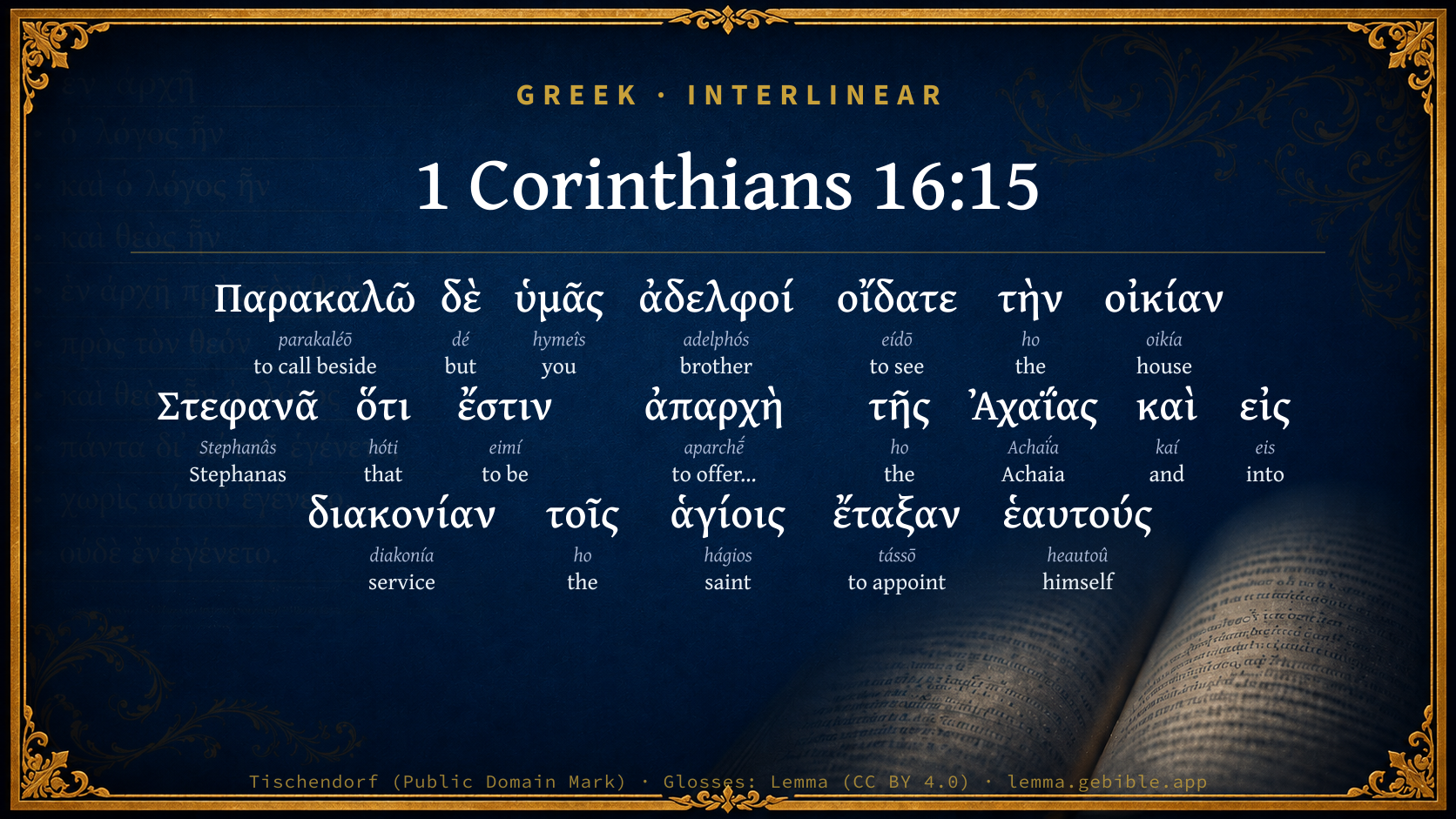
  1. Παρακαλῶ parakaléō G3870 “to call beside” Verb, Present, Active, Indicative, 1st person, Singular
  2. δὲ dé G1161 “but” Conjunction
  3. ὑμᾶς hymeîs G5210 “you” Personal pronoun, 2nd person, Accusative, Plural
  4. ἀδελφοί adelphós G80 “brother” Noun, Vocative, Plural, Masculine
  5. οἴδατε eídō G1492 “to see” Verb, Perfect, Active, Indicative, 2nd person, Plural
  6. τὴν ho G3588 “the” Article, Accusative, Singular, Feminine
  7. οἰκίαν oikía G3614 “house” Noun, Accusative, Singular, Feminine
  8. ὅτι hóti G3754 “that” Conjunction
  9. ἔστιν eimí G1510 “to be” Verb, Present, Active, Indicative, 3rd person, Singular
  10. ἀπαρχὴ aparchḗ G536 “to offer firstfruits” Noun, Nominative, Singular, Feminine
  11. τῆς ho G3588 “the” Article, Genitive, Singular, Feminine
  12. Ἀχαΐας Achaḯa G882 “Achaia” Noun, Genitive, Singular, Feminine
  13. καὶ kaí G2532 “and” Conjunction
  14. εἰς eis G1519 “into” Preposition
  15. διακονίαν diakonía G1248 “service” Noun, Accusative, Singular, Feminine
  16. τοῖς ho G3588 “the” Article, Dative, Plural, Masculine
  17. ἁγίοις hágios G40 “saint” Adjective, Dative, Plural, Masculine
  18. ἔταξαν tássō G5021 “to appoint” Verb, Aorist, Active, Indicative, 3rd person, Plural
  19. ἑαυτούς heautoû G1438 “himself” Reflexive pronoun, 3rd person, Accusative, Plural, Masculine

About this verse

These counts appear in no published source. They are computed here, from the morphology-tagged text and Lemma’s own curated glosses. What Lemma adds →

20
words
18
distinct lemmas
Pauline Epistles
section

Notable vocabulary

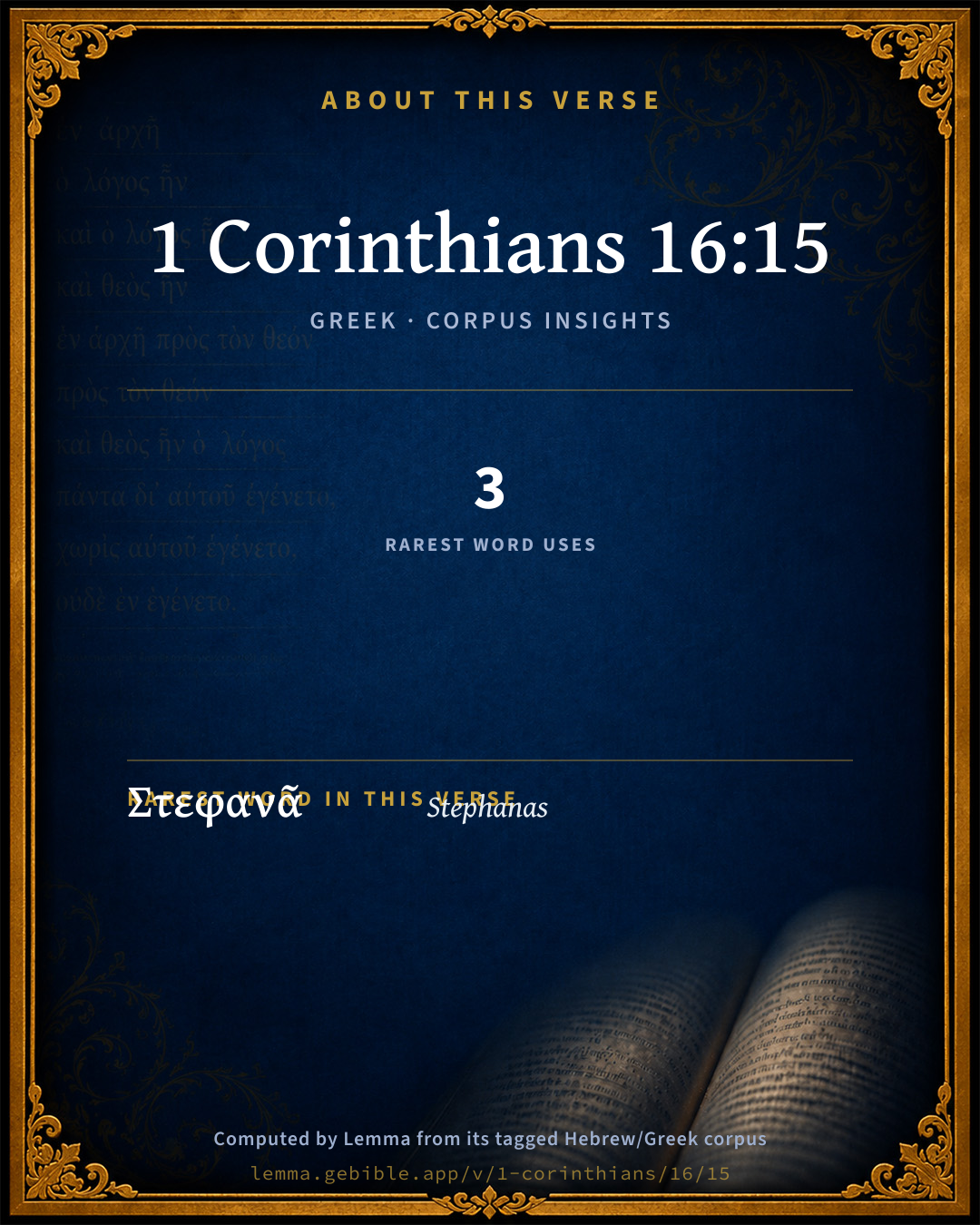
The rarest word here is Στεφανᾶ Stephanas G4734 — appearing just 3 times in the whole Greek New Testament.

Shared distinctive vocabulary

Στεφανᾶ Stephanas G4734 occurs in 3 verses of the Greek New Testament. Also found in:

Repetition

A word recurs within this verse:

Cross-references

17

Topical passages linked to 1 Corinthians 16:15 in the Treasury of Scripture Knowledge — connected by theme and wording, ordered by reader-vote popularity; previews shown in the World English Bible.

  • 1 Corinthians 1:16 (I also baptized the household of Stephanas; besides them, I don't know whether I baptized any other.)
  • Romans 16:5 Greet the assembly that is in their house. Greet Epaenetus, my beloved, who is the first fruits of Achaia to Christ.
  • Romans 15:25 But now, I say, I am going to Jerusalem, serving the saints.
  • Romans 12:13 contributing to the needs of the saints; given to hospitality.
  • Romans 16:2 that you receive her in the Lord, in a way worthy of the saints, and that you assist her in whatever matter she may need from you, for she herself also has been a helper of many, and of my own self.
  • 2 Corinthians 8:4 begging us with much entreaty to receive this grace and the fellowship in the service to the saints.
  • 2 Corinthians 9:1 It is indeed unnecessary for me to write to you concerning the service to the saints,
  • 1 Timothy 5:10 being approved by good works, if she has brought up children, if she has been hospitable to strangers, if she has washed the saints' feet, if she has relieved the afflicted, and if she has diligently followed every good work.
  • 1 Peter 4:10 According as each has received a gift, be ministering it among yourselves, as good stewards of the grace of God in its various forms.
  • Acts 9:36–41 Now there was at Joppa a certain disciple named Tabitha, which when translated, means Dorcas. This woman was full of good works and acts of mercy which she did.
  • Acts 18:12 But when Gallio was proconsul of Achaia, the Jews with one accord rose up against Paul and brought him before the judgment seat,
  • Romans 15:31 that I may be delivered from those who are disobedient in Judea, and that my service which I have for Jerusalem may be acceptable to the saints;
  • 1 Corinthians 16:17 I rejoice at the coming of Stephanas, Fortunatus, and Achaicus; for that which was lacking on your part, they supplied.
  • 2 Corinthians 9:12–15 For this service of giving that you perform not only makes up for lack among the saints, but abounds also through many givings of thanks to God;
  • Philemon 1:7 For we have much joy and comfort in your love, because the hearts of the saints have been refreshed through you, brother.
  • Hebrews 6:10 For God is not unrighteous, so as to forget your work and the labor of love which you showed toward his name, in that you served the saints, and still do serve them.
  • Revelation 14:4 These are those who were not defiled with women, for they are virgins. These are those who follow the Lamb wherever he goes. These were redeemed by Jesus from among men, the first fruits to God and to the Lamb.

Cross-references courtesy of OpenBible.info (CC BY 4.0).

Commentary

Notes on 1 Corinthians 16:15 from classic Christian and Jewish commentators (each source and its license shown beneath its notes). The classic Christian expositions comment on the surrounding passage and are grouped to its opening verse, so a note may address several verses; the Jewish commentaries on the Tanakh (Rashi and others) are per-verse, so they appear only where the commentator wrote on this verse.

Lemma curates 59 commentaries, every one of them public domain or Creative Commons licensed, each selected and text-cleaned for this edition rather than reprinted as found. About our sources →

Albert Barnes' Notes on the Bible

I beseech you, brethren - The construction here is somewhat involved, but the sense is plain. The words, “I beseech you,” in this verse, are evidently to be taken in connection with 1Co 16:16, “I beseech you that ye submit yourselves unto such,” etc. The design is to exhort them to pay proper deference to Stephanas, and to all who sustained the same rank and character; and the remainder of 1Co 16:15 is designed to state the reason why they should show respect and kindness to the household of Stephanas.

Ye know the house - You are acquainted with the household, or family. Probably a considerable portion, or all, of the family of Stephanas had been converted to the Christian faith.

Of Stephanas - See the note at 1Co 1:16. Paul there says that he had baptized his family. That it is the first-fruits of Achaia. They were the first converted to the Christian religion in Achaia; see the note at Rom 16:5. Respecting Achaia, see the note at Act 18:12.

That they have addicted themselves ... - That they have devoted themselves to the service of Christians. That is, by aiding the ministry; by showing hospitality; by providing for their needs; by attending and aiding the apostles in their journeys, etc.

Albert Barnes' Notes on the Bible (1834–1885) — public domain. Text from a community e-Sword/MySword module.

The Biblical Illustrator

Joseph S. Exell

1Co_16:15-18

Ye know the house of Stephanas, that it is the firstfruits of Achaia.

The house of Stephanas

I. Its happiness--united in--

1. Faith.

2. Hope.

3. Purpose.

II. Its true nobility--precedence of--

1. Heavenly birth.

2. Experience.

3. Rank.

4. Influence.

III. Its devoted service.

1. Love to the brethren.

2. Liberality of spirit.

3. Sincere attachment to the cause of Christ. (J. Lyth, D.D.)

The natural right of priority

We all feel interested in firstborn children, first forms of enterprise, firstfruits of our labour. Natural feeling gives all first things prominence. First things--

I. Are done with intense feeling, as we see in the youth beginning business, the man entering on a new undertaking. Men brace themselves up for first things, and having no experience as to what strength is required, often put too much into it. Happily life is full of these first things, especially early life, and they exert a most gracious influence on us.

II. Have a natural pre-eminence. The position and rights of the firstborn are an illustration of this. First things are felt to have a representative character. When a servant comes into a house the employers watch the first actions to see how they will frame. When a convert joins a Church the first forms in which Christian responsibility is met are closely scrutinised. Turning his mind back to their hopeful first things the apostle says to the Galatians, Ye did run well; who did hinder you?

III. Have promise for following things--as firstfruits have for harvest. A mans first work need not be his maximum standard, but it ought to be his minimum standard. A first result may tell of power, and power always holds the promise of what culture can make it. One convert made in a new sphere of labour holds the promise of a great ingathering.

IV. Keep a prominent place in the memory, e.g., our first school, first place of business, first love, first sickness, etc. (R. Tuck, B. A.)

That they have addicted themselves to the ministry of the saints.--

Ministering to the saints

I. A very needful work. Many of Gods children are poor, and need the necessaries of life; many are afflicted, and need sympathy; many are weak, and need taking by the hand (Gal_6:10).

II. A very honourable and beautiful work.

1. Angel-like (Heb_1:14).

2. Christ-like (Mat_20:28; Mat_25:40).

III. A work that may be exercised in many ways. Thus it is suited to all.

IV. A work that merits recognition on the part of the Church. Those so engaged should be--

1. Highly esteemed. They do much to elevate the tone of the Church; much to preserve it in peace and content; much to stimulate its zeal.

2. Encouraged. The work is trying. Those who encourage others often want much encouragement themselves.

3. Aided. This is probably what the apostle meant in verse 16. As they serve you, serve them.

V. A work very beneficial to the workers. They who water others shall themselves be watered. We grow rich by bestowing. A sure way of getting to heaven is to get others there. (W. E. Hurndall, M.A.)

That ye submit yourselves unto such.--

Submission due to the elders of the Church

I. Its obligation arises out of their--

1. Age.

2. Experience.

3. Services.

II. Its extent reaches as far as they act.

1. In conformity with the apostolic faith; and

2. Help forward its interests.

III. Its fruits.

1. Order.

2. Edification.

3. Unity. (J. Lyth, D.D.)

Service and honour

I. The vocation to spiritual ministry.

1. Its first condition is sincere personal adhesion to Christianity (verse 15).

2. Christian ministers are of the most various kinds. They vary with capacity, opportunity, necessity.

3. Such services involve co-operation. Some leading, others following, etc.

4. Ministering unto the saints is an especial form of acceptable service.

II. The honour and subjection due to those engaged in spiritual ministry.

1. Regard and gratitude. Paul here sets the example.

2. Help.

3. Submission. There are many who should be ready not only to work with, but to work under. (Prof. J. R. Thomson, M.A.)

Our duty to the truly useful

We should--

I. Cherish the highest respect for them. Stephanas was one of Pauls first converts in Achaia, and his family the only one Paul baptized in Corinth, He and his were addicted to the ministries of love. Fortunatus and Achaicus had supplied to Paul what the Corinthians had neglected. The truly useful are the only truly honourable. A man is to be honoured not because of his ancestry, his office, his wealth, but because of what he is morally, and what he does generously in the way of helping the race. The philanthropist is the true prince.

II. Heartily co-operate (verse 16).

1. Co-operate with useful men.

2. In your co-operation let them take the lead. They have proved themselves worthy of your co-operation. (D. Thomas, D. D.)

The Biblical Illustrator, edited by Joseph S. Exell (c. 1880s–1900s) — public domain. Text from a community e-Sword module.

Joseph Benson's Commentary

1Co 16:15-16. Ye know the house, or family, of Stephanas, that it is the first-fruits of Achaia — That he and they were the first converts in that province; and that they have addicted themselves — According to the rank in which Providence has placed them, and the abilities which God hath given them; to the ministry of the saints — To the supplying of their temporal and spiritual wants, both in promoting the progress of the gospel, and succouring the afflicted. That ye also — In your turn; submit yourselves to the admonitions of such; so repaying their free service. And to every one that helpeth with us, and laboureth — That labours in the gospel, either with or without a fellow-labourer.

Joseph Benson's Commentary on the Old and New Testaments (1811–1818) — public domain. Text from a community e-Sword module.

Whedon's Commentary on the Bible

Daniel D. Whedon

d. Paul intercedes with Corinthians in behalf of mutual friends, 1Co_16:15-18.

15. House of Stephanas—Mentioned in 1Co_1:16 as among the few baptized by Paul himself.

Firstfruits—See note on 1Co_15:23.

Ministry of the saints— Hospitalities and benefactions to poorer Christians, especially to the apostles and preachers.

Daniel D. Whedon (gen. ed.), Commentary on the Old and New Testaments (1874–1909) — public domain. Text from a community e-Sword module.

The Preacher's Complete Homiletical Commentary

Joseph S. Exell (gen. ed.)

CRITICAL NOTES

1Co_16:15.—Postscript-like personal matters begin here. Achaia.—This corrects the wrong reading in Rom_16:5. Stephanas’ household.—See 1Co_1:16. What a family picture! “Addicted to,” etc. Stanley (apparently alone) thinks the Stephanas of 1Co_16:17 the slave of this one, who had taken his master’s name, by a not unusual custom; Fortunatus and Achaicus being his fellow-slaves.

1Co_16:17.—No blame to the Corinthians in “lacking on your part”; they could not, so far away and without opportunity to visit Paul, do what these had done, viz. 1Co_16:18 (Php_2:30; Php_4:10 sqq.).

1Co_16:19. Church in … house.—Cf. 1Co_1:2; 1Co_16:1; Rom_16:5. See other cases, Col_4:15; Phm_1:2. Observe “salute you much.” They had lived in Corinth (Act_18:2); but are at Ephesus by Act_19:26.

1Co_16:20. A holy kiss.—Rom_16:16; 2Co_13:12; 1Th_5:26. “The common form of affectionate Eastern salutation, transferred to the forms of the Christian society, and hence the epithet of holy. The practice continued in Christian assemblies chiefly at the celebration of the Eucharist. The Apostolical Constitutions and the Canons of Laodicea enjoin that before the Communion the clergy are to kiss the bishop, the men amongst the laity each other, and so the women. On Good Friday it was omitted, in commemoration of the kiss of Judas.… It is still continued in the Coptic Church. Every member of the congregation there kisses and is kissed by the priest. In the Western Church it was finally laid aside in the thirteenth century.” (Stanley.)

1Co_16:21.—The authenticating autograph, 1Co_16:21-24. So 2Th_3:17. What shall it be? What shall he write? What is worthy of his own hand, after all this dictating to an amanuensis? “If any man,” etc. (1Co_16:22). Note the, shorter reading and punctuation. Maran atha.—“Syriac,” so-called. “The Lord … has? or will?… come.” “Cometh,” best. Very recently M. Halévy divides it “Marana tha,” and translates “Our Lord, come!” And in this is supported by (the Syrian) Archbishop David, of Damascus (Expos., 1889, p. 240). Quite a separate word from the word “Anathema,” N.B. “His grace;” “my love.”

HOMILETIC ANALYSIS.—1Co_16:15-24

Friends and Foes.

I. Friends—

1. Even in Ephesus, and because in Ephesus, where there are “many adversaries.” A day came when Paul, like his Master before His judge, stood friendless, “when no man stood by him,” not a Christian in all Rome daring to show himself as a friend of Paul in court that day (2Ti_4:10). Yet he was not forsaken: “The Lord stood by me, and strengthened … and delivered.” That is the supreme strength and support of a Christian man. But next to that is the “refreshing of spirit” when, to a hard-worked toiler in a dangerous post in Ephesus, some Stephanas or Fortunatus or Achaicus “comes,” bringing letters and tidings and supplies. Others brought ill news and disquieting (1Co_1:11, where, however, see note). Paul’s Master is careful that His servant shall not have all disquiet; these bring “supplies.” It is good to see a loyal Corinthian face again! [See another instance of God’s loving consideration, by way of alleviation and compensation (Php_2:27), “lest I should have sorrow upon sorrow.”] What worker for Christ does not recall many such instances, where the coming of friends has been as “cold water to a thirsty soul,” or as a “draught from a brook by the wayside” (Psa_110:7); a supply and comfort which was only typical of many another up-springing well of comfort in a very desert of isolated experience or labour. The highest service that friendship can be made to render, next to that of leading a soul to seek the Highest Friendship of all.

2. A new brotherhood is springing up.—“Greetings” fly across the Ægean between Ephesus and Corinth. There are “Churches in Asia” who join hands across the water with a Church in Corinth. Aquila and Priscilla have a “Church in their house” [as afterward they had in Rome (1Co_16:5)], which greets Corinth. Paul “greets” Corinth,—Corinth and not merely the party “of Paul.” Corinthian is to greet Corinthian “with a holy kiss,” though one may be a rich man and the other a slave. A new love has been born into the world, which forgets that Aquila is a Pontian Jew and Apollos an Alexandrian Greek, and that Stephanas and his friends are Corinthians. “See how these Christians love another!” See how this Paul loves the Timothy who is “his son in the faith.” See how he loves this Stephanas and his household. They were his “firstfruits”; in them he first tasted the joy of harvest in the field of “Achaia.” Christian and Christian, minister and convert, are the closest “kin.”

3. This new brotherhood is an organised thing.—The friends, the brethren, form themselves into Churches, “in a house,” “in Asia.” Of such units of construction “The Church” is being built up; and each unit in its essential feature is a miniature of the Whole; it is “a Church” as really as is the whole. Precedence and sequence are beginning to show, as in all human social life. Some are to “submit” to others, but it is only for their worth’s sake and their work’s sake. And their precedence is in service. Beyond most they “set themselves to minister to the saints” (R.V.). [“Whosoever would be chief among you, let him be your servant” (Mat_20:27).] In the Church there should never have been office or precedence which did not mean serviceableness to the welfare of the whole; there should never have been an official whose honour was not rooted in this: “He helpeth with us, and laboureth.” There should have been no fainéants amongst the Church’s exalted names. “Working helpers” should be “acknowledged,” and if needful “submitted to.” And in the long-run recognition and deference do come naturally to worth and work.

II. Foes.—There is but one foe: “he who does not love the Lord Jesus Christ.” Not love Him? Think slowly over His Name and full style: “Jesus”—“Lord”—“Christ.” Why in His very name Jew, Gentile, Man, have their share and place. Not love Him? The embodiment of all moral Beauty, Truth, Goodness; the True, the Beautiful, the Good, after which the philosophers sought, and of whose interrelations they disputed in endless discussion—they meet in Him; the simplest Christian is no seeker merely, he has “Heureka!” in his mouth, since he got to know “the Lord Jesus Christ”! Not love Him? Who has loved us to the death; Who for our sakes became poor with a “Great Renunciation” which is, according to any human standard, by any human calculus, quite an incommensurable quantity. Not love Him? What is the matter with the heart that does not love Him? Is it blind, or deaf, or dead? Can it not see, or know, or love Him? The unloving heart perhaps admires, and says, or sings, or writes, fine words about the Teacher of Nazareth; it may gather up its skirts, with a shrinking that is a reminder from former days of a real faith, or which is only an æsthetic shrinking from “bad form,” when some daring, outspoken man calls “Jesus” plainly “accursed,” (1Co_12:3); but Paul has no softer, lesser word for the loveless heart itself. Not love Him? “Anathema” the loveless one! That seems “unjust”? “You cannot command love?” Certainly; but it can be awakened or suppressed, cultivated or killed, by the man himself. He will cultivate or let it die, as toward Christ, according to the whole moral attitude he takes up. “Mere indifference” to Christ reveals an inner world of moral alienation, and at least a possibility of the very fiercest aversion. Between the man, almost demoniac, who screams, “Jesus is Anathema! Jesus is Anathema!” and the man who perhaps would shrink from saying it outright, but who really feels no interest in, and cares nothing for, Christ, the difference is rather one of possibility, of opportunity, of occasion, of provocation. Press Christ and His claims upon the “merely indifferent” man, and you either lead to submission, trust, love, or you provoke anger at yourself, and dislike, antagonism, hatred to Him. There is no being neutral in the presence of Christ and His claim. “For judgment he is come into this world;” He is the test of character, the Revealer of hearts, making a swift, sharp discrimination between friends and foes (Joh_9:39). There is no trace of a permission to put mere sincerity in the place of correct faith, of separating a man’s religion from a correct theology on this topic. No man can help taking sides for or against Him; for better or for worse no man can remain the man he was before, after once being really, clearly, intelligently confronted with Christ. To say nothing of His personal “character”; He makes—as is often urged by Christian controversialists—such claims for Himself; He assumes, as with perfect, simple right, such a position in regard both to God and men; He makes such assertions about Himself as are tanta mount to a claim to be, and to be honoured and accepted as, Divine in the highest, the exact, sense. Presuming His sanity, He leaves no alternative: either He is a blasphemer, and justly “Anathema,” or Divine and at once and forthwith to be “honoured even as men honour the Father.” “He that is not with Me is against Me.” Not to be His friend is to be a foe, and necessarily “under the ban.” And He “cometh”!

III. Paul’s outburst of feeling.—These last verses (chap. 16) have been, as it were, gradually “subsiding” from the often highly wrought interest and feeling of the body of the letter. The thought and tone have accompanied each other, as with the settling of a bird alighting, not suddenly, but in a series of gentle curves, each of which, though rising, ends at a level a little lower than it began, till one expects a quiet gliding in the last to the level ground. But instead there is this sudden dash upward; a volcanic, eruptive outburst of feeling. “Let all be in charity,” Paul had just said (1Co_16:14). What then is this? It is the Intolerance of Love. [Often pointed out that the “Apostle of love,” John, when a young man, was “Boanerges,” who would have called down fire upon the Samaritan village that would give no hospitality to Christ (Luk_9:54); and that the Boanerges temper is not extinct in the old man of ripest love and piety (1Jn_4:3; 2Jn_1:10). In each case it is to be observed how with John, as with Paul, it is the very intensity of conviction, and of devotion to Christ, which called out the fiery denunciation.] A man cannot be a lukewarm enemy, nor a lukewarm friend, of Jesus Christ. It is the “Intolerance of the Gospel” [title of a good sermon by A. Vinet], and throws much light upon the difficult question of the imprecatory psalms. At least it cannot be said without much qualification that they are wholly of an “Old Testament spirit,” in strong antithesis to that of the New. [Look, e.g., at 2Ti_4:14, “Lord … reward him according to his deeds!” (N.B. reading); Gal_5:10, “Shall bear his burden”; 1Co_5:12, “Circumcision? I would there were an excision; a clean excision of these men from the body of Christ”; hear Stephen denounce the Sanhedrin (Act_7:51-52), or Paul Bar-jesus (Act_13:10-11); hear Christ Himself denounce the Pharisees, “Fill ye up the measure of your fathers!” (Mat_23:32); hear John, “I do not say that he shall pray for it,”—as though he had been brought into such a perfect accord with God’s own abhorrence of sin, such a perfect acceptance of the righteousness of the heaviest judgment of God upon it, that he anticipates the day when the saved and the heavenly host shall together stand in holy aloofness from the condemned Harlot-evil of the universe, and, over the very judgments of God, shall solemnly sing an exultant “Alleluia!” (Rev_19:1-5).] The New Testament cannot tolerate indifference to Christ or the Truth. No Christian man can leave it an open question whether his Master be “Jesus of Nazareth” or “Our Lord Jesus Christ.” It is no question of exactly agreeing about the doctrinal phraseology of a creed; but of a love to the personal Christ, which has sometimes co-existed with an imperfect creed about Him. [E.g. Dr. Adam Clarke denied the eternity a parte ante of His Sonship.] It is not the intellectual rightness of the man which is in issue, but the moral state of the man’s heart. The Godhead of Christ is a test question indeed, as men must apply tests; the moral attitude toward Christ, be He what He may, is the deeper thing which stirs Paul’s heart. “He may not accept, or totidem verbis repeat, my Christology; but does he love my Christ? If not, let him be Anathema.” If we are not so outspoken, or so confident in our condemnation, we should inquire whether our devotion to Christ is less intense; whether our convictions are as deep as Paul’s; whether truth is of as much certainty and importance to us. Loyalty to Christ may sometimes need to override all considerations of conventional courtesy and “charity” and liberality. (See also Separate Homily under 1Co_16:22.)

The Benediction.

The “bird” does “alight,” and very quietly! The outburst of 1Co_16:22 is quite compatible with a perfect peace and self-control within Paul’s soul. He passes as easily from it to these words of tender farewell, as he did from the Resurrection to the Collection (above). “His grace, my first and greatest wish for you at Corinth. My love, less, but not less real, with you also; and I wish it not with the mere good feeling of a benevolent heart; I wish it ‘in Christ Jesus’ ” Paul’s heart is full of Christ’s heart; to him “to live,” and so to greet his Churches, “is Christ.”

SEPARATE HOMILIES

1Co_16:22, connected with 2Co_1:20; 2Co_8:9; 2Co_9:15, may be made the occasion of a sermon on Undesigned Illustrations of “To me to live is Christ.”

I. (2Co_1:20.) Paul had not kept to the route announced in the First Epistle—to Macedonia viâ Corinth. He had gone by the direct, shorter road, viâ Troas. The factious party seized upon this change of route. Said they to the loyal ones: “See this Paul of yours! What dependence on his word? He promises and fails; says he will come and does not.” Others, with more malice: “He wrote a very bold letter, and was going to follow it up with a visit; but your valorous apostle dares not come to Corinth.” This chapter very largely his indignant protest, his defence of his character and conduct. He appeals to his conscience whether all his conduct amongst them was not “in simplicity and godly sincerity.” He calls the True God to witness that he was never amongst them a “Yes and No” man, saying and unsaying in a breath, affirming one day, the next denying what he had affirmed, wavering in his own mind between “Yea” and “Nay.” If he had changed his plan, it was for good and sufficient reasons. But this vindicating of himself was uncongenial work. To him to live was not Paul, but Christ. His character as a man is to him only a matter of importance as it affected his character as a preacher of Christ’s Gospel. Every word in his preaching was “Yea.” He was no man to preach doubts or hints of doubt, or to give to his readers opinions crudely formed or loosely held. And then his thought by instinct rises to and rests in his Lord, the same yesterday, to-day, and for ever; Himself the great Promise and the great Ratification of all promises besides. This grand outburst in the midst of all this personal vindication, is a digression, a parenthesis; but he cannot help putting it in. Self-vindication is irksome. Christ exaltation is ever welcome. A word of it relieves him before he resumes the personal talk. To him “to live is Christ.”

II. (2Co_8:9.) Paul puts the Corinthians on their mettle, and tries to shame them into diligence. He has been telling all the Churches, up and down: “Achaia was ready a year ago.” With their zeal he has been calling out the zeal and generosity of many. He begs that they will not shame his boasting when the Macedonian (and other) delegates come with him to Corinth. Macedonia is a model to them, giving even “beyond their power.” Surely Corinth will not be behindhand. And with appeals to such motives many would have stopped. Not so this man; to him “to live is Christ,” and to him the motive to plead is, “Ye know the grace,” etc. In the next verse he is back again to the Fund. But the parenthetic insertion is significant as to this man’s habit of heart. He gladly escapes away from the Fund and laggard Church benevolence into a world of everlasting, world-concerning truth, and to his best-loved theme—his Lord who became a beggar to make him eternally rich.

III. (2Co_9:15.) With startling abruptness he breaks out: “Thanks be unto God,” etc. The chapter has been full of small details about the Fund, and his plans, and the movements of Titus. What has this outburst to do with the collection? Nothing. Everything. He sits dictating his letter. In the pauses, whilst the writer is doing his part, Paul’s mind goes off upon a well-known path. Every thought of this benevolence of saints to saints is pregnant to him with suggestion of a greater benevolence. He cannot think of these gifts of Church to Church without his thoughts flying off to the ever-welcome topic, God’s Gift to sinners. There is bounty! There is the root and the rule of all kindness between Christian and Christian! And as the amanuensis is finishing the last words dictated, his friend and teacher breaks out, “Thanks be to God for,” etc. For twenty years he had been studying Christ from all sides: the love that did not spare even Him; the grace of the Son which resigned such native dignity and glory; the misery, here and hereafter, of an unredeemed world; the eternally growing blessing flowing from the work of Christ. The twenty years of pondering express their result in one word; they are condensed into this “irrelevant,” parenthetic cry: “Unspeakable! Unspeakable! God’s unspeakable Gift! Thank God for Christ!”

IV. (Here 1Co_16:22.) He is in Ephesus, getting his letter off. He takes pen in hand to add the authenticating autograph sentence. Usually it is a benediction. In this letter all sorts of topics have been discussed: the resurrection and the collection, the Lord’s Supper and the women’s hair,—grand themes of eternal importance, and mere regulations no longer concerning men except in the underlying principles of which they are particular, passing embodiments. And now the letter is finished. What shall he add “with his own hand”? What he does add is: “If any man … Anathema!” There is apparently nothing to suggest it. But Christ never needs “suggesting” to Paul. To him “to live is Christ.” Within him is a heart of burning love for Christ. The fire breaks out here with eruptive force, but it is always burning. He loves Christ. Who would not? Not love Christ! Not love the Christ he loves! “Accursed be the man who does not love my Christ!” It is the intolerance of devoted love. This spontaneous, irrelevant, fierce exclamation is consummate proof that this man, Paul, has only one love, one thought, one object in life. To him to live is Christ, CHRIST, CHRIST!—H. J. F. From article in “Homiletical Magazine,” Jan. 1883 (condensed).

The Preacher's Complete Homiletical Commentary (gen. ed. Joseph S. Exell; Funk & Wagnalls, c. 1892) — public domain (pre-1929). A full-Bible homiletical/sermon-outline anthology covering 65 of 66 books (2 John is absent from the source module). Text from a community e-Sword module.

Bengel's Gnomon

Johann Albrecht Bengel

1Co 16:15. Τοῖς ἁγίοις, to the saints) The Dative is governed by διακονίαν, ministry. To the saints of Israel, for they were the first fruits of Achaia.—εἁυτοὺς, themselves) spontaneously [These were the very persons, who had come from Corinth to Paul, 1Co 16:17.—V. g.] The more voluntary the service in difficult circumstances, the more agreeable and praiseworthy. 2Co 8:16-17; Isa 6:8.

Bengel's Gnomon of the New Testament — English translation (T&T Clark, Edinburgh, 1860) — public domain. Text from a community e-Sword module.

Meyer's Critical & Exegetical Commentary

Heinrich August Wilhelm Meyer

1Co_16:15-18. Commendation of the three Corinthian delegates who had brought to the apostle the letter of the church; first of all (1Co_16:15 f.) and chiefly, of Stephanas (1Co_1:16) and his house. The special expression which Paul gives (1Co_16:16) to the commendation of Stephanas must have been grounded in some antagonism unknown to us, which the man had to lament in his work for the churc.

παρακαλῶ] The question is, Whether the exhortation itself begins at once with οἴδατε (so that the latter would be imperative), or only with ἵνα, so that οἴδατε would be indicative, and the passage ending with ἑαυτούς would put forward the motive in the first place? The latter is the ordinary view and the only correct one, for οἴδατε as an imperative form (instead of ἴστε) cannot be pointed out (in opposition to Erasmus, Wolf, Heydenreich); on the supposition of its being imperative, εἰδέναι would require to be taken as in 1Th_5:12 (ut jubeat agnosci bene meritos, Erasmus); on the view of its being indicative, it is the simple know. The construction is the ordinary attraction οἶδά σε τίς εἶ, and οἴδατε … ἑαυτούς is an auxiliary thought which interrupts the construction (comp. Dissen, ad Dem. de Cor. p. 34 b).

ἀπαρχὴ τῆς Ἀχ.] i.e. the first family which had accepted Christianity in Achaia; the holy first-fruits of the land, in so far as it was destined to become, and was in process of becoming, Christian. Comp. Rom_15:6.

ἔταξαν] The plural, on account of the collective οἰκία. They have set themselves (voluntarily devoted themselves and placed themselves at the post) for the service of the saints. Instances of τάσσειν ἑαυτόν in this sense may be seen in Wetstein and Kypke, II. p. 234. Comp. Plato, Rep. p. 371 C: ἑαυτοὺς ἐπὶ τὴν διακονίαν τάττουσι ταύτην, Xen. Ages. ii. 25, Mem. ii. 1. 11. Beza denies the emphasis of ἑαυτούς, unwarrantably, but in the interest of the vocatio legitima.[109] We have no more precise knowledge of the historical circumstances here pointed to. Perhaps Stephanas devoted himself also especially to journeys, embassies, execution of special commissions, and the like; his wife, to the care of the poor and sic.

ΤΟῖς ἉΓΊΟΙς is an appropriating dative to ΔΙΑΚ. See, already, Raphel, Xenoph. in loc.; Bernhardy, p. 88. By οἱ ἅγιοι are meant the Christians, as in 1Co_16:1; not, however, the mother church at Jerusalem (Hofmann). A reference to prosecuting the collection (in connection with which people had, it is supposed, been refractory towards Stephanas) lies wholly remote from the word.

καὶ ὑμεῖς] You too. The καί finds its reference, according to the context, in what goes before: ΕἸς ΔΙΑΚ. Τ. ἉΓ. ἜΤΑΞ. ἙΑΥΤ. Wetstein is right, therefore, in saying: illi vobis ministrant; aequum est, ut vos illis vicissim honorem exhibeatis (rather: obsequamini).

ὑποτάσσ.] namely, to their proposals, exhortations, etc. Ewald and Ritschl regard Stephanas as one of the overseers of the church; a relation which, however, would have required a more precise and definite designation than the general and qualitative τοῖς τοιούτοις. See, besides, on 1Co_1:17.

ΤΟῖς ΤΟΙΟΎΤΟΙς] to those who are so affected, indicates, in a generalizing way, the category to which Stephanas and his house belong. This generalization, by which the injunction of obedience towards the concrete persons comes out in a less strict and immediate form, but in which it is still implied, is a delicacy of expressio.

τῷ συνεργ.] The reference of the ΣΥΝ is given by the context from ΤΟῖς ΤΟΙΟΎΤΟΙς; hence: who works with them, i.e. in fellowship with them, which presupposes harmony in the spirit and purport of the work. Comp. Chrysostom. While Rückert leaves us our choice between three supplements contrary to the context: τῷ θεῷ (1Co_4:9), ἘΜΟΊ (so Erasmus), and ὙΜῖΝ (2Co_1:24), Hofmann adds a fourth arbitrary supplement: helpful to increase the kingdom of God. This design is of course taken for granted of itself, but does not explain the συν.

καὶ κοπιῶντι] and takes pains (therein), gives himself trouble about it. Comp. 1Co_15:10, 1Co_4:12; Gal_4:11; Rom_16:6.

[109] Which does not fall to be considered here, since there is no mention of entrance upon an ecclesiastical office.

Meyer — Critical and Exegetical Commentary on the New Testament — English translation by Peter Christie, edited by Frederick Crombie (T&T Clark, 1880) — public domain. Text from a community e-Sword module.

Expositor's Greek Testament

ed. W. Robertson Nicoll

1Co 16:15-16 urge particular instances of the above ἐν ἀγάπῃ γινέσθω . The ἵνα clause of 1Co 16:16 is complementary to παρακαλῶ (see note on 1Co 1:10 ), and is suspended to make room for the explanatory οἴδατε … ἑαυτοὺς : “you know that the household of Stephanas is the first-fruit of Achaia, and that they set themselves for ministering to the saints”. τὴν οἰκίαν κ . τ . λ ., acc [2679] by attraction to οἴδατε , according to the well-known Gr [2680] usage with vbs. of this class (Wr [2681] , p. 781). There were earlier individual converts in Achaia (see Act 17:34 ), but with this family the Gospel took root in the province and the earnest appeared of the subsequent ingathering: cf. Rom 16:5 ; also 1Co 1:16 above, and note. The St. family must have been of independent means; for ἔταξαν ἑαυτοὺς ( they arrayed or appointed themselves made this their business) implies a systematic laying out of themselves for service, such as is possible only to those free to dispose, as they choose, of their persons and their time; see this idiom in Plato, Rep ., ii., 371C. “The saints” can hardly be the Jerus. saints of 1Co 16:1 , since εἰς διακονίαν is quite general, and the last words of 1Co 16:16 imply manifold Christian labour; the present commission of St. to Eph. is an instance of “service to the saints”. P. “exhorts” his “brethren … that you also (in return for their service to you) submit yourselves to such as these ( τ . τοιούτοις , referring to the interpolated οἴδατε κ . τ . λ .), and to every one that shares in the work and labours”. These persons did not constitute a body of Church officers; we find no traces as yet of an official order in the church of Cor [2682] : the Ap. enjoins spontaneous submission to the direction of those able and disposed to lead in good works. The prp [2683] in συν - εργοῦντι refers not to St. specifically, still less to P., but generally to co-operative labour in the Church, while κοπιῶντι implies labour carried to the point of toil or suffering (see note on κόπος , 1Co 3:8 ; also 1Co 15:58 ). Loyal and hard work in the cause of Christ earns willing respect and deference in the Church: cf. 1Th 5:12 f.

[2679] accusative case.

[2680] Greek, or Grotius’ Annotationes in N.T.

[2681] Winer-Moulton’s Grammar of N.T. Greek (8th ed., 1877).

[2682] Corinth, Corinthian or Corinthians.

[2683] preposition.

The Expositor's Greek Testament, edited by W. Robertson Nicoll (1897–1910) — public domain. Text from a community e-Sword module.

Godet's Commentaries

Frédéric Louis Godet

Vv. 15, 16. “I beseech you, brethren: Ye know the house of Stephanas, that it is the first-fruits of Achaia, and that they have addicted themselves to the ministry of the saints. 16. That ye submit yourselves unto such, and to every one that helpeth with us, and laboureth.”

The most natural construction is not to make 1Co 16:16 the object of παρακαλῶ: “I exhort you to submit yourselves,” but to take this verb in the absolute sense: “I have an exhortation to address to you.” The ἵνα of 1Co 16:16 will specify the contents of this exhortation. In the interval there is indicated the motive which justifies this request: Ye know...For the ὅτι, that, comp. 1Co 1:4-5. Stephanas and his house had been, according to 1Co 1:16, baptized by Paul himself; which seems to prove that their conversion took place before the arrival of Silas and Timothy at Corinth; the fact agrees with the title “first-fruits of Achaia,” which is given them here.

On this ground alone they are worthy of respect; but they possess another: namely, the earnestness with which they have devoted themselves to the service of the Church. There is nothing here to indicate an ecclesiastical office strictly so called. The phrase: τάσσειν ἑαυτόν, frequent in classic Greek, rather denotes a voluntary consecration. The reference doubtless is to their readiness to care for the poor and the sick and the afflicted; to charge themselves with the business of the Church, deputations, journeys, paying for them personally (ἑαυτούς, themselves), as the delegates at present with the apostle had done. Hofmann thought that the ministry of the saints here denoted the collection for the Church of Jerusalem (1Co 16:1-4); comp. Rom 15:31; 2Co 9:12. But the context does not lead to this special sense.

Vv. 16. This respectful deference ought to be extended to every one who voluntarily makes himself like those of whom Paul has just spoken; their fellow-labourer by working for the good of the Church. There is an evident correspondence between the two verbs ὑποτάσσεσθαι and ἔταξαν of 1Co 16:15. The σύν, with, in συνεργοῦντι, who acts with, cannot signify: acting with God, or with Paul, or with the Corinthians, but only: with them that are such, τοῖς τοιούτοις. The term κοπιᾶν, to labour, relates to the varied works in the kingdom of God, and contains the accessory idea of painful labour; comp. Gal 4:11; Rom 16:6. It is plain from this exhortation that the Corinthians were naturally prone to be lacking in submission and respect to those whom their age, experience, and services naturally pointed out for the veneration of the flock. The same defect appears from the letter which Clement of Rome was called forty years later to address to this Church.

Frédéric Louis Godet — Commentaries on Luke, John, Romans, and 1 Corinthians — English translation (T&T Clark, Edinburgh, 1870s–1890s) — public domain. Text from a community e-Sword module.

Hodge's Commentary on Romans, Ephesians & First Corinthians

Charles Hodge

1Co_16:15, 1Co_16:16

I beseech you, brethren, [ye know the house of Stephanas, that it is the first-fruits of Achaia, and (that) they have addicted themselves to the ministry of the saints,] that ye submit yourselves unto such, and to every one that helpeth with (us,) and laboreth.

The family of Stephanas was the first family in Achaia that embraced the gospel. In Rom_16:5, Epenetus, according to the common text, is said to have been the first-fruits of Achaia; but there the true reading is Asia; so that there is no conflict between the two passages. Of the family of Stephanas it is said, that they addicted themselves to the ministering of the saints, i.e. devoted themselves to the service of believers. The expression does not necessarily involve the idea of any official service. The exhortation is, that ye also submit yourselves to such. As they serve you, do you serve them. Nothing is more natural than submission to the good. And to every one that helpeth with (such), and laboreth. This may mean, submit yourselves to every one who co-operates with such persons; i.e. to all who in like manner are addicted to the service of believers. Those who serve, should be served.

Charles Hodge — Commentary on Romans (1835), First Corinthians (1857), and Ephesians (1856) — public domain. Text from a community e-Sword module.

Geneva Bible (1599)

Geneva Bible translators

Stephanas is the name of a man and not of a woman.

Given themselves wholly to the ministry.

Geneva Bible (1599) marginal notes — public domain. Text via Bolls.life.

Jamieson, Fausset & Brown

Robert Jamieson, A. R. Fausset & David Brown

first-fruits of Achaia--the first Achæan converts (compare Rom 16:5). The image is from the first-fruits offered to the Lord (Lev 23:10; compare Co1 15:20). The members of this family had been baptized by Paul himself (Co1 1:16).

addicted themselves to the ministry of the saints--Translate, "Set themselves, (that is, voluntarily) to minister unto the saints" (compare Co2 8:4).

Jamieson, Fausset & Brown — Commentary Critical and Explanatory on the Whole Bible (1871) — public domain (CC PDM 1.0). Text via the HelloAO Bible API.

Adam Clarke's Commentary

Verse 15. Ye know the house of Stephanas] Ye know that Stephanas and his family have addicted them to the help of the followers of Christ; they have been the chief instruments of supporting the work of God in Achaia, of which work they themselves have been the first fruits. See Clarke on Ro 16:5.

Adam Clarke's Commentary on the Bible (1810–1826) — public domain. Text from a community e-Sword/MySword module.

Ellicott's Commentary for English Readers

(15) The house of Stephanas.—The Apostle here reminds the Corinthians that the devotion of teachers, and all who serve in the gospel ministry, ought to be rewarded with a return of sympathy and devotion on the part of those whom they serve. There is in the original a characteristic play upon words here which can scarcely be rendered adequately in the English: “Ye know the house of Stephanas, that they have ordered themselves to the ministry of the saints, now I exhort you, order yourselves to be subject to them.” Stephanas (1Co_16:1-16), Fortunatus, and Achaicus had come from Corinth to Ephesus, probably with the letter from the Corinthians (1Co_8:1), and their presence had cheered the Apostle. They, “faithful amid the faithless,” had made up for the want of zeal and love on the part of so many of the Corinthians. The Corinthians might think that these men had told St. Paul much of the evil state of Corinth, and he, therefore, carefully commends them to their consideration as having refreshed, not only his spirit, but “theirs also.” They had come on behalf of the whole Church there, not enemies to bear tales, but well-wishing friends to obtain apostolic help and counsel for all. The Apostle did not send his reply back by the same messengers, but by Titus instead, as probably their return to Corinth would have stirred up a good deal of controversy and ill feeling as to what account they had given him verbally of the various parties and their conduct in Corinth.

A Bible Commentary for English Readers, edited by Charles John Ellicott (1878–1897) — public domain. Text from a community e-Sword module.

The Cambridge Bible for Schools and Colleges

gen. ed. J. J. S. Perowne

15. the house of Stephanas] See note on ch. 1Co_1:16.

the firstfruits of Achaia] Not necessarily the very first converts, but among the very first. See Rom_16:5. ‘Achaia’ is used by St Paul to denote the Peloponnesus, now called the Morea.

to the ministry of the saints] Rather, to service for the saints. The context would imply that they had not confined themselves to ministering to the temporal necessities of the saints, but had given valuable assistance to St Paul in his spiritual ministrations. See next verse.

The Cambridge Bible for Schools and Colleges (gen. ed. J. J. S. Perowne; Cambridge University Press, 1878–1918) — public domain. Text from a community e-Sword module.

John Gill's Exposition

I am glad of the coming of Stephanas, and Fortunatus, and Achaicus,.... Who very probably were those of the household of Chloe, mentioned in Co1 1:11, who came either of their own accord, or were sent as messengers from the church at Corinth to the apostle; who was glad to see them, one of them being baptized by him, and perhaps all of them converted under his ministry: however, they were believers in Christ, if not ministers of the Gospel, which seems very probable.

For that which was lacking on your part they have supplied; which is not to be understood of their supplying him with money, in which the Corinthians had been deficient; for as he had never taken anything of them, he was determined he never would; see Co2 11:7; but either of their presence which supplied the want of theirs, the apostle had been for some time greatly desirous of; or whereas they had been greatly wanting in sending him an account of the state of the church, and how things stood with them, these brethren greatly supplied that defect, by giving him a very particular account of their church affairs.

John Gill's Exposition of the Whole Bible (1746–1763) — public domain (CC PDM 1.0). Text via the HelloAO Bible API.

Trapp's Complete Commentary

John Trapp

15 I beseech you, brethren, (ye know the house of Stephanas, that it is the firstfruits of Achaia, and that they have addicted themselves to the ministry of the saints,)

Ver. 15. To the ministry of saints] To serve them in collecting and distributing alms to the nessissitous.

John Trapp, A Commentary or Exposition upon All the Books of the Old and New Testament (1647–1656) — public domain. Text from a community e-Sword module.

Haydock's Catholic Bible Commentary

The first-fruits fo Achaia; the first there converted. (Witham)

George Leo Haydock (1774–1849), Haydock's Catholic Family Bible and Commentary, 1859 edition — public domain. Excludes Psalms (Douay-Rheims chapter numbering differs from Protestant) and Deuterocanonical books (Catholic canon only).

Matthew Poole's English Annotations

Of this Stephanas we read before, 1Co 1:16; his family was one of those few families which Paul baptized: he is here called

the first-fruits of Achaia, because (as it should seem) he was one of the first of all those who in that courtry received the gospel. He further saith of him, that he had given up himself

to the ministry of the saints, either in preaching the gospel, or (which is more probable) in the proper employment of a deacon, in relieving such amongst the saints (whether of that or other churches) as were in want.

Matthew Poole's English Annotations on the Holy Bible (1683–1685) — public domain. Text from a community e-Sword/MySword module.

The Pulpit Commentary

Ye know the house of Stephanas. This paragraph seems to have been written lest the Corinthians should be angry with Stephanas, Fortunatus, and Achaicus who, perhaps, were slaves of the household of Chloe for having carried to St. Paul their ill report. (1Co_1:11) The firstfruits of Achaia. For which reason St. Paul had baptized Stephanas and his house. (1Co_1:16) In Rom_16:5 Epaenetus is called "the firstfruits of Achaia," but there the reading ought to be, of Asia. Have addicted themselves; rather, they set themselves.

Vers. 15-18.

Our duty to the truly useful.

beseech you, brethren," etc. The subject of these verses is our duty to the truly useful, and

I FOR THE TRULY USEFUL WE SHOULD CHERISH THE HIGHEST RESPECT. There are three useful persons that Paul mentions here. "Stephanas." He was one of Paul"s first converts of Achaia; he and. his house were baptized by Paul, and he and his family were "addicted" to the ministries of love. "Fortunatus and Achaicus" are also mentioned here. To these three personages Paul calls the special attention of the Corinthians, and that because they were useful. They had all ministered to Paul. The latter had supplied to him what the Corinthians had neglected, and they refreshed both his spirit and theirs; hence for this he says, "Acknowledge ye them that are such." The truly useful are the truly honourable. A man is to be honoured, not because of his ancestry, his office, his wealth, but because of what he is morally, and what he does generously in the way of helping the race. The philanthropist is the true prince.

II WITH THE TRULY USEFUL WE SHOULD HEARTILY COOPERATE. "That ye submit yourselves unto such, and to every one that helpeth with us, and laboureth.

1. Cooperate with useful men.

2. In your cooperation let them take the lead. They have proved themselves worthy of your cooperation.

Vers. 15, 16.

Service and honour.

As the family that had first in Achaia received the gospel, Stephanas and his household were regarded by the apostle with peculiar interest and affection. The manner in which they are introduced in this passage is highly instructive and suggestive.

I THE VOCATION TO SPIRITUAL MINISTRY.

1. Its first condition is sincere personal adhesion to Christianity. Stephanas and his household were converted, baptized, and well instructed in the Christian faith. It was when their had become penetrated with the Spirit of Christ that they were impelled to holy and devoted service. We cannot expect men and women to become unselfish labourers for the welfare of their fellow men, until they have come under the new and Divine motive and power.

1. Christian ministries are of many and very various kinds. These vary with the capacity and opportunity of the labourers, and the necessities of those whose welfare is sought. Too limited a view of ministry is frequently taken; the fact is, that whatever service men render to their fellow men, for the

2. sake of Christ, is a Christian ministry. Not only the preaching of the gospel, but the instruction of the young, the nursing and healing of the sick, the showing of kindness and hospitality, the supporting with generosity of benevolent undertakings, all fall into this class.

3. Services of such kinds involve both labour and cooperation. His people find a pleasure in offering to Christ, their Lord, that which costs them something. And. they delight to help one another; some leading and others following, but all setting before them the same end, and toiling in the same spirit.

1. Ministering "unto the saints" is an especial form of acceptable service. From the beginning Churches have cared for their widows, and for their poor and aged members. The household of faith has a peculiar claim upon the sympathy and affection and liberal support of the Saviour"s friends.

II THE HONOUR AND SUBJECTION DUE TO THOSE ENGAGED IN SPIRITUAL MINISTRY.

1. They should be treated with especial regard and gratitude. Paul himself honoured the good Stephanas and his like-minded wife and household, and he reminded the Corinthians that a family among themselves so distinguished in the annals of the Church, and so dear to the apostle"s heart, should be esteemed highly in love for their work"s sake.

2. They had a claim upon such as were in a position to render them help in the good cause. Doubtless it was the case at Corinth, as elsewhere, that the burden was too readily left upon the shoulders of those disposed to bear it. But this ought not to be. "When one man is seen working hard for Christ, his neighbour should put to himself the question, "Can I help my brother, relieve him of some pressure, or render his labour more effective?

3. Submission is, in many cases, a duty in Christian Churches. There are those whom we should be ready not only to work with but to work under.

T.

Ministering to the saints.

I A VERY NEEDFUL WORK. Many of God"s children are poor children. The saints who presently shall inherit all things, at present often lack the necessaries of life. Not a few of God"s choicest servants are afflicted, and need sympathy and aid. Persecution for the faith should be counteracted as far as possible by careful ministration. In early days imprisoned saints were specially cared for by those at liberty. "Remember those who are in bonds." In modern forms of persecution aid is equally needful. Many need to be "taken by the hand." "As we have therefore opportunity, let us do good unto all men, especially unto them who are of the household of faith". (Gal_6:10)

II A VERY HONOURABLE AND BEAUTIFUL WORK. Angel like: they are "ministering spirits, sent forth to minister for them who shall be heirs of salvation". (Heb_1:14) Christ like: "The Son of man came not to be ministered unto, but to minister". (Mat_20:28) At last the Lord will say, "Inasmuch as ye have done it unto one of the least of these my brethren, ye have done it unto me". (Mat_25:40) Many do not rightly estimate this "high calling." True love for the brethren (a sign of our salvation, (1Jn_3:14) will make us diligent in this service.

III A WORK WHICH CAN BE EXERCISED IN MANY WAYS. Thus suited to the abilities and opportunities of a large number. Many are idle in our Churches because they can find nothing to do. Let them look in this direction. Visiting the sick, condoling with the bereaved, relieving the destitute, cheering the depressed, securing rest for the overworked, guiding the perplexed, encouraging despondent workers (ministers, sabbath school teachers, etc.), how many might find a suitable sphere in such holy ministries as these!

IV A WORK WHICH MERITS RECOGNITION ON THE PART OF THE CHURCH. Those who engage actively in such service as this should be:

1. Highly esteemed. It is no slight service which they render. They do much to elevate the tone of the Church; much to preserve it in peace and content; much to stimulate its zeal.

2. Encouraged. The work is trying. Those who seek to encourage others often need very much encouragement themselves.

3. Aided. This is probably what the apostle means by "Submit yourselves unto such." "As they serve you, do you serve them." Above all, no obstacles should be put in their way.

V A WORK VERY BENEFICIAL TO THOSE WHO ENGAGE IN IT. "They who water others shall themselves be watered." Here when we give we take. We grow rich by bestowing. Christians stagnate because they think of themselves. Saints take so much care of themselves that they become spiritual invalids. We may "sit under" our own ministry with great profit. A sure way of getting to heaven is resolving that some one else shall get there. Labours for others make us blind to our own troubles. If our ears are filled with the cries of the needy, we shall not be able to hear the croakings of sceptics or the evil prognostications of Satan. True ministering to the saints is truest ministry to ourselves. H.

The natural right of priority.

firstfruits of Achaia." We need not think of the household of Stephanas as being actually the first converts St. Paul made. in the Peloponnesus, as apparently another person is spoken of in the same terms Rom_16:5: "Salute my well-beloved Epsenetus, who is the firstfruits of Achaia unto Christ." The meaning need only be that the household of Stephanas was among those brought to Christ at St. Paul"s first missionary visit. The apostle had an affectionate regard for his first converts in new spheres, as may be illustrated in the case of Lydia at Philippi. The interest we always feel in first things can be illustrated by way of introduction.

1. Firstborn children.

2. First forms of enterprise.

3. Firstfruits of our labour, etc.

Natural feeling gives all first things prominence; and the Old Testament history and religion rested on the recognition of the rights of the firstborn and the interest of first things. They are the key to the life; the strong impress of the character. They are like the first proofs of an engraving; every line is sharply defined in them. They may become the reproach of our weaker after doings, for they show what we did actually attain once, and prove that we could, through life, have done better. It is, however, the hope and promise of first things on which we now propose to dwell.

I FIRST THINGS ARE DONE WITH INTENSE FEELING. Illustrate from the youth beginning business life; the man entering on a new undertaking; the missionary going forth to his new sphere, etc. Men brace themselves up to deal with new things. They have no experience to tell them what amount of strength the new work will demand, so they are likely to put too much into it. A vague but arousing wonder clings all about new things, and imagination makes them bigger and better than they are. At first we fail to estimate difficulties, qualifications, hindrances; we start out like Israel, and expect to reach our Canaan quickly: so all our hearts go out into our first things. And happily life is full of them, especially early life, and they exert a most gracious influence on us, for they again and again lift us out of ourselves and above ourselves.

II FIRST THINGS HAVE A NATURAL PRE-EMINENCE. Of this the position and rights of the firstborn sons are but the illustration. First things are felt to have a representative character; they are the natural leaders of all that come after them the specimens and examples of their sort. In all the spheres of life we give prominence to beginnings. When a servant comes to a new situation, the master or mistress watch the first actions to see "how they will frame." When a convert joins a Church, the pastor give prominence to the first forms in which Church responsibilities are met. Turning their thoughts back to their hopeful "first things," the apostle reproaches his converts thus: "Ye did run well; who did hinder you?

III FIRST THINGS HAVE PROMISE FOR THE FOLLOWING THINGS. As firstfruits have for harvest. The harvest need not be worse than the specimen firstfruits, but it may be much better. A man"s first work need not be his maximum standard, but it ought to be his minimum standard. A first result may tell of power, and power always holds the promise of what culture can make it. Or, applying the point in relation to our text, one convert made in a new sphere of Christian labour holds the promise of a great ingathering; as we find at first one star in the darkening evening sky, which is the "glorious prospect of millions more.

IV FIRST THINGS KEEP PROMINENT PLACE IN OUR MEMORY. Illustrate our first school; first steps in business life; first love; first communion; first convert to Christ by our influence; first sickness; first success in life, etc. The most treasured things in our memory are these first things of life; and, as such, their moral mission is

(1) to aid us in the review of life, by fixing attention upon points;

(2) to remind us that the spirit of energy in which we take things up is the spirit in which we should carry them through; and

(3) to show us that we need the Divine help for "patient continuance in well doing," as much as we remember we needed it for our anxious beginnings. R.T.

The Pulpit Commentary (1880–1919), ed. H.D.M. Spence-Jones & Joseph S. Exell — public domain. Text from a community e-Sword module.

John Wesley's Explanatory Notes

The first fruits of Achaia - The first converts in that province.

John Wesley, Explanatory Notes Upon the Whole Bible (1754–1765) — public domain. Text via the GEBible commentary corpus.

Burkitt's Expository Notes on the New Testament

William Burkitt

Observe here, 1. The honourable mention which St. Paul makes of Stephanas, and his house; they were the first fruits of Achaia, that is, the first three converted to Christianity. It is a great honour to be in Christ before others: happy they that come in at the call of Christ, even at the last hour; but thrice happy those that come in at the first, who are the first-ripe fruits unto God.

Observe, 2. What good proof and evidence Stephanas gave of the sincerity of his early conversion: He addicted himself to the ministry of the saints; that is, he was very forward to assist the poor saints with his estate and labour. There is no better evidence of our interest in Christ than an entire affection and operative compassion towards all our fellow-members in Christ, for grace’s sake.

Observe, 3. The great deference and regard, the special respect and honour, which was due, and is here commanded to be paid, to Stephanas, for his ministering to the poor saints that were in want: Submit yourselves unto such: that is, give reverence and honour to them, and to all such as are like unto them, who laboured with the apostle in the furthering of the gospel.

William Burkitt's Expository Notes on the New Testament (1700–1703) — public domain. Text from a community e-Sword module.

Godbey's Commentary on the New Testament

William B. Godbey

15, 16. He here commends unto them all the household of Stephenas, whom he had baptized with his own hands in the beginning of his work at Corinth, and so they became the first fruit of Achaia.

William B. Godbey, Commentary on the New Testament (1896–1900) — public domain. Text from a community e-Sword module.

McGarvey & Pendleton's Commentaries

J. W. McGarvey

Now I beseech you, brethren (ye know the house of Stephanas, that it is the firstfruits of Achaia [i. e., my first converts in Greece-- 1Co_1:16 ], and that they have set themselves to minister unto the saints) ,

J. W. McGarvey (with Philip Y. Pendleton), Commentaries on the New Testament (The Fourfold Gospel, 1914; Acts; and the epistles) — public domain. Text from a community e-Sword/MySword module.

The People's New Testament

B. W. Johnson

15–20. I beseech you, brethren (ye know the house of Stephanas). Paul had baptized the household of Stephanas. See 1 Cor. 1:16. They were his first converts at Corinth.

B. W. Johnson's The People's New Testament with Notes (1889–1891) — public domain. Electronic text from the Christian Classics Ethereal Library (CCEL) ThML edition.

unfoldingWord translationNotes

Door43 World Missions Community

Connecting Statement:

Paul begins to close his letter and sends greetings from other churches, as well as from Prisca, Aquila, and Paul himself.

household of Stephanas

Stephanas was one of the first believers in the church at Corinth. (See: How to Translate Names)

Achaia

This is the name of a province in Greece. (See: How to Translate Names)

translationWords

household

servant

believe

submit

works

labor

unfoldingWord translationNotes — © Distant Shores Media and the Door43 World Missions Community, licensed CC BY-SA 4.0. Source: git.door43.org/Door43/en_tn.

Cambridge Greek Testament for Schools and Colleges

15. οἴδατε. Cf. 1Th 5:12. οἴδατε may be either indicative or imperative. 1Co 16:18 makes the latter more probable. See note on ἐπιγινώσκετε there. In the first case the succeeding ὅτι must be translated ‘that,’ in the second it may have the signification ‘because.’

Στεφανᾶ. See note on ch. 1Co 1:16.

ἀπαρχή. Not necessarily the very first converts, but among the very first. See Rom 16:5. ‘Achaia’ is used by St Paul to denote the Peloponnesus, now called the Morea.

εἰς διακονίαν τοῖς ἁγίοις. To service for the saints. The context would imply that they had not confined themselves to ministering to the temporal necessities of the saints, but had given valuable assistance to St Paul in his spiritual ministrations. See next verse.

Cambridge Greek Testament for Schools and Colleges (Cambridge University Press, 1896; 21 vols, various authors incl. Carr, Maclear, Plummer, Farrar, Lumby, Moule, M. R. James, Simcox) — public domain. Text from a community e-Sword module.

Alford’s Greek Testament

Henry Alford

15-18.] Recommendation of the family of Stephanas to their honourable regard: and bg occasion, expression of his own joy at the presence of Stephanas and his companions.

15.] Some expositors (Erasm., Wolf, al.) take οἴδατε as imperative, and regard it as the command: but the imperative use of οἴδατε for ἴστε) seems to be without example. We must therefore understand it as indicative, and the construction is the well-known attraction, οἶδά σε τίς εἶ (Meyer).

ἀπαρχή] See Rom 16:5: the first Achæan, converts.

ἔταξαν, plur., referring to the noun of number, οἰκία. This family were among the few baptized by Paul, see ch. 1:16.

ἔταξαν ἑαυτούς] So Demosth. de falsa legat.: βούλομαι δὲ ὑπομνῆσαι εἰς τίνα τάξιν ἔταξεν ἑαυτὸν Αἰσχίνης, Wetst.: where see other examples. The ἑαυτούς is not without meaning—they voluntarily devoted their services.

εἰς διακ. τοῖς ἁγίοις] to service for the saints: in what way, does not appear: but perhaps, from the fact of Stephanas being at that time in Ephesus,—for journeys and missions.

Henry Alford, The Greek Testament (1849–1861) — public domain. Text from a community e-Sword module.

International Critical Commentary

15-18. He remembers some other directions which must be given before he concludes: comp. Rom 16:17. He has spoken of his own fellow-workers, Timothy and Apollos, who are to visit them. He now says a word in commendation of some among themselves whose services to the Church ought to command esteem and deference as well as love. Perhaps he had heard that those whom he mentions had been treated with disrespect. Dobschütz, Probleme, pp. 66, 69.

15. Παρακαλῶ δὲ ὑμᾶς, ἀδελφό. ‘Now I beseech you, my brothers,’—and then he breaks off in order to mention something which will induce them to grant his request. Dionysius the Areopagite, Damaris, and possibly others (Act 17:33) had been won over before Stephanas, but his was the first Christian household, and as such was the foundation of the Church in those parts. It began with ‘the Church in his house.’ In a similar sense Epaenetus was ἀπαρχὴ τῆς Ἀσίας (Rom 16:5). It was no doubt on account of this important fact that St Paul made an exception in his usual practice and baptized Stephanas and his household (1:16). What follows shows their devotion to the cause. Clement of Rome (Cor. 42), speaking of the Apostles, says: “So preaching everywhere in country and town, they appointed their firstfruits, when they had proved them by the Spirit, to be bishops and deacons unto them that should believe”; where τὰς ἀπαρχὰς αὐτῶν seems to mean the firstfruits of the country districts and towns, χώρας κ. πόλεις. But here it is evident that the Apostle had not appointed Stephanas and his household to any διακονία. They had spontaneously taken this service upon themselves. Just as the brethren appointed (ἔταξαν) that Paul and Barnabas and others should go to Jerusalem about the question of circumcision (Act 15:2), so Stephanas and his household appointed themselves (ἔταξαν ἑαυτοὐς) to the service of their fellow-Christians. It was a self-imposed duty*.‘The saints’ does not mean the poor at Jerusalem, but believers generally,—the sick and needy, travellers, etc. In class. Grk. τάσσειν ἐαυτόν is common.

International Critical Commentary — older volumes (1896–1929), various authors — public domain. Text from a community e-Sword module.

Vincent's Word Studies in the New Testament

Marvin R. Vincent

Achaia. In a restricted sense, the northwest of Peloponnesus; but often used by the poets for the whole of Greece. Under the Romans Greece was divided into two provinces, Macedonia and Achaia; the former including Macedonia proper, with Illyricum, Epirus, and Thessaly, and the latter all that lay south of these. In this latter acceptation the word is uniformly employed in the New Testament.

Marvin R. Vincent, Word Studies in the New Testament (1887–1900) — public domain. Text from a community e-Sword/MySword module.

Lesson kit

Teaching starters — assembled from the data on this page, not authored interpretation. Every prompt links to the verse data it draws on. Edit before teaching.

1 Corinthians, in the Pauline Epistles, opens this verse with 20 words (18 distinct Greek lemmas). Its most distinctive word is Stephanâs (“Stephanas”). A historical commentator’s framing appears above. Read the whole chapter for the surrounding context.

Discussion questions

  1. What does “Stephanas” (Stephanâs) contribute to the verse as a whole?
  2. 1 Corinthians 1:16 shares the word «Stephanas» with this verse. How do the two illuminate each other?
  3. “the” occurs 3× in this one verse. What is the effect of the repetition?
  4. These translations render this verse differently. What is at stake in choosing one wording over another?
  5. Reading how Albert Barnes' Notes on the Bible and The Biblical Illustrator read this verse, where do the two commentators agree and where do they part?

Things to notice

Reading settings

Reading text

Shown beneath each verse's original-language words.

Old Testament
Old Testament edition

Read the OT as the Masoretic Hebrew (MT) or the Greek Septuagint (LXX).

English shown for the Greek Septuagint (in the Hebrew ↔ Greek comparison).

Comparing translations? Open the Compare panel on any verse page to stack up to four side by side.