Colossians 1:22

Greek (Tischendorf 8th ed.) Colossians 1:22 appears in the Greek New Testament. The text above is from the Tischendorf 8th edition. Each word links to its Strong’s number and a concise gloss. Click any word for its full Thayer’s Greek Lexicon entry.
Download image
Cite this verse

Colossians 1:22 (World English Bible). Public Domain. Lemma interlinear Bible study tool, https://lemma.gebible.app/v/colossians/1/22.

Show BibTeX & RIS
BibTeX
RIS
English Translation
yet now he has reconciled in the body of his flesh through death, to present you holy and without blemish and blameless before him,
World English Bible · Public Domain
Download a study sheet

One document with this verse’s original text, its word-by-word gloss line, the meaning frame, cross-references with their text, attributed commentary, and full source and license credits — printable, and it pastes into notes with its structure intact.

This verse Autodidact and up

Study sheet (.html) Plain text (.txt)

A passage Seminary Student

Up to 50 verses in one chapter. A passage sheet keeps up to 6 commentary sources and 12 cross-references per verse, in the order this page ranks them, and says so on the sheet whenever that leaves anything out. Ask for a single verse and you get the Autodidact verse sheet above.

Everything on this page stays free to read, with no account — the sheet is a download of what is already on screen, not access to it.

Want to remove ads? Support Godless Engineer
Compare translations 3

The same verse in 3 English versions, stacked beneath the original-language interlinear above. Click any original word for its lexicon entry.

Each is an independent rendering of the whole verse — the interlinear is not word-aligned to these translations.

Highlighted words mark where these versions differ — a whole-verse word diff, not a word-by-word alignment.

  • World English Bible Public Domain
    yet now he has reconciled in the body of his flesh through death, to present you holy and without blemish and blameless before him,
  • King James Version Public Domain
    In the body of his flesh through death, to present you holy and unblameable and unreproveable in his sight:
  • unfoldingWord Literal Text CC BY-SA 4.0
    But now you have been reconciled by the body of his flesh through death to present you holy and blameless and above reproach before him,

unfoldingWord Literal Text — © unfoldingWord, licensed CC BY-SA 4.0. Word-aligned USFM3 via Door43 (git.door43.org/unfoldingWord/en_ult).

Versions to compare (up to 4)

3 of 4 selected

Show all 19 translations

Every available English version of this verse, each an independent rendering of the whole verse.

  • World English Bible Public Domain
    yet now he has reconciled in the body of his flesh through death, to present you holy and without blemish and blameless before him,
  • Berean Standard Bible Public Domain
    But now He has reconciled you by Christ’s physical body through death to present you holy, unblemished, and blameless in His presence—
  • Majority Standard Bible Public Domain
    But now He has reconciled you by Christ’s physical body through death to present you holy, unblemished, and blameless in His presence—
  • King James Version Public Domain
    In the body of his flesh through death, to present you holy and unblameable and unreproveable in his sight:
  • American Standard Version (1901) Public Domain
    yet now hath he reconciled in the body of his flesh through death, to present you holy and without blemish and unreproveable before him:
  • Revised Version (1885) Public Domain
    in the body of his flesh through death, to present you holy and without blemish and unreproveable before him:
  • Geneva Bible (1599) Public Domain
    In that body of his flesh through death, to make you holy, and vnblameable and without fault in his sight,
  • Douay-Rheims (1899) Public Domain
    Yet now he hath reconciled in the body of his flesh through death, to present you holy and unspotted, and blameless before him:
  • Young's Literal Translation Public Domain
    in the body of his flesh through the death, to present you holy, and unblemished, and unblameable before himself,
  • Literal Standard Version CC BY-SA 4.0
    in the body of His flesh through death, to present you holy, and unblemished, and unblameable before Himself,
  • Unlocked Literal Bible CC BY-SA 4.0
    But now he has reconciled you by his physical body through death. He did this in order to present you holy, blameless, and above reproach before him,
  • unfoldingWord Literal Text CC BY-SA 4.0
    But now you have been reconciled by the body of his flesh through death to present you holy and blameless and above reproach before him,
  • Darby Bible Public Domain
    in the body of his flesh through death; to present you holy and unblamable and irreproachable before it,
  • World Messianic Bible Public Domain
    yet now he has reconciled in the body of his flesh through death, to present you holy and without defect and blameless before him,
  • Webster's Bible Public Domain
    In the body of his flesh through death, to present you holy and unblamable and unreprovable in his sight:
  • Free Bible Version CC BY-SA 4.0
    but now he has reconciled you through his dying human body, bringing you into his presence where you stand holy, pure, and faultless.
  • Bible in Basic English Public Domain
    In the body of his flesh through death, so that you might be holy and without sin and free from all evil before him:
  • Text-Critical English NT CC BY 4.0
    through the death of Christ in his physical body, in order to bring you into his own presence as holy, unblemished, and above reproach,
  • Tyndale New Testament (1534) Public Domain
    in the body of his flesshe thorowe deeth to make you holy vnblameable and with out faut in his awne syght

Literal Standard Version (2020), Covenant Press — licensed CC BY-SA 4.0. Text via the HelloAO Bible API (eBible.org). Unlocked Literal Bible (unfoldingWord) — licensed CC BY-SA 4.0. Text via the HelloAO Bible API (eBible.org). unfoldingWord Literal Text — © unfoldingWord, licensed CC BY-SA 4.0. Word-aligned USFM3 via Door43 (git.door43.org/unfoldingWord/en_ult). Free Bible Version, Dr. Jonathan Gallagher — licensed CC BY-SA 4.0. Text via the HelloAO Bible API (eBible.org).

Word by word

More ways to search: Search by grammar → Find every occurrence → Compare this word →

Practice this passage: Drill this verse → Learn its vocabulary →

κατενώπιον
katenṓpion
G2714
“before”
Adverb
Part of Speech
Adverb
Full Thayer's Definition

Origin: from G2596 and G1799

TDNT: None

1. over against, before the face of, before the presence of, in the sight of, before a. referring to places b. metaph. 1. having one as it were before the eyes, before one as witness 2. before God as judge
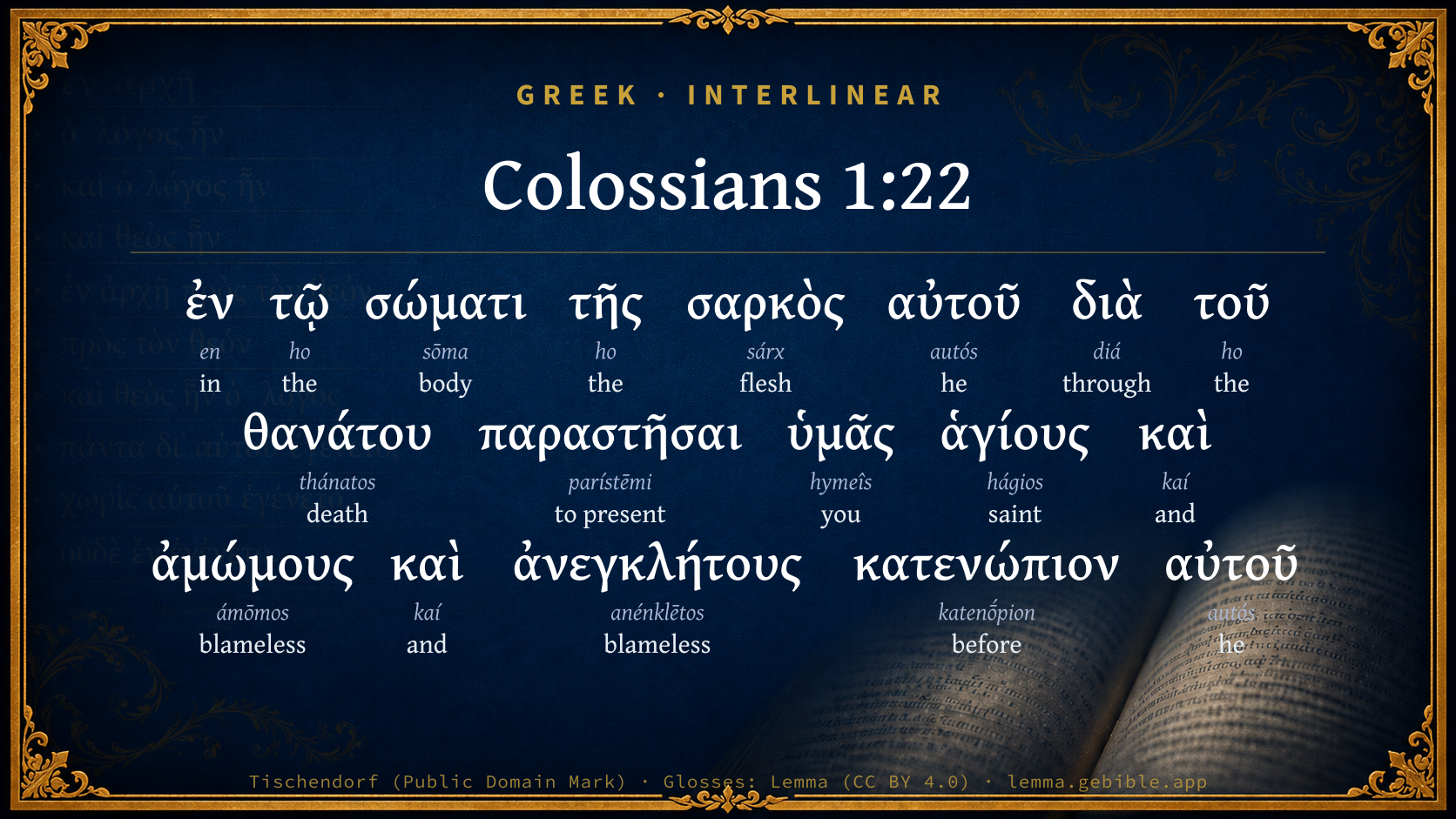
  1. ἐν en G1722 “in” Preposition
  2. τῷ ho G3588 “the” Article, Dative, Singular, Neuter
  3. σώματι sōma G4983 “body” Noun, Dative, Singular, Neuter
  4. τῆς ho G3588 “the” Article, Genitive, Singular, Feminine
  5. σαρκὸς sárx G4561 “flesh” Noun, Genitive, Singular, Feminine
  6. αὐτοῦ autós G846 “he” Personal pronoun, Genitive, Singular, Masculine
  7. διὰ diá G1223 “through” Preposition
  8. τοῦ ho G3588 “the” Article, Genitive, Singular, Masculine
  9. θανάτου thánatos G2288 “death” Noun, Genitive, Singular, Masculine
  10. παραστῆσαι parístēmi G3936 “to present” Verb, Aorist, Active, Infinitive
  11. ὑμᾶς hymeîs G5210 “you” Personal pronoun, 2nd person, Accusative, Plural
  12. ἁγίους hágios G40 “saint” Adjective, Accusative, Plural, Masculine
  13. καὶ kaí G2532 “and” Conjunction
  14. ἀμώμους ámōmos G299 “blameless” Adjective, Accusative, Plural, Masculine
  15. καὶ kaí G2532 “and” Conjunction
  16. ἀνεγκλήτους anénklētos G410 “blameless” Adjective, Accusative, Plural, Masculine
  17. αὐτοῦ autós G846 “he” Personal pronoun, Genitive, Singular, Masculine

About this verse

These counts appear in no published source. They are computed here, from the morphology-tagged text and Lemma’s own curated glosses. What Lemma adds →

18
words
14
distinct lemmas
Pauline Epistles
section

Notable vocabulary

The rarest word here is κατενώπιον before G2714 — appearing just 3 times in the whole Greek New Testament.

Shared distinctive vocabulary

κατενώπιον before G2714 occurs in 3 verses of the Greek New Testament. Also found in:

Repetition

Words recur within this verse:

Cross-references

14

Topical passages linked to Colossians 1:22 in the Treasury of Scripture Knowledge — connected by theme and wording, ordered by reader-vote popularity; previews shown in the World English Bible.

  • Ephesians 5:27 that he might present the assembly to himself gloriously, not having spot or wrinkle or any such thing; but that it should be holy and without blemish.
  • Ephesians 1:4 even as he chose us in him before the foundation of the world, that we would be holy and without blemish before him in love;
  • Jude 1:24 Now to him who is able to keep them from stumbling, and to present you faultless before the presence of his glory in great joy,
  • Hebrews 10:10 by which will we have been sanctified through the offering of the body of Jesus Christ once for all.
  • Titus 2:14 who gave himself for us, that he might redeem us from all iniquity, and purify for himself a people for his own possession, zealous for good works.
  • Romans 7:4 Therefore, my brothers, you also were made dead to the law through the body of Christ, that you would be joined to another, to him who was raised from the dead, that we might bring forth fruit to God.
  • Hebrews 10:20 by the way which he dedicated for us, a new and living way, through the veil, that is to say, his flesh;
  • 2 Corinthians 11:2 For I am jealous over you with a godly jealousy. For I married you to one husband, that I might present you as a pure virgin to Christ.
  • Ephesians 2:15–16 having abolished in the flesh the hostility, the law of commandments contained in ordinances, that he might create in himself one new man of the two, making peace;
  • Hebrews 13:21 make you complete in every good work to do his will, working in you that which is well pleasing in his sight, through Jesus Christ, to whom be the glory forever and ever. Amen.
  • 1 Thessalonians 4:7 For God called us not for uncleanness, but in sanctification.
  • 2 Peter 3:14 Therefore, beloved, seeing that you look for these things, be diligent to be found in peace, without blemish and blameless in his sight.
  • Luke 1:75 In holiness and righteousness before him all the days of our life.
  • Psalms 51:7 Purify me with hyssop, and I will be clean. Wash me, and I will be whiter than snow.

Cross-references courtesy of OpenBible.info (CC BY 4.0).

Commentary

Notes on Colossians 1:22 from classic Christian and Jewish commentators (each source and its license shown beneath its notes). The classic Christian expositions comment on the surrounding passage and are grouped to its opening verse, so a note may address several verses; the Jewish commentaries on the Tanakh (Rashi and others) are per-verse, so they appear only where the commentator wrote on this verse.

Lemma curates 59 commentaries, every one of them public domain or Creative Commons licensed, each selected and text-cleaned for this edition rather than reprinted as found. About our sources →

The Biblical Illustrator

Joseph S. Exell

Col_1:22-23

To present you holy and umblameable and unreproveable in His sight.

The ultimate purpose of reconciliation

I. The ultimate purpose of God in the work of Christ.

1. In present there is possibly a sacrificial allusion (Rom_12:1), or the more eloquent metaphor of the bringing of the bride to the husband by the friend of the bridegroom (2Co_2:2; Eph_5:27), or perhaps it means simply to sit in the presence of. The reference is to the day of judgment (2Co_4:14). In the light of that revealing day His purpose is that we shall stand holy, i.e., devoted to God, and therefore pure, without blemish, as the offerings had to be, and unreproveable, against whom no charge can be brought. They must be spotless indeed who are without fault before the throne.

2. All the lines of thought in the preceding section lead up to this peak. The meaning of God in creation and redemption cannot be fathomed without taking into view the future perfecting of men. The Christian ideal of the possibilities for men is the noblest vision that can animate our hopes. Nothing short of this satisfies Gods heart, for it has to be connected with It pleased the Father. Nor will anything less exhaust the power of the reconciling Christ. His Cross and passion reach no adequate result short of the perfecting of the saints. We ought, then, to keep before us this as the crowning object of Christianity; not to make us happy except as a consequence of holiness. Nothing less should satisfy us.

II. The conditions on which the accomplishment of that purpose depends.

1. Generally speaking, a steadfast adherence to the gospel. If ye continue in the exercise of your faith. This continuance is explained--

(1) Positively, grounded, i.e., built into a foundation, and steadfast, as banded into the firm rock, and so partaking of its fixedness.

(2) Negatively, not moved away, a process that may be continually going on, and in which, by some force constantly acting from without, they may be imperceptibly pushed off from the foundation, i.e., the hope evoked or held out by the gospel.

2. Some plain lessons may be drawn from these words.

(1) There is an if. However great the powers of Christ, and deep the desire, and fixed the purpose of God, no fulfilment of these is possible except on the condition of our habitual exercise of faith. The gospel does not act on men by magic. He could not do because of their unbelief.

(2) It must be present faith that leads to present results. We cannot make an arrangement by which we exercise faith wholesale once for all, and secure a delivery of its blessings in small quantities for a time after.

(3) If our lives are to be firm we must have a foundation outside of ourselves. If my practical life be not built on Christ the blows of circumstance will make it reel and stagger.

(4) This Christ-derived steadfastness will make us able to resist influences that would move us away from the hope of the gospel. If we do not look to our moorings we shall drift away down stream and never know we are moving. Many a man is completely unaware how completely his Christian faith has gone till some crisis comes when he needs it.

III. A three-fold motive for adherence to the gospel.

1. The gospel which ye heard. Paul would have them recall what they heard at their conversion, and tamper with no teaching inconsistent with it. He also appeals to their experience. Have these truths become less precious? To us the same appeal comes. The word has been sounding in our ears since childhood. The one thing we know is not to be lightly abandoned.

2. This gospel was preached in all creation under heaven, whereas the heretical teachings only belonged to a class. All errors are transient and limited; but the gospel can go into any corner under heaven.

3. Whereof I Paul am made a minister.

(1) This is not merely an appeal to their affection, though that is perfectly legitimate.

(2) He puts stress upon the fact that he became a minister, as being an evidence of Christianity; which indeed it is. (A. Maclaren, D. D.)

Holiness through Christ

What are you doing here by yourself? asked a man of his neighbour one day. I am reading a book that has only two leaves, was the reply. Then it wont take you long to read it, said the other. Months passed away, and they met again. Well, what are you doing now? I am still reading my little book. What! and only two leaves in it? Yes; a white leaf and a red one. I dont understand you. Well, the white leaf is the holiness of God, and the red leaf is the blood of Jesus Christ, His Son. When I study the white leaf, and see my sin in the light of Gods holiness, I am glad to turn to the red leaf and rest my eye on the blood of Jesus. And when I realize the preciousness and efficacy of the Saviours blood, I feel a longing for holiness, and turn again to the white leaf. The little book will occupy me all my life, and I expect it will be my joyful meditation through eternity. (New Encyclopedia of Anecdotes.)

The Biblical Illustrator, edited by Joseph S. Exell (c. 1880s–1900s) — public domain. Text from a community e-Sword module.

The Expositor's Bible

Chapter 1 Part 7

THE ULTIMATE PURPOSE OF RECONCILIATION AND ITS HUMAN CONDITIONS

Col_1:22-23 (R.V.)

THE Apostle has been sketching in magnificent outline a vast system, which we may almost call the scheme of the universe. He has set forth Christ as its Lord and centre, through Whom all things at first came into being, and still continue to be. In parallel manner he has presented Christ as Lord and Centre of the Church, its life giving Head. And finally he has set forth Christ as the Reconciler of all discords in heaven and earth, and especially of that which parts sinful men from God.

And now he shows us here, in the first words of our text, the purpose of this whole manifestation of God in Christ to be the presenting of men perfect in purity, before the perfect judgment of God. He then appends the condition on which the accomplishment of this ultimate purpose in each man depends-namely, the mans continuance in the faith and hope of the Gospel. That leads him to gather up, in a series of clauses characterising the Gospel, certain aspects of it which constitute subordinate motives and encouragements to such steadfastness. That is, I think, the outline connection of the words before us, which at first sight seem somewhat tangled and difficult to unravel.

I. We have then, first, to consider the ultimate purpose of God in the work of Christ.

"To present you holy and without blemish and unreprovable before Him." It may be a question whether these words should be connected with "now hath He reconciled," or whether we are to go farther back in the long paragraph, and make them dependent on "it was the good pleasure of the Father." The former seems the more natural-namely, to see here a statement of the great end contemplated in our reconciliation to God; which, indeed, whatever may be the grammatical construction preferred here, is also, of course, the ultimate object of the Fathers good pleasure. In the word "present" there is possibly a sacrificial allusion, as there is unquestionably in its use in Rom_12:1, "Present your bodies a living sacrifice"; or there may be another and even more eloquent metaphor implied, that of the bringing of the bride to the husband by the friend of the bridegroom. That lovely figure is found in two instances of the use of the word in Pauls epistle (2Co_2:2, "to present you as a chaste virgin to Christ," and Eph_5:27, "that He might present it to Himself a glorious Church"), and possibly in others. It certainly gives an appropriate and beautiful emblem here if we think of the presentation of the bride in virginal beauty and purity to her Lord at that last great day which is the bridal day of the perfected Church.

There is, however, no need to suppose any metaphor at all, nor any allusion beyond the general meaning of the word-to set in the presence of. The sacrificial reference is incongruous here, and the bridal one not indicated by anything in the context, as it is in the instances just quoted. One thing is clear, that the reference is to a future presentation in the day of judgment, as in another place, where Paul says, "He shall raise up us also and shall present us". {2Co_4:14} In the light of that revealing day, His purpose is that we shall stand "holy," that is, devoted to God and therefore pure-"without blemish," as the offerings had to be, and "unreprovable," against whom no charge can be brought. These three express a regular sequence; first, the inward principle of consecration and devotion to God, then its visible issue in stainless conduct and character, and then its last consequence, that in the judgment of God and of men we shall stand acquitted of blame, and every accusation drop away from our dazzling purity, like muddy water from the white wing of the sea bird as it soars. And all this moral perfectness and unblamableness is to be not merely in the judgment of men, but "before Him," the light of whose "pure eyes and perfect judgment" discovers all stains and evils. They must be spotless indeed who are "without fault before the throne of God."

Such, then, is the grand conception of the ultimate purpose and issue of Christs reconciling work. All the lines of thought in the preceding section lead up to and converge in this peak. The meaning of God in creation and redemption cannot be fully fathomed without taking into view the future perfecting of men. This Christian ideal of the possibilities for men is the noblest vision that can animate our hopes. Absolute moral purity which shall be recognised as perfect by the, perfect Judge, and a close approach to God, so as that we shall be "before Him" in a manner unknown here-are hopes as much brighter than those which any other systems of belief print on the dim canvas curtain of the future, as the Christian estimate of mans condition apart from Christ is sadder and darker than theirs. Christianity has a much more extended scale of colours than they have. It goes further down into blackness for the tints with which it paints man as he is, and further up into flashing glories of splendour for the gleaming hues with which it paints him as he may become. They move within narrow limits of neutral tints, The Gospel alone does not try to minimise mans evil, because it is triumphantly confident of its power to turn all that evil into good.

Nothing short of this complete purity and blamelessness satisfies Gods heart. We may travel back to the beginning of this section, and connect its first words with these, "It pleased the Father, to present us holy and spotless and blameless." It delights Him. thus to effect the purifying of sinful souls, and He is glad when He sees Himself surrounded by spirits thus echoing His will and reflecting His light. This is what He longs for. This is what He aims at in all His working-to make good and pure men. The moral interest is uppermost in His heart and in His doings. The physical universe is but the scaffolding by which the true house of God may be built. The work of Christ is the means to that end. and when God has got us, by such lavish expenditure, to be white like Himself, and can find nothing in us to condemn, then, and not till then, does He brood over us satisfied and glad at heart, resting in His love, and rejoicing over us with singing.

Nor will anything short of this complete purity exhaust the power of the Reconciling Christ. His work is like an unfinished column, or Giottos Campanile, all shining with marbles and alabasters and set about with fair figures, but waiting for centuries for the glittering apex to gather its glories into a heaven-piercing point. His cross and passion reach no adequate result, short of the perfecting of saints, nor was it worth Christs while to die for any less end. His cross and passion have evidently power to effect this perfect purity, and cannot be supposed to have done all that is in them to do, until they have done that with every Christian.

We ought then to keep very clear before us this as the crowning object of Christianity: not to make men happy, except as a consequence of holiness; not to deliver from penalty, except as a means to holiness; but to make them holy, and being holy, to set them close by the throne of God. No man understands the scope of Christianity, or judges it fairly, who does not give full weight to that as its own statement of its purpose. The more distinctly we, as Christians, keep that purpose prominent in our thoughts, the more shall we have our efforts stimulated and guided, and our hopes fed, even when we are saddened by a sense of failure. We have a power working in us which can make us white as the angels, pure as our Lord is pure. If it, being able to produce perfect results, has produced only such imperfect ones, we may well ask where the reason for the partial failure lies. If we believed more vividly that the real purpose and use of Christianity was to make us good men, we should surely labour more earnestly to secure that end, should take more to heart our own responsibility for the incompleteness with which it has been attained in us, and should submit ourselves more completely to the operation of the "might of the power" which worketh in us.

Nothing less than our absolute purity will satisfy God about us. Nothing less should satisfy ourselves. The only worthy end of Christs work for us is to present us holy, in complete consecration, and without blemish, in perfect homogeneousness and uniformity of white purity and unreproachable in manifest innocence in His sight. If we call ourselves Christians let us make it our lifes business to see that that end is being accomplished in us in some tolerable and growing measure.

II. We have next set forth the conditions on which the accomplishment of that purpose depends:

"If so be that ye continue in the faith, grounded and steadfast, and not moved away from the hope of the Gospel."

The condition is, generally speaking, a steadfast adherence to the Gospel which the Colossians had received. "If ye continue in the faith," means, I suppose, if ye continue to live in the exercise of your faith. The word here has its ordinary subjective sense, expressing the act of the believing man, and there is no need to suppose that it has the later ecclesiastical objective sense, expressing the believers creed, a meaning in which it may be questioned whether the word is ever employed in the New Testament. Then this continuance in the faith is further explained as to its manner, and that first positively, and then negatively. They are to be grounded, or more picturesquely and accurately, "founded," that is, built into a foundation, and therefore "steadfast," as banded into the firm rock, and so partaking of its fixedness. Then, negatively, they are not to be "moved away"; the word by its form conveying the idea that this is a process which may be continually going on, and in which, by some force constantly acting from without, they may be gradually and imperceptibly pushed off from the foundation-that foundation is the hope evoked or held out by the Gospel, a representation which is less familiar than that which makes the Gospel itself the foundation, but is substantially equivalent to it, though with a different colour.

One or two plain lessons may be drawn from these words. There is an "if," then. However great the powers of Christ and of His work, however deep the desire and fixed the purpose of God, no fulfilment of these is possible except on condition of our habitual exercise of faith. The Gospel does not work on men by magic. Mind, heart, and will must be exercised on Christ, or all His power to purify and bless will be of no avail to us. We shall be like Gideons fleece, dry when the dew is falling thick, unless we are continually putting forth living faith. That attracts the blessing and fits the soul to receive it. There is nothing mystical about the matter. Common sense tells us, that if a man never thinks about any truth, that truth will do him no good in any way. If it does not find its road into his heart through his mind, and thence into his life, it is all one as if there were no such truth, or as if he did not believe it. If our creed is made up of truths which we do not think about, we may just as well have no creed. If we do not bring ourselves into contact with the motives which the Gospel brings to bear on character, the motives will not mould our character. If we do not, by faith and meditation, realise the principles which flow from the truth as it is in Jesus, and obtain the strength which is stored in Him, we shall not grow by Him or like Him. No matter how mighty be the renewing powers of the Gospel wielded by the Divine Spirit, they can only work on the nature that is brought into contact with and continues in contact with them by faith. The measure in which we trust Jesus Christ will be the measure in which He helps us. "He could do no mighty works because of their unbelief." He cannot do what He can do, if we thwart Him by our want of faith. God will present us holy before Him if we continue in the faith. And it must be present faith which leads to present results. We cannot make an arrangement by which we exercise faith wholesale once for all, and secure a delivery of its blessings in small quantities for a while after, as a buyer may do with goods. The moments act of faith will bring the moments blessings; but tomorrow will have to get its own grace by its own faith. We cannot lay up a stock for the future. There must be present drinking for present thirst; we cannot lay in a reserve of the water of life, as a camel can drink at a draught enough for a long desert march. The Rock follows us all through the wilderness, but we have to fill our pitchers day by day. Many Christians seem to think that they can live on past acts of faith. No wonder that their Christian character is stunted, and their growth stopped, and many a blemish visible, and many a "blame" to be brought against them. Nothing but continual exercise of faith, day by day, moment by moment, in every duty, and every temptation, will secure the continual entrance into our weakness of the strength which makes strong and the purity which makes pure. Then again, if we and our lives are to be firm and stable, we must have a foundation outside of ourselves on which to rest. That thought is involved in the word "grounded" or "founded." It is possible that this metaphor of the foundation is carried on into the next clause, in which case "the hope of the Gospel" would be the foundation. Strange to make a solid foundation out of so unsubstantial a thing as "hope"! That would be indeed to build a castle on the air, a palace on a soap bubble, would it not? Yes, it would, if this hope were not "the hope produced by the Gospel," and therefore as solid as the ever-enduring Word of the Lord on which it is founded. But, more probably, the ordinary application of the figure is preserved here, and Christ is the foundation, the Rock, on which builded, our fleeting lives and our fickle selves may become rock like too, and every impulsive and changeable Simon Bar Jonas rise to the mature steadfastness of a Peter, the pillar of the Church.

Translate that image of taking Christ for our foundation into plain English, and what does it come to? It means, let our minds find in Him, in His Word, and whole revealing life, the basis of our beliefs, the materials for thought; let our hearts find in Him their object, which brings calmness and unchangeableness into their love; let our practical energies take Him as their motive and pattern, their strength and their aim, their stimulus and their reward; let all hopes and joys, emotions and desires, fasten themselves on Him; let Him occupy and fill our whole nature, and mould and preside over all our actions. So shall we be "founded" on Christ.

And so "founded," we shall, as Paul here beautifully puts it, be "steadfast." Without that foundation to give stability and permanence, we never get down to what abides, but pass our lives amidst fleeting shadows, and are ourselves transient as they. The mind whose thoughts about God and the unseen world are not built on the personal revelation of God in. Christ will have no solid certainties which cannot be shaken, but, at the best, opinions which cannot have more fixedness than belongs to human thoughts upon the great problem. If my love does not rest on Christ, it will flicker and flutter; lighting now here and now there, and even where it rests most secure in. human love, sure to have to take wing some day, when Death with his woodmans axe fells the tree where it nestles. If my practical life is not built on Him, the blows of circumstance will make it reel and stagger. If we are not well joined to Jesus Christ, we shall be driven by gusts of passion and storms of trouble, or borne along on the surface of the slow stream of all-changing time like thistle down on the water. If we are to be stable, it must be because we are fastened to something outside of ourselves that is stable, just as they have to lash a man to the mast or other fixed things on deck, if he is not to be washed overboard in the gale. If we are lashed to the unchangeable Christ by the "cords of love" and faith, we too shall, in our degree, be steadfast. And, says Paul, that Christ-derived steadfastness will make us able to resist influences that would move us away from the hope of the Gospel. That process which their steadfastness would enable the Colossians successfully to resist is described by the language of the Apostle as continuous, and as one which acted on them from without. Intellectual dangers arose from false teachings. The ever-acting tendencies of worldliness pressed upon them, and they needed to make a distinct effort to keep themselves from being overcome by these.

If we do not take care that imperceptible, steady pressure of the all-surrounding worldliness, which is continually acting on us, will push us right off the foundation without our knowing that we have shifted at all. If we do not look well after our moorings we shall drift away down stream, and never know that we are moving, so smooth is the motion, till we wake up to see that everything round about is changed. Many a man is unaware how completely his Christian faith has gone till some crisis comes when he needs it, and when he opens the jar there is nothing. It has evaporated.

When white ants eat away all the inside of a piece of furniture, they leave the outside shell apparently solid, and it stands till some weight is laid upon it, and then goes down with a crash. Many people lose their Christianity in that fashion, by its being nibbled away in tiny flakes by a multitude of secretly working little jaws, and they never know that the pith is out of it till they want to lean on it, and then it gives under them.

The only way to keep firm hold of hope is to keep fast on the foundation. If we do not wish to slide imperceptibly away from Him who alone will make our lives steadfast and our hearts calm with the peacefulness of having found our All, we must continuously make an effort to tighten our grasp on Him, and to resist the subtle forces which, by silent pressure or by sudden blows, seek to get us off the one foundation.

III. Then lastly, we have a threefold motive for adherence to the Gospel.

The three clauses which close these verses seem to be appended as secondary and subordinate encouragements to steadfastness, which encouragements are drawn from. certain characteristics of the Gospel. Of course, the main reason for a mans sticking to the Gospel, or to anything else, is that it is true. And unless we are prepared to say that we believe it true, we have nothing to do with such subordinate motives for professing adherence to it, except to take care that they do not influence us. And that one sole reason is abundantly wrought out in this letter. But then, its truth being established, we may fairly bring in other subsidiary motives to reinforce this, seeing that there may be a certain coldness of belief which needs the warmth of such encouragements. The first of these lies in the words, "the Gospel, which ye heard." That is to say, the Apostle would have the Colossians, in the face of these heretical teachers, remember the beginning of their Christian life, and be consistent with that. They had heard it at their conversion. He would have them recall what they had heard then, and tamper with no teaching inconsistent with it. He also appeals to their experience. "Do you remember what the Gospel did for you? Do you remember the time when it first dawned upon your astonished hearts, all radiant with heavenly beauty, as the revelation of a Heart in heaven that cared for you, and of a Christ Who, on earth, had died for you? Did it not deliver you from your burden? Did it not set new hope before you? Did it not make earth as the very portals of heaven? And have these truths become less precious because familiar? Be not moved away from the Gospel which ye have heard."

To us the same appeal comes. This word has been sounding in our ears ever since childhood. It has done everything for some of us, something for all of us. Its truths have sometimes shone out for us like suns, in the dark, and brought us strength when nothing else could sustain us. If they are not truths, of course they will have to go. But they are not to be abandoned easily. They are interwoven with our very lives. To part with them is a resolution not to be lightly undertaken.

The argument of experience is of no avail to convince others, but is valid for ourselves. A man has a perfect right to say, "I have heard Him myself, and I know that this is indeed the Christ, the Saviour of the world." A Christian may wisely decline to enter on the consideration of many moot questions which he may feel himself incompetent to handle, and rest upon the fact that Christ has saved his soul. The blind man beat the Pharisees in logic when he sturdily took his stand on experience, and refused to be tempted to discuss subjects which he did not understand, or to allow his ignorance to slacken his grasp of what he did know. "Whether this man be a sinner or no, I know not one thing I know, that, whereas I was blind, now I see." There was no answering that, so by excommunicating him they confessed themselves beaten.

A second encouragement to steadfast adherence to the Gospel lies in the fact that it "was preached in all creation under heaven." We need not be pedantic about literal accuracy, and may allow that the statement has a rhetorical colouring. But what the Apostle means is, that the gospel has spread so widely, through so many phases of civilisation, and has proved its power by touching men so unlike each other in mental furniture and habits, that it had showed itself to be a word for the whole race. It is the same thought as we have already found in Col_1:6. His implied exhortation is, "Be not moved away from what belongs to humanity by teachings which can only belong to a class." All errors are transient in duration and limited in area. One addresses itself to one class of men, another to another. Each false, or exaggerated, or partial representation of religious truth, is congenial to some group with idiosyncrasies of temperament or mind. Different tastes like different spiced meats, but the gospel, "human natures daily food," is the bread of God that everybody can relish, and which everybody must have for healthy life. What only a certain class or the men of one generation or of one stage of culture can find nourishment in, cannot be meant for all men. But the great message of Gods love in Jesus Christ commends itself to us because it can go into any corner of the world, and there, upon all sorts of people, work its wonders. So we will sit down with the women and children upon the green grass, and eat of it, however fastidious people whose appetites have been spoiled by high-spiced meat, may find it coarse and insipid. It would feed them too, if they would try-but whatever they may do, let us take it as more than our necessary food.

The last of these subsidiary encouragements to steadfastness lies in, "whereof I Paul was made a minister." This is not merely an appeal to their affection for him, though that is perfectly legitimate. Holy words may be holier because dear lips have taught them to us, and even the truth of God may allowably have a firmer hold upon our hearts because of our love for some who have ministered it to us. It is a poor commentary on a preachers work if, after long service to a congregation, his words do not come with power given to them by old affection and confidence. The humblest teacher who has done his Masters errand will have some to whom he can appeal as Paul did, and urge them to keep hold of the message which he has preached.

But there is more than that in the Apostles mind. He was accustomed to quote the fact that he, the persecutor, had been made the, messenger of Christ, as a living proof of the infinite mercy and power of that ascended Lord, whom his eyes saw on the road to Damascus. So here, he puts stress on the fact that he became a minister of the gospel, as being an "evidence of Christianity." The history of his conversion is one of the strongest proofs of the resurrection and ascension of Jesus Christ. You know, he seems to say, what turned me from being a persecutor into an apostle. It was because I saw the living Christ, and "heard the words of His mouth," and, I beseech you, listen to no words which make His dominion less sovereign, and His sole and all-sufficient work on the cross less mighty as the only power that knits earth to heaven.

So the sum of this whole matter is-abide in Christ. Let us root and ground our lives and characters in Him, and then Gods inmost desire will be gratified in regard to us, and He will bring even us stainless and blameless into the blaze of His presence. There we shall all have to stand, and let that all-penetrating light search us through and through. How do we expect to be then "found of Him in peace, without spot and blameless"? There is but one way-to live in constant exercise of faith in Christ, and grip Him so close and sure that the world, the flesh, and the devil cannot make us loosen our fingers. Then He will hold us up, and His great purpose, which brought Him to earth, and nailed Him to the cross, will be fulfilled in us, and at last we shall lift up voices of wondering praise "to Him who is able to keep us from falling, and to present us faultless before the presence of His glory with exceeding joy."

William Robertson Nicoll, ed., The Expositor's Bible (London: Hodder & Stoughton, 1887–1910) — public domain. 65 of 66 books (1 Corinthians is not separately keyed, as that volume carries no machine-parseable verse references); section-level commentary keyed to the opening verse. Introductory and overview sections not keyed to a specific passage are excluded.

Tyndale Open Study Notes

Tyndale Open Resources

1:22 The Colossians, like all believers, were holy and blameless in God’s sight not because of their own perfection but because they had been reconciled with God through Christ’s death.

Tyndale Open Study Notes — © Tyndale Open Resources, licensed CC BY-SA 4.0. Text via the HelloAO Bible API.

Bengel's Gnomon

Johann Albrecht Bengel

Col 1:22. Ἐν τῷ σώματι τῆς σαρκὸς αὐτοῦ, by the body of His flesh) By this appellation, taken as a whole, He is distinguished from the Church, which is called the body of Christ: and at the same time the body denotes the true and entire humanity of Christ, Rom 7:4. Flesh implies the capacity of suffering, and the suffering itself; Eph 2:15.—παραστῆσαι, to present) Eph 5:27.—ἁγίους, holy) towards God.—ἀμώμους, spotless) in respect of yourselves.—ἀνεγκλήτους, unreproveable) in respect of your neighbour.

Bengel's Gnomon of the New Testament — English translation (T&T Clark, Edinburgh, 1860) — public domain. Text from a community e-Sword module.

Meyer's Critical & Exegetical Commentary

Heinrich August Wilhelm Meyer

Col_1:22. Ἐν τῷ σώματι κ.τ.λ.] that, by means of which they have been reconciled; corresponding to the διʼ αὐτοῦ and διὰ τοῦ αἵματος τοῦ σταυροῦ αὐτοῦ of Col_1:20 : in the body of His flesh by means of death. Since God is the reconciling subject, we are not at liberty, with Elzevir, Scholz, and others, to read αὑτοῦ (with the spiritus asper), which would not be justified, even though Christ were the subject. We have further to note: (1) διὰ τ. θανάτου informs us whereby the being reconciled ἐν τῷ σώματι τ. σ. αὐ. was brought about, namely, by the death occurring, without which the reconciliation would not have taken place in the body of Christ. (2) Looking to the concrete presentation of the matter, and because the procuring element is subsequently brought forward specially and on its own account by διά, the ἐν is not, with Erasmus and many others, to be taken as instrumental, but is to be left as local; not, however, in the sense that Christ accomplished the ἀποκαταλλάσσειν in His body, which was fashioned materially like ours (Hofmann, comp. Calvin and others, including Bleek)which, in fact, would amount to the perfectly self-evident point, that it took place in His corporeally-human form of being,but, doubtless, especially as διὰ τοῦ θανάτου follows, in the sense, that in the body of Christ, by means of the death therein accomplished, our reconciliation was objectively realized, which fact of salvation, therefore, inseparably associated itself with His body; comp. ἐν τῇ σαρκί μου, Col_1:24, see also 1Pe_2:24 and Huther in loc. The conception of substitution, however, though involved in the thing (in the ἱλαστήριον), is not to be sought in ἐν (in opposition to Böhmer and Baumgarten-Crusius). (3) The reason for the intentional use of the material description: in the body which consisted of His flesh (comp. Col_2:11; Sir_23:16), is to be sought in the apologetic interest of antagonism to the false teachers, against whom, however, the charge of Docetism, possibly on the ground of Col_2:23, can the less be proved (in opposition to Beza, Balduin, Böhmer, Steiger, Huther, and Dalmer), as Paul nowhere in the epistle expressly treats of the material Incarnation, which he would hardly have omitted to do in contrast to Docetism (comp. 1 John). In fact, the apostle found sufficient occasion for writing about the reconciliation as he has done here and in Col_1:20, in the faith in angels on the part of his opponents, by which they ascribed the reconciling mediation with God in part to those higher spiritual beings (who are without σῶμα τῆς σαρκός). Other writers have adopted the view, without any ground whatever in the connection, that Paul has thus written in order to distinguish the real body of Christ from the spiritual σῶμα of the church (Bengel, Michaelis, Storr, Olshausen). The other σῶμα of Christ, which contrasts with His earthly body of flesh (Rom_1:3; Rom_8:3), is His glorified heavenly body, Php_3:21; 1Co_15:47 ff. References, however, such as Calvin, e.g., has discovered (humile, terrenum et infirmitatibus multis obnoxium corpus), or Grotius (tantas res perfecit instrumento adeo tenui; comp. also Estius and others), are forced upon the words, in which the form of expression is selected simply in opposition to spiritualistic erroneous doctrines. Just as little may we import into the simple historical statement of the means διὰ τοῦ θανάτου, with Hofmann, the ignominy of shedding His blood on the cross, since no modal definition to that effect is subjoined or indicated.

παραστῆσαι ὑμᾶς κ.τ.λ.] Ethical definition of the object aimed at in the ἀποκατηλλ.: ye have been reconciled … in order to present you, etc. The presenting subject is therefore the subject of ἀποκατηλλ., so that it is to be explained: ἵνα παραστήσητε ὑμᾶς, ut sisteretis vos, and therefore this continuation of the discourse is by no means awkward in its relation to the reading ἀποκατηλλάγητε (in opposition to de Wette). We should be only justified in expecting ἑαυτούς (as Huther suggests) instead of ὑμᾶς (comp. Rom_12:1) if (comp. Rom_6:13; 2Ti_2:15) the connection required a reflexive emphasis. According to the reading ἀποκατήλλαξεν the sense is ut sisteret vos, in which case, however, the subject would not be Christ (Hofmann), but, as in every case since εὐδόκησε in Col_1:19, God.

The point of time at which the παραστ. is to take place (observe the aorist) is that of the judgment, in which they shall come forth holy, etc., before the Judge. Comp. Col_1:28, and on Eph_5:27. This reference (comp. Bähr, Olshausen, Bleek) is required by the context in Col_1:23, where the παραστῆσαι κ.τ.λ. is made dependent on continuance in the faith as its condition; consequently there cannot be meant the result already accomplished by the reconciliation itself, namely, the state of δικαιοσύνη entered upon through it (so usually, including Hofmann). The state of justification sets in at any rate, and unconditionally, through the reconciliation; but it may be lost again, and at the Parousia will be found subsisting only in the event of the reconciled remaining constant to the faith, by means of which they have appropriated the reconciliation, Col_1:23.

ἁγίους κ.τ.λ.] does not represent the subjects as sacrifices (Rom_12:1), which would not consist with the fact that Christ is the sacrifice, and also would not be in harmony with ἀνεγκλ.; it rather describes without figure the moral holiness which, after the justification attained by means of faith, is wrought by the Holy Spirit (Rom_7:6; Rom_8:2; Rom_8:9, et al.), and which, on the part of man, is preserved and maintained by continuance in the faith (Col_1:23). The three predicates are not intended to represent the relation erga Deum, respectu vestri, and respectu proximi (Bengel, Bähr), since, in point of fact, ἀμώμους (blameless, Eph_1:4; Eph_5:27; Herod, ii. 177; Plat. Rep. p. 487 A: οὐδʼ ἂν ὁ Μῶμος τό γε τοιοῦτον μέμψαιτο) no less than ἀνεγκλ. (reproachless, 1Co_1:8) points to an external judgment: but the moral condition is intended to be described with exhaustive emphasis positively (ἁγίους) and negatively (ἀμώμ. and ἀνεγκλ.). The idea of the moral holiness of the righteous through faith is thoroughly Pauline; comp. not only Eph_2:10, Tit_2:14; Tit_3:8, but also such passages as Rom_6:1-23; Rom_8:4 ff.; Gal_5:22-25; 1Co_9:24 ff.; 2Co_11:2, et al.

κατενώπιον αὐτοῦ] refers to Christ,[58] to His judicial appearance at the Parousia, just as by the previous αὐτοῦ after ΣΑΡΚΌς Christ also was meant. The usual reference to God (so Huther, de Wette, Baumgarten-Crusius, Ewald, Bleek) is connected with the reading ἀποκατήλλαξεν taken as so referring; comp. Jud_1:24; Eph_1:4. The objection that ΚΑΤΕΝΏΠΙΟΝ elsewhere occurs only in reference to God, is without force; for that this is the case in the few passages where the word is used, seems to be purely accidental, since ἐνώπιον is also applied to Christ (2Ti_2:14), and since in the notion itself there is nothing opposed to this reference. The frequent use of the expression before God is traceable to the theocratically national currency of this conception, which by no means excludes the expression before Christ. So ἔμπροσθεν is also used of Christ in 1Th_2:19. Comp. 2Co_5:10 : ἜΜΠΡΟΣΘΕΝ ΤΟῦ ΒΉΜΑΤΟς ΤΟῦ ΧΡΙΣΤΟῦ, which is a commentary on our κατενώπιον αὐτοῦ; see also Mat_25:32.

[58] So also Holtzmann, p. 47, though holding in favour of the priority of Eph_1:4, that the sense requires a reference to God, although syntactically the reference is made to Christ. But, in fact, the one is just as consistent with the sense as the other.

REMARK.

The proper reference of παραστῆσαι κ.τ.λ. to the judgment, as also the condition appended in Col_1:23, place it beyond doubt that what is meant here (it is otherwise in Eph_1:4) is the holiness and blamelessness, which is entered upon through justification by faith actu judiciali and is positively wrought by the Holy Spirit, but which, on the other hand, is preserved and maintained up to the judgment by the self-active perseverance of faith in virtue of the new life of the reconciled (Romans 6); so that the justitia inhaerens is therefore neither meant alone (Chrysostom, Oecumenius, Theophylact, Calvin, and others), nor excluded (Theodoret, Erasmus, Beza, and others), but is included. Comp. Calovius.

Meyer — Critical and Exegetical Commentary on the New Testament — English translation by Peter Christie, edited by Frederick Crombie (T&T Clark, 1880) — public domain. Text from a community e-Sword module.

Expositor's Greek Testament

ed. W. Robertson Nicoll

Col 1:22-23 . THEIR RECONCILIATION WILL RESULT IN THE PRESENTATION OF THEMSELVES AS BLAMELESS BEFORE GOD, IF THEY ARE STEADFAST IN THE GOSPEL THEY HAVE HEARD, WHICH IS NO OTHER THAN THAT PREACHED THROUGHOUT THE WORLD.

Col 1:22 . νυνὶ in contrast to ποτὲ : “now,” not “at the present moment,” but “in the present state of things,” thus, as Lightfoot points out, admitting an aorist, referring to an action lying in the past. ἀποκατηλλάγητε : “ye were reconciled,” but scarcely to be represented in English except by the perfect. ἐν τῷ σώματι τῆς σαρκὸς αὐτοῦ . It is disputed why Paul should add to σώμ . the defining words τ · σαρκὸς . Bengel, Lightfoot and Moule think they are added to distinguish Christ’s physical from His mystical body, the Church. But this would imply an incredible obtuseness on the part of his readers, for διὰ θαν · sufficiently fixes the reference to the physical body; and, as Meyer points out, the contrast to the body of His flesh is the glorified body, not the Church. Nor is a reference to Docetism probable. We have no evidence that it had appeared so early, and Paul would not have refuted it by a mere aside. Oltramare thinks that they are added because the flesh was the actual seat of suffering. But the addition would have been unnecessary, for ἐν τ . σώμ . was sufficient in itself. The most satisfactory view is that Paul has in mind the false spiritualism which thought reconciliation could be accomplished by spiritual beings only, and hence attached little or no value to the work of Christ in a body composed of flesh (Mey., Alf., Ell., Haupt, Abb.). In opposition to this Paul emphasises the fact that it was just by the putting to death of this body composed of flesh that reconciliation was effected, and thereby excludes from the work the angels who had no body of flesh. But while this is so, it is hard to avoid the impression that the phrase is also chosen because in the corresponding experience of Christians their death to sin is the removal of the σῶμα . τ . σαρκός (Col 2:11 ). παραστῆσαι ὑμᾶς : cf. Eph 5:27 . With the reading ἀποκατήλλαξεν the infinitive expresses purpose, “He reconciled in order to present”. With λάγητε , if we adopt Lightfoot’s parenthesis, the infinitive will depend on εὐδόκ . (Col 1:19 ). But if νυνὶ δὲ begins a new sentence we should translate “ye were reconciled to present yourselves”. This presentation is usually taken to be at the judgment, and that is the impression the passage naturally makes. Hofmann, Lightfoot and Haupt refer it to God’s present approbation. Haupt thinks the presentation is just the same as the reconciliation. Reconciliation has not to do with a change of feeling in God or man, but of the relation of God to men. It is synonymous with justification. This παραστ . is a continuous process dependent on continuance in faith and love. He urges that Paul regards the judgment as depending on moral conditions, not on the holding fast of faith and love. But a distinction of this kind should not be pressed in the case of Paul; for him faith was the root of morality, and love the fulfilment of the Law. κατενώπιον αὐτοῦ . Generally this is taken to be before God. But since Paul elsewhere teaches that we must appear before the judgment seat of Christ, it seems best (with Meyer) to take αὐτοῦ in the same way. ἁγίους καὶ ἀμώμους καὶ ἀνεγκλήτους . Soden and Haupt insist that these are not ethical but religious terms. This is probably correct; since the reference is to the judgment, they have a forensic sense. ἀμώμους probably means blameless rather than undefiled, and this is supported by the addition of ἀνεγκλ .

The Expositor's Greek Testament, edited by W. Robertson Nicoll (1897–1910) — public domain. Text from a community e-Sword module.

Geneva Bible (1599)

Geneva Bible translators

In that fleshly body, to give us to understand that his body was not a fantastical body, but a true body.

Geneva Bible (1599) marginal notes — public domain. Text via Bolls.life.

Jamieson, Fausset & Brown

Robert Jamieson, A. R. Fausset & David Brown

In the body of his flesh--the element in which His reconciling sufferings had place. Compare Col 1:24, "afflictions of Christ in my flesh" (Pe1 2:24). Angels who have not a "body of flesh" are not in any way our reconciling mediators, as your false teachers assert, but He, the Lord of angels, who has taken our flesh, that in it He might atone for our fallen manhood.

through death--rather as Greek, "through His death" (which could only take place in a body like ours, of flesh, Heb 2:14). This implies He took on Him our true and entire manhood. Flesh is the sphere in which His human sufferings could have place (compare Col 1:24; Eph 2:15).

to present you-- (Eph 5:27). The end of His reconciling atonement by death.

holy--positively; and in relation to God.

unblamable . . . unreprovable--negatively. "Without blemish" (as the former Greek word is translated as to Jesus, our Head, Pe1 1:19) in one's self. Irreproachable (the Greek for the second word, one who gives no occasion for his being brought to a law court) is in relation to the world without. Sanctification, as the fruit, is here treated of; justification, by Christ's reconciliation, as the tree, having preceded (Eph 1:4; Eph 5:26-27; Tit 2:14). At the same time, our sanctification is regarded here as perfect in Christ, into whom we are grafted at regeneration or conversion, and who is "made of God unto us (perfect) sanctification" (Co1 1:30; Pe1 1:2; Jde 1:1): not merely progressive sanctification, which is the gradual development of the sanctification which Christ is made to the believer from the first.

in his sight--in God's sight, at Christ's appearing.

Jamieson, Fausset & Brown — Commentary Critical and Explanatory on the Whole Bible (1871) — public domain (CC PDM 1.0). Text via the HelloAO Bible API.

Adam Clarke's Commentary

Verse 22. In the body of his flesh] By Christ's assumption of a human body, and dying for man, he has made an atonement for sin, through which men become reconciled to God and to each other.

To present you holy] Having saved you from your sins.

Unblamable] Having filled you with his Spirit, and written his law in your hearts, so that his love, shed abroad in your hearts, becomes the principle and motive to every action. The tree therefore being good, the fruit is also good.

And unreprovable] For, being filled with love, joy, peace, meekness, gentleness, and goodness, against these there is no law; and as they were called to love God with all their heart, soul, mind, and strength, and their neighbour as themselves, the whole spirit and design of the law was fulfilled in them, for love is the fulfilling of the law.

In his sight] At the day of judgment. None can enjoy heaven who have not been reconciled to God here, and shown forth the fruits of that reconciliation in being made holy and unblamable, that, when they come to be judged, they may be found unreprovable.

Adam Clarke's Commentary on the Bible (1810–1826) — public domain. Text from a community e-Sword/MySword module.

John Calvin's Commentaries

22. In the body of his flesh. The expression is in appearance absurd, but the body of his flesh means that human body, which the Son of God had in common with us. He meant, therefore, to intimate, that the Son of God had put on the same nature with us, that he took upon him this vile earthly body, subject to many infirmities, that he might be our Mediator. When he adds, by death, he again calls us back to sacrifice. For it was necessary that the Son of God should become man, and be a partaker of our flesh, that he might be our brother: it was necessary that he should by dying become a sacrifice, that he might make his Father propitious to us.

That he might present us holy. Here we have the second and principal part of our salvation — newness of life. For the entire blessing of redemption consists mainly in these two things, remission of sins, and spiritual regeneration. (Jeremiah 31:33.) What he has already spoken of was a great matter, that righteousness has been procured for us through the death of Christ, so that, our sins being remitted, we are acceptable to God. Now, however, he teaches us, that there is in addition to this another benefit equally distinguished — the gift of the Holy Spirit, by which we are renewed in the image of God. This, also, is a passage worthy of observation, as shewing that a gratuitous righteousness is not conferred upon us in Christ, without our being at the same time regenerated by the Spirit to the obedience of righteousness, as he teaches us elsewhere, that

Christ is made to us righteousness and sanctification. (1 Corinthians. 1:30.)

The former we obtain by a gratuitous acceptance; and the latter by the gift of the Holy Spirit, when we are made new creatures. There is however an inseparable connection between these two blessings of grace.

Let us, however, take notice, that this holiness is nothing more than begun in us, and is indeed every day making progress, but will not be perfected until Christ shall appear for the restoration of all things. For the Cœlestinians and the Pelagians in ancient times mistakingly perverted this passage, so as to shut out the gracious benefit of the remission of sins. For they conceived of a perfection in this world which could satisfy the judgment of God, so that mercy was not needed. Paul, however, does not by any means shew us here what is accomplished in this world, but what is the end of our calling, and what blessings are brought to us by Christ.

John Calvin's Commentaries (1540-1563) — public domain. Text from the Calvin Translation Society English edition (1840s-50s) via the Christian Classics Ethereal Library (ccel.org). Calvin's coverage is partial (roughly two-thirds of the Bible); uncommented books and verses are honest gaps, never fabricated. The 19th-century editor's footnotes and remarks are omitted so the notes are faithfully Calvin's own voice.

Ellicott's Commentary for English Readers

(22) In the body of his flesh.—There seems to be some emphasis on the word “flesh:” just as in the parallel of Eph_2:16, the expression is “in one body,” with a characteristic emphasis on the word “one,” suiting the genius of the passage. The meaning is, of course, His natural body, as distinguished from His mystic Body, spoken of above (Col_1:18). But this is no sufficient reason for the use of this phrase, for there could be no confusion between them in this passage. Hence, without ascribing to the word “flesh” a distinctly polemical intention, we may not unnaturally suppose that there was present to St. Paul’s mind the thought of the Gnosticism, which depreciated the body as evil, and which must have always inclined to the idea that “Jesus Christ had not come in the flesh” (1Jn_4:2-3); and that the presence of this thought induced some special emphasis in his language.

Holy and unblameable and unreproveable.—See Note on Eph_1:4. The word “to present” is used both in a sacrificial sense (as in Rom_12:1) and in the sense of introduction and presentation (as of a bride, see Eph_5:27). The words, “holy and unblameable,” i.e., “without blemish,” suit the former sense. But “unreproveable” is incongruous with it, and the parallel passage (Eph_2:18) speaks of “access” or introduction to the Father.

A Bible Commentary for English Readers, edited by Charles John Ellicott (1878–1897) — public domain. Text from a community e-Sword module.

The Cambridge Bible for Schools and Colleges

gen. ed. J. J. S. Perowne

22. in the body] Cp. for this word in a similar connexion Rom_7:4; Heb_10:10. And see Mat_26:26 (and parallels); 1Co_10:16; 1Co_11:27; 1Pe_2:24. In all these passages the thought is of the blessed Body not generally, as regarding the Incarnation, but particularly, as regarding the Propitiation. “He partook of flesh and blood, that by means of death he might … deliver” (Heb_2:14-15).—The phrase “in the body” has relation to the Union of the Redeemer and redeemed. His dying work actually availed for them as they became “members of His body, of His flesh and of His bones” (Eph_5:30).

of his flesh] His “natural” Body, as distinguished from His “mystical” or non-literal Body, the Church. It has been thought that these words aim at the Docetic, or phantasm, heresy; the belief that the Body of the Lord was but a semblance. But Lightfoot observes that Docetism does not appear in history till later than St Paul’s time[81], and that were it otherwise the phrase here is too passing for the supposed purpose.

[81] Jerome however (adv. Lucif., § 23) says that the “Lord’s Body was said to be a phantasm” “while the Apostles were yet in Judæa” (Apostolis adhuc apud Judæam).

through death] Better, perhaps, having regard to mss., through His death. See note on “in the body,” just above, and “the blood of His cross” Col_1:20.—The mysterious glory of the Atoning Death, dealt with as the central topic of teaching in Romans and Galatians, is never far from the foreground in these later Epistles, though their main work is to unfold other aspects of the truth. Cp. e.g. Eph_1:7; Eph_2:16; Eph_5:2; Eph_5:25; Php_2:8; Php_3:10; Php_3:18; below, Col_2:14.

Here probably ends the parenthesis indicated in the last note on Col_1:21.

to present you] The construction is continuous with, “It pleased [the Father] … to reconcile … all things … and you” (Col_1:19-21), supposing our view of a parenthesis of the words just before these to be right. (Otherwise, the construction is continuous with the “He reconciled” of the A.V. in Col_1:21.)—The infinitive is illative, carrying out into details of purpose the previous statement. The Father was “pleased to reconcile them” so that His purpose for them was to “present them to Himself” (see Eph_5:27 for similar language about the work of the Son), in the great day of triumph and welcome (2Co_4:14), when the “justified” shall be the “glorified” (Rom_8:30).

holy and unblameable and unreproveable] holy, and without blemish, and unaccusable. Does this mean, spiritually perfect as to their condition, or judicially perfect as to their position? We may perhaps reply, both; for in both respects the glorified will be complete. But we think the main reference is to perfectness of acceptance in Christ, perfectness of “reconciliation” “in the body of His flesh through death.” The language of Rom_8:33 is much in point here; there the saints are “unaccusable” (“who shall accuse the elect of God?”) because Christ died, rose again, and intercedes. In His merits they are welcomed as He is welcomed Himself. See further our notes on Eph_2:4.—Meantime the concurrent and related prospect of the personal spiritual perfectness of the saints, as “Christ in them” is at length fully developed in the world of glory, lies close to the other reference.

in his sight] before Him. So Eph_1:4; and cp. Jude 24, “before His glory.”

The Cambridge Bible for Schools and Colleges (gen. ed. J. J. S. Perowne; Cambridge University Press, 1878–1918) — public domain. Text from a community e-Sword module.

John Gill's Exposition

In the body of his flesh through death,.... Or "through his death", as the Alexandrian copy and some others, and all the Oriental versions, read. These words express the means by which that reconciliation was made, which in the virtue and efficacy of it was applied particularly to these Colossians at their conversion whereby their minds were actually reconciled to God, as "in" or "by the body of his flesh"; that is, by the offering up of his body on the accursed tree, in which he bore the sins of his people, and made reconciliation for them: and it is so called either to distinguish it from his mystical and spiritual body the church, of which he is the head before spoken of; or from his glorious and immortal body, as now raised and exalted at God's right hand; and to denote the truth of his human body, that it was a real fleshly body, consisting of flesh and blood as ours does, and the same with ours, and not an aerial, celestial bony, or a mere phantom; and also to signify the infirmity and mortality of it, being, excepting sin, in all points like to ours, and subject to death; and that it was in that body his Father prepared for him, and he assumed; and as he was clothed with it in the days of his flesh, or mortal state, that he made reconciliation for the sins of his people, and that "through death" in it; even the death of the cross, by which he bore the penalty of the law, the curse of it, made satisfaction to justice, obtained life, abolished death, and destroyed him that had the power of it, and fixed a sure and lasting peace for all his saints; his end in which was,

to present you holy and unblamable, and unreproveable in his sight. This presentation of the saints by Christ is either in his own sight, "before himself", as the Arabic version reads it; and is here in this present state, they being considered by him both as sanctified and as justified; he taking delight in the graces of his Spirit, and the exercise of them on himself, though imperfect, and in them as clothed with his spotless righteousness, in which they are perfectly comely, all fair, and without spot: or in the latter day glory, the New Jerusalem church state; when the church will be as a bride prepared for her husband, will be brought into his presence in raiment of needlework, in fine linen clean and white, the righteousness of the saints, and be presented to himself a glorious church, without spot or wrinkle, or any such thing; or in the ultimate glory, when all the saints shall be for ever with him, continually before him, and in his sight; which is what his heart was set upon from everlasting, which he had in view in his sufferings and death, and still has in his prayers and preparations: or else this presentation is what has been or will be made before his Father, and in his sight; and which was partly done, when he gathered together all the elect in himself, and represented them on the cross, in the body of his flesh; and partly is now doing in heaven, where he appears in the presence of God for them, bears their names on his breastplate, presents their persons and their cases; and especially will be done at the last day, when he will deliver up the kingdom to the Father, and say, lo, I and the children thou hast given me: and who will be presented "holy" by him; he being their sanctification, and they having all their sins expiated by his sacrifice, and their persons washed and cleansed in his blood, and their hearts sanctified by his Spirit; which sanctification though it is imperfect in this life, yet will be completed by the author of it at death; without perfect holiness no man shall see God, or be presented in his sight: and this is in consequence of the death of Christ and reconciliation by it and a fruit of electing grace, by which persons are chosen in Christ, that they should be holy and without blame; and as here, "unblamable and unreproveable": as they are, not now in themselves, but in Christ, as arrayed with his robe of righteousness and garments of salvation, being all glorious within, and their clothing of wrought gold, in which they will be introduced and presented to himself, and to his Father, faultless, with exceeding joy, and stand so before the throne, and that to all eternity.

John Gill's Exposition of the Whole Bible (1746–1763) — public domain (CC PDM 1.0). Text via the HelloAO Bible API.

Trapp's Complete Commentary

John Trapp

22 In the body of his flesh through death, to present you holy and unblameable and unreproveable in his sight:

Ver. 22. To present you holy and unblameable] By his righteousness imputed and imparted; though most interpreters expound this text of sanctification, and not of justification or future perfection.

John Trapp, A Commentary or Exposition upon All the Books of the Old and New Testament (1647–1656) — public domain. Text from a community e-Sword module.

Albert Barnes' Notes on the Bible

In the body of his flesh through death - The death of his body, or his death in making an atonement, has been the means of producing this reconciliation. It:

(1) Removed the obstacles to reconciliation on the part of God - vindicating his truth and justice, and maintaining the principles of his government as much as if the sinner had himself suffered the penalty of the law - thus rendering it consistent for God to indulge the benevolence of his nature in pardoning sinners; and,

(2) It was the means of bringing the sinner himself to a willingness to be reconciled - furnishing the strongest possible appeal to him; leading him to reflect on the love of his Creator, and showing him his own guilt and danger. No means ever used to produce reconciliation between two alienated parties has had so much tenderness and power as those which God has adopted in the plan of salvation; and if the dying love of the Son of God fails to lead the sinner back to God, everything else will fail. The phrase “the body of his flesh” means, the body of flesh which he assumed in order to suffer in making an atonement. The reconciliation could not have been effected but by his assuming such a body, for his divine nature could not so suffer as to make atonement for sins.

To present you - That is, before God. The object of the atonement was to enable him to present the redeemed to God freed from sin, and made holy in his sight. The whole work had reference to the glories of that day when the Redeemer and the redeemed will stand before God, and he shall present them to his Father as completely recovered from the ruins of the fall.

Holy - Made holy, or made free from sin; compare Luk 20:36.

And unblameable - Not that in themselves they will not be deserving of blame, or will not be unworthy, but that they will be purified from their sins. The word used here - ἄμωμος amōmos - means, properly “spotless, without blemish;” see Eph 1:4, note; Eph 5:27, note; Heb 9:4, note. It is applied to a lamb, 1Pe 1:19; to the Savior, Heb 9:14, and to the church, Eph 1:4; Eph 5:27; Jud 1:24; Rev 14:5. It does not elsewhere occur. When the redeemed enter heaven, all their sins will have been taken away; not a spot of the deep dye of inquiry will remain on their souls; Rev 1:5; Rev 7:14.

And unreproveable in his sight - There will be none to accuse them before God; or they will be free from all accusation. The law will not accuse them - for the death of their Redeemer has done as much to honor it as their own punishment would have done; God will not accuse them - for he has freely forgiven them; their consciences will not accuse them - for their sins will all have been taken away, and they will enjoy the favor of God as if they had not sinned; holy angels will not accuse them - for they will welcome them to their society; and even Satan will not accuse them, for he will have seen that their piety is sincere, and that they are truly what they profess to be; compare the notes at Rom 8:33-34.

Albert Barnes' Notes on the Bible (1834–1885) — public domain. Text from a community e-Sword/MySword module.

Matthew Poole's English Annotations

In the body of his flesh through death; the means whereby their reconciliation to God was purchased, (which they had particularly applied by faith, Col 1:4), was the sacrifice of that fleshy (not fantastical) body which Christ had assumed, subject to the condition of an animal life, being capable of suffering and mortal, (not refined and immortal, as after his resurrection, Rom 5:10; 1Co 15:44, 53), 2Co 5:14; Phi 2:16, with Heb 10:5,10; 1Pe 2:24; 1Pe 3:18. Christ’s death was not only for our good, but in our stead thereby offering himself to God, he satisfied Divine justice, and his sacrifice, giving himself for us, was a sacrifice of a sweet smell to God, Eph 5:2. To present you holy and unblamable and unreprovable in his sight; before whom believers cannot make themselves to stand holy, but Christ doth upon the account of his sacrifice for them; so that through the veil of his flesh, Heb 10:19,20, God doth look upon such as having neither spot nor wrinkle, without blame or blemish: see Eph 1:4 5:27. Unto whom Christ is made righteousness, he is also made sanctification, 1Co 1:30. Those who are washed are sanctified, 1Co 6:11. The end of reconciliation is restoration or sanctification, Luk 1:74,75; 2Co 5:15; Tit 2:14; 1Pe 2:24; inchoatively here, with a perfection of parts, Heb 13:21, and consummatively hereafter, with a perfection of degrees, 1Co 13:10; Eph 4:13; Phi 3:11,12.

Matthew Poole's English Annotations on the Holy Bible (1683–1685) — public domain. Text from a community e-Sword/MySword module.

Whedon's Commentary on the Bible

Daniel D. Whedon

22. Body… flesh… death—Only by the actual death of our Lord’s human, physical body has atonement been made for sin, and salvation for sinners become possible. The statement is in silent contrast with the doctrine of the mediation of angels who have no blood to shed and no body of… flesh to die. It is also opposed to all schemes of reconciliation to God without an atonement by death. The end to be attained is to present all who are saved from sin, holy in themselves, spotless and irreproachable in their relations to God before him in the Judgment day.

Daniel D. Whedon (gen. ed.), Commentary on the Old and New Testaments (1874–1909) — public domain. Text from a community e-Sword module.

The Pulpit Commentary

In the body of his flesh (ver. 20; Col_2:11; Rom_8:3 Rom_7:4; 1Ti_3:10; 1Pe_2:24 1Pe_3:18 1Pe_4:1; Heb_2:14, 15 10:20; 1Jn_4:2; 2Jn_1:7; Luk_24:39) With a significant emphasis, the material body of Christ is made the instrument of that reconciliation in the carrying out of which "his whole fulness" is engaged (vers. 19, 20); see note on "thought," ver. 21, and on "body," Col_2:23. The necessity of the double expression was shown by the fact that the Gnostic Marcion erased "of his flesh" from the text of this Epistle, and interpreted "the body" as "the Church;" Bengel and others suppose "of his flesh "to be added to prevent this mistake (see Tertullian, "Against Marcion," 5:19). This phrase was the crux of Docetism, whose principles were indeed implicitly contained in the Alexandrine-Jewish philosophy with its contempt for matter and the physical life, which was now first beginning to leaven the Church. Body is antithetical to soul: flesh to spirit. The former is individual and concrete, the actual physical organism; the latter denotes the material of which it consists, the bodily nature in its essence and characteristics (comp. note on ver. 11; and see Cremer"s "Lexicon" on these words). "In the body" is not "by the body," nor "during his earthly life" (as though opposed to "out of the body," 2Co_5:8 2Co_12:3), but "as incarnate." The Epistle to the Hebrews expands the thought of our Epistle in its own way in Heb_2:14-18; 10:5-10. That reconciliation is through the (or, his) death (Rom_3:25 Rom_4:25 Rom_5:10; 1Co_15:3; 2Co_5:14, 2Co_5:15; Gal_3:13; Heb_2:9 Heb_9:15, Heb_9:16; Joh_11:51, Joh_11:52; Rev_1:18 Rev_2:8) is the fundamental axiom of the gospel (ver. 5), already implied in vers. 14 and 20. And the atoning death presupposes the Incarnation. (Heb_2:14) The two foregoing phrases belong grammatically to ver. 21. To present you holy and without blemish and unreprovable before him. (ver. 28; Eph_1:4 Eph_5:25-27; 1Th_2:19 1Th_5:23; Rom_2:16; 1Co_4:5; 2Co_4:14 2Co_5:10; Act_17:31) before "Christ" (ver. 19), who is "Judge" (Joh_5:22, Joh_5:23) as well as "King" and "Redeemer" (vers. 13, 14): this also belongs to his fulness. He will "himself present the Church to himself" Eph_5:27, Revised Text; also. (2Co_4:14) In this presentation his redeeming work culminates Php_1:6, 10 2:16; and, in view of the connection of vers. 22 and 23,. (1Co_1:6-9) So, in general, Meyer and Alford. Ellicott and Lightfoot refer to God"s present approbations, quoting Eph_1:4, a parallel much less close than ver. 27, and supposing "God" the subject of the verb (see note on ver. 19). "Holy erga Deum; without blemish respectu vestri; unreprovable respectu proximi" (Bengel). (On "holy," see note, ver. 2; also (Col_3:12) "Apropos is not "without blame," but "without blemish," "immaculate" (Lightfoot, R.V; Eph_1:4 Eph_5:27; Php_2:15: comp. Heb_9:14 1Pe_1:19) In the LXX it is the equivalent of the Hebrew tamim ("integer"), "faultless" in bodily condition or in moral character. "Unreprovable," as a judicial term ("without charge that can be preferred"), points to the judgment day, and hence is wanting in Eph_1:4 (comp. 1Co_1:8; Rom_8:33, Rom_8:34; 1Ti_3:10; Tit_1:6, Tit_1:7)

The Pulpit Commentary (1880–1919), ed. H.D.M. Spence-Jones & Joseph S. Exell — public domain. Text from a community e-Sword module.

John Wesley's Explanatory Notes

By the body of his flesh - So distinguished from his body, the church. The body here denotes his entire manhood. Through death - Whereby he purchased the reconciliation which we receive by faith. To present you - The very end of that reconciliation. Holy - Toward God. Spotless - In yourselves. Unreprovable - As to your neighbour.

John Wesley, Explanatory Notes Upon the Whole Bible (1754–1765) — public domain. Text via the GEBible commentary corpus.

Godbey's Commentary on the New Testament

William B. Godbey

ARGUMENT 6

HOLINESS THE ULTIMATUM

22. “—To present you holy and blameless and unrebukable in His presence.” Here Paul reaches the culmination of his prologue, running into a transcendent climax on holiness, the end of the apostolic ministry. No wonder he reaches this conclusion after the wonderful affirmations on the Christhood, leading human thought up to the highest pinnacle of the created universe, amid the splendors and glories of cherubim and seraphim, to gaze upon the unparalleled beauties of the glorified bridehood. No wonder he reminds us of the absolute necessity that we be holy and blameless and irreproachable in his presence. The slipshod theology that would satisfy carnal people short of entire sanctification will never get in a million miles of the glorified bridehood. It is a wholesale delusion and caprice of the devil.

23. “If ye abide, having been grounded in the faith, firm and immovable from the hope of the gospel which ye have heard.” The holiness which Paul preaches is no superficial affair; it goes down through all the mud, sand, and slate, and builds its superstructure on the everlasting Rock, destined to stand forever unshaken by cyclones, eternally towering, the admiration of angels and redeemed spirits. This experimental holiness gives you a permanent and abiding settlement in Christ, no longer the sport of the billow, the caprice of the storm. “Preached in all creation, which is under heaven;” not as E.V. reads, “to every creature,” as if the gospel had reached all people in Paul’s day; but it is for the whole world.

William B. Godbey, Commentary on the New Testament (1896–1900) — public domain. Text from a community e-Sword module.

The People's New Testament

B. W. Johnson

22. In the body of his flesh. It is through the sufferings of Christ that they are enabled to come to God. Without Christ and the cross there could be no gospel. Through his blood their sins are cleansed, so that they are holy in the sight of God.

B. W. Johnson's The People's New Testament with Notes (1889–1891) — public domain. Electronic text from the Christian Classics Ethereal Library (CCEL) ThML edition.

Cambridge Greek Testament for Schools and Colleges

22. ἀποκατήλλαξεν אACDcKL(P), Vulg. Syrr. Boh.; ἀποκατηλλάγητε B (17 ἀποκατηλλακηται) appy Hilary of Poitiers; ἀποκαταλλαγέντες D*FgrG, Irenint. Ambrst.

The participle is almost certainly due to the analogy of the preceding ἀπηλλοτριωμένους. But it is difficult to decide between the two finite verbs. Lightfoot thinks that ἀποκατήλλαξεν “is probably a grammatical correction to straighten the syntax” (add. note).

τῆς σαρκὸς, omitted by Marcion for theological reasons.

22. ἐν τῷ σώματι τῆς σαρκὸς αὐτοῦ. The exact phrase here only, but compare Col 2:11, ἐν τῇ ἀπεκδύσει τοῦ σώματος τῆς σαρκός, and Sir 23:16 (23)†.

The addition of τῆς σαρκὸς αὐτοῦ, “in the body which consisted in His flesh,” lays stress upon His body having passions and the capacity for suffering, “capacitatem patiendi ac passionem ipsam Eph 2:15” (Bengel), as all human bodies have. Compare Heb 2:14-15. The thought is so well suited to meet the opinions of the false teachers, who were inclined to include angels in the work of mediation, that probably the desire to distinguish this σῶμα from that of Col 1:18 had but a small share in his choice of the expression. Marcion naturally omitted τῆς σαρκός, but Tertullian rightly argues (without mentioning the true text) that σῶμα alone cannot here mean the Church (adv. Marc. Col 1:19).

ἐν refers to the sphere in which the act of reconciliation took place.

διὰ τοῦ θανάτου. διά expresses here, as in Col 1:20, the means of reconciliation. The article probably = “His.”

θανάτου. In view of the frequency of words and phrases in the N.T. suggesting the death of Christ as the means of our salvation it is curious how rarely the word θάνατος appears to be actually used of it. The following references seem to be complete: Rom 5:10; Heb 2:9-14, Heb 9:15; Php 2:8.

παραστῆσαι. Probably dependent on ἀποκατήλλαξεν (see note at beginning of Col 1:21), expressing the purpose and intent of the reconciliation.

In this word παρά has the meaning of coram, “before,” “in the presence of,” which it has in the Classics, Od. I. 154, ἤειδε παρὰ μνηστῆρσιν. So probably LXX., 1Sa 5:2, παρέστησαν αὐτὴν παρὰ Δαγών. But the meaning of definitely presenting, which the verb has here (so also Col 1:28; Eph 5:27; 2Co 11:2, cf. Luk 2:22), seems not to be found in the LXX. except as a varia lectio in Lev 16:7, καὶ λήμψεται τοὺς δύο χιμάρους καὶ στήσει (F. παραστήσει) αὐτοὺς ἔναντι Κυρίου.

Hence the word in itself has no connotation of “present as a sacrifice,” though of course it may be used for this (Rom 12:1).

If it has any special connotation here that of presenting before a judge is more probable. Compare for παρά alone Hdt. III. 160, παρὰ Δαρείῳ κριτῇ; Rom 2:13; and for the verb Act 23:33; 2Co 4:14, and perhaps 2Ti 2:15.

It has been suggested that the presentation takes place at conversion, or even repeatedly, but the time of the final Judgment appears to be much more probable. See also Col 1:28.

ὑμᾶς. Probably taken up from καὶ ὑμᾶς in Col 1:21. See note there.

ἁγίους. See Col 1:2 note. Does it here refer to (1) consecration, Christian standing with its potential possibilities, as in Col 1:2, implying the recognised position, from the very first, of all believers; or to (2) actual holiness? Is it, in other words, said of justification, or of ethical effect the result of sanctification?

Probably St Paul made no such sharp distinction in his use of the word. Compare Col 3:12. Those who are presented as “holy” at the Judgment Day (vide supra) will be consecrated both potentially and in ethical fact.

καὶ ἀμώμους. An interesting word, illustrative of the tendency of translators to give to a foreign term the connotation of a native word of similar sound.

In Herodotus and Aeschylus it = “without blame,” derived, doubtless, from the root of μωμάομαι “blame,” μῶμος “blame,” “disgrace.” But in Deu 17:1, “Thou shalt not sacrifice unto the LORD thy God an ox, or a sheep, wherein is a blemish (mûm),” the LXX. reads, οὐ θύσεις Κυρίῳ τῷ θεῷ σου μόσχον ἢ πρόβατον ἐν ᾧ ἐστιν ἐν αὐτῷ μῶμος. Hence in LXX. ἄμωμος frequently translates tamim “perfect” in the sense of “having no blemish” (e.g. Exo 29:1) as Well as in its purely ethical meaning (e.g. Psalms 14(15):2). So in Philo, de Agric. 29 § 130, Wendland (I. 320) μωμοσκόπος = “looking for blemishes” in sacrificial victims, and μωμοσκοπεῖν is used by Clem. Rom. § 41 in a similar meaning. So also Dan 1:4, “youths in whom there was no blemish (mûm), but well favoured,” etc., is in Theod., νεανίσκους οἷς οὐκ ἔστιν αὐτοῖς μῶμος, and in LXX. νεανίσκους ἀμώμους.

In the N.T. ἄμωμος = “without blemish” in probably every passage in which it occurs, Eph 1:4; Eph 5:27; Php 2:5; Heb 9:14; 1Pe 1:19; Jud 1:24; Rev 14:5†, and in two of these has a distinctly sacrificial reference: Heb 9:14; 1Pe 1:19. The other passages appear to have no direct reference to sacrifice.

Thus the history of ἄμωμος is (1) blameless, (2) without blemish, (a) literally, of an animal for sacrifice, (b) metaphorically, of Christ the true sacrifice, (c) solely metaphorically, without any connotation of sacrifice. Both our passage and the very similar Eph 5:27 appear to come under this last heading, even though in each the sacrificial reference may appear to be strengthened by the additional presence of παραστήσῃ and ἅγιος.

καὶ ἀνεγκλήτους, “and unimpeachable.” The thought appears to be that they cannot be challenged, or pleaded against, cf. Rom 8:33, Act 19:38. And so 1Co 1:8, where the impleading denied is expressly referred to the last Judgment. So probably here.

κατενώπιον αὐτοῦ, “before him.” κατενώπιον does not appear to be found in secular Greek, though κατενῶπα occurs in Il. XV. 320 = “right over against.” Certainly to be taken with παραστῆσαι and not with the three adjectives or the last only. For in the LXX. its construction with the verb is indubitable in every case, as also in Jud 1:24. Even in Eph 1:4 it is probably to be taken with εἷναι.

Cambridge Greek Testament for Schools and Colleges (Cambridge University Press, 1896; 21 vols, various authors incl. Carr, Maclear, Plummer, Farrar, Lumby, Moule, M. R. James, Simcox) — public domain. Text from a community e-Sword module.

Alford’s Greek Testament

Henry Alford

22.] And you, who were once alienated (subjective or objective?—‘estranged’ (in mind), or ‘banished’ (in fact)? In Eph 2:12, it is decidedly objective, for such is the cast of the whole sentence there: so also in ref. Ps.: in Eph 4:18 it describes the objective result, with regard to the life of God, of the subjective ‘being darkened in the understanding.’ It is better then here to follow usage, and interpret objectively—‘alienated’—made aliens) (from God,—not ἀπὸ τῆς πολιτείας τοῦ Ἰσρ., nor ἀπὸ τῆς ζωῆς τ. θεοῦ: for ‘God’ is the subject of the sentence), and at enmity (active or passive? ‘hating God,’ or ‘hated by God?’ Mey. takes the latter, as necessary in Rom 5:10 (see note there). But here, where the διάνοια and ἔργα τὰ πονηρά are mentioned, there exists no such necessity: the objective state of enmity is grounded in its subjective causes;—and the intelligent responsible being is contemplated in the whole sentence: cf. εἴ γε ἐπιμένετε κ.τ.λ. below. I take ἐχθ. therefore actively, ‘hostile to Him’) in (dative of reference; not, as Mey. is obliged to take it on account of his passive ἐχθ. of the cause, ‘on account of,’ &c.: this is not the fact: our passive ἔχθρα subsists not on account of any subjective actuality in us, but on account of the pollution of our parent stock in Adam) your understanding (intellectual part: see on Eph 2:3, Eph 4:18. Erasm.’s rendering, in his Par., ‘enemies to reason,’ ‘etenim qui carni servit, repugnat rationi,’ is clearly wrong: διάνοια is a ‘vox media,’ and cannot signify ‘reason:’ besides, there is nothing here about ‘carni inservire:’ that of Tert., Ambr., and Jer., ‘enemies to God’s will,’ rests on the reading αὐτοῦ after διαν.,—see var. readd.: that of Beza, Mich., Storr, and Bähr,—‘mente operibus malis intenta,’ is allowable constructionally: the verb is followed by ἐν, cf. Psa 72:8, διενοήθησαν ἐν πονηρίᾳ, Sir. 6:37; 39:1, and consequently the article before ἐν would not be needed: but is impugned by the τοῖς ἔρ. τοῖς πονηροῖς,—not only wicked works, but the wicked works which ye did) in your wicked works (sphere and element in which you lived, applying to both ἀπηλλ. and ἐχθ. τῇ διαν.), now however (contrast to the preceding description,—the participles forming a kind of πρότασις: so δέον αὐτοὺς τὴν φρόνησιν ἀσκεῖν μᾶλλον τῶν ἄλλων, οἱ δὲ χεῖρον πεπαίδευνται τῶν ἰδιωτῶν, Isocr. ἀντιδ. c. 26: χρεὼν γάρ μιν μὴ λέγειν τὸ ἐόν, λέγει δʼ ὦν, Herod. v. 50: Eur. Alcest. 487 (476). See more examples in Hartung, i. p. 186. It is probably this δέ which has given rise to the variety of readings: and if so, the rec. is most likely to have been original, at least accounting for it) hath He (i.e. God, as before: the apparent difficulty of this may have likewise been an element in altering the reading) reconciled in (of the situation or element of the reconciliation, cf. ver. 24, ἑν τῇ σαρκί μον, and 1Pe 2:24) the body of his (Christ’s) flesh (why so particularized? ‘distinguitur ab ecclesia, quæ corpus Christi dicitur,’ Beng.,—but this is irrelevant here: no one could have imagined that to be the meaning:—‘corpus humanum quod nobiscum habet commune Filius Dei,’ Calv. (and so Grot., Calov.),—of which the same may be said:—as against the Docetæ, who maintained the unreality of the incarnation: so Beza, al.; but St. Paul no where in this Epistle maintains, as against any adversaries, the doctrine of its reality. I am persuaded that Mey. is right: ‘He found occasion enough to write of the reconciliation as he does here and ver. 20, in the angel-following of his readers, in which they ascribed reconciling mediatorship with God partly to higher spiritual beings, who were without a σῶμα τῆς σαρκόςʼ) by means of His Death (that being the instrumental cause, without which the reconciliation would not have been effected) to (aim and end, expressed without εἰς τό: as in Eph 1:4, al. fr.) present you (see Eph 5:27 and note: not, as a sacrifice) holy and unblameable and irreproachable (‘erga Deum … respectu vestri … respectu proximi,’ Beng. But is this quite correct? do not ἀμώμ. and ἀνεγκλ. both refer to blame from without? rather with Meyer, ἁγίους represents the positive, ἀμώμ. and ἀνεγκλ. the negative side of holiness. The question whether sanctitas inhærens or sanctitas imputata is here meant, is best answered by remembering the whole analogy of St. Paul’s teaching, in which it is clear that progressive sanctification is ever the end, as regards the Christian, of his justification by faith. Irrespective even of the strong testimony of the next verse, I should uphold here the reference to inherent holiness, the work of the Spirit, consequent indeed on entering into the righteousness of Christ by faith: ‘locus est observatione dignus, non conferri nobis gratuitam justitiam in Christo, quin Spiritu etiam regeneremur in obedientiam justitiæ: quemadmodum alibi (1Co 1:30) docet, Christum nobis factum esse justitiam et sanctificationem.’ Calvin) before His (own, but the aspirate is not required: see above on ver. 20: not, that of Christ, as Mey., reading ἀποκατηλλάγητε: in Eph 1:4, a different matter is spoken of) presence (at the day of Christ’s appearing):

Henry Alford, The Greek Testament (1849–1861) — public domain. Text from a community e-Sword module.

International Critical Commentary

22. νυνὶ δέ, “now,” i.e. in the present order of things, not “at the present moment.” The aorist marks that the state of things followed a given event. It is correctly rendered by the English perfect. So ver. 26; also Eph 2:13, Eph 2:3:5; Rom 5:11, Rom 5:7:6, Rom 5:11:30, 31, Rom 5:16:26; 2Ti 1:10; 1Pe 1:10, 1Pe 1:2:10, 1Pe 1:25. We have the aorist similarly used in Plato, Symp. 193 A, πρὸ τοῦ, ὥσπερ λέγω, ἒν ἦμεν· νυνὶ δὲ διὰ τὴν ἀδικίαν διῳκίσθημεν ὑπὸ τοῦ Θεοῦ, and in Isaeus, De Cleon. her. 20, τότε μὲν … νυνί δέ … ἐβουλὴθη·

ἀποκατηλλάγητε or ἀποκατήλλαξεν. For reading and construction, see above.

ἐν τῷ σώματι τῆς σαρκὸς αὐτοῦ, ἐν pointing to the medium of the reconciliation. The addition of τῆς σαρκὸς αὐτοῦ, “consisting in His flesh,” has been variously accounted for. Beza, Huther, Barry, al., suppose the expression directed against Docetism; but there is no direct evidence of this form of error so early, nor does there appear to be any allusion to it in this Epistle. Others, as Bengel, Olshausen, Lightfoot, supposed the words added to distinguish between the physical and the spiritual σῶμα, i.e. the Church. But this would be irrelevant. Marcion, however, omitted τῆς σαρκός as inconsistent with his views, and explained ἐν τῷ σώματι of the Church. Tertullian, referring to this, says: “in eo corpore in quo mori potuit per carnem mortuus est, non per ecclesiam sed propter ecclesiam” (Adv. Marc. v. 19). The most probable explanation is that the words have reference to the opinion of the false teachers, that angels who were without a σῶμα τῆς σαρκός assisted in the work of reconciliation (so Alford, Ellicott, Meyer, Soden). διὰ τοῦ θανάτου expresses the manner in which the reconciliation was wrought.

After θανάτου, αὐτοῦ is added in א A P al., Boh., Arm., al.

παραστῆσαι ὑμᾶς. With the reading ἀποκατήλλαξεν this infinitive expresses the final purpose; comp. 2Co 11:2, ἡρμοσάμην ὑμᾶς ἑνὶ ἀνδρί, παρθένον ἁγνήν παραστῆσαι τῷ Χριστῷ. Here, however, the verb has its judicial sense; comp. 2Co 4:14, ὁ ἐγείρας τὸν Κύριον Ἰησοῦν καὶ ἡμᾶς σὺν Ἰησοῦ ἐγερεῖ καὶ παραστήσει σὺν ὑμῖν. As this παραστῆσαι is thus included by God Himself in His work as the consequence of the reconciliation which He has accomplished, it follows that there is no room for anything to be contributed to this end by man himself.

With the reading ἀπὀατηλλάγητε two constructions are possible. First, it may be taken as dependent on εὐδόκησέ, νυνὶ δέ—θανάτου being parenthetical (Lightfoot). This makes the sentence rather involved. Or, secondly, the subjet of παραστῆσαι and that of ἀποκατ. may be the same, viz. ὑμεῖς, “ut sisteretis vos.” Comp. Rom 6:13, παραστήσατε ἑαυτοὺς τῷ Θεῷ 2Ti 2:15, σπούδασον σεαυτὸν δόκιμον παραστῆσαι τῷ Θεῷ. There is here no emphasis on the reflexive sense (the words being nearly equivalent to “that ye may stand”), so that ἑαυτούς is not required.

Lightfoot regards παραστῆσαι here as sacrificial, paraphrasing thus: “He will present you a living sacrifice, an acceptable offering to Himself.” But this is reading into the words something which is not suggested, nor even favoured, by the context. Though ἁγίους καὶ ἀμὼμους may seem to be borrowed from the vocabulary of sacrifice, the combination does not carry any such connotation with it. Comp. Eph 1:4 (ἐξελὲξατο ἡμᾶς) εἶναι ἡμᾶς ἁγίους καὶ ἀμώμους κατενώπιον αὐτοῦ; ib. ver. 27 (in connexion with the same verb παραστῆναι, where the figure is that of a bride); Jud 1:24, στῆσαι καπενὼπιον τῆς δόξης αὐτοῦ ἀμώμους. ἀνεγκλήτους, moreover, is not suitable to sacrifice. It is a judicial term, and thus determines the sense of the other two, παραστῆσαι being quite as much a judicial as a sacrificial word; cf. Act 23:33. May we not add that the thought expressed in Lightfoot’s paraphrase has no parallel in the N.T.? For Rom 12:1 does not support the idea of God presenting believers to Himself as a sacrifice. Accordingly, this view is rejected by most commentators. The adjectives, then, are best understood of moral and spiritual character, the first expressing the positive aspect, the others the negative; and κατενώπιον αὐτοῦ being connected with the verb, which requires such an addition, not with the adjectives, nor with the last only.

International Critical Commentary — older volumes (1896–1929), various authors — public domain. Text from a community e-Sword module.

Vincent's Word Studies in the New Testament

Marvin R. Vincent

Body of His flesh. Which consisted of flesh; without which there could have been no death (see next clause).

To present [παραστησαι] . Purpose of the reconciliation. Compare Rom 8:30. See on shewed himself, Act 1:3. Compare Rom 12:1, where it is used of presenting a sacrifice. 192 Holy, unblamable, unreprovable [αγιους, αμωμους, ανεγκλητους] . Holy, see on saints, Act 26:10; Rev 3:7. The fundamental idea of the word is separation unto God and from worldly defilement.

Unblamable, Rev. much better, without blemish. Compare Eph 1:4; Eph 5:27; and see on 1Pe 1:19, and blemishes, 2Pe 2:13. Unreprovable, not only actually free from blemish, but from the charge of it. See on 1Co 1:8, and compare 1Ti 6:14.

In His sight [κατεωπιον αυοτυ] . Rev., before Him. Him refers to God, not Christ. Whether the reference is to God 's future judgment or to His present approval, can hardly be determined by the almost unexceptional usage of katenwpion before, in the latter sense, as is unquestionably the case in Eph 1:4. The simple ejnwpion before, is used in the former sense, Luk 12:9. Emprosqen before, occurs in both senses. The reference to the future judgment seems the more natural as marking the consummation of the redemptive work described in vers. 20 - 22. Compare 1Th 3:13, and Eph 5:27, which corresponds with the figure of the bride, the Lamb 's wife, in Rev 21:9 sqq. This view is further warranted by the following words, if ye continue, etc., the final presentation being dependent on steadfastness. 193

Marvin R. Vincent, Word Studies in the New Testament (1887–1900) — public domain. Text from a community e-Sword/MySword module.

Lightfoot's Colossians and Philemon

J. B. Lightfoot

ἐχθρούς] ‘hostile to God,’ as the consequence of ἀπηλλοτριωμένους, not ‘hateful to God,’ as it is taken by some. The active rather than the passive sense of ἐχθρούς is required by the context, which (as commonly in the New Testament) speaks of the sinner as reconciled to God, not of God as reconciled to the sinner: comp. Rom. v. 10 εἰ γὰρ ἐχθροὶ ὄντες κατηλλάγημεν τῷ Θεῷ κ.τ.λ. It is the mind of man, not the mind of God, which must undergo a change, that a reunion may be effected.

τῇ διανοι|ᾳ] ‘in your mind, intent.’ For the dative of the part affected compare Ephes. iv. 18 ἐσκοτωμένοι τῇ διανοίᾳ, Luke i. 51 ὑπερηφάνους διανοίᾳ καρδίας αὐτῶν. So καρδίᾳ, καρδίαις, Matt. v. 8, xi. 29, Acts vii. 51, 2 Cor. ix. 7, 1 Thess. ii. 17; φρεσίν, 1 Cor. xiv. 20.

ἐν τοῖς ἔργοις κ.τ.λ.] ‘in the midst of, in the performance of your wicked works’; the same use of the preposition as e.g. ii. 23, iv. 2.

νυνί] Here, as frequently, νῦν (νυνί) admits an aorist, because it denotes not ‘at the present moment,’ but ‘in the present dispensation, the present order of things’: comp. e.g. ver. 26, Rom. v. 11, vii. 6, xi. 30, 31, xvi. 26, Ephes. ii. 13, iii. 5, 2 Tim. i. 10, 1 Pet. i. 12, ii. 10, 25. In all these passages there is a direct contrast between the old dispensation and the new, more especially as affecting the relation of the Gentiles to God. The aorist is found also in Classical writers, where a similar contrast is involved; e.g. Plato Symp. 193 A πρὸ τοῦ, ὥσπερ λέγω, ἓν ἦμεν· νυνὶ δὲ διὰ τὴν ἀδικίαν διῳκίσθημεν ὑπὸ τοῦ θεοῦ, Isæus de Cleon. her. 20 τότε μὲν ... νυνὶ δὲ ... ἐβουλήθη.

ἀποκατηλλάγητε] The reasons for preferring this reading, though the direct authority for it is so slight, are given in the detached note on the various readings. But, whether ἀποκατηλλάγητε or ἀποκατήλλαξεν be preferred, the construction requires explanation. If ἀποκατήλλαξεν be adopted, it is perhaps best to treat δὲ as introducing the apodosis, the foregoing participial clause serving as the protasis: ‘And you, though ye were once estranged ... yet now hath he reconciled,’ in which case the first ὑμᾶς will be governed directly by ἀποκατήλλαξεν; see Winer Gramm. § liii. p. 553. If this construction be adopted, παραστῆσαι ὑμᾶς will describe the result of ἀποκατήλλαξεν, ‘so as to present you’; but ὁ Θεὸς will still be the nominative to ἀποκατήλλαξεν as in 2 Cor. v. 19. If on the other hand ἀποκατηλλάγητε be taken, it is best to regard νυνὶ δὲ ἀποκατηλλάγητε as a direct indicative clause substituted for the more regular participial form νυνὶ δὲ ἀποκαταλλαγέντας for the sake of greater emphasis: see the note on ver. 26 τὸ ἀποκεκρυμμένον ... νῦν δὲ ἐφανερώθη. In this case παραστῆσαι will be governed directly by εὐδόκησεν, and will itself govern ὑμας πότε ὄντας κ.τ.λ., the second ὑμᾶς being a repetition of the first; ‘And you who once were estranged ... but now ye have been reconciled ... to present you, I say, holy and without blemish.’ For the repetition of ὑμᾶς, which was needed to disentangle the construction, see the note on δι’ αὐτοῦ ver. 20.

22. τῆς σαρκὸς αὐτοῦ] It has been supposed that St Paul added these words, which are evidently emphatic, with a polemical aim either; (1) To combat docetism. Of this form of error however there is no direct evidence till a somewhat later date: or (2) To combat a false spiritualism which took offence at the doctrine of an atoning sacrifice. But for this purpose they would not have been adequate, because not explicit enough. It seems simpler therefore to suppose that they were added for the sake of greater clearness, to distinguish the natural body of Christ intended here from the mystical body mentioned just above ver. 18. Similarly in Ephes. ii. 14 ἐν τῇ σαρκὶ αὐτοῦ is used rather than ἐν τῷ σώματι αὐτοῦ, because σῶμα occurs in the context (ver. 16) of Christ’s mystical body. The same expression, τὸ σῶμα τῆς σαρκός, which we have here, occurs also below, ii. 11, but with a different emphasis and meaning. There the emphasis is on τὸ σῶμα, the contrast lying between the whole body and a single member (see the note); whereas here τῆς σαρκὸς is the emphatic part of the expression, the antithesis being between the material and the spiritual. Compare also Ecclus. xxiii. 16 ἄνθρωπος πόρνος ἐν σώματι σαρκὸς αὐτοῦ.

Marcion omitted τῆς σαρκὸς as inconsistent with his views, and explained ἐν τῷ σώματι to mean the Church. Hence the comment of Tertullian adv. Marc. v. 19, ‘utique in eo corpore, in quo mori potuit per carnem, mortuus est, non per ecclesiam sed propter ecclesiam, corpus commutando pro corpore, carnale pro spiritali.’

J. B. Lightfoot, St Paul's Epistles to the Colossians and Philemon: a revised text with introductions, notes and dissertations (London: Macmillan, 1875) — public domain. Electronic text from Project Gutenberg (ebook #50857). Covers Colossians and Philemon only (the verse-by-verse notes; introductions and dissertations are omitted); Lightfoot's companion Galatians and Philippians volumes are not included, as the available public-domain scans carry garbled Greek that cannot be faithfully reproduced.

Lesson kit

Teaching starters — assembled from the data on this page, not authored interpretation. Every prompt links to the verse data it draws on. Edit before teaching.

Colossians, in the Pauline Epistles, opens this verse with 18 words (14 distinct Greek lemmas). Its most distinctive word is katenṓpion (“before”). A historical commentator’s framing appears above. Read the whole chapter for the surrounding context.

Discussion questions

  1. What does “before” (katenṓpion) contribute to the verse as a whole?
  2. How does Ephesians 1:4, which shares the word «before», read alongside this verse?
  3. What does the repetition of “the” (3× in this one verse) do in this verse?
  4. The translations on this page render this verse differently — a whole-verse word diff, not a word-by-word alignment. What might account for the different wordings?
  5. Compare how The Biblical Illustrator and The Expositor's Bible read this verse. Where do they agree or differ?

Things to notice

Reading settings

Reading text

Shown beneath each verse's original-language words.

Old Testament
Old Testament edition

Read the OT as the Masoretic Hebrew (MT) or the Greek Septuagint (LXX).

English shown for the Greek Septuagint (in the Hebrew ↔ Greek comparison).

Comparing translations? Open the Compare panel on any verse page to stack up to four side by side.