

Mark 12:36
Greek (Tischendorf 8th ed.) Mark 12:36 appears in the Greek New Testament. The text above is from the Tischendorf 8th edition. Each word links to its Strong’s number and a concise gloss. Click any word for its full Thayer’s Greek Lexicon entry.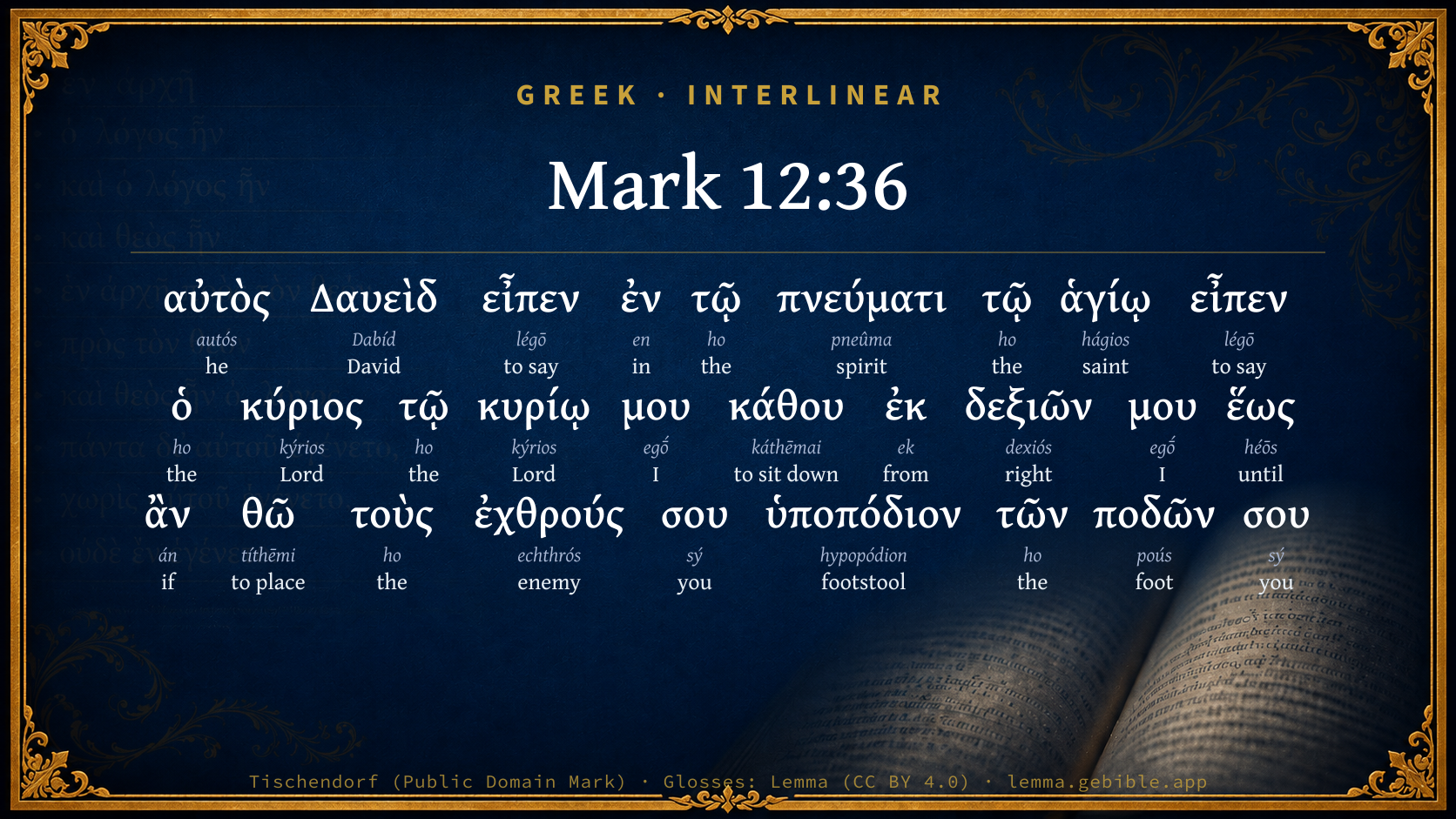
For David himself said in the Holy Spirit, 'The Lord said to my Lord, Sit at my right hand, Until I make your enemies the footstool of your feet.'
Download a study sheet
One document with this verse’s original text, its word-by-word gloss line, the meaning frame, cross-references with their text, attributed commentary, and full source and license credits — printable, and it pastes into notes with its structure intact.
This verse Autodidact and up
A passage Seminary Student
Up to 50 verses in one chapter. A passage sheet keeps up to 6 commentary sources and 12 cross-references per verse, in the order this page ranks them, and says so on the sheet whenever that leaves anything out. Ask for a single verse and you get the Autodidact verse sheet above.
Everything on this page stays free to read, with no account — the sheet is a download of what is already on screen, not access to it.
Compare translations 3
The same verse in 3 English versions, stacked beneath the original-language interlinear above. Click any original word for its lexicon entry.
Each is an independent rendering of the whole verse — the interlinear is not word-aligned to these translations.
Highlighted words mark where these versions differ — a whole-verse word diff, not a word-by-word alignment.
-
World English Bible Public Domain
For David himself said in the Holy Spirit, 'The Lord said to my Lord, Sit at my right hand, Until I make your enemies the footstool of your feet.'
-
King James Version Public Domain
For David himself said by the Holy Ghost, The LORD said to my Lord, Sit thou on my right hand, till I make thine enemies thy footstool.
-
unfoldingWord Literal Text CC BY-SA 4.0
David himself, in the Holy Spirit, said, ‘The Lord said to my Lord, “Sit at my right hand, until I put your enemies under your feet.”’
unfoldingWord Literal Text — © unfoldingWord, licensed CC BY-SA 4.0. Word-aligned USFM3 via Door43 (git.door43.org/unfoldingWord/en_ult).
Show all 19 translations
Every available English version of this verse, each an independent rendering of the whole verse.
-
World English Bible Public Domain
For David himself said in the Holy Spirit, 'The Lord said to my Lord, Sit at my right hand, Until I make your enemies the footstool of your feet.'
-
Berean Standard Bible Public Domain
Speaking by the Holy Spirit, David himself declared: ‘The Lord said to my Lord, “Sit at My right hand until I put Your enemies under Your feet.”’
-
Majority Standard Bible Public Domain
Speaking by the Holy Spirit, David himself declared: ‘The Lord said to my Lord, “Sit at My right hand until I make Your enemies a footstool for Your feet.”’
-
King James Version Public Domain
For David himself said by the Holy Ghost, The LORD said to my Lord, Sit thou on my right hand, till I make thine enemies thy footstool.
-
American Standard Version (1901) Public Domain
David himself said in the Holy Spirit, The Lord said unto my Lord, Sit thou on my right hand, Till I make thine enemies the footstool of thy feet.
-
Revised Version (1885) Public Domain
David himself said in the Holy Spirit, The Lord said unto my Lord, Sit thou on my right hand, Till I make thine enemies the footstool of thy feet.
-
Geneva Bible (1599) Public Domain
For Dauid himselfe said by ye holy Ghost, The Lord said to my Lord, Sit at my right hand, till I make thine enemies thy footestoole.
-
Douay-Rheims (1899) Public Domain
For David himself saith by the Holy Ghost: The Lord said to my Lord, Sit on my right hand, until I make thy enemies thy footstool.
-
Young's Literal Translation Public Domain
for David himself said in the Holy Spirit, The Lord said to my lord, Sit thou on My right hand, till I place thine enemies -- thy footstool;
-
Literal Standard Version CC BY-SA 4.0
For David himself said in the Holy Spirit, The LORD said to my Lord, || Sit on My right hand, || Until I place Your enemies—Your footstool;
-
Unlocked Literal Bible CC BY-SA 4.0
David himself, in the Holy Spirit, said, 'The Lord said to my Lord, “Sit at my right hand, until I make your enemies your footstool.”'
-
unfoldingWord Literal Text CC BY-SA 4.0
David himself, in the Holy Spirit, said, ‘The Lord said to my Lord, “Sit at my right hand, until I put your enemies under your feet.”’
-
Darby Bible Public Domain
[for] David himself said [speaking] in the Holy Spirit, The Lord said to my Lord, Sit on my right hand until I put thine enemies [as] footstool of thy feet.
-
World Messianic Bible Public Domain
For David himself said in the Holy Spirit, ‘The Lord said to my Lord, “Sit at my right hand, until I make your enemies the footstool of your feet.”’
-
Webster's Bible Public Domain
For David himself said by the Holy Spirit, The LORD said to my Lord, Sit thou on my right hand, till I make thy enemies thy footstool.
-
Free Bible Version CC BY-SA 4.0
David himself declared, inspired by the Holy Spirit, that the Lord said to my Lord, ‘Sit at my right hand until I put your enemies under your feet.’
-
Bible in Basic English Public Domain
David himself said in the Holy Spirit, The Lord said to my Lord, Be seated at my right hand, till I put those who are against you under your feet.
-
Text-Critical English NT CC BY 4.0
For David himself said in the Holy Spirit, ‘The Lord said to my Lord, “Sit at my right hand until I make yoʋr enemies a footstool for yoʋr feet.” ’
-
Tyndale New Testament (1534) Public Domain
for David him selfe inspyred with the holy goost sayde: The Lorde sayde to my Lorde syt on my right honde tyll I make thyne enemyes thy fote stole.
Literal Standard Version (2020), Covenant Press — licensed CC BY-SA 4.0. Text via the HelloAO Bible API (eBible.org). Unlocked Literal Bible (unfoldingWord) — licensed CC BY-SA 4.0. Text via the HelloAO Bible API (eBible.org). unfoldingWord Literal Text — © unfoldingWord, licensed CC BY-SA 4.0. Word-aligned USFM3 via Door43 (git.door43.org/unfoldingWord/en_ult). Free Bible Version, Dr. Jonathan Gallagher — licensed CC BY-SA 4.0. Text via the HelloAO Bible API (eBible.org).
Word by word
More ways to search: Search by grammar → Find every occurrence → Compare this word →
Practice this passage: Drill this verse → Learn its vocabulary →
- Appears 8× in the Greek New Testament
- First appears at Matthew 5:35
- Part of Speech
- Noun
- Case
- Accusative
- Number
- Singular
- Gender
- Neuter
Full Thayer's Definition
- αὐτὸς autós G846 “he” Personal pronoun, Nominative, Singular, Masculine
- Δαυεὶδ Dabíd G1138 “David” Noun, Proper, indeclinable
- εἶπεν légō G3004 “to say” Verb, Aorist, Active, Indicative, 3rd person, Singular
- ἐν en G1722 “in” Preposition
- τῷ ho G3588 “the” Article, Dative, Singular, Neuter
- πνεύματι pneûma G4151 “spirit” Noun, Dative, Singular, Neuter
- τῷ ho G3588 “the” Article, Dative, Singular, Neuter
- ἁγίῳ hágios G40 “saint” Adjective, Dative, Singular, Neuter
- εἶπεν légō G3004 “to say” Verb, Aorist, Active, Indicative, 3rd person, Singular
- ὁ ho G3588 “the” Article, Nominative, Singular, Masculine
- κύριος kýrios G2962 “Lord” Noun, Nominative, Singular, Masculine
- τῷ ho G3588 “the” Article, Dative, Singular, Masculine
- κυρίῳ kýrios G2962 “Lord” Noun, Dative, Singular, Masculine
- μου egṓ G1473 “I” Personal pronoun, 1st person, Genitive, Singular
- κάθου káthēmai G2521 “to sit down” Verb, Present, Middle or Passive deponent, Imperative, 2nd person, Singular
- ἐκ ek G1537 “from” Preposition
- δεξιῶν dexiós G1188 “right” Adjective, Genitive, Plural, Masculine
- μου egṓ G1473 “I” Personal pronoun, 1st person, Genitive, Singular
- ἕως héōs G2193 “until” Adverb
- ἂν án G302 “if” Particle
- θῶ títhēmi G5087 “to place” Verb, Aorist, Active, Subjunctive, 1st person, Singular
- τοὺς ho G3588 “the” Article, Accusative, Plural, Masculine
- ἐχθρούς echthrós G2190 “enemy” Adjective, Accusative, Plural, Masculine
- σου sý G4771 “you” Personal pronoun, 2nd person, Genitive, Singular
- ὑποπόδιον hypopódion G5286 “footstool” Noun, Accusative, Singular, Neuter
- τῶν ho G3588 “the” Article, Genitive, Plural, Masculine
- ποδῶν poús G4228 “foot” Noun, Genitive, Plural, Masculine
- σου sý G4771 “you” Personal pronoun, 2nd person, Genitive, Singular
About this verse
These counts appear in no published source. They are computed here, from the morphology-tagged text and Lemma’s own curated glosses. What Lemma adds →
- 28
- words
- 19
- distinct lemmas
- Gospels
- section
Cross-references
15Topical passages linked to Mark 12:36 in the Treasury of Scripture Knowledge — connected by theme and wording, ordered by reader-vote popularity; previews shown in the World English Bible.
- Psalms 110:1 Yahweh says to my Lord, "Sit at my right hand, Until I make your enemies your footstool for your feet."
- Matthew 22:43–45 He said to them, "How then does David in the Spirit call him Lord, saying,
- Hebrews 1:13 But of which of the angels has he said at any time, "Sit at my right hand, Until I make your enemies the footstool of your feet?"
- 1 Corinthians 15:25 For he must reign until he has put all his enemies under his feet.
- Hebrews 10:12–13 but he, when he had offered one sacrifice for sins for ever, sat down on the right hand of God;
- Acts 2:34–36 For David didn't ascend into the heavens, but he says himself, 'The Lord said to my Lord, "Sit by my right hand,
- Acts 1:16 "Brothers, it was necessary that this Scripture should be fulfilled, which the Holy Spirit spoke before by the mouth of David concerning Judas, who was guide to those who took Jesus.
- 2 Samuel 23:2 The Spirit of Yahweh spoke by me, His word was on my tongue.
- Nehemiah 9:30 Yet many years did you bear with them, and testified against them by your Spirit through your prophets: yet would they not give ear: therefore gave you them into the hand of the peoples of the lands.
- Acts 28:25 When they didn't agree among themselves, they departed after Paul had spoken one word, "The Holy Spirit spoke rightly through Isaiah, the prophet, to our fathers,
- 2 Timothy 3:16 Every writing inspired by God is profitable for teaching, for reproof, for correction, and for instruction which is in righteousness,
- Hebrews 3:7–8 Therefore, even as the Holy Spirit says, "Today if you will hear his voice,
- Hebrews 4:7 he again defines a certain day, today, saying through David so long a time afterward (just as has been said), "Today if you will hear his voice, Don't harden your hearts."
- 1 Peter 1:11 searching for who or what kind of time the Spirit of Christ, which was in them, pointed to, when he predicted the sufferings of Christ, and the glories that would follow them.
- 2 Peter 1:21 For no prophecy ever came by the will of man: but holy men of God spoke, being moved by the Holy Spirit.
Cross-references courtesy of OpenBible.info (CC BY 4.0).
Lesson kit
Teaching starters — assembled from the data on this page, not authored interpretation. Every prompt links to the verse data it draws on. Edit before teaching.
Mark, in the Gospels, opens this verse with 28 words (19 distinct Greek lemmas). Its most distinctive word is hypopódion (“footstool”). A historical commentator’s framing appears above. Read the whole chapter for the surrounding context.
Discussion questions
- What does “footstool” (hypopódion) contribute to the verse as a whole?
- How does Matthew 5:35, which shares the word «footstool», read alongside this verse?
- What does the repetition of “to say” (2× in this one verse) do in this verse?
- The translations on this page render this verse differently — a whole-verse word diff, not a word-by-word alignment. What might account for the different wordings?
- Compare how Scofield Reference Notes and Tyndale Open Study Notes read this verse. Where do they agree or differ?
Things to notice
- These translations choose different wording for 9 words in this verse.
- “to say” occurs 2× in this single verse.
- 19 distinct Greek lemmas span 28 words in this verse.
Commentary
Notes on Mark 12:36 from classic Christian and Jewish commentators (each source and its license shown beneath its notes). The classic Christian expositions comment on the surrounding passage and are grouped to its opening verse, so a note may address several verses; the Jewish commentaries on the Tanakh (Rashi and others) are per-verse, so they appear only where the commentator wrote on this verse.
Lemma curates 59 commentaries, every one of them public domain or Creative Commons licensed, each selected and text-cleaned for this edition rather than reprinted as found. About our sources →
Scofield Reference Notes
C. I. Scofield
The Scofield Reference Bible (1917 edition), notes by C. I. Scofield — public domain. Text from a community e-Sword module.
Tyndale Open Study Notes
Tyndale Open Resources
Tyndale Open Study Notes — © Tyndale Open Resources, licensed CC BY-SA 4.0. Text via the HelloAO Bible API.
Bengel's Gnomon
Johann Albrecht Bengel
Bengel's Gnomon of the New Testament — English translation (T&T Clark, Edinburgh, 1860) — public domain. Text from a community e-Sword module.
Expositor's Greek Testament
ed. W. Robertson Nicoll
The Expositor's Greek Testament, edited by W. Robertson Nicoll (1897–1910) — public domain. Text from a community e-Sword module.
Geneva Bible (1599)
Geneva Bible translators
Geneva Bible (1599) marginal notes — public domain. Text via Bolls.life.
Ellicott's Commentary for English Readers
A Bible Commentary for English Readers, edited by Charles John Ellicott (1878–1897) — public domain. Text from a community e-Sword module.
The Cambridge Bible for Schools and Colleges
gen. ed. J. J. S. Perowne
The Cambridge Bible for Schools and Colleges (gen. ed. J. J. S. Perowne; Cambridge University Press, 1878–1918) — public domain. Text from a community e-Sword module.
John Gill's Exposition
John Gill's Exposition of the Whole Bible (1746–1763) — public domain (CC PDM 1.0). Text via the HelloAO Bible API.
Trapp's Complete Commentary
John Trapp
John Trapp, A Commentary or Exposition upon All the Books of the Old and New Testament (1647–1656) — public domain. Text from a community e-Sword module.
The Pulpit Commentary
The Pulpit Commentary (1880–1919), ed. H.D.M. Spence-Jones & Joseph S. Exell — public domain. Text from a community e-Sword module.
John Wesley's Explanatory Notes
John Wesley, Explanatory Notes Upon the Whole Bible (1754–1765) — public domain. Text via the GEBible commentary corpus.
Cambridge Greek Testament for Schools and Colleges
Cambridge Greek Testament for Schools and Colleges (Cambridge University Press, 1896; 21 vols, various authors incl. Carr, Maclear, Plummer, Farrar, Lumby, Moule, M. R. James, Simcox) — public domain. Text from a community e-Sword module.
Alford’s Greek Testament
Henry Alford
Henry Alford, The Greek Testament (1849–1861) — public domain. Text from a community e-Sword module.
International Critical Commentary
International Critical Commentary — older volumes (1896–1929), various authors — public domain. Text from a community e-Sword module.