Philippians 4:22

Greek (Tischendorf 8th ed.) Philippians 4:22 appears in the Greek New Testament. The text above is from the Tischendorf 8th edition. Each word links to its Strong’s number and a concise gloss. Click any word for its full Thayer’s Greek Lexicon entry.
Download image
Cite this verse

Philippians 4:22 (World English Bible). Public Domain. Lemma interlinear Bible study tool, https://lemma.gebible.app/v/philippians/4/22.

Show BibTeX & RIS
BibTeX
RIS
English Translation
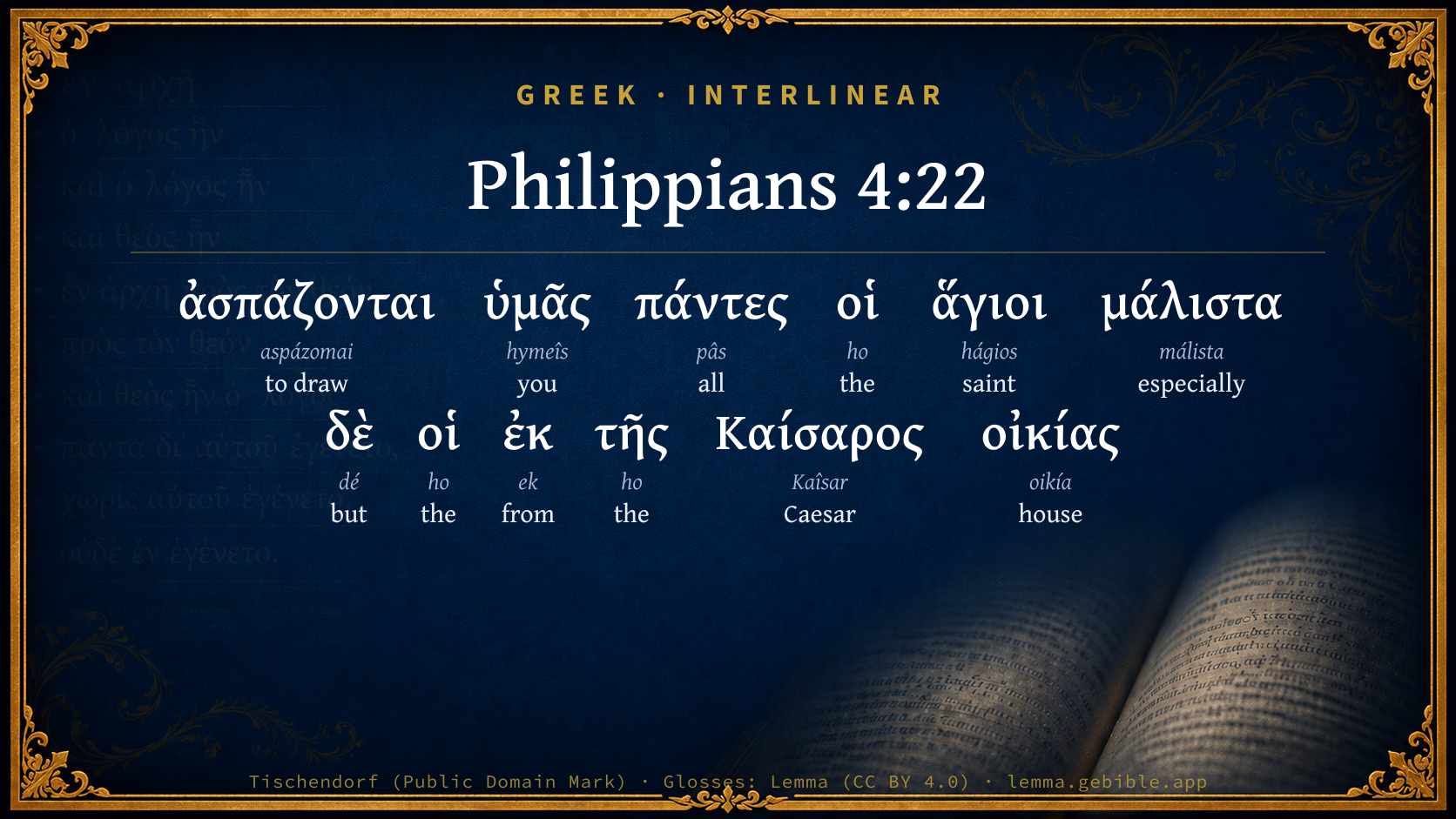
All the saints greet you, especially those who are of Caesar's household.
World English Bible · Public Domain
Download a study sheet

One document with this verse’s original text, its word-by-word gloss line, the meaning frame, cross-references with their text, attributed commentary, and full source and license credits — printable, and it pastes into notes with its structure intact.

This verse Autodidact and up

Study sheet (.html) Plain text (.txt)

A passage Seminary Student

Up to 50 verses in one chapter. A passage sheet keeps up to 6 commentary sources and 12 cross-references per verse, in the order this page ranks them, and says so on the sheet whenever that leaves anything out. Ask for a single verse and you get the Autodidact verse sheet above.

Everything on this page stays free to read, with no account — the sheet is a download of what is already on screen, not access to it.

Want to remove ads? Support Godless Engineer
Compare translations 3

The same verse in 3 English versions, stacked beneath the original-language interlinear above. Click any original word for its lexicon entry.

Each is an independent rendering of the whole verse — the interlinear is not word-aligned to these translations.

Highlighted words mark where these versions differ — a whole-verse word diff, not a word-by-word alignment.

  • World English Bible Public Domain
    All the saints greet you, especially those who are of Caesar's household.
  • King James Version Public Domain
    All the saints salute you, chiefly they that are of Caesar's household.
  • unfoldingWord Literal Text CC BY-SA 4.0
    All the saints greet you, but especially the ones from the household of Caesar.

unfoldingWord Literal Text — © unfoldingWord, licensed CC BY-SA 4.0. Word-aligned USFM3 via Door43 (git.door43.org/unfoldingWord/en_ult).

Versions to compare (up to 4)

3 of 4 selected

Show all 19 translations

Every available English version of this verse, each an independent rendering of the whole verse.

  • World English Bible Public Domain
    All the saints greet you, especially those who are of Caesar's household.
  • Berean Standard Bible Public Domain
    All the saints send you greetings, especially those from the household of Caesar.
  • Majority Standard Bible Public Domain
    All the saints send you greetings, especially those from the household of Caesar.
  • King James Version Public Domain
    All the saints salute you, chiefly they that are of Caesar's household.
  • American Standard Version (1901) Public Domain
    All the saints salute you, especially they that are of Caesar's household.
  • Revised Version (1885) Public Domain
    All the saints salute you, especially they that are of Caesar’s household.
  • Geneva Bible (1599) Public Domain
    All the Saintes salute you, and most of all they which are of Cesars houshold.
  • Douay-Rheims (1899) Public Domain
    The brethren who are with me, salute you. All the saints salute you; especially they that are of Caesar's household.
  • Young's Literal Translation Public Domain
    there salute you all the saints, and specially those of Caesar's house;
  • Literal Standard Version CC BY-SA 4.0
    all the holy ones greet you, and especially those of Caesar’s house.
  • Unlocked Literal Bible CC BY-SA 4.0
    All the believers here greet you, especially those of Caesar's household.
  • unfoldingWord Literal Text CC BY-SA 4.0
    All the saints greet you, but especially the ones from the household of Caesar.
  • Darby Bible Public Domain
    All the saints salute you, and specially those of the household of Caesar.
  • World Messianic Bible Public Domain
    All the holy ones greet you, especially those who are of Caesar’s household.
  • Webster's Bible Public Domain
    All the saints salute you, chiefly they that are of Cesar's household.
  • Free Bible Version CC BY-SA 4.0
    All the believers send you greetings, especially those from Caesar's palace.
  • Bible in Basic English Public Domain
    All the saints send their love to you, specially those who are of Caesar's house.
  • Text-Critical English NT CC BY 4.0
    All the saints greet you, especially those of Caesar's household.
  • Tyndale New Testament (1534) Public Domain
    All the saynctes salute you: and most of all they which are of the Emperours housholde.

Literal Standard Version (2020), Covenant Press — licensed CC BY-SA 4.0. Text via the HelloAO Bible API (eBible.org). Unlocked Literal Bible (unfoldingWord) — licensed CC BY-SA 4.0. Text via the HelloAO Bible API (eBible.org). unfoldingWord Literal Text — © unfoldingWord, licensed CC BY-SA 4.0. Word-aligned USFM3 via Door43 (git.door43.org/unfoldingWord/en_ult). Free Bible Version, Dr. Jonathan Gallagher — licensed CC BY-SA 4.0. Text via the HelloAO Bible API (eBible.org).

Word by word

More ways to search: Search by grammar → Find every occurrence → Compare this word →

Practice this passage: Drill this verse → Learn its vocabulary →

About this verse

These counts appear in no published source. They are computed here, from the morphology-tagged text and Lemma’s own curated glosses. What Lemma adds →

12
words
10
distinct lemmas
Pauline Epistles
section

Notable vocabulary

The rarest word here is μάλιστα especially G3122 — appearing just 12 times in the whole Greek New Testament.

Shared distinctive vocabulary

μάλιστα especially G3122 occurs in 12 verses of the Greek New Testament. Also found in:

Repetition

A word recurs within this verse:

Cross-references

6

Topical passages linked to Philippians 4:22 in the Treasury of Scripture Knowledge — connected by theme and wording, ordered by reader-vote popularity; previews shown in the World English Bible.

  • Philippians 1:13 so that it became evident to the whole praetorian guard, and to all the rest, that my bonds are in Christ;
  • 2 Corinthians 13:13 All the saints greet you.
  • Romans 16:16 Greet one another with a holy kiss. The assemblies of Christ greet you.
  • Acts 9:13 But Ananias answered, "Lord, I have heard from many about this man, how much evil he did to your saints at Jerusalem.
  • Hebrews 13:24 Greet all of your leaders and all the saints. The Italians greet you.
  • 1 Peter 5:13 She who is in Babylon, chosen together with you, greets you; and so does Mark, my son.

Cross-references courtesy of OpenBible.info (CC BY 4.0).

Commentary

Notes on Philippians 4:22 from classic Christian and Jewish commentators (each source and its license shown beneath its notes). The classic Christian expositions comment on the surrounding passage and are grouped to its opening verse, so a note may address several verses; the Jewish commentaries on the Tanakh (Rashi and others) are per-verse, so they appear only where the commentator wrote on this verse.

Lemma curates 59 commentaries, every one of them public domain or Creative Commons licensed, each selected and text-cleaned for this edition rather than reprinted as found. About our sources →

The Biblical Illustrator

Joseph S. Exell

Php_4:22

Chiefly they that are of Caesars household

These words

I.

Remind us of the adaptation of the gospel to men everywhere.

1. It is no part of Gods purpose in redemption to limit its blessings to a nation or class. Hence the provisions of the gospel are suited to the circumstances of man as man. It knows nothing of the distinctions of rich and poor, noble and ignoble, learned and ignorant, bond and free. It knows them only as sinners, and offers salvation to all on equal terms. Hence in the early Churches we find slaves like Onesimus, fishermen like Peter, physicians like Luke, lawyers like Zenas, soldiers like Cornelius, and saints in Caesars household.

2. The gospel is still of universal adaptation. Christ is still the Saviour of sinners, and has disciples in every country and amidst all circumstances and conditions.

II. Teaches us the possibility of serving God in positions of temptation and difficulty.

1. Caesars household was the last place where one would have expected to find saints. Under any circumstances it could not be favourable to conversions and Christian growth; and it was now at about its worst. It illustrates the sovereignty of Divine grace that out of these circumstances there should arise witnesses for the gospel. It must have required great courage; but the grace that called them sustained them.

2. So it is always. There are some positions in which a man cannot serve God because they are wrong. There are others lawful enough, yet encompassed by temptation, e.g., the position of the sailor shut up for months with ungodly shipmates, that of the pious soldier in barracks with ungodly comrades, that of a godly citizen among scoffing fellow workmen. In all such cases God is able to make all grace abound to His servants. Faint not. God by placing you in a post of trial has assigned to you a post of honour. Never try to effect a compromise between right and wrong.

III. Tells how the Spirit of Christ animates all his followers. That spirit is love and sympathy. See how it breathes through these brotherly salutations. The age wants more of this spirit. What Christ requires is not so much uniformity of belief and worship as union of heart.

IV. Illustrates the way in which Christians may comfort and help one another.

1. The Philippians needed comfort. They had adversaries and were in danger of being terrified by this. The letter itself would afford deep consolation, this postscript especially so. The salutation was not much, but it showed that they were not forgotten at the throne of grace.

2. In many ways comfort and help may be afforded if there be only a little thoughtfulness. A truly sympathetic heart can give help with a look and a grasp of the hand. A too common sin is thoughtlessness. Evil is wrought by want of thought, as well as want of heart. The youth in the midst of scoffing companions, the young girl in an ungodly house, the poor man battling with poverty, the discouraged Christian worker--what might not be done by a timely and kind word.

V. A suggestion of the way in which our conduct becomes example and influence to others. Little did the Roman saints think that their salutations would be preserved and handed down through the centuries for the use of the Church. Kind words can never die. Neither can kind actions. Our names may perish but we shall live. Who these saints were we cannot tell. Nevertheless their power is felt today. (W. Walters.)

The saints in Caesars household

The throne of the Caesars was at this time occupied by Nero, a monster rather than a man. Certainly if ever there was an atmosphere uncongenial to Christianity it may be supposed to have been that of the court and palace of this bloody debauchee. Yet so true is it that gospel weapons are mighty to the casting down of strongholds that there were here Christians of the highest type willing to give their profession all publicity by sending greetings to Christians in distant cities.

I. The agency which brought round so unlikely a result. The mind naturally turns to Pauls miraculous gifts, and remembers how with noble intrepidity Paul rose up before the sages of Greece, and that as he spoke to Felix, the slave of base lusts, the haughty Roman trembled. It is easy to imagine, therefore, Paul working some great miracle to command the attention of the emperor and the court, and then reasoning of temperance, righteousness, and judgment to come. But this fancy would be incorrect. Paul was now a prisoner, and could not go like Moses, rod in hand, and compel by his miracles the attention of the profligate king, and yet it was at this time of seeming impotence that the great victory was won. Nay, it appears actually to have been in consequence of his imprisonment. Php_1:12-14 shows the two ways in which his bonds gave enlargement to Christianity. His patience and meekness witnessed for the truth of the gospel for which he suffered, and nerved the Christians to greater energy.

II. We have here a lesson as to Gods power of overruling evil for good. We are apt to imagine when a man is withdrawn from active duty that his usefulness is gone. But a minister can preach from a sick bed as well as from a pulpit. The report which goes forth of his patience and fortitude will do as much and perhaps more towards overcoming resistance to the gospel than his active ministrations. The martyrs did most for God and truth when actually in the clutches of their persecutors. A true Christian is never laid by. The influence that he exerts when suffering or reduced to poverty is often greater than when he led a benevolent enterprise. Let no one then be discouraged.

III. A man cannot be placed in circumstances which put it out of his power to give heed to the duties of religion. The instance of saints in Caesars household takes away the excuse that temptations, hindrances, opposition render piety impossible. Where are any so circumstanced as these people? It is true that more appears to be done for one man than for another, and that some circumstances are conducive and others hindering to religion. But under every possible disadvantage there may be a striving with evil and a following after good. The excuse assumes that God has put it out of some mens power to provide for their souls safety, and to assume this is to contradict the Divine word, and to throw scorn on the Divine attributes. Take a case like the one before us, that of servants in an irreligious family. Their superiors set them a bad example, give them few opportunities for public or private devotion, and would frown on or ridicule any indication of piety. Let this be granted. Yet these difficulties would disappear before earnest resolve. They have but to begin and obstacles would be gradually lowered and strength would grow by exercise. The Spirit of the living God fails no man who is not false to himself.

IV. These saints not only belonged to Caesars household at the time of their conversion, but remained after their conversion. They did not feel it their duty to abandon their stations and seek others apparently more favourable to religion. So that it does not follow that a man is to withdraw from circumstances of danger and difficulty, and place himself where there is less temptation and opposition. It is true a converted man is not justified in seeking employment where it would be specially difficult to cultivate religion; but to desert it because it made religion difficult would be to declare that the grace which had converted him in spite of disadvantages would not suffice to establish him, and to mark distrust of Gods Spirit. If the employment were sinful, there would be no room for debate; but if only dangerous, and simply required a greater amount of vigilance and boldness, to forsake it would prove timidity rather than prudence. For, e.g., a Christian nobleman in a corrupt court, or servant in an ungodly family, may find it unlawful to leave, inasmuch as distinct opportunity may be afforded of doing honour to God and promoting Christs cause. They are placed by God as leaven in the midst of an unsound mass. Not that a servant has to travel beyond the duties of his station; he has simply to carry his Christianity into all his occupations, and to distinguish himself from others by closer attention to his masters interests, stricter adherence to truth, etc. Let an irreligious master perceive all this, and he will scarcely fail to receive an impression favourable to religion. There are families to which the preacher can gain no access. God forbid that pious domestics should hastily withdraw from such.

V. Wheresoever God makes it a mans duty, there he will make it his interest to remain. If He employ one of His servants in turning others from sin, He will cause the employment to conduce to that servants holiness. Notice the chiefly of our text. Of all the Roman Christians the foremost in love were these saints who probably remained in Caesars service for the express purpose of furthering the gospel. Nor need we feel any surprise at this. Absence of trial is not the most favourable thing to religious growth. Neros palace may be a far better place for the development of personal piety than the cell of the monk; in the one the Christian has his graces put continually to the proof, and this serves both to discover and strengthen them; in the other there may be comparatively nothing to exercise them. And then the God of all grace, who has promised that His people shall not be tempted above that they are able, will bestow assistance proportioned to their wants. (H. Melvill, B. D.)

Saints in Caesars household

I. It is possible to be a Christian anywhere.

1. Christianity is not a thing of locality but of character. There are plants which will bloom in some latitudes and die in others, but Christianity can live where man can live, because it consists in the loyalty of the heart and life to Christ. Obadiah kept his conscience in the house of Ahab, Daniel his in the court of Babylon, Nehemiah his in the Persian palace. As Jonathan Edwards says, The grace of God can live where neither you nor I can. In the abodes of poverty humble Christians are living as near to God as Enoch. Even yet, if we care to look for it, we may find the lily among thorns.

2. What is true of places is true of occupations. Unless a mans business is sinful he may serve God in any profession. The Roman army was a very poor school of morals, yet all the centurions mentioned in the New Testament were good men. The sailor is proverbially rough, yet some of the best Christians have been sailors. What heroic godliness has been manifested by miners?

3. Now, if this be so it follows--

(1) That we must not be prejudiced against a man because of the locality he comes from. What peril Nathaniel nearly incurred because he thought Jesus came from Nazareth. Test a man by what he is, not by what he comes from.

(2) That we ought not to excuse ourselves for our lack of Christianity by pleading the force of circumstances. How often do we hear one saying, It is no use trying to be a Christian where I am. But it is never necessary to do wrong. Sin is a voluntary thing, and no external force can constrain a man to commit it. One comes home intoxicated and pleads that he met some friends and had to go with them; another excuses his extravagance on the plea that he must keep up appearances; a third excuses his dishonourable practices because he is in danger of bankruptcy. But if you cannot help doing wrong it is not wrong, but it is the consciousness of being able to help it that makes you so eager to use the excuse.

II. It is harder to be a Christian in some places than in others. There are households in which it seems most natural for a child to grow up in the beauty of holiness, and others where loyalty to Christ is met with opposition. The surroundings of some occupations are more trying to piety than others. When the lymphatic Dutchman, who took things easily, said to his excited minister, Dominic, restrain your temper, he was met with the pertinent reply, Restrain my temper, sir! I restrain more temper in the course of a single day than you do in a year. That was a difference of temperament. What then?

1. The Lord knows that this is so, and He will estimate our work by our opportunity. We may be sure that if we are in a hard place He will give us strength according to our need. Each gets his own grace. Ilka blade of grass has its ain drap o dew, and grace is suited to the place in which one dwells.

2. We ought to be charitable in our judgment of each other. While we hold ourselves to a rigid reckoning in all circumstances, let us make allowance for the circumstances of others. The flower in the window of a poor mans cottage may be far from a perfect specimen, but it is a greater marvel than the superb specimen in a rich mans conservatory. There may be more honour to one man for the Christianity he has maintained in the face of great obstacles, though it may be marked with blemishes, than there is to another who has no such blemishes, but who has had no such conflict.

III. The harder the place in which we are we should be the more earnest to maintain our Christianity. Here, however, it is needful to know what the hardest place is. It is not always that where there is the greatest external resistance to Christianity. An avowed antagonist the Christian meets as such; he prepares himself for the encounter, and is not taken unawares; but when the ungodly meet him as friends, then he is in real peril. The worlds attentions are more deadly than its antagonisms. The Church is in the world as a boat is in the sea; it can float only by being kept above it; and if we let it become waterlogged it will be swamped.

IV. The greater the difficulty we overcome in the maintenance of our Christianity the greater will be our reward. (W. M. Taylor, D. D.)

Sainthood in Neros household

1. This incidental allusion informs us that already Jesus was confessed before emperors; men that in irresponsible power and savage cruelty had almost lost the nature of men. Faith has won its greatest conquests on straitened and sorrowful fields.

2. If the strength and joy of believing are proportioned to the weight of the crosses born for it, then in some such post as this we must look for the bravest witnesses to the truth.

3. We eulogize virtues that flourish only in a favourite soil and climate. We palliate and excuse the deficiency, when honesty is missing in the household of Caesar. We forget that the piety of the Church and of society dwindles inevitably unless it is replenished by the energy of those valiant examples which will dare to be true in the palaces of power, and fashion, and mammon.

4. There are yet saints in Caesars household, and there is as good cause to venerate them as when beasts licked up their blood from the sand. For the substance of all sainthood which has vitality enough to live in Caesars household is this, that its virtue is so built on interior foundations, and its faith so rooted in its Divine Master, that no outward opposition can break it down.

5. There are special traits essential to sainthood in Caesars household.

I. Courage Christianity has favour for every noble sentiment; and so she offers to the veteran soldier, and to the enthusiastic youth, a field for bravery grander than any battle, in the resistance of moral invasion. Accordingly, we find that, very soon, Christianity seized on rough warriors, and some of these believers about the person of Nero must probably have been guards of his palace. On one of the early Christian monuments at Rome there is an epitaph of a young military officer, who lived long enough when he shed his blood for Christ. But Christs religion courts no consideration from armies. Its courage is of another kind--the courage that bears wrong, but will not commit it--that saves life, rather than destroys it; that springs from an unspotted conscience; that goes into and out of all companies, counting houses, caucuses, and churches, with an uprightness not to be bent, whether you bring threats, or sneers, or golden baits to tempt it; that lifts up an unblenched face in the most formidable array of difficulties, satisfied to stand on Gods side, to listen to the encouragement of the beatitudes and to hold to the breastplate of righteousness. Wherever such Christian courage in duty is there will be saints of Caesars household.

II. Modesty. They did not call themselves saints; Paul called them so. They did not boast of their religion; there was too much solemn sincerity in it. They did not lurk about the temples to mock the soothsayers, and to disseminate slanders about the priesthood. They knew the joy of their communion with Jesus, and cared more for that than for the admiration of the citizens. That was their Christian modesty. Disjoined from their fortitude, it might haw degenerated into timidity. And that is often our danger. There are persons of a diffident disposition, that err in not mixing enough boldness of resistance with their good nature. They remain inefficient disciples because they shrink from public notice. This is to turn the ornament of a meek and quiet spirit into a deformity, and to rob the Master of the testimony that is His due. This is the danger of all threatened minorities, but they will get strength for the fiery trial by going back to see how the inmates of a palace full of gluttony, licentiousness, and all royal vices, held their allegiance fast.

III. But to imitate that successful blending of modesty and courage, they will want a third quality, namely, independence. The question of duty once settled, all gates but that which leads to acting it out must be shut. And beyond that point, all arguments from custom, from the general expectation, from popular applause, from public or private gratification, are impertinent. Remember, these saints were living in the centre of the great worlds energy and splendour, and in the very focus of its intelligence. Independence was a virtue quite indispensable to them; but not a whit more so than to us. For, every day, Providence, through our own instincts, pushes us into some crisis of moral peril, where, if we do not act simply of ourselves, and take our direction at first hand from the Spirit, our integrity itself is gone.

IV. And superadded to independence and modesty and courage is constancy. There must have been many days when it would have been easy and convenient for these saints to slip round into the old comfortable heathenism. Inducements were not wanting. For the ignorant there was personal safety. For the cultivated Seneca was alive. But they held fast. They might be hunted out, and see their teachers slaughtered; but they gathered again the next evening, and other hands, willing to be mangled by the same martyrdom, broke to them the bread of life. The emperor might send them out to build his baths; they raised no civil rebellion, but while they bent to their slavery they knelt and prayed to their Father. Arrows might pierce their bodies, but they believed the Lord Jesus would receive their spirits. God is asking constancy of us. Our Nero is self-love. The senses are the Caesars of all ages. Fashion is a Rome that commissions its legions and spreads its silent empire wider than the Praetorian eagles. The reigning temper of the world is the imperishable persecutor and tyrant of the faithful soul. And so, in every home and street there are chances for the reappearing of saints in Caesars household. (Bishop Huntington.)

The religion of charity compatible with all callings

Notice that the chief salutations came from the unlikeliest place. It is a rebuke to some who think that Christianity pervades one state of life more than another. At times men have thought that the Christian religion was peculiarly suitable to the poor, and had nothing to do with the officers of Caesars household. Christ preached at first to the lowly, yet wise and rich were also called. If saints are found in Caesars household where shall they not be found? But men go sighing to find the proper soil for religion, and go to the desert to be religious, and think that when a man is a beggar he must be nearest heaven.

I. Christianity has affinity with all callings.

1. With riches, because the great grace of charity can be exercised thereby. Whose has charity in his heart and wealth in his hand has the finest gift of God.

2. With statesmanship, although it is common to say that that is a very uncongenial atmosphere for a Christian. But a statesman can put an end to the foul obstructions that hinder truth; he can make laws that men shall be no longer housed in conditions that make righteousness impossible.

3. With the soldier, though some think not. Though the day will come when war shall be at an end, nevertheless he who goes forth in a good cause stirred by the spirit of verity to do righteousness in the spirit of order, obedience, and self sacrifice, between him and the Christian faith are strong affinities.

4. With retirement. Christianity has much to say about the blessings of quiet existence, in deepening the wells of life.

5. With business. The merchant may be the most eminent missionary.

6. With art. The artist who gives relief to the tired eye and brain, who preaches the God of eternal beauty, and the spirit which underlies all visible things, is in harmony with our faith.

II. Wherein consists this unity by which the spirit of Christ has an affinity with extremely opposite characteristics?

1. Let us wander seemingly for a time and answer this question by asking another. It is not whether this or that calling or characteristic be holy or not, but what is that holiness which justifies us in calling it holy? A man may be a sweeper of chimneys or the holder of a sceptre; but the sceptre may be swayed in righteousness, and so may the besom. The righteousness of each depends on the degree to which each embodies in his calling that which constitutes righteousness.

2. To do a good action three things are essential.

(1) That you know what you are doing.

(2) That you do it from choice.

(3) That you have firmness and perseverance to do the like at all times.

3. Having knowledge, intention, and persistence in the performance of that which is just and wise, the question becomes this--What is that which, put into voice or action, constitutes it an act in accord with the Christian faith? Christianity pronounces it to be charity. Charity means the large, loving, constant doing of all things great and small. It is the universal spirit to which there is nothing great or small. A king through charity may sway the sceptre, and a room may be swept to the glory of God. So in Caesars household and Peters fishing hut, it is possible to be filled with that which constitutes the spirit of religion. Therefore it is a matter of indifference what your calling may be. If you are scandal mongers, indeed, it is impossible to be charitable, because you violate the first principles of charity. When one lives not in constant piety one goes back to Caesars household and thinks who they were. (G. Dawson, M. A.)

Christianity

I. Is holy--it makes men saints.

II. Might--it enters the palace.

III. Fearless--it stands before Nero.

IV. Kind--it teaches love. (J. Lyth, D. D.)

The composition of Caesars household

The household of the emperor consisted mainly of troops and of slaves who ministered to his wants and caprices as the wealthiest and most luxurious of Roman magnates. But senators and knights were also in close attendance upon him, equally in his hours of business and relaxation. These, indeed, were probably masters of households of their own; thus Seneca, the most intimate of his ministers, enjoyed a private residence in his gardens; Burrus, the prefect of the Praetorians, whose duty brought him, no doubt, daily into the imperial presence, occupied his own lodging in the Praetorian camp. The affairs of government were transacted chiefly by the emperors freedmen, some of them notorious for their riches and influence, court favourites who had been enfranchised by himself or his predecessors. These also had each his own palace and gardens, in which he vied with the proudest of the ancient aristocracy. Nevertheless these, too, were so closely attached to the emperors person that they might claim to form a part of Caesars household, and any one of them may have come in contact with Paul. A man of Pauls power of thought and language, speaking with the academic tone of a scholar of Tarsus, and the natural fervour of a Hebrew prophet, could hardly fail to command the attention of the feverish students of moral truth who abounded in the ranks of the Roman aristocracy. But if such turned away he could not fail to be received among the lower class of the emperors household attendants, both male and female, who filled a thousand menial offices about his person, and that of his consort. The ministers to the luxury of Poppaea were certainly not less numerous than those who discharged similar functions for Livia before her. Among them were servants of the chamber and the ante-chamber, servants who waited at the doors, who attended at the bath, who assisted at the toilet, who kept the jewels, who read at the empresss couch, who sat at her feet, who followed her in her walks, who lulled her to sleep and watched over her slumbers, who had charge of her purse, and distributed the tasks of the whole household. The persons in waiting on the emperor were probably even more multitudinous, and while many of their functions were merely manual, there were not a few entrusted with affairs which required high intellectual training. The emperor was surrounded with numerous members of the learned classes such as could discharge the duties of secretaries, physicians, professors of every art and accomplishment and teachers in philosophy. To have access to Caesars household was to be put into communication with the most intelligent people of the day. Over Pauls intercourse with these people a cloud rests, but it so happens that recent excavations have discovered the names of various persons connected with the court of Claudius which are identical with those which the apostle mentions in his Epistle to the Romans. We find among these names those of Amphas, Urbanus, Stachys, Apella, Tryphena, Tryphosa, Rufus, Hermas, Potrobius (Patrobas), Philologus, and Nerens. Some of these, no doubt, are very common appellatives; but the occurrence of so many coincidences can hardly be accidental. And the easy and familiar way in which the apostle introduces the mention of the saints in Caesars household, seems to imply that he stood on an easy footing with them. It is the style of one who went in and out among them, of a man who dwelt close at hand; accessible daily as they passed by on their ordinary avocations. (Dean Merivale.)

The Biblical Illustrator, edited by Joseph S. Exell (c. 1880s–1900s) — public domain. Text from a community e-Sword module.

Tyndale Open Study Notes

Tyndale Open Resources

4:22 Those in Caesar’s household were believers employed in the service of the Roman government—perhaps those whom Paul had evangelized while in prison. They might have been especially close to Paul and concerned for him in prison (see 1:13).

Tyndale Open Study Notes — © Tyndale Open Resources, licensed CC BY-SA 4.0. Text via the HelloAO Bible API.

Expositor's Greek Testament

ed. W. Robertson Nicoll

Phi 4:22 . μάλιστα . If by this time, as is probable (see Introduction ), Paul had been removed from his lodging to one of the state prisons near the palace, it is plain that Christians of the Imperial household would have special opportunities of close intercourse with him. οἱ ἐκ τῆς Κ . οἰκίας . See esp [73] . SH [74] . , Romans , pp. 418 423, as supplementary to Lightfoot’s important discussion; and also, Riggenbach, Neue Jahrb. f. deutsche Th. , 1892, pp. 498 525, Mommsen, Handbuch d. röm. Alterth. , ii., 2 (Exo 3 ), pp. 833 839. SH [75] . point out that a number of the names mentioned for salutation in Rom 16 . occur in the Corpus of Latin Inscriptions as members of the Imperial household, which seems to have been one of the chief centres of the Christian community at Rome. In the first century A.D. most of the Emperor’s household servants came from the East. Under Claudius and Nero they were people of real importance. And we find, from history, that Christian slaves had great influence over their masters. See Friedländer, Sittengeschichte Roms , i., pp. 70 ff., 74, 110 112.

[73] especially.

[74] . Sanday and Headlam ( Romans ).

[75] . Sanday and Headlam ( Romans ).

The Expositor's Greek Testament, edited by W. Robertson Nicoll (1897–1910) — public domain. Text from a community e-Sword module.

Geneva Bible (1599)

Geneva Bible translators

Such as belong to the Emperor Nero.

Geneva Bible (1599) marginal notes — public domain. Text via Bolls.life.

Jamieson, Fausset & Brown

Robert Jamieson, A. R. Fausset & David Brown

they that are of Cæsar's household--the slaves and dependents of Nero who had been probably converted through Paul's teaching while he was a prisoner in the Prætorian barrack attached to the palace. Philippi was a Roman "colony," hence there might arise a tie between the citizens of the mother city and those of the colony; especially between those of both cities who were Christians, converted as many of them were by the same apostle, and under like circumstances, he having been imprisoned at Philippi, as he now is at Rome.

Jamieson, Fausset & Brown — Commentary Critical and Explanatory on the Whole Bible (1871) — public domain (CC PDM 1.0). Text via the HelloAO Bible API.

Adam Clarke's Commentary

Verse 22. All the saints] All the Christians now at Rome.

They that are of Caesar's household.] Nero was at this time emperor of Rome: a more worthless, cruel, and diabolic wretch never disgraced the name or form of man; yet in his family there were Christians: but whether this relates to the members of the imperial family, or to guards, or courtiers, or to servants, we cannot tell. If even some of his slaves were converted to Christianity, it would he sufficiently marvellous. Converts to Christianity in this family there certainly were; and this shows how powerfully the Divine word had been preached and spread. That the Empress Poppaea may have been favourably inclined to Christianity is possible; for Josephus relates of her, Antiq., lib. xx. cap. 7: θεοσεβης γαρ ην. She was a worshipper of the true God; it is not likely, therefore, that she threw any hinderances in the way of her servants who might wish to embrace the Christian faith. St. Jerome, in Philemon, states that St. Paul had converted many in Caesar's family; A Caesare missus in carcerem, notior familiae ejus factus, persecutoris Christi domum fecit ecclesiam. "Being by the emperor cast into prison, he became the more known to his family, and he turned the house of Christ's persecutor into a church." Some imagine that Seneca, the preceptor of Nero and the poet Lucan, were converted by St. Paul; and there are still extant, and in a MS. now before me, letters which profess to have passed between Paul and Seneca; but they are worthy of neither. They have been printed in some editions of Seneca's works. See the remarks below.

Adam Clarke's Commentary on the Bible (1810–1826) — public domain. Text from a community e-Sword/MySword module.

John Calvin's Commentaries

22 The brethren that are with me salute you In these salutations he names first of all his intimate associates, afterwards all the saints in general, that is, the whole Church at Rome, but chiefly those of the household of Nero — a thing well deserving to be noticed; for it is no common evidence of divine mercy, that the gospel had made its way into that sink of all crimes and iniquities. It is also the more to be admired, in proportion as it is a rare thing for holiness to reign in the courts of sovereigns. The conjecture formed by some, that Seneca is here referred to among others, has no appearance of foundation; for he never gave any evidence, even the smallest, of his being a Christian; nor did he belong to the household of Caesar, but was a senator, and had at one time held the office of praetor.

END OF THE COMMENTARY ON THE EPISTLE TO THE PHILIPPIANS.

John Calvin's Commentaries (1540-1563) — public domain. Text from the Calvin Translation Society English edition (1840s-50s) via the Christian Classics Ethereal Library (ccel.org). Calvin's coverage is partial (roughly two-thirds of the Bible); uncommented books and verses are honest gaps, never fabricated. The 19th-century editor's footnotes and remarks are omitted so the notes are faithfully Calvin's own voice.

Ellicott's Commentary for English Readers

(22) of Cæsar’s household.—The “household of Cæsar” included a multitude of persons of all ages and ranks and occupations. Dr. Lightfoot, in a very interesting excursus on this verse, remarking that these Christians of Cæsar’s household are alluded to as if well known to the Philippians, has examined the various names mentioned in Romans 16. (three years before this time), and finds many of them identical with names actually found in sepulchral inscriptions, as belonging to members of the “domus Augusta,” or imperial household. These were earlier converts; but, wherever St. Paul’s prison was, he can hardly have failed to gain through the prætorians some communication with the household of the emperor, whose body-guard they were; and the allusion here seems to show that for some reason these Christians of Caesar’s household were in an especial familiarity of intercourse with him. Probably, therefore, he had added from that household new converts to Christ; and he mentions this here, as he had before spoken of his bonds being made manifest in the “prætorium” (Php_1:13), in order to show the Philippians that his very imprisonment had given special opportunity for the spread of the gospel.

A Bible Commentary for English Readers, edited by Charles John Ellicott (1878–1897) — public domain. Text from a community e-Sword module.

The Cambridge Bible for Schools and Colleges

gen. ed. J. J. S. Perowne

22. chiefly] More exactly, but chiefly. There was something marked and emphatic about this message.

they of Cesar’s household] “Probably slaves and freedmen attached to the palace” (Lightfoot). It has been sometimes assumed that these persons, on the other hand, were members of the imperial family, and this has been used either to prove the remarkable advance of the Gospel in the highest Roman society during St Paul’s first captivity, and incidentally to evidence a late date in that captivity for the Epistle, or to support a theory of the spuriousness of the Epistle. Bp Lightfoot, in an “additional note,” or rather essay (Philippians, pp. 171–178), has shewn with great fulness of proof that the “household of Cæsar” was a term embracing a vast number of persons, not only in Rome but in the provinces, all of whom were either actual or former slaves of the Emperor, filling every possible description of office more or less domestic. The Bishop illustrates his statements from the very numerous burial inscriptions of members of the “Household” found within the last 170 years near Rome, most of them of the period of the Julian and Claudian Emperors. And the names of persons in these inscriptions afford a curiously large number of coincidences with the list in Romans 16; among them being Amplias, Urbanus, Apelles, Tryphæna, Tryphosa, Patrobas, Philologus. And it appears by the way to be very probable that both Aristobulus’ and Narcissus’ “households” (Rom_16:10-11) were in fact the slave-establishments of the son of Herod the Great, and of the favourite of Claudius, respectively, transferred to the possession of the Emperor. Bp Lightfoot infers from this whole evidence the great probability that the “saints” greeted in Romans 16 were, on the whole, the same “saints” who send greeting here from Rome. Various as no doubt were their occupations, and their native lands, the members of the Household of Cæsar as such must have had an esprit de corps, and, for their rank in society, a prestige, which made it humanly speaking likely that a powerful influence, like that of the Gospel, if felt among them at all, would be felt widely, and that they would be in the way to make a distinctive expression of their faith and love, when occasion offered.

The view thus given of the saints here mentioned, their associations and functions, not only in the age of Nero but in the precincts of his court, and probably for many of them within the chambers of his palace, gives a noble view in passing of the power of grace to triumph over circumstances, and to transfigure life where it seems most impossible.

A certain parallel to the Household of Cæsar appears in the vast Maison du Roy of the later French monarchy. But the Maison was for the noblesse alone.

The Cambridge Bible for Schools and Colleges (gen. ed. J. J. S. Perowne; Cambridge University Press, 1878–1918) — public domain. Text from a community e-Sword module.

John Gill's Exposition

All the saints salute you,.... The members of the church at Rome,

chiefly they that are of Caesar's household; for by means of the apostle's bonds, which were made manifest in the emperor's palace, Christ was made known to some there likewise; though Nero, the then reigning emperor, was a very wicked prince, and his court a very debauched one, yet the grace of God reached some there: who these were cannot be said; as for the conjecture that Seneca the philosopher, Nero's master, was one of them, it is without foundation; the eight letters of his to the Apostle Paul, and the six letters of the apostle to him, are spurious, though of ancient date, being made mention of by Austin and Jerom (g): a like groundless conjecture is that, that Lucan the poet, Seneca's brother's son, was another; for there is nothing in his writings, or in any account of him, any more than in the former, that shows him to be a Christian. Torpes, a man in great favour and dignity in Nero's court, and Evellius his counsellor, who both suffered martyrdom under him, according to the Roman martyrology, are also mentioned,

(g) Vid. Fabricii Bibliothec. Latin, p. 69.

John Gill's Exposition of the Whole Bible (1746–1763) — public domain (CC PDM 1.0). Text via the HelloAO Bible API.

Trapp's Complete Commentary

John Trapp

22 All the saints salute you, chiefly they that are of Caesar’s household.

Ver. 22. All the saints salute you] Christianity is no enemy to courtesy. God’s scholars are taught better manners than to neglect so much as salutations.

They that are of Caesar’s household] When Caesar himself lived and died an unconverted caitiff (wretch) and a castaway. So did Seneca, for aught we can find by his writings, though some would have him to be here designed among the rest. {See Trapp on "Rom 1:18"}

John Trapp, A Commentary or Exposition upon All the Books of the Old and New Testament (1647–1656) — public domain. Text from a community e-Sword module.

Albert Barnes' Notes on the Bible

All the saints salute you - All in Rome, where this Epistle was written. No individuals are specified, perhaps because none of the Christians at Rome wore personally known to the church at Philippi. They would, however, feel a deep interest in a church which had thus the confidence and affection of Paul. There is reason to believe that the bonds of affection among the churches then were much stronger than they are now. There was a generous warmth in the newness of the Christian affection - the first ardor of love; and the common trials to which they were exposed would serve to bind them closely together.

Chiefly they that are of Caesar’s household - That is, of Nero, who was at that time the reigning emperor. The name Caesar was given to all the emperors after the time of Julius Caesar, as the name Pharaoh was the common name of the kings of Egypt. The phrase used here - “the household of Caesar” - may refer to the relatives of the emperor; and it is certainly possible that some of them may have been converted to Christianity. But it does not of necessity refer to those related to him, but may be applied to his domestics, or to some of the officers of the court that were more particularly employed around his person; and as it is more probable that some of them would be converted than his own relatives, it is more safe to suppose that they were intended; see the notes at Phi 1:13.

Albert Barnes' Notes on the Bible (1834–1885) — public domain. Text from a community e-Sword/MySword module.

Matthew Poole's English Annotations

The rest of the Christians at Rome do the same; more especially they of Nero the emperor’s own family and court, his domestics, Phi 1:13. It seems there were some there truly pious and Christian: but however some conceit, there is no real evidence that Seneca was of that number; he being not a courtier, but a senator, who left no real token (we know of) that he was a Christian.

Matthew Poole's English Annotations on the Holy Bible (1683–1685) — public domain. Text from a community e-Sword/MySword module.

The Pulpit Commentary

All the saints salute you, chiefly they that are of Caesar"s household. All the Christians at Rome, not only St. Paul"s personal friends and companions. It is not clear why he lays a special stress on those belonging to Nero"s household. The reason given by Chrysostom seems somewhat fanciful: "If those who dwelt in palaces despised all things for the sake of the King of heaven, much more should the Philippians do so." Some of them may have been known to the Philippian Christians. The term familia or domus Caesaris included all ranks, from the highest official to the lowest freedman or slave. It is probable that those alluded to here belonged to the humbler classes. But at any rate St. Paul"s words prove that his preaching had penetrated into that abyss of all infamy, the palace of Nero. (For the Christianity of Seneca, and the supposed correspondence between him and St. Paul see Bishop Lightfoot"s dissertation on "St. Paul and Seneca." See also his detached note on "Caesar"s Household.")

The Pulpit Commentary (1880–1919), ed. H.D.M. Spence-Jones & Joseph S. Exell — public domain. Text from a community e-Sword module.

The People's New Testament

B. W. Johnson

22. Chiefly. Especially. The class next named send special greetings. Of Cæsar's household. Amid the vast number who dwelt in the palace as immediate attendants of the emperor, amounting to hundreds and perhaps thousands, there were some who had become Christians. What was their condition in life is a matter of conjecture. Philippi was a colony (Acts 16:12), a sort of outlying suburb of Rome, populated with Roman citizens. Hence it is possible that these would have friends in the Philippian church, who would know well who were meant, and to them they send special greetings.

B. W. Johnson's The People's New Testament with Notes (1889–1891) — public domain. Electronic text from the Christian Classics Ethereal Library (CCEL) ThML edition.

Cambridge Greek Testament for Schools and Colleges

22. μάλιστα δὲ. There was something marked and emphatic about this message.

οἱ ἐκ τῆς Καίσαρος οἰκίας. “Probably slaves and freedmen attached to the palace” (Lightfoot). It has been thought, on the other hand, that these persons were members of the imperial family, or at least grandees of the court; and this has been used either to prove a remarkable advance of the Gospel in the highest circles during St Paul’s imprisonment (and incidentally to evidence a late date for the Epistle in that imprisonment), or to indicate the spuriousness of the Epistle. Lightfoot (Phil., pp. 171–178) has fully shewn that “the Household of Cæsar” was a term embracing a vast number of persons, not only in Rome but in the provinces, all of them either actual or former imperial slaves, filling every description of more or less domestic office. He illustrates his statements from the numerous epitaphs of members of the Domus Cæsaris found within the last 175 years near Rome, most of them of the Julian and Claudian times. It is remarkable that the names in these epitaphs afford curiously many coincidences with the names in Romans 16; among them are Amplias, Urbanus, Stachys, Apelles, Tryphæna, Tryphosa, Rufus, Hermes, Hermas, Patrobas, Philologus, Julius, Nereis (a name which might possibly be that of the sister (Rom 16:15) of a man Nereus). It appears by the way very likely that both Aristobulus’ and Narcissus’ “households” (Rom 16:10-11) were in fact the slave-establishments respectively of the son of Herod the Great and of the favourite freedman of Claudius—transferred to the possession of the Emperor. Lightfoot infers a high probability that the “saints” greeted in Romans 16, as resident at Rome, were on the whole identical with “the saints of the Household” who here send greeting from Rome. Various as no doubt were their functions, and their nationalities, the members of the Household, as such, must have had an esprit de corps which made it likely, humanly speaking, that a powerful influence like that of the Gospel would be felt widely among them, if felt at all; and that it would be intensified by the difficulties of their surroundings; and that so that they would be in the way to make a united and emphatic expression of their faith and love on occasion.

This view of “the saints” here mentioned, as to their associations and duties, not only in the age of Nero but in the precincts of his court, and probably (for many of them) within the chambers of his palace, gives a noble passing illustration of the power of grace to triumph over circumstances, and to transfigure life where it seems most impossible. “Dieu laisse quelquefois ses serviteurs au milieu du monde, pour montrer la souveraineté de sa grace” (Quesnel on this verse).

A certain parallel to the Domus Cæsaris appears in the vast Maison du Roy of the French monarchy. But the Maison was for the nobility alone.

Cambridge Greek Testament for Schools and Colleges (Cambridge University Press, 1896; 21 vols, various authors incl. Carr, Maclear, Plummer, Farrar, Lumby, Moule, M. R. James, Simcox) — public domain. Text from a community e-Sword module.

Alford’s Greek Testament

Henry Alford

22.] πάντες οἱ ἅγιοι, all the Christians here.

οἱ ἐκ τῆς Καίσαρος οἰκίας] These perhaps were slaves belonging to the familia of Nero, who had been converted by intercourse with St. Paul, probably at this time a prisoner in the prætorian barracks (see ch. 1:13 note) attached to the palace. This is much more likely, than that any of the actual family of Nero should have embraced Christianity. The hint which Chrys., al., find here, εἰ γὰρ οἱ ἐν τοῖς βασιλείοις πάντων κατεφρόνησαν διὰ τὸν βασιλέα τῶν οὐρανῶν, πολλῷ μᾶλλον αὐτοὺς χρὴ τοῦτο ποιεῖν, is alien from the simplicity of the close of an Epistle. The reason of these being specified is not plain: the connexion perhaps between a colonia, and some of the imperial household, might account for it.

Henry Alford, The Greek Testament (1849–1861) — public domain. Text from a community e-Sword module.

International Critical Commentary

22. πάντες οἱ ἅγιοι: The church-members in Rome generally, as distinguished from the smaller circle just named.

μάλιστα δὲ οἱ ἐκ τῆς Καίσαρος οἰκίας: ‘especially they that are of Cæsar’s household.’ Οἰκαία does not signify members of the imperial family, but the whole ménage of the imperial residence— slaves, freedmen, household servants, and other dependants, possibly some of high rank. Freedmen, and even slaves, were often entrusted with high and confidential positions in the palace. The imperial establishment was enormous, and the offices and duties were minutely divided and subdivided. (See R. Lanciani’s Ancient Rome in the Light of Recent Excavations, p. 128 ff.) Many Christians were doubtless numbered among these retainers. Some have thought that οἰκία included the prætorian guard, members of which might have come from Macedonia; for though the prætorians were originally of Italian birth, they were drawn, later, from Macedonia, Noricum, and Spain, as well as from Italy. But this is improbable. I cannot do better than to refer the reader to Lightf.’s dissertation on “Cæsar’s Household,” Comm. p. 171, to which may be added Professor Sanday on Rom. Introd. p. xciv., and notes on Ch. xvi., p. 422 ff. Lightf. argues, fairly I think, that, assuming the earlier date of the Philippian letter (see Introd. v.), the members of Cæsar’s household who sent their salutations to Philippi were earlier converts who did not owe their knowledge of the gospel to Paul’s preaching at Rome; that Paul assumes the acquaintance of the Philippians with these, and that therefore we must look for them among the names in the closing salutations of the Roman Epistle, composed some three years before this letter.

Why μάλιστα, cannot be explained. It may imply some previous acquaintance of these persons with the Philippians.

International Critical Commentary — older volumes (1896–1929), various authors — public domain. Text from a community e-Sword module.

Vincent's Word Studies in the New Testament

Marvin R. Vincent

Of Caesar's household. Probably the slaves and freedmen attached to the palace.

Marvin R. Vincent, Word Studies in the New Testament (1887–1900) — public domain. Text from a community e-Sword/MySword module.

Lesson kit

Teaching starters — assembled from the data on this page, not authored interpretation. Every prompt links to the verse data it draws on. Edit before teaching.

Philippians, in the Pauline Epistles, opens this verse with 12 words (10 distinct Greek lemmas). Its most distinctive word is málista (“especially”). A historical commentator’s framing appears above. Read the whole chapter for the surrounding context.

Discussion questions

  1. The word málista carries the sense “especially.” How does it shape the verse?
  2. How does Acts 20:38, which shares the word «especially», read alongside this verse?
  3. What does the repetition of “the” (3× in this one verse) do in this verse?
  4. These translations render this verse differently; the difference is in the English rendering, not the original. What questions does that raise?
  5. Compare how The Biblical Illustrator and Tyndale Open Study Notes read this verse. Where do they agree or differ?

Things to notice

Reading settings

Reading text

Shown beneath each verse's original-language words.

Old Testament
Old Testament edition

Read the OT as the Masoretic Hebrew (MT) or the Greek Septuagint (LXX).

English shown for the Greek Septuagint (in the Hebrew ↔ Greek comparison).

Comparing translations? Open the Compare panel on any verse page to stack up to four side by side.