Hebrews 13:24

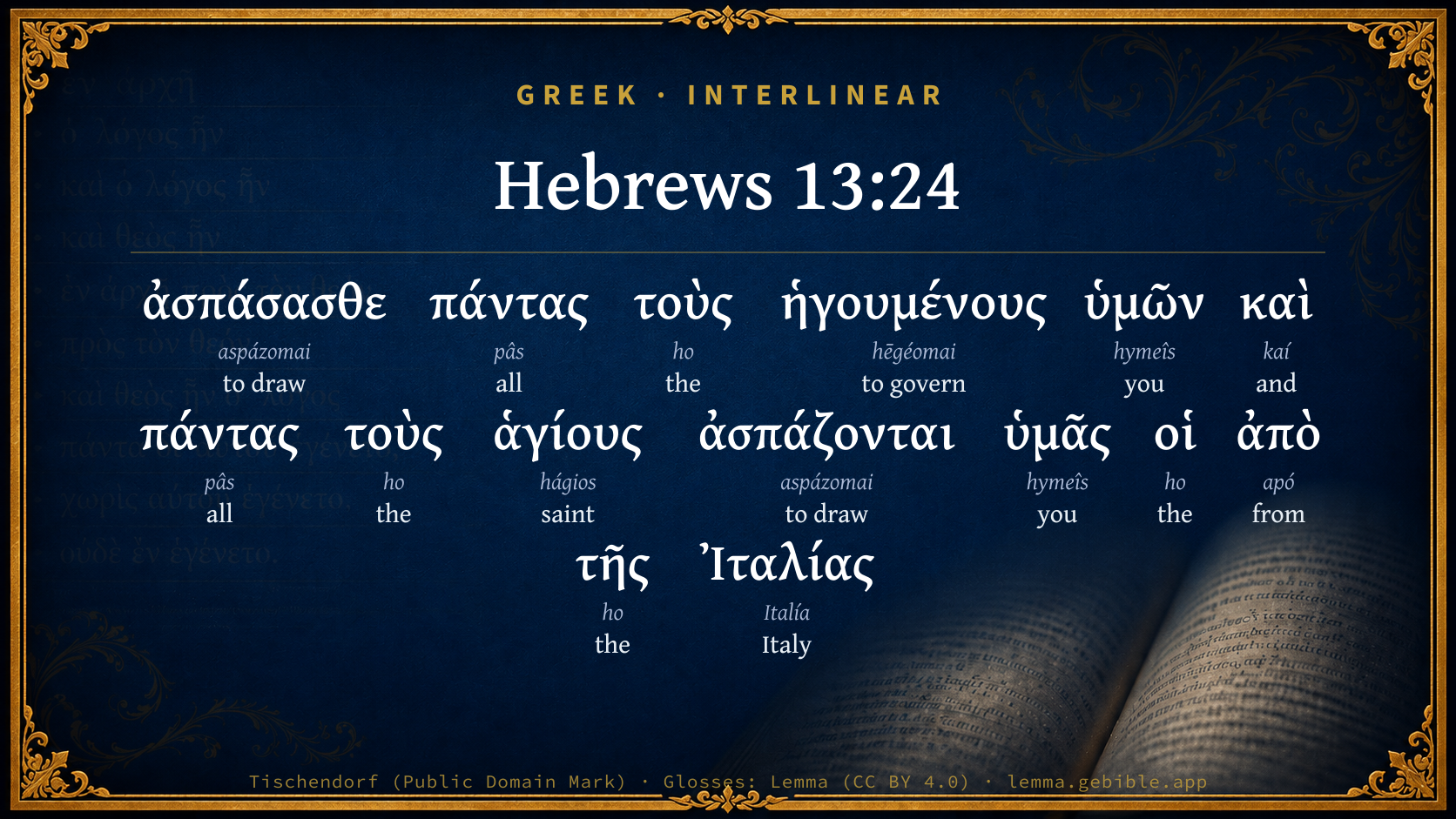
Greek (Tischendorf 8th ed.) Hebrews 13:24 appears in the Greek New Testament. The text above is from the Tischendorf 8th edition. Each word links to its Strong’s number and a concise gloss. Click any word for its full Thayer’s Greek Lexicon entry.
Download image
Cite this verse

Hebrews 13:24 (World English Bible). Public Domain. Lemma interlinear Bible study tool, https://lemma.gebible.app/v/hebrews/13/24.

Show BibTeX & RIS
BibTeX
RIS
English Translation
Greet all of your leaders and all the saints. The Italians greet you.
World English Bible · Public Domain
Download a study sheet

One document with this verse’s original text, its word-by-word gloss line, the meaning frame, cross-references with their text, attributed commentary, and full source and license credits — printable, and it pastes into notes with its structure intact.

This verse Autodidact and up

Study sheet (.html) Plain text (.txt)

A passage Seminary Student

Up to 50 verses in one chapter. A passage sheet keeps up to 6 commentary sources and 12 cross-references per verse, in the order this page ranks them, and says so on the sheet whenever that leaves anything out. Ask for a single verse and you get the Autodidact verse sheet above.

Everything on this page stays free to read, with no account — the sheet is a download of what is already on screen, not access to it.

Want to remove ads? Support Godless Engineer
Compare translations 3

The same verse in 3 English versions, stacked beneath the original-language interlinear above. Click any original word for its lexicon entry.

Each is an independent rendering of the whole verse — the interlinear is not word-aligned to these translations.

Highlighted words mark where these versions differ — a whole-verse word diff, not a word-by-word alignment.

  • World English Bible Public Domain
    Greet all of your leaders and all the saints. The Italians greet you.
  • King James Version Public Domain
    Salute all them that have the rule over you, and all the saints. They of Italy salute you.
  • unfoldingWord Literal Text CC BY-SA 4.0
    Greet all your leaders and all the saints. The ones from Italy greet you.

unfoldingWord Literal Text — © unfoldingWord, licensed CC BY-SA 4.0. Word-aligned USFM3 via Door43 (git.door43.org/unfoldingWord/en_ult).

Versions to compare (up to 4)

3 of 4 selected

Show all 19 translations

Every available English version of this verse, each an independent rendering of the whole verse.

  • World English Bible Public Domain
    Greet all of your leaders and all the saints. The Italians greet you.
  • Berean Standard Bible Public Domain
    Greet all your leaders and all the saints. Those from Italy send you greetings.
  • Majority Standard Bible Public Domain
    Greet all your leaders and all the saints. Those from Italy send you greetings.
  • King James Version Public Domain
    Salute all them that have the rule over you, and all the saints. They of Italy salute you.
  • American Standard Version (1901) Public Domain
    Salute all them that have the rule over you, and all the saints. They of Italy salute you.
  • Revised Version (1885) Public Domain
    Salute all them that have the rule over you, and all the saints. They of Italy salute you.
  • Geneva Bible (1599) Public Domain
    Salute all them that haue the ouersight of you, and all the Saintes. They of Italie salute you.
  • Douay-Rheims (1899) Public Domain
    Salute all your prelates, and all the saints. The brethren from Italy salute you.
  • Young's Literal Translation Public Domain
    Salute all those leading you, and all the saints; salute you doth those from Italy:
  • Literal Standard Version CC BY-SA 4.0
    Greet all those leading you, and all the holy ones. Those from Italy greet you.
  • Unlocked Literal Bible CC BY-SA 4.0
    Greet all your leaders and all the believers. Those from Italy greet you.
  • unfoldingWord Literal Text CC BY-SA 4.0
    Greet all your leaders and all the saints. The ones from Italy greet you.
  • Darby Bible Public Domain
    Salute all your leaders, and all the saints. They from Italy salute you.
  • World Messianic Bible Public Domain
    Greet all of your leaders and all the holy ones. The Italians greet you.
  • Webster's Bible Public Domain
    Salute all them that have the rule over you, and all the saints. They of Italy salute you.
  • Free Bible Version CC BY-SA 4.0
    Give my greetings to all your leaders, and to all the believers there. The believers here in Italy send their greetings.
  • Bible in Basic English Public Domain
    Give words of love from me to those who are rulers over you, and to all the saints. Those who are in Italy send you their love.
  • Text-Critical English NT CC BY 4.0
    Greet all your leaders and all the saints. Those who are from Italy greet you.
  • Tyndale New Testament (1534) Public Domain
    Salute the that have the oversight of you and all the saynctes. They of Italy salute you.

Literal Standard Version (2020), Covenant Press — licensed CC BY-SA 4.0. Text via the HelloAO Bible API (eBible.org). Unlocked Literal Bible (unfoldingWord) — licensed CC BY-SA 4.0. Text via the HelloAO Bible API (eBible.org). unfoldingWord Literal Text — © unfoldingWord, licensed CC BY-SA 4.0. Word-aligned USFM3 via Door43 (git.door43.org/unfoldingWord/en_ult). Free Bible Version, Dr. Jonathan Gallagher — licensed CC BY-SA 4.0. Text via the HelloAO Bible API (eBible.org).

Word by word

More ways to search: Search by grammar → Find every occurrence → Compare this word →

Practice this passage: Drill this verse → Learn its vocabulary →

Ἰταλίας
Italía
G2482
“Italy”
Noun, Genitive, Singular, Feminine
Part of Speech
Noun
Case
Genitive
Number
Singular
Gender
Feminine
Full Thayer's Definition

Origin: probably of foreign origin

TDNT: None

Italy = "calf like" 1. the whole peninsula between the Alps and the Straits of Messina
  1. ἀσπάσασθε aspázomai G782 “to draw” Verb, Aorist, Middle deponent, Imperative, 2nd person, Plural
  2. πάντας pâs G3956 “all” Adjective, Accusative, Plural, Masculine
  3. τοὺς ho G3588 “the” Article, Accusative, Plural, Masculine
  4. ἡγουμένους hēgéomai G2233 “to govern” Verb, Present, Middle or Passive deponent, Participle, Accusative, Plural, Masculine
  5. ὑμῶν hymeîs G5210 “you” Personal pronoun, 2nd person, Genitive, Plural
  6. καὶ kaí G2532 “and” Conjunction
  7. πάντας pâs G3956 “all” Adjective, Accusative, Plural, Masculine
  8. τοὺς ho G3588 “the” Article, Accusative, Plural, Masculine
  9. ἁγίους hágios G40 “saint” Adjective, Accusative, Plural, Masculine
  10. ἀσπάζονται aspázomai G782 “to draw” Verb, Present, Middle or Passive deponent, Indicative, 3rd person, Plural
  11. ὑμᾶς hymeîs G5210 “you” Personal pronoun, 2nd person, Accusative, Plural
  12. οἱ ho G3588 “the” Article, Nominative, Plural, Masculine
  13. ἀπὸ apó G575 “from” Preposition
  14. τῆς ho G3588 “the” Article, Genitive, Singular, Feminine

About this verse

These counts appear in no published source. They are computed here, from the morphology-tagged text and Lemma’s own curated glosses. What Lemma adds →

15
words
9
distinct lemmas
General Epistles
section

Notable vocabulary

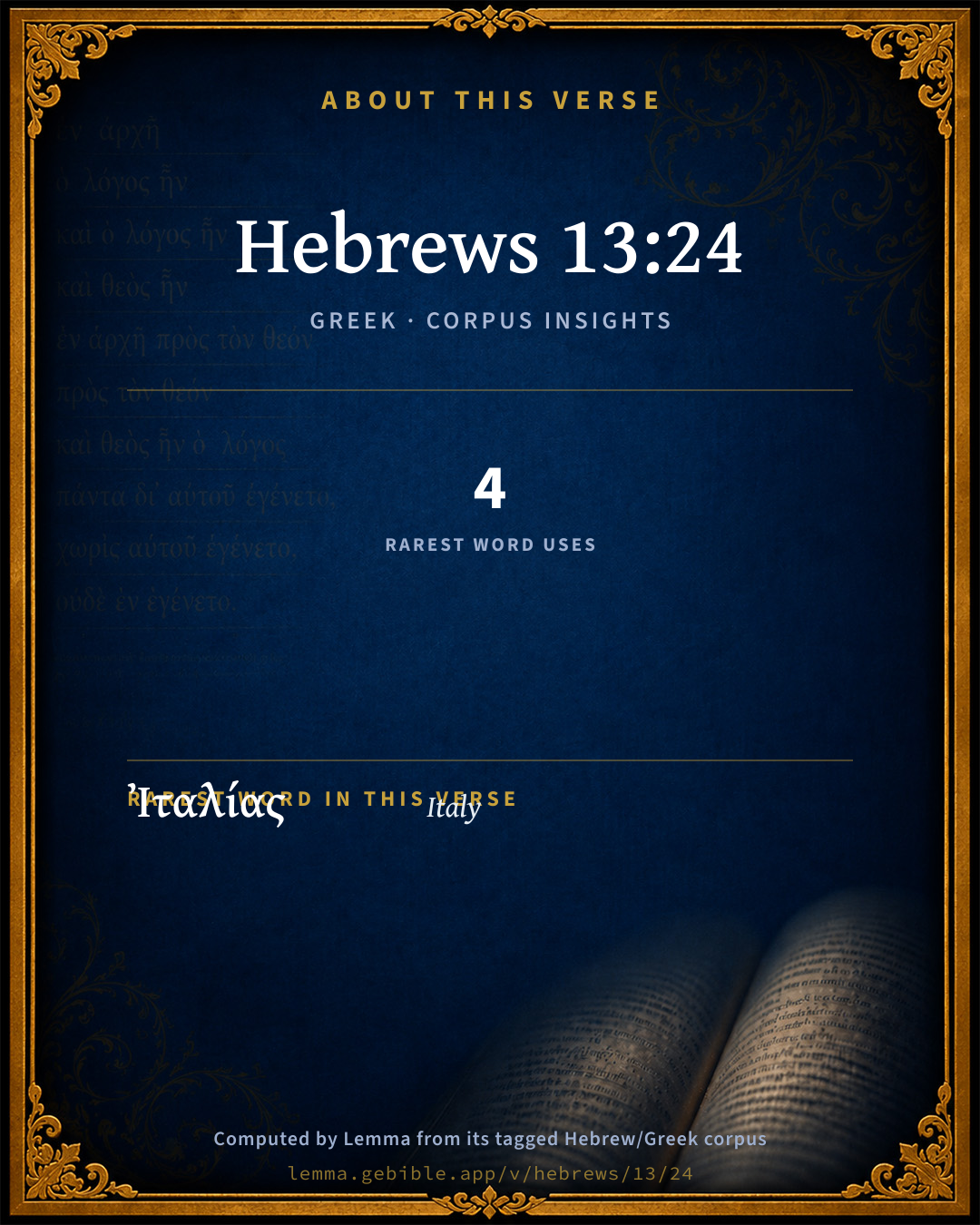
The rarest word here is Ἰταλίας Italy G2482 — appearing just 4 times in the whole Greek New Testament.

Shared distinctive vocabulary

Ἰταλίας Italy G2482 occurs in 4 verses of the Greek New Testament. Also found in:

Repetition

Words recur within this verse:

  • ἀσπάσασθε to draw G782 ×2
  • πάντας all G3956 ×2
  • τοὺς the G3588 ×4
  • ὑμῶν you G5210 ×2

Cross-references

10

Topical passages linked to Hebrews 13:24 in the Treasury of Scripture Knowledge — connected by theme and wording, ordered by reader-vote popularity; previews shown in the World English Bible.

  • Hebrews 13:7 Remember your leaders, men who spoke to you the word of God, and considering the results of their conduct, imitate their faith.
  • Hebrews 13:17 Obey your leaders and submit to them, for they watch on behalf of your souls, as those who will give account, that they may do this with joy, and not with groaning, for that would be unprofitable for you.
  • Acts 18:2 He found a certain Jew named Aquila, a man of Pontus by race, who had recently come from Italy, with his wife Priscilla, because Claudius had commanded all the Jews to depart from Rome. He came to them,
  • Philemon 1:5 hearing of your love, and of the faith which you have toward the Lord Jesus, and toward all the saints;
  • Romans 16:1–16 I commend to you Phoebe, our sister, who is a servant of the assembly that is at Cenchreae,
  • Romans 16:21–23 Timothy, my fellow worker, greets you, as do Lucius, Jason, and Sosipater, my relatives.
  • 2 Corinthians 1:1 Paul, an apostle of Christ Jesus through the will of God, and Timothy our brother, to the assembly of God which is at Corinth, with all the saints who are in the whole of Achaia:
  • 2 Corinthians 13:13 All the saints greet you.
  • Philippians 4:22 All the saints greet you, especially those who are of Caesar's household.
  • Colossians 1:2 to the saints and faithful brothers in Christ at Colossae: Grace to you and peace from God our Father, and the Lord Jesus Christ.

Cross-references courtesy of OpenBible.info (CC BY 4.0).

Commentary

Notes on Hebrews 13:24 from classic Christian and Jewish commentators (each source and its license shown beneath its notes). The classic Christian expositions comment on the surrounding passage and are grouped to its opening verse, so a note may address several verses; the Jewish commentaries on the Tanakh (Rashi and others) are per-verse, so they appear only where the commentator wrote on this verse.

Lemma curates 59 commentaries, every one of them public domain or Creative Commons licensed, each selected and text-cleaned for this edition rather than reprinted as found. About our sources →

Tyndale Open Study Notes

Tyndale Open Resources

13:24-25 The book closes with a formal greeting and a blessing. • The believers from Italy: The author is probably writing back to Rome from elsewhere in the Mediterranean world; some scholars, however, have thought that the author was writing from Rome.

Tyndale Open Study Notes — © Tyndale Open Resources, licensed CC BY-SA 4.0. Text via the HelloAO Bible API.

Bengel's Gnomon

Johann Albrecht Bengel

Heb 13:24. Πάντας τοὺς ἡγουμένους ὑμῶν, all them that have the rule over you) They laboured under dulness of apprehension; but this epistle has solid food for them that are perfect. Therefore if any epistle needed to have been withdrawn from the general multitude, this certainly was that epistle. And yet this epistle too is directed to the general multitude, rather than to the ministers, to whom it was less necessary. [So the discourse is addressed to women, children, servants, young men, etc., Eph 5:22, etc.; 1Jn 2:18; 2Jn 1:1: and to all together, 1Pe 3:8; 1Pe 5:5. Paul gives an injunction to Archippus through the Col 4:17.—V. g.] The writings of the apostles were read in the public assembly, as those of the prophets formerly were: how much more ought it so to be left free to every individual to read them in private, as much as is requisite, so that it should not be granted only by a dispensation from the Pope! For it is more profitable often to read, what it is safe once to hear. Paul elsewhere mentions the bishops and deacons: Php 1:1. Here he only names ἡγουμένους, them that rule—the ministers: comp. 1Th 5:12; 1Ti 5:17. He sends salutations to them all; for those to whom he writes were in many places.—πάντας τοὺς ἁγίους, all the saints) believers, especially Israelites.

Bengel's Gnomon of the New Testament — English translation (T&T Clark, Edinburgh, 1860) — public domain. Text from a community e-Sword module.

Meyer's Critical & Exegetical Commentary

Heinrich August Wilhelm Meyer

Heb_13:24. Request for the delivering of salutations, together with the conveying of salutations to the readers.

πάντας τοὺς ἡγουμένους ὑμῶν καὶ πάντας τοὺς ἁγίους] This designation of persons has about it something surprising, since according to it the letter would have the appearance of being addressed neither to the presidents of the assembly, nor to the whole congregation, but to single members of the latter. Probably, however, the meaning of the author is only that those to whom the epistle is delivered, for reading to the congregation, should greet as well all the presidents as also all the other members of the congregation.

οἱ ἀπὸ τῆς Ἰταλίας] is not to be explained from the absorption of one local preposition into another; in such wise that it should stand for οἱ ἐν τῇ Ἰταλίᾳ ἀπὸ τῆς Ἰταλίας, which is thought possible by Winer, Gramm., 7 Aufl. p. 584. It signifies: those from Italy, i.e. Christians who have come out of Italy, and are now to be found in the surroundings of the writer. The general expression: οἱ ἀπὸ τῆς Ἰταλίας, seems to point to a compact number of persons already known to the readers. It is highly probable, therefore, that those referred to are Christians who, on the occasion of the Neronian persecution, had fled from Italy, and had settled down for the time being at the place of the authors present abode. The expression shows, moreover, that the epistle was written outside of Italy. See p. 13.

Meyer — Critical and Exegetical Commentary on the New Testament — English translation by Peter Christie, edited by Frederick Crombie (T&T Clark, 1880) — public domain. Text from a community e-Sword module.

Jamieson, Fausset & Brown

Robert Jamieson, A. R. Fausset & David Brown

all--The Scriptures are intended for all, young and old, not merely for ministers. Compare the different classes addressed, "wives," Eph 5:22; little children, Jo1 2:18; "all," Pe1 3:8; Pe1 5:5. He says here "all," for the Hebrews whom he addresses were not all in one place, though the Jerusalem Hebrews are chiefly addressed.

They of Italy--not merely the brethren at Rome, but of other places in Italy.

Jamieson, Fausset & Brown — Commentary Critical and Explanatory on the Whole Bible (1871) — public domain (CC PDM 1.0). Text via the HelloAO Bible API.

Adam Clarke's Commentary

Verse 24. Salute all them that have the rule over you] Salute all your leaders or guides, τους ἡγουμενους ὑμων. See Clarke on Heb 13:7 and "Heb 13:17".

And all the saints.] All the Christians; for this is the general meaning of the term in most parts of St. Paul's writings. But a Christian was then a saint, i.e. by profession a holy person; and most of the primitive Christians were actually such. But in process of time the term was applied to all that bore the Christian name; as elect, holy people, sanctified, c., were to the nation of the Jews, when both their piety and morality were at a very low ebb.

They of Italy salute you.] Therefore it is most likely that the writer of this epistle was then in some part of Italy, from which he had not as yet removed after his being released from prison. By they of Italy probably the apostle means the Jew's there who had embraced the Christian faith. These salutations show what a brotherly feeling existed in every part of the Christian Church even those who had not seen each other yet loved one another, and felt deeply interested for each other's welfare.

Adam Clarke's Commentary on the Bible (1810–1826) — public domain. Text from a community e-Sword/MySword module.

John Calvin's Commentaries

24. Salute, etc. As he writes his Epistle generally to the Hebrews, it is strange that he bids some, separate from the rest, to be saluted; but he sends this salutation, as I think, more particularly to the rulers, as a mark of honor, that he might conciliate them, and gently lead them to assent to his doctrine. And he adds, —

And all the saints. He either means the faithful from among the Gentiles, and refers to them that both Jews and Gentiles might learn to cultivate unity among themselves; or his object was to intimate, that they who first received the Epistle, were to communicate it to others.

END OF THE COMMENTARIES ON THE EPISTLE TO THE HEBREWS

John Calvin's Commentaries (1540-1563) — public domain. Text from the Calvin Translation Society English edition (1840s-50s) via the Christian Classics Ethereal Library (ccel.org). Calvin's coverage is partial (roughly two-thirds of the Bible); uncommented books and verses are honest gaps, never fabricated. The 19th-century editor's footnotes and remarks are omitted so the notes are faithfully Calvin's own voice.

Ellicott's Commentary for English Readers

(24) That have the rule over you.—Better, that are your leaders: see Heb_13:7; Heb_13:17.

They of Italy salute you.—These much discussed words are consistent with either of two hypotheses:—(1) That the writer is in Italy, and salutes “the Hebrews” in the name of the Christians of Italy: (2) That the writer is addressing a Church of Italy, and sends greeting from Christians who have their home in Italy, but are now with him. (See Introduction.)

A Bible Commentary for English Readers, edited by Charles John Ellicott (1878–1897) — public domain. Text from a community e-Sword module.

The Cambridge Bible for Schools and Colleges

gen. ed. J. J. S. Perowne

24. Salute all them that have the rule over you] This salutation to all their spiritual leaders implies the condition of Churches, which was normal at that period—namely, little communities, sometimes composed separately of Jews and Gentiles, who in default of one large central building, met for worship in each other’s houses.

They of Italy] This merely means “the Italians in the place from which I write,” just as “they of Asia” means Asiatic Jews (Act_21:27. Comp. Act_17:13, Heb_6:9, &c.). The phrase therefore gives no clue whatever to the place from which, or the persons to whom, the Epistle was written. It merely shews that some Christians from Italy—perhaps Christians who had fled from Italy during the Neronian persecution—formed a part of the writer’s community; but it suggests a not unnatural inference that it was written to some Italian community from some other town out of Italy. Had he been writing from Italy he would perhaps have been more likely to write “those in Italy” (comp. 1Pe_5:13).

The Cambridge Bible for Schools and Colleges (gen. ed. J. J. S. Perowne; Cambridge University Press, 1878–1918) — public domain. Text from a community e-Sword module.

John Gill's Exposition

Salute all them that have the rule over you,.... The pastors and officers of the church of the Hebrews, the same with those in Heb 13:7 and all the saints; the several members of the church, who were set apart to holiness by God; whose sins were expiated by Christ; to whom Christ was made sanctification; and who were internally sanctified by the Spirit of God, and lived holy lives and conversations; to these the apostle wished all prosperity, inward and outward, spiritual and temporal; and he uses the word "all" in both clauses; and, including every officer and member, expresses his universal love to them, whether high or low, rich or poor, greater or lesser believers:

they of Italy salute you; that is, the brethren, as the Vulgate Latin version reads; the Italian brethren; such as were at Puteoli, and other places, in that country; see Act 28:13. Italy is a famous and well known country in Europe; a very fruitful and delightful one; of which Rome, where the apostle very likely now was, is the chief city: it has been called by different names, as Saturnia from Saturn; and Ausonia, Aenotria, and Hesperia Magna; and it had its name Italy, some say, from Italus, the son of Penelope and Telegonus; others, from Italus, a king of the Arcadians, or, as some say, the Sicilians; but, according to Timsaeus and Varro (e), it was so called from the multitude of oxen in it, which in the old Greek language were called "Italoi", to which comes near in sound the Latin word "vituli", used for "calves"; and Italy is frequently, by Jewish writers (f) called , "Italy of Greece"; and formerly it was inhabited by Greeks, and was called Great Greece (g): it is bounded on the east with the Adriatic sea; and on the west by the river Var, with the Alps, which separate France from Italy; and on the south with the Tyrrhene, or Tuscan sea, called the lower, and on the north, partly with the Alps, which are on the borders of Germany, and partly with the Adriatic sea, called the higher. There were Christians in this country before the Apostle Paul came to Rome, both at Rome, and other places, as before observed. It is said (h), that Barnabas was first at Rome, and planted the church there; that he went round Lombardy, and lived at Milain; that in the "first" century, Apollinaris preached at Ravenna, and Hermagoras at Aquileia; and there were Christian churches in the "second" century, not only at Rome, but in many other cities and places; and so likewise in the "third" century, as at Verona, Spoletum, Beneventum, &c. and in the "fourth" century, there were great numbers of churches in this country; as at Verona, and Capua, in Calabria, Campania, and Apulia; and which might be traced in following centuries.

(e) Apud Aul. Gell. Noct. Attic. l. 11. c. 1. Vid. Apollodor. de Orig. Deorum, l. 2. p. 101. (f) Bereshit Rabba, sect. 67. fol. 59. 4. T. Bab. Sabbat, fol. 56. 2. R. Sol. Jarchi in Gen. xxvii. 39. (g) lsidor. Hispal. Origin. l. 14. c. 4. (h) Hist. Eccl. Magdeburg. cent. 1. l. 2. c. 2. p. 17. cent. 2. c. 2. p. 4. cent. 3. c. 2. p. 4. cent. 4. c. 2. p. 6.

John Gill's Exposition of the Whole Bible (1746–1763) — public domain (CC PDM 1.0). Text via the HelloAO Bible API.

Trapp's Complete Commentary

John Trapp

24 Salute all them that have the rule over you, and all the saints. They of Italy salute you.

Ver. 24. Salute all them] This Epistle then was first read to the people, who are required to deliver the apostle’s comments to their ministers. The Papists debar the people, not of the Scriptures only, but of all books of the reformed religion; and for a terror not to retain such books prohibited, I have seen (saith Sir Edwin Sands) in their printed instructions for confession, the hearing or reading of books forbidden set in rank among the sins against the first commandment.

They of Italy salute you] Few saints there now; the Italians hold integrity for little better than silliness; they blaspheme oftener than swear, they murder more than revile or slander. And yet even in Italy there are fully four thousand professed Protestants. But their paucity and obscurity (saith mine author) shall enclose them in a cipher.

John Trapp, A Commentary or Exposition upon All the Books of the Old and New Testament (1647–1656) — public domain. Text from a community e-Sword module.

Albert Barnes' Notes on the Bible

Salute all them - see the notes on Rom 16:3 ff. It was customary for the apostle Paul to close his epistles with an affectionate salutation.

That have the rule over you - notes, Heb 13:7, 17. None are mentioned by name, as is usual in the Epistles of Paul. The cause of this omission is unknown. “And all the saints.” The common name given to Christians in the Scriptures; see the notes on Rom 1:7.

They of Italy salute you - The saints or Christians in Italy. Showing that the writer of the Epistle was then in Italy. He was probably in Rome; see the introduction, section 4.

Albert Barnes' Notes on the Bible (1834–1885) — public domain. Text from a community e-Sword/MySword module.

Matthew Poole's English Annotations

He sends his salutations, which were good wishes and prayers for the peace, prosperity, health, and happiness of their souls and bodies, and success in all their concernments; first unto their excellent guides and rulers, Heb 13:7,17, that they may prosper and succeed in their work among the saints; and then unto

the saints themselves, conveying the gospel peace, according to Christ’s command, Mat 10:12; Luk 10:5. Which saints were all those Hebrews dispersed in several places, and there convening, and maintaining church society; and to whose hand the Epistle first came, they were to receive the salutations themselves, and transmit them to others. With his own he transmits the salutations of all that part of the church of Christ which was in Italy to them. Which salutations, though commonly abused, yet are of great weight and worth where communicated and received by the churches in which the Holy Spirit abideth.

Matthew Poole's English Annotations on the Holy Bible (1683–1685) — public domain. Text from a community e-Sword/MySword module.

Whedon's Commentary on the Bible

Daniel D. Whedon

24. Them that have the rule over you—Same word as in Heb_13:7; Heb_13:15, and signifying leaders. The antithesis here between leaders and all the saints implies a distinct and authorized drawn line between ministry and laity. The doctrine that such distinction is post-apostolical is inadmissible. And the duty of the latter to the former is expressed in Heb_13:17 (where see notes) in terms rarely used by modern Congregationalism.

They of Italy— That is, (as the best criticism now interprets the Greek,) the Italian Christians. The Greek phrase is, οι απο της ‘Ιταλιας, they from Italy. The German critic Bleek, in reviewing Stuart on Hebrews, maintained that the Greek απο signified that the they were away from Italy, and so the epistle could not have been written in Italy. But Stuart triumphantly quoted instances where the phrase simply implied origin, or birthplace, or residence. Thus Joh_11:1 : Lazarus, of (απο) Bethany; Lazarus being both a resident of the place, and at that time in Bethany. A salutation to the Hebrews at Jerusalem from so wide-spread a body as “Italian Christians” generally, might seem strange. But, 1. Paul says to the Corinthians, (1Co_16:19,) “The Churches of Asia salute you.” And St. Peter (1Pe_1:1) addresses the Churches in Pontus, Galatia, Cappadocia, Asia, and Bithynia. 2. The leading body of Christians in Italy were doubtless known to Paul; his writing this epistle was doubtless known to them; he was authorized in spirit to salute the Jerusalem Church in their name. 3. What Church was more suitable or more likely to be saluted from Rome than the mother Church of all, in whose streets Jesus had preached, and without whose gates he was crucified—Jerusalem? And in this we have a strong confirmation of the judgment of Christian antiquity, unwisely impugned by modern “criticism,” that this epistle was written to the Church of that city.

Daniel D. Whedon (gen. ed.), Commentary on the Old and New Testaments (1874–1909) — public domain. Text from a community e-Sword module.

The Pulpit Commentary

Salute all them that have the rule over you (tounouv , as before), and all the saints. They of Italy salute you. The fact that no names are here mentioned, as is usual with St. Paul in sending salutations to Churches he was personally well acquainted with, leads us to infer that there had been no such close association, at any rate recently, between the writer and the readers in this case; or else that a circle of Churches in some locality is addressed. Nothing certain can be concluded as to the writer"s whereabouts at the time of writing from the expression, "they of Italy (oi apo thv Italiav)," though it seems to favor the idea, rather than otherwise, that he was in Italy at the time, possibly at Rome. For the phrase means simply "natives of Italy"; (cf. Act_10:23 Act_10:38 Act_12:1 Act_17:13 Act_21:27 Act_18:13; all these being, we observe, expressions of St. Luke"s) it by no means implies that they had left Italy. In fact, as Delitzsch observes, "if the author was then in Italy, and at the same time was not a native of Italy, he could not have selected a more appropriate designation for the Italian Christians." The Epistle is concluded by St. Paul"s accustomed words, which, with some variations, seem to have been appended to all his letters as his authenticating autograph (see 2Th 3, etc.)

The Pulpit Commentary (1880–1919), ed. H.D.M. Spence-Jones & Joseph S. Exell — public domain. Text from a community e-Sword module.

The People's New Testament

B. W. Johnson

24. Salute all them, etc. Salute for me the elders, and saints, at Jerusalem and in Judea. They of Italy salute you. The epistle was, therefore, written from Italy, which harmonizes with Paul's long imprisonment there.

B. W. Johnson's The People's New Testament with Notes (1889–1891) — public domain. Electronic text from the Christian Classics Ethereal Library (CCEL) ThML edition.

unfoldingWord translationNotes

Door43 World Missions Community

Those from Italy greet you

Possible meanings are 1) the author is not in Italy, but there is a group of believers with him who have come from Italy or 2) the author is in Italy while writing this letter.

Italy

This is the name of a region at that time. Rome was the then-capital city of Italy. (See: How to Translate Names)

translationWords

believe

grace

unfoldingWord translationNotes — © Distant Shores Media and the Door43 World Missions Community, licensed CC BY-SA 4.0. Source: git.door43.org/Door43/en_tn.

Cambridge Greek Testament for Schools and Colleges

24. ἀσπάσασθε. This salutation to all their spiritual leaders implies the condition of Churches, which was normal at that period—namely, little communities, sometimes composed separately of Jews and Gentiles, who in default of one large central building, met for worship in each other’s houses.

οἱ ἀπὸ τῆς Ἰταλίας. This merely means “the Italians in the place from which I write,” just as “they of Asia” means Asiatic Jews (Act 21:27. Comp. Act 17:13, Heb 6:9, &c.). The phrase therefore gives no clue whatever to the place from which, or the persons to whom, the Epistle was written. It merely shews that some Christians from Italy—perhaps Christians who had fled from Italy during the Neronian persecution—formed a part of the writer’s community; but it suggests a not unnatural inference that it was written to some Italian community from some other town out of Italy. Had he been writing from Italy he would perhaps have been more likely to write “those in Italy” (comp. 1Pe 5:13), and some have explained the phrase as a constr. praegnans for οἱ ἐν τῇ Ἰταλίᾳ ἀσπ. ὑμᾶς ἀπὸ τῆς Ἰταλίας. But this is quite needless, and as Winer says (p. 784) “a critical argument as to the place where the Epistle was written should never have been founded on these words.”

Cambridge Greek Testament for Schools and Colleges (Cambridge University Press, 1896; 21 vols, various authors incl. Carr, Maclear, Plummer, Farrar, Lumby, Moule, M. R. James, Simcox) — public domain. Text from a community e-Sword module.

Alford’s Greek Testament

Henry Alford

24.] Salute all your leaders, and all the saints. They from Italy salute you (on this, see Prolegg. § ii. 13).

Henry Alford, The Greek Testament (1849–1861) — public domain. Text from a community e-Sword module.

Vincent's Word Studies in the New Testament

Marvin R. Vincent

They of Italy [οι απο της ιταλιας] . This may mean, "those who are in Italy send greeting from Italy "; or," those of Italy (Italian Christians with the writer at the time) send greeting' from the place at which the letter is being written. See Introduction. The phrase affords no reliable indication as to the residence of the persons addressed.

Marvin R. Vincent, Word Studies in the New Testament (1887–1900) — public domain. Text from a community e-Sword/MySword module.

Westcott on Hebrews & the Epistles of John

Brooke Foss Westcott

24. ἀσπάσασθε... A general salutation of this kind is found in most of the Epistles of the N. T. (Rom., 1, 2 Cor., Phil., Col., 1 Thess., Tit, 1 Pet.,

᾿Ασπάζονται ὑμᾶς οἱ ἀπὸ

ἔρχησθε ἰδ".

unique; and there appears to be an emphasis in the repetition πάντας... wavras...all...all... which probably points to the peculiar circumstances of the Church. Comp. Phil iv. 21 special salutation of ‘all that have the rule’ implies that the letter was not addressed officially to the Church, but to somo soction of it, The patristic commentators notice tho significance of tho clause :

Alvirreras ὁ λόγος ὡς ol προστατεύοντες αὐτῶν τοιαύτης διδασκαλίας οὐκ ἔχρῃζον" οὗ δὴ χάριν οὐκ ἐκείνοις ἐπέστειλεν ἀλλὰ τοῖς μαθηταῖς (Theodt.).

Ὅρα πῶς αὐτοὺς τιμᾷ elye δι' αὐτῶν τοὺς ἡγουμένους προσαγορεύει (Thoophict.).

dow. v. of awd τῆς τ.) They of Italy salute you, Vulg. Salutant vos de Italia. The phrase may mean either (1) ‘those who are in Italy send greeting from Italy,’ or (2) ‘those of Italy,’ that is Italian Christians who were with tho writer at tho time, ‘send greeting.” The former rendering is adequately illustrated by Matt. xxiv. 17; Luke xi. 13; Col. iv. 16; and it is adopted by the Fathers: ol ἀπὸ τῆς ᾿Ιταλίας" ἔδειξε πόθεν γέγραφε his verbis nobis innuit quod Rone hanc epistolam scripeerit que in regione Italic sita est (Primas.).

The choice between tho two renderings will be determined by the view

ματος μετάληψις. And Primasius, more in detail: Gratiso nomine debemus hic accipere fidem perfectam cum exsecutione bonorum operum, remissioncm quoque peccatorum quam percipiunt fideles tempore baptismatis, donum etiam Spiritus Sancti quod datur in baptismato per impositionom manus episcoporum, 420 omnia gratis a Deo dantur. The changes in the revised texts of Haymo and Atto are worth notice.

Brooke Foss Westcott (1825–1901), The Epistle to the Hebrews (1889) and The Epistles of St John (1883) — public domain (pre-1929). Text recovered from Internet Archive / Google Books OCR scans. Westcott’s Gospel of John commentary is not included (its OCR lost the chapter running-heads required for reliable verse-keying). Some Greek quoted in the Hebrews volume is imperfectly rendered by the OCR.

Lesson kit

Teaching starters — assembled from the data on this page, not authored interpretation. Every prompt links to the verse data it draws on. Edit before teaching.

Hebrews, in the General Epistles, opens this verse with 15 words (9 distinct Greek lemmas). Its most distinctive word is Italía (“Italy”). A historical commentator’s framing appears above. Read the whole chapter for the surrounding context.

Discussion questions

  1. The word Italía carries the sense “Italy.” How does it shape the verse?
  2. Acts 18:2 shares the word «Italy» with this verse. How do the two illuminate each other?
  3. “to draw” occurs 2× in this one verse. What is the effect of the repetition?
  4. The translations on this page render this verse differently — a whole-verse word diff, not a word-by-word alignment. What might account for the different wordings?
  5. Reading how Tyndale Open Study Notes and Bengel's Gnomon read this verse, where do the two commentators agree and where do they part?

Things to notice

  • These translations choose different wording for 9 words in this verse.
  • “to draw” occurs 2× in this single verse.
  • 9 distinct Greek lemmas span 15 words in this verse.

Reading settings

Reading text

Shown beneath each verse's original-language words.

Old Testament
Old Testament edition

Read the OT as the Masoretic Hebrew (MT) or the Greek Septuagint (LXX).

English shown for the Greek Septuagint (in the Hebrew ↔ Greek comparison).

Comparing translations? Open the Compare panel on any verse page to stack up to four side by side.