Titus 3:5

Greek (Tischendorf 8th ed.) Titus 3:5 appears in the Greek New Testament. The text above is from the Tischendorf 8th edition. Each word links to its Strong’s number and a concise gloss. Click any word for its full Thayer’s Greek Lexicon entry.
Download image
Cite this verse

Titus 3:5 (World English Bible). Public Domain. Lemma interlinear Bible study tool, https://lemma.gebible.app/v/titus/3/5.

Show BibTeX & RIS
BibTeX
RIS
English Translation
not by works of righteousness, which we did ourselves, but according to his mercy, he saved us, through the washing of regeneration and renewing by the Holy Spirit,
World English Bible · Public Domain
Download a study sheet

One document with this verse’s original text, its word-by-word gloss line, the meaning frame, cross-references with their text, attributed commentary, and full source and license credits — printable, and it pastes into notes with its structure intact.

This verse Autodidact and up

Study sheet (.html) Plain text (.txt)

A passage Seminary Student

Up to 50 verses in one chapter. A passage sheet keeps up to 6 commentary sources and 12 cross-references per verse, in the order this page ranks them, and says so on the sheet whenever that leaves anything out. Ask for a single verse and you get the Autodidact verse sheet above.

Everything on this page stays free to read, with no account — the sheet is a download of what is already on screen, not access to it.

Want to remove ads? Support Godless Engineer
Compare translations 3

The same verse in 3 English versions, stacked beneath the original-language interlinear above. Click any original word for its lexicon entry.

Each is an independent rendering of the whole verse — the interlinear is not word-aligned to these translations.

Highlighted words mark where these versions differ — a whole-verse word diff, not a word-by-word alignment.

  • World English Bible Public Domain
    not by works of righteousness, which we did ourselves, but according to his mercy, he saved us, through the washing of regeneration and renewing by the Holy Spirit,
  • King James Version Public Domain
    Not by works of righteousness which we have done, but according to his mercy he saved us, by the washing of regeneration, and renewing of the Holy Ghost;
  • unfoldingWord Literal Text CC BY-SA 4.0
    not by works of righteousness that we did but by his mercy that he saved us through the washing of new birth and renewal by the Holy Spirit,

unfoldingWord Literal Text — © unfoldingWord, licensed CC BY-SA 4.0. Word-aligned USFM3 via Door43 (git.door43.org/unfoldingWord/en_ult).

Versions to compare (up to 4)

3 of 4 selected

Show all 19 translations

Every available English version of this verse, each an independent rendering of the whole verse.

  • World English Bible Public Domain
    not by works of righteousness, which we did ourselves, but according to his mercy, he saved us, through the washing of regeneration and renewing by the Holy Spirit,
  • Berean Standard Bible Public Domain
    He saved us, not by the righteous deeds we had done, but according to His mercy, through the washing of new birth and renewal by the Holy Spirit.
  • Majority Standard Bible Public Domain
    He saved us, not by the righteous deeds we had done, but according to His mercy, through the washing of new birth and renewal by the Holy Spirit.
  • King James Version Public Domain
    Not by works of righteousness which we have done, but according to his mercy he saved us, by the washing of regeneration, and renewing of the Holy Ghost;
  • American Standard Version (1901) Public Domain
    not by works `done' in righteousness, which we did ourselves, but according to his mercy he saved us, through the washing of regeneration and renewing of the Holy Spirit,
  • Revised Version (1885) Public Domain
    not by works done in righteousness, which we did ourselves, but according to his mercy he saved us, through the washing of regeneration and renewing of the Holy Ghost,
  • Geneva Bible (1599) Public Domain
    Not by the woorkes of righteousnesse, which we had done, but according to his mercie he saued vs, by the washing of the newe birth, and the renewing of the holy Ghost,
  • Douay-Rheims (1899) Public Domain
    Not by the works of justice, which we have done, but according to his mercy, he saved us, by the laver of regeneration, and renovation of the Holy Ghost;
  • Young's Literal Translation Public Domain
    (not by works that `are' in righteousness that we did but according to His kindness,) He did save us, through a bathing of regeneration, and a renewing of the Holy Spirit,
  • Literal Standard Version CC BY-SA 4.0
    (not by works that [are] in righteousness that we did but according to His kindness), He saved us, through a bathing of regeneration, and a renewing of the Holy Spirit,
  • Unlocked Literal Bible CC BY-SA 4.0
    it was not by works of righteousness that we did, but by his mercy that he saved us. He saved us through the washing of new birth and renewal by the Holy Spirit.
  • unfoldingWord Literal Text CC BY-SA 4.0
    not by works of righteousness that we did but by his mercy that he saved us through the washing of new birth and renewal by the Holy Spirit,
  • Darby Bible Public Domain
    not on the principle of works which [have been done] in righteousness which *we* had done, but according to his own mercy he saved us through [the] washing of regeneration and renewal of [the] Holy Spirit,
  • World Messianic Bible Public Domain
    not by works of righteousness which we did ourselves, but according to his mercy, he saved us through the mikveh of rebirth and renewing by the Holy Spirit,
  • Webster's Bible Public Domain
    Not by works of righteousness which we have done, but according to his mercy he saved us, by the washing of regeneration, and renewing of the Holy Spirit;
  • Free Bible Version CC BY-SA 4.0
    not because of anything good that we've done, but because of his mercy. He did this through the cleansing of rebirth and renewal of the Holy Spirit,
  • Bible in Basic English Public Domain
    Not by works of righteousness which we did ourselves, but in the measure of his mercy, he gave us salvation, through the washing of the new birth and the giving of new life in the Holy Spirit,
  • Text-Critical English NT CC BY 4.0
    he saved us, not because of any righteous works we had done, but according to his mercy, through the washing of regeneration and the renewal of the Holy Spirit.
  • Tyndale New Testament (1534) Public Domain
    not of the dedes of rightewesnes which we wrought but of his mercie he saved vs by the foutayne of the newe birth and with the renuynge of the holy goost

Literal Standard Version (2020), Covenant Press — licensed CC BY-SA 4.0. Text via the HelloAO Bible API (eBible.org). Unlocked Literal Bible (unfoldingWord) — licensed CC BY-SA 4.0. Text via the HelloAO Bible API (eBible.org). unfoldingWord Literal Text — © unfoldingWord, licensed CC BY-SA 4.0. Word-aligned USFM3 via Door43 (git.door43.org/unfoldingWord/en_ult). Free Bible Version, Dr. Jonathan Gallagher — licensed CC BY-SA 4.0. Text via the HelloAO Bible API (eBible.org).

Word by word

More ways to search: Search by grammar → Find every occurrence → Compare this word →

Practice this passage: Drill this verse → Learn its vocabulary →

λουτροῦ
loutrón
G3067
“bathing”
Noun, Genitive, Singular, Neuter
Part of Speech
Noun
Case
Genitive
Number
Singular
Gender
Neuter
Full Thayer's Definition

Origin: from G3068

TDNT: 08:55,5

1. bathing, bath, the act of bathing
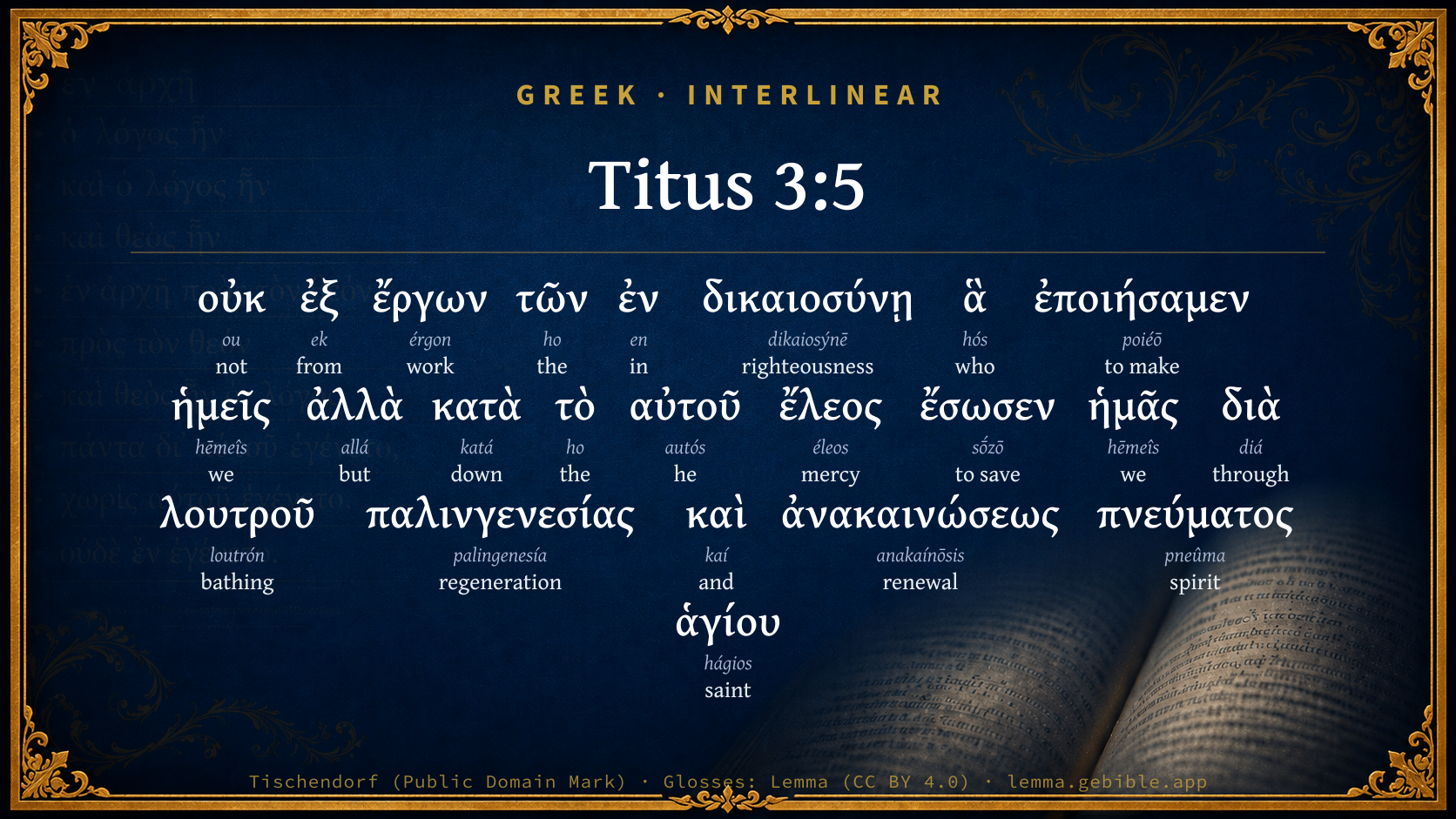
  1. οὐκ ou G3756 “not” Particle, Negative
  2. ἐξ ek G1537 “from” Preposition
  3. ἔργων érgon G2041 “work” Noun, Genitive, Plural, Neuter
  4. τῶν ho G3588 “the” Article, Genitive, Plural, Neuter
  5. ἐν en G1722 “in” Preposition
  6. δικαιοσύνῃ dikaiosýnē G1343 “righteousness” Noun, Dative, Singular, Feminine
  7. ἃ hós G3739 “who” Relative pronoun, Accusative, Plural, Neuter
  8. ἐποιήσαμεν poiéō G4160 “to make” Verb, Aorist, Active, Indicative, 1st person, Plural
  9. ἡμεῖς hēmeîs G2249 “we” Personal pronoun, 1st person, Nominative, Plural
  10. ἀλλὰ allá G235 “but” Conjunction
  11. κατὰ katá G2596 “down” Preposition
  12. τὸ ho G3588 “the” Article, Accusative, Singular, Neuter
  13. αὐτοῦ autós G846 “he” Personal pronoun, Genitive, Singular, Masculine
  14. ἔλεος éleos G1656 “mercy” Noun, Accusative, Singular, Neuter
  15. ἔσωσεν sṓzō G4982 “to save” Verb, Aorist, Active, Indicative, 3rd person, Singular
  16. ἡμᾶς hēmeîs G2249 “we” Personal pronoun, 1st person, Accusative, Plural
  17. διὰ diá G1223 “through” Preposition
  18. παλινγενεσίας palingenesía G3824 “regeneration” Noun, Genitive, Singular, Feminine
  19. καὶ kaí G2532 “and” Conjunction
  20. ἀνακαινώσεως anakaínōsis G342 “renewal” Noun, Genitive, Singular, Feminine
  21. πνεύματος pneûma G4151 “spirit” Noun, Genitive, Singular, Neuter
  22. ἁγίου hágios G40 “saint” Adjective, Genitive, Singular, Neuter

About this verse

These counts appear in no published source. They are computed here, from the morphology-tagged text and Lemma’s own curated glosses. What Lemma adds →

23
words
21
distinct lemmas
Pauline Epistles
section

Notable vocabulary

The rarest word here is λουτροῦ bathing G3067 — appearing just 2 times in the whole Greek New Testament.

Shared distinctive vocabulary

λουτροῦ bathing G3067 occurs in 2 verses of the Greek New Testament. Also found in:

Repetition

Words recur within this verse:

Cross-references

40

Topical passages linked to Titus 3:5 in the Treasury of Scripture Knowledge — connected by theme and wording, ordered by reader-vote popularity; previews shown in the World English Bible.

  • Ephesians 2:8–9 for by grace you have been saved through faith, and that not of yourselves; it is the gift of God,
  • 2 Timothy 1:9 who saved us and called us with a holy calling, not according to our works, but according to his own purpose and grace, which was given to us in Christ Jesus before times eternal,
  • 1 Corinthians 6:11 Such were some of you, but you were washed. But you were sanctified. But you were justified in the name of the Lord Jesus, and in the Spirit of our God.
  • 1 Peter 1:3 Blessed be the God and Father of our Lord Jesus Christ, who according to his great mercy became our father again to a living hope through the resurrection of Jesus Christ from the dead,
  • 1 Peter 3:21 This is a symbol of baptism, which now saves you-- not the putting away of the filth of the flesh, but the answer of a good conscience toward God, through the resurrection of Jesus Christ,
  • Romans 12:2 Don't be conformed to this world, but be transformed by the renewing of your mind, so that you may prove what is the good, well-pleasing, and perfect will of God.
  • Ephesians 2:4 But God, being rich in mercy, for his great love with which he loved us,
  • Romans 11:6 And if by grace, then it is no longer of works; otherwise grace is no longer grace. But if it is of works, it is no longer grace; otherwise work is no longer work.
  • Ephesians 5:26 that he might sanctify it, having cleansed it by the washing of water with the word,
  • Psalms 51:10 Create in me a clean heart, O God. Renew a right spirit within me.
  • Hebrews 4:16 Let us therefore draw near with boldness to the throne of grace, that we may receive mercy, and may find grace for help in time of need.
  • John 3:3–5 Jesus answered him, "Most assuredly, I tell you, unless one is born anew, he can't see the Kingdom of God."
  • Psalms 86:15 But you, Lord, are a merciful and gracious God, Slow to anger, and abundant in loving kindness and truth.
  • Colossians 3:10 and have put on the new man, that is being renewed in knowledge after the image of his Creator,
  • Romans 3:20 Because by the works of the law, no flesh will be justified in his sight. For through the law comes the knowledge of sin.
  • Romans 3:28 We maintain therefore that a man is justified by faith apart from the works of the law.
  • Galatians 2:16 yet knowing that a man is not justified by the works of the law but through the faith of Jesus Christ, even we believed in Christ Jesus, that we might be justified by faith in Christ, and not by the works of the law, because no flesh will be justified by the works of the law.
  • Psalms 130:7 Israel, hope in Yahweh, For with Yahweh there is loving kindness. With him is abundant redemption.
  • Romans 9:16 So then it is not of him who wills, nor of him who runs, but of God who has mercy.
  • 1 Peter 2:10 who in time past were no people, but now are God's people, who had not obtained mercy, but now have obtained mercy.
  • Romans 4:5 But to him who doesn't work, but believes in him who justifies the ungodly, his faith is accounted for righteousness.
  • Ephesians 4:23 and that you be renewed in the spirit of your mind,
  • Job 25:4 How then can man be just with God? Or how can he who is born of a woman be clean?
  • Psalms 143:2 Don't enter into judgment with your servant, For in your sight no man living is righteous.
  • Luke 1:50 His mercy is for generations of generations on those who fear him.
  • Romans 9:30 What shall we say then? That the Gentiles, who didn't follow after righteousness, attained to righteousness, even the righteousness which is of faith;
  • Galatians 3:16–21 Now the promises were spoken to Abraham and to his seed. He doesn't say, "To seeds," as of many, but as of one, "To your seed," which is Christ.
  • Isaiah 57:12 I will declare your righteousness; and as for your works, they shall not profit you.
  • Micah 7:18 Who is a God like you, who pardons iniquity, And passes over the disobedience of the remnant of his heritage? He doesn't retain his anger forever, Because he delights in loving kindness.
  • Luke 1:54 He has given help to Israel, his servant, that he might remember mercy,
  • Luke 1:78 Because of the tender mercy of our God, Whereby the dawn from on high will visit us,
  • Romans 9:11 For being not yet born, neither having done anything good or bad, that the purpose of God according to election might stand, not of works, but of him who calls,
  • Ephesians 1:6–7 to the praise of the glory of his grace, by which he freely bestowed favor on us in the Beloved,
  • Titus 3:4 But when the kindness of God our Savior and his love toward mankind appeared,
  • Luke 1:72 To show mercy towards our fathers, To remember his holy covenant,
  • Luke 10:27–29 He answered, "You shall love the Lord your God with all your heart, with all your soul, with all your strength, and with all your mind; and your neighbor as yourself."
  • Job 15:14 What is man, that he should be clean? He who is born of a woman, that he should be righteous?
  • Psalms 86:5 For you, Lord, are good, and ready to forgive; Abundant in loving kindness to all those who call on you.
  • Hebrews 6:6 and then fell away, it is impossible to renew them again to repentance; seeing they crucify the Son of God for themselves again, and put him to open shame.
  • Psalms 62:12 Also to you, Lord, belongs loving kindness, For you reward every man according to his work.

Cross-references courtesy of OpenBible.info (CC BY 4.0).

Commentary

Notes on Titus 3:5 from classic Christian and Jewish commentators (each source and its license shown beneath its notes). The classic Christian expositions comment on the surrounding passage and are grouped to its opening verse, so a note may address several verses; the Jewish commentaries on the Tanakh (Rashi and others) are per-verse, so they appear only where the commentator wrote on this verse.

Lemma curates 59 commentaries, every one of them public domain or Creative Commons licensed, each selected and text-cleaned for this edition rather than reprinted as found. About our sources →

The Cambridge Bible for Schools and Colleges

gen. ed. J. J. S. Perowne

5. not by works of righteousness] The exact grammatical form is rendered by not by virtue of works, works in righteousness which we did. We should read the neut. accus. of the relative with the best authorities, rather than the genitive here. Bp Wordsworth well explains the reason of the clause: that when those false teachers were asked what was their ground of hope of salvation, they would reply ‘The works wrought in righteousness which we did’; but St Paul would answer ‘God’s mercy.’

he saved us] Vulg. ‘salvos nos fecit.’ Compare the aorist tenses in Col_2:13-15. Bp Lightfoot thus brings out the force (Revision of N.T. p. 85): ‘St Paul regards this change from sin to righteousness, from bondage to freedom, from death to life, as summed up in one definite act of the past; potentially to ail men in our Lord’s Passion and Resurrection, actually to each individual man when he accepts Christ, is baptized into Christ.’ ‘It is the definiteness, the absoluteness of this change, considered as a historical crisis, which forms the central idea of St Paul’s teaching, and which the aorist marks.’ See also note on 1Ti_2:4.

by the washing of regeneration] Properly through the washing or through the laver; the preposition expresses the channel or means through which; the ‘washing’ or ‘laver’ ‘of regeneration’ is evidently one phrase for the sacrament of Holy Baptism. The genitive marks the attribute or inseparable accompaniments,’ Winer § 30 2 b, who quotes Mar_1:4, ‘repentance-baptism.’ Cf. Col_1:22, ‘his flesh-body,’ i.e. His material, natural body, distinguished from the mystical body before mentioned. Cf. also ‘the fire of testing,’ Teaching of the Twelve Apostles xvi. 5.

Should we render here ‘washing’ or ‘laver’? It has been usual among English commentators as Wordsw., Alf., Conybeare, Ellicott, to render ‘laver,’ and to understand the baptismal font, on the ground that the Greek word ‘means always a vessel or pool in which washing takes place.’ So no doubt the form in tron properly signifies, as e.g. arotron a plough, alabastron, an ointment-bottle. But classical usage is in the plural ‘a bath,’ Hom. Il. xviii. 489, Æsch. Ag. 1080; in the sing, ‘the act of washing,’ Hes. Op. 755, ‘expiatory libations,’ Soph. El. 84, ‘water for washing,’Œd. Col. 1599; Aristoph. Lys. 378. The Septuagint usage is only in the sing., Jer_31:25, ‘A man baptized from the death of sin, and again taking hold of it, what does he gain from his washing?’ Son_4:2 ‘Thy teeth are like a flock of ewes that are newly shorn, which are come up from the washing.’ The N.T. usage is only in the sing., Eph_5:26, ‘having cleansed it (the Church) by the washing of water with the word,’ R.V., with margin ‘Gr. laver,’ and the present passage where R.V. gives ‘washing,’ with margin ‘Or, laver.’ According to R.V. rules this inconsistency neutralises its verdict. For in Eph_5:26 it is implied that ‘laver’ is more exact; in Tit. that ‘washing’ is more, and ‘laver’ less likely, as the meaning of the Greek. On the whole the classical usage, the A.V. and R.V. text, support the rendering ‘washing.’ As to the form of the word, the Greeks may have been at liberty to divert it from its proper meaning, having the kindred form loutêr for ‘a bath,’ which, according to analogy, should be ‘a bathing man.’ Somewhat similarly having astêr for ‘a star’ they used astron for ‘a cluster of stars.’

regeneration] ‘Palingenesia is one of the many words which the Gospel found, and, so to speak, glorified.’ Abp Trench, who admirably draws out the enlargement here, N. T. Syn. § 18. The word had been used by the Pythagoreans, in the doctrine of transmigration of souls, for their reappearance in new bodies; by the Stoics for the periodic renovation of the earth in spring; in Cicero it describes his restoration to his dignities and honours after his return from exile; in Josephus the restoration of the Jewish nation after the captivity. The word does not occur in the Septuagint; and in N.T. only here and Mat_19:28. ‘In our Lord’s words there is evident reference to the new birth of the whole creation (Act_3:21), which shall be when the Son of Man hereafter comes in His glory; while St Paul’s “washing of regeneration” has to do with the new birth not of the whole travailing creation, but of the single soul, which is now evermore finding place.… The palingenesia which Scripture proclaims begins with the microcosmus of single souls; but it does not end there; it does not cease its effectual working till it has embraced the whole macrocosmus of the universe.’

But if, as seems most consistent with the whole chapter, and with St Matthew’s grand aim to paint a present ‘kingdom of the heavens,’ the reference of Mat_19:28 is to the Church, Catholic and Apostolic, then ‘regeneration’ in both passages refers to the same act and epoch, when our Lord having ‘overcome the sharpness of death’ opened the Kingdom of Heaven to all believers, and on the day of Pentecost 3000 souls said to Peter and the rest of the Apostles ‘Brethren, what shall we do?’ and were baptized by them ‘unto the remission of their sins,’ and ‘continued stedfastly in the apostles’ teaching and fellowship.’ In our Lord’s words and in St Paul’s the setting up of this kingdom, the entrance into it, is life from the dead, a second birth; and Joh_3:3; Joh_3:5 ‘Except a man be born anew, he cannot see the kingdom of God; Except a man be born of water and of the spirit, he cannot enter into the kingdom of God,’ (summed up in palingenesia Mat_19:28) explains and is explained by Eph_5:25-26, ‘Christ loved the church and gave himself up for it, that he might cleanse it by the washing of water with the word’ (summed up in palingenesia:, Tit_3:5).

and renewing of the Holy Ghost] R.V. keeps this rendering of A.V. which necessarily makes ‘renewing’ depend like ‘regeneration’ on ‘the washing’; giving in the margin as a good, but not so good, construction ‘and through renewing,’ where the government is carried back to the preposition. It is only a question of the naturalness of the order of words, and of the doctrine that ‘renewing’ or ‘renovation’ depends on Baptism being expressly stated or left to be inferred. The doctrine itself cannot but be true, as life must precede growth, and growth must depend upon life. Compare Eph_5:26, where the purpose of Christ giving Himself up for the Church is stated to be, first that He might cleanse it by the washing of water through the word (as above), and then that He might sanctify it, till there should be no spot nor blemish; and Rom_12:2, ‘Be ye transformed (present tense) by the renewal of your mind;’ see that the gradual restoration of the Divine image be ever going forward. No nobler commentary on the phrase has been written than the ancient ‘Veni Creator.’

The Cambridge Bible for Schools and Colleges (gen. ed. J. J. S. Perowne; Cambridge University Press, 1878–1918) — public domain. Text from a community e-Sword module.

Albert Barnes' Notes on the Bible

Not by works of righteousness which we have done - The plan was not based on our own good works, nor are our own good works now the cause of our salvation. If people could have been saved by their own good works, there would have been no need of salvation by the Redeemer; if our own deeds were now the basis of our title to eternal life, the work of Christ would be equally unnecessary. It is a great and fundamental principle of the gospel that the good works of men come in for no share in the justification of the soul. They are in no sense a consideration on account of which God pardons a man, and receives him to favor. The only basis of justification is the merit of the Lord Jesus Christ, and in the matter of justification before God, all the race is on a level; see the notes at Eph 2:8-9.

But according to his mercy -

It had its origin in mercy; It is by mere mercy or compassion, and not by justice; It is an expression of great mercy, and, It is now in fact conferred only by mercy.

Whatever we have done or can do, when we come to receive salvation from the hand of God, there is no other element which enters into it but mercy. It is not because our deeds deserve it; it is not because we have by repentance and faith wrought ourselves into such a state of mind that we can claim it; but, after all our tears, and sighs, and prayers, and good deeds, it is a mere favor. Even then God might justly withhold it if he chose, and no blame would be attached to him if he should suffer us to sink down to ruin.

He saved us - That is, he began that salvation in us which is to be completed in heaven. A man who is already renewed and pardoned may be spoken of as saved - for:

(1)The work of salvation is begun, and,

(2)When begun it will certainly be completed; see the notes at Phi 1:6.

By the washing of regeneration - In order to a correct understanding of this important passage, it is necessary to ascertain whether the phrase here used refers to baptism, and whether anything different is intended by it from what is meant by the succeeding phrase - “renewing of the Holy Ghost.” - The word rendered “washing” (λουτρόυ loutrou) occurs in the New Testament only in this place and in Eph 5:26, where also it is rendered “washing” - “That he might sanctify and cleanse it (the church) with the washing of water by the word.” The word properly means “a bath;” then water for bathing; then the act of bathing, washing, ablution. Passow and Robinson. It is used by Homer to denote a warm or cold bath; then a washing away, and is thus applied to the drink-offerings in sacrifice, which were supposed to purify or wash away sin. Passow. The word here does not mean “laver,” or the vessel for washing in, which would be expressed by λουτὴρ loutēr and this word cannot be properly applied to the baptismal font.

The word in itself would naturally be understood as referring to baptism (compare notes at Act 22:16), which was regarded as the emblem of washing away sins, or of cleansing from them. I say it was the emblem, not the means of purify ing the soul from sin. If this be the allusion, and it seems probable, then the phrase “washing of regeneration” would mean “that outward washing or baptism which is the emblem of regeneration,” and which is appointed as one of the ordinances connected with salvation; see the notes at Mar 16:16, “He that believeth and is baptized shall be saved.” It is not affirmed in this phrase that baptism is the means of regeneration; or that grace is necessarily conveyed by it; and still less that baptism is regeneration, for no one of these is a necessary interpretation of the passage, and should not be assumed to be the true one. The full force of the language will be met by the supposition that it means that baptism is the emblem or symbol of regeneration, and, if this is the case, no one has a right to assume that the other is certainly the meaning.

And that this is the meaning is further clear, because it is nowhere taught in the New Testament that baptism is regeneration, or that it is the means of regeneration. The word rendered “regeneration” (παλιγγενεσία palingenesia) - occurs in the New Testament only here and in Mat 19:28, - “in the regeneration when the Son of man,” etc. It means, properly, a new birth, reproduction, or renewal. It would properly be applied to one who should be begotten again in this sense, that a new life was commenced in him in some way corresponding to his being made to live at first. To the proper idea of the word, it is essential that there should be connected the notion of the commencement of life in the man, so that he may be said to live anew; and as religion is in the Scriptures represented as life, it is properly applied to the beginning of that kind of life by which man may be said to live anew. This word, occurring only here and in Mat 19:28, and there indubitably not referring to baptism, should not be here understood as referring to that, or be applied to that, because:

(1)That is not the proper meaning of the word;

(2)There is no Scripture usage to sanction it;

(3)The connection here does not demand it;

(4)The correlatives of the word (see Joh 3:3, Joh 3:5-6, Joh 3:8; 1Pe 1:3,) are applied only to that great moral change which is produced by the Holy Spirit, and,

(5)It is a dangerous use of the word.

Its use in this sense leaves the impression that the only change needful for man is that which is produced by being regularly baptized. On almost no point has so much injury been done in the church as by the application of the word “regeneration” to baptism. It affects the beginning of religion in the soul, and if a mistake is made there, it is one which must pervade all the views of piety.

And renewing of the Holy Ghost - This is an important clause, added by Paul apparently to save from the possibility of falling into error. If the former expression, “the washing of regeneration,” had been left to stand by itself, it might have been supposed possibly that all the regeneration which would be needed would be that which would accompany baptism. But he avoids the possibility of this error, by saying that the “renewing of the Holy Ghost” is an indispensable part of that by which we are saved. It is necessary that this should exist in addition to that which is the mere emblem of it - the washing of regeneration - for without this the former would be unmeaning and unavailing. It is important to observe that the apostle by no means says that this always follows from the former, nor does he affirm that it ever follows from it - whatever may be the truth on that point - but he asserts that this is that on which our salvation depends. - The word rendered “renewing” (ἀνακαίνωσις anakainōsis) occurs only here and in Rom 12:2, where it is also rendered “renewing;” compare Note on that place. The verb (ἀνακαινόω anakainoō) occurs in 2Co 4:15, and Col 3:19, in both which places it is rendered “renewed,” and the corresponding word, ἀνακαινίζω anakainizō, in Heb 6:6.

The noun properly means making new again: a renewing; a renovation; compare H. Planck in Bib. Repos. i. 677. It is a word which is found only in the writings of Paul, and in ecclesiastical Greek writers. It would be properly applied to such a change as the Holy Spirit produces in the soul, making one a new man; that is, a man new, so far as religion is concerned - new in his views, feelings, desires, hopes, plans, and purposes. He is so far different from what he was before, that it may be said he enters on a new life; see the notes at Eph 4:23-24. The “renewing of the Holy Ghost” of course means that which the Holy Spirit produces, recognizing the fact, everywhere taught in the Scriptures, that the Holy Spirit is the Author of the new creation. It cannot mean, as Koppe supposes, the renewing of the mind itself, or producing a holy spirit in the soul.

Albert Barnes' Notes on the Bible (1834–1885) — public domain. Text from a community e-Sword/MySword module.

The Pulpit Commentary

Done in for of, A.V; did ourselves for hare done, A.V; through for by, A.V By works (ex ergwn); i.e. in consequence of. God"s kindness and love to man did not spring from man"s good work as the preceding and producing conditions. (comp. Gal_2:16, and the notes of Bishops Ellicott and Lightfoot) Done in righteousness (twn en dikaiosunh); the particular description of the works wrought in a sphere or element of righteousness (Alford and Ellicott). Which we did ourselves; emphasizing that they were our good works, done by us in a state of righteousness. All this, as the cause of our salvation, the apostle emphatically denies. -Not, etc., but according to his mercy he saved us. The predisposing cause, the rule and measure of our salvation, was God"s mercy and grace, originating and completing that salvation. Through the washing of regeneration (dia loutrou palligenesiav). Here we have the means through or by which God"s mercy saves us. The washing or rather laver of regeneration (loutron) found elsewhere in the New Testament only in Eph_5:26, in exactly the same connection is the laver or bath in which the washing takes place. The nature or quality of this bath is described by the words, "of regeneration" (thv paliggenesiav ); elsewhere in the New Testament only in Mat_19:28, where it seems rather to mean the great restoration of humanity at the second advent. The word is used by Cicero of his restoration to political power, by Josephus of the restoration of the Jews under Zerubbabel, and by several Greek authors; and the LXX of Job_14:14 have the phrase, ewv palin genwmai , but in what sense is not quite clear, Paliggenesia , therefore, very fifty describes the new birth in holy baptism, when the believer is put into possession of a new spiritual life, a new nature, and a new inheritance of glory. And the laver of baptism is called "the laver of regeneration," because it is the ordained means by or through which regeneration is obtained. And renewing of the Holy Ghost. It is doubtful whether the genitive anakaigwsewv depends upon dia or upon loutrou . Bengel, followed by Alford, takes the former, "per lavacrum et renovationem;" the Vulgate (lavacrum regenerationis et renova-tionis Spiritus Sancti), the latter, followed by Huther, Bishop Ellicott, and others. It is difficult to hit upon any conclusive argument for one side or the other. But it is against the latter construction that it gives such a very long rambling sentence dependent upon loutrou . "The laver of regeneration and of the renewing of the Holy Ghost, which he shed on us abundantly through Jesus Christ our Savior." And it is in favor of the former that the "laver of regeneration" and "the renewing of the Holy Ghost" seem to describe very clearly the two parts of the sacrament, the outward visible sign and the inward spiritual grace; the birth of water and of the Holy Ghost. So that Bengel"s rendering seems on the whole to be preferred. Renewing (anakainwsewv); only here and Rom_12:2, and not at all in the LXX or in classical Greek. But the verb anakainow is found in 2Co_4:16 Col_3:10. The same idea is in the kainh ktisiv , the "new creature" of 2Co_5:17 and Gal_6:15, and the kainothv zwh of Rom_6:4, and the kainothv pneumatov of Rom_7:6, and in the contrast between the "old man" (the palaio) and "the new man" (the kaino) of Eph_4:22-24. This renewal is the work of the Holy Ghost in the new birth, when men are "born again" of the Spirit. (Joh_3:5) Alford is wrong in denying its application here to the first gift of the new life. It is evidently parallel with the paliggesia . The connection of baptism with the effusion of the Holy Spirit is fully set forth in Ac 2. (see especially ver. 38; comp. Mat_3:16, Mat_3:17)

The mercy of God.

"According to his mercy he saved us." Mercy is the key-note of redemption. It is the music of the Psalms; the spirit of Christ"s ministry, and the motive of the atonement. It is the very heart of God as permanent as his justice and his righteousness; "for his mercy endureth forever.

I SALVATION IS NOT A SUPERSTRUCTURE OF MAN"S. "Not according to works of righteousness which we have done." Good actions do not make a good man; it is the good man that makes the good actions. If man is to be saved, he must have new life from within. Mercy meets his case. God"s pity and compassion are seen in this. He gives the new heart that makes the new life, and so he saves us from self and sin.

II SALVATION IS A DUAL WORRY. This is" the washing of regeneration," the redemption that comes to the heart through the fountain opened for sin and uncleanness. But the removal of the stain of sin is not all. The heart, however clean, is not to be a blank. A new likeness is to be brought out. So there is to be the "renewing of the Holy Ghost." We are made new creatures in Christ Jesus. God"s likeness comes out again in the soul. We are made holy with God"s holiness, and beautiful with God"s beauty. W.M.S.

The Pulpit Commentary (1880–1919), ed. H.D.M. Spence-Jones & Joseph S. Exell — public domain. Text from a community e-Sword module.

The People's New Testament

B. W. Johnson

5. He saved us. Not by our righteousness, but by his mercy. The means chosen by his mercy to place us in the state of salvation are next spoken of. By the washing of regeneration and renewing of the Holy Ghost. Two elements enter into the saving; these are referred to in John 3:5 as the birth of water and of the Spirit. God's spirit effects the renewal of the spirit of man by bringing him to faith and repentance through the preaching of the gospel; thus the renewal of the Holy Spirit is begun, and the gift of the Holy Spirit is promised as a sequence of baptism. Rom. 6:1–8 shows that the sinner dies to sin, is buried by baptism, rises to a new life, and is a new creature. Washing of regeneration. Literally, “Bath of regeneration.” All commentators of reputation refer this to baptism, such as Meyer, Olshausen, Lange, Plumptree, Schaff, Canon Cook, Wesley, etc. Regeneration is due to the Holy Spirit, but baptism is an outward act that God requires to complete the fact. The term “regeneration” only occurs here and in Matt. 19:28.

B. W. Johnson's The People's New Testament with Notes (1889–1891) — public domain. Electronic text from the Christian Classics Ethereal Library (CCEL) ThML edition.

Tyndale Open Study Notes

Tyndale Open Resources

3:5 not because . . . but because: The contrast is between human actions that might be thought to merit salvation and God’s grace (see Gal 2:16). Salvation is through faith in God’s mercy alone (Eph 2:8). • He washed away our sins, giving us a new birth: See Ezek 16:9; John 3:1-15; Eph 5:26; Heb 10:22; 2 Pet 1:9. • and new life through the Holy Spirit: This signifies a complete departure from the life of sin and death and a transfer into the realm of life and purity (see also Rom 12:2; 2 Cor 5:17; Col 3:10).

Tyndale Open Study Notes — © Tyndale Open Resources, licensed CC BY-SA 4.0. Text via the HelloAO Bible API.

Bengel's Gnomon

Johann Albrecht Bengel

Tit 3:5. Οὐκ ἐξ ἔργων, not of [by] works) The negative belongs to the whole sentence: we had not been in a state of righteousness; we had not done works in righteousness; we had no works by which we could be saved. So Moses to Israel, Deu 9:5—[13] διὰ λουτροῦ παλιγγενεσίας καὶ ἀνακαινώσεως Πνεύματος Ἁγιου, by the washing of regeneration and renewing of the Holy Ghost) The renewing is immediately construed with by; for as washing and regeneration, so renewing and He shed on us, are closely connected. Two things are mentioned: the washing of regeneration, which is a periphrasis for baptism into Christ; and the renewing of the Holy Spirit. Comp. Heb 2:4, note. For in both places the benefits are praised, which have come to us by Christ and by the Holy Spirit. So it is called the work of divine grace, not only in respect of individuals, but in respect of the very abundant economy of the New Testament. This regeneration and renewing takes away all the death and the old state, under which we so wretchedly lay, and which is described, Tit 3:3:2Co 5:17.

[13] Ἔσωσεν ἡμᾶς, He saved us) Christianity itself, as opposed to former misery (ver. 3), brings a most real and present salvation.—V. g.

Bengel's Gnomon of the New Testament — English translation (T&T Clark, Edinburgh, 1860) — public domain. Text from a community e-Sword module.

Expositor's Greek Testament

ed. W. Robertson Nicoll

Tit 3:5 . The ἡμεῖς and ἡμᾶς refer to the same persons as those mentioned in Tit 3:3 , i.e. , the apostles and those who have had a similar experience. The verse may be paraphrased as a statement of fact thus: God saved us by Baptism, which involves two complementary processes, ( a ) the ceremony itself which marks the actual moment in time of the new birth, and ( b ) the daily, hourly, momently renewing of the Holy Spirit, by which the spiritual life is supported and fostered and increased. And the moving cause of this exceeding kindness of God was not any merits of our own, but His mercy.

οὐκ ἐξ ἔργων : ἐκ here, as in Rom 3:30 , expresses the source. See also the emphatic repetition in Gal 2:16 of οὐκ ἐξ ἔργων νόμου . The δικαιοσύνη here is that which we can call our own, ἡ ἐκ νόμου (Phi 3:9 ). Its existence as δικαιοσύνη must not be denied; but it does not pass as current coin in the kingdom of God. It has indeed no saving value whatever. Accordingly there is no question here as to whether we did, or did not do, works which are ἐν δικαιοσύνῃ . “Not the labours of my hands can fulfil Thy law’s demands.” See note on 2Ti 1:9 .

Bengel, comparing Deu 9:5 , refers the negative to each term in the clause: we had not been ἐν δικ .; we had not done ἔργα ἐν δικ .; we had no works through which we could be saved. But this exegesis is too much affected by the controversies of the sixteenth century. The A.V., which we have done , confuses the thought by a suggestion that the works referred to are those “after justification”.

τῶν ἐν δικαιοσύνῃ : δικαιοσύνη is the sphere in which the works were done, and to which they are related.

κατὰ … ἔλεος : The phraseology is borrowed from Psalms 108:26 (Psa 109:26 ), σῶσόν με κατὰ τὸ μέγα ἔλεός σου . A remarkable parallel is furnished by 1Pe 1:3 , ὁ κατὰ τὸ πολὺ αὐτοῦ ἔλεος ἀναγεννήσας ἡμᾶς ; and also by 2Es 8:32 , “For if thou hast a desire to have mercy upon us, then shalt thou be called merciful, to us, namely, that have no works of righteousness”.

ἔσωσεν ἡμᾶς : The N.T. seldom diverts attention from the main lesson to be taught from time to time by noting qualifications, even necessary ones. Here St. Paul is speaking only about the efficient and instrumental and formal causes of salvation, without any thought of man’s part in co-operation with God. It is as when teaching the principles of mechanics, we do not confuse the beginner’s mind by making allowances for friction, etc. Here, as in Rom 6 and 1Pe 3:21 , it is assumed that man co-operates with God in the work of his own salvation. On the force of the aorist, ἔσωσεν , see note on 1Ti 2:4 .

διὰ λουτροῦ : the washing . λουτρόν may mean the water used for washing , or the process itself of washing . The R.V.m. laver would be λουτήρ . See Dean Armitage Robinson’s note on Eph 5:26 .

παλινγενεσίας : This defines the nature of the λουτρόν which God employs as His instrument in effecting the salvation of man; not any λουτρόν whatever, but that of new birth. It is sufficient to observe here that much of the controversy about regeneration might have been avoided had men kept before them the analogy of natural birth, followed as it is immediately, not by vigorous manhood, but by infancy and childhood and youth.

ἀνακαινώσεως : The genitive ἀνακαινώσεως depends on διὰ (which is actually inserted in the Harclean Syriac; so R.V.m., and through renewing ), not on λουτροῦ , as apparently Vulg., per lavacrum regenerationis et renovationis Spiritus Sancti , f. Boh. Arm., followed by R.V. The λουτρόν , the washing , secures a claim on the Holy Spirit for renewing , just as birth gives a child a claim on society for food and shelter; but unless we are compelled to do otherwise, it is best to keep the two notions distinct. Birth, natural or spiritual, must be a definite fact taking place at a particular moment; whereas renewing is necessarily a subsequent process, constantly operating. Without this renewing the life received at birth is at best in a state of suspension. The references to ἀνακαίνωσις and ἀνακαινοῦν , and the similar passage, Eph 4:23 , show that the terms are always used of those who are actually living the Christian life.

The Expositor's Greek Testament, edited by W. Robertson Nicoll (1897–1910) — public domain. Text from a community e-Sword module.

Cambridge Greek Testament for Schools and Colleges

5. ἅ. This reading is guaranteed by the majority of the uncials, viz. אAC*D2*G, and by 17; the rec. text has ὦν, an obvious correction, with CbD2cEKLP and many cursives and Fathers.

τὸ αὐτοῦ ἔλεος. So אRevelation 17 and the preponderance of patristic testimony; instead of the neuter, the rec. text has τὸν αὐτοῦ ἔλεον with D2bKL.

λουτροῦ. A stands alone in inserting τοῦ before λουτροῦ.

5. οὐκ ἐξ ἔργων τῶν ἐν δικαιοσύνη ἃ ἐποιήσαμεν ἡμεῖς, not by works done in righteousness which we did ourselves. This is the side of St Paul’s teaching so prominent in the Second Group of his Epistles (cp. Rom 9:11; Gal 2:16 &c.). No more pregnant statement of the doctrines of the Gospel is found anywhere in his writings than we find in these verses. see on 1Ti 2:10 and 2Ti 1:9.

For the reading ἄ see the critical note.

ἀλλὰ κατὰ τὸ αὐτοῦ ἔλεος ἔσωσεν ἡμᾶς, but according to His own mercy He saved us. The position of αὐτοῦ makes it emphatic, and marks its contrast with ἡμεῖς of the preceding clause.

That man’s salvation is ‘according to’ God’s mercy is deep-rooted in the O.T.; cp. Ps. 108:26, σῶσόν με κατὰ τὸ μέγα ἔλεός σου.

διὰ λουτροῦ παλινγενεσίας καὶ ἀνακαινώσεως πνεύματος ἁγίου, through the washing of regeneration and renewal of the Holy Spirit.

That the ‘washing of regeneration’ is the Water of Baptism is undoubted; see Eph 5:26 καθαρίσας τῷ λουτρῷ τοῦ ὕδατος. It is the instrument (διά) of salvation (cp. 1Pe 3:21 ὅ καὶ ὑμᾶς ἀντίτυπον νῦν σώζει βάπτισμα), the means, that is, through which we are placed in a ‘state of salvation,’ in union with the mystical Body of Christ; cp. Gal 3:27. For λουτρόν ‘washing,’ cp. Son 4:2; Sir 34:25.

Two constructions are grammatically possible. (1) διά may govern λουτροῦ and also ἀνακαινώσεως, ‘through the washing of regeneration and through the renewing of the Holy Spirit,’ as the margin of the R.V. and, by its punctuation, the A.V., suggest. So it is taken by Tyndale, “by the fountain of the New Birth and with the renewing of the Holy Ghost”; and, of ancient versions, the Peshito also takes the words thus. Indeed D2*E*G d e g bear witness to the insertion in the text of διά before ἀνακαινώσεως. Or, (2) we may take ἀνακαινώσεως (with the Greek Fathers generally) as a second genitive after λουτροῦ, the meaning being ‘through a washing which was a washing of regeneration and of renewal of the Holy Spirit.’ This is the rendering of the Vulgate, “per lavacrum regenerations et renovationis Spiritus sancti,” and of the Bohairic and Armenian versions, and is adopted by the R.V. Both (1) and (2) being admissible in grammar, (2) seems to preserve better the balance of the sentence, and to bring out better the double function, as it were, of the baptismal water, which is not only the instrument of the New Birth (cp. Joh 3:5), but a pledge of the abiding grace of the Holy Ghost. It is this second aspect of baptismal grace, the Renovation of the Spirit, which is prominent in Confirmation. παλινγενεσία is, as it were, a ‘new creation’ (cp. Mat 19:28, the only other place where the word is found in the N.T.); ἀνακαίνωσις (cp. Rom 12:2) is the daily renewal of grace which the Holy Spirit gives; cp. 2Co 4:16.

The Christmas Day Collect (while leaning to interpretation (1) above) supplies a good devotional paraphrase, where we pray that “we being regenerate, and made God’s children by adoption and grace, may daily be renewed by His Holy Spirit.”

Cambridge Greek Testament for Schools and Colleges (Cambridge University Press, 1896; 21 vols, various authors incl. Carr, Maclear, Plummer, Farrar, Lumby, Moule, M. R. James, Simcox) — public domain. Text from a community e-Sword module.

International Critical Commentary

5. διὰ λουτροῦ] For the stress on baptism, cf. 1Co 6:11, Eph 5:26 (the instrument of cleansing), 1 P 3:21 (of salvation, as here), Joh 3:5 (of new birth). There is probably a conscious reference to 1:15 and 2:14. We needed cleansing, but with more than Jewish ceremonial ablutions, with a washing that would entirely renew our nature.

λουτροῦ] “washing” rather than “a laver” (RV margin), “fountain,” Tynd.; cf. Robinson on Eph 5:26. Justin. Mart. Apol. 1:61 τὸ ἐν τῷ ὕδατι λουτρὸν πολοῦνται . . . καλεῖται τοῦτο τὸ λουτρὸν φωτισμός, 66 λουσαμένῳ τὸ εἰς ἀναγέννησιν λουτρόν.

παλιγγενεσίας, here only in NT of spiritual birth: cf. ἀναγεγεννημένοι, 1 P 1:3 and 23, both perhaps suggested by the Lord’s saying, afterwards recorded in Joh 3:3-5. Cf. Justin Mart. Apol. 1:61 ἄγονται ὑφʼ ἡμῶν ἔνθα ὕδωρ ἐστὶ καὶ τρόπον ἀναγεννήσεως . . . ἀναγεννῶνται: Aug. de pecc. mer. iii. 9, “Christianos non facit generatio sed regeneratio.” Other associations may have led to the choice of the word. (1) The analogy of the Rabbinic title for a convert to Judaism, “a new creature,” καινὴ κτίσις (Gal 6:15, ubi v. Lightfoot). (2) The thought of the new birth of one initiated in the Greek mysteries, a rebirth which followed a ritual bathing; cf. Apul. Met. xi. 23-25. (3) The Stoic use of the word for the periodical restoration of the world after its periodical destruction by fire: this is less obvious, but there may be a conscious contrast between the Stoic and the Christian παλιγγενεσία—“the one by fire the other by water: the one physical, the other spiritual; the one subject to periodical relapses and renewal, the other occurring once for all and issuing in an endless life” (Swete, The Holy Spirit in N.T., App. M). Philo seems to apply this Stoic thought to the Flood (vit. Mos. ii.12 of Noah, οὐ μόνον αὐτοὶ σωτηρίας ἔτυχον . . . ἀλλὰ καὶ παλιγγενεσίας ἐγένοντο ἡγεμόνες καὶ δευτέρας ἀρχηγέται περιόδου, cf. 1 P 3:21 and Clem. Rom_9, Νῶε παλιγγενεσίαν κόσμῳ ἐκήρυξεν (cf. Dalman, The Words of Jesus, p. 177; Trench, Syn. N.T., § xviii.).

ἀνακαινώσεως] (Rom 12:2 only in N.T. ἀνακαινοῦν, 2Co 4:16, Col 3:10 only; both perhaps coined by St. Paul, M.M. s.v.), probably governed by λουτροῦ, “per lavacrum regenerationis et renovationis,” Vulg., referring to the moment of baptism; cf. Joh 3:5, Act 9:17-19, 2Co 5:17, Gal 6:15 καινὴ κτίσις, Eze 36:25, Eze 36:26 ῥανῶ ἐφʼ ὑμᾶς ὕδωρ καθαρὸν . . . καὶ δώσω ὑμῖν καρδίαν καινὴν καὶ πνεῦμα καινὸν δώσω ἐν ὑμῖν. If governed by διά it might add the thought of subsequent daily renewal, or of the fuller gift of the laying on of hands in Confirmation (Chase, Confirmation in the Apostolic Age, p. 98).

International Critical Commentary — older volumes (1896–1929), various authors — public domain. Text from a community e-Sword module.

Geneva Bible (1599)

Geneva Bible translators

Which the virtue of the holy Ghost worketh.

Word for word, of works which are done in righteousness: and this place doth fully refute the doctrine of merits.

Geneva Bible (1599) marginal notes — public domain. Text via Bolls.life.

Jamieson, Fausset & Brown

Robert Jamieson, A. R. Fausset & David Brown

Not by--Greek, "Out of"; "not as a result springing from works," &c.

of righteousness--Greek, "in righteousness," that is, wrought "in a state of righteousness": as "deeds . . . wrought in God." There was an utter absence in us of the element ("righteousness") in which alone righteous works could be done, and so necessarily an absence of the works. "We neither did works of righteousness, nor were saved in consequence of them; but His goodness did the whole" [THEOPHYLACT].

we--emphatically opposed to "His."

mercy--the prompting cause of our salvation individually: "In pursuance of His mercy." His kindness and love to man were manifested in redemption once for all wrought by Him for mankind generally; His mercy is the prompting cause for our individual realization of it. Faith is presupposed as the instrument of our being "saved"; our being so, then, is spoken of as an accomplished fact. Faith is not mentioned, but only God's part. as Paul's object here is not to describe man's new state, but the saving agency of God in bringing about that state, independent of all merit on the man's part (see on Tit 3:4).

by--Greek, "through"; by means of.

the washing--rather, "the laver," that is, the baptismal font.

of regeneration--designed to be the visible instrument of regeneration. "The apostles are wont to draw an argument from the sacraments to prove the thing therein signified, because it ought to be a recognized principle among the godly, that God does not mark us with empty signs, but by His power inwardly makes good what He demonstrates by the outward sign. Wherefore baptism is congruously and truly called the laver of regeneration. We must connect the sign and thing signified, so as not to make the sign empty and ineffectual; and yet not, for the sake of honoring the sign, to detract from the Holy Spirit what is peculiarly His" [CALVIN], (Pe1 3:21). Adult candidates for baptism are presupposed to have had repentance and faith (for Paul often assumes in faith and charity that those addressed are what they profess to be, though in fact some of them were not so, Co1 6:11), in which case baptism would be the visible "laver or regeneration" to them, "faith being thereby confirmed, and grace increased, by virtue of prayer to God" [Article XXVII, Church of England]. Infants are charitably presumed to have received a grace in connection with their Christian descent, in answer to the believing prayers of their parents or guardians presenting them for baptism, which grace is visibly sealed and increased by baptism, "the laver of regeneration." They are presumed to be then regenerated, until years of developed consciousness prove whether they have been actually so or not. "Born of (from) water and (no 'of' in Greek) the Spirit." The Word is the remote and anterior instrument of the new birth; Baptism, the proximate instrument. The Word, the instrument to the individual; Baptism, in relation to the Society of Christians. The laver of cleansing stood outside the door of the tabernacle, wherein the priest had to wash before entering the Holy Place; so we must wash in the laver of regeneration before we can enter the Church, whose members are "a royal priesthood." "Baptism by the Spirit" (whereof water baptism is the designed accompanying seal) makes the difference between Christian baptism and that of John. As Paul presupposes the outward Church is the visible community of the redeemed, so he speaks of baptism on the supposition that it answers to its idea; that all that is inward belonging to its completeness accompanied the outward. Hence he here asserts of outward baptism whatever is involved in the believing appropriation of the divine facts which it symbolizes, whatever is realized when baptism fully corresponds to its original design. So Gal 3:27; language holding good only of those in whom the inward living communion and outward baptism coalesce. "Saved us" applies fully to those truly regenerate alone; in a general sense it may include many who, though put within reach of salvation, shall not finally be saved. "Regeneration" occurs only once more in New Testament, Mat 19:28, that is, the new birth of the heaven and earth at Christ's second coming to renew all material things, the human body included, when the creature, now travailing in labor-throes to the birth, shall be delivered from the bondage of corruption into the glorious liberty of the children of God. Regeneration, which now begins in the believer's soul, shall then be extended to his body, and thence to all creation.

and renewing--not "the laver ('washing') of renewing," but "and BY the renewing," &c., following "saved us." To make "renewing of the Holy Ghost" follow "the laver" would destroy the balance of the clauses of the sentence, and would make baptism the seal, not only of regeneration, but also of the subsequent process of progressive sanctification ("renewing of the Holy Ghost"). Regeneration is a thing once for all done; renewing is a process daily proceeding. As "the washing," or "laver," is connected with "regeneration," so the "renewing of the Holy Ghost" is connected with "shed on us abundantly" (Tit 3:6).

Jamieson, Fausset & Brown — Commentary Critical and Explanatory on the Whole Bible (1871) — public domain (CC PDM 1.0). Text via the HelloAO Bible API.

Adam Clarke's Commentary

Verse 5. Not by works of righteousness] Those who were foolish, disobedient, and deceived, serving divers lusts and pleasures, could not possibly have works of righteousness to plead; therefore, if saved at all, they must be saved by mercy. See Clarke on Eph 2:8; and see a discourse entitled, Salvation by Faith proved, 8vo., 1816, in which I have examined every system invented by man for his restoration to the Divine favour and image: and have demonstrated, by mere reason, their utter insufficiency to answer the end for which they have been invented; and have proved that the doctrine of salvation by faith is the only rational way of salvation.

By the washing of regeneration] δια λουτρου παλιγγενεσιας. Undoubtedly the apostle here means baptism, the rite by which persons were admitted into the Church, and the visible sign of the cleansing, purifying influences of the Holy Spirit, which the apostle immediately subjoins. Baptism is only a sign, and therefore should never be separated from the thing signified; but it is a rite commanded by God himself, and therefore the thing signified should never be expected without it.

By the renewing of the Holy Ghost we are to understand, not only the profession of being bound to live a new life, but the grace that renews the heart, and enables us thus to live; so the renewing influences are here intended. Baptism changes nothing; the grace signified by it cleanses and purifies. They who think baptism to be regeneration, neither know the Scriptures nor the power of God; therefore they do greatly err.

Adam Clarke's Commentary on the Bible (1810–1826) — public domain. Text from a community e-Sword/MySword module.

John Calvin's Commentaries

5 Not by works Let us remember that here Paul addresses his discourse to believers, and describes the manner in which they entered into the kingdom of God. He affirms that by their works they did not at all deserve that they should become partakers of salvation, or that they should be reconciled to God through faith; but he says that they obtained this blessing solely through the mercy of God. We therefore conclude from his words, that we bring nothing to God, but that he goes before us by his pure grace, without any regard to works. For when he says, — “Not by works which we have done”, he means, that we can do nothing but sin till we have been renewed by God. This negative statement depends on the former affirmation, by which he said that they were foolish and disobedient, and led away by various desires, till they were created anew in Christ; and indeed, what good work could proceed from so corrupt a mass?

It is madness, therefore, to allege that a man approaches to God by his own “preparations,” as they call them. During the whole period of life they depart further and further from him, until he puts forth his hand, and brings them back into that path from which they had gone astray. In short, that we, rather than others, have been admitted to enjoy the salvation of Christ, is altogether ascribed by Paul to the mercy of God, because there were no works of righteousness in us. This argument would have no weight, if he did not take for granted, that everything that we attempt to do before we believe, is unrighteous and hateful to God.

Which we had done. To argue from the preterite tense of this verb, that God looks at the future merits of men when he calls them, is sophistical and foolish. “When Paul,” say they, “denies that God is induced by our merits to bestow his grace upon us, he limits the statement to the past time; and therefore, if it is only for the righteousness going before that no room is left, future righteousness is admitted to consideration.” But they assume a principle, which Paul everywhere rejects, when he declares that election by free grace is the foundation of good works. If we owe it entirely to the grace of God, that we are fit for living a holy life, what future works of ours will God look upon? If, previously to our being called by God, iniquity holds such dominion over us, that it will not cease to make progress till it come to its height, how can God be induced, by a regard to our righteousness, to call us? Away then with such trifling! When Paul spoke of past works, his sole object was to exclude all merits. The meaning of his words is as if he had said, — “If we boast of any merit, what sort of works had we?” This maxim holds good, that men would not be better than they were before, if the Lord did not make them better by his calling.

He hath saved us He speaks of faith, and shews that we have already obtained salvation. Although, so long as we are held by the entanglements of sin, we carry about a body of death, yet we are certain of our salvation, provided that we are ingrafted into Christ by faith, according to that saying, —

“He that believeth in the Son of God hath passed from death into life.” (John 5:24.)

Yet, shortly afterwards, by introducing the word faith, the Apostle will shew that we have not yet actually attained what Christ procured for us by his death. Hence it follows, that, on the part of God, our salvation is completed, while the full enjoyment of it is delayed till the end of our warfare. And that is what the same Apostle teaches in another passage, that “we are saved by hope.” (Romans 8:24.)

By the washing of regeneration I have no doubt that he alludes, at least, to baptism, and even I will not object to have this passage expounded as relating to baptism; not that salvation is contained in the outward symbol of water, but because baptism tells to us the salvation obtained by Christ. Paul treats of the exhibition of the grace of God, which, we have said, has been made by faith. Since therefore a part of revelation consists in baptism, that is, so far as it is intended to confirm our faith, he properly makes mention of it. Besides, baptism — being the entrance into the Church and the symbol of our ingrafting into Christ — is here appropriately introduced by Paul, when he intends to shew in what manner the grace of God appeared to us; so that the strain of the passage runs thus: — “God hath saved us by his mercy, the symbol and pledge of which he gave in baptism, by admitting us into his Church, and ingrafting us into the body of his Son.”

Now the Apostles are wont to draw an argument from the Sacraments, to prove that which is there exhibited under a figure, because it ought to be held by believers as a settled principle, that God does not sport with us by unmeaning figures, but inwardly accomplishes by his power what he exhibits by the outward sign; and therefore, baptism is fitly and truly said to be “the washing of regeneration.” The efficacy and use of the sacraments will be properly understood by him who shall connect the sign and the thing signified, in such a manner as not to make the sign unmeaning and inefficacious, and who nevertheless shall not, for the sake of adorning the sign, take away from the Holy Spirit what belongs to him. Although by baptism wicked men are neither washed nor renewed, yet it retains that power, so far as relates to God, because, although they reject the grace of God, still it is offered to them. But here Paul addresses believers, in whom baptism is always efficacious, and in whom, therefore, it is properly connected with its truth and efficacy. But by this mode of expression we are reminded that, if we do not wish to annihilate holy baptism, we must prove its efficacy by “newness of life.” (Romans 6:4.)

And of the renewing of the Holy Spirit Though he mentioned the sign, that he might exhibit to our view the grace of God, yet, that we may not fix our whole attention on the sign, he immediately sends us to the Spirit, that we may know that we are washed by his power, and not by water, agreeably to what is said, —

“I will sprinkle on you clean waters, even my Spirit.” (Ezekiel 36:25, 27.)

And indeed, the words of Paul agree so completely with the words of the Prophet, that it appears clearly that both of them say the same thing. For this reason I said at the commencement, that Paul, while he speaks directly about the Holy Spirit, at the same time alludes to baptism. It is therefore the Spirit of God who regenerates us, and makes us new creatures; but because his grace is invisible and hidden, a visible symbol of it is beheld in baptism.

Some read the word “renewing,” in the accusative case, thus: — “through the washing of regeneration and (through) the renewing of the Holy Spirit.”, But the other reading — “through the washing of regeneration and of the renewing of the Holy Spirit” — is, in my opinion, preferable.

John Calvin's Commentaries (1540-1563) — public domain. Text from the Calvin Translation Society English edition (1840s-50s) via the Christian Classics Ethereal Library (ccel.org). Calvin's coverage is partial (roughly two-thirds of the Bible); uncommented books and verses are honest gaps, never fabricated. The 19th-century editor's footnotes and remarks are omitted so the notes are faithfully Calvin's own voice.

Ellicott's Commentary for English Readers

(5) Not by works of righteousness.—This by no means asserts that such works ever had been done, and then produced, as it were, before the bar of God, and weighed and found insufficient; but it simply maintains that to win salvation such must be done. Sad experience, more forcibly than any theological assertion, has demonstrated to us all the utter impossibility of any of us, even the holiest, ever, even for one day, doing the works of a purely righteous man.

But according to his mercy.—As there was nothing in us which called for such a salvation, as there were no acts of ours which deserved reward, His gift of salvation, which includes (Tit_3:7) eternal life, was owing entirely to His divine love which saw and pitied our misery, our endless suffering. Out of this hopeless state the eternal pity lifted us, and put us into a state of salvation. The next clause specifies the outward and visible sign of the salvation our loving God was pleased to ordain in His Church, namely, “baptism;” but here great care must be taken properly to understand what St. Paul meant by this baptism, to which he attributed so great power. In St. Paul’s mind it was no mere observance, but was a sacrament, in which all that was inward properly and completely accompanied all that was outward. In another place the Apostle has grandly paraphrased his words here. In the Galatian Letter (Gal_3:27) he writes how “that as many as were baptised into Christ have put on Christ,” that is, have entered into vital union with Him—a blessed state, which most surely leads to life eternal, if the baptised only remain faithful.

By the washing of regeneration, and renewing of the Holy Ghost.—Seeing, then, that God has saved us by His own act, independently of any work of ours, we ask, How has He effected this? The words we are here considering give the answer to the question. The Greek should be rendered, “by the laver of regeneration,” &c. Then, by means of the laver of regeneration, &c, has God put us into a state of salvation. In other words, He has effected this by means of “baptism” (for the laver here can only signify the baptismal font, and is called the laver of regeneration because it is the vessel consecrated to the use of that sacrament), whereby, in its completeness as a sacrament, the new life in Christ is conveyed. Baptism, then, is the means through which we receive the saving grace of Christ; in its laver we are born again to a new life, in it we receive strength through the Holy Ghost constantly to renew and to develop this new life, for it is not only the laver of regeneration but also of renovation by the Holy Spirit. But baptism is here understood in all its completion—the outward visible sign accompanied with the inward spiritual grace. In the case of one who is come to years of understanding seeking baptism, repentance and faith in the promises of God are absolutely required. In the case of infants, who have also from the very earliest times been, through this same laver, enrolled in the communion of Christians, the same profession is required, only they make it by their sureties, and directly that they have come to years of discretion they solemnly and publicly assent to what had been already affirmed in their name. Thus, by means of the laver of regeneration, &c, or, in other words, by baptism in all its completion—the outward act being accompanied with the inward faith—He saved us, that is, put us into a state of salvation. Of the difference between “regeneration” and “renovation,” the first, “regeneration,” is well explained in the words of the collect for Christmas Day, which speaks of the “regenerated” as “made God’s children by adoption and grace.” The second, “renovation,” the same collect goes on to speak of, when it prays that “the regenerated” “may daily be renewed by the Holy Spirit.” The first, “regeneration,” is spoken of by St. John in his words, “Ye must be born again” (Joh_3:7); the second is alluded to by St. Paul when he wrote, “the inward man is renewed day by day” (2Co_4:16).

A Bible Commentary for English Readers, edited by Charles John Ellicott (1878–1897) — public domain. Text from a community e-Sword module.

John Gill's Exposition

Not by works of righteousness which we have done,.... The great instance of the kindness and love of God our Saviour is salvation; which the apostle denies that it is brought about by any works, even the best works of men; for "works of righteousness" are works done according to a righteous law, and in obedience to it; and in a righteous manner, from right principles of grace, in faith, and with a view to the glory of God; or otherwise they are not righteous actions, or works of righteousness; wherefore not works before, but after conversion, are here meant; for works before conversion are not properly works of righteousness: besides, these are such which we have done, who formerly were as before described, but now are regenerated and renewed by the Holy Ghost, and created in Christ Jesus unto good works. Now salvation, neither in whole, nor in part, is by these, either as causes; conditions, or means; See Gill on Ti2 1:9; , "works of righteousness", is a Jewish phrase used for righteous or good works (z).

but according to his mercy he saved us; the mercy of God is natural and essential to him, but the actings and exercise of it, towards this or the other objects, are sovereign and free, and according to his will; the effects of it are many, he is rich and abundant in it; and they are channelled in, and flow forth through the blood and righteousness of Christ; and this is the moving cause of salvation: this moved God to make a covenant with his Son, the blessings of which are the sure mercies of David, and in which God is merciful to the sins and unrighteousnesses of his people; it is owing to the tender mercy of God, that Christ, the dayspring from on high, has visited the earth; and the glory of it is very conspicuous in the affair of redemption by him; the pardon of sin is according to the multitude of God's tender mercies; and regeneration springs from the abundance of it; and even eternal life is the effect of it. Now according to this, God has "saved" his people; salvation is not only a thing determined, and resolved on in the mind of God, but is actually and completely accomplished by Jesus Christ, and an application of it is made to the saints in effectual calling; and because of the certain enjoyment of the whole of it, even eternal glory, the saints are said to be saved already; as they are also in faith and hope, as well as in Christ, their head and representative; See Gill on Eph 2:8. It follows, as the means of salvation,

by the washing of regeneration, and renewing of the Holy Ghost; by the former is meant, not the ordinance of water baptism; for that is never expressed by washing, nor is it the cause or means of regeneration; the cause being the Spirit of God, and the means the word of God: and besides, persons ought to be regenerated before they are baptized; and they may be baptized, and yet not regenerated, as Simon Magus; nor is it a saving ordinance, or a point of salvation; nor can it be opposed to works of righteousness, as this washing is; for that itself is a work of righteousness; see Mat 3:15 and if persons were saved by that, they would be saved by a work of righteousness, contrary to the text itself: but regenerating grace is meant, or a being born of water, and of the Spirit; that is, of the grace of the Spirit, comparable to water for its purity and cleansing virtue: hence such who are regenerated and sanctified, are said to be washed and cleansed, having their hearts purified by faith, and their consciences purged from sin by the blood of Christ: by the latter,

the renewing of the Holy Ghost, is meant either the fruit and effect of the former, even newness of life and conversation, under the influence of the Holy Spirit; or else the gradual increase and progress of the work of grace upon the soul, renewed day by day in the spirit of the mind, by the Holy Ghost; or rather it means the same thing with regeneration, and is added partly as explanative of the washing of regeneration, showing that that is no other than the new creature, the new man, the new heart, and new spirit, formed in the soul, in the effectual calling; and partly to observe that the Holy Ghost is the author of it. Now it is in this way God saves his people, namely, by regenerating and renewing them; in this is the first appearance and discovery of the love of God to them; this is their open passage into a state of grace, and without this there is no entrance into glory; this is the foundation of all grace and good works, and by which saints appear to be heirs of the heavenly inheritance.

(z) Seder Tephillot, Ed. Amsterdam, fol. 46. 2.

John Gill's Exposition of the Whole Bible (1746–1763) — public domain (CC PDM 1.0). Text via the HelloAO Bible API.

Trapp's Complete Commentary

John Trapp

5 Not by works of righteousness which we have done, but according to his mercy he saved us, by the washing of regeneration, and renewing of the Holy Ghost;

Ver. 5. Which we have done] We that are bankrupts in Adam, would yet fain be doing, and think to be saved for a company of poor beggarly duties; as bankrupts will be trading again, thougth but for pins, &c.

But according to his mercy] God is no merchant; his kingdom is not partum, but paratum He that said, Coelum gratis non accipiam, I will not have heaven on free cost, went without it. (Vega.)

He saved us by the washing of regeneration] So baptism saveth us, 1Pe 3:21. It sacramentally saveth, by sealing up salvation to the believer: hence it is called the laver of regeneration. It is a noble question in divinity (saith Mr. Burgess, Vindic. Legis.), seeing regeneration is attributed both to the word and to baptism, how one worketh it differently from the other. Or if both work it, why is not one superfluous?

John Trapp, A Commentary or Exposition upon All the Books of the Old and New Testament (1647–1656) — public domain. Text from a community e-Sword module.

Haydock's Catholic Bible Commentary

Not by the works, &c. St. Paul in this verse alludes to the sacrament of baptism. This text is brought by divines to prove that baptism, like every other sacrament, produces its effect by its own power, (or, as it is termed in the schools, ex opere operato) independently of any disposition on the part of the receiver. We are saved, says the apostle, not by the works of justice, or any good works we have performed, but our salvation must be attributed solely to the mercy of our Saviour, God, manifested to us by the washing itself of regeneration and renovation of the Holy Ghost. --- by the laver of regeneration, &c.[2] That is, baptism, by which we are born anew the adoptive children of God, by the grace of the Holy Ghost, whom he hath poured, &c. (Witham)

===============================

[BIBLIOGRAPHY]

Lavacrum, Greek: loutron. See Ephesians v. 26.

George Leo Haydock (1774–1849), Haydock's Catholic Family Bible and Commentary, 1859 edition — public domain. Excludes Psalms (Douay-Rheims chapter numbering differs from Protestant) and Deuterocanonical books (Catholic canon only).

Matthew Poole's English Annotations

Not by works of righteousness which we have done; not according to our works, 2Ti 1:9, whether ceremonial or moral.

But according to his mercy; but from his own bowels freely yearning upon persons in misery.

He saved us; he hath put us into a state of, and given us a right to, eternal salvation.

By the washing of regeneration; washing us by regeneration, as in a laver, the pledge and sign of which is in baptism.

And renewing of the Holy Ghost; the Holy Spirit changing and renewing our natures.

Matthew Poole's English Annotations on the Holy Bible (1683–1685) — public domain. Text from a community e-Sword/MySword module.

Whedon's Commentary on the Bible

Daniel D. Whedon

5. Not… righteousness—It was not man’s righteousness, but his sin, that brought the Saviour and the plan of salvation.

By works—Literally, out from works; as the outcome of works.

We have done—The Greek is, literally, not by works in righteousness which we did; that is, did at the time we were potentially saved.

He saved us—When? Not when we were converted, but when the love of God appeared at the advent of the Incarnate, (Tit_3:4;) for appeared, have done, and saved, are all in the same tense, the Greek aorist, and all denote the same period of time. The whole work is conceptually viewed as completely done by Christ at his first coming. It is true, the vast process of our salvation is going on, and will not be completed until the second advent. Nevertheless, here as elsewhere, St. Paul’s aorist conceptually contemplates the entire process, through all its means and stages, as one great act. See notes on 2Co_5:14, and Rom_5:12.

By—As an instrumental means used by Christ through his ministry.

The washing—Or bath; either the bathing vessel or the act, which could be performed secularly, either by plunging into the water or by the application of water to the person.

Of regeneration—Not a washing that consisted spiritually of regeneration; nor a washing that caused or effected regeneration; nor a washing necessarily simultaneous with regeneration; but a washing which was sign or seal of regeneration, as its intentional and appointed authentication. Just so (Rom_4:11) circumcision is called a “seal of righteousness.” It is a washing which implies regeneration. It is a sacrament; an “outward sign of an inward grace;” and the “outward sign” does assume that the “inward grace” already exists. In adults it is recognised as existing by faith; in infants, being quasi or virtual believers, as existing by the justifying power of the grace of Christ.

By the early fathers baptism was itself usually called regeneration. This was done either as using the sign for the thing signified, or as embracing both in one comprehensive term. Baptism was that external act of faith by which regeneration, as both an internal and external process, was completed. In this view the doctrine of “baptismal regeneration” is correct enough. But so external a use of the word regeneration tends to produce a superstitious trust in the mechanical act of baptism, as if it were a saving process, or an absolute condition of salvation. Yet it is in a good sense true that baptism, when rightly performed, does save us. See note on 1Pe_3:21.

Renewing—We view the washing of regeneration as covering the negative side of our sanctification, namely, the cleansing from sin; and renewing, the positive side, the empowering and invigorating the soul to active holiness. Both these are, indeed, ordinarily included under the term regeneration.

Daniel D. Whedon (gen. ed.), Commentary on the Old and New Testaments (1874–1909) — public domain. Text from a community e-Sword module.

John Wesley's Explanatory Notes

Not by works - In this important passage the apostle presents us with a delightful view of our redemption. Herein we have,

1. The cause of it; not our works or righteousness, but "the kindness and love of God our saviour."

2. The effects; which are,

(1.) Justification; "being justified," pardoned and accepted through the alone merits of Christ, not from any desert in us, but according to his own mercy, "by his grace," his free, unmerited goodness.

(2.) Sanctification, expressed by the laver of regeneration, (that is, baptism, the thing signified, as well as the outward sign,) and the renewal of the Holy Ghost; which purifies the soul, as water cleanses the body, and renews it in the whole image of God.

3. The consummation of all; - that we might become heirs of eternal life, and live now in the joyful hope of it.

John Wesley, Explanatory Notes Upon the Whole Bible (1754–1765) — public domain. Text via the GEBible commentary corpus.

Fairbairn on Ezekiel, Jonah & the Pastoral Epistles

Patrick Fairbairn

Ver. 5. Here the apostle carefully guards the divine benignity and loving-kindness with respect to the freeness of its actings: not of works—works in righteousness—which we did, (There is a diversity of reading here: the received text has ὧν ἐποιήσαμεν—the ὧν by attraction for ἅ, as very commonly in the New Testament—with E, K, L, and many later MSS.; but the reading of א, A1,C1,D1, F, is ἅ ἐποιήσ., which is adopted by Tisch., Lachm., Ηuther, Alford, who regard the other as a correction of the scribes in accordance with the law of attraction. It may have been so; but apart from that, this is the reading of our best MSS., and on that ground should be adhered to.) but according to His mercy He saved us. The act of God, though expressed only at the close, covers the whole of the passage: He saved us, not on one ground, but on another. Not of works—that is, out of them (ἐξ) as the formal or meritorious cause. And then the works are more exactly defined as τῶν ἐν δικαιοσύνῃ—those, namely, done in righteousness as the state or sphere in which we moved, or, with Winer (Gr. § 48. 3, e), in the spirit of a righteous person; and to make the meaning plain in English, we require either to repeat works, or to insert some such word as done or wrought. Bengel rightly states that “the negative belongs to the whole announcement: We had not been in righteousness; we had not done works in righteousness; we did not possess works through which we could be saved.” The works of righteousness, in respect to which salvation is denied, are contemplated as past with reference to God’s saving act: they were non-existent when that act came into effect, consequently had no influence in calling it forth; it proceeded entirely irrespective of them. And then, in contrast to this negation as to things on our part—works that we had not done—there is introduced the real ground of action—God’s own mercy. The connection is expressed by κατὰ, which in such a case denotes the occasion or reason, and is much the same as “in consequence of,” “by reason of” (see Winer, Gr. § 49. d. b, and similar examples in Act 3:17, 1Pe 1:3, Php 2:3). So that the wellspring of salvation is here represented as lying in the kind and loving propensions of God toward men, and these coming forth in the character of provisions and overtures of mercy in behalf of the undeserving, the sinful (comp. Luk 1:72, Luk 1:78; Rom 9:23; Eph 2:4). As the apostle, however, is speaking of the actual experience of salvation, the mercy of God is contemplated mainly in connection with the application of the provisions of grace to individual souls. For, as well noted by Wiesinger, “it is only the part which God performs in our salvation that is held up to view; and so it did not admit of that being mentioned which is required on the part of man, as the subjective instrument or condition of his entrance on salvation. Hence it is not said, διὰ τῆς πίστεως (as in other passages); for the apostle’s aim here is not to describe the new state of the man, but to point to the act and saving agency of God in regard to the individual, by which the new state is brought about, and which shows, more than anything else, that this new state does not rest on man’s merit or his own doing.”

Then follows an indication of the means through which the divine mercy realizes itself in experience: through the laver of regeneration, and [through] renewing of the Holy Ghost. Such appears to be the proper rendering of the text. The word λουτρόν, which in New Testament Scripture occurs only here and in Eph 5:26, has been very variously understood. Washing is the sense adopted by Wycliffe and the Authorized Version; but Tyndale, Cranmer, and the Geneva have fountain; the Rheims, after the Vulgate (lavacrum), has laver. This last is the only ascertained sense of the word: taken literally, it signifies not the act of washing, but the vessel or bath in which the act was performed. And the only question is, how the expression, when coupled here with regeneration, is to be explained. Some have taken it in an altogether figurative sense, as emblematically representing the spiritual change; some, again, of the Holy Spirit, or of the word—the one as the efficient, the other as the instrumental, cause of regeneration. But these cannot be termed quite natural explanations; and neither here nor at Eph 5:26 do they seem to have once occurred to the ancient interpreters. They all apply the expression to the baptismal ordinance: thus Theodoret, by the complex phrase λουτρόν παλιγγενεσίας, understands τὸ σωτήριον βάπτισμα, saving baptism; Greg. Naz., “We call baptism λουτρόν, as being an ablution”—ὡς ἔκπλυσιν (see further in Suicer, Thes., under the words λουτρόν and παλιγ.). “I do not doubt (says Calvin) but that he at least alludes to baptism; nay, I readily admit that the passage is to be explained of baptism, not because salvation is included in the outward symbol of water, but because baptism seals to us the salvation procured by Christ. . . . But the apostles are wont to deduce an argument from the sacraments to prove the reality sealed therein; since that beginning ought to convince pious minds that God does not mock us with empty figures, but by His own power inwardly accomplishes what He exhibits by an external sign. That man will rightly hold the proper use and virtue of the sacraments, who shall thus connect the sign and the thing signified, so as neither to make the sign empty or inefficacious, nor yet, with the view of extolling it, detract from the Holy Spirit what is His own.” When interpreted thus, the passage yields no countenance to a ritualistic and superstitious use of the ordinance, such as became common with the Fathers, when they regarded the very waters of baptism as being, when rightly administered, impregnated with the power of the Spirit—trans-elemented, as it was called—so as by a kind of sacred magic to produce the spiritual result. (It was a source of inextricable confusion in the Patristic theology, and the occasion of much practical error and superstition, that the Fathers identified, in the unqualified manner they did, the ordinance of baptism with regeneration. Mr. Mozley’s endeavour to justify them in so doing (in his Primitive Doctrine of Baptismal Regeneration), though containing much valuable matter, cannot be regarded as satisfactory; for their usual style of representation was clearly fitted to mislead, and in Augustine particularly was inconsistent with his doctrine of grace. But occasionally they could distinguish well enough. Augustine, for example, speaks of the possibility of the laver of regeneration being unaccompanied with the grace of regeneration (Enar. in Psalms 77), and of conversion of heart being sometimes where there is not baptism, and of baptism being where conversion of heart is not (De Bap. 4:25). So Jerome speaks of persons who do not receive baptism with a full faith, and says of them that “they have received the water, but have not received the Spirit” (Com. in Eze 16:4-5).) It is simply as an ordinance of God—an ordinance that has specially connected with it the promise of God’s Holy Spirit—that the apostle here speaks of it; implying that, if entered into with the same sincerity on man’s part that it is appointed on God’s, the promise will assuredly be made good; while to the hypocritical and unbelieving it may not less certainly prove, in common with other divine ordinances, altogether fruitless. If, therefore, we say that the natural import of St. Paul’s words here obliges us to hold that he speaks of baptism, it is of baptism, we must remember (to use the words of Ellicott), “on the supposition that it was no mere observance, but that it was a sacrament, in which all that was inward properly and completely accompanied all that was outward. He thus could say, in the fullest sense of the words, that it was a laver of regeneration, as he had also said (Gal 3:27) that as many as were baptized into Christ had put on Christ—entered into vital union with Him.” The most exact parallel, however, is 1Pe 3:21, where, with reference to the salvation wrought for Noah through the deluge and the ark, the apostle says that “baptism now also saves us; “but then baptism of what sort? Not that (he presently adds) which is simply outward, and which could avail only to the purifying of the flesh, but that which carries with it “the answer (or interrogation) of a good conscience toward God through the resurrection of Jesus Christ.” It was baptism of such a kind as involved an earnest and conscientious dealing with God in respect to salvation, and an appropriation of the new life brought in for believers by the death and resurrection of Christ.

In our passage, what is said of baptism is further guarded and defined by what follows respecting the work of the Spirit: through the laver of regeneration, and renewing of the Holy Ghost (καὶ ἀνακαινώσεως Πν. ἁγίου). So far as grammatical construction is concerned, ἀνακαινώσεως might be made dependent either on λουτροῦ or on διὰ: it might be rendered either “through the laver of regeneration and of the Holy Ghost’s renewing,” or “through the laver of regeneration, and through renewing of the Holy Ghost.” With the view of securing the latter rendering, several MSS. insert a second διὰ (D, E, F, G); Jerome also expresses it, per renovationem, though the Vulgate has renovationis: hence connecting renovation as well as regeneration with laver. By renovation, however, as used in New Testament Scripture, is meant a progressive change to the better—a growing advancement in the divine life, of which the Holy Spirit, indeed, is the efficient agent, but in which also there is a concurrent action of the regenerated soul. The grace that works in it is not converting, but co-operating and strengthening grace. And while baptism is the seal of the new birth, and gives assurance of the Spirit for all redemption blessings, it is never formally represented as the seal of spiritual progress, nor could it with propriety be so. For it has respect to our introduction into a new state, but not to any future and successive advances thereafter to be made in it. The ordinance of the Supper, in a sacramental point of view, stands related to this, not baptism. There are therefore two things marked here—first baptism (as the laver of regeneration), and then the renewing of the Holy Ghost, which is but another name for progressive sanctification. And as the apostle, in predicating salvation, or an experimental acquaintance with the saving mercy of God in Christ, speaks only of such as have partaken alike of baptism and of the Spirit’s renewal—partaken not of one of these merely, but of both—it is a departure from the precedent of apostolic teaching to use language indicative of a saved condition, where one only of the two can be said to have come into play. If people will speak of baptismal regeneration, let them take care, as Alford has justly cautioned, to bear in mind what baptism in such a case should be understood to mean: “not the mere ecclesiastical act—not the mere fact of reception by that act among God’s professing people; but that, completed by the divine act, manifested by the operation of the Holy Ghost in the heart and through the life.” Precisely similar language, it may be added, is often used regarding the word which is here applied to baptism: it, too, is coupled with regeneration, or a saving change (Joh 1:12-13; 1Co 1:18, 1Co 1:21; Rom 10:9; Jas 1:18; 1Pe 1:23; 1Jn 5:1); but then it is always on the understanding, expressed or implied, that the word has been received into the heart, and produced through divine grace its proper effect.

Patrick Fairbairn — An Exposition of Ezekiel (1851), Jonah (1849), and The Pastoral Epistles (1874) — public domain. Text from a community e-Sword module.

Scofield Reference Notes

C. I. Scofield

righteousness (See Scofield "Rom 10:3")

saved (See Scofield "Rom 1:16").

The Scofield Reference Bible (1917 edition), notes by C. I. Scofield — public domain. Text from a community e-Sword module.

Vincent's Word Studies in the New Testament

Marvin R. Vincent

Not by works of righteousness which we have done [ουκ εξ εργων των εν δικαιοσυνη α εποιησαμεν] . Lit. not by works, those namely in righteousness, which we did. The thought is entirely Pauline. Ex ergwn strictly, out of, in consequence of works. En dikaiosunh in the sphere of righteousness; as legally righteous men. Comp. Eph 2:9. We did emphatic. Comp. Rom 10:5; Gal 3:10, 12; Gal 5:3.

According to his mercy [κατα το αυτου ελεος] . The phrase only 1Pe 1:3. Comp. Rom 14:9; Eph 2:4; Jude 1:21.

By the washing of regeneration [δια λουτρου παλινγενεσιας] .

Loutron only here and Eph 5:26. It does not mean the act of bathing, but the bath, the laver. Palingenesia only here and Mt 19:28, where it is used of the final restoration of all things. The phrase laver of regeneration distinctly refers to baptism, in connection with which and through which as a medium regeneration is conceived as taking place. Comp. Rom 6:3 - 5. It is true that nothing is said of faith; but baptism implies faith on the part of its recipient. It has no regenerating effect apart from faith; and the renewing of the Holy Spirit is not bestowed if faith be wanting.

Renewing [ανακαινωσεως] . Only here and Rom 12:2. Comp. 2Co 5:7. Paul has ajnakainoun to renew, 2Co 4:16; Col 3:10 : ajnakainwsiv renewing, Rom 12:2. Anakainizein to renew, only Heb 6:6. The connection of the genitive is disputed. Some make it dependent on loutrou bath, so that the bath of baptism is conceived as implying regeneration and renewing of the Holy Spirit. Others construe with renewing only, ajnakainwsewv being dependent on dia; through the laver of regeneration and (through) the renewing, etc. The former seems the more probable. The phrase renewing of the Holy Spirit only here. In N. T. the Spirit or the Holy Spirit is joined in the genitive with the following words : comfort, joy, power, love, demonstration, manifestation, earnest, ministration, fellowship, promise, fruit, unity, sword, sanctification.

Marvin R. Vincent, Word Studies in the New Testament (1887–1900) — public domain. Text from a community e-Sword/MySword module.

Lesson kit

Teaching starters — assembled from the data on this page, not authored interpretation. Every prompt links to the verse data it draws on. Edit before teaching.

Titus, in the Pauline Epistles, opens this verse with 23 words (21 distinct Greek lemmas). Its most distinctive word is loutrón (“bathing”). A historical commentator’s framing appears above. Read the whole chapter for the surrounding context.

Discussion questions

  1. The word loutrón carries the sense “bathing.” How does it shape the verse?
  2. How does Ephesians 5:26, which shares the word «bathing», read alongside this verse?
  3. What does the repetition of “the” (2× in this one verse) do in this verse?
  4. The translations on this page render this verse differently — a whole-verse word diff, not a word-by-word alignment. What might account for the different wordings?
  5. Compare how The Cambridge Bible for Schools and Colleges and Albert Barnes' Notes on the Bible read this verse. Where do they agree or differ?

Things to notice

Reading settings

Reading text

Shown beneath each verse's original-language words.

Old Testament
Old Testament edition

Read the OT as the Masoretic Hebrew (MT) or the Greek Septuagint (LXX).

English shown for the Greek Septuagint (in the Hebrew ↔ Greek comparison).

Comparing translations? Open the Compare panel on any verse page to stack up to four side by side.