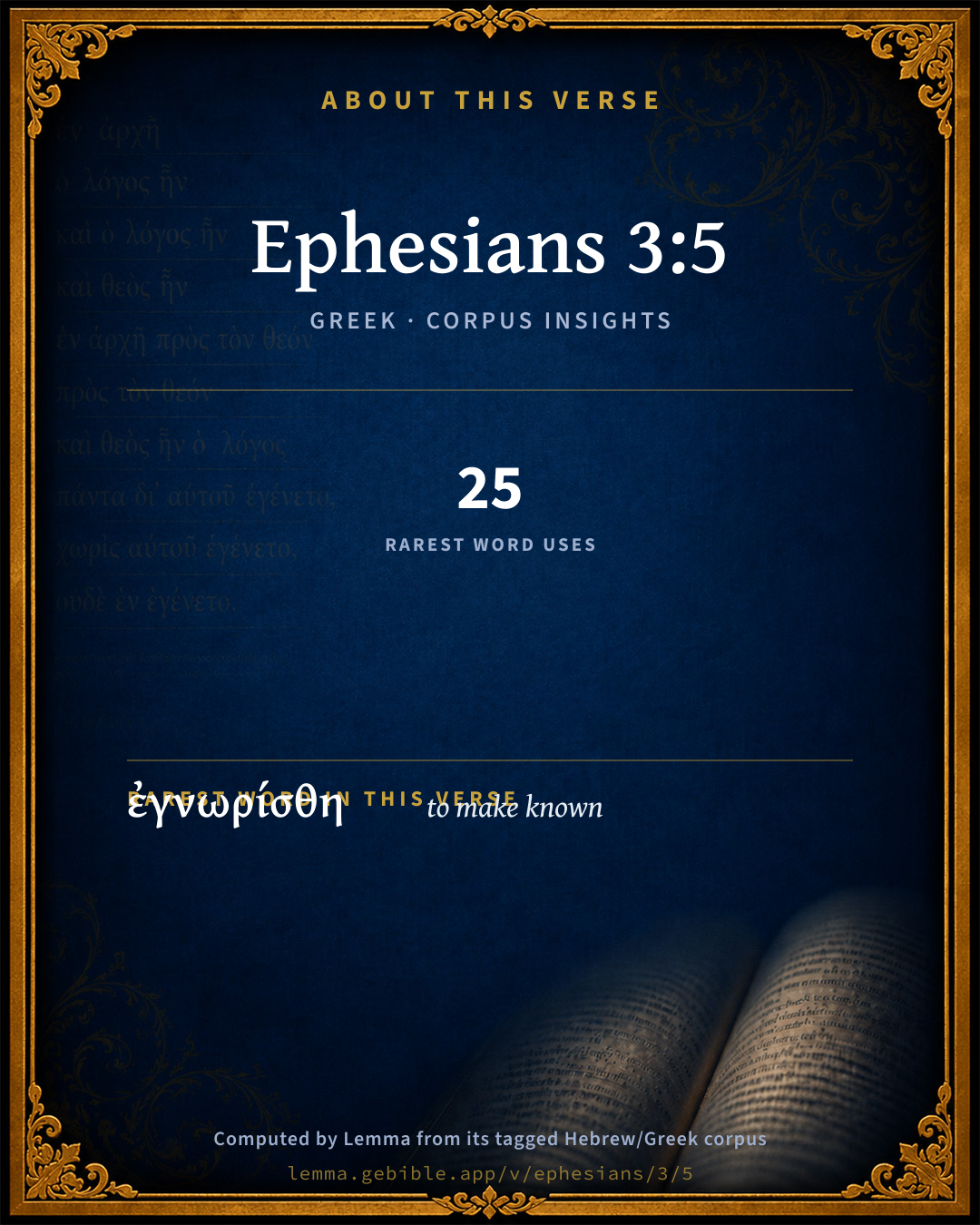
Ephesians 3:5

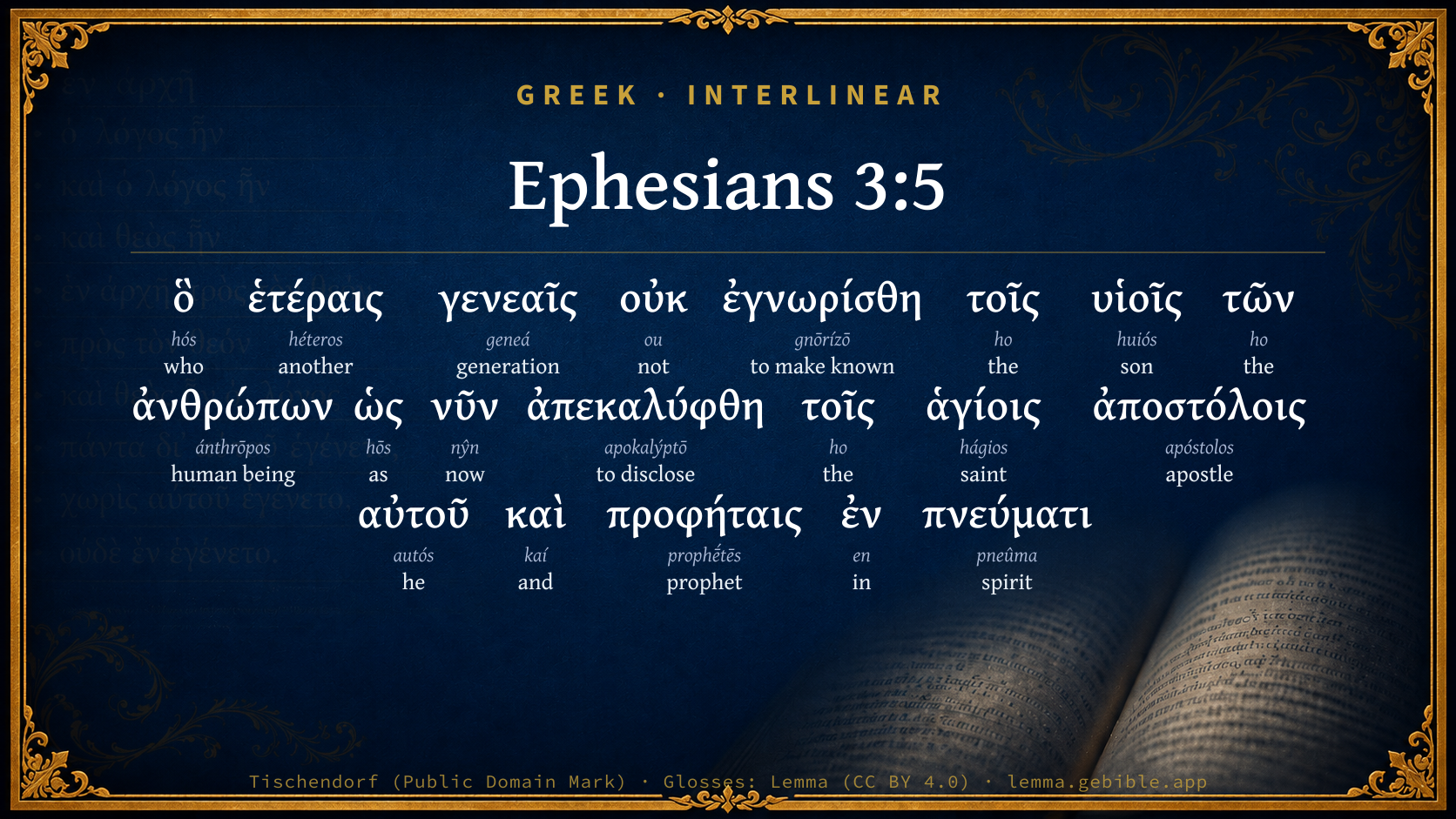
Greek (Tischendorf 8th ed.) Ephesians 3:5 appears in the Greek New Testament. The text above is from the Tischendorf 8th edition. Each word links to its Strong’s number and a concise gloss. Click any word for its full Thayer’s Greek Lexicon entry.
Download image
Cite this verse

Ephesians 3:5 (World English Bible). Public Domain. Lemma interlinear Bible study tool, https://lemma.gebible.app/v/ephesians/3/5.

Show BibTeX & RIS
BibTeX
RIS
English Translation
which in other generations was not made known to the children of men, as it has now been revealed to his holy apostles and prophets in the Spirit;
World English Bible · Public Domain
Download a study sheet

One document with this verse’s original text, its word-by-word gloss line, the meaning frame, cross-references with their text, attributed commentary, and full source and license credits — printable, and it pastes into notes with its structure intact.

This verse Autodidact and up

Study sheet (.html) Plain text (.txt)

A passage Seminary Student

Up to 50 verses in one chapter. A passage sheet keeps up to 6 commentary sources and 12 cross-references per verse, in the order this page ranks them, and says so on the sheet whenever that leaves anything out. Ask for a single verse and you get the Autodidact verse sheet above.

Everything on this page stays free to read, with no account — the sheet is a download of what is already on screen, not access to it.

Want to remove ads? Support Godless Engineer
Compare translations 3

The same verse in 3 English versions, stacked beneath the original-language interlinear above. Click any original word for its lexicon entry.

Each is an independent rendering of the whole verse — the interlinear is not word-aligned to these translations.

Highlighted words mark where these versions differ — a whole-verse word diff, not a word-by-word alignment.

  • World English Bible Public Domain
    which in other generations was not made known to the children of men, as it has now been revealed to his holy apostles and prophets in the Spirit;
  • King James Version Public Domain
    Which in other ages was not made known unto the sons of men, as it is now revealed unto his holy apostles and prophets by the Spirit;
  • unfoldingWord Literal Text CC BY-SA 4.0
    which in other generations was not made known to the sons of men as it now has been revealed by the Spirit to his holy apostles and prophets—

unfoldingWord Literal Text — © unfoldingWord, licensed CC BY-SA 4.0. Word-aligned USFM3 via Door43 (git.door43.org/unfoldingWord/en_ult).

Versions to compare (up to 4)

3 of 4 selected

Show all 19 translations

Every available English version of this verse, each an independent rendering of the whole verse.

  • World English Bible Public Domain
    which in other generations was not made known to the children of men, as it has now been revealed to his holy apostles and prophets in the Spirit;
  • Berean Standard Bible Public Domain
    which was not made known to men in other generations as it has now been revealed by the Spirit to God’s holy apostles and prophets.
  • Majority Standard Bible Public Domain
    which was not made known to men in other generations as it has now been revealed by the Spirit to God’s holy apostles and prophets.
  • King James Version Public Domain
    Which in other ages was not made known unto the sons of men, as it is now revealed unto his holy apostles and prophets by the Spirit;
  • American Standard Version (1901) Public Domain
    which in other generation was not made known unto the sons of men, as it hath now been revealed unto his holy apostles and prophets in the Spirit;
  • Revised Version (1885) Public Domain
    which in other generations was not made known unto the sons of men, as it hath now been revealed unto his holy apostles and prophets in the Spirit;
  • Geneva Bible (1599) Public Domain
    Which in other ages was not opened vnto the sonnes of men, as it is nowe reueiled vnto his holy Apostles and Prophets by the Spirit,
  • Douay-Rheims (1899) Public Domain
    Which in other generations was not known to the sons of men, as it is now revealed to his holy apostles and prophets in the Spirit:
  • Young's Literal Translation Public Domain
    which in other generations was not made known to the sons of men, as it was now revealed to His holy apostles and prophets in the Spirit --
  • Literal Standard Version CC BY-SA 4.0
    which in other generations was not made known to the sons of men, as it was now revealed to His holy apostles and prophets in the Spirit—
  • Unlocked Literal Bible CC BY-SA 4.0
    In other generations this truth was not made known to the sons of men. But now it has been revealed by the Spirit to his apostles and prophets who were set apart for this work.
  • unfoldingWord Literal Text CC BY-SA 4.0
    which in other generations was not made known to the sons of men as it now has been revealed by the Spirit to his holy apostles and prophets—
  • Darby Bible Public Domain
    which in other generations has not been made known to the sons of men, as it has now been revealed to his holy apostles and prophets in [the power of the] Spirit,
  • World Messianic Bible Public Domain
    which in other generations was not made known to the children of men, as it has now been revealed to his holy emissaries and prophets in the Spirit,
  • Webster's Bible Public Domain
    Which in other ages was not made known to the sons of men, as it is now revealed to his holy apostles and prophets by the Spirit;
  • Free Bible Version CC BY-SA 4.0
    In past generations this wasn't made clear to anyone, but now it's been revealed to God's holy apostles and prophets by the Spirit
  • Bible in Basic English Public Domain
    Which in other generations was not given to the sons of men, but the revelation of it has now been made to his holy Apostles and prophets in the Spirit;
  • Text-Critical English NT CC BY 4.0
    which in previous generations was not made known to the sons of men as it has now been revealed by the Spirit to his holy apostles and prophets.
  • Tyndale New Testament (1534) Public Domain
    which mistery in tymes passed was not opened vnto the sonnes of men as it is nowe declared vnto his holy apostles and prophetes by the sprete:

Literal Standard Version (2020), Covenant Press — licensed CC BY-SA 4.0. Text via the HelloAO Bible API (eBible.org). Unlocked Literal Bible (unfoldingWord) — licensed CC BY-SA 4.0. Text via the HelloAO Bible API (eBible.org). unfoldingWord Literal Text — © unfoldingWord, licensed CC BY-SA 4.0. Word-aligned USFM3 via Door43 (git.door43.org/unfoldingWord/en_ult). Free Bible Version, Dr. Jonathan Gallagher — licensed CC BY-SA 4.0. Text via the HelloAO Bible API (eBible.org).

Word by word

More ways to search: Search by grammar → Find every occurrence → Compare this word →

Practice this passage: Drill this verse → Learn its vocabulary →

ἐγνωρίσθη
gnōrízō
G1107
“to make known”
Verb, Aorist, Passive, Indicative, 3rd person, Singular
Part of Speech
Verb
Tense
Aorist
Voice
Passive
Mood
Indicative
Person
3rd person
Number
Singular
Full Thayer's Definition

Origin: from a derivative of G1097

TDNT: 12:58,1

1. to make known a. to become known, be recognised 2. to know, to gain knowledge of, have thorough knowledge of a. in earlier Greek it means "to gain a knowledge of" or "have thorough knowledge of"
  1. ὃ hós G3739 “who” Relative pronoun, Nominative, Singular, Neuter
  2. ἑτέραις héteros G2087 “another” Adjective, Dative, Plural, Feminine
  3. γενεαῖς geneá G1074 “generation” Noun, Dative, Plural, Feminine
  4. οὐκ ou G3756 “not” Particle, Negative
  5. τοῖς ho G3588 “the” Article, Dative, Plural, Masculine
  6. υἱοῖς huiós G5207 “son” Noun, Dative, Plural, Masculine
  7. τῶν ho G3588 “the” Article, Genitive, Plural, Masculine
  8. ἀνθρώπων ánthrōpos G444 “human being” Noun, Genitive, Plural, Masculine
  9. ὡς hōs G5613 “as” Adverb
  10. νῦν nŷn G3568 “now” Adverb
  11. ἀπεκαλύφθη apokalýptō G601 “to disclose” Verb, Aorist, Passive, Indicative, 3rd person, Singular
  12. τοῖς ho G3588 “the” Article, Dative, Plural, Masculine
  13. ἁγίοις hágios G40 “saint” Adjective, Dative, Plural, Masculine
  14. ἀποστόλοις apóstolos G652 “apostle” Noun, Dative, Plural, Masculine
  15. αὐτοῦ autós G846 “he” Personal pronoun, Genitive, Singular, Masculine
  16. καὶ kaí G2532 “and” Conjunction
  17. προφήταις prophḗtēs G4396 “prophet” Noun, Dative, Plural, Masculine
  18. ἐν en G1722 “in” Preposition
  19. πνεύματι pneûma G4151 “spirit” Noun, Dative, Singular, Neuter

About this verse

These counts appear in no published source. They are computed here, from the morphology-tagged text and Lemma’s own curated glosses. What Lemma adds →

20
words
18
distinct lemmas
Pauline Epistles
section

Notable vocabulary

The rarest word here is ἐγνωρίσθη to make known G1107 — appearing just 25 times in the whole Greek New Testament.

Shared distinctive vocabulary

ἐγνωρίσθη to make known G1107 occurs in 24 verses of the Greek New Testament. Also found in:

Repetition

A word recurs within this verse:

  • τοῖς the G3588 ×3

Cross-references

21

Topical passages linked to Ephesians 3:5 in the Treasury of Scripture Knowledge — connected by theme and wording, ordered by reader-vote popularity; previews shown in the World English Bible.

  • 1 Peter 1:10–12 Concerning this salvation, the prophets sought and searched diligently, who prophesied of the grace that would come to you,
  • 2 Peter 3:2 that you should remember the words which were spoken before by the holy prophets, and the commandments of us, the apostles of the Lord and Savior:
  • Titus 1:1–3 Paul, a servant of God, and an apostle of Jesus Christ, according to the faith of God's chosen ones, and the knowledge of the truth which is according to godliness,
  • Jude 1:17 But you, beloved, remember the words which have been spoken before by the apostles of our Lord Jesus Christ.
  • Luke 10:24 for I tell you that many prophets and kings desired to see the things which you see, and didn't see them, and to hear the things which you hear, and didn't hear them."
  • Acts 10:28 He said to them, "You yourselves know how it is an unlawful thing for a man who is a Jew to join himself or come to one of another nation, but God has shown me that I shouldn't call any man unholy or unclean.
  • Ephesians 2:20 being built on the foundation of the apostles and prophets, Christ Jesus himself being the chief cornerstone;
  • Ephesians 3:9 and to make all men see what is the administration of the mystery which for ages has been hidden in God, who created all things through Jesus Christ;
  • Matthew 13:17 For most assuredly I tell you that many prophets and righteous men desired to see the things which you see, and didn't see them; and to hear the things which you hear, and didn't hear them.
  • John 14:26 But the Counselor, the Holy Spirit, whom the Father will send in my name, he will teach you all things, and will remind you of all that I said to you.
  • John 16:13 However when he, the Spirit of truth, has come, he will guide you into all truth, for he will not speak from himself; but whatever he hears, he will speak. He will declare to you things that are coming.
  • Romans 16:25
  • Matthew 23:34 Therefore, behold, I send to you prophets, wise men, and scribes. Some of them you will kill and crucify; and some of them you will scourge in your synagogues, and persecute from city to city;
  • Luke 2:26–27 It had been revealed to him by the Holy Spirit that he should not see death before he had seen the Lord's Christ.
  • Acts 10:19–20 While Peter was pondering the vision, the Spirit said to him, "Behold, three men seek you.
  • 1 Corinthians 12:8–10 For to one is given through the Spirit the word of wisdom, and to another the word of knowledge, according to the same Spirit;
  • 1 Corinthians 12:28–29 God has set some in the assembly: first apostles, second prophets, third teachers, then miracle workers, then gifts of healings, helps, governments, and various kinds of languages.
  • Ephesians 4:11–12 He gave some to be apostles; and some, prophets; and some, evangelists; and some, shepherds and teachers;
  • 2 Timothy 1:10–11 but has now been revealed by the appearing of our Savior, Christ Jesus, who abolished death, and brought life and immortality to light through the Gospel.
  • Hebrews 11:39–40 These all, having had testimony given to them through their faith, didn't receive the promise,
  • Luke 11:49 Therefore also the wisdom of God said, 'I will send to them prophets and apostles; and some of them they will kill and persecute,

Cross-references courtesy of OpenBible.info (CC BY 4.0).

Commentary

Notes on Ephesians 3:5 from classic Christian and Jewish commentators (each source and its license shown beneath its notes). The classic Christian expositions comment on the surrounding passage and are grouped to its opening verse, so a note may address several verses; the Jewish commentaries on the Tanakh (Rashi and others) are per-verse, so they appear only where the commentator wrote on this verse.

Lemma curates 59 commentaries, every one of them public domain or Creative Commons licensed, each selected and text-cleaned for this edition rather than reprinted as found. About our sources →

Tyndale Open Study Notes

Tyndale Open Resources

3:5 his holy apostles: See 1:1. • The order of the terms apostles and prophets (see 2:20) suggests that Paul is speaking of New Testament, not Old Testament, prophets. In both the Old Testament and the New Testament, the gift of prophecy is concerned less with predicting the future than with speaking a special word from God (see 1 Cor 12:10).

Tyndale Open Study Notes — © Tyndale Open Resources, licensed CC BY-SA 4.0. Text via the HelloAO Bible API.

Bengel's Gnomon

Johann Albrecht Bengel

Eph 3:5. Ὃ, which) This refers to Eph 3:3, as the repetition of the verb γνωρίζω, I make known, indicates.—ἑτέραις γενεαῖς, in other ages) Time in the ablative, as Act 13:36.—οὐκ ἐγνωρίσθνη, was not made known) He does not say οὐκ ἀπεκαλύφθη, was not revealed. Making known by revelation (Eph 3:3) is the source of making known by preaching. Revelation is somewhat more special; making known is done in the hearing of others also: revelation is only made to the prophets.—τοῖς υἱοῖς τῶν ἀνθρώπων, to the sons of men) A very wide appellation, expressing the cause of ignorance, natural descent, to which the Spirit is opposed; comp. Mat 16:17. He speaks of their former state in the idiom of the Hebrew language. Moreover, the antithesis of the apostles and prophets of the New Testament to the sons of men leads to the conclusion, that by this appellation the ancient prophets are principally intended; for example, Ezekiel, who is often called בן אדם, son of man, and has copiously described the city and house of God, as Paul does in this place.—ἐν Πνεύματι, in the Spirit) the gift of whom was reserved for the New Testament, with a view to the glorifying of Christ.

Bengel's Gnomon of the New Testament — English translation (T&T Clark, Edinburgh, 1860) — public domain. Text from a community e-Sword module.

Meyer's Critical & Exegetical Commentary

Heinrich August Wilhelm Meyer

Eph_3:5. Not an explanation, to what extent he was speaking of a mystery (Rückert, Meier): for that the readers knew, and the design of bringing in a mere explanation would not be in keeping with the elevated solemn style of the whole verse; but a triumphant outburst of the conscious exalted happiness of belonging to the number of those who had received the revelation of the mysteryan outburst, which was very naturally called forth by the sublime contents of the μυστήριον.

ἑτέραις γενεαῖς] may be either a definition of time, like the dative at Eph_2:12 (so taken usually); in that case γενεαῖς is not periodis or temporibus in general, but: in other generations (comp. on Eph_3:21); or it may express the simple dative relation, so that γενεαῖς is generationibus (Vulgate): which to other generations was not made known, according to which τοῖς υἱοῖς τῶν ἀνθρ. would form a characteristic epexegesis (Lobeck, ad Aj. 308; Bernhardy, p. 55; Nägelsbach, Anm. z. Ilias, ed. 3, pp. 272, 307). This was my previous view. Yet the former explanation, as being likewise linguistically correct, and withal more simple and more immediately in keeping with the contrast νῦν, is to be preferred. The ἕτεραι γεν. are the generations which have preceded the νῦν; and τοῖς υἱοῖς τῶν ἀνθρ. (not elsewhere occurring with Paul) has the significance, that it characterizes men according to their lower sphere conditioned by their ortum naturalem (Bengel), under which they were incapable in themselves of understanding the μυστήριον. Comp. Gen_11:5; Psa_8:5; Psa_11:5; Wis_9:6. That specially the O. T. prophets are meant by τοῖς υἱοῖς τῶν ἀνθρώπ., as Bengel supposed,[169] is wrongly inferred from τοῖς ἁγίοις ἀποστόλοις κ.τ.λ., since the contrast does not lie in the persons,[170] but in the time (ἑτέραις γενεαῖς … νῦν). It is true Ezekiel often bears the name בֶּן־אָדָם (Eze_7:1; Eze_12:1, al.), not, however, as prophet, but as man; and thereby likewise his human lowliness and dependence upon God are brought home to him.

Ὡς] By this expression, which (in opposition to Bleek) is to be left as comparative, the disclosure made to Abraham and the ancient prophets of the future participation of the Gentiles in Messiahs kingdom (Gal_3:8; Rom_9:24-26; Rom_15:9 ff.) remains undisputed; for fuit illis hoc mysterium quasi procul et cum involucris ostensum, Beza; hence the prophetic prediction served only as means for the making known of the later complete revelation of the mystery (Rom_16:26).

ΝῦΝ] in the Christian period. Comp. 1Pe_1:12.

ἈΠΕΚΑΛΎΦΘΗ] not a repetition of ἘΓΝΩΡΊΣΘΗ, but the distinguishing mode in which this manifestation took place, is intended to be expressed: ΚΑΤᾺ ἈΠΟΚΆΛΥΨΙΝ ἘΓΝΩΡΊΣΘΗ, Eph_3:3.

ΤΟῖς ἉΓΊΟΙς ἈΠΟΣΤ. Κ.Τ.Λ.] is not to be divided by a comma after ἉΓΊΟΙς (Lachmann, Bisping), so that ἈΠΟΣΤ. ΑὐΤ. Κ. ΠΡΟΦ. would be apposition or more precise definition, whereby the flow of the expression would be only needlessly interrupted. The predicate holy was already borne by the Old Testament prophets (2Ki_4:9; Luk_1:70; 2Pe_1:21), and this appellation at our passage by no means exposes the apostolic origin of the Epistle to suspicion (de Wette derives ἁγίοις from the passage Col_1:26 recast in post-apostolic times; Baur: from the post-apostolic reverential looking back to the apostles); but it is very naturally called forth by the context, in order to distinguish the recipients of the revelation amidst the mass of the υἱοὶ τῶν ἀνθρώπων, in accordance with the connection, as Gods special messengers and instruments, as ἅγιοι Θεοῦ ἄνθρωποι (2Pe_1:21); whereupon the apostolic consciousness in Paul was great and decided enough not to suppress the predicate suggested by the connection,[171] while he is speaking of the apostles and prophets in general, whereas, immediately afterwards, at Eph_3:8, in speaking of himself in particular, he gives full play to his individual deep humility. How can we conceive that the author should thus in one breath have fallen out of his assumed part at Eph_3:5 with τοῖς ἁγίοις, by a slip (Baur), and then have resumed it at Eph_3:8 with ἐμοὶ τῷ ἐλαχιστοτέρῳ!

αὐτοῦ] not of Christ (Bleek), but of God, whose action is implied in ἐγνωρίσθη and ἀπεκαλύφθη.

καὶ προφήταις] quite as at Eph_2:20.

ἐν πνεύματι] The Holy Spirit is the divine principle, through which the ἀπεκαλύφθη took place. Comp. Eph_1:17; 1Co_2:10 ff. Rückert wrongly takes it as: in an inspired state, which πνεῦμα never means, but, on the contrary, even without the article is the objective Holy Spirit. Comp. on Eph_2:22. Koppe and Holzhausen connect ἐν πνεύματι (sc. οὖσι) with προφήταις. In this way it would be an exceedingly superfluous addition, since prophets, who should not be ἐν πν., are inconceivable, whereas a revelation was conceivable even otherwise than through the Spirit (by means of theophany, angel, vision, ecstasy, etc.). Meier connects ἐν πν. even with ἁγίοις, so that the sense would be: in sacred enthusiasm! and Ambrosiaster (comp. Erasmus) with the following εἶναι κ.τ.λ. Baur, p. 440, knows how to explain ἐν πνεύματι from a Montanistic view, and thinks that it is only on account of the prophets that it is applied to the apostles also.

[169] In quite an opposite way Jerome would exclude the ancient patriarchs and prophets from the υἱοῖς τῶν ἀνθρ.; for these were rather sons of God!

[170] The ἀπόστολοι and προφῆται were also υἱοὶ τῶν ἀνθρ., but a sacred ἐκλογή of the same.

[171] A side-glance at the Jews, who would have seen a blasphemy in the apostolic message of the joint-heirship of the Gentiles (Lange, Apostol. Zeitalt. I. p. 128), is utterly remote from the connection.

Meyer — Critical and Exegetical Commentary on the New Testament — English translation by Peter Christie, edited by Frederick Crombie (T&T Clark, 1880) — public domain. Text from a community e-Sword module.

Expositor's Greek Testament

ed. W. Robertson Nicoll

Eph 3:5 . ὃ ἐν ἑτέραις γενεαῖς οὐκ ἐγνωρίσθη τοῖς υἱοῖς τῶν ἀνθρώπων : which in other generations was not made known to the sons of men . The TR inserts ἐν before ἑτέραις , as in Syr.-Phil. and Copt. But the insertion is due probably to the double dative, and the ἐν (which is not found in [219] [220] [221] [222] [223] [224] [225] [226] , etc.) is rightly omitted by LTTrWHRV. The γενεαῖς , therefore, is the dat. of time ; the term γενεά , like the OT דּו̇ר (of which it is the usual rendering in the LXX), meaning the period covered by a generation of men (Luk 1:20 ; Act 14:16 ; Act 15:21 ; Col 1:26 ) as well as the generation or race itself. By τοῖς υἱοῖς τῶν ἀνθρώπων are to be understood, not the OT prophets (Beng.) as contrasted with the “Apostles and prophets” of the next clause, but men generally and in the absolute sense, in conformity with the γενεαῖς . ὡς γῦν , ἀπεκαλύφθη τοῖς ἁγίοις ἀποστόλοις αὐτοῦ καὶ προφήταις ἐν πνεύματι : as now it was revealed to His holy Apostles and prophets in the Spirit . The ὡς has its proper comparative force. The fact of the revelation made in pre-Christian times to the fathers and the prophets is not questioned. The matter in view is the measure or manner of the revelation. The νῦν = “now,” in these Christian times , and the aor. ἀπεκαλύφθη defines the fuller revelation as made definitely at a former period in these times. The verb also has its proper force, as distinguished from the ἐγνωρίσθη and as describing the way, viz. , by revelation , that the truth was made known. The prophets of the OT dispensation were designated ἅγιοι (2Ki 4:9 ; Luk 1:20 ; 2Pe 1:21 ). Those of these Christian times are in like manner designated ἅγιοι , as men separated and consecrated to the office and distinguished from the mass of the υἱοὶ τῶν ἀνθρώπων . They are further described as His ( αὐτοῦ ), i.e., God’s Apostles and prophets, God being the subject implied in the ἐγνωρίσθη and the ἀπεκαλύφθη . The terms ἀποστόλοις and προφήταις have the same sense here as in Eph 2:20 , viz. , the Christian Apostles and prophets. The clause ἐν Πνεύματι defines the ἀπεκαλύφθη ; not the προφήταις , as if = προφῆται θεόπνευστοι (Holzh., Koppe), for the προφῆται need no such definition. As in Eph 2:22 the πνεῦμα here is the Holy Spirit, and the ἐν would most naturally be taken in the same sense as these. Here, however, most understand it as the instrumental ἐν . It seems to combine the two ideas of agency and element or condition , and describes the revelation as having been made in and by the Spirit.

[219] Codex Vaticanus (sæc. iv.), published in photographic facsimile in 1889 under the care of the Abbate Cozza-Luzi.

[220] Codex Sinaiticus (sæc. iv.), now at St. Petersburg, published in facsimile type by its discoverer, Tischendorf, in 1862.

[221] Codex Alexandrinus (sæc. v.), at the British Museum, published in photographic facsimile by Sir E. M. Thompson (1879).

[222] Codex Ephraemi (sæc. v.), the Paris palimpsest, edited by Tischendorf in 1843.

[223] Codex Claromontanus (sæc. vi.), a Græco-Latin MS. at Paris, edited by Tischendorf in 1852.

[224] Codex Augiensis (sæc. ix.), a Græco-Latin MS., at Trinity College, Cambridge, edited by Scrivener in 1859. Its Greek text is almost identical with that of G, and it is therefore not cited save where it differs from that MS. Its Latin version, f, presents the Vulgate text with some modifications.

[225] Codex Mosquensis (sæc. ix.), edited by Matthæi in 1782.

[226] Codex Angelicus (sæc. ix.), at Rome, collated by Tischendorf and others.

The Expositor's Greek Testament, edited by W. Robertson Nicoll (1897–1910) — public domain. Text from a community e-Sword module.

Hodge's Commentary on Romans, Ephesians & First Corinthians

Charles Hodge

Eph_3:5

God by revelation had made known to Paul a mystery, or purpose, which was not revealed as it now was to the apostles. That the Gentiles were to partake of the blessings of the Messiahs reign, and to be united as one body with the Jews in his kingdom, is not only frequently predicted by the ancient prophets, but Paul himself repeatedly and at length quotes their declarations on this point to prove that what he taught was in accordance with the Old Testament; see Rom_9:25-33. The emphasis must, therefore, be laid on the word as. This doctrine was not formerly revealed as, i.e. not so fully or so clearly as under the Gospel.

The common text reads ἐν ἑτέρἀς γενεαῖς, in other generations. But most editors, on the authority of the older MSS., omit the preposition. Still the great majority of commentators interpret the above phrase as determining the time, and render it, during other ages. To this, however, it is objected that γενεά never means, an age in the sense of period of time, but always a generation, the men of any age, those living in any one period. If this objection is valid γενεαῖς must be taken as the simple dative, and υἱοῖς τῶν ἀνθρώπων be regarded as explanatory. The passage would then read, Which was not made known to other generations, i.e. to the sons of men, etc. But in Act_14:16, Act_15:21, and especially in Col_1:26 (ἀπὸ τῶν αἰώνων καὶ ἀπὸ τῶν γἐνῶν), γενεά is most naturally taken in the sense of age, or period of duration. In the same sense it is used in the Septuagint, Psa_72:5, Psa_102:25; Isaiah 51, 8.

As it is now revealed to his holy apostles and to the prophets by the Spirit, ὡς νῦν ἀπεκαλύφθη … ἐν πνεύματι. The apostles and prophets of the new dispensation were the only classes of inspired men; the former being the permanent, the latter the occasional organs of the Spirit. They therefore were the only recipients of direct revelations. They are here called holy in the sense of sacred, consecrated. They were men set apart for the peculiar service of God. In the same sense the prophets of the old economy are called holy. Luk_1:70; 2Pe_1:21. The pronoun his in connection with apostles may refer to God as the author of the revelation spoken of, or to Christ whose messengers the apostles were. My knowledge of the mystery of Christ, which, in former ages, was not made known, as it is now revealed to his apostles, etc. By the Spirit, i.e. revealed by the Spirit. Πνεύματι, though without the article, refers to the Holy Spirit, the immediate author of these divine communications. It follows from the scriptural doctrine of the Trinity, which teaches the identity as to substance of the Father, Son, and Spirit, that the act of the one is the act of. the others. Paul, therefore, refers the revelations which he received sometimes to God, as in Eph_3:3; sometimes to Christ as in Gal_1:12; sometimes to the Spirit.

Charles Hodge — Commentary on Romans (1835), First Corinthians (1857), and Ephesians (1856) — public domain. Text from a community e-Sword module.

Geneva Bible (1599)

Geneva Bible translators

He meaneth not that none knew the calling of the Gentiles before, but because very few knew of it, and they that did know it, as the Prophets, had it revealed unto them very darkly, and under figures.

Geneva Bible (1599) marginal notes — public domain. Text via Bolls.life.

Jamieson, Fausset & Brown

Robert Jamieson, A. R. Fausset & David Brown

in other ages--Greek, "generations."

not made known--He does not say, "has not been revealed." Making known by revelation is the source of making known by preaching [BENGEL]. The former was vouchsafed only to the prophets, in order that they might make known the truth so revealed to men in general.

unto the sons of men--men in their state by birth, as contrasted with those illuminated "by the Spirit" (Greek, "IN the Spirit," compare Rev 1:10), Mat 16:17.

as--The mystery of the call of the Gentiles (of which Paul speaks here) was not unknown to the Old Testament prophets (Isa 56:6-7; Isa 49:6). But they did not know it with the same explicit distinctness "As" it has been now known (Act 10:19-20; Act 11:18-21). They probably did not know that the Gentiles were to be admitted without circumcision or that they were to be on a level with the Jews in partaking of the grace of God. The gift of "the Spirit" in its fulness was reserved for the New Testament that Christ might thereby be glorified. The epithet, "holy," marks the special consecration of the New Testament "prophets" (who are here meant) by the Spirit, compared with which even the Old Testament prophets were but "sons of men" (Eze 2:3, and elsewhere).

Jamieson, Fausset & Brown — Commentary Critical and Explanatory on the Whole Bible (1871) — public domain (CC PDM 1.0). Text via the HelloAO Bible API.

Adam Clarke's Commentary

Verse 5. Which in other ages was not made known] That the calling of the Gentiles was made known by the prophets in different ages of the Jewish Church is exceedingly clear; but it certainly was not made known in that clear and precise manner in which it was now revealed by the Spirit unto the ministers of the New Testament: nor was it made known unto them at all, that the Gentiles should find salvation without coming under the yoke of the Mosaic law, and that the Jews themselves should be freed from that yoke of bondage; these were discoveries totally new, and now revealed for the first time by the Spirit of God.

Adam Clarke's Commentary on the Bible (1810–1826) — public domain. Text from a community e-Sword/MySword module.

John Calvin's Commentaries

5. Which in other ages was not made known. He had simply called it a mystery, but now calls it a mystery of Christ, because it was necessary that it should remain hidden, until it was revealed by his coming; just as the appellation of “prophecies of Christ” may be given to those which relate to his kingdom. We must first explain the word mystery, and then inquire why it is said to have remained unknown in all ages. The mystery was,

“that the Gentiles should be fellow-heirs, and of the same body, and partakers of his promise in Christ by the gospel.” (Verse 6.)

When this name is given to the gospel, it has other meanings, which do not apply to the present passage. The calling of the Gentiles, then, was a “mystery of Christ;” that is, it was to be fulfilled under the reign of Christ.

But why does he affirm that it was not known, when it had been the subject of so many predictions? The prophets everywhere declare, that people shall come from every nation in the world, to worship God; that an altar shall be erected both in Assyria and in Egypt, and that all alike shall speak the language of Canaan. (Isaiah 19:18.) It is intimated by these words, that the worship of the true God, and the same profession of faith, will be everywhere diffused. Of the Messiah it is predicted, that he shall have dominion from east to west, and that all nations shall serve him. (Psalm 72:8,11.) We see also, that many passages to this purpose are quoted by the apostles, not only from the later prophets, but from Moses. How could that be hidden which had been proclaimed by so many heralds? Why are all without exception pronounced to have been in ignorance? Shall we say, that the prophets spake what they did not understand, and uttered sounds without meaning?

I answer, the words of Paul must not be understood to mean that there had been no knowledge at all on these subjects. There had always been some of the Jewish nation who acknowledged that, at the advent of the Messiah, the grace of God would be proclaimed throughout the whole world, and who looked forward to the renovation of the human race. The prophets themselves, though they spoke with the certainty of revelation, left the time and manner undetermined. They knew that some communication of the grace of God would be made to the Gentiles, but at what time, in what manner, and by what means it should be accomplished, they had no information whatever. This ignorance was exemplified in a remarkable way by the apostles. They had not only been instructed by the predictions of the prophets, but had heard the distinct statement of their Master, (John 10:16,)

“Other sheep I have which are not of this fold: them also I must bring, and they shall hear my voice: and there shall be one fold and one shepherd;”

and yet the novelty of the subject prevented them from understanding it fully. Nay, after they had received the injunction,

“Go ye into all the world, and preach the gospel to every creature,” (Mark 16:15,)

and,

“Ye shall be witnesses to me both in Jerusalem, and in all Judea, and in Samaria, and to the uttermost part of the earth,” (Acts 1:8,)

they dreaded and recoiled from the calling of the Gentiles as a proposal absolutely monstrous, because the manner of its accomplishment was still unknown. Before the actual event arrived, they had dark and confused apprehensions of our Savior’s words; for ceremonies were

“a vail over their face, that they could not steadfastly look to the end of that which is abolished.” (2 Corinthians 3:13.)

With unquestionable propriety, therefore, does Paul call this a mystery, and say, that it had been hidden; for the repeal of the ceremonial law, which admitted them within the vail, was not understood.

As it is now revealed. To lay claim to information which none of the patriarchs, prophets, or holy kings, had possessed, might wear the aspect of arrogance. To guard against this imputation, Paul reminds them, first, that in this respect he was not alone, but shared the revelation with the most eminent teachers of the church; and, secondly, that it was the gift of the Holy Spirit, who has a right to bestow it on whom he pleases; for there is no other limit of our knowledge but that which he assigns to us.

These few words, as it is now revealed, throw additional light on the admission of the Gentiles to be the people of God. It is on the condition that they shall be placed on a level with the Jews, and form one body. That the novelty might give no offense, he states that this must be accomplished by the gospel. (Ephesians 3:6.) Now, the gospel was itself a novelty; for it had never till now been heard of, and yet was acknowledged by all the godly to have come from heaven. Where, then, was the wonder, if, in renewing the world, God should follow an unwonted method?

John Calvin's Commentaries (1540-1563) — public domain. Text from the Calvin Translation Society English edition (1840s-50s) via the Christian Classics Ethereal Library (ccel.org). Calvin's coverage is partial (roughly two-thirds of the Bible); uncommented books and verses are honest gaps, never fabricated. The 19th-century editor's footnotes and remarks are omitted so the notes are faithfully Calvin's own voice.

Ellicott's Commentary for English Readers

(5) Which in other ages (rather, to other generations) was not made known unto the sons of men.—For the general sense comp. Col_1:27. The phrase “the sons of men” (except that it is once used in Mar_3:28) is peculiar to the Old Testament, where it is of frequent use in the poetical books, and it is notable that in Ezekiel it is the name by which the prophet himself is constantly addressed. Hence, although it is probably wrong to restrict to the children of Israel, or to the prophets, words which by their very nature apply to all mankind, yet the phrase seems to be used with a suggestion of the contrast between the old dispensation and the new. (Comp. our Lord’s words in Mat_11:11, “Among them that are born of women there hath not risen a greater than John the Baptist: notwithstanding he that is least in the kingdom of heaven is greater than he.”)

As it is now revealed unto his holy apostles and prophets by the Spirit.—The application of the epithet “holy” to the Apostles has been thought strange as coming from one of their number; and it is worth notice that this exceptional application is certainly more appropriate to the comparatively impersonal style of an encyclical epistle. But the epithet (applied to the Old Testament prophets in Luk_1:70; Act_3:21; 2Pe_3:2), like the frequent use of it as the substantive “saints,” in application to all Christians, refers not to personal character, but to official call and privilege. In this passage it is clear that it is used thus, in emphatic contrast with “the sons of men” above, and in connection with the following words, “in the Spirit.” The contrast here briefly conveyed is the same which is drawn out in 1 Corinthians 2 between the “wisdom of men,” and the “wisdom of God,” sanctifying, and so enlightening, the Christian soul.

A Bible Commentary for English Readers, edited by Charles John Ellicott (1878–1897) — public domain. Text from a community e-Sword module.

The Cambridge Bible for Schools and Colleges

gen. ed. J. J. S. Perowne

5. ages] Better, generations. The reference (see next words) is to human time, and the periods before the Gospel.

unto the sons of men] A designedly large phrase; mankind in general, both inside and outside the Jewish pale. Outside, the secret was wholly unknown; inside, it was only dimly and sparingly intimated, though certainly intimated (cp. Act_13:47; Rom_15:8-12). That it was in some measure revealed is suggested by the phrase here, “As it is now &c.” On the present scale, in the present mode, it was not then revealed; but not therefore quite concealed. But the O.T. hints were after all little more than prepared materials for N.T. revelation.

his holy apostles and prophets] On the “prophets,” see note on Eph_2:20.—The recipients are called “holy” to mark their special nearness to, and knowledge of, the revealing God, and so the absolute truth of their report.

by the Spirit] Lit., and better, in [the] Spirit. They were “in the Spirit” (Rev_1:10) while receiving the knowledge of the great mystery. The Holy Ghost possessed them, that He might inform them.

The Cambridge Bible for Schools and Colleges (gen. ed. J. J. S. Perowne; Cambridge University Press, 1878–1918) — public domain. Text from a community e-Sword module.

John Gill's Exposition

Which in other ages was not made known unto, the sons of men,.... That is, which mystery of Christ, and of the Gospel, was not made known to men in general, nor so clearly as under the Gospel dispensation. Some hints were given of it to Adam, immediately after his fall; and the Gospel was before preached to Abraham, Moses, and David, and others knew something of it; and it was still more fully dispensed in the times of the prophet Isaiah, and other following prophets: but then the knowledge of it was not so extensive, nor so clear as now; it lay hid in types and shadows, in obscure prophecies and short hints. Moreover, this may have respect particularly to the calling of the Gentiles, as appears from the following words; this was, in some measure, made known, as that in Christ all the nations of the earth should be blessed; that when Shiloh came, to him should the gathering of the people be; that the Messiah should be an ensign of the people, and to him should the Gentiles seek; that he should be the covenant of the people, and a leader and a commander of them; and that there should be great flockings to him; but then this was not known to many, and the time, mode, and circumstances of it were but little understood, and comparatively speaking, it was not known: however, it was not so known,

as it is now revealed unto his holy apostles and prophets by the spirit. The apostles and prophets were the superior officers in the Gospel dispensation; the former design the twelve apostles of Christ, and the latter such who had the gift of interpreting the prophecies of the Old Testament, and of foretelling things to come, having received gifts from Christ to fit them for such offices, some apostles, some prophets; and to these a revelation was made of the mystery of the Gospel in general, and of the calling of the Gentiles in particular, by the Spirit, who searches the deep things of God, and reveals them, and leads into all truth; and who, by falling upon the Gentiles, as upon Cornelius and his family, and by the success which he gave to the Gospel in the Gentile world, made their calling clear and manifest. The Complutensian edition reads, "by the Holy Spirit"; and so the Arabic and Ethiopic versions.

John Gill's Exposition of the Whole Bible (1746–1763) — public domain (CC PDM 1.0). Text via the HelloAO Bible API.

Trapp's Complete Commentary

John Trapp

5 Which in other ages was not made known unto the sons of men, as it is now revealed unto his holy apostles and prophets by the Spirit;

Ver. 5. Was not made known] sc. So clearly and particularly. Peter himself could hardly be persuaded to it, Act 10:14; Act 11:2-4.

John Trapp, A Commentary or Exposition upon All the Books of the Old and New Testament (1647–1656) — public domain. Text from a community e-Sword module.

Albert Barnes' Notes on the Bible

Which in other ages - The great purposes of God in regard to the salvation of mankind were not revealed; see the notes at Rom 16:25.

And prophets - Those who exercised the office of a prophet or inspired teacher in the Christian church; see the notes at 1Co 12:1.

By the Spirit - This proves that those who exercised the office of prophet in the Christian church were inspired. They were persons endowed in this manner for the purpose of imparting to the newly formed churches the doctrines of the Christian system. There is no evidence that this was designed to be a permanent order of people in the church. They were necessary for settling the church on a permanent basis, in the absence of a full written revelation, and when the apostles were away. When the volume of revelation was finished, and the doctrines of the gospel were fully understood, the functions of the office ceased.

Albert Barnes' Notes on the Bible (1834–1885) — public domain. Text from a community e-Sword/MySword module.

Haydock's Catholic Bible Commentary

As it is now revealed.[3] St. Paul, as both St. Jerome and St. John Chrysostom take notice, does not absolutely say that this mystery was not known, but only not known as it was afterwards to the apostles. For whether by this mystery we understand the incarnation of Christ, or the uniting of the Jews and Gentiles into one Church, we cannot doubt but both were revealed to Abraham, to David, to many prophets and just men in the time of the law; but now it was revealed and made known to all. (Witham)

===============================

[BIBLIOGRAPHY]

Sicuti nunc, Greek: os nun.

George Leo Haydock (1774–1849), Haydock's Catholic Family Bible and Commentary, 1859 edition — public domain. Excludes Psalms (Douay-Rheims chapter numbering differs from Protestant) and Deuterocanonical books (Catholic canon only).

Matthew Poole's English Annotations

Which in other ages; in the times before Christ’s coming in the flesh.

Was not made known unto the sons of men: that the Gentiles should be called was formerly known and foretold, but not as since, viz. as to the time and manner of it, and the means whereby it should be effected.

Prophets; New Testament prophets, Eph 4:11; Rom 12:6; 1Co 14:1,3.

By the Spirit; either by the Spirit’s being poured out on the Gentiles, it was known that they should be co-heirs with the believing Jews; or rather, by the Spirit instructing the apostles and prophets, and immediately acquainting them with this mystery.

Matthew Poole's English Annotations on the Holy Bible (1683–1685) — public domain. Text from a community e-Sword/MySword module.

Whedon's Commentary on the Bible

Daniel D. Whedon

5. Other ages, or dispensations preceding this, as the patriarchal, the Mosaic, the prophetic.

Not made known—Of the same mystery, Paul affirms (Rom_16:25-26) that it “was kept secret since the world began,” but “now is made manifest,” and “made known to all nations.” In his apostleship was enclosed the mystery of God.

The sons of men— Who, with all their natural powers, could never discover it.

As it is now— Beautiful predictions are recorded in the prophets of future good to the Gentiles. But the disclosure was not then made as it is now, when it forms the great theme and event of this newly opened age.

Prophets—Clearly the New Testament prophets, as in Eph_2:20. And these are holy as truly as the prophets of old, who were set apart for revelation to men.

Daniel D. Whedon (gen. ed.), Commentary on the Old and New Testaments (1874–1909) — public domain. Text from a community e-Sword module.

The Pulpit Commentary

Which was not made known to the sons of men in other generations. Though not a new purpose, the knowledge of it is new. Abraham, David, and the prophets, however much they knew of Christ and the fullness of blessing in him for all the families of the earth, did not know the full extent of God"s grace to the Gentries did not know that the middle wall was to be wholly broken down, and all inequality removed. This might seem to throw some doubt on the reality of this doctrine; but it was on purpose that God kept it secret, and those by whom he has now revealed it are worthy of all regard. As it has now been revealed unto his holy apostles and prophets in the Spirit. It is not revealed to Paul only, although he has got the privilege of announcing it to the Gentiles, but to the whole body of "holy apostles and prophets." The designation, "holy apostles," is rare; it is used here to magnify the office, to show that those whom the Head of the Church had set apart for himself were fit instruments to receive so important a revelation. "Prophets" here are undoubtedly New Testament prophets, (see Eph_2:20) the contrast being with "sons of men in other generations." Reference may be made to the experience and decree of the Council of Jerusalem, guided by the Holy Spirit. (see Act_15:28)

The Pulpit Commentary (1880–1919), ed. H.D.M. Spence-Jones & Joseph S. Exell — public domain. Text from a community e-Sword module.

John Wesley's Explanatory Notes

Which in other - In former, ages was not so clearly or fully made known to the sons of men - To any man, no, not to Ezekiel, so often styled, "son of man;" nor to any of the ancient prophets. Those here spoken of are New Testament prophets.

John Wesley, Explanatory Notes Upon the Whole Bible (1754–1765) — public domain. Text via the GEBible commentary corpus.

The People's New Testament

B. W. Johnson

5. Which. The mystery. It was in past ages hidden from men, but now revealed by the Spirit to apostles and prophets. Not the old Hebrew prophets, but the prophets in the church. Some of the Hebrew prophets might have had a glimpse of Gentile salvation, but they did not understand their own language as well as we do in the light of the gospel.

B. W. Johnson's The People's New Testament with Notes (1889–1891) — public domain. Electronic text from the Christian Classics Ethereal Library (CCEL) ThML edition.

Cambridge Greek Testament for Schools and Colleges

5. ἑτέραις γενεαῖς. ‘In former generations.’ Cf. Eph 2:12; Rom 16:25.

τοῖς υἱοῖς τῶν ἀνθρώπων. Contrast Eph 3:10 (ταῖς ἀρχαῖς καὶ ταῖς ἐξουσίαις ἐν τοῖς ἐπουρανίοις).

ὡς νῦν ἀπεκαλύφθη. For the ignorance even of the O.T. Prophets, cf. 1Pe 1:10. For νῦν with aor. cf. Hort on 1Pe 1:12.

τοῖς ἁγίοις ἀποστόλοις αὐτοῦ καὶ προφήταις. Cf. Col 1:26. It is not easy to say when this revelation was granted. St Paul felt that it was included in the revelation that he received at his conversion. But it does not seem to have been fully accepted at Jerusalem before the conference in Acts 15. The terms of the letter to Antioch written in the name of the Apostles and Elders (including at least Judas and Silas who were prophets, Act 15:32), ἔδοξεν γὰρ τῷ πνεύματι τῷ ἁλίῳ καὶ ἡμῖν, would satisfy St Paul’s language here exactly. Everything in fact falls naturally into its place if we may suppose that St Paul had the decision of such a representative gathering in mind from which he was himself excluded (cf. Hort Chris. Eccl., p. 166). If the Western reading τοῖς ἁγίοις αὐτοῦ ἀπ. καὶ προφ. be adopted, it would be possible to take ἁγίοις as a substantive, as in Col 1:26. The punctuation of Lachm. and Treg., retaining the common text with a comma after ἁγίοις, is surely impossible. ἁγίοις, epithet constantly applied to prophets (Luk 1:70; Act 3:21; 2Pe 3:2; Wis 11:1). Here only with ἀπόστολοι (cf. Rev 18:20).

ἐν πνεύματι. To be connected with ἀπεκαλύφθη. The truth was one which it needed special illumination to apprehend.

Cambridge Greek Testament for Schools and Colleges (Cambridge University Press, 1896; 21 vols, various authors incl. Carr, Maclear, Plummer, Farrar, Lumby, Moule, M. R. James, Simcox) — public domain. Text from a community e-Sword module.

Alford’s Greek Testament

Henry Alford

5.] which in other generations (dative of time: so Luk 12:20, ταύτῃ τῇ νυκτὶ τὴν ψυχήν σου ἀπαιτοῦσιν ἀπὸ σοῦ,—Mat 16:21 al.: for the temporal meaning of γενεά, see reff.) was not made known to the sons of men (‘latissima appellatio, causam exprimens ignorantiæ, ortum naturalem, cui opponitur Spiritus,’ Beng.; and to which, remarks Stier, ἁγίοις and αὐτοῦ are further contrasted) as (ἐγνωρίσθη μὲν τοῖς πάλαι προφήταις, ἀλλʼ οὐχ ὡς νῦν· οὐ γὰρ τὰ πράγματα εἶδον, ἀλλὰ τοὺς περὶ τῶν πραγμάτων προέγραψαν λόγους, Thdrt.) it has been now revealed (we are compelled in the presence of νῦν, to desert the aorist rendering ‘was revealed,’ which in our language cannot be used in reference to present time. The Greek admits of combining the two. We might do it by a paraphrastic extension of νῦν,—‘as in this present age it was revealed’) to His holy (see Stier’s remark above. Olshausen says, “It is certainly peculiar, that Paul here calls the Apostles, and consequently himself among them, ‘holy Apostles.’ It is going too far when De W. finds in this a sign of an unapostolic origin of the Epistle: but still the expression remains an unusual one. I account for it to myself thus,—that Paul here conceives of the Apostles and Prophets, as a corporation (cf. ch. 4:11), and as such, in their official character, he gives them the predicate ἅγιος, as he names believers, conceived as a whole, ἅγιοι or ἡγιασμένοι, but never an individual”) Apostles and Prophets (as in ch. 2:20, the N. T. Prophets—note there) in (as the conditional element; in and by) the Spirit (Chrys. remarks, ἑννόησον γάρ· ὁ Πέτρος, εἰ μὴ παρὰ τοῦ πνεύματος ἤκουσεν, οὐκ ἂν ἐπορεύθη εἰς τὰ ἔθνη. ἐν πν. must not be joined with προφ. as Koppe, al. (not Chrys., as the above citation shews); for, as De W. remarks, the words would thus either be superfluous, or make an unnatural distinction between the Apostles and Prophets)—that (‘namely, that’—giving the purport of the mystery) the Gentiles are (not, ‘should be:’ a mystery is not a secret design, but a secret fact) fellow-heirs (with the Jews) and fellow-members (of the same body) and fellow-partakers of the promise (in the widest sense; the promise of salvation:—the complex, including all other promises, even that chief promise of the Father, the promise of the Spirit itself) in (not to be referred to τῆς ἐπαγγ., which would be more naturally, though not necessarily, τῆς ἐν,—but to the three foregoing adjectives,—in Christ Jesus, as the conditional element in which their participation consisted) Christ Jesus (see above on ch. 2:13) through the Gospel (He Himself was the objective ground of their incorporation; the εὐαγγέλιον, the joyful tidings of Him, the subjective medium by which they apprehended it): of which (Gospel) I became (a reference to the event by which. “The passive form, however, implies no corresponding difference of meaning (Rück., Eadie): γίγνομαι in the Doric dialect was a deponent passive: ἐγενήθην was thus used for ἐγενόμην, and from thence occasionally crept into the language of later writers. See Buttm., Irregular Verbs, s.v. ΓΕΝ—, Lobeck, Phryn. pp. 108-9.” Ellic.) a minister (see the parallel, Col 1:23: and the remarks in Mey., and Ellic. on διάκονος and ὑπηρέτης) according to (in consequence of and in analogy with) the gift of the grace (genitive of apposition, as clearly appears from the definition of the grace given in the next verse: the grace was the gift) of God which was given to me (δοθ., not tautological, or merely pleonastic after δωρεάν, but to be joined with what follows) according to the working in me of his power (because, and in so far as, His Almighty power wrought in me, was this gift of the χάρις, the ἀποστολή, the office of preaching among the Gentiles, &c., bestowed upon me).

Henry Alford, The Greek Testament (1849–1861) — public domain. Text from a community e-Sword module.

International Critical Commentary

5. ὃ ἐτέραις γενεαῖς οὐκ ἐγνωρίσθη τοῦς υἱοῖς τῶν ἀνθρώπων. “Which in other ages was not made known to the sons of men.” ἐν, which in the Received Text precedes ἑτέραις, rests on slight authority, but it expresses the right construction of ἑτ. γεν. Meyer, in his earlier editions, adopted the view that the meaning was “to other generations,” τοῖς υἱοῖς, κ.τ.λ., being epexegetical. (So also v. Soden.) But the usual interpretation is simpler, and corresponds better with the antithetical νῦν. For γενεά in this sense, cf. Act 14:16, ἐν ταῖς παρῳχημέναις γ.; and for the dative of time, 2:12, ἑτέραις, i.e. other than the present.

“The sons of men,” an expression frequent in the O.T. and simply = “men.” Comp. Mar 3:28 (the only N.T. parallel) with Mat 12:31. It is needless, therefore, to adopt Bengel’s remark, “latissima appellatio, causam exprimens ignorantiae, ortum naturalem cui opponitur Spiritus.” Bengel, indeed, thinks that the prophets are especially referred to, because Ezekiel, who writes largely of the temple, as St. Paul does here, calls himself the son of man; but this is peculiar to him. It seems equally erroneous to find in the words a marked contrast with “His holy apostles,” namely, because these were Θεοῦ ἄνθρωποι (2Pe 1:21) (Ellicott). This is far-fetched. The apostles and prophets were not the less sons of men; and we might, with as much reason, follow Jerome, who would exclude the O.T. patriarchs and prophets because they were “sons of God.”

ὡς νῦν ἀπεκαλύφθη τοῖς ἁγίοις ἀποστόλοις αὐτοῦ καὶ προφήταις ἐν Πνεύματι. “As it has now been revealed to His holy apostles and prophets in the Spirit.”

ὡς is comparative, with such clearness as now. οὕτως ἀκριβῶς οὐκ ᾔδεισαν οἱ παλαιοὶ τὸ μυστήριον, Theoph.; “fuit illis hoc mysterium quasi procul et cum involucris ostensum,” Beza.

ἀπεκαλύφθη, not now ἐγνωρίσθη, because the special manner in which the knowledge was given is to be brought out.

“His holy apostles.” How can the writer, if himself an apostle, use such an expression? Some critics answer unhesitatingly that it is incredible that an apostle should do so, and that the expression betrays the view which belonged to a later age. Baur thinks the ἁγίοις an oversight. And the writer who was so unskilful as to be guilty of this palpable oversight, is so mindful of his assumed character that in the same breath he says, ἐμοὶ τῷ ἐλαχιστοτέρῳ πάντων ἁγίων. The difficulty seems to arise from the use of the word “holy,” and the corresponding words in other modern languages, to express the personal character of “holiness.” But ἅγιος is used of any thing that is set apart for a sacred purpose. So we have “holy prophets,” Luk 1:70; Act 3:21. All Christians are by their calling ἅγιοι, and St. Paul frequently uses the word where he himself is included (e.g. 1Co 6:2 and Col 1:26). When he calls all believers ἅγιοι, what delicacy should prevent him from calling the apostles by the same word? A clergyman is not expected to be prevented, by a feeling of delicacy, from speaking of his “reverend brethren,” or a bishop of his “right reverend brethren.”

Lachmann and Tregelles place a comma after ἁγίοις, the following words being in apposition: “to the saints, His apostles and prophets,” or rather “apostles and prophets of His.” But such a separation of the adjective from the following substantive is harsh, although it must be admitted that it is suggested by the parallel in Col 1:26.

A more considerable difficulty seems to arise from the statement that the mystery of the free admission of the Gentiles had been revealed to “the apostles and prophets,” viz. as a body. For this is precisely the special doctrine which St. Paul seems elsewhere, and here in ver. 3, to claim as his own, and which, at least at first, was not accepted by the other apostles (Gal_2.). In ver. 8, also, this is recognised as the distinctive characteristic of St. Paul’s apostleship. For this reason Reuss makes the suggestion that the second half of ver. 5 is a gloss. In favour of this suggestion, it may also be observed that αὐτοῦ has no expressed antecedent, unless, indeed, in opposition to most expositors, we take it to be Χριστοῦ. In the parallel in Col 1:26, τοῖς ἁγίοις αὐτοῦ, the antecedent Θεοῦ occurs just before. But the authority of the MSS. is too strong for this suggestion to be accepted. B, indeed, omits ἀποστόλοις (with ps. Ambr.), while D G place the word after αὐτοῦ.

The difficulty, however, is met by the consideration that, not-withstanding the doubts which the other apostles at first entertained, they afterwards fully accepted the doctrine as taught by St. Paul, Acts 15., Gal 2:7 ff., and that long before the present Epistle was written. The “prophets” are manifestly Christian prophets. ἐν πνεύματι must be joined with the verb, not with προφήταις, to which it would be a superfluous addition, or ἁγίοις or the following εἶναι.

International Critical Commentary — older volumes (1896–1929), various authors — public domain. Text from a community e-Sword module.

Vincent's Word Studies in the New Testament

Marvin R. Vincent

Other generations [ετεραις] . Other and different. See on Mt 6:24.

Marvin R. Vincent, Word Studies in the New Testament (1887–1900) — public domain. Text from a community e-Sword/MySword module.

Lesson kit

Teaching starters — assembled from the data on this page, not authored interpretation. Every prompt links to the verse data it draws on. Edit before teaching.

Ephesians, in the Pauline Epistles, opens this verse with 20 words (18 distinct Greek lemmas). Its most distinctive word is gnōrízō (“to make known”). A historical commentator’s framing appears above. Read the whole chapter for the surrounding context.

Discussion questions

  1. The word gnōrízō carries the sense “to make known.” How does it shape the verse?
  2. Luke 2:15 shares the word «to make known» with this verse. How do the two illuminate each other?
  3. “the” occurs 3× in this one verse. What is the effect of the repetition?
  4. The translations on this page render this verse differently — a whole-verse word diff, not a word-by-word alignment. What might account for the different wordings?
  5. Reading how Tyndale Open Study Notes and Bengel's Gnomon read this verse, where do the two commentators agree and where do they part?

Things to notice

Reading settings

Reading text

Shown beneath each verse's original-language words.

Old Testament
Old Testament edition

Read the OT as the Masoretic Hebrew (MT) or the Greek Septuagint (LXX).

English shown for the Greek Septuagint (in the Hebrew ↔ Greek comparison).

Comparing translations? Open the Compare panel on any verse page to stack up to four side by side.