
Ephesians 6:18

Greek (Tischendorf 8th ed.) Ephesians 6:18 appears in the Greek New Testament. The text above is from the Tischendorf 8th edition. Each word links to its Strong’s number and a concise gloss. Click any word for its full Thayer’s Greek Lexicon entry.
Download image
Cite this verse

Ephesians 6:18 (World English Bible). Public Domain. Lemma interlinear Bible study tool, https://lemma.gebible.app/v/ephesians/6/18.

Show BibTeX & RIS
BibTeX
RIS
English Translation
with all prayer and requests, praying at all times in the Spirit, and being watchful to this end in all perseverance and requests for all the saints:
World English Bible · Public Domain
Highlights
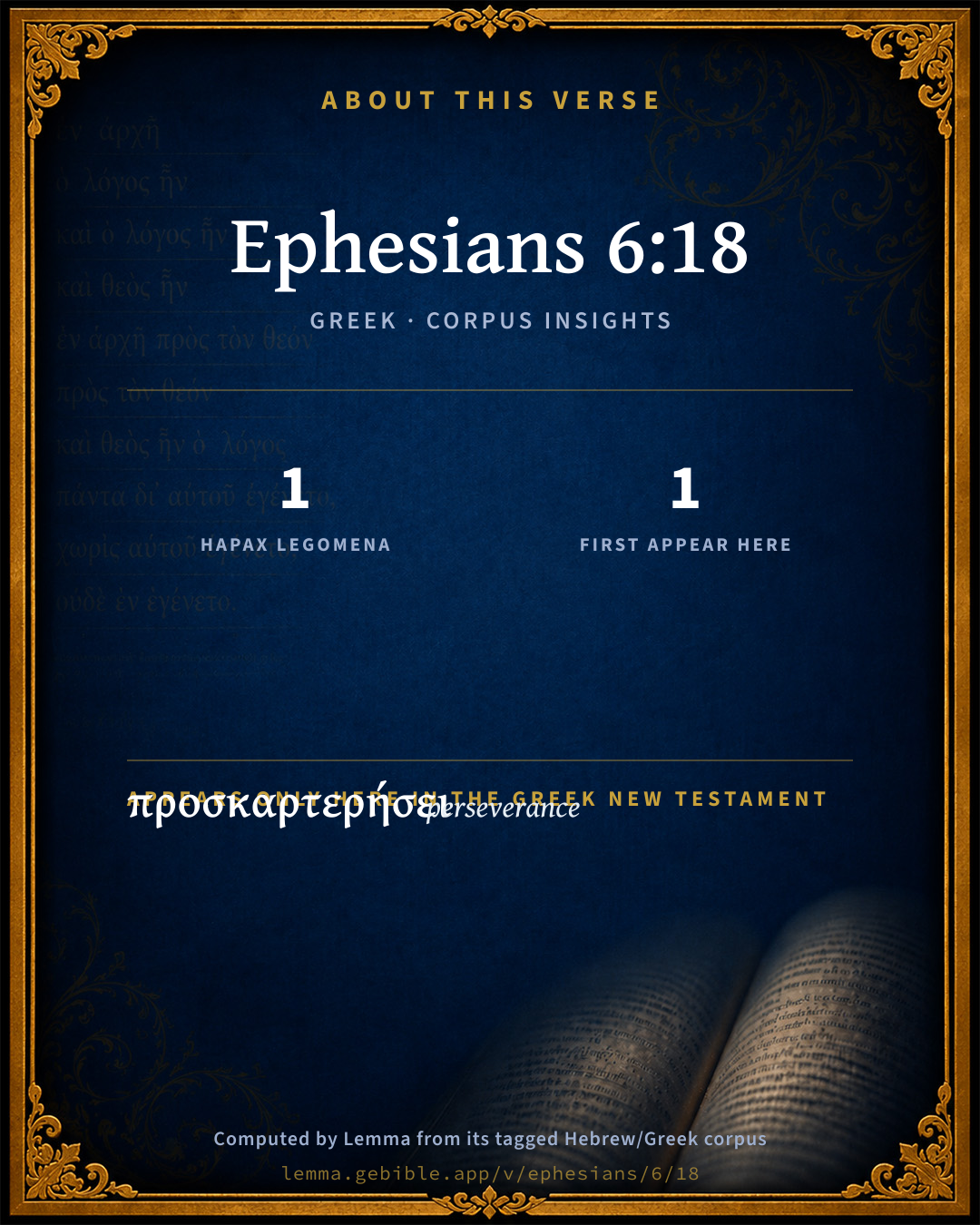
  • 1 hapax legomenon — only here in the Greek New Testament
  • 1 first appearance in the Greek New Testament
Full analysis ↓
Download a study sheet

One document with this verse’s original text, its word-by-word gloss line, the meaning frame, cross-references with their text, attributed commentary, and full source and license credits — printable, and it pastes into notes with its structure intact.

This verse Autodidact and up

Study sheet (.html) Plain text (.txt)

A passage Seminary Student

Up to 50 verses in one chapter. A passage sheet keeps up to 6 commentary sources and 12 cross-references per verse, in the order this page ranks them, and says so on the sheet whenever that leaves anything out. Ask for a single verse and you get the Autodidact verse sheet above.

Everything on this page stays free to read, with no account — the sheet is a download of what is already on screen, not access to it.

Want to remove ads? Support Godless Engineer
Compare translations 3

The same verse in 3 English versions, stacked beneath the original-language interlinear above. Click any original word for its lexicon entry.

Each is an independent rendering of the whole verse — the interlinear is not word-aligned to these translations.

Highlighted words mark where these versions differ — a whole-verse word diff, not a word-by-word alignment.

  • World English Bible Public Domain
    with all prayer and requests, praying at all times in the Spirit, and being watchful to this end in all perseverance and requests for all the saints:
  • King James Version Public Domain
    Praying always with all prayer and supplication in the Spirit, and watching thereunto with all perseverance and supplication for all saints;
  • unfoldingWord Literal Text CC BY-SA 4.0
    With every prayer and request, pray at all times in the Spirit. And to this, be watchful with all perseverance and requests for all the saints,

unfoldingWord Literal Text — © unfoldingWord, licensed CC BY-SA 4.0. Word-aligned USFM3 via Door43 (git.door43.org/unfoldingWord/en_ult).

Versions to compare (up to 4)

3 of 4 selected

Show all 19 translations

Every available English version of this verse, each an independent rendering of the whole verse.

  • World English Bible Public Domain
    with all prayer and requests, praying at all times in the Spirit, and being watchful to this end in all perseverance and requests for all the saints:
  • Berean Standard Bible Public Domain
    Pray in the Spirit at all times, with every kind of prayer and petition. To this end, stay alert with all perseverance in your prayers for all the saints.
  • Majority Standard Bible Public Domain
    Pray in the Spirit at all times, with every kind of prayer and petition. To this end, stay alert with all perseverance in your prayers for all the saints.
  • King James Version Public Domain
    Praying always with all prayer and supplication in the Spirit, and watching thereunto with all perseverance and supplication for all saints;
  • American Standard Version (1901) Public Domain
    with all prayer and supplication praying at all seasons in the Spirit, and watching thereunto in all perseverance and supplication for all the saints,
  • Revised Version (1885) Public Domain
    with all prayer and supplication praying at all seasons in the Spirit, and watching thereunto in all perseverance and supplication for all the saints,
  • Geneva Bible (1599) Public Domain
    And pray alwayes with all maner prayer and supplication in the Spirit: and watch thereunto with all perseuerance and supplication for al Saints,
  • Douay-Rheims (1899) Public Domain
    By all prayer and supplication praying at all times in the spirit; and in the same watching with all instance and supplication for all the saints:
  • Young's Literal Translation Public Domain
    through all prayer and supplication praying at all times in the Spirit, and in regard to this same, watching in all perseverance and supplication for all the saints --
  • Literal Standard Version CC BY-SA 4.0
    through all prayer and supplication praying at all times in the Spirit, and in this, watching in all perseverance and supplication for all the holy ones—
  • Unlocked Literal Bible CC BY-SA 4.0
    With every prayer and request, pray at all times in the Spirit. To this end, always be watching with all perseverance, as you offer prayers for all the saints.
  • unfoldingWord Literal Text CC BY-SA 4.0
    With every prayer and request, pray at all times in the Spirit. And to this, be watchful with all perseverance and requests for all the saints,
  • Darby Bible Public Domain
    praying at all seasons, with all prayer and supplication in [the] Spirit, and watching unto this very thing with all perseverance and supplication for all the saints;
  • World Messianic Bible Public Domain
    with all prayer and requests, praying at all times in the Spirit, and being watchful to this end in all perseverance and requests for all the holy ones.
  • Webster's Bible Public Domain
    Praying always with all prayer and supplication in the Spirit, and watching for this purpose with all perseverance and supplication for all saints;
  • Free Bible Version CC BY-SA 4.0
    Always pray in the Spirit as you do all this. Stay awake and keep on praying for all God's people.
  • Bible in Basic English Public Domain
    With prayers and deep desires, making requests at all times in the Spirit, and keeping watch, with strong purpose, in prayer for all the saints,
  • Text-Critical English NT CC BY 4.0
    Pray in the Spirit at all times, with every prayer and supplication, and to this end, stay alert and be persistent in praying for all the saints.
  • Tyndale New Testament (1534) Public Domain
    And praye all wayes with all maner prayer and supplicacion: and that in the sprete: and watch thervnto with all instance and supplicacion for all saynctes

Literal Standard Version (2020), Covenant Press — licensed CC BY-SA 4.0. Text via the HelloAO Bible API (eBible.org). Unlocked Literal Bible (unfoldingWord) — licensed CC BY-SA 4.0. Text via the HelloAO Bible API (eBible.org). unfoldingWord Literal Text — © unfoldingWord, licensed CC BY-SA 4.0. Word-aligned USFM3 via Door43 (git.door43.org/unfoldingWord/en_ult). Free Bible Version, Dr. Jonathan Gallagher — licensed CC BY-SA 4.0. Text via the HelloAO Bible API (eBible.org).

Word by word

More ways to search: Search by grammar → Find every occurrence → Compare this word →

Practice this passage: Drill this verse → Learn its vocabulary →

προσκαρτερήσει
proskartérēsis
G4343
“perseverance”
Noun, Dative, Singular, Feminine
Part of Speech
Noun
Case
Dative
Number
Singular
Gender
Feminine
Full Thayer's Definition

Origin: from G4342

TDNT: 13:19,4

1. perseverance
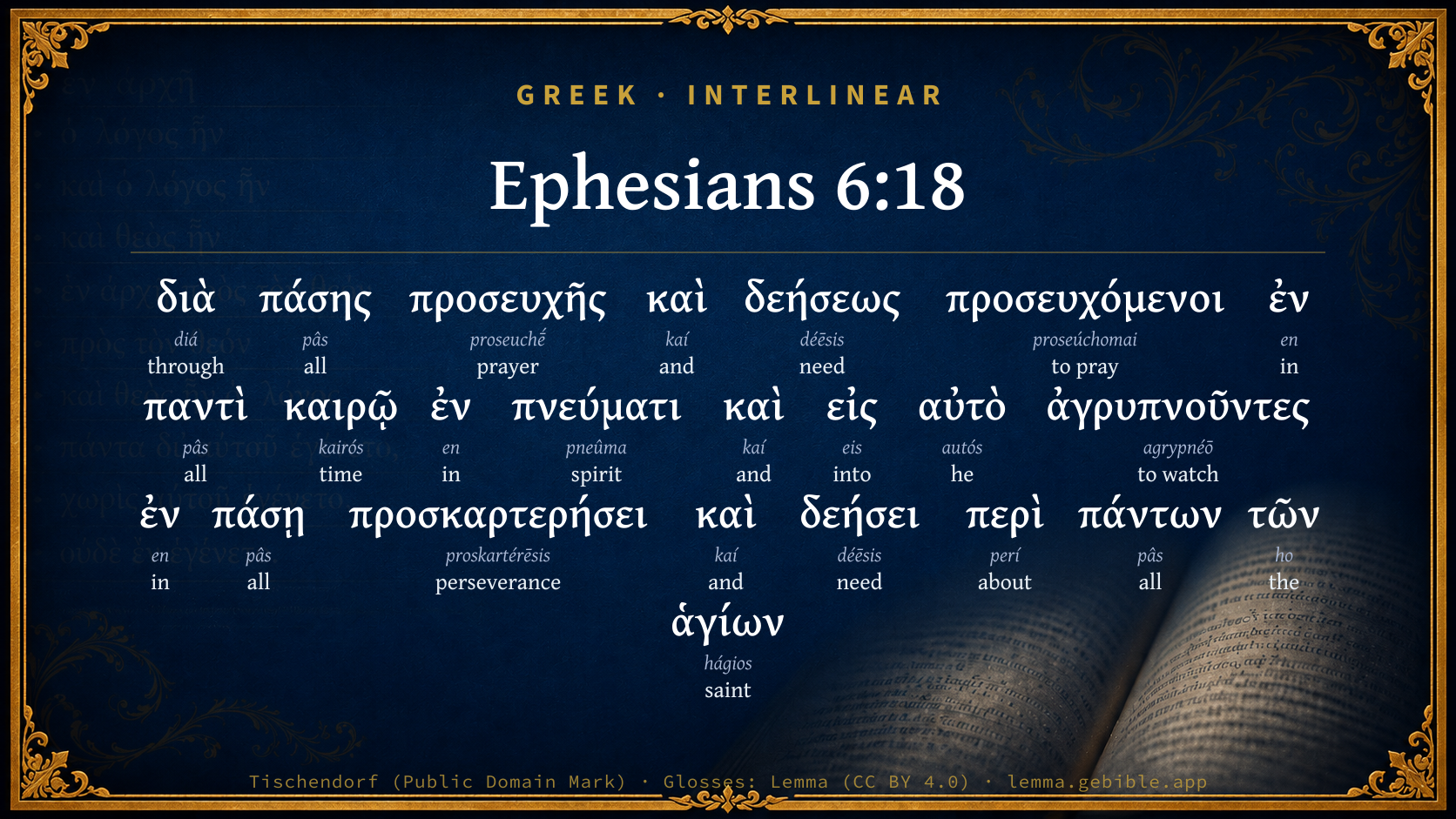
  1. διὰ diá G1223 “through” Preposition
  2. πάσης pâs G3956 “all” Adjective, Genitive, Singular, Feminine
  3. προσευχῆς proseuchḗ G4335 “prayer” Noun, Genitive, Singular, Feminine
  4. καὶ kaí G2532 “and” Conjunction
  5. δεήσεως déēsis G1162 “need” Noun, Genitive, Singular, Feminine
  6. προσευχόμενοι proseúchomai G4336 “to pray” Verb, Present, Middle or Passive deponent, Participle, Nominative, Plural, Masculine
  7. ἐν en G1722 “in” Preposition
  8. παντὶ pâs G3956 “all” Adjective, Dative, Singular, Masculine
  9. καιρῷ kairós G2540 “time” Noun, Dative, Singular, Masculine
  10. ἐν en G1722 “in” Preposition
  11. πνεύματι pneûma G4151 “spirit” Noun, Dative, Singular, Neuter
  12. καὶ kaí G2532 “and” Conjunction
  13. εἰς eis G1519 “into” Preposition
  14. αὐτὸ autós G846 “he” Personal pronoun, Accusative, Singular, Neuter
  15. ἀγρυπνοῦντες agrypnéō G69 “to watch” Verb, Present, Active, Participle, Nominative, Plural, Masculine
  16. ἐν en G1722 “in” Preposition
  17. πάσῃ pâs G3956 “all” Adjective, Dative, Singular, Feminine
  18. καὶ kaí G2532 “and” Conjunction
  19. δεήσει déēsis G1162 “need” Noun, Dative, Singular, Feminine
  20. περὶ perí G4012 “about” Preposition
  21. πάντων pâs G3956 “all” Adjective, Genitive, Plural, Masculine
  22. τῶν ho G3588 “the” Article, Genitive, Plural, Masculine
  23. ἁγίων hágios G40 “saint” Adjective, Genitive, Plural, Masculine

About this verse

These counts appear in no published source. They are computed here, from the morphology-tagged text and Lemma’s own curated glosses. What Lemma adds →

24
words
16
distinct lemmas
Pauline Epistles
section

Notable vocabulary

1 hapax legomenon — a word that appears only here in the entire Greek New Testament:

  • προσκαρτερήσει perseverance G4343

First appearance in Scripture

This word makes its first canonical appearance in the Greek New Testament here:

  • προσκαρτερήσει perseverance G4343

Shared distinctive vocabulary

ἀγρυπνοῦντες to watch G69 occurs in 4 verses of the Greek New Testament. Also found in:
Repetition

Words recur within this verse:

Cross-references

48

Topical passages linked to Ephesians 6:18 in the Treasury of Scripture Knowledge — connected by theme and wording, ordered by reader-vote popularity; previews shown in the World English Bible.

  • 1 Thessalonians 5:17 Pray without ceasing.
  • Colossians 4:2 Continue steadfastly in prayer, watching therein with thanksgiving;
  • Philippians 4:6 In nothing be anxious, but in everything, by prayer and petition with thanksgiving, let your requests be made known to God.
  • 1 Timothy 2:1 I exhort therefore, first of all, that petitions, prayers, intercessions, and givings of thanks, be made for all men:
  • Jude 1:20 But you, beloved, keep building up yourselves on your most holy faith, praying in the Holy Spirit.
  • Romans 8:26–27 In the same way, the Spirit also helps our weaknesses, for we don't know how to pray as we ought. But the Spirit himself makes intercession for us with groanings which can't be uttered.
  • Mark 14:38 Watch and pray, that you may not enter into temptation. The spirit indeed is willing, but the flesh is weak."
  • Luke 21:36 Therefore be watchful all the time, asking that you may be counted worthy to escape all these things that will happen, and to stand before the Son of Man."
  • Luke 18:1–8 He also spoke a parable to them that they must always pray, and not give up,
  • Matthew 26:41 Watch and pray, that you don't enter into temptation. The spirit indeed is willing, but the flesh is weak."
  • Daniel 9:20 While I was speaking, and praying, and confessing my sin and the sin of my people Israel, and presenting my supplication before Yahweh my God for the holy mountain of my God;
  • Ephesians 1:16 don't cease to give thanks for you, making mention of you in my prayers,
  • Psalms 6:9 Yahweh has heard my supplication. Yahweh accepts my prayer.
  • Mark 13:33 Watch, keep alert, and pray; for you don't know when the time is.
  • Luke 22:46 and said to them, "Why do you sleep? Rise and pray that you may not enter into temptation."
  • Romans 12:12 rejoicing in hope; enduring in troubles; continuing steadfastly in prayer;
  • Acts 1:14 All these with one accord continued steadfastly in prayer and supplication, along with the women, and Mary the mother of Jesus, and with his brothers.
  • Hebrews 5:7 He, in the days of his flesh, having offered up prayers and petitions with strong crying and tears to him who was able to save him from death, and having been heard for his godly fear,
  • Philippians 1:4 always in every request of mine on behalf of you all making my requests with joy,
  • 1 Kings 8:52 that your eyes may be open to the supplication of your servant, and to the supplication of your people Israel, to listen to them whenever they cry to you.
  • Psalms 4:1 Answer me when I call, God of my righteousness. Give me relief from my distress. Have mercy on me, and hear my prayer.
  • 2 Timothy 1:3 I thank God, whom I serve as my forefathers did, with a pure conscience. How unceasing is my memory of you in my petitions, night and day
  • 1 Peter 4:7 But the end of all things is near. Therefore be of sound mind, self-controlled, and sober in prayer.
  • Acts 12:5 Peter therefore was kept in the prison, but constant prayer was made by the assembly to God for him.
  • Genesis 32:24–28 Jacob was left alone, and wrestled with a man there until the breaking of the day.
  • 1 Kings 8:54 It was so, that when Solomon had made an end of praying all this prayer and supplication to Yahweh, he arose from before the altar of Yahweh, from kneeling on his knees with his hands spread forth toward heaven.
  • 1 Kings 9:3 Yahweh said to him, I have heard your prayer and your supplication, that you have made before me: I have made this house holy, which you have built, to put my name there forever; and my eyes and my heart shall be there perpetually.
  • Matthew 15:25–28 But she came and worshiped him, saying, "Lord, help me."
  • 1 Kings 8:59 Let these my words, with which I have made supplication before Yahweh, be near to Yahweh our God day and night, that he maintain the cause of his servant, and the cause of his people Israel, as every day shall require;
  • Daniel 6:10 When Daniel knew that the writing was signed, he went into his house (now his windows were open in his chamber toward Jerusalem) and he kneeled on his knees three times a day, and prayed, and gave thanks before his God, as he did before.
  • Job 27:10 Will he delight himself in the Almighty, And call on God at all times?
  • Luke 11:5–8 He said to them, "Which of you, if you go to a friend at midnight, and tell him, 'Friend, lend me three loaves of bread,
  • Isaiah 26:16 Yahweh, in trouble have they visited you; they poured out a prayer [when] your chastening was on them.
  • Hosea 12:4 Indeed, he had power over the angel, and prevailed; He wept, and made supplication to him. He found him at Bethel, and there he spoke with us,
  • Zechariah 12:10 I will pour on the house of David, and on the inhabitants of Jerusalem, the spirit of grace and of supplication; and they will look to me whom they have pierced; and they shall mourn for him, as one mourns for his only son, and will grieve bitterly for him, as one grieves for his firstborn.
  • Acts 6:4 But we will continue steadfastly in prayer and in the ministry of the word."
  • Acts 10:2 a devout man, and one who feared God with all his house, who gave gifts for the needy generously to the people, and always prayed to God.
  • Ephesians 6:19 on my behalf, that utterance may be given to me in opening my mouth, to make known with boldness the mystery of the Gospel,
  • Philemon 1:5 hearing of your love, and of the faith which you have toward the Lord Jesus, and toward all the saints;
  • Esther 4:8 Also he gave him the copy of the writing of the decree that was given out in Shushan to destroy them, to show it to Esther, and to declare it to her, and to charge her that she should go in to the king, to make supplication to him, and to make request before him, for her people.
  • Romans 8:15 For you didn't receive the spirit of bondage again to fear, but you received the Spirit of adoption, by whom we cry, "Abba! Father!"
  • Ephesians 3:8 To me, the very least of all saints, was this grace given, to preach to the Gentiles the unsearchable riches of Christ,
  • Ephesians 3:18 may be strengthened to comprehend with all the saints what is the breadth and length and height and depth,
  • Luke 3:37 the son of Methuselah, the son of Enoch, the son of Jared, the son of Mahalaleel, the son of Cainan,
  • Ephesians 2:22 in whom you also are built together for a habitation of God in the Spirit.
  • Galatians 4:6 And because you are children, God sent out the Spirit of his Son into your hearts, crying, "Abba, Father!"
  • Colossians 1:4 having heard of your faith in Christ Jesus, and of the love which you have toward all the saints,
  • Luke 3:26 the son of Maath, the son of Mattathias, the son of Semein, the son of Joseph, the son of Judah,

Cross-references courtesy of OpenBible.info (CC BY 4.0).

Commentary

Notes on Ephesians 6:18 from classic Christian and Jewish commentators (each source and its license shown beneath its notes). The classic Christian expositions comment on the surrounding passage and are grouped to its opening verse, so a note may address several verses; the Jewish commentaries on the Tanakh (Rashi and others) are per-verse, so they appear only where the commentator wrote on this verse.

Lemma curates 59 commentaries, every one of them public domain or Creative Commons licensed, each selected and text-cleaned for this edition rather than reprinted as found. About our sources →

The Biblical Illustrator

Joseph S. Exell

Eph_6:18-20

Praying always with all prayer and supplication in the Spirit.

Prayer and panoply

Christians have a battle to fight, an enemy to overcome. The enemy is so strong and wily that no human power can resist him. The Christian must be clad in Gods armour. Moreover, he must be armed at every point. Nothing less than the whole armour of God will avail. Not only so: the armour itself is valuable only as it is entire. It is of little consequence where the soldier is struck, if only he falls. Moreover, the Christian qualities figured in this picture of complete armour can exist and thrive only in company. Hope is nothing without faith; readiness is nothing without hope; righteousness is of faith only, and is nothing without truth; while truth finds its highest expression in righteousness. Then, as the soldier, however well protected, is useless without his sword; so Christian hope and truth and faith and righteousness get their highest sanction, and are taught their appropriate uses, by the Word of God alone--the sword of the Spirit. The Word of God and the armour of God are as necessary to each other as the captains orders are to the armed soldier; in short, this passage of Holy Scripture will be of little use to us unless we study it entire, and possess ourselves of the unity of all its parts. Consequently, we cannot understand these words in the text about prayer unless we see how they are related to what goes before. Prayer is the divinely ordained means of intercourse with God. In all that precedes we get no intimation of the personal contact of the Christian warrior with his Divine Leader. This is given us in prayer. We have the Word of God to the soldier; but in prayer we have the soldiers word with God, the contact and communion of soldier and general; and it is not without a purpose that the Word of God and prayer are brought together here. The Word of God gathers up into itself, expounds and interprets Christian truth, hope, faith, righteousness, readiness; but the Word of God becomes a living power, something to strike and to slay with, only through the living contact of the Christian with Christ, and this contact is afforded by prayer only. Now, in our text, the apostle describes some of the laws and characteristics of prayer; and these we will touch upon in the order in which he places them.

I. The variety of prayer. All prayer is the same in essence, but it takes on different modes, just as your intercourse with a friend does. It is not all asking. Sometimes it is only interchange, without any petition at all--talking to God for the pleasure of communion; sometimes a sharp, short cry for help, like Peters Lord, save me! when he felt himself sinking; sometimes merely the aspiration of the heart to God without a word; sometimes a half-conscious sympathy of thought with God; sometimes a formal, public petition; sometimes a struggle to climb over self to God. We are to pray with every prayer, with all kinds of prayer. He is not always the most prayerful man who prays most regularly or most formally, or most publicly. Sometimes more prayer is condensed into a sentence than is to be found in a whole series of prayer meetings. I never can read without emotion the story of the good old German professor, who sat studying until far into the night, and then, pushing his books wearily aside, was heard by the occupant of the next room to say, ere he lay down to rest, Lord Jesus, we are upon the same old terms.

II. The seasonableness of prayer. Praying in every season; this includes the habitual contact of the life with God everywhere. Life is full of occasions and suggestions of contact with God, and the Christian is to avail himself of them. You want God everywhere; you want His counsel in everything; your joy is incomplete, yea, empty, without His sanction and sympathy; your sorrow is unbearable without His comfort; your business lacks its one great element of success if God is left out of it; you will as surely fall under temptation as you are human, if God does not help you. Pray, therefore, with every kind of prayer, at every season.

III. The element and atmosphere of prayer--In the Spirit. What we are, comes very largely out of our surroundings; just as a taper gets much of the material for combustion out of the atmosphere. A light goes out in a vacuum. A swan cannot do his best in the air, nor an eagle in the water. So the power of prayer depends largely on the element in which it works. The only effective prayer is in the Spirit, i.e., under the impulse and direction of the Spirit of God (Rom_8:26). Otherwise, prayer is only an evidence of infirmity, like the dim burning of a candle in foul air.

1. The Spirit creates a prayerful heart (Rom_8:16). We never can truly pray at all until we can pray Our Father!

2. The Spirit suggests the substance of our prayers.

3. The Spirit reveals the love and helpfulness of God, and so encourages us to present our many and deep needs to Him.

4. The Spirit communicates Divine love to our hearts, and this love communicates warmth and enthusiasm to prayers.

5. The Spirit so identifies Himself with our case that He makes intercession for us. In other words, Gods own heart pleads for us; and our mightiest plea is there.

IV. Alertness in prayer. Being awake thereunto.

1. Keep watch over prayer. Cut that great main which leads the water from the reservoir into yonder city, and how long wilt it be ere the city is in distress? Prayer is the medium of communion with God, and without that communion there is no Christian living. No life without God, and no contact with God without prayer; so that, if Satan can cut that main, the life is in his power; and the danger is linked with the treasure, as always. Hence prayer is a thing to be watched--watched as a habit to be encouraged by practice, as a pleasure with which the Christian is to grow into a sweet familiarity by frequent communings with Him in whose presence is fulness of joy; as a duty which he neglects at the peril of his spiritual life.

2. And we must watch after prayer, to see what becomes of our prayers. He would be a strange archer who did not look to see where his arrow struck, a strange merchant who did not care whether his richly freighted ship arrived at her port or not.

3. This watching must be persistent. The conflict with temptation is lifelong; the necessity for prayer never ceases; there is always, therefore, need to watch.

V. The objects of prayer. Prayer must not be selfish. It is the language of the kingdom of God; and the kingdom of God is a community, a brotherhood. Prayer is the expression of the life of Gods kingdom, and that life is social. (Marvin R. Vincent, D. D.)

Pastor and people

I. The duty of the people.

1. Constant prayer.

(1) Private.

(2) Family.

(3) Public.

2. Habitual watchfulness.

(1) Spirit.

(2) Language.

(3) Actions.

3. Steady perseverance. This is opposed to--

(1) Indecision.

(2). Lukewarmness.

(3) Despondency.

4. Christian affection.

(1) Sincere.

(2) Ardent.

(3) Comprehensive.

II. The office of the pastor--An ambassador: one who has received a commission, and has a delegated authority. As a minister my duty is--

1. To instruct you with plainness.

2. To entreat you affectionately.

(1) By exhibiting Christ in all the loveliness of His character.

(2) By the exhibition of His work in all its suitableness and sufficiency.

(3) By dwelling on the work of the Holy Spirit, the energy by which the soul is renewed and sanctified, and made ripe for felicity.

(4) By making known the boundless love of God.

3. To warn you with faithfulness.

(1) Against erroneous doctrines.

(2) Against wicked practices.

(3) Of imminent danger.

4. To watch over you with care.

III. The text also affords me an opportunity to solicit your prayers.

1. Pray that I may preach fluently.

2. Pray that I may preach with boldness.

3. Pray that I may preach correctly.

4. Pray that I may preach successfully.

Concluding observations: From what has been said we cannot but observe--

1. The connection which subsists between a successful ministry and a praying people.

2. The importance of exemplifying all the graces of the Holy Spirit. Here is prayer, watchfulness, perseverance, comprehensive love; all these are required, and how important are they all. (W. S. Palmer.)

Subjects of intercession

I. Proper subjects of prayer.

1. Our own personal needs.

2. The needs of all our brethren in Christ--for all saints.

3. The needs of ambassadors of Christ--for me.

II. Proper method of prayer.

1. Variety in the method--all prayer, public and private, secret and social, with confession, petition, and thanksgiving.

2. Frequency--at all seasons (R.V.).

3. Seeking the help of Gods Spirit--in the Spirit (Rom_8:15; Rom_8:26).

4. Watchfulness, lest weariness overtake us.

5. Perseverance (Luk_18:1). (Family Churchman.)

Intercession

Intercession is the characteristic of Christian worship, the privilege of the heavenly adoption, the exercise of the perfect and spiritual mind. This is the subject to which I shall now direct your attention.

1. First, let us turn to the express injunctions of Scripture. For instance, the text itself: Praying in every season with all prayer and supplication in the Spirit, and abstaining from sleep for the purpose, with all perseverance and supplication for all saints. Observe the earnestness of the intercession here inculcated; in every season, with all supplication, and to the loss of sleep (see also Col_4:2; 1Th_5:25; 1Ti_2:1-2; 1Ti_2:8; 2Th_3:1; 1Co_14:3). Next consider St. Pauls own example, which is quite in accordance with his exhortations (Eph_1:16-17; Php_1:3-4; Col_1:3; 1Th_1:2). The instances of prayer, recorded in the book of Acts, are of the same kind, being almost entirely of an intercessory nature, as offered at ordinations, confirmations, cures, missions, and the like (Act_13:2-3; Act_9:4).

2. Such is the lesson taught us by the words and deeds of the apostles and their brethren. Nor could it be otherwise, if Christianity be a social religion, as it is preeminently. If Christians are to live together, they will pray together; and united prayer is necessarily of an intercessory character, as being offered for each other and for the whole, and for self as one of the whole.

3. But the instance of St. Paul opens upon us a second reason for this distinction. Intercession is the especial observance of the Christian, because he alone is in a condition to offer it. It is the function of the justified and obedient, of the sons of God, who walk not after the flesh but after the Spirit; not of the carnal and unregenerate. God heareth not sinners; nature tells us this; but none but God Himself could tell us that He will hear and answer those who are not sinners; for when we have done all, we are unprofitable servants, and can claim no reward for our services. But He has graciously promised us this mercy, in Scripture, as the following texts will show: Jam_5:16; 1Jn_3:22; Joh_15:7-15.

4. The history of Gods dealings with Abraham will afford us an additional lesson, which must be ever borne in mind in speaking of the privilege of the saints on earth as intercessors between God and man (see also Exo_20:12; Jer_35:18-19; Dan_10:2-14; Mar_9:29).

5. Why should we be unwilling to admit what is is so great a consolation to know? Why should we refuse to credit the transforming power and efficacy of our Lords sacrifice? Surely He did not die for any common end, but in order to exalt man, who was of the dust of the field, into heavenly places. He died to bestow upon him that privilege which implies or involves all others, and brings him into nearest resemblance to Himself, the privilege of intercession. This, I say, is the Christians especial prerogative; and if he does not exercise it, certainly he has not risen to the conception of his real place among created beings. He is made after the pattern and in the fulness of Christ--he is what Christ is. Christ intercedes above, and he intercedes below. Why should he linger in the doorway, praying for pardon, who has been allowed to share in the grace of the Lords passion, to die with Him and rise again? He is already in a capacity for higher things. His prayer thenceforth takes a higher range, and contemplates not himself merely, but others also. To conclude. If anyone asks, How am I to know whether I am advanced enough in holiness to intercede? he has plainly mistaken the doctrine under consideration. The privilege of intercession is a trust committed to all Christians who have a clear conscience and are in full communion with the Church. We leave secret things to God--what each mans real advancement is in holy things, and what his real power in the unseen world. Two things alone concern us, to exercise our gift and make ourselves more and more worthy of it. (J. H. Newman, D. D.)

Prayer

1.The apostle here supposes our obligation to prayer to be so plain, that every rational mind will see it, and so important, that every pious heart will feel it. Therefore, instead of adducing arguments to prove the duty, he rather points out the manner in which it should be performed.

2. Prayer is of several kinds: social and secret, public and domestic, stated and occasional; and it consists of several parts: confession, supplication, intercession, thanksgiving.

3. The apostle next instructs us concerning the manner in which our prayers should be offered.

(1) The first thing necessary in prayer is faith, or a believing view of Gods providential government, and of the wisdom and goodness with which it is administered.

(2) Our desires must be good and reasonable.

(3) Attention of mind, collection of thought, and warmth of affection, are qualifications required in prayer.

(4) That our prayers may be acceptable to God, they must be accompanied with justice to men.

(5) Charity is an essential qualification in prayer.

(6) We must bring before the throne of God a meek and peaceable spirit.

(7) Our prayers must be accompanied with a sense of, and sorrow for, sin.

(8) We must persevere in prayer.

4. The apostle here teaches us the duty of intercession for others. The goodness of God is the foundation of prayer. If God is good to others, as well as to us, there is the same ground on which to offer our social intercessions, as our personal petitions. (J. Lathrop, D. D.)

The necessity of prayer

Whatever may be the character of other military men, the Christian soldier must be a man of prayer. This will appear both from his own wants, and from the character of the Captain of his salvation. Among your wants we may point to your weakness. You have a great battle to wage against a great enemy. The serried hosts of Marathon or Waterloo, drawn out in long and splendid array, might well have appalled even an experienced soldier whose office called him to draw his sword for that desperate battle strife; but the hosts of Marathon and Waterloo were trifles compared With the principalities and powers with which you must contend. And what are you against such a gigantic enemy? an enemy whose legions are almost countless, whose adroitness and long experience are unequalled amongst all Gods creatures, and whose long marches have been signalized with such numberless victories? What are you in yourself but dust and ashes, but a poor, weak, helpless worm? in your natural state fitly described by inspiration as without strength, and even when introduced into the kingdom of Gods dear Son, still constrained to say, In me, that is, in my flesh, dwelleth no good thing: when I would do good, evil is present with me. Utterly imbecile as to the conquest of your own evil passions, how can you in your own strength stand against the principalities and powers, and wiles of the devil? The necessity for prayer to the Christian soldier appears also from his ignorance. However much he may have known and sadly felt of the wiles of the devil, he has not yet learned the whole of his devices. Satans empire is a deep abyss; it is a school in which, however large your experience, you will still be a learner to your dying day. As regards many of the wiles of Saran, and many of the purposes of Gods providence and grace, we are the veriest babes. These considerations are further enforced by the character of the Captain of your salvation. He is, first of all, able to understand perfectly your wants. As God, He is omniscient. Consider, also, that the Captain of your salvation is possessed of infinite power. The strength and ability to carry out their purposes with all creatures is limited. Some possess this attribute in larger measure than others, but with all it has its bounds. But your Leader is Divine, and with Him all things are possible. We are further encouraged to call on God our Saviour in the midst of our spiritual march, by the fact that He has a heart of the most tender sensibilities and sympathies. Are you tempted, desponding, sorrowing, suffering in mind, body, or estate? Are you wrestling hard against the principalities and powers of Satan, or against the cravings of flesh and blood? Does the battle seem long, the odds much against you, the result uncertain, and your helpers far away? Soldier of the Cross, thy conflicts are not unseen nor unpitied; thy Helper is not far away; thy sorrows will not be greater than thou canst bear, nor thy foes prove too much for thee. Although unseen by mortal eyes, He who called you from darkness to light is very near you; He has a feeling for your infirmities, and declares He will never leave nor forsake you. (J. Leyburn, D. D.)

Praying always

We consider that the word always in the text is not satisfied by a mans having stated times for prayer--by his offering up prayer every morning and night, but that it requires a prayerful mind--a mind at all times apt for prayer. He prays always who feels the duty and the privilege of communing with God at all times and under all circumstances; not only when God is chastening him, but when He is crowning him with loving kindness; not only in adversity, but in prosperity; who has wants to express when to the eye of the world every want seems satisfied; who has desires to breathe as well when his cup runneth over as when, hungry and thirsty, his soul fainteth in him. He prays always, not, indeed, who is always on his knees, or always engaged with specific acts of devotion, for this were impossible, and if possible, inconsistent with the appointed duties of life; but he who carries a prayerful spirit into every occupation and every condition; who never feels as if it would be a violent transition, in any company or under any Circumstances, to address himself to God, so truly has he God in all his thoughts, so pervaded is the whole train and current of his being with the consciousness that of Him, and through Him, and by Him, are all things. But there must be true religion, the religion of the heart, before there can be this praying always. Let it be observed, that all prayer supposes a sense of want to be supplied, and a consciousness that the supply can come only from God. In this way you may readily see how it comes to be a test of depth and sincerity in religion, that there should be perseverance in prayer. Judge yourselves, your religion, by such a test as this. A really godly man carries with him a prayerful mind into every scene and every occupation. Be not content till you have--what as fallen and ruined creatures in a state of peril you ought to have--an abiding sense of abiding want; so that at no moment are you at a loss what to ask for, and at none at a loss whom to ask it from. Till you have this--this which will lead you to pray in the crowd as well as in solitude--this which will keep the heart ever sitting at Gods gate, the spirit ever bent on intercourse with heaven--your religion is at best that of the hypocrite or the formalist. You do not live in an atmosphere of prayer, the atmosphere which a genuine Christian weaves around him, and carries with him. You are still at a distance from conformity such as that of our text, Praying always with all prayer and supplication in the Spirit. And here we would desire to point out to you that such constant and intimate communion as is indicated by our text can only take place where there is delight in God, and a feeling that His service is indeed perfect freedom. This is the secret of a Christian being always ready for prayer. He delights in God; he draws his happiness from God. We have yet to throw rapidly together certain reasons for that inconstancy in prayer, which is one great sign of a defective religion. You are not now, it may be, regular in prayer; but you have had your times of prayer--times when you performed that great duty with considerable care, though you have gradually relaxed, and then perhaps omitted it altogether. Now, how came this to pass? How was it that you did not arrive at the praying always with all prayer and supplication in the Spirit? Probably you left off praying because you were not willing to leave off sinning. Habitual prayer and habitual sin cannot exist long together. Sin will make you uneasy in prayer, or prayer will make you uneasy in sin. It was a good saying of some of the old divines--Praying will make a man leave off sinning, or sinning will make a man leave off praying. May not this be the explanation of your not praying always unto God? There was some favourite passion which you persisted in indulging, even whilst you persisted in praying. Perhaps--for this is possible, this is even common--perhaps you indulged the very passion against which you were praying: the prayer serving as a sort of sop to the conscience--a make-believe, that whilst you did the wrong thing, you had the wish, though not the power, to do the right. No wonder, if before long you left off praying. Be more honest another time. If you are secretly determined on continuing in sin, if you are not sincerely desirous of overcoming that sin, do not mock God by praying against that sin. And take it as a general rule, that prayer will be only by fits and starts; that there will never be such a habit of prayer, such a prayerfulness of spirit, as to justify the expression, praying always with all prayer and supplication in the Spirit, unless you are at war with sin; unless you strive with all diligence to keep under those evil propensities, the indulgence of which, as it grieves Gods Spirit, will necessarily hinder, and at last silence, supplication. For here you are to observe another great reason why, where there is no depth in religion, there will be no perseverance in prayer. You should mark the expression in the text, supplication in the Spirit. Fervent, effectual, importunate prayer is the utterance of Gods Spirit, making intercession within us. It is not our own voice, for we know not what we should pray for as we ought; we have to be taught how to pray, and our constant prayer should be for the spirit of prayer. But this is what the hypocrite and the formalist are either ignorant or unmindful of. They pray in their own strength; they have no consciousness of their inability for the very act in which it is their duty to engage; not an inability which exonerates them from the duty, but an inability which should make them seek Divine help for its discharge. Praying not in dependence on the Holy Spirit is but swimming in the wide sea, where there is nothing to lay hold on--a few desperate struggles, and then a sinking down in death. If, then, you would learn to pray always unto God, keep much in mind that the Spirit must help your infirmities. When you kneel down for prayer, pray that you may pray; do not proceed at once to the remembering and expressing other wants; confine yourselves to the one great want of the Spirit of grace and supplication. That obtained, you will pray the effectual fervent prayer, even though, as the apostle saith, it may be with groanings that cannot be uttered; that withheld, your prayer will bring down no blessing from above, however fluent it may have been in expression. (H. Melvill, B. D.)

The triumphs of the praying life

I stood lately in St Pauls Cathedral, and saw many monuments raised to English heroes, on which were written a list of their victories. But what monument could hold the list of triumphs won by prayer; triumphs gained in drawing room and garret, in palace and hovel, in prison cell and workhouse ward, in noisy barracks and tossing ships, or hospital couches wet with tears of agony, by empty cradles, and by new made graves? These are the victories won on battlefields of sorrow, of trial, of loss, of temptation, where the fighting was harder than at Marathon, or Austerlitz, or Waterloo; victories of faith, victories won by prayer. The history of the Church of Christ is the history of these triumphs. And take heed how you pray.

1. Then, pray faithfully, believing that God can and will answer you, though not, perhaps, just as you expect. Many prayers are wasted because they are without faith; those who utter them are just trying an experiment to see whether God will hear and answer or not.

2. Next, pray persistently; dont be disheartened because God does not answer at once.

3. Next, pray submissively, striving to give up your will to Gods will.

4. Next, pray simply. Some people pick out the longest and hardest words when they speak to God. (H. J. Wilmot-Buxton, M. A.)

The power of prayer

Prayer, which is of supreme necessity both for our own defence and for the destruction of the kingdom of darkness, cannot be properly described as part of the defensive armour which we are to wear, or as one of the weapons which we are to wield. It, is an appeal to the Divine strength and to Divine grace. To speak of the power of prayer, as though prayer itself were a spiritual force, is misleading. In prayer, human weakness invokes Divine protection and Divine support. We pray because our position in relation to God is a position of absolute dependence. Apart from Him we can do nothing. And in the spiritual life no system of secondary laws comes between Him and us. In the inferior provinces of our activity we are environed by the unchanging order of the physical universe; the Divine energy is voluntarily limited by natural laws; without any direct appeal to God we can command physical forces by a knowledge of the fixed methods of their action. But the higher life is a perpetual miracle. In the spiritual universe the Divine will works freely, and we have to do, not with forces which act under the restraint of fixed laws, but with a personal Will. God is the Fountain of our life and of our strength; but the streams flow, not under the compulsion of necessity, but according to His free volitions. We therefore pray that the life and the strength may he ours. Our dependence upon God is constant, and therefore our prayers should be constant. With the chances and changes of life our necessities are infinitely varied, and our prayers should be equally varied. Our opportunities for prayer are not always the same; sometimes we must pray alone, sometimes we can pray with others; sometimes our prayers must be brief, sometimes they may be prolonged. At all times, to pray aright, we must have the illumination and gracious aid of the Divine Spirit. (R. W. Dale, LL. D.)

Prayer acts upon God

Habitual intercession for others is one of the surest correctives of the tendency to regard prayer as deriving its chief value and importance--not from the fact that God listens to us when we pray, and gives us what we ask for--but from the influence which devotional thought, the confession of sin and of weakness, the grateful acknowledgment of Gods goodness, and the contemplation of Gods eternal majesty and glory, exert on our own spiritual life. None of us can escape altogether from the prevailing temper of our time. Those of us who think that we are least affected by the currents of contemporary thought feel their power. The tendency to eliminate the supernatural element from the spiritual as well as the physical universe is affecting the whole life of the Church. Christian people can understand that when they pray their devotional acts exert a reflex influence on their own minds and hearts; but to expect a direct answer from God requires a vigorous faith; and to this faith I fear that many of us are unequal. If Christian men are in trouble they are conscious that their hearts are lighter after they have spoken to God about it, just as their hearts are lighter when they have spoken about it to a friend; and they suppose that this kind of relief is all that they have a right to look for. They pray for stronger faith, and they suppose that it is by their own thoughts about God and His great goodness, thoughts which are made more vivid by the act of prayer, that their faith is to be Strengthened. Or if they pray that their love for God may become more ardent, they imagine that it is by the very excitement of praying for it that the result is to be obtained. They think that their prayer will be ineffective if, while they pray, their hearts are not flooded with emotion; they are satisfied if the emotion comes, and if, to use their own words, they feel better when the prayer is over. It is no doubt true that religious thought and communion with God purify, invigorate, and ennoble the soul; but if when we pray we think only or chiefly of the effect of prayer upon ourselves, instead of thinking of its effect in inducing God to grant us what we pray for, we misapprehend the nature of the act. When your child comes to you hungry or thirsty, and asks for food or drink, the child expects you to do something in answer to its request. It does not suppose that the mere act of asking will satisfy its hunger or quench its thirst; and so when we ask God for spiritual wisdom and strength we are not to imagine that the mere asking will make us wiser and stronger. God teaches us and God strengthens us, in answer to our prayer. (R. W. Dale, LL. D.)

Prayer for others

The duty of praying for others is frequently inculcated in the New Testament. It is one of the obligations arising from the great law which makes it impossible for any of us to live an independent and an isolated life. We are members of one body; if one member suffers, all the members suffer with it; if one member is strong and healthy, all the members share the health and strength. We are not fighting a solitary battle. We belong to a great army, and the fortunes of a regiment in a remote part of the field may give us an easy victory, or increase the chances of our defeat. We are to offer supplication for all the saints. (R. W. Dale, LL. D.)

A share in others moral victories through prayer

There are Christian people whose life is so far removed from excitement, agitation, and peril, that they seem to have no opportunities for winning great moral victories; their powers are very limited, and they are not appointed to tasks of great difficulty and honour. Let them resolve to have their part in the righteousness of their comrades who face the fiercest dangers, and in the fame of the very chiefs and heroes of the great army of God. Let them pray for all the saints, and their prayers will give courage, endurance, and invincible fidelity to those who are struggling with incessant temptations. Some Christian brother, who under the stress of bad trade and unexpected losses is almost driven to dishonesty, will preserve his integrity. Some young man, who is no longer sheltered by the kindly defence of a religious home, and who is surrounded by companions that are trying to drug his conscience, to excite his passions, and to drag him down into vice, will stand firm in his fidelity to Christ. Some poor woman, harassed by anxiety, worn down by unkindness, will receive strength to bear her sorrows with patience, and will rise to a lofty faith in the righteousness and love of God. The feverish passion for wealth will be cooled in some Christian merchant, and he will obey the words of Christ charging him to seek first Gods kingdom and Gods righteousness. Some Christian statesman will have a clearer vision of Divine and eternal things, and the vision will enable him to master the impulses of personal ambition and to care only for serving Christ by serving the State. Saintly souls will become more saintly. New fervour will kindle in many a heart already glowing with apostolic zeal for the glory of God and the salvation of men. New gifts of wisdom and of utterance will be conferred on some who are already conspicuous for their spiritual power and their spiritual achievements. By constant and earnest intercession for all the saints, those who are living in quiet and obscure places may share the honours and victories of all their comrades, may have some part in the praise of their holiness, and some part in their final reward. (R. W. Dale, LL. D.)

Christian watchfulness

None are so likely to maintain watchful guard over their hearts and lives as those who know the comfort of living in near communion with God. They feel their privilege, and will fear losing it. They will dread falling from their high estate, and marring their own comforts by bringing clouds between themselves and Christ. He that goes on a journey with a little money about him takes little thought of danger, and cares little how late he travels. He, on the contrary, that carries gold and jewels, will be a cautious traveller; he will look well to his roads, his horses, and his company, and run no risks. The fixed stars are those that tremble most. The man that most fully enjoys the light of Gods countenance will be a man tremblingly afraid of losing its blessed consolations, and jealously fearful of doing anything to grieve the Holy Ghost. (Bishop Ryle.)

Watching unto prayer

A mother sends a letter to her much-loved son in India; and how she watches for the return of an answer! A merchant invests an amount of money in some speculation, and how he watches for the success of the scheme, and the repayment of his money with satisfactory interest. A farmer for the first time sows his land with grain, and how he watches for the blade, the ear, the full corn in the ear, and the ripened corn to be gathered into the barn; so should Christians, after they have sent up their prayers to heaven, wait and watch for the return of answers. (John Bate.)

Praying always

Prayer, then, though not a specific part of the Christian armour, is a necessary preparative to the battle. It is the tongue of war which is to summon the scattered forces together, to marshal them in their appointed order,. animating by its spirit stirring voice all the faculties and powers of the soul; and, in times of danger and fainting, sound an alarm in the ears of heaven. The true Christian soldier will love prayer even as the absent patriot loves the anthems of his native home.

I. Let us, first, consider what is meant by this expression, praying always. How can the Christian be always in prayer?

1. Well, first, the expression means, that there should be a holy regularity in our habits of prayer.

2. Again, by praying always is meant, that you should pray in every condition and circumstance of life; that is, in sickness you should pray for patience, and in health you should pray for a thankful heart; in prosperity you should pray that you should not forget God, and in adversity you should pray that God may not forget you. It is not enough to seek God in times of our tribulation only, we must seek Him in times of our wealth.

3. Further: by praying always, no doubt, is meant, that we should make everything a matter of prayer.

4. Once more. By praying always, the apostle means, that prayer should be the pervading habit of the Christians life--that it should be as a leaven fermenting the whole substance of our moral being; a sentinel continually keeping watch over our unguarded moments; a sanctified enclosure fencing us round by the protection and presence of God. Prayer, like Him to whom it is addressed, knows nothing of our finite magnitude and relations. They are all lost sight of in their relation to the Infinite and the Eternal--to their bearing on our preparation for a state of everlasting existence.

II. But let us consider, secondly, the comprehensive form of the precept which is here given--With all prayer and supplication. The two words here chosen by the apostle are, without doubt, sometimes used interchangeably in Scripture. But there is an etymological difference between them, suggesting that we consider prayer as having reference to petitions for some good to be desired, whilst supplication be referred to petitions for evils to be avoided. Acting upon this definition, we are first taught to pray with all prayer--that is, with prayer for all good things. And this rule should be extended even to those blessings which at first sight we might think it lawful to ask of God without limitation and without reserve--I mean those which relate to our spiritual happiness. With all prayer and supplication--that is, as we have supposed, with all deprecation of evil--with prayer, that things really hurtful to us may be kept away. But here, as in the other case, God alone must be the judge of what the evil is.

III. But note, in the last place, the internal assistance we are taught to look for in the performance of this duty--Praying always with all prayer and supplication in the Spirit. The expression is obviously the same as that which we have in the Epistle of Jude--Praying in the Holy Ghost; and it refers to the promised assistance of that Divine Agent when we know not what to pray for as we ought. Praying in the Spirit, therefore, is to pray in that spirit of grace and supplication which the Holy Ghost alone can bestow--to pray in that spirit of adoption, whereby we cry, Abba, Father! And further, by praying in the Spirit is meant, that we should pray in a right mind--that we should pray fervently--that we should pray with a consciousness that there is an assisting Power to help us. For the Spirit of God not only originates holy desires, but it actuates, it maintains, it cherishes, it keeps alive all praying influences in the heart. Such, brethren, is the great duty with which the apostle shuts up his description of our spiritual warfare. He does not, indeed, make prayer a part of the spiritual equipment, because it is the life, and strength, and safeguard of the whole. You must gird on your sword, and pray; you must bind on your sandals, and pray; you must buckle on your breastplate, and pray. In all things there must be a simultaneous outgoing of that which is to give effect to all the weapons you employ in your spiritual encounter. No prayer, no victory. (D. Moore, M. A.)

The Biblical Illustrator, edited by Joseph S. Exell (c. 1880s–1900s) — public domain. Text from a community e-Sword module.

Joseph Benson's Commentary

Eph 6:18. Praying always — As if he had said, And join prayer to all these graces, for your defence against your spiritual enemies, and that at all times, and on every occasion, in the midst of all employments, inwardly praying without ceasing, 1Th 5:7; with all prayer — Public and private, mental and vocal, ordinary and extraordinary, occasional and solemn. Some are careful with respect to one kind of prayer only, and negligent in others: some use only mental prayer, or ejaculations, and think they are in a high state of grace, and use a way of worship far superior to any other; but such only fancy themselves to be above what is really above them; it requiring far more grace to be enabled to pour out a fervent and continued prayer, than to offer up mental aspirations. If we would receive the petitions we ask, let us use every sort. And supplication — Repeating and urging our prayer, as Christ did in the garden; and watching thereunto — Keeping our minds awake to a sense of our want of the blessings we ask, and of the excellence and necessity of them; and maintaining a lively expectation of receiving them, and also inwardly attending on God to know his will, and gain power to do it. With all perseverance — With unwearied importunity renewing our petitions till they be granted, Luk 18:1-5; 2Co 12:8; notwithstanding apparent repulses, Mat 15:22-28. And supplication for all saints — Wrestling in fervent, continued intercessions for others, especially for the faithful, that they may do all the will of God, and be steadfast to the end. Perhaps we receive few answers to prayer, because we do not intercede enough for others.

Joseph Benson's Commentary on the Old and New Testaments (1811–1818) — public domain. Text from a community e-Sword module.

The Preacher's Complete Homiletical Commentary

Joseph S. Exell (gen. ed.)

CRITICAL AND EXPLANATORY NOTES

Eph_6:18. Praying always with all prayer and supplication in the Spirit.—Here we have the recognition of a directing Superior. The true soldier fights under the direction of his ἀρχηγός. The “sounds of strife” are dying away in this verse.

Eph_6:20. An ambassador in bonds.—R.V. “in chains.” Sustaining the honour of Christ under personal indignity. That I may speak boldly.—It needed not only the apostle’s own, but his readers’ prayers to enable him to speak freely within stroke of the “lion’s paw” (2Ti_4:17).

MAIN HOMILETICS OF THE PARAGRAPH.—Eph_6:18-20

The Programme of Prayer.

I. Prayer should be constant and varied in its methods.—“Praying always with all prayer and supplication” (Eph_6:18). The Christian warrior is armed from head to foot with the girdle, the breastplate, the greaves, the shield, the helmet, and the sword; no weapon of defence or offence is wanting; it would seem as if nothing was needed to complete the equipment. The one essential now is the spirit and courage to fight, to use the spiritual weapons with dexterity and effect; and the power to do this is secured by prayer. Prayer should be constant; the soul should be ever in a praying mood; and supplication, earnest entreaty, should be used in the special emergencies that occur in the battle of life. “Praying always with all prayer”: all kinds and methods of prayer should be employed—prayer in public aided by the sympathy and inspiration of numbers, in private when alone with God, in the family, in the whirl of business, in the stress of battle, in the intervals of recreation, in the heart without a voice and with the voice from the heart. The earnest and needy soul will find its own way of keeping up a prayerful intercourse with God. “Some there are,” said Wesley, “who use only mental prayer or ejaculations, and think they are in a state of grace and use a way of worship far superior to any other; but such only fancy themselves to be above what is really above them, it requiring far more grace to be enabled to pour out a fervent and continued prayer than to offer up mental aspirations.”

“Warrior, that from battle won,

Breathest now at set of sun;

Woman, o’er the lowly slain,

Weeping on his burial plain!

Ye that triumph, ye that sigh,

Kindred by one holy tie:

Heaven’s first star alike ye see—

Lift the heart and bend the knee.”

Hemans.

II. Prayer is prompted and sustained by the divine Spirit.—“Praying … in the Spirit” (Eph_6:18). The Spirit is the author and element of the believer’s life in Christ. It is He who gives the grace and power to pray; He helps our infirmities, and intercedes for us and in us. Prayer is one of the highest exercises of the soul, and achieves its loftiest triumphs under the inspiration and help of the Spirit. He suggests topics for prayer, proper times and seasons, imparts urgency and perseverance in supplication, and He alone makes prayer effectual.

III. Prayer should be accompanied with persevering vigilance.—“Watching [keeping awake] thereunto with all perseverance and supplication” (Eph_6:18). We must not only watch and pray, but watch while we pray. Watch against wandering thoughts, against meaningless and insincere petitions, against the seductive suggestions of the tempter, and against the tendency to trust in our prayers or in our earnestness rather than in God, whose help we supplicate. “With all perseverance” means a sustained, unsleeping, and unresting vigilance. The word implies stretching out the neck and looking about in order to discern an enemy at a distance. Without watchfulness prayer and all the spiritual armour will be unavailing. The best-appointed army, over-confident in its strength, has suffered inglorious defeat by neglecting to watch. The wakeful and earnest suppliant must persist in prayer, undaunted by opposition and unwearied by delay.

IV. Prayer should be offered on behalf of the Church in general.—“For all saints” (Eph_6:18). Prayer that in its nature is generous and comprehensive is apt to become selfish and narrowed down into despicable limits. The man prays best for himself who prays most earnestly for others. “Prayer for ourselves must broaden out into a catholic intercession for all the servants of our Master, for all the children of the household of faith. By the bands of prayer we are knit together—a vast multitude of saints throughout the earth, unknown by face or name to our fellows, but one in the love of Christ and in our heavenly calling and all engaged in the same perilous conflict. All the saints were interested in the faith of the Asian believers; they were called with ‘all the saints’ to share in the comprehension of the immense designs of God’s kingdom. The dangers and temptations of the Church are equally far-reaching; they have a common origin and character in all Christian communities. Let our prayers at least be catholic. At the throne of grace, let us forget our sectarian divisions. Having access in one Spirit to the Father, let us realise in His presence our communion with all His children” (Findlay).

“The saints in prayer appear as one,

In word and deed and mind;

While with the Father and the Son

Sweet fellowship they find.

“Nor prayer on earth is made alone—

The Holy Spirit pleads;

And Jesus on the eternal throne

For sinners intercedes.”

J. Montgomery.

V. Prayer should be definite and special in its petitions.—

1. For the preacher of the gospel in unfavourable circumstances. “And for me … an ambassador in bonds” (Eph_6:19-20). An ambassador, being the representative of his king, his person was in all civilised countries held sacred, and it was regarded as the greatest indignity and breach of faith to imprison or injure him. Contrary to the lights of nations, this ambassador of the King of heaven was put in chains. Even Paul, with all his magnificent endowments, felt the need for the prayers of God’s people and craved for them. The fortunes of the gospel were bound up with his life, and he was now suffering for his courageous defence of the truth. It was of immense importance to the early Church that he should be true and faithful in this crisis, and he asks for the prayers of God’s people that he may be sustained and the gospel victorious. Here was a definite and special theme for prayer. Occasions of great peril evoke the spirit of earnest supplication. It is an aid to devotion to have some one to specially pray for.

2. For courage and facility in unfolding the mystery of the gospel he feels constrained to declare.—“That utterance may be given unto me, that I may … make known the mystery of the gospel, … that therein I may speak boldly, as I ought to speak [as I must needs speak]” (Eph_6:19-20). The apostolic prisoner was more concerned about his message than his own fate. He hailed the occasion of His defence before the civil authorities as an opportunity for unfolding and enforcing the gospel, for preaching which he was now in chains. He feels the gravity of the crisis, and he is nervously anxious to do justice to his grand theme. Clear as was his insight and firm as was his grasp of the leading truths of the gospel, he invokes the prayers of the Ephesian saints that God may give him liberty and power in their exposition, and that he may win converts to the truth from the midst of his enemies. The pulpit will become a greater power if the people of God pray fervently and unitedly for the ambassadors of Christ. Prayer is more potent in winning souls than the logic and eloquence of the preacher.

Lessons.—

1. The topics for prayer are abundant and ever present.

2. Prayer nerves the soul with divine power.

3. Earnest and believing prayer will prevail.

GERM NOTES ON THE VERSES

Eph_6:18-20. Praying with all Prayer.

I. The apostle supposes our obligation to prayer to be so plain that every rational mind will see it, and so important that every pious heart will feel it.—Our obligation to prayer naturally results from our weakness and dependence and God’s all-sufficiency and goodness. Desires directed to Him are prayers. To clothe our desires in language is not essential. God hears the desire of the humble. There is the same reason for daily prayer as for daily labour. Prayer is a means of enlivening our pious sentiments and exciting us to the practice of duty and thus preparing us for divine favours.

II. Prayer is of several kinds.—Social and secret, public and domestic, stated and occasional; and consists of several parts—confession, supplication, intercession, and thanksgiving. The apostle points out no part or kind of prayer in distinction from all others, but exhorts in general to pray with all prayer.

III. The manner in which our prayers should be offered.—The spirit and temper of the heart in our prayers is the main thing necessary to qualify them for God’s acceptance. The first thing necessary in prayer is faith. Our desires must be good and reasonable. Attention of mind, collection of thought, and warmth of affection are qualifications required in prayer. Our prayers must be accompanied with justice to men. Charity is an essential qualification in prayer. Our prayers must be joined with a sense of and sorrow for sin, and submission to the divine will. We are to continue in prayer, and watch thereunto with all perseverance.

IV. The apostle here teaches the duty of intercession for others.—If God is good to others as well as to us, there is the same ground on which to offer our social intercessions as our personal petitions. We are commanded to pray for all men, and especially for all saints; this is to pray for the general virtue and happiness of the human race in this and all succeeding ages. Christians ought to pray for their minister. There was something special in Paul’s case—he was an ambassador in bonds.

V. The apostle points out the manner in which he aimed and all ministers ought to preach the gospel.—The apostle desired to make known the mystery of the gospel, and to speak boldly. In a minister boldness is necessary; not that impudent boldness which assumes an unmerited superiority, but that pious fortitude that dares to utter the important things of religion without reserve and without fear of personal inconvenience. He must persevere in the faithful execution of his office, whatever discouragements may arise from the opposition of the world, the frowns of the great, the contempt of the proud, the want of concurrence, or the smallness of his success.—Lathrop.

Eph_6:18. Praying in the Spirit.

I. The time.—“Always.”

1. The frequent practice of prayer.

2. The constant cultivation of the spirit of prayer.

II. The manner.—“With all prayer and supplication.”

1. The prayer of the closet. Secret.

2. The prayer of the family. Domestic.

3. The prayer of the social circle. United.

4. The prayer of the sanctuary. Public.

III. The matter.—“With all prayer and supplication.”—

1. There are thanksgivings to be rendered.

2. There are confessions to be made.

3. There are petitions to be offered.

4. There are intercessions to be presented.

IV. Spirituality.—“In the Spirit.”

1. With our own heart.—Not formal or mechanical.

2. In dependence on the aid of the Holy Ghost.

V. The continuance.—“With all perseverance.”

1. In the general habit. Prayer never to be given up.

2. In special objects. No fainting in prayer.

VI. The intercession.—“And supplication for all saints.”

1. For the whole Church. 2. For any part of the Church that is in danger of distress.

3. For our own section of the Church. 4. For our Christian friends.—G. Brooks.

The Duty of Prayer.—Prayer is the communion of the soul with God, and the casting of itself upon Him for help and guidance.

I. God has implanted prayer as an instinct in the hearts of men.—In times of danger the soul instinctively cries out for God or some unseen power to interpose and save.

II. God desires that men should pray regularly and constantly.—Blessings are promised in answer to prayer which the soul can obtain in no other way.

III. God commands men to pray.—To abound in prayer and to pray without weariness and fainting.

IV. God teaches how to pray and what to pray for.—The Spirit helps our infirmities.

V. There is no religious life apart from prayer.—The Bible saints were men of prayer. At the very beginning of human history men began to call upon God. And in the visions of heaven which St. John has recorded, when the Lamb had taken the book to open its seals, the twenty-four elders fell down before Him, “having every one of them harps and golden phials full of odours, which are the prayers of the saints, and they sang a new song.” Prayer leads to praise.

VI. How can we make the duty a privilege and the privilege a pleasure?—If Christ was comforted and strengthened by prayer, can we as Christians live without it? Is not a prayerless Christian in danger of being no Christian at all?—Homiletic Monthly.

Eph_6:19-20. A Picture of Moral Bravery.

I. An ambassador charged with a message of world-wide significance and importance.—“To make known the mystery of the gospel” (Eph_6:19).

II. An ambassador, contrary to the law of nations, imprisoned because of his message.—“For which I am an ambassador in bonds” (Eph_6:20).

III. An ambassador irresistibly constrained to declare the message for which he suffers.—“That therein I may speak boldly as I ought to speak” (Eph_6:20).

IV. An ambassador imploring, not the sanction of civil authorities, but the prayers of God’s people that he may be emboldened to discharge his high commission.—“And for me, that utterance may be given unto me, that I may open my mouth boldly” (Eph_6:19).

Eph_6:19. The Gospel a Mystery.

I. Because it is known only by divine revelation.—Such a secret it is that the wit of man could never have found out. As none but God could lay the plot, so none but Himself could make it known.

II. Because when revealed its truths exceed the grasp of human understanding.—They are to the eye of our reason as the sun to the eye of our body, that dazzles and overpowers. They disdain to be discussed and tried by human reason that there are three subsistences in the Godhead and but one divine essence. We believe, because they are revealed. God and man united in Christ’s person is undeniably demonstrable from the gospel, but the cordage of our understanding is too short to fathom this great deep. “Would’st thou see a reason,” said Augustine, “for all that God says? Look into thine own understanding, and thou wilt find a reason why thou seest not a reason.”

III. The gospel is a mystery in regard of the kind of knowledge the saints themselves have of it.—

1. Their knowledge is but in part, and imperfect.—The most of what they know is the least of what they do not know. The gospel is a rich piece of arras rolled up this God has been unfolding ever since the first promise was made to Adam, opening it every age wider than the other.

2. It is mysterious and dark.—Gospel truths are not known in their native beauty and glory, but in shadows. Our apprehension of things are manly compared with those under the law, but childish compared with the knowledge of glorified saints.

IV. The gospel is a mystery in regard to the rare and strange effects it has upon the godly.—It enables them to believe strange mysteries—to believe that which they understand not, and hope for that which they do not see. It enables them to do as strange things as they believe—to live by another’s spirit, to act from another’s strength, to live by another’s will, and aim at another’s glory. It makes them so meek and gentle that a child may lead them to anything good, yet so stout that fire and faggot shall not fright them into sin. They are taught that all things are theirs, yet they dare not take a penny, a pin, from the wicked by force and rapine. They can pray for life, and at the same time desire to die.—Gurnall.

Eph_6:20. Boldness a Duty in a Minister.

I. The nature of the boldness desired.—

1. To speak all he has in command from God to deliver.

2. To speak with liberty and freedom of spirit, without fear or bondage to any. Speaking openly and plainly.

II. Boldness to be shown in preaching the gospel.—

1. In asserting the truth of the gospel.

2. In reproving sin and denouncing judgment against impenitent sinners.

III. The kind of boldness a minister should cultivate.—

1. A convincing boldness.

2. A meek boldness.

3. A zealous boldness.

IV. The means of procuring ministerial boldness.—

1. A holy fear of God.

2. Castle thyself within the power and promise of God for assistance and protection.

3. Keep a clear conscience.

4. Consider that which thou most fearest is best prevented by freedom and boldness in thy ministry.

5. Consider how bold Christ was in His ministry. What greater incentive to valour can the soldier have than to see his general stand with undaunted courage where the bullets fly thickest! Such valiant captains do not breed white-livered soldiers. It is impossible we should be dastardly, if instructed by Him and actuated by His Spirit.—Ibid.

Eph_6:20. The Gospel Ambassador.

I. The dignity of his office.—Seen:

1. In the majesty of the Prince from whom he comes.

2. In the greatness of the Person whose place he supplies.

3. In the excellency of the message he brings.

II. How the duty of his office should be discharged.—

1. Stain not the dignity of thy office by any base, unworthy practices.

2. Keep close to thy instructions.

3. Think it not enough that thou deliverest thy message from God, but show a zeal for thy Master whose cause thou negotiatest.

4. Let not any person or thing in the world bribe or scare thee from a faithful discharge of thy trust.

5. Be kind to and tenderly careful of thy fellow-subjects.—Ibid.

The Preacher's Complete Homiletical Commentary (gen. ed. Joseph S. Exell; Funk & Wagnalls, c. 1892) — public domain (pre-1929). A full-Bible homiletical/sermon-outline anthology covering 65 of 66 books (2 John is absent from the source module). Text from a community e-Sword module.

MacLaren's Expositions of Holy Scripture

Alexander MacLaren

EPHESIANS

‘THE SWORD OF THE SPIRIT’

Eph 6:18

We reach here the last and only offensive weapon in the panoply. The ‘of’ here does not indicate apposition, as in the ‘shield of faith,’ or ‘the helmet of salvation,’ nor is it the ‘of’ of possession, so that the meaning is to be taken as being the sword which the Spirit wields, but it is the ‘of’ expressing origin, as in the ‘armour of God’; it is the sword which the Spirit supplies. The progress noted in the last sermon from subjective graces to objective divine facts, is completed here, for the sword which is put into the Christian soldier’s hand is the gift of God, even more markedly than is the helmet which guards his head in the day of battle.

I. Note what the word of God is.

The answer which would most commonly and almost unthinkingly be given is, I suppose, the Scriptures; but while this is on the whole true, it is to be noted that the expression employed here properly means a word spoken, and not the written record. Both in the Old and in the New Testaments the word of God means more than the Bible; it is the authentic utterance of His will in all shapes and applying to all the facts of His creation. In the Old Testament ‘God said’ is the expression in the first chapter of Genesis for the forthputting of the divine energy in the act of creation, and long ages after that divine poem of creation was written a psalmist re-echoed the thought when he said ‘For ever, O Lord, Thy word is settled in the heavens. Thou hast established the earth and it abideth.’

But, further, the expression designates the specific messages which prophets and others received. These are not in the Old Testament spoken of as a unity: they are individual words rather than a word. Each of them is a manifestation of the divine will and purpose; many of them are commandments; some of them are warnings; and all, in some measure, reveal the divine nature.

That self-revelation of God reaches for us in this life its permanent climax, when He who ‘at sundry times and in divers manner spake unto the fathers by the prophets, hath in these last days spoken unto us by a Son.’ Jesus is the personal ‘word of God’ though that name by which He is designated in the New Testament is a different expression from that employed in our text, and connotes a whole series of different ideas.

The early Christian teachers and apostles had no hesitation in taking that sacred name-the word of the Lord-to describe the message which they spoke. One of their earliest prayers when they were left alone was, that with all boldness they might speak Thy word; and throughout the whole of the Acts of the Apostles the preached Gospel is designated as the word of God, even as Peter in his epistle quotes one of the noblest of the Old Testament sayings, and declares that the ‘word of the Lord’ which ‘abideth for ever’ is ‘the word which by the gospel is preached unto you.’

Clearly, then, Paul here is exhorting the Ephesian Christians, most of whom probably were entirely ignorant of the Old Testament, to use the spoken words which they had heard from him and other preachers of the Gospel as the sword of the Spirit. Since he is evidently referring to Christian teaching, it is obvious that he regards the old and the new as one whole, that to him the proclamation of Jesus was the perfection of what had been spoken by prophets and psalmists. He claims for his message and his brethren’s the same place and dignity that belonged to the former messengers of the divine will. He asserts, and all the more strongly, because it is an assertion by implication only, that the same Spirit which moved in the prophets and saints of former days is moving in the preachers of the Gospel, and that their message has a wider sweep, a deeper content, and a more radiant light than that which had been delivered in the past. The word of the Lord had of old partially declared God’s nature and His will: the word of God which Paul preached was in his judgment the complete revelation of God’s loving heart, the complete exhibition to men of God’s commandments of old; longing eyes had seen a coming day and been glad and confidently foretold it, now the message was ‘the coming one has come.’

It is as the record and vehicle of that spoken Gospel, as well as of its earlier premonitions, that the Bible has come to be called the word of God, and the name is true in that He speaks in this book. But much harm has resulted from the appropriation of the name exclusively to the book, and the forgetfulness that a vehicle is one thing and that which it carries quite another.

II. The purpose and power of the word.

The sword is the only offensive weapon in the list. The spear which played so great a part in ancient warfare is not named. It may well be noted that only a couple of verses before our text we read of the Gospel of peace, and that here with remarkable freedom of use of his metaphors, Paul makes the word of God, which as we have seen is substantially equivalent to the preached Gospel, the one weapon with which Christian men are to cut and thrust. Jesus said ‘I come not to send peace, but a sword,’ but Paul makes the apparent contradiction still more acute when he makes the very Gospel itself the sword. We may recall as a parallel, and possibly a copy of our text, the great words of the Epistle to the Hebrews which speak of the word of God as ‘living and active and sharper than any two-edged sword.’ And we cannot forget the magnificent symbolism of the Book of Revelation which saw in the midst of the candlestick one like unto a Son of Man, and ‘out of His mouth proceeded a sharp, two-edged sword.’ That image is the poetic embodiment of our Lord’s own words which we have just quoted, and implies the penetrating power of the word which Christ’s gentle lips have uttered. Gracious and healing as it is, a Gospel of peace, it has an edge and a point which cut down through all sophistications of human error, and lay bare the ‘thoughts and intents of the heart.’ The revelation made by Christ has other purposes which are not less important than its ministering of consolation and hope. It is intended to help us in our fight with evil, and the solemn old utterance, ‘with the breath of His mouth He will slay the wicked,’ is true in reference to the effect of the word of Christ on moral evil. Such slaying is but the other side of the life-giving power which the word exercises on a heart subject to its influence. For the Christian soldier’s conflict with evil as threatening the health of his own Christian life, or as tyrannising over the lives of others, the sword of the Spirit is the best weapon.

We are not to take the rough-and-ready method, which is so common among good people, of identifying this spirit-given sword with the Bible. If for no other reason, yet because it is the Spirit which supplies it to the grasp of the Christian soldier, our possession of it is therefore a result of the action of that Spirit on the individual Christian spirit; and what He gives, and we are to wield, is ‘the engrafted word which is able to save our souls.’ That word, lodged in our hearts, brings to us a revelation of duty and a chart of life, because it brings a loving recognition of the character of our Father, and a glad obedience to His will. If that word dwell in us richly, in all wisdom, and if we do not dull the edge of the sword by our own unworthy handling of it, we shall find it pierce to the ‘dividing asunder of joints and marrow,’ and the evil within us will either be cast out from us, or will shrivel itself up, and bury itself deep in dark corners.

Love to Christ will be so strong, and the things that are not seen will so overwhelmingly outweigh the things that are seen, that the solemn majesty of the eternal will make the temporal look to our awed eyes the contemptible unreality which it really is. They who humbly receive and faithfully use that engrafted word, have in it a sure touchstone against which their own sins and errors are shivered. It is for the Christian consciousness the true Ithuriel’s spear, at the touch of which ‘upstarts in his own shape the fiend’ who has been pouring his whispered poison into an unsuspicious ear. The standard weights and measures are kept in government custody, and traders have to send their yard measures and scales thither if they wish them tested; but the engrafted word, faithfully used and submitted to, is always at hand, and ready to pronounce its decrees, and to cut to the quick the evil by which the understanding is darkened and conscience sophisticated.

III. The manner of its use.

Here that is briefly but sufficiently expressed by the one commandment, ‘take,’ or perhaps more accurately, ‘receive.’ Of course, properly speaking, that exhortation does not refer to our manner of fighting with the sword, but to the previous act by which our hand grasps it. But it is profoundly true that if we take it in the deepest sense, the possession of it will teach the use of it. No instruction will impart the last, and little instruction is needed for the first. What is needed is the simple act of yielding ourselves to Jesus Christ, and looking to Him only, as our guide and strength. Before all Christian warfare must come the possession of the Christian armour, and the commandment that here lies at the beginning of all Paul’s description of it is ‘Take.’ Our fitness for the conflict all depends on our receiving God’s gift, and that reception is no mere passive thing, as if God’s grace could be poured into a human spirit as water is into a bucket. Hence, the translation of this commandment of Paul’s by ‘take’ is better than that by ‘receive,’ inasmuch as it brings into prominence man’s activity, though it gives too exclusive importance to that, to the detriment of the far deeper and more essential element of the divine action. The two words are, in fact, both needed to cover the whole ground of what takes place when the giving God and the taking man concur in the great act by which the Spirit of God takes up its abode in a human spirit. God’s gift is to be received as purely His gift, undeserved, unearned by us. But undeserved and unearned as it is, and given ‘without money and without price,’ it is not ours unless our hand is stretched out to take, and our fingers closed tightly over the free gift of God. There is a dead lift of effort in the reception; there is a still greater effort needed for the continued possession, and there is a life-long discipline and effort needed for the effective use in the struggle of daily life of the sword of the Spirit.

If that engrafted word is ever to become sovereign in our lives, there must be a life-long attempt to bring the tremendous truths as to God’s will for human conduct which it plants in our minds into practice, and to bring all our practice under their influence. The motives which it brings to bear on our evils will be powerless to smite them, unless these motives are made sovereign in us by many an hour of patient meditation and of submission to their sweet and strong constraint. One sometimes sees on a wild briar a graft which has been carefully inserted and bandaged up, but which has failed to strike, and so the strain of the briar goes on and no rosebuds come. Are there not some of us who profess to have received the engrafted word and whose daily experience has proved, by our own continual sinfulness, that it is unable to ‘save our souls’?

There are in the Christian ranks some soldiers whose hands are too nerveless or too full of worldly trash to grasp the sword which they have received, much less to strike home with it at any of the evils that are devastating their own lives or darkening the world. The feebleness of the Christian conflict with evil, in all its forms, whether individual or social, whether intellectual or moral, whether heretical or grossly and frankly sensual, is mainly due to the feebleness with which the average professing Christians grasp the sword of the Spirit. When David asked the priests for weapons, and they told him that Goliath’s sword was lying wrapt in a cloth behind the ephod, and that they had none other, he said, ‘There is none like that, give it me.’ If we are wise, we will take the sword that lies in the secret place, and, armed with it, we shall not need to fear in any day of battle.

We do well that we take heed to the word of God, ‘as unto a lamp shining in a dark place until the day dawn,’ when swords will be no more needed, and the Word will no longer shine in darkness but be the Light that makes the Sun needless for the brightness of the New Jerusalem.

Alexander MacLaren, Expositions of Holy Scripture (1904–1910) — public domain. Text from a community e-Sword module.

Tyndale Open Study Notes

Tyndale Open Resources

6:18 Paul contrasts purely mental prayer with prayer in the Spirit, prayer that arises from the Spirit of God within (see 1 Cor 14:15; Jude 1:20; cp. Rom 8:26-27). • at all times and on every occasion: Believers are to make prayer a way of life and turn the whole of life into prayer (see Phil 4:6-7; 1 Thes 5:17)—not simply for themselves, but for all believers everywhere. • Stay alert and be persistent: Because the danger of the devil is constant.

Tyndale Open Study Notes — © Tyndale Open Resources, licensed CC BY-SA 4.0. Text via the HelloAO Bible API.

Bengel's Gnomon

Johann Albrecht Bengel

Eph 6:18. Διὰ, [by] with) As often as you pray, pray in the Spirit, inasmuch as He is at no time shut out from you.

Bengel's Gnomon of the New Testament — English translation (T&T Clark, Edinburgh, 1860) — public domain. Text from a community e-Sword module.

Meyer's Critical & Exegetical Commentary

Heinrich August Wilhelm Meyer

Eph_6:18. After Paul has, Eph_6:14-17, placed before his readers in what armour they are to stand forth, he shows yet further how this standing ready for the combat must be combined with prayer: with prayer and entreaty of every kind, praying at each moment in virtue of the Spirit. These are two parallel specifications of mode, whereof the second more precisely defines the first, and which stand in grammatical and logical connection with στῆτε οὖν, Eph_6:14; not with the intervening δέξασθε, Eph_6:17, which rather is itself subordinate to the στῆτε, and only by a deviation from the construction has come to be expressed in the imperative instead of the participle, wherefore στῆτε οὖν remains the precept ruling the whole description, Eph_6:14-17. Should we join them to δέξασθε, neither πάσης nor ἐν παντὶ καιρῷ would be appropriate to this momentary act; for we would, in fact, be told not how the sword of the Spirit should be handled (Olshausen; comp. Harless: the temper in which they are to wield such weapons), but how it should be taken! An imperative signification (Bleek) the participle has not.

διὰ πάσης προσευχ. κ. δεήσ.] is to be taken by itself, not to be joined to the following προσευχόμ. (so usually, as also by Rückert, Matthies, Harless, Bleek; not Meier and Baumgarten-Crusius), since otherwise a tautological redundancy of expression would arise (not to be confounded with the mode of expression προσευχῇ προσεύχεσθαι, Jam_5:17),arbitrarily conjectured by de Wette to have been occasioned by Php_4:6,and because it is an impossibility to pray διὰ πάσης προσευχῆς ἐν παντὶ καιρῷ.[312] διά here denotes conditionem, in qua locatus aliquid vel facias vel patiaris, Fritzsche, ad Rom. I. p. 138; Winer, p. 339 [E. T. 453], i.e. while ye employ every kind of prayer and entreaty, omit no sort of prayer and entreaty. Those who join with προσευχόμ. take διά as by means of. But see above. The expression πάσης προσευχ. receives its elucidation from the following ἐν παντὶ καιρῷ, inasmuch as to different circumstances of the time different kinds of prayer, as respects contents and form, are appropriate. προσευχή and δέησις are distinguished not so, that the former applies to the obtaining of a blessing, the latter to the averting of an evil (Grotius and many)a meaning which, quite without proof from the linguistic usage of the single words, is derived merely from the combination of the two; but rather as prayer and entreaty, of which only the former has the sacred character and may be of any tenor; the latter, on the other hand, may be addressed not merely to God, as here, but also to men, and is supplicatory in tenor. See Harless on the passage, and Fritzsche, ad Rom. II. p. 372 f.

ἐν παντί καιρῷ] at every season, not merely under special circumstances and on particular occasions. Comp. Luk_21:36. It is the ἀδιαλείπτως προσεύχεσθαι, 1Th_5:17; 1Th_2:13; 1Th_1:3; Rom_1:9.

ἐν πνεύματι] understood of the human spirit (Rom_8:10), would denote the heartfelt prayer in contrast to the mere utterance of the lips (Castalio, Zanchius, Erasmus Schmid, Grotius, Morus, Koppe, Rosenmüller, and others). But this contrast was so obvious of itself, that such a description of prayer would be quite out of place in the flow of the passage before us, accumulating, as it does, simply elements that are specifically Christian. The Holy Spirit is meant (Eph_6:17), by virtue of whom the Christian is to pray. See Rom_8:15; Rom_8:26; Gal_4:6.

καὶ εἰς αὐτὸ ἀγρυπν. κ.τ.λ.] attaches to the general προσευχόμενοι ἐν π. κ. ἐν πν. something special, namely, intercession, and that for all Christians, and in particular for the apostle himself: and in that ye on this behalf are watchful in every kind of perseverance and entreaty for all saints and for me, etc. According to de Wette, εἰς αὐτὸ ἀγρ. is to be held as still belonging to the general exhortation to prayer, and ἐν π. προσκαρτ. κ.τ.λ. to be the addition of a special element, like ἐν εὐχαρ., Col_4:2. But how idly would κ. εἰς αὐτὸ ἀγρ. then be used, seeing that the continual praying is already before so urgently expressed! Moreover, καί betrays the transition to a new element of prayer.

εἰς αὐτό] in reference thereto, on behalf of this, namely, of the προσεύχεσθαι ἐν παντὶ καιρῷ ἐν πνεύματι just required. By αὐτό, namely, is denoted that which is just being spoken of, and it is distinguished from αὐτὸ τοῦτο (the Recepta) only in this respect, that the latter (comp. on Rom_9:17) designates the subject in question at the same time demonstratively, and so still more definitely; see on Eph_6:22; Kühner, ad Xen, Mem. iii. 10. 14; Stallb. ad Plat. Rep. ii. p. 362 D. According to Holzhausen (comp. Koppe), it has reference to ἵνα μοι δοθῇ. But in that case εἰς τοῦτο must have been written; and, moreover, περὶ πάντων τῶν ἁγίων would be from a logical point of view opposed to it.

ἐν πάσῃ προσκαρτ. κ. δεήσει περὶ π. τ. ἁγ.] denotes the domain, wherein, etc. On behalf of the required προσεύχεσθαι they are to be watchful in every kind of perseverance and entreaty for all saints. The προσκαρτέρησις is, according to the context (and comp. Col_4:2), the perseverance in prayer, so that ἐν π. προσκ. corresponds to the διὰ πάσ. προσευχῆς at the beginning of the verse, and then with καὶ (ἐν πάσῃ) δεήσει, as there, the entreaty attaches itself, but now with the more precise definition: περὶ πάντων τῶν ἁγίων, which hence belongs not to προσκαρτ., but only to δεήσει, as, indeed, accordingly the latter may not be amalgamated with προσκαρτ. into a ἓν διὰ δυοῖν. According to Rückert, ἐν πάσῃ προσκαρτ. κ. δεήσει is added, in order to be able to annex περὶ πάντ. τ. ἁγ. But in that case could not Paul have written merely εἰς αὐτὸ ἀγρυπν. περὶ πάντ. τ. ἁγ., and that without risk of being misunderstood? No, the ἐν πάσῃ προσκ. κ. δεήσ., in itself not essential, gives to his discourse the emphasis of earnestness and solemnity. Comp. Bornemann, Schol. in Luc. p. xxxviii. f.

πάσῃ] as previously πάσης.

[312] The case would be otherwise, and this impossibility would not exist, if it were said: διὰ πάσης προσευχῆς κ. δεήσ. καὶ ἐν π. καιρῷ.

Meyer — Critical and Exegetical Commentary on the New Testament — English translation by Peter Christie, edited by Frederick Crombie (T&T Clark, 1880) — public domain. Text from a community e-Sword module.

Expositor's Greek Testament

ed. W. Robertson Nicoll

Eph 6:18 . διὰ πάσης προσευχῆς καὶ δεήσεως προσευχόμενοι : with all prayer and supplication praying . This clause is a further explanation of the manner in which the injunction στῆτε οὖν is to be carried. It is connected by some with the preceding δέξασθε ; but it is not appropriate to the δέξασθε , which represents a single, definite act, while it is entirely suitable to the continuous attitude expressed by στῆτε . This great requirement of standing ready for the combat can be made good only when prayer, constant, earnest, spiritual prayer, is added to the careful equipment with all the parts of the panoply. Meyer would separate προσευχόμενοι from the διὰ πάσης , etc., and make it the beginning of a new, independent clause. His reason is that it is impossible to pray with every kind of prayer on every occasion . But the absoluteness of the statement is only of the kind that is often seen in Paul, as, e.g. , when he charges us to pray ἀδιαλείπτως (1Th 5:17 ). διά has the familiar sense of “by means of,” in the particular aspect of formal cause , the manner in which a thing is done ( cf. εἶπε διά παραβολῆς , Luk 8:4 ; εἶπε διὰ ὁράματος , Act 18:9 ; τῷ λόγῳ διʼ ἐπιστολῶν , 2Co 5:11 , etc.; Grimm-Thayer, Lex. , p. 133). The πάσης has the force of “ every kind of”. The distinction attempted to be drawn between προσευχή (= תְּפִלָּה ) and δέησις (= תִּחְנָּה ), as between prayer for blessing and prayer for the withholding or removing of evil , cannot be made good. The only difference between the two terms appears to be that προσευχή means prayer in general, precatio , and δέησις , a special form of prayer, petition, rogatio. ἐν παντὶ καιρῷ : in every season . Not merely in the crisis of the conflict or on special occasions, but habitually, in all kinds of times. ἐν πνεύματι : in the Spirit . The reference is not to our spirit, as if = with inward devoutness or with heart-felt pleading (Erasm., Grot., etc.), nor as opposed to βαττολογεῖν (Chrys.), but “in the Holy Spirit,” the Holy Spirit being the sphere or element in which alone true prayer of all different kinds can proceed and from which it draws its inspiration; cf. the great statement on the intercession of the Spirit (Rom 8:26-27 ); also Gal 4:6 , and especially Jud 1:20 , ἐν πνεύματι ἁγίῳ προσευχόμενοι . Thus the praying is defined in respect of its variety and earnestness ( διὰ πάσης , etc.), its constancy ( ἐν παντὶ καιρῷ ), and its spiritual reality or its “holy sphere” ( cf. Ell.). καὶ εἰς αὐτὸ [ τοῦτο ] ἀγρυπνοῦντες : and thereunto watching . The τοῦτο of the TR inserted after αὐτό has the support only of such MSS. as [847] 3 J [848] , etc.; it is omitted in [849] [850] [851] , etc., while αὐτόν alone occurs in [852] * [853] . τοῦτο , therefore, is to be deleted, as is done by LTTrWHRV. The εἰς τοῦτο refers not to what is to follow, as, e.g. , to the ἵνα μοι δοθῇ (Holzh.), but to what immediately precedes. The clause, therefore, attaches (by the καί ) a more particular requirement to the general statement just made, specifying something that is to be done with a view ( εἰς τοῦτο ) to the fulfilment of the large injunction as to praying. That is watchfulness, readiness , and, as the next words state, watchfulness in intercession , ἀγρυπνεῖν = to keep awake or to keep watch , and then to be attentive, vigilant (Mar 13:33 ; Luk 21:36 ), is much the same as γρηγορεῖν and νήφειν . So far as any distinction is made between them it may be that ἀγρυπνεῖν expresses alertness as opposed to listlessness , γρηγορεῖν watchfulness as the result of effort , and νήφειν wariness , the wakefulness that is safe against drowsiness (Sheldon Green, Crit. Notes on the N.T., sub Mar 13:33 ). ἐν πάσῃ προσκαρτερήσει καὶ δεήσει : in all perseverance and supplication . The only occurrence of the noun προσκαρτέρησις . The verb, however, is found a number of times, both in profane Greek and in the NT, especially in Acts (Mar 3:9 ; Act 1:14 ; Act 2:42 ; Act 2:46 ; Act 6:4 ; Act 8:13 ; Act 10:7 ; Rom 12:12 ; Rom 13:6 ; Col 4:2 ) in the sense of giving heed to ( e.g. , τῇ προσευχῇ , Act 1:14 , etc.), continuing in , etc. The perseverance or stedfastness in view is in the matter of prayer, so that the “in every kind of perseverance and supplication” is much the same as “in every kind of persevering supplication,” although in the case of a hendiadys proper the order would rather have been ἐν δεήσει καὶ προσκαρτερήσει . περὶ πάντων τῶν ἁγίων : for all the saints . Thus in order to prayer of the kind described prayer comprehensive, continuous, and moving in the domain of the Spirit of God, there must be intercession for all and watchfulness and perseverance in it. Only when we constantly pray in this way for others can we pray for ourselves “with all prayer and supplication in every season in the Spirit”.

[847] Codex Claromontanus (sæc. vi.), a Græco-Latin MS. at Paris, edited by Tischendorf in 1852.

[848] Codex Mosquensis (sæc. ix.), edited by Matthæi in 1782.

[849] Codex Vaticanus (sæc. iv.), published in photographic facsimile in 1889 under the care of the Abbate Cozza-Luzi.

[850] Codex Alexandrinus (sæc. v.), at the British Museum, published in photographic facsimile by Sir E. M. Thompson (1879).

[851] Codex Sinaiticus (sæc. iv.), now at St. Petersburg, published in facsimile type by its discoverer, Tischendorf, in 1862.

[852] Codex Claromontanus (sæc. vi.), a Græco-Latin MS. at Paris, edited by Tischendorf in 1852.

[853] Codex Boernerianus (sæc. ix.), a Græco-Latin MS., at Dresden, edited by Matthæi in 1791. Written by an Irish scribe, it once formed part of the same volume as Codex Sangallensis ( δ ) of the Gospels. The Latin text, g, is based on the O.L. translation.

The Expositor's Greek Testament, edited by W. Robertson Nicoll (1897–1910) — public domain. Text from a community e-Sword module.

Hodge's Commentary on Romans, Ephesians & First Corinthians

Charles Hodge

Eph_6:18

It is not armor or weapons which make the warrior. There must be courage and strength; and even then he often needs help. As the Christian has no resources of strength in himself, and can succeed only as aided from above, the apostle urges the duty of prayer. The believer is

1. To avail himself of all kinds of prayer.

2. He is to pray on every suitable occasion.

3. He is to pray in the Spirit.

4. He is to be alert and persevering in the discharge of this duty.

5. He is to pray for all the saints; and the Ephesians were urged by the apostle to pray for him.

The connection of this verse is with στῆτε οὗν of Eph_6:14. Stand, therefore, with all prayer and supplication, praying on every occasion, in the Spirit. Διὰ πάσης προσευχῆς καὶ δεήσεως, may be connected with the following participle προσευχόμενοι, as has been done by our translators, who render the passage, praying with all prayer and supplication. But this, renders the passage tautological. Others take this clause by itself, and understand διὰ as expressing the condition or circumstances. Stand, therefore, with all prayer, praying at all times, etc. As to the difference between προσευχή and δεήσις, prayer and supplication, some say that the former has for its object the attaining of good; the latter, the avoidance of evil or deliverance from it. The usage of the words does not sustain that view. The more common opinion is that the distinction is twofold; first, that προσευχή is addressed only to God, whereas δεήσις may be addressed to men; and secondly, that the former includes all address to God, while the latter is limited to petition. The expression all prayer, means all kinds of prayer, oral and mental, ejaculatory and formal. The prayers which Paul would have the Christian warrior use, are not merely those of the closet and of stated seasons, but also those habitual and occasional aspirations, and outgoings of the heart after God, which a constant sense of his nearness and a constant sense of our necessity must produce.

Not only must all kinds of prayer be used, but believers should pray ἐν παντὶ καιρῷ, on every occasion; on every emergency. This constancy in prayer is commanded by our Lord, Luk_18:1, Men ought always to pray and not to faint. In 1Th_5:17, the apostle exhorts believers to pray without ceasing. It is obvious, therefore, that prayer includes all converse with God, and is the expression of all our feelings and desires which terminate in him. In the scriptural sense of the term, therefore, it is possible that a man should pray almost literally without ceasing.

The third direction is, to pray ἐν πνεύματι. This does not mean inwardly, or with the heart; non voce tantum, sed et animo, as Grotius explains it; but it means under the influence of the Spirit, and with his assistance, whose gracious office it is to teach us how to pray, and to make intercessions for us with groanings that cannot be uttered; Rom_8:26. The fourth direction has reference to alertness and perseverance in prayer; εἰς αὐτὸ τοῦτο ἀγρυπνοῦντες, watching unto this very thing. This very thing is that of which he had been speaking, viz. praying in the Spirit. It was in reference to that duty they were to be wakeful and vigilant, not allowing themselves to become weary or negligent. Ἐν πάσῃ προσκαρτερήσει καὶ δεήσει περὶ πάντων τῶν ἁγίων, with all perseverance and supplication for all saints. Perseverance and supplication amounts to persevering or importunate supplication. In Rom_12:12, the expression is, τῇ προσευχῇ προσκαρτεροῦντες, continuing instant in prayer. This persevering supplication is to be offered for all the saints. The conflict of which the apostle has been speaking is not merely a single combat between the individual Christian and Satan, but also a war between the people of God and the powers of darkness. No soldier entering battle prays for himself alone, but for all his fellow soldiers also. They form one army, and the success of one is the success of all. In like manner Christians are united as one army, and therefore have a common cause; and each must pray for all. Such is the communion of saints, as set forth in this Epistle and in other parts of Scripture, that they can no more fail to take this interest in each others welfare, than the hand can fail to sympathize with the foot.

Charles Hodge — Commentary on Romans (1835), First Corinthians (1857), and Ephesians (1856) — public domain. Text from a community e-Sword module.

Geneva Bible (1599)

Geneva Bible translators

That holy prayers may proceed from the holy Spirit.

Geneva Bible (1599) marginal notes — public domain. Text via Bolls.life.

Jamieson, Fausset & Brown

Robert Jamieson, A. R. Fausset & David Brown

always--Greek, "in every season"; implying opportunity and exigency (Col 4:2). Paul uses the very words of Jesus in Luk 21:36 (a Gospel which he quotes elsewhere, in undesigned consonance with the fact of Luke being his associate in travel, Co1 11:23, &c.; Ti1 5:18). Compare Luk 18:1; Rom 12:12; Th1 5:17.

with all--that is, every kind of.

prayer--a sacred term for prayer in general.

supplication--a common term for a special kind of prayer [HARLESS], an imploring request. "Prayer" for obtaining blessings, "supplication" for averting evils which we fear [GROTIUS].

in the Spirit--to be joined with "praying." It is he in us, as the Spirit of adoption, who prays, and enables us to pray (Rom 8:15, Rom 8:26; Gal 4:6; Jde 1:20).

watching--not sleeping (Eph 5:14; Psa 88:13; Mat 26:41). So in the temple a perpetual watch was maintained (compare Anna, Luk 2:37).

thereunto--"watching unto" (with a view to) prayer and supplication.

with--Greek, "in." Persevering constancy ("perseverance") and (that is, exhibited in) supplication are to be the element in which our watchfulness is to be exercised.

for all saints--as none is so perfect as not to need the intercessions of his fellow Christians.

Jamieson, Fausset & Brown — Commentary Critical and Explanatory on the Whole Bible (1871) — public domain (CC PDM 1.0). Text via the HelloAO Bible API.

Adam Clarke's Commentary

Verse 18. Praying always] The apostle does not put praying among the armour; had he done so he would have referred it, as he has done all the rest, to some of the Grecian armour; but as he does not do this, therefore we conclude that his account of the armour is ended, and that now, having equipped his spiritual soldier, he shows him the necessity of praying, that he may successfully resist those principalities, powers, the rulers of the darkness of this world, and the spiritual wickednesses in heavenly places, with whom he has to contend. The panoply, or whole armour of God, consists in,

1. the girdle;

2. the breast-plate;

3. the greaves;

4. the shield;

5. the helmet; and

6. the sword. He who had these was completely armed.

And as it was the custom of the Grecian armies, before they engaged, to offer prayers to the gods for their success, the apostle shows that these spiritual warriors must depend on the Captain of their salvation, and pray with all prayer, i.e. incessantly, being always in the spirit of prayer, so that they should be ever ready for public, private, mental, or ejaculatory prayer, always depending on HIM who can alone save, and who alone can destroy.

When the apostle exhorts Christians to pray with all prayer, we may at once see that he neither means spiritual nor formal prayer, in exclusion of the other. Praying, προσευχομενοι, refers to the state of the spirit as well as to the act.

With all prayer] Refers to the different kinds of prayer that is performed in public, in the family, in the closet, in business, on the way, in the heart without a voice, and with the voice from the heart. All those are necessary to the genuine Christian; and he whose heart is right with God will be frequent in the whole. "Some there are," says a very pious and learned writer, who use only mental prayer or ejaculations, and think they are in a state of grace, and use a way of worship far superior to any other; but such only fancy themselves to be above what is really above them; it requiring far more grace to be enabled to pour out a fervent and continued prayer, than to offer up mental aspirations." Rev. J. Wesley.

And supplication] There is a difference between προσευχη, prayer, and δεησις, supplication. Some think the former means prayer for the attainment of good; the latter, prayer for averting evil. Supplication however seems to mean prayer continued in, strong and incessant pleadings, till the evil is averted, or the good communicated. There are two things that must be attended to in prayer.

1. That it be εν παντι καιρω, in every time, season, or opportunity;

2. That it should be εν πνευματι, in or through the Spirit-that the heart should be engaged in it, and that its infirmities should be helped by the Holy Ghost,

Watching thereunto] Being always on your guard lest your enemies should surprise you. Watch, not only against evil, but also for opportunities to do good, and for opportunities to receive good. Without watchfulness, prayer and all the spiritual armour will be ineffectual.

With all perseverance] Being always intent on your object, and never losing sight of your danger, or of your interest. The word implies stretching out the neck, and looking about, in order to discern an enemy at a distance.

For all saints] For all Christians; for this was the character by which they were generally distinguished.

Adam Clarke's Commentary on the Bible (1810–1826) — public domain. Text from a community e-Sword/MySword module.

John Calvin's Commentaries

18. Praying always with all prayer. Having instructed the Ephesians to put on their armor, he now enjoins them to fight by prayer. This is the true method. To call upon God is the chief exercise of faith and hope; and it is in this way that we obtain from God every blessing. Prayer and supplication are not greatly different from each other, except that supplication is only one branch of prayer

With all perseverance. We are exhorted to persevere in prayer. Every tendency to weariness must be counteracted by a cheerful performance of the duty. With unabated ardor we must continue our prayers, though we do not immediately obtain what we desire. If, instead of with all perseverance, some would render it, with all Earnestness, I would have no objection to the change.

But what is the meaning of always? Having already spoken of continued application, does he twice repeat the same thing? I think not. When everything flows on prosperously, — when we are easy and cheerful, we seldom feel any strong excitement to prayer, — or rather, we never flee to God, but when we are driven by some kind of distress. Paul therefore desires us to allow no opportunity to pass, — on no occasion to neglect prayer; so that praying always is the same thing with praying both in prosperity and in adversity.

For all saints. There is not a moment of our life at which the duty of prayer may not be urged by our own wants. But unremitting prayer may likewise be enforced by the consideration, that the necessities of our brethren ought to move our sympathy. And when is it that some members of the church are not suffering distress, and needing our assistance? If, at any time, we are colder or more indifferent about prayer than we ought to be, because we do not feel the pressure of immediate necessity, — let us instantly reflect how many of our brethren are worn out by varied and heavy afflictions, — are weighed down by sore perplexity, or are reduced to the lowest distress. If reflections like these do not rouse us from our lethargy, we must have hearts of stone. But are we to pray for believers only? Though the apostle states the claims of the godly, he does not exclude others. And yet in prayer, as in all other kind offices, our first care unquestionably is due to the saints.

John Calvin's Commentaries (1540-1563) — public domain. Text from the Calvin Translation Society English edition (1840s-50s) via the Christian Classics Ethereal Library (ccel.org). Calvin's coverage is partial (roughly two-thirds of the Bible); uncommented books and verses are honest gaps, never fabricated. The 19th-century editor's footnotes and remarks are omitted so the notes are faithfully Calvin's own voice.

Ellicott's Commentary for English Readers

(18, 19) And supplication for all saints; and for me.—It is curious, and probably not accidental, that the prepositions in these two clauses are different. The first is properly “touching all saints,” and the second “on behalf of me.” Both are often interchanged; but there is, perhaps, here a touch of greater earnestness in the request of their prayers for himself, in especial reference to the need which is spoken of in the next words.

A Bible Commentary for English Readers, edited by Charles John Ellicott (1878–1897) — public domain. Text from a community e-Sword module.

The Cambridge Bible for Schools and Colleges

gen. ed. J. J. S. Perowne

18. praying always] Lit., praying on every occasion, every incident of life, especially every incident of temptation. Cp. the yet broader and deeper precept, 1Th_5:17, “pray without intermission.” See too Luk_18:1; Php_4:6; Col_1:3; Col_1:9; Col_4:2. The attitude of the believer’s mind is to be one of perpetual prayer, in the sense of continuously maintaining a trustful and humble reference of all parts of life to his Lord’s will and grace. This will express itself in acts, if only momentary and wholly internal acts, of adoration and petition at each felt crisis of need. See Heb_4:16.

with] Lit., by means of; the expressions being the instruments of the spiritual state.

all prayer and supplication] “All:”—every variety; deliberate, ejaculatory; public, private, secret; confessing, asking, praising. Or again, more simply, with a full, not partial and niggardly, employment of the privilege and resource of prayer.

“Prayer” is the larger word, “supplication” the more definite. The former includes the whole attitude and action of the creature’s approach to God; the latter denotes only petition. “Prayer,” however, is very often used in this narrower sense. See out of many passages Mat_5:44; Luk_22:40.—The two words occur together, as here, Php_4:6; 1Ti_2:1; 1Ti_5:5.

in the Spirit] So also R. V. Lit., “in spirit;” but see last note on Eph_2:22 above.—The Holy Spirit was to be “the Place” of the prayer, in the sense of being the surrounding, penetrating, transforming atmosphere of the spirit of the praying Christian. Cp. Zec_12:10; Rom_8:26; Judges 20.

watching] Keeping awake. The Gr. word occurs also Mar_13:33; Luk_21:36; Heb_13:17. There was to be no indolent, somnolent oblivion of the need of prayer, or of the fact of offered prayer. For similar precepts (with another Gr. word) see Mat_26:41; Col_4:2; 1Pe_4:7.

with all perseverance] Lit., in (as R. V.).—“All:”—that is, “full,” “utmost;” so “all faith” (1Co_13:2).—For a close parallel to the thought see Rom_12:12; where lit., “in the (matter of) prayer, persevering.” Our Lord’s parable (Luk_18:1, &c.), makes it plain that persistency as well as trust has a mysterious value in the efficacy of prayer.

supplication] “All supplication;” the “all” being implied from the previous words. “All:”—with the full particularity and thoughtfulness proper to faithful intercessions.

for all saints] Lit., for all the saints. With a noble abruptness the thought, long detained upon the combat and resources of the individual, and of the single community, now runs out to the great circle of the Church. The inner connexion of ideas is close and strong. The Christian cannot really arm himself with Christ, and use his armour, without getting nearer in sympathy to the brotherhood of the saints of Christ. Cp. 1Pe_5:9 for the same connexion otherwise indicated.

“Saints:”—see on Eph_1:1 above.

The Cambridge Bible for Schools and Colleges (gen. ed. J. J. S. Perowne; Cambridge University Press, 1878–1918) — public domain. Text from a community e-Sword module.

John Gill's Exposition

Praying always with all prayer and supplication in the spirit,.... The last weapon is prayer, and takes in all sorts of prayer, mental and vocal, public and private; and every branch of it, as deprecation of evils, petitions for good things, and thanksgiving for mercies: and which should be used always: this stands opposed to such who pray not at all, or who have prayed, but have left it off; or who pray only in distress, and it suggests, that a man should pray as often as he has an opportunity; and particularly, that he should make use of it in times of darkness, desertion, and temptation: and this, when performed aright, is performed "in the Spirit"; with the heart, soul, and spirit engaged in it; it is put up with a true heart, and a right spirit, and without hypocrisy; in a spiritual way, and with fervency, and under the influence, and by the assistance of the Spirit of God.

And watching thereunto; either to the word, as a direction for prayer, or to prayer itself; for opportunities to pray for the assistance of the Spirit in prayer, for an answer of it, and to return thanks for blessings when bestowed; and against all dependence on it, and against Satan's temptations, and our own corruptions with respect to it:

with all perseverance; in it, notwithstanding what Satan and an unbelieving heart may suggest to the contrary:

and supplication for all saints; of every nation, age, sex, and condition, in all places, and of every denomination. So Christ taught his disciples to pray, saying, our Father, suggesting, that they were not only to pray for themselves, but for all the children of God.

John Gill's Exposition of the Whole Bible (1746–1763) — public domain (CC PDM 1.0). Text via the HelloAO Bible API.

Trapp's Complete Commentary

John Trapp

18 Praying always with all prayer and supplication in the Spirit, and watching thereunto with all perseverance and supplication for all saints;

Ver. 18. Praying always] Prayer is not only a part of the armour, but enables to use all the rest. It is not only a charm for that crooked serpent, Leviathan, Isa 26:16, to enchant him, but a whip of the devil ( Flagellum Diaboli) to torment him, and put him into another hell, saith Chrysostom. It fetcheth Christ into the battle, and so is sure of victory. It obtaineth fresh supplies of the Spirit, Php 1:19, and so maketh us more than conquerors, even triumphers., It driveth the devil out of the field, and maketh him flee from us. Tanquam si leones ignera expuentes essemus, saith Chrysostom. Especially if we go not to the battle δορπον ελοντες, with our breakfast, as Nestor in Homer, but "fasting and praying." For some kind of devils are not cast out but by fasting and prayer.

And watching thereunto] That we be not surprised at unawares. The bird Onocratalus is so well practised to expect the hawk to grapple with her, that even when she shutteth her eyes, she sleepeth with her beak exalted, as if she would contend with her adversary. Let us likewise stand continually upon our guard. The devil watcheth and walketh the round, 1Pe 5:8. Watch therefore.

John Trapp, A Commentary or Exposition upon All the Books of the Old and New Testament (1647–1656) — public domain. Text from a community e-Sword module.

Albert Barnes' Notes on the Bible

Praying always - It would be well for the soldier who goes forth to battle to pray - to pray for victory; or to pray that he may be prepared for death, should he fall. But soldiers do not often feel the necessity of this. To the Christian soldier, however, it is indispensable. Prayer crowns all lawful efforts with success and gives a victory when nothing else would. No matter how complete the armor; no matter how skilled we may be in the science of war; no matter how courageous we may be, we may be certain that without prayer we shall be defeated. God alone can give the victory; and when the Christian soldier goes forth armed completely for the spiritual conflict, if he looks to God by prayer, he may be sure of a triumph. This prayer is not to be intermitted. It is to be always. In every temptation and spiritual conflict we are to pray; see notes on Luk 18:1.

With all prayer and supplication - With all kinds of prayer; prayer in the closet, the family, the social meeting, the great assembly; prayer at the usual hours, prayer when we are specially tempted, and when we feel just like praying (see the notes, Mat 6:6) prayer in the form of supplication for ourselves, and in the form of intercession for others. This is, after all, the great weapon of our spiritual armor, and by this we may hope to prevail.

“Restraining prayer, we cease to fight;

Prayer makes the Christian armor bright,

And Satan trembles when he sees.

The meanest saint upon his knees.”

In the Spirit - By the aid of the Holy Spirit; or perhaps it may mean that it is not to be prayer of form merely, but when the spirit and the heart accompany it. The former idea seems, however, to be the correct one.

And watching thereunto - Watching for opportunities to pray; watching for the spirit of prayer; watching against all those things which would hinder prayer; see the Mat 26:38, note, 41, note; compare 1Pe 4:7.

With all perseverance - Never becoming discouraged and disheartened; compare notes, Luk 18:1.

And supplication for all saints - For all Christians. We should do this:

(1) Because they are our brethren - though they may have a different skin, language, or name.

(2) Because, like us, they have hearts prone to evil, and need, with us, the grace of God.

(3) Because nothing tends so much to make us love others and to forget their faults, as to pray for them.

(4) Because the condition of the church is always such that it greatly needs the grace of God. Many Christians have backslidden; many are cold or lukewarm; many are in error; many are conformed to the world; and we should pray that they may become more holy and may devote themselves more to God.

(5) Because each day many a Christian is subjected to some special temptation or trial, and though he may be unknown to us, yet our prayers may benefit him.

(6) Because each day and each night many Christians die. We may reflect each night as we lie down to rest, that while we sleep, some Christians are kept awake by the prospect of death, and are now passing through the dark valley; and each morning we may reflect that “today” some Christian will die, and we should remember them before God.

(7) Because we shall soon die, and it will be a comfort to us if we can remember then that we have often prayed for dying saints, and if we may feel that they are praying for us.

Albert Barnes' Notes on the Bible (1834–1885) — public domain. Text from a community e-Sword/MySword module.

Matthew Poole's English Annotations

Praying always; i.e. in every opportunity, so often as our own or others’ necessities call us to it, 1Th 5:17.

With all prayer and supplication; prayer, when opposed to supplication, seems to signify petitioning for good things, and supplication the deprecating of evil, 1Ti 2:1.

In the Spirit; either our own spirit, with which we pray, so as not to draw nigh to God with our mouth only, as Isa 29:13; or rather, the Holy Spirit of God, by whose assistance we pray, Rom 8:26,27; Jude 1:20.

Watching thereunto; to prayer, in opposition to sloth and security: see Mat 26:41; Col 4:2; 1Pe 4:7.

With all perseverance; constancy and continuance in prayer in every condition, adverse as well as prosperous, though prayer be not presently answered, Luk 18:1.

And supplication for all saints; not only for ourselves, but for our brethren in the world, none being in so good a condition but they may need our prayers.

Matthew Poole's English Annotations on the Holy Bible (1683–1685) — public domain. Text from a community e-Sword/MySword module.

Whedon's Commentary on the Bible

Daniel D. Whedon

18. The image of the warrior in armour is here dropped; but what was even in ancient times the accompaniment of battle, prayer, is presented as a main part of the Christian soldier’s duty. The knights of the middle ages, who were often model Christian soldiers, consecrated themselves to the divine duty of defending innocence and sustaining justice, with nights of fasting and fervent prayer.

All prayer—All its forms and modes; whether public, private, domestic, or secret; whether oral, ejaculatory, or thought without words.

Supplication—A special form of prayer, distinguished from ascription and thanksgiving; here specified as matter of special request.

Watching—Waking, earnestly and directly thereto.

Perseverance—In the frame and purpose of prayer; supplication its direct expression.

For all saints—For the common spiritual interests and temporal welfare.

Daniel D. Whedon (gen. ed.), Commentary on the Old and New Testaments (1874–1909) — public domain. Text from a community e-Sword module.

The Pulpit Commentary

With all prayer and supplication praying. The metaphor of armor is now dropped, but not the idea of the conflict, for what is now insisted on is of the most vital importance for successful warfare. Though prayer is virtually comprehended in most of the previous exhortations, it is now specifically enjoined, and in a great variety of ways; "all prayer and supplication," equivalent to every form of it, e.g. ejaculatory, secret, spoken, domestic, social, congregational. At all seasons. No period of life should be without it youth, middle life, old age, all demand it; no condition of life adversity, prosperity, sunshine, desolation, under sore temptation, under important duty, under heavy trial, under all the changing circumstances of life, personal, social, Christian. See the hymn

Go, when the morning shineth; Go, when the noon is bright; Go, when the day declineth; Go, in the hush of night.

In the Spirit; for true prayer is spiritual, and it is not true prayer unless by the Holy Spirit the heart is filled with heavenward longings and aspirations, changing our prayer from cold form to heartfelt realities. The ordinary habit of the soul should be prayerful, realizing the presence of God and looking for his grace and guidance. And watching thereunto; that is, "towards" spirituality, against formality, as also against forgetfulness and neglect of prayer. Perhaps also the idea of watching for the answer is involved, as you wait for an answer when you have dispatched a letter. In all perseverance; this being very specially needed to make prayer triumphant, as in the case of the Syro-phoenician mother, or in that of Monica, mother of Augustine, and many more. And prayer for all saints; this being one of the great objects for which saints are gathered into the "one body" the Church, that they may be upheld and carried on, in warfare and in work, by mutual prayer, kept from slips and infirmities, and from deadly sins, and enabled one and all to "walk worthy of the vocation wherewith they are called.

Vers. 18-20.

Praying always.

Here is a part of the Christian"s amour which had nothing corresponding to it in the panoply of the Roman soldier. Prayer comes in without any figure. We are taught that, even when every spiritual weapon is prepared and directed against the spiritual foe, all is in vain without a direct appeal to God. When Jacob, looking for an attack by Esau, had completed his arrangements of his family and flocks, the most important part of his preparations remained another warfare had to be carried on, he must wrestle with the angel for his blessing. So in the Christian conflict, even when the loins are girt with truth, the heart protected by the breastplate of righteousness, the feet shod with peace, the head crowned with the helmet of salvation, the person protected by the shield of faith, and when the hands are grasping and wielding the sword of the Spirit, there is another duty which is quite indispensable prayer: "Praying always with all prayer," etc. This is in accordance with the whole tenor of the Bible: Enoch, walking with God; Abraham, interceding for Sodom; Moses, pleading on the mountain; Elijah, praying for rain; David, Hezekiah, Daniel, Simeon, Anna, our blessed Lord in Gethsemane, all show us that fighting men ought always to pray and not to faint. The soul is thus strengthened and encouraged; it reaches the promises and rests on them; it feels that God is with it; "They that wait on the Lord renew their strength; they mount up with wings as eagles; they run, and are not weary; they walk, and are not faint? The prayer required is marked by six features.

1. Manifold. With all prayer and supplication; all kinds secret, ejaculatory, domestic, social, public.

2. Incessant. At all seasons:

(1) at all times or periods of life, youth, manhood, age;

(2) in connection with every employment, recreation, trial, mercy, undertaking, both great and small;

(3) as a constant habit of the spirit, thinking on God, depending on him, working for him.

1. Spiritual. In the Spirit in dependence on his aid and inspiring power, in opposition to the mere form or rhyming of "pater nosters.

2. Watchful. (See Exposition.)

3. Persevering (see Exposition).

4. Comprehensive. "For all saints," and especially for God"s servants in the gospel, the men who are bearing the burden and heat of the battle. Men may ridicule prayer; they may scoff at a praying man, a praying family, a praying nation; but the spectacle is really sublime. When Pere Hyacinthe, lecturing on the public immorality of his country, made the aisles of Notre Dame ring with his eloquence, he did not find cause to scoff at prayer. He said that it moved him to find England and the United States not ashamed to pray in the time of calamity, and to give thanks in the hour of deliverance. God, after all, is the Ruler among the nations, and his rule of good will stand true. "Them that honor me I will honor, but they that despise me shall be lightly esteemed.

The duty of prayer.

We are not to regard prayer as a seventh weapon, but rather as exhibiting the spirit in which the Divine armor is to be assumed and the warfare carried on. It is easy to see the intimate relation existing, between prayer and each individual part of the Christian"s armor.

1. It is to be prayer of all kinds public and private, oral and mental, formal and ejaculatory.

2. It is to be spiritual prayer: "In the Spirit;" for" He makes intercession for the saints with groanings which cannot be uttered". (Rom_8:26) We must "pray in the Holy Ghost". (Jud_1:20)

3. It is to be persevering prayer: "At all times; at every suitable season. We must cultivate a habitual frame of prayer.

4. It is to be watchful prayer: "Watching thereunto." We must watch against watchlessness, watch for occasions of prayer, watch for answers to prayer.

5. It is to be intercessory prayer: "For all saints." It is most comprehensive in its character. It is based on the communion of saints. We have every heavenly motive for continuing in prayer. We have no ground to expect blessing without it. (Eze_36:37) It is a means of getting all blessings, temporal, and spiritual (Mat_7:7 Mat_21:22; Jam_1:5) It is in itself the most heavenly duty we can perform. T.C. (Php_3:20)

Vers. 18-20.

True prayer.

The arming and fighting referred to in the previous verses are to be accompanied with praying. Prayer is as necessary as action. The part of Moses on the mount was at least as important as that of Joshua on the plain. Consider the character and object of true prayer.

1. THE CHARACTER OF TRUE PRAYER.

1. Earnestness. What a ring of vehement intensity sounds through the apostle"s words! Here is a man who believes in prayer and is greatly anxious to secure it. It would be wonderful if some prayers were answered. When the prayer does not affect the heart of the suppliant how can it touch the heart of God? A half-hearted prayer can bring no blessing from heaven because it is too feeble even to reach heaven.

2. Spirituality. We must pray in the Spirit. Our own thoughts must be spiritual and we must seek the inspiration of God"s Spirit to give light and life to our praying. (Rom_8:26)

3. Independence of hindering circumstances. "At all seasons." Prayer is always in season. But we are not always inclined to pray. Yet when we least desire to pray prayer is most necessary.

4. Watching, in order that our prayers may be apposite" to the occasion, that we may discern the Divine response, and that we may be roused to renewed earnestness in face of the dangers and needs of the times.

5. Earnest prayer will be persevering prayer. It need be so, for God sometimes delays his reply to test our faith.

II THE OBJECTS OF TRUE PRAYER.

1. On behalf of all saints. We should pray for all mankind, but especially for those who are of the household of the faith. Christian brotherhood should be seen in prayer. Mutual prayer is the greatest bond of union in the Church.

2. For any in trouble. St. Paul, the "ambassador in chains," seeks the prayers of his friends. He in Rome can find comfort from the prayers of Christians in Asia. It would be well if, instead of condemning our brother when he falls before temptation, we would pray for him while he is in it.

3. For the spread of the gospel. St. Paul is not so anxious that prayer should be offered for the alleviation of his harsh imprisonment and for safe deliverance from the hands of his foes, as for grace to be faithful and bold in his declaration of the mystery of the gospel a noble, self-forgetful request. If the Church at home believed more in the efficacy of prayer and practiced it more earnestly, the missionary abroad would be more successful in his work. W.F.A.

The Pulpit Commentary (1880–1919), ed. H.D.M. Spence-Jones & Joseph S. Exell — public domain. Text from a community e-Sword module.

John Wesley's Explanatory Notes

Praying always - At all times, and on every occasion, in midst of all employments, inwardly praying without ceasing. By the Spirit - Through the influence of the Holy Spirit. With all prayer - With all sort of prayer, public, private, mental, vocal. Some are careful in respect of one kind of prayer, and negligent in others. If we would have the petitions we ask, let us use all. Some there are who use only mental prayer or ejaculations, and think they are in a state of grace, and use a way of worship, far superior to any other: but such only fancy themselves to be above what is really above them; it requiring far more grace to be enabled to pour out a fervent and continued prayer, than to offer up mental aspirations. And supplication - Repeating and urging our prayer, as Christ did in the garden. And watching - Inwardly attending on God, to know his will, to gain power to do it, and to attain to the blessings we desire. With all perseverance - Continuing to the end in this holy exercise. And supplication for all the saints - Wrestling in fervent, continued intercession for others, especially for the faithful, that they may do all the will of God, and be steadfast to the end. Perhaps we receive few answers to prayer, because we do not intercede enough for others.

John Wesley, Explanatory Notes Upon the Whole Bible (1754–1765) — public domain. Text via the GEBible commentary corpus.

The People's New Testament

B. W. Johnson

18–20. Praying always. No one can wield the sword of the Spirit rightly without constant prayer. In the Spirit. As spiritual men. For all saints. Our supplications are not to be for ourselves only, but for all the people of God.

B. W. Johnson's The People's New Testament with Notes (1889–1891) — public domain. Electronic text from the Christian Classics Ethereal Library (CCEL) ThML edition.

Cambridge Greek Testament for Schools and Colleges

18. διὰ πάσης προσευχῆς καὶ δεήσεως. These words are best taken with δέξασθε as describing the special condition under which we can receive these last two elements in our equipment. For διὰ ‘in a state of,’ ‘to the accompaniment of,’ cf. Rom 2:27; Rom 4:11; 2Co 2:4; 2Co 9:12 etc. No doubt the prayers themselves are ῥήματα θεοῦ inspired by God as the next clause will show (so Robinson and Hort). But they can hardly cover the whole ground of our need, Luk 21:15. See Eph 6:19.

προσευχόμενοι ἐν παντὶ καιρῷ ἐν πνεύματι. The call to constant persevering prayer recurs in 1Th 5:17; Rom 12:12; Php 4:6 besides the parallel in Col 4:2. It recalls Luk 18:1, and in connexion with the injunction to watchfulness Luk 22:40 and the parallels. See esp. Luk 21:36.

ἐν πνεύματι. See on Eph 2:22; cf. Eph 2:18. ‘In the power of the Spirit.’ True prayer is an inspiration; cf. Joh 4:24; Jud 1:20.

καὶ εἰς αὐτὸ ἀγρυπνοῦντες. Mar 13:33; Luk 21:36; cf. 1Pe 4:7.

προσκαρτερήσει. Cf. Act 1:14; Act 2:46. The substantive has now been found in two Jewish Manumissions from C. A.D. 81. See Deissm. Light from Ancient East, p. 100.

περὶ πάντων τῶν ἁγίων. Cf. on Eph 3:18. Even the solitary warrior must realize in prayer the common concerns of the whole army of which he is a unit. περὶ and ὑπὲρ are practically indistinguishable.

Cambridge Greek Testament for Schools and Colleges (Cambridge University Press, 1896; 21 vols, various authors incl. Carr, Maclear, Plummer, Farrar, Lumby, Moule, M. R. James, Simcox) — public domain. Text from a community e-Sword module.

International Critical Commentary

18. διὰ πάσης προσευχῆς καὶ δεήσεως, κ.τ.λ. These words are best taken with the principal imperative στῆτε, not simply with the previous clause, for πάσης and ἐν ηαντὶ καιρῷ would not agree with the momentary act δέξασθε, which is itself subordinate to στῆτε. “With all prayer, i.e. prayer of every form.”

προσευχή and δέησις differ in this respect, that the former is used only of prayer, whether supplication or not, to God, while δέησις means “request,” and may be addressed to either God or man. Here, then, we may say that πρ. expresses that the prayer is addressed to God, and δ., that it involves a request. Compare Php 4:6, ἐν παντὶ τῇ προσευχῇ καὶ τῇ δέησει, and see on Luk 1:13.

ἐν παντὶ καιρῷ corresponds with the ἀδιαλείπτως προσεύχεσθαι of 1Th 5:17.

ἐν Πνεύματι. “In the Spirit” (cf. Jud 1:21) not = ἐκ ψυχῆς, for which interpretation St. Paul’s usage supplies no justification, besides which it was not necessary to say that the prayer was to be from the heart. Chrysostom supposes ἐν πν. to be in contrast to βαττολογίαις, which is also open to the objection that he who has put on the specified armour must be assumed not to pray ἐν βαττολογίᾳ.

καὶ εἰς αὐτό. “Thereunto,” i.e. to the προσευχόμενοι ἐν π. κ ἐν πν.

Rec. has τοῦτο after αὐτό, with Dc J K, etc.; but αὐτό alone, א A B (D* G, αὐτόν). The frequent occurrence of αὐτὸ τοῦτο in St. Paul accounts for the insertion.

ἀγρυπνοῦντες ἐν πάσῃ προσκαρτερήσει. Compare Col 4:2, τῇ προσευχῇ προσκαρτερεῖτε, γρηγοροῦντες ἐν αὐτῇ ἐν εὐυχαριστίᾳ, “keeping watch,” or “being watchful”; cf. Mar 13:33, ἀγρυπνεῖτε καὶ προσεύχεσθε: ib. 35, γρηγορεῖτε: Luk 21:36, ἀγρυπνεῖτε ἐν παντὶ καιρῷ δεόμενοι, κ.τ.λ.

Προσκαρτέρησις is not found elsewhere, but the verb προσκαρτερέω is frequent both in classical writers and N.T. always with the sense of continued waiting on, attention to, adherence, etc. Cf Act 2:42, τῇ διδαχῇ: ib. 46, ἐν τῷ ἱερῷ: 8:13, τῷ Φιλίππῳ: Mar 3:9, ἵνα πλοιάριον προσκαρτεπῇ αὐτῷ: Rom 12:12, προσευχῇ: ib. 13:6, εἰς αὐτὸ τοῦτο. It is clear, then, that Alford is not justified in rendering it “importunity” in order to avoid a hendiadys. Practically, there is a hendiadys.

περὶ πάντων τῶν ἁγίων, καὶ ὑπὲρ ἐμου. καί, introducing a special case, see ch. 5:18. Harless and Eadie distinguish περί here from ὑπέρ, regarding the latter as more vague. “They could not know much about all saints, and they were to pray about them.” Eadie admits, however, that such a distinction cannot be uniformly Carried out. Meyer, to prove the prepositions synonymous, quotes Dem. Phil. ii. p. 74, μὴ περὶ τῶν δικαίων μηδʼ ὑπὲρ τῶν ἔξω πραγμάτων εἶναι τὴν βουλήν, ἀλλʼ ὑπὲρ τῶν ἐν τῇ χώρᾳ: but this passage rather indicates the contrary; “not about a question of justice, but in defence of.” So also the similar one, οὐ περὶ δόξης οὐδʼ ὑπὲρ μέρους χώρας πολεμοῦσι, i.e. “not about a matter of glory, but in defence of,” etc. ὑπὲρ δόξης might have been used, but the idea would not be quite the same. Here, too, ὑπέρ expresses with more precision “on behalf of”; but the reason of the difference is probably not to be found in the difference between πάντων τῶν ἁγίων and ἐμοῦ, but in the fact that the special object of the latter prayer is stated: “and on behalf of me, that,” etc. See Dale, Lect. xxiv. p. 437.

International Critical Commentary — older volumes (1896–1929), various authors — public domain. Text from a community e-Sword module.

Vincent's Word Studies in the New Testament

Marvin R. Vincent

Always [εν παντι καιρω] . Incorrect. It means on every occasion. Rev., at all seasons. Compare Luk 21:36.

With all prayer and supplication [δια πασης προσευχης και δεησεως] . Prayer is general, supplication special. Dia with is literally through; that is, through the medium of. All, lit., every. Prayer is of various kinds, formal, silent, vocal, secret, public, petitionary, ejaculatory - shot upward like a dart (jaculum) on a sudden emergency. Compare Psa 5:1, 2.

Watching thereunto [εις αυτο αγρυπνουντες] . Compare Col 4:2. For watching, see on Mr 13:33, 35. Thereunto, unto prayer, for occasions of prayer, and to maintain the spirit of prayer. One must watch before prayer, in prayer, after prayer.

Perseverance [προσκαρτερησει] . Only here. The kindred verb proskarterew to continue, occurs often. See on Act 1:14.

Marvin R. Vincent, Word Studies in the New Testament (1887–1900) — public domain. Text from a community e-Sword/MySword module.

Lesson kit

Teaching starters — assembled from the data on this page, not authored interpretation. Every prompt links to the verse data it draws on. Edit before teaching.

Ephesians, in the Pauline Epistles, opens this verse with 24 words (16 distinct Greek lemmas). Its most distinctive word is proskartérēsis (“perseverance”). A historical commentator’s framing appears above. Read the whole chapter for the surrounding context.

Discussion questions

  1. What does “perseverance” (proskartérēsis) contribute to the verse as a whole?
  2. 1 word here appears nowhere else in the Greek New Testament. Why might the author reach for such rare wording?
  3. This is the first place “perseverance” appears in Scripture (first appears here). What does its debut here establish?
  4. How does Mark 13:33, which shares the word «to watch», read alongside this verse?
  5. What does the repetition of “all” (4× in this one verse) do in this verse?
  6. These translations render this verse differently. What is at stake in choosing one wording over another?
  7. Compare how The Biblical Illustrator and Joseph Benson's Commentary read this verse. Where do they agree or differ?

Things to notice

  • 1 word in this verse appears nowhere else in the Greek New Testament.
  • 1 word makes its first canonical appearance in Scripture here.
  • These translations choose different wording for 13 words in this verse.
  • “all” occurs 4× in this single verse.
  • 16 distinct Greek lemmas span 24 words in this verse.

Reading settings

Reading text

Shown beneath each verse's original-language words.

Old Testament
Old Testament edition

Read the OT as the Masoretic Hebrew (MT) or the Greek Septuagint (LXX).

English shown for the Greek Septuagint (in the Hebrew ↔ Greek comparison).

Comparing translations? Open the Compare panel on any verse page to stack up to four side by side.