Romans 1:7

Greek (Tischendorf 8th ed.) Romans 1:7 appears in the Greek New Testament. The text above is from the Tischendorf 8th edition. Each word links to its Strong’s number and a concise gloss. Click any word for its full Thayer’s Greek Lexicon entry.
Download image
Cite this verse

Romans 1:7 (World English Bible). Public Domain. Lemma interlinear Bible study tool, https://lemma.gebible.app/v/romans/1/7.

Show BibTeX & RIS
BibTeX
RIS
English Translation
to all who are in Rome, beloved of God, called to be saints: Grace to you and peace from God our Father and the Lord Jesus Christ.
World English Bible · Public Domain
Download a study sheet

One document with this verse’s original text, its word-by-word gloss line, the meaning frame, cross-references with their text, attributed commentary, and full source and license credits — printable, and it pastes into notes with its structure intact.

This verse Autodidact and up

Study sheet (.html) Plain text (.txt)

A passage Seminary Student

Up to 50 verses in one chapter. A passage sheet keeps up to 6 commentary sources and 12 cross-references per verse, in the order this page ranks them, and says so on the sheet whenever that leaves anything out. Ask for a single verse and you get the Autodidact verse sheet above.

Everything on this page stays free to read, with no account — the sheet is a download of what is already on screen, not access to it.

Want to remove ads? Support Godless Engineer
Compare translations 3

The same verse in 3 English versions, stacked beneath the original-language interlinear above. Click any original word for its lexicon entry.

Each is an independent rendering of the whole verse — the interlinear is not word-aligned to these translations.

Highlighted words mark where these versions differ — a whole-verse word diff, not a word-by-word alignment.

  • World English Bible Public Domain
    to all who are in Rome, beloved of God, called to be saints: Grace to you and peace from God our Father and the Lord Jesus Christ.
  • King James Version Public Domain
    To all that be in Rome, beloved of God, called to be saints: Grace to you and peace from God our Father, and the Lord Jesus Christ.
  • unfoldingWord Literal Text CC BY-SA 4.0
    To all the ones being in Rome, beloved of God, called saints: Grace to you and peace from God our Father and the Lord Jesus Christ.

unfoldingWord Literal Text — © unfoldingWord, licensed CC BY-SA 4.0. Word-aligned USFM3 via Door43 (git.door43.org/unfoldingWord/en_ult).

Versions to compare (up to 4)

3 of 4 selected

Show all 19 translations

Every available English version of this verse, each an independent rendering of the whole verse.

  • World English Bible Public Domain
    to all who are in Rome, beloved of God, called to be saints: Grace to you and peace from God our Father and the Lord Jesus Christ.
  • Berean Standard Bible Public Domain
    To all in Rome who are loved by God and called to be saints: Grace and peace to you from God our Father and the Lord Jesus Christ.
  • Majority Standard Bible Public Domain
    To all in Rome who are loved by God and called to be saints: Grace and peace to you from God our Father and the Lord Jesus Christ.
  • King James Version Public Domain
    To all that be in Rome, beloved of God, called to be saints: Grace to you and peace from God our Father, and the Lord Jesus Christ.
  • American Standard Version (1901) Public Domain
    To all that are in Rome, beloved of God, called `to be' saints: Grace to you and peace from God our Father and the Lord Jesus Christ.
  • Revised Version (1885) Public Domain
    To all that are in Rome, beloved of God, called to be saints: Grace to you and peace from God our Father and the Lord Jesus Christ.
  • Geneva Bible (1599) Public Domain
    To all you that be at Rome beloued of God, called to be Saints: Grace be with you, and peace from God our Father, and from the Lord Iesus Christ.
  • Douay-Rheims (1899) Public Domain
    To all that are at Rome, the beloved of God, called to be saints. Grace to you, and peace from God our Father, and from the Lord Jesus Christ.
  • Young's Literal Translation Public Domain
    to all who are in Rome, beloved of God, called saints; Grace to you, and peace, from God our Father, and `from' the Lord Jesus Christ!
  • Literal Standard Version CC BY-SA 4.0
    to all who are in Rome, beloved of God, called holy ones: Grace to you and peace from God our Father and the Lord Jesus Christ!
  • Unlocked Literal Bible CC BY-SA 4.0
    This letter is to all who are in Rome, the beloved of God, who are called to be holy people. May grace be to you, and peace from God our Father and the Lord Jesus Christ.
  • unfoldingWord Literal Text CC BY-SA 4.0
    To all the ones being in Rome, beloved of God, called saints: Grace to you and peace from God our Father and the Lord Jesus Christ.
  • Darby Bible Public Domain
    to all that are in Rome, beloved of God, called saints: Grace to you and peace from God our Father and [our] Lord Jesus Christ.
  • World Messianic Bible Public Domain
    to all who are in Rome, beloved of God, called to be holy ones: Grace to you and peace from God our Father and the Lord Yeshua the Messiah.
  • Webster's Bible Public Domain
    To all that are in Rome, beloved of God, called to be saints: Grace to you, and peace from God our Father, and the Lord Jesus Christ.
  • Free Bible Version CC BY-SA 4.0
    I'm writing to all of you in Rome who are loved by God, and called to be his special people. Grace and peace to you from God our Father and the Lord Jesus Christ!
  • Bible in Basic English Public Domain
    To all those who are in Rome, loved by God, marked out as saints: Grace to you and peace from God our Father and the Lord Jesus Christ.
  • Text-Critical English NT CC BY 4.0
    to all who are in Rome, beloved by God and called to be saints: Grace to you and peace from God our Father and the Lord Jesus Christ.
  • Tyndale New Testament (1534) Public Domain
    To all you of Rome beloved of God and saynctes by callinge. Grace be with you and peace from God oure father and from the Lorde Iesus Christ.

Literal Standard Version (2020), Covenant Press — licensed CC BY-SA 4.0. Text via the HelloAO Bible API (eBible.org). Unlocked Literal Bible (unfoldingWord) — licensed CC BY-SA 4.0. Text via the HelloAO Bible API (eBible.org). unfoldingWord Literal Text — © unfoldingWord, licensed CC BY-SA 4.0. Word-aligned USFM3 via Door43 (git.door43.org/unfoldingWord/en_ult). Free Bible Version, Dr. Jonathan Gallagher — licensed CC BY-SA 4.0. Text via the HelloAO Bible API (eBible.org).

Word by word

More ways to search: Search by grammar → Find every occurrence → Compare this word →

Practice this passage: Drill this verse → Learn its vocabulary →

Ῥώμῃ
Rhṓmē
G4516
“Rome”
Noun, Dative, Singular, Feminine
Part of Speech
Noun
Case
Dative
Number
Singular
Gender
Feminine
Full Thayer's Definition

Origin: from the base of G4517

TDNT: None

Rome = "strength" 1. the famous capital of the ancient world
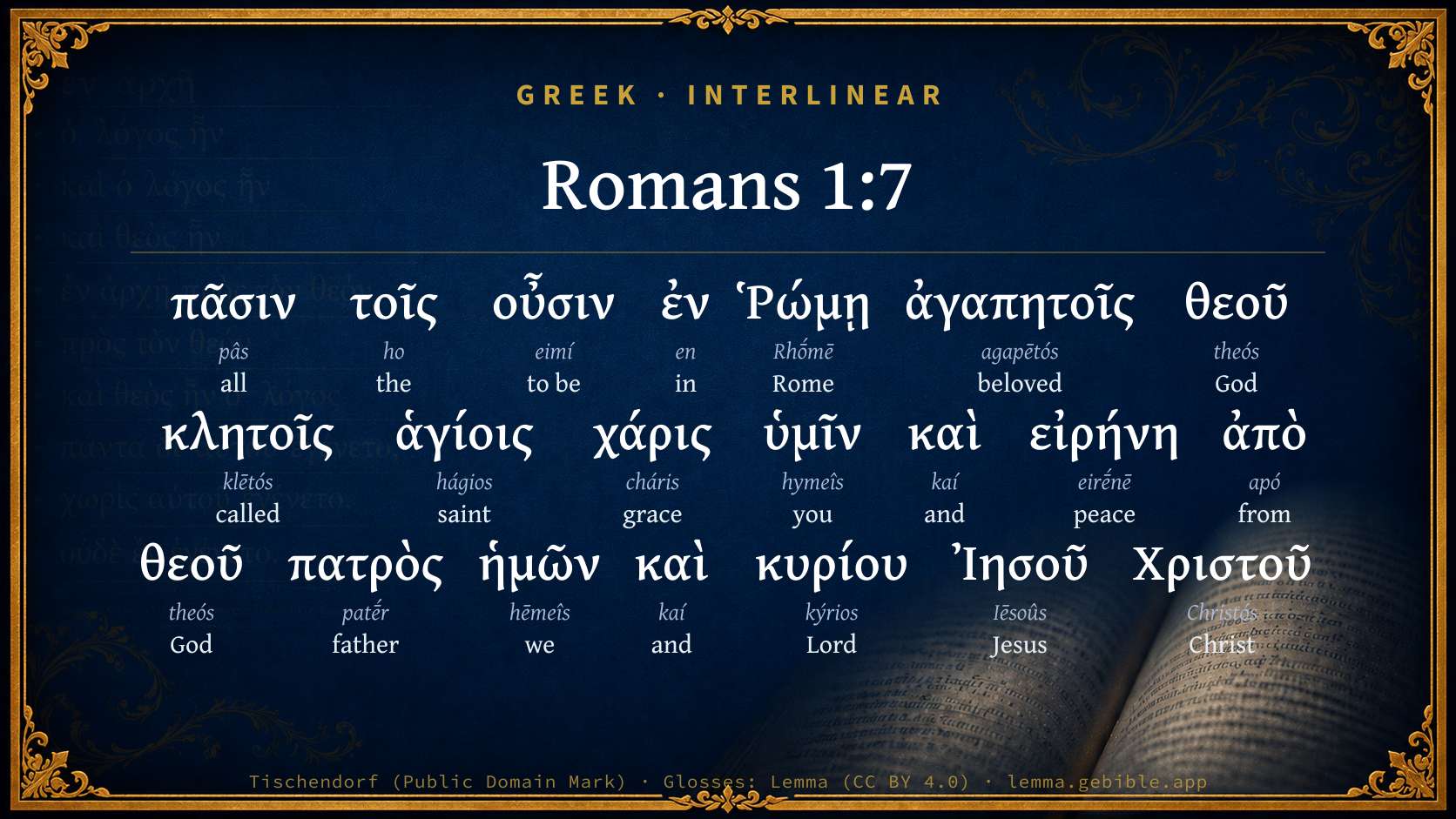
  1. πᾶσιν pâs G3956 “all” Adjective, Dative, Plural, Masculine
  2. τοῖς ho G3588 “the” Article, Dative, Plural, Masculine
  3. οὖσιν eimí G1510 “to be” Verb, Present, Active, Participle, Dative, Plural, Masculine
  4. ἐν en G1722 “in” Preposition
  5. ἀγαπητοῖς agapētós G27 “beloved” Adjective, Dative, Plural, Masculine
  6. θεοῦ theós G2316 “God” Noun, Genitive, Singular, Masculine
  7. κλητοῖς klētós G2822 “called” Adjective, Dative, Plural, Masculine
  8. ἁγίοις hágios G40 “saint” Adjective, Dative, Plural, Masculine
  9. χάρις cháris G5485 “grace” Noun, Nominative, Singular, Feminine
  10. ὑμῖν hymeîs G5210 “you” Personal pronoun, 2nd person, Dative, Plural
  11. καὶ kaí G2532 “and” Conjunction
  12. εἰρήνη eirḗnē G1515 “peace” Noun, Nominative, Singular, Feminine
  13. ἀπὸ apó G575 “from” Preposition
  14. θεοῦ theós G2316 “God” Noun, Genitive, Singular, Masculine
  15. πατρὸς patḗr G3962 “father” Noun, Genitive, Singular, Masculine
  16. ἡμῶν hēmeîs G2249 “we” Personal pronoun, 1st person, Genitive, Plural
  17. καὶ kaí G2532 “and” Conjunction
  18. κυρίου kýrios G2962 “Lord” Noun, Genitive, Singular, Masculine
  19. Ἰησοῦ Iēsoûs G2424 “Jesus” Noun, Genitive, Singular, Masculine
  20. Χριστοῦ Christós G5547 “Christ” Noun, Genitive, Singular, Masculine

About this verse

These counts appear in no published source. They are computed here, from the morphology-tagged text and Lemma’s own curated glosses. What Lemma adds →

21
words
19
distinct lemmas
Pauline Epistles
section

Notable vocabulary

The rarest word here is Ῥώμῃ Rome G4516 — appearing just 8 times in the whole Greek New Testament.

Shared distinctive vocabulary

Ῥώμῃ Rome G4516 occurs in 8 verses of the Greek New Testament. Also found in:

Repetition

Words recur within this verse:

Cross-references

50

Topical passages linked to Romans 1:7 in the Treasury of Scripture Knowledge — connected by theme and wording, ordered by reader-vote popularity; previews shown in the World English Bible.

  • Colossians 1:2 to the saints and faithful brothers in Christ at Colossae: Grace to you and peace from God our Father, and the Lord Jesus Christ.
  • Jude 1:1–2 Jude, a servant of Jesus Christ, and brother of James, to those who are called, sanctified by God the Father, and kept for Jesus Christ:
  • Ephesians 1:2 Grace to you and peace from God our Father and the Lord Jesus Christ.
  • 2 Corinthians 13:14 The grace of the Lord Jesus Christ, the love of God, and the communion of the Holy Spirit, be with you all. Amen.
  • 1 Thessalonians 1:1 Paul, Silvanus, and Timothy, to the assembly of the Thessalonians in God the Father and the Lord Jesus Christ: Grace to you and peace from God our Father and the Lord Jesus Christ.
  • 2 Thessalonians 3:16 Now may the Lord of peace himself give you peace at all times in all ways. The Lord be with you all.
  • 2 John 1:3 Grace, mercy, and peace will be with us, from God the Father, and from the Lord Jesus Christ, the Son of the Father, in truth and love.
  • 2 Thessalonians 2:16–17 Now our Lord Jesus Christ himself, and God our Father, who loved us and gave us eternal comfort and good hope through grace,
  • 2 Thessalonians 3:18 The grace of our Lord Jesus Christ be with you all. Amen.
  • Philemon 1:3 Grace to you and peace from God our Father and the Lord Jesus Christ.
  • 2 Peter 1:2–3 Grace to you and peace be multiplied in the knowledge of God and of Jesus our Lord,
  • 1 Corinthians 1:2–9 to the assembly of God which is at Corinth; those who are sanctified in Christ Jesus, called to be saints, with all who call on the name of our Lord Jesus Christ in every place, both theirs and ours:
  • Philemon 1:25 The grace of our Lord Jesus Christ be with your spirit. Amen.
  • Revelation 22:21 The grace of the Lord Jesus Christ be with all the saints. Amen.
  • Acts 15:23 They wrote these things by their hand: "The apostles, the elders, and the brothers, to the brothers who are of the Gentiles in Antioch, Syria, and Cilicia: greetings.
  • Romans 5:1 Being therefore justified by faith, we have peace with God through our Lord Jesus Christ;
  • Romans 9:25 As he says also in Hosea, "I will call them 'my people,' which were not my people; And her 'beloved,' who was not beloved."
  • 1 Corinthians 16:23 The grace of the Lord Jesus Christ be with you.
  • 2 Corinthians 1:1–2 Paul, an apostle of Christ Jesus through the will of God, and Timothy our brother, to the assembly of God which is at Corinth, with all the saints who are in the whole of Achaia:
  • 2 Corinthians 12:8–10 Concerning this thing, I begged the Lord three times that it might depart from me.
  • Galatians 1:3–4 Grace to you and peace from God the Father, and our Lord Jesus Christ,
  • Galatians 6:18 The grace of our Lord Jesus Christ be with your spirit, brothers. Amen.
  • Ephesians 6:23 Peace be to the brothers, and love with faith, from God the Father and the Lord Jesus Christ.
  • Philippians 4:20 Now to our God and Father be the glory forever and ever! Amen.
  • Philippians 4:23 The grace of the Lord Jesus Christ be with you all. Amen.
  • Colossians 3:12 Put on therefore, as God's chosen ones, holy and beloved, a heart of compassion, kindness, lowliness, humility, and perseverance;
  • 1 Thessalonians 1:3 remembering without ceasing your work of faith and labor of love and patience of hope in our Lord Jesus Christ, before our God and Father.
  • 1 Thessalonians 3:11–13 Now may our God and Father himself, and our Lord Jesus Christ, direct our way to you;
  • 1 Thessalonians 4:7 For God called us not for uncleanness, but in sanctification.
  • 1 Thessalonians 5:28 The grace of our Lord Jesus Christ be with you. Amen.
  • 1 Timothy 1:2 to Timothy, my true child in faith: Grace, mercy, and peace, from God our Father and Christ Jesus our Lord.
  • 2 Timothy 1:2 to Timothy, my beloved child: Grace, mercy, and peace, from God the Father and Christ Jesus our Lord.
  • 2 Timothy 4:22 The Lord Jesus Christ be with your spirit. Grace be with you. Amen.
  • Titus 1:4 to Titus, my true child according to a common faith: Grace, mercy, and peace from God the Father and the Lord Jesus Christ our Savior.
  • 1 Peter 1:1–2 Peter, an apostle of Jesus Christ, to the chosen ones who are living as strangers in the Dispersion in Pontus, Galatia, Cappadocia, Asia, and Bithynia,
  • 1 Peter 1:15 but just as he who called you is holy, you yourselves also be holy in all of your behavior;
  • 1 John 3:1 Behold, how great a love the Father has bestowed on us, that we should be called children of God! For this cause the world doesn't know us, because it didn't know him.
  • Matthew 6:8–9 Therefore don't be like them, for your Father knows what things you need, before you ask him.
  • Romans 1:6 among whom you are also called to belong to Jesus Christ;
  • Romans 8:39 nor height, nor depth, nor any other created thing, will be able to separate us from the love of God, which is in Christ Jesus our Lord.
  • Philippians 4:13 I can do all things through Christ, who strengthens me.
  • Colossians 3:15 And let the peace of God rule in your hearts, to which also you were called in one body; and be thankful.
  • Deuteronomy 33:12 Of Benjamin he said, The beloved of Yahweh shall dwell in safety by him; He covers him all the day long, He dwells between his shoulders.
  • Psalms 60:5 So that your beloved may be delivered, Save with your right hand, and answer us.
  • Matthew 5:16 Even so, let your light shine before men; that they may see your good works, and glorify your Father who is in heaven.
  • John 20:17 Jesus said to her, "Don't touch me, for I haven't yet ascended to my Father; but go to my brothers, and tell them, 'I am ascending to my Father and your Father, to my God and your God.'"
  • Acts 7:59–60 They stoned Stephen as he called out, saying, "Lord Jesus, receive my Spirit!"
  • James 1:1 James, a servant of God and of the Lord Jesus Christ, to the twelve tribes which are in the Dispersion: Greetings.
  • Revelation 1:4–5 John, to the seven assemblies that are in Asia: Grace to you and peace, from God, who is and who was and who is to come; and from the seven Spirits who are before his throne;
  • Revelation 2:1 To the angel of the assembly in Ephesus write: "He who holds the seven stars in his right hand, he who walks among the seven golden lampstands says these things:

Cross-references courtesy of OpenBible.info (CC BY 4.0).

Commentary

Notes on Romans 1:7 from classic Christian and Jewish commentators (each source and its license shown beneath its notes). The classic Christian expositions comment on the surrounding passage and are grouped to its opening verse, so a note may address several verses; the Jewish commentaries on the Tanakh (Rashi and others) are per-verse, so they appear only where the commentator wrote on this verse.

Lemma curates 59 commentaries, every one of them public domain or Creative Commons licensed, each selected and text-cleaned for this edition rather than reprinted as found. About our sources →

The Biblical Illustrator

Joseph S. Exell

Rom_1:7

To all that be in Rome.

The apostolic greeting

I. Its contents.

1. Grace.

(1) Favour bestowed by God in conviction, conversion, sanctification, comfort, help, etc.

(2) Consciously enjoyed. Not something placed to our account in a heavenly record, but actually experienced in the heart and life.

(3) Through the use of means. Not a mysterious endowment, but received by the exercise of a rational faith working through prayer, meditation, communion, etc.

(4) Exhibited in the ever ripening fruits of the Spirit. Not an inward enjoyment merely, but an outward expression by which, in grace of character and usefulness, a Christian is read and known of all men.

(5) Issuing in glory. As grace originates in heaven, so it works through our earthly experience only to return to its source. Its final issue is eternal fellowship with the God of all grace.

2. Peace.

(1) Its nature.

(a) Reconciliation with God--indifference of fear replaced by love and confidence.

(b) Inward tranquillity--freedom from mental and moral disturbance; all can cast upon God.

(c) Amity with all men. When men are at peace with God they will be at peace with each other. Wars and dissentions are utterly foreign to the family of the God of peace.

(2) Its relation to grace.

(3) It originates in grace. God makes overtures of peace; says, roll thy burden upon the Lord; the fruit of the Spirit is … peace; as grace ripens, peace increases.

II. Their source.

1. God as Father delights to bestow--

(1) Grace. It is His pleasure--

(a) To confer the highest benefit.

(b) To see its blessed operation.

(c) To contemplate its lovely effects.

(d) To enjoy its everlasting fruits.

(2) Peace. The supreme desire of a father is to see his children in amity with himself and with one another and free from care.

2. God as our Father is the warrant for our confidence in--

(1) Supplicating these highest blessings.

(2) Anticipating their presence here and their full perfection hereafter.

III. Their medium--The Lord Jesus Christ.

1. As God He has grace and peace to give.

2. As Man He exhibited the perfect enjoyment of these blessings. He was full of grace; and He had peace to such an extent that He regarded it peculiarly as His own--My peace.

3. As God-Man Mediator He is qualified and commissioned to bestow them.

(1) He purchased both by the blood of the Cross.

(2) He gives both (2Co_12:9; Joh_14:17; Joh_14:27; Joh_20:19; Php_4:7). (J. W. Burn.)

This salutation is

I. Rich in its import.

1. Grade.

2. Peace.

II. Divine in its efficacy--from God, etc.

III. Special in its application and design--to all that are beloved, etc. (J. Lyth, D. D.)

Christian salutation

Many persons say, What is the use of salutations? When I meet a lady in the street, why should I raise my hat? And, by the by, young men, it is worth your while either to salute a lady, or not to. The habit of touching your hat is a vulgar habit. It is like, in letter writing, using gent instead of gentleman. It is a kind of contraction that is indicative of a lack of proper information. A man says, Why should I say Good morning to a man when I meet him? or, Why should friends say Good-bye when they part? That very expression, Good-bye, shows what the Western literalising tendency is. There was a time when friends at parting looked gravely at each other, and said, God be with you; but now they say Good-bye, which is the same thing abbreviated. In the God be with you of the West there is no God, no with you, no anything, except Good-bye, which is what a bird is when its feathers have all been plucked off. But why should we have so many of these salutations? Well, for my part, I think that even good folks, without such little ceremonies, are like grapes packed for market without leaves between them. They will crush and come in mashed. Even good folks need to have little courtesies between them to keep them from attrition. And to take society and divest it of all these little civilities would be to deteriorate it, and carry it toward the savage state. I do not think that the bushmen of South Africa trouble themselves about such things. They economise speech and conduct. And as you go up in civilised and Christian communities, you will find more and more, and not fewer and fewer, of them. And when you come to the very height of civilisation and Christianity--the family--you will not only find more of them, but you will find that they are not conventional. There you will hear the mother talking to the little child, and the child talking back; and you will hear them calling each other all manner of fond epithets. The whole of society is chased by golden figures of those civilities that tend to make life rich and happy. And if you think that these things are of no use, it is because you never put your heart into them. When you see a friend coming, and you say, Good morning, mean good morning. Let your heart go in kindness toward him. If you meet a person, and you choose to uncover your head, let your heart be uncovered too. When in honour you prefer others to yourselves, put more goodwill, more Christianity into it. Please men more, desire to please them more, and it will swell up the shrunken proportions of these civilities, and make them put new buds and new blossoms out. We need not fewer, but more of these things in human life, to take away its vulgarity, and its hard surfaces, and to enrich it with more flowers and perfumes. (H. W. Beecher.)

Beloved of God.

Beloved of God

This is the glorious distinction of believers. So of Israel (Deu_33:4). Gods love the origin of believers salvation (Joh_3:16; Eph_2:4; 1Jn_3:1). God has a common love to all men (Deu_10:18; Joh_3:16; 1Ti_4:10; Tit_2:11; Tit_3:4); a special love to believers (1Jn_3:1; Jer_31:3; Eph_1:3-6; Eph_2:4-8). This special love is seen in making them His people and blessing them as such. This love is--

I. Distinguishing (1Co_4:7; Rom_8:28-29).

II. Free and spontaneous (Eph_1:2-6; Eph_2:4).

III. Unchanging and everlasting (Joh_13:1; Jer_31:3; Isa_54:10).

IV. Infinitely costly (Zec_13:7; Isa_53:6; Isa_53:10; Rom_8:32).

V. Operative and efficacious (2Th_2:16 2Ti_1:9).

VI. All-conquering (Psa_110:3; Rom_8:30; Rom_8:35-39).

VII. Existing in and for the sake of Christ (Rom_8:39; Eph_1:8; Eph_1:6; Joh_17:23). To be beloved of God is a creatures highest blessedness, secures every blessing, and, when realised, is bliss itself (Psa_63:3; Psa_30:5; Son_1:2). (T. Robinson, D. D.)

Called to be saints.--

Called to be saints

The text might have been rendered called saints. It is requisite to remember this, because you might think that it means called to be saints hereafter, as though it would be impossible to be a saint here.

I. Where and by what means are we called to be saints?

1. By the election of God and the providence of birth in a Christian land.

2. By the dedication and grace of baptism,

3. By those inward calls felt in the heart.

4. By the many voices of affliction and the constant gentle operations of the Comforter in the soul.

II. What is the process?

1. Stands the pardon of sin and the sense of pardon. Many greatly increase the difficulty of saintliness by putting holiness before peace.

2. But forgiveness is not merit; it is not even acceptance. You must be acceptable and pleasing in Gods sight, And for this you must have righteousness not your own, and be able to present yourself to God in Christ, and be pleasing even to Him, because He sees the Christ in whom you are.

3. When you are so justified, an act of union takes place between Christ and your soul, Through that union the Holy Ghost, who is the fountain of all saintliness, flows into you, and the flow will vary according as the Spirit is grieved or honoured in you,

4. And now saintliness, properly so-called, begins. You are a thing dedicate,

(1) There is intercourse set up between your soul and God, You feed on spiritual food, Your Bible is a home--worship is the atmosphere of your love, especially the Holy Communion.

(2) Meanwhile the natural appetites are being subdued, and the body subjugated. The besetting sin, by the power of a wonderful alchemy, is being gradually turned into a characteristic grace. The temper which was hot, is meek--the spirit which was restless, is patient--your appetites first changed, then turned, go upward.

(3) You have become devoted to good works; you love the brethren; whatever is holy, it is akin to you; you yearn for souls and to extend the Church.

(4) And now men are beginning to take knowledge of you.

(5) I do not venture now to look where those blessed ones, in the dazzling lustre of their white robes, are still pursuing their saintly offices. But I do ask, Out of what material is that holy saintship made? And He who makes the rainbow from the mist, and the pearl from the shell, and the butterfly from the grub, and the diamond from the charcoal gives the answer. These are they which came out of great tribulation, etc. (J. Vaughan, M. A.)

Called to be saints. Why?

Because--

I. They lived with Jesus.

II. They lived for Jesus, and therefore--

III. They grew like Jesus. (T. Guthrie, D. D.)

Saints

What is a saint? A celebrated wit, who was asked this question, replied, A saint is long-faced piety, which has neither the smile of friendliness, nor the tear of pity. It is to be regretted that the word saint is a sort of nickname for that which is mean and spurious; but when people know a man to be really saint-like they give him reverence. I remember, one day, asking a little orphan girl, What is a saint? After a little thought, she answered, Please, sir, my mother was a saint! To that childs mind saint meant somebody good, holy, and loving; and the person whom she had known to fulfil that description was her mother. Every mother should try to be to her daughters the panorama of what a saint should be, and every father too. A saint is--

I. A repenting child of God.

II. A changed child of God. That man who is honest, because it is the best policy, is in a very low state of morality; is he not at heart a thief? The prodigal may desire pardon as a policy which saves him from hell and admits him into heaven; but the saint acts from a nobler motive. The saint yearns for heaven more as a state of holiness than as a place of freedom from pain. Napoleon once said, If you would truly conquer, you must replace. This is true of morals as of nations. If you wish to take away the craving for sin, whatever it may be--drink, or anything else--you must replace it with a craving for something higher and better. You remember the old fable of the Isle of Sirens, whose songs lured the sailors from their ships to sin and death; and the shore of the island was covered with the bleached bones of tempted men. We are told that Ulysses, when sailing past, in order to see and not be captivated, ordered that his crew should have wax put into their ears, and then stopped up his own ears, and had himself tied to the mast. When his ship sailed by the island the Sirens sang their most bewitching melodies, but Ulysses and his crew did not hear; and were, therefore, not tempted as other sailors who had both seen and heard. But, some time afterwards, there came another ship, commanded by Orpheus, who was a master of music, Orpheus did not attempt to resist the temptation by putting wax in his ears, or by tying himself to the mast. The Sirens sang their most melodious strains; but Orpheus played a sweeter music, which, like a magnet, kept his crew from having the slightest desire to go to the island. The song of the Sirens charmed the ear; but the music of Orpheus thrilled the soul. Such is the change which has taken place in the soul of the saint. The joys of religion are sweeter to him than the pleasures of sin; to be beloved of God is more precious than the applause of erring men. You may ask, How is this accomplished? Just by the love of God being inspired in the spirit of the forgiven penitent.

III. A forgiven child of God. A young man went headlong into evil courses, and stole some of his fathers money, and ran away from home. Some time afterwards his father solemnly crossed the prodigals name from the family register at the beginning of the Bible. After many years the son, like the prodigal, came to himself, and when he knocked at the door was received with a loving welcome. Tim following morning the father opened the Bible at the first page, wrote the name of his son, and after it, Everything forgiven. This is like what takes place when a penitent cries for pardon; but the page where the forgiveness is written is in the heart of the penitent. (W. Birch.)

Sainthood now being prepared for glory

They who are not made saints in a state of grace shall never be saints in glory. The stones which are appointed for that glorious Temple above are hewn and polished and prepared for it here, as the stones were wrought and prepared in the mountains for building the temple at Jerusalem. (T. H. Leary, D. C. L.)

Grace.--

Grace

1. The word is from the French, who got it from the Romans. And the Romans got it under the old parental roof, at that remote period which preceded the migration both of Latins and Greeks from their common Oriental home. The Greek form of the word is χάρις, connected with χαίρω, I rejoice. So that the word, in its etymology, means that which gives joy and pleasure, that which is delightful.

2. Hence it was, at a very early period of its career as a word, applied to that which was beautiful. Beauty gives delight. It is grace. A beautiful movement of the body is graceful. If a dress is beautiful in its fabric, and if it fits beautifully, it is graceful. The fertile Greek imagination constructed three distinct personifications of beauty, the Graces. The echo of their idea continues, and we still speak of the three Christian graces--faith, hope, charity. When our Queen visits some private home, we sometimes say that the royal lady graces the home with her presence. She lends charm and beauty to it; and the charm and beauty occasion delight.

3. But Greeks, Latins, French, and English, were not slow to perceive that there is an inner as really as an outer beauty. There is beauty of character, of moral deportment, of moral feeling and acting; and this beauty is fitted to give great delight and joy. Hence all united in calling it grace. Kindness and loving kindness is grace. It is really most graceful. It is the most beautiful possible ornament. Justice is admirable. It cannot be dispensed with. Its presence lends dignity to character; and dignity is a species of grandeur; and grandeur is a species of beauty. Thus there is beauty in justice. But it is by a circuitous logical process that we find out the beauty of holiness, and the corresponding beauty that is inherent in the hatred of sin. But not so is it with kindness. It inspires us, on the spur of the moment, with delight and joy, especially when we find ourselves the objects of the loving kindness. It is the grace that belongs peculiarly to God. Gods favour is grace.

4. But man, too, as well as God, can be gracious. Our Queen and Princess of Wales are gracious. It is their pleasure to be kind; and their loving kindness is delightful, and, because delightful, is grace; so that they are gracious. Even a very humble man can be gracious, or show favour to his fellow men, when, e.g., his fellow men have injured him. Such graciousness is the reflection in man of the peculiar glory which is inherent in the character of God.

5. Again: We speak of grace before and after meals. The meaning is the utterance of thanks or gratitude to God, the bountiful Benefactor. This gratitude is grace. How significant! With what charm it invests the idea of gratitude! Gratitude for favour received, as a token of loving kindness, is as truly graceful as is loving kindness itself. In nothing is there greater deformity and unloveliness than in ingratitude. Hence both Greeks and Romans freely combined in calling gratitude grace. For if ye love them who love you, what thank have ye? for sinners also love those that love them. And if ye do good to them who do good to you, what thank have ye? for sinners also do even the same. And if ye lend to them of whom ye hope to receive, what thank have ye? for sinners also lend to sinners to receive as much again. We read in another part of the New Testament those glorious and glowing words of the Apostle St. Paul, Thanks be unto God for His unspeakable gift. In these passages the term employed is grace. In the sayings of our Saviour, as is evidenced by the parallel expression in St. Matthew, the word is tantamount in import to reward. What thank or reward do ye deserve? In the saying of the apostle it simply means thanks; and thanks is expressed by this term grace, just because thankfulness is always, as a manifestation of character, a grace, delightful to God and to all other beings who are Godlike. (J. Morison, D. D.)

The beginnings of grace

Trace back any river to its source, and you will find its beginnings small. A little moisture oozing through the sand or dripping out of some unknown rock, a gentle gush from some far away mountains foot, are the beginning of many a broad river, in whose waters tall merchantmen may anchor and gallant fleets may ride. For it widens and gets deeper, till it mingles with the ocean. So is the beginning of a Christians or a nations grace. It is first a tiny stream, then it swells into a river, then a sea. There is life and progression towards an ultimate perfection when God finds the beginning of grace in any man. (J. J. Wray.)

Grace necessary for human perfection

The nature of a seed is such that when it is thrown into the ground it unfolds itself without culture, without any exterior influence beyond the light and air and soil, to be just that thing which it was meant to be. Every flower comes to its own nature; and although culture may make it larger and finer, yet it expresses the radical idea involved in the seed. It is so with every insect and every animal But man is not a creature that, according to this analogy, being born into the world opens and develops himself to that which God meant manhood to be. When left in the most favourable conditions man does not, and will not, so develop himself; for that which is required to make manhood is not in him. There were elements left out of the nature of man without which that nature never can come to its perfection. For, as in fruits sugar comes from the sun, so in man grace comes from the Sun of righteousness, working in us, and elaborating the things that we need. But they are never wrought out by any process that takes place by the natural faculties in the soul. (H. W. Beecher.)

Peace.--

The peace of God

Hence the worldling does not understand our peace, and frequently sneers at it because he is puzzled by it. Even the Christian is sometimes surprised at his own peacefulness. I know what it is to suffer from terrible depression of spirit at times; yet at the very moment when it has seemed to me that life was not worth one single bronze coin, I have been perfectly peaceful with regard to all the greater things. There is a possibility of having the surface of the mind lashed into storm while yet down deep in the caverns of ones inmost consciousness all is still: this I know by experience. There are earthquakes upon this earth, and yet our globe pursues the even tenor of its way, and the like is true in the little world of a believers nature. Why, sometimes the Christian will feel himself to be so flooded with a delicious peace that he could not express his rapture. (C. H. Spurgeon.)

The Biblical Illustrator, edited by Joseph S. Exell (c. 1880s–1900s) — public domain. Text from a community e-Sword module.

Joseph Benson's Commentary

Rom 1:7. To all that be in Rome — To all the Christians residing at Rome. Most of these were heathen by birth, Rom 1:13, though the Jews mixed among them. They were scattered up and down in that large city, and not yet reduced into the form of a church. Beloved of God — And from his free love, not from any merit of yours; called to be saints — Or saints called, as κγητοις ανιοις may be rendered; that is, called by his word and Spirit to believe in him, and now, through faith, made saints, or holy persons. By this honourable appellation the Christians are distinguished from the idolatrous inhabitants of the city, and from the unbelieving Jews. Grace be to you — The peculiar favour of God, and the influences and fruits of his Spirit; and peace — Namely, with him, in your own consciences, and tranquillity of mind, arising from the regulation of your affections, from trusting in him, and casting your care upon him; from resignation to his will, and possessing your souls in patience under all the trials and troubles which you may be called to pass through. See Rom 5:1; Isa 26:3; Php 4:6. In this sense, it seems, the word peace is used in the apostolic benedictions. It may, however, also include all manner of blessings, temporal, spiritual, and eternal. From God our Father — The original source of all our blessings, who is now become our reconciled Father, having adopted us into his family, and regenerated us by his grace; and the Lord Jesus Christ — The one Mediator between God and man, through whose sacrifice and intercession we receive all the blessings of providence and grace. It is one and the same peace, and one and the same grace, which we receive from the Father and from the Son: and our trust must be placed, for grace and peace, on God, as he is the Father of Christ; and on Christ, as he reconciles us and presents us to the Father. “Because most of the Roman brethren were unacquainted with Paul, he judged it necessary, in the inscription of his letter, to assure them that he was an apostle, called by Jesus Christ himself, and that he was separated to preach the gospel to the Gentiles, in fulfilment of the promises which God had made by the prophets in the Scriptures, that the gospel should be preached to them. These circumstances he mentions, to remove the prejudices of the believing as well as of the unbelieving Jews, who, he knew, were displeased with him for preaching the gospel to the Gentiles. Withal, because the church of Rome had not been planted by any apostle, he instructed them in some particulars concerning the nature and character of Christ, which it was of great importance for them to know.” — Macknight.

Joseph Benson's Commentary on the Old and New Testaments (1811–1818) — public domain. Text from a community e-Sword module.

The Preacher's Complete Homiletical Commentary

Joseph S. Exell (gen. ed.)

CRITICAL NOTES

Rom_1:7. Grace to you and peace, etc.—εἰρήνη, happiness of every kind; peace with God and man. God first Christ’s Father and then ours. Grace and peace are cause and effect.

MAIN HOMILETICS OF THE PARAGRAPH.—Rom_1:7

A graceful salutation.—The universality of this address has led some commentators to maintain that the epistle was meant for the heathens of Rome as well as for the Christians. But this cannot be admitted. Most certainly we should say that it cannot. Imagine a letter addressed to all that be in Rome by the adherent of a new sect everywhere spoken against. Claudius sought comfort and recreation in literary pursuits; but surely it would be a long time before he would be induced to forsake his Homer and his Virgil to find out that there was after all some literary power in the letter of a Jew who had turned Christian. Homer and Virgil still live, and schoolboys try with great pains and much reluctance to put their sentences into bad English; while the obscure letter of the insignificant Jew is being expounded from thousands of pulpits, read by millions, and translated into a vast number of the tongues of earth. Imagine a new sect, called the Brotherhood of Love, originated amongst one of the tribes of Africa, about the shores of Tanganyika. Some of the converts make their way to London and establish a brotherhood. There rises up in Africa a convert of great zeal and energy. He addresses a letter to the brotherhood in London, beginning, To all that be in London. Who would ever suppose that it was meant for the whole of London? What newspapers would print it? What Christian readers, though taught large toleration by their great chapter on charity in the First Epistle to the Corinthians, would condescend to examine this tractate? Outside the circle of the brotherhood the only likely readers would be writers on heterodox London and novelists seeking for some new sensation. Strangest fact of all, the letter from Africa to all that be in London becomes in after time one of the great epistles of all civilised peoples, and engages the attention of greatest scholars. The letter sent to Rome by the hands of Phœbe was a precious document—more precious than the law suit on which she was engaged. Rome commanded the world. Paul’s Romans has commanded a larger world and wielded a wider influence than ever Rome knew or possessed. It is well worth studying. The very inscription is attractive. It gives a comprehensive view of the dealings of God with His people. It shows their high privilege, exalted relationship, and precious bestowals. It may be made to speak to us of:—

I. The outward aspect of Christian development.—By the words “outward aspect” we mean outward as regards the work of grace in the soul. Whatever may be our views of predestination and election, we must admit antecedent purposes in the divine mind. All schools of religious thought will subscribe to the simple creed—By grace are ye saved. If grace mean the favour and kindness of God, then that grace is antecedent to all its subjects. God and grace are inseparable words. God existed before all creatures; therefore grace must have been in essence, if not in operation, before the existence of gracious subjects and the manifestation of gracious methods. Christianity was a development along the divine line carried through all pre-Christian dispensations. The individual Christian is a development in the divine idea. Here is the glorious plan:

1. Beloved of God;

2. Called;

3. Saints. “Beloved of God” speaks to us of antecedent emotion. “Called” declares the emotion formulating itself into gracious action. “Saints” describes the result of emotion and action. Shall we presume to say that “beloved of God” is a consequent and not an antecedent? Shall we say that the prodigal was beloved of the father because the son turned repentantly from his journey to the father’s house? Shall we not rather say that “beloved of the father” went before the prodigal’s thoughts of repentance and moved him back, though he knew it not, to sweet thoughts of home, of love, of father, and of rich content?

II. The inward aspect of Christian development.—“Grace to you and peace.” This cannot mean converting grace—this cannot refer to that peace which results to the soul of man from the realisation of the benefits conferred by justification: for these people are already Christians; they are subjects of divine grace; they have peace with God through believing in Jesus Christ. We take the salutation to mean “grace and peace be multiplied,”—perfecting grace; ever developing peace; grace for all seasons; needed grace for needy times; grace when we do not feel our need—at such times it often is that we have greatest need of grace to watch our own welfare, and keep us still moving upward and onward. As grace ripens, peace increases. Peace may be at first as the little rivulet, flowing, like the waters of Siloam, softly and sweetly from the pleasant heights of infinite love into the soul. At first peace struggles along like the mountain torrent over rugged rocks. It meets with obstructions in human nature, though renewed. By-and-by it flows in the broader land of the disciplined nature. Then peace flows a river deep, broad, refreshing, fertilising. How much happiness is implied in the wish for the increase of grace and peace!

III. The source and channel of Christian development.—“God our Father, and the Lord Jesus Christ.” Modern developments are developments from nothing, a theory which we cannot understand. The law of evolution without an evolver is to us a mystery. It may be true, but its processes are not plain to us at least. Organic life has developed from simpler to more complex forms in obedience to universal natural law. Very good of the organic life! In what school has it learnt lessons of obedience? Does natural law exist without a lawgiver? Does organic life move by virtue of its own inherent force? Whence the life? Did the organic substance give itself life before it had being? We think that we tread more satisfactory ground as we trace all developments to God our Father. More emphatically we thus trace Christian developments. God our Father. Jesus Christ our Saviour. The grace flows from God the source through Christ the channel, and refreshes the thirsty soul. Peace comes from and by Him who is the author of our peace by virtue of His medastorial work. What sublimity the Christian conception unfolds! It makes earth radiant with the light of heaven. It lifts man to the mount of transfiguration, where all things glow with beautiful colours that transcend the poet’s highest fancy or the painter’s keenest skill.

Rom_1:7. God’s beloved saints.—The apostle Paul had never been in Rome, and he knew very little about the religious nature of the converts there; but he has no hesitation in declaring that they are all “beloved of God” and “saints.” Let us look at these two points—the universal privilege, and the universal obligation of the Christian life.

I. The universal privilege of the Christian life.—“Beloved of God.” We are so familiar with the juxtaposition of the two ideas, “love” and “God,” that we cease to feel the wonderfulness of their union. But until Jesus had done His work no man believed that the two thoughts could be brought together. Think of the facts of life, think of the facts of nature, and let us feel how true the great saying is, that

“Nature, red in tooth and claw,

With rapine, shrieks against the creed”

that God is love. Think of what the world has worshipped, and of all the varieties of monstrosity before which men have bowed—cruel, lustful, rapacious, selfish, the different deities they have adored; and then, “God hath established, proved His love to us, in that while we were yet sinners Christ died for us.” Brethren, do not let us kick down the ladder by which we have climbed; nor, in the name of a loving God, put away the Christian teaching which has begotten the conception in humanity of a God that loves. There are men to-day who now turn round upon the very gospel which has given them the conception of this truth, and accuse it of narrow and hard thoughts of the love of God. One of the Scripture truths against which the assailant often turns his sharpest weapons is that which is involved in my text, the answer to the other question, Does not God love all? Yes, yes, a thousand times, yes! But there is another question: Does the love of God to all make His special designation of Christian men as His beloved the least unlikely? Surely special affection is not, in its nature, inconsistent with universal beneficence and benevolence. Surely you are not honouring God when you say, It is all the same to Him whether a man loves and serves Him, or lifts himself up in rebellion against Him, and makes himself his own centre and earth his aim and his all. “God so loved the world.” There are manifestations of His loving heart which any man can receive; and each man gets as much of the love of God as it is possible to pour upon him. But a granite wall does not drink in the dew as a flower does; and the nature of the man on whom God’s love falls determines how much and what manner of its manifestations shall pass into his true possession, and what shall remain without. So, on the whole, we have to answer the questions, Does God love any? does not God love all? does God specially love some? with the one monosyllable, Yes! Myths tell us that the light which, at the beginning, had been diffused through a nebulous mass, was next gathered into a sun. So the universal love of God is concentrated in Jesus Christ; and if we have Him, we have it; and if we have faith, we have Him.

II. The universal obligation of the Christian life.—“Called to be saints,” or “the called saints.” The word “called” means summoned by God. It is their vocation, not their designation. I need not remind you that “saint” and “holy” carry precisely the same idea. We notice that the true idea of this universal holiness, which ipso facto belongs to all Christian people, is consecration to God. The next thing is purity. Purity will follow consecration, and would not be much without it, even if it were possible to be attained. Next, this consecration is to be applied all through a man’s nature. There are two ways of living in the world; and I venture to say there are only two. Either God is my centre, and that is holiness; or self is my centre, and that is sin. This consecration is only possible when we have drunk in the blessed thought, “beloved of God.” You cannot argue a man into loving God, any more than you can hammer a rosebud open. But He can love us into loving Him, and the sunshine, falling on the closed flower, will expand it. There is no faith which does not lead to surrender. There is no aristocracy in the Christian Church who deserve to have the family name given expressly to them, for this honour and obligation of being saints belongs equally to all that love Jesus Christ. But consecration may be cultivated, and must be cultivated and increased. The apostle Paul’s letter, addressed to the “beloved of God,” the “called saints” that are in Rome, found its way to the people for whom it was meant. If a letter so addressed were dropped in our street, do you think anybody would bring it to you?—A. Maclaren, D.D.

SUGGESTIVE COMMENTS ON Rom_1:7

Reason for the universal address.—The universality of this address has led some commentators to maintain that the epistle was meant for the heathens of Rome as well as for the Christians. But this cannot be admitted; for the description given of the persons addressed as “beloved of God” and “called to be saints” could have no application whatever to the heathen inhabitants of Rome. The reason of the universality of the address appears to be this: The apostle is about to show that the Jewish and the Gentile converts to Christianity are precisely on a footing in regard to their religious state, and therefore he makes no distinction between them, but addresses them all, whether Jewish or Gentile converts, as equally entitled to the same honourable appellation. The expression “called to be saints” is equivalent to “called to be Christians,” the members of the Christian Church being often denominated in the New Testament “the saints.” The additional phrase “beloved of God” is also applied to them as Christians, and with great propriety. For since God had so far manifested His favour to them as to enable them to know and embrace the gospel, they may justly be called “beloved of God” when compared with the rest of mankind, to whom no such favour had been extended. It must not, however, be supposed that these distinguished titles are intended by the apostle to be descriptive of every individual of the Church addressed. They are given merely in reference to their outward privileges as members of the Church of Christ. As in the Old Testament the collective body of the Israelites are often called “a holy people” because they were chosen to preserve the worship of the true God, so in the New Testament particular Christian Churches are called “the saints” because they also are constituted the Church and people of God. But in neither case is any allusion intended to the personal holiness of individuals; the reference is merely to the general privileges of the collective body.—D. Ritchie, D.D.

Paul’s course of thought often interrupted.—All that intervenes is not properly a parenthesis, but an accumulation of clauses, one growing out of the other, and preventing the apostle finishing the sentence with which he commenced. This is very characteristic of Paul’s manner, and is peculiarly obvious in his two epistles to the Ephesians and Colossians. His teeming mind protruded its rich thoughts and glowing sentiments so rapidly that his course was often impeded, and the original object for a time entirely lost sight of.—Hodge.

Living saints.—Those, then, that are called are saints whilst alive, and not only those that are canonised by the Pope after they are dead in numerum Deorum ab Ecclesia Romana relati, as Bembus profanely speaketh of their St. Francis—a sorry man, of whom (as once of Becket forty-eight years after his death) it may be disputed whether he were damned or saved. Pope Calixtus III. sainted some such in his time, as to whom Cardinal Bessarion, knowing them for naught, said, “These new saints make me doubt much of the old.”—Trapp.

Christians to be holy.—The duty of Christians, and that is to be holy, for hereunto are they called—“called to be saints,” called to salvation through sanctification. Saints, and only saints, are beloved of God with a special and peculiar love. “Called saints,” saints in profession; it were well if all that are called saints were saints indeed. Those that are called saints should labour to answer to the name, otherwise, though it is an honour and a privilege, yet it will be of little avail at the great day to have been called saints if we be not really so.—Henry.

The name Christian must be written on the conscience.—If thy name be written Christian in the book of thy conscience, this is a special argument of thy registering in heaven. For if our heart condemn us not, we have boldness and confidence towards God. If the good spoken of us be not found in our conscience, that glory is our shame. If the evil spoken of us be not found in our conscience, that shame is our glory. Therefore, as Seneca says, look to thy conscience more than to thy credit; fame may be often deceived, conscience never. The beams that play upon the waters are shot from the sun in heaven. The peace and joy that danceth in that conscience comes from the Sun of righteousness, the Lord Jesus. If a hearty laughter dimple the cheek, there is a smooth and quiet mind within. Upon the wall there is a writing. A man sitting with his back to that wall, how should he read it? But let a looking-glass be set before him, it will reflect it to his eyes; he should read it by the reflection. The writing our names in heaven is hid, yet in the glass of a good conscience it is presented to our eye of faith, and the soul reads it. For it is impossible to have a good conscience on earth except a man’s name be written in heaven.—Adams.

The Christians are saints—i.e., separated from the world and consecrated to the service of God—holy in principle, and destined to become more and more holy and perfect in their whole life and conduct. The redeeming grace of God in Christ the foundation of peace with God and ourselves. First grace, then peace—no grace without peace, no peace without grace. The co-ordination of Christ with God the Father in the epistolary inscriptions an indirect proof of the deity of Christ.—Schaff.

The Preacher's Complete Homiletical Commentary (gen. ed. Joseph S. Exell; Funk & Wagnalls, c. 1892) — public domain (pre-1929). A full-Bible homiletical/sermon-outline anthology covering 65 of 66 books (2 John is absent from the source module). Text from a community e-Sword module.

MacLaren's Expositions of Holy Scripture

Alexander MacLaren

Romans

PRIVILEGE AND OBLIGATION

Rom 1:7.

This is the address of the Epistle. The first thing to be noticed about it, by way of introduction, is the universality of this designation of Christians. Paul had never been in Rome, and knew very little about the religious stature of the converts there. But he has no hesitation in declaring that they are all ‘beloved of God’ and ‘saints.’ There were plenty of imperfect Christians amongst them; many things to rebuke; much deadness, coldness, inconsistency, and yet none of these in the slightest degree interfered with the application of these great designations to them. So, then, ‘beloved of God’ and ‘saints’ are not distinctions of classes within the pale of Christianity, but belong to the whole community, and to each member of the body.

The next thing to note, I think, is how these two great terms, ‘beloved of God’ and ‘saints,’ cover almost the whole ground of the Christian life. They are connected with each other very closely, as I shall have occasion to show presently, but in the meantime it may be sufficient to mark how the one carries us deep into the heart of God and the other extends over the whole ground of our relation to Him. The one is a statement of a universal prerogative, the other an enforcement of a universal obligation. Let us look, then, at these two points, the universal privilege and the universal obligation of the Christian life.

I. The universal privilege of the Christian life.

‘Beloved of God.’ Now we are so familiar with the juxtaposition of the two ideas, ‘love’ and ‘God,’ that we cease to feel the wonderfulness of their union. But until Jesus Christ had done His work no man believed that the two thoughts could be brought together.

Does God love any one? We think the question too plain to need to be put, and the answer instinctive. But it is not by any means instinctive, and the fact is that until Christ answered it for us, the world stood dumb before the question that its own heart raised, and when tortured spirits asked, ‘Is there care in heaven, and is there love?’ there was ‘no voice, nor answer, nor any that regarded.’ Think of the facts of life; think of the facts of nature. Think of sorrows and miseries and pains, and sins, and wasted lives and storms, and tempests, and diseases, and convulsions; and let us feel how true the grim saying is, that

‘Nature, red in tooth and claw,

With rapine, shrieks against the creed’

that God is love.

And think of what the world has worshipped, and of all the varieties of monstrosity, not the less monstrous because sometimes beautiful, before which men have bowed. Cruel, lustful, rapacious, capricious, selfish, indifferent deities they have adored. And then, ‘God hath established,’ proved, demonstrated ‘His love to us in that while we were yet sinners Christ died for us.’

Oh, brethren, do not let us kick down the ladder by which we have climbed; or, in the name of a loving God, put away the Christian teaching which has begotten the conception in humanity of a God that loves. There are men to-day who would never have come within sight of that sunlight truth, even as a glimmering star, away down upon the horizon, if it had not been for the Gospel; and who now turn round upon that very Gospel which has given them the conception, and accuse it of narrow and hard thoughts of the love of God.

One of the Scripture truths against which the assailant often turns his sharpest weapons is that which is involved in my text, the Scripture answer to the other question, ‘Does not God love all?’ Yes! yes! a thousand times, yes! But there is another question, Does the love of God, to all, make His special designation of Christian men as His beloved the least unlikely? Surely there is no kind of contradiction between the broadest proclamation of the universality of the love of God and Paul’s decisive declaration that, in a very deep and real manner, they who are in Christ are the beloved of God. Surely special affection is not in its nature, inconsistent with universal beneficence and benevolence. Surely it is no exaltation, but rather a degradation of the conception of the divine love, if we proclaim its utter indifference to men’s characters. Surely you are not honouring God when you say, ‘It is all the same to Him whether a man loves Him and serves Him, or lifts himself up in rebellion against Him, and makes himself his own centre, and earth his aim and his all.’ Surely to imagine a God who not only makes His sun to shine and His rains and dews to fall on the unthankful and the evil, that He may draw them to love Him, but who also is conceived as taking the sinful creature who yet cleaves to his sins to His heart, as He does the penitent soul that longs for His image to be produced in it, is to blaspheme, and not to honour the love, the universal love of God.

God forbid that any words that ever drop from my lips should seem to cast the smallest shadow of doubt on that great truth, ‘God so loved the world that He gave His Son!’ But God forbid, equally, that any words of mine should seem to favour the, to me, repellent idea that the infinite love of God disregards the character of the man on whom it falls. There are manifestations of that loving heart which any man can receive; and each man gets as much of the love of God as it is possible to pour upon him. But granite rock does not drink in the dew as a flower does; and the nature of the man on whom God’s love falls determines how much, and what manner of its manifestations shall pass into his true possession, and what shall remain without.

So, on the whole, we have to answer the questions, ‘Does God love any? Does not God love all? Does God specially love some?’ with the one monosyllable, ‘Yes.’

And so, dear brethren, let us learn the path by which we can pass into that blessed community of those on whom the fullness and sweetness and tenderest tenderness of the Father’s heart will fall. ‘If a man love Me, he will keep My words; and My Father will love him.’ Myths tell us that the light which, at the beginning, had been diffused through a nebulous mass, was next gathered into a sun. So the universal love of God is concentrated in Jesus Christ; and if we have Him we have it; and if we have faith we have Him, and can say, ‘Neither life, nor death, nor things present, nor things to come, nor height, nor depth, nor any other creature shall be able to separate us from the love of God which is in Christ Jesus our Lord.’

II. Then, secondly, mark the universal obligation of the Christian life.

‘Called to be saints,’ says my text. Now you will observe that the two little words ‘to be’ are inserted here as a supplement. They may be correct enough, but they are open to the possibility of misunderstanding, as if the saintship, to which all Christian people are ‘called’ was something future, and not realised at the moment. Now, in the context, the Apostle employs the same form of expression with regard to himself in a clause which illuminates the meaning of my text. ‘Paul, a servant of Jesus Christ’ says he, in the first verse, ‘called to be an Apostle’ or, more correctly, ‘a called Apostle.’ The apostleship coincided in time with the call, was contemporaneous with that which was its cause. And if Paul was an Apostle since he was called, saints are saints since they are called. ‘The beloved of God’ are ‘the called saints.’

I need only observe, further, that the word ‘called’ here does not mean ‘named’ or ‘designated’ but ‘summoned.’ It describes not the name by which Christian men are known, but the thing which they are invited, summoned, ‘called’ by God to be. It is their vocation, not their designation. Now, then, I need not, I suppose, remind you that ‘saint’ and ‘holy’ convey precisely the same idea: the one expressing it in a word of Teutonic, and the other in one of classic derivation.

We notice that the true idea of this universal holiness which, ipso facto, belongs to all Christian people, is consecration to God. In the old days temple, altars, sacrifices, sacrificial vessels, persons such as priests, periods like Sabbaths and feasts, were called ‘holy.’ The common idea running through all these uses of the word is belonging to God, and that is the root notion of the New Testament ‘saint’ a man who is God’s. God has claimed us for Himself when He gave us Jesus Christ. We respond to the claim when we accept Christ. Henceforth we are not our own, but ‘consecrated’-that is, ‘saints.’

Now the next step is purity, which is the ordinary idea of sanctity. Purity will follow consecration, and would not be worth much without it, even if it was possible to be attained. Now, look what a far deeper and nobler idea of the service and conditions of moral goodness this derivation of it from surrender to God gives, than does a God-ignoring morality which talks and talks about acts and dispositions, and never goes down to the root of the whole matter; and how much nobler it is than a shallow religion which in like manner is ever straining after acts of righteousness, and forgets that in order to be right there must be prior surrender to God. Get a man to yield himself up to God and no fear about the righteousness. Virtue, goodness, purity, righteousness, all these synonyms express very noble things; but deep down below them all lies the New Testament idea of holiness, consecration of myself to God, which is the parent of them all.

And then the next thing to remind you of is that this consecration is to be applied all through a man’s nature. Yielding yourselves to God is the talismanic secret of all righteousness, as I have said; and every part of our complex, manifold being is capable of such consecration. I hallow my heart if its love twines round His heart. I hallow my thoughts if I take His truth for my guide, and ever seek to be led thereby in practice and in belief. I hallow my will when it bows and says, ‘Speak, Lord! Thy servant heareth!’ I hallow my senses when I use them as from Him, with recognition of Him and for Him. In fact, there are two ways of living in the world; and, narrow as it sounds, I venture to say there are only two. Either God is my centre, and that is holiness; or self is my centre, in more or less subtle forms, and that is sin.

Then the next step is that this consecration, which will issue in all purity, and will cover the whole ground of a human life, is only possible when we have drunk in the blessed thought ‘beloved of God.’ My yielding of myself to Him can only be the echo of His giving of Himself to me. He must be the first to love. You cannot argue a man into loving God, any more than you can hammer a rosebud open. If you do you spoil its petals. But He can love us into loving Him, and the sunshine, falling on the closed flower, will expand it, and it will grow by its reception of the light, and grow sunlike in its measure and according to its nature. So a God who has only claims upon us will never be a God to whom we yield ourselves. A God who has love for us will be a God to whom it is blessed that we should be consecrated, and so saints.

Then, still further, this consecration, thus built upon the reception of the divine love, and influencing our whole nature, and leading to all purity, is a universal characteristic of Christians. There is no faith which does not lead to surrender. There is no aristocracy in the Christian Church which deserves to have the family name given especially to it. ‘Saint’ this, and ‘Saint’ that, and ‘Saint’ the other-these titles cannot be used without darkening the truth that this honour and obligation of being saints belong equally to all that love Jesus Christ. All the men whom thus God has drawn to Himself, by His love in His Son, they are all, if I may so say, objectively holy; they belong to God. But consecration may be cultivated, and must be cultivated and increased. There is a solemn obligation laid upon every one of us who call ourselves Christians, to be saints, in the sense that we have consciously yielded up our whole lives to Him; and are trying, body, soul, and spirit, ‘to perfect holiness in the fear of the Lord.’

Paul’s letter, addressed to the ‘beloved in God,’ the ‘called saints’ that are in Rome, found its way to the people for whom it was meant. If a letter so addressed were dropped in our streets, do you think anybody would bring it to you, or to any Christian society as a whole, recognising that we were the people for whom it was meant? The world has taunted us often enough with the name of saints; and laughed at the profession which they thought was included in the word. Would that their taunts had been undeserved, and that it were not true that ‘saints’ in the Church sometimes means less than ‘good men’ out of the Church! ‘Seeing that we have these promises, dearly beloved, let us cleanse ourselves from all filthiness of flesh and spirit; perfecting holiness in the fear of the Lord.’

Alexander MacLaren, Expositions of Holy Scripture (1904–1910) — public domain. Text from a community e-Sword module.

Tyndale Open Study Notes

Tyndale Open Resources

1:7 To be holy means to be set apart for God. This expression is used throughout the Old Testament to describe Israel, God’s chosen people (cp. Exod 19:6), whom God called from among all other nations to be his own. By calling the Gentile Christians his own holy people, Paul makes it clear that Gentiles are now fully included among God’s people.

Tyndale Open Study Notes — © Tyndale Open Resources, licensed CC BY-SA 4.0. Text via the HelloAO Bible API.

Meyer's Critical & Exegetical Commentary

Heinrich August Wilhelm Meyer

Rom_1:7. Now for the first time, brought by Rom_1:6 nearer to his readers, Paul passes from the throng of the great intervening thoughts, Rom_1:2 ff., in which he has given full and conscious expression to the nature and the dignity of his calling, to the formal address and to the apostolic salutation.

πᾶσι κ.τ.λ[332]] directs the letter to all beloved of God who are in Rome, etc., and therefore to the collective Roman Christian church, Php_1:1; Eph_1:1; Col_1:1),[333] but not, as Tholuck thinks (comp Turretin, Wolf, and Böhme), at the same time also to those foreign Christians who were accidentally staying in Rome, for against this view Rom_1:8, in which ὙΠῈΡ ΠΆΝΤΩΝ ὙΜῶΝ can only refer to the Romans, is decisive. The ΠᾶΣΙ would be self-obvious and might have been dispensed with, but in this Epistle, just because it is so detailed and is addressed to a great church still far away from the Apostle, ΠᾶΣΙ carries with it a certain diplomatic character. Similarly, though from other grounds, Php_1:1.

ἀγαπητ. Θεοῦ, κλητοῖς ἁγίοις] Characteristic special analysis of the idea Christians in accordance with the high privileges of their Christian condition. For, as reconciled with God through Christ, they are beloved of God (Rom_5:5 ff., Rom_8:39; Col_3:12); and, as those who through the divine calling to the Messianic salvation have become separated from the κόσμος and consecrated to God, because members of the new covenant of grace, they are called saints; comp 1Co_1:2. This saintship is produced through the justification of the called (Rom_8:30), and their accompanying subjection to the influence of the Holy Spirit (1Co_1:30). De Wette erroneously interprets: those who are called to be saints. So also Baumgarten-Crusius. The calling always refers to the salvation of the Messiahs kingdom. But that the ἁγιότης is to be understood in that Christian theocratic sense after the analogy of the Old Testament קדושׁ, and not of individual moral holiness (Pareus, Toletus, Estius, Grotius, Flatt, Glöckler, de Wette, and others), is plain from the very fact, that all Christians as Christians are ἅγιοι.

χάρις.… εἰρήνη] See Otto, in the Jahrb. f. d. Theol. 1867, p. 678 ff. Χάρις is the disposition, the subjective feeling in God and Christ, which the Apostle wishes to be entertained towards and shown to his readers; εἰρήνη is the actual result, which is produced through the manifestation of the χάρις: grace and salvation (שָׁלוֹס), the latter in every aspect in which it presents itself as the Christian issue of the χάρις. Comp Melancthon. The specifically Christian element in this salutation[337] lies in ἀπὸ Θεοῦ πατρὸς.… Χριστοῦ. Comp 1Co_1:3; 2Co_1:2; Eph_1:2; Php_1:2; 1Th_1:1; 2Th_1:1 f.; 1Ti_1:2; 2Ti_1:2; Tit_1:4; Phm_1:3. The special rendering of εἰρήνη, peace, which, following Chrysostom and Jerome, the majority, including Reiche, Olshausen, Tholuck, Philippi, Umbreit and others retain (the higher peace which is given, not by the world, but by the consciousness of divine grace and love, see especially Umbreit, p. 190 ff.), must be abandoned, because χάρις καὶ εἰρήνη represent the general epistolary χαίρειν (Act_15:23; Jam_1:1), and thus the generality of the salutation is expressed in a way characteristically Christian.

πατήρ ἡμῶν means God, in so far as we, as Christians, are His children through the υἱοθεσία (see on Gal_4:5; Rom_8:15).

καὶ κυρίου] i.e. καὶ ἀπὸ κυρίου, not, as Glöckler, following Erasmus, takes it, and the Father of our Lord Jesus Christ, for against this view stands the decisive fact that God is never called our and Christs Father; see also Tit_1:4; 2Ti_1:2. The formal equalisation of God and Christ cannot be certainly used as a proof (as Philippi and Mehring contend) of the divine nature of Christwhich, however, is otherwise firmly enough maintained by Paulsince the different predicates πατρός and κυρίου imply the different conceptions of the causa principalis and medians. For this purpose different prepositions were not required; comp on Gal_1:1.

[332] .τ.λ. καὶ τὰ λοιπά.

[333] With these parallels before us, it is unreasonable to ask why Paul does not designate the readers as a church. Bengel and van Hengel are of opinion that no regular congregational bond was as yet in existence. Th. Schott thinks that Paul as yet stood in no relation whatever to the church. The ὄντες ἐν ʼΡώμῃ κ.τ.λ. are the church, and it is to the churches that he has written where he does not write to specified persons.

[337] Regarding Ottos attempted derivation of it from the Aaronic benediction, see on 1Co_1:3.

Meyer — Critical and Exegetical Commentary on the New Testament — English translation by Peter Christie, edited by Frederick Crombie (T&T Clark, 1880) — public domain. Text from a community e-Sword module.

Expositor's Greek Testament

ed. W. Robertson Nicoll

Rom 1:7 . The salutation proper. It is addressed to all who are in Rome, etc., to include Christians of Jewish as well as Gentile origin. They are ἀγαπητοὶ θεοῦ , God’s beloved, because they have had experience of His redeeming love in Jesus Christ; and they are κλητοὶ ἅγιοι , saints, in virtue of His calling. See on κλητὸς ἀπόστολος above. The word ἅγιος did not originally describe character, but only a certain relation to God; the ἅγιοι are God’s people. What this means depends of course on what God is; it is assumed in scripture that the character of God’s people will answer to their relation to Him. It is worth mentioning that, as a synonym for Christian, it is never applied in the N.T. to an individual: no person is called ἅγιος . Phi 4:21 ( ἀσπάσασθε πάντα ἅγιον ἐν Χ . Ἰ .) is not an exception. The ideal of God’s people cannot be adequately realised in, and ought not to be presumptuously claimed by, any single person. (Hort’s Christian Ecclesia , 56.) Paul wishes the Romans grace and peace (the source and the sum of all Christian blessings) from God our Father, and from the Lord Jesus Christ. The greeting is followed by a thanksgiving, which passes over insensibly into an introduction of a more personal character, in which Paul explains his desire to visit the Romans and to work among them (Rom 1:8-15 ).

The Expositor's Greek Testament, edited by W. Robertson Nicoll (1897–1910) — public domain. Text from a community e-Sword module.

Godet's Commentaries

Frédéric Louis Godet

Vv. 7. “To all the well-beloved of God who are at Rome, saints by way of call: Grace be given you and peace on the part of God our Father, and the Lord Jesus Christ.”

The dative: to all those, might be dependent on a verb understood: I write, or I address myself; but it is simpler to connect it with the verb implied in the statement of the prayer which immediately follows: “To you all may there be given.” The adjective all would be quite superfluous here if Paul had not the intention of widening the circle of persons spoken of in Rom 1:6 as being of the number of the Gentiles. Paul certainly has no doubt that there are also among the Christians of Rome some brethren of Jewish origin, and by his to all he now embraces them in the circle of those to whom he addresses his letter. We need not separate the two datives: to all those who are at Rome and to the well-beloved of God, as if they were two different regimens; the dative: well-beloved of God, is taken substantively: to all the well-beloved of God who are at Rome. The words denote the entire number of Roman believers, Jews and Gentiles. All men are in a sense loved of God (Joh 3:16); but apart from faith, this love of God can only be that of compassion. It becomes an intimate love, like that of father and child, only through the reconciliation granted to faith. Here is the first bond between the apostle and his readers: the common love of which they are the objects. This bond is strengthened by another: the internal work which has flowed from it, consecration to God, holiness: κλητοῖς ἁγίοις, saints by way of call. We need not translate either: called to be saints, which would imply that holiness is in their case no more as yet than a destination, or called and holy (Ostervald), which would give to the notion of calling too independent a force. Paul means that they are really saints, and that if they possess this title of nobility before God, it is because Christ has honored them with His call, by drawing some from the defilements of paganism, and raising others from the external consecration of God’s ancient people to the spiritual consecration of the new. Under the old covenant, consecration to God was hereditary, and attached to the external rite of circumcision. Under the new economy, consecration is that of the will first of all, and so of the entire life. It passes from within outward, and not from without inward; it is real holiness. The words ἐν ῾Ρώμῃ, at Rome, are omitted in the Greek text of the Cod. de Baerner. (G), as well as in the Latin translation accompanying it (g). This might be regarded as an accidental omission, if it were not repeated in Rom 1:15. Rückert and Renan think that it arises from manuscripts intended for other churches, and in which accordingly, the indication of the readers had been left blank. But in this case would it not occur in a larger number of documents? Meyer supposes that some church or other, having the letter copied for its own special use, had intentionally suppressed the words. But it needs to be explained why the same thing did not take place with other Epistles. Perhaps the cause of the omission in this case was the contrast between the general character of the contents of the letter and the local destination indicated in the suppressed words, the second fact appearing contradictory to the first (see Rom 1:15).

Why does the apostle not salute this community of believers, as he does those of Thessalonica, Galatia, and Corinth, with the name of church? The different Christian groups which existed at Rome, and several of which are mentioned in chap. 16, were perhaps not yet connected with one another by a common presbyterial organization.

The end of Rom 1:7 contains the development of the third part of the address, the prayer. For the usual term χαίρειν, joy and prosperity, Paul substitutes the blessings which form the Christian’s wealth and happiness. Grace, χάρις, denotes the love of God manifested in the form of pardon toward sinful man; peace, εἰρήνη, the feeling of profound calm or inward quiet which is communicated to the heart by the possession of reconciliation. It may seem that the title: well-beloved of God, given above, included these gifts; but the Christian possesses nothing which does not require to be ever received anew, and daily increased by new acts of faith and prayer. The Apocalypse says that “salvation flows from the throne of God and of the Lamb;” it is from God and from Jesus Christ that Paul likewise derives the two blessings which he wishes for the believers of Rome; from God as Father, and from Jesus Christ as Lord or Head of the church. We need not explain these two regimens as if they meant “from God through Christ.” The two substantives depend on a common preposition: on the part of. The apostle therefore has in view not a source and a channel, but two sources. The love of God and the love of Christ are two distinct loves; the one is a father’s, the other a brother’s. Christ loves with his own love, Rom 5:15. Comp. Joh 5:21 (those whom he will) and 26 (he hath life in himself). Erasmus was unhappy in taking the words: Jesus Christ our Lord, as a second complement to the word Father: “our Father and that of Jesus Christ.” But in this case the complement Jesus Christ would have required to be placed first, and the notion of God’s fatherhood in relation to Christ would be without purpose in the context. The conviction of Christ’s divine nature can alone explain this construction, according to which His person and that of the Father are made alike dependent on one and the same proposition.

It is impossible not to admire the prudence and delicacy which St. Paul shows in the discharge of his task toward this church. To justify his procedure, he goes back on his apostleship; to justify his apostleship to them, Gentiles, he goes back to the transformation which the resurrection wrought in Christ’s person, when from being Jewish Messiah it made Him Lord in the absolute sense of the word. Like a true pastor, instead of lording it over the conscience of his flock, he seeks to associate it with his own.

Frédéric Louis Godet — Commentaries on Luke, John, Romans, and 1 Corinthians — English translation (T&T Clark, Edinburgh, 1870s–1890s) — public domain. Text from a community e-Sword module.

Hodge's Commentary on Romans, Ephesians & First Corinthians

Charles Hodge

Rom_1:7

To all who are in Rome. These words are, in sense, connected with the first verse, Paul, the servant of Jesus Christ, to all who are in Rome. Beloved of God. This is the great distinction and blessedness of believers, they are the beloved of God. They are not so called simply because, as was the case with the ancient Israelites, they are selected from the rest of the world, and made the recipients of peculiar external favors; but because they are the objects of that great love wherewith he hath loved those whom, when they were dead in sins, he hath quickened together with Christ, Eph_2:4, Eph_2:5. They are the elect of God, holy and beloved, Col_3:12; they are brethren beloved of the Lord, 2Th_2:13. Called to be saints. The former of these worlds stands in the same relation to the latter that κλητός does to ἀπόστολος in Rom_1:1, called to be an apostle, called to be saints. It is one of those designations peculiar to the true people of God, and expresses at once their vocation, and that to which they are called, viz., holiness. The word ἃγιος, in accordance with the meaning of קָדוֹשׁ, holy, in the Old Testament, signifies clean, pure morally, consecrated, and especially as applied to God, holy, worth of reverence. The people of Israel, their land, their temple, etc., are called holy, as separated and devoted to God. The term ἃγιοι as applied to the people of God under the new dispensation, includes this idea. They are saints, because they are a community separated from the world and consecrated to God. But agreeably to the nature of the Christian dispensation, this separation is not merely external; believers are assumed to be really separated from sin, that is, clean, pure. Again, as the impurity of sin is, according to Scripture, twofold, its pollution, and guilt or just liability to punishment, so the words, καθαίρειν, καθαρίζειν, ἁγιάζειν, which all mean to cleanse, are used both to express the cleansing from guilt by expiation, and from pollution by the Holy Spirit. Sometimes the one and sometimes the other, and often both of these ideas are expressed by the words. See Joh_15:2; Heb_10:2 for the use of καθαίρω; Act_15:9; Eph_5:26; Tit_2:14; Heb_9:14, Heb_9:22; 1Jo_1:7; for the use of καθαρίζω; Joh_17:19; Act_26:16; 1Ti_4:5; Heb_2:11; Heb_10:10, Heb_10:14, Heb_10:29; for the use of ἁγιάζω. Hence Christians are called ἃγιοι, ἡγιασμένοι, not only as those who are consecrated to God, but also as those who are cleansed both by expiation, and by the renewing of the Holy Ghost.

Novam hîc periodum incipio, says Beza, adscripto puncto post ἁγίοις. In this punctuation he is followed by Knapp, Lachmann, Fritzsche, and many others. The sense then is, Paul, an apostle to the saints in Rome. And then follows the salutation, Grace and peace to you. That the words χάρις καὶ εἰρήνη are in the nominative, and the introduction of ὑμῖν show that a new sentence is here begun.

Grace be to you, and peace. Χάρις is kindness, and especially undeserved kindness, and therefore it is so often used to express the unmerited goodness of God in the salvation of sinners. Very frequently it is used metonymically for the effect of kindness, that is, for a gift or favor. Anything, therefore, bestowed on the undeserving may be called χάρις. In this sense Paul calls his apostleship χάρις, Rom_12:3; Eph_3:2, Eph_3:8; and all the blessings conferred on sinners through Jesus Christ, are graces, or gifts. It is in this sense repentance, faith, love, and hope are graces. And especially the influence of the Holy Spirit in the heart, in connection with the gift of the Son, the greatest of Gods free gifts to men, is with peculiar propriety called χάρις, or grace. Such is its meaning in 1Co_15:10; 2Co_8:1; Rom_12:6; Gal_1:15 and in many other passages. In the text, it is to be taken in the comprehensive sense in which it is used in the apostolic benedictions for the favor and love of God and Christ. The word εἰρήνη, which is so often united with χάρις in the formulas of salutation, is used in the wide sense of the Hebrew word שָׁלוֹם, Shalom, well-being, prosperity, every kind of good. Grace and peace therefore include everything that we can desire or need, the favor of God, and all the blessings that favor secures. Nihil prius optandum, says Calvin, quàm ut Deum propitium habeamus; quod designatur per gratiam. Deinde ut ab eo prosperitas et successus omnium rerum fluat, qui significatur Pacis vocabulo.

From God our Father, and the Lord Jesus Christ. This association of the Father and Christ as equally the object of prayer, and the source of spiritual blessings, is a conclusive proof that Paul regarded Christ as truly God. God is called our Father, not merely as the author of our existence, and the source of every blessing, but especially as reconciled towards us through Jesus Christ. The term expresses the peculiar relation in which he stands to those who are his sons, who have the spirit of adoption, and are the heirs or recipients of the heavenly inheritance. Jesus Christ is our Lord, as our supreme Ruler, under whose care and protection we are placed, and through whose ministration all good is actually bestowed.

Charles Hodge — Commentary on Romans (1835), First Corinthians (1857), and Ephesians (1856) — public domain. Text from a community e-Sword module.

Geneva Bible (1599)

Geneva Bible translators

God’s free good will: by peace, the Hebrews mean a prosperous success in all things.

Geneva Bible (1599) marginal notes — public domain. Text via Bolls.life.

Jamieson, Fausset & Brown

Robert Jamieson, A. R. Fausset & David Brown

beloved of God--(Compare Deu 33:12; Col 3:12).

Grace, &c.--(See on Joh 1:14).

and peace--the peace which Christ made through the blood of His cross (Col 1:20), and which reflects into the believing bosom "the peace of God which passeth all understanding" (Phi 4:7).

from God our Father, and the Lord Jesus Christ--"Nothing speaks more decisively for the divinity of Christ than these juxtapositions of Christ with the eternal God, which run through the whole language of Scripture, and the derivation of purely divine influences from Him also. The name of no man can be placed by the side of the Almighty. He only, in whom the Word of the Father who is Himself God became flesh, may be named beside Him; for men are commanded to honor Him even as they honor the Father (Joh 5:23)" [OLSHAUSEN].

Jamieson, Fausset & Brown — Commentary Critical and Explanatory on the Whole Bible (1871) — public domain (CC PDM 1.0). Text via the HelloAO Bible API.

Adam Clarke's Commentary

Verse 7. Called to be saints] Invited to become holy persons, by believing the Gospel and receiving the gifts of the Holy Ghost. Or, here, the word may have the meaning of made or constituted, as above; κλητοις αγιοις, to all that be in Rome, CONSTITUTED saints, for they had already received the Gospel grace, and were formed into a Christian Church.

Grace to you] χαρις υμιν; May you be partakers of the Divine favour, the source whence every blessing is derived.

I think it necessary, once for all, to give the several acceptations of this word grace which occur in the sacred writings.

1. The word χαριν signifies in general favour or benevolence, but especially that favour which is powerful and active, and loads its objects with benefits. Lu 1:30: Fear not, Mary, thou hast found FAVOUR, χαριν, with God. Lu 2:40: And the child grew - and the GRACE of God, χαρις θεου, the favour of God was upon him. Lu 1:52: And Jesus increased in FAVOUR, χαριτι GRACE, with God and man. Ac 2:47: Having FAVOUR, χαριν, GRACE, with all the people. Ac 4:33: And great GRACE, χαρις, FAVOUR, was upon them all. The apostles were at that time in universal favour with the multitude. In this sense the word occurs in a great variety of places, both in the Old and New Testaments.

2. Hence it is often used for the blessing which it dispenses; for, if God be favourably disposed towards a person, his beneficent acts, in that person's behalf, will be a necessary consequence of such favour. Joh 1:14: Full of GRACE and truth; accomplished in all spiritual blessings. Joh 1:16: And GRACE upon GRACE: he who is full of the most excellent blessings, confers them liberally on all believers. Ac 11:23: When he had seen the GRACE of God, i.e. had the fullest evidence that they were richly endowed with heavenly gifts. 1Co 1:4: For the GRACE of God which is given you - the Divine blessings conferred upon you. 2Co 9:8: God is able to make all GRACE abound toward you; i.e. to enrich you with every benediction. This is also a very common acceptation of the word; and in this sense the word grace or favour is now generally understood among religious people. The grace of God meaning with them some Divine or spiritual blessing communicated.

3. It is sometimes taken for the whole of the Christian religion, as being the grandest possible display of God's favour to a lost, ruined world: and in this sense it appears to be used, Joh 1:17: For the LAW was given by Moses; but GRACE and truth came by Jesus Christ: where the term GRACE is evidently opposed to LAW; the latter meaning the Mosaic, the other the Christian, dispensation. Ac 13:43: Barnabas persuaded them to continue in the GRACE of God; i.e. to hold fast their profession of the religion of Christ. Ro 6:14: Ye are not under the LAW, but under GRACE - ye are no longer under obligation to fulfil the Mosaic precepts, but are under the Christian dispensation. See also Ro 6:15; and see 2Co 1:12; 2Co 6:1; Ga 1:6; Col 1:6; Rom 1:2; Rom 2:1, Tit 2:11: The GRACE of God, that bringeth salvation unto all men, hath appeared. The Jewish religion was restricted in its benefits to a few; but the Christian religion proposes the salvation of all men; and the author of it has become a sacrifice for the sins of the whole world. Heb 12:15: Looking diligently lest any man fall from the GRACE of God - lest any man apostatize from the Christian religion, and the blessings of pardon and holiness which he has received through it. 1Pe 5:12: This is the true GRACE of God wherein ye stand - the Christian religion which ye have received is the genuine religion of God.

4. It signifies all the blessings and benefits which Christ has purchased, and which he gives to true believers, both in time and eternity. See Rom 5:15; Rom 5:17, where the grace of God is opposed to death; i.e. to all the wretchedness and misery brought into the world by Adam's transgression. 1Co 16:23: The GRACE of the Lord Jesus Christ be with you all - May every blessing purchased by Christ's passion and death be the portion of you all. Ga 5:4: Ye are fallen from GRACE - ye have lost the blessings of the Gospel by submitting to circumcision.

5. It signifies the apostolic and ministerial office, or the authority to propagate the Christian religion, and the unction or influence by which that office is executed; so in the 5th verse of this chapter, Ro 1:5 as has been already noted: By whom we have received GRACE and apostleship, or, the apostolic office. Ro 13:3: I say, through the GRACE given unto me; i.e. I command you, by the authority of my apostolic office, c. See also Ro 13:6.

6. It signifies a gift, salary, or money collected for the use of the poor. 1Co 16:3: Whomsoever ye shall approve - them will I send to bring your LIBERALITY, την χαριν υμων, your GRACE i.e. the collection made for the poor saints: see 1Co 16:1. 2Co 8:4: Praying us - that we would receive the GIFT, την χαριν, the GRACE, the contribution made in the Churches of Macedonia, for the relief of the poor. In this sense it is used in Ecclus. xvii. 22: He will keep the GOOD DEEDS of man, χαριν, the same as ελεημοσυνη, alms, in the beginning of the verse; and it signifies a kind or friendly act, in the same author. Ecclus. xxix. 16: Forget not the FRIENDSHIP, χαριτας, of thy surety. GRACES or χαρις, was a deity among the ancients; and the three GRACES, αι τρεις χαριτες, were called Pitho, Aglaia, and Euphrosyne; πειθω, mild persuasion; αγλαια, dignity; ευφροσυνη, liberality and joyfulness; and these were always painted naked, to show that all benefits should be gratuitous, this being essential to the nature of a gift. See Suidas, in χαριτας.

7. It sometimes signifies merely thanks or thanksgiving. See Lu 17:9: Doth he thank, μη χαριν εχει, that servant? Ro 6:17: But God be THANKED, χαρις οε τω θεω. 1Co 10:30: For if I by GRACE, χαριτι, THANKSGIVING, as our margin has it, and properly.

8. It signifies remuneration, wages, or reward Lu 6:32-34: If ye love them that love you - do good to them which do good to you - lend to them of whom ye hope to receive, what THANK have ye? ποια υμιν χαρις εστι; what REWARD have ye? This appears, from the parallel place, Mt 5:46, to be most evidently the meaning: τινα μισθον εχετε; what REWARD have ye? The word is used in this sense by several Greek writers.

9. It signifies whatever is the means of procuring the favour or kindness of another. 2Pe 2:19; 2Pe 2:20: For this is THANKWORTHY, τουτο γαρ χαρις παρα τω θεω, this is the means of PROCURING FAVOUR from God.

10. It signifies joy, pleasure, and gratification, which is the, meaning of χαρα, and with which it is often confounded in the New Testament. Phm 1:7: For we have great JOY, χαριν γαρ εχομεν πολλην. Tobit vii. 18: The Lord give thee JOY, χαριν, for this thy sorrow. In this sense the word is used by the best Greek writers; and in this sense it appears to be used, 2Co 1:15.

11. It signifies the performance of an act which is pleasing or grateful to others. Ac 24:27: Felix, willing to show the Jews a PLEASURE, χαριτας καταθεσθαι, to perform an act which he knew would be highly gratifying to them.

12. It signifies whatever has the power or influence to procure favour, c. Suavity, kindness, benevolence, gentle demeanour. Lu 4:22: All wondered at the GRACIOUS WORDS, τοις λογοις της χαριτος, the benevolent, kind, and tender expressions such as his text, Lu 4:18, would naturally lead him to speak. He hath anointed me to preach the Gospel to the poor; he hath sent me to heal the broken-hearted, to preach deliverance to the captives, c. Eph 4:29 Col 4:6: Let your speech be always with GRACE; i.e. gracious, kind, benevolent, savouring of the doctrine of Christ: it is thus used by several Greek writers. See Schleusner. As the word χαρις GRACE, most frequently signifies some blessing or benefit calculated to promote human happiness, it is generally derived from χαρω, I rejoice, because of the effect produced by the blessing.

And peace] ειρηνη, the same as שלום shalom in Hebrew, generally signifying all kinds of blessing, but especially harmony and unity, and the bond of such unity. The most probable derivation of the word ειρηνη is from ειρω, I bind, and εν, one - because peace unites and binds those who were, by discord, before disunited. In the New Testament it signifies - 1. Peace, public or private, in the general acceptation of the word, as implying reconciliation and friendship; and to the etymology of the word the apostle seems to allude in Eph 4:3: Endeavouring to keep the UNITY of the Spirit in the BOND of PEACE. Ac 12:20: They of Tyre and Sidon desired PEACE - they sought reconciliation, with Herod, by means of Blastus, the king's chamberlain.

2. It signifies regularity, good order. 1Co 14:33: God is not the God of confusion, but of PEACE.

3. It signifies the labour or study of preserving peace and concord; and this is supposed to be its meaning, Mt 10:34; Lu 12:51; and Ac 7:26. Ro 14:17: For the kingdom of God is righteousness and PEACE - the Christian dispensation admits of no contention, but inculcates peace. 1Co 7:15: God hath called us to PEACE - to labour to preserve quietness and concord. Heb 12:14: Follow PEACE - labour to preserve it.

4. It signifies the author or procurer of peace and concord. Eph 2:14: He is our PEACE - the author of concord betwixt Jews and Gentiles.

5. It signifies the Gospel and its blessings. Eph 2:17: And came and preached PEACE to you which were afar off, and to them that were nigh.

6. It signifies all kinds of mental and corporeal happiness, and especially the happiness of Christians. Lu 1:79: To guide our feet into the way of PEACE - to show us the way to obtain true happiness. Lu 19:42: The things which belong unto thy PEACE - that by which thou mightest have been made truly happy. 1Th 5:23: The very God of PEACE - God, the only source of true felicity. Joh 16:33: These things have I spoken unto you, that in me ye might have PEACE - that ye might have confidence and happiness in believing on me as your only Saviour.

7. It signifies good wishes and affectionate prayers. Mt 10:13: And if the house be worthy, let your PEACE come upon it. Our Lord commands his disciples, Mt 10:12, to salute the house into which they entered; and this was done by saying, Peace be unto this house! that is, Let every blessing, spiritual and temporal, be the portion of this family! See Lu 10:6; Joh 14:27; Ac 15:33: They were let go in PEACE - they had the most fervent and affectionate prayers of the Church.

8. It signifies praise. Lu 19:38: PEACE in heaven and glory in the highest! - May all the heavenly host praise God, and give him the highest honour!

9. It signifies benignity, benevolence, favour. Ro 5:1: Being justified by faith, we have PEACE with God - In consequence of having our sins forgiven, we have a clear sense of the Divine favour. Php 4:7: The PEACE of God which passeth all understanding - the inexpressible blessedness of a sense of the Divine favour. See Schleusner's Lexicon.

From God our Father] The apostle wishes them all the blessings which can flow from GOD, as the fountain of grace, producing in them all the happiness which a heart filled with the peace of God can possess; all of which are to be communicated to them through the Lord Jesus Christ. See Clarke on Ac 28:31.

Adam Clarke's Commentary on the Bible (1810–1826) — public domain. Text from a community e-Sword/MySword module.

John Calvin's Commentaries

7. To all of you who are at Rome, etc. By this happy arrangement he sets forth what there is in us worthy of commendation; he says, that first the Lord through his own kindness made us the objects of his favor and love; and then that he has called us; and thirdly, that he has called us to holiness: but this high honor only then exists, when we are not wanting to our call.

Here a rich truth presents itself to us, to which I shall briefly refer, and leave it to be meditated upon by each individual: Paul does by no means ascribe the praise of our salvation to ourselves, but derives it altogether from the fountain of God’s free and paternal love towards us; for he makes this the first thing — God loves us: and what is the cause of his love, except his own goodness alone? On this depends our calling, by which in his own time he seals his adoption to those whom he had before freely chosen. We also learn from this passage that none rightly connect themselves with the number of the faithful, except they feel assured that the Lord is gracious, however unworthy and wretched sinners they may be, and except they be stimulated by his goodness and aspire to holiness, for he hath not called us to uncleanness, but to holiness. (1 Thessalonians 4:7.) As the Greek can be rendered in the second person, I see no reason for any change.

Grace to you and peace, etc. Nothing is more desirable than to have God propitious to us, and this is signified by grace; and then to have prosperity and success in all things flowing from him, and this is intimated by peace; for however things may seem to smile on us, if God be angry, even blessing itself is turned to a curse. The very foundation then of our felicity is the favor of God, by which we enjoy true and solid prosperity, and by which also our salvation is promoted even when we are in adversities. And then as he prays to God for peace, we must understand, that whatever good comes to us, it is the fruit of divine benevolence. Nor must we omit to notice, that he prays at the same time to the Lord Jesus Christ for these blessings. Worthily indeed is this honor rendered to him, who is not only the administrator and dispenser of his Father’s bounty to us, but also works all things in connection with him. It was, however, the special object of the Apostle to show, that through him all God’s blessings come to us.

There are those who prefer to regard the word peace as signifying quietness of conscience; and that this meaning belongs to it sometimes, I do not deny: but since it is certain that the Apostle wished to give us here a summary of God’s blessings, the former meaning, which is adduced by Bucer, is much the most suitable. Anxiously wishing then to the godly what makes up real happiness, he betakes himself, as he did before, to the very fountain itself, even the favor of God, which not only alone brings to us eternal felicity but is also the source of all blessings in this life.

John Calvin's Commentaries (1540-1563) — public domain. Text from the Calvin Translation Society English edition (1840s-50s) via the Christian Classics Ethereal Library (ccel.org). Calvin's coverage is partial (roughly two-thirds of the Bible); uncommented books and verses are honest gaps, never fabricated. The 19th-century editor's footnotes and remarks are omitted so the notes are faithfully Calvin's own voice.

Ellicott's Commentary for English Readers

(7) In Rome.—It is to be observed that one MS. of some importance, the Codex Boernerianus, omits these words. The same MS., with some others, alters the next phrase, “beloved of God” to “in the love of God,” thus substituting for the special address to the Romans a general address to all “who are in the love of God.” Traces of a similar reading appear to be found in the two earliest commentators on the Epistle, Origen (ob. A.D. 253) and the Ambrosian Hilary (A.D. 366-384). The Codex Boernerianus also omits the words “at Rome” in Rom_1:15, while at the end of the Epistle it interposes a blank space between Romans 14, 15. These peculiarities give some support to the theory that the Epistle to the Romans was circulated, most probably with the sanction of the Apostle himself, in the form of a general treatise, with the personal matter eliminated. This theory will be found more fully discussed in the Notes on the last two chapters.

Beloved of God.—Reconciled to God through the death of His Son, and therefore with the barrier that separated you from His love removed.

Called to be saints.—Consecrated or set apart by His own special summons, brought within the sphere and range of the holy life.

These epithets, high-sounding as they are, if applied by a modern writer to a modern church would seem to be indiscriminating or conventional, but as coming from St. Paul they have not yet lost their freshness and reality. They correspond to no actual condition of things, but to that ideal condition in which all Christians, by the mere fact of their being Christians, are supposed to be. They are members of the new Messianic kingdom, and share in all its privileges. The Apostle will not let them forget this, but holds it up before them as a mirror to convict them if they are unfaithful.

Grace . . . and peace.—May God and Christ look favourably upon you, and may you enjoy, as the result of that favour, the peace and composure of mind which is the proper attribute of the Christian.

The terms “grace” and “peace” nearly correspond to two ordinary forms of Jewish salutation, the first of which has also something of a counterpart among the Greeks and Romans. But here, as elsewhere, the Apostle has given to them a heightened and deepened Christian signification. Grace is the peculiar state of favour with God and Christ, into which the sincere Christian is admitted. Peace is the state of mind resulting from the sense of that favour.

“The joy Thy favour gives,

Let me again obtain.”

A Bible Commentary for English Readers, edited by Charles John Ellicott (1878–1897) — public domain. Text from a community e-Sword module.

The Cambridge Bible for Schools and Colleges

gen. ed. J. J. S. Perowne

7. to all that be in Rome, beloved of God] Better perhaps without comma: to all God’s beloved ones who are in Rome. The Gr. admits either construction.

called to be saints] Lit. called saints; i.e., practically, “converted, so as to be saints.” The idea is not of a “call” which may or may not result in sanctification. They were “saints” as being “called.” The same phrase occurs 1Co_1:2. See on Rom_1:6 above.

grace to you and peace] So in the first words of 1 Cor., 2 Cor., Gal., Eph., Phil., Col., 1 Thess., 2 Thess., Philem. In the Pastoral Epp. the remarkable addition “mercy” appears. In these salutations, “Grace” is all the free and loving favour of God in its efficacy on the saints; “Peace” is specially, perhaps, the complacency of reconciliation with which He regards them, but so as to imply also the results of this—their repose in His favour, and consequent serenity of heart, life, and intercourse. See for various illustrations of the word, Rom_2:10, Rom_5:1; Php_4:7; Col_3:15.

from God our Father, and, &c.] To St Paul the Father and the Saviour are equally the Givers of eternal blessing, as they are equally the Possessors of the soul. See on Rom_1:1.

The Cambridge Bible for Schools and Colleges (gen. ed. J. J. S. Perowne; Cambridge University Press, 1878–1918) — public domain. Text from a community e-Sword module.

John Gill's Exposition

To all that be in Rome,.... These words contain both the inscription of the epistle, and the apostle's usual salutation, as in all his epistles, The inscription of it is not to the Roman emperor; nor to the Roman senate, nor to all the inhabitants in Rome; but to all the saints there, whether rich or poor, bond or free, male or female, Jew or Gentile, without any distinction, being all one in Christ Jesus: and these are described as

beloved of God; not for any loveliness there was in them, nor because of any love in them to God, nor on account of their obedience and righteousness; but through the free favour and sovereign will and pleasure of God, who loved them before he called them, even from eternity, and will love them to eternity; which love of his is the source and spring of all the blessings of grace, and, among the rest, of the effectual calling: hence this character is set before the following one,

called to be saints; not born so, nor become so through their own power, but were so by calling grace, as a fruit of everlasting love; men are first beloved of the Lord, and then called to be his saints. The salutation follows; the things wished for in it are,

grace to you, and peace: by "grace" is not meant ministerial gifts, which are not common to all the saints; nor the Gospel, which was at Rome already; nor the love and favour of God, which these persons were sharers in, as appears from their above characters; nor the principle of grace, which was now formed there in their effectual calling; but an increase of grace, as to its degrees, acts, and exercise; every grace is imperfect in this respect, and those who have the most stand in need of more; there is such a thing as growing in grace, which is very desirable, and may be expected from God, who is able to make all grace to abound, and has promised to give more: by "peace" is meant, peace with God through Christ; peace in their own consciences, and with one another; all manner of prosperity inward and outward here, and eternal happiness hereafter. The persons from whom these are desired are,

God our Father and the Lord Jesus Christ; God the Father of Christ is spoken of as our Father, which is by adoption; partly to engage fear and reverence of him at his throne; and partly to encourage freedom and boldness there, and an expectation of receiving every blessing of grace from him: "the Lord Jesus Christ" is mentioned, as being the person through whom, and for whose sake, all the blessings of grace and peace are communicated to us; and being put upon a level with the Father in these petitions, shows him to be equal with him, and so truly and properly God. "Grace" may be thought to be particularly wished for from the Father, though not exclusive of Christ, since he is the God of all grace, who has treasured up a fulness of it in his Son. And "peace" may be considered as desired to be had from Christ, though not exclusive of the Father; since the covenant of peace was made with him, the chastisement of peace was laid on him, and he has made peace by the blood of his cross, and is the giver of it to his people.

John Gill's Exposition of the Whole Bible (1746–1763) — public domain (CC PDM 1.0). Text via the HelloAO Bible API.

Trapp's Complete Commentary

John Trapp

7 To all that be in Rome, beloved of God, called to be saints: Grace to you and peace from God our Father, and the Lord Jesus Christ.

Ver. 7. Called to be saints] Those then that are called, are saints while alive, and not only those that are canonized by the pope after they are dead in numerum Deorum ab Ecclesia Romana relati, as Bembus profanely speaketh of their St Francis, a sorry man, of whom (as once of Becket 48 years after his death) it may well be disputed whether he were damned or saved. Pope Callistus III sainted some such in his time, as of whom Cardinal Bessarion, knowing them for naught, said, These new saints make me doubt much of the old.

Grace be to you, and peace] {See Trapp on "1Co 1:2"}

John Trapp, A Commentary or Exposition upon All the Books of the Old and New Testament (1647–1656) — public domain. Text from a community e-Sword module.

Albert Barnes' Notes on the Bible

To all that be in Rome - That is, to all who bear the Christian name. Perhaps he here included not only the church at Rome, but all who might have been there from abroad. Rome was a place of vast concourse for foreigners; and Paul probably addressed all who happened to be there.

Beloved of God - Whom God loves. This is the privilege of all Christians. And this proves that the persons whom Paul addressed were “not” those merely who had been invited to the external privileges of the gospel. The importance of this observation will appear in the progress of these notes.

Called to be saints - So called, or influenced by God who had called them, as to become saints. The word “saints,” ἅγιοι hagioi, means those who are holy, or those who are devoted or consecrated to God. The radical idea of the word is what is separated from a common to a sacred use, and answers to the Hebrew word, קדושׁ qadowsh. It is applied to any thing that is set apart to the service of God, to the temple, to the sacrifices, to the utensils about the temple, to the garments, etc. of the priests, and to the priests themselves. It was applied to the Jews as a people separated from other nations, and devoted or consecrated to God, while other nations were devoted to the service of idols. It is also applied to Christians, as being a people devoted or set apart to the service of God. The radical idea then, as applied to Christians, is, that “they are separated from other men, and other objects and pursuits, and consecrated to the service of God.” This is the special characteristic of the saints. And this characteristic the Roman Christians had shown. For the use of the word, as stated above, see the following passages of scripture; Luk 2:23; Exo 13:2, Rom 11:16; Mat 7:6; 1Pe 1:16; Act 9:13; 1Pe 2:5; Act 3:21, Eph 3:5; 1Pe 2:9; Phi 2:15; 1Jo 3:1-2.

Grace - This word properly means “favor.” It is very often used in the New Testament, and is employed in the sense of benignity or benevolence; felicity, or a prosperous state of affairs; the Christian religion, as the highest expression of the benevolence or favor of God; the happiness which Christianity confers on its friends in this and the future life; the apostolic office; charity, or alms; thanksgiving; joy, or pleasure; and the benefits produced on the Christian’s heart and life by religion - the grace of meekness, patience, charity, etc., “Schleusner.” In this place, and in similar places in the beginning of the apostolic epistles, it seems to be a word including all those blessings that are applicable to Christians in common; denoting an ardent wish that all the mercies and favors of God for time and eternity, blended under the general name grace, may be conferred on them. It is to be understood as connected with a word implying invocation. I pray, or I desire, that grace, etc. may be conferred on you. It is the customary form of salutation in nearly all the apostolic epistles; 1Co 1:3; 2Co 1:2; Gal 1:3; Eph 1:2; Phi 1:2; Col 1:2; 1Th 1:1; 2Th 1:2; Phm 1:3.

And peace - Peace is the state of freedom from war. As war conveys the idea of discord and numberless calamities and dangers, so peace is the opposite, and conveys the idea of concord, safety, and prosperity. Thus, to wish one peace was the same as to wish him all safety and prosperity. This form of salutation was common among the Hebrews. Gen 43:23, “peace to you! fear not;” Jdg 6:23; Jdg 19:20; Luk 24:36. But the word “peace” is also used in contrast with that state of agitation and conflict which a sinner has with his conscience. and with God. The sinner is like the troubled sea, which cannot rest, Isa 57:20. The Christian is at peace with God through the Lord Jesus Christ, Rom 5:1. By this word, denoting reconciliation with God, the blessings of the Christian religion are often described in the scriptures, Rom 8:6; Rom 14:17; Rom 15:13; Gal 5:22; Phi 4:7. A prayer for peace, therefore, in the epistles, is not a mere formal salutation, but has a special reference to those “spiritual” blessings which result from reconciliation with God through the Lord Jesus Christ.

From God our Father - The Father of all Christians. He is the Father of all his creatures, as they are his offspring, Act 17:28-29. He is especially the Father of all Christians, as they have been “begotten by him to a lively hope,” have been adopted into his family, and are like him; Mat 5:45; 1Pe 1:3; 1Jo 5:1; 1Jo 3:1-2. The expression here is equivalent to a prayer that God the Father would bestow grace and peace on the Romans. It implies that these blessings proceed from God, and are to be expected from him.

And the Lord Jesus Christ - From him. The Lord Jesus Christ is especially regarded in the New Testament as the Source of peace, and the Procurer of it; see Luk 2:14; Luk 19:38, Luk 19:42; Joh 14:27; Joh 16:33; Act 10:36; Rom 5:1; Eph 2:17. Each of these places will show with what propriety peace was invoked from the Lord Jesus. From thus connecting the Lord Jesus with the Father in this place, we may see,

That the apostle regarded him as the source of grace and peace as really as he did the Father.

(2)He introduced them in the same connection, and with reference to the bestowment of the same blessings.

(3)If the mention of the Father in this connection implies a prayer to him, or an act of worship, the mention of the Lord Jesus implies the same thing, and was an act of homage to him.

(4)All this shows that his mind was familiarized to the idea that he was divine.

No man would introduce his name in such connections if he did not believe that he was equal with God; compare Phi 2:2-11. It is from this incidental and unstudied manner of expression, that we have one of the most striking proofs of the manner in which the sacred writers regarded the Lord Jesus Christ.

These seven verses are one sentence. They are a striking instance of the manner of Paul. The subject is simply a salutation to the Roman church. But at the mention of some single words, the mind of Paul seems to catch fire, and go burn and blaze with signal intensity. He leaves the immediate subject before him, and advances some vast thought that awes us, and fixes us in contemplation, and involves us in difficulty about his meaning, and then returns to his subject. This is the characteristic of his great mind; and it is this, among other things, that makes it so difficult to interpret his writings.

Albert Barnes' Notes on the Bible (1834–1885) — public domain. Text from a community e-Sword/MySword module.

Haydock's Catholic Bible Commentary

To all that are at Rome...called to be saints. That is, who not only are named saints, but who by such a call from God, are to be sanctified by his grace, and to become holy, or saints. (Witham)

George Leo Haydock (1774–1849), Haydock's Catholic Family Bible and Commentary, 1859 edition — public domain. Excludes Psalms (Douay-Rheims chapter numbering differs from Protestant) and Deuterocanonical books (Catholic canon only).

Matthew Poole's English Annotations

To all that be in Rome; he doth not direct this Epistle to all that there inhabited, as to the emperor and senate, &c.; but to the church, and all the Christians there, as appears by the two following phrases. He wrote not to those only which were Romans by nation, but to all the faithful, whether Jews or Gentiles, bond or free, for they were all one and alike in Christ. They are deceived that think this Epistle, because directed to the Romans, was written in Latin. The Greek tongue was well understood in that city. Juvenal calls Rome a Greek city, because the inhabitants, as well natives as strangers, did some of them use, and most of them understand, that language.

Called to be saints, or, called saints; though there might be hypocrites amongst them, yet they were denominated from the better part. The Jews of old were only accounted a holy nation or people; and the Gentiles, common or unclean; but now that difference is taken away, faith in Jesus Christ, and effectual calling, makes the Gentiles holy as well as the Jews. The name saint doth not denote a perfection in holiness, but one that is devoted and consecrated to God, who is holy in heart and life, though he hath many imperfections.

Grace to you, and peace: under these two words, grace and peace, are comprehended all spiritual and temporal blessings. It is a usual salutation or benediction in the Epistles of this apostle: see 1Co 1:3; 2Co 1:2; Gal 1:3; Eph 1:2; Phi 1:2; Col 1:2; 2Th 1:2; 1Ti 1:2; Tit 1:4; Phm 1:3. See the like in the Epistles of Peter, 1Pe 1:2; 2Pe 1:2. See also 2Jo 1:3; Rev 1:4.

From God our Father, and the Lord Jesus Christ: why is there no mention made here of the Holy Ghost?

Answer. Because he is implied in his gifts: grace and peace are the fruits and gifts of the Holy Spirit. In other salutations the Holy Ghost is expressed; see 2Co 13:14; and here, when the Father and Son are named, he is plainly implied.

Matthew Poole's English Annotations on the Holy Bible (1683–1685) — public domain. Text from a community e-Sword/MySword module.

Whedon's Commentary on the Bible

Daniel D. Whedon

7. To all—The direction.

Saints—One of the ordinary terms for Christians.

Grace—May there be is understood. Grace is the method of our reconciliation with God; peace the result. St. Paul here introduces a higher address than the old term, Greeting.

Daniel D. Whedon (gen. ed.), Commentary on the Old and New Testaments (1874–1909) — public domain. Text from a community e-Sword module.

The Pulpit Commentary

To all that be in Rome, beloved of God, called to be saints (cf. klhtostolon , in ver. 1). Bengel"s view, that by agaphtoiv Yeou are specially meant the Jewish Christians, as being "beloved for the fathers" sakes", (Rom_11:28) and by klhtoiv agioiv the Gentile converts, is untenable. Both phrases are applicable to all. The word agioi , be it observed, is elsewhere used to denote all Christians, without implying eminence in personal holiness. (cf. 1Pe_2:9, umeiv de) Grace to you and peace from God our Father and the Lord Jesus Christ. The union, here and elsewhere, of Jesus Christ with the Father as imparting heavenly blessing, implies his Deity no less than any dogmatic statement could do; for it is surely impossible to conceive the apostle thus associating with the Godhead one whom he regarded as a mere human being. The same form of benediction is found at the beginning of all St. Paul"s Epistles, and there can be no doubt that its meaning is as given above. For, though here, in 1 and 2 Corinthians, Ephesians, Philippians, Colossians, 1 and 2 Thessalonians, and Philemon, this collocation of words might allow the rendering, "Grace... from God, the Father of us and of the Lord Jesus Christ," yet in Galatians, 1 and 2 Timothy, and Titus, it is obviously inadmissible. And even without these instances the true meaning would have been probable from hmwn coming before Ihsou Cristou . If the apostle had intended to express a common Fatherhood of God, he would surely not have written, "Our Father and Christ"s," but rather, "Christ"s and ours". (cf. Joh_20:17)

An honourable class.

Describe Rome, and compare it with our modern cities. The metropolis of the world, with two millions of people in about sixteen square miles; every trade, nationality, and religion represented there. The apostle knew the strategic importance of a Christian stronghold in Rome. What a mighty influence might radiate thence to every quarter of the globe! To energize the heart of the empire was to quicken with Christian life the whole world.

I A SPECIAL CLASS SINGLED OUT. The "all" in Rome are restricted by the subsequent designations. It is useless to ignore the New Testament line of distinction. Men are distinguished by their relationship to the gospel, not by their social standing or intellectual ability, but by their moral qualifications, as possessors of good hearts which have received the seed of the kingdom. To speak of Christians is to mark them off from all besides, as a straight stick differentiates crooked ones. Would Christ send his messengers to our houses as to those "who are worthy"? This distinction creates a bond of union. The superficial diversities amongst the followers of Christ are merged in the one great feature of similarity. All are "one" in Christ Jesus, whether they live in the East or the West End, in the great rooms of a palace or the attic of a lodging-house. And in the primitive Church, as to-day, the uniting power of the gospel was a striking proof of its Divine origin that he who made the key to fit so many hearts was the same who first constructed those human wards. If Christ appeared to-day, it would be as when a magnet is introduced into a box of iron filings; the affinity of his people would be discovered by their instant attraction to him, and the closer they pressed to him the nearer they would draw to one another. Christianity is healthful socialism.

II THEIR HAPPY CONDITION. "Beloved of God." The Almighty is good to all his creatures; he "is great, and despiseth not any;" his sunshine and rain benefit all indiscriminately. Jesus weeping over Jerusalem exemplified God"s infinite pity towards rebellious subjects, sorrowing over their distresses and grieved at their sins. But the love of the text is that of complacency, where God can rest in his love with satisfaction, rejoicing in the renewed nature and the evidences of restored sonship. Love must bet strongest and most delightful when reciprocated by its object, as the mirror increases light by reflection. It is an animating designation; for men need love as plants need sunshine and warmth. The loneliest heart may be cheered by the assurance of the Divine paternal affection. It is an ennobling love. Many a man has risen through love to the height of his capacity; his powers have been stimulated and developed. How strong for noble deeds must those be who think of the mighty heart of God pulsating to the rhythm of their feeble souls! Stunted lives may blossom and grow fruitful under the "light of his countenance," seeking to live worthy of his wondrous love. It implies the well-being of those loved. Not necessarily exemption from hardship and trial, not miraculous interposition every day; but unfailing guidance and succour, and the certainty of a blessed issue to all events. Our God never intended us to dwell all our lives in suspense concerning our relationship to him, but to come out into the unclouded day by accepting his declarations, and we honour him when we arm our breasts with these magnificent truths as with triple steel against all vexation, and flood our dwelling with the benignant splendour of his promises.

III THEIR DIGNIFIED VOCATION. "Called to be saints." The word "called" has become so theological that to enter into its meaning with any freshness we must strip it of its technical clothing. A man"s calling is his occupation in life that by which he earns his livelihood. The main business of the Christian is to cultivate holiness. He is set apart, like the priest, with anointing oil for the service of God. This aim is in no wise incompatible with the fulfilment of his ordinary worldly avocation. Every situation is adapted to the pursuit of holiness, disciplining the soul, calling for endurance or activity. The saint is separate from sinners, not by reason of bodily absence, but through his consecrated thought and endeavour and behaviour. The same action may be performed from higher motives and with a regard to vaster issues. The saints are furnished with all requisite aids to holiness. The written Word, the Spirit, the house of prayer, these are all helps to a godly life. We are not set to make bricks without straw. The manner of our call enforces the obligation to sainthood. We have been called by Jesus Christ, our Redeemer, our Pattern and Power, who called the disciples by the sea-shore, and Matthew at the toll-bar; and his summons reaches us from his cross of anguish, and from his throne of victory on high. The title of "saints" is expressly assigned to the followers of Christ, and it behoves us to walk worthy of our high calling and of the name by which we are called. Mistrust disowns such high, grand titles; faith claims and justifies them. Will not some respond to Christ"s call to-day? "Harden not your hearts, if ye should hear his voice. S.R.A.

The Pulpit Commentary (1880–1919), ed. H.D.M. Spence-Jones & Joseph S. Exell — public domain. Text from a community e-Sword module.

John Wesley's Explanatory Notes

To all that are in Rome - Most of these were heathens by birth, ver. 13, though with Jews mixed among them. They were scattered up and down in that large city, and not yet reduced into the form of a church. Only some had begun to meet in the house of Aquila and Priscilla. Beloved of God - And from his free love, not from any merit of yours, called by his word and his Spirit to believe in him, and now through faith holy as he is holy. Grace - The peculiar favour of God. And peace - All manner of blessings, temporal, spiritual, and eternal. This is both a Christian salutation and an apostolic benediction. From God our Father, and the Lord Jesus Christ - This is the usual way wherein the apostles speak, "God the Father," "God our Father." Nor do they often, in speaking of him, use the word Lord, as it implies the proper name of God, Jehovah. In the Old Testament, indeed, the holy men generally said, "The Lord our God;" for they were then, as it were, servants; whereas now they are sons: and sons so well know their father, that they need not frequently mention his proper name. It is one and the same peace, and one and the same grace, which is from God and from Jesus Christ. Our trust and prayer fix on God, as he is the Father of Christ; and on Christ, as he presents us to the Father.

John Wesley, Explanatory Notes Upon the Whole Bible (1754–1765) — public domain. Text via the GEBible commentary corpus.

Burkitt's Expository Notes on the New Testament

William Burkitt

Two things are here observable, 1. The general inscription of St. Paul’s epistle; and, next, the particular salutations therein given.

In the inscription, we have the persons described to whom the epistle is directed:

And that, 1. By their place of abode and habitation; To all that be at Rome.

Thence note, That Rome, though now a grove of idols, a nest of unclean birds, yet was once an habitation of holiness; a receptacle for the saints and dearly-beloved ones of God. Rome, that is now a lewd and impudent strumpet, was once the chaste and holy spouse of Christ.

Behold, the grace and favour of God is not confined to place or person! The Lord is with you while you are with him, and not longer.

2. They are described by their title; Beloved of God, Saints, and Called.

Whence note, The order of their titles; first, Beloved of God, then Called, and Sanctified; intimating, That the love and grace, the favour and free good will of God, are the source and spring, the root and original causes of all blessings and benefits; namely, of vocation, sanctification, and remission, &c. We love him, because he first loved us, 1Jn 4:10. The love of God is the cause of our holiness, and our perseverance in holiness will be the preservation of his love. If ye keep my commandments, ye shall abide in my love. Joh 15:10

Question, But how could the apostle call the whole church at Rome saints, when doubtless there were many hypocrites amongst them?

Answer, 1. They were all saints by external communion and visible profession. They were called out of the world, that is, separated from the world, and consecrated to the service of Christ, and so lay under a necessary obligation to be true and real saints.

2. They were denominated saints from the better, and we would hope, from the greater part amongst them. Doubtless there were many, very many of them that answered their character, who were holy in the habitiual frame of their hearts, and in the general course of their lives, and from them the whole received their denomination of saints, or holy.

Observe, 2. After the inscription follows the apostle’s salutation, Grace to you, and peace from God our Father, and the Lord Jesus Christ.

Where note, 1. The comprehensiveness of the salutation: Grace and peace comprehend all blessings, spiritual and temporal; grace implies and includes, both the spring and fountain of all divine favour, and likewise the several streams which flow from that fountain, all the effects and fruits of grace. And peace, according to the Hebrew manner of speaking, implies all good things for soul and body, for time and eternity.

Note, 2. The persons from whom these blessings are derived, from God the Father, and our Lord Jesus Christ: From God as the sovereign and fontal cause, and from Christ as the Mediator the divine favours; for both grace and peace come by Jesus Christ. And whereas Christ is called Lord, and here joined with the Father, and the same blessings are said to flow from Christ as from the Father; we learn, That Christ is really and undoubtedly God equal with the Father, and blessed evermore.

Question, But why is the Holy Ghost here excluded, no mention at all being made of him?

Answer, He is not excluded, though he be not named, but necessarily implied in the forementioned gifts; because grace and peace are the fruits of the Spirit, they come from God the Father, though the mediation of the Son, and are wrought in us by the operation of the Holy Ghost. Besides, in other salutations (though not in this) the Holy Ghost is expressly mentioned, as in The grace of our Lord Jesus Christ, and the love of God, and communion of the Holy Ghost be with you. 2Co 13:13-14

William Burkitt's Expository Notes on the New Testament (1700–1703) — public domain. Text from a community e-Sword module.

Godbey's Commentary on the New Testament

William B. Godbey

7. “Unto all who are in Rome, beloved of God, elect saints: Grace to you, and peace, from God our Father and the Lord Jesus Christ.” This is a beautiful, loving and affectionate salutation.

William B. Godbey, Commentary on the New Testament (1896–1900) — public domain. Text from a community e-Sword module.

McGarvey & Pendleton's Commentaries

J. W. McGarvey

to all that are in Rome, beloved of God, called to be saints: Grace to you and peace from God our Father and the Lord Jesus Christ . [The apostle opens his Epistle with one of his characteristic sentences: long and intricate, yet wonderful in its condensation and comprehensiveness, his style of expression being, as Tholuck says, "most aptly compared to a throng of waves, where, in ever loftier swell, one billow presses close upon the other." The opening here may be compared with that at Gal_1:1-5 . Taken without its qualifying clauses, the sentence runs thus: "Paul to all that are at Rome: Grace to you and peace from God our Father and the Lord Jesus Christ." (Comp. Act_23:26 ) This sentence the apostle enlarges by three series of statements which lead up to each other, and the items of which also introduce each other, thus forming a closely connected chain of thought. First, by statements about himself, which assert that he, Paul, is an apostle, separated from worldly occupations, and sent out to preach the gospel ( Gal_1:1 ; Act_9:15 ; Act_22:14-15 ); second, by statements about the gospel, viz.: that it had its source of origin in God, that it was no innovation, being promised long beforehand through the prophets in the Holy Scriptures (comp. Act_26:22 ; see Mic_4:2 ; Isa_40:9 ; Isa_52:7 ; Nah_1:15 ); that it concerned God's Son; third, by statements about God's Son, viz.: that according to the flesh (i. e., as to his human or fleshly nature) he was born (in the weakness of a child), and thus came into being as a descendant of David (which was required by prophecy-- Psa_89:36 ; Psa_132:11-12 ; Jer_23:5 ); that according to the spirit of purity or holiness (i. e., as to his spiritual or divine nature, which, though a Sonship, was birthless, and hence did not come into being, but existed from the beginning) he was pointed out, declared or demonstrated to be the Son of God with power; which power manifested itself by triumphing over death in his resurrection ( Psa_7:2 ; Psa_16:10 ; comp. 2Ti_2:8 ; Act_13:23 ; Act_13:30 ); and that the Son of God is Jesus Christ our Lord. Thus Paul's thought completes its circle, and comes back again to himself and his apostleship, and introduces the second series of statements, which are about himself and his apostleship in this gospel of the Son of God: First, that through this Jesus Christ our Lord he had received grace (i. e., forgiveness, reconciliation, salvation, and all the other blessings which the gospel bestows), and the apostleship of which he has spoken; and that the aim of that apostleship, or the purpose for which he was sent, is (1) to produce among all nations, i. e., the Gentiles, that obedience to the will of God which results from faith, or belief, in Jesus Christ, and (2) to glorify or exalt the name of Jesus Christ by promoting this obedience, etc. ( Act_9:15 ); (the majesty, dignity and authority of the apostleship are emphasized by the Lordship of him who gave it, by the world-wide scope of it and the glorious purpose of it); second, that his apostleship embraced those to whom he wrote, since they were also Gentiles, who had been called into this faith which made them Christ's. And here the second series leads to the third, and Paul now addresses the Roman Christians, to whom he writes, and states that they are: (1) the object of God's love, and (2) called to that obedience of faith which separates from sin and makes holy. Thus, step by step, Paul explains as to what gospel he is an apostle, as to whom his gospel relates, from whom he received his apostleship, for what purpose he had received it, what right it gave him to indite this letter, and to whom the letter was addressed. So much for the paragraph as a whole. Looking over its items, we may remark that: the term "servant" employed by Paul applied to all Christians generally ( 1Co_7:22 ; Eph_6:6 ); but the apostles loved to appropriate it, as expressing their entire devotion to Christ and his people, and lack of all official pride ( Jam_1:1 ; 2Pe_1:1 ; Jud_1:1 ; Rev_1:1 ). The phrase "spirit of holiness" is equivalent to Holy Spirit. It serves to show that Jesus had the same divine nature as the Holy Spirit, yet does not confuse the two personalities, so as to lose our Lord's identity. The resurrection of our Lord differed from all other resurrections in several important respects, each of which aided to reveal his divinity: (1) The prophets announced it beforehand ( Psa_16:10-11 ). (2) He himself announced it beforehand ( Mat_16:21 ). (3) The power which raised him was not external to him, but within him ( Joh_2:19 ; Joh_10:17-18 ). (4) It was a representative and all-inclusive resurrection ( 1Co_15:22 ). (5) It was not a temporary restoration, like the cases of Lazarus and others who returned once more to the grave, but an eternal triumph over death ( Rom_6:9 ; Rev_1:18 ). (6) It was the firstfruits of a like immortality for all those who, being part of the mystical body of Christ, shall be raised with him at the last day ( 1Co_15:23-26 ). Lard, in his comments on this paragraph, calls attention to the fact that faith and belief are absolutely synonymous, for the two words in our English Bible are represented by one single substantive in the Greek text, viz.: pistis, which is derived from the verb pisteuoo, which is uniformly translated "believe." An endless amount of theological discussion and mystical preaching would have been avoided if our translators had not given us two words where one would have sufficed. Having in his opening address shown that he had an official right to write to the church at Rome, the apostle next reveals to them that he has an additional right to do so because of his interest in them and affection for them, which is manifested by his thanksgivings, prayers, etc.]

J. W. McGarvey (with Philip Y. Pendleton), Commentaries on the New Testament (The Fourfold Gospel, 1914; Acts; and the epistles) — public domain. Text from a community e-Sword/MySword module.

The People's New Testament

B. W. Johnson

7. To all that are in Rome. To all Christians in Rome. The letter is addressed to the church in the great imperial city. Rome was the capital of the world, the home of Nero, the emperor, the largest city on earth, supposed to contain about two million inhabitants. Saints. All Christians were called saints by the New Testament writers. Any one consecrated to a holy life is a saint. Grace to you and peace. This is the ordinary New Testament Christian salutation. It is the expression of a prayer that God the Father and our Lord may bestow favor and peace upon them. The Father is the source, and our Lord Jesus Christ the mediator and procurer of these blessings. It is plain that Paul was not a Unitarian.

Let it be noted that this section, written, as admitted by skeptical critics, less than thirty years after the crucifixion, by Paul, to a body of believers at a distance from Judea, affirms the main facts of the Gospels: 1. That Jesus was the Son of God. 2. That he took upon himself our nature. 3. That he displayed divine power. 4. That he was raised from the dead. 5. That men are saved by the obedience of the faith.

B. W. Johnson's The People's New Testament with Notes (1889–1891) — public domain. Electronic text from the Christian Classics Ethereal Library (CCEL) ThML edition.

unfoldingWord translationNotes

Door43 World Missions Community

This letter is to all who are in Rome, the beloved of God, who are called to be holy people

You can translate this in an active form. AT: "I am writing this letter to all of you in Rome whom God loves and has chosen to become his people" (See: Active or Passive)

May grace be to you, and peace

You can translate this in an active form. AT: "May God give you grace and peace" or "May God bless you and give you inner peace" (See: Active or Passive)

God our Father

The word "Father" is an important title for God. (See: Translating Son and Father)

translationWords

Rome

beloved

call

chosen one

grace

peace

God the Father

lord

Jesus

unfoldingWord translationNotes — © Distant Shores Media and the Door43 World Missions Community, licensed CC BY-SA 4.0. Source: git.door43.org/Door43/en_tn.

Cambridge Greek Testament for Schools and Colleges

7. πᾶσιν κ.τ.λ. The local designation comes first, then the foundation of their state in GOD’S love, then the demand thus made on them for response.

All Christians in Rome are addressed, whatever their previous history.

ἀγαπητοῖς θεοῦ, ‘GOD’S beloved’: a unique phrase, but cf. 1Th 1:4, 2Th 2:13, and with ἅγιοι Col 3:12. GOD’s love for them is the beginning, the call follows, and it is a call to respond to that love by a life consecrated to GOD; cf. Eph 5:1.

κλητοῖς ἁγίοις, called to be holy, as GOD is holy; cf. 1Pe 1:15-16 (see Hort). Constructed as κλητὸς ἀπόστολος above. See note on ἁγιωσύνης, Rom 1:4.

Χάρις ὑ. κ.τ.λ. The words, while reminding of the common forms of salutation, have their full Christian sense. GOD’s favour and the peace which it brings between man and GOD, and between man and man, is the prayer of S. Paul for his readers. The stress is thrown on χάρις by the interposition of ὑμῖν.

ἀπὸ θ. π. ἡ. κ. κ. Ἰ. Χρ. S. Paul’s regular form except Col 1:2, 1Th 1:1 (2Th 1:2, ἡμῶν is absent), till the Pastoral Epistles. Note that here the Lord Jesus Christ is coordinated with GOD our Father as the source of blessing (in Rom 1:5 He is the Agent of the Father’s blessing): this coordination is highly significant; it appears in its clearest form already in Epp. Thes. (n. esp. 1Th 3:11, 2Th 1:12; 2Th 2:16): it combines the Christian experience and conviction as to the Person of the Lord with the Lord’s own teaching as to the Fatherhood of GOD into the theological conception which (cf. 2Co 13:13) was ultimately expressed in the Catholic dogma of the Trinity. See S. H. ad lo[63]. For a Jew the position is already implied in the first phrase δοῦλος Ἰ. Χρ.

[63] ad loc ad locum

These introductory verses thus lay the foundations of the Gospel in the nature and act of GOD as revealed through His Son—a fitting introduction to an Epistle which is in fact a reasoned exposition of the Gospel as preached to Gentiles by S. Paul. The main theological conceptions are here stated or implied in a fully developed form, but as attained through religious experience, not deduced or even interpreted by any philosophical method. In full accordance with all other evidence as to the primitive development of Christian thought, these conceptions are seen to be reached by the reflection upon the fact of the Resurrection and the light thrown back from that fact on the teaching, acts, and character of the Lord Jesus Christ.

Cambridge Greek Testament for Schools and Colleges (Cambridge University Press, 1896; 21 vols, various authors incl. Carr, Maclear, Plummer, Farrar, Lumby, Moule, M. R. James, Simcox) — public domain. Text from a community e-Sword module.

Alford’s Greek Testament

Henry Alford

7.] This verse follows, in the sense, close on ver. 1.

ἀγ. θ., κλητ. ἁγ.] Both these clauses refer to all the Christians addressed: not (as Bengel) the first to Jewish, the second to Gentile believers. No such distinction would be in place in an exordium which anticipates the result of the Epistle—that Jew and Gentile are one in guilt, and one in Christ.

ἀπ. θ. πατ. ἡμ. κ. κυρ. Ἰ. χ.] Not, as Erasmus, ‘from God, the Father of us and of our Lord Jesus Christ,’—but from God our Father, and from the Lord Jesus Christ. God is the Giver of Grace and Peace,—Christ the Imparter.

Henry Alford, The Greek Testament (1849–1861) — public domain. Text from a community e-Sword module.

International Critical Commentary

7. ἐν ʼΡώμῃ: om. G g, schol. cod. 47 (τὸ ἐν ʼΡώμῃ οὔτε ἐν τῇ ἐξηγήσει οὔτε ἐν τῷ ῥητῷ μνημονεύει, i. e. some commentator whom the Scholiast had before him). G reads πᾶσι τοῖς οὖσιν ἐν ἀγάπῃ Θεοῦ (similarly d* Vulg. codd. and the commentary of Ambrstr. seem to imply πᾶσι τοῖς οὖσιν ἐν Ῥώμῃ ἐν ἀγάπῃ Θεοῦ). The same MS. omits τοῖς ἐν Ῥώμῃ in ver. 15. These facts, taken together with the fluctuating position of the final doxology, 16:25-27, would seem to give some ground for the inference that there were in circulation in ancient times a few copies of the Epistle from which all local references had been removed. It is however important to notice that the authorities which place the doxology at the end of ch. 14 are quite different from those which omit ἐν Ῥώμῃ here and in ver. 15. For a full discussion of the question see the Introduction, § 9.

κλητοῖς ἁγίοις. Κλητὴ ἁγία represents consistently in LXX the phrase which is translated in AV. and RV. ‘an holy convocation’ (so eleven times in Lev_23 and Exo 12:16). The rendering appears to be due to a misunderstanding, the Heb. word used being one with which the LXX translators were not familiar. Whereas in Heb. the phrase usually runs, ‘on such a day there shall be a holy convocation,’ the LXX treat the word translated convocation as an adj. and make ‘day’ the subject of the sentence, ‘such a day (or feast) shall be κλητὴ ἁγία, i. e. specially appointed, chosen, distinguished, holy (day).’ This is a striking instance of the way in which St. Paul takes a phrase which was clearly in the first instance a creation of the LXX and current wholly through it, appropriating it to Christian use, and recasts its meaning, substituting a theological sense for a liturgical. Obviously κλητοῖς has the same sense as κλητός in ver. 1: as he himself was ‘called’ to be an Apostle, so all Christians were ‘called’ to be Christians; and they personally receive the consecration which under the Old Covenant was attached to ‘times and seasons.’

For the following detailed statement of the evidence respecting κλητὴ ἁγία we are indebted to Dr. Driver:—

κλητή corresponds to מִקְרָא, from קָרָאִ to call, a technical term almost wholly confined to the Priests’ Code, denoting apparently a special religious meeting, or ‘convocation,’ held on certain sacred days.

It is represented by κλητή, Exo 12:16 b; Lev 23:7, Lev 23:8, Lev 23:27, Lev 23:35, Lev 23:36; Num 28:25. Now in all these passages, where the Heb. has ‘on such a day there shall be a holy convocation.’ the LXX have ‘such a day shall be κλητὴ ἁγία, ’ i. e. they alter the form of the sentence, make day subject, and use κλητή with its proper force as an adj. ‘shall be a called (i.e. a specially appointed, chosen, distinguished* ), holy(day)’; cf. κλ. in Il. ix. 165 and Rom 1:1. They read analogously with מִקְרָא in Lev 23:2 αἱ ἑορταὶ κυρίου, ἂς καλέσετε αὐτὰς κλητὰς ἁγίας (cf. 5:37), 21 καὶ καλέσετε ταύτην τὴν ἡμέραν κλητήν· ἁγία ἔσται ὑμῖν. In Lev 23:3 (cf. 5:24), κλητὴ ἁγία seems to be in apposition with ἀνάπαυσις. The usage of κλητή in Lev_23 is, however, such as to suggest that it was probably felt to have the form of a subst. (sc. ἡμέρα); cf. ἐπίκλητος.

This view of κλ. is supported by their rendering of מִקְרָא elsewhere. In Exo 12:16a, Lev 23:4 they also alter the form of the sentence, and render it by a verb, κληθήσεται ἁγία, and ἁγίας καλέσετε respectively.

In Num 28:18, Num 28:26 (καὶ τῇ ἡμέρᾳ τῶν νέων. … ἐπίκλητος ἁγία ἔσται ὑμῖν: similarly 29:1, 7, 12), they express it by ἐπίκλητος (the same word used (ἡ ἡμέρα ἡ πρώτη ἐπίκλητος ἁγία ἔσται ὑμῖν) ib. 1:16; 26:9, for the ordinary partic. called, summoned), i.e. I suppose in the same sense of specially appointed (cf. Jos 20:9 αἱ πόλεις αἱ ἐπίκλητοι τοῖς υἱοῖς Ἰσραήλ).

Isa 1:13 ‘the calling of a convocation’ is represented in LXX by ἡμέραν μεγάλην, and 4:5 ‘all her convocations’ by τἁ περικύκλῳ αὐτῆς.

From all this, it occurs to me that the LXX were not familiar with the term מקרא, and did not know what it meant. I think it probable that they pronounced it not as a subst. מִקְרָא, but as a participle מְקֹרָא (‘called’).

ἁγίοις. The history of this word would seem to be very parallel to that of κλητοῖς. It is more probable that its meaning developed by a process of deepening from without inwards than by extension from within outwards. Its connotation would seem to have been at first physical and ceremonial, and to have become gradually more and more ethical and spiritual. (1) The fundamental idea appears to be that of ‘separation.’ So the word ‘holy’ came to be applied in all the Semitic languages, (2) to that which was ‘set apart’ for the service of God, whether things (e. g. 1Ki 7:51 [37]) or persons (e.g. Exo 22:31 [29]). But (3) inasmuch as that which was so ‘set apart’ or ‘consecrated’ to God was required to be free from blemish, the word would come to denote ‘freedom from blemish, spot, or stain’—in the first instance physical, but by degrees, as moral ideas ripened, also moral. (4) At first the idea of ‘holiness,’ whether physical or moral, would be directly associated with the service of God, but it would gradually become detached from this connexion and denote ‘freedom from blemish, spot, or stain,’ in itself and apart from any particular destination. In this sense it might be applied even to God Himself, and we find it so applied even in the earliest Hebrew literature (e. g. 1Sa 6:20). And in proportion as the conception of God itself became elevated and purified, the word which expressed this central attribute of His Being would contract a meaning of more severe and awful purity, till at last it becomes the culminating and supreme expression for the very essence of the Divine Nature. When once this height had been reached the sense so acquired would be reflected back over all the lower uses, and the tendency would be more and more to assimilate the idea of holiness in the creature to that of holiness in the Creator. This tendency is formulated in the exhortation, ‘Ye shall be holy; for I, the Lord your God, am holy’ (Lev 19:2, &c.).

Such would appear to have been the history of the word up to the time when St. Paul made use of it. He would find a series of meanings ready to his hand, some lower and some higher; and he chooses on this occasion not that which is highest but one rather midway in the scale. When he describes the Roman Christians as ἅγιοι, he does not mean that they reflect in their persons the attributes of the All-Holy, but only that they are ‘set apart’ or ‘consecrated’ to His service. At the same time he is not content to rest in this lower sense, but after his manner he takes it as a basis or starting-point for the higher. Because Christians are ‘holy’ in the sense of ‘consecrated,’ they are to become daily more fit for the service to which they are committed (Rom 6:17, Rom 6:18, Rom 6:22), they are to be ‘transformed by the renewing’ of their mind (Rom 12:2). He teaches in fact implicitly if not explicitly the same lesson as St. Peter, ‘As He which called you is holy, be ye yourselves also holy in all manner of living (AV. conversation); because it is written, Ye shall be holy, for I am holy’ (1Pe 1:15, 1Pe 1:16).

We note that Ps. Sol. had already described the Messianic people as λαὸς ἅγιος (καὶ συνάξει λαὸν ἅγιον, οὗ ἀφηγήσεται ἐν δικαιοσύνῃ 17:28; cf. Dan 7:18-27; Dan 8:24). Similarly Enoch ciii. 2; cviii. 3, where ‘books of the holy ones = the roll of the members of the Kingdom’ (Charles). The same phrase had been a designation for Israel in O. T., but only in Deut. (7:6; 14:2, 21; 26:19; 28:9, varied from Exo 19:6 ἔθνος ἅγιον). We have thus another instance in which St. Paul transfers to Christians a title hitherto appropriated to the Chosen People. But in this case the Jewish Messianic expectation had been beforehand with him.

There is a certain element of conjecture in the above sketch, which is inevitable from the fact that the earlier stages in the history of the word had been already gone through when the Hebrew literature begins. The instances above given will show this. The main problem is how to account for the application of the same word at once to the Creator and to His creatures, both things and persons. The common view (accepted also by Delitzsch) is that in the latter case it means ‘separated’ or ‘set apart’ for God, and in the former case that it means ‘separate from evil’ (sejunctus ab omni vitio, labis expers). But the link between these two meanings is little more than verbal; and it seems more probable that the idea of holiness in God, whether in the sense of exaltedness (Baudissin) or of purity (Delitzsch), is derivative rather than primary. There are a number of monographs on the subject, of which perhaps the best and the most accessible is that by Fr. Delitzsch in Herzog’s Real-Encyklopädie, Exo_2, s. v. ‘Heiligkeit Gottes.’ Instructive discussions will be found in Davidson, Ezekiel, p. xxxix. f.; Robertson Smith, Religion of the Semites, pp. 132 ff., 140 (140 ff., 150 Exo_2); Schultz, Theology of the Old Testament, ii. 131, 167 ff. A treatise by Dr. J. Agar Beet is on a good method, but is somewhat affected by critical questions as to the sequence of the documents.

There is an interesting progression in the addresses of St. Paul’s Epp.: 1, 2 Thess. Gal. τῇ ἐκκλησίᾳ (ταῖς ἐκκλησίαις); 1, 2 Cor. τῇ ἐκκλ. + τοῖς ἁγίοις; 1 Cor. Rom. κλητοῖς ἁγίοις; Rom. Phil. πᾶσι τοῖς ἁγίοις; Eph. Col. τοῖς ἁγίοις καὶ πιστοῖς.

The idea of the local Church, as a unit in itself, is more prominent in the earlier Epp.; that of individual Christians forming part of the great body of believers (the Church Catholic) is more prominent in the later. And it would be natural that there should be some such progression of thought, as the number of local churches multiplied, and as the Apostle himself came to see them in a larger perspective. It would however be a mistake to argue at once from this that the use of ἐκκλησία for the local Church necessarily came first in order of time. On the other side may be urged the usage of the O. T., and more particularly of the Pentateuch, where ἐκκλησία constantly stands for the religious assembly of the whole people, as well as the saying of our Lord Himself in Mat 16:13. But the question is too large to be argued as a side issue.

Rudolf Sohm’s elaborate Kirchenrecht (Leipzig, 1892) starts from the assumption that the prior idea is that of the Church as a whole. But just this part of his learned work has by no means met with general acceptance.

χάρις καὶ εἰρήνη. Observe the combination and deepened religious significance of the common Greek salutation χαίρειν, and the common Heb. salutation Shalom, ‘Peace.’ χάρις and εἰρήνη are both used in the full theological sense: χάρις = the favour of God εἰρήνη = the cessation of hostility to him and the peace of mind which follows upon it.

There are four formulae of greeting in N. T.: the simple χαίρειν in St. James; χάρις καὶ εἰρήνη in Epp. Paul. (except 1, 2 Tim.) and in 1, 2 St. Peter; χάρις, ἔλεος, εἰρήνη in the Epistles to Timothy and 2 St. John; ἔλεος καὶ εἰρήνη καὶ ἀγάπη in St. Jude.

εἰρήνη. We have seen how χάρις had acquired a deeper sense in N. T. as compared with O. T.; with εἰρήνη this process had taken place earlier. It too begins as a phrase of social intercourse, marking that stage in the advance of civilization at which the assumption that every stranger encountered was an enemy gave place to overtures of friendship (Εἰρήνη σοι Jud 1:19:20, &c.). But the word soon began to be used in a religious sense of the cessation of the Divine anger and the restoration of harmony between God and man (Psa_29. [28], 11 Κύριος εὐλογήσει τὸν λαὸν αὐτοῦ ἐν εῖρήνῃ: 85. [84], 8 λαλήσει εἰρήνην ἐπὶ τὸν λαὸν αὐτοῦ: ibid. 10 δικαιοσύνη καὶ εἰρήνη κατεφίλησαν: 119. [118], 165 εἰρήνη πολλὴ τοῖς ἀγαπῶσι τὸν νόμον: Isa 53:5 παιδεία εἰρήνης ήμῶν ἐπʼ αὐτόν: Jer 14:13 ἀλήθειαν καὶ εἰρήνην δώσω ἐπὶ τῆς γῆς: Eze 34:25 διαθήσομαι τῷ Δαυὶδ διαθήκην εἰρήνης [cf. 37:26]. Nor is this use confined to the Canonical Scriptures: cf. Enoch v. 4 (other reff. in Charles, ad loc.); Jubilees i. 15, 29; xxii. 9; xxxiii. 12, 30, &c.; it was one of the functions of the Messiah to bring ‘peace’ (Weber, Altsyn. Theol. p. 362 f.).

The nearest parallel for the use of the word in a salutation as here is Dan. 3:98 [31]; 4:34 (LXX); 3:98 [31]; 6:25 (Theodot.) εἰρήνη ὑμῖν πληθυνθείη.

ἀπὸ Θεοῦ πατρὸς ἡμῶν καὶ Κυρίου Ἰησοῦ χριστοῦ. The juxtaposition of God as Father and Christ as Lord may be added to the proofs already supplied by vv. 1, 4, that St. Paul, if not formally enunciating a doctrine of the Divinity of Christ, held a view which cannot really be distinguished from it. The assignment of the respective titles of ‘Father’ and ‘Lord’ represents the first beginning of Christological speculation. It is stated in precise terms and with a corresponding assignment of appropriate prepositions in 1Co 8:6 ἀλλʼ ἡμῖν εἷς Θεὸς ὁ πατήρ, ἐξ οὗ τὰ πάντα, καὶ ἡμεῖς εἰς αὐτόν, καὶ εἷς Κύριος Ἰησοῦς Χριστός, διʼ οὗ τὰ πάντα, καὶ ἡμεῖς διʼ αὐτοῦ. The opposition in that passage between the gods of the heathen and the Christians’ God seems to show that ἡμῶν = at least primarily, ‘us Christians’ rather than ‘us men.’

Not only does the juxtaposition of ‘Father’ and ‘Lord’ mark a stage in the doctrine of the Person of Christ; it also marks an important stage in the history of the doctrine of the Trinity. It is found already some six years before the composition of Ep. to Romans at the time when St. Paul wrote his earliest extant Epistle (1Th 1:1; cf. 2Th 1:2). This shows that even at that date (a.d. 52) the definition of the doctrine had begun. It is well also to remember that although in this particular verse of Ep. to Romans the form in which it appears is incomplete, the triple formula concludes an Epistle written a few months earlier (2Co 13:14). There is nothing more wonderful in the history of human thought than the silent and imperceptible way in which this doctrine, to us so difficult, took its place without struggle and without controversy among accepted Christian truths.

πατρὸς ἡμῶν. The singling out of this title must be an echo of its constant and distinctive use by our Lord Himself. The doctrine of the Fatherhood of God was taught in the Old Testament (Psa 68:5; Psa 89:26; Deu 32:6; Isa 63:16; Isa 64:8; Jer 31:9; Mal 1:6; Mal 2:10); but there is usually some restriction of qualification—God is the Father of Israel, of the Messianic King, of a particular class such as the weak and friendless. It may also be said that the doctrine of Divine Fatherhood is implicitly contained in the stress which is laid on the ‘loving-kindness’ of God (e.g. in such fundamental passages as Exo 34:6, Exo 34:7 compared with Psa 103:13). But this idea which lies as a partially developed germ in the Old Testament breaks into full bloom in the New. It is placed by our Lord Himself in the fore-front of the conception of God. It takes however a two-fold ramification: ὁ πατὴρ ὑμῶν [ἡμῶν, σου, αὐτῶν] (e. g. twenty times in St. Matt.), and ὁ πατήρ μου [ὁ πατήρ] (e. g. twenty-three times in St. Matt.). In particular this second phrase marks the distinction between the Son and the Father; so that when the two are placed in juxtaposition, as in the greeting of this and other Epistles, ὁ Πατήρ is the natural term to use. The mere fact of juxtaposition sufficiently suggests the πατὴρ τοῦ Κυρίου ἡμῶν Ἰησοῦ Χριστοῦ (which is expressed in full in 2Co 1:3; Eph 1:3; Col 1:3; cf. Rom 15:6; 2Co 11:31, but not Eph 3:14; Col 2:2); so that the Apostle widens the reference by throwing in ἡμῶν, to bring out the connexion between the source of ‘grace and peace’ and its recipients.

It is no doubt true that πατήρ is occasionally used in N. T. in the more general sense of ‘Creator’ (Jas 1:17 ‘Father of lights,’ i. e. in the first instance, Creator of the heavenly bodies; Heb 12:9 ‘Father of spirits’; cf. Act 17:28, but perhaps not Eph 4:6 πατὴρ πάντων, where πάντων may be masc.). It is true also that ὁ πατὴρ τῶν ὅλων in this sense is common in Philo, and that similar phrases occur in the early post-apostolic writers (e. g. Clem. Rom. ad Cor. xix. 2; Justin, Apol. i. 36, 61; Tatian, Or. c. Graec. 4). But when Harnack prefers to give this interpretation to Pater in the earliest creeds (Das Apost. Glaubensbekenntniss, p. 20), the immense preponderance of N. T. usage, and the certainty that the Creed is based upon that usage (e. g. in 1Co 8:6) seem to be decisive against him. On the early history of the term see esp. Swete, Apost. Creed, p. 20 ff.

The Theological Terminology of Rom 1:1-7

In looking back over these opening verses it is impossible not to be struck by the definiteness and maturity of the theological teaching contained in them. It is remarkable enough, and characteristic of this primitive Christian literature, especially of the Epistles of St. Paul, that a mere salutation should contain so much weighty teaching of any kind; but it is still more remarkable when we think what that teaching is and the early date at which it was penned. There are no less than five distinct groups of ideas all expressed with deliberate emphasis and precision: (1) A complete set of ideas as to the commission and authority of an Apostle; (2) A complete set of ideas as to the status in the sight of God of a Christian community; (3) A clear apprehension of the relation of the new order of things to the old; (4) A clear assertion of what we should call summarily the Divinity of Christ, which St. Paul regarded both in the light of its relation to the expectations of his countrymen, and also in its transcendental reality, as revealed by or inferred from the words and acts of Christ Himself; (5) A somewhat advanced stage in the discrimination of distinct Persons in the Godhead. We observe too how St. Paul connects together these groups of ideas, and sees in them so many parts of a vast Divine plan which covers the whole of human history, and indeed stretches back beyond its beginning. The Apostle has to the full that sense which is so impressive in the Hebrew prophets that he himself is only an instrument, the place and function of which are clearly foreseen, for the accomplishment of God’s gracious purposes (compare e. g. Jer 1:5 and Gal 1:15). These purposes are working themselves out, and the Roman Christians come within their range.

When we come to examine particular expressions we find that a large proportion of them are drawn from the O. T. In some cases an idea which has been hitherto fluid is sharply formulated (κλητός, ἀφωρισμένος); in other cases an old phrase has been adopted with comparatively little modification (ὑπὲρ τοῦ ὀνόματος αὐτοῦ, and perhaps εἰρήνη); in others the transference involves a larger modification (δοῦλος Ἰησοῦ Χριστοῦ, χάρις, κλητοὶ ἅγιοι, Κύριος, Θεὸς πατήρ); in others again we have a term which has acquired a significance since the close of the O. T. which Christianity appropriates (ἐπαγγελία [προεπηγγείλατο], γραφαὶ ἅγιαι, ἀνάστασις νεκρῶν, ἅγιοι); in yet others we have a new coinage (ἀπόστολος, εὐαγγέλιον), which however in these instances is due, not to St. Paul or the other Apostles, but to Christ Himself.

ST. PAUL AND THE ROMAN CHURCH

1:8-15. God knows how long I have desired to see you —a hope which I trust may at last be accomplished—and to deliver to you, as to the rest of the Gentile world, my message of salvation.

8 In writing to you I must first offer my humble thanks to God, through Him Who as High Priest presents all our prayers and praises, for the world-wide fame which as a united Church you bear for your earnest Christianity. 9 If witness were needed to show how deep is my interest in you, I might appeal to God Himself Who hears that constant ritual of prayer which my spirit addresses to Him in my work of preaching the glad tidings of His Son. 10 He knows how unceasingly your Church is upon my lips, and how every time I kneel in prayer it is my petition, that at some near day I may at last, in the course which God’s Will marks out for me, really have my way made clear to visit you. 11 For I have a great desire to see you and to impart to you some of those many gifts (of instruction, comfort, edification and the like) which the Holy Spirit has been pleased to bestow upon me, and so to strengthen your Christian character. 12 I do not mean that I am above receiving or that you have nothing to bestow,—far from it,—but that I myself may be cheered by my intercourse with you (ἐν ὑμῖν), or that we may be mutually cheered by each other’s faith, I by yours and you by mine. 13 I should be sorry for you to suppose that this is a new resolve on my part. The fact is that I often intended to visit you—an intention until now as often frustrated —in the hope of reaping some spiritual harvest from my labours among you, as in the rest of the Gentile world. 14 There is no limit to this duty of mine to preach the Gospel. To all without distinction whether of language or of culture, I must discharge the debt which Christ has laid upon me. 15 Hence, so far as the decision rests with me, I am bent on delivering the message of salvation to you too at Rome.

International Critical Commentary — older volumes (1896–1929), various authors — public domain. Text from a community e-Sword module.

Vincent's Word Studies in the New Testament

Marvin R. Vincent

In Rome [εν ρωμη] . The words are omitted in a MS. Of the tenth or eleventh century, and in a cursive 14 of the eleventh or twelfth. The words ejn Efesw in Ephesus, are also omitted from Eph 1:1, by two of the oldest MSS. On which fact has arisen the theory that the Ephesian Epistle was encyclical, or addressed to a circle of churches, and not merely to the church at Ephesus. This theory has been very widely received. With this has been combined the omission of in Rome from the Roman Epistle, and the attempt has been made to show that the Roman Epistle was likewise encyclical, and was sent to Ephesus, Thessalonica, and possibly to some other churches. Archdeacon Farrar advocates this view in "The Expositon," first ser., 9, 211; and also in his "Life and Work of Paul," 2, 170. This theory is used to defend the view which places the doxology of Act 16:25 - 27 at the end of ch. 14. See note there.

Called to be saints [κλητοις αγιοις] . Or, saints by way of call. See on called to be an apostle, ver. 1. It is asserted that they are what they are called. The term agioi saints is applied to Christians in three senses in the New Testament. 1, As members of a visible and local community (Act 9:32, 41; Act 26:10); 2, as members of a spiritual community (1Co 1:2; Col 3:12); 3, as individually holy (Eph 1:18; Col 1:12; Rev 13:10).

Marvin R. Vincent, Word Studies in the New Testament (1887–1900) — public domain. Text from a community e-Sword/MySword module.

Lesson kit

Teaching starters — assembled from the data on this page, not authored interpretation. Every prompt links to the verse data it draws on. Edit before teaching.

Romans, in the Pauline Epistles, opens this verse with 21 words (19 distinct Greek lemmas). Its most distinctive word is Rhṓmē (“Rome”). A historical commentator’s framing appears above. Read the whole chapter for the surrounding context.

Discussion questions

  1. How does “Rome” (Rhṓmē) shape what this verse is saying?
  2. Acts 18:2 shares the word «Rome» with this verse. How do the two illuminate each other?
  3. “God” occurs 2× in this one verse. What is the effect of the repetition?
  4. These translations render this verse differently; the difference is in the English rendering, not the original. What questions does that raise?
  5. Reading how The Biblical Illustrator and Joseph Benson's Commentary read this verse, where do the two commentators agree and where do they part?

Things to notice

Reading settings

Reading text

Shown beneath each verse's original-language words.

Old Testament
Old Testament edition

Read the OT as the Masoretic Hebrew (MT) or the Greek Septuagint (LXX).

English shown for the Greek Septuagint (in the Hebrew ↔ Greek comparison).

Comparing translations? Open the Compare panel on any verse page to stack up to four side by side.