
Ephesians 1:4

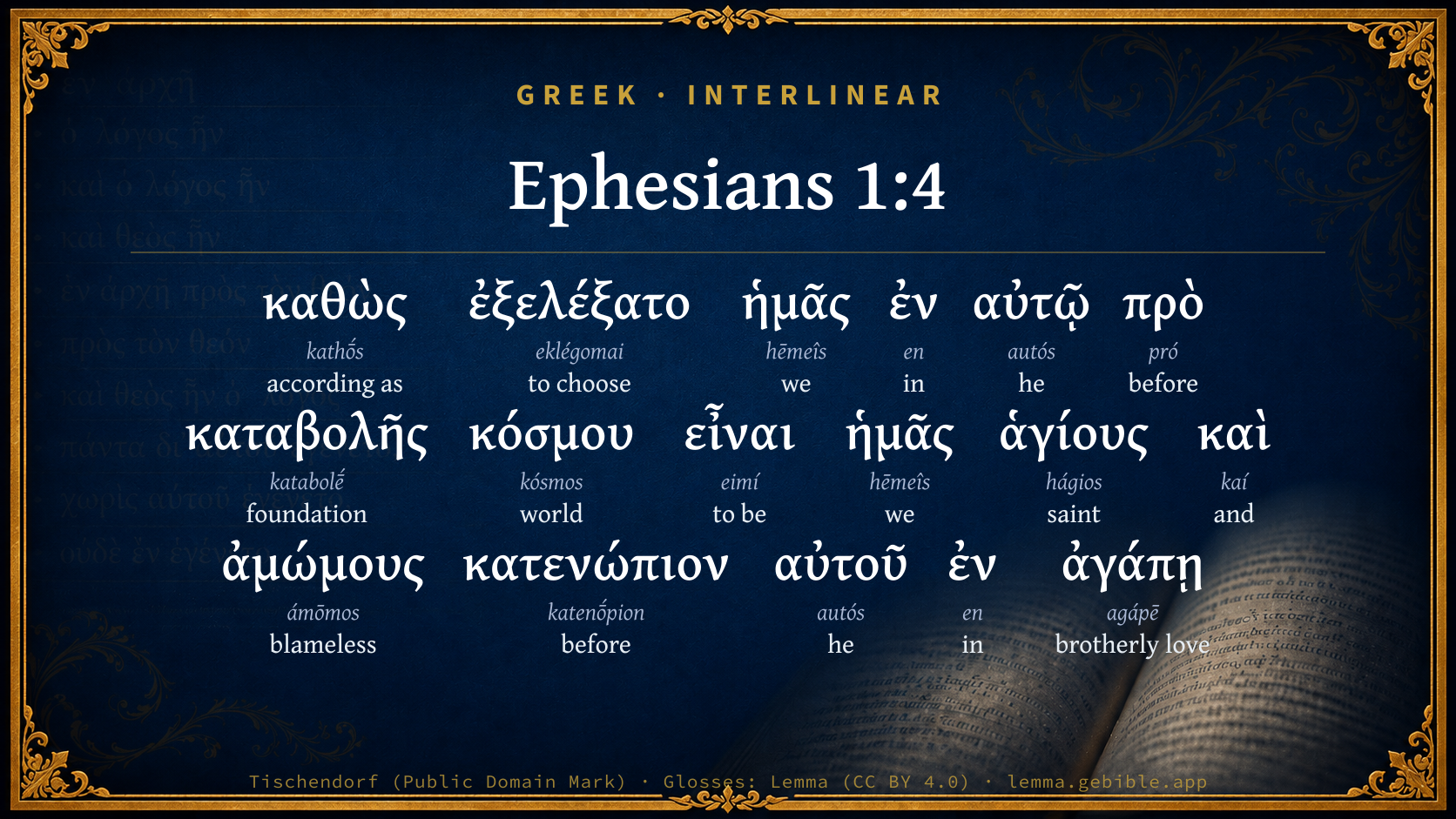
Greek (Tischendorf 8th ed.) Ephesians 1:4 appears in the Greek New Testament. The text above is from the Tischendorf 8th edition. Each word links to its Strong’s number and a concise gloss. Click any word for its full Thayer’s Greek Lexicon entry.
Download image
Cite this verse

Ephesians 1:4 (World English Bible). Public Domain. Lemma interlinear Bible study tool, https://lemma.gebible.app/v/ephesians/1/4.

Show BibTeX & RIS
BibTeX
RIS
English Translation
even as he chose us in him before the foundation of the world, that we would be holy and without blemish before him in love;
World English Bible · Public Domain
Highlights
  • 2 first appearances in the Greek New Testament
Full analysis ↓
Download a study sheet

One document with this verse’s original text, its word-by-word gloss line, the meaning frame, cross-references with their text, attributed commentary, and full source and license credits — printable, and it pastes into notes with its structure intact.

This verse Autodidact and up

Study sheet (.html) Plain text (.txt)

A passage Seminary Student

Up to 50 verses in one chapter. A passage sheet keeps up to 6 commentary sources and 12 cross-references per verse, in the order this page ranks them, and says so on the sheet whenever that leaves anything out. Ask for a single verse and you get the Autodidact verse sheet above.

Everything on this page stays free to read, with no account — the sheet is a download of what is already on screen, not access to it.

Want to remove ads? Support Godless Engineer
Compare translations 3

The same verse in 3 English versions, stacked beneath the original-language interlinear above. Click any original word for its lexicon entry.

Each is an independent rendering of the whole verse — the interlinear is not word-aligned to these translations.

Highlighted words mark where these versions differ — a whole-verse word diff, not a word-by-word alignment.

  • World English Bible Public Domain
    even as he chose us in him before the foundation of the world, that we would be holy and without blemish before him in love;
  • King James Version Public Domain
    According as he hath chosen us in him before the foundation of the world, that we should be holy and without blame before him in love:
  • unfoldingWord Literal Text CC BY-SA 4.0
    just as he chose us in him from the foundation of the world, us to be holy and blameless before him. In love

unfoldingWord Literal Text — © unfoldingWord, licensed CC BY-SA 4.0. Word-aligned USFM3 via Door43 (git.door43.org/unfoldingWord/en_ult).

Versions to compare (up to 4)

3 of 4 selected

Show all 19 translations

Every available English version of this verse, each an independent rendering of the whole verse.

  • World English Bible Public Domain
    even as he chose us in him before the foundation of the world, that we would be holy and without blemish before him in love;
  • Berean Standard Bible Public Domain
    For He chose us in Him before the foundation of the world to be holy and blameless in His presence. In love
  • Majority Standard Bible Public Domain
    For He chose us in Him before the foundation of the world to be holy and blameless in His presence. In love
  • King James Version Public Domain
    According as he hath chosen us in him before the foundation of the world, that we should be holy and without blame before him in love:
  • American Standard Version (1901) Public Domain
    even as he chose us in him before the foundation of the world, that we should be holy and without blemish before him in love:
  • Revised Version (1885) Public Domain
    even as he chose us in him before the foundation of the world, that we should be holy and without blemish before him in love:
  • Geneva Bible (1599) Public Domain
    As hee hath chosen vs in him, before the foundation of the worlde, that we should be holy, and without blame before him in loue:
  • Douay-Rheims (1899) Public Domain
    As he chose us in him before the foundation of the world, that we should be holy and unspotted in his sight in charity.
  • Young's Literal Translation Public Domain
    according as He did choose us in him before the foundation of the world, for our being holy and unblemished before Him, in love,
  • Literal Standard Version CC BY-SA 4.0
    according as He chose us in Him before the foundation of the world, for our being holy and unblemished before Him, in love,
  • Unlocked Literal Bible CC BY-SA 4.0
    God chose us in him from the beginning of the world, that we may be holy and blameless in his sight in love.
  • unfoldingWord Literal Text CC BY-SA 4.0
    just as he chose us in him from the foundation of the world, us to be holy and blameless before him. In love
  • Darby Bible Public Domain
    according as he has chosen us in him before [the] world's foundation, that we should be holy and blameless before him in love;
  • World Messianic Bible Public Domain
    even as he chose us in him before the foundation of the world, that we would be holy and without defect before him in love,
  • Webster's Bible Public Domain
    According as he hath chosen us in him, before the foundation of the world, that we should be holy and without blame before him in love:
  • Free Bible Version CC BY-SA 4.0
    just as he chose us to be in him before the beginning of this world, so that in love we could be holy and without fault before him.
  • Bible in Basic English Public Domain
    Even as he made selection of us in him from the first, so that we might be holy and free from all evil before him in love:
  • Text-Critical English NT CC BY 4.0
    just as he chose us in Christ before the foundation of the world to be holy and unblemished before him in love.
  • Tyndale New Testament (1534) Public Domain
    accordynge as he had chosen vs in him before the foundacion of the worlde was layde that we shuld be saintes and without blame before him thorow loue.

Literal Standard Version (2020), Covenant Press — licensed CC BY-SA 4.0. Text via the HelloAO Bible API (eBible.org). Unlocked Literal Bible (unfoldingWord) — licensed CC BY-SA 4.0. Text via the HelloAO Bible API (eBible.org). unfoldingWord Literal Text — © unfoldingWord, licensed CC BY-SA 4.0. Word-aligned USFM3 via Door43 (git.door43.org/unfoldingWord/en_ult). Free Bible Version, Dr. Jonathan Gallagher — licensed CC BY-SA 4.0. Text via the HelloAO Bible API (eBible.org).

Word by word

More ways to search: Search by grammar → Find every occurrence → Compare this word →

Practice this passage: Drill this verse → Learn its vocabulary →

κατενώπιον
katenṓpion
G2714
“before”
Adverb
Part of Speech
Adverb
Full Thayer's Definition

Origin: from G2596 and G1799

TDNT: None

1. over against, before the face of, before the presence of, in the sight of, before a. referring to places b. metaph. 1. having one as it were before the eyes, before one as witness 2. before God as judge
  1. καθὼς kathṓs G2531 “according as” Adverb
  2. ἐξελέξατο eklégomai G1586 “to choose” Verb, Aorist, Middle, Indicative, 3rd person, Singular
  3. ἡμᾶς hēmeîs G2249 “we” Personal pronoun, 1st person, Accusative, Plural
  4. ἐν en G1722 “in” Preposition
  5. αὐτῷ autós G846 “he” Personal pronoun, Dative, Singular, Masculine
  6. πρὸ pró G4253 “before” Preposition
  7. καταβολῆς katabolḗ G2602 “foundation” Noun, Genitive, Singular, Feminine
  8. κόσμου kósmos G2889 “world” Noun, Genitive, Singular, Masculine
  9. εἶναι eimí G1510 “to be” Verb, Present, Active, Infinitive
  10. ἡμᾶς hēmeîs G2249 “we” Personal pronoun, 1st person, Accusative, Plural
  11. ἁγίους hágios G40 “saint” Adjective, Accusative, Plural, Masculine
  12. καὶ kaí G2532 “and” Conjunction
  13. ἀμώμους ámōmos G299 “blameless” Adjective, Accusative, Plural, Masculine
  14. αὐτοῦ autós G846 “he” Personal pronoun, Genitive, Singular, Masculine
  15. ἐν en G1722 “in” Preposition
  16. ἀγάπῃ agápē G26 “brotherly love” Noun, Dative, Singular, Feminine

About this verse

These counts appear in no published source. They are computed here, from the morphology-tagged text and Lemma’s own curated glosses. What Lemma adds →

17
words
14
distinct lemmas
Pauline Epistles
section

Notable vocabulary

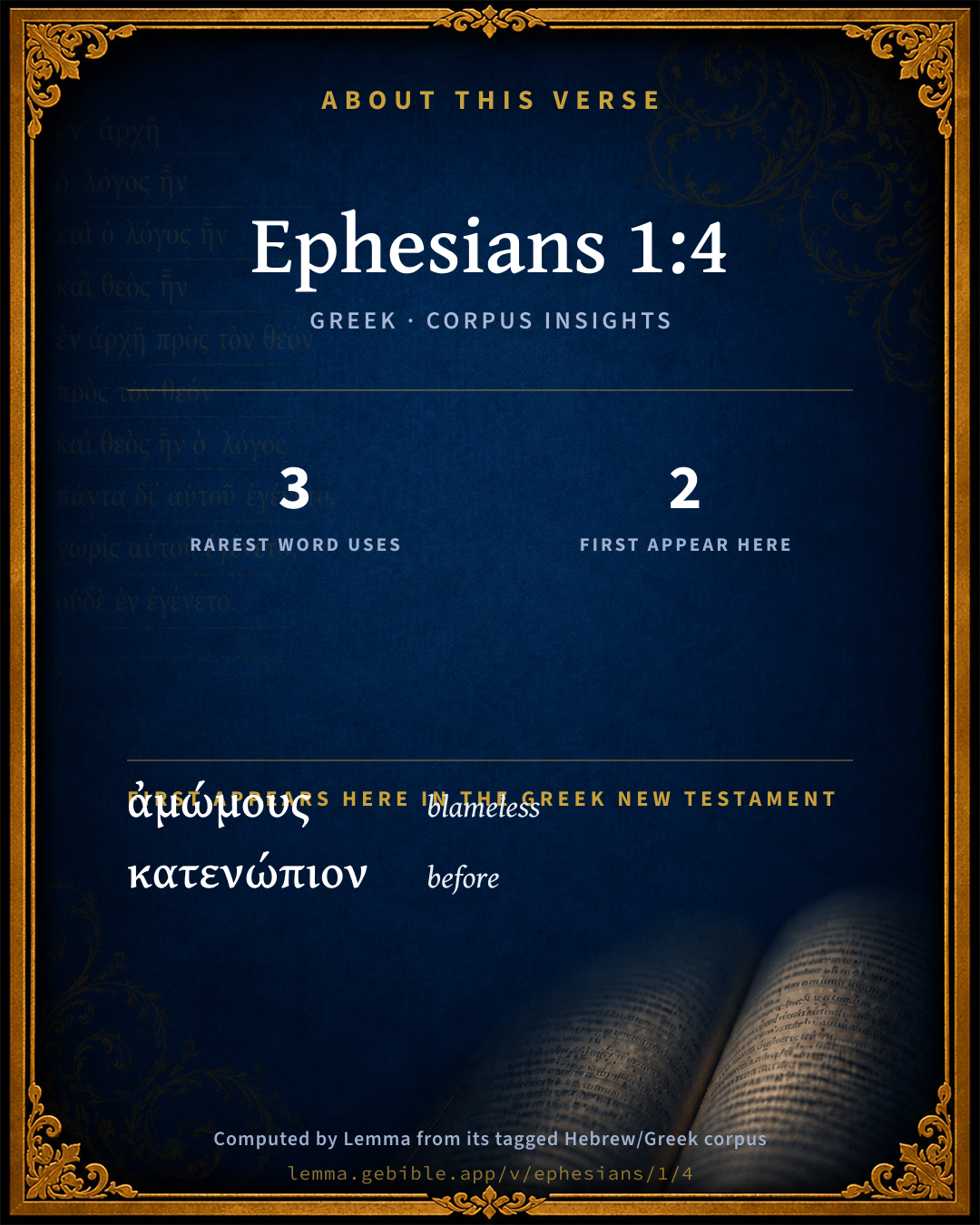
The rarest word here is κατενώπιον before G2714 — appearing just 3 times in the whole Greek New Testament.

First appearance in Scripture

These words make their first canonical appearance in the Greek New Testament here:

  • ἀμώμους blameless G299
  • κατενώπιον before G2714

Shared distinctive vocabulary

κατενώπιον before G2714 occurs in 3 verses of the Greek New Testament. Also found in:
Repetition

Words recur within this verse:

Cross-references

52

Topical passages linked to Ephesians 1:4 in the Treasury of Scripture Knowledge — connected by theme and wording, ordered by reader-vote popularity; previews shown in the World English Bible.

  • 2 Timothy 1:9 who saved us and called us with a holy calling, not according to our works, but according to his own purpose and grace, which was given to us in Christ Jesus before times eternal,
  • Romans 8:28–30 We know that all things work together for good for those who love God, to those who are called according to his purpose.
  • Ephesians 2:10 For we are his workmanship, created in Christ Jesus for good works, which God prepared before that we would walk in them.
  • Matthew 25:34 Then the King will tell those on his right hand, 'Come, blessed of my Father, inherit the Kingdom prepared for you from the foundation of the world;
  • 1 Peter 2:9 But you are a chosen race, a royal priesthood, a holy nation, a people for God's own possession, that you may show forth the excellencies of him who called you out of darkness into his marvelous light:
  • James 2:5 Listen, my beloved brothers. Didn't God choose those who are poor in this world to be rich in faith, and heirs of the Kingdom which he promised to those who love him?
  • John 15:16 You didn't choose me, but I chose you, and appointed you, that you should go and bear fruit, and that your fruit should remain; that whatever you will ask of the Father in my name, he may give it to you.
  • 1 Peter 1:20 who was foreknown indeed before the foundation of the world, but was revealed at the end of times for your sake,
  • Revelation 13:8 All who dwell on the earth will worship him, everyone whose name has not been written from the foundation of the world in the book of life of the Lamb who has been killed.
  • 1 Peter 1:2 according to the foreknowledge of God the Father, in sanctification of the Spirit, that you may obey Jesus Christ and be sprinkled in his blood: Grace to you and peace be multiplied.
  • Colossians 3:12 Put on therefore, as God's chosen ones, holy and beloved, a heart of compassion, kindness, lowliness, humility, and perseverance;
  • Titus 1:1–2 Paul, a servant of God, and an apostle of Jesus Christ, according to the faith of God's chosen ones, and the knowledge of the truth which is according to godliness,
  • 2 Thessalonians 2:13–14 But we are bound to always give thanks to God for you, brothers loved by the Lord, because God chose you from the beginning for salvation through sanctification of the Spirit and belief in the truth;
  • Ephesians 5:27 that he might present the assembly to himself gloriously, not having spot or wrinkle or any such thing; but that it should be holy and without blemish.
  • Colossians 1:22 yet now he has reconciled in the body of his flesh through death, to present you holy and without blemish and blameless before him,
  • John 17:24 Father, I desire that they also whom you have given me be with me where I am, that they may see my glory, which you have given me, for you loved me before the foundation of the world.
  • Revelation 17:8 The beast that you saw was, and is not; and is about to come up out of the abyss and to go into destruction. Those who dwell on the earth and whose names have not been written in the book of life from the foundation of the world will marvel when they see that the beast was, and is not, and shall be present.
  • Acts 13:48 As the Gentiles heard this, they were glad, and glorified the word of God. As many as were appointed to eternal life believed.
  • Deuteronomy 7:6–7 For you are a holy people to Yahweh your God: Yahweh your God has chosen you to be a people for his own possession, above all peoples who are on the face of the earth.
  • Romans 9:23–24 and that he might make known the riches of his glory on vessels of mercy, which he prepared beforehand for glory,
  • 1 Thessalonians 4:7 For God called us not for uncleanness, but in sanctification.
  • Isaiah 42:1 Behold, my servant, whom I uphold; my chosen, in whom my soul delights: I have put my Spirit on him; he will bring forth justice to the Gentiles.
  • 2 Timothy 2:19 However God's firm foundation stands, having this seal, "The Lord knows those who are his," and, "Let every one who names the name of the Lord depart from unrighteousness."
  • Isaiah 41:8–9 But you, Israel, my servant, Jacob whom I have chosen, the seed of Abraham my friend,
  • Acts 18:10 for I am with you, and no one will attack you to harm you, for I have many people in this city."
  • Philippians 2:15 that you may become blameless and harmless, children of God without blemish in the midst of a crooked and perverse generation, among whom you are seen as lights in the world,
  • Psalms 135:4 For Yah has chosen Jacob for himself; Israel for his own possession.
  • Luke 1:74–75 To grant to us that we, being delivered out of the hand of our enemies, should serve him without fear,
  • John 10:16 I have other sheep, which are not of this fold. I must bring them also, and they will hear my voice. They will become one flock with one shepherd.
  • Matthew 11:25–26 At that time, Jesus answered, "I thank you, Father, Lord of heaven and earth, that you hid these things from the wise and understanding, and revealed them to infants.
  • Matthew 24:22 Unless those days had been shortened, no flesh would have been saved. But for the sake of the chosen ones, those days will be shortened.
  • Matthew 24:31 He will send out his angels with a great sound of a trumpet, and they will gather together his chosen ones from the four winds, from one end of the sky to the other.
  • 1 Corinthians 1:8 who will also confirm you until the end, blameless in the day of our Lord Jesus Christ.
  • Ephesians 4:2 with all lowliness and humility, with patience, bearing with one another in love;
  • 2 Timothy 2:10 Therefore I endure all things for the chosen ones' sake, that they also may obtain the salvation which is in Christ Jesus with eternal glory.
  • Romans 8:33 Who could bring a charge against God's chosen ones? It is God who justifies.
  • Galatians 5:22 But the fruit of the Spirit is love, joy, peace, patience, kindness, goodness, faithfulness,
  • Ephesians 4:15–16 but speaking truth in love, we may grow up in all things into him, who is the head, Christ;
  • Ephesians 5:2 Walk in love, even as Christ also loved you, and gave himself up for us, an offering and a sacrifice to God for a sweet-smelling fragrance.
  • Isaiah 65:8–10 Thus says Yahweh, As the new wine is found in the cluster, and one says, Don't destroy it, for a blessing is in it: so will I do for my servants' sake, that I may not destroy them all.
  • Romans 11:5–6 Even so then at this present time also there is a remnant according to the election of grace.
  • Galatians 5:13 For you, brothers, were called for freedom. Only don't use your freedom for gain to the flesh, but through love be servants to one another.
  • Ephesians 3:17 that Christ may dwell in your hearts through faith; to the end that you, being rooted and grounded in love,
  • 1 Thessalonians 3:12 and the Lord make you to increase and abound in love one toward another, and toward all men, even as we also do toward you,
  • Titus 2:11–12 For the grace of God has appeared, bringing salvation to all men,
  • 1 John 4:16 We know and have believed the love which God has for us. God is love, and he who remains in love remains in God, and God remains in him.
  • Matthew 24:24 For there will arise false christs, and false prophets, and they will show great signs and wonders, so as to lead astray, if possible, even the chosen ones.
  • Galatians 5:6 For in Christ Jesus neither circumcision amounts to anything, nor uncircumcision, but faith working through love.
  • Colossians 2:2 that their hearts may be comforted, they being knit together in love, and gaining all riches of the full assurance of understanding, that they may know the mystery of God, both of the Father and of Christ,
  • 2 Peter 1:5–10 Yes, and for this very cause adding on your part all diligence, in your faith supply moral excellence; and in moral excellence, knowledge;
  • 2 Peter 3:14 Therefore, beloved, seeing that you look for these things, be diligent to be found in peace, without blemish and blameless in his sight.
  • Acts 15:18 All his works are known to God from eternity.'

Cross-references courtesy of OpenBible.info (CC BY 4.0).

Commentary

Notes on Ephesians 1:4 from classic Christian and Jewish commentators (each source and its license shown beneath its notes). The classic Christian expositions comment on the surrounding passage and are grouped to its opening verse, so a note may address several verses; the Jewish commentaries on the Tanakh (Rashi and others) are per-verse, so they appear only where the commentator wrote on this verse.

Lemma curates 59 commentaries, every one of them public domain or Creative Commons licensed, each selected and text-cleaned for this edition rather than reprinted as found. About our sources →

Jamieson, Fausset & Brown

Robert Jamieson, A. R. Fausset & David Brown

hath chosen us--Greek, "chose us out for Himself" (namely, out of the world, Gal 1:4): referring to His original choice, spoken of as past.

in him--The repetition of the idea, "in Christ" (Eph 1:3), implies the paramount importance of the truth that it is in Him, and by virtue of union to Him, the Second Adam, the Restorer ordained for us from everlasting, the Head of redeemed humanity, believers have all their blessings (Eph 3:11).

before the foundation of the world--This assumes the eternity of the Son of God (Joh 17:5, Joh 17:24), as of the election of believers in Him (Ti2 1:9; Th2 2:13).

that we should be holy--positively (Deu 14:2).

without blame--negatively (Eph 5:27; Th1 3:13).

before him--It is to Him the believer looks, walking as in His presence, before whom he looks to be accepted in the judgment (Col 1:22; compare Rev 7:15).

in love--joined by BENGEL and others with Eph 1:5, "in love having predestinated us," &c. But English Version is better. The words qualify the whole clause, "that we should be holy . . . before Him." Love, lost to man by the fall, but restored by redemption, is the root and fruit and sum of all holiness (Eph 5:2; Th1 3:12-13).

Jamieson, Fausset & Brown — Commentary Critical and Explanatory on the Whole Bible (1871) — public domain (CC PDM 1.0). Text via the HelloAO Bible API.

The Biblical Illustrator

Joseph S. Exell

Eph_1:4

According as He hath chosen us before the foundation of the world.

Election

I. Let us consider the cause, fountain, origin of the blessings of salvation--according as He hath chosen as. The blessings which we enjoy, the apostle affirms, are in consequence of Gods having chosen us, that we might become partakers of them in all their extent and fulness. To this source alone are they to be traced. How comes it that the Church of Gods saints and faithful thus stands distinguished from the ungodly world, in the blessings it enjoys, the favours reserved for it, and the eternal glory it shall inherit?

1. It is a matter of fact concerning which this question is raised. Whatever may be the solution of the question, or difficulties connected with it, there is no denying or concealing the fact itself, that there has been, is, and will be, a distinction among men--a difference--a separation--as respects their state and character before God, and their ultimate destiny.

2. This fact cannot be accounted for by any reference to individual or personal distinctions of character or worthiness.

3. We reach the only reasonable account of the matter when we adopt the Scriptural explanation, and ascribe all spiritual blessing in the heavenlies as enjoyed by Gods people to His free electing love, according as He hath chosen us. If you wished to explore the true source of some majestic liver, which in its course beautifies and blesses the earth, as it flows through thousands of miles to the great ocean, you would not pause at some expanding lake which it fills and empties, nor ascend the route of some acceding tributary which helps to swell its volume; but, keeping by the main channel, and leaving behind you the verdant plain and the smiling hamlet and the sleeping lake, you ascend high up the mountain steep, and there hidden in the cleft of the rock you discover the little bubbling spring that marks the origin and fountain and true rising place of that noble stream. So, taught and guided by Gods Word, when you would trace to its true fountain the stream of spiritual blessing which blesses you in the heavenlies, you pause not at any works or deeds of yours, you point not to any superiority natural or acquired over others, you fix not even on faith and repentance (as if these all did not need to be accounted for!), but, in all humility, yet with all thankfulness, you rest in the elective love of God, as the original and actual cause of all. You hear Paul saying, and you must echo the acknowledgment, according as He hath chosen us, whilst with John you gaze on that pure river of water of life, clear as crystal, proceeding out of the throne of God and of the Lamb.

II. We come now to consider the second thing in our text, viz.: how this electing love of God--the cause or fountain of salvation--comes into being and operation--hath chosen us in Him, i.e., in Christ. A virtual or representative union was formed by God, between sinners of mankind and Christ, when He purposed their salvation. A covenant was entered into between God, of the one part, and Christ constituted the head of the Church and its representative, of the other part. In terms of this covenant Christ was to do the will of God; i.e., fulfil the requirements of law, suffer its penalty and perform its duties, in room and stead of His people; and God, on His part, was to confer on them His Spirit, work holiness in their natures, and at last receive them into eternal mansions.

III. In the third place we are here taught when the election took place, viz., before the foundation of the world. This surely must be allowed to carry us far back, beyond the operation of human merit or agency.

1. There is no room, then, for chance, uncertainty, or hazard. Gods plans are complete, and His purposes definite. Doubtless He has chosen, on the whole, the greatest good of the universe as His object; and, in the election unto grace, only displays a part of His glorious and all-comprehending plan.

2. Again, we are taught in this not only Gods wisdom, but also His sovereignty. This, at least, is a precious truth--that the Lord God Omnipotent reigneth. What comfort, otherwise, would there be in contemplating a scene where sin abounds and agents of darkness are abroad on the earth?

IV. This suggests to us the fourth topic in our text, viz., why, or for what end God hath chosen us in him before the foundation of the world--that we should be holy and without blame before Him in love. It is an old saying: God does not find, but makes men holy. It is evident, indeed, that none are chosen because they are holy or blameless, but some are chosen in order that they may become so. (W. Alves, M. A.)

The doctrine of election

I. The spiritual blessing.

1. The term election is sometimes used for that election which is made in temporary execution of Gods purpose;

(1) whether it be a separating of men to the state of grace, which makes them as the chosen first fruits of the creation (Joh_15:19; 1Pe_1:2); or

(2) a separating of them to any office and dignity. Saul, Judas.

2. But here it means that choice which God made with Himself from all eternity. From this flow all the blessings we receive, even as the body and boughs and branches of the tree issue from the root. What a cause for thankfulness is here!

II. The persons. Those who have true faith and holiness. As we may know faith, so we may know election. If we see in any a faith unfeigned and true endeavour after holiness, we may charitably judge that such are elected.

III. The order of election.

1. Christ, the Head.

2. From Christ it descends to us His members.

IV. The time. Before all worlds (2Ti_1:9; Joh_17:24).

V. The end.

1. God has of grace chosen us to the supernatural life.

2. He has not only chosen us to this supernatural life, but to the perfection of it.

3. He has called us to this life, that we may live forever in His presence. (Paul Bayne.)

Gods elective grace

It would be a narrow and superficial view of these words to suppose them to refer only to the enjoyment of external privilege, or to imagine that they are meant to level Jewish pride, and that they describe simply the choice of the Gentiles to religious blessings. The purpose of the election is, that its objects should be holy, an end that cannot fail, for they are in Christ, and in Him they are complete. Yet the sovereign love of God is strikingly manifested even in the bestowment of external advantage. Ephesus enjoyed what many a city in Asia Minor wanted. The motive that took Paul to Ephesus, and the wind that sped the bark which carried him, were alike of Gods creation. It was not because God chanced to look down from His high throne, and saw the Ephesians bowing at the shrine of Diana, and worshipping the image that fell from Jupiter, that His heart was moved, and He resolved to give them the gospel. Nor was it because its citizens had a deeper relish for virtue and peace than masses of the population around them, that He sent among them the grace of His Spirit. He is of one mind, and who can turn Him? Every purpose is eternal, and awaits an evolution in the fulness of the time, which is neither antedated nor postponed. The same difficulties are involved in this choice to the external blessing, as are found in the election of men to personal salvation. The whole procedure lies in the domain of pure sovereignty, and there can therefore be no partiality where none have any claim. The choice of Abraham is the great fact which explains and gives name to the doctrine. Why then should the race of Shem be selected to the exclusion of Ham and Japheth? Why of all the families in Shem should that of Terah be chosen? and why of all the members of Terahs house should the individual Abraham be marked out, and set apart by God to be the father of a new race? As well impugn the fact as attempt to upset the doctrine. Providence presents similar views of the Divine procedure. One is born in Europe with a fair face, and becomes enlightened and happy; another is born in Africa with a sable countenance, and is doomed to slavery and wretchedness. One has his birth from Christian parents, and is trained in virtue from his earlier years; another has but a heritage of shame from his father, and the shadow of the gallows looms over his cradle. One is an heir of genius; another, with some malformation of brain, is an idiot. Some, under the enjoyment of Christian privilege, live and die unimpressed; others, with but scanty opportunities, believe, and grow eminent in piety. Does not more seem really to be done by God externally for the conversion of others who live and die in impenitence, than for many who believe and are saved? And yet the Divine prescience and predestination are not incompatible with human responsibility. Man is free, perfectly free, for his moral nature is never strained or violated. Foreknowledge, which is only another phase of electing love, no more changes the nature of a future incident, than after knowledge can affect an historical fact. Gods grace fits men for heaven, but men by unbelief prepare themselves for hell. It is not mans non-election, but his continued sin, that leads to his eternal ruin. Action is not impeded by the certainty of the Divine foreknowledge, he who believes that God has appointed the hour of his death is not fettered by such a faith in the earnest use of every means to prolong his life. And God does not act arbitrarily or capriciously. He has the best of reasons for His procedure, though He does not choose to disclose them to us. (John Eadie, D. D.)

God the author of the plan of salvation

Christians have no grounds for self-felicitation in their possession of holiness and hope, as if with their own hand they had inscribed their names in the Book of Life. Their possession of all spiritual blessing in the heavenly places is not self-originated. Its one author is God, and he has conferred it in harmony with His eternal purpose regarding them. His is all the work, and His is all the glory. And therefore the apostle glories in this eternal election. It is cause of deep and prolonged thankfulness, not of gloom, distrust, or perplexity. The very eternity of design clothes the plan of salvation with a peculiar nobleness. It has its origin in an eternity behind us, and its consummation in an eternity before us. Kindness, the result of momentary impulse, has not and cannot have such claim to gratitude, as a beneficence which is the fruit of a matured and predetermined arrangement. The grace which springs from eternal choice must command the deepest homage of our nature. (John Eadie, D. D.)

Salvation an eternal provision for human need

The eternity of the plan suggests another thought. It is this--salvation is an original thought and resolution it is no novel expedient struck out in the fertility of Divine ingenuity, after Gods first purpose in regard to man had failed through mans apostasy. It is no afterthought, but the embodiment of a design which, foreseeing our ruin, had made preparation for it. (John Eadie, D. D.)

The object of the Divine election

In the words That we should be holy and without blame before Him, we have the object of the Divine election declared, and the cooperation of the elect implied, by the inseparable connection of holiness with election. There is an instructive parallel in Col_1:22, He hath reconciled you in the body of His flesh through death, to present you holy and unblamable, and unreprovable in His sight. The word without blame, or unblamable, is properly without blemish; and the word unreprovable more nearly corresponds to our idea of one unblamable--i.e., one against whom no charge can be brought. Here God is said to have chosen us, in the other passage to have presented us (comp. the sacrificial use of the word in Rom_12:1), in Christ, to be holy and without blemish. It seems clear that the words refer not to justification in Christ, but to sanctification in Him. They express the positive and negative aspects of holiness; the positive in the spirit of purity, the negative in the absence of spot or blemish. The key to their interpretation is to be found in the idea of Rom_8:29, whom He did foreknow, He did predestinate to be conformed to the image of His Son. The word without blame is applied to our Lord (in Heb_9:14; 1Pe_1:19) as a lamb without blemish. To Him alone it applies perfectly; to us, in proportion to that conformity to His image. The words before Him refer us to Gods unerring judgment as contrasted with the judgment of men, and even our own judgment on ourselves (comp. 1Co_4:3-4; 1Jn_3:20-21) (A. Barry, D. D.)

The antiquity of our final humanity

The word foundation. (καταβολή) suggests a descent, or letting down. But since we were chosen m Christ before the foundation of the world, let us joy with reverence over the priority of our original nature, and not confound ourselves with any of the products of time. We are clothed upon with temporal nature, but we are not children of time. We are fallen into time, but we are from eternity. From of old, God loved us with an everlasting love. There is nothing in the world that represents to us either what we were, or what we shall be. Long before the geological eras began, long before the great chaotic age, and long before that first of all the sad changes, namely, the angel fall, God beheld His final human race, perfect in His Son. Whatever we have become through the two great falls, in heaven, and in earth, in Christ Jesus we are the holy children of eternity. Our right home is in our Fathers house, amid the first-born eternal glories. It is not strange, therefore, that there should be a spirit in us which refuses to rest in anything under the sun, as our final condition. That which was elect and precious, before the foundation of the world, lingers in us. (John Pulsford.)

Election and holiness

God elected us as well to the means as to the end. Note this. For as they (in Act_27:31) could not come safe to land if any left the ship, so neither can men come to heaven but by holiness. (John Trapp.)

Predestination to holiness

It would be a poor proof that I were on my voyage to India, that with glowing eloquence and thrilling poetry, I could discourse on the palm groves and spice isles of the East. Am I on the waters? Is the sail hoisted to the wind? and does the land of my birth look blue and faint in the distance? The doctrine of election may have done harm to many, but only because they have fancied themselves elected to the end, and have forgotten that those whom Scripture calls elected are elected to the means. The Bible never speaks of men as elected to be saved from the shipwreck, but only as elected to tighten the ropes and hoist the sails and stand at the rudder. Let a man search faithfully: let him see that when Scripture describes Christians as elected, it is as elected to faith, as elected to sanctification, as elected to, obedience; and the doctrine of election will be nothing but a stimulus to effort. It will not act as a soporific. I shall cut away the boat, and let drive all human devices, and gird myself, amid the fierceness of the tempest, to steer the shattered vessel into port. (H. Melvill, B. D.)

Of election to everlasting life

I. Our first business is, to show what election is. It is that decree of God whereby some men are chosen out from among the rest of mankind, and appointed to obtain eternal life by Jesus Christ, flowing from the mere good pleasure of God; as appears from the text. So the elect are they whom God has chosen to everlasting life (Act_13:48).

II. I proceed to show who are elected. Who they are in particular, God only knows; but in general we say, that it is not all men, but some only. For where all are taken, there is no choice made.

III. The next head is to shew what they are chosen to.

1. They are chosen to be partakers of everlasting life. Hence the scripture speaks of some being ordained to eternal life (Act_13:48), and of appointing them to obtain salvation (1Th_5:9), God appoints some to be rich, great, and honourable, some to be low and mean in the world: but electing love appoints those on whom it falls to be saved from sin, and all the ruins of the fall; its great view is to eternal glory in heaven.

2. They are chosen also to grace as the mean, as well as to glory as the end. Gods predestinating them to eternal blessedness includes both, as in the text; and it further appears from 2Th_2:13. Hence faith is held out as a certain consequent of election (Act_13:48). As many as were ordained unto eternal life, believed. The man who intends to dwell in a house yet unbuilt, intends also the means by which it may be made a fit habitation. And therefore there is no ground from the decree of election to slight the means of salvation.

IV. Let us consider the properties of election.

1. It is altogether free, without any moving cause, but Gods mere good pleasure. No reason can be found for this but only in the bosom of God.

2. Election is eternal. They are elected from all eternity (Eph_1:4), chosen before the foundation of the world; (2Ti_1:9). All Gods decrees are eternal (Eph_1:11). Because God is eternal, His purposes must be of equal duration with His existence.

3. It is particular and definite.

4. It is secret, and cannot be known till God is pleased to discover it.

V. The next thing is to show, that all the elect, and they only, are in time brought out of a state of sin and misery into a state of salvation.

1. All the elect are redeemed by Christ (Joh_10:15). None other but the elect are brought into a state of salvation; none but they are redeemed, sanctified, and believe in the Lord Jesus Christ (Joh_17:9).

VI. I come to show by whom the elect are saved. It is by Christ the Redeemer. Hence the apostle says (Tit_3:4-6).

1. Before the elect could be delivered from that state of sin and misery into which they had brought themselves, a valuable satisfaction behoved to be given to the justice of God for the injury done by sin. It is evident from Scripture that God stood upon full satisfaction, and would not remit one sin without it. Several things plead strongly for this: As,

(1) The infinite purity and holiness of God.

(2) The justice of God.

(3) The wisdom of God.

(4) The truth and veracity of God. He must be true to His threatenings as well as to His promises.

2. As satisfaction to justice was necessary, and that which God insisted upon, so the elect could not give it themselves, neither was there any creature in heaven or earth that could do it for them (Isa_63:5). This is the desperate and forlorn condition of the elect by nature as well as others. God pitched upon Christ in His infinite grace and wisdom as the fittest person for managing this grand design.

4. Christ accepted the office of a Redeemer, and engaged to make His soul an offering for sin. He cheerfully undertook this work in that eternal transaction that was between the Father and Him.

5. Christ satisfied offended justice in the room of the elect, and purchased eternal redemption for them. He became obedient unto death, even the death of the cross (Php_2:8). Thus the elect are saved by the Lord Jesus Christ.

I shall conclude all with a few inferences.

1. Behold here the freedom and glory of sovereign grace, which is the sole cause why God did not leave all mankind to perish in the state of sin and misery, as He did the fallen angels.

2. This doctrine should stop mens murmurings, and silence all their pleadings with or against God.

3. This is ground of humility and admiration to the elect of God, and shows them to what they owe the difference that is between them and others, even to free grace. (T. Boston, D. D.)

On election

I. State the doctrine itself. The word rendered predestinated denotes simply predetermined, or foreordained (See Act_4:27-28),

1. It proceeds on the assumption of the fact that man is in a state of guilt, condemnation, and ruin: that, in himself considered, he is without any claim on the Divine favour, without help and without hope.

2. In maintaining the doctrine under consideration, it is assumed that a sufficient, complete, and glorious redemption has been accomplished and revealed.

3. This salvation is proclaimed to all men, without restriction; and all are freely invited to receive its blessings. Is not the blessed God sincere, in all the proffers of His mercy? Can there be any secret counsels at variance, in reality, with the overtures of His grace?

4. All men, if left to themselves, disregard the overtures of mercy, and neglect the great salvation.

5. That grace which God now communicates to the hearts of men, He has resolved and decreed, from all eternity, to communicate.

II. Remove misconceptions. Let it be observed--

1. That the leading object of our present inquiry regards not an abstract truth, involved in metaphysical obscurity, but a matter of fact, to be determined by scriptural testimony.

2. That the proof of the fact and of the doctrine of election, does not rest on a few insulated texts of Scripture. A minister of the gospel, lately deceased, who was distinguished by no common share of mental energy, discovered, on one occasion, that he had armed against himself the strongest prejudices of a very intelligent hearer, by preaching the doctrine of election. In his private writings he thus records the conversation which ensued:--I told her that I had no choice; the doctrine was not mine; nor did the evidence rest on the words elect and election. I advised her to read the fifth and sixth chapters of the Gospel of John, in which the word election does not once occur, but which are full of the doctrine itself. She followed my advice, and in a few days she was confirmed in the belief of this truth. I then advised her to read the seventeenth chapter of John; and she acknowledged, that it was full of the same truth. I asked her, to what conclusion her experience led her on the subject;--whether she had chosen Christ as the Saviour of her soul? Yes, she exclaimed. And do you think He has chosen you? Yes, I do, she replied. If you chose Him first, I rejoined, you made yourself to differ, and salvation is of works: if the Divine choice was first, your choice of Christ was the effect of it, and salvation is of grace. This, she added, is the fact. Then, I concluded, fact, matter of fact, establishes the doctrine of election. Her peace now flowed like a river, bearing all abjections before it, and her blessedness was as the waves of the sea.

3. The doctrine does not in the least restrict the free invitation of the gospel. God has given these invitations in full sincerity. He has given them on the finished and accepted redemption of His Beloved Son. The only barrier between the sinner and salvation is his cherished unbelief.

4. This doctrine does not in the slightest degree affect mans obligation to repent and to believe the gospel. Mans responsibility arises out of his rational and moral nature, and his relation to the God that made him. He does net cease to be accountable, because he has made himself sinful; for were this the case, a man would only have to become a depraved and abandoned transgressor, in order to exonerate himself from all further obligation to obey the Author of his existence.

5. This fact--that there is a Divine election--does not create an obstacle to the salvation of any human being. From the remarks already made, it is apparent, that if any man perish, he must perish in consequence of his own unbelief. In the investigation of the Word of God, I discover no traces of any decree involving an appointment to wrath irrespective of guilt. Throughout the Bible, the perdition of the soul is ascribed, not to Gods decree, but to mans transgression. No human being will be condemned at the last day, on the ground of not being included in the election of grace.

6. This doctrine, rightly understood, has no tendency unfavourable to the interests of practical religion.

III. The effects which a correct view and a cordial reception of this doctrine are calculated to produce on the mind and heart of the believer.

1. The belief of this doctrine is calculated to extend and to elevate our views of the character of God.

2. This doctrine presents the most vivid exhibition of the certainty of the final salvation of all who truly believe in the Divine Redeemer.

3. This doctrine is adapted to produce the deepest humility. Every truth associated with this doctrine is a humbling truth. We are reminded, at every step of our researches, of some trait in our own character, or in the character of the blessed God, which is calculated to humble the heart. We are reminded, that we are, by nature, children of wrath--that by unmerited grace alone we can be saved. Where is boasting then? It is excluded; that no flesh should glory in His presence; that according as it is written, He that glorieth, let him glory in the Lord.

4. Finally, The subject under consideration is designed and adapted to call forth the most grateful and adoring praise. (H. F. Burder, D. D.)

Good men the subjects of Divine thoughts from all eternity

Every true Christian, then, as a member of Christs body, is thus an elect and predestinated person, and as such has been, along with Christ Himself--the Head of that body--an object of thought to the Almighty Lord of Life during the eternity bygone. But now what an awful dignity is thus seen at once to gather around the existence of a predestinated soul, around one whose appearance and character are both the subject and result of the never commenced meditations and resolves of the Omniscient and Eternal Mind. We look, if at all given to such reflections, with a feeling of profound interest upon a stone, which has been agitated far ages on the sunken floor of the ocean, and which is at length cast up by the sounding sea, rounded by the attrition of the sea bottom, and by the currents of unnumbered centuries--an agate or carnelian, that was being rolled and polished by the billows before the old empires of antiquity were founded, or before the deluge, or before the creation of man. We gaze awestruck upon these everlasting hills, whose summits were standing above the universal waters before some of the other continents were made, and whose stratified contents, rich with the fossils of successive worlds, and the deep-lying beds of molten and crystallized porphyry and granite below them, indicate an era of upheaval that is lost in the mists and twilights of remotest eld. But what are such feelings of awe and wonder at such immeasurable antiquity, compared with those which fill the soul when we look upon a Person older than all geological chronology, older than the stars, whose goings forth have been from everlasting. On Christ, whose countenance, whose aspect, marred more than any mans, whose history, instinct with miracles, whose words, full of grace and truth, were the manifestations of a Divine purpose as ancient in the darkness, that all the works of the visible universe--rock systems and the deepest foundations of the mountains, and constellations that have already shone through cycles which would defy even archangelic arithmetic to measure, are comparatively of yesterday. Before Abraham was, I am. Before the universe was, I was in the bosom of the Infinite. And all good men were chosen in Him. The names of all who believe in God were written before the foundation of the world, in the Lambs Book of Life. They have from eternity been there recorded by Divine love as members of Christ--of His Body, of His flesh, and of His bones. Every Christian has thus been, in ideal vision, a subject of blissful Divine thought from before all worlds. (E. White.)

The saving purpose of God in earthly realization

I. Its spiritual character (verses 3, 4).

1. Bestowing spiritual gifts.

2. Contemplating a moral change in its objects. It is not because they are already better than other men that believers are chosen, but in order that they may become so.

II. Its predetermining influence. (verses 4, 5, 9-11).

1. It works from afar. Through eternity and time--from before the foundation of the world.

2. Bestowing provisional advantage. It does not appear that by the adoption here spoken of, final salvation is implied, but rather that the Gentiles being brought nigh through the blood of Christ, are put in the way of being saved. It is well for us to consider the limits as well as the vastness of spiritual privilege.

3. Ordaining the means of salvation. In Christ.

III. Its cyclic completeness (verses 4-14).

1. Engaging successively the several Persons of the Blessed Trinity. In the progress of revelation and the history of the Church there seem to be discernible an age of the Father, an age of the Son, and an age of the Holy Ghost.

2. Perfecting human salvation. There are indicated three stages of the process of salvation, viz., election, justification through the blood of Christ, and, finally, sanctification by the Spirit. The cycle of redemption, as evolved in this passage, recalls that of Rom_8:28-30.

3. Consummating the order of the universe. In Christ all things are summed up, i.e., He is the Head and Representative of time, creation, humanity, etc. They gather about Him as their true Centre and Lord.

IV. Its resultant glory (verses 6, 12, 14). (A. F. Muir, M. A.)

The electing love of God

I. As expressive of the Divine character. Paul labours by variety and accumulation of phrases to show that in its entire manifestation it is of God and not of man. He calls attention to--

1. Its absoluteness. It is according to the good pleasure of His will, i.e., an absolutely free impulse and act. No cause external to the Divine Being can be discovered to account for it.

2. Its sublime consistency and harmony.

II. As affecting human destiny.

1. It reveals itself in a gracious act, viz., the choice or adoption of men as its objects.

2. It sets before itself a grand moral aim.

3. It exerts a transforming power.

III. As evoking grateful adoration (verse 6). The objects of saving grace realizing the benefits it confers,

1. Bless God with their lips.

2. Glorify Him in their lives. (A. F. Muir, M. A.)

Gods purpose in election

What was God driving at in His electing some out of the lump of mankind? Was it only their impunity He desired, that while others were left to swim in torment and misery, they should only be exempted from that infelicity? No, sure; the apostle will tell us more. He hath chosen us in Him before the foundation of the world, that we should be holy. Mark, not because He foresaw that they would be of themselves holy, but that they should be holy; this was that God resolved He would make them to be. As if some curious workman, seeing a forest growing upon his own ground of trees (all alike, not one better than another), should mark some above all the rest, and set them apart in his thoughts, as resolving to make some rare pieces of workmanship of them. Thus God chose some out of the lump of mankind, whom He set apart for this purpose, to carve His own image upon them, which consists in righteousness and true holiness; a piece of such rare workmanship which, when God hath intended, and shall show it to men and angels, will appear to exceed the fabric of heaven and earth itself. (W. Gurnall.)

Election

1. The elector is the Father, to whom it belongs to originate all things. The purpose of eternal love flows directly from the Divine mind, as its heavenly source (Rom_8:29; 2Th_2:13)

2. The person in whom the election is made is the Son. We are chosen in Him as the Divine Mediator, and predestinated Election-Head, in whom, by means of our union with Him, we find a supply for all our wants, strength for our weakness, joy for our sorrow, light for our darkness, and eternal life for our all-sufficient portion at last.

3. As to the date of this election; it is before the foundation of the world (comp. Mat_13:35, Joh_17:4, Luk_11:50, Mat_14:34, 1Pe_1:20). This is the same as the expression, Before the ages or worlds (1Co_2:7; comp. Eph_3:9, Col_1:26, 2Ti_1:9, and Rom_16:25). This is the ancient love of God to His people of which the Scriptures are so full, and on which the believing soul delights to dwell. His love is no impulsive feeling, varying with the changes of the creature, but the steady, irreversible purpose of His grace, based on the life and death, the doing and dying of the Mediator.

4. The purpose of this election is very clearly stated in one passage--That we should be holy and without blame before Him in love. Holy means separated, consecrated, devoted to Gad. He would have a loving, devoted, holy, people, and for this end He elects them. (W. Graham, D. D.)

Gods choice and desire

I. Let us observe the first outflow of these heavenly blessings. The fountain of eternal love burst forth in our election--According as He hath chosen us in Him before the foundation of the world. Consider these words one by one.

1. The first is, He hath chosen: God has a will and a choice in the matter of salvation. Is mans will to be deified? Is the whole result of the scheme of salvation to depend upon the creatures choice? God forbid.

2. Carefully note that election shapes everything: the Father has blessed us with all spiritual blessings, According as He hath chosen us in Christ. All the grace of earth and the glory of heaven come to us in accordance with the eternal choice. There is not a single boon that comes from the blessed hand of the Divine Redeemer but is stamped with the mark of Gods electing love. We were chosen to each mercy, and each mercy was appointed for us.

3. The next word is, He hath chosen us. Herein is grace indeed. What could there be in us that the Lord should choose us? Some of us feel ourselves the most unworthy of the unworthy, and we can see no trace of a reason for our being chosen. So far from being choice men in our own esteem, we feel ourselves by nature to be the very reverse. But if God has chosen us, then let our hearts love Him, our lips extol Him, our hands serve Him, our whole lives adore Him.

4. Then we are told, he has chosen us in Christ Jesus. He first chose Christ as the head, and then looked through Christ upon us, and chose us to be members of Christs mystical body.

5. The time when this choice was made--Before the foundation of the world, the earliest conceivable period. The choice is no sudden act.

II. The designed result of all this blessing.

1. It is Gods eternal design that His people should be holy. When you grow in grace, and faith, and hope, and joy, all that growth is towards holiness. There is something practical in every boon that comes from the Fathers hand, and you should pray to Him that you may by each one conquer sin, advance in virtue and perfect holiness in His fear. The ultimate end of election is the praise of the glory of Divine grace, but the immediate and intermediate end is the personal sanctification of the chosen.

2. The Father chose us to Himself that we might be without blame before Him in love. He would have us blameless, so that no man can justly find fault with us; and harmless, so that our lives may injure none, but bless all.

3. But notice where and what kind of holiness this is: holy and blameless before Him. It would be something to be perfect before the eyes of men who are so ready to criticize us; but to be blameless before Him who reads our thoughts and sees our every failure in a moment--this is an attainment of a far higher order. To conclude, we are to be holy and blameless before Him in love. Love is the anointing oil which is to be poured on all the Lords priests; when he has robed them in their spotless garments, they shall partake of the unction of love. (C. H. Spurgeon.)

Gods election of men in Jesus Christ

I. That God, before He made the world, chose some persons of His own free grace to become His children, or to be made holy and happy.

1. There is a manifest difference between the children of men in this world.

2. This difference between men, or this distinction of the righteous from the wicked, is not ascribed in Scripture, originally and supremely, to the will and power of man, as the cause of it, but to the will and power of God, and to His Spirit working in them.

3. The distinction that is made by this work of God in the heart of men, is attributed in Scripture, not to any merit in man, which God foresaw, but to the free grace of God toward His people, and His special choice or election of them, to be partakers of these blessings.

4. This choice of persons to sanctification and salvation by the grace on God is represented in Scripture, as before the foundation of the world, or from eternity.

II. That God from the beginning appointed His Son Jesus Christ to be the medium of exercising all this grace, and gave His chosen people to the care of His Son, to make them partakers of these blessings.

1. Let us consider what it was that Christ undertook, as the chosen Saviour of His people (Joh_1:18; Joh_17:5; Joh_16:28; Php_2:7; Heb_2:14; Gal_4:4; Rom_8:3; Eph_5:30).

2. Let us take a brief survey of the articles of this covenant on God the Fathers side. Whatsoever powers, or honours, or employments He bestowed on His Son, we have reason to suppose it was in pursuance of this original covenant of grace and salvation. First then, we may justly conclude, that God engaged to employ Him in the work of creation, as a foundation of His future kingdom among men; by Him God made angels, and they shall be His ministering Spirits, for the men who shall be heirs of his salvation; by Him God created mankind, and He shall be Lord of them all; by Him the Blessed God made His own people, and He shall save them. Again, We may suppose it was agreed by the Father, that He should be the King of Israel, which was the visible Church of God, as a type of His kingdom, and the government of His invisible Church; that He should fix His dwelling in a cloud of glory, in His holy hill of Sion (Psa_2:6-7), and should govern the Jewish nation by judges, or priests, or kings, as His deputies, till He Himself should appear in the flesh. God the Father undertook also to furnish Him with everything necessary for His appearance and His ministry here upon earth, to prepare a body for Him (Heb_10:5), to give Him the Spirit without measure (Joh_3:34; Isa_11:2), to bear Him up through all His sufferings, to accept His sacrifice and atonement for sin, to raise Him up from the dead, to exalt Him not only to the former glory which He had with Him before the world was, which He asks for as a matter of agreement (Joh_17:4-5), but to honour Him at His right hand with superior powers.

1. Since we are chosen to be holy, as well as happy, we may search and find out our election by our sanctification, and make it sure and evident.

2. Let those who by a sincere search have found the blessed marks and evidences of their election in Christ Jesus take the comfort of it, rejoice in it, and walk worthy of so Divine a privilege. See that you keep your evidences of grace ever clear and bright by holy watchfulness, that ye may have a strong defence in every hour of temptation.

In conclusion:

1. I infer that there are some doctrines wherein the reason of man finds many difficulties, and which the folly of man would abuse to unhappy purposes, which yet are plain and express truths asserted in the Word of God. Among these, we place the great doctrine of the election of sinners in Christ to be made holy and happy.

2. However this doctrine may be opposed by the reasonings of men, and even ridiculed by a bold jest, yet, if it then appear to be a Divine truth, as the Scriptures now seem to teach us, the blessed God will not be ashamed of it in the last great day; then shall He unfold all the scheme of His original counsels, and spread abroad His transactions towards mankind, before the face of all His intelligent creatures. I cannot think, that any of the cavils of wit against this doctrine will stand before the light of the great tribunal.

3. The whole chain and current of our salvation, from the beginning to the end, arises and proceeds all the way from the free grace of God, through the mediation of His Son Jesus Christ. God and His Son must have the glory, and pride must be hid from man forever. (Dr. Watts.)

The Biblical Illustrator, edited by Joseph S. Exell (c. 1880s–1900s) — public domain. Text from a community e-Sword module.

Tyndale Open Study Notes

Tyndale Open Resources

1:4 God’s people are holy and without fault in his eyes because they trust in Christ’s atoning sacrifice for their sins (see 1:7; 5:25-27; Col 1:22; Titus 3:5-7; Jude 1:24).

Tyndale Open Study Notes — © Tyndale Open Resources, licensed CC BY-SA 4.0. Text via the HelloAO Bible API.

Bengel's Gnomon

Johann Albrecht Bengel

Eph 1:4. Καθὼς ἐξελέξατο ἡμᾶς, according as He has chosen us) The blessing corresponds to the [prior] election, and follows upon it and makes it manifest.—ἐν Αὐτῷ, in Him) Eph 3:11. These things presuppose the eternity of the Son of God; for the Son, before the world was made, was not merely the future, but even then the present object of the Father’s love; Joh 17:24; Joh 17:5, otherwise the Father would not have loved Him in [or for] Himself [per se], but likewise through another [per alium: God would have loved in connection with the Church, not in Himself purely].—πρὸ, before) Joh 17:24.—εἶναι, to be) i.e. τοῦ εἶναι, that we should be.—ἁγίους, holy) positively.—ἀμώμους, without blame) without evil and fault [ch. Eph 5:27].

Eph 1:4-5. Ἐν ἀγάπῃ προορίσας ἡμᾶς, having predestinated us in love) Many construe these words with the preceding, holy and without blame before Him in love. The terms, I love, love, loved, are very prevalent in this epistle both ways, so that either the love of God to us, or ours to Him, may be denoted; but it is most consistent with the very beginning of the epistle, that love should be construed not with holy and without blame—an expression which is likewise used without express mention of love, Eph 1:27—but with the subsequent description of adoption;[6] comp. Eph 2:4; Eph 2:3; 1Jn 3:1: and that the love of God should be celebrated before ours. In this way the sum of those things which follow, will be in love, Eph 1:5, at the end. So love is put at the beginning of the section [tmematis], ch. Eph 3:18. And in turn, on the other hand, the word having predestinated is much more emphatic, if we consider it to be placed at the beginning: and everywhere the apostle, especially in this chap., closes the period with some clause, which, in respect of what goes before, is equivalent to a Syncategorema,[7] and in respect of what follows, is equivalent to a Thema [the main proposition]. If this be attended to, and the connection by participles and relatives be observed, the analysis will be cleared from all difficulty. This is the custom of the ancients, quite different from our present method, which proceeds by many divisions and sub-divisions (sub-distinctions) set forth expressly and prominently.—προορίσας, having predestinated) The participle depends on He has chosen: Rom 8:29. Chosen from among others, they are predestinated to all things which belong to the obtaining of blessedness, Eph 1:11.—κατὰ τὴν εὐδοκίαν, according to the good pleasure) We are not allowed to go beyond this good pleasure either in searching into the causes of our salvation or of any of the Divine works, Eph 1:9. Why needest thou to philosophize about an imaginary world of optimism? That which thou oughtest to take care of is, lest thou thyself be bad. Nor was there anything in us which deserved love.—τοῦ θελήματος, of His will) Eph 1:9; Eph 1:11; Eph 1:1.

[6] The margin of the larger Ed. had preferred this mode of connecting the words by punctuation; the margin of the 2d Ed. leaves it an evenly balanced question as to that other, by which the words ἐν ἀγάπῃ are referred to the preceding; and the Germ. Vers. distinctly exhibits it.—E. B.

[7] See App. An accessory proposition added to the principal one.—ED.

Both Lachm. and Tischend. join ἐν ἀγάπῃ with προόρισας: but Engl. Vers. with κατενώπιον αὐτοῦ, “Without blame before Him in love.”—ED.

Bengel's Gnomon of the New Testament — English translation (T&T Clark, Edinburgh, 1860) — public domain. Text from a community e-Sword module.

Meyer's Critical & Exegetical Commentary

Heinrich August Wilhelm Meyer

Eph_1:4. Further amplification of ὁ εὐλογήσας κ.τ.λ. on to Eph_1:14. See the contents.

καθώς] even as, denotes that that εὐλογεῖν has taken place in conformity with the fact that, etc., and is consequently argumentative; see on 1Co_1:6; Joh_13:34.

ἐξελέξατο ἡμᾶς] He has chosen us (from the collective mass of men) for Himself (sibi). Comp. 1Co_1:27; Rom_9:11; Rom_11:5; Rom_11:7; Rom_11:28; Joh_15:19; 1Pe_2:9 f. Entirely without reason does Hofmann, Schriftbeweis, I. p. 223, deny that ἐκλέγεσθαι here has reference to others not chosen, and assert that it applies only to that which we, in the absence of election, should not have become. This is according to the very notion of the word quite impossible. Ἐκλέγεσθαι always has, and must of logical necessity have, a reference to others, to whom the chosen would, without the ἐκλογή, still belong. Even in Act_6:5; Act_13:17; 1Ti_5:21; Exo_18:25; Deu_4:37, it sets forth the distinctive separation from the remaining mass, just as also Christ, as one who is chosen out from all that is man, is called the ἐκλεκτός of God (Luk_9:35; Luk_23:35).

ἐν αὐτῷ] for in nothing else and in no one else than in Christ, whose future work of redemption God has foreknown and decreed from eternity (Act_15:18; Rom_16:25; 2Ti_1:9; 1Pe_1:20, al.), lay the ground, that the electing grace (Rom_11:5) chose us (comp. Eph_3:11); hence God had, as respected the subjects to be affected by the election, to deal, not in any arbitrary manner, but according to His πρόγνωσις of the same (praecognovit credituros). See on Rom_8:29. Christ is not, however, here conceived of as Himself chosen of God, and we as included in Him (ἐν αὐτῷ), as Hofmann, p. 229, thinks; but, as the more precise explanation in Eph_1:5 shows, the divine act of our election has in Christ its determining ground, so that to us by this act there is assigned and allotted no other than the salvation to be gained through Christ (who in the fulness of the times was out of His preexistence to be sent as Incarnate and was to accomplish the work of salvation). Apart from this connection of the divine election with Christ we should not be chosen; but in Christ lay for God the causa meritoria of our election.[95] The reference of ἐν αὐτῷ to God (Al. Morus, Holzhausen: with Himself, in His heart) is to be rejected on account of the utter superfluousness of this definition, and on account of the preceding ἐν Χριστῷ.

πρὸ καταβολῆς κόσμου] thus before all time, already in eternity. Comp. Col_1:15 ff.; 2Th_2:13; Mat_25:34; also 1Co_2:7; 2Ti_1:9. The expression is nowhere else found in Paul; but see Mat_13:35; Luk_11:50; Joh_17:24; Heb_4:3; 1Pe_1:20; Rev_13:8.

εἶναι ἡμᾶς ἁγίους κ.τ.λ.] Infinitive of the design: in order that we should be, etc. See Winer, p. 298 f. [E. T. 399 f.]. The predicates ἅγιος and ἄμωμος (blameless, Herod, ii. 177; Theoc. xviii. 25) exhaust the conception positively and negatively. Comp. Plut. Pericl. p. 173 D: βιός … καθαρὸς καὶ ἀμίαντος, and see on Col_1:22; Eph_5:27. It is not, however, to be explained of the holiness conditioned by morality and virtue (Chrysostom, Theophylact, Calvin, Piscator, Grotius, Calixtus, and many others, including Flatt, Rückert, Matthies, Meier, Schenkel), in which case reservations on account of human imperfection are often arbitrarily inserted, or it is referred, as by Rückert, to the ideal point of view of the apostle; but rather of the holiness and blamelessness brought about through the atoning death of Christ by means of the δικαιασύνη Θεοῦ thereby attained (Rom_3:21 ff; Rom_5:1 ff; Rom_8:1; Rom_8:33 ff; 1Co_6:11; Heb_10:10; Heb_10:14; Heb_10:29), in favour of which the very εἶναι (not γίνεσθαι) and the whole context are decisive (Eph_1:5-7). We may add that, if the emphasis with which our Epistle brings into prominence the holiness of the church (comp. Eph_5:27) is to be held as betraying the standpoint of the second century (see Schwegler in Zellers Jahrb. 1844, p. 382), for which especial reference is made to Eph_3:10; Eph_3:21, with equal reason the like suspicion may be thrown even on the most fully acknowledged Epistles (such as the Epistles to the Corinthians).

κατενώπιον αὐτοῦ] before Gods eyes, judice Deo (Col_2:14; Rom_3:20; Rom_4:5). It is Gods judgment, which has posited the reconciled as holy and blameless, and that by imputation of faith unto righteousness; thereupon He gives to them every εὐλογία πνευματική, Eph_1:3. The reference of αὐτός successively recurring to different subjects cannot surprise us (Winer, p. 135 [E. T. 179]); and so it is not to be written αὑτοῦ (as Harless still does), but αὐτοῦ, from the standpoint of the author (Dissen, ad Dem. de Cor. p. 276; Kühner, ad Xen. Mem. i. 2. 49).

ἐν ἀγάπῃ] is attached by many to Eph_1:4, so that it is connected either with ἐξελέξατο (Oecumenius, Thomas, Flacius, Olearius, Baumgarten, Flatt, and others), but in how isolated and awkward a way! or with εἶναι ἡμᾶς ἁγίους κ.τ.λ. (Vulgate, Ambrosiaster, Erasmus, Luther, Castalio, Beza, Calvin, Piscator, Grotius, Wolf, Wetstein, and others, including Rückert,but with hesitation,

Matthies, Meier, Baumgarten-Crusius), so that ἐν ἀγάπῃ would be the ground, or rather the element (evangelii τὸ πᾶν, says Grotius, lies in love), of the holiness and blamelessness. But this is not compatible with the correct explanation of ἁγίους καὶ ἀμώμους, as a state brought about by the ἱλαστήριον of Christ, according to which, not ἐν ἀγάπῃ, but ἐν πίστει, would have been a definition of the element of holiness in keeping with the context. Hence the connection with προορίσας, Eph_1:5, remains as the only correct one. So the Peshito, Chrysostom, Theodoret, Theophylact, Augustine, Estius (but with hesitation), Bengel, Michaelis, Zachariae, Koppe, and others, including Lachmann, Harless, Olshausen, de Wette, Tischendorf, Schenkel, Bleek. The only one of the objections made to this view which is plausible is that of Matthies and Meier, that the following κατὰ τὴν εὐδοκίαν τοῦ θελημάτος αὐτοῦ would render the preceding ἐν ἀγάπῃ in this connection superfluous. But see on Eph_1:5.

[95] Beyschlag (Christol. d. N.T. p. 141) finds in ἐν αὐτῷ the thought, that the divinely conceived prototypes of perfected believers are from eternity posited by God in the One Prototype of humanity acceptable unto Him, as the countless multiplications of the same, to be thereupon brought through the historically realized One Prototype to their realization and perfection. In opposition to this view we may simply urge the context, according to which ἐν αὐτῷ denotes Christ as the personal ground of the ἐκλογή made before all time, in so far as He, as Reconciler, is the bearer of the divine grace, vv. 6, 7.

Meyer — Critical and Exegetical Commentary on the New Testament — English translation by Peter Christie, edited by Frederick Crombie (T&T Clark, 1880) — public domain. Text from a community e-Sword module.

Expositor's Greek Testament

ed. W. Robertson Nicoll

Eph 1:4 . καθώς : even as . Not “because,” but “according as,” “in conformity with the fact that”. Cf. καθότι , which is used in the NT only by Luke and means both “according as” and “because”; and the Attic καθά , καθό , for which, indeed, καθώς is occasionally used in classical Greek, at least from Aristotle’s time. Here καθώς designates the ground of the “blessing” and so is also the note of its grandeur. The “blessing” proceeded on a Divine election, and took effect in accordance with that. It has its foundation, therefore, in eternity, and is neither an incidental thing nor an afterthought of God. So in 1Pe 1:2 , the ἐκλογή has its ground and norm in the πρόγνωσις , the foreknowledge of God the Father, and that “foreknowledge” is not a theoretical but an efficient knowledge. ἐξελέξατο ἡμᾶς : He chose us (not “hath chosen us”), or elected us . The verb, which occurs in the NT only in the Middle (except, perhaps, in Luk 9:35 ), is the LXX equivalent for בָּחַר , and expresses the idea of selecting for oneself out of a number . It is sometimes alleged that we are not entitled to give it so definite a meaning in doctrinal paragraphs like the present, because there are passages in which it appears to express nothing more than the general idea of a, choice , without reference either to any special relation to the person choosing or to the leaving of others unchosen. (So, e.g. , Abbott.) But the passages adduced in support of this are few in number and by no means bear out the contention. In Luk 9:35 , e.g. , where ἐκλελεγμένος is said of the Son, the idea of a choice from among others is certainly not an alien idea ( cf. Thayer-Grim., Lex., sub voc. ); and in Act 4:5 ; Act 15:22 ; Act 15:25 , the point is a choice for oneself in the form of an appointment to a particular service or office. That the verb denotes the choice of one or more out of others is implied in its compound form, and is made abundantly clear by actual usage, e.g. , in the case of the selection of the Twelve (Joh 6:70 ; Joh 13:18 ; Joh 15:16 ), the appointment of a successor to Judas (Act 1:24 , etc.). In not a few passages it is made more certain still by the addition of explanatory terms, e.g. , ἀπό τινων (Luk 6:13 ), ἐκ κόσμου (Joh 15:19 ), ἔκ τινων (Act 1:24 ), ἐν ἡμῖν (Act 15:7 ). That it means to choose out for oneself appears from such passages as Luk 10:42 ; Luk 14:7 . The verb ἐκλέγεσθαι is specially used of God’s election of some out of mankind generally to be His own in a peculiar sense, the objects of His grace, destined for special privilege, special relations, special service; cf. Act 13:17 (of Israel); Mar 13:20 ; Joh 15:19 ; Rom 9:11 ; Rom 11:5 ; Rom 11:7 ; Rom 11:28 ; 1Co 1:27 ff.; Jam 2:5 ; 1Pe 2:9 ff. The foundation of the statement is the great OT idea of Israel as a nation chosen by the Lord to be “a peculiar people unto Himself, above all peoples that are upon the face of the earth” (Deu 14:2 ; cf. Psa 33:11-12 ; Psa 135:4 ; Isa 41:8-9 ; Isa 42:1 ). What is meant, therefore, is that the blessing which God bestowed on these Ephesians was not a thing of the time merely, but the issue of an election prior to their call or conversion, a blessing that came to them in accordance with a definite choice of them out of the mass of others by God for Himself. ἐν αὐτῷ : in Him ; that is, in Christ, not “through Him” simply. But in what sense? It is true that Christ is the first “Elect” of God, and that our election is contained in His. But His election is not the matter in hand here, and the point, therefore, is not that in electing Christ God also elected us (Calv., Beng., etc.). Nor, again, is it that we are included in Him (Hofm.), for neither is this the point in view here. The immediate subject is not what we are or are made, but what God does His election and how it proceeds. And the idea is that that election has its ground in Christ, in the sense that apart from Christ and without respect to His special relation to us, and His foreseen work, there would be no election of us. An extraordinary sense is attached to the ἐν αὐτῷ by Beys., who takes the point to be that the “divinely conceived prototypes of perfected believers are from eternity posited by God in the One Prototype of humanity acceptable unto Him” ( Christ. d. N. T. , p. 141). This is a philosophical notion wholly alien to Paul, on which see Meyer, in loc. The ἐν αὐτῷ might mean that God’s election of us was in Christ in so far as Christ was contemplated as having the relation of “head and representative of spiritual, as Adam was the representative of natural, humanity” (Ols., Ell.). But it is best taken as expressing again the broad idea that “in Christ lay for God the causa meritoria of our election” (Mey.). πρὸ καταβολῆς τοῦ κόσμου : before the foundation of the world . This is the only occurrence of this particular expression in the Pauline writings, but it occurs also once in John (Joh 17:24 ) and once in Peter (1Pe 1:20 ). It is akin to the form ἀπὸ καταβολῆς (Mat 13:35 , omitting κόσμου with LTTrWHR marg. ), ἀπὸ καταβολῆς κόσμου (Luk 11:50 ; Heb 4:3 ; Rev 13:8 ); as also to these phrases: ἀπʼ ἀρχῆς (1Th 2:13 ), πρὸ τῶν αἰώνων (1Co 2:7 ), πρὸ χρόνων αἰωνίων (2Ti 1:9 ). It expresses most definitely the fact that the election in question is not the setting apart of certain persons at a definite period, an act in time, a historical selection, as some ( e.g. , Beys.) strive to prove, but an eternal choice, a determination of the Divine Mind before all time. The idea of the Divine election in the NT is not a philosophical idea expressing the ultimate explanation of the system of things or giving the rationale of the story of the human race as such, but a religious idea, a note of grace, expressing the fact that salvation is originally and wholly of God. In Pauline teaching the subjects of this Divine election are neither the Church as such (Ritschl), nor mankind as such (Beck), but Christian men and women, designated as ἡμεῖς , ὑμεῖς . It is, as is here clearly intimated, an eternal determination of the Divine Will, and it has its ground in the freedom of God, not in anything foreseen in its subjects. Of a prevision of faith as the basis or motive of the election there is no indication here. On the contrary, the character or distinguishing inward quality of the subjects of the election is presented in the next clause as the object of the election, the end it had in view. (See especially Haupt, in loc. ) εἶναι ἡμᾶς ἁγίους καὶ ἀμώμους : that we should be holy and without blemish . The election, therefore, had a definite purpose before it the making of its subjects ἁγίους καὶ ἀμώμους . The simple infinitive is freely used to express the idea of purpose or design not only in the NT but in classical Greek (Soph., Oed. Col. , 12; Thuc., i., 50, iv., 8; Herod., vii., 208, etc.; cf. Winer-Moult. Gram. , p. 399). On the ἁγίους see under Eph 1:1 . There is a question, however, as to the precise sense of ἀμώμους . The adjective means both “without blame” ( inculpatus ) and “without blemish” ( immaculatus ). In the LXX it is a sacrificial term, applied in the latter sense to victims (Exo 29:1 ; Lev 1:3 ; Lev 1:10 ; Lev 3:1 ; Lev 3:6 ; Lev 3:9-10 ; Lev 22:19 , etc.). It has this sense of “without blemish” also in Heb 9:14 ; 1Pe 1:19 ; cf. the use of the noun in 2Pe 2:13 . In the Pauline writings it is found, in addition to the present passage, in Eph 5:27 ; Phi 2:15 (according to the best reading); Col 1:22 . In the first and third of these occurrences it is rendered by the RV “without blemish,” in the second, “blameless”. On the ground of usage, especially in the LXX, many commentators conclude for the second sense. Light., e.g. , takes the point of the two adjectives to be that the former denotes the consecration of the victim and the latter its fitness for the consecration ( Notes on Epistles of Paul , p. 313). The Vulg. gives immaculati , and Wycl. “without wene ”. On the other hand, there is nothing in the verse to suggest the idea of sacrifice or a victim . The parallel passage, also, in Col 1:22 , where we have not only ἁγίους and ἀμώμους but a third adjective ἀνεγκλήτους , is on the whole on the side of “blameless”. That, too, is the meaning of the word in classical Greek ( e.g. , Herod, ii., 177), and in inscriptions (C. I., 1974). Little indeed depends on the decision between the two senses; for both terms, “without blemish” and “without blame,” may have ethical applications. There is the further question, however, whether in this statement Paul has in view the standing of believers or their character whether he thinks of them as justified or as designed to be sanctified. The arguments in support of the objective relation to God being a view here (Mey., Haupt, etc.) are weighty. It is held, e.g. , that γίγνεσθαι would be more appropriate than εἶναι if the personal sanctification of believers was in the writer’s mind; that in that case the ἐν ἀγάπῃ would more naturally have come in before the κατενώπιον αὐτοῦ ; above all, that the tenor of the section as a whole is on the side of the first view, the idea all through the paragraph (Eph 1:3-14 ) being what God does for us, not what we are now or are meant to be inwardly to Him, and the objective facts of the forgiveness of sin, adoption, etc., being clearly introduced in Eph 1:7 ff. On the other hand the ethical sense is strongly advocated by many (Chrys., Theophy., Alf., Ell., Candl., Abb., etc.) on the broad ground that it is so much Paul’s way to point us to newness and holiness of life as the great end of the Divine purpose and the Divine call (Phi 2:15 ; 1Th 4:7 ; 2Th 2:13 ; Tit 2:14 ). This is supported further by the presence of the qualifying ἐν ἀγάπῃ , if it is attached to Eph 1:4 ; and by the weighty consideration that the ἁγίους καὶ ἀμώμους καὶ ἀνεγκλήτους in the parallel passage in Col 1:22 is followed immediately by a reference to continuing “in the faith, grounded and stedfast, and not moved away from the hope of the Gospel”. Something depends, however, on the position of the following ἐν ἀγάπῃ , on which see below. κατενώπιον αὐτοῦ : before Him ; that is, before God. Read αὐτοῦ , not (as Harl., etc.) αὑτοῦ ; see Winer-Moul., Gram. , pp. 188, 189. So, too, in the parallel passage Col 1:22 . The present approbation of God is in view, not His future judgment. Light, thinks that God Himself is thus regarded as the great μωμοσκόπος , who inspects the victims and takes cognizance of blemishes. But this is to import a priestly notion which is not expressed in the context. This phrase might be specially appropriate to the idea of the standing or relation of believers as supposed to be conveyed by ἀμώμους . But it also suits the idea of character ἀμώμους “in God’s sight,” “under the eye of God as Witness and Judge, and so in truth and reality ”. The terms ἐνώπιον , κατενώπιον , κατέναντι are also used in this sense in the NT, and do not appear to occur in profane Greek. They are peculiar to the LXX, the Apocrypha , and the NT. All three are used by Paul, κατενώπιον and κατέναντι sparingly (the former only here and in Col 1:22 , the latter in Rom 4:17 ; 2Co 2:17 ; 2Co 12:19 ); most frequently ἐνώπιον (Rom 3:20 ; Rom 12:17 ; Rom 14:22 ; 1Co 1:29 ; 2Co 4:2 , etc.), which is also much employed in Luke and Revelation, never in Matthew or Mark. ἐν ἀγάπῃ : in love . What does this qualify? The divine election , say some (Œc.; etc.). But the remoteness of the ἐν ἀγάπῃ from the ἐξελέξατο makes this, if not an impracticable, at least a less likely connection. It is possible, indeed, also to retain the connection of the ἐν ἀγάπῃ with Eph 1:4 and yet give it the sense of the Divine love, if we take it to qualify not the ἐξελέξατο alone, but the whole clause which it concludes. In that case the idea would be that the electing act and the object it had in view, namely holiness and blamelessness on our part, were both due to God’s love and had their explanation in it. The choice, however, appears to be between attaching the clause to the preceding ἁγίους καὶ ἀμώμους and attaching it to the following προορίσας . Commentators and Versions are widely divided on the question. The former is the connection in LP, the Goth. and Copt. Vv., the Vulg., the texts of Stephens, WH, and the Revisers, and it is preferred by Eras., Luth., Beza, Calv., Grot., Wetst., Alf., Light. The latter is the connection in the Syr.-P, and is followed by LTTr marg. , RV marg. , Orig., Chrys., Thdrt., Theophy., August., Beng., Harl., de Wette, Olsh., Hof., Bleek., Mey., Ell., V. Sod., Haupt, Abbott, etc. The propriety of understanding the ἐν ἀγάπῃ as meant to qualify the προορίσας is urged on such grounds as these that the Pauline Epistles furnish no other instance of ἄγιος or ἄμωμος having attached to it any grace or virtue defined by ἐν as the form in which the holiness or blamelessness shows itself (Haupt); that it is befitting that the love which is its principle and ground should get emphatic expression when the Divine προορισμός is first introduced (Ell., etc.); that this connection is most in harmony with the ascription of praise (Mey.), and with the genius of the paragraph as a whole, which is concerned with what God is to us rather than what we are required to be to Him. On the other hand in support of attaching the ἐν ἀγάπῃ to the preceding, it is pointed out that in view of the subsequent κατʼ εὐδοκίαν there is less reason for introducing ἐν ἀγάπῃ in so emphatic a position before the προορίσας ; that, if not in the Pauline Epistles themselves, yet elsewhere both within and without the NT we have instances analogous to the connection of ἐν ἀγάπῃ with ἀμώμους here e.g. , 2Pe 3:14 , ἀμώμητοι … ἐν εἰρήνῃ ; Jud 1:24 , ἀμώμους ἐν ἀγαλλιάσει ; Clem. Rom. , 50, ἵνα ἐν ἀγάπῃ εὑρεθῶμεν δίχα προσκλίσεως ἀνθρωπίνης ἄμωμοι (cited by Light., Notes; ut sup. , 313), and above all that it is Paul’s usual, if not constant, habit to place ἐν ἀγάπῃ after the clause it qualifies (Eph 4:2 ; Eph 4:15-16 ; Eph 5:2 ; Col 2:2 ; 1Th 5:13 ; cf. also, though in association with other terms, 1Ti 4:12 ; 2Ti 1:13 ). On the whole this connection is to be preferred, and the ἐν ἀγάπῃ will then define the holiness and blamelessness, which are the end and object of God’s election of us, as having their truth and perfection in the supreme Christian grace of love.

The Expositor's Greek Testament, edited by W. Robertson Nicoll (1897–1910) — public domain. Text from a community e-Sword module.

Hodge's Commentary on Romans, Ephesians & First Corinthians

Charles Hodge

Ephesians 1:4

All these blessings have their source in the electing love of God. Ευλογήσαςκαθὼς ἐξελέξατο ἡμᾶς, he blessed us because he chose us. Καθὼς, according as, or, inasmuch as, because, seeJoh_17:2; Rom_1:28; 1Co_1:6. Election is the cause or source of all subsequent benefits.

He hath chosen us. By us is not meant the apostle alone, because there is nothing in the context to indicate or justify this restriction. The blessings consequent on the election here spoken of, are in no sense peculiar to the apostle. Neither does the word refer to any external community or society as such. It is not us Ephesians, as Ephesians, nor us Corinthians, nor us Romans, as formerly the Jews were chosen by a national election. But it is us believers, scattered here and there. It is those who are the actual recipients of the blessings spoken of, viz. holiness, sonship, remission of sins, and eternal life.

We are said to be chosen in Him; an expression which is variously explained. Some refer the pronoun to God, chosen us in himself; which is contrary not only to the context but to the signification of the words ἐν αὐτῷ, which is the received text. Others say the meaning is, He hath chosen us because we are in him. The foresight of our faith or union with Christ, being the ground of this election. This however cannot be admitted.

1. Because faith, or a living union with Christ, is the very blessing to which we are chosen.

2. Because it introduces into the passage more than the words express.

3. Because in this immediate connection, as well as elsewhere, the ground of this election is declared to be the good pleasure of God.

A third interpretation also supposes an ellipsis. The full expression would be: εἰς τὸ εἶναι ἡμᾶς ἐν αὐτῷ, Chosen us to be in Him; in ipso, videlicet adoptandos, as Beza explains it. The objection to this is that it introduces more than the words contain, and that the end to which we are chosen is expressed in the following clause, εἶναι ἡμᾶς ἁγίους. It is best therefore to take the words as they stand, and to inquire in what sense our election is in Christ. The purpose of election is very comprehensive. It is the purpose of God to bring his people to holiness, sonship, and eternal glory. He never intended to do this irrespective of Christ. On the contrary it was his purpose, as revealed in Scripture, to bring his people to these exalted privileges through a Redeemer. It was in Christ as their head and representative they were chosen to holiness and eternal life, and therefore in virtue of what he was to do in their behalf. There is a federal union with Christ which is antecedent to all actual union, and is the source of it. God gave a people to his Son in the covenant of redemption. Those included in that covenant, and because they are included in itin other words, because they are in Christ as their head and representativereceive in time the gift of the Holy Spirit and all other benefits of redemption. Their voluntary union with Christ by faith, is not the ground of their federal union, but, on the contrary, their federal union is the ground of their voluntary union. It is, therefore, in Christ, i.e. as united to him in the covenant of redemption, that the people of God are elected to eternal life and to all the blessings therewith connected. Much in the same sense the Israelites are said to have been chosen in Abraham. Their relation to Abraham and Gods covenant with him, were the ground and reason of all the peculiar blessings they enjoyed. So our covenant union with Christ is the ground of all the benefits which we as the people of God possess or hope for. We were chosen in Christ, as the Jews were chosen in Abraham. The same truth is expressed in Eph_3:11, where it is said that the carrying out or application of the plan of redemption is according to the eternal purpose which He purposed in Christ Jesus our Lord. God purposed to save men in Christ, He elected them in him to salvation.

Again, this election is from eternity. He chose us πρὸ καταβολῆς κόσμου, before the foundation of the world. Compare 2 Thessalonians 2:13; Matthew 25:34. As our idea of time arises from the perception of motion or consciousness of succession, the natural expression for eternity is before time, before the existence of creatures who exist in time. Hence what has been from eternity is said in Scriptures to have been before the world was, John 17:24; 1 Peter 1:20; or before the ages, 1 Corinthians 2:7; 2 Timothy 1:9. The grace given us in Christ Jesus, πρὸ χρόνων αἰωνιων, before the world began.There seems to be two things intended by this reference to the eternity of the divine purpose. The one is, to represent God as doing everything in time according to a preconceived plan; or as working all things after the counsel of his own will. From eternity the whole scheme of redemption with all its details and in all its results lay matured in the divine mind. Hence everything is certain. There is no possibility either of failure or of any change of purpose. The eternity of Gods purpose is, therefore, a strong ground of confidence and comfort. The other is, to express the sovereignty of the divine purpose. The grace was given to us before we existed, before the world began, and of course before we had done any good or evil. It was, therefore, not for works of righteousness which we have done, but according to his mercy he saved us. If the one aspect of the truth that God chose us before the foundation of the world, is adapted to produce confidence; the other aspect is no less adapted to produce humility.

This election is to holiness. We are chosen εἶναι ἁγίους καὶ ἀμώμους κατενώπιον αὐτοῦ, to be holy and without blame before him. These words admit of two interpretations. They may be understood to refer to our justification, or to our sanctification. They express either that freedom from guilt and blame in the sight of God, which is the proximate effect of the death of Christ; or that subjective purification of the soul which is its indirect, but certain effect produced by the Holy Spirit which his death secures for his people. The words admit of either interpretation; because ἁγιάζειν, as remarked above on Eph_1:1, often means to cleanse from guilt, to atone for; and ἅγιος means clean from guilt, atoned for; and ἄμωμος may mean free from any ground of blame; unsträflich (not deserving of punishment), as Luther renders it. In favor of this interpretation it is urged, first, that it is unscriptural as well as contrary to experience, to make perfect purity and freedom from all blemish, the end of election. There is little force in this argument, because the end of election is not fully attained in this life. It might as well be said that the υἱοθεσία (the adoption of sons), to which in Eph_1:5 we are said to be predestinated, includes nothing more than what is experienced in this world. Besides, in Eph_5:27, it is said, Christ gave himself for the church, That he might present it to himself a glorious church, not having spot or wrinkle, or any such thing, but (ἵνα ᾗ ἁγία καὶ ἄμωμος) that it should be holy and without blemish. This certainly is descriptive of a degree of inward purity not attained by the church militant. Compare Col_1:22. Secondly, it is urged that the whole context treats of the effect of the ἱλαστήριον or propitiatory sacrifice of Christ, and therefore these words must be understood of justification, because sanctification is not the effect of a sacrifice. But the Scriptures often speak of the remote, as well as of the immediate end of Christs death. We are reconciled to God by the death of his Son in order that we should be holy. Propitiation is in order to holiness. Therefore, it is said, He gave himself for us that he might redeem us from all iniquity, and purify us unto himself a people zealous of good works. Tit_2:14. In many other passages sanctification is said to be the end for which Christ died. There is nothing in the context, therefore, which requires us to depart from the ordinary interpretation of this passage. If the words ἐν ἀγάπῃ (in love) are to be connected with the preceding clause, it is decisive as to its meaning. We are chosen to be holy and without blame in love. It is a state of moral excellence which consists in love. That is, it is no mere external consecration to God, as was the case with the Jews, nor any mere ceremonial freedom from blemish, to which we are elected. This is altogether the most natural connection of the words, from which no one would have thought of departing, had it not been assumed that the words holy and without blame refer to sacrificial purification. To connect ἐν ἀγάπῃ with ἐξελέξατο, would give the sense, Hath chosen us in love; but this the position of the words forbids. To connect them with προορίσας, which follows, would give the sense, In love having predestinated us. But this also is unnatural; and besides, the word predestinated has its limitation or explanation in the following clause, according to the good pleasure of his will. It would be tautological to say: He hath predestinated us in love according to the good pleasure of his will. The majority of commentators, therefore, adopt the construction followed by our translators.

If election is to holiness as the apostle here teaches, it follows, first, that individuals, and not communities or nations, are the objects of election; secondly, that holiness in no form can be the ground of election. If men are chosen to be holy, they cannot be chosen because they are holy. And, thirdly, it follows that holiness is the only evidence of election. For one who lives in sin to claim to be elected unto holiness, is a contradiction.

Charles Hodge — Commentary on Romans (1835), First Corinthians (1857), and Ephesians (1856) — public domain. Text from a community e-Sword module.

Geneva Bible (1599)

Geneva Bible translators

He declareth the efficient cause, or by what means God the Father saveth us in his Son: Because saith he, he chose us from everlasting in his Son.

He expoundeth the next final cause, which he maketh double, to wit, sanctification and justification, whereof he will speak hereafter. And hereby also two things are to be noted, to wit, that holiness of life cannot be separated from the grace of election: and again what pureness forever is in us, is the gift of God, who hath freely of his mercy chosen us.

Truly and sincerely.

Being clothed with Christ’s righteousness.

Then God did not choose us, because we were, or otherwise should have been holy, but to the end we should be holy.

To be adopted in him.

Geneva Bible (1599) marginal notes — public domain. Text via Bolls.life.

Adam Clarke's Commentary

Verse 4. According as he hath chosen us in him] As he has decreed from the beginning of the world, and has kept in view from the commencement of the religious system of the Jews, (which the phrase sometimes means,) to bring us Gentiles to the knowledge of this glorious state of salvation by Christ Jesus. The Jews considered themselves an elect or chosen people, and wished to monopolize the whole of the Divine love and beneficence. The apostle here shows that God had the Gentiles as much in the contemplation of his mercy and goodness as he had the Jews; and the blessings of the Gospel, now so freely dispensed to them, were the proof that God had thus chosen them, and that his end in giving them the Gospel was the same which he had in view by giving the law to the Jews, viz. that they might be holy and without blame before him. And as his object was the same in respect to them both, they should consider that, as he loved them, so they should love one another: God having provided for each the same blessings, they should therefore be αγιους, holy-fully separated from earth and sin, and consecrated to God and αμωμους, without blame-having no spot nor imperfection, their inward holiness agreeing with their outward consecration. The words are a metaphor taken from the perfect and immaculate sacrifices which the law required the people to bring to the altar of God. But as love is the fulfilling of the law, and love the fountain whence their salvation flowed, therefore love must fill their hearts towards God and each other, and love must be the motive and end of all their words and works.

Adam Clarke's Commentary on the Bible (1810–1826) — public domain. Text from a community e-Sword/MySword module.

John Calvin's Commentaries

4. According as he hath chosen us. The foundation and first cause, both of our calling and of all the benefits which we receive from God, is here declared to be his eternal election. If the reason is asked, why God has called us to enjoy the gospel, why he daily bestows upon us so many blessings, why he opens to us the gate of heaven, — the answer will be constantly found in this principle, that he hath chosen us before the foundation of the world. The very time when the election took place proves it to be free; for what could we have deserved, or what merit did we possess, before the world was made? How childish is the attempt to meet this argument by the following sophism! “We were chosen because we were worthy, and because God foresaw that we would be worthy.” We were all lost in Adam; and therefore, had not God, through his own election, rescued us from perishing, there was nothing to be foreseen. The same argument is used in the Epistle to the Romans, where, speaking of Jacob and Esau, he says,

“For the children being not yet born, neither having done any good or evil, that the purpose of God according to election might stand, not of works, but of him that calleth.” (Romans 9:11.)

But though they had not yet acted, might a sophist of the Sorbonne reply, God foresaw that they would act. This objection has no force when applied to the depraved natures of men, in whom nothing can be seen but materials for destruction.

In Christ. This is the second proof that the election is free; for if we are chosen in Christ, it is not of ourselves. It is not from a perception of anything that we deserve, but because our heavenly Father has introduced us, through the privilege of adoption, into the body of Christ. In short, the name of Christ excludes all merit, and everything which men have of their own; for when he says that we are chosen in Christ, it follows that in ourselves we are unworthy.

That we should be holy. This is the immediate, but not the chief design; for there is no absurdity in supposing that the same thing may gain two objects. The design of building is, that there should be a house. This is the immediate design, but the convenience of dwelling in it is the ultimate design. It was necessary to mention this in passing; for we shall immediately find that Paul mentions another design, the glory of God. But there is no contradiction here; for the glory of God is the highest end, to which our sanctification is subordinate.

This leads us to conclude, that holiness, purity, and every excellence that is found among men, are the fruit of election; so that once more Paul expressly puts aside every consideration of merit. If God had foreseen in us anything worthy of election, it would have been stated in language the very opposite of what is here employed, and which plainly means that all our holiness and purity of life flow from the election of God. How comes it then that some men are religious, and live in the fear of God, while others give themselves up without reserve to all manner of wickedness? If Paul may be believed, the only reason is, that the latter retain their natural disposition, and the former have been chosen to holiness. The cause, certainly, is not later than the effect. Election, therefore, does not depend on the righteousness of works, of which Paul here declares that it is the cause.

We learn also from these words, that election gives no occasion to licentiousness, or to the blasphemy of wicked men who say, “Let us live in any manner we please; for, if we have been elected, we cannot perish.” Paul tells them plainly, that they have no right to separate holiness of life from the grace of election; for

“whom he did predestinate, them he also called, and whom he called, them he also justified.” (Romans 8:30.)

The inference, too, which the Catharists, Celestines, and Donatists drew from these words, that we may attain perfection in this life, is without foundation. This is the goal to which the whole course of our life must be directed, and we shall not reach it till we have finished our course. Where are the men who dread and avoid the doctrine of predestination as an inextricable labyrinth, who believe it to be useless and almost dangerous? No doctrine is more useful, provided it be handled in the proper and cautious manner, of which Paul gives us an example, when he presents it as an illustration of the infinite goodness of God, and employs it as an excitement to gratitude. This is the true fountain from which we must draw our knowledge of the divine mercy. If men should evade every other argument, election shuts their mouth, so that they dare not and cannot claim anything for themselves. But let us remember the purpose for which Paul reasons about predestination, lest, by reasoning with any other view, we fall into dangerous errors.

Before him in love. Holiness before God (κατενώπιον αὐτοῦ) is that of a pure conscience; for God is not deceived, as men are, by outward pretense, but looks to faith, or, which means the same thing, the truth of the heart. If we view the word love as applied to God, the meaning will be, that the only reason why he chose us, was his love to men. But I prefer connecting it with the latter part of the verse, as denoting that the perfection of believers consists in love; not that God requires love alone, but that it is an evidence of the fear of God, and of obedience to the whole law.

John Calvin's Commentaries (1540-1563) — public domain. Text from the Calvin Translation Society English edition (1840s-50s) via the Christian Classics Ethereal Library (ccel.org). Calvin's coverage is partial (roughly two-thirds of the Bible); uncommented books and verses are honest gaps, never fabricated. The 19th-century editor's footnotes and remarks are omitted so the notes are faithfully Calvin's own voice.

Ellicott's Commentary for English Readers

(4) According as (i.e., inasmuch as) he hath chosen us in him before the foundation of the world.—Again it should be, He chose us for Himself. The eternal election of God is inseparably connected with the blessing of the Spirit. This passage stands alone in St. Paul’s Epistles in its use of this word “chosen” in connection with God’s eternal purpose, “before the foundation of the world”—a phrase only applied elsewhere to the eternal communion of the Son with the Father (Joh_17:24), and to the foreordaining of His sacrifice in the divine counsels (1Pe_1:20). The word “chosen” itself is used by our Lord of His choice of the Apostles (Joh_6:70; Joh_13:18; Joh_15:16-19); but in one case with the significant addition, “one of you is a devil,” showing that the election was not final. It is similarly used in the Acts (Act_1:2; Act_1:24; Act_6:5; Act_15:7; Act_15:22; Act_15:25) of His choice or the choice of the Apostles; and once (Act_13:7) of the national election of Israel. In 1Co_1:27-28 (the only other place where it is used by St. Paul), and in Jas_2:5 it refers to choice of men by God’s calling in this world. Clearly in all these cases it is applied to the election of men to privilege by an act of God’s mercy here. In this passage, on the contrary, the whole reference is to the election “in Christ,” by the foreknowledge of God, of those who should hereafter be made His members. From this examination of Scriptural usage it is clear that the visible election to privilege is constantly and invariably urged upon men; the election in God’s eternal counsels only dwelt upon in passages which (like this or Romans 9, 11) have to ascend in thought to the fountain-head of all being in God’s mysterious will. It will be observed that even here it clearly refers to all members of the Church, without distinction.

That we should be holy and without blame before him.—In these words we have the object of the divine election declared, and the co-operation of the elect implied, by the inseparable connection of holiness with election. There is an instructive parallel in Col_1:22 :—“He hath reconciled you in the body of His flesh through death, to present you holy and unblamable, and unreprovable in His sight.” The word “without blame,” or “unblamable,” is properly without blemish; and the word “unreprovable” more nearly corresponds to our idea of one unblamable—i.e., one against whom no charge can be brought. Here God is said to have “chosen” us, in the other passage to have “presented” us (comp. the sacrificial use of the word in Rom_12:1), in Christ, to be “holy and without blemish.” It seems clear that the words refer not to justification in Christ, but to sanctification in Him. They express the positive and negative aspects of holiness; the positive in the spirit of purity, the negative in the absence of spot or blemish. The key to their interpretation is to be found in the idea of Rom_8:29, “whom He did foreknow, He did predestinate to be conformed to the image of His Son.” The word “without blame” is applied to our Lord (in Heb_9:14; 1Pe_1:19) as a lamb “without blemish.” To Him alone it applies perfectly; to us, in proportion to that conformity to His image. The words “before Him” refer us to God’s unerring judgment as contrasted with the judgment of men, and even our own judgment on ourselves. (Comp. 1Co_4:3-4; 1Jn_3:20-21.)

In love.—If these words are connected with the previous verse, they must be taken with “He hath chosen us,” in spite of the awkwardness of the dislocation of order. But it is best to connect them with the verse following, “Having predestinated us in love.”

A Bible Commentary for English Readers, edited by Charles John Ellicott (1878–1897) — public domain. Text from a community e-Sword module.

The Cambridge Bible for Schools and Colleges

gen. ed. J. J. S. Perowne

4. According as he hath chosen, &c.] Better, According as He chose, &c. The time-reference is the same as just above; to the Divine premundane deed of purpose.—“Chosen”:—out of mankind. See Rom_8:33 and its context for commentary on the idea of the word. The word “elect” (chosen) is generally used in N. T. in connexions where the highest level of Divine purposes, or spiritual privileges, is in view. In the O. T., Israel is “My people, My chosen” (Isa_43:20). In the N. T. the chosen are “the Israel of God” (Gal_6:16; cp. Gal_3:29; Rom_4:11). As with the Old so with the New Israel the choice is emphatically sovereign; “not according to our works” (2Ti_1:9). On the other hand, it takes effect through means; a truth perfectly harmonious with sovereign purpose, while often conveyed in the language of ordinary contingency. Cp. 2Ti_2:10; and, by way of illustration, Act_27:22 with 31.

before the foundation of the world] For the identical phrase, cp. Joh_17:24; 1Pe_1:20. “From the foundation, &c.” occurs, among other places, Luk_11:50; Heb_4:3; Heb_9:26, where the apparent meaning is “since the beginning of human time.” But with the word “before”, as here, the context always suggests the highest reference; “before any created being began.” Cp. the parallel phrases “before the ages (œons)” (1Co_2:7); “before eternal (œonian) times” (2Ti_1:9; Tit_1:2); and see Rom_16:25. Every genuine scientific discovery of vast antiquity in material nature throws a true though faint light on the grandeur of such words of Revelation.

that we should be, &c.] This clause, taken in itself, is of ambiguous reference. It may bear either (1) on the intended personal spiritual state of the elect, whether in this life, or in the life eternal, or in both; or (2) on their intended standing, as they are viewed as “in Christ,” their Covenant Head. In the first case it would convey the undoubted truth that the intention of the electing Father is a real and universal personal holiness, perfect in this life in principle and motive (cp. e.g. Mat_5:48; below, Eph_4:24; Col_3:12; 1Th_5:23; 1Pe_1:15-16; 1Jn_3:3; 1Jn_3:6; 1Jn_3:9), and, in the life eternal, in attainment (cp. e.g. ch. Eph_5:27; Rom_4:22; 1Jn_3:2; Jude 24). Cp. 1Th_4:7 (where the “call” closely corresponds to the “choice” here, as to the persons in view), and 2Th_2:13, a remarkable parallel. In the second case the clause would mean that the elect are to be viewed as holy and spotless because identified, for purposes of acceptance, with their absolutely holy Head and Representative, “in Whom” they stand. Cp. for illustration the whole range of passages where believers are said to have “died and risen with Christ,” in respect of atonement and justification, e.g. Rom_6:2, &c.; Col_3:1; Col_3:3. (And see Article XI. of the Church of England.) On the whole the powerful argument of context decides the ambiguity for the second alternative. The thought throughout this passage is of the relation of the elect to Christ as their Head and Representative in the pre-mundane Covenant of the Father and the Son. We may explain accordingly, “that we should stand, in the judgment of eternal and absolute Holiness, accepted and satisfactory because united to Christ.” Such a truth is only one aspect, but an all-important one, of the great Truth of Salvation.

in love] I.e., in the embrace of that Divine Love which gave, and sustains, our position (1Jn_3:1). If we connect “in love” with the words previous (as A. V.), and explain those words as above, this must be the meaning. Many expositors, however, ancient and modern, and the important Peshito Syriac Version (cent. 2), connect “in love” with the words following; “in love having predestinated, &c.” So margin, R.V. But the cadence of the Greek is in favour of the ordinary connexion.—In questions of punctuation in the Greek Testament it must be remembered that the oldest MSS. are scarcely punctuated at all, and the decision must rest accordingly with grammar, context, or the like.

The Cambridge Bible for Schools and Colleges (gen. ed. J. J. S. Perowne; Cambridge University Press, 1878–1918) — public domain. Text from a community e-Sword module.

John Gill's Exposition

According as he hath chosen us in him,.... This choice cannot be understood of a national one, as Israel of old were chosen by the Lord; for the persons the apostle writes to were not a nation; nor does he address all the inhabitants of Ephesus, only the saints and faithful in Christ that resided there; nor are they all intended here, if any of them. However, not they only, since the apostle includes himself, and perhaps some others, who did not belong to that place, nor were of that country: nor does this choice regard them as a church; for though the saints at Ephesus were in a church state, yet the apostle does not write to them under that formal consideration, but as saints and faithful; nor are these persons said to be chosen to church privileges, but to grace and glory, to be holy and blameless: besides, from Eph 1:3, the apostle seems to speak of himself, and some others, who first trusted in Christ, as distinct from the believers at Ephesus, Eph 1:13, nor is this choice of persons to an office, for all that are here intended were not apostles, or pastors, or deacons: nor can it design the effectual calling, or the call of persons in time by efficacious grace; because this was before the foundation of the world, as follows: but it intends an eternal election of particular persons to everlasting life and salvation; and which is the first blessing of grace, and the foundation one, upon which all the rest proceed, and

according to which they are dispensed; for according to predestination are calling, justification, and glorification. The author of this choice is God, God the Father, who is distinguished from Christ, in whom this act is made; and it is according to his foreknowledge, and is an act of his grace, and is entirely sovereign: the objects of it, us, are not angels, but men, considered as unfallen with respect to the end, and as fallen with respect to the means; and these not all mankind: to choose, implies the contrary; and they that are chosen are distinguished from others, and are represented as few; nor do all men partake either of the means or end appointed in the decree of election; and yet some of all nations, Jews and Gentiles, are included in it; though none for any previous qualifications in them, as not for their good works, faith, holiness, or perseverance therein; for these are fruits and effects of election, and therefore cannot be causes or conditions of it: and this choice is made in Christ; and the persons chosen are chosen in him, and by being chosen they come to be in him; for this refers not to their openly being in him at conversion, as believers, but to their secretly being in him before time. Christ, as Mediator, is the object of election himself; and all the elect were chosen in him as their head, in whose hands their persons, grace, and glory are, and so are safe and secure in him: the Arabic version renders it, "by him"; not as the meritorious cause, for Christ's merits are not the cause of election, though they are of redemption and salvation; but as the means, in order to the end: the Ethiopic version renders it, "to him"; to salvation by him, and to the obtaining of his glory; as if he and his benefits, being the end of this choice, were intended; which was made

before the foundation of the world: and that it was so early, is certain, from the love of God to his people, which this is the effect of, and which is an everlasting love; and from the covenant which was made with Christ from everlasting, on account of these chosen ones, when Christ was set up as the head and representative of them; and from the provision of all spiritual blessings for them in it, which proceeds according to this choice; and from the preparation of a kingdom for them from the foundation of the world; and from the nature of God's decrees, which are eternal; for no new will, or act of will, can arise in God, or any decree be made by him, which was not from eternity: God's foreknowledge is eternal, and so is his decree, and is no other than himself decreeing. The end of this choice follows,

that we should be holy, and without blame, before him in love; the objects of it are not chosen because they were holy, but that they might partake of the sanctification of the Spirit; that they might be sanctified by him here, and be perfectly holy hereafter; and be without fault and blame, both in this life, as instilled by the righteousness of Christ, and as washed in his blood; and in the life to come, being entirely freed from all sin, and without spot, or wrinkle, or any such thing; and appear so in the sight of Christ, who will present them to himself, and in the sight of his Father, to whom they will also be presented by him, even in the sight of divine justice: and this will be all "in love", or "through love", as the Syriac version renders it; or "through his love", as the Arabic version; for the love of God is the source and spring of election itself, and of holiness and happiness, the end of it; and which is shed abroad in the hearts of God's people now, and will be more fully comprehended and enjoyed in the other world; and which causes love again in them to him. A phrase somewhat like this is used by the Targumist on Ecc 11:6 where, speaking of a man's children, he says;

"it is not known unto thee which of them , "is chosen to be good", this, or that, or both of them, to be alike good.''

Some copies put the stop at before him; and read the phrase, "in love"; in connection with the words following, thus, "in love", or "by love hath predestinated us"; so the Syriac version.

John Gill's Exposition of the Whole Bible (1746–1763) — public domain (CC PDM 1.0). Text via the HelloAO Bible API.

Trapp's Complete Commentary

John Trapp

4 According as he hath chosen us in him before the foundation of the world, that we should be holy and without blame before him in love:

Ver. 4. He hath chosen us in him] Christ was mediator therefore from eternity, viz. by virtue of that human nature which he should assume.

That we should be holy] God elected us as well to the means as to the end. Note this against libertines. For as they {Act 27:31} could not come safe to land that left the ship; so neither can men come to heaven but by holiness. Cyrus was moved to restore the captivity by finding himself before appointed to this glorious service 170 years before he was born, Isa 44:28. Should not we likewise be excited to good works by this that we were elected to them?

Without blame] Or blot, Eph 5:27. Absque querela, Luk 1:6.

Before him] i.e. In purity of heart, 2Ki 20:3.

In love] In sanctity of life.

John Trapp, A Commentary or Exposition upon All the Books of the Old and New Testament (1647–1656) — public domain. Text from a community e-Sword module.

Albert Barnes' Notes on the Bible

According as - The importance of this verse will render proper a somewhat minute examination of the words and phrases of which it is composed. The general sense of the passage is, that these blessings pertaining to heaven were bestowed upon Christians in accordance with an eternal purpose. They were not conferred by chance or hap-hazard. They were the result of intention and design on the part of God. Their value was greatly enhanced from the fact that God had designed from all eternity to bestow them, and that they come to us as the result of his everlasting plan. It was not a recent plan; it was not an afterthought; it was not by mere chance; it was not by caprice; it was the fruit of an eternal counsel. Those blessings had all the value, and all the assurance of “permanency,” which must result from that fact. The phrase “according as” - καθὼς kathōs - implies that these blessings were in conformity with that eternal plan, and have flowed to us as the expression of that plan. They are limited by that purpose, for it marks and measures all. It was as God had chosen that it should be, and had appointed in his eternal purpose.

He hath chosen us - The word “us” here shows that the apostle had reference to individuals, and not to communities. It includes Paul himself as one of the “chosen,” and those whom he addressed - the mingled Gentile and Jewish converts in Ephesus. That it must refer to individuals is clear. Of no “community” as such can it be said that it was” chosen in Christ before the foundation of the world to be holy.” It is not true of the Gentile world as such, nor of anyone of the nations making up the Gentile world. The word rendered here “hath chosen” - ἐξελέξατο exelexato - is from a word meaning “to lay out together,” (Passow,) to choose out, to select. It has the idea of making a choice or selection among different objects or things. It is applied to things, as in Luk 10:42, Mary “hath chosen that good part;” - she has made a choice, or selection of it, or has shown a “preference” for it. 1Co 1:27, “God hath chosen the foolish things of the world;” he has preferred to make use of them among all the conceivable things which might have been employed” to confound the wise;” compare Act 1:2, Act 1:24; Act 6:5; Act 15:22, Act 15:25.

It denotes “to choose out,” with the accessary idea of kindness or favor. Mar 13:20, “for the elect’s sake whom “he hath chosen,” he hath shortened the days.” Joh 13:18, “I know whom I have chosen.” Act 13:17, “the God of this people of Israel “chose” our fathers;” that is, selected them from the nations to accomplish important purposes. This is evidently the sense of the word in the passage before us. It means to make a selection or choice with the idea of favor or love, and with a view to impart important benefits on those whom be chose. The idea of making some “distinction” between them and others, is essential to a correct understanding of the passage - since there can be no choice where no such distinction is made. He who chooses one out of many things makes a difference, or evinces a preference - no matter what the ground or reason of his doing it may be. Whether this refers to communities and nations, or to individuals, still it is true that a distinction is made or a preference given of one over another. It may be added, that so far as “justice” is concerned, it makes no difference whether it refers to nations or to individuals. If there is injustice in choosing an “individual” to favor, there cannot be less in choosing a “nation” - for a nation is nothing but a collection of individuals. Every objection which has ever been made to the doctrine of election as it relates to individuals, will apply with equal force to the choice of a nation to unique privileges. If a distinction is made, it may be made with as much propriety in respect to individuals as to nations.

In him - In Christ. The choice was not without reference to any means of saving them; it was not a mere purpose to bring a certain number to heaven; it was with reference to the mediation of the Redeemer, and his work. It was a purpose that they should be saved “by” him, and share the benefits of the atonement. The whole choice and purpose of salvation had reference to him, and “out” of him no one was chosen to life, and no one out of him will be saved.

Before the foundation of the world - This is a very important phrase in determining the time when the choice was made. It was not an “afterthought.” It was not commenced in time. The purpose was far back in the ages of eternity. But what is the meaning of the phrase “before the foundation of the world?” Dr. Clarke supposes that it means “from the commencement “of the religious system of the Jews,” which,” says he, “the phrase sometimes means.” Such principles of interpretation are they compelled to resort to who endeavor to show that this refers to a national election to privileges, and who deny that it refers to individuals. On such principles the Bible may be made to signify anything and everything. Dr. Chandler, who also supposes that it refers to nations, admits, however, that the word “foundation” means the beginning of anything; and that the phrase here means, “before the world began” There is scarcely any phrase in the New Testament which is more clear in its signification than this.

The word rendered “foundation” - καταβολή katabolē - means properly a laying down, a founding, a foundation - as where the foundation of a building is laid - and the phrase “before the foundation of the world” clearly means before the world was made, or before the work of creation; see Mat 13:35; Mat 25:34; Luk 11:50; Heb 9:26; Rev 13:8, in all which places the phrase “the foundation of the world” means the beginning of human affairs; the beginning of the world; the beginning of history, etc. Thus, in Joh 17:24, the Lord Jesus says, “thou lovedst me before the foundation of the world,” i. e., from eternity, or before the work of creation commenced. Thus, Peter says 1Pe 1:20 of the Saviour, “who verily was fore-ordained before the foundation of the world.” It was the purpose of God before the worlds were made, to send him to save lost men; compare Rev 17:8. Nothing can be clearer than that the phrase before us must refer to a purpose that was formed before the world was made. it is not a temporary arrangement; it has not grown up under the influence of vacillating purposes; it is not a plan newly formed, or changed with each coming generation, or variable like the plans of people. It has all the importance, dignity, and assurances of stability which necessarily result from a purpose that has been eternal in the mind of God. It may be observed here,

(1) That if the plan was formed “before the foundation of the world,” all objections to the doctrine of an “eternal” plan are removed. If the plan was formed “before” the world, no matter whether a moment, an hour, a year, or millions of years, the plan is equally fixed, and the event equally necessary. All the objections which will lie against an “eternal” plan, will lie against a plan formed a day or an hour before the event. The one interferes with our freedom of action as much as the other.

(2) If the plan was formed “before the foundation of the world,” it “was eternal.” God has no new plan, He forms no new schemes. He is not changing and vacillating. If we can ascertain what is the plan of God at any time, we can ascertain what his eternal plan was with reference to the event. It has always been the same - for “he is of one MinD, and who can turn him?” Job 23:13. In reference to the plans and purposes of the Most High, there is nothing better settled than that what he actually does, he always meant to do - which is the doctrine of eternal decrees - “and the whole of it.

That we should be holy - Paul proceeds to state the “object” for which God had chosen his people. It is not merely that they should enter into heaven. It is not that they may live in sin. It is not that they may flatter themselves that they are safe, and then live as they please. The tendency among people has always been to abuse the doctrine of predestination and election; to lead people to say that if all things are fixed there is no need of effort; that if God has an eternal plan, no matter how people live, they will be saved if he has elected them, and that at all events they cannot change that plan, and they may as well enjoy life by indulgence in sin. The apostle Paul held no such view of the doctrine of predestination. In his apprehension it is a doctrine suited to excite the gratitude of Christians, and the whole tendency and design of the doctrine, according to him, is to make people holy, and without blame before God in love.

And without blame before him in love - The expression “in love,” is probably to be taken in connection with the following verse, and should be rendered “In love,” having predestinated us unto the adoption of children.” It is all to be traced to the love of God.

(1) It was love for us which prompted to it.

(2) It is the highest expression of love to be ordained to eternal life - for what higher love could God show us?

(3) It is love on his part, because we had no claim to it, and had not deserved it. If this be the correct view, then the doctrine of predestination is not inconsistent with the highest moral excellence in the divine character, and should never be represented as the offspring of partiality and injustice. Then too we should give thanks that” God “has, in love,” predestinated us to the adoption of children by Jesus Christ, according to the good pleasure of his will.”

Albert Barnes' Notes on the Bible (1834–1885) — public domain. Text from a community e-Sword/MySword module.

Haydock's Catholic Bible Commentary

As by his eternal decree, according to the purpose of his good will and pleasure, he hath made choice of us to be his adoptive sons, and predestinated us to be saved and glorified by the merits and grace of his beloved Son, our Redeemer, without any merits of ours to the glorious praise and riches of his grace, by which he hath made us abound in all wisdom and true prudence. (Witham)

George Leo Haydock (1774–1849), Haydock's Catholic Family Bible and Commentary, 1859 edition — public domain. Excludes Psalms (Douay-Rheims chapter numbering differs from Protestant) and Deuterocanonical books (Catholic canon only).

Matthew Poole's English Annotations

God blesseth us with all spiritual blessings according as he hath chosen us; election being the fountain from whence those blessings come, so that God doeth nothing for us in carrying on the work of our salvation, but what he had in his eternal counsel before determined.

Chosen us; separated us in his purpose and decree from others, (whom he left out of that gracious act of his will), and determined that we should be holy and unblamable, &c.

In him; either:

1. By and through Christ, (as in the former verse), for his sake, and upon the account of his merit as the procuring cause, not of our election, but sanctification; q.d. God hath chosen us, that we should be made holy and unblamable by Christ. Or rather:

2. In Christ, as the foundation on which he would build us, (his spiritual house), and by which both we might be united to God, and he communicate his influence and grace to us; or as our Head, by which he might convey grace, and strength, and life to us as Christ’s members.

Before the foundation of the world; either before God’s decree of creating the world, or rather, before his executing that decree in the actual creation of it; i.e. from eternity, when neither we nor the world had a being.

That we should be holy and without blame; by inherent grace begun in regeneration, and carried on in sanctification and mortification in this life, though not perfected till the other. Holiness in us is declared here to be not the cause, but the effect of our election; we are chosen that we may be holy, not because we are, or God foresees we will be holy.

Before him; in the sight of God, who is not deceived with an outward appearance, but looks to the heart.

In love; as a principal part of our sanctification, and the best evidence of the fear of God in us, and our obedience to the whole law.

Matthew Poole's English Annotations on the Holy Bible (1683–1685) — public domain. Text from a community e-Sword/MySword module.

Whedon's Commentary on the Bible

Daniel D. Whedon

4. According as—The blessing of us by the blessed One is in full accordance with his eternal choice of us. But who are this us? This is a most important question in determining the meaning of this epistle. The objects of choice must present to the Chooser the proper qualities, either seen or foreseen, in order to being intelligently chosen. They cannot be mere characterless blanks. Nor are they personal or impersonal entities in which exist no qualities, conditions, or suitableness for being chosen rather than not, for that makes the Chooser act without a wise reason. But they are those who present the proper rational conditions of the divine choice, namely, submitting and believing men.

We may say that in the section 3-12 St. Paul uses the first person plural of the personal pronoun, namely, we, us, and our, thirteen times in all, which, while it explicitly includes himself and the Ephesians, it also, by implication, takes in all believers. With Eph_1:13 commences the second person, used mainly throughout the epistle. It applies specially to the Ephesians, with much that is inferentially true of all believers. In Eph_1:14 the our refers to the Ephesians and himself directly, and all other believers inferentially.

Hath chosen—The Greek is a word full of force—chose out for himself. The prefix εκ, out from, implies an unchosen remainder really or conditionally left, which remainder constitutes the anti-Church of chapter Eph_5:1-21. This choice was part of the grand divine ideal, the universal restoration of Eph_1:10.

In him—In Christ; as the mystical embodiment of the redemption in whom it was the divine idea and purpose of God’s mercy that all should be gathered, Eph_1:10.

Before the foundation of the world—The world is here figured as a building; and the builder as laying his plans for the transactions in the house before he lays its foundations. And as the builder is no less than the Eternal, so this before sends our thoughts back into the deep, dim, anterior eternity. And, then, Paul’s glad thought is, that salvation and the Church being gathered from out the world, is not a human thing of to-day, but a divine thing from eternity. The choice of a sinner conditioned upon his faith, now first objectively performed, is traced far back into the divine mind, as in a mirror; the mind that, foreseeing all things, and precognizing the evil to result from the misdirected freewill of finite man, provides and adjusts them with the good, so that the highest good is ultimately attained.

The fact that God chooses—chooses us from all eternity, chooses us out from the world, chooses us from his divine good pleasure—does not in the slightest degree countenance the inadmissible idea that God does not know and foreknow what he is choosing, as well as the reasons both without the man and within the man on account of which he is chosen. Scripture most decisively shuts out from the text such an idea. The apostle puts foreknowledge as antecedent to predestination. “Whom he did foreknow, he also did predestinate,” Rom_8:29, where see our notes. So also 1Pe_1:2 : “Elect according to the foreknowledge of God.” And this election is made definite, individual, and sure by our performance of the human condition: 2Pe_1:10, “Give diligence to make your calling and election sure.” So that this elective purpose, as ideal purpose in eternity, becomes objective and real divine act in time.

In this present paragraph, Paul says little about conditions, and nothing to exclude them. He says little about them because it is not the human but the divine side of this election upon which he is now, with grateful rapture, expatiating. The human side comes in at Eph_2:4. Preaching to unconverted men, he would make the condition the main topic, calling upon them to enter, by faith and repentance, into the range of God’s eternal conditional purpose, by which he, from all eternity, chooses all who truly believe.

That we should be holy—As faith is the condition upon which we are elected, so holiness, blamelessness, and eternal life, are the results for which and to which we are elected. See note on Rom_8:29.

Holy and without blame—”The positive and negative aspects,” says Ellicott, “of true Christian life.”

Before him—Blameless even under His dread scrutiny.

In love—Meyer, Ellicott, and others, join this to predestinated; making a predestination in love. To this Afford objects, conclusively, that all the three leading verbs, chosen, predestinated, made known, being co-ordinate with each other, have no qualifying phrase prefixed, but lead and give the drift of what follows. Love is the element in which the forgiven soul is held before God as without blame, not justice or innocence in the past; love, as from God and reciprocated to God.

Daniel D. Whedon (gen. ed.), Commentary on the Old and New Testaments (1874–1909) — public domain. Text from a community e-Sword module.

The Pulpit Commentary

Even as he chose us in him before the foundation of the world; literally, he chose us out, or selected us (ejxelexato) for himself (middle voice). The Father chose the heirs of salvation, selected those who were to be quickened from the dead (Eph_2:1) and saved, they chose them in Christ in connection with his work and office as Mediator, giving them to him to be re-decreed; (Joh_17:11, Joh_17:12) not after man was created, nor after man had fallen, but "before the foundation of the world." We are here face to face with a profound mystery. Before even the world was founded, mankind presented themselves to God as lost; the work of redemption was planned and its details arranged from all eternity. Before such a mystery it becomes us to put the shoes from off our feet, and bow reverently before him whose "judgments are unsearchable and his ways past finding out." That we should be holy and without blame before him in love. This is obviously the design of God"s electing act; e=nai hJmav cannot denote the ground, but the purpose, of the choice. God did not choose some because he foresaw their holiness, but in order that they might become "holy and without blame." These two terms denote the positive and negative sides of purity: holy possessed of all the fruits of the Spirit; (Gal_5:22, Gal_5:23) without blame, or blemish marked by no stain or imperfection. (see Eph_5:27) The terms do not denote justification, but a condition of sanctification which implies justification already bestowed, but goes beyond it; our justification is a step towards our complete final sanctification. This renewal being "before him," must be such as to bear the scrutiny of his eye; therefore not external or superficial merely, but reaching to the very heart and center of our nature. (1Sa_16:7) The expression further denotes how it is of the very nature and glory of the new life to be spent in God"s presence, our souls flourishing in the precious sunshine which ever beams out there from. For, when thus renewed, we do not fly from his presence like Adam, (Gen_3:8) but delight in it. (Psa_42:1 Psa_63:1) Fear is changed to love; (1Jn_4:18) the loving relation between us and God is restored. It has been much disputed whether the words ejn ajgaph ought to be construed with the fourth verse or with proorisav in the fifth. The weight of authority seems in favor of the latter; but we prefer the construction which is given both in the Authorized and the Revised Version, first, because if ejn ejgaph qualified proorisav, it would come more naturally after it; and second, because the scope of the passage, the train of the apostle"s thought, seems to require us to keep ejn ajgaph in ver. 4. We never could come to be holy and without blemish before God unless the loving relations between us were restored (comp. Eph_3:17, "Rooted and grounded in love The spirit of love, trust, admiration, directed to God helps our complete sanctification changes us into the same image. (2Co_3:18)

The origin of our blessings: the election of grace.

The difficulties that attach to this doctrine do not arise from any ambiguity in the Scripture proofs which support it, but from the nature of the doctrine itself, and its apparent inconsistency with other doctrines of Scripture. Many of the difficulties, indeed, that we associate with the doctrine are involved in the doctrine of Divine providence; so much so that William III could say to Bishop Burnett, Did I not believe absolute predestination, I could not believe a providence; for it would be most absurd to suppose a Being of infinite wisdom to act without a plan, for which plan predestination is only another name." Predestination is but God"s plan of action; providence is the evolution of that plan. "If this providence has ordered and ordained everything which relates to the temporal lot and life, it is absolutely inconceivable that man"s eternal lot should be determined without God"s eternal counsel being fulfilled therein" (Oosterzee).

I THE ELECTION OF GRACE, WHICH IS THE FOUNDATION OF ALL OUR SPIRITUAL BLESSINGS, HAS CHRIST FOR ITS CENTER; for "God hath chosen us in him." We are regarded as existing in him, even in the Divine plan. The Son of God is the Firstborn, as well as the eldest Brother of the vast family of God. He who is the Center of creation, providence, history, is also the Center of the Divine plan.

II THE ELECTION IS FOUNDED ON THE GOOD PLEASURE OF HIS WILL, WHICH IS ABSOLUTELY ONE WITH HIS MORAL PERFECTIONS, AND CANNOT, THEREFORE, PARTAKE OF AN ARBITRARY CHARACTER. The great question is Is God or man the author of salvation? Are not faith and repentance, though man"s acts, God"s gifts? Is not the Christian God"s workmanship in Christ Jesus unto good works"? Is it possible to maintain the doctrine of grace without referring man"s salvation to God? The system which rejects an election of grace does not make provision for the salvation of a single soul.

III THE ELECTION IS FROM ETERNITY. It is "before the foundation of the world." It is as eternal as God himself, and not, therefore, founded in man"s excellence, or even originated by sin, like an after-thought to rectify disorder or mistake; for believers are chosen, not on the ground of foreseen holiness, but that they may become holy, their faith itself being the effect, not the cause, of their election.

IV IT IS AN ELECTION TO ADOPTION OR TO HOLINESS; for "God hath chosen us in him... that we should be holy and without blame" the positive and the negative sides of Christian life or he hath"predestinated us to the adoption of children." A holy God cannot choose us to be anything but holy. Holiness is the end of our calling, as it is of our election. The Church of God is to be finally "without pot, or wrinkle, or any such thing." Holiness is the way to happiness. "A holy heart is a happy heart," even in this world of care.

V IT IS AN ELECTION OF INDIVIDUALS. There is a national election, or an election to covenant privileges; but there is an individual election inside it: "Israel hath not obtained that which he seeketh for, but the election hath obtained it". (Rom_11:7) This fact is further manifest from the manner in which the Apostle Paul comforts believers, and urges them to sanctification by reminding them of their personal election. Believers are comforted besides with the assurance that their names are written in heaven, or in the book of life T.C. (Php_4:3; Luk_10:20; Heb_12:23)

Vers. 4-10.

Origination of the Church.

I THE CHURCH TRACED UP TO THE ELECTIVE LOVE OF GOD.

1. Chosen for himself. "Even as he chose us." He chose us out of the sinful mass of humanity. He chose us for himself, as he chose ancient Israel for himself.

2. Chosen in Christ as covenant Head. "In him." He was God"s sovereign choice: "Behold my Servant, whom I have chosen." Abraham, notably among men, was chosen; and, viewed as existing in him as their covenant head, were the Israelites chosen as a nation. And so, viewed as existing in Christ as our greater Representative, have we been thought about and chosen by God.

3. Chosen for eternity. "Before the foundation of the world." He chose us ere ever we had thought of him, ere ever we had being, ere ever this world on which we stand was founded. There in the depths of eternity the Church lay in the thought of God, the object of the Divine election.

1. Chosen with a view to holiness. "That we should be holy and without blemish before him." For in the thought of God we could not be thought as

2. simply standing before him in our sinful state. Called out of that, the intention was that we should have those positive elements of holiness wrought in us to our highest capacity which God has in absolute perfection; and that we should be free from all that incapacitates for his presence.

3. Chosen in love. "In love." It seems best to connect this with what goes before. He chose us to be fit for his presence in love. The love being placed last covers the intention as well as the act of choosing. It was love that was the moving principle in the election of the Church. God was so full of love that he could be satisfied with nothing but his having the Church for himself.

II THE CHURCH TRACED UP TO THE PURPOSE OF ADOPTION.

1. Our adoption predetermined. "Having foreordained us unto adoption as sons." This predetermining (prearranging, prelimiting) is thought of as anterior to the elective act, covering, we may say, the whole counsel that there was about us. God has foreordained with a view to our having the position of sons. It was the highest position in which God could place us. Behold, what manner of love the Father hath bestowed upon us, that we should be called the sons of God." It was placing us in most favored nearness to himself. It was placing us where we could enjoy all the tenderness of his fatherly love, all the plenitude of his fatherly blessing. This adoption was placing us in the family, after we had been displaced, disowned, disinherited.

2. The predetermining extended to the means by which our adoption as sons was to be accomplished. "Through Jesus Christ." It was arranged beforehand that Christ should be Accomplisher of our adoption. His own Son had to be parted with that we might be adopted as sons. It was under no sudden impulse of obedience that Abraham lifted the knife against Isaac. He bad time to think of what he was doing, a three days" journey to take to the place which God was to show him, and he was animated throughout by a calm, abiding spirit of obedience. So it was no momentary impulse that led God to make so inconceivable a sacrifice; but it was the deep, unchangeable feeling of his heart. It was all well thought over and arranged beforehand. It was deliberately written down in the book of the Divine counsels.

3. It was an adoption ante himself. "Unto himself." It was taking men from the street, as it were, that he might surround himself with them in his own home.

4. It was a sovereign adoption. "According to the good pleasure of his will." While we were the gainers by it, God, in so acting, had a supreme regard to himself. It was his sovereign desire that man should be lifted so high, and lifted by so wondrous means.

5. It was an adoption that magnified the grace of God. "To the praise of the glory of his grace, which he freely bestowed on us in the Beloved." The great and ultimate end or adoption was to magnify the Divine love in its freeness. It was not called forth by any excellence or merit God saw in us. In Christ that love could find its fitting object. He is the beloved, the unadopted Son of God; and it is only because of the infinite excellence and merit the Father sees in him that we are adopted into his family. This love of God, then, is most free, and, as such, is to be praised. Other attributes of God we see elsewhere; but it is in the Church that the Divine grace shines forth.

III THE CHURCH IN CONNECTION WITH THE REDEMPTIVE PURPOSE OF GOD.

1. It is in Christ that we enjoy redemption. "In whom." It was only in a very limited way that the children of Israel were redeemed in Moses. He had not the redemption in his own person. But the person of Christ is of infinite consequence in the matter of our redemption. It is in him that redemption has its everlasting subsistence and sphere of operation. "Neither is there salvation in any other." And it is only as we are united to him and live in him that we are redeemed.

1. We are the Church of God by redemption. "We have our redemption." Redemption implies a previous state of bondage. "Out of the land of Egypt, from the house of bondage:" so the children of Israel were often reminded. Sin brings us under a worse than Egyptian bondage. The most galling tasks are those imposed upon us by our own foolishness. The most crushing tyranny is that which we bring upon ourselves by our own evil habits. It is out of the gall of bitterness, and bond of iniquity, that we have come. Redemption is to be taken in its widest sense. To the Israelites it meant deliverance from Egyptian bondage. It meant also the setting up for them in Canaan of those conditions which were best fitted to develop their national life. So redemption for us means deliverance from all the evil

2. under which sin brings us. It also means the setting up of those conditions, and the bringing unto us of those influences, which are most conducive to our spiritual development.

3. The procuring cause of redemption is the blood of Christ. "Through his blood." The word translated "redemption" points to deliverance through a ransom; and the ransom is here stated to be blood. And it is the sacrificial association of blood that we are to lay hold of. The apparent procuring cause of the redemption of the children of Israel was the blood of animals slain in sacrifice, which was sprinkled on their doorposts. That was manifestly an insufficient account of the matter. It was, however, typical, as all blood similarly shed was typical, of what is the real procuring cause of all redemption for men, viz. the blood of Christ.

(1) It points to life given for life. The animal was the substitute of the worshipper. That lies at the root of all sacrifice. When, therefore, the animal gave its life, it was as though the worshipper gave his life. So Christ was our Substitute, and, when he shed his blood, it was as though we shed our blood.

(2) It pellets to life given in the same kind. This was wanting in the case of the old sacrifices. But it is manifestly an indispensable condition of all true substitution. And so Christ had the same flesh and blood as those for whom he became a sacrifice.

(3) It points to unforfeited life given for forfeited life. The animal had done nothing to forfeit its life. It was therefore, in this respect, a fit substitute. It had a life to part with, in order that the sentence of forfeiture might be removed from the offerer, upon whom sin rested. So Christ had no sin of his own, and therefore he had an unforfeited life to give for those who had sinned, in order that forfeiture might be removed from them.

(4) It points to a more valuable life given. It was the life of One who, in becoming man, could not part with his essential divinity. It was, therefore, a life of infinite value. And, when he shed his blood, it was far more than if the whole world of sinners had shed their blood.

(5) It was life carried to the highest state of human perfection. The animal had to be without blemish. But that was only an imperfect symbol. The Head of humanity required to have more than mere innocence. He required to have perfection in human kind. And when he finished the most beautiful human life with an act of perfect love to man and of absolute devotion to God, he once for all touched the summit for us. He first touched the lowest depth of human misery; but it was that, with him, we might touch the summit. Such was the life, not untried, but grown rich in all excellence, that was substituted for ours, that we might be redeemed.

1. Redemption in its first and characteristic blessing is the forgiveness of sins. "The forgiveness of our trespasses." God does actually forgive sins. This is a fact, for the certain knowledge of which we are indebted to Divine revelation. What are our sources of knowledge? There is, first of all, nature. The great system and fabric of force, of cause and effect, does it tell us anything about forgiveness? In the first chapter of the Epistle to the Romans, there is a verse which bears that it is the fault even of the heathen if they do not learn from God"s works the lesson of the eternal power and Godhead; but it does not bear that it is expected that we learn, and that it is our fault if we do not learn, from nature the lesson of the Divine forgiveness. Nature has no such message. Its message is this a working toward good ends, but, according to unchangeable law, a gospel for angels, for unfallen men, and not for sinners. Can human nature, then, give us any assistance? It shows us God"s laws broken; but it shows us also conscience testifying to the inviolability of law, as when it haunts the criminal with the feeling of remorse. If not, then, from conscience, are we led to look for forgiveness from any other part of human nature? Is not forgivingness the property of noble, royal dispositions? Does it not belong to the idea of the fatherly character? A father forgives a son; will not God, then, as our Father, forgive us our trespasses? Yes, if it were only a private matter, so to speak. He who is the Fountain of all fatherly feeling will not do less than that feeling prompts to in his creatures. But sin is not a private matter at all. There are involved in it public considerations. There is raised by it the question of government on the widest scale. A father naturally feels disposed to forgive his erring child; but he cannot do so on any basis whatsoever. He is not to allow him to remain under his roof and defy his authority. It is evident that there must be something in the name of law, and for the safety of other members of the household. And so we are left uncertain as to whether God can forgive our sin. Now the whole of Divine revelation may be summed up in this that, in spite of inflexible laws, in spite of the condemning voice of conscience, God can forgive, will forgive, does forgive, sin. The moral consequences of the past can be reversed. This has not been certainly by the setting aside of Law. The blood of Christ speaks to the majesty of Law, and to a basis of righteousness, of satisfaction made to the Law, on which the offer of forgiveness is made. In this the Bible stands alone. Confucianism, Buddhism, Mohammedanism, know nothing of forgiveness. They have something about human

2. purification. But there is this clear ring only in the Bible: "Go in peace; thy sins are forgiven thee.

3. Redemption has its measure in the Divine grace. "According to the riches of his grace." Israel was redeemed by the stretched-out arm of God. It had a miraculous origin as a nation. God stretched out his arm, and miraculously interposed for us in Christ. Now that the ransom is paid, there is no hindrance to the forgiving disposition of God, unless it is in ourselves. It goes forth, not according to a penury of nature such as exists in men, but according to a wealth and liberality of disposition which belongs to God. We are thus forbidden to despair.

1. The grace which determines redemption is conjoined with wisdom and prudence. "Which he made to abound toward us in all wisdom and prudence." A parent often makes mistakes in bestowing his favors on his children; not so our heavenly Father. Wisdom is to be taken generally; prudence is rather the application of wisdom, according to time and circumstance. A seaman who is wise prudently looks to wind and tide. An agriculturist who is wise prudently considers the season and the nature of the soil and suitable implements. "His God doth instruct him to discretion, and doth teach him." And what God gives thus, one in one kind, and another in another, he has in himself in an unbroken completeness. And, therefore, he must always abound in all wisdom and prudence. The whole scheme of redemption is a manifestation of wisdom; but there is specially a look forward here to the time and manner of its disclosure with which the Divine prudence has to deal.

1. The purpose of redemption part concealed and part revealed. "Having made known unto us the mystery of his will, according to his good pleasure which he purposed in him." There is a phase in which the purpose of redemption is the mystery of his will, and a phase in which it is made known. It was hidden in the eternal counsels. It was in part revealed when the promise was given that the Seed of the woman would bruise the head of the serpent. It was more fully revealed when he appeared who w. as the great Discloser of the Divine counsels. But we are not to suppose that mystery has been entirely removed from the purpose. "Should the sun glare in our eye in all its brightness on a sudden, after we have been in a thick darkness, it would blind us, instead of comforting us; so great a work as this must have several digestions." We are not in a position to estimate aright the prudence that has marked the disclosure. It must be held to be a

2. well-timed disclosure, as being what he purposed in himself. And we should feel thankful for our being included within its scope.

3. It is a purpose in which there is development and a consummation. "Unto a dispensation of the fullness of the times, to sum up all things in Christ, the things in the heavens, and the things upon the earth." God is here represented as having the administration of times or seasons. These must be regarded as making up the whole extent across which the redemptive purpose of God stretches. The time proper for redemption is broken up into epochs. These are all determined and brought in by him, who, from one to another, is ever filling up his purpose and getting nearer to his end. We must not have too rounded conceptions of what these epochs are. When we are tempted to despond, the psalmist tells us that we are to "remember the years of the right hand of the Most High." We are to think of the vast time which God has in which to work out his purpose.

(1) There is a completing-point in the development. The times administered by God are to come to their fullness. When that will be is yet mystery.

(2) At the point of completion there is to be a unification which is described in terms of universality. There is to be a gathering up into one of all things in Christ, both which are in heaven, and which are on earth. There is confusion now; all things will be harmonized at last. We who are in the midst of the confusion cannot expect that the future shall stand out all clear before us. How many will be included in the redeemed Church of mankind? Will the unification extend to the angels as well as to men? Will it extend to the material creation? In what form will God at last conquer evil? These are questions of which we have not the full solution. The final shaping of the purpose has not been all brought out of mystery. Enough that he who has the administration of the times is to bring all things to an issue which will be satisfactory to his own mind and to that of every rational creature. Such a prospect as is here pictured, while it may not gratify curiosity, is fitted to fill the imagination and to kindle hope.

(3) This unification is to be in Christ. It was promised that in Abraham all families of the earth would be blessed. The Church has a greater word of hope here. It is Christ who has made this possible and certain. He is harmonizing now by his blood and Spirit, by his Word and Church; and he will not cease until, under the great Administrator, he has harmonized all. It is in him that the purposes of God will come forth at last into all their clearness, and have their complete justification. R.F.

Vers. 4-6.

God"s idea of humanity.

We commonly regard our lives from a human standpoint, which we cannot well leave even in thought. But, if it were possible, it would be most interesting to see how God looks upon them. Now, it is one of the objects of revelation to help us to do this to lead us to see ourselves as God sees us. Next to the vision of God himself, such a picture of humanity as it appears in the eyes of God is of the greatest importance. The manifestation of our present condition in the searching light of God turns out to be a shameful exhibition of sin and failure. But the declaration of God"s idea of our lives, of what he wishes and purposes for us, and of his design in fashioning us, is truly sublime, and should fill us with genuine "selfreverence." In the verses before us, by a magnificent feat of inspired imagination, St. Paul describes this idea and the method by which God is working it out.

I THE ORIGIN OF THE IDEA. It was conceived "before the foundation of the world." The architect"s design precedes the builder"s structure. God had his plan of mankind before a man was created.

1. Seeing that God is infinite, that plan must extend to every detail of the vocation of every individual soul.

2. Seeing that God is independent of time, he must know from the first all future issues, and. what course will be taken by the free-will of each man.

3. Seeing that all things are united by successive waves of influence, what God does from the foundation of the world onwards must all have its bearings on the latest development of mankind, and must therefore be determined in some measure with respect to God"s idea of humanity.

II THE OBJECTS OF THE IDEA.

1. In our character. God"s will regarding us is our sanctification. He foreordains us to be pure and free from all defilement and imperfection. Thus we learn that the moral and spiritual state of a soul is far more important in the eyes of God than any intellectual gifts, or any amount of comfort anti happiness.

2. In our condition. God wishes us to be his sons. The high privilege of Christ he desires to bestow upon Christ"s brethren. To be thus nearly related to God is to have the highest possible destiny.

3. In relation to God himself. The praise of his glory is thus attained. If God seeks his own glory, it is because this is the glory of goodness seen in the welfare of his creatures.

III THE MOTIVES OF THE IDEA.

1. In Gods sovereign freedom. He purposes "according to the good pleasure of his will." Like the potter with his clay, God has a right to choose his own idea of humanity.

2. In Gods great love. God"s will is always holy and always gracious. If, therefore, anything depends solely on his will, it is sure to be done in the best possible way, and in the way that brings most good to his creatures. Instead of fearing God"s free choice, we ought to rejoice in it, seeing that it is always determined by love. It is love that leads God to design for mankind so glorious a destiny as was conceived before the foundation of the world.

IV THE METHOD OF REALIZING THE IDEA.

1. Through grace "freely bestowed on us." God does not call us tea high vocation without giving us the means whereby to fulfill it. As he first ordained the future destiny, he alone can now give us power to accomplish it.

2. Through Christ. Christ is the greatest gift of God"s grace. By our faith in Christ we receive God"s grace. Christ, as the Beloved of God, brings us into the blessings of God"s love. W.F.A.

The Pulpit Commentary (1880–1919), ed. H.D.M. Spence-Jones & Joseph S. Exell — public domain. Text from a community e-Sword module.

John Wesley's Explanatory Notes

As he hath chosen us - Both Jews and gentiles, whom he foreknew as believing in Christ, 1 Pet. i, 2.

John Wesley, Explanatory Notes Upon the Whole Bible (1754–1765) — public domain. Text via the GEBible commentary corpus.

Burkitt's Expository Notes on the New Testament

William Burkitt

Our apostle having in the former verse offered up a very solemn thanksgiving to God, for blessing the Ephesians with all spiritual blessings in heavenly things in Christ, he comes in this verse to discover and declare the fountain from whence all these spiritual blessings did proceed and flow, namely, from God’s gracious purpose in our election before all time; He hath chosen us in him before the foundation of the world, that we should be holy, &c.

Where note, 1. The favour vouchsafed, election; and the fruit and product of that favour, holiness of life and conversation.

Note, 1. The favour and privilege vouchsafed by God, He hath chosen. This denotes the freeness of the favour: he chose when he might have refused. His book of life is a book of love; the cause of our love is in the object; the reason of God’s love is in himself.

Note, 2. The subject of this favour, He hath chosen us, us Gentiles. The Jews much gloried in their being a chosen generation, a peculiar people; we Gentiles are a chosen generation also; they were beloved for their father’s sake, Abraham’s, we for Christ’s sake.

Note, 3. The antiquity of this favour: Before the foundation of the world: that is, from all eternity. The apostle, to take the Jews off from boasting, as they did, that the world was made for their sake, and that the Messiah from the beginning of the world did enter into a covenant with God to redeem them especially, declares, that the despised Gentiles were elected and chosen by God to be an holy people to himself; and all this, in the purpose of God, before the foundations of the world were laid.

Note, 4. God is said to have chosen us in Christ, as our head. Consider Christ as God, so we are chosen by him. I know whom I have chosen, says Christ. Consider him as a Mediator; so we are chosen in him, not for him: because, not Christ’s undertaking for us, but the Father’s good pleasure towards us, was the spring and fontal cause of our election. The truth is, God was so far from choosing the Gentiles out of faith foreseen, that he did not choose them for the sake and obedience of Christ foreseen; God did not love us from eternity because Christ was to die for us in time, but because he loved us with an everlasting love; therefore in the fulness of time, Christ was sent to die for us: so that the death of Christ was the fruit and effect, but not the cause of our election. No other reason, says bishop Fell upon the place, can be assigned of this privilege, but the good pleasure of God; and if Christ’s sufferings were not the cause of our election, much less our own deserving, as he adds there; Almighty God not choosing us because worthy, but to make us worthy by choosing us.

Note, 5. The effect and fruit, the benefit and end, of this free and ancient favour: That we should be holy and without blame before him in love. Holiness is here declared not to be the cause, but the effect of our election: God chose the Gentiles from eternity to be his people, not because they were holy, they were far enough from that, being afar off from God, but designing that they thus graciously chosen should be holy; initially, progressively, and perseveringly holy in this life, and perfectly holy in the next; yet arriving at such a perfection here in holiness as to denominate us blameless in the account of God, by virtue of our faith in Christ, and love to one another.

From the whole learn, 1. That God’s bestowing all spiritual blessings upon us in time, is the effect and fruit of his electing love from all eternity; He hath blessed us with all spiritual blessings, according as he hath chosen us in Christ before the foundation of the world.

Learn, 2. That God hath chosen none to happiness and glory hereafter, but only such as are holy in conversation here, holy in the habitual frame and disposition of their hearts, and in the general course and tenor of their lives and actions.

Learn, 3. That such as are holy before God, will endeavour to walk unblamably in the sight of man, in the exercise of love, and in the practice of all the duties of the second table, which are at once evidences of our sincerity, and an ornament to our profession; That we should be holy, and without blame, before him in love.

William Burkitt's Expository Notes on the New Testament (1700–1703) — public domain. Text from a community e-Sword module.

The People's New Testament

B. W. Johnson

4. According as. “Even as,” in Revision. Chosen us in him before the foundation of the world. This does not affirm that God chose some individuals and rejected others, but that before the world was, before there was Jew or Gentile, God chose to have a people for himself, the whole church of Christ, a covenant people confined to no one earthly race. Holy and without blame. God chose them that they might be holy. Holiness is the proof that a church is a chosen church.

B. W. Johnson's The People's New Testament with Notes (1889–1891) — public domain. Electronic text from the Christian Classics Ethereal Library (CCEL) ThML edition.

Cambridge Greek Testament for Schools and Colleges

4. ἐν ἀγάπῃ, with preceding sentence (LP vg boh goth Ambst Pelag Cassiod); joined with Eph 1:5 (lat-vet syr-vg Orig Chrys Hier).

4. καθὼς ἐξελέξατο ἡμᾶς ἐν αὐτῷ. This blessing corresponds both in its character and in the manner of bestowing it to an antecedent ‘choosing of us in Him’ which was involved from the beginning in the creative purpose of God, and so preceded the first step towards its realization.

On Election see Hort on 1Pe 1:1. God’s method of working out His widest purposes by chosen instruments had been illustrated by the whole course of His dealings with Israel. The nation as a whole had been taught to regard itself as chosen out from all other nations to be the instrument of God’s blessing to them. Within the nation again God had raised up from time to time chosen men, notably David, to be His instruments in guiding and governing their brethren. The thought of God’s choice is constantly associated with the prophetic vision of the Servant of the Lord, Isa 41:8, &c. And St Paul himself must have been led from the very beginning of his Christian life to meditate on the mysteries involved in this revealed method of the Divine working. See Act 9:15. He would therefore know from within the strength that comes into a life which God has knit to Himself and admitted to a definite share in the working out of His Eternal purpose. Thackeray (St Paul and Jewish Thought, pp. 250 f.) calls attention to the prominence of the thought of Election in the Book of Similitudes, Enoch, chaps. 37–71.

πρὸ καταβολῆς κόσμου (cf. Enoch xlviii. 6 f., and Hort on 1Pe 1:20). The choice is no after-thought. Speaking of the Divine acts, as we are bound to speak, in the language of time, the plan of Creation preceded its execution.

εἶναι ἡμᾶς ἁγίους καὶ ἀμώμους. The object of our election is that we should be positively and negatively worthy of our consecration; cf. Eph 5:27, ἁγίους; cf. on Eph 1:1.

ἀμώμους (cf. Lightfoot on Col 1:22; Hort on 1Pe 1:19) ‘without blemish.’ The strict meaning of the word in classical Greek would be ‘without blame.’ In the Greek Bible, however, the word acquired a special connotation by being used of sacrificial victims.

κατενώπιον αὐτοῦ (cf. Jud 1:24, also in conjunction with ἄμωμος), tried by the searching light of His presence.

ἐν ἀγάπῃ, Eph 3:17, Eph 4:2; Eph 4:15-16, Eph 5:2. ‘In the power of love.’ Love appears in this Epistle as the condition of the indwelling of Christ (Eph 3:17), an unfailing spring of mutual forbearance (Eph 4:2), of life in accordance with the Truth (Eph 4:15), and of the development of the Body (Eph 4:16). Here it is (see G. H. Whitaker in loc.) ‘the atmosphere of holiness,’ not so much the test of obedience to the law of life, failure in which would constitute a blemish, as the source and shield of sanctification. Cf. Seeley in Ecce Homo, c. 1 (fin.), ‘No heart is pure that is not passionate.’

Cambridge Greek Testament for Schools and Colleges (Cambridge University Press, 1896; 21 vols, various authors incl. Carr, Maclear, Plummer, Farrar, Lumby, Moule, M. R. James, Simcox) — public domain. Text from a community e-Sword module.

Alford’s Greek Testament

Henry Alford

4.] According as (καθώς explains and expands the foregoing—shewing wherein the εὐλογία consists as regards us, and God’s working towards us. Notice, that whereas ver. 3 has summarily included in the work of blessing the Three Persons, the Father bestowing the Spirit in Christ,—now the threefold cord, so to speak, is unwrapped, and the part of each divine Person separately described: cf. argument above) He selected us (reff. I render selected, in preference to elected, as better giving the middle sense,—‘chose for himself,’—and the ἐξ, that it is a choosing out of the world. The word (ref. Deut.) is an O. T. word, and refers to the spiritual Israel, as it did to God’s elect Israel of old. But there is no contrast between their election and ours: it has been but one election throughout—an election in Christ, and to holiness on God’s side—and involving accession to God’s people (cf. πιστεύσαντες, ver. 13, and εἴγε ἐπιμένετε τῇ πίστει, Col 1:23) on ours. See Ellicott’s note on the word, and some excellent remarks in Stier, p. 62, on the divine and human sides of the doctrine of election as put forward in this Epistle) in Him (i.e. in Christ, as the second Adam (1Co 15:22), the righteous Head of our race. In Him, in one wide sense, were all mankind elected, inasmuch as He took their flesh and blood, and redeemed them, and represents them before the Father: but in the proper and final sense, this can be said only of His faithful ones, His Church, who are incorporated in Him by the Spirit. But in any sense, all God’s election is in Him only) before the foundation of the world (πρὸ κατ. κ. only here in St. Paul: we have ἀπὸ κατ. κ. in Heb 4:3; his expressions elsewhere are πρὸ τῶν αἰώνων, 1Co 2:7,—ἀπὸ τ. αἰ., Eph 3:9. Col 1:26,—πρὸ χρόνων αἰωνίων, 2Ti 1:9,—χρόνοις αἰωνίοις, Rom 16:25,—ἀπʼ ἀρχῆς, 2Th 2:13.

Stier remarks on the necessary connexion of the true doctrines of creation and redemption: how utterly irreconcilable pantheism is with this, God’s election before laying the foundation of the world, of His people in His Son), that we should be (infinitive of the purpose, see Winer, edn. 3, p. 267, § 45. 3. (In edn. 6, the treatment of the inf. of the purpose without the art. τοῦ, seems to have been inadvertently omitted.) The Apostle seems to have Deu 7:6; Deu 14:2, before his mind; in both which places the same construction occurs) holy and blameless (the positive and negative sides of the Christian character—ἅγιοι, of the general positive category,—ἄμωμοι, of the non-existence of any exception to it. So Plut. Pericl., p. 173 (Mey.), βίος καθαρὸς κ. ἀμίαντος. This holiness and unblamableness must not be understood of that justification by faith by which the sinner stands accepted before God: it is distinctly put forth here (see also ch. 5:27) as an ultimate result as regards us, and refers to that sanctification which follows on justification by faith, and which is the will of God respecting us, 1Th 4:7. See Stier’s remarks against Harless, p. 71) before Him (i.e. in the deepest verity of our being—throughly penetrated by the Spirit of holiness, bearing His searching eye, ch. 5:27: but at the same time implying an especial nearness to His presence and dearness to Him—and bearing a foretaste of the time when the elect shall be ἐνώπιον τοῦ θρόνου τοῦ θεοῦ, Rev 7:15. Cf. Col 1:22, note) in love. There is considerable dispute as to the position and reference of these words. Three different ways are taken. (1) Œcum., &c., join them with ἐξελέξατο. I do not see, with most Commentators, the extreme improbability of the qualifying clause following the verb after so long an interval, when we take into account the studied solemnity of the passage, and remember that ἐν χριστῷ in the last verse was separated nearly as far from its verb εὐλογήσας. My objection to this view is of a deeper kind: see below. (2) The Syr., Chrys., Thdrt., Thl., Bengel, Lachm., Harless, Olsh., Mey., De W., Stier, Ellic., all., join them with προορίσας in the following verse. To this, in spite of all that has been so well said in its behalf, there is an objection which seems to me insuperable. It is, that in the whole construction of this long sentence, the verbs and participles, as natural in a solemn emphatic enumeration of God’s dealings with His people, precede their qualifying clauses: e.g. εὐλογήσας ver. 3, ἐξελέξατο ver. 4, ἐχαρίτωσεν ver. 6, ἐπερίσσευσεν ver. 8, γνωρίσας ver. 9, προέθετο ib., ἀνακεφαλαιώσασθαι ver. 10. In no one case, except the necessary one of a relative qualification (ἧς ver. 6, and again ver. 8), does the verb follow its qualifying clause: and for this reason, that the verbs themselves are emphatic, and not the conditions under which they subsist. “Blessed be God who did all this, &c.” He may have fore-ordained, and did fore-ordain, in love: and this is implied in what follows, from κατὰ τ. εὐδ. to ἠγαπημένῳ: but the point brought out, as that for which we are to bless Him, is not that in love He fore-ordained us, but the fact of that fore-ordination itself: not His attribute, but His act. It is evidently no answer to this, to bring forward sentences elsewhere in which ἐν ἀγάπῃ stands first, such as ch. 3:18, where the spirit of the passage is different. (3) The vulg., Ambrst., Erasm., Luth., Castal., Beza, Calvin, Grot., all., join them, as in the text, with εἶναι … ἀμώμους κατ. αὐτοῦ. This has been strongly impugned by the last-mentioned set of Commentators: mainly on the ground that the addition of ἐν ἀγάπῃ to ἁγ. κ. ἀμώμ. κατ. αὐτοῦ, is ungrammatical,—is flat and superfluous,—and that in neither ch. 5:27, nor Col 1:22, have these adjectives any such qualification. But in answer, I would submit, that in the first place, as against the construction of ἐν ἁγ. with ἀμώμ., the objection is quite futile, for our arrangement does not thus construct it, but adds it as a qualifying clause to the whole εἶναι … αὐτοῦ. Next, I hold the qualification to be in the highest degree solemn and appropriate. ἀγάπη, that which man lost at the Fall, but which God is, and to which God restores man by redemption, is the great element in which, as in their abode and breathing-place, all Christian graces subsist, and in which, emphatically, all perfection before God must be found. And so, when the Apostle, ch. 4:16, is describing the glorious building up of the body, the Church, he speaks of its increasing εἰς οἰκοδομὴν ἑαυτοῦ ἐν ἀγάπῃ. And it is his practice, in this and the parallel Epistle, to add ἐν ἀγάπῃ as the completion of the idea of Christian holiness—cf. ch. 3:18; Col 2:2, also ch. 4:2; 5:2. With regard to the last objection,—in both the places cited, the adjectives are connected with the verb παραστῆσαι, expressed therefore in the abstract as the ultimate result of sanctification in the sight of the Father, not, as here, referring to the state of sanctification, as consisting and subsisting in love.

Henry Alford, The Greek Testament (1849–1861) — public domain. Text from a community e-Sword module.

Vincent's Word Studies in the New Testament

Marvin R. Vincent

Even as [καθως] . Explaining blessed us, in ver. 3. His blessing is in conformity with the fact that He chose.

Chose [εξελεξατο] . Middle voice, for himself.

In Him. As the head and representative of our spiritual humanity.

Compare 1Co 14:22. Divine election is in Christ the Redeemer. The crown of divine sovereignty is redemption. God rules the world to save it.

Holy and without blame [αγιους και αμωμους] . The positive and negative aspects of christian life. See on Col 1:22. Rev., without blemish. The reference is to moral rather than to forensic righteousness. Compare 1Th 4:7.

In love. Join with foreordained, ver. 5. Having in love foreordained.

Marvin R. Vincent, Word Studies in the New Testament (1887–1900) — public domain. Text from a community e-Sword/MySword module.

Lesson kit

Teaching starters — assembled from the data on this page, not authored interpretation. Every prompt links to the verse data it draws on. Edit before teaching.

Ephesians, in the Pauline Epistles, opens this verse with 17 words (14 distinct Greek lemmas). Its most distinctive word is katenṓpion (“before”). A historical commentator’s framing appears above. Read the whole chapter for the surrounding context.

Discussion questions

  1. What does “before” (katenṓpion) contribute to the verse as a whole?
  2. 2 words make their first appearance in Scripture here. What does this debut establish?
  3. How does Colossians 1:22, which shares the word «before», read alongside this verse?
  4. What does the repetition of “we” (2× in this one verse) do in this verse?
  5. The translations on this page render this verse differently — a whole-verse word diff, not a word-by-word alignment. What might account for the different wordings?
  6. Compare how Jamieson, Fausset & Brown and The Biblical Illustrator read this verse. Where do they agree or differ?

Things to notice

  • 2 words make their first canonical appearance in Scripture here.
  • These translations choose different wording for 12 words in this verse.
  • “we” occurs 2× in this single verse.
  • 14 distinct Greek lemmas span 17 words in this verse.

Reading settings

Reading text

Shown beneath each verse's original-language words.

Old Testament
Old Testament edition

Read the OT as the Masoretic Hebrew (MT) or the Greek Septuagint (LXX).

English shown for the Greek Septuagint (in the Hebrew ↔ Greek comparison).

Comparing translations? Open the Compare panel on any verse page to stack up to four side by side.