
Acts 26:10

Greek (Tischendorf 8th ed.) Acts 26:10 appears in the Greek New Testament. The text above is from the Tischendorf 8th edition. Each word links to its Strong’s number and a concise gloss. Click any word for its full Thayer’s Greek Lexicon entry.
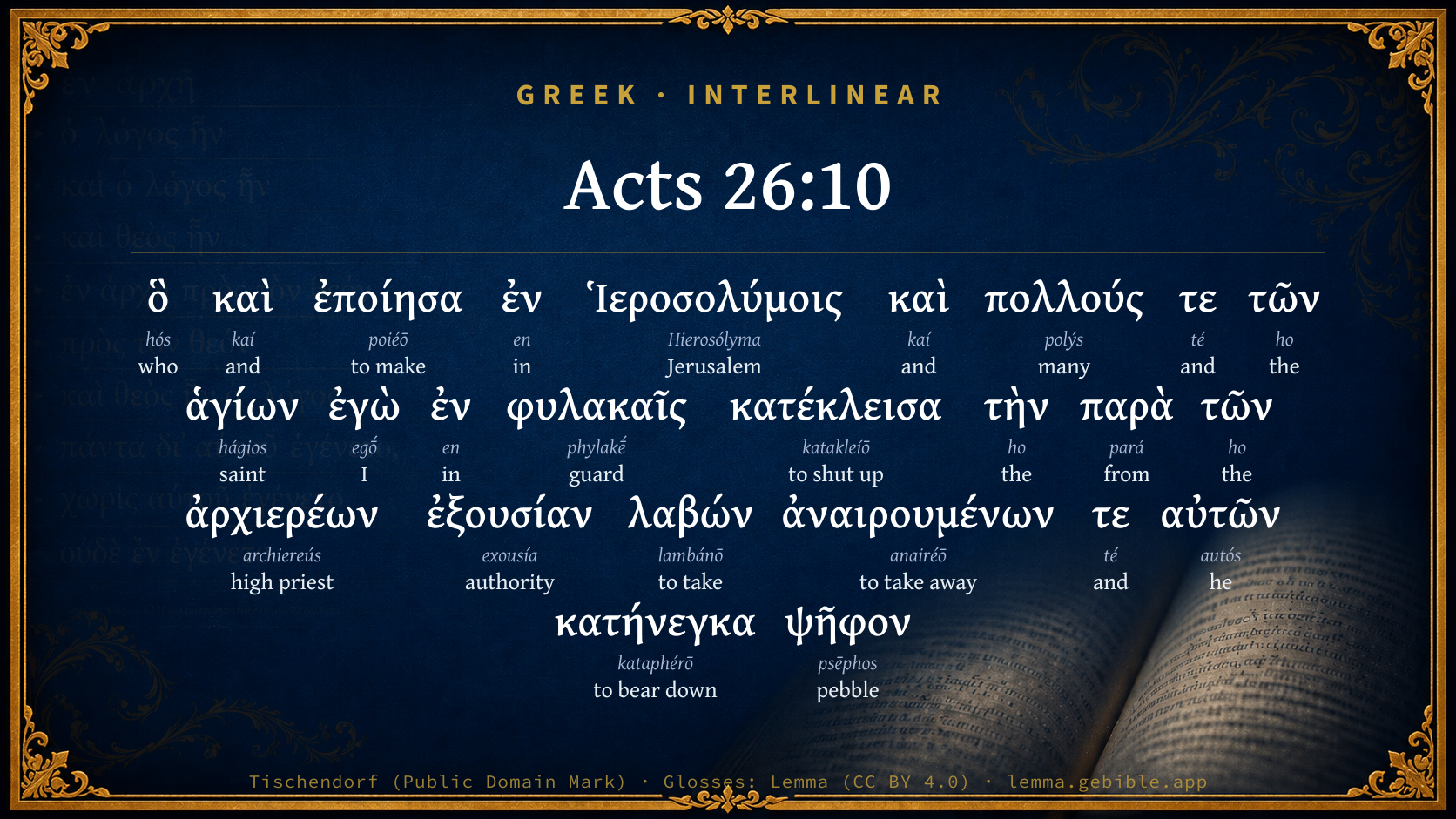
Download image
Cite this verse

Acts 26:10 (World English Bible). Public Domain. Lemma interlinear Bible study tool, https://lemma.gebible.app/v/acts/26/10.

Show BibTeX & RIS
BibTeX
RIS
English Translation
This I also did in Jerusalem. I both shut up many of the saints in prisons, having received authority from the chief priests, and when they were put to death I gave my vote against them.
World English Bible · Public Domain
Highlights
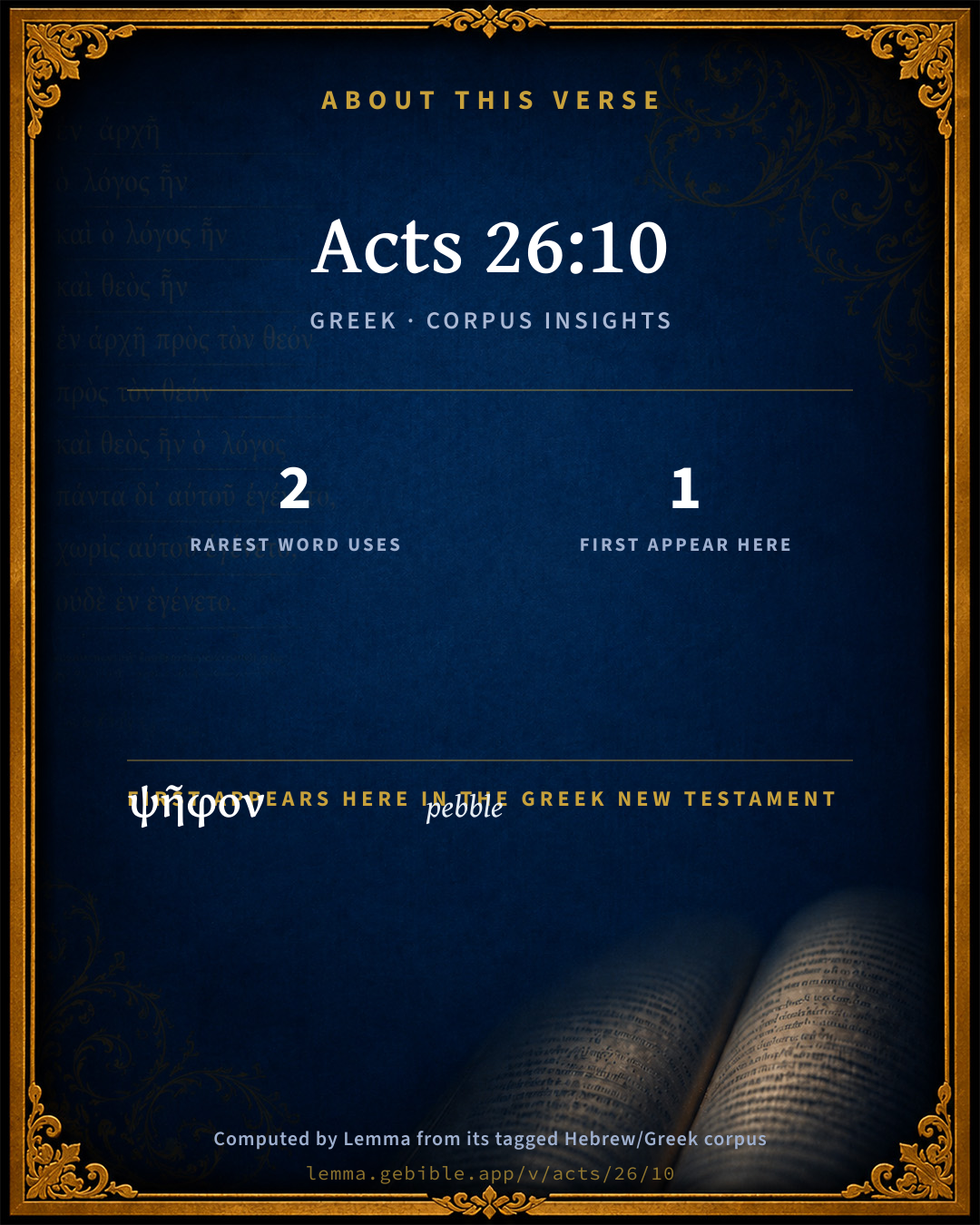
  • 1 first appearance in the Greek New Testament
Full analysis ↓
Download a study sheet

One document with this verse’s original text, its word-by-word gloss line, the meaning frame, cross-references with their text, attributed commentary, and full source and license credits — printable, and it pastes into notes with its structure intact.

This verse Autodidact and up

Study sheet (.html) Plain text (.txt)

A passage Seminary Student

Up to 50 verses in one chapter. A passage sheet keeps up to 6 commentary sources and 12 cross-references per verse, in the order this page ranks them, and says so on the sheet whenever that leaves anything out. Ask for a single verse and you get the Autodidact verse sheet above.

Everything on this page stays free to read, with no account — the sheet is a download of what is already on screen, not access to it.

Want to remove ads? Support Godless Engineer
Compare translations 3

The same verse in 3 English versions, stacked beneath the original-language interlinear above. Click any original word for its lexicon entry.

Each is an independent rendering of the whole verse — the interlinear is not word-aligned to these translations.

Highlighted words mark where these versions differ — a whole-verse word diff, not a word-by-word alignment.

  • World English Bible Public Domain
    This I also did in Jerusalem. I both shut up many of the saints in prisons, having received authority from the chief priests, and when they were put to death I gave my vote against them.
  • King James Version Public Domain
    Which thing I also did in Jerusalem: and many of the saints did I shut up in prison, having received authority from the chief priests; and when they were put to death, I gave my voice against them.
  • unfoldingWord Literal Text CC BY-SA 4.0
    which I did even in Jerusalem, and I even locked up many of the saints in prisons, having received authority from the chief priests, and when they were being executed, I cast my vote against them.

unfoldingWord Literal Text — © unfoldingWord, licensed CC BY-SA 4.0. Word-aligned USFM3 via Door43 (git.door43.org/unfoldingWord/en_ult).

Versions to compare (up to 4)

3 of 4 selected

Show all 19 translations

Every available English version of this verse, each an independent rendering of the whole verse.

  • World English Bible Public Domain
    This I also did in Jerusalem. I both shut up many of the saints in prisons, having received authority from the chief priests, and when they were put to death I gave my vote against them.
  • Berean Standard Bible Public Domain
    And that is what I did in Jerusalem. With authority from the chief priests I put many of the saints in prison, and when they were condemned to death, I cast my vote against them.
  • Majority Standard Bible Public Domain
    And that is what I did in Jerusalem. With authority from the chief priests I put many of the saints in prison, and when they were condemned to death, I cast my vote against them.
  • King James Version Public Domain
    Which thing I also did in Jerusalem: and many of the saints did I shut up in prison, having received authority from the chief priests; and when they were put to death, I gave my voice against them.
  • American Standard Version (1901) Public Domain
    And this I also did in Jerusalem: and I both shut up many of the saints in prisons, having received authority from the chief priests, and when they were put to death I gave my vote against them.
  • Revised Version (1885) Public Domain
    And this I also did in Jerusalem: and I both shut up many of the saints in prisons, having received authority from the chief priests, and when they were put to death, I gave my vote against them.
  • Geneva Bible (1599) Public Domain
    Which thing I also did in Hierusalem: for many of the Saints I shut vp in prison, hauing receiued authoritie of the hie Priests, and when they were put to death, I gaue my sentence.
  • Douay-Rheims (1899) Public Domain
    Which also I did at Jerusalem, and many of the saints did I shut up in prison, having received authority of the chief priests: and when they were put to death, I brought the sentence.
  • Young's Literal Translation Public Domain
    which also I did in Jerusalem, and many of the saints I in prison did shut up, from the chief priests having received the authority; they also being put to death, I gave my vote against them,
  • Literal Standard Version CC BY-SA 4.0
    which I also did in Jerusalem, and I shut up many of the holy ones in prison, having received the authority from the chief priests; they also being put to death, I gave my vote against them,
  • Unlocked Literal Bible CC BY-SA 4.0
    I did these in Jerusalem. I locked up many of the saints in prison by the authority I received from the chief priests, and when they were killed, I cast my vote against them.
  • unfoldingWord Literal Text CC BY-SA 4.0
    which I did even in Jerusalem, and I even locked up many of the saints in prisons, having received authority from the chief priests, and when they were being executed, I cast my vote against them.
  • Darby Bible Public Domain
    Which also I did in Jerusalem, and myself shut up in prisons many of the saints, having received the authority from the chief priests; and when they were put to death I gave my vote.
  • World Messianic Bible Public Domain
    I also did this in Jerusalem. I both shut up many of the holy ones in prisons, having received authority from the chief priests; and when they were put to death I gave my vote against them.
  • Webster's Bible Public Domain
    Which thing I also did in Jerusalem: and many of the saints did I shut up in prison, having received authority from the chief priests; and when they were put to death, I gave my voice against them.
  • Free Bible Version CC BY-SA 4.0
    This is what I did in Jerusalem. I threw many of the believers in prison, having been given authority to do this by the chief priests. When they were sentenced to death I cast my vote against them.
  • Bible in Basic English Public Domain
    And this I did in Jerusalem: and numbers of the saints I put in prison, having had authority given to me from the chief priests, and when they were put to death, I gave my decision against them.
  • Text-Critical English NT CC BY 4.0
    And that is just what I did in Jerusalem. I locked up many of the saints in prison by the authority I received from the chief priests, and when they were being put to death, I cast my vote against them.
  • Tyndale New Testament (1534) Public Domain
    which thinge I also dyd in Ierusalem. Where many of the sainctes I shut vp in preson and had receaved auctorite of the hye prestes. And when they were put to deeth I gave the sentence.

Literal Standard Version (2020), Covenant Press — licensed CC BY-SA 4.0. Text via the HelloAO Bible API (eBible.org). Unlocked Literal Bible (unfoldingWord) — licensed CC BY-SA 4.0. Text via the HelloAO Bible API (eBible.org). unfoldingWord Literal Text — © unfoldingWord, licensed CC BY-SA 4.0. Word-aligned USFM3 via Door43 (git.door43.org/unfoldingWord/en_ult). Free Bible Version, Dr. Jonathan Gallagher — licensed CC BY-SA 4.0. Text via the HelloAO Bible API (eBible.org).

Word by word

More ways to search: Search by grammar → Find every occurrence → Compare this word →

Practice this passage: Drill this verse → Learn its vocabulary →

κατέκλεισα
katakleíō
G2623
“to shut up”
Verb, Aorist, Active, Indicative, 1st person, Singular
Part of Speech
Verb
Tense
Aorist
Voice
Active
Mood
Indicative
Person
1st person
Number
Singular
Full Thayer's Definition

Origin: from G2596 and G2808

TDNT: None

1. to shut up, confine
  1. ὃ hós G3739 “who” Relative pronoun, Accusative, Singular, Neuter
  2. καὶ kaí G2532 “and” Conjunction
  3. ἐποίησα poiéō G4160 “to make” Verb, Aorist, Active, Indicative, 1st person, Singular
  4. ἐν en G1722 “in” Preposition
  5. Ἱεροσολύμοις Hierosólyma G2414 “Jerusalem” Noun, Dative, Plural, Neuter
  6. καὶ kaí G2532 “and” Conjunction
  7. πολλούς polýs G4183 “many” Adjective, Accusative, Plural, Masculine
  8. τε té G5037 “and” Particle
  9. τῶν ho G3588 “the” Article, Genitive, Plural, Masculine
  10. ἁγίων hágios G40 “saint” Adjective, Genitive, Plural, Masculine
  11. ἐγὼ egṓ G1473 “I” Personal pronoun, 1st person, Nominative, Singular
  12. ἐν en G1722 “in” Preposition
  13. φυλακαῖς phylakḗ G5438 “guard” Noun, Dative, Plural, Feminine
  14. τὴν ho G3588 “the” Article, Accusative, Singular, Feminine
  15. παρὰ pará G3844 “from” Preposition
  16. τῶν ho G3588 “the” Article, Genitive, Plural, Masculine
  17. ἀρχιερέων archiereús G749 “high priest” Noun, Genitive, Plural, Masculine
  18. ἐξουσίαν exousía G1849 “authority” Noun, Accusative, Singular, Feminine
  19. λαβών lambánō G2983 “to take” Verb, Aorist, Active, Participle, Nominative, Singular, Masculine
  20. ἀναιρουμένων anairéō G337 “to take away” Verb, Present, Passive, Participle, Genitive, Plural, Masculine
  21. τε té G5037 “and” Particle
  22. αὐτῶν autós G846 “he” Personal pronoun, Genitive, Plural, Masculine
  23. κατήνεγκα kataphérō G2702 “to bear down” Verb, Aorist, Active, Indicative, 1st person, Singular
  24. ψῆφον psēphos G5586 “pebble” Noun, Accusative, Singular, Feminine

About this verse

These counts appear in no published source. They are computed here, from the morphology-tagged text and Lemma’s own curated glosses. What Lemma adds →

25
words
20
distinct lemmas
Acts
section

Notable vocabulary

The rarest word here is κατέκλεισα to shut up G2623 — appearing just 2 times in the whole Greek New Testament.

First appearance in Scripture

This word makes its first canonical appearance in the Greek New Testament here:

  • ψῆφον pebble G5586

Shared distinctive vocabulary

κατέκλεισα to shut up G2623 occurs in 2 verses of the Greek New Testament. Also found in:
Repetition

Words recur within this verse:

Cross-references

17

Topical passages linked to Acts 26:10 in the Treasury of Scripture Knowledge — connected by theme and wording, ordered by reader-vote popularity; previews shown in the World English Bible.

  • Acts 8:3 But Saul ravaged the assembly, entering into every house, and dragged both men and women off to prison.
  • Acts 9:13–14 But Ananias answered, "Lord, I have heard from many about this man, how much evil he did to your saints at Jerusalem.
  • Acts 9:21 All who heard him were amazed, and said, "Isn't this he who in Jerusalem made havoc of those who called on this name? And he had come here intending to bring them bound before the chief priests!"
  • Acts 22:4–5 I persecuted this Way to the death, binding and delivering into prisons both men and women.
  • Acts 7:58 They threw him out of the city, and stoned him. The witnesses placed their garments at the feet of a young man named Saul.
  • Acts 8:1 Saul was consenting to his death. A great persecution arose against the assembly which was in Jerusalem in that day. They were all scattered abroad throughout the regions of Judea and Samaria, except for the apostles.
  • Acts 9:1–2 But Saul, still breathing threats and slaughter against the disciples of the Lord, went to the high priest,
  • Acts 9:26 When Saul had come to Jerusalem, he tried to join himself to the disciples; but they were all afraid of him, not believing that he was a disciple.
  • Acts 22:19–20 I said, 'Lord, they themselves know that I imprisoned and beat in every synagogue those who believed in you.
  • 1 Corinthians 15:9 For I am the least of the apostles, who is not worthy to be called an apostle, because I persecuted the assembly of God.
  • Psalms 16:3 As for the saints who are in the earth, They are the excellent ones in whom is all my delight.
  • Acts 9:32 It happened, as Peter went throughout all those parts, he came down also to the saints who lived at Lydda.
  • Acts 9:41 He gave her his hand, and raised her up. Calling the saints and widows, he presented her alive.
  • Romans 15:25–26 But now, I say, I am going to Jerusalem, serving the saints.
  • Galatians 1:13 For you have heard of my way of living in time past in the Jews' religion, how that beyond measure I persecuted the assembly of God, and ravaged it.
  • Ephesians 1:1 Paul, an apostle of Christ Jesus through the will of God, to the saints who are at Ephesus, and the faithful in Christ Jesus:
  • Revelation 17:6 I saw the woman drunken with the blood of the saints, and with the blood of the martyrs of Jesus. When I saw her, I wondered with great amazement.

Cross-references courtesy of OpenBible.info (CC BY 4.0).

Commentary

Notes on Acts 26:10 from classic Christian and Jewish commentators (each source and its license shown beneath its notes). The classic Christian expositions comment on the surrounding passage and are grouped to its opening verse, so a note may address several verses; the Jewish commentaries on the Tanakh (Rashi and others) are per-verse, so they appear only where the commentator wrote on this verse.

Lemma curates 59 commentaries, every one of them public domain or Creative Commons licensed, each selected and text-cleaned for this edition rather than reprinted as found. About our sources →

Bengel's Gnomon

Johann Albrecht Bengel

Act 26:10. Τῶν ἁγίων, of the saints) So he terms the Christians, in a manner appropriate to the beginning of his speech, using a term transferred to them from the Jews.—ἐγὼ, I) Emphasis.—τὴν) The article signifies that Paul could not have done this without the power (the authority); and that the chief priests gave a general power (authority) to all who wished to persecute.—κατήνεγκα ψῆφον) A rare phrase. Paul added his vote, since he thought what was done altogether right.

Bengel's Gnomon of the New Testament — English translation (T&T Clark, Edinburgh, 1860) — public domain. Text from a community e-Sword module.

Expositor's Greek Testament

ed. W. Robertson Nicoll

Act 26:10 . ὃ καὶ ἐποίησα , cf. Gal 2:10 (Bethge, p. 272), on the distinction between πράσσειν and ποιεῖν Westcott on St.Joh 3:22 . ἐγὼ : emphatic. τῶν ἁγίων , see above Act 9:13 , cf. its use in Act 9:32 ; the word aggravates St. Paul’s own guilt. Agrippa too would know of pious Jews by the same designation. ἀναιρ . τε αὐτῶν : probably pointing to more deaths, not as expressing the death of Stephen alone, cf. Act 8:1 , Act 9:1 , Act 22:4 . The state of affairs which rendered the murder of St. Stephen possible in the capital would easily account for similar acts of outrage in other places, so that there is no need to suppose with Weiss that the notice here is unhistorical. κατήνεγκα ψῆφον : “I gave my vote,” R.V., the ψῆφος , literally the pebble used in voting, calculum defero sc. in urnam (Grimm), i.e. , addo calculum, approbo, cf. ψῆφον φέρειν , ἐπιφ . or ἐκφ . If the phrase is taken quite literally, it is said to denote the vote of a judge, so that Paul must have been a member of the Sanhedrim, and gave his vote for the death of St. Stephen and other Christians. On the other hand the phrase is sometimes taken as simply = συνευδοκεῖν τῇ ἀναιρέσει (so amongst recent writers, Knabenbauer), Act 22:20 . (C. and H. think that if not a member of the Sanhedrim at the time of Stephen’s death, he was elected soon after, whilst Weiss holds that if the expression does not imply that the writer represents Paul by mistake as a member of the Sanhedrim, it can only be understood as meaning that by his testimony Paul gave a decisive weight to the verdict in condemnation of the Christians.) Certainly it seems, as Bethge urges, difficult to suppose that Paul was a member of such an august body as the Sanhedrim, not only on account of his probable age at the time of his conversion, but also because of his comparatively obscure circumstances. The Sanhedrim was an assembly of aristocrats, composed too of men of mature years and marked influence, and the question may be asked how Saul of Tarsus, who may not even have had a stated residence in the Holy City, could have found a place in the ranks of an assembly numbering the members of the high priestly families and the principal men of Judæa: see Expositor , June, 1897, and also for the bearing of the statement on the question of Paul’s marriage, with Hackett’s note, in loco . For the voting in the Sanhedrim see Schürer, div. ii., vol. i., p. 194. E.T. Rendall, p. 336, meets the difficulty above by referring the expression under discussion to a kind of popular vote confirming the sentence of the court against Stephen, for which he finds support in the language of the law and in the narrative of the proto-martyr’s condemnation.

The Expositor's Greek Testament, edited by W. Robertson Nicoll (1897–1910) — public domain. Text from a community e-Sword module.

Geneva Bible (1599)

Geneva Bible translators

I consented to, and allowed of their doing: for he was not a judge.

Geneva Bible (1599) marginal notes — public domain. Text via Bolls.life.

Adam Clarke's Commentary

Verse 10. Many of the saints] From what is said in this verse, it seems that Paul, before his conversion, was invested with much power: he imprisoned the Christians; punished many in various synagogues; compelled them to blaspheme-to renounce, and, perhaps, to execrate Christ, in order to save their lives; and gave his voice, exerted all his influence and authority, against them, in order that they might be put to death; and from this it would seem that there were other persons put to death besides St. Stephen, though their names are not mentioned.

Adam Clarke's Commentary on the Bible (1810–1826) — public domain. Text from a community e-Sword/MySword module.

John Calvin's Commentaries

10. Which thing I did. He proveth by his very facts with what force of zeal he was carried away to strive against Christ, until greater force did pull him back, and made him go the quite contrary way. Furthermore, his adversaries were witnesses of this his vehemency, so that it was most certain that he was suddenly changed; and undoubtedly the priests would never have put him in any such office, unless he had behaved himself courageously in exercising cruelty; and it was meet that he should be very courageous who should satisfy their fury. This is also to be noted, that Paul was not ashamed to confess how sore he had offended against God, so that that might turn to the glory of Christ. It was to him undoubtedly reproachful, to have been carried away with blind zeal, so that he enforced those to blaspheme which did desire to serve God; to have troubled the good and simple diversely; to have given sentence of the shedding of innocent blood; finally, to have lifted up his horns even unto heaven, until he was thrown down. But he doth not spare his own estimation, but doth willingly utter his own shame, that the mercy of God may the more plainly appear thereby.

Wherefore, there could no sinister suspicion rest in his speech, seeing that (without having any respect of himself) he saith, that he did utterly offend in those things whereby he got the praise of all the people. Therefore, he condemneth his very zeal of madness, which others did honor.

Whereby it appeareth how filthy the ambition of those men is, who are ashamed simply to confess, if they have offended through ignorance or error. For although they do not altogether excuse the same, yet they go about to lessen or paint these things, for which they ought humbly with sorrow and tears to crave pardon. But though Paul might have retained the fame of a courageous man, yet he confesseth he was a madman. For the participle which Luke useth importeth thus much, that he compelled many to blaspheme. By this we know that there was great corruption even in the very first fruits of believers, seeing that having first professed themselves to be disciples of Christ, and being afterwards discouraged with fear or stripes, they did not only deny him, but also spake evil of his blessed name. Though the very denial itself containeth an horrible blasphemy.

John Calvin's Commentaries (1540-1563) — public domain. Text from the Calvin Translation Society English edition (1840s-50s) via the Christian Classics Ethereal Library (ccel.org). Calvin's coverage is partial (roughly two-thirds of the Bible); uncommented books and verses are honest gaps, never fabricated. The 19th-century editor's footnotes and remarks are omitted so the notes are faithfully Calvin's own voice.

Ellicott's Commentary for English Readers

(10) Many of the saints did I shut up in prison.—The use of the term as applied to the believers in Christ (see Note on Act_9:13) is remarkable as an example of courage. In the presence of Agrippa, St. Paul does not shrink from speaking of them as the “holy ones” of God’s people Israel—what the Chasidim, or “devout ones” (the “Assideans” of 1Ma_7:13; 2Ma_14:6) had been in an earlier generation.

When they were put to death.—The history of the Acts records only one instance. Were there other martyrdoms besides that of Stephen, of which we know nothing? or does the Apostle speak in general terms of that single act? On the whole, the former seems the more probable alternative. He was breathing an atmosphere of “slaughter” (Act_9:1). On this view, the language of Heb_12:4, “ye have not yet resisted unto blood,” must be referred to the sufferings of a later time, or. more probably, of a different region. In 1Th_2:15, Jas_5:10, we have, perhaps, traces of widely extended sufferings.

I gave my voice against them.—Better, gave my vote. The words show that St. Paul, though a “young man” (see Note on Act_7:58), must have been a member either of the Sanhedrin itself or of some tribunal with delegated authority.

A Bible Commentary for English Readers, edited by Charles John Ellicott (1878–1897) — public domain. Text from a community e-Sword module.

The Cambridge Bible for Schools and Colleges

gen. ed. J. J. S. Perowne

10. Which thing I also did in Jerusalem] Saul must have been a most active and prominent agent in the work of persecution in Jerusalem, for we learn here that the death of Stephen was not the only one for which he had given his vote. He had also had the warrant of the chief priests for other arrests beside those he intended to make in Damascus. We can see that the slaughter of the Christians was not in all cases the result of a sudden outburst of rage at some act or speech, but that some of them were imprisoned, then subjected to a form of trial, and afterwards put to death as men condemned by law.

The Cambridge Bible for Schools and Colleges (gen. ed. J. J. S. Perowne; Cambridge University Press, 1878–1918) — public domain. Text from a community e-Sword module.

John Gill's Exposition

Which thing I also did in Jerusalem,.... The metropolis of Judea, where he had had his education, and was well known; here he consented to the death of Stephen, and held the clothes of the witnesses while they stoned him; and here he haled men and women out of their houses, and committed them to prison, and made havoc of the church of Christ, and destroyed the faith, and those that professed it, as much as in him lay.

And many of the saints I shut up in prison; at Jerusalem; see Act 8:3.

having received authority from the chief priests; to take them up, and imprison them.

And when they were put to death; for it seems there were more than Stephen put to death, though we have no account of them:

I gave my voice against them; not that he sat in council, or was a member of the Jewish sanhedrim, and voted for the execution of the Christians, but he was pleased with the sentence they passed, and approved of it; or he joined the zealots, who, without any form of law, seized on the Christians, and put them to death wherever they found them; and this he assented to, and encouraged: some render the words, "I carried the sentence"; as the Vulgate Latin version; that is, the sentence of condemnation, which the Jewish sanhedrim passed upon the disciples and followers of Christ: this Saul took, and carried, it may be, both to the Roman governor, to be signed by him, and to the officers to put it in execution; so industrious and forward was he in persecuting the saints.

John Gill's Exposition of the Whole Bible (1746–1763) — public domain (CC PDM 1.0). Text via the HelloAO Bible API.

Trapp's Complete Commentary

John Trapp

10 Which thing I also did in Jerusalem: and many of the saints did I shut up in prison, having received authority from the chief priests; and when they were put to death, I gave my voice against them.

Ver. 10. I gave my voice] So did Gerson to the condemnation of John Huss and Jerome of Prague at the Council of Constance, against his conscience doubtless. (Joh. Manl.) So did the Lord Cromwell to the condemnation of Lambert the martyr; for the which he afterwards cried him mercy. And so did Sir John Cheek, in Queen Mary’s days, out of a base fear of the bishops; he was, saith Mr Fox, through the crafty handling of the Catholics, allured first to dine and company with them; at length drawn unawares to sit in the place where the poor martyrs were brought before Bonner and other bishops, to be condemned; and so to give his voice, or seem to do so by his presence there. The remorse whereof so mightily wrought in his heart, that not long after he left this mortal life; whose fall though it was full of infirmity, yet his rising again by repentance was great, and his end comfortable.

John Trapp, A Commentary or Exposition upon All the Books of the Old and New Testament (1647–1656) — public domain. Text from a community e-Sword module.

Albert Barnes' Notes on the Bible

Which thing I also did ... - Act 8:3.

And many of the saints ... - Many Christians, Act 8:3.

And when they were put to death - In the history of those transactions, there is no account of any Christian being put to death except Stephen, Acts 7. But there is no improbability in supposing that the same thing which had happened to Stephen had occurred in other cases. Stephen was the first martyr, and as he was a prominent man his case is particularly recorded.

I gave my voice - Paul was not a member of the Sanhedrin, and this does not mean that he voted, but simply that he joined in the persecution; he approved it; he assented to the putting of the saints to death. Compare Act 22:20. The Syriac renders it, “I joined with those who condemned them.” It is evident, also, that Paul instigated them in this persecution, and urged them on to deeds of blood and cruelty.

Albert Barnes' Notes on the Bible (1834–1885) — public domain. Text from a community e-Sword/MySword module.

Haydock's Catholic Bible Commentary

I brought the sentence.[2] That is, from those who in the great council were judges of life and death, to those officers who were to put the sentence in execution. This seems to be the sense of these words, rather than, I voted, or gave my voice in condemning them; for we have no grounds to think St. Paul was one of the council, or of the judges. (Witham)

===============================

[BIBLIOGRAPHY]

Ego sententiam detuli, Greek: katenegka psephon, calculum, suffragium. It was the custom for judges to give their votes either by taking up a white or a black stone: that it, a white stone, if the persons judged were found not guilty, and a black stone, if guilty: so Ovid, Mos erat antiquis niveis, atrisque lapillis,

His damnare reos, illis absolvere culpa.

--- So that Greek: psephos was a lapillus, or a little stone made use of in giving sentence, and from thence taken for the sentence itself.

====================

George Leo Haydock (1774–1849), Haydock's Catholic Family Bible and Commentary, 1859 edition — public domain. Excludes Psalms (Douay-Rheims chapter numbering differs from Protestant) and Deuterocanonical books (Catholic canon only).

Matthew Poole's English Annotations

The saints; the professors of the religion of the holy Jesus, who are called to be saints, Rom 1:7, and have him for the great example of holiness, who fulfilled all righteousness; and from him they have the Spirit of holiness; being sanctified in him, 1Co 1:2; and whosoever hath not his Spirit, he is none of his, Rom 8:9.

I gave my voice against them: Paul was not one of the council, nor, that we read of, in any office or place to judge any person; besides, the Jews are thought to have had no power of life and death; and that St. Stephen was slain rather in a popular tumult, than legally: but Paul may be said to do this, by carrying the suffrages or sentence to the Roman man president, or any others, to get it executed (for so the words will bear); and howsoever, by his approving, rejoicing at, and delighting in their condemnation, (which was indeed giving his voice, as much as he could, against them), this was verified.

Matthew Poole's English Annotations on the Holy Bible (1683–1685) — public domain. Text from a community e-Sword/MySword module.

Whedon's Commentary on the Bible

Daniel D. Whedon

10. I also did—The apostle paints his sad behaviour with a copious accumulation of particulars. Perhaps a true interpretation would reduce some of his indignant and eloquent self-condemnations as hyperboles.

Saints—By this striking word here Paul asserts to Agrippa the holy character of his victims, and aggravates his own misdoing.

They… death—The plural perhaps for the singular, as it is doubtful whether any person suffered death besides Stephen.

Voice—The Greek word signifies the pebble, which (before the invention of the modern paper) was anciently used for voting. Some have inferred from this that young Saul was a member of the Sanhedrin; erroneously, for he was not of sufficient age. Others suppose that his vote was given in the informal consultations that took place. More probably it is a metaphorical use of the word, as we would use the word suffrage to indicate one’s support of a movement.

Daniel D. Whedon (gen. ed.), Commentary on the Old and New Testaments (1874–1909) — public domain. Text from a community e-Sword module.

The Pulpit Commentary

And this for which thing, A.V.; I both shut up for did I shut up, A.V. (with a change of order); prisons for prison, A.V.; vote for voice, A.V.. I...shut up. The ejgw is emphatic. The verb katakleiw, peculiar to St. Luke. (see Luk_3:20) is much used by medical writers. Were put to death; ajnairoumenwn, a word frequent in St. Luke"s writings, and much used in medical works, as well as ajnairesiv. (Act_8:1) The phrase kataferein yhfon is unusual; ferein yhfon is the more common phrase, both in Josephus and in classical writers. I gave my vote, etc. Not, as Meyer and others take it, "I assented to it, at the moment of their being killed," equivalent to suneudokwn of Act_22:20; but rather," when the Christians were being punished with death, I was one of those who in the Sanhedrim voted for their death."

The Pulpit Commentary (1880–1919), ed. H.D.M. Spence-Jones & Joseph S. Exell — public domain. Text from a community e-Sword module.

John Wesley's Explanatory Notes

I shut up many of the saints - Men not only innocent, but good, just, holy. I gave my vote against them - That is, I joined with those who condemned them. Perhaps the chief priests did also give him power to vote on these occasions.

John Wesley, Explanatory Notes Upon the Whole Bible (1754–1765) — public domain. Text via the GEBible commentary corpus.

McGarvey & Pendleton's Commentaries

J. W. McGarvey

See notes on verse 9

J. W. McGarvey (with Philip Y. Pendleton), Commentaries on the New Testament (The Fourfold Gospel, 1914; Acts; and the epistles) — public domain. Text from a community e-Sword/MySword module.

Cambridge Greek Testament for Schools and Colleges

10. καὶ ἐποίησα ἐν Ἰεροσολύμοις, which thing I also did in Jerusalem. Saul must have been a most active and prominent agent in the work of persecution in Jerusalem, for we learn here that the death of Stephen was not the only one for which he had given his vote. He had also had the warrant of the chief priests for other arrests beside those he intended to make in Damascus. We can see that the slaughter of the Christians was not in all cases the result of a sudden outburst of rage at some act or speech, but that some of them were imprisoned, then subjected to a form of trial, and afterwards put to death as men condemned by law.

φυλακαῖς. On the use of this word in the plural Bee Act 22:4, note.

ψῆφον, vote. Of course the sense is the same as ‘voice’ in A.V., but the literal translation brings out more prominently that these proceedings were all carried on in a formal and quasi-legal manner.

Cambridge Greek Testament for Schools and Colleges (Cambridge University Press, 1896; 21 vols, various authors incl. Carr, Maclear, Plummer, Farrar, Lumby, Moule, M. R. James, Simcox) — public domain. Text from a community e-Sword module.

Vincent's Word Studies in the New Testament

Marvin R. Vincent

Saints [των αγιων] . Lit., the holy ones. Paul did not call the Christians by this name when addressing the Jews, for this would have enraged them; but before Agrippa he uses the word without fear of giving offense. On this word agiov, holy, which occurs over two hundred times in the New Testament, it is to be noted how the writers of the Greek scriptures, both in the New Testament and, what is more remarkable, in the Septuagint, bring it out from the background in which it was left by classical writers, and give preference to it over words which, in pagan usage, represented conceptions of mere externality in religion. Even in the Old Testament, where externality is emphasized, agiov is the standard word for holy. 28 Gave my voice [κατηνεγκα ψηφον] . Lit., laid down my vote. See on counteth, Luk 14:28. Some suppose that Paul here refers to casting his vote as a member of the Sanhedrim; in which case he must have been married and the father of a family. But this there is no reason for believing (compare 1Co 7:7, 8); and the phrase may be taken as expressing merely moral assent and approval.

Marvin R. Vincent, Word Studies in the New Testament (1887–1900) — public domain. Text from a community e-Sword/MySword module.

Lesson kit

Teaching starters — assembled from the data on this page, not authored interpretation. Every prompt links to the verse data it draws on. Edit before teaching.

Acts, in the Acts, opens this verse with 25 words (20 distinct Greek lemmas). Its most distinctive word is katakleíō (“to shut up”). A historical commentator’s framing appears above. Read the whole chapter for the surrounding context.

Discussion questions

  1. The word katakleíō carries the sense “to shut up.” How does it shape the verse?
  2. The word “pebble” first appears here in Scripture. What is being introduced at this debut?
  3. Luke 3:20 shares the word «to shut up» with this verse. How do the two illuminate each other?
  4. “the” occurs 3× in this one verse. What is the effect of the repetition?
  5. The translations on this page render this verse differently — a whole-verse word diff, not a word-by-word alignment. What might account for the different wordings?
  6. Reading how Bengel's Gnomon and Expositor's Greek Testament read this verse, where do the two commentators agree and where do they part?

Things to notice

  • 1 word makes its first canonical appearance in Scripture here.
  • These translations choose different wording for 17 words in this verse.
  • “the” occurs 3× in this single verse.
  • 20 distinct Greek lemmas span 25 words in this verse.

Reading settings

Reading text

Shown beneath each verse's original-language words.

Old Testament
Old Testament edition

Read the OT as the Masoretic Hebrew (MT) or the Greek Septuagint (LXX).

English shown for the Greek Septuagint (in the Hebrew ↔ Greek comparison).

Comparing translations? Open the Compare panel on any verse page to stack up to four side by side.