Romans 15:26

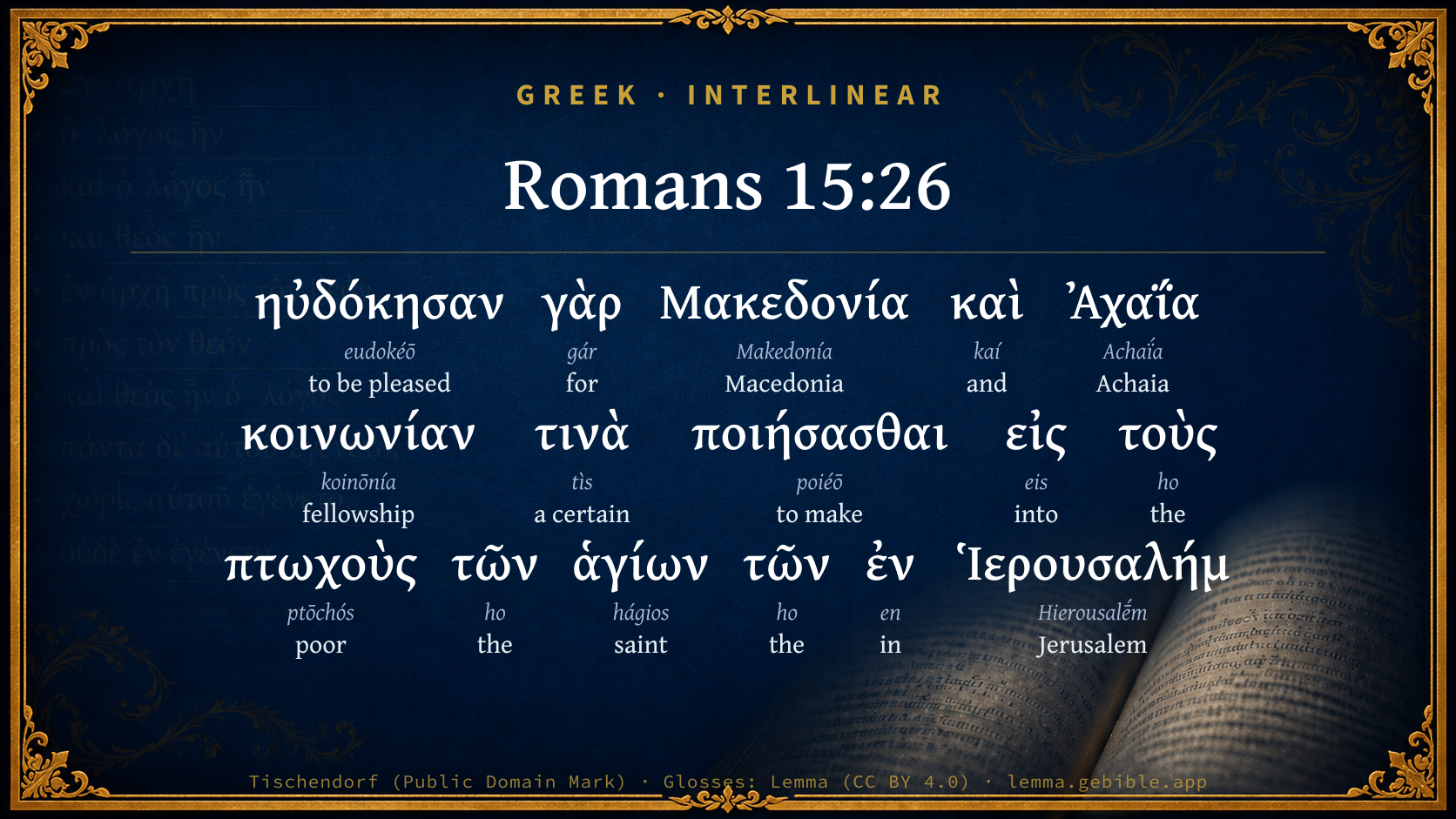
Greek (Tischendorf 8th ed.) Romans 15:26 appears in the Greek New Testament. The text above is from the Tischendorf 8th edition. Each word links to its Strong’s number and a concise gloss. Click any word for its full Thayer’s Greek Lexicon entry.
Download image
Cite this verse

Romans 15:26 (World English Bible). Public Domain. Lemma interlinear Bible study tool, https://lemma.gebible.app/v/romans/15/26.

Show BibTeX & RIS
BibTeX
RIS
English Translation
For it has been the good pleasure of Macedonia and Achaia to make a certain contribution for the poor among the saints who are at Jerusalem.
World English Bible · Public Domain
Download a study sheet

One document with this verse’s original text, its word-by-word gloss line, the meaning frame, cross-references with their text, attributed commentary, and full source and license credits — printable, and it pastes into notes with its structure intact.

This verse Autodidact and up

Study sheet (.html) Plain text (.txt)

A passage Seminary Student

Up to 50 verses in one chapter. A passage sheet keeps up to 6 commentary sources and 12 cross-references per verse, in the order this page ranks them, and says so on the sheet whenever that leaves anything out. Ask for a single verse and you get the Autodidact verse sheet above.

Everything on this page stays free to read, with no account — the sheet is a download of what is already on screen, not access to it.

Want to remove ads? Support Godless Engineer
Compare translations 3

The same verse in 3 English versions, stacked beneath the original-language interlinear above. Click any original word for its lexicon entry.

Each is an independent rendering of the whole verse — the interlinear is not word-aligned to these translations.

Highlighted words mark where these versions differ — a whole-verse word diff, not a word-by-word alignment.

  • World English Bible Public Domain
    For it has been the good pleasure of Macedonia and Achaia to make a certain contribution for the poor among the saints who are at Jerusalem.
  • King James Version Public Domain
    For it hath pleased them of Macedonia and Achaia to make a certain contribution for the poor saints which are at Jerusalem.
  • unfoldingWord Literal Text CC BY-SA 4.0
    For Macedonia and Achaia were well-pleased to make a certain contribution to the poor ones of the saints in Jerusalem.

unfoldingWord Literal Text — © unfoldingWord, licensed CC BY-SA 4.0. Word-aligned USFM3 via Door43 (git.door43.org/unfoldingWord/en_ult).

Versions to compare (up to 4)

3 of 4 selected

Show all 19 translations

Every available English version of this verse, each an independent rendering of the whole verse.

  • World English Bible Public Domain
    For it has been the good pleasure of Macedonia and Achaia to make a certain contribution for the poor among the saints who are at Jerusalem.
  • Berean Standard Bible Public Domain
    For Macedonia and Achaia were pleased to make a contribution for the poor among the saints in Jerusalem.
  • Majority Standard Bible Public Domain
    For Macedonia and Achaia were pleased to make a contribution for the poor among the saints in Jerusalem.
  • King James Version Public Domain
    For it hath pleased them of Macedonia and Achaia to make a certain contribution for the poor saints which are at Jerusalem.
  • American Standard Version (1901) Public Domain
    For it hath been the good pleasure of Macedonia and Achaia to make a certain contribution for the poor among the saints that are at Jerusalem.
  • Revised Version (1885) Public Domain
    For it hath been the good pleasure of Macedonia and Achaia to make a certain contribution for the poor among the saints that are at Jerusalem.
  • Geneva Bible (1599) Public Domain
    For it hath pleased them of Macedonia and Achaia, to make a certaine distribution vnto the poore Saints which are at Hierusalem.
  • Douay-Rheims (1899) Public Domain
    For it hath pleased them of Macedonia and Achaia to make a contribution for the poor of the saints that are in Jerusalem.
  • Young's Literal Translation Public Domain
    for it pleased Macedonia and Achaia well to make a certain contribution for the poor of the saints who `are' in Jerusalem;
  • Literal Standard Version CC BY-SA 4.0
    for it pleased Macedonia and Achaia well to make a certain contribution for the poor of the holy ones who [are] in Jerusalem;
  • Unlocked Literal Bible CC BY-SA 4.0
    For it was the good pleasure of Macedonia and Achaia to make a certain contribution to the poor among the saints who are in Jerusalem.
  • unfoldingWord Literal Text CC BY-SA 4.0
    For Macedonia and Achaia were well-pleased to make a certain contribution to the poor ones of the saints in Jerusalem.
  • Darby Bible Public Domain
    for Macedonia and Achaia have been well pleased to make a certain contribution for the poor of the saints who [are] in Jerusalem.
  • World Messianic Bible Public Domain
    For it has been the good pleasure of Macedonia and Achaia to make a certain contribution for the poor among the holy ones who are at Jerusalem.
  • Webster's Bible Public Domain
    For it hath pleased them of Macedonia and Achaia to make a certain contribution for the poor of the saints who are at Jerusalem.
  • Free Bible Version CC BY-SA 4.0
    because the believers in Macedonia and Achaia thought it was a good idea to send a contribution to the poor among the believers in Jerusalem.
  • Bible in Basic English Public Domain
    For it has been the good pleasure of those of Macedonia and Achaia to send a certain amount of money for the poor among the saints at Jerusalem.
  • Text-Critical English NT CC BY 4.0
    For Macedonia and Achaia have been pleased to make a contribution for the poor among the saints in Jerusalem.
  • Tyndale New Testament (1534) Public Domain
    For it hath pleased them of Macedonia and Achaia to make a certayne distribucion vpo the poore saynctes which are at Ierusalem.

Literal Standard Version (2020), Covenant Press — licensed CC BY-SA 4.0. Text via the HelloAO Bible API (eBible.org). Unlocked Literal Bible (unfoldingWord) — licensed CC BY-SA 4.0. Text via the HelloAO Bible API (eBible.org). unfoldingWord Literal Text — © unfoldingWord, licensed CC BY-SA 4.0. Word-aligned USFM3 via Door43 (git.door43.org/unfoldingWord/en_ult). Free Bible Version, Dr. Jonathan Gallagher — licensed CC BY-SA 4.0. Text via the HelloAO Bible API (eBible.org).

Word by word

More ways to search: Search by grammar → Find every occurrence → Compare this word →

Practice this passage: Drill this verse → Learn its vocabulary →

Ἀχαΐα
Achaḯa
G882
“Achaia”
Noun, Nominative, Singular, Feminine
Part of Speech
Noun
Case
Nominative
Number
Singular
Gender
Feminine
Full Thayer's Definition

Origin: of uncertain derivation

TDNT: None

Achaia = "trouble" 1. in a restricted sense, the maritime region of northern Peloponnesus 2. in a broader sense, a Roman province embracing all Greece except Thessaly
  1. ηὐδόκησαν eudokéō G2106 “to be pleased” Verb, Aorist, Active, Indicative, 3rd person, Plural
  2. γὰρ gár G1063 “for” Conjunction
  3. Μακεδονία Makedonía G3109 “Macedonia” Noun, Nominative, Singular, Feminine
  4. καὶ kaí G2532 “and” Conjunction
  5. κοινωνίαν koinōnía G2842 “fellowship” Noun, Accusative, Singular, Feminine
  6. τινὰ tìs G5100 “a certain” Indefinite pronoun, Accusative, Singular, Feminine
  7. ποιήσασθαι poiéō G4160 “to make” Verb, Aorist, Middle, Infinitive
  8. εἰς eis G1519 “into” Preposition
  9. τοὺς ho G3588 “the” Article, Accusative, Plural, Masculine
  10. πτωχοὺς ptōchós G4434 “poor” Adjective, Accusative, Plural, Masculine
  11. τῶν ho G3588 “the” Article, Genitive, Plural, Masculine
  12. ἁγίων hágios G40 “saint” Adjective, Genitive, Plural, Masculine
  13. τῶν ho G3588 “the” Article, Genitive, Plural, Masculine
  14. ἐν en G1722 “in” Preposition
  15. Ἱερουσαλήμ Hierousalḗm G2419 “Jerusalem” Noun, Proper, indeclinable

About this verse

These counts appear in no published source. They are computed here, from the morphology-tagged text and Lemma’s own curated glosses. What Lemma adds →

16
words
14
distinct lemmas
Pauline Epistles
section

Notable vocabulary

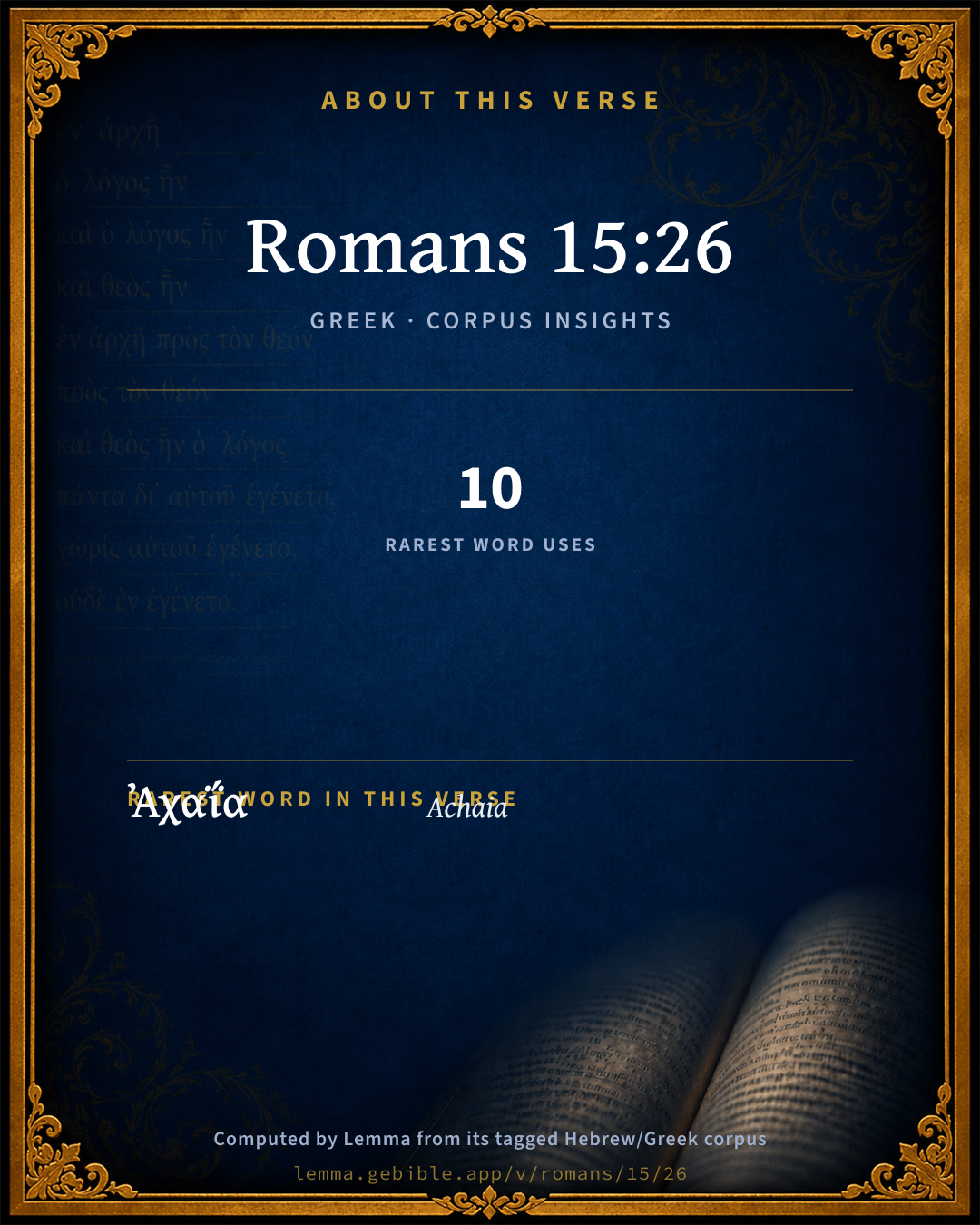
The rarest word here is Ἀχαΐα Achaia G882 — appearing just 10 times in the whole Greek New Testament.

Shared distinctive vocabulary

Ἀχαΐα Achaia G882 occurs in 10 verses of the Greek New Testament. Also found in:

Repetition

A word recurs within this verse:

  • τοὺς the G3588 ×3

Cross-references

19

Topical passages linked to Romans 15:26 in the Treasury of Scripture Knowledge — connected by theme and wording, ordered by reader-vote popularity; previews shown in the World English Bible.

  • 2 Corinthians 8:1–9 Moreover, brothers, we make known to you the grace of God which has been given in the assemblies of Macedonia;
  • Acts 11:27–30 Now in these days, prophets came down from Jerusalem to Antioch.
  • 2 Corinthians 9:2 for I know your readiness, of which I boast on your behalf to them of Macedonia, that Achaia has been prepared for a year past. Your zeal has stirred up very many of them.
  • 2 Corinthians 9:12 For this service of giving that you perform not only makes up for lack among the saints, but abounds also through many givings of thanks to God;
  • James 2:5–6 Listen, my beloved brothers. Didn't God choose those who are poor in this world to be rich in faith, and heirs of the Kingdom which he promised to those who love him?
  • Proverbs 14:21 He who despises his neighbor sins, But blessed is he who has pity on the poor.
  • Proverbs 14:31 He who oppresses the poor shows contempt for his Maker, But he who is kind to the needy honors him.
  • Proverbs 17:5 Whoever mocks the poor reproaches his Maker. He who is glad at calamity shall not be unpunished.
  • Zechariah 11:7 So I fed the flock of slaughter, especially the oppressed of the flock. I took for myself two staffs. The one I called "Favor," and the other I called "Union," and I fed the flock.
  • Zechariah 11:11 It was broken in that day; and thus the poor of the flock that listened to me knew that it was the word of Yahweh.
  • Matthew 25:40 "The King will answer them, 'Most assuredly I tell you, inasmuch as you did it to one of the least of these my brothers, you did it to me.'
  • Matthew 26:11 For you always have the poor with you; but you don't always have me.
  • Luke 6:20 He lifted up his eyes to his disciples, and said, "Blessed are you who are poor, For yours is the Kingdom of God.
  • Luke 14:13 But when you make a feast, ask the poor, the maimed, the lame, or the blind;
  • Acts 16:9 A vision appeared to Paul in the night. There was a man of Macedonia standing, begging him, and saying, "Come over into Macedonia and help us."
  • Acts 18:12 But when Gallio was proconsul of Achaia, the Jews with one accord rose up against Paul and brought him before the judgment seat,
  • 1 Corinthians 16:15 Now I beg you, brothers (you know the house of Stephanas, that it is the first fruits of Achaia, and that they have set themselves to minister to the saints),
  • Galatians 6:6–10 But let him who is taught in the word share all good things with him who teaches.
  • Philemon 1:5 hearing of your love, and of the faith which you have toward the Lord Jesus, and toward all the saints;

Cross-references courtesy of OpenBible.info (CC BY 4.0).

Commentary

Notes on Romans 15:26 from classic Christian and Jewish commentators (each source and its license shown beneath its notes). The classic Christian expositions comment on the surrounding passage and are grouped to its opening verse, so a note may address several verses; the Jewish commentaries on the Tanakh (Rashi and others) are per-verse, so they appear only where the commentator wrote on this verse.

Lemma curates 59 commentaries, every one of them public domain or Creative Commons licensed, each selected and text-cleaned for this edition rather than reprinted as found. About our sources →

Tyndale Open Study Notes

Tyndale Open Resources

15:26 Paul founded churches in several prominent cities in Macedonia, including Philippi, Thessalonica, and Berea. In Achaia, Paul had preached in Athens and founded the church in Corinth (see Acts 16–18). • the poor among the believers in Jerusalem: Jewish Christians in Jerusalem were suffering from famines that had hit the area (see Acts 11:27-30) and also because their faith in Christ caused them to be ostracized from Jewish society.

Tyndale Open Study Notes — © Tyndale Open Resources, licensed CC BY-SA 4.0. Text via the HelloAO Bible API.

Bengel's Gnomon

Johann Albrecht Bengel

Rom 15:26. Μακεδονία καὶ ʼ Αχαΐα, Macedonia and Achaia) From this expression the time, at which the epistle was written, may be gathered, Act 19:21.—Κοινωνίαν, an act of communion, or communication [a contribution]) A term of description [applied to their gift of brotherly love] honourable and exceedingly just.—τῶν ἁγίων, of the saints) He does not say, poor saints (Gr. the poor among the saints). Therefore not all the saints were poor. Therefore the community of goods had now ceased at Jerusalem, after the death of Ananias and Sapphira, and after the persecution, Act 8:1.

Bengel's Gnomon of the New Testament — English translation (T&T Clark, Edinburgh, 1860) — public domain. Text from a community e-Sword module.

Meyer's Critical & Exegetical Commentary

Heinrich August Wilhelm Meyer

Rom_15:26. More precise information respecting the διακονῶν τοῖς ἁγ.: Placuit enim Macedonibus, etc. On εὐδόκ., they have been pleased, comp. Luk_12:32; 1Co_1:21; Gal_1:15; Col_1:19; 1Th_2:8.

κοινων. τινὰ ποιής. κ.τ.λ.] to bring about a participation, in reference to the poor, i.e. to make a collection for them. The contributor, namely, enters into fellowship with the person aided, in so far as he κοινωνεῖ ταῖς χρείαις αὐτοῦ, Rom_12:13; κοινωνία is hence the characteristic expression for almsgiving, without, however, having changed its proper sense communio into the active one of communication; honesta et aequitatis plena appellatio, Bengel. Comp. 2Co_9:13; Heb_13:16. The added τινὰ, of some sort or other, corresponds to the freedom from constraint, and the consequent indefiniteness, of the amount to be aimed at. On the collection itself, see 1Co_16:1 ff.; 2Co_8:9; Act_24:17.

τοὺς πτωχοὺς τῶν ἁγ.] the poor among the saints at Jerusalem. These were thus not all of them poor. Comp. Kühner, II. 1, p. 290. Of the community of goods there is no longer a trace in Paul. Philippi incorrectly holds that the πτωχοὶ τῶν ἁγίων are the poor saints generally. Since the genitive is in any case partitive (even in the passages in Matthiae, § 320, p. 791), the expression must at least have been τοὺς (not τῶν) ἐν Ἱερους.

Meyer — Critical and Exegetical Commentary on the New Testament — English translation by Peter Christie, edited by Frederick Crombie (T&T Clark, 1880) — public domain. Text from a community e-Sword module.

Expositor's Greek Testament

ed. W. Robertson Nicoll

Rom 15:26 . εὐδόκησαν γὰρ Μακεδονία καὶ Ἀχαία : Macedonia and Achaia would include all the Pauline Churches in Europe, and we know from 1Co 16:1 that a similar contribution was being made in Galatia. εὐδόκησαν expresses the formal resolution of the churches in question, but here as in many places with the idea that it was a spontaneous and cordial resolution (though it had been suggested by Paul): see chap. Rom 10:1 (Fritzsche’s note there), Luk 12:32 , Gal 1:15 , 1Co 1:21 , 1Th 2:8 ; 1Th 3:1 . κοινωνίαν τινὰ : τινὰ marks the in-definiteness of the collection. It was no assessment to raise a prescribed amount, but “some contribution,” more or less according to will and circumstances. For κοινωνίαν in this sense see 2Co 8:4 ; 2Co 9:13 : where the whole subject is discussed. εἰς τοὺς πτωχοὺς τῶν ἁγίων : from the partitive genitive it is clear that not all the saints in Jerusalem were poor. But Gal 2:10 , Act 6 show that the community at least included many poor, towards whom it assumed a responsibility so burdensome that it was unable to discharge it unaided.

The Expositor's Greek Testament, edited by W. Robertson Nicoll (1897–1910) — public domain. Text from a community e-Sword module.

Hodge's Commentary on Romans, Ephesians & First Corinthians

Charles Hodge

Rom_15:26, Rom_15:27

For it hath pleased them of Macedonia and Achaia to make a contribution for the poor saints which are at Jerusalem. To make a contribution, κοινωνίαν τινὰ ποιήσασθαι, to bring about a communion or participation. That is, to cause the poor in Jerusalem to partake of the abundance of the brethren in Achaia. In this way the ordinary intransitive sense of the word κοινωνία is retained. Compare, however, 2Co_9:13, and Heb_13:16, where the transitive sense of the word is commonly preferred. Having mentioned this fact, the apostle immediately seizes the opportunity of showing the reasonableness and duty of making these contributions. This he does in such a way as not to detract from the credit due to the Grecian churches, while he shows that it was but a matter of justice to act as they had done. It hath pleased them verily; and their debtors they are; i.e. It hath pleased them, I say (ga&r, redordiendae rationi inservit), they did it voluntarily, yet it was but reasonable they should do it. The ground of this statement is immediately added: For if the Gentiles have been made partakers of their spiritual things, their duty is also to minister to them in carnal things. If the Gentiles have received the greater good from the Jews, they may well be expected to contribute the lesser. The word (λειτουργῆσαι) rendered to minister, may have the general sense of serving; or it may be used with some allusion to the service being a sacred duty, a kind of offering which is acceptable to God. Nec dubito, quin significet Paulus sacrificii speciem esse, quum de suo erogant fideles ad egestatem fratrum levandam. Sic enim persolvunt quod debent caritatis officium, ut Deo simul hostiam grati odoris offerant: sed proprie hoc loco ad illud mutuum jus compensationis respexit. Calvin. This, however, is not very probable, as the expression is, λειτουργῆσαι αὐτοῖς, to minister to them. The λειτουργία was rendered to the brethren, not to God.

Charles Hodge — Commentary on Romans (1835), First Corinthians (1857), and Ephesians (1856) — public domain. Text from a community e-Sword module.

Jamieson, Fausset & Brown

Robert Jamieson, A. R. Fausset & David Brown

For, &c.--better, "For Macedonia and Achaia have thought good to make a certain contribution for the poor of the saints which are at Jerusalem." (See Act 24:17). "They have thought it good; and their debtors verily they are"; that is, "And well they may, considering what the Gentile believers owe to their Jewish brethren."

Jamieson, Fausset & Brown — Commentary Critical and Explanatory on the Whole Bible (1871) — public domain (CC PDM 1.0). Text via the HelloAO Bible API.

Ellicott's Commentary for English Readers

(26) The poor saints.—Literally, for the poor among the saints. It cannot, therefore, be inferred from this that the church at Jerusalem consisted entirely of poor. Still from the first it would seem as if persons like Joseph of Arimathæa, and Nicodemus, and Mary the mother of Mark, were exceptions, and we know that the church at Jerusalem suffered severely during the famine in the reign of Claudius. Wealthier churches, such as those of Macedonia and Greece, would naturally be glad to have the opportunity of sending relief to the mother church, from which they might be said to be derived themselves. St. Paul himself proceeds to urge this very argument. From Jerusalem went forth the gospel which had been preached in Greece and Macedonia, and it would be but a small and due return if some of the superfluous wealth of those more favoured regions found its way to Jerusalem.

A Bible Commentary for English Readers, edited by Charles John Ellicott (1878–1897) — public domain. Text from a community e-Sword module.

The Cambridge Bible for Schools and Colleges

gen. ed. J. J. S. Perowne

26. For it hath pleased, &c.] Lit. For Macedonia and Achaia were pleased. (The tense is aor., perhaps here an “epistolary past.”) The verb rendered “were pleased” implies, as E. V. also does, not only a voluntary act but the act of a superior; in the sense in which the giver of bounty is the superior party. It is no doubt chosen as a word of gentle irony, to be used further in the next sentence.

“Macedonia and Achaia” are the personification of the Churches of Greece, North and South.

a contribution] Lit. a communion. The giver communicates, or shares his store, with the receiver.—The word is kindred to the Gr. of “distributing,” Rom_12:13.

For this same Collection, see 1Co_16:1-4, where incidentally we see the Apostle’s own influence, methodical care, and high sense of honour, at work in the matter. See too 2Co_8:1-14; 2Co_9:1-15, for beautiful examples of appeal in this same matter to “Achaia” and to “Macedonia” respectively.

On this passage as a note of chronology, see Introduction, ii. § 1.

for the poor saints] Lit., and better, for the poor among the saints. The Christians at Jerusalem were not all poor, but included an unusually large proportion of poor, apparently, among them. Doubtless the special influences of the Capital of Pharisaism kept Christian artizans at a great disadvantage in matter of employment.

The Cambridge Bible for Schools and Colleges (gen. ed. J. J. S. Perowne; Cambridge University Press, 1878–1918) — public domain. Text from a community e-Sword module.

John Gill's Exposition

For it hath pleased them of Macedonia and Achaia,.... That is, the churches of Macedonia, particularly Philippi and Thessalonica; and the churches of Achaia, especially the church at Corinth, which was the metropolis of Achaia:

to make a certain contribution for the poor saints which are at Jerusalem; of which contribution, of their great forwardness, readiness, and liberality, a large account is given in Co2 8:1; from whence Origen and others have rightly concluded, that this epistle to the Romans was wrote after that; since in that the apostle exhorts and encourages them, by the example of the Macedonian churches, to finish the collection they had begun; which collection is here called a contribution, or "communion", as the word signifies; it being one part of the communion of churches and of saints, to relieve their poor, by communicating to them, and to assist each other therein; and in which they have not only fellowship with one another, but with Christ the head; who takes what is done to the least of his brethren as done to himself: the persons for whom the collection was made, are "the poor saints", or "the poor of the saints"; for not all the saints, but the poor among them, were the objects of this generosity: they were saints such as are sanctified by God the Father in eternal election, and by the blood of Christ in redemption, and by the Spirit of Christ in the effectual calling, to these this goodness extended; for though good is to be done to all men, yet more especially to the household of faith: they were "poor", which is the lot of many who are saints, whom God has chosen, to whom the Gospel is preached, and who are called by grace: these came to be so, either through the great dearth which was throughout the world in the times of Claudius Caesar, when the brethren at Jerusalem particularly suffered, and were relieved by the disciples at Antioch; but this collection was made some years after that, and therefore rather they became so, through the persecutions of their countrymen; by whom they suffered joyfully the spoiling of their goods, knowing that they had a better and more enduring substance in heaven; or else through their having sold all their possessions, and thrown their money into one common stock and fund, for mutual subsistence, which was now exhausted: these poor saints lived at Jerusalem, which was at a great distance from Macedonia and Achaia; but though they were strangers, and unknown by face to them, and had only heard of them, and their distress; yet this was no objection to their cheerful contribution; they considered them as members of the same body, as belonging to the same family, and as standing in the same spiritual relation to God and Christ with themselves; and upon this foot they acted; and what they did is worthy the imitation of all the churches and people of God.

John Gill's Exposition of the Whole Bible (1746–1763) — public domain (CC PDM 1.0). Text via the HelloAO Bible API.

Trapp's Complete Commentary

John Trapp

26 For it hath pleased them of Macedonia and Achaia to make a certain contribution for the poor saints which are at Jerusalem.

Ver. 26. It hath pleased them] It hath not been squeezed out of them as verjuice is out of a crab, but freely and cheerfully they have contributed, ευδοκησαν.

For the poor saints which are at Jerusalem] The Jews do to this day send their alms yearly from all parts to Jerusalem for the maintenance of the poor that live there, and spend their time praying for the welfare of the whole nation.

John Trapp, A Commentary or Exposition upon All the Books of the Old and New Testament (1647–1656) — public domain. Text from a community e-Sword module.

Albert Barnes' Notes on the Bible

For it hath pleased them of Macedonia - That is, they have done it “cheerfully” and “voluntarily.” See their liberality and cheerfulness commended by the apostle in 2Co 8:1-6; 2Co 9:2. Paul had been at much pains to obtain this collection, but still they did it freely; see 2Co 9:4-7. It was with reference to this collection that he directed them to lay by for this purpose as God had prospered them on the first day of the week; 1Co 16:1.

Of Macedonia - That is, the Christians in Macedonia - those who had been Gentiles, and who had been converted to the Christian religion; Rom 15:27. Macedonia was a country of Greece, bounded north by Thrace, south by Thessaly, west by Epirus, and east by the AEgean sea. It was an extensive region, and was the kingdom of Philip, and his son Alexander the Great. Its capital was Philippi, at which place Paul planted a church. A church was also established at Thessalonica, another city of that country; Act 16:9, etc.; compare Act 18:5; Act 19:21; 2Co 7:5; 1Th 1:1, 1Th 1:7-8; 1Th 4:10.

And Achaia - Achaia in the largest sense comprehended “all” ancient Greece. Achaia Proper, however, was a province of Greece embracing the western part of the Peloponnesus, of which Corinth was the capital; see the note at Act 18:12. This place is mentioned as having been concerned in this collection in 2Co 9:2.

The poor saints ... - The Christians who were in Judea were exposed to special trials. They were condemned by the sanhedrin, opposed by the rulers, and persecuted by the people; see Act 8:1, etc.; Act 12:1, etc. Paul sought not only to relieve them by this contribution, but also to promote fellow-feeling between them and the Gentile Christians. And “this” circumstance would tend much to enforce what he had been urging in Rom. 14; 15 on the duty of kind feeling between the Jewish and Gentile converts to Christianity. Nothing tends so much to wear off prejudice, and to prevent unkind feeling in regard to others, as to set about some purpose “to do them good,” or to unite “with” them in doing good.

Albert Barnes' Notes on the Bible (1834–1885) — public domain. Text from a community e-Sword/MySword module.

Matthew Poole's English Annotations

For the understanding of these words, you need only to read 2Co 8:1, and 2Co 9:2. When he saith, it hath pleased them, it is implied, that it was not extorted or squeezed out of them; but that it proceeded from a ready and willing mind, and that they took delight therein. The word here rendered contribution, properly signifieth communication, which implieth a mutual exchange or intercourse between the givers and the receivers; the one contributing alms, the other prayers and intercessions to God. He speaks elsewhere of communicating concerning giving and receiving, Phi 4:15.

Matthew Poole's English Annotations on the Holy Bible (1683–1685) — public domain. Text from a community e-Sword/MySword module.

John Wesley's Explanatory Notes

The poor of the saints that are in Jerusalem - It can by no means be inferred from this expression, that the community of goods among the Christians was then ceased. All that can be gathered from it is, that in this time of extreme dearth, Acts xi, 28, 29, some of the church in Jerusalem were in want; the rest being barely able to subsist themselves, but not to supply the necessities of their brethren.

John Wesley, Explanatory Notes Upon the Whole Bible (1754–1765) — public domain. Text via the GEBible commentary corpus.

McGarvey & Pendleton's Commentaries

J. W. McGarvey

For it hath been the good pleasure of Macedonia and Achaia to make a certain contribution for the poor among the saints that are at Jerusalem . [It was quite natural that there should be many Christians in Jerusalem, for Palestine was filled with poor, and it was to that class that the gospel was especially preached ( Luk_7:22 ), and it was among that class that it was everywhere successful ( 1Co_1:26-29 ). But it is also likely that these poor, being converted, lost their employment because of their faith, for such petty persecution has been common in all ages ( Jam_2:4-7 ; Gal_2:10 ; 1Pe_4:15-16 ). But, unhappily, these cruel distinctions, when made by Jews against Jewish Christians, did not cause the latter to affiliate with Gentile Christians. On the contrary, Jerusalem became the center of a vast and practically worldwide enmity cherished by Jewish against Gentile Christians, by reason of racial and educational prejudice. To break down this prejudice and hatred, that the partition wall might be removed between Jew and Gentile, Paul conceived the idea of inducing the Gentile Christians to send an offering to the poor Jewish Christians at Jerusalem ( 1Co_16:1-3 ), hoping thereby to make each faction think more kindly of the other. In this he partly succeeded ( 2Co_9:12-15 ). The Bible accounts of this collection lead us to think that it was quite large. See Act_19:21 ; Act_24:17 ; 2Co_8:1-24 through 2Co_9:1-15 ]

J. W. McGarvey (with Philip Y. Pendleton), Commentaries on the New Testament (The Fourfold Gospel, 1914; Acts; and the epistles) — public domain. Text from a community e-Sword/MySword module.

The People's New Testament

B. W. Johnson

26. For it hath pleased them of Macedonia, etc. Concerning the contribution, see 1 Cor. 16:1; 2 Cor. 8:1, and 9:2. Certain contribution. The Greek word is the same rendered fellowship in Acts 2:42.

B. W. Johnson's The People's New Testament with Notes (1889–1891) — public domain. Electronic text from the Christian Classics Ethereal Library (CCEL) ThML edition.

unfoldingWord translationNotes

Door43 World Missions Community

it was the good pleasure of Macedonia and Achaia

Here the words "Macedonia" and "Achaia" are synecdoches for the people who live in those areas. AT: "the believers in the provinces of Macedonia and Achaia were happy" (See: Synecdoche)

Yes, it was their good pleasure

"The believers in Macedonia and Achaia were pleased to do it"

indeed, they are their debtors

"indeed the people of Macedonia and Achaia are in debt to the believers in Jerusalem"

if the Gentiles have shared in their spiritual things, they owe it to them also to serve them

"since the Gentiles have shared in the spiritual things of the Jerusalem believers, the Gentiles owe service to the Jerusalem believers"

translationWords

Macedonia

believe

Jerusalem

Gentile

spirit

unfoldingWord translationNotes — © Distant Shores Media and the Door43 World Missions Community, licensed CC BY-SA 4.0. Source: git.door43.org/Door43/en_tn.

Cambridge Greek Testament for Schools and Colleges

26. ηὐδόκησαν of men; cf. 2Co 5:8; 2Co 12:10; 1Th 2:8; 1Th 3:1; 2Th 2:12; subst. Luk 2:14 (v.l.); Rom 10:1; Php 1:15 only.

Μακ. καὶ Ἀχ. The provinces are named to include all the Churches in them; cf. 2Co 9:2 f. The Churches of Galatia are also named in this connexion 1Co 16:1; cf. the list of companions Act 20:4.

κοινωνίαν τινὰ ποιής. ‘To make a contribution’ Rutherford. Contribution is rather too cold a word. κοιν. = act of partnership or fellowship; cf. 2Co 9:13 where eh εἰς πάντας brings out the fuller meaning: so here τινα = a kind of partnership to help the poor etc. The act united the Gentile Churches in fellowship with each other and with the Church in Jerusalem whose poor they were helping; cf. also 2Co 8:4.

Cambridge Greek Testament for Schools and Colleges (Cambridge University Press, 1896; 21 vols, various authors incl. Carr, Maclear, Plummer, Farrar, Lumby, Moule, M. R. James, Simcox) — public domain. Text from a community e-Sword module.

Alford’s Greek Testament

Henry Alford

26.] See 2Co 9:1, ff.

κοινων.] See reff.

Olsh. remarks, on τοὺς πτωχοὺς τ. ἁγίων, that this shews the community of goods in the church at Jerusalem not to have lasted long: cf. Gal 2:10.

Henry Alford, The Greek Testament (1849–1861) — public domain. Text from a community e-Sword module.

International Critical Commentary

26. εὐδόκησαν implies that the contribution was voluntary, and made with heartiness and good-will: see on Rom 10:1 (εὐδοκία); 1Co 1:21; Gal 1:15.

κοινωνίαν: of a collection or contribution 2Co 8:4; 2Co 9:13 ἁπλότητι τῆς κοινωνίας εἰς αὐτοὺς καὶ εἰς πάντας and κοινωνεῖν Rom 12:13 ταῖς χρείαις τῶν ἁγίων κοινωνοῦντες.

πτωχούς: cf. Gal 2:10 μόνον τῶν πτωχῶν ἵνα μνημονεύωμεν. On the poor Christians at Jerusalem see Jas 2:2 ff.; Renan, Hist. des Origines, &c., vol. iv. ch. 3. In Jerusalem the Sadducees, who were the wealthy aristocracy, were the determined opponents of Christianity, and there must have been in the city a very large class of poor who were dependent on the casual employment and spasmodic alms which are a characteristic of a great religious centre. The existence of this class is clearly implied in the narrative at the beginning of the Acts of the Apostles. There was from the very first a considerable body of poor dependent on the Church, and hence the organization of the Christian community with its lists (1Ti 5:19) and common Church fund (ἀπὸ τοῦ κοινοῦ Ign. Ad Polyc. iv. 3) and officers for distributing alms (Act 6:1-4) must have sprung up very early.

International Critical Commentary — older volumes (1896–1929), various authors — public domain. Text from a community e-Sword module.

Vincent's Word Studies in the New Testament

Marvin R. Vincent

Contribution [κοινωνιαν] . See on fellowship, Act 2:42.

Poor saints [πτωχους των αγιων] . More literally, and better, the poor of the saints. Rev., among the saints. All the saints were not poor.

Marvin R. Vincent, Word Studies in the New Testament (1887–1900) — public domain. Text from a community e-Sword/MySword module.

Godet's Commentaries

Frédéric Louis Godet

Vv. 26. The expression: the saints, characterizes the church of Jerusalem as the most venerable of Christendom; comp. 1Co 16:1. But it is not to all the church, it is the most indigent of its members, that this service is destined. The idea has often been advanced, that the cause of the poverty of so large a number of believers at Jerusalem was the community of goods which is thought to have prevailed at the origin of this church. This is to exaggerate and mistake the import of the facts related in the narrative of the Acts on this subject. The state of things is quite naturally explained in the following way. From the beginning, the preaching of Christ found but little access except to the poorer classes; “Blessed are the poor,” said Jesus (Luk 6:20). The indigence of those first believers must have been increased day by day by the violent hatred of the Jewish authorities and of the upper classes; comp. Jas 2:4-6. What easier for rich and powerful families than to deprive poor artisans, who had become the objects of their reprobation, of their means of subsistence! This is an event which is reproduced everywhere when there is a transition from one religious form to another; so in Catholic countries where Protestantism is preached; among the Jews, among the heathen of India or China, etc., when one of their own becomes a Christian. Thus are naturally explained the meals in common (the service of tables) to which the whole church was invited in the first times, the collection made at Antioch (Act 11:29) in behalf of the church of Jerusalem, and the request which the apostles addressed to Paul and Barnabas, Gal 2:10.—Κοινωνία, strictly communion, and hence material communication so far as it arises from communion of hearts; comp. Heb 13:16. The word τινά, “some communication,” brings out with delicacy the free and at the same time accidental character of this collection, both as to the thing in itself and as to its amount. It is the churches which have spontaneously taxed themselves for this purpose. It is surprising that Paul speaks only of the churches of Greece, for Act 20:4 and 1Co 16:1 put beyond doubt the participation of the churches of Asia and Galatia.

Frédéric Louis Godet — Commentaries on Luke, John, Romans, and 1 Corinthians — English translation (T&T Clark, Edinburgh, 1870s–1890s) — public domain. Text from a community e-Sword module.

Lesson kit

Teaching starters — assembled from the data on this page, not authored interpretation. Every prompt links to the verse data it draws on. Edit before teaching.

Romans, in the Pauline Epistles, opens this verse with 16 words (14 distinct Greek lemmas). Its most distinctive word is Achaḯa (“Achaia”). A historical commentator’s framing appears above. Read the whole chapter for the surrounding context.

Discussion questions

  1. What does “Achaia” (Achaḯa) contribute to the verse as a whole?
  2. Acts 18:12 shares the word «Achaia» with this verse. How do the two illuminate each other?
  3. “the” occurs 3× in this one verse. What is the effect of the repetition?
  4. These translations render this verse differently. What is at stake in choosing one wording over another?
  5. Reading how Tyndale Open Study Notes and Bengel's Gnomon read this verse, where do the two commentators agree and where do they part?

Things to notice

Reading settings

Reading text

Shown beneath each verse's original-language words.

Old Testament
Old Testament edition

Read the OT as the Masoretic Hebrew (MT) or the Greek Septuagint (LXX).

English shown for the Greek Septuagint (in the Hebrew ↔ Greek comparison).

Comparing translations? Open the Compare panel on any verse page to stack up to four side by side.