
Exodus 36:8

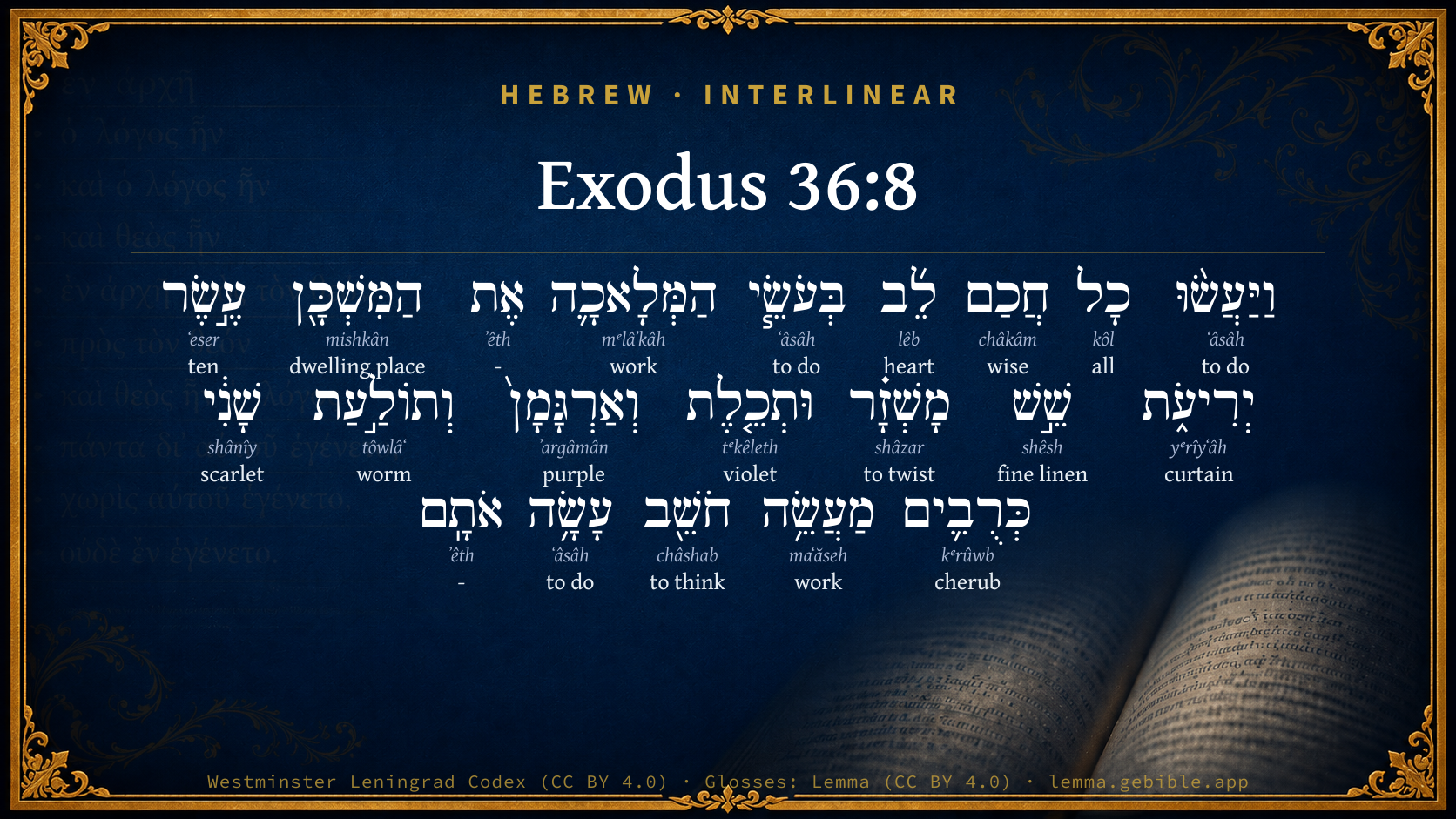
Hebrew (Westminster Leningrad Codex) Exodus 36:8 appears in the Hebrew Old Testament. The text above is from the Westminster Leningrad Codex. Each word links to its Strong’s number, a concise gloss, and parsing drawn from the Open Scriptures Hebrew Bible morphology. Click any word for its full Brown-Driver-Briggs (BDB) entry.
Download image
Cite this verse

Exodus 36:8 (World English Bible). Public Domain. Lemma interlinear Bible study tool, https://lemma.gebible.app/v/exodus/36/8.

Show BibTeX & RIS
BibTeX
RIS
English Translation
All the wise-hearted men among those who did the work made the tent with ten curtains; of fine twined linen, blue, purple, and scarlet, with cherubim, the work of the skillful workman, they made them.
World English Bible · Public Domain
Download a study sheet

One document with this verse’s original text, its word-by-word gloss line, the meaning frame, cross-references with their text, attributed commentary, and full source and license credits — printable, and it pastes into notes with its structure intact.

This verse Autodidact and up

Study sheet (.html) Plain text (.txt)

A passage Seminary Student

Up to 50 verses in one chapter. A passage sheet keeps up to 6 commentary sources and 12 cross-references per verse, in the order this page ranks them, and says so on the sheet whenever that leaves anything out. Ask for a single verse and you get the Autodidact verse sheet above.

Everything on this page stays free to read, with no account — the sheet is a download of what is already on screen, not access to it.

Want to remove ads? Support Godless Engineer
Compare translations 3

The same verse in 3 English versions, stacked beneath the original-language interlinear above. Click any original word for its lexicon entry.

Each is an independent rendering of the whole verse — the interlinear is not word-aligned to these translations.

Highlighted words mark where these versions differ — a whole-verse word diff, not a word-by-word alignment.

  • World English Bible Public Domain
    All the wise-hearted men among those who did the work made the tent with ten curtains; of fine twined linen, blue, purple, and scarlet, with cherubim, the work of the skillful workman, they made them.
  • King James Version Public Domain
    And every wise hearted man among them that wrought the work of the tabernacle made ten curtains of fine twined linen, and blue, and purple, and scarlet: with cherubim of cunning work made he them.
  • unfoldingWord Literal Text CC BY-SA 4.0
    And every skilled of heart among the doers of the work made the Dwelling with ten curtains: twisted fine linen and blue and purple and worm of scarlet; cherubim—the work of a skilled craftsman he made them.

unfoldingWord Literal Text — © unfoldingWord, licensed CC BY-SA 4.0. Word-aligned USFM3 via Door43 (git.door43.org/unfoldingWord/en_ult).

Versions to compare (up to 4)

3 of 4 selected

Show all 18 translations

Every available English version of this verse, each an independent rendering of the whole verse.

  • World English Bible Public Domain
    All the wise-hearted men among those who did the work made the tent with ten curtains; of fine twined linen, blue, purple, and scarlet, with cherubim, the work of the skillful workman, they made them.
  • Berean Standard Bible Public Domain
    All the skilled craftsmen among the workmen made the ten curtains for the tabernacle. They were made of finely spun linen, as well as blue, purple, and scarlet yarn, with cherubim skillfully worked into them.
  • Majority Standard Bible Public Domain
    All the skilled craftsmen among the workmen made the ten curtains for the tabernacle. They were made of finely spun linen, as well as blue, purple, and scarlet yarn, with cherubim skillfully worked into them.
  • King James Version Public Domain
    And every wise hearted man among them that wrought the work of the tabernacle made ten curtains of fine twined linen, and blue, and purple, and scarlet: with cherubim of cunning work made he them.
  • American Standard Version (1901) Public Domain
    And all the wise-hearted men among them that wrought the work made the tabernacle with ten curtains; of fine twined linen, and blue, and purple, and scarlet, with cherubim, the work of the skilful workman, `Bezalel' made them.
  • Revised Version (1885) Public Domain
    And every wise hearted man among them that wrought the work made the tabernacle with ten curtains; of fine twined linen, and blue, and purple, and scarlet, with cherubim the work of the cunning workman made he them.
  • Geneva Bible (1599) Public Domain
    All the cunning men therefore among the workemen, made for the Tabernacle ten curtaines of fine twined linnen, and of blewe silke, and purple, and skarlet: Cherubims of broydred worke made they vpon them.
  • Douay-Rheims (1899) Public Domain
    And all the men that were wise of heart, to accomplish the work of the tabernacle, made ten curtains of twisted fine linen, and violet, and purple, and scarlet twice dyed, with varied work, and the art of embroidering:
  • Young's Literal Translation Public Domain
    And all the wise-hearted ones among the doers of the work make the tabernacle; ten curtains of twined linen, and blue, and purple, and scarlet, `with' cherubs, work of a designer, he hath made them.
  • Literal Standard Version CC BY-SA 4.0
    And all the wise-hearted ones among the doers of the work make the Dwelling Place; he has made them [with] ten curtains of twined linen, and blue, and purple, and scarlet, [with] cherubim, the work of a designer.
  • Unlocked Literal Bible CC BY-SA 4.0
    So all the craftsmen among them constructed the tabernacle with ten curtains made from fine linen and blue, purple, and scarlet wool with the designs of cherubim. This was the work of Bezalel, the very skilled craftsman.
  • unfoldingWord Literal Text CC BY-SA 4.0
    And every skilled of heart among the doers of the work made the Dwelling with ten curtains: twisted fine linen and blue and purple and worm of scarlet; cherubim—the work of a skilled craftsman he made them.
  • Darby Bible Public Domain
    And every wise-hearted man among those that wrought the work of the tabernacle made ten curtains of twined byssus, and blue, and purple, and scarlet: [with] cherubim of artistic work did he make them.
  • World Messianic Bible Public Domain
    All the wise-hearted men among those who did the work made the tabernacle with ten curtains of fine twined linen, blue, purple, and scarlet. They made them with cherubim, the work of a skillful workman.
  • Webster's Bible Public Domain
    And every wise-hearted man among them that wrought the work of the tabernacle made ten curtains of fine twined linen, and blue, and purple, and scarlet: he made them with cherubim of curious work.
  • Free Bible Version CC BY-SA 4.0
    The skilled craftsmen among the workers made the ten curtains for the Tabernacle. They were made of finely-spun linen together with blue, purple, and crimson thread, embroidered with cherubim.
  • Bible in Basic English Public Domain
    Then all the expert workmen among them made the House with its ten curtains; of the best linen, blue and purple and red, they made them, with winged ones worked by expert designers.
  • JPS Tanakh (1917) Public Domain
    And every wise-hearted man among them that wrought the work made the tabernacle with ten curtains: of fine twined linen, and blue, and purple, and scarlet, with cherubim the work of the skilful workman made he them.

Literal Standard Version (2020), Covenant Press — licensed CC BY-SA 4.0. Text via the HelloAO Bible API (eBible.org). Unlocked Literal Bible (unfoldingWord) — licensed CC BY-SA 4.0. Text via the HelloAO Bible API (eBible.org). unfoldingWord Literal Text — © unfoldingWord, licensed CC BY-SA 4.0. Word-aligned USFM3 via Door43 (git.door43.org/unfoldingWord/en_ult). Free Bible Version, Dr. Jonathan Gallagher — licensed CC BY-SA 4.0. Text via the HelloAO Bible API (eBible.org).

Word by word

More ways to search: Search by grammar → Find every occurrence → Compare this word →

Practice this passage: Drill this verse → Learn its vocabulary →

מָשְׁזָ֗ר
shâzar
H7806
“twisted”
Verb, Hophal, Participle Passive, Masculine, Singular, Absolute
Part of Speech
Verb
Stem
Hophal
Form
Participle Passive
Gender
Masculine
Number
Singular
State
Absolute
Full BDB Definition

Origin: a primitive root

TWOT: 2358

to twist, be twisted - (Hophal) - to be twisted - twisted (participle)
  1. וַיַּעֲשׂ֨וּ ʻâsâh H6213 “and · to do” Conjunction + Verb, Qal, Sequential Imperfect, 3rd Person, Masculine, Plural
  2. כָל kôl H3605 “all of” Noun, Common, Masculine, Singular, Construct
  3. חֲכַם châkâm H2450 “wise of” Adjective, Adjective, Masculine, Singular, Construct
  4. לֵ֜ב lêb H3820 “heart” Noun, Common, Masculine, Singular, Absolute
  5. בְּעֹשֵׂ֧י ʻâsâh H6213 “in/at · doing” Preposition + Verb, Qal, Participle Active, Masculine, Plural, Construct
  6. הַמְּלָאכָ֛ה mᵉlâʼkâh H4399 “the · work” Particle, Definite Article + Noun, Common, Feminine, Singular, Absolute
  7. אֶת ʼêth H853 “-” Particle, Direct Object
  8. הַמִּשְׁכָּ֖ן mishkân H4908 “the · dwelling place” Particle, Definite Article + Noun, Common, Masculine, Singular, Absolute
  9. עֶ֣שֶׂר ʻeser H6235 “ten” Adjective, Cardinal number, Feminine, Singular, Absolute
  10. יְרִיעֹ֑ת yᵉrîyʻâh H3407 “curtains” Noun, Common, Feminine, Plural, Absolute
  11. שֵׁ֣שׁ shêsh H8336 “fine linen” Adjective, Cardinal number, Feminine, Singular, Absolute
  12. וּתְכֵ֤לֶת tᵉkêleth H8504 “and · violet” Conjunction + Noun, Common, Feminine, Singular, Absolute
  13. וְאַרְגָּמָן֙ ʼargâmân H713 “and · purple” Conjunction + Noun, Common, Masculine, Singular, Absolute
  14. וְתוֹלַ֣עַת tôwlâʻ H8438 “and · worm of” Conjunction + Noun, Common, Feminine, Singular, Construct
  15. שָׁנִ֔י shânîy H8144 “scarlet” Noun, Common, Masculine, Singular, Absolute
  16. כְּרֻבִ֛ים kᵉrûwb H3742 “cherubim” Noun, Common, Masculine, Plural, Absolute
  17. מַעֲשֵׂ֥ה maʻăseh H4639 “work of” Noun, Common, Masculine, Singular, Construct
  18. חֹשֵׁ֖ב châshab H2803 “thinking” Verb, Qal, Participle Active, Masculine, Singular, Absolute
  19. עָשָׂ֥ה ʻâsâh H6213 “to do” Verb, Qal, Perfect, 3rd Person, Masculine, Singular
  20. אֹתָֽם ʼêth H853 “- · them” Particle, Direct Object + Suffix, Personal, 3rd Person, Masculine, Plural

About this verse

These counts appear in no published source. They are computed here, from the morphology-tagged text and Lemma’s own curated glosses. What Lemma adds →

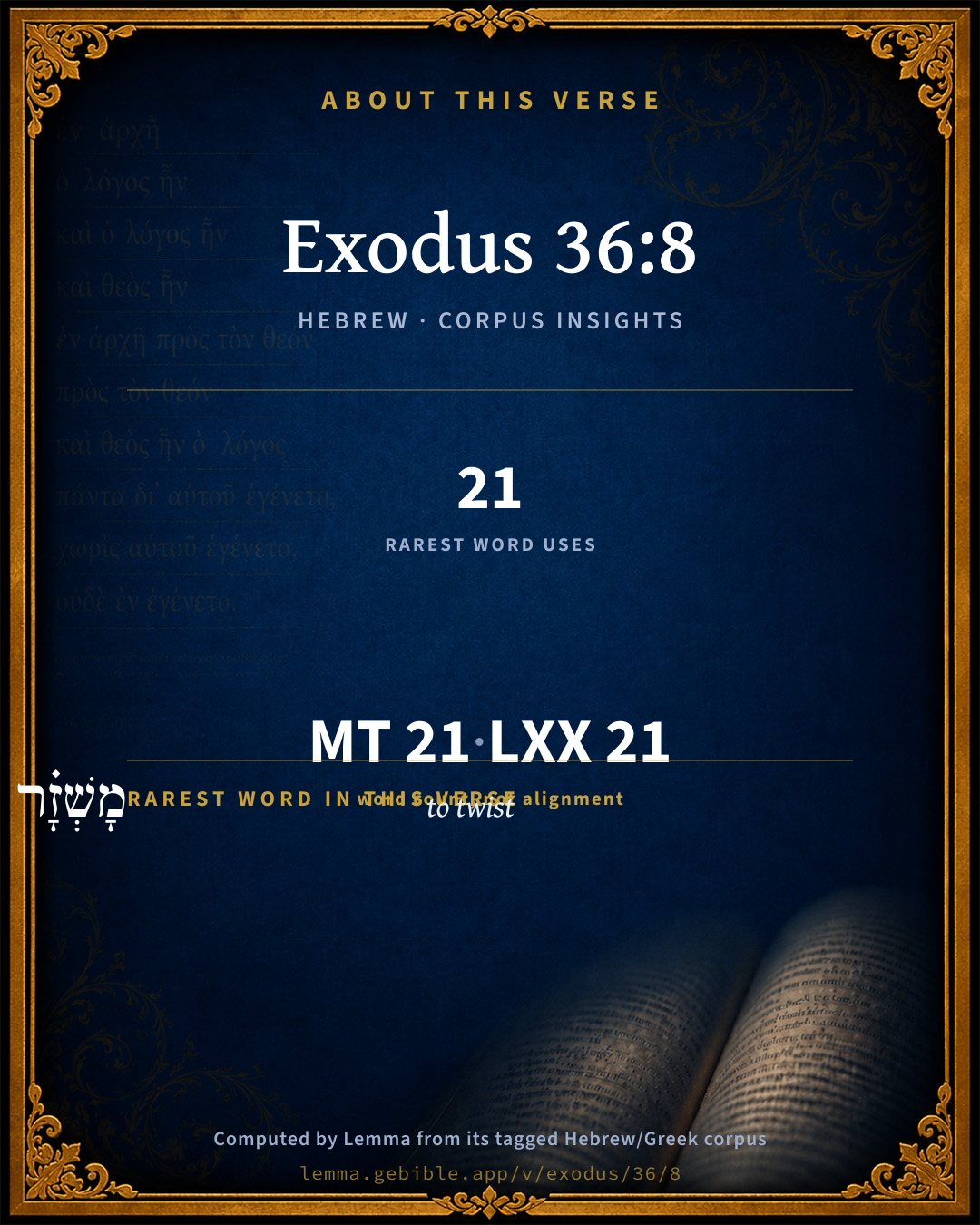
21
words
18
distinct lemmas
Pentateuch
section

Notable vocabulary

The rarest word here is מָשְׁזָ֗ר to twist H7806 — appearing just 21 times in the whole Hebrew Bible.

Shared distinctive vocabulary

מָשְׁזָ֗ר to twist H7806 occurs in 21 verses of the Hebrew Bible. Also found in:

Grammatical profile

  • 5 verbs
  • 11 nouns
  • 3 adjectives
  • 2 particles

Verb forms

  • וַיַּעֲשׂ֨וּ Qal · Sequential Imperfect
  • בְּעֹשֵׂ֧י Qal · Participle Active
  • מָשְׁזָ֗ר Hophal · Participle Passive
  • חֹשֵׁ֖ב Qal · Participle Active
  • עָשָׂ֥ה Qal · Perfect

Repetition

A word recurs within this verse — often emphatic in Hebrew:

  • וַיַּעֲשׂ֨וּ to do H6213 ×3

Hebrew & Septuagint length

In English translation the verse runs 35 words from the Hebrew and 26 from the Septuagint (LXX English) — closely comparable.

A rough comparison of the two English renderings, which tokenize alike — not a word-level alignment.

Word counts can differ between the Hebrew and the Greek without any difference in meaning — e.g. the Hebrew direct-object marker אֵת has no separate Greek word, and Greek often adds the article ὁ.

In the original languages it is 21 Hebrew tokens and 21 Greek tokens — but the two are counted differently (Hebrew bundles its prefixes and suffixes into one token; the Greek is in lemma form), so that isn’t a like-for-like length.

Cross-references

10

Topical passages linked to Exodus 36:8 in the Treasury of Scripture Knowledge — connected by theme and wording, ordered by reader-vote popularity; previews shown in the World English Bible.

  • Exodus 25:18 You shall make two cherubim of hammered gold. You shall make them at the two ends of the mercy seat.
  • Exodus 25:22 There I will meet with you, and I will tell you from above the mercy seat, from between the two cherubim which are on the ark of the testimony, all that I command you for the children of Israel.
  • Exodus 26:1–37 "Moreover you shall make the tent with ten curtains; of fine twined linen, and blue, and purple, and scarlet, with cherubim. The work of the skillful workman you shall make them.
  • Exodus 31:6 I, behold, I have appointed with him Oholiab, the son of Ahisamach, of the tribe of Dan; and in the heart of all who are wise-hearted I have put wisdom, that they may make all that I have commanded you:
  • Exodus 35:10 "Let every wise-hearted man among you come, and make all that Yahweh has commanded:
  • 1 Kings 6:23 In the oracle he made two cherubim of olive-wood, each ten cubits high.
  • 1 Chronicles 15:1 [David] made him houses in the city of David; and he prepared a place for the ark of God, and pitched for it a tent.
  • 2 Chronicles 3:10 In the most holy house he made two cherubim of image work; and they overlaid them with gold.
  • Ezekiel 1:5–28 Out of the midst of it came the likeness of four living creatures. This was their appearance: they had the likeness of a man.
  • Ezekiel 10:1–19 Then I looked, and see, in the expanse that was over the head of the cherubim there appeared above them as it were a sapphire stone, as the appearance of the likeness of a throne.

Cross-references courtesy of OpenBible.info (CC BY 4.0).

Hebrew and Greek witnesses Masoretic Hebrew ↔ Greek Septuagint

The same verse in the two great witnesses to the Old Testament, shown verse-for-verse.

These are two independent witnesses, not word-aligned to each other, and the Septuagint is shown in lemma (dictionary) form.

Hebrew Exodus 36:8 Masoretic · Westminster Leningrad Codex

וַיַּעֲשׂ֨וּ כָל חֲכַם לֵ֜ב בְּעֹשֵׂ֧י הַמְּלָאכָ֛ה אֶת הַמִּשְׁכָּ֖ן עֶ֣שֶׂר יְרִיעֹ֑ת שֵׁ֣שׁ מָשְׁזָ֗ר וּתְכֵ֤לֶת וְאַרְגָּמָן֙ וְתוֹלַ֣עַת שָׁנִ֔י כְּרֻבִ֛ים מַעֲשֵׂ֥ה חֹשֵׁ֖ב עָשָׂ֥ה אֹתָֽם

All the wise-hearted men among those who did the work made the tent with ten curtains; of fine twined linen, blue, purple, and scarlet, with cherubim, the work of the skillful workman, they made them.

World English Bible · Public Domain

Greek LXX Exodus 36:8 Septuagint · lemma form

καί ποιέω πᾶς σοφός ἐν ὁ ἐργάζομαι ὁ στολή ὁ ἅγιος ὅς εἰμί ααρων ὁ ἱερεύς καθά συντάσσω κύριος ὁ μωυσῆς

And every wise one among those that wrought made the robes of the holy places, which belong to Aaron the priest, as the Lord commanded Moses.

LXX2012 (modern English Septuagint) · Public Domain

Hebrew: Westminster Leningrad Codex (CC BY 4.0). Greek: Septuagint (public domain); English from LXX2012 (modern English Septuagint) (Public Domain). How the Septuagint differs from the Hebrew →

Targum (Aramaic paraphrase)

2

The Targum is the ancient Jewish Aramaic paraphrase of the Hebrew Scriptures — an interpretive translation, not the Hebrew text itself. Onkelos (literal) and Pseudo-Jonathan (expansive) render the Torah, and Jonathan the Prophets. Coverage is partial: where no permissively-licensed English translation exists for a verse, only the Aramaic is shown. This is verse-level text, not a word-by-word alignment to the Hebrew.

  1. Targum Onkelos Torah (Genesis–Deuteronomy)
    וַעֲבָדוּ כָל חַכִּימֵי לִבָּא בְּעָבְדֵי עִבִדְתָּא יָת מַשְׁכְּנָא עֲשַׂר יְרִיעָן דְבוּץ שְׁזִיר וְתִכְלָא וְאַרְגְוָנָא וּצְבַע זְהוֹרִי צוּרַת כְּרוּבִין עוֹבַד אֳמָן עֲבַד יָתְהוֹן:

    (no public-domain English translation for this verse)

    Targum Onkelos — Aramaic: “Onkelos Genesis” (public domain); “Onkelos Exodus” (public domain); “Onkelos Leviticus” (public domain); “Onkelos Numbers” (public domain); “Onkelos Deuteronomy” (public domain). English: “Sefaria Community Translation” (CC0 1.0 (public-domain dedication)); “J.W. Etheridge. The Targums of Onkelos and Jonathan Ben Uzziel on the Pentateuch. London: Longmans, Green, 1862” (public domain). Text via Sefaria.

  2. Targum Pseudo-Jonathan Torah (Genesis–Deuteronomy)
    וַעֲבָדוּ כָּל חַכִּימֵי לִבָּא יַת מַשְׁכְּנָא עֲשַר יְרִיעַן דְּבוּץ שְׁזִיר וְתִכְלָא וְאַרְגְּוָונָא וּצְבַע זְהוֹרִי צוּרַת כְּרוּבִין עוֹבַד אוּמַן עֲבַד יַתְהוֹן

    And all the wise in heart made the TABERNACLE; ten curtains of fine linen, and hyacinth, and purple, and scarlet, figured with kerubin, the work of the embroiderer, he made them.

    Targum Pseudo-Jonathan — Aramaic: “Targum Jonathan on Genesis” (public domain); “Targum Jonathan on Exodus” (public domain); “Targum Jonathan on Leviticus” (public domain); “Targum Jonathan on Numbers” (public domain); “Targum Jonathan on Deuteronomy” (public domain). English: “The Targum of Jonathan ben Uzziel, trans. J. W. Etheridge, London, 1862” (public domain). Text via Sefaria.

Commentary

Notes on Exodus 36:8 from classic Christian and Jewish commentators (each source and its license shown beneath its notes). The classic Christian expositions comment on the surrounding passage and are grouped to its opening verse, so a note may address several verses; the Jewish commentaries on the Tanakh (Rashi and others) are per-verse, so they appear only where the commentator wrote on this verse.

Lemma curates 59 commentaries, every one of them public domain or Creative Commons licensed, each selected and text-cleaned for this edition rather than reprinted as found. About our sources →

Trapp's Complete Commentary

John Trapp

Exo 36:8 And every wise hearted man among them that wrought the work of the tabernacle made ten curtains [of] fine twined linen, and blue, and purple, and scarlet: [with] cherubims of cunning work made he them.

Ver. 8. And every wise-hearted man.] Let no man look upon this and the following chapter as an idle repetition; nor say, as one said once, Did we not know that all Scripture was divinely inspired, we should be ready to say, Quandoque bonus dormitat Homerus. But know that here is set forth a table, index, or inventory, of what Moses and the workmen did in obedience to God’s command, for every particular about the sanctuary. This inventory was taken by Ithamar, at the commandment of Moses, Et sic in archivum Ecclesiae relatum, and so laid up in the charter house of the Church for the use of posterity. See the notes on Exo 36:1-38, and consider that saying of an ancient, Necessarium et utile est etiam quae scripta sunt scribere, ne leve existimetur quod non frequenter arguitur. {a}

{a} Prosper., Epist. ad Augustin.

John Trapp, A Commentary or Exposition upon All the Books of the Old and New Testament (1647–1656) — public domain. Text from a community e-Sword module.

Keil & Delitzsch

C. F. Keil & F. Delitzsch

Ex 36:8-38:20. Execution of the Work. - Preparation of the dwelling-place: viz., the hangings and covering (Exo 36:8-19, as in Exo 26:1-14); the wooden boards and bolts (Exo 36:20-34, as in Ex 26:15-30); the two curtains, with the pillars, hooks, and rods that supported them (Exo 36:35-38, as in Exo 26:31-37). As these have all been already explained, the only thing remaining to be noticed here is, that the verbs עשׂה in Exo 36:8, ויחבּר in Exo 36:10, etc., are in the third person singular with an indefinite subject, corresponding to the German man (the French on).

Keil & Delitzsch — Biblical Commentary on the Old Testament (1861–1891) — public domain (CC PDM 1.0). Text via the HelloAO Bible API. (Old Testament only.)

F. W. Grant's Numerical Bible

Section 2. (Exo 36:8-38.)

The growth of the work.

In the second section we find the growth of the tabernacle to completion; and here it is that we have the repetitions which have been already noticed. The difference between the detail of the patterns of heavenly things given before and the present is principally in the order in which they are presented; first, the tabernacle itself being given us; then the vessels of the tabernacle, what was in it or around it; and then the priestly garments, or what had to do with entrance and worship. These are the three subsections, the number 3 having naturally a large place in all this part.

1. The tabernacle comes first, evidently because it is the house of God itself which we are now seeing put together as a whole. Before it was rather one among many objects in connection with the wider plan of salvation. Now all other objects seen are seen in relation to it. Thus the incense-altar which before was detached from the tabernacle itself to find its place in connection with the sanctification of the priesthood, is now among the vessels of the sanctuary where it belongs.

But what does its numerical place point out? In the earlier series of types it occupies the fourth place, and this evidently points out its character as belonging to the wilderness, -God come down in it to man. Here in the account given there is no change from the former one, except that what was before commanded is now accomplished. But the numerical place may point to what is there and here insisted on, that the tabernacle is one. There is internal unity; there is, beside, no other tabernacle of God but this. There is one Christ and no other; in whom dwelleth all the fullness of the Godhead bodily, and in whom we are filled up. He is not one of many incarnations of God, which has been or which will be, but one for eternity the same; and to Him, as in His temple, shall be "glory in the Church by Christ Jesus throughout all the generations of the age of ages." (Eph 3:21.)

Blessed be God! there is not room even in eternity, for any future glory to surpass this! There is room only for its wondrous anthem to show its power to fill infinity with praise. If of Zion, its earthly shadow, God can say, "This is My rest forever: here will I dwell, for I have desired it," how much more must it be said of this! Conditions may change: the wilderness give place to the land which is the "glory of all lands;" under the unchanging brightness of skies where storm is not, the "tent upon the tabernacle" be removed, so that its glory shall be fully exposed; the tabernacle form may pass into the temple: -with all this, the delight of God in His beloved changes not, -His "rest" is disturbed no more!

Admire the beauty of these many-hued curtains, where the golden clasp of divine glory embraces the blue loop of heaven’s condescending love! Thus are they united into one, and droop their folds over the board-work overlaid with the gold again. This is the Church, as we have already seen in the beauty put upon her, -the glory of Christ her Lord.

2. And now we come to the vessels of the tabernacle, in which we find portrayed for us the salvation which the dwelling of God with man implies. That His name might be "Immanuel" ("God with us"), they called the Son of Mary "Jesus," ("Jehovah the Saviour"), because He was to save His people from their sins (Mat 1:22-25.)

I have not much to add to what has been already said with regard to these precious types, which, moreover, fall, in general, into the same numerical place as before. There are, however, now (in this and the following part) seven minor divisions instead of six, as there: a number which speaks for itself in connection with these closing portions of the book. As already noticed, the incense-altar fills its own place here among the vessels of the sanctuary: the fourth place, because, as we have seen, the practical life is brought into the sanctuary in this way, transformed by the knowledge of redemption into the priestly offering of thanksgiving and praise."

The brazen altar fills the fifth place, as before; and connected with it, as it seems to me, is the note as to the laver, that it was made of the mirrors of the women attending the tabernacle. This does not, I think, as it might seem, claim for itself a sixth section, both because the court of the tabernacle which follows it, holds that in the prior account, and also that this is followed in its turn by what has evidently the character of a seventh -the tale of the complete amount of metal used.

From another point of view there seems to me a most natural and beautiful thought suggested by this close association of the brazen altar with the laver. For if the former show us, as is evident, our responsibility measured and met in atonement, how simple is the connection of this with the self-judgment intimated in the brazen laver! Is it not so that the knowledge of sin put away for us is that which puts it away from us? that the realization of its judgment in Another is that which accomplishes its judgment in ourselves? The association of the brazen altar with the laver has thus its justification in experience.

And the women’s sacrifice of their mirrors, where all is so plainly typical, may represent the willing giving up of our own self-estimates -in general, some form of self-flattery, -to find in the Word of God our true mirror, and fashion ourselves by it.

How beautiful, again, that then, in the next place, we come to the court, where the fine linen of practical righteousness is held up before the world!

Finally the seventh section here gives the estimates of the metals used, and we find whence the silver of the rods and sockets was derived. It has already been considered, however.

3. The priestly garments come in the third place, identified as they are with the means of drawing near to God. Here each minor section is closed with the words, "as Jehovah commanded Moses." And here, again, there are just seven of them. The numerical place of each is as given before, with the exception of the last two items of the dress, which are reversed. The coats of fine linen are in the fifth place instead of the sixth, the diadem in the sixth instead of the fifth. It is not strange that in this enumeration we shall end with the latter, the final victory over sin being secured by the character of Him into whose hands all is put. Thus here for the first time the plate is called "the diadem."

As for the other change, the meaning of it is not so clear, although the number of responsibility is suitable enough where as here the ordinary priests come in, -our representatives; and well may we be reminded of it. For where do we more fail than in this character? and it is the root of all other failure.

F. W. Grant, The Numerical Bible (4th ed., 1903) — public domain. Text from a community e-Sword module.

Geneva Bible (1599)

Geneva Bible translators

Which were little pictures with wings in the form of children.

Geneva Bible (1599) marginal notes — public domain. Text via Bolls.life.

Matthew Henry's Commentary

The first work they set about was the framing of the house, which must be done before the furniture of it was prepared. This house was not made of timber or stone, but of curtains curiously embroidered and coupled together. This served to typify the state of the church in this world, the palace of God's kingdom among men. 1. Though it is upon the earth, yet its foundation is not in the earth, as that of a house is; no, Christ's kingdom is not of this world, nor founded in it. 2. It is mean and mutable, and in a militant state; shepherds dwelt in tents, and God is the Shepherd of Israel; soldiers dwelt in tents, and the Lord is a man of war, and his church marches through an enemy's country, and must fight its way. The kings of the earth enclose themselves in cedar (Jer 22:15), but the ark of God was lodged in curtains only. 3. Yet there is a beauty in holiness; the curtains were embroidered, so is the church adorned with the gifts and graces of the Spirit, that raiment of needle-work, Psa 45:14. 4. The several societies of believers are united in one, and, as here, all become one tabernacle; for there is one Lord, one faith, and one baptism.

Matthew Henry's Commentary on the Whole Bible (1708–1710) — public domain (CC PDM 1.0). Text via the HelloAO Bible API.

Adam Clarke's Commentary

Verse 8. Cherubims of cunning work] See on Ex 25:18. Probably the word means no more than figures of any kind wrought in the diaper fashion in the loom, or by the needle in embroidery, or by the chisel or graving tool in wood, stone, or metal; See Clarke on Ex 25:18. This meaning Houbigant and other excellent critics contend for. In some places the word seems to be restricted to express a particular figure then well known; but in many other places it seems to imply any kind of figure commonly formed by sculpture on stone, by carving on wood, by engraving upon brass, and by weaving in the loom, &c.

Adam Clarke's Commentary on the Bible (1810–1826) — public domain. Text from a community e-Sword/MySword module.

Ellicott's Commentary for English Readers

THE CONSTRUCTION OF THE TABERNACLE.

(8-13) This passage follows exactly Exo_26:1-6, the tenses of the verbs alone being changed. It relates the construction of the inner covering.

A Bible Commentary for English Readers, edited by Charles John Ellicott (1878–1897) — public domain. Text from a community e-Sword module.

The Cambridge Bible for Schools and Colleges

gen. ed. J. J. S. Perowne

8. every wise hearted man, &c.] cf. vv. 1, 2, 4. In the account of the construction of the sanctuary these are mentioned only here; in the sequel (even in v. 8b) the sing. (referring to Bìẓal’çl) is used regularly (as in Exo_26:1; Exo_26:4 &c.) till ch. 39, where the plur. reappears (though not uniformly).

the tabernacle] the Dwelling. See on Exo_26:1, and Exo_25:9.

the cunning workman] the designer, or pattern-wearer.

The Cambridge Bible for Schools and Colleges (gen. ed. J. J. S. Perowne; Cambridge University Press, 1878–1918) — public domain. Text from a community e-Sword module.

John Gill's Exposition

And every wise hearted man among them that wrought the work of the tabernacle,.... Did the part assigned him, what he was fittest for, and most skilful in: particularly some

made ten curtains, &c. which were properly the tabernacle, and were made first, and then the several things appertaining to it; and from hence, to the end of the chapter Exo 36:9, is only an account of the making of the tabernacle, its curtains, coverings, boards, sockets, and bars, the vail for the most holy place, and the hangings for the tabernacle, exactly as they are ordered to be made; see Gill on Exo 26:1 &c. to end of chapter: and it may be observed, that throughout the account of the various articles, it is all along said "he" did this and the other; either referring to Moses, by whose orders they were done, or to Bezaleel, the chief director of the work, or to each and everyone of the artificers severally concerned.

Next: Exodus Chapter 37

John Gill's Exposition of the Whole Bible (1746–1763) — public domain (CC PDM 1.0). Text via the HelloAO Bible API.

The Pulpit Commentary

Vers. 8-38. The remainder of this chapter requires no comment, since it goes over ground already covered. The passage from ver. 8 to ver. 18 corresponds exactly with Exo_26:1-11; that from ver. 19-34 with Exo_26:14-29; that consisting of vers. 35, 36, with Exo_26:33, Exo_26:34; and the two concluding vers. with Exo_26:36, Exo_26:37. Under these circumstances a few mistranslations will alone be noticed.

Vers. 8-38. Exactitude in obedience.

Kalisch observes on this passage, that, "though even literal repetitions of the same occurrence, or the same command, are not unusual in the Biblical style, yet the lengthened and accurate reiteration" which here occurs, is unusual and must have some special meaning. He himself considers that he has sufficiently accounted for it as intended to draw attention to the importance of the tabernacle in the Mosaic system, and the significance, and especially the symbolical character of the descriptions ("Commentary on Exodus," pp. 449, 450). To us it seems that there must have been some further reason for the phenomenon; and we are inclined to find it in the importance of the example which Moses here sets of exactitude in obedience. If any one might ever be supposed entitled to depart from the strict letter of observance, where the commands of God are concerned, it would be such a one as Moses, who had conversed as friend to friend with God, and had been twice summoned to a conference of forty days" duration. But Moses does not seem to feel that he is so privileged. The exact correspondency of paragraph with paragraph, verse with verse, clause with clause, word with word, seems intended to teach and enforce the lesson that what God commands is to be observed to the letter, down to its minutest point. Certainly, what these five concluding chapters of Exodus especially set forth, is the extreme exactitude which Moses and those under him showed in carrying out all the directions that God had given with regard to the tabernacle. If "fifty taches" were ordered, (Exo_26:6) "fifty taches" were made; (Exo_36:13) if "five pillars" were commanded here, (Exo_26:37) and "four pillars" there (ib, 32), the five and the four were constructed and set up accordingly; (Exo_36:36, Exo_36:38) if this curtain was to have a pattern woven into it, (Exo_26:31) and that curtain was to be adorned with embroidery (ib, 36), the embroiderer"s and the weaver"s art were employed upon them as ordered. (Exo_36:35, Exo_36:37) Nothing commanded was ever neglected; only in one or two cases (notably in verse 38) small additions were made, if not to the orders given, at any rate to the orders recorded. Generally, however, there was an entire effacement of self, a complete restraint of private fancy and private preference. Note

1. The rarity of exact obedience;

2. The difficulty of it;

3. The scant praise which it obtains from men;

4. The certainty that it is approved in God"s sight.

Examples

1. The obedience of Moses as here set out;

2. The perfect obedience of Christ.

meat is to do the will of him that sent me". (Joh_4:34) "I have finished the work which thou gavest me to do". (Joh_17:4)

Vers. 8-37. On Tabernacle symbolism see the Homiletics on Exo_26:1-11.

HOMILIES BY J. ORR Ver. 8-ch. Exo_39:33-43) When the work was finished the makers brought it to Moses, who looked upon it and pronounced that all had been done according "as the Lord had commanded" (ver. 43). The day of inspection will come for our work Also. (1Co_3:14, 1Co_3:15) Happy for us if the same verdict can be passed upon it!

III WORK BLESSED. "And Moses blessed them" (ver. 43). "If any man"s work abide which he has built thereupon, he shall receive a reward". J.O. (1Co_3:14)

Vers. 8-38. Jehovah"s dwelling-place.

See homily on chap. 26. J.O.

The Pulpit Commentary (1880–1919), ed. H.D.M. Spence-Jones & Joseph S. Exell — public domain. Text from a community e-Sword module.

Kretzmann's Popular Commentary

Paul E. Kretzmann

The Curtains of the Tabernacle

v. 8. And every wise-hearted man among them, all the artists appointed to the work, that wrought the work of the Tabernacle, made ten curtains of fine twined linen, and blue, and purple, and scarlet; with cherubim of cunning work made he them, the figures of the cherubim were skillfully woven into the cloth, as it was made on the loom with the four kinds of yarn, or thread, mentioned throughout the narrative.

v. 9. The length of one curtain of the inner wall of the tent was twenty and eight cubits and the breadth of one curtain four cubits; the curtains were all of one size.

v. 10. And he coupled the five curtains one unto another; and the other five curtains he coupled one unto another, the inner tent thus consisting of two large pieces, each twenty by twenty-eight cubits in size.

v. 11. And he made loops of blue on the edge of one curtain from the selvage in the coupling; likewise he made in the uttermost side of another curtain, in the coupling of the second. Cf Exodus 26.

v. 12. Fifty loops made he in one curtain, and fifty loops made he in the edge of the curtain which was in the coupling of the second; the loops held one curtain to another.

v. 13. And he made fifty taches of gold, froglike clasps, and coupled the curtains one unto another with the taches; so it became one tabernacle, a single tent curtain for the inside covering.

v. 14. And he made curtains of goats’ hair, evidently woven from the hair as it was spun into threads, for the tent over the Tabernacle; eleven curtains he made them.

v. 15. The length of one curtain was thirty cubits, and four cubits was the breadth of one curtain. The eleven curtains were of one size.

v. 16. And he coupled five curtains by themselves and six curtains by themselves. The five and six strips, respectively, as sewed together, formed two pieces of unequal size, which formed the tent proper.

v. 17. And he made fifty loops upon the uttermost edge of the curtain in the coupling, and fifty loops made he upon the edge of the curtain which coupleth the second.

v. 18. And he made fifty taches of brass, clasps of copper or bronze, to couple the tent together, that it might be one.

v. 19. And he made a covering for the tent of rams’ skins dyed red, and a covering of badgers’ skins above that. Cf Exo 26:1-14. The leather coverings were intended to serve for a protection against the weather.

Paul E. Kretzmann, Popular Commentary of the Bible (1921–1924) — public domain. Text from a community e-Sword module.

unfoldingWord translationNotes

Door43 World Missions Community

So all the craftsmen ... joined to each other

For Exo 38:8-10 see how you translated many of these words in Exodus 26:1-3.

ten curtains made from fine linen

These curtains are sheets of cloth woven and sewed together so that they can hang to form a wall or tent.

Bezalel

This is the name of a man. See how you translated this in Exodus 31:1-2. (See: How to Translate Names)

translationWords

tabernacle

cherub

unfoldingWord translationNotes — © Distant Shores Media and the Door43 World Missions Community, licensed CC BY-SA 4.0. Source: git.door43.org/Door43/en_tn.

Ramban (Nachmanides)

Rabbi Moshe ben Nachman (Ramban / Nachmanides)

AND EVERY WISE-HEARTED MAN AMONG THEM THAT WROUGHT THE WORK, MADE THE TABERNACLE OF TEN CURTAINS. The Torah has repeated the [description of the] work of the Tabernacle five times. — Chapters 25-27, and in parts of Tetzaveh]. 2. In a general way [in the section of Ki Thisa — 31:6-11]. 3. At the time of the actual making thereof — in a general way [at the beginning of this section — 35:10-19]. 4. Specifically at the time of construction. For even though this is not mentioned expressly, yet Moses surely told them details, such as that the curtains should be of such and such a length, etc., as will be explained by Ramban further on. 5. The specific account of how each part was made [beginning with our verse here]. It mentions the whole of it at the time of the command in detail, and in general terms. First it says, “and you shall make it thus,” “and you shall make it thus,” and then it mentioned all things in a general way, and they will make all that I have commanded thee: the Tent of Meeting, and the ark of the Testimony, until according to all that I have commanded thee shall they do., Verse 11. The reason [why the command is repeated in a general way], is that G-d commanded Moses that he should tell Bezalel and Oholiab and all the wise men about the work in general terms, and only afterwards should they begin to do it, for they would not be suited for the sacred work until they had heard the scope of the whole undertaking and understood it all, and only then could they accept it upon themselves, when they know how to finish it. At the time of its actual construction he described it to them first in the general way as mentioned here, saying, let every wise-hearted man among you come, and make all that the Eternal hath commanded: the Tabernacle, its tent, etc., 35:10-11. This is the third time (see Note 55). The statement of the details is, however, missing here; for surely Moses had to say to the wise men who did the work: “make the Tabernacle of ten curtains, each curtain of such-and-such a length and such-and-such a width,” and so on with the whole work. This procedure [of Moses’ telling the workers the exact details of the measurements] Scripture does not mention, for it is understood that he told them everything in order, since they made each part exactly as prescribed. And the reason why Scripture does not mention it is that it was not necessary for Moses to go with them into the smallest details as they are mentioned at the command and the construction; instead, he told it to them briefly, as if to say that they should make the Tabernacle of ten curtains, five opposite five, and they themselves understood that they had to make loops corresponding to clasps of gold in order to couple the curtains together. Similarly with the rest of the work, he hinted to them the matter in brief, and they understood everything. It is for this reason that Scripture does not dwell at length on this detail [of Moses’ instruction to the workers], since its hints [at the same time] at their wisdom, understanding, and good sense. After this Scripture describes again the whole work in a specific way as at first, stating, And every wise-hearted man among them that wrought the work made the Tabernacle; and he made curtains of goats’ hair; and he made the boards etc., Verse 20.Now it would have been sufficient in this whole subject for Scripture to have said, “and Moses told the whole congregation of the children of Israel all the work which G-d had commanded him,” and then say, “and the children of Israel did according to all that the Eternal had commanded Moses, so did they., 39:42. And Moses saw all the work, and behold they had done it, as the Eternal had commanded, even so had they done it. And Moses blessed them.”, Verse 43. Scripture, however, wanted to state that Moses mentioned to the whole congregation of the children of Israel and the wise men who were there all the work in general, for he intended thereby to stir the people to donate sufficiently for the large work, and in order also that the wise men should hear [the entire scope of the work] and would know if they could undertake to do everything as he had been commanded. Then Scripture mentions in detail the whole work in order to tell us that all the wise men worked on the Tabernacle. It is with reference to this that Scripture states here, And every wise-hearted man among them that wrought the work made the Tabernacle of ten curtains. The verses stating, and he made curtains of goats’ hair, and he made the boards, Verse 20. mean: “and every wise-hearted man made the curtains of goats’ hair,” [not Bezalel alone].In the case of the ark, however, Scripture mentions specifically, and Bezalel made the ark, 37:1. in order to say that the greatest craftsman amongst them made the ark alone. The reason for this is because he was filled with the spirit of G-d, in wisdom, and understanding, and in knowledge, so that he could contemplate its meaning and make it with the proper intention. For in the actual making of the ark there was no great craftsmanship entailed, there being amongst the other work things which required greater skill than that of the ark. [Hence we must conclude that Bezalel was required to make the ark on account of its great significance.]Then Scripture again states without elaboration, and he made the table, and he made the candelabrum., Verse 17. In the opinion of Rabbi Abraham ibn Ezra, 37:1. this alludes to Bezalel who made all the sacred vessels. But this is not my opinion, for in the case of the court of the Tabernacle it likewise says, and he made the court., 38:9. And it would not be reasonable to say that Bezalel alone made the court. Rather, this refers back to every wise-hearted man as mentioned in the making of the Tabernacle. After Scripture completed the account of the construction of the Tabernacle in general and particular terms, it mentions their bringing it to Moses in a general way, stating, And they brought the Tabernacle unto Moses, the Tent, and all its vessels etc., in order to tell of their wisdom, in that they brought everything in order and no one brought his work to Moses until the whole work had been completed, as Scripture says, Thus was finished all the work of the Tabernacle of the Tent of Meeting., Verse 32. After it was finished they all gathered and showed it to Moses in order, saying at first: “Our Rabbi, here is the Tent and there are its vessels,” and afterwards they said, “Here is the ark and here are its staves,” and so on with everything.Now [in this whole section of Vayakheil] Scripture does not state that the Tabernacle and its vessels were made “as the Eternal commanded Moses.” But in the next section of Eileh Pekudei, with reference to the garments of priesthood, it mentions such a statement at each item. The reason for this is that the whole work of the Tabernacle is included in the verse mentioned at the end, And Bezalel the son of Uri… made all that the Eternal commanded Moses., 38:22. Perhaps it is because of the change of the order, as our Rabbis have mentioned. In general, then, all this repetition in the account of the Tabernacle is a sign of love and distinction, showing that G-d desires the work, and He mentions it in His Torah many times in order to increase the reward of those who engage themselves in its study. This is similar to what the Rabbis have said in the Midrash: “The ordinary conversation of the servants of the patriarchs’ homes is more pleasing to the Holy One, blessed be He, than even the Torah-discourses of their children, for the section about Eliezer [as he recounts his journey], comprises two or three columns in the Torah, [whereas many important principles of the Torah are derived from only slight references in the text].”

Ramban (Nachmanides) on the Tanakh — English translation: “Commentary on the Torah by Ramban (Nachmanides). Translated and annotated by Charles B. Chavel. New York, Shilo Pub. House, 1971-1976” (CC BY 4.0). Text via Sefaria.

Lesson kit

Teaching starters — assembled from the data on this page, not authored interpretation. Every prompt links to the verse data it draws on. Edit before teaching.

Exodus, in the Pentateuch, opens this verse with 21 words (18 distinct Hebrew lemmas). Its most distinctive word is shâzar (“to twist”). A historical commentator’s framing appears above. Read the whole chapter for the surrounding context.

Discussion questions

  1. The word shâzar carries the sense “to twist.” How does it shape the verse?
  2. How does Exodus 26:1, which shares the word «to twist», read alongside this verse?
  3. What does the repetition of “to do” (3× in this one verse) do in this verse?
  4. These translations render this verse differently. What is at stake in choosing one wording over another?
  5. «וַיַּעֲשׂ֨וּ» is a Qal Sequential Imperfect verb. How does that grammatical form shape the action described?
  6. Compare how Trapp's Complete Commentary and Keil & Delitzsch read this verse. Where do they agree or differ?

Things to notice

Reading settings

Reading text

Shown beneath each verse's original-language words.

Old Testament
Old Testament edition

Read the OT as the Masoretic Hebrew (MT) or the Greek Septuagint (LXX).

English shown for the Greek Septuagint (in the Hebrew ↔ Greek comparison).

Comparing translations? Open the Compare panel on any verse page to stack up to four side by side.