Acts 4:25

Greek (Tischendorf 8th ed.) Acts 4:25 appears in the Greek New Testament. The text above is from the Tischendorf 8th edition. Each word links to its Strong’s number and a concise gloss. Click any word for its full Thayer’s Greek Lexicon entry.
Download image
Cite this verse

Acts 4:25 (World English Bible). Public Domain. Lemma interlinear Bible study tool, https://lemma.gebible.app/v/acts/4/25.

Show BibTeX & RIS
BibTeX
RIS
English Translation
who by the mouth of your servant, David, said, 'Why do the nations rage, And the peoples plot a vain thing?
World English Bible · Public Domain
Highlights
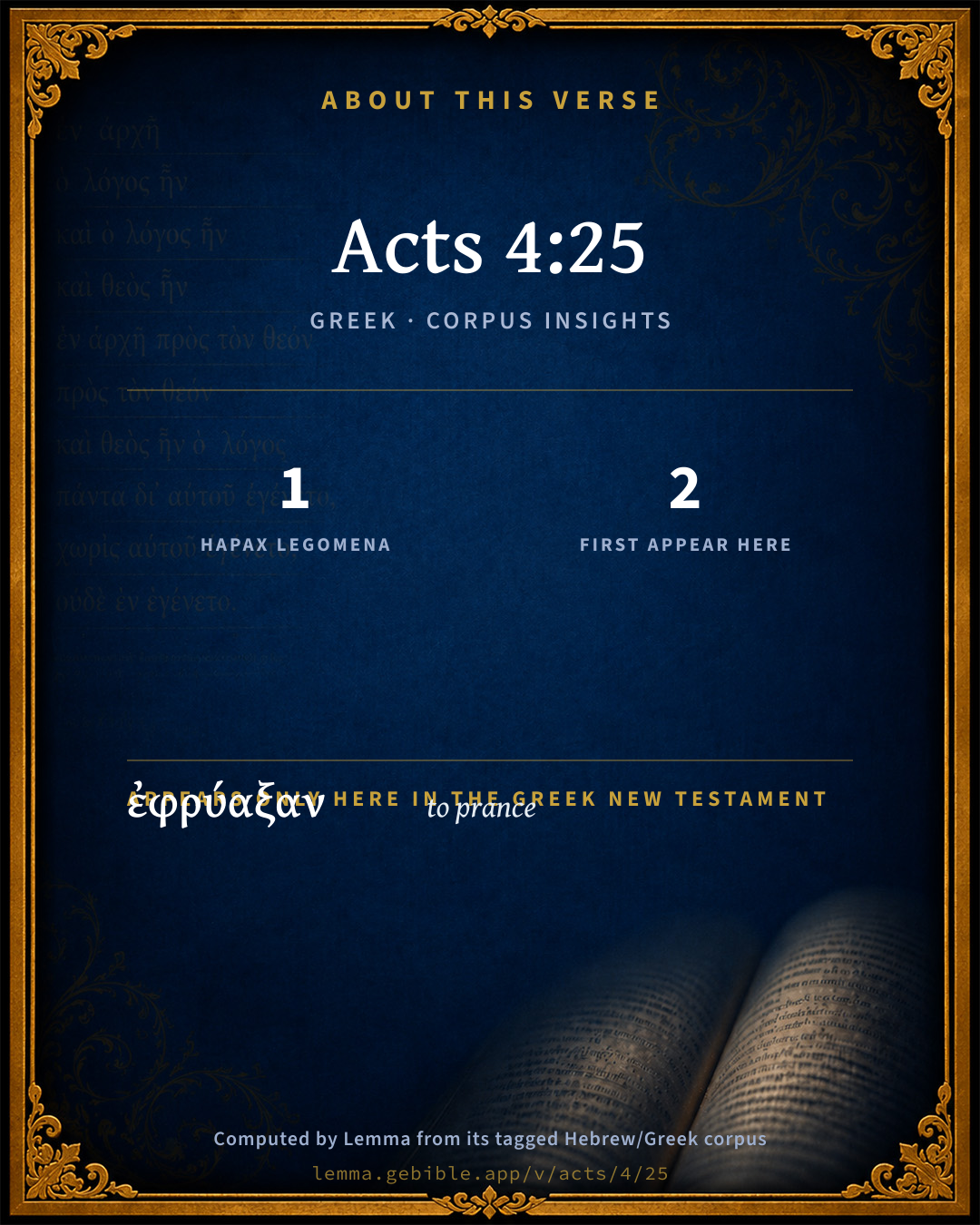
  • 1 hapax legomenon — only here in the Greek New Testament
  • 2 first appearances in the Greek New Testament
Full analysis ↓
Download a study sheet

One document with this verse’s original text, its word-by-word gloss line, the meaning frame, cross-references with their text, attributed commentary, and full source and license credits — printable, and it pastes into notes with its structure intact.

This verse Autodidact and up

Study sheet (.html) Plain text (.txt)

A passage Seminary Student

Up to 50 verses in one chapter. A passage sheet keeps up to 6 commentary sources and 12 cross-references per verse, in the order this page ranks them, and says so on the sheet whenever that leaves anything out. Ask for a single verse and you get the Autodidact verse sheet above.

Everything on this page stays free to read, with no account — the sheet is a download of what is already on screen, not access to it.

Want to remove ads? Support Godless Engineer
Compare translations 3

The same verse in 3 English versions, stacked beneath the original-language interlinear above. Click any original word for its lexicon entry.

Each is an independent rendering of the whole verse — the interlinear is not word-aligned to these translations.

Highlighted words mark where these versions differ — a whole-verse word diff, not a word-by-word alignment.

  • World English Bible Public Domain
    who by the mouth of your servant, David, said, 'Why do the nations rage, And the peoples plot a vain thing?
  • King James Version Public Domain
    Who by the mouth of thy servant David hast said, Why did the heathen rage, and the people imagine vain things?
  • unfoldingWord Literal Text CC BY-SA 4.0
    the one having said by the Holy Spirit from the mouth of our father David, your servant, ‘Why did the nations rage, and the peoples imagine useless things?

unfoldingWord Literal Text — © unfoldingWord, licensed CC BY-SA 4.0. Word-aligned USFM3 via Door43 (git.door43.org/unfoldingWord/en_ult).

Versions to compare (up to 4)

3 of 4 selected

Show all 19 translations

Every available English version of this verse, each an independent rendering of the whole verse.

  • World English Bible Public Domain
    who by the mouth of your servant, David, said, 'Why do the nations rage, And the peoples plot a vain thing?
  • Berean Standard Bible Public Domain
    You spoke by the Holy Spirit through the mouth of Your servant, our father David: ‘Why do the nations rage and the peoples plot in vain?
  • Majority Standard Bible Public Domain
    You spoke through the mouth of Your servant David: ‘Why do the nations rage and the peoples plot in vain?
  • King James Version Public Domain
    Who by the mouth of thy servant David hast said, Why did the heathen rage, and the people imagine vain things?
  • American Standard Version (1901) Public Domain
    who by the Holy Spirit, `by' the mouth of our father David thy servant, didst say, Why did the Gentiles rage, And the peoples imagine vain things?
  • Revised Version (1885) Public Domain
    who by the Holy Ghost, by the mouth of our father David thy servant, didst say, Why did the Gentiles rage, And the peoples imagine vain things?
  • Geneva Bible (1599) Public Domain
    Which by the mouth of thy seruant Dauid hast saide, Why did the Gentiles rage, and the people imagine vaine things?
  • Douay-Rheims (1899) Public Domain
    Who, by the Holy Ghost, by the mouth of our father David, thy servant, hast said: Why did the Gentiles rage, and the people meditate vain things?
  • Young's Literal Translation Public Domain
    who, through the mouth of David thy servant, did say, Why did nations rage, and peoples meditate vain things?
  • Literal Standard Version CC BY-SA 4.0
    who, through the mouth of Your servant David, said, Why did nations rage, and peoples meditate vain things?
  • Unlocked Literal Bible CC BY-SA 4.0
    You spoke by the Holy Spirit through the mouth of your servant, our father David, 'Why did the Gentile nations rage, and the peoples imagine useless things?'
  • unfoldingWord Literal Text CC BY-SA 4.0
    the one having said by the Holy Spirit from the mouth of our father David, your servant, ‘Why did the nations rage, and the peoples imagine useless things?
  • Darby Bible Public Domain
    who hast said by the mouth of thy servant David, Why have [the] nations raged haughtily and [the] peoples meditated vain things?
  • World Messianic Bible Public Domain
    who by the mouth of your servant David, said, ‘Why do the nations rage, and the peoples plot a vain thing?
  • Webster's Bible Public Domain
    Who, by the mouth of thy servant David hast said, Why did the heathen rage, and the people imagine vain things?
  • Free Bible Version CC BY-SA 4.0
    You spoke by the Holy Spirit through David, our forefather and your servant, saying ‘Why did the people of the other nations become so angry? Why did they plot so foolishly against me?
  • Bible in Basic English Public Domain
    Who has said, by the Holy Spirit, through the mouth of our father David your servant, Why are the nations so violently moved, and why are the thoughts of the people so foolish?
  • Text-Critical English NT CC BY 4.0
    It is yoʋ who said through the mouth of yoʋr servant David, ‘Why do the nations rage, and the peoples plot foolish things?
  • Tyndale New Testament (1534) Public Domain
    which by the mouth of thy servaunt David hast sayd: Why dyd the hethen rage and the people immagen vayne thinges.

Literal Standard Version (2020), Covenant Press — licensed CC BY-SA 4.0. Text via the HelloAO Bible API (eBible.org). Unlocked Literal Bible (unfoldingWord) — licensed CC BY-SA 4.0. Text via the HelloAO Bible API (eBible.org). unfoldingWord Literal Text — © unfoldingWord, licensed CC BY-SA 4.0. Word-aligned USFM3 via Door43 (git.door43.org/unfoldingWord/en_ult). Free Bible Version, Dr. Jonathan Gallagher — licensed CC BY-SA 4.0. Text via the HelloAO Bible API (eBible.org).

Word by word

More ways to search: Search by grammar → Find every occurrence → Compare this word →

Practice this passage: Drill this verse → Learn its vocabulary →

ἐφρύαξαν
phryássō
G5433
“to prance”
Verb, Aorist, Active, Indicative, 3rd person, Plural
Part of Speech
Verb
Tense
Aorist
Voice
Active
Mood
Indicative
Person
3rd person
Number
Plural
Full Thayer's Definition

Origin: akin to G1032 , G1031

TDNT: None

1. to neigh, stamp the ground, prance, snort 2. to be high-spirited a. of horses b. of men 1. to take on lofty airs 2. behave arrogantly c. to be tumultuous, to rage
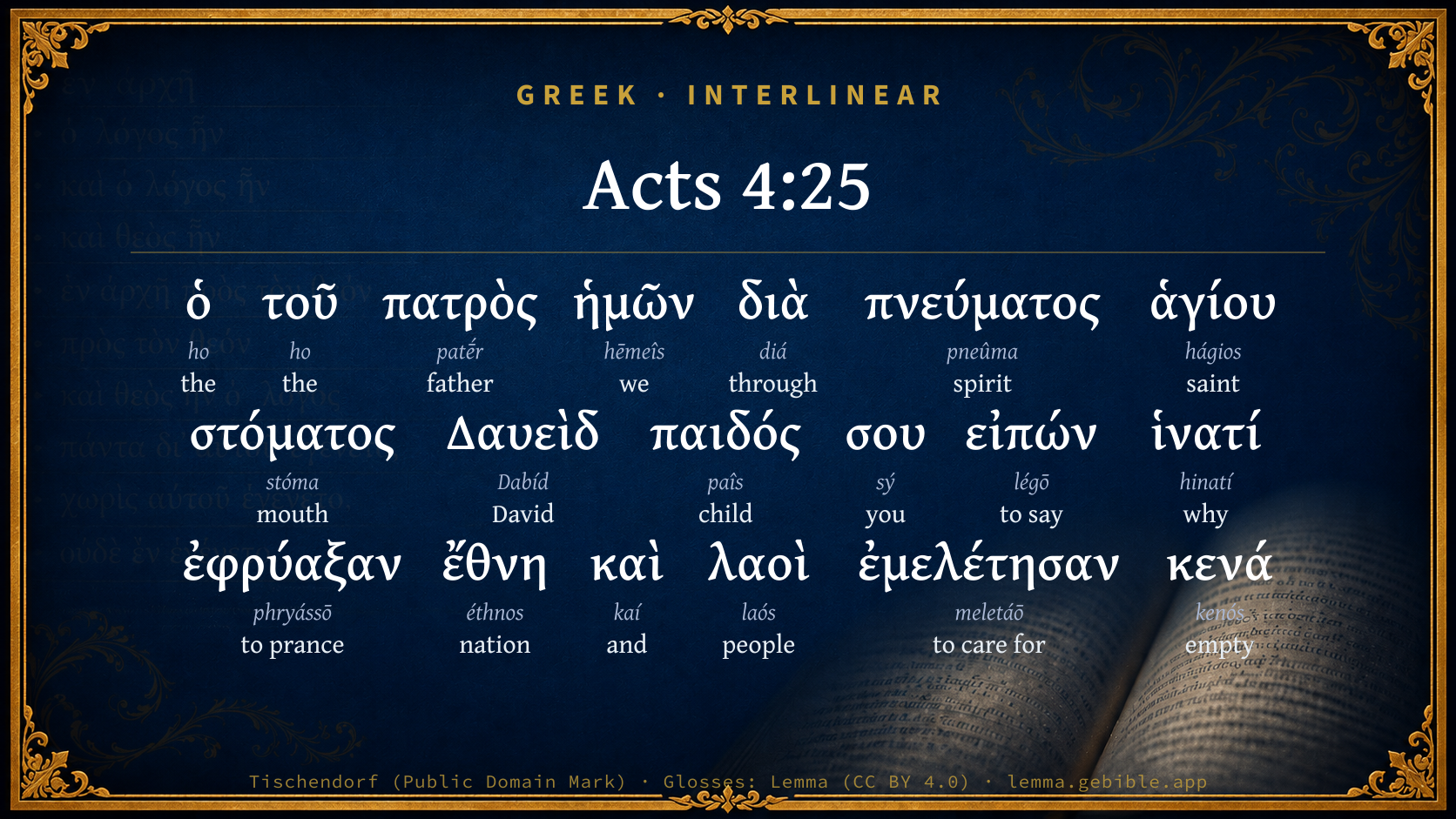
  1. ὁ ho G3588 “the” Article, Nominative, Singular, Masculine
  2. τοῦ ho G3588 “the” Article, Genitive, Singular, Masculine
  3. πατρὸς patḗr G3962 “father” Noun, Genitive, Singular, Masculine
  4. ἡμῶν hēmeîs G2249 “we” Personal pronoun, 1st person, Genitive, Plural
  5. διὰ diá G1223 “through” Preposition
  6. πνεύματος pneûma G4151 “spirit” Noun, Genitive, Singular, Neuter
  7. ἁγίου hágios G40 “saint” Adjective, Genitive, Singular, Neuter
  8. στόματος stóma G4750 “mouth” Noun, Genitive, Singular, Neuter
  9. Δαυεὶδ Dabíd G1138 “David” Noun, Proper, indeclinable
  10. παιδός paîs G3816 “child” Noun, Genitive, Singular, Masculine
  11. σου sý G4771 “you” Personal pronoun, 2nd person, Genitive, Singular
  12. εἰπών légō G3004 “to say” Verb, Aorist, Active, Participle, Nominative, Singular, Masculine
  13. ἱνατί hinatí G2444 “why” Adverb, Interrogative
  14. ἔθνη éthnos G1484 “nation” Noun, Nominative, Plural, Neuter
  15. καὶ kaí G2532 “and” Conjunction
  16. λαοὶ laós G2992 “people” Noun, Nominative, Plural, Masculine
  17. ἐμελέτησαν meletáō G3191 “to care for” Verb, Aorist, Active, Indicative, 3rd person, Plural
  18. κενά kenós G2756 “empty” Adjective, Accusative, Plural, Neuter

About this verse

These counts appear in no published source. They are computed here, from the morphology-tagged text and Lemma’s own curated glosses. What Lemma adds →

19
words
18
distinct lemmas
Acts
section

Notable vocabulary

1 hapax legomenon — a word that appears only here in the entire Greek New Testament:

  • ἐφρύαξαν to prance G5433

First appearance in Scripture

These words make their first canonical appearance in the Greek New Testament here:

  • ἐφρύαξαν to prance G5433
  • ἐμελέτησαν to care for G3191

Shared distinctive vocabulary

ἐμελέτησαν to care for G3191 occurs in 2 verses of the Greek New Testament. Also found in:

Repetition

A word recurs within this verse:

Cross-references

3

Topical passages linked to Acts 4:25 in the Treasury of Scripture Knowledge — connected by theme and wording, ordered by reader-vote popularity; previews shown in the World English Bible.

  • Psalms 2:1–6 Why do the nations rage, And the peoples plot a vain thing?
  • Acts 1:16 "Brothers, it was necessary that this Scripture should be fulfilled, which the Holy Spirit spoke before by the mouth of David concerning Judas, who was guide to those who took Jesus.
  • Acts 2:30 Therefore, being a prophet, and knowing that God had sworn with an oath to him that of the fruit of his body, according to the flesh, he would raise up the Christ to sit on his throne,

Cross-references courtesy of OpenBible.info (CC BY 4.0).

Where the printed editions differ

2 variants

Places in this verse where the major printed Greek editions disagree on the wording in a way that affects the translation — a comparison of editions, not a manuscript-by-manuscript collation. The editions are the modern critical texts (Nestlé-Aland 28/27, SBL, Westcott-Hort, Tregelles, Tyndale House) and the traditional texts behind the KJV (the Textus Receptus and the Byzantine/Majority text). It is not a claim about which reading is original.

  1. Extra text
    τοῦ πατρὸς ἡμῶν

    “of the father of us”

    In NA28NA27TynSBLWHTreg Not in TRByz

    τοῦ πατρὸς ἡμῶν (tou patros hēmōn) 'of the father of us' is only in older manuscripts (NA28+NA27+Tyn+SBL+WH+Treg)

  2. Extra text
    πνεύματος ἁγίου

    “[the] Spirit Holy”

    In NA28NA27TynSBLWHTreg Not in TRByz

    πνεύματος ἁγίου (pneumatos hagiou) '[the] Spirit Holy' is only in older manuscripts (NA28+NA27+Tyn+SBL+WH+Treg)

Textual data: Translators Amalgamated Greek New Testament (STEPBible TAGNT) · CC BY 4.0.

Commentary

Notes on Acts 4:25 from classic Christian and Jewish commentators (each source and its license shown beneath its notes). The classic Christian expositions comment on the surrounding passage and are grouped to its opening verse, so a note may address several verses; the Jewish commentaries on the Tanakh (Rashi and others) are per-verse, so they appear only where the commentator wrote on this verse.

Lemma curates 59 commentaries, every one of them public domain or Creative Commons licensed, each selected and text-cleaned for this edition rather than reprinted as found. About our sources →

The Biblical Illustrator

Joseph S. Exell

Act_4:25-28

Why do the heathen rage.

Opposition to the gospel

I. Its characteristics.

1. Furiousness, rage, a word signifying the neighing or snorting of highly excited horses--Like the prancing war-horse in the book of Job. It is metaphorically used to represent the noise and fury of insolent and overbearing men, and well represents the attitude of Christs enemies.

2. Vanity. They imagine vain things. Those who aspire to thwart the plans of Christ, to crush Christianity, live in a region of mad dreams. They are agents of consummate folly, and must fall victims to their own delusions.

3. Combination. Kings and rulers were banded together. Ungodly men that differ widely in other things, are one in their antagonism to Christ.

II. Its frustration. All that Herod, Pontius Pilate, etc., could do was just as much as God determined they should do. How great is God! He maketh His enemies to do His work. (D. Thomas, D. D.)

Whatsoever Thy hand and Thy counsel determined before to be done.--

The hand of God

For to do, or be the means of doing, that by which Christ became the Saviour of the world. This was the effect, although the secondary agents were ignorant of it. In their blindness and sinfulness they did just so much and no more than God had determined to be done. God decreed the salvation of the world by the death of Christ, but He did not decree the means--mans sin; but overruled it to the accomplishment of His purpose. This is ascribed to the hand of God, which in Scripture implies--

I. Power. This was displayed in the work of our deliverance from the slavery of Satan--the strong man; and this deliverance was effected by the suffering and death of Christ, in which the great power of God was displayed.

II. Providence or direction. It was not Jewish malice that procured our redemption, but malice overruled by Divine providence.

III. Operation. God by the death of Christ has wrought our redemption, and established His Church as a channel of salvation.

IV. Mercy and grace. The work of our salvation was wrought through the mercy God bears towards us,

V. Wisdom (Job_28:11; Ezr_8:18; Nehemiah if. 8, 18). (W. Denton, M. A.)

The Biblical Illustrator, edited by Joseph S. Exell (c. 1880s–1900s) — public domain. Text from a community e-Sword module.

MacLaren's Expositions of Holy Scripture

Alexander MacLaren

Acts

OBEDIENT DISOBEDIENCE

THE SERVANT AND THE SLAVES

Act 4:25, Act 4:27, Act 4:29.

I do not often take fragments of Scripture for texts; but though these are fragments, their juxtaposition results in by no means fragmentary thoughts. There is obvious intention in the recurrence of the expression so frequently in so few verses, and to the elucidation of that intention my remarks will be directed. The words are parts of the Church’s prayer on the occasion of its first collision with the civil power. The incident is recorded at full length because it is the first of a long and bloody series, in order that succeeding generations might learn their true weapon and their sure defence. Prayer is the right answer to the world’s hostility, and they who only ask for courage to stand by their confession will never ask in vain. But it is no part of my intention to deal either with the incident or with this noble prayer.

A word or two of explanation may be necessary as to the language of our texts. You will observe that, in the second of them, I have followed the Revised Version, which, instead of ‘Thy holy child,’ as in the Authorised Version, reads ‘Thy holy Servant.’ The alteration is clearly correct. The word, indeed, literally means ‘a child,’ but, like our own English ‘boy,’ or even ‘man,’ or ‘maid,’ it is used to express the relation of servant, when the desire is to cover over the harsher features of servitude, and to represent the servant as a part of the family. Thus the kindly centurion, who besought Jesus to come and heal his servant, speaks of him as his ‘boy.’ And that the word is here used in this secondary sense of ‘servant’ is unmistakable. For there is no discernible reason why, if stress were meant to be laid on Christ as being the Son of God, the recognised expression for that relationship should not have been employed. Again, the Greek translation of the Old Testament, with which the Apostles were familiar, employs the very phrase that is here used as its translation of the well-known Old Testament designation of the Messiah, ‘the Servant of the Lord’ and the words here are really a quotation from the great prophecies of the second part of the Book of Isaiah. Further, the same word is employed in reference to King David and in reference to Jesus Christ. In regard to the former, it is evident that it must have the meaning of ‘servant’; and it would be too harsh to suppose that in the compass of so few verses the same expression should be used, at one time in the one signification, and at another in the other. So, then, David and Jesus are in some sense classified here together as both servants of God. That is the first point that I desire to make.

Then, in regard to the third of my texts, the expression is not the same there as in the other two. The disciples do not venture to take the loftier designation. Rather they prefer the humble one, ‘slaves,’ bondmen, the familiar expression found all through the New Testament as almost a synonym to Christians.

So, then, we have here three figures: the Psalmist-king, the Messiah, the disciples; Christ in the midst, on the one hand a servant with whom He deigns to be classed, on the other hand the slaves who, through Him, have become sons. And I think I shall best bring out the intended lessons of these clauses in their connection if I ask you to note these two contrasts, the servants and the Servant; the Servant and the slaves. ‘David Thy servant’; ‘Thy holy Servant Jesus’; us ‘Thy servants.’

I. First, then, notice the servants and the Servant.

The reason for the application of the name to the Psalmist lies, not so much in his personal character or in his religious elevation, as in the fact that he was chosen of God for a specific purpose, to carry on the divine plans some steps towards their realisation. Kings, priests, prophets, the collective Israel, as having a specific function in the world, and being, in some sense, the instruments and embodiments of the will of God amongst men, have in an eminent degree the designation of His ‘servants.’ And we might widen out the thought and say that all men who, like the heathen Cyrus, are God’s shepherds, though they do not know it-guided by Him, though they understand not whence comes their power, and blindly do His work in the world, being ‘epoch-making’ men, as the fashionable phrase goes now-are really, though in a subordinate sense, entitled to the designation.

But then, whilst this is true, and whilst Jesus Christ comes into this category, and is one of these special men raised up and adapted for special service in connection with the carrying out of the divine purpose, mark how emphatically and broadly the line is drawn here between Him and the other members of the class to which, in a certain sense, He does belong. Peter says, ‘Thy servant David,’ but he says ‘Thy holy Servant Jesus.’ And in the Greek the emphasis is still stronger, because the definite article is employed before the word ‘servant.’ ‘The holy Servant of Thine’-that is His specific and unique designation.

There are many imperfect instruments of the divine will. Thinkers and heroes and saints and statesmen and warriors, as well as prophets and priests and kings, are so regarded in Scripture, and may profitably be so regarded by us; but amongst them all there is One who stands in their midst and yet apart from them, because He, and He alone, can say, ‘I have done all Thy pleasure, and into my doing of Thy pleasure no bitter leaven of self-regard or by-ends has ever, in the faintest degree, entered.’ ‘Thy holy Servant Jesus’ is the unique designation of the Servant of the Lord.

And what is the meaning of holy? The word does not originally and primarily refer to character so much as to relation to God. The root idea of holiness is not righteousness nor moral perfectness, but something that lies behind these-viz, separation for the service and uses of God. The first notion of the word is consecration, and, built upon that and resulting from it, moral perfection. So then these men, some of whom had lived beside Jesus Christ for all those years, and had seen everything that He did, and studied Him through and through, had summered and wintered with Him, came away from the close inspection of His character with this thought; He is utterly and entirely devoted to the service of God, and in Him there is neither spot nor wrinkle nor blemish such as is found in all other men.

I need not remind you with what strange persistence of affirmation, and yet with what humility of self-consciousness, our Lord Himself always claimed to be in possession of this entire consecration, and complete obedience, and consequent perfection. Think of human lips saying, ‘I do always the things that please Him.’ Think of human lips saying, ‘My meat is to do the will of Him that sent me.’ Think of a man whose whole life’s secret was summed up in this: ‘As the Father hath given Me commandment, so’-no more, no less, no otherwise-’so I speak.’ Think of a man whose inspiring principle was, consciously to himself, ‘not My will, but Thine be done’; and who could say that it was so, and not be met by universal ridicule. There followed in Jesus the moral perfectness that comes from such uninterrupted and complete consecration of self to God. ‘Thy servant David,’-what about Bathsheba, David? What about a great many other things in your life? The poet-king, with the poet-nature so sensitive to all the delights of sense, and so easily moved in the matter of pleasure, is but like all God’s other servants in the fact of imperfection. In every machine power is lost through friction; and in every man, the noblest and the purest, there is resistance to be overcome ere motion in conformity with the divine impulse can be secured. We pass in review before our minds saints and martyrs and lovely characters by the hundred, and amongst them all there is not a jewel without a flaw, not a mirror without some dint in it where the rays are distorted, or some dark place where the reflecting surface has been rubbed away by the attrition of sin, and where there is no reflection of the divine light. And then we turn to that meek Figure who stands there with the question that has been awaiting an answer for nineteen centuries upon His lips, and is unanswered yet: ‘Which of you convinceth Me of sin?’ ‘He is the holy Servant,’ whose consecration and character mark Him off from all the class to which He belongs as the only one of them all who, in completeness, has executed the Father’s purpose, and has never attempted anything contrary to it.

Now there is another step to be taken, and it is this. The Servant who stands out in front of all the group-though the noblest names in the world’s history are included therein-could not be the Servant unless He were the Son. This designation, as applied to Jesus Christ, is peculiar to these three or four earlier chapters of the Acts of the Apostles. It is interesting because it occurs over and over again there, and because it never occurs anywhere else in the New Testament. If we recognise what I think must be recognised, that it is a quotation from the ancient prophecies, and is an assertion of the Messianic character of Jesus, then I think we here see the Church in a period of transition in regard to their conceptions of their Lord. There is no sign that the proper Sonship and Divinity of our Lord was clear before them at this period. They had the facts, but they had not yet come to the distinct apprehension of how much was involved in these. But, if they knew that Jesus Christ had died and had risen again-and they knew that, for they had seen Him-and if they believed that He was the Messiah, and if they were certain that in His character of Messiah there had been faultlessness and absolute perfection-and they were certain of that, because they had lived beside Him-then it would not be long before they took the next step, and said, as I say, ‘He cannot be the Servant unless He is more than man.’

And we may well ask ourselves the question, if we admit, as the world does admit, the moral perfectness of Jesus Christ, how comes it that this Man alone managed to escape failures and deflections from the right, and sins, and that He only carried through life a stainless garment, and went down to the grave never having needed, and not needing then, the exercise of divine forgiveness? Brethren, I venture to say that it is hopeless to account for Jesus Christ on naturalistic principles; and that either you must give up your belief in His sinlessness, or advance, as the Christian Church as a whole advanced, to the other belief, on which alone that perfectness is explicable: ‘Thou art the King of Glory, O Christ! Thou art the Everlasting Son of the Father!’

II. And so, secondly, let us turn to the other contrast here-the Servant and the slaves.

I said that the humble group of praying, persecuted believers seemed to have wished to take a lower place than their Master’s, even whilst they ventured to assume that, in some sense, they too, like Him, were doing the Father’s will. So they chose, by a fine instinct of humility rather than from any dogmatical prepossessions, the name that expresses, in its most absolute and roughest form, the notion of bondage and servitude. He is the Servant; we standing here are slaves. And that this is not an overweighting of the word with more than is meant by it seems to be confirmed by the fact that in the first clause of this prayer, we have, for the only time in the New Testament, God addressed as ‘Lord’ by the correlative word to slave, which has been transferred into English, namely, despot.

The true position, then, for a man is to be God’s slave. The harsh, repellent features of that wicked institution assume an altogether different character when they become the features of my relation to Him. Absolute submission, unconditional obedience, on the slave’s part; and on the part of the Master complete ownership, the right of life and death, the right of disposing of all goods and chattels, the right of separating husband and wife, parents and children, the right of issuing commandments without a reason, the right to expect that those commandments shall be swiftly, unhesitatingly, punctiliously, and completely performed-these things inhere in our relation to God. Blessed the man who has learned that they do, and has accepted them as his highest glory and the security of his most blessed life! For, brethren, such submission, absolute and unconditional, the blending and the absorption of my own will in His will, is the secret of all that makes manhood glorious and great and happy.

Remember, however, that in the New Testament these names of slave and owner are transferred to Christians and Jesus Christ. ‘The Servant’ has His slaves; and He who is God’s Servant, and does not His own will but the Father’s will, has us for His servants, imposes His will upon us, and we are bound to render to Him a revenue of entire obedience like that which He hath laid at His Father’s feet.

Such slavery is the only freedom. Liberty does not mean doing as you like, it means liking as you ought, and doing that. He only is free who submits to God in Christ, and thereby overcomes himself and the world and all antagonism, and is able to do that which it is his life to do. A prison out of which we do not desire to go is no restraint, and the will which coincides with law is the only will that is truly free. You talk about the bondage of obedience. Ah! ‘the weight of too much liberty’ is a far sorer bondage. They are the slaves who say, ‘Let us break His bonds asunder, and cast away His cords from us’; and they are the free men who say, ‘Lord, put Thy blessed shackles on my arms, and impose Thy will upon my will, and fill my heart with Thy love; and then will and hands will move freely and delightedly.’ ‘If the Son make you free, ye shall be free indeed.’

Such slavery is the only nobility. In the wicked old empires, as in some of their modern survivals to-day, viziers and prime ministers were mostly drawn from the servile classes. It is so in God’s kingdom. They who make themselves God’s slaves are by Him made kings and priests, and shall reign with Him on earth. If we are slaves, then are we sons and heirs of God through Jesus Christ.

Remember the alternative. You cannot be your own masters without being your own slaves. It is a far worse bondage to live as chartered libertines than to walk in the paths of obedience. Better serve God than the devil, than the world, than the flesh. Whilst they promise men liberty, they make them ‘the most abject and downtrodden vassals of perdition.’

The Servant-Son makes us slaves and sons. It matters nothing to me that Jesus Christ perfectly fulfilled the law of God; it is so much the better for Him, but of no value for me, unless He has the power of making me like Himself. And He has it, and if you will trust yourselves to Him, and give your hearts to Him, and ask Him to govern you, He will govern you; and if you will abandon your false liberty which is servitude, and take the sober freedom which is obedience, then He will bring you to share in His temper of joyful service; and even we may be able to say, ‘My meat and my drink is to do the will of Him that sent me,’ and truly saying that, we shall have the key to all delights, and our feet will be, at least, on the lower rungs of the ladder whose top reaches to Heaven.

‘What fruit had ye in the things of which ye are now ashamed? But being made free from sin, and become the slaves of God, ye have your fruit unto holiness; and the end everlasting life.’ Brethren, I beseech you, by the mercies of God, that ye yield yourselves to Him, crying, ‘O Lord, truly I am Thy servant. Thou hast loosed my bonds.’

Alexander MacLaren, Expositions of Holy Scripture (1904–1910) — public domain. Text from a community e-Sword module.

Tyndale Open Study Notes

Tyndale Open Resources

4:25-26 This passage quotes Ps 2:1-2, which describes the response of the Gentile nations to the Lord’s anointed king. In a similar manner, the Jews and Gentiles in Jerusalem had gathered together against Jesus and now against his followers.

Tyndale Open Study Notes — © Tyndale Open Resources, licensed CC BY-SA 4.0. Text via the HelloAO Bible API.

Bengel's Gnomon

Johann Albrecht Bengel

Act 4:25. Ἱνατί—αὐτοῦ) Psa 2:1-2. So altogether the LXX.—ἐφρύαξαν) This word is strictly said of horses, to snort fiercely.—κενὰ) This is equivalent to an adverb. So the LXX., παρακαλεῖτε κενά, “Comfort ye me in vain,” Job 21:34. This word in the second hemistich, is parallel to the interrogation in the former hemistich.

Bengel's Gnomon of the New Testament — English translation (T&T Clark, Edinburgh, 1860) — public domain. Text from a community e-Sword module.

Meyer's Critical & Exegetical Commentary

Heinrich August Wilhelm Meyer

Act_4:25-26. Psa_2:1-2, exactly according to the LXX. The Psalm itself, according to its historical meaning, treats of the king, most probably of Solomon, mounting the throne; but this theocratic king is a type of the ideal of the Israelitish kingdom, i.e. of the Messiah, present to the prophetic eye. The Psalm is not by David (see Ewald and Hupfeld); but those who are praying follow the general assumption that the Psalms, of which no other is mentioned as author, proceed from him.

From the standpoint of the antitypical fulfilment in Christ they understood (see Act_4:27) the words of the Psalm thus: Wherefore raged (against Jesus) Gentiles (the Romans), and tribes (of Israel) imagined a vain thing (in which they could not succeed, namely, the destruction of Jesus)? There arose (against Him) the kings of the earth, and the rulers (the former represented by Herod, and the latter by Pilate) assembled themselves (namely with the ἔθνεσιν and λαοῖς, see Act_4:27) against Jehovah (who had sent Jesus) and against His anointed.

φρυάσσω] primarily, to snort; then, generally, ferocio; used in ancient Greek only in the middle. See Wesseling, ad Diod. iv. 74.

Meyer — Critical and Exegetical Commentary on the New Testament — English translation by Peter Christie, edited by Frederick Crombie (T&T Clark, 1880) — public domain. Text from a community e-Sword module.

Expositor's Greek Testament

ed. W. Robertson Nicoll

Act 4:25 . The words form an exact quotation from the LXX (Psa 2:1 ). ἵνα τί , again in quotation, Act 7:26 ; cf. Luk 13:7 , 1Co 10:29 ; twice in Mat 9:4 ; Mat 27:46 , quotation; W.H [161] , Blass (Weiss, ἱνατί ), sc. , γένηται , Blass, Grammatik des N. G. , p. 14, and Winer-Schmiedel, p. 36. ἐφρύαξαν : in the active form the verb occurs once in LXX, viz. , in this passage, as a translation of רָגַשׁ , φρυάσσομαι , primarily of the snorting and neighing of a high-spirited horse, then of the haughtiness and insolence of men; twice it is used as a dep. in LXX, 2Ma 7:34 , R.; Act 3:2 ; Act 3:2 , and so in profane writers. ἔθνη , i.e. , the Gentiles, see on Act 4:27 . λαός might be used, and is used of any people, but it is used in Biblical Greek specially of the chosen people of God, cf. Luk 2:32 , Act 26:17 ; Act 26:23 , Rom 15:10 , and it is significant that the word is transferred to the Christian community, which was thus regarded as taking the place of the Jewish theocracy, Act 15:14 ; Act 18:10 , Rom 9:25 , 1Pe 2:10 ; Hort, Ecclesia , pp. 11, 12, Grimm, sub v. , λαός ; so too in the LXX, ἔθνος in the plural is used in an overwhelming number of instances of other nations besides Israel, cf. Psa 56 (57):9, Zec 1:15 ; in N.T., ἔθνη = pagans, Rom 3:29 , and Roman Christians, Rom 15:27 , cf. populus , the Roman people, as opposed to gentes , Lucan, Phars. , i., 82, 83 (Page); Kennedy, Sources of N. T. Greek , p. 98.

[161] Westcott and Hort’s The New Testament in Greek: Critical Text and Notes.

The Expositor's Greek Testament, edited by W. Robertson Nicoll (1897–1910) — public domain. Text from a community e-Sword module.

Jamieson, Fausset & Brown

Robert Jamieson, A. R. Fausset & David Brown

by the mouth of . . . David--to whom the Jews ascribed the second Psalm, though anonymous; and internal evidence confirms it. David's spirit sees with astonishment "the heathen, the people, the kings and princes of the earth," in deadly combination against the sway of Jehovah and His Anointed (his Messiah, or Christ), and asks "why" it is. This fierce confederacy our praying disciples see in full operation, in the "gathering together of Herod and Pilate, the Gentiles (the Roman authority), and the people of Israel, against God's holy Child ('Servant') Jesus." (See on Act 3:13). The best ancient copies read, after "were gathered together," "in this city," which probably answers to "upon my holy hill of Zion," in the Psa 2:6.

Jamieson, Fausset & Brown — Commentary Critical and Explanatory on the Whole Bible (1871) — public domain (CC PDM 1.0). Text via the HelloAO Bible API.

Adam Clarke's Commentary

Verse 25. By the mouth of thy servant David hast said] Several add, but impertinently, δια πνευματος αγιου, by the Holy Spirit; but it is sufficient that GOD has said it; and thugs we find that David spoke by the inspiration of God; and that the second Psalm relates to Jesus Christ, and predicts the vain attempts made by Jewish and heathen powers to suppress Christianity.

Adam Clarke's Commentary on the Bible (1810–1826) — public domain. Text from a community e-Sword/MySword module.

John Calvin's Commentaries

25. Who by the mouth of David. They descend now into the second member, that they ask nothing but that which God hath promised to perform, so that his will and power are joined together, to the end they may fully assure themselves that they shall obtain their requests; and because the kingdom of Christ is now in hand, they make rehearsal of the promise of God, wherein he promiseth to defend and maintain the same, so that when the whole world hath done what it can to overthrow it, yet all shall be in vain; and herein their godliness and sincere zeal, in that they are not so much careful for their own safety, as for the increasing and advancement of the kingdom of Christ.

Why have the Gentiles raged? We must need confess that David speaketh of himself, who after he was chosen king by the Lord, and anointed by Samuel the prophet, did enjoy the kingdom very hardly, because his enemies withstood him on every side. We know how the rulers and people conspired together with Saul and his family; after that the Philistines, and other strange enemies, despising him when he came newly to the crown, made war against him, striving who should begin first, wherefore it is not without cause that he complaineth that the kings rage and take counsel together, and that the people do go about divers things; nevertheless, because he knew that God was the supporter of his kingdom, he derideth their foolish enterprises, and affirmeth that they are vain; but because his kingdom was established, that it might be a figure or image of the kingdom of Christ, David doth not stay still in the shadow itself; but he apprehendeth the body, yea, the Holy Ghost, as the apostles do truly repeat the same, doth sharply reprove the foolish and ridiculous madness of the world, in that they dare invade the kingdom of Christ which God had esta-blished, as well in the person of David as of Christ himself. And this is a singular comfort, in that we hear that God is on our side, so long as we go on warfare under the kingdom of Christ. Hereby we may persuade ourselves, that howsoever all men, both high and low do wickedly conspire together against this kingdom, yet shall they not prevail, for what is all the whole world compared with God? But we must first of all know and assure ourselves of this, that God will continually maintain the kingdom of his Son, whereof he himself is the author, so that we may set his decree (which shall not be broken) against the rashness of men, that trusting to the help of his hand, we may not doubt to despise all the preparation and furniture of men, though they be terrible; and he doth diligently express how great the bands of the adversaries are; he saith, that they attempt all things, he doth also reckon up their counsels, lest any of these do terrify us. Furthermore, when as the Psalm teacheth, that the kingdom of Christ shall endure, maugre the heads of the adversaries, it doth also show that there shall be many adversaries, which shall endeavor to overthrow the same. On the one side, he bringeth in the kings raging, on the other, the people all out of quiet, whereby he signifieth that all estates shall be offended at it; and no marvel, because nothing is more contrary to the flesh than the spiritual sword of the gospel wherewith Christ killeth us, that he may make us obey him, (Romans 15:16.) Therefore, we must know this for a surety, that the kingdom of Christ shall never be quiet in the world, lest when we are to fight, we be afraid as at some strange thing.

John Calvin's Commentaries (1540-1563) — public domain. Text from the Calvin Translation Society English edition (1840s-50s) via the Christian Classics Ethereal Library (ccel.org). Calvin's coverage is partial (roughly two-thirds of the Bible); uncommented books and verses are honest gaps, never fabricated. The 19th-century editor's footnotes and remarks are omitted so the notes are faithfully Calvin's own voice.

Ellicott's Commentary for English Readers

(25) Who by the mouth of thy servant David . . . .—The older MSS. present many variations of the text. It probably stood originally somewhat in this form: “Who through the Holy Ghost, by the mouth of David our father, thy servant,” and was simplified by later copyists. In the citation from Psalms 2 we have another lesson from the Apostles’ school of prophetic interpretation. The Psalm is not cited in the Gospels. Here what seems to us the most striking verse (Act_4:7) of it is passed over, and it does not appear as referred to Christ till we find it in Heb_1:5; Heb_5:5.

Why did the heathen rage, and the people imagine . . .?—Neither noun has the article in the Greek or in the Hebrew. Why did nations rage and peoples imagine . . .? The word for “rage” is primarily applied to animal ferocity, especially to that of untamed horses.

A Bible Commentary for English Readers, edited by Charles John Ellicott (1878–1897) — public domain. Text from a community e-Sword module.

The Cambridge Bible for Schools and Colleges

gen. ed. J. J. S. Perowne

25. In the first part of this verse there is some confusion in the Greek text. The most authoritative reading may be translated who by the Holy Ghost [through] the mouth of our father David thy servant hast said. From the Rec. Text there has been omitted “the Holy Ghost,” and perhaps the preposition by was repeated before “the mouth.” But the order in which the Greek words stand makes it difficult to see what has happened, for even in the best MSS. their arrangement is much involved.

The Apostle now proceeds to apply the words of the second Psalm, which has been admitted by the Jews themselves to be Messianic, to the circumstances under which Christ was put to death.

Why did the heathen rage] Better, the nations, or the Gentiles, as it is rendered Act_4:27.

The Psalm in its first application probably referred to some revolt against the king of Israel. We have such a revolt mentioned in David’s reign (2 Samuel 8), where the Syrians, Moabites, Ammonites and other nations were conquered by David, after being in vain rebellion.

The words of the Psalm are quoted from the Septuagint.

The Cambridge Bible for Schools and Colleges (gen. ed. J. J. S. Perowne; Cambridge University Press, 1878–1918) — public domain. Text from a community e-Sword module.

John Gill's Exposition

Who by the mouth of thy servant David has said,.... In Psa 2:1 from whence we learn, that that psalm, though it is without a title, and does not bear David's name, yet is one of his and so Kimchi says, that David composed it at the beginning of his reign; though Aben Ezra thinks, that it was composed by one of the singers for him, on the day he was anointed; yet he afterwards seems to doubt of it, and on Psa 2:7 says, they are the words of David, or the words of the singer. And certain it is, that in the apostles' time this psalm was reckoned to be David's by the Jews in common; and therefore they speak of it as such: and it was the sense of the ancient doctors of the synagogue, that this psalm is to be understood of the Messiah. Jarchi says, our Rabbins expound the business (of this psalm) concerning the King Messiah; and Kimchi observes, that there are some that interpret this psalm of Gog and Magog (k), and the Messiah, or anointed, that is the King Messiah; though one of these writers was of opinion, that it is best to understand it of David himself; and Aben Ezra says, that it was composed either for David, or for the Messiah, and to understand it of the Messiah, the thing is more clear. The verses Psa 2:7 are particularly applied to the Messiah in some of their most ancient writings (l), and also in modern ones (m), as is Psa 2:2 to Messiah ben Joseph (n): and indeed the whole psalm belongs to the Messiah, as appears from the express mention of him, and the vain attempts of the kings of the earth against him; from the decree and resolution of God to make and declare him king of Zion, notwithstanding their utmost efforts; from his having the Gentiles for his inheritance, which is true of no other; and especially from that reverence, adoration, and worship, which were to be given to him, and that trust and confidence to be placed in him, which can by no means agree with David, nor with any mere creature. The Syriac version reads, "who in the Holy Ghost, by the mouth", &c. and so read Beza's most ancient copy, and five other manuscripts of his; and the Vulgate Latin, and Ethiopic versions, read, "who in the Holy Ghost, by the mouth of our father David", &c. and the Alexandrian copy, but does not seem to be a genuine reading; since the Jews were not used to call David, but Abraham, their father; nor is it, with propriety, expressed, that God the Father said in, or by the Spirit, what follows,

why did the Heathen rage, and the people imagine vain things? that is, the Gentiles, and the people of the Jews, Pilate, and his council, with the Roman soldiers, and the Jewish sanhedrim, with the common people; who raged against Christ, seized him in a furious manner, led him as a malefactor, and hurried him from bar to bar, in a tumultuous way, and with great noise and clamour urged the crucifixion of him; nor did their rage cease until they had put him to death: yet it was a vain thing in them to imagine he should be held under the power of death; or that this would put a stop to the spread of his doctrine, and the enlargement of his kingdom and interest; since he rose from the dead, as a triumphant conqueror, over all his enemies, and pouring forth his Spirit, in an extraordinary way, he spread his Gospel, and his glory throughout the earth.

(k) Vid. T. Bab. Avoda Zara, fol 3. 2. (l) Zohar in Numb. fol. 82. 2. Bereshit Rabba, sect. 44. fol. 38. 4. & T. Bab. Succa, fol. 52. 1. (m) Maimon. in Misn. Sanhedrin, c. 11. sect. 1. Abarbinel Mashmiah, Jeshua, fol. 37. 4. & 38. 1. (n) Pirke Eliezer, c. 19.

John Gill's Exposition of the Whole Bible (1746–1763) — public domain (CC PDM 1.0). Text via the HelloAO Bible API.

Trapp's Complete Commentary

John Trapp

25 Who by the mouth of thy servant David hast said, Why did the heathen rage, and the people imagine vain things?

Ver. 25. The heathen rage] Or make a stir. The devil being cast out of heaven makes ado, so do unruly spirits led by him.

John Trapp, A Commentary or Exposition upon All the Books of the Old and New Testament (1647–1656) — public domain. Text from a community e-Sword module.

Albert Barnes' Notes on the Bible

Who by the mouth ... - , Psa 2:1-2. This is a strong, solemn testimony to the inspiration of David. It is a declaration of the apostles, made in solemn prayer, that God himself spake by the mouth of David. This is the second part of their prayer. In the first, they acknowledge the right of God to rule; in this, they appeal to a prophecy; they plead that this was a thing foretold; and as God had foreseen it and foretold it, they appealed to him to protect them. The times of tumult and opposition which had been foreseen, as about to attend the introduction of the gospel, had now come. They inferred, therefore, that Jesus was the Messiah; and as God had designed to establish his kingdom, they appealed to him to aid and protect them in this great work. This passage is taken from Psa 2:1-2, and is an exact quotation from the Septuagint. This proves that the Psalm had reference to the Messiah. Thus, it was manifestly understood by the Jews; and the authority of the apostles settles the question. The Psalm was composed by David, but on what occasion is not known; nor is it material to our present purpose. It has been a matter of inquiry whether it referred to the Messiah primarily, or only in a secondary sense. Grotius supposes that it was composed by David when exposed to the hostility of the Assyrians, the Moabites, Philistines, Amalekites, etc.; and that, in the midst of his dangers, he sought consolation in the purpose of God to establish him and his kingdom. But the more probable opinion is, that it referred directly and solely to the Messiah.

Why did the heathen - The nations which were not Jews. This refers, doubtless, to the opposition which would be made to the spread of Christianity, and not merely to the opposition made to the Messiah himself, and to the act of putting him to death.

Rage - This word refers to the excitement and tumult of a multitude; not a settled plan, but rather the heated and disorderly conduct of a mob. It means that the progress of the gospel would encounter tumultuous opposition, and that the excited nations would rush violently to put it down and destroy it.

And the people - The expression “the people” does not refer to a class of people different essentially from the pagan. The “pagan,” Hebrew and Greek, “the nations,” refer to people as organized into communities; the expression the people is used to denote the same persons without respect to their being so organized. The Hebrews were in the habit, in their poetry, of expressing the same idea essentially in parallel members of a sentence; that is, the last member of a sentence or verse expressed the same idea, with some slight variation, as the former. (See Lowth on the sacred poetry of the Hebrews.)

Imagine - The word “imagine” does not quite express the force of the original. The Hebrew and the Greek both convey the idea of meditating, thinking, purposing. It means that they employed “thought,” “plan,” “purpose,” in opposing the Messiah.

Vain things - The word used here κενά kena is a literal translation of the Hebrew רק rēyq, and means usually “empty,” as a vessel. which is not filled; then “useless,” or what amounts to nothing, etc. Here it means that they devised a plan which turned out to be vain or ineffectual. They attempted an opposition to the Messiah which could not succeed. God would establish his kingdom in spite of their plans to oppose it. Their efforts were vain because they were not strong enough to oppose God; because he had purposed to establish the kingdom of his Son; and because he could overrule even their opposition to advance his cause.

Albert Barnes' Notes on the Bible (1834–1885) — public domain. Text from a community e-Sword/MySword module.

Matthew Poole's English Annotations

Who by the mouth of thy servant David; through the Holy Ghost by the mouth of David; so it is read in many ancient copies; and shows, that what David and other holy men spake, was from the Holy Ghost, and is to be attended unto and believed as spoken by him.

Servant, or son; David’s relation to God is mentioned as a greater dignity than his being ruler over so great a people.

Why did the heathen rage, and the people imagine vain things? It shows the unreasonable fury where which the enemies of God persecute his people, without cause, but what themselves imagine or make, and the event failing of their end; for all things work for good to them that love God, Rom 8:28; and the blood of martyrs have been found to be the seed of the church. These words are quoted out of Psa 2:1.

Matthew Poole's English Annotations on the Holy Bible (1683–1685) — public domain. Text from a community e-Sword/MySword module.

Whedon's Commentary on the Bible

Daniel D. Whedon

4. The Church triumphant over the Sanhedrin, Act_4:23-31.

From the high court of the nation, in its dignity and deadness, we are now transferred to the retired “room” of the living Church. The separation is now forever initiated. In the heart and language of this inspired body, David, Christ, and their own souls are on one side with God, and the heathen, Herod, and the Jewish rulers are on the other. They spread their case before God and receive a miraculous response. That response is the divine affirmation that Jehovah is with them. The current of their prayer is this: Invoking the supreme God, (24,) they proclaim that the powers of evil are in arms against them, (25-28,) and implore that they may have divine aid to maintain the holy cause of Jesus, (29, 30.)

25. By… David… said—Psalms 2. In that Psalm a son of God is endowed, as king upon Zion, with the empire of the world. The image is borrowed from David’s own, or perhaps Solomon’s, coronation, but enlarged to a superhuman magnitude. The Psalm was applied by the Jewish Church to the Messiah, and is in good proof that other Psalms do, under the image of David, shadow forth a far greater than David.

Daniel D. Whedon (gen. ed.), Commentary on the Old and New Testaments (1874–1909) — public domain. Text from a community e-Sword module.

The Pulpit Commentary

Who by the Holy Ghost, by the mouth of our father David thy servant, didst say for who by the mouth of thy servant David hast said, T.R. and A.V.; Gentiles for heathen, A.V.; peoples for people, A.V. Who by the Holy Ghost, etc. The R.T. here is impossible, but the T.R. is perfectly easy and natural. The confusion in the manuscripts from which the R.T. is formed appears to have arisen from stomatov having been accidentally mistaken for pneumatov, which led to other changes. Three readings resulted and seem to be combined: oJ diav hJmwn Dabin: or, oJ diamatov aJgiou eijpwn: or the original one, oJ diamatov Dabiv sou eijpwn, which is preserved in the T.R.

The Pulpit Commentary (1880–1919), ed. H.D.M. Spence-Jones & Joseph S. Exell — public domain. Text from a community e-Sword module.

John Wesley's Explanatory Notes

Psalm ii, 1.

John Wesley, Explanatory Notes Upon the Whole Bible (1754–1765) — public domain. Text via the GEBible commentary corpus.

Scofield Reference Notes

C. I. Scofield

said

(See Scofield "Psa 2:6").

The Scofield Reference Bible (1917 edition), notes by C. I. Scofield — public domain. Text from a community e-Sword module.

McGarvey & Pendleton's Commentaries

J. W. McGarvey

See notes on verse 23

J. W. McGarvey (with Philip Y. Pendleton), Commentaries on the New Testament (The Fourfold Gospel, 1914; Acts; and the epistles) — public domain. Text from a community e-Sword/MySword module.

The People's New Testament

B. W. Johnson

25. Why did the heathen rage? Quoted from the second psalm. The predicted facts were all fulfilled in the trial and death of Christ. Verse 27 shows how they were fulfilled.

B. W. Johnson's The People's New Testament with Notes (1889–1891) — public domain. Electronic text from the Christian Classics Ethereal Library (CCEL) ThML edition.

Cambridge Greek Testament for Schools and Colleges

25. ὁ τοῦ πατρὸς ἡμῶν διὰ πνεύματος ἁγίου στόματος Δαυεὶδ παιδός σου. This is the reading of אABE. The Vulg. in some degree confirms it, having ‘qui Spiritu sancto per os patris nostri David, pueri tui.’ But the reading is full of difficulty and there is probably some error. The Vulg. would seem to have had τοῦ πατρὸς ἡμῶν after στόματος, and, it may be, another διὰ preceding that word. Dr Hort suggests that τοῦ πατρὸς may be a corruption for τοῖς πατράσιν, and that στόματος &c. may be taken in apposition with what precedes, the mouth of David being represented as the mouth of the Holy Ghost.

25. ὁ τοῦ πατρὸς … παιδός σον. Render, who by the Holy Ghost [through] the mouth of our father David thy servant. See textual note. If through be omitted in this rendering then the latter clause becomes an apposition in explanation of the words ‘by the Holy Ghost.’

The Apostle now proceeds to apply the words of the second Psalm, which has been admitted by the Jews themselves to be Messianic, to the circumstances under which Christ was put to death.

The words of the LXX. are here quoted exactly.

ἔθνη, the nations, or the Gentiles as it is rendered in Act 4:27.

The Psalm in its first application probably referred to some revolt against the king of Israel. We have such a revolt mentioned in David’s reign (2 Samuel 8), where the Syrians, Moabites, Ammonites and other nations were conquered by David, after being in vain rebellion.

Cambridge Greek Testament for Schools and Colleges (Cambridge University Press, 1896; 21 vols, various authors incl. Carr, Maclear, Plummer, Farrar, Lumby, Moule, M. R. James, Simcox) — public domain. Text from a community e-Sword module.

Alford’s Greek Testament

Henry Alford

25.] The text of this verse (see var. readd.) is in a very confused state. I have kept to that of the oldest mss., adopted also by Lachmann. Though harsh in construction, their words are not senseless, as De Wette styles them,—στόματος Δαυεὶδ … being in apposition with πνεύματος ἁγίου. The rec. has been an emendation and simplification of the text, which bears, in this its original form, the solemn and stately character, in the accumulation of parallel clauses, of the rest of the prayer; cf. ver. 27.

ἵνα τί κ.τ.λ.] cited verbatim from the LXX.

The Messianic import of this Psalm has been acknowledged even by those who usually deny all such reference, e.g. De Wette. Meyer endeavours to refer it to some circumstances then present, but is not bold enough to enter into any vindication of his view.

φρυάσσω is only found in the middle in good Greek (see Kypke, Observ. ii. p. 30 f. Meyer). φρύαγμά ἐστι τὸ ἀλόγιστον κίνημα, Athanas. in Catena.

Henry Alford, The Greek Testament (1849–1861) — public domain. Text from a community e-Sword module.

Vincent's Word Studies in the New Testament

Marvin R. Vincent

Servant [παιδος] . See on ch. Act 3:13.

Rage [εφρυαξαν] . Only here in New Testament. Originally, to neigh or snort like a horse. Of men, to give one's self haughty airs, and to act and speak insolently. Philo describes a proud man as "walking on tiptoe, and bridling [φρυαττομενος] , with neck erect like a horse."

Marvin R. Vincent, Word Studies in the New Testament (1887–1900) — public domain. Text from a community e-Sword/MySword module.

Lesson kit

Teaching starters — assembled from the data on this page, not authored interpretation. Every prompt links to the verse data it draws on. Edit before teaching.

Acts, in the Acts, opens this verse with 19 words (18 distinct Greek lemmas). Its most distinctive word is phryássō (“to prance”). A historical commentator’s framing appears above. Read the whole chapter for the surrounding context.

Discussion questions

  1. The word phryássō carries the sense “to prance.” How does it shape the verse?
  2. This verse holds 1 word here found nowhere else in the Greek New Testament. What might the rare word draw attention to?
  3. 2 words here appear for the first time in Scripture. What is being introduced at this debut?
  4. 1 Timothy 4:15 shares the word «to care for» with this verse. How do the two illuminate each other?
  5. “the” occurs 2× in this one verse. What is the effect of the repetition?
  6. The translations on this page render this verse differently — a whole-verse word diff, not a word-by-word alignment. What might account for the different wordings?
  7. Reading how The Biblical Illustrator and MacLaren's Expositions of Holy Scripture read this verse, where do the two commentators agree and where do they part?

Things to notice

  • 1 word in this verse appears nowhere else in the Greek New Testament.
  • 2 words make their first canonical appearance in Scripture here.
  • These translations choose different wording for 18 words in this verse.
  • “the” occurs 2× in this single verse.
  • 18 distinct Greek lemmas span 19 words in this verse.

Reading settings

Reading text

Shown beneath each verse's original-language words.

Old Testament
Old Testament edition

Read the OT as the Masoretic Hebrew (MT) or the Greek Septuagint (LXX).

English shown for the Greek Septuagint (in the Hebrew ↔ Greek comparison).

Comparing translations? Open the Compare panel on any verse page to stack up to four side by side.