
1 Timothy 5:10

Greek (Tischendorf 8th ed.) 1 Timothy 5:10 appears in the Greek New Testament. The text above is from the Tischendorf 8th edition. Each word links to its Strong’s number and a concise gloss. Click any word for its full Thayer’s Greek Lexicon entry.

Download image
Cite this verse

1 Timothy 5:10 (World English Bible). Public Domain. Lemma interlinear Bible study tool, https://lemma.gebible.app/v/1-timothy/5/10.

Show BibTeX & RIS
BibTeX
RIS
English Translation
being approved by good works, if she has brought up children, if she has been hospitable to strangers, if she has washed the saints' feet, if she has relieved the afflicted, and if she has diligently followed every good work.
World English Bible · Public Domain
Highlights
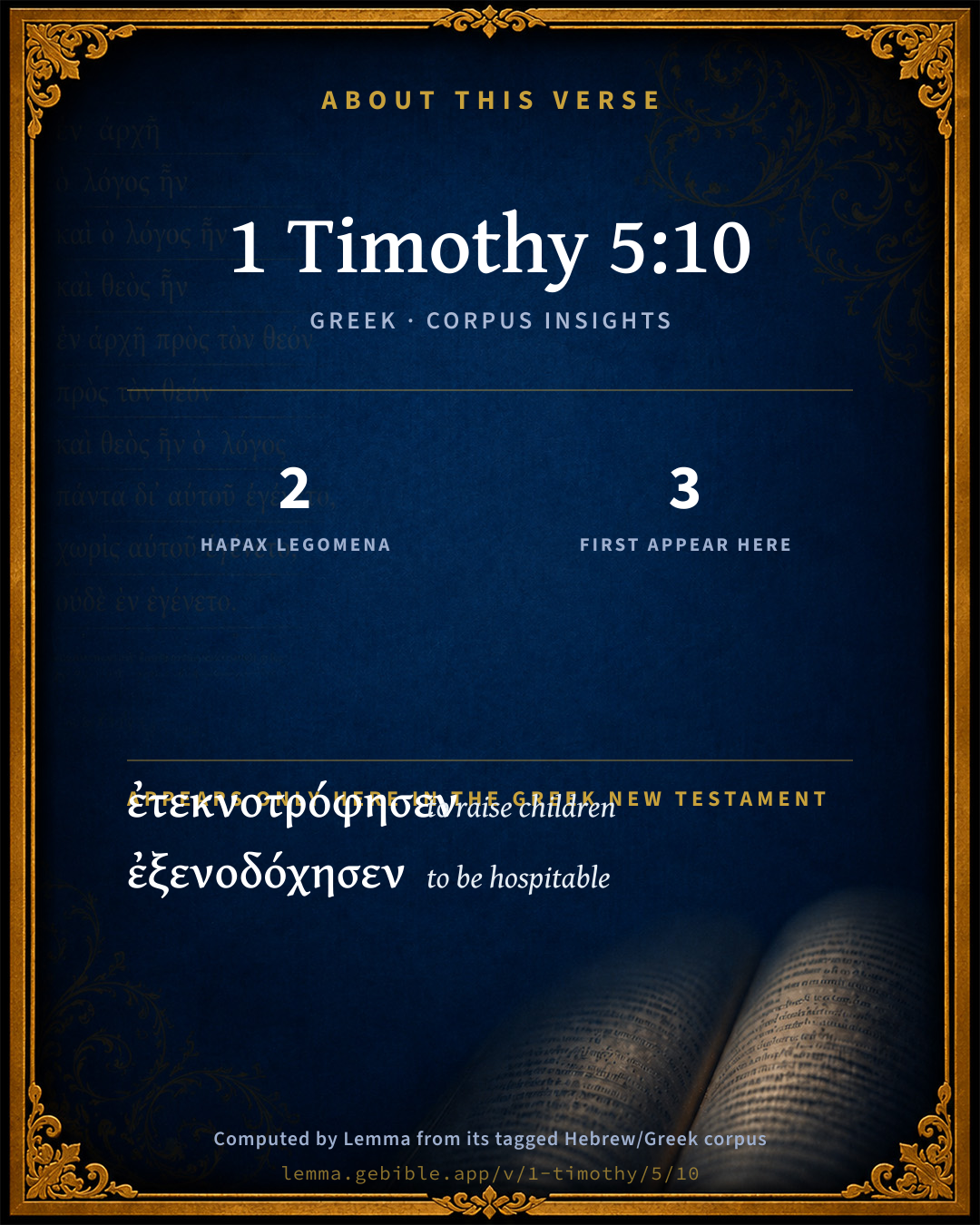
  • 2 hapax legomena — only here in the Greek New Testament
  • 3 first appearances in the Greek New Testament
Full analysis ↓
Download a study sheet

One document with this verse’s original text, its word-by-word gloss line, the meaning frame, cross-references with their text, attributed commentary, and full source and license credits — printable, and it pastes into notes with its structure intact.

This verse Autodidact and up

Study sheet (.html) Plain text (.txt)

A passage Seminary Student

Up to 50 verses in one chapter. A passage sheet keeps up to 6 commentary sources and 12 cross-references per verse, in the order this page ranks them, and says so on the sheet whenever that leaves anything out. Ask for a single verse and you get the Autodidact verse sheet above.

Everything on this page stays free to read, with no account — the sheet is a download of what is already on screen, not access to it.

Want to remove ads? Support Godless Engineer
Compare translations 3

The same verse in 3 English versions, stacked beneath the original-language interlinear above. Click any original word for its lexicon entry.

Each is an independent rendering of the whole verse — the interlinear is not word-aligned to these translations.

Highlighted words mark where these versions differ — a whole-verse word diff, not a word-by-word alignment.

  • World English Bible Public Domain
    being approved by good works, if she has brought up children, if she has been hospitable to strangers, if she has washed the saints' feet, if she has relieved the afflicted, and if she has diligently followed every good work.
  • King James Version Public Domain
    Well reported of for good works; if she have brought up children, if she have lodged strangers, if she have washed the saints' feet, if she have relieved the afflicted, if she have diligently followed every good work.
  • unfoldingWord Literal Text CC BY-SA 4.0
    being testified in good works: if she has raised children, if she has received strangers, if she has washed the feet of the saints, if she has aided the afflicted, if she has followed every good work.

unfoldingWord Literal Text — © unfoldingWord, licensed CC BY-SA 4.0. Word-aligned USFM3 via Door43 (git.door43.org/unfoldingWord/en_ult).

Versions to compare (up to 4)

3 of 4 selected

Show all 19 translations

Every available English version of this verse, each an independent rendering of the whole verse.

  • World English Bible Public Domain
    being approved by good works, if she has brought up children, if she has been hospitable to strangers, if she has washed the saints' feet, if she has relieved the afflicted, and if she has diligently followed every good work.
  • Berean Standard Bible Public Domain
    and well known for good deeds such as bringing up children, entertaining strangers, washing the feet of the saints, imparting relief to the afflicted, and devoting herself to every good work.
  • Majority Standard Bible Public Domain
    and well known for good deeds such as bringing up children, entertaining strangers, washing the feet of the saints, imparting relief to the afflicted, and devoting herself to every good work.
  • King James Version Public Domain
    Well reported of for good works; if she have brought up children, if she have lodged strangers, if she have washed the saints' feet, if she have relieved the afflicted, if she have diligently followed every good work.
  • American Standard Version (1901) Public Domain
    well reported of for good works; if she hath brought up children, if she hath used hospitality to strangers, if she hath washed the saints' feet, if she hath relieved the afflicted, if she hath diligently followed every good work.
  • Revised Version (1885) Public Domain
    well reported of for good works; if she hath brought up children, if she hath used hospitality to strangers, if she hath washed the saints’ feet, if she hath relieved the afflicted, if she hath diligently followed every good work.
  • Geneva Bible (1599) Public Domain
    And well reported of for good woorkes: if shee haue nourished her children, if shee haue lodged the strangers, if shee haue washed the Saintes feete, if shee haue ministred vnto them which were in aduersitie, if shee were continually giuen vnto euery good woorke.
  • Douay-Rheims (1899) Public Domain
    Having testimony for her good works, if she have brought up children, if she have received to harbour, if she have washed the saints' feet, if she have ministered to them that suffer tribulation, if she have diligently followed every good work.
  • Young's Literal Translation Public Domain
    in good works being testified to: if she brought up children, if she entertained strangers, if saints' feet she washed, if those in tribulation she relieved, if every good work she followed after;
  • Literal Standard Version CC BY-SA 4.0
    being testified to in good works: if she brought up children, if she entertained strangers, if she washed holy ones’ feet, if she relieved those in tribulation, if she followed after every good work;
  • Unlocked Literal Bible CC BY-SA 4.0
    She must be known for good deeds, whether it is that she has cared for children, or has been hospitable to strangers, or has washed the feet of the saints, or has relieved the afflicted, or has been devoted to every good work.
  • unfoldingWord Literal Text CC BY-SA 4.0
    being testified in good works: if she has raised children, if she has received strangers, if she has washed the feet of the saints, if she has aided the afflicted, if she has followed every good work.
  • Darby Bible Public Domain
    borne witness to in good works, if she have brought up children, if she have exercised hospitality, if she have washed saints' feet, if she have imparted relief to the distressed, if she have diligently followed every good work.
  • World Messianic Bible Public Domain
    being approved by good works, if she has brought up children, if she has been hospitable to strangers, if she has washed the holy ones’ feet, if she has relieved the afflicted, and if she has diligently followed every good work.
  • Webster's Bible Public Domain
    Well reported of for good works; if she hath brought up children, if she hath lodged strangers, if she hath washed the saints' feet, if she hath relieved the afflicted, if she hath diligently followed every good work.
  • Free Bible Version CC BY-SA 4.0
    The widow should have a reputation for doing good. Did she bring up children properly? Has she been hospitable? Has she washed the feet of church members? Has she helped those who were in trouble? Has she really tried to do good in every way?
  • Bible in Basic English Public Domain
    And if witness is given of her good works; if she has had the care of children, if she has been kind to travellers, washing the feet of the saints, helping those who are in trouble, giving herself to good works.
  • Text-Critical English NT CC BY 4.0
    and has a reputation for good works, that is, if she has brought up children, shown hospitality, washed the feet of the saints, helped the afflicted, and devoted herself to every good work.
  • Tyndale New Testament (1534) Public Domain
    and well reported of in good workes: yf she have noresshed children yf she have bene liberall to straugers yf she have wesshed the saynctes fete yf she have ministred vnto them which were in adversite yf she were continually geve vnto all maner good workes.

Literal Standard Version (2020), Covenant Press — licensed CC BY-SA 4.0. Text via the HelloAO Bible API (eBible.org). Unlocked Literal Bible (unfoldingWord) — licensed CC BY-SA 4.0. Text via the HelloAO Bible API (eBible.org). unfoldingWord Literal Text — © unfoldingWord, licensed CC BY-SA 4.0. Word-aligned USFM3 via Door43 (git.door43.org/unfoldingWord/en_ult). Free Bible Version, Dr. Jonathan Gallagher — licensed CC BY-SA 4.0. Text via the HelloAO Bible API (eBible.org).

Word by word

More ways to search: Search by grammar → Find every occurrence → Compare this word →

Practice this passage: Drill this verse → Learn its vocabulary →

ἐτεκνοτρόφησεν
teknotrophéō
G5044
“to raise children”
Verb, Aorist, Active, Indicative, 3rd person, Singular
Part of Speech
Verb
Tense
Aorist
Voice
Active
Mood
Indicative
Person
3rd person
Number
Singular
Full Thayer's Definition

Origin: from a compound of G5043 and G5142

TDNT: None

1. to bring up children
  1. ἐν en G1722 “in” Preposition
  2. ἔργοις érgon G2041 “work” Noun, Dative, Plural, Neuter
  3. καλοῖς kalós G2570 “good” Adjective, Dative, Plural, Neuter
  4. μαρτυρουμένη martyréō G3140 “to testify” Verb, Present, Passive, Participle, Nominative, Singular, Feminine
  5. εἰ ei G1487 “if” Conditional
  6. εἰ ei G1487 “if” Conditional
  7. ἐξενοδόχησεν xenodochéō G3580 “to be hospitable” Verb, Aorist, Active, Indicative, 3rd person, Singular
  8. εἰ ei G1487 “if” Conditional
  9. ἁγίων hágios G40 “saint” Adjective, Genitive, Plural, Masculine
  10. πόδας poús G4228 “foot” Noun, Accusative, Plural, Masculine
  11. ἔνιψεν níptō G3538 “to wash” Verb, Aorist, Active, Indicative, 3rd person, Singular
  12. εἰ ei G1487 “if” Conditional
  13. θλιβομένοις thlíbō G2346 “to press” Verb, Present, Passive, Participle, Dative, Plural, Masculine
  14. ἐπήρκεσεν eparkéō G1884 “to avail” Verb, Aorist, Active, Indicative, 3rd person, Singular
  15. εἰ ei G1487 “if” Conditional
  16. παντὶ pâs G3956 “all” Adjective, Dative, Singular, Neuter
  17. ἔργῳ érgon G2041 “work” Noun, Dative, Singular, Neuter
  18. ἀγαθῷ agathós G18 “good” Adjective, Dative, Singular, Neuter
  19. ἐπηκολούθησεν epakolouthéō G1872 “to follow after” Verb, Aorist, Active, Indicative, 3rd person, Singular

About this verse

These counts appear in no published source. They are computed here, from the morphology-tagged text and Lemma’s own curated glosses. What Lemma adds →

20
words
15
distinct lemmas
Pauline Epistles
section

Notable vocabulary

2 hapax legomena — words that appear only here in the entire Greek New Testament:

  • ἐτεκνοτρόφησεν to raise children G5044
  • ἐξενοδόχησεν to be hospitable G3580

First appearance in Scripture

These words make their first canonical appearance in the Greek New Testament here:

  • ἐτεκνοτρόφησεν to raise children G5044
  • ἐξενοδόχησεν to be hospitable G3580
  • ἐπήρκεσεν to avail G1884

Shared distinctive vocabulary

ἐπήρκεσεν to avail G1884 occurs in 2 verses of the Greek New Testament. Also found in:
Repetition

Words recur within this verse:

Cross-references

39

Topical passages linked to 1 Timothy 5:10 in the Treasury of Scripture Knowledge — connected by theme and wording, ordered by reader-vote popularity; previews shown in the World English Bible.

  • 1 Timothy 6:18 that they do good, that they be rich in good works, that they be ready to distribute, willing to communicate;
  • Titus 3:8 This saying is faithful, and concerning these things I desire that you affirm confidently, so that those who have believed God may be careful to maintain good works. These things are good and profitable to men;
  • Acts 9:36 Now there was at Joppa a certain disciple named Tabitha, which when translated, means Dorcas. This woman was full of good works and acts of mercy which she did.
  • Titus 2:7 in all things showing yourself an example of good works; in your teaching showing integrity, seriousness, incorruptibility,
  • Titus 3:1 Remind them to be in subjection to rulers and to authorities, to be obedient, to be ready for every good work,
  • Matthew 5:16 Even so, let your light shine before men; that they may see your good works, and glorify your Father who is in heaven.
  • Luke 7:44 Turning to the woman, he said to Simon, "Do you see this woman? I entered into your house, and you gave me no water for my feet, but she has wet my feet with her tears, and wiped them with the hair of her head.
  • Romans 12:13 contributing to the needs of the saints; given to hospitality.
  • 2 Timothy 3:17 that the man of God may be complete, thoroughly equipped for every good work.
  • Genesis 18:4 Now let a little water be fetched, wash your feet, and rest yourselves under the tree.
  • Luke 7:38 Standing behind at his feet weeping, she began to wet his feet with her tears, and she wiped them with the hair of her head, kissed his feet, and anointed them with the ointment.
  • Titus 2:14 who gave himself for us, that he might redeem us from all iniquity, and purify for himself a people for his own possession, zealous for good works.
  • Titus 3:14 Let our people also learn to maintain good works for necessary uses, that they may not be unfruitful.
  • Hebrews 10:24 Let us consider how to provoke one another to love and good works,
  • Hebrews 13:2 Don't forget to show hospitality to strangers, for in doing so, some have entertained angels without knowing it.
  • Hebrews 13:21 make you complete in every good work to do his will, working in you that which is well pleasing in his sight, through Jesus Christ, to whom be the glory forever and ever. Amen.
  • 1 Peter 2:12 having good behavior among the nations, so in that which they speak against you as evil-doers, they may by your good works, which they see, glorify God in the day of visitation.
  • Genesis 19:2 and he said, "See now, my lords, please turn aside into your servant's house, stay all night, wash your feet, and you will rise up early, and go on your way." They said, "No, but we will stay in the street all night."
  • Genesis 24:32 The man came into the house, and he unloaded the camels. He gave straw and provender for the camels, and water to wash his feet and the feet of the men who were with him.
  • Leviticus 25:35 "'If your brother has become poor, and his hand can't support him among you; then you shall uphold him. As a stranger and a sojourner he shall live with you.
  • Psalms 119:4 You have commanded your precepts, That we should fully obey them.
  • Isaiah 1:17 Learn to do well. Seek justice, Relieve the oppressed, Judge the fatherless, Plead for the widow."
  • John 13:5–15 Then he poured water into the basin, and began to wash the disciples' feet, and to wipe them with the towel that was wrapped around him.
  • Acts 6:3 Therefore select from among you, brothers, seven men of good report, full of the Holy Spirit and of wisdom, whom we may appoint over this business.
  • Acts 9:39 Peter got up and went with them. When he had come, they brought him into the upper chamber. All the widows stood by him weeping, and showing the coats and garments which Dorcas had made while she was with them.
  • Acts 10:22 They said, "Cornelius, a centurion, a righteous man and one who fears God, and well spoken of by all the nation of the Jews, was directed by a holy angel to invite you to his house, and to listen to what you say."
  • Acts 16:14–15 A certain woman named Lydia, a seller of purple, of the city of Thyatira, one who worshiped God, heard us; whose heart the Lord opened to listen to the things which were spoken by Paul.
  • Acts 22:12 One Ananias, a devout man according to the law, well reported of by all the Jews who lived in Damascus,
  • Ephesians 2:10 For we are his workmanship, created in Christ Jesus for good works, which God prepared before that we would walk in them.
  • Colossians 1:10 that you may walk worthily of the Lord, to please him in all respects, bearing fruit in every good work, and increasing in the knowledge of God;
  • 1 Timothy 2:10 but (which becomes women professing godliness) with good works.
  • 1 Timothy 5:25 In the same way also there are good works that are obvious, and those that are otherwise can't be hidden.
  • 2 Timothy 1:5 having been reminded of the unfeigned faith that is in you; which lived first in your grandmother Lois, and your mother Eunice, and, I am persuaded, in you also.
  • 2 Timothy 2:21 If anyone therefore purges himself from these, he will be a vessel for honor, sanctified, and suitable for the master's use, prepared for every good work.
  • 2 Timothy 3:15 From infancy, you have known the sacred writings which are able to make you wise for salvation through faith, which is in Christ Jesus.
  • 1 Peter 4:9 Be hospitable one to another without grumbling.
  • 3 John 1:12 Demetrius has the testimony of all, and of the truth itself; yes, we also testify, and you know that our testimony is true.
  • 1 Timothy 3:7 Moreover he must have good testimony from those who are outside, to avoid falling into reproach and the snare of the devil.
  • 1 Timothy 5:16 If any man or woman who believes has widows, let them relieve them, and don't let the assembly be burdened; that it might relieve those who are widows indeed.

Cross-references courtesy of OpenBible.info (CC BY 4.0).

Commentary

Notes on 1 Timothy 5:10 from classic Christian and Jewish commentators (each source and its license shown beneath its notes). The classic Christian expositions comment on the surrounding passage and are grouped to its opening verse, so a note may address several verses; the Jewish commentaries on the Tanakh (Rashi and others) are per-verse, so they appear only where the commentator wrote on this verse.

Lemma curates 59 commentaries, every one of them public domain or Creative Commons licensed, each selected and text-cleaned for this edition rather than reprinted as found. About our sources →

Tyndale Open Study Notes

Tyndale Open Resources

5:10 and served other believers humbly: Cp. Gen 18:4; Luke 7:44; John 13:1-17.

Tyndale Open Study Notes — © Tyndale Open Resources, licensed CC BY-SA 4.0. Text via the HelloAO Bible API.

Bengel's Gnomon

Johann Albrecht Bengel

1Ti 5:10. Ἔργοις καλοῖς, good works) These are presently enumerated, among which is also this species, παντὶ ἔργῳ ἀγαθῷ ἐπακολουθεῖν, where ἀγαθὸς is more than καλός.—ἐτεκνοτρόφησεν) if she have rightly brought up children, either her own, or those of others, for the benefit of the Church.—ἐξενοδόχησεν, lodged strangers) that she may be worthy of being publicly compensated by the Church for the benefits which she has conferred on its members.—πόδας ἔνιψεν, has washed the feet) A Synecdoche of the part, for every kind of humble offices.—θλιβομένοις, the straitened [the afflicted]) with poverty.—[41] ἐπηκολούθησε, has followed up) It is the part of ministers and men to take the lead in good works, Tit 3:8; Tit 3:14 (προΐστασθαι, not as Engl. Vers. to maintain, but to take the lead in good works); of women to follow up, by assisting so far as they are able. The glosses in Pricæus are, ἐπηκολούθησεν, ἐκοινώνησεν, ὑπηρέτησεν.

[41] Παντὶ ἔργῳ ἀγαθῷ, every good work) Wherever any good springs forth, either near or at a distance, it is a sacred duty for us to go to its support. If it was the duty of widows, who subsequently were glad to enjoy the assistance of others, how much more does it become men, and those, too, appointed to offices? Many pay attention to their sons perhaps, their relatives, neighbours, or countrymen. But, indeed, they consider it altogether alien to them (an uncalled for act) to bestow anything on persons unknown and on strangers; or if any case occur seeming to be rather unconnected with them, or a little more remote, to attempt anything in its behalf; 1Sa 25:10. Whoever has attempted a good work will experience the truth of this.—V. g.

Bengel's Gnomon of the New Testament — English translation (T&T Clark, Edinburgh, 1860) — public domain. Text from a community e-Sword module.

Expositor's Greek Testament

ed. W. Robertson Nicoll

1Ti 5:10 . ἐν ἔργοις καλοῖς μαρτυρουμένη : ἐν with μαρτυρεῖσθαι means in respect of . See reff. and Moulton and Milligan, Expositor , vii., vii., 562.

It is characteristic of the sanity of apostolic Christianity that as typical examples of “good works,” St. Paul instances the discharge of commonplace duties, “the daily round, the common task”. For ἔργα καλά see on chap. 1Ti 3:1 .

εἰ ἐτεκνοτρόφησεν : As has been just explained, the εἰ is not so much dependent on καταλεγέσθω as explanatory of ἐν ἔργοις καλ . μαρτ . The rendering of the Vulg., [276] , [277] , [278] , Amb., filios educavit , is better than that of [279] 141 , nutrivit , or Ambrst. enutrivit . It is not child-birth so much as the “Christianly and virtuously bringing up of children,” her own or those entrusted to her charge, that St. Paul has in his mind. Tert. de Virg. vel . 9, alluding to this passage, says, “Non tantum univirae, id est nuptae, aliquando eliguntur, sed et matres et quidem educatrices filiorum, scilicet ut experimentis omnium affectuum structae facile norint ceteras et consilio et solatio iuvare, etrut nihilominus ea decucurrerint, per quae femina probari potest”. The later Church widows, among other duties, had the care of the Church orphans ( cf. Hermas Mand . viii.; Lucian, de morte Peregrini , 12).

[276] The Latin text of Codex Claromontanus (sæc. vi.), a Græco-Latin MS. at Paris, edited by Tischendorf in 1852.

[277] The Latin version of Codex Augiensis (sæc. ix.), a Græco-Latin MS., at Trinity College, Cambridge, edited by Scrivener in 1859. Its presents the Vulgate text with some modifications.

[278] The Latin text of Codex Boernerianus (sæc. ix.), a Græco-Latin MS., at Dresden, edited by Matthæi in 1791. Written by an Irish scribe, it once formed part of the same volume as Codex Sangallensis ( δ ) of the Gospels.

[279] Speculum

ἐξενοδόχησεν : Hospitality is a virtue especially demanded in a condition of society in which there is much going to and fro, and no satisfactory hotel accommodation. The episcopus must be φιλόξενος (1Ti 3:2 , where see note).

εἰ ἁγίων πόδας ἔνιψεν : If the strangers were also “saints,” members of the Christian Society, they would naturally receive special attention. The mistress of the house would act as servant of the servants of God ( cf. Gen 18:6 ; 1Sa 25:41 ). Unless we assume the unhistorical character of St. John’s Gospel, it is natural to suppose that the story told in Joh 13:5-14 , and the Master’s command to do as He had done, was known to St. Paul and Timothy. The absence of an article before πόδας “is due to assimilation to ἁγίων ” (Blass, Grammar , p. 151, note 2).

εἰ παντὶ ἐπηκολούθησεν cuts short any further enumeration of details, if in short, she has devoted herself to good works of every kind . There is an exact parallel to this use of ἐπακολουθέω in Jos 14:14 , διὰ τὸ αὐτὸν [Caleb] ἐπακολουθῆσαι τῷ προστάγμαλι Κυρίου θεοῦ Ἰσραήλ . The word also means to “check” or “verify” an account. In Mar 16:20 , “the signs ‘endorse’ the word” (Moulton and Milligan, Expositor , vii., vii. 376). So here it may connote sympathy with, and interest in, good works, without actual personal labour in them.

The Expositor's Greek Testament, edited by W. Robertson Nicoll (1897–1910) — public domain. Text from a community e-Sword module.

Geneva Bible (1599)

Geneva Bible translators

This is spoken in respect of the manner of those countries.

Geneva Bible (1599) marginal notes — public domain. Text via Bolls.life.

Jamieson, Fausset & Brown

Robert Jamieson, A. R. Fausset & David Brown

for good works--Greek, "IN honourable (excellent) works"; the sphere or element in which the good report of her had place (Tit 2:7). This answers to Ti1 3:7, as to the bishop or presbyter, "He must have a good report of them which are without."

if--if, in addition to being "well reported of."

she . . . brought up children--either her own (Ti1 3:4, Ti1 3:12), or those of others, which is one of the "good works"; a qualification adapting her for ministry to orphan children, and to mothers of families.

lodged strangers-- Ti1 3:2, "given to hospitality" (Tit 1:8); in the case of presbyters.

washed . . . saints' feet--after the example of the Lord (Joh 13:14); a specimen of the universal spirit of humbly "by love serving one another," which actuated the early Christians.

relieved the afflicted--whether by pecuniary or other relief.

followed . . . good-- (Th1 5:15; compare instances in Mat 25:35-36).

Jamieson, Fausset & Brown — Commentary Critical and Explanatory on the Whole Bible (1871) — public domain (CC PDM 1.0). Text via the HelloAO Bible API.

Adam Clarke's Commentary

Verse 10. Well reported of for good works] Numbers being able to bear testimony, as the word implies, that she has not only avoided all sin, but that she has walked according to the testimony of God.

Brought up children] It was customary among the Gentiles to expose their children, when so poor that they were not able to provide for them. Pious and humane people took these up; and fed, clothed, and educated them. The words brought up may refer to the children of others, who were educated in the Christian faith by pious Christian women.

Lodged strangers] If she have been given to hospitality, freely contributing to the necessitous, when she had it in her power.

Washed the saints' feet] This was an office of humanity shown to all strangers and travellers in the eastern countries, who, either walking barefoot, or having only a sort of sole to defend the foot, needed washing when they came to their journey's end. Pious women generally did this act of kindness.

Relieved the afflicted] Visited and ministered to the sick.

Diligently followed every good work] In a word, if she have been altogether a Christian, living according to the precepts of the Gospel, and doing the Lord's work with all her heart, soul, and strength.

From the character given here of the widow indeed, it may be doubted whether χηρα, widow, was not in some cases the name of an office, which name it might have from being ordinarily filled by widows. It can hardly be supposed that any widow, unless she had considerable property, could have done the things enumerated in this verse, some of which would occasion no small expense. The widow indeed may mean a person who was to be employed in some office in the Church; and Timothy is enjoined not to take any into that office unless she had been before remarkable for piety and humanity. Some think that the widows of whom the apostle speaks had been deaconesses, and wished now to be taken on what might be termed the superannuated list; and the apostle lays down rules for the admission of such, the sum of which is: Let none come on this superannuated list unless she be at least sixty years of age, and can bring proof of her having conscientiously discharged the office and duty of a deaconess.

Adam Clarke's Commentary on the Bible (1810–1826) — public domain. Text from a community e-Sword/MySword module.

John Calvin's Commentaries

10 For good works Those qualifications which are next enumerated relate partly to honor, and partly to labor. There can be no doubt that the assemblies of widows were honorable, and highly respectable; and, therefore, Paul does not wish that any should be admitted into them, but those who had excellent attestations of the whole of their past life. Besides, they were not appointed in order to lazy and indolent inactivity, but to minister to the poor and the sick, until, being completely worn out, they should be allowed honorably to retire. Accordingly, that they may be better prepared for the discharge of their office, he wishes them to have had long practice and experience in all the duties which belong to it; such as — labor and diligence in bringing up children, hospitality, ministering to the poor, and other charitable works.

If it be now asked, Shall all that are barren be rejected, because they have never borne any children? We must reply, that Paul does not here condemn barrenness, but the daintiness of mothers, who, by refusing to endure the weariness of bringing up their children, sufficiently shew that they will be very unkind to strangers. And at the same time he holds out this as an honorable reward to godly matrons, who have not spared themselves, that they, in their turn, shall be received into the bosom of the Church in their old age.

By a figure of speech, in which a part is taken for the whole, he means by the washing of the feet all the services which are commonly rendered to the saints; for at that time it was customary to “wash the feet.” An employment of this nature might have the appearance of being mean and almost servile; and therefore he makes use of this mark for describing females who were industrious, and far from being fastidious or dainty. What next follows relates to liberality; and, lastly, he expresses the same thing in general terms, when he says, if she hath been diligent in every good work; for here he speaks of acts of kindness.

John Calvin's Commentaries (1540-1563) — public domain. Text from the Calvin Translation Society English edition (1840s-50s) via the Christian Classics Ethereal Library (ccel.org). Calvin's coverage is partial (roughly two-thirds of the Bible); uncommented books and verses are honest gaps, never fabricated. The 19th-century editor's footnotes and remarks are omitted so the notes are faithfully Calvin's own voice.

Ellicott's Commentary for English Readers

(10) Well reported of for good works.—Not only must men have no evil to say of her, but she must be well known for her good works, for her kindly willingness to help the weary and heavy-laden ones of the world.

If she have brought up children.—This title to honour must be understood quite in a general sense. It must not, of course, be supposed that St. Paul deemed it necessary to exclude from the order of presbyteral widows the childless mothers. Only the candidate for admission must be well known as one who loves children, and would be ready and willing gladly to discharge any public duties to the little orphan ones of the flock who might be intrusted to her care.

If she have lodged strangers.—If, even in a comparatively humble state, she have been always mindful of the sacred rites of hospitality, a virtue perhaps even more valued in the East than in the more reserved Western countries. In the early days of the new faith, the readiness to entertain and welcome Christian strangers seems to have been an especial characteristic of believers in Jesus of Nazareth.

If she have washed the saints’ feet.—Not perhaps to be understood literally, though the act of the Lord on the night before the Cross had invested this act of common hospitality with a peculiar halo of love and devotion. The woman who was to be admitted into the fellowship of this honoured order must be well known as one who had never shrunk from any act of devoted love, however painful or seemingly degrading.

If she have relieved the afflicted.—Not merely, or even chiefly, by alms, but by all kindly and sisterly encouragement: ever ready to mourn with those that mourn, deeming none too low or too degraded for her friendship, none out of the reach of her sisterly help and counsel.

If she have diligently followed every good work.—This sums up the beautiful character to be sought for in the candidates for membership in this chosen woman’s band. She must be known not merely as a mother and a wife, who had well and faithfully performed the womanly duties of her home life, but men must speak of her as one who had diligently and lovingly sought out the rough places of the world, and who, with a brave and patient self-denial, with a sweet and touching self-forgetfulness, had set herself to perform those kind, good actions the Master loves so well.

In the Shepherd of Hermas, written about A.D. 150, some eighty years after St. Paul wrote this letter to Timothy, we have probably an example of one of these honoured widows in the person of Grapte, whose task it was to teach the widows and orphans of the Roman Church the meaning of certain prophecies. The authorship of the Shepherd has also been ascribed to the Hermas mentioned in Rom_16:14. It belongs, however, more probably to the middle of the second century, as stated above.

The criticism which dwells on this celebrated passage, containing St. Paul’s rules for admission into the order of presbyteral widows, and which finds in it subject matter belonging to a date later than the age of St. Paul and Timothy, forgets that, dating from the days when Jesus of Nazareth walked on earth, women had been enrolling themselves among His foremost followers, and had been sharing in the toils and enterprises of His most zealous disciples. We find the Marys and other holy women associated with “His own” in the days of the earthly ministry; they were foremost in the work done to the person of the sacred dead. We hear of them after the Resurrection repeatedly in the Jerusalem Church of the first days. It was the neglect of some of the Hebrew widows which led to the foundation of the deacon’s order. Dorcas, before ten years of the Church’s life had passed, appears to have presided over a charitable company of women at Lydda. Dorcas, no doubt, was but one out of many doing, in different centres, a similar work. Priscilla, the wife of Aquila, the wandering tent-maker of Pontus, early in St. Paul’s career evidently took a leading part in organising congregations of Christians. Lydia, the purple seller of Thyatira, was prominent in developing the Philippian Church. Phebe, under the title of the Deaconess of Cenchrea, was the official bearer of St. Paul’s famous letter to the Roman Church. This passage, dwelling on the growing organisation for women’s work at Ephesus, tells us more, certainly, than the scattered incidental allusions of the Acts and earlier Epistles. But the words of St. Paul speak only of the natural results and development of a great movement, which, dating from the earthly days of the ministry of Christ, was destined to give women a new position among the workers of the world.

The Ephesian organisation here regulated by the Apostle is nothing more than we should expect to find after thirty or thirty-two years of female effort in the Master’s cause.

A Bible Commentary for English Readers, edited by Charles John Ellicott (1878–1897) — public domain. Text from a community e-Sword module.

The Cambridge Bible for Schools and Colleges

gen. ed. J. J. S. Perowne

10. well reported of] So the word is used of good testimony, in the appointment of the deacons, Act_6:3, ‘seven men of good report;’ of Ananias, ‘a devout man … well reported of by all the Jews,’ Act_22:12.

for good works] Lit. ‘in the matter of good works;’ the preposition expresses ‘the range in which a power acts,’ Winer, § 48, 3, a. Cf. 1Th_3:2, ‘God’s minister in the Gospel of Christ;’ and 1Ti_1:18 with note. These good works are not to be limited to such as a widow with means could perform. All were within the reach of the devoted Christian widow, poor as she might be. And pastoral experience can shew similar ‘wonderful works’ still wrought by ‘pious poverty’ for the Saviour. The rhythmical structure of the verse is at least characteristic of St Paul’s rhetoric, fitted now to incorporate some sacred strain, now to suggest one.

if she have brought up children] R.V. rightly, if she hath brought up; ‘hath’ not ‘have’ because the moods are indicative, not conditional; ‘hath brought up,’ not ‘brought up,’ because the English idiom, in such a retrospect, uses the definite past, while the Greek uses the indefinite aorist: see Revisers’ Preface. ‘There are numerous cases in which the use of the indefinite past tense in Greek and English is altogether different, and in such instances we have not attempted to violate the idiom of our language by forms of expression which it could not bear.’ The bringing up of children most naturally refers to her own home and family, where she has been a nursing mother. This compound verb occurs only here in N.T.; as does the next.

lodged strangers] An ordinary daily incident of both rich and poor life then: and in the days of persecution soon to follow a sacred privilege and necessity.

washed the saints’ feet] This special act of Eastern hospitality is singled out doubtless from our Lord’s taking the humble service upon Himself at the Last Supper, Joh_13:4-17. Cf. Abraham’s reception of the ‘three men’ at Mamre, Gen_28:4, ‘Let a little water be fetched and wash your feet;’ and the designation of Elijah’s companion and disciple, 2Ki_3:11, ‘Elisha the son of Shaphat, which poured water on the hands of Elijah.’ ‘The saints’ is another word used like ‘faithful’ (1Ti_5:8) at the commencement of the Epistles and elsewhere to describe all who have been ‘set apart’ from the heathen as ‘Christ’s people’ by baptism.

relieved the afflicted] The ‘relief’ is the same word as in 1Ti_5:16, exemplifying the promise ‘with what measure ye mete it shall be measured to you again.’ To give such relief from small means would not then be harder than now; and it is very striking, when one knows the real life of the poor, to see how much they can and do help one another in trouble, especially when there is ‘Christian will’ to ‘find the way.’

diligently followed every good work] Bp Ellicott rightly seems to point out that the preposition in the compound verb indicates direction rather than diligence, quoting 1Pe_2:21, ‘that ye should follow his steps.’ Cf. also Mar_16:20 and 1Ti_5:24 in this chapter. She might not have been in front rank but she hath humbly followed and ‘hath done what she could’ in every good work.

The Cambridge Bible for Schools and Colleges (gen. ed. J. J. S. Perowne; Cambridge University Press, 1878–1918) — public domain. Text from a community e-Sword module.

John Gill's Exposition

Well reported of for good works,.... Both by the members of the church, and by them that were without:

particularly if she have brought up children; that is, "well", as the Arabic version adds; in the nurture and admonition of the Lord; commanding them, as Abraham did, to keep the way of the Lord, and to do justice and judgment; training them up in the paths of religion and virtue, from which they will not so easily depart when grown up.

If she have lodged strangers; as Abraham and Lot did, who entertained angels unawares: this may be understood of strangers in common, but especially of the brethren, ministers, and others, who came from distant parts, and travelled about to spread the Gospel of Christ. The (y) Jews say many things , "in honour of hospitality" or entertaining of strangers, especially of receiving into their houses the disciples of the wise men, and giving them food and drink, and the use of their goods; this was what gave persons a very great character with them, and highly recommended them.

If she have washed the saints' feet; which was usual in those hot countries, where they wore sandals only, partly for refreshment, and partly for the removal of dust and filth, contracted in walking; instances of this we have in several places of Scripture, Gen 18:4. It was such a common piece of civility, that our Lord complains of the neglect of it towards him, Luk 7:44. It was what he did to his own disciples, and in so doing set them an example of what they should do to one another, Joh 13:14 and being a mean and low office, and which very likely was done by the servants of the house; the sense may be, if she has condescended to do the meanest office for the saints.

If she have relieved the afflicted; either in body, with her purse; or in mind, by visiting them, and speaking comfortably to them: in general,

if she have diligently followed every good work; not only have done good works at certain times, but has followed that which is good; has closely pursued it, and that with great eagerness and diligence; has been constant and indefatigable in the performance of it.

(y) T. Bab. Beracot, fol. 63. 2.

John Gill's Exposition of the Whole Bible (1746–1763) — public domain (CC PDM 1.0). Text via the HelloAO Bible API.

Trapp's Complete Commentary

John Trapp

10 Well reported of for good works; if she have brought up children, if she have lodged strangers, if she have washed the saints’ feet, if she have relieved the afflicted, if she have diligently followed every good work.

Ver. 10. Well reported of, &c.] "A good name is better than precious ointment," Ecc 7:1; and "rather to be chosen than great riches," Pro 22:1. Provident we must be to preserve it, learning of the unjust steward by lawful, though he did it by unlawful, means; for our Saviour noted this defect, when he said, "The children of this world are wiser in their generation than the children of light," Luk 16:8.

John Trapp, A Commentary or Exposition upon All the Books of the Old and New Testament (1647–1656) — public domain. Text from a community e-Sword module.

Albert Barnes' Notes on the Bible

Well reported of for good works - Of good character or reputation; see the notes on 1Ti 3:7.

If she have brought up children - Either her own or others. The idea is, if she has done this in a proper manner.

If she have lodged strangers - If she has been characterized by hospitality - a virtue greatly commended in the Scriptures; compare notes on 1Ti 3:2.

If she have washed the saints’ feet - It is not certain whether this is to be understood literally, or whether it merely denotes that she had performed offices of a humble and self-denying kind - such as would be shown by washing the feet of others. It was one of the rites of hospitality in the East to wash the feet of the guest Gen 18:4, and Paul might have spoken of this as having been literally performed. There is not the slightest evidence that he refers to it as a religious rite, or ordinance, anymore than he does to the act of bringing up children as a religious rite; compare notes on Joh 13:1-10.

If she have relieved the afflicted - If it has been her character that she was ready to furnish relief to those who were in distress.

If she have diligently followed every good work - This is one of the characteristics of true piety. A sincere Christian will, like God, be the friend of all that is good, and will be ready to promote every good object according to his ability. He will not merely be the friend of one good cause, to the neglect of others, but he will endeavor to promote every good object, and though from special circumstances, and special dealings of Providence, he may have been particularly interested in some one object of charity, yet every good object will find a response in his heart, and he will be ready to promote it by his influence, his property, and his prayers.

Albert Barnes' Notes on the Bible (1834–1885) — public domain. Text from a community e-Sword/MySword module.

Matthew Poole's English Annotations

Well reported of for good works; if she be a person of repute for actions concerning others which are consonant to the will and commandment of God.

If she have brought up children well, in the nurture and admonition of the Lord.

If she have lodged strangers; if when persons that are Christians have come from other places, either driven from them, or upon their occasion, and could not amongst pagans find a convenient inn, her house have been open to them.

If she have washed the saints’ feet; if she have been ready to do the meanest offices for the servants of God, of which this washing of feet was one in great use in those hot countries, where they had not the benefit of shoes, either to cool, or refresh, or cleanse them.

If she have relieved the afflicted; if to her ability she have relieved such as have been in any kind of distress.

If she have diligently followed every good work; if though it may be she have not had ability, or opportunity, to do all the good works she would, yet she have diligently followed them, doing what she could; —let such a one be put into the catalogue of those whom the church will relieve, and honour, and employ.

Matthew Poole's English Annotations on the Holy Bible (1683–1685) — public domain. Text from a community e-Sword/MySword module.

Whedon's Commentary on the Bible

Daniel D. Whedon

10. Second qualification, good Christian housewifery while her husband lived. Of course, the general picture implies that the individual reach this standard so far as circumstances enabled.

Good works—The general term of which next follow the specifications.

Brought up children—Had been a good and dutiful mother.

Lodged strangers—Hospitable, especially to Christian visitors.

Washed… feet—The ordinary hospitable act for the traveller over the tropical sands, and so put as symbol for hearty service rendered by the housewife to the comer.

Every good work—Landing where the catalogue of good qualities started.

Daniel D. Whedon (gen. ed.), Commentary on the Old and New Testaments (1874–1909) — public domain. Text from a community e-Sword module.

The Pulpit Commentary

Hath for have, A.V (five times); used hospitality to for lodged, A.V Well reported of. (marturoumenh; see 1Ti_3:7 and note) This use is frequent in the Epistle to the Hebrews, (Heb_7:8 Heb_11:2, Heb_11:4, Heb_11:5, Heb_11:39) also inrgoiv 3Jn_1:6, 3Jn_1:12. Good works (e kaloiv). The phrase occurs frequently in the pastoral Epistles, both in the singular and in the plural. (1Ti_2:10 1Ti_3:1; in this verse; ver. 25; 2Ti_2:21 2Ti_3:17; Tit_1:16 Tit_2:7, 14 3:1, 8, 14) Our Lord had first used the phrase, and taught how "good works" were to be the distinctive marks of his disciples, (Mat_5:16) as they were evidences of his own mission. (Joh_10:32, Joh_10:33) It denotes all kinds of good actions as distinguished from sentiments. Love, e.g. is not a good work. Feeding the hungry and clothing the naked and visiting the sick are good works. (see Mat_25:35, etc.) Brought up children (ejteknotrufhsen); only here in the New Testament or LXX, but found, as well as teknotrofia, in Aristotle. The word must mean "brought up children of her own," because teknon does not mean "a child" with reference to its age, but "a child" with reference to its parent who bare it. The only apparent exception in Holy Scripture isskopov 1Th_2:7, where the nurse"s alumni are called "her own children," but obviously this is no rent exception. The classical usage is the same. We must, therefore, understand the apostle here to mean "if she hath brought up her children well and carefully, and been a good mother to them." The precept corresponds to that laid down for an ejpi inchsen); 1Ti_3:4. Possibly, as Grotius suggests, a contrast may be intended with the conduct of some heathen mothers, who, if they were very poor, exposed their children. Used hospitality to (ejxenodo) only here in the New Testament or LXX, but, as well as xenodokov and xenodocia, not uncommon in classical Greek. The common form in the New Testament is xenizein. (For the inculcation of hospitality, see 1Ti_3:2, note, and 3Jo

5) Washed the saints" feet. (see Joh_13:5-8; anti comp. Luk_7:44, where the omission to provide water to wash the feet of a guest is reprobated as inhospitable) The saints. (Rom_12:13) Hath relieved (ejphrkesen); only here and twice in ver. 16 in the New Testament, and. in RAPC 1Ma 8:26 and 11:35; but common in classical Greek. The afflicted (toiv qlibomenoiv); used of any kind of trouble or afflictions (qliyiv); compare, for the precept,qhse; Rom_13:1-5. Diligently followed (ejphkolou) (comp. 1Pe_2:21) The idea is somewhat similar to that of "pressing on toward the goal," in Php_3:14 (see also ver. 12, where diwkw is rendered in A.V, "I follow after"). Good work. Here ergw ajgaqw, as in Act_9:36; Rom_2:7, 10 13:3; 2Co_9:8; Eph_2:10; and frequently in the pastoral Epistles. (1Ti_2:10)

The Pulpit Commentary (1880–1919), ed. H.D.M. Spence-Jones & Joseph S. Exell — public domain. Text from a community e-Sword module.

John Wesley's Explanatory Notes

If she hath washed the feet of the saints - Has been ready to do the meanest offices for them.

John Wesley, Explanatory Notes Upon the Whole Bible (1754–1765) — public domain. Text via the GEBible commentary corpus.

The People's New Testament

B. W. Johnson

10. Well reported of. Good character was a requisite. Good works. The good works are named. Brought up children. Either her own, or orphans or neglected children. Lodged strangers. The duty of hospitality is often urged. Often, in that age, saints were made homeless by persecution. Washed the saints' feet. A duty of hospitality, not a church ordinance. Relieved the afflicted. A ministering angel.

B. W. Johnson's The People's New Testament with Notes (1889–1891) — public domain. Electronic text from the Christian Classics Ethereal Library (CCEL) ThML edition.

Cambridge Greek Testament for Schools and Colleges

10. A widow to be placed on the Church’s list must be ἐν ἔργοις καλοῖς μαρτυρουμένη, well reported of in the matter of good works. The emphasis laid on ἔργα καλά in the Pastoral Epistles has been already remarked (see on 1Ti 2:10 above): of the good works which would especially come within the widow’s province a few are enumerated.

εἰ ἐτεκνοτρόφησεν, if she hath brought up children, whether her own or the children of others. χῆραι are frequently mentioned in connexion with orphans of the Church (e.g. Hermas Mand. 8 and Lucian de morte Peregr. 12); but it would be quite as unreasonable to confine the reference to these, as to exclude it, and so to forbid a barren widow a place on the list. τεκνοτροφέω occurs only here in the Greek Bible.

εἰ ἐξενοδόχησεν, if (sc. at any time) she hath used hospitality to strangers. The word ξενοδοχέω is not found again in N.T. or LXX.; but cp. Mat 25:35 ξένος ἥμην καὶ συνηγάγετέ με. Like the ‘bishop’ (1Ti 3:2, on which see note) the ‘widow’ will be φιλόξενος. although from her circumstances it may be on a more humble scale. This qualification, however, suggests (what is reasonable in itself) that the widow who is placed on the Church’s list need not necessarily be destitute of worldly wealth or dependent for her maintenance on the Church’s alms.

εἰ ἁγίων πόδας ἔνιψεν, if she hath washed the saints’ feet. This was a not unfamiliar feature of Eastern hospitality; it was a service of humility (1Sa 25:41), as of love (Luk 7:38), and was commended to the Apostles by the Lord Himself (Joh 13:14). But this last command does not seem to have been understood literally by those to whom it was addressed; and so in the case of the Church’s widows it was the spirit of their hospitality, rather than any such detail, which would enter into consideration. Note ἁγίων; this humility of service is only due to fellow Christians, who are the most welcome guests of all.

εἰ θλιβομένοις ἐπήρκεσεν, if she hath relieved the afflicted, whether “in mind, body or estate.” ἐπαρκέω is only found in N.T. here and at 1Ti 5:16; but it occurs in 1Ma 8:26; 1Ma 11:35 and is a common Greek word.

εἰ παντὶ ἔργῳ ἀγαθῷ ἐπηκολούθησεν, if she hath followed every good work. see on 1Ti 2:10 above. The A.V. and R.V. have “diligently followed”; but ἐπί seems here (as in 1Pe 2:21) to mark direction rather than intensity, the pursuit of good works whether initiated by others or by oneself.

(c) 11–16. YOUNG WIDOWS

Cambridge Greek Testament for Schools and Colleges (Cambridge University Press, 1896; 21 vols, various authors incl. Carr, Maclear, Plummer, Farrar, Lumby, Moule, M. R. James, Simcox) — public domain. Text from a community e-Sword module.

International Critical Commentary

10. ἕὸς ἀνδρὸς γυνή] cf. 3:2 note. The arguments for translating “married only once” are stronger in this case, because of the dislike of “nuptiæ secundæ” and the praise of the “univira” or “virginea” both in the Jewish (Judith 16:22, Luk 2:36) and in the heathen world (cf. Tert. ad Uxor. 1. c. 6, De Monog. c. 17, and illustrations in Wetstein). Yet the permission to remarry 14 points the other way; the writer would scarcely exclude from the official list a widow who on his advice had remarried and again become a widow. Hence “faithful to one man” remains possible. So Thd.-Mops. Thdt. τὸ σωφρόνως ἐν γάμῳ βιοῦν νομοθετεῖ: Ramsay and many modern Commentators.

ἐτεκνοτρόφησεν] “vel suos vel alienos” (Bengel); the context (ἐργ. καλ. μαρτυρ.) suggests something that goes beyond the duties of her own home; and Church widows later had the charge of orphans, Herm. Mand. viii. There may be implied—if she has not exposed her children, but brought them up (Hillard).

ἐξενοδόχησεν] cf. 3:2 φιλόξενον, note, Act 16:15, Heb 13:2. Chrys. ad loc. ὡς αὐτὸν δεχομένη τὸν Χριστόν.

εἰ ἁγίων πόδας ἔνιψεν] Cf. 1 S 25:41, Luk 7:44, Joh 13:14.

εἰ . . . ἐπηκολούθησεν] “If she has followed up thoroughly (ἐπί) every good work,” summing up the preceding and expanding it to include all good tasks (ἔργῳ ἀγαθῷ), not merely those that stand out in the eyes of the world (ἔργοις καλοῖς). Cf. Plato, Rep. 370 B, ἀνάγκη τὸν πράττοντα τῷ πραττομένῳ ἐπακαλουθεῖν μὴ ἐν παρέργου μέρει (Wohlenberg), and illustrations from the papyri, ap. M.M. s.v. There may also be the new point—“if she has helped in the good works which others have begun” (Liddon), but this would probably have been more clearly expressed.

καταστρηνιάσωσι (ἅπαξ λεγ., but cf. στρηνιᾶν, Rev 18:9; στρῆνος, Rev 18:3, Rev 18:2 K 19:28 used of the Assyrian king, τὸ στρῆνός σου ἀνέβη ἐν τοῖς ὠσί μου), to grow physically restless and so restive against the limitations of Christian widowhood; Apost. Const. iii. 1, προφάσει τοῦ μὴ δύνασθαι κρατεῖν τῆς ἀκμῆς.

International Critical Commentary — older volumes (1896–1929), various authors — public domain. Text from a community e-Sword module.

Vincent's Word Studies in the New Testament

Marvin R. Vincent

Well reported of [μαρτυρουμενη] . Lit. born witness to or attested, as Act 6:3; Act 10:22; Heb 11:2. Comp. marturian kalhn ecein to have good testimony, ch. 3 7.

For good works [εν εργοις καλοις] . Lit. in good works; in the matter of. Comp. 1Ti 6:18; Tit 2:7; Tit 3:8, 14. In the Gospels, ergon work appears with kalov and never with ajgaqov. In Paul, always with ajgaqov and never with kalov Kings In the Pastorals, with both. The phrase includes good deeds of all kinds, and not merely special works of beneficence. Comp. Act 9:36.

If [ει] . Introducing the details of the general expression good works. Have brought up children [ετεκνοτροφησεν] . N. T. o. o LXX; very rare in Class. The children may have been her own or others'.

Lodged strangers [εξενοδοχησεν] . N. T. o. o LXX On the duty of hospitality comp. ch. 1ti 3:2; Mt 25:35; Rom 12:13; Heb 13:2; 1Pe 4:9; 3Jo 1:5.

Washed the feet. A mark of Oriental hospitality bestowed on the stranger arriving from a journey, and therefore closely associated with lodged strangers.

Of the saints [αγιων] . %Agiov is rare in Class. In LXX, the standard word for holy. Its fundamental idea is setting apart, as in Class., devoted to the gods. In O T., set apart to God, as priests; as the Israelites consecrated to God. In N. T., applied to Christians. Ideally, it implies personal holiness. It is used of God, Christ, John the Baptist, God 's law, the Spirit of God. Paul often uses oiJ agioi as a common designation of Christians belonging to a certain region or community, as Phi 1:1; 2Co 1; Col 1:2. In such cases it does not imply actual holiness, but holiness obligatory upon those addressed, as consecrated persons, and appropriate to them. What ought to be is assumed as being. In this sense not in the Gospels (unless, possibly, Mt 27:52) or in the Epistles of Peter and John. Rare in Acts.

Relieved [επηρκεσεν] . Only here and ver. 16. Comp. 1 Macc. 8 26; 11

1Ti 5:35Common in Class. Originally, to suffice for, to be strong enough for, as in Homer, where it is always used in connection with danger or injury. See Il. 2 873; Od. 17 568. Hence, to ward off, help, assist.

The afflicted [θλιβομενοις] See on tribulation, Mt 13:21, and comp. 2Co 1:6; 2Co 4:8; 2Th 1:6, 7; Heb 11:37. Diligently followed [επακο ουθησεν] . Comp. ver. 24. Epi after or close upon. o P. Once in the disputed verses at the end of Mark (xvi. 20), and 1Pe 2:21. Comp. the use of diwkein pursue, Rom 9:30; Rom 12:13; 1Co 14:1; 1Th 5:15.

Marvin R. Vincent, Word Studies in the New Testament (1887–1900) — public domain. Text from a community e-Sword/MySword module.

Lesson kit

Teaching starters — assembled from the data on this page, not authored interpretation. Every prompt links to the verse data it draws on. Edit before teaching.

1 Timothy, in the Pauline Epistles, opens this verse with 20 words (15 distinct Greek lemmas). Its most distinctive word is teknotrophéō (“to raise children”). A historical commentator’s framing appears above. Read the whole chapter for the surrounding context.

Discussion questions

  1. How does “to raise children” (teknotrophéō) shape what this verse is saying?
  2. 2 words here appear nowhere else in the Greek New Testament. Why might the author reach for such rare wording?
  3. 3 words make their first appearance in Scripture here. What does this debut establish?
  4. How does 1 Timothy 5:16, which shares the word «to avail», read alongside this verse?
  5. What does the repetition of “work” (2× in this one verse) do in this verse?
  6. These translations render this verse differently; the difference is in the English rendering, not the original. What questions does that raise?
  7. Compare how Tyndale Open Study Notes and Bengel's Gnomon read this verse. Where do they agree or differ?

Things to notice

  • 2 words in this verse appear nowhere else in the Greek New Testament.
  • 3 words make their first canonical appearance in Scripture here.
  • These translations choose different wording for 17 words in this verse.
  • “work” occurs 2× in this single verse.
  • 15 distinct Greek lemmas span 20 words in this verse.

Reading settings

Reading text

Shown beneath each verse's original-language words.

Old Testament
Old Testament edition

Read the OT as the Masoretic Hebrew (MT) or the Greek Septuagint (LXX).

English shown for the Greek Septuagint (in the Hebrew ↔ Greek comparison).

Comparing translations? Open the Compare panel on any verse page to stack up to four side by side.