
Exodus 29:31

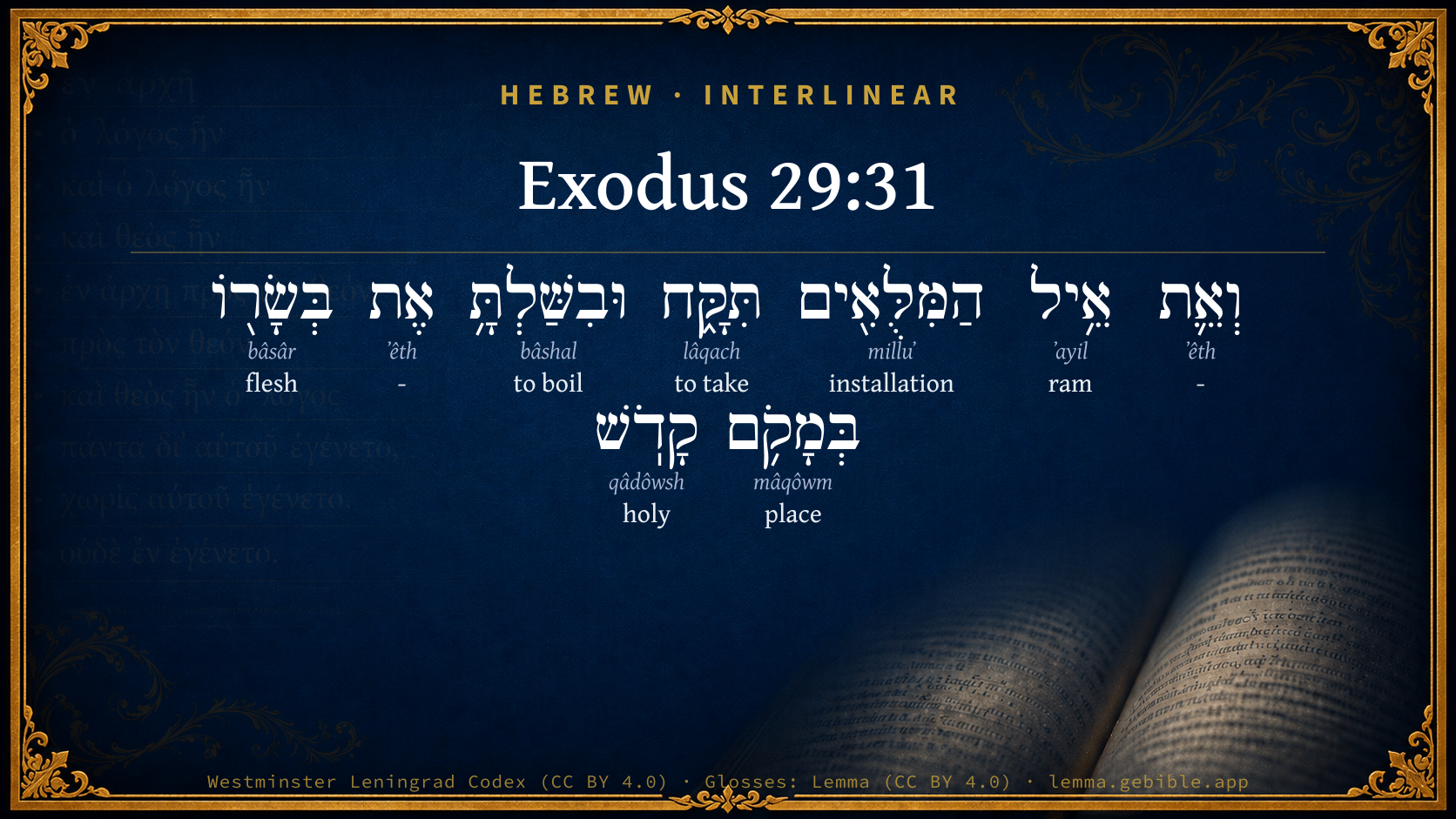
Hebrew (Westminster Leningrad Codex) Exodus 29:31 appears in the Hebrew Old Testament. The text above is from the Westminster Leningrad Codex. Each word links to its Strong’s number, a concise gloss, and parsing drawn from the Open Scriptures Hebrew Bible morphology. Click any word for its full Brown-Driver-Briggs (BDB) entry.
Download image
Cite this verse

Exodus 29:31 (World English Bible). Public Domain. Lemma interlinear Bible study tool, https://lemma.gebible.app/v/exodus/29/31.

Show BibTeX & RIS
BibTeX
RIS
English Translation
"You shall take the ram of consecration, and boil its flesh in a holy place.
World English Bible · Public Domain
Download a study sheet

One document with this verse’s original text, its word-by-word gloss line, the meaning frame, cross-references with their text, attributed commentary, and full source and license credits — printable, and it pastes into notes with its structure intact.

This verse Autodidact and up

Study sheet (.html) Plain text (.txt)

A passage Seminary Student

Up to 50 verses in one chapter. A passage sheet keeps up to 6 commentary sources and 12 cross-references per verse, in the order this page ranks them, and says so on the sheet whenever that leaves anything out. Ask for a single verse and you get the Autodidact verse sheet above.

Everything on this page stays free to read, with no account — the sheet is a download of what is already on screen, not access to it.

Want to remove ads? Support Godless Engineer
Compare translations 3

The same verse in 3 English versions, stacked beneath the original-language interlinear above. Click any original word for its lexicon entry.

Each is an independent rendering of the whole verse — the interlinear is not word-aligned to these translations.

Highlighted words mark where these versions differ — a whole-verse word diff, not a word-by-word alignment.

  • World English Bible Public Domain
    "You shall take the ram of consecration, and boil its flesh in a holy place.
  • King James Version Public Domain
    And thou shalt take the ram of the consecration, and seethe his flesh in the holy place.
  • unfoldingWord Literal Text CC BY-SA 4.0
    And you shall take the ram of consecration and boil its meat in a holy place.

unfoldingWord Literal Text — © unfoldingWord, licensed CC BY-SA 4.0. Word-aligned USFM3 via Door43 (git.door43.org/unfoldingWord/en_ult).

Versions to compare (up to 4)

3 of 4 selected

Show all 18 translations

Every available English version of this verse, each an independent rendering of the whole verse.

  • World English Bible Public Domain
    "You shall take the ram of consecration, and boil its flesh in a holy place.
  • Berean Standard Bible Public Domain
    You are to take the ram of ordination and boil its flesh in a holy place.
  • Majority Standard Bible Public Domain
    You are to take the ram of ordination and boil its flesh in a holy place.
  • King James Version Public Domain
    And thou shalt take the ram of the consecration, and seethe his flesh in the holy place.
  • American Standard Version (1901) Public Domain
    And thou shalt take the ram of consecration, and boil its flesh in a holy place.
  • Revised Version (1885) Public Domain
    And thou shalt take the ram of consecration, and seethe its flesh in a holy place.
  • Geneva Bible (1599) Public Domain
    So thou shalt take the ram of the consecration, and seeth his flesh in the holy place.
  • Douay-Rheims (1899) Public Domain
    And thou shalt take the ram of the consecration, and shalt boil the flesh thereof in the holy place:
  • Young's Literal Translation Public Domain
    `And the ram of the consecration thou dost take, and hast boiled its flesh in the holy place;
  • Literal Standard Version CC BY-SA 4.0
    And you take the ram of the consecration and have boiled its flesh in the holy place;
  • Unlocked Literal Bible CC BY-SA 4.0
    You must take the ram for the installation of the priests to me and boil its meat in a holy place.
  • unfoldingWord Literal Text CC BY-SA 4.0
    And you shall take the ram of consecration and boil its meat in a holy place.
  • Darby Bible Public Domain
    And thou shalt take the ram of the consecration, and boil its flesh in a holy place.
  • World Messianic Bible Public Domain
    “You shall take the ram of consecration and boil its meat in a holy place.
  • Webster's Bible Public Domain
    And thou shalt take the ram of the consecration, and seethe his flesh in the holy place.
  • Free Bible Version CC BY-SA 4.0
    Take the ram of ordination and boil its meat in a holy place.
  • Bible in Basic English Public Domain
    Then take the sheep of the wave offering and let its flesh be cooked in water in a holy place.
  • JPS Tanakh (1917) Public Domain
    And thou shalt take the ram of consecration, and seethe its flesh in a holy place.

Literal Standard Version (2020), Covenant Press — licensed CC BY-SA 4.0. Text via the HelloAO Bible API (eBible.org). Unlocked Literal Bible (unfoldingWord) — licensed CC BY-SA 4.0. Text via the HelloAO Bible API (eBible.org). unfoldingWord Literal Text — © unfoldingWord, licensed CC BY-SA 4.0. Word-aligned USFM3 via Door43 (git.door43.org/unfoldingWord/en_ult). Free Bible Version, Dr. Jonathan Gallagher — licensed CC BY-SA 4.0. Text via the HelloAO Bible API (eBible.org).

Word by word

More ways to search: Search by grammar → Find every occurrence → Compare this word →

Practice this passage: Drill this verse → Learn its vocabulary →

הַמִּלֻּאִ֖ים
milluʼ
H4394
“the · installations”
Particle, Definite Article + Noun, Common, Masculine, Plural, Absolute
Part of Speech
Particle + Noun
Type
Common
Gender
Masculine
Number
Plural
State
Absolute
Full BDB Definition

Origin: from H4390

TWOT: 1195e

setting, installation - setting, stones for setting - installation (of priests)
  1. וְאֵ֛ת ʼêth H853 “and · -” Conjunction + Particle, Direct Object
  2. אֵ֥יל ʼayil H352 “ram of” Noun, Common, Masculine, Singular, Construct
  3. תִּקָּ֑ח lâqach H3947 “to take” Verb, Qal, Imperfect, 2nd Person, Masculine, Singular
  4. וּבִשַּׁלְתָּ֥ bâshal H1310 “and · to boil” Conjunction + Verb, Piel, Sequential Perfect, 2nd Person, Masculine, Singular
  5. אֶת ʼêth H853 “-” Particle, Direct Object
  6. בְּשָׂר֖וֹ bâsâr H1320 “flesh · his” Noun, Common, Masculine, Singular, Construct + Suffix, Personal, 3rd Person, Masculine, Singular
  7. בְּמָקֹ֥ם mâqôwm H4725 “in/at · place” Preposition + Noun, Common, Masculine, Singular, Absolute
  8. קָדֹֽשׁ qâdôwsh H6918 “holy” Adjective, Adjective, Masculine, Singular, Absolute

About this verse

These counts appear in no published source. They are computed here, from the morphology-tagged text and Lemma’s own curated glosses. What Lemma adds →

9
words
8
distinct lemmas
Pentateuch
section

Notable vocabulary

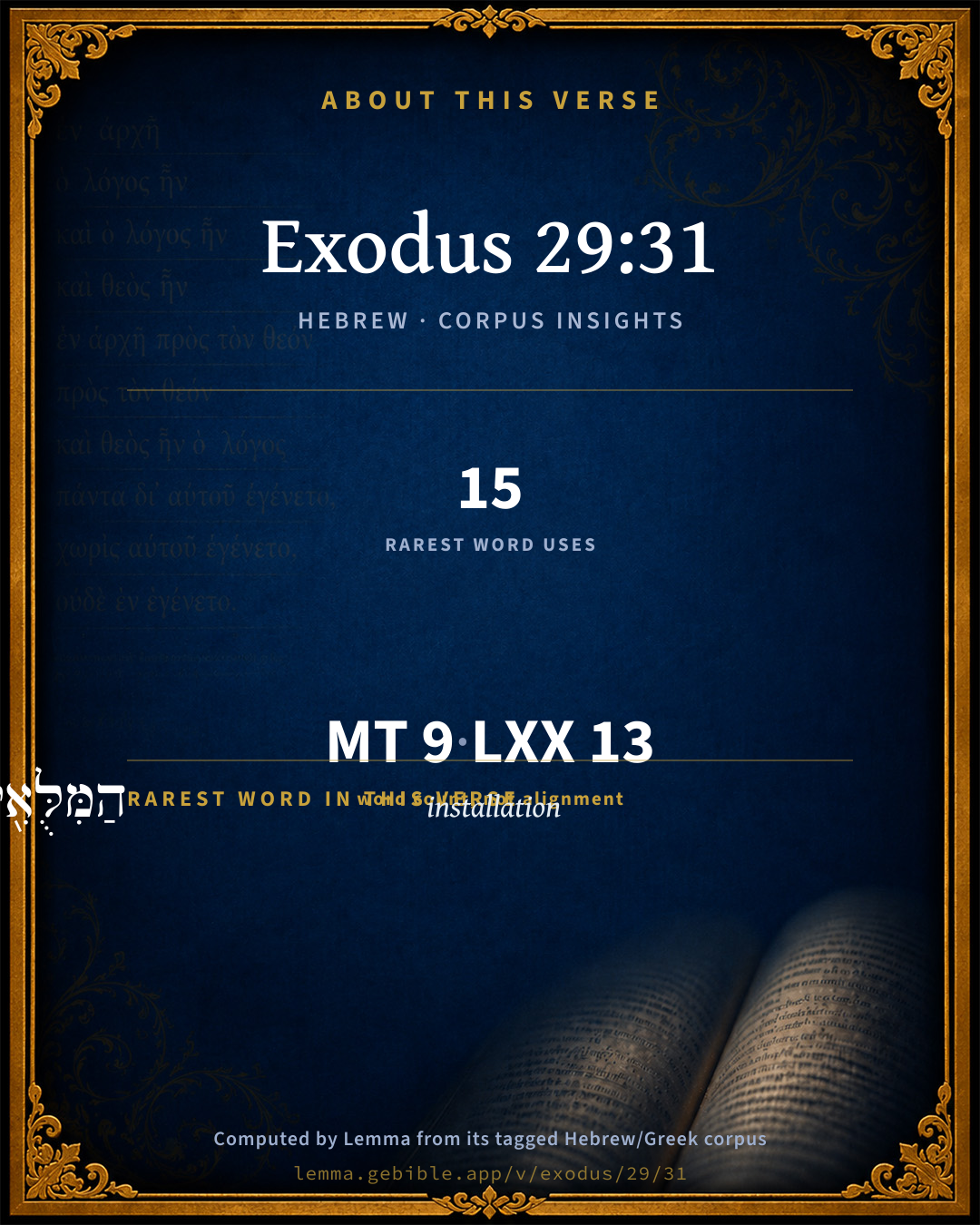
The rarest word here is הַמִּלֻּאִ֖ים installation H4394 — appearing just 15 times in the whole Hebrew Bible.

Shared distinctive vocabulary

הַמִּלֻּאִ֖ים installation H4394 occurs in 15 verses of the Hebrew Bible. Also found in:

Grammatical profile

  • 2 verbs
  • 4 nouns
  • 1 adjective
  • 2 particles

Verb forms

  • תִּקָּ֑ח Qal · Imperfect
  • וּבִשַּׁלְתָּ֥ Piel · Sequential Perfect

Hebrew & Septuagint length

In English translation the verse runs 15 words from the Hebrew and 18 from the Septuagint (LXX English) — closely comparable.

A rough comparison of the two English renderings, which tokenize alike — not a word-level alignment.

Word counts can differ between the Hebrew and the Greek without any difference in meaning — e.g. the Hebrew direct-object marker אֵת has no separate Greek word, and Greek often adds the article ὁ.

In the original languages it is 9 Hebrew tokens and 13 Greek tokens — but the two are counted differently (Hebrew bundles its prefixes and suffixes into one token; the Greek is in lemma form), so that isn’t a like-for-like length.

Cross-references

4

Topical passages linked to Exodus 29:31 in the Treasury of Scripture Knowledge — connected by theme and wording, ordered by reader-vote popularity; previews shown in the World English Bible.

  • Leviticus 8:31 Moses said to Aaron and to his sons, "Boil the flesh at the door of the Tent of Meeting, and there eat it and the bread that is in the basket of consecration, as I commanded, saying, 'Aaron and his sons shall eat it.'
  • 1 Samuel 2:13 The custom of the priests with the people was that when any man offered sacrifice, the priest's servant came, while the flesh was boiling, with a flesh-hook of three teeth in his hand;
  • 1 Samuel 2:15 Yes, before they burnt the fat, the priest's servant came, and said to the man who sacrificed, Give flesh to roast for the priest; for he will not have boiled flesh of you, but raw.
  • Ezekiel 46:20–24 He said to me, This is the place where the priests shall boil the trespass-offering and the sin-offering, [and] where they shall bake the meal-offering; that they not bring them forth into the outer court, to sanctify the people.

Cross-references courtesy of OpenBible.info (CC BY 4.0).

Hebrew and Greek witnesses Masoretic Hebrew ↔ Greek Septuagint

The same verse in the two great witnesses to the Old Testament, shown verse-for-verse.

These are two independent witnesses, not word-aligned to each other, and the Septuagint is shown in lemma (dictionary) form.

Hebrew Exodus 29:31 Masoretic · Westminster Leningrad Codex

וְאֵ֛ת אֵ֥יל הַמִּלֻּאִ֖ים תִּקָּ֑ח וּבִשַּׁלְתָּ֥ אֶת בְּשָׂר֖וֹ בְּמָקֹ֥ם קָדֹֽשׁ

"You shall take the ram of consecration, and boil its flesh in a holy place.

World English Bible · Public Domain

Greek LXX Exodus 29:31 Septuagint · lemma form

καί ὁ κριός ὁ τελείωσις λαμβάνω καί ἕψω ὁ κρέας ἐν τόπος ἅγιος

And you shall take the ram of consecration, and you shall boil the flesh in the holy place.

LXX2012 (modern English Septuagint) · Public Domain

Hebrew: Westminster Leningrad Codex (CC BY 4.0). Greek: Septuagint (public domain); English from LXX2012 (modern English Septuagint) (Public Domain). How the Septuagint differs from the Hebrew →

Targum (Aramaic paraphrase)

2

The Targum is the ancient Jewish Aramaic paraphrase of the Hebrew Scriptures — an interpretive translation, not the Hebrew text itself. Onkelos (literal) and Pseudo-Jonathan (expansive) render the Torah, and Jonathan the Prophets. Coverage is partial: where no permissively-licensed English translation exists for a verse, only the Aramaic is shown. This is verse-level text, not a word-by-word alignment to the Hebrew.

  1. Targum Onkelos Torah (Genesis–Deuteronomy)
    וְיָת דְכַר קֻרְבָּנַיָא תִּסָב וּתְבַשֵׁל יָת בִּסְרֵהּ בַּאֲתַר קַדִישׁ:

    (no public-domain English translation for this verse)

    Targum Onkelos — Aramaic: “Onkelos Genesis” (public domain); “Onkelos Exodus” (public domain); “Onkelos Leviticus” (public domain); “Onkelos Numbers” (public domain); “Onkelos Deuteronomy” (public domain). English: “Sefaria Community Translation” (CC0 1.0 (public-domain dedication)); “J.W. Etheridge. The Targums of Onkelos and Jonathan Ben Uzziel on the Pentateuch. London: Longmans, Green, 1862” (public domain). Text via Sefaria.

  2. Targum Pseudo-Jonathan Torah (Genesis–Deuteronomy)
    וְיַת דְּכַר קוּרְבָּנַיָא תִיסַב וּתְבַשֵּׁל יַת בִּשְרֵיהּ בְּאָתַר קַדִּישׁ

    And thou shalt take the ram of the oblation, and boil its flesh in the holy place;

    Targum Pseudo-Jonathan — Aramaic: “Targum Jonathan on Genesis” (public domain); “Targum Jonathan on Exodus” (public domain); “Targum Jonathan on Leviticus” (public domain); “Targum Jonathan on Numbers” (public domain); “Targum Jonathan on Deuteronomy” (public domain). English: “The Targum of Jonathan ben Uzziel, trans. J. W. Etheridge, London, 1862” (public domain). Text via Sefaria.

Commentary

Notes on Exodus 29:31 from classic Christian and Jewish commentators (each source and its license shown beneath its notes). The classic Christian expositions comment on the surrounding passage and are grouped to its opening verse, so a note may address several verses; the Jewish commentaries on the Tanakh (Rashi and others) are per-verse, so they appear only where the commentator wrote on this verse.

Lemma curates 59 commentaries, every one of them public domain or Creative Commons licensed, each selected and text-cleaned for this edition rather than reprinted as found. About our sources →

Trapp's Complete Commentary

John Trapp

Exo 29:31 And thou shalt take the ram of the consecration, and seethe his flesh in the holy place.

Ver. 31. And thou shalt take the ram,] i.e., The remnant of him.

John Trapp, A Commentary or Exposition upon All the Books of the Old and New Testament (1647–1656) — public domain. Text from a community e-Sword module.

Tyndale Open Study Notes

Tyndale Open Resources

29:31 This sacred place was probably in the courtyard of the Tabernacle.

Tyndale Open Study Notes — © Tyndale Open Resources, licensed CC BY-SA 4.0. Text via the HelloAO Bible API.

Ellicott's Commentary for English Readers

THE FEAST UPON THE CONSECRATION OFFERINGS.

(31-34) The writer having digressed in Exo_29:27 from his main subject (the consecration of Aaron and his sons) to the consideration of certain permanent laws which arose out of the occasion, returns to his main subject at this point, and records the directions which he received with respect to the feast that followed, as a matter of course, on the consecration sacrifice. The parts of the victim neither consumed on the altar nor assigned to the officiating priest, were to be boiled at the door of the Tabernacle (Lev_8:31), and there consumed by Aaron and his sons, together with the loaf of unleavened bread, the oiled cake, and the wafer, which still remained in the “basket of consecrations” (Lev_8:31) mentioned in Exo_29:3; Exo_29:23. No “stranger”—i.e., no layman—was to join with them in the feast (Exo_29:33); and, if they were unable to consume the whole, what remained was to be burnt. (Comp. the injunctions with respect to the paschal lamb, given in Exo_12:10; Exo_23:18.) Christian ritualism draws from these injunctions the propriety of an entire consumption of the elements on each occasion of the celebration of the Eucharist.

A Bible Commentary for English Readers, edited by Charles John Ellicott (1878–1897) — public domain. Text from a community e-Sword module.

The Cambridge Bible for Schools and Colleges

gen. ed. J. J. S. Perowne

31. seethe] i.e. boil, as the word is actually rendered (in both AV. and RV.) in the parallel place, Lev_8:31.

its flesh] apart from the right thigh (v. 22), and, if v. 27 form an original part of the regulation, the breast.

in a holy place, i.e. in the court: see on Lev_6:16. In the║, Lev_8:31, ‘at the entrance of the Tent of Meeting,’ where also (as directed here in v. 32) it is to be eaten.

31–34. Continuation of v. 26 (cf. Lev_8:31-32). The sacrificial meal accompanying the peace-offering; the flesh of the ram of installation to be eaten by Aaron and his sons in the court of the Tent of Meeting. For the general principle, see Lev_7:15-21; and cf. on Exo_18:12.

The Cambridge Bible for Schools and Colleges (gen. ed. J. J. S. Perowne; Cambridge University Press, 1878–1918) — public domain. Text from a community e-Sword module.

John Gill's Exposition

And thou shalt take the ram of the consecration,.... For the other ram was cut in pieces and burnt, even the whole of it:

and seethe his flesh in the holy place; not in that part of the tabernacle which was properly the holy place, as distinguished from the holy of holies, and from the court of the tabernacle; for in that there was no convenience for boiling, but in the court of the tabernacle of the congregation, even at the door of it, as in Lev 8:31.

John Gill's Exposition of the Whole Bible (1746–1763) — public domain (CC PDM 1.0). Text via the HelloAO Bible API.

Haydock's Catholic Bible Commentary

Holy place. The court of the tabernacle, where a constant fire was kept, to prepare the food of the priests, and sometimes of others, who wished to eat their share of the victims in the presence of the Lord.

George Leo Haydock (1774–1849), Haydock's Catholic Family Bible and Commentary, 1859 edition — public domain. Excludes Psalms (Douay-Rheims chapter numbering differs from Protestant) and Deuterocanonical books (Catholic canon only).

Matthew Poole's English Annotations

In the court-yard at the door of the tabernacle, where it was both boiled and eaten, as appears from this and the next verse, and from Lev 8:31. And part of this was eaten by the person or persons that brought the offering, though they were of the people, who were not admitted into any other holy place but this.

Matthew Poole's English Annotations on the Holy Bible (1683–1685) — public domain. Text from a community e-Sword/MySword module.

Whedon's Commentary on the Bible

Daniel D. Whedon

31-37. Eat the flesh of the ram — The ceremony of consecration, continuing for seven days, afforded opportunity for divers acts of worship, and for feasting upon the flesh of the peace offerings. This latter the priests were to do at the door of the tabernacle; and of the portion dedicated to them, and regarded therefore as specially holy, no stranger, no one outside the priestly family, was permitted to eat. No portions either of the flesh of the consecrations or of the bread which remained over unto the next day after they had been consecrated, were permitted to be eaten, but must all be burned. So, too, the altar of burnt offerings was to be cleansed, anointed, and sanctified on each of the seven days, probably by such forms of consecration as are mentioned in Exo_29:12; Exo_29:20.

Daniel D. Whedon (gen. ed.), Commentary on the Old and New Testaments (1874–1909) — public domain. Text from a community e-Sword module.

The Pulpit Commentary

The ram of consecrationi.e. , the part of the ram that was left and had not been burnt (ver. 25). Seethe his flesh in the holy place. This was understood to mean boiling at the door of the tabernacle. (Lev_8:31) A sacrificial meal followed on every peace-offering, in which the offerers participated. (See above, Exo_18:12)

The Pulpit Commentary (1880–1919), ed. H.D.M. Spence-Jones & Joseph S. Exell — public domain. Text from a community e-Sword module.

John Wesley's Explanatory Notes

The other part of the flesh of the ram, and of the bread, Aaron and his sons were to eat at the door of the tabernacle, to signify that he not only called them servants but friends. He supped with them, and they with him. Their eating of the things wherewith the atonement was made, signified their receiving the atonement, their thankful acceptance of the benefit of it, and their joyful communion with God thereupon.

John Wesley, Explanatory Notes Upon the Whole Bible (1754–1765) — public domain. Text via the GEBible commentary corpus.

Kretzmann's Popular Commentary

Paul E. Kretzmann

The Portion of the Priests

v. 31. And thou shalt take the ram of the consecration, and seethe his flesh in the Holy Place; it was sacred food intended to nourish them during the week of consecration.

v. 32. And Aaron and his sons shall eat the flesh of the ram, and the bread that is in the basket, by the door of the Tabernacle of the Congregation, that being their official place of abode when they were engaged in their work.

v. 33. And they shall eat those things wherewith the atonement was made, the parts of the daily offerings of consecration, which also served for expiation, to consecrate and to sanctify them. But a stranger shall not eat thereof, because they are holy, set apart for the worship of the Lord.

v. 34. And if aught of the flesh of the consecrations or of the bread remain unto the morning, the priests finding themselves unable to eat all, then thou shalt burn the remainder with fire; it shall not be eaten, because it is holy. Once being set aside for the Lord’s use, it should not be returned to profane use.

v. 35. And thus shalt thou do unto Aaron and to his sons according to all things which I have commanded thee: seven days shalt thou consecrate them. Moses was held responsible for the proper and complete execution of God’s orders.

v. 36. And thou shalt offer every day a bullock for a sin-offering for atonement, as on the first day, vv. 10 and 11; and thou shalt cleanse the altar when thou hast made an atonement for it; the altar was also included in the rites of expiation and dedication; and thou shalt anoint it, to sanctify it.

v. 37. Seven days thou shalt make an atonement for the altar and sanctify it; and it shall be an altar most holy; whatsoever toucheth the altar shall be holy, set apart and dedicated to the Lord. Thus was the altar, in a symbolic sense, cleansed from defilement, and placed exclusively in the service of Jehovah, designed for permanent use in His service.

Paul E. Kretzmann, Popular Commentary of the Bible (1921–1924) — public domain. Text from a community e-Sword module.

unfoldingWord translationNotes

Door43 World Missions Community

General Information:

Yahweh continues speaking to Moses.

the ram for the installation of the priests

"the ram you killed when you installed the priests"

in a holy place

This is not the same as the holy place outside of the most holy place. This refers to a place within the courtyard. AT: "at the entrance to the tent of meeting" (See: Assumed Knowledge and Implicit Information)

tent of meeting

This is another name for the tabernacle. See how you translated this in Exodus 27:21.

that were given

This can be stated in active form. AT: "that you sacrificed" (See: Active or Passive)

It must not be eaten

This can be stated in active form. AT: "No one must eat it" (See: Active or Passive)

because it has been set apart to me

This can be stated in active form. AT: "because you have set it apart to me" (See: Active or Passive)

translationWords

ewe

dedicate

priest

Aaron

bread

basket

tent of meeting

atonement

sacrifice

unfoldingWord translationNotes — © Distant Shores Media and the Door43 World Missions Community, licensed CC BY-SA 4.0. Source: git.door43.org/Door43/en_tn.

Rashi

Rabbi Shlomo Yitzchaki (Rashi)

במקום קדש IN A HOLY PLACE in the court of the tent of meeting because these peace-offerings were holy in the highest degree (cf. Rashi on Leviticus 6:9).

Rashi on the Tanakh — English translations: “The Judaica Press complete Tanach with Rashi, translated by A. J. Rosenberg” (CC BY 4.0); “Pentateuch with Rashi's commentary by M. Rosenbaum and A.M. Silbermann, 1929-1934” (public domain); “The Metsudah Tanach series, Lakewood, N.J” (CC BY 4.0); and “The Book of Joshua, Metsudah Publications, 1997” (CC BY 4.0). Text via Sefaria.

Ramban (Nachmanides)

Rabbi Moshe ben Nachman (Ramban / Nachmanides)

AND THOU SHALT SEETHE ITS FLESH IN A HOLY PLACE. We do not know whether this was a temporary, special legislation that the flesh of [the ram of] consecration be seethed only by a priest, [who in this case was Moses] or — as Rabbi Abraham ibn Ezra has it — that the expression and thou shalt seethe means by commanding [another person to do it], it being similar in usage to these verses: and thy rod wherewith thou smotest the river;, 7:19), the verse must mean: “thy rod wherewith thou smotest the river — by commanding Aaron.” and Solomon built the house [by commanding the builders to build it].The seething had to be done in a holy place, since they were like the peace-offerings of the congregation which were to be eaten within the hangings of the court, the same day and evening until midnight.

Ramban (Nachmanides) on the Tanakh — English translation: “Commentary on the Torah by Ramban (Nachmanides). Translated and annotated by Charles B. Chavel. New York, Shilo Pub. House, 1971-1976” (CC BY 4.0). Text via Sefaria.

Lesson kit

Teaching starters — assembled from the data on this page, not authored interpretation. Every prompt links to the verse data it draws on. Edit before teaching.

Exodus, in the Pentateuch, opens this verse with 9 words (8 distinct Hebrew lemmas). Its most distinctive word is milluʼ (“installation”). A historical commentator’s framing appears above. Read the whole chapter for the surrounding context.

Discussion questions

  1. The word milluʼ carries the sense “installation.” How does it shape the verse?
  2. How does Exodus 25:7, which shares the word «installation», read alongside this verse?
  3. The translations on this page render this verse differently — a whole-verse word diff, not a word-by-word alignment. What might account for the different wordings?
  4. «תִּקָּ֑ח» is a Qal Imperfect verb. How does that grammatical form shape the action described?
  5. Compare how Trapp's Complete Commentary and Tyndale Open Study Notes read this verse. Where do they agree or differ?

Things to notice

Reading settings

Reading text

Shown beneath each verse's original-language words.

Old Testament
Old Testament edition

Read the OT as the Masoretic Hebrew (MT) or the Greek Septuagint (LXX).

English shown for the Greek Septuagint (in the Hebrew ↔ Greek comparison).

Comparing translations? Open the Compare panel on any verse page to stack up to four side by side.