Colossians 1:2

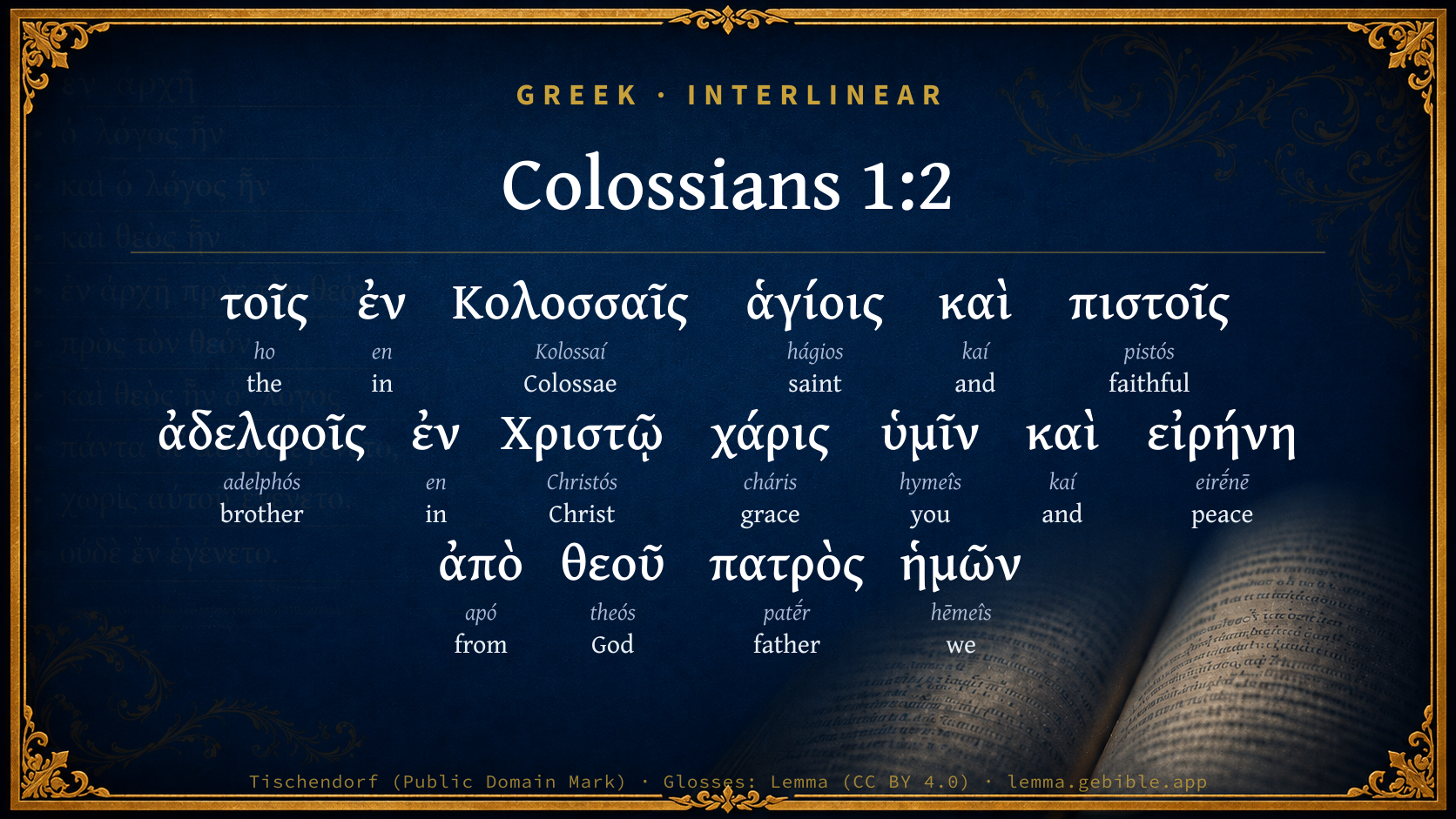
Greek (Tischendorf 8th ed.) Colossians 1:2 appears in the Greek New Testament. The text above is from the Tischendorf 8th edition. Each word links to its Strong’s number and a concise gloss. Click any word for its full Thayer’s Greek Lexicon entry.
Download image
Cite this verse

Colossians 1:2 (World English Bible). Public Domain. Lemma interlinear Bible study tool, https://lemma.gebible.app/v/colossians/1/2.

Show BibTeX & RIS
BibTeX
RIS
English Translation
to the saints and faithful brothers in Christ at Colossae: Grace to you and peace from God our Father, and the Lord Jesus Christ.
World English Bible · Public Domain
Highlights
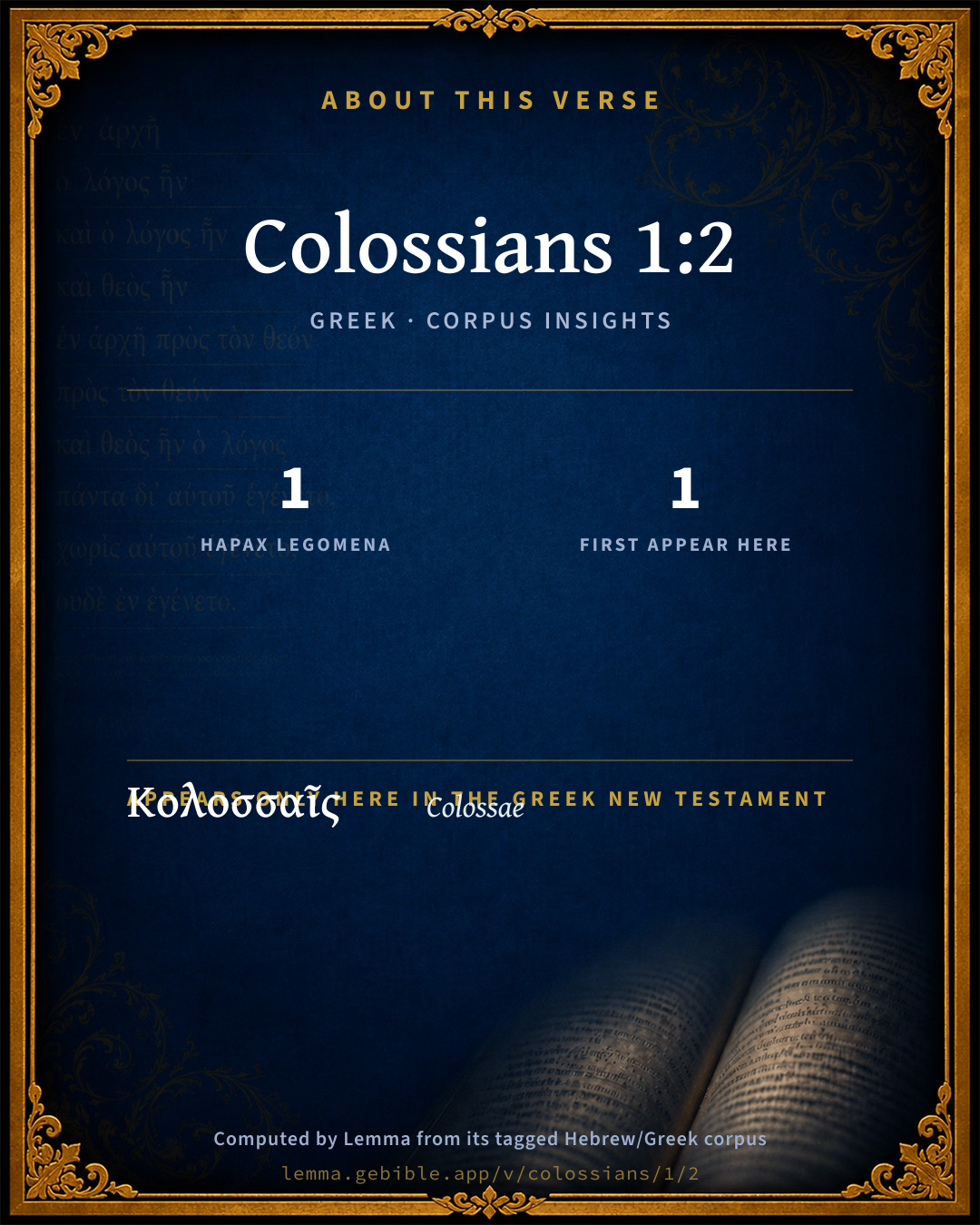
  • 1 hapax legomenon — only here in the Greek New Testament
  • 1 first appearance in the Greek New Testament
Full analysis ↓
Download a study sheet

One document with this verse’s original text, its word-by-word gloss line, the meaning frame, cross-references with their text, attributed commentary, and full source and license credits — printable, and it pastes into notes with its structure intact.

This verse Autodidact and up

Study sheet (.html) Plain text (.txt)

A passage Seminary Student

Up to 50 verses in one chapter. A passage sheet keeps up to 6 commentary sources and 12 cross-references per verse, in the order this page ranks them, and says so on the sheet whenever that leaves anything out. Ask for a single verse and you get the Autodidact verse sheet above.

Everything on this page stays free to read, with no account — the sheet is a download of what is already on screen, not access to it.

Want to remove ads? Support Godless Engineer
Compare translations 3

The same verse in 3 English versions, stacked beneath the original-language interlinear above. Click any original word for its lexicon entry.

Each is an independent rendering of the whole verse — the interlinear is not word-aligned to these translations.

Highlighted words mark where these versions differ — a whole-verse word diff, not a word-by-word alignment.

  • World English Bible Public Domain
    to the saints and faithful brothers in Christ at Colossae: Grace to you and peace from God our Father, and the Lord Jesus Christ.
  • King James Version Public Domain
    To the saints and faithful brethren in Christ which are at Colosse: Grace be unto you, and peace, from God our Father and the Lord Jesus Christ.
  • unfoldingWord Literal Text CC BY-SA 4.0
    to the saints and faithful brothers in Christ in Colossae. Grace to you, and peace from God our Father and the Lord Jesus Christ.

unfoldingWord Literal Text — © unfoldingWord, licensed CC BY-SA 4.0. Word-aligned USFM3 via Door43 (git.door43.org/unfoldingWord/en_ult).

Versions to compare (up to 4)

3 of 4 selected

Show all 19 translations

Every available English version of this verse, each an independent rendering of the whole verse.

  • World English Bible Public Domain
    to the saints and faithful brothers in Christ at Colossae: Grace to you and peace from God our Father, and the Lord Jesus Christ.
  • Berean Standard Bible Public Domain
    To the saints and faithful brothers in Christ at Colossae: Grace and peace to you from God our Father.
  • Majority Standard Bible Public Domain
    To the saints and faithful brothers in Christ at Colossae: Grace and peace to you from God our Father and the Lord Jesus Christ.
  • King James Version Public Domain
    To the saints and faithful brethren in Christ which are at Colosse: Grace be unto you, and peace, from God our Father and the Lord Jesus Christ.
  • American Standard Version (1901) Public Domain
    To the saints and faithful brethren in Christ `that are' at Colossae: Grace to you and peace from God our Father.
  • Revised Version (1885) Public Domain
    To the saints and faithful brethren in Christ which are at Colossae: Grace to you and peace from God our Father.
  • Geneva Bible (1599) Public Domain
    To them which are at Colosse, Saintes and faithfull brethren in Christ: Grace bee with you, and peace from God our Father, and from the Lord Iesus Christ.
  • Douay-Rheims (1899) Public Domain
    To the saints and faithful brethren in Christ Jesus, who are at Colossa.
  • Young's Literal Translation Public Domain
    to the saints in Colossae, and to the faithful brethren in Christ: Grace to you, and peace from God our Father, and the Lord Jesus Christ!
  • Literal Standard Version CC BY-SA 4.0
    to the holy ones in Colossae, and to the faithful brothers in Christ: Grace to you and peace from God our Father and the Lord Jesus Christ!
  • Unlocked Literal Bible CC BY-SA 4.0
    to the believers and faithful brothers in Christ who are at Colossae. May grace be to you, and peace from God our Father.
  • unfoldingWord Literal Text CC BY-SA 4.0
    to the saints and faithful brothers in Christ in Colossae. Grace to you, and peace from God our Father and the Lord Jesus Christ.
  • Darby Bible Public Domain
    to the holy and faithful brethren in Christ which [are] in Colosse. Grace to you and peace from God our Father [and Lord Jesus Christ].
  • World Messianic Bible Public Domain
    to the holy ones and faithful brothers in Messiah at Colossae: Grace to you and peace from God our Father and the Lord Yeshua the Messiah.
  • Webster's Bible Public Domain
    To the saints and faithful brethren in Christ who are at Colosse: Grace be to you, and peace, from God our Father and the Lord Jesus Christ.
  • Free Bible Version CC BY-SA 4.0
    To the believers and trusting Christians at Colossae: May you have grace and peace from God our Father.
  • Bible in Basic English Public Domain
    To the saints and true brothers in Christ at Colossae: Grace to you and peace from God our Father.
  • Text-Critical English NT CC BY 4.0
    to the saints and faithful brothers in Christ who are in Colossae: Grace to you and peace from God our Father and the Lord Jesus Christ.
  • Tyndale New Testament (1534) Public Domain
    To the sayntes which are at Colossa and brethren that beleve in Christ. Grace be with you and peace from God oure father and from the Lorde Iesus Christ.

Literal Standard Version (2020), Covenant Press — licensed CC BY-SA 4.0. Text via the HelloAO Bible API (eBible.org). Unlocked Literal Bible (unfoldingWord) — licensed CC BY-SA 4.0. Text via the HelloAO Bible API (eBible.org). unfoldingWord Literal Text — © unfoldingWord, licensed CC BY-SA 4.0. Word-aligned USFM3 via Door43 (git.door43.org/unfoldingWord/en_ult). Free Bible Version, Dr. Jonathan Gallagher — licensed CC BY-SA 4.0. Text via the HelloAO Bible API (eBible.org).

Word by word

More ways to search: Search by grammar → Find every occurrence → Compare this word →

Practice this passage: Drill this verse → Learn its vocabulary →

Κολοσσαῖς
Kolossaí
G2857
“Colossae”
Noun, Dative, Plural, Feminine
Part of Speech
Noun
Case
Dative
Number
Plural
Gender
Feminine
Full Thayer's Definition

Origin: "apparently feminine plural of kolossos ("colossal")"

TDNT: None

Colosse = "monstrosities" 1. anciently a large and flourishing city, but in Strabo's time a small town of Phrygia Major situated on the Lycus not far from its junction with the Maeander and in the neighbourhood of Laodicea and Hierapolis
  1. τοῖς ho G3588 “the” Article, Dative, Plural, Masculine
  2. ἐν en G1722 “in” Preposition
  3. ἁγίοις hágios G40 “saint” Adjective, Dative, Plural, Masculine
  4. καὶ kaí G2532 “and” Conjunction
  5. πιστοῖς pistós G4103 “faithful” Adjective, Dative, Plural, Masculine
  6. ἀδελφοῖς adelphós G80 “brother” Noun, Dative, Plural, Masculine
  7. ἐν en G1722 “in” Preposition
  8. Χριστῷ Christós G5547 “Christ” Noun, Dative, Singular, Masculine
  9. χάρις cháris G5485 “grace” Noun, Nominative, Singular, Feminine
  10. ὑμῖν hymeîs G5210 “you” Personal pronoun, 2nd person, Dative, Plural
  11. καὶ kaí G2532 “and” Conjunction
  12. εἰρήνη eirḗnē G1515 “peace” Noun, Nominative, Singular, Feminine
  13. ἀπὸ apó G575 “from” Preposition
  14. θεοῦ theós G2316 “God” Noun, Genitive, Singular, Masculine
  15. πατρὸς patḗr G3962 “father” Noun, Genitive, Singular, Masculine
  16. ἡμῶν hēmeîs G2249 “we” Personal pronoun, 1st person, Genitive, Plural

About this verse

These counts appear in no published source. They are computed here, from the morphology-tagged text and Lemma’s own curated glosses. What Lemma adds →

17
words
15
distinct lemmas
Pauline Epistles
section

Notable vocabulary

1 hapax legomenon — a word that appears only here in the entire Greek New Testament:

  • Κολοσσαῖς Colossae G2857

First appearance in Scripture

This word makes its first canonical appearance in the Greek New Testament here:

  • Κολοσσαῖς Colossae G2857

Repetition

Words recur within this verse:

Cross-references

12

Topical passages linked to Colossians 1:2 in the Treasury of Scripture Knowledge — connected by theme and wording, ordered by reader-vote popularity; previews shown in the World English Bible.

  • 2 Peter 1:2 Grace to you and peace be multiplied in the knowledge of God and of Jesus our Lord,
  • Ephesians 1:1 Paul, an apostle of Christ Jesus through the will of God, to the saints who are at Ephesus, and the faithful in Christ Jesus:
  • Romans 1:7 to all who are in Rome, beloved of God, called to be saints: Grace to you and peace from God our Father and the Lord Jesus Christ.
  • 1 Corinthians 1:2 to the assembly of God which is at Corinth; those who are sanctified in Christ Jesus, called to be saints, with all who call on the name of our Lord Jesus Christ in every place, both theirs and ours:
  • Revelation 1:4 John, to the seven assemblies that are in Asia: Grace to you and peace, from God, who is and who was and who is to come; and from the seven Spirits who are before his throne;
  • Galatians 1:3 Grace to you and peace from God the Father, and our Lord Jesus Christ,
  • Psalms 16:3 As for the saints who are in the earth, They are the excellent ones in whom is all my delight.
  • 1 Corinthians 4:17 Because of this I have sent Timothy to you, who is my beloved and faithful child in the Lord, who will remind you of my ways which are in Christ, even as I teach everywhere in every assembly.
  • Galatians 3:9 So then, those who are of faith are blessed with the faithful Abraham.
  • Ephesians 6:21 But that you also may know my affairs, how I am doing, Tychicus, the beloved brother and faithful servant in the Lord, will make known to you all things;
  • 1 Peter 1:2 according to the foreknowledge of God the Father, in sanctification of the Spirit, that you may obey Jesus Christ and be sprinkled in his blood: Grace to you and peace be multiplied.
  • Jude 1:2 Mercy to you and peace and love be multiplied.

Cross-references courtesy of OpenBible.info (CC BY 4.0).

Where the printed editions differ

1 variant

Places in this verse where the major printed Greek editions disagree on the wording in a way that affects the translation — a comparison of editions, not a manuscript-by-manuscript collation. The editions are the modern critical texts (Nestlé-Aland 28/27, SBL, Westcott-Hort, Tregelles, Tyndale House) and the traditional texts behind the KJV (the Textus Receptus and the Byzantine/Majority text). It is not a claim about which reading is original.

  1. Extra text
    καὶ κυρίου Ἰησοῦ Χριστοῦ.¶

    “and Lord Jesus Christ.”

    In TRByz Not in NA28NA27TynSBLWHTreg

    καὶ κυρίου Ἰησοῦ Χριστοῦ.¶ (kai kuriou Iēsou Christou) 'and Lord Jesus Christ.' is only in traditional manuscripts (TR+Byz)

Textual data: Translators Amalgamated Greek New Testament (STEPBible TAGNT) · CC BY 4.0.

Commentary

Notes on Colossians 1:2 from classic Christian and Jewish commentators (each source and its license shown beneath its notes). The classic Christian expositions comment on the surrounding passage and are grouped to its opening verse, so a note may address several verses; the Jewish commentaries on the Tanakh (Rashi and others) are per-verse, so they appear only where the commentator wrote on this verse.

Lemma curates 59 commentaries, every one of them public domain or Creative Commons licensed, each selected and text-cleaned for this edition rather than reprinted as found. About our sources →

The Cambridge Bible for Schools and Colleges

gen. ed. J. J. S. Perowne

2. to the saints] Holy ones; persons possessed of holiness, separated from sin to God. It is true that this is the language of “charitable presumption” (Pearson, Exposition of the Creed, Art. ix. p. 353); when a community is thus described St Paul does not thereby positively assert that each individual answers the description. But this presumptive use of the word “saint” does not lower the true sense of the word so as to make it properly mean merely a member of the baptized community, a possessor of visible Church privileges. “The saints” are supposed to be really separated to God, by purchase, conquest, and self-surrender.

faithful] The adjective is used of Christians frequently; see (in the Greek) Act_10:45; Act_16:1; 2Co_6:15; Col_1:2; 1Ti_4:3; 1Ti_5:16; 1Ti_6:2; Tit_1:6. These and similar passages, and the contrast of the word “unfaithful” (infidelis, infidel), shew that as a designation of Christians it means not trustworthy but trustful; full of faith, in the Christian sense. The “faithful” are (see last note) supposed to be those who have really “believed unto life everlasting” (1Ti_1:16) and now “walk by faith” (2Co_5:7).

brethren] Because “children of God by faith in Christ Jesus” (Gal_3:26; and see next note).

in Christ] See for parallels to this all-important phrase, Rom_8:1; 1Co_15:18; 2Co_5:17; &c. And cp. the Lord’s language, Joh_6:56; Joh_14:20; Joh_15:1-7, and the illustration given by e.g. Eph_5:30.—These “brethren” are regarded as one with their Lord in respect of inseparable interest, holy dearness, and union by the life-giving Spirit (1Co_6:17); especially the latter. They are “brethren in Christ,” brothers because “in” the Firstborn Son (Rom_8:29).—This phrase occurs some 12 times in the Epistle, and closely kindred phrases raise the number to about 20. It is likely that the special doctrinal perils of Colossæ led to this emphasis on the Christian’s union with Christ.

Colosse] Properly Colossœ (Colassai), or Colassœ. On the spelling, see Introd., p. 20, and on the topography of Colossæ and its neighbourhood, Introd., ch. 1 generally.—The older English Versions read Colise (Wyclif, 1380), Colossa (Tyndale, 1534, Cranmer, 1539, Rheims 1582), Collossœ (Geneva, 1557).

The verse thus far may perhaps be rendered more exactly, To those who at Colossæ are holy and faithful brethren in Christ. But the A.V. (and text R.V.) is grammatically defensible and is certainly practically correct.

Grace be unto you, and peace] So in the openings of Rom., Cor., Gal., Phil., Col., Thess., Philem., Pet., and Rev. In the Pastoral Epistles, and in 2 Joh., the remarkable addition “mercy” appears; in Jude, “mercy, peace, and love.”—In these salutations “Grace” is all the free and loving favour of God in its spiritual efficacy; “Peace” is specially the complacency of reconciliation with which He regards His people, but so as to imply also its results in them; repose, serenity of soul; happiness in its largest sense. See further on Col_3:15 below.

from God our Father] To St Paul, God is the Pater Noster of Christians, in the inner sense of their union by faith with His Son. The Scriptures, while not ignoring a certain universal Fatherhood of God, always tend to put into the foreground the Fatherhood and Sonship of special connexion, of covenant, grace, faith. Among many leading passages see Joh_1:12; Rom_8:14 &c.; Gal_3:26; 1Jn_3:1-2.—Cp. the Editor’s Outlines of Christian Doctrine, p. 34.

and the Lord Jesus Christ] These words, present in the parallel passage Eph_1:2, are probably to be omitted here, on documentary evidence.

The Cambridge Bible for Schools and Colleges (gen. ed. J. J. S. Perowne; Cambridge University Press, 1878–1918) — public domain. Text from a community e-Sword module.

Matthew Poole's English Annotations

To the saints: See Poole on "Phi 1:1".

And faithful brethren in Christ: See Poole on "Phi 4:21".

Which are at Colosse: see the Argument: (See Poole on "Col 1:1".)

Grace be unto you, and peace, from God our Father and the Lord Jesus Christ: See Poole on "Eph 1:2", and See Poole on "Phi 1:2".

Matthew Poole's English Annotations on the Holy Bible (1683–1685) — public domain. Text from a community e-Sword/MySword module.

The Biblical Illustrator

Joseph S. Exell

Col_1:2

To the saints and faithful brethren in Christ.

Saints

I. Their character. Holy persons. The idea is derived from the sacred vessels of the temple, which might not be appropriated to common uses. In a more general sense, saints are those who are eminent for piety, not all who are flattered or derided as such. One who is truly a saint--

1. Acknowledges that he was once a lost and undone sinner, and who daily brings his sins for pardon and his graces for increase to the throne of grace.

2. Has a new heart and a right spirit. He is a new creature--loving what God loves, and hating what He hates.

3. Is zealous for the cause of his Divine Master. Where there are no spiritual actions there is no spiritual life. The chief motives are fortitude and the constraining love of Christ.

4. Grows in grace.

II. Their relation to each other.

1. There are three kinds of brotherhood--natural, such as that between Esau and Jacob; national, such as existed among the Jews; spiritual, by adoption and grace. The last is the strongest, purest, and most enduring.

2. Of this Christ is the Elder Brother, and as He is not ashamed to own this relationship should we be either in regard to Himself or the poorest member of the family?

3. Love should spring out of this relationship. This is most natural! Christ has made love the badge of Christian discipleship; it is good and pleasant for brethren to dwell together in unity.

4. Its distinguishing attribute is fidelity. Be thou faithful in defending your brother when defamed, in admonishing him when in the wrong, in helping him in difficulty, in comforting him in trouble. A false brother is worse than an open foe.

III. Their situation in the world.

1. Christians in the midst of heathens, and exposed to temptation and persecution.

2. Believers surrounded by heretics--their faith exposed to subtle undermining and bold attack.

3. Few as against many. Churches are often thus situated, but if they retain their holiness and faithfulness become more than conquerors. (T. Watson, B. A.)

Motives to saintliness

I. As our God is holy so must we be (1Pe_1:15).

II. It is the end of our Divine choice (Eph_1:4).

III. Our calling bindeth us (1Th_4:7).

IV. Our redemption (Tit_2:14).

V. The grace of God teaches us this (Tit_2:11-12).

VI. The final judgment persuades us thereunto (1Pe_5:2; 1Jn_3:3).

VII. The right constitution of the Church prohibits the unholy (Mat_7:6). Conclusion:

1. This discovers to us the vanity of the Pope in restraining a title common to all believers while they live to some few whom it pleaseth him to canonize after death.

2. We see the lewdness of many profane Esaus who scoff at the name.

3. We must remember what kind of men we must be even such as must profess and practice holiness. (P. Bayne, B. D.)

In Christ

This mystical but most real union of Christians with their Lord is never far away from the apostles thoughts, and in the Epistle to the Ephesians it is the very burden of the whole. A shallower Christianity tries to weaken that great phrase to something more intelligible to the unspiritual temper and poverty-stricken experience proper to it; but no justice can be done to Pauls teaching unless it be taken in all its depth as expressive of the same mutual indwelling and interlacing of spirit with spirit, which ,is so prominent in the writings of John. There is one point of contact between the Pauline and Johannean conceptions, on the difference between which so much exaggeration has been expended; to both the inmost essence of the Christian life is union to Christ, and abiding in Him. If we are Christians we are in Him in a profounder sense than creation lives and moves and has its being in God. This is the deepest mystery of the Christian life. To be in Him is to be complete. In Him we are blessed with all spiritual blessings. In Him we are chosen. In Him God freely bestows His grace upon us. In Him we have redemption through His blood. In Him all things in heaven and earth are gathered. In Him is the better life of an that live. In Him we have peace though the world be seething with changed all storm. In Him we conquer though earth and our own evil he all in arms against us. If we live in Him, we live in purity and joy. If we die in Him, we die in tranquil trust. If our gravestones may truly carry the sweet old inscription, carved on many a nameless slab in the Catacombs, In Christo, they will also bear the other, In pace. If we sleep in Him, our glory is assured, For them also that sleep in Jesus, will God bring with Him. (A. Maclaren, D. D.)

Grace and peace

Grace is introductory good; peace is final good: he therefore who wishes these two blessings includes every intermediate benefit.

I. Grace denotes--

1. The gratuitous act of the Divine will accepting man in Christ and pardoning his sins (Eph_2:5; Rom_3:24). This free love of God is the first gift in which all other gifts are bestowed.

2. All those habitual gifts which God infuses for the sanctification of the soul. So faith, love, and all virtues and salutary endowments are called graces (Eph_4:7).

3. The actual assistance of God, whereby the regenerate, after having received habitual grace, are strengthened to perform good works, and to persevere in faith and godliness. For to man renewed and sanctified by grace, the daily aid of God is still necessary for every single act. The union of all these is necessary: inherent grace is not given unless the grace of acceptance has preceded it; neither being given is it available to the production of fruits, unless also the efficacious help of God follow and accompany it through every individual action.

II. Peace. The Hebrews used this expression as we use the expression health or joy: it signifies prosperity marked by no calamities either public or private (Gen_43:27; Psa_122:6). But with the apostles it is used more extensively, and comprehends more especially spiritual joy and prosperity. Therefore under this term Paul desires for them--

1. Internal peace, or peace of conscience, which arises from the grace of God accepting us for Christs sake (Joh_14:27; Rom_5:1; Php_4:7).

2. Brotherly peace; breaking peace they exclude grace. This is a great and desirable good, and is frequently celebrated as the special gift of God (1Co_14:33; 2Co_13:11). The seeds of schism had been scattered abroad; there was therefore need of peace.

3. That external peace which is the well-being of the Church; but only yet so far as it does not militate against their spiritual good; for sometimes it conduces more to the welfare of the faithful that they be afflicted than that they enjoy external tranquility.

III. We may gather--

1. From the order itself, as he places grace before peace, he teaches us--

(1) That this is first of all to be desired, that we may have God propitious. If He be hostile, even blessings will be turned into a curse.

(2) That true peace cannot belong except to those only who are in favour with God. There is no peace to the wicked.

(3) That all good things which fall to the lot of the godly are streams from this fountain of Divine grace.

2. From the thing itself desired--

(1) Paul shows us by his own example the duty of every minister of the gospel; which is, not only to preach grace and peace to his people, but from their inmost souls to intreat and implore the same from God by incessant prayer: neither is sufficient of itself.

(2) He reproves the folly of this world, in which almost all wish for themselves and their friends, health, riches, and honours; but grace, peace, and other spiritual good things, they neither regard nor think of. But Christ commands us to seek first the kingdom of God (Mat_6:33).

(3) He comforts the godly and faithful by showing them that the grace of God, and the peace of God they always possess; in comparison of which good things whatsoever fall to the wicked are refuse. A God appeased, says Bernard, tranquillizes all things, and to behold Him at peace is to be ourselves at peace. (Bp. Davenant.)

The Biblical Illustrator, edited by Joseph S. Exell (c. 1880s–1900s) — public domain. Text from a community e-Sword module.

The Pulpit Commentary

To those in Colossae (which are) saints and faithful brethren in Christ (Eph_1:1; Php_1:1; 1Co_1:2; 2Co_1:1) "Saints" in respect of their Divine calling and character; Col_3:12 1Co 1, 2, where this title is formally introduced) "faithful brethren in Christ" (Eph_1:1) in view of the errors and consequent divisions threatening them as a Church. (ver. 23; Col_2:5, Col_2:18, 19 3:15; Eph_4:14-16 Eph_6:10-18; Php_1:27; 2Ti_2:19) Grace to yon, and peace: "as in all his Epistles." This Pauline formula of greeting combines the Greek and Hebrew, Western and Eastern, forms of salutation (comp. "Abba, Father,". (Rom_8:15) Cariv is a modification of the everyday cairein, hail! (Act_15:23; 2Jn_1:10) and eijrhnh reproduces the Hebrew shalom (salam). Grace is the source of all blessing as bestowed by God (ver. 6; Eph_1:3-6 Eph_2:5; Rom_5:2, Rom_5:17, Rom_5:21; Tit_2:11) and peace, in the large sense of its Hebrew original, of all blessing as experienced by man (Eph_2:16, Eph_2:17; Luk_2:14; Rom_5:1 Rom_8:6; 2Th_3:16) From God our Father. Among the apostle"s salutations this alone fails to add "and from our Lord Jesus Christ a defect which copyists were tempted to remedy. The omission is well established (see Revised Text, and critical editors generally), and cannot surely be accidental. In this and the twin Ephesian letter, devoted as they are to the glory of Christ, the name of the Father stands out with a peculiar prominence and dignity, much as in St. John"s Gospel: "honouring the Son," they must needs "honour the Father" also (vers. 12, 13; Col_3:17; Eph_1:17 Eph_2:18 Eph_3:14 Eph_4:6 Eph_5:20)

The Pulpit Commentary (1880–1919), ed. H.D.M. Spence-Jones & Joseph S. Exell — public domain. Text from a community e-Sword module.

The Preacher's Complete Homiletical Commentary

Joseph S. Exell (gen. ed.)

CRITICAL AND EXPLANATORY NOTES

Col_1:2. To the saints and faithful brethren.—We may observe that such a phrase is characteristic of St. Paul’s later epistles; in the earlier it was “to the Church.” It seems better thus to translate than to give the meaning “to the holy and believing brethren” (see on Eph_1:1). Grace … and peace, from God our Father and the Lord Jesus Christ.—Not “grace” from the Father and “peace” from the Lord Jesus Christ, as the usual benediction shows—“The grace of our Lord Jesus.” “Whatsoever the Father doeth, these also doeth the Son” (Joh_5:19).

MAIN HOMILETICS OF Col_1:2

Apostolic Estimate of Christian Character.

I. Suggestive phases of Christian character.—“Saints and faithful brethren in Christ which are at Colossæ.”

1. Saints.—This implies union with God and a personal participation in His righteousness. This is the root of the saintly life. Faith in Christ is the point and means of junction. Canonisation cannot make a saint. Must be saintly experience to produce saintly conduct. A holy reputation excites to action consistent with itself. Nehemiah refused to hide from threatened assassination as an act beneath his well-known character for high integrity and bravery (Neh_6:11).

2. Faithful brethren which are at Colossæ.—Implies union with each other. They embraced a common faith, and held steadfastly together amid the agitations of false teachers and the defections of the wavering. Christianity blends the strangest elements. It is a foe to all national enmities and prejudices. Paul, a Jew, Timothy, a Grecian, and the Colossians, a mixture of several races, are here united in a holy and faithful brotherhood. “Here the Gentile met the Jew whom he had been accustomed to regard as an enemy of the human race; the Roman met the lying Greek sophist, the Syrian slave, the gladiator born beside the Danube. In brotherhood they met, the natural birth and kindred of each forgotten, the baptism alone remembered in which they had been born again to God and to each other” (Ecce Homo).

3. The sublime origin of the Christian character.—“In Christ.” Character is the development and crystallisation of a life. The character of the blossom and fruit is decided by the vital energy in the tree. Christ is the unfathomable fount of all spiritual life; the ideal pattern and formative force of a perfect character. He is the centre and bond of all true brotherhood.

II. The salutation supplicates the bestowment of highest divine blessings.—

1. Grace. A term of vast significance, inclusive of all the blessings that can flow from the superabundant and free favour of God. Grace is the source of all temporal good—life, health, preservation, success, felicity; and of all spiritual benefactions—pardon, soul-rest, guidance, strength, deliverance, purity, final triumph. The generosity of God is illimitable.

2. Peace.—Grace expresses the spirit and fulness in which divine manifestations come to us; peace the result they accomplish in us. Peace with God. Sin has thrown human nature into a state of discord and enmity. The reception of grace must ever precede the enjoyment of peace. The universal mistake is, in first seeking, through many avenues, the happiness which peace with God alone can bring, instead of accepting humbly, penitently, believingly, the grace of God in Christ. Peace with each other—peace in the Church. How great a blessing is this! One turbulent spirit can ruffle the tranquillity of thousands.

3. The source of the blessings desired.—“From God our Father and the Lord Jesus Christ.” The Father’s love and the Son’s work are the sole source and cause of every blessing to humanity, while the Holy Spirit is the agent of their communication. The Trinity is ever harmonious in acts of beneficence; the divine fountain is inexhaustible.

Learn.—

1. The broad, deep charity of the apostolic spirit.

2. The scope and temper of the prayers we should offer for the race.

The Preacher's Complete Homiletical Commentary (gen. ed. Joseph S. Exell; Funk & Wagnalls, c. 1892) — public domain (pre-1929). A full-Bible homiletical/sermon-outline anthology covering 65 of 66 books (2 John is absent from the source module). Text from a community e-Sword module.

Tyndale Open Study Notes

Tyndale Open Resources

1:2 Colosse was situated in the Lycus River valley in western Asia Minor, about 120 miles (193 kilometers) east of Ephesus and 10 miles (16 kilometers) southeast of Laodicea. Its location on an important Roman road meant that it was influenced by the social and religious currents of the time. • brothers and sisters: Greek adelphoi, a generic term commonly used to refer to members of the same family, both male and female.

Tyndale Open Study Notes — © Tyndale Open Resources, licensed CC BY-SA 4.0. Text via the HelloAO Bible API.

Expositor's Greek Testament

ed. W. Robertson Nicoll

Col 1:2 . Paul does not address the Church as a Church. This has been explained by the fact that he stood in no official relation to the community, and therefore addressed individuals. But he does not mention the Church in Philippians , though he had founded it. The omission may be accidental; but he seems to have changed his custom in his later Epistles, since it occurs in all his letters to Churches from Romans downwards. ἁγίοις may be an adjective (so Kl. [1] , Weiss and others), but more probably a substantive (so Mey., Ell., Lightf., Ol., Sod., Haupt, Abb.), since Paul seems not to use it in the plural in an adjectival sense, except in Eph 3:5 , and in the salutations of 2 Cor., Eph. and Phil. it is certainly a substantive. Like ἀδελφοῖς it may be joined with ἐν Χ ., but should more probably be taken by itself. The saints are those who are set apart for God, as belonging to His holy people, the Israel of God (Gal 6:16 ); the privileges of the chosen nation under the Old Covenant being transferred to Christians under the New. πιστοῖς : not to be taken in the passive sense (as by Ew., Ell., Lightf., Abb., R.V.) = “steadfast,” “faithful,” with tacit reference to the falling away to false doctrine. Combined with ἀδελφ . its meaning would be faithful to Paul, which would have no point here. It should be taken here, as by most commentators, in the sense of “believing”. ἐν Χριστῷ . It is significant that Χριστός occurs alone very frequently in this Epistle, but Ἰησοῦς never (though Κυρίου ἡμ . Ἰησοῦ , Col 1:3 ; Κυρ . Ἰησ ., Col 3:17 ). No doubt this is to be accounted for by the need for emphasis on the doctrine of the Person of Christ. χάρις ὑμῖν κ . εἰρήνη . This combination is found in all the Epistles that claim to be Paul’s except the Pastorals, where it is modified. The formula, which was probably constructed by Paul, combines the Greek and Hebrew forms of salutation. ἀπὸ Θεοῦ πατρὸς ἡμῶν . This is not added in 1 Thess. The other Epistles add καὶ Κυρίου Ἰησοῦ Χριστοῦ . No importance is to be attached to their omission here. Cf. the similarly shortened form ἡ χάρις μεθʼ ὑμῶν (Col 4:18 ).

[1] Klöpper.

The Expositor's Greek Testament, edited by W. Robertson Nicoll (1897–1910) — public domain. Text from a community e-Sword module.

Cambridge Greek Testament for Schools and Colleges

2. Κολοσσαῖς א (A hiatus) BD; Κολοσσαῖς KP.

ἀπὸ θεοῦ πατρὸς ἡμῶν BDKL amiat. fuldensis. Both Origen and Chrysostom expressly. Text. Rec. adds καὶ κυρίου Ἰησοῦ Χριστοῦ with אAC etc. Clementine Vulg. The addition is so often genuine, Rom 1:7; 1Co 1:3; Eph 1:2; Php 1:2; 2Th 1:2, that the insertion of it came very naturally to a careless scribe.

2. In the second half of the salutation observe:

(1) The dative suggests the omission either of χαίρειν (λέγω); Act 23:26, Jas 1:1, 2Ma 1:1, or, more probably, simply γράφω. (2) ἀδελφοῖς occurs nowhere else in such a position (vide supra). (3) A comparison of the other salutations where ἁγίοις occurs shows that in 2Co 1:1, Eph 1:1, Php 1:1 certainly, and in Rom 1:7, 1Co 1:2 probably, ἁγίοις is not a mere epithet, “holy,” but rather “holy ones,” “saints.” (4) Hence καὶ πιστοῖς ἀδ. ἐν Χῷ. is added by way of further definition; cf. Eph 1:1. (5) We do not find here τῇ ἐκκλησίᾳ (as in 1Co 1:2, 1Th 1:1, 2Th 1:1, Phm 1:2) or ταῖς ἐκκλησίαις (Gal 1:2)[95]. St Paul here regards his readers not as united into one whole, or into several communities, but primarily as individuals set apart for God. That, however, he closely connected the thought of οἱ ἅγιοι with that of ἡ ἑκκλησία may be assumed in view of the fact that both are taken over from Jewish usage (for ἑκκλησία, Act 7:38, and for οἱ ἅγιοι cf. Mat 27:52 with Act 9:13, on which last passage Hort remarks, “Members of the holy Ecclesia of Israel were themselves holy by the mere fact of membership, and this prerogative phrase is here boldly transferred to the Christians by the bold Damascene disciple,” The Christian Ecclesia, p. 56). (6) He does not repeat the article before ἀδελφοῖς lest he should seem to differentiate the persons. He regards them first as saints towards God, and then as brethren towards each other.

[95] It has been suggested (Abbott) that ἐκκλησία is not used in the salutations of Romans, Ephesians, Colossians, because he had no official relations with the heads of Churches to which he was personally unknown. In Philippians he uses what is perhaps an equivalent, σὺν ἑπισκοποις καὶ διακόνοις.

πιστοῖς. This is almost certainly used in the passive sense of “trustworthy,” proved “faithful,” and not in the active sense of “believing,” “trustful.”

For (1) in classical literature the active sense “is confined to half-a-dozen passages from poets, one from Plato, Leg. 1:824 B (perhaps a quotation from a poet), and one from Dion Cassius 37:12, where πιστός with a negative = ἄπιστος, which often has the active sense.” Also “neither in the LXX. nor in any other Greek Jewish book (Apocrypha, etc.) does πιστός have the distinctly active sense” (Hort on 1Pe 1:21).

(2) Further, in every case in the N.T. where it = “believing” (Joh 20:27; Act 10:45; Act 16:1; 2Co 6:15; Gal 3:9 prob.; 1Ti 4:3; 1Ti 4:10; 1Ti 4:12; 1Ti 5:16; 1Ti 6:2; Tit 1:6) it is used either absolutely or semi-absolutely, predicating belief of those who would not necessarily be believers. It never occurs, that is to say, as a mere epithet of those who are known to be already believing. Thus “believing brethren” would be tautology. Eph 1:1 is indeed doubtful, but is probably to be interpreted passively on the analogy of our passage.

For πιστός with ἀδελφός see Col 4:9 (cf. Col 1:7); 1Pe 5:12. By calling them “faithful” St Paul wishes to imply that they at least have not yielded to the temptations against which he is about to warn them. In 1Pe 5:12 ὡς λογίζομαι is added, but it is not St Paul’s way so to modify his statements, especially in the opening words of an epistle. In Gal 6:16, Eph 6:24 the exclusion of others from his greetings is more marked.

ἐν Χριστῷ. In view of the non-Christian, yet religious, use of ἀδελφοί (Col 1:1 note) such an addition was perhaps necessary. We may say that while ἀδελφοί regards believers externally, and πιστοί their inner disposition tested by behaviour, ἐν Χριστῷ both defines that in which they are brethren, and points to the reality in which alone true brotherhood takes its rise and is maintained. On the absence of τοῖς before of ἐν Χριστῷ see Col 1:8 end.

χάρις ὑμῖν. The epistolary formula χαίρειν common among heathen (2Ma 9:19, Act 23:26; cf. also the examples given from the papyri in J. A. R. Ephesians, p. 276) and Jews (2Ma 1:1), and even among Christians (Act 15:23; Jas 1:1) is here ennobled by St Paul. He wants for his brethren more than greeting and joy, even God’s grace. χαίρις here doubtless comprises the fullest sense of the word, both God’s favour and His power freely given.

καὶ εἰρήνη). Not, apparently, a heathen formula, though compare Dan. 3:98 = Dan 4:1 (LXX. and Theod.) of Nebuchadnezzar and Dan 6:25 (Theod.) of Darius, but Jewish. Perhaps derived from the high priest’s blessing, Num 6:26. It occurs in David’s message to Nabal, 1Sa 25:5 (ἐρωτήσατε αὐτὸν ἐπὶ τῷ ὀνόματί μου εἰς εἰρήνην). It is found with χαίρειν in 2Ma 1:1.

As used by St Paul after χάρις, which assumes that all is right between the soul and God, it probably refers not so much to inward peace as to external, the disposition of their affairs by God in such a way as to bring them quietness and happiness. The Christian greeting will then chiefly mean: May God’s mercies be given to you, and His protection be ever round you! But of course this protection will reach to body, soul, and spirit.

ἀπὸ θεοῦ πατρὸς ἡμῶν. The thought is not of God as the universal Father (Act 17:28), but as Father of those who are in Christ, among whom St Paul includes himself. On the omission of καὶ κυρίον Ἰησοῦ Χριστοῦ in the true text see the notes on Textual Criticism. The formula “Grace and Peace” is found in every epistle except Heb., James , 1 and 3 John (Jude), and is increased by “mercy” in 1 and 2 Tim., 2 John. St Paul, save in 1 Thes., always adds the Source of these blessings, limiting it to the Father here only. His reason for so limiting it here perhaps lies in the fact that in Col 1:3, and frequently in this epistle, he brings out the special relationship of Christ to the Father, and he therefore avoids a phrase that, in itself, might support independence. He thus lays stress on God as the Father of believers (Col 1:2), and in a special sense the Father of “our Lord Jesus” (Col 1:3).

Cambridge Greek Testament for Schools and Colleges (Cambridge University Press, 1896; 21 vols, various authors incl. Carr, Maclear, Plummer, Farrar, Lumby, Moule, M. R. James, Simcox) — public domain. Text from a community e-Sword module.

International Critical Commentary

2. τοῖς ἐν Κ. ἁγίοις καὶ πιστοῖς ἀδελφοῖς. ἁγίοις, as in all similar salutations, must be taken as a substantive. De Wette, however, and apparently Syr. and Vulg., connect it as an adjective with ἀδελφοῖς. πιστοῖς is more than “believing,” which would add nothing to ἁγίοις and ἀδελφοῖς. It is “true, steadfast.” Cf. Act 16:15.

ἐν Χριστῷ. Closely connected with πιστοῖς ἀδ., but refers chiefly to πιστοῖς. Cf. πιστὸς διάκονος ἐν Κυρίῳ, Eph 6:21. Only in Christ were they “faithful brethren”; the article, therefore, is not required. ἐν Χρ. might, indeed, have been dispensed with; but it suits the formality of the introductory greeting.

After ἐν Χριστῷ, Ἰησοῦ is added in A D* G 17, Vulg., Boh., not in א B DeK L P, Syr-Harcl., Arm., etc. (Syr-Pesh has Ἰησοῦ before Χριστῷ).

It is remarkable that St. Paul’s earlier Epistles are addressed τῇ ἐκκλησίᾳ, ταῖς ἐκκλησίαις; whereas here, as in Rom. and Eph., the address is to the saints and brethren. This can hardly be accidental. It certainly gives the address a more personal and less official aspect, and may have been adopted because the apostle had no personal relations with the heads of these Churches, to which he was personally unknown. It has been objected to this, that in 4:16 the Church of the Laodiceans is mentioned; and, again, that the Epistle to the Philippians, to whom St. Paul was personally known, is similarly addressed. As to the former objection, it may be fairly replied that to speak of his Epistle being read in the Church is very different from addressing it to the Church; and as to the second, although the word ἐκκλησία is not used in the address to the Phil., we have what may be regarded as an equivalent, σὺν ἐπισκόποις καὶ διακόνοις. It is hardly satisfactory to say that the disuse of ἐκκλησία in the address is characteristic of the later Epistles; for, first, this is not an explanation; and, secondly, the word is used in Philemon, τῇ κατʼ οἶκόν σου ἐκκλησίᾳ.

χάρις ὑμῖν καὶ εἰρήνη ἀπὸ Θεοῦ πατρὸς ἡμῶν = Eph 1:2, where there follows Καὶ Κυρίον Ἰησοῦ Χριστοῦ.

These words are added here also in א A C G and most MSS. Boh., Arm., also P in a different order, Ἰησοῦ Χρ. τοῦ Κυρίου ἡμῶν. The words are absent from B D K L 17, al. Amiat., Fuld.., Syr-Pesh (text). Origen and Chrysostom both expressly attest the absence of the words. The latter, after quoting the preceding words, observes: τὸν υἱὸν ἐσίγησεν καὶ οὐ προσέθηκεν ὡς ἐν πάσαις ταῖς ἐπιστολαῖς· καὶ Κυρίου Ἰησοῦ Χριστοῦ. The addition has plainly come in by assimilation to Eph.

International Critical Commentary — older volumes (1896–1929), various authors — public domain. Text from a community e-Sword module.

Geneva Bible (1599)

Geneva Bible translators

Colosse is situated in Phrygia, not far from Hierapolis and Laodicea, on that side that they bend toward Lycia and Pamphylia.

Geneva Bible (1599) marginal notes — public domain. Text via Bolls.life.

Jamieson, Fausset & Brown

Robert Jamieson, A. R. Fausset & David Brown

Colosse--written in the oldest manuscripts, "Colasse." As "saints" implies union with God, so "the faithful brethren" union with Christian men [BENGEL].

and the Lord Jesus Christ--supported by some oldest manuscripts omitted by others of equal antiquity.

Jamieson, Fausset & Brown — Commentary Critical and Explanatory on the Whole Bible (1871) — public domain (CC PDM 1.0). Text via the HelloAO Bible API.

Adam Clarke's Commentary

Verse 2. To the saints] Those who professed Christianity. See Clarke on Eph 1:1.

Which are at Colosse] Instead of εν κολοσσαις, at Colosse, or among the Colossians, ABC, and many other excellent MSS., with both the Syriac, Coptic, Slavonic, Origen, Gregory Nyssen, Amphilochus, Theodoret, Damascenus, Theophylact, and others, read εν κολασσαις in Colassa, or among the Colassians; and this is most probably the true reading. That this city perished by an earthquake, a short time after the date of this epistle, we have the testimony of Eusebius. That which at present is supposed to occupy the site of this ancient city is called Konos. For other particulars see the preface to this epistle. See Clarke on Col 1:1

Grace be unto you] See Clarke on Ro 1:7.

And the Lord Jesus Christ.] This clause is omitted by many MSS., several versions, and some of the fathers. Griesbach has left it out of the text, not, in my opinion, on sufficient evidence.

Adam Clarke's Commentary on the Bible (1810–1826) — public domain. Text from a community e-Sword/MySword module.

Ellicott's Commentary for English Readers

(2) From God our Father and the Lord Jesus Christ.—The best MSS. show here, that the salutation should run simply “from God the Father,” thus varying from St. Paul’s otherwise universal phraseology. Such variation can hardly be accidental. Could it have been suggested to St. Paul’s mind, in connection with his special desire to emphasize the true Godhead of Christ, so obvious in this Epistle, by an instinctive reluctance to use in this case any phrase, however customary with him, which might even seem to distinguish His nature from the Godhead? It is certainly notable that in the true reading of Col_2:2 Christ is called “the mystery of God, even the Father”—an unique and remarkable expression, which marks a preparation for the full understanding of the teaching of our Lord, “He that hath seen Me hath seen the Father” (Joh_14:9).

A Bible Commentary for English Readers, edited by Charles John Ellicott (1878–1897) — public domain. Text from a community e-Sword module.

John Gill's Exposition

To the saints and faithful brethren in Christ,.... This is the inscription of the epistle, in which the persons wrote unto are described as "saints", or holy men; not by birth, for all are unholy and unclean by nature; nor by baptism, for that neither takes away sin, nor gives grace; nor merely externally, by an outward reformation; but by separation, being by an act of eternal election set apart for God, for holiness, and happiness; and by imputation, Christ being made sanctification to them; and by the sanctifying grace of the Spirit of God in regeneration, being called with an holy calling, and having principles of grace and holiness wrought in them, and they formed as new men in righteousness and true holiness: and as "brethren"; being born of God, having him for their Father, and being of his household, and a part of the family in heaven and earth named of Christ, and heirs together of the grace of life, and of the heavenly glory: and as "faithful" ones; true and sincere believers in Christ, constant and persevering in the faith of him; faithful to the Gospel, and their profession of it, and to Christ, whose name they bore, and to one another, to whom they stood in the relation of brethren: and all this "in Christ"; and by, and through him; they were saints in him; they were chosen in him, and sanctified in him their head, and received all their holiness from him; they were brethren in him the firstborn of them; his God being their God, and his Father their Father; and had their faith and faithfulness from him, as well as it was exercised towards, and on him: and they are further described by the place of their abode,

which are at Colosse: a city of Phrygia:

grace be unto you, and peace from God our Father, and the Lord Jesus Christ. This is the salutation, and which stands in this form in most of Paul's epistles; See Gill on Rom 1:7. The Syriac version puts "peace" before "grace", and leaves out the last clause, "and the Lord Jesus Christ"; as does also the Ethiopic version.

John Gill's Exposition of the Whole Bible (1746–1763) — public domain (CC PDM 1.0). Text via the HelloAO Bible API.

Trapp's Complete Commentary

John Trapp

2 To the saints and faithful brethren in Christ which are at Colosse: Grace be unto you, and peace, from God our Father and the Lord Jesus Christ.

Ver. 2. Which are at Colosse] A city in Phrygia, swallowed up by an earthquake not long after this Epistle was written. God’s judgments are sometimes secret, but ever just. It may be that these Colossians, being led away with the error of these false teachers (who sought to entangle them with many pharisaical observations and philosophical speculations, Col 2:16-23), had fallen from their own stedfastness, 2Pe 2:17, had suffered a heartquake, being shaken in mind, 2Th 2:2, and were sucked in by the whirlpool of divers and strange doctrines, μη περιφερεσθε, Heb 13:9. I affirm nothing, but God sometimes speaks from heaven against heretics: as he did against Arius, Nestorius, Stephen Langton, Stephen Gardiner, Arminius (who craftily revived the Pelagian heresy), all which died miserably; that I speak not of those two monsters in New England brought forth by Mistress Hutchinson and Mistress Dyer, and the fearful end that the former of these two women came to, being burnt with her family by the savages of that country. Aliorum perditio tua sit cautio. Christ will have all the Churches know, Rev 2:23, that he is jealous of his glory, and will revenge the quarrel of his covenant. Those primitive Churches sinned away their light, and are therefore now given up to darkness. Infatuati seducebantur, et seducti iudicabantur, saith Austin; that is, being infatuated, they were seduced; and being seduced, they were justly punished. (Melancth.) They were first overspread with Arianism, and therefore now with Mahometism, which is nothing else but Arii stercus, the odour of Arius, as one rightly calleth it.

John Trapp, A Commentary or Exposition upon All the Books of the Old and New Testament (1647–1656) — public domain. Text from a community e-Sword module.

Albert Barnes' Notes on the Bible

Grace be unto you - See the notes at Rom 1:7.

Albert Barnes' Notes on the Bible (1834–1885) — public domain. Text from a community e-Sword/MySword module.

Whedon's Commentary on the Bible

Daniel D. Whedon

2. Saints—As elsewhere, a technical name for Christians, who are also addressed by the warmer title of brothers in Christ.

Colosse—Colossae, or Colassae, as it was often written, was a city of Phrygia situated on the river Lycus, a branch of the Maeander, and near the great road from Ephesus to the Euphrates, and was of considerable importance in the time of Cyrus. It was destroyed by an earthquake in the ninth year of Nero, about A.D. 63, but was soon afterward rebuilt. It now lies in ruins about three miles from the modern village of Chonas.

Daniel D. Whedon (gen. ed.), Commentary on the Old and New Testaments (1874–1909) — public domain. Text from a community e-Sword module.

John Wesley's Explanatory Notes

The saints-This word expresses their union with God. And brethren -- this, their union with their fellow-Christians.

John Wesley, Explanatory Notes Upon the Whole Bible (1754–1765) — public domain. Text via the GEBible commentary corpus.

Godbey's Commentary on the New Testament

William B. Godbey

2. “To the saints in Colosse, and to the faithful brethren in Christ.” You see here again a confirmation of the fact patent throughout the Scriptures, that “saint” is the epithet given by the Holy Ghost to the Lord’s people. We should all accept the name, and recognize the standard which God has given us.

William B. Godbey, Commentary on the New Testament (1896–1900) — public domain. Text from a community e-Sword module.

The People's New Testament

B. W. Johnson

2. To the saints. A designation in apostolic ages of all Christians. Two characteristics are named; they were believing brethren also. At Colosse. For an account of Colosse, see Introduction to this Epistle.

B. W. Johnson's The People's New Testament with Notes (1889–1891) — public domain. Electronic text from the Christian Classics Ethereal Library (CCEL) ThML edition.

Alford’s Greek Testament

Henry Alford

2.] Address and greeting.

2.] On Colossæ, or Colassæ, see Prolegg. § ii. 1.

ἁγίοις should be taken (Mey.) as a substantive, not (De W.) with ἀδελφοῖς, in which case πιστοῖς, being already (as Mey.) presupposed in ἁγίοις, would be tame and superfluous:—and καὶ πιστοῖς ἀδελφοῖς ἐν χριστῷ seems to be a specifying clause, ‘viz.—to the &c.:’ or perhaps added merely on account of the natural diplomatic character of an opening address. ἐν χρ. belongs closely to πιστοῖς ἀδελφοῖς or perhaps rather to ἀδελφοῖς alone, as Php 1:14: no article before ἐν χριστῷ being wanted, because no distinction between these and any other kind of brethren is needed—the idea ἀδελφὸς-ἐν-χριστῷ being familiar.

χάρις κ.τ.λ.] see Rom 1:7.

Henry Alford, The Greek Testament (1849–1861) — public domain. Text from a community e-Sword module.

Vincent's Word Studies in the New Testament

Marvin R. Vincent

Colossae. The form of the name appears to have been both Kolossai and Kolassai, the former being probably the earlier.

The city was in Phrygia, in the valley of the Lycus, about ten or twelve miles beyond Laodicaea and Hierapolis. The region is volcanic, and the earthquakes common to large portions of Asia Minor are here peculiarly severe. The tributaries of the Lyous carried calcareous matter which formed everywhere deposits of travertine, said to be among the most remarkable formations of this character in the world. "Ancient monuments are buried, fertile lands overlaid, river - beds choked up, and streams diverted, fantastic grottos and cascades and arches of stone formed by this strange, capricious power, at once destructive and creative, working silently and relentlessly through long ages. Fatal to vegetation, these incrustations spread like a stony shroud over the ground. gleaming like glaciers on the hillside, they attract the eye of the traveler at a distance of twenty miles, and form a singularly striking feature in scenery of more than common beauty and impressiveness" (Lightfoot).

The fertility of the region was nevertheless great. The fine sheep, and the chemical qualities of the streams which made the waters valuable for dyeing purposes, fostered a lively trade in dyed woolen goods. All the three cities were renowned for the brilliancy of their dyes.

Colossae stood at the junction of the Lycus with two other streams, on a highway between eastern and western Asia, and commanding the approaches to a pass in the Cadmus mountains. Both Herodotus and Xenophon speak of it as a prosperous and great city; but in Paul 's time its glory had waned. Its site was at last completely lost, and was not identified until the present century. Its ruins are insignificant. Paul never visited either of the three cities. The church at Colossae was the least important of any to which Paul 's epistles were addressed.

To the saints. A mode of address which characterizes Paul 's later epistles. The word is to be taken as a noun, and not construed as an adjective with faithful brethren : to the holy and faithful brethren.

And faithful brethren in Christ. Or believing brethren. Compare Eph 1:1. There is no singling out of the faithful brethren from among others who are less faithful.

Our Father. The only instance in which the name of the Father stands in the opening benediction of an epistle without the addition and Jesus Christ.

Marvin R. Vincent, Word Studies in the New Testament (1887–1900) — public domain. Text from a community e-Sword/MySword module.

Lightfoot's Colossians and Philemon

J. B. Lightfoot

2. Κολοσσαῖς] For the reasons why this form is preferred here, while Κολασσαεῖς is adopted in the heading of the epistle, see above, p. 16 sq.

J. B. Lightfoot, St Paul's Epistles to the Colossians and Philemon: a revised text with introductions, notes and dissertations (London: Macmillan, 1875) — public domain. Electronic text from Project Gutenberg (ebook #50857). Covers Colossians and Philemon only (the verse-by-verse notes; introductions and dissertations are omitted); Lightfoot's companion Galatians and Philippians volumes are not included, as the available public-domain scans carry garbled Greek that cannot be faithfully reproduced.

Lesson kit

Teaching starters — assembled from the data on this page, not authored interpretation. Every prompt links to the verse data it draws on. Edit before teaching.

Colossians, in the Pauline Epistles, opens this verse with 17 words (15 distinct Greek lemmas). Its most distinctive word is Kolossaí (“Colossae”). A historical commentator’s framing appears above. Read the whole chapter for the surrounding context.

Discussion questions

  1. What does “Colossae” (Kolossaí) contribute to the verse as a whole?
  2. 1 word here appears nowhere else in the Greek New Testament. Why might the author reach for such rare wording?
  3. This is the first place “Colossae” appears in Scripture (first appears here). What does its debut here establish?
  4. How does 2 Peter 1:2, which shares this passage’s theme, read alongside this verse?
  5. What does the repetition of “in” (2× in this one verse) do in this verse?
  6. The translations on this page render this verse differently — a whole-verse word diff, not a word-by-word alignment. What might account for the different wordings?
  7. Compare how The Cambridge Bible for Schools and Colleges and Matthew Poole's English Annotations read this verse. Where do they agree or differ?

Things to notice

  • 1 word in this verse appears nowhere else in the Greek New Testament.
  • 1 word makes its first canonical appearance in Scripture here.
  • These translations choose different wording for 5 words in this verse.
  • “in” occurs 2× in this single verse.
  • 15 distinct Greek lemmas span 17 words in this verse.

Reading settings

Reading text

Shown beneath each verse's original-language words.

Old Testament
Old Testament edition

Read the OT as the Masoretic Hebrew (MT) or the Greek Septuagint (LXX).

English shown for the Greek Septuagint (in the Hebrew ↔ Greek comparison).

Comparing translations? Open the Compare panel on any verse page to stack up to four side by side.