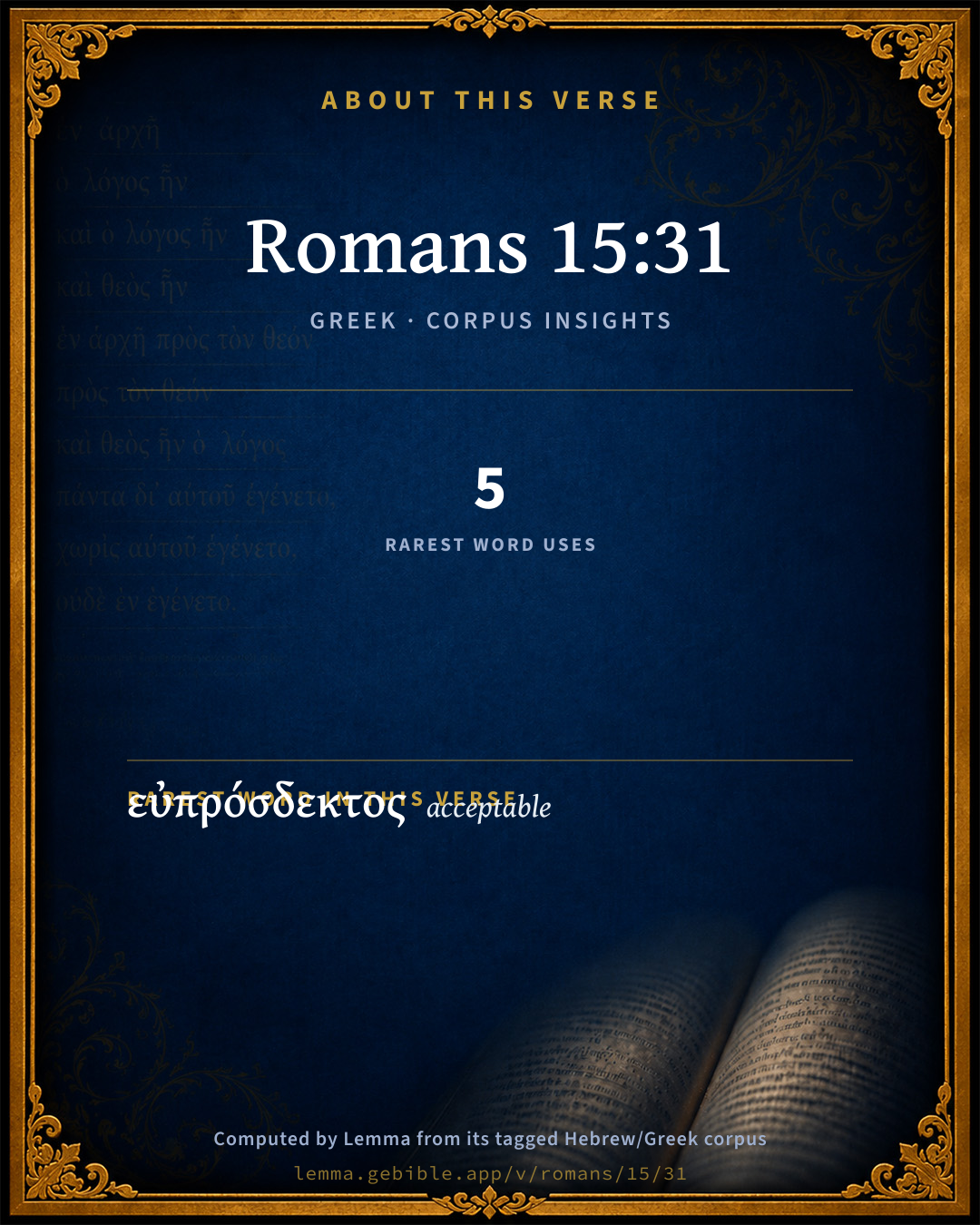
Romans 15:31

Greek (Tischendorf 8th ed.) Romans 15:31 appears in the Greek New Testament. The text above is from the Tischendorf 8th edition. Each word links to its Strong’s number and a concise gloss. Click any word for its full Thayer’s Greek Lexicon entry.

Download image
Cite this verse

Romans 15:31 (World English Bible). Public Domain. Lemma interlinear Bible study tool, https://lemma.gebible.app/v/romans/15/31.

Show BibTeX & RIS
BibTeX
RIS
English Translation
that I may be delivered from those who are disobedient in Judea, and that my service which I have for Jerusalem may be acceptable to the saints;
World English Bible · Public Domain
Download a study sheet

One document with this verse’s original text, its word-by-word gloss line, the meaning frame, cross-references with their text, attributed commentary, and full source and license credits — printable, and it pastes into notes with its structure intact.

This verse Autodidact and up

Study sheet (.html) Plain text (.txt)

A passage Seminary Student

Up to 50 verses in one chapter. A passage sheet keeps up to 6 commentary sources and 12 cross-references per verse, in the order this page ranks them, and says so on the sheet whenever that leaves anything out. Ask for a single verse and you get the Autodidact verse sheet above.

Everything on this page stays free to read, with no account — the sheet is a download of what is already on screen, not access to it.

Want to remove ads? Support Godless Engineer
Compare translations 3

The same verse in 3 English versions, stacked beneath the original-language interlinear above. Click any original word for its lexicon entry.

Each is an independent rendering of the whole verse — the interlinear is not word-aligned to these translations.

Highlighted words mark where these versions differ — a whole-verse word diff, not a word-by-word alignment.

  • World English Bible Public Domain
    that I may be delivered from those who are disobedient in Judea, and that my service which I have for Jerusalem may be acceptable to the saints;
  • King James Version Public Domain
    That I may be delivered from them that do not believe in Judaea; and that my service which I have for Jerusalem may be accepted of the saints;
  • unfoldingWord Literal Text CC BY-SA 4.0
    so that I might be delivered from the disobedient ones in Judea, and my service that for Jerusalem might be acceptable to the saints;

unfoldingWord Literal Text — © unfoldingWord, licensed CC BY-SA 4.0. Word-aligned USFM3 via Door43 (git.door43.org/unfoldingWord/en_ult).

Versions to compare (up to 4)

3 of 4 selected

Show all 19 translations

Every available English version of this verse, each an independent rendering of the whole verse.

  • World English Bible Public Domain
    that I may be delivered from those who are disobedient in Judea, and that my service which I have for Jerusalem may be acceptable to the saints;
  • Berean Standard Bible Public Domain
    Pray that I may be delivered from the unbelievers in Judea, and that my service in Jerusalem may be acceptable to the saints there,
  • Majority Standard Bible Public Domain
    Pray that I may be delivered from the unbelievers in Judea, and that my service in Jerusalem may be acceptable to the saints there,
  • King James Version Public Domain
    That I may be delivered from them that do not believe in Judaea; and that my service which I have for Jerusalem may be accepted of the saints;
  • American Standard Version (1901) Public Domain
    that I may be delivered from them that are disobedient in Judaea, and `that' my ministration which `I have' for Jerusalem may be acceptable to the saints;
  • Revised Version (1885) Public Domain
    that I may be delivered from them that are disobedient in Judaea, and that my ministration which I have for Jerusalem may be acceptable to the saints;
  • Geneva Bible (1599) Public Domain
    That I may be deliuered from them which are disobedient in Iudea, and that my seruice which I haue to doe at Hierusalem, may be accepted of the Saintes,
  • Douay-Rheims (1899) Public Domain
    That I may be delivered from the unbelievers that are in Judea, and that the oblation of my service may be acceptable in Jerusalem to the saints.
  • Young's Literal Translation Public Domain
    that I may be delivered from those not believing in Judea, and that my ministration, that `is' for Jerusalem, may become acceptable to the saints;
  • Literal Standard Version CC BY-SA 4.0
    that I may be delivered from those not believing in Judea, and that my ministry, that [is] for Jerusalem, may become acceptable to the holy ones;
  • Unlocked Literal Bible CC BY-SA 4.0
    Pray that I may be rescued from those who are disobedient in Judea, and that my service for Jerusalem may be acceptable to the believers.
  • unfoldingWord Literal Text CC BY-SA 4.0
    so that I might be delivered from the disobedient ones in Judea, and my service that for Jerusalem might be acceptable to the saints;
  • Darby Bible Public Domain
    that I may be saved from those that do not believe in Judaea; and that my ministry which [I have] for Jerusalem may be acceptable to the saints;
  • World Messianic Bible Public Domain
    that I may be delivered from those who are disobedient in Judea, and that my service which I have for Jerusalem may be acceptable to the holy ones,
  • Webster's Bible Public Domain
    That I may be delivered from them in Judea who do not believe; and that my service which I have for Jerusalem, may be acceptable to the saints;
  • Free Bible Version CC BY-SA 4.0
    Pray that I may be kept safe from the unbelievers in Judea. Pray that my work in Jerusalem will be welcomed by the believers there.
  • Bible in Basic English Public Domain
    So that I may be kept safe from those in Judaea who have not put themselves under the rule of God, and that the help which I am taking for Jerusalem may be pleasing to the saints;
  • Text-Critical English NT CC BY 4.0
    Pray that I may be rescued from those in Judea who refuse to believe and that my ministry to Jerusalem may be acceptable to the saints,
  • Tyndale New Testament (1534) Public Domain
    that I maye be delyvered from them which beleve not in Iewry and that this my service which I have to Ierusalem maye be accepted of the saynctes

Literal Standard Version (2020), Covenant Press — licensed CC BY-SA 4.0. Text via the HelloAO Bible API (eBible.org). Unlocked Literal Bible (unfoldingWord) — licensed CC BY-SA 4.0. Text via the HelloAO Bible API (eBible.org). unfoldingWord Literal Text — © unfoldingWord, licensed CC BY-SA 4.0. Word-aligned USFM3 via Door43 (git.door43.org/unfoldingWord/en_ult). Free Bible Version, Dr. Jonathan Gallagher — licensed CC BY-SA 4.0. Text via the HelloAO Bible API (eBible.org).

Word by word

More ways to search: Search by grammar → Find every occurrence → Compare this word →

Practice this passage: Drill this verse → Learn its vocabulary →

εὐπρόσδεκτος
euprósdektos
G2144
“acceptable”
Adjective, Nominative, Singular, Feminine
Part of Speech
Adjective
Case
Nominative
Number
Singular
Gender
Feminine
Full Thayer's Definition

Origin: from G2095 and a derivative of G4327

TDNT: 02:58,1

1. well received, accepted, acceptable
  1. ἵνα hína G2443 “that” Conjunction
  2. ῥυσθῶ rhýomai G4506 “to draw” Verb, Aorist, Passive, Subjunctive, 1st person, Singular
  3. ἀπὸ apó G575 “from” Preposition
  4. τῶν ho G3588 “the” Article, Genitive, Plural, Masculine
  5. ἀπειθούντων apeithéō G544 “to disobey” Verb, Present, Active, Participle, Genitive, Plural, Masculine
  6. ἐν en G1722 “in” Preposition
  7. τῇ ho G3588 “the” Article, Dative, Singular, Feminine
  8. Ἰουδαίᾳ Ioudaía G2449 “Judea” Noun, Dative, Singular, Feminine
  9. καὶ kaí G2532 “and” Conjunction
  10. ἡ ho G3588 “the” Article, Nominative, Singular, Feminine
  11. διακονία diakonía G1248 “service” Noun, Nominative, Singular, Feminine
  12. μου egṓ G1473 “I” Personal pronoun, 1st person, Genitive, Singular
  13. ἡ ho G3588 “the” Article, Nominative, Singular, Feminine
  14. εἰς eis G1519 “into” Preposition
  15. Ἱερουσαλὴμ Hierousalḗm G2419 “Jerusalem” Noun, Proper, indeclinable
  16. τοῖς ho G3588 “the” Article, Dative, Plural, Masculine
  17. ἁγίοις hágios G40 “saint” Adjective, Dative, Plural, Masculine
  18. γένηται gínomai G1096 “to become” Verb, Aorist, Middle deponent, Subjunctive, 3rd person, Singular

About this verse

These counts appear in no published source. They are computed here, from the morphology-tagged text and Lemma’s own curated glosses. What Lemma adds →

19
words
15
distinct lemmas
Pauline Epistles
section

Notable vocabulary

The rarest word here is εὐπρόσδεκτος acceptable G2144 — appearing just 5 times in the whole Greek New Testament.

Shared distinctive vocabulary

εὐπρόσδεκτος acceptable G2144 occurs in 5 verses of the Greek New Testament. Also found in:

Repetition

A word recurs within this verse:

Cross-references

13

Topical passages linked to Romans 15:31 in the Treasury of Scripture Knowledge — connected by theme and wording, ordered by reader-vote popularity; previews shown in the World English Bible.

  • 2 Thessalonians 3:2 and that we may be delivered from unreasonable and evil men; for not all have faith.
  • 2 Corinthians 8:4 begging us with much entreaty to receive this grace and the fellowship in the service to the saints.
  • Romans 15:25 But now, I say, I am going to Jerusalem, serving the saints.
  • 2 Corinthians 9:1 It is indeed unnecessary for me to write to you concerning the service to the saints,
  • Acts 21:17–31 When we had come to Jerusalem, the brothers received us gladly.
  • Acts 22:24 the commanding officer commanded him to be brought into the barracks, ordering him to be examined by scourging, that he might know for what crime they shouted against him like that.
  • Acts 23:12–24 When it was day, some of the Jews banded together, and bound themselves under a curse, saying that they would neither eat nor drink until they had killed Paul.
  • Acts 24:1–9 After five days, the high priest, Ananias, came down with certain elders and an orator, one Tertullus. They informed the governor against Paul.
  • Acts 25:2 Then the high priest and the principal men of the Jews informed him against Paul, and they begged him,
  • Acts 25:24 Festus said, "King Agrippa, and all men who are here present with us, you see this man, about whom all the multitude of the Jews petitioned me, both at Jerusalem and here, crying that he ought not to live any longer.
  • 1 Thessalonians 2:15 who killed both the Lord Jesus and their own prophets, and drove us out, and didn't please God, and are contrary to all men;
  • 2 Timothy 3:11 persecutions, and sufferings: those things that happened to me at Antioch, Iconium, and Lystra. I endured those persecutions. Out of them all the Lord delivered me.
  • 2 Timothy 4:17 But the Lord stood by me, and strengthened me, that through me the message might be fully proclaimed, and that all the Gentiles might hear; and I was delivered out of the mouth of the lion.

Cross-references courtesy of OpenBible.info (CC BY 4.0).

Where the printed editions differ

1 variant

Places in this verse where the major printed Greek editions disagree on the wording in a way that affects the translation — a comparison of editions, not a manuscript-by-manuscript collation. The editions are the modern critical texts (Nestlé-Aland 28/27, SBL, Westcott-Hort, Tregelles, Tyndale House) and the traditional texts behind the KJV (the Textus Receptus and the Byzantine/Majority text). It is not a claim about which reading is original.

  1. Extra text
    ἵνα

    “so that”

    In TRByz Not in NA28NA27TynSBLWHTreg

    ἵνα (ina) 'so that' is only in traditional manuscripts (TR+Byz)

Textual data: Translators Amalgamated Greek New Testament (STEPBible TAGNT) · CC BY 4.0.

Commentary

Notes on Romans 15:31 from classic Christian and Jewish commentators (each source and its license shown beneath its notes). The classic Christian expositions comment on the surrounding passage and are grouped to its opening verse, so a note may address several verses; the Jewish commentaries on the Tanakh (Rashi and others) are per-verse, so they appear only where the commentator wrote on this verse.

Lemma curates 59 commentaries, every one of them public domain or Creative Commons licensed, each selected and text-cleaned for this edition rather than reprinted as found. About our sources →

Tyndale Open Study Notes

Tyndale Open Resources

15:31 Pray that I will be rescued from those in Judea who refuse to obey God: See Acts 21–22. God preserved Paul’s life and used the circumstances of his arrest in Jerusalem to take him precisely where he planned to go—Rome.

Tyndale Open Study Notes — © Tyndale Open Resources, licensed CC BY-SA 4.0. Text via the HelloAO Bible API.

Bengel's Gnomon

Johann Albrecht Bengel

Rom 15:31. Καὶ ἵνα, and that) This is also an important matter.—εὐπρόσδεκτος, accepted) that the Jews and Gentiles may be united in the closest bonds of love. The liberality of the Gentiles, which was shown for the sake of the name of Jesus, afforded to the Jews an argument for the truth and efficacy of the Christian faith, and for lawful communion with the Gentiles, 2Co 9:13.

Bengel's Gnomon of the New Testament — English translation (T&T Clark, Edinburgh, 1860) — public domain. Text from a community e-Sword module.

Expositor's Greek Testament

ed. W. Robertson Nicoll

Rom 15:31 f. ἵνα ῥυσθῶ ἀπὸ τῶν ἀπειθούντων : from the disobedient, i.e. , from the Jews who had not received the Gospel, 2Th 1:8 , chap. Rom 11:30 . καὶ ἡ διακονία μου κ . τ . λ . It was not the unbelieving Jews only who hated Paul. To them he was an apostate, who had disappointed all their hopes; but even Christian Jews in many cases regarded him as false to the nation’s prerogative, and especially to the law. There was a real danger that the contribution he brought from the Gentile Churches might not be graciously accepted, even accepted at all; it might be regarded as a bribe, in return for which Paul’s opposition to the law was to be condoned, and the equal standing of his upstart churches in the Kingdom of God acknowledged. It was by no means certain that it would be taken as what it was a pledge of brotherly love; and God alone could dispose “the saints” to take it as simply as it was offered. Paul’s state of mind as seen here is exactly that which is revealed in Act 20:17-38 ; Act 21:13 , etc. ἵνα ἐν χαρᾷ ἐλθών … συναναπαύσωμαι ὑμῖν . συναναπ . here only in N.T. but cf. συνπαρακληθῆναι , Rom 1:12 , and συναγωνίσασθαι Rom 15:30 . “Rest after the personal danger and after the ecclesiastical crisis of which the personal danger formed a part” (Hort). The ἵνα here seems to be subordinate to, not co-ordinate with the preceding one. Paul looks forward to a time of joy and rest beyond these anxieties and dangers, as the ultimate end to be secured by their prayers. διὰ θελήματος θεοῦ : it depends on this whether Paul is to return or how. He did reach Rome, by the will of God (Rom 1:10 ), but hardly in the conditions anticipated here.

The Expositor's Greek Testament, edited by W. Robertson Nicoll (1897–1910) — public domain. Text from a community e-Sword module.

Hodge's Commentary on Romans, Ephesians & First Corinthians

Charles Hodge

Rom_15:31

That I may be delivered from them that do not believe in Judea. There are three objects for which he particularly wished them to pray; his safety, the successful issue of his mission, and that he might come to them with joy. How much reason Paul had to dread the violence of the unbelieving Jews is evident from the history given of this visit to Jerusalem, in the Acts of the Apostles. They endeavored to destroy his life, accused him to the Roman governor, and effected his imprisonment for two years in Cesarea, whence he was sent in chains to Rome. Nor were his apprehensions confined to the unbelieving Jews; he knew that even the Christians there, from their narrow-minded prejudices against him as a preacher to the Gentiles, and as the advocate of the liberty of Christians from the yoke of the Mosaic law, were greatly embittered against him. He, therefore, begs the Roman believers to pray that the service which (he had) for Jerusalem might be accepted of the saints. The words service which I have, etc., (ἡ διακονία μου ἡ εἰς Ἱερουσαλήμ) means the contribution which I carry to Jerusalem; see the use of this word (διακονία) in 2Co_8:4; 2Co_9:1, 2Co_9:13. The ordinary sense of διακονία, service, however, may be retained. Paul desired that the work of love on which he was to go to Jerusalem might be favorably received by the Christians of that city. Paul labored for those whom he knew regarded him with little favor; he calls them saints, recognizes their Christian character, notwithstanding their unkindness, and urges his brethren to pray that they might be willing to accept of kindness at his hands.

Charles Hodge — Commentary on Romans (1835), First Corinthians (1857), and Ephesians (1856) — public domain. Text from a community e-Sword module.

Jamieson, Fausset & Brown

Robert Jamieson, A. R. Fausset & David Brown

That I may be delivered from them that do not believe--"that do not obey," that is, the truth, by believing it; as in Rom 2:8.

in Judea--He saw the storm that was gathering over him in Judea, which, if at all, would certainly burst upon his head when he reached the capital; and the event too clearly showed the correctness of these apprehensions.

and that my service which I have for Jerusalem--(See on Rom 15:25-28).

may be accepted of--"prove acceptable to"

the saints--Nor was he without apprehension lest the opposition he had made to the narrow jealousy of the Jewish converts against the free reception of their Gentile brethren, should make this gift of theirs to the poor saints at Jerusalem less welcome than it ought to be. He would have the Romans therefore to join him in wrestling with God that this gift might be gratefully received, and prove a cement between the two parties. But further.

Jamieson, Fausset & Brown — Commentary Critical and Explanatory on the Whole Bible (1871) — public domain (CC PDM 1.0). Text via the HelloAO Bible API.

Adam Clarke's Commentary

Verse 31. That I may be delivered from them that do not believe] He knew that his countrymen, who had not received the Gospel, lay in wait for his life; and, no doubt, they thought they should do God service by destroying him, not only as an apostate, in their apprehension, from the Jewish religion, but as one who was labouring to subvert and entirely destroy it.

And that my service] διακονια. But several eminent MSS. read δωροφορια, the gift which I bear. This probably was a gloss, which in many MSS. subverted the word in the text; for διακονια, service, in its connection here, could refer to nothing else but the contribution which he was carrying to the poor saints at Jerusalem.

Adam Clarke's Commentary on the Bible (1810–1826) — public domain. Text from a community e-Sword/MySword module.

John Calvin's Commentaries

31. That my ministration, etc. Slanderers had so prevailed by their accusations, that he even feared that the present would hardly be acceptable, as coming from his hands, which otherwise, under such a distress, would have been very seasonable. And hence appears his wonderful meekness, for he ceased not to labor for those to whom he doubted whether he would be acceptable. This disposition of mind we ought to imitate, so that we may not cease to do good to those of whose gratitude we are by no means certain. We must also notice that he honors with the name of saints even those by whom he feared he would be suspected, and deemed unwelcome. He also knew that, saints may sometimes be led away by false slanders into unfavorable opinions, and though he knew that they wronged him, he yet ceased not to speak honorably of them.

By adding that I may come to you, he intimates that this prayer would be profitable also to them, and that it concerned them that he should not be killed in Judea. To the same purpose is the expression with joy; for it would be advantageous to the Romans for him to come to them in a cheerful state of mind and free from all grief, that he might in a more lively and strenuous manner labor among them. And by the word refreshed, or satisfied, he again shows how fully persuaded he was of their brotherly love. The words by the will of God remind us how necessary it is to be diligent in prayer, for God alone directs all our ways by his providence.

And the God of peace, etc. From the universal word all, I conclude that he did not simply pray that God would be present with and favor the Romans in a general sense, but that he would rule and guide every one of them. But the word peace refers, I think, to their circumstances at the time, that God, the author of peace, would keep them all united together.

John Calvin's Commentaries (1540-1563) — public domain. Text from the Calvin Translation Society English edition (1840s-50s) via the Christian Classics Ethereal Library (ccel.org). Calvin's coverage is partial (roughly two-thirds of the Bible); uncommented books and verses are honest gaps, never fabricated. The 19th-century editor's footnotes and remarks are omitted so the notes are faithfully Calvin's own voice.

Ellicott's Commentary for English Readers

(31) From them that do not believe.—This prayer of the Apostle was, perhaps, it may be said, partially granted. He escaped with his life from his unbelieving countrymen (Act_23:27), but only to be delivered over to the Romans. He was naturally in fear of the party to which he had himself once belonged, and who would regard him as one of the worst of apostates. But it is to be observed that he expresses no apprehension of the Judaising Christians, as might have been expected if their antagonism had really been as violent as some would make out.

My service which I have for Jerusalem.—My service or ministration (i.e., “The gift of which I am the bearer”) which is destined for Jerusalem.

May be accepted.—It is possible, though we cannot speak at all positively, that there was mingled with the desire of the Apostle to benefit the church at Jerusalem something of a wish to do a graceful and conciliatory act to that Judaising branch of the church from which circumstances tended to estrange him.

A Bible Commentary for English Readers, edited by Charles John Ellicott (1878–1897) — public domain. Text from a community e-Sword module.

The Cambridge Bible for Schools and Colleges

gen. ed. J. J. S. Perowne

31. that I may be delivered, &c.] This prayer was granted, though not in the way expected. See Act_21:31-32; Act_23:12-24; Act_25:2-4; Act_25:12.—The words here (cp. 2Th_3:1-2,) are among the many proofs of St Paul’s naturally anxious and sensitive character, and that his faith and zeal had always this secret obstacle to struggle with. His life-long victory is the more admirable, and the more illustrates Divine grace.

accepted of the saints] This seems to indicate his consciousness that some of the Christians of Jerusalem bore a prejudice against his person. (Cp. Act_21:20-21.) Otherwise, this would scarcely be named as a matter for “striving” prayer.

The Cambridge Bible for Schools and Colleges (gen. ed. J. J. S. Perowne; Cambridge University Press, 1878–1918) — public domain. Text from a community e-Sword module.

John Gill's Exposition

That I may be delivered from them that do not believe in Judea,.... By whom some think are meant such, who, though they believed in Jesus as the Messiah, yet were violently set against the apostle for preaching down the ceremonial law; and from whom he foresaw he should be in much danger when he came to Jerusalem, and therefore desires the church at Rome to pray for his deliverance from them; though rather such who did not believe in Jesus Christ at all are designed; and who were enemies to the Gospel, and to all Gospel ministers, but especially to the Apostle Paul, for preaching among the Gentiles, and such doctrines as he did, which struck at their peculiar notions; and, as he feared, he should be set upon by them, and his life be in great danger, so it was; see Act 21:27; though he was not disheartened and intimidated, and did not shun going up to Jerusalem, though entreated not to go; yet he thought proper to engage the churches of Christ in prayer for him, that he might be delivered out of the hands of such wicked and unreasonable men, who being destitute of faith in Christ, were filled with enmity against his ministers; see Th2 3:1;

and that my service which I have for Jerusalem, may be accepted of the saints; that is, that the collection which was made by the Gentile churches for the poor saints at Jerusalem, the ministration of which unto them he had took upon him, might be cheerfully and gratefully received by them. One would think there were no fear of this, nor any need to pray for it; for if they were poor, and in necessitous circumstances, as they were, they would be glad of relief, and thankfully accept it: but the case was this, and the difficulties attending this service were, that this collection came from the Gentiles, to whom the Jews had an aversion, and was brought to them by one that they had entertained an ill opinion of, being informed that he had taught the Gentiles to forsake Moses, not to circumcise their children, or walk after the customs; wherefore he did not know whether, though in necessity, anything coming for their relief from such a quarter, and through his hands, would be received with any pleasure by them: besides, his desire was that it might be received as a token of the true and sincere love the Gentiles bore to them; and be a means of reconciling the believing Jews to them, to own them as sister churches of the same faith and order with themselves.

John Gill's Exposition of the Whole Bible (1746–1763) — public domain (CC PDM 1.0). Text via the HelloAO Bible API.

Trapp's Complete Commentary

John Trapp

31 That I may be delivered from them that do not believe in Judaea; and that my service which I have for Jerusalem may be accepted of the saints;

Ver. 31. That my service which, &c.] One would have thought that the apostle coming with alms to them, should easily have been well accepted; but he saw cause to seek God for such a mercy, since it is he alone that fashions men’s opinions, and gives favour and kind acceptance. Besides wisdom, he gave Solomon honour.

John Trapp, A Commentary or Exposition upon All the Books of the Old and New Testament (1647–1656) — public domain. Text from a community e-Sword module.

Albert Barnes' Notes on the Bible

That I may be ... - The unbelieving Jews in Judea had been opposed to Paul’s conversion. They could not forget that he had borne letters of commission from them to persecute the Christians at Damascus. They regarded him as an apostate. They had heard of his success among the Gentiles; and they had been informed that he “taught all the Jews among the Gentiles to forsake the laws of Moses;” Act 21:21. Hence, the apostle could not but be aware that in returning to Judea, he exposed himself to special dangers. His fears, as the result showed, were well founded. They evinced all the opposition to him which he had ever anticipated; Acts 21.

And that my service - My ministry; or the act of service which I am going to perform for them; referring to the contribution which he was bearing for the poor saints at Jerusalem.

For Jerusalem - For the poor Christians in Jerusalem.

May be accepted of the saints - That the poor Christians there may be willing to receive it. The grounds of “doubt” and “hesitation” whether they would be willing to receive this, seem to have been two.

(1) Many, even among Christians, might have had their minds filled with prejudice against the apostle, from the reports constantly in circulation among the Jews, that he was opposing and denouncing the customs of Moses. Hence, in order to satisfy them, when he went up to Jerusalem, he actually performed a “vow,” in accordance with the Law of Moses, to show that he did not intend to treat his laws with contempt; Act 21:22-23, Act 21:26-27.

(2) Many of the converts from Judaism might be indisposed to receive an offering made by “Gentiles.” They might have retained many of their former feelings - that the Gentiles were polluted, and that they ought to have no fellowship with them. Early opinions and prejudices wear off by slow degrees. Christians retain former notions long after their conversion; and often many years are required to teach them enlarged views of Christian charity. It is not wonderful that the Christians in Judea should have been slow to learn all the ennobling lessons of Christian benevolence, surrounded as they were by the institutions of the Jewish religion, and having been themselves educated in the strictest regard for those institutions.

Albert Barnes' Notes on the Bible (1834–1885) — public domain. Text from a community e-Sword/MySword module.

Matthew Poole's English Annotations

Here are two things more particularly, which he desires them to beg of God in his behalf.

First: That ye may be delivered from them that did not believe, or were disobedient and refractory, in Judea. He knew the Jews were incensed against him; that troubles did abide him or wait for him in Judea, thither he was going; see Act 20:23. And it happened accordingly, for the Jews went about to kill him, Act 21:31. Therefore it is that he desires their prayers, that he might be delivered from them; see 2Th 3:2.

Secondly: That the alms he brought the poor saints at Jerusalem might be taken by them in good part; that they might be reconciled, both to the Gentile churches that sent it, and to him that brought it. It detracts greatly from a gift, when it comes, either from one, or by one, against whom we are prejudiced.

Matthew Poole's English Annotations on the Holy Bible (1683–1685) — public domain. Text from a community e-Sword/MySword module.

Whedon's Commentary on the Bible

Daniel D. Whedon

31. Do not believe—His presentiment of danger was from unbelievers; his fear of nonacceptance was from the Jerusalem Church. The last fear, through the prayers, doubtless, of himself and fellow Christians, was obviated; the former was terribly yet graciously verified.

Daniel D. Whedon (gen. ed.), Commentary on the Old and New Testaments (1874–1909) — public domain. Text from a community e-Sword module.

John Wesley's Explanatory Notes

That I may be delivered - He is thus urgent from a sense of the importance of his life to the church. Otherwise he would have rejoiced "to depart, and to be with Christ." And that my service may be acceptable - In spite of all their prejudices; to the end the Jewish and gentile believers may be knit together in tender love.

John Wesley, Explanatory Notes Upon the Whole Bible (1754–1765) — public domain. Text via the GEBible commentary corpus.

McGarvey & Pendleton's Commentaries

J. W. McGarvey

that I may be delivered from them that are disobedient in Judæa, and that my ministration [offering] which I have for Jerusalem may be acceptable to the saints ;

J. W. McGarvey (with Philip Y. Pendleton), Commentaries on the New Testament (The Fourfold Gospel, 1914; Acts; and the epistles) — public domain. Text from a community e-Sword/MySword module.

The People's New Testament

B. W. Johnson

31. That I may be delivered. Paul knew too well the bitter hostility of the Jews to him, and that his visit to Jerusalem would be beset with dangers. He goes there with some forebodings. See Acts 20:22, and 21:13. And that my service … may be accepted of the saints. We learn from Acts 21:21, that the Jewish brethren looked with great prejudice on Paul's work among the Gentiles, and that various rumors were circulated among them.

B. W. Johnson's The People's New Testament with Notes (1889–1891) — public domain. Electronic text from the Christian Classics Ethereal Library (CCEL) ThML edition.

Cambridge Greek Testament for Schools and Colleges

31. ἵνα κ.τ.λ. The two elements in the situation are already marked: (1) rescue of S. Paul from the enemy who thought by one blow to shatter the work, (2) acceptance of the offering and its meaning by the Church in Jerusalem.

τῶν ἀπειθούντων. Cf. Act 14:2 supra, Rom 10:21, Rom 11:30; 1Pe 2:8.

Cambridge Greek Testament for Schools and Colleges (Cambridge University Press, 1896; 21 vols, various authors incl. Carr, Maclear, Plummer, Farrar, Lumby, Moule, M. R. James, Simcox) — public domain. Text from a community e-Sword module.

Alford’s Greek Testament

Henry Alford

31.] Compare Act 20:22; Act 21:10-14. The exceeding hatred in which the Apostle was held by the Jews, and their want of fellow-feeling with the Gentile churches, made him fear lest even the ministration with which he was charged might not prove acceptable to them.

Henry Alford, The Greek Testament (1849–1861) — public domain. Text from a community e-Sword module.

International Critical Commentary

31. The Apostle’s fear is double. He fears the attacks upon himself of the unbelieving Jews, to whom more than any other Christian teacher he was an object of hatred: and he is not certain whether the peace-offering of the Gentile Churches which he was bearing to Jerusalem would be accepted as such by the narrow Jewish Christians at Jerusalem. How strong the first feeling was and how amply justified the Acts of the Apostles show (Act 20:3, Act 20:22; Act 21:11).

In ver. 30 ἀδελφοί is omitted by B 76, Aeth., Chrys. alone, but perhaps correctly. In ver. 31 ἡ δωροφορία for διακονία, and ἐν Ἱερουσαλήμ for εἰς Ἱ. are instances of Western paraphrase shared by B (B D F G).

International Critical Commentary — older volumes (1896–1929), various authors — public domain. Text from a community e-Sword module.

Vincent's Word Studies in the New Testament

Marvin R. Vincent

Them that do not believe [των απειθουντων] . See on ch. Rom 10:21. Better, Rev., them that are disobedient.

Marvin R. Vincent, Word Studies in the New Testament (1887–1900) — public domain. Text from a community e-Sword/MySword module.

Lesson kit

Teaching starters — assembled from the data on this page, not authored interpretation. Every prompt links to the verse data it draws on. Edit before teaching.

Romans, in the Pauline Epistles, opens this verse with 19 words (15 distinct Greek lemmas). Its most distinctive word is euprósdektos (“acceptable”). A historical commentator’s framing appears above. Read the whole chapter for the surrounding context.

Discussion questions

  1. How does “acceptable” (euprósdektos) shape what this verse is saying?
  2. Romans 15:16 shares the word «acceptable» with this verse. How do the two illuminate each other?
  3. “the” occurs 5× in this one verse. What is the effect of the repetition?
  4. The translations on this page render this verse differently — a whole-verse word diff, not a word-by-word alignment. What might account for the different wordings?
  5. Reading how Tyndale Open Study Notes and Bengel's Gnomon read this verse, where do the two commentators agree and where do they part?

Things to notice

Reading settings

Reading text

Shown beneath each verse's original-language words.

Old Testament
Old Testament edition

Read the OT as the Masoretic Hebrew (MT) or the Greek Septuagint (LXX).

English shown for the Greek Septuagint (in the Hebrew ↔ Greek comparison).

Comparing translations? Open the Compare panel on any verse page to stack up to four side by side.