
Acts 2:4

Greek (Tischendorf 8th ed.) Acts 2:4 appears in the Greek New Testament. The text above is from the Tischendorf 8th edition. Each word links to its Strong’s number and a concise gloss. Click any word for its full Thayer’s Greek Lexicon entry.
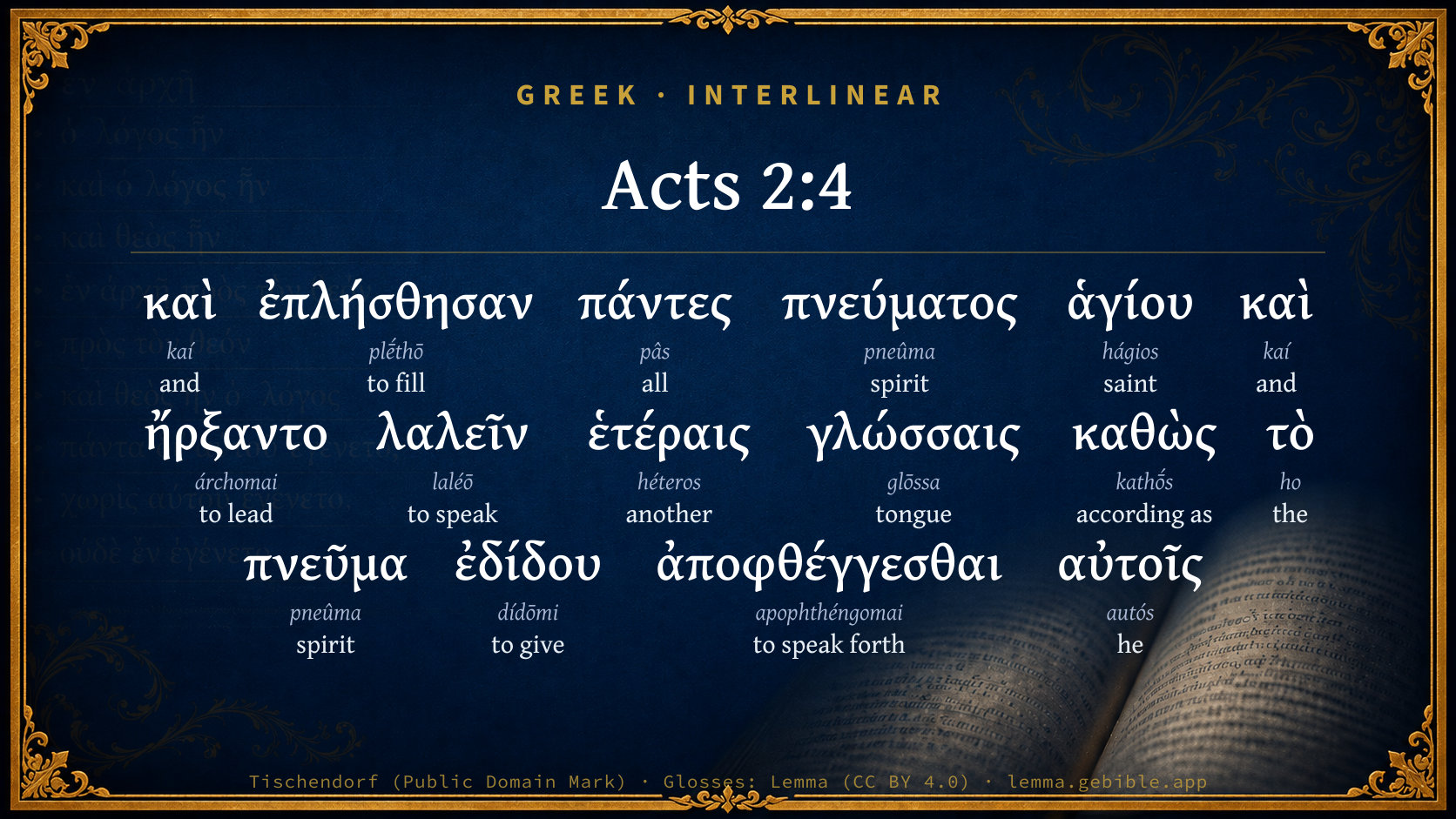
Download image
Cite this verse

Acts 2:4 (World English Bible). Public Domain. Lemma interlinear Bible study tool, https://lemma.gebible.app/v/acts/2/4.

Show BibTeX & RIS
BibTeX
RIS
English Translation
They were all filled with the Holy Spirit, and began to speak with other languages, as the Spirit gave them the ability to speak.
World English Bible · Public Domain
Highlights
  • 1 first appearance in the Greek New Testament
Full analysis ↓
Download a study sheet

One document with this verse’s original text, its word-by-word gloss line, the meaning frame, cross-references with their text, attributed commentary, and full source and license credits — printable, and it pastes into notes with its structure intact.

This verse Autodidact and up

Study sheet (.html) Plain text (.txt)

A passage Seminary Student

Up to 50 verses in one chapter. A passage sheet keeps up to 6 commentary sources and 12 cross-references per verse, in the order this page ranks them, and says so on the sheet whenever that leaves anything out. Ask for a single verse and you get the Autodidact verse sheet above.

Everything on this page stays free to read, with no account — the sheet is a download of what is already on screen, not access to it.

Want to remove ads? Support Godless Engineer
Compare translations 3

The same verse in 3 English versions, stacked beneath the original-language interlinear above. Click any original word for its lexicon entry.

Each is an independent rendering of the whole verse — the interlinear is not word-aligned to these translations.

Highlighted words mark where these versions differ — a whole-verse word diff, not a word-by-word alignment.

  • World English Bible Public Domain
    They were all filled with the Holy Spirit, and began to speak with other languages, as the Spirit gave them the ability to speak.
  • King James Version Public Domain
    And they were all filled with the Holy Ghost, and began to speak with other tongues, as the Spirit gave them utterance.
  • unfoldingWord Literal Text CC BY-SA 4.0
    And they were all filled with the Holy Spirit, and they began to speak in other languages, as the Spirit was giving them to speak out.

unfoldingWord Literal Text — © unfoldingWord, licensed CC BY-SA 4.0. Word-aligned USFM3 via Door43 (git.door43.org/unfoldingWord/en_ult).

Versions to compare (up to 4)

3 of 4 selected

Show all 19 translations

Every available English version of this verse, each an independent rendering of the whole verse.

  • World English Bible Public Domain
    They were all filled with the Holy Spirit, and began to speak with other languages, as the Spirit gave them the ability to speak.
  • Berean Standard Bible Public Domain
    And they were all filled with the Holy Spirit and began to speak in other tongues as the Spirit enabled them.
  • Majority Standard Bible Public Domain
    And they were all filled with the Holy Spirit and began to speak in other tongues as the Spirit enabled them.
  • King James Version Public Domain
    And they were all filled with the Holy Ghost, and began to speak with other tongues, as the Spirit gave them utterance.
  • American Standard Version (1901) Public Domain
    And they were all filled with the Holy Spirit, and began to speak with other tongues, as the Spirit gave them utterance.
  • Revised Version (1885) Public Domain
    And they were all filled with the Holy Spirit, and began to speak with other tongues, as the Spirit gave them utterance.
  • Geneva Bible (1599) Public Domain
    And they were all filled with the holy Ghost, and began to speake with other tongues, as the Spirit gaue them vtterance.
  • Douay-Rheims (1899) Public Domain
    And they were all filled with the Holy Ghost, and they began to speak with divers tongues, according as the Holy Ghost gave them to speak.
  • Young's Literal Translation Public Domain
    and they were all filled with the Holy Spirit, and began to speak with other tongues, according as the Spirit was giving them to declare.
  • Literal Standard Version CC BY-SA 4.0
    and they were all filled with the Holy Spirit, and began to speak with other tongues, according as the Spirit was giving them to declare.
  • Unlocked Literal Bible CC BY-SA 4.0
    They were all filled with the Holy Spirit and began to speak with other languages, as the Spirit gave them to speak.
  • unfoldingWord Literal Text CC BY-SA 4.0
    And they were all filled with the Holy Spirit, and they began to speak in other languages, as the Spirit was giving them to speak out.
  • Darby Bible Public Domain
    And they were all filled with [the] Holy Spirit, and began to speak with other tongues as the Spirit gave to them to speak forth.
  • World Messianic Bible Public Domain
    They were all filled with the Holy Spirit and began to speak with other languages, as the Spirit gave them the ability to speak.
  • Webster's Bible Public Domain
    And they were all filled with the Holy Spirit, and began to speak in other languages, as the Spirit gave them utterance.
  • Free Bible Version CC BY-SA 4.0
    All of them were filled with the Holy Spirit and began to speak in different languages as the Spirit gave them the ability to do so.
  • Bible in Basic English Public Domain
    And they were all full of the Holy Spirit, and were talking in different languages, as the Spirit gave them power.
  • Text-Critical English NT CC BY 4.0
    Then they were all filled with the Holy Spirit and began speaking in other tongues as the Spirit enabled them.
  • Tyndale New Testament (1534) Public Domain
    and they were all filled with the holy goost and beganne to speake with other tonges even as the sprete gave them vtteraunce.

Literal Standard Version (2020), Covenant Press — licensed CC BY-SA 4.0. Text via the HelloAO Bible API (eBible.org). Unlocked Literal Bible (unfoldingWord) — licensed CC BY-SA 4.0. Text via the HelloAO Bible API (eBible.org). unfoldingWord Literal Text — © unfoldingWord, licensed CC BY-SA 4.0. Word-aligned USFM3 via Door43 (git.door43.org/unfoldingWord/en_ult). Free Bible Version, Dr. Jonathan Gallagher — licensed CC BY-SA 4.0. Text via the HelloAO Bible API (eBible.org).

Word by word

More ways to search: Search by grammar → Find every occurrence → Compare this word →

Practice this passage: Drill this verse → Learn its vocabulary →

ἀποφθέγγεσθαι
apophthéngomai
G669
“to speak forth”
Verb, Present, Middle or Passive deponent, Infinitive
Part of Speech
Verb
Tense
Present
Voice
Middle or Passive deponent
Mood
Infinitive
Full Thayer's Definition

Origin: from G575 and G5350

TDNT: 08:27,8

1. to speak out, speak forth, pronounce a. not a word of everyday speech but one "belonging to dignified and elevated discourse"
  1. καὶ kaí G2532 “and” Conjunction
  2. ἐπλήσθησαν plḗthō G4130 “to fill” Verb, Aorist, Passive, Indicative, 3rd person, Plural
  3. πάντες pâs G3956 “all” Adjective, Nominative, Plural, Masculine
  4. πνεύματος pneûma G4151 “spirit” Noun, Genitive, Singular, Neuter
  5. ἁγίου hágios G40 “saint” Adjective, Genitive, Singular, Neuter
  6. καὶ kaí G2532 “and” Conjunction
  7. ἤρξαντο árchomai G756 “to lead” Verb, Aorist, Middle deponent, Indicative, 3rd person, Plural
  8. λαλεῖν laléō G2980 “to speak” Verb, Present, Active, Infinitive
  9. ἑτέραις héteros G2087 “another” Adjective, Dative, Plural, Feminine
  10. γλώσσαις glōssa G1100 “tongue” Noun, Dative, Plural, Feminine
  11. καθὼς kathṓs G2531 “according as” Adverb
  12. τὸ ho G3588 “the” Article, Nominative, Singular, Neuter
  13. πνεῦμα pneûma G4151 “spirit” Noun, Nominative, Singular, Neuter
  14. ἐδίδου dídōmi G1325 “to give” Verb, Imperfect, Active, Indicative, 3rd person, Singular
  15. αὐτοῖς autós G846 “he” Personal pronoun, Dative, Plural, Masculine

About this verse

These counts appear in no published source. They are computed here, from the morphology-tagged text and Lemma’s own curated glosses. What Lemma adds →

16
words
14
distinct lemmas
Acts
section

Notable vocabulary

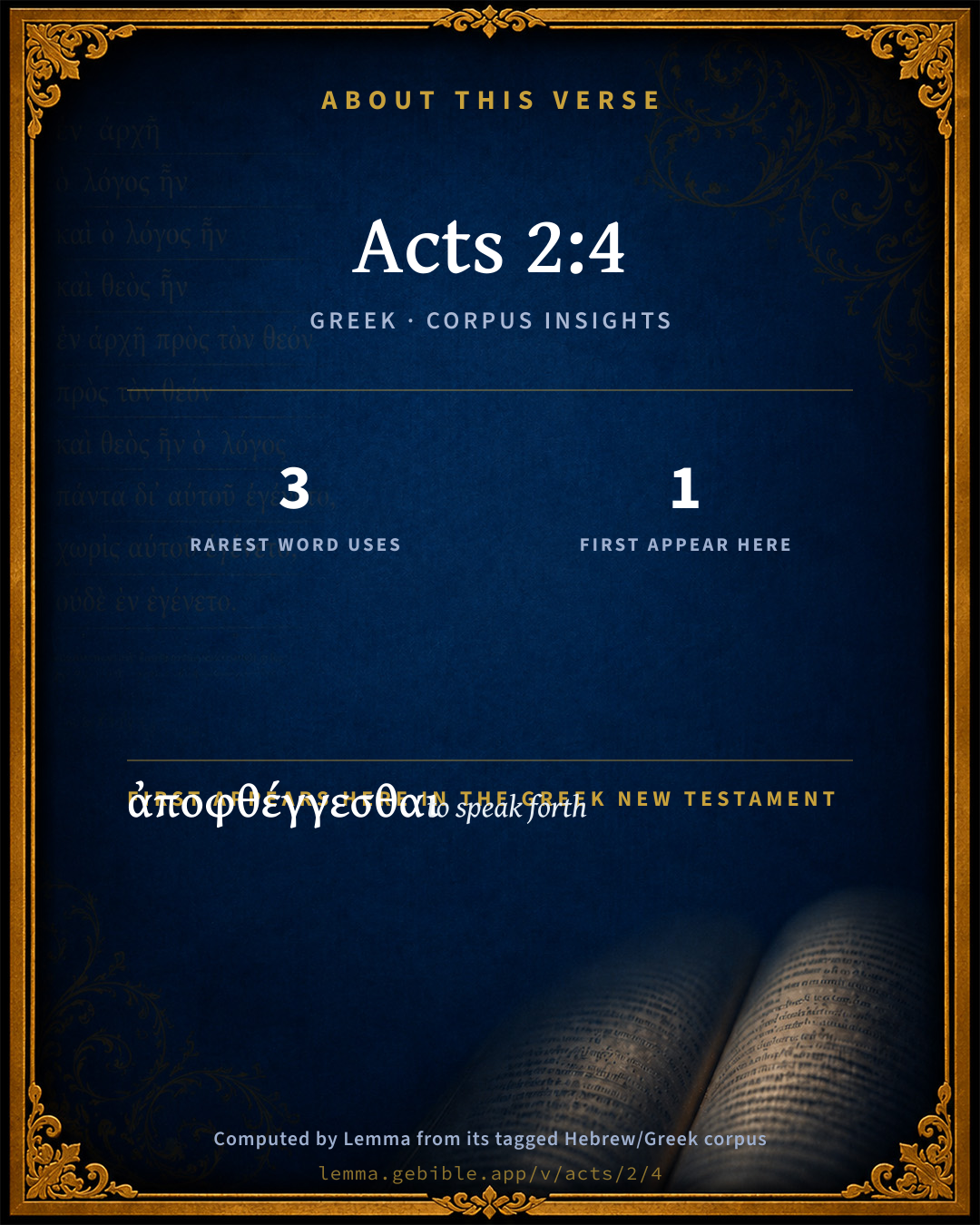
The rarest word here is ἀποφθέγγεσθαι to speak forth G669 — appearing just 3 times in the whole Greek New Testament.

First appearance in Scripture

This word makes its first canonical appearance in the Greek New Testament here:

  • ἀποφθέγγεσθαι to speak forth G669

Shared distinctive vocabulary

ἀποφθέγγεσθαι to speak forth G669 occurs in 3 verses of the Greek New Testament. Also found in:
Repetition

Words recur within this verse:

  • πνεύματος spirit G4151 ×2
  • καὶ and G2532 ×2

Cross-references

49

Topical passages linked to Acts 2:4 in the Treasury of Scripture Knowledge — connected by theme and wording, ordered by reader-vote popularity; previews shown in the World English Bible.

  • Mark 16:17 These signs will accompany those who believe: in my name they will cast out demons; they will speak with new languages;
  • Acts 13:52 The disciples were filled with joy with the Holy Spirit.
  • Acts 4:31 When they had prayed, the place was shaken where they were gathered together. They were all filled with the Holy Spirit, and they spoke the word of God with boldness.
  • Ephesians 5:18 Don't be drunken with wine, in which is dissipation, but be filled with the Spirit,
  • 1 Corinthians 12:10 and to another workings of miracles; and to another prophecy; and to another discerning of spirits; to another different kinds of languages; and to another the interpretation of languages.
  • 1 Corinthians 14:21–23 In the law it is written, "By men of strange languages and by the lips of strangers I will speak to this people. Not even thus will they hear me, says the Lord."
  • John 14:26 But the Counselor, the Holy Spirit, whom the Father will send in my name, he will teach you all things, and will remind you of all that I said to you.
  • Acts 7:55 But he, being full of the Holy Spirit, looked up steadfastly into heaven, and saw the glory of God, and Jesus standing on the right hand of God,
  • Acts 10:46 For they heard them speaking in other languages and magnifying God. Then Peter answered,
  • Acts 9:17 Ananias departed, and entered into the house. Laying his hands on him, he said, "Brother Saul, the Lord, who appeared to you on the road by which you came, has sent me, that you may receive your sight, and be filled with the Holy Spirit."
  • Acts 19:6 When Paul had laid his hands on them, the Holy Spirit came on them, and they spoke with other languages and prophesied.
  • Luke 12:12 for the Holy Spirit will teach you in that same hour what you must say."
  • Acts 1:5 For John indeed baptized in water, but you will be baptized in the Holy Spirit not many days from now."
  • Jeremiah 1:7–9 But Yahweh said to me, Don't say, I am a child; for to whoever I shall send you, you shall go, and whatever I shall command you, you shall speak.
  • Acts 2:11 Cretans and Arabians: we hear them speaking in our languages the mighty works of God!"
  • Acts 13:9 But Saul, who is also called Paul, filled with the Holy Spirit, fastened his eyes on him,
  • Romans 15:13 Now may the God of hope fill you with all joy and peace in believing, that you may abound in hope, in the power of the Holy Spirit.
  • 1 Corinthians 13:1 If I speak with the languages of men and of angels, but don't have love, I have become sounding brass, or a clanging cymbal.
  • 1 Corinthians 13:8 Love never fails. But where there are prophecies, they will be done away with. Where there are various languages, they will cease. Where there is knowledge, it will be done away with.
  • 1 Corinthians 14:26–32 What is it then, brothers? When you come together, each one of you has a psalm, has a teaching, has a revelation, has another language, has an interpretation. Let all things be done to build each other up.
  • Luke 4:1 Jesus, full of the Holy Spirit, returned from the Jordan, and was led by the Spirit into the wilderness
  • John 20:22 When he had said this, he breathed on them, and said to them, "Receive the Holy Spirit!
  • Acts 4:8 Then Peter, filled with the Holy Spirit, said to them, "You rulers of the people, and elders of Israel,
  • 1 Corinthians 14:18 I thank my God, I speak with other languages more than you all.
  • Numbers 11:25–29 Yahweh came down in the cloud, and spoke to him, and took of the Spirit that was on him, and put it on the seventy elders: and it happened that when the Spirit rested on them, they prophesied, but they did so no more.
  • 2 Samuel 23:2 The Spirit of Yahweh spoke by me, His word was on my tongue.
  • Isaiah 28:11 No, but by [men of] strange lips and with another language will he speak to this people;
  • Isaiah 59:21 As for me, this is my covenant with them, says Yahweh: my Spirit who is on you, and my words which I have put in your mouth, shall not depart out of your mouth, nor out of the mouth of your seed, nor out of the mouth of your seed's seed, says Yahweh, from henceforth and forever.
  • Luke 1:15 For he will be great in the sight of the Lord, and he will drink no wine nor strong drink. He will be filled with the Holy Spirit, even from his mother's womb.
  • Acts 1:8 But you will receive power when the Holy Spirit has come upon you. You will be witnesses to me in Jerusalem, in all Judea and Samaria, and to the uttermost parts of the earth."
  • Acts 6:3 Therefore select from among you, brothers, seven men of good report, full of the Holy Spirit and of wisdom, whom we may appoint over this business.
  • Acts 6:5 These words pleased the whole multitude. They chose Stephen, a man full of faith and of the Holy Spirit, Philip, Prochorus, Nicanor, Timon, Parmenas, and Nicolaus, a proselyte of Antioch;
  • Acts 11:15 As I began to speak, the Holy Spirit fell on them, even as on us at the beginning.
  • 1 Corinthians 12:28–30 God has set some in the assembly: first apostles, second prophets, third teachers, then miracle workers, then gifts of healings, helps, governments, and various kinds of languages.
  • 1 Corinthians 14:5 Now I desire to have you all speak with other languages, but rather that you would prophesy. For he is greater who prophesies than he who speaks with other languages, unless he interprets, that the assembly may be built up.
  • 1 Peter 1:12 To them it was revealed, that not to themselves, but to you, did they minister these things, which now have been announced to you through those who preached the Gospel to you by the Holy Spirit sent out from heaven; which things angels desire to look into.
  • Micah 3:8 But as for me, I am full of power by the Spirit of Yahweh, And of judgment, and of might, To declare to Jacob his disobedience, And to Israel his sin.
  • Luke 1:41 It happened, when Elizabeth heard Mary's greeting, that the baby leaped in her womb, and Elizabeth was filled with the Holy Spirit.
  • Luke 1:67 His father, Zacharias, was filled with the Holy Spirit, and prophesied, saying,
  • Luke 21:15 for I will give you a mouth and wisdom which all your adversaries will not be able to withstand or to contradict.
  • Acts 6:8 Stephen, full of faith and power, performed great wonders and signs among the people.
  • Acts 11:24 For he was a good man, and full of the Holy Spirit and of faith, and many people were added to the Lord.
  • Ephesians 3:19 and to know Christ's love which surpasses knowledge, that you may be filled with all the fullness of God.
  • Ephesians 6:18 with all prayer and requests, praying at all times in the Spirit, and being watchful to this end in all perseverance and requests for all the saints:
  • Exodus 4:11–12 Yahweh said to him, "Who made man's mouth? Or who makes one mute, or deaf, or seeing, or blind? Isn't it I, Yahweh?
  • 1 Samuel 10:10 When they came there to the hill, behold, a band of prophets met him; and the Spirit of God came mightily on him, and he prophesied among them.
  • Matthew 10:19 But when they deliver you up, don't be anxious how or what you will say, for it will be given you in that hour what you will say.
  • Ezekiel 3:11 Go, get you to them of the captivity, to the children of your people, and speak to them, and tell them, Thus says the Lord Yahweh; whether they will hear, or whether they will forbear.
  • 2 Peter 1:21 For no prophecy ever came by the will of man: but holy men of God spoke, being moved by the Holy Spirit.

Cross-references courtesy of OpenBible.info (CC BY 4.0).

Commentary

Notes on Acts 2:4 from classic Christian and Jewish commentators (each source and its license shown beneath its notes). The classic Christian expositions comment on the surrounding passage and are grouped to its opening verse, so a note may address several verses; the Jewish commentaries on the Tanakh (Rashi and others) are per-verse, so they appear only where the commentator wrote on this verse.

Lemma curates 59 commentaries, every one of them public domain or Creative Commons licensed, each selected and text-cleaned for this edition rather than reprinted as found. About our sources →

Albert Barnes' Notes on the Bible

Were all filled with the Holy Ghost - Were entirely under his sacred influence and power. See the notes on Luk 1:41, Luk 1:67. To be filled with anything is a phrase denoting that all the faculties are pervaded by it, engaged in it, or under its influence, Act 3:10, “Were filled with wonder and amazement”; Act 5:17, “Filled with indignation”; Act 13:45, “Filled with envy”; Act 2:4, “Filled with joy and the Holy Spirit.”

Began to speak with other tongues - In other languages than their native tongue. The languages which they spoke are specified in Act 2:9-11.

As the Spirit gave them utterance - As the Holy Spirit gave them power to speak. This language implies plainly that they were now endued with a faculty of speaking languages which they had not before learned. Their native tongue was that of Galilee, a somewhat barbarous dialect of the common language used in Judea - the Syro-Chaldaic. It is possible that some of them might have been partially acquainted with the Greek and Latin, as each of those languages was spoken among the Jews to some extent; but there is not the slightest evidence that they were acquainted with the languages of the different nations afterward specified. Various attempts have been made to account for this remarkable phenomenon without supposing it to be a miracle. But the natural and obvious meaning of the passage is, that they were endowed by the supernatural power of the Holy Spirit with ability to speak foreign languages, and languages to them before unknown. It does not appear that each one had the power of speaking all the languages which are specified Act 2:9-11, but that this ability was among them, and that together they could speak these languages, probably some one and some another. The following remarks may perhaps throw some light on this remarkable occurrence:

(1) It was predicted in the Old Testament that what is here stated would occur in the times of the Messiah. Thus, in Isa 28:11, “With ...another tongue will he speak unto this people.” Compare 1Co 14:21 where this passage is expressly applied to the power of speaking foreign languages under the gospel.

(2) It was promised by the Lord Jesus that they should have this power, Mar 16:17, “These signs shall follow them that believe ...they shall speak with new tongues.”

(3) The ability to do it existed extensively and long in the church, 1Co 12:10-11, “To another divers kinds of tongues; to another the interpretation of tongues: all these worketh that one and the self-same Spirit”; Act 2:28, “God hath set in the church ...diversities of tongues.” Compare also Act 2:30, and Act 14:2, Act 14:4-6, Act 14:9,Act 14:13-14; Act 14:18-19, Act 14:22-23, Act 14:27, Act 14:39. From this it appears that the power was well known in the church, and was not confined to the apostles. This also may show that in the case in the Acts , the ability to do this was conferred on other members of the church as well as the apostles.

(4) It was very important that they should be endowed with this power in their great work. They were going forth to preach to all nation; and though the Greek and Roman tongues were extensively spoken, yet their use was not universal, nor is it known that the apostles were skilled in those languages. To preach to all nations, it was indispensable that they should be able to understand their language. And in order that the gospel might be rapidly propagated through the earth, it was necessary that they should be endowed with ability to do this without the slow process of being compelled to learn them. It will contribute to illustrate this to remark that one of the principal hindrances in the spread of the gospel now arises from the inability to speak the languages of the nations of the earth, and that among missionaries of modern times a long time is necessarily spent in acquiring the language of a people before they are prepared to preach to them.

(5) One design was to establish the gospel by means of miracles. Yet no miracle could be more impressive than the power of conveying their sentiments at once in all the languages of the earth. When it is remembered what a slow and toilsome process it is to learn a foreign tongue, this would I be regarded by the pagan as one of the most striking miracles which could be performed, 1Co 14:22, 1Co 14:24-25.

(6) The reality and certainty of this miracle is strongly attested by the early triumphs of the gospel. That the gospel was early spread over all the world, and that, too, by the apostles of Jesus Christ, is the clear testimony of all history. They preached it in Arabia, Greece, Syria, Asia, Persia, Africa, and Rome. Yet how could this have been effected without a miraculous power of speaking the languages used in all those places? Now, it requires the toil of many years to speak in foreign languages; and the recorded success of the gospel is one of the most striking attestations to the fact of the miracle that could be conceived.

(7) The corruption of language was one of the most decided effects of sin, and the source of endless embarrassments and difficulties, Gen. 11: It is not to be regarded as wonderful that one of the effects of the plan of recovering people should be to show the power of God over all evil, and thus to furnish striking evidence that the gospel could meet all the crimes and calamities of people. And we may add,

(8) That from this we see the necessity now of training people who are to be missionaries to other lands. The gift of miracles is withdrawn. The apostles, by that miracle, simply were empowered to speak other languages. That power must still be had if the gospel is to be preached. But it is now to be obtained, not by miracle, but by stow and careful study and toil. If possessed, people must be taught it. And as the church is bound Mat 28:19 to send the gospel to all nations, so it is bound to provide that the teachers who shall be sent forth shall be qualified for their work. Hence, one of the reasons of the importance of training men for the holy ministry.

Albert Barnes' Notes on the Bible (1834–1885) — public domain. Text from a community e-Sword/MySword module.

The Biblical Illustrator

Joseph S. Exell

Act_2:4

And they were all filled with the Holy Ghost.

The historic movement towards spiritually

The succession which is indicated by the words Father, Son, and Holy Ghost, is neither nominal nor accidental, it is a philosophicaI progress and culmination.

1. When we go back towards the origin of things, we are dissatisfied with all mere critical terms, and yearn for something for which we cannot hit the exact word. Then is suggested the Biblical word, Father, and with it comes a promise of satisfaction in spite of all its difficulties.

2. But fatherhood is an inclusive term, suggesting the idea of childhood, and childhood is realised most impressively in the sonship of Christ; but sonship such as this, involving visible expression, is beset with peculiar risks. So He withdrew Himself immediately that He had secured for His personality an unquestioned place in history, as there was nothing more to be gained by His visible continuance on earth.

3. But what of the future of His work? Then, according to Christian teaching, was to come manifestation without visibility; instead of bodily presence, there was to be a new experience of life and spirituality. In one word, the holy Man was to be followed by the Holy Ghost. This idea of a philosophical rather than a merely arbitrary succession is strictly consistent with the fact that the whole movement of history, in all that is vital and permanent, is a movement from the outward and visible to the inward and spiritual.

I. The order of creation. The succession runs thus: Light, firmament, dry land, seas, the fruit-tree yielding fruit, sun, moon, and stars, the moving creature that hath life, and fowl flying in the open firmament of heaven, cattle, creeping thing, and beast of the earth; if we pause here we shall be dissatisfied, because of a sense of incompleteness; but to crown the whole God said, Let us make man in our image and in our likeness.

II. The order of human recovery. Beginning with the Levitical ritual, what could be more objective? The sin-offering, the trespass-offering, the incenses, etc., represent the most sensuous and exhausting system of mediation? Could aught be farther from the point of spirituality? In moving forward to the incarnation, we take an immense step along the line whose final point is spirituality, yet even there we are still distinctly upon the carnal line. The final representative of sensuous worship must Himself be the revealer of spiritual life. Jesus Christ ascended, and henceforth we know not even Him after the flesh, for the fleshly Christ has Himself placed mankind under the tuition of a spiritual monitor.

III. The order of written testimony. From picture and symbol we pass to spiritual meanings; through the noise and fury of war we pass into the quietness and security of moral civilisation; through the porch of miracles and mighty signs and wonders we enter the holy place of truth and love. The quality of Johns Gospel requires the very place that has been assigned to it in the New Testament. John seems to say, You have heard what the Evangelists have had to tell, and have seen the wonderful things of their Masters ministry; now let me explain the deep meaning of the whole. From Malachi to Matthew is but a step; but to get from Malachi to John, you have to cross the universe. Matthew shows the fact; John reveals the truth; Matthew pourtrays on canvas; John puts his word into the heart.

IV. The whole law. From the minuteness of microscopic bye-laws men have passed to a spiritual sense of moral distinctions. Every moment of the Jews time, and every act of his life, was guarded by a regulation. Amidst our spiritual light, such regulations could not be re-established without awakening the keenest resentment. The great tables of bye-laws have been taken down, because the spirit of order and of truth has been given. What is true of law is equally true of all institutionalism.

V. Precisely the same movement takes place in the experience of every progressive life. Every man can test this doctrine for himself--the doctrine, namely, that the growth of manhood is towards spirituality. The child grows towards contempt of its first toys; the youth reviews the narrow satisfactions of his childhood with pity; the middle-aged man smiles, half-sneeringly, as he recalls the conceits of his youth; and the hoary-haired thinker lives already amid the peace and joy of invisible scenes, or if he go back, living in memory rather than in expectation, it is so ideally as to divest his recollections of all that was transient and unlovely. The spiritual world of the wise man increases every day. These suggestions point to the conclusion that the Holy Ghost is the reasonable completion of revelation, and as such His ministry is an impregnable proof of the reasonableness of Christianity. In the person of Jesus Christ truth was outward, visible, and most beautiful; in the person of the Holy Ghost truth is inward, spiritual, all-transfiguring. By the very necessity of the case the bodily Christ could be but a passing figure; but by a gracious mystery He caused Himself to be succeeded by an eternal Presence, even the Spirit of Truth, which abideth for ever. It is claimed, then, on behalf of Christianity, that there is a Holy Ghost, and to this doctrine is invited not only the homage of the heart but the full assent of the most robust and dispassionate understanding. (J. Parker, D. D.)

Filled with the Spirit

I. They were filled with the spirit.

1. Men may be filled but not with the Spirit (verse 13). The audience confessed they were full, but with wine, a liquor though full of spirit, yet no spirit. It was false, yet if the Spirit may be taken for a humour, why not a humour for a spirit. Isaiah says (Isa_29:9) that men may be drunk but not with wine. A hot humour is taken for this fire and termed, though untruly, a spirit of zeal, and men imbued with it are ever mending churches, states, superiors, and all save themselves.

2. Not every spirit. There is a spirit in man, i.e. our own spirit, and many there be who follow their own ghost, and not the Holy Ghost; for even that ghost taketh upon it to inspire, and we know its revelations (Mat_16:17).

3. blot the worlds spirit (1Co_2:12).

4. But the Holy Spirit, i.e. His gifts and graces. And because these be of many points they are all included under these two--

(l) Under the wind is represented saving graces; as necessary to our spiritual life as breath is to our natural. This is meant for us personally. Of this Spirit there are nine points (Gal_5:22).

(2) Under the tongues are set forth the grace meant for the benefit of others. Tongues serve to teach and fire to warm; and of this spirit the points are reckoned up in 1Co_12:7, etc.

II. They were filled with the Spirit.

1. It was not a wind that blew through them, as it does through many of us, but that filled them.

2. Not that they were devoid of the Spirit before. Christ had not breathed upon them (Joh_20:22) in vain. This shows us that there are diverse measures of the Spirit, some single, some double portions (1Ki_2:9). As there are degrees in the wind--a breath, a blast, a gale, so there are in the Spirit. It is one thing to receive the Spirit as at Easter and to be filled with Him as at Whitsuntide. Then but a breath; now a mighty wind; then but sprinkled as with a few drops (Eze_20:46), now baptized with that which was plenteously poured out (Joe_2:20).

III. In sign that they were filled they ran over. The fire was kindled in them by this wind, and in sign thereof they spoke with their tongue (Psa_39:3). The wind would have served them as Christians, but as apostles, i.e. ambassadors, they must have tongues.

1. They were filled and then they began to speak. Some speak, I will not say before they are full, or half full, but while they are little better than empty, if not empty quite.

2. This beginning to speak argues courage. Any man might see that there was a new spirit come into them. Before they were tongue-tied. A damsel did but ask Peter a question, and he faltered. But after this mighty wind blew up the fire, and they were warmed with it, then they were not afraid to testify before magistrates and kings. (Bp. Andrewes.)

Filled with the Spirit

The new era opened at Pentecost was one in which all Gods people were to have God abiding in them always, the Guest, Comforter and Friend of every Christian heart. It must be admitted, however, that this Divine ideal has been very inadequately realised. Let us consider some of the results which may be expected to flow from a fuller baptism of the Spirit.

I. Spiritual mindedness.

1. This does not mean that our thoughts should be perpetually running on the future, that we should ever be debating theological questions, but that we shall have the power to appreciate those great and eternal realities that are about us.

2. This spiritual mindedness will reveal itself--

(1) In the estimate we form of our fellow men.

(2) In our appreciation of the great spiritual end we ought ever to be seeking in order to do Christian work.

(3) In our appreciation of Christian doctrine caring more about the spiritual substance than the particular form or fashion by which the truth may have been expressed. For instance--

(a) In all our thought about the death and atonement of Christ, the imagination will not dwell on the physical blood that was shed, or upon the physical agony that was endured, but upon the majesty of Gods righteousness, the wonder of Gods love, the mystery of that great sacrifice on the Cross, and the awfulness of the sin which made that sacrifice necessary.

(b) When we think about the second coming of Christ, our thoughts will not be taken up with the external circumstances of pomp and splendour, but rather with the triumph of good over evil, and truth over falsehood, which is the consummation to which all devout souls must ever be looking.

(c) In thinking about inspiration we shall not trouble ourselves about theories of it, or about the mere letter, but our care will be mostly for the Divine truth itself, which will lift us up in our despondency, and guide us in our perplexity when we come to the sacred page.

II. An access of power by which the naturally timid will be enabled to do things which would be otherwise impossible to the strongest; in regard to--

1. Testimony for Christ.

2. Endurance of suffering.

3. Philanthropic work.

III. A change of disposition.

1. The cessation of jealousies, strifes, and divisions, which Paul includes amongst the works of the flesh.

2. The prevalence of a spirit of mercy and kindness towards others.

(1) To those who in our midst are compelled to live very hard lives.

(2) For those multitudes all over the world who are without the knowledge of God as revealed in Christ.

IV. An enthusiasm of holy fervour in all work.

1. In worship.

2. In Church life.

3. In evangelism. (H. Arnold Thomas, M. A.)

Filled with the Spirit

I. The fulness. There was no part of the complex nature of man that was not pervaded by the Spirit.

1. The intellect was illumined to know the truths of the Spirit.

2. The affections were purified and inflamed with desires after heavenly things.

3. The will was strengthened to obey the motions of the Spirit.

II. Its manifestation. Those who are so filled give out only the language of the life-giving Spirit. Even when they speak of earthly things it is with a tongue reminding men of the wisdom and simplicity of the children of God. When they do aught in the common business of life, their example recalls the thought of a higher life. All they say or do is to edifying. (Cornelius a Lapide.)

Filled with the Spirit and receiving the Spirit

The difference is not of kind, but of degree. In the one case, the light of heaven has reached the dark chamber, dispelling night, but leaving some obscurity and some deep shadows. In the other, that light has filled the whole chamber, and made every corner bright. This state of the soul--being filled with the Holy Ghost--is the normal antecedent of true prophetic or miraculous power, but may exist without it; without it, in individuals who are never endowed with the gift either of prophecy or of miracles; without it, in individuals who have such powers, but in whom they are not in action, as in John the Baptist, before his ministry commenced. (W. Arthur, M. A.)

Fulness of the Spirit not necessarily miraculous

Eyesight is the necessary basis of what is called a painters or a poets eye; the sense of hearing, the necessary basis of what is called a musical ear, yet eyesight may exist where there is no poets or painters eye, and hearing where there is no musical ear. So may the human soul be filled with the Holy Ghost, having every faculty illuminated, and every affection purified, without any miraculous gift. On the other hand, the miraculous power does not necessarily imply the spiritual fulness: for Paul puts the supposition of speaking with tongues, prophesying, removing mountains, and yet lacking charity, that love which must be shed abroad in every heart that is full of the Holy Ghost. (W. Arthur, M. A.)

The fulness of the Spirit the need of the Church

I. We are apt to fix our thoughts and desires on subordinate instrumentalities.

1. Good organisation. Many are chiefly anxious to perfect the ecclesiastical apparatus of the Church; but without speaking disparagingly of this, yet perfect machinery is useless without motive power, a Church may be organised to death, and may be only like a stately tomb. The Churchs finest triumphs were gained in days when it had no elaborate organisation.

2. Orthodoxy. Many are distressed by the present unsettlement of theological opinion, and regard uniformity of belief as the great desideratum. Correct thinking is much to be desired, and in proportion as any Church departs from fundamental Christian truth it emasculates its moral force. But an orthodox Church may be a scene of mental and spiritual stagnation. It may have a perfect creed and yet be loveless, lifeless, helpless.

3. Intellectual equipment. Of scholarship and disciplined thought it is impossible for a Church to have too much, but a Church that prides itself on its culture may be as cold as an iceberg and exclusive as a coterie. It may virtually say to any candidate who cannot be classed among its thoughtful, or who does not rise to a certain standard of wealth and social status, what a deacon is reported to have said to an unwelcome applicant, There is no vacancy in our church just now.

4. Liberty, fearless independence of thought and expression. But liberty may degenerate into license quite as easily as zeal for truth may pass into bigotry, and in its sacred name deadly errors and worthless speculations and conceits may be passed off as current coin of the realm of truth.

II. What we want supremely is the fulness of the Spirit.

1. Organisation, etc., are good things, but there is something more essential. Might not the Master say to-day as He did of old, Ye are careful about many things, but one thing is needful. With the fulness of the Spirit our organisation will be filled with power, our orthodoxy pulsate with love, our culture have in it no Phariseeism, and our liberty always serve the interests of truth and godliness.

2. Filled with the Spirit.

(1) The Church will be guided into all truth, for a fuller tide of the Spirit means finer spiritual discernment and discrimination, and deeper insight into eternal verities.

(2) The Church will be glorious in holiness, for wherever the Spirit of God dwells He is as the refiners fire.

(3) The peace and harmony of the Church will be insured, for brotherly love will reign supreme, and fidelity to truth will carry no bitterness with it.

(4) The Church will be preserved from selfishness, and made missionary and philanthropic.

(5) The Church will not descend to carnal and unworthy methods of spreading the kingdom of God. It will cease to bow at the shrine of mammon, disdain the expedients of worldly wisdom, and not measure its success by statistical tables or worldly standards.

(6) The Church will have an attractive power. We look too much to the mere accessories of religion--to music and ritual, intellectual brilliance and sensational services, forgetful of the fact that the magnetic spell of the Church is the beauty, intensity, and fulness of its spiritual life. When the fruits of the Spirit abound men will be drawn as bees to the apple blossom, or steel filings to the magnet.

(7) The Church will exert a mighty power to perform greater miracles than those of Christ, and in their presence the voice of the caviller will be silenced. Preaching will be in the demonstration of the Spirit and power, and we shall rejoice in constant accessions.

III. How shall we obtain this fulness of the spirit? There have been seasons when the Spirit has swept in mighty tides, and we are tempted to think that the supply of the Spirit is according to some capricious or arbitrary arrangement. But the supernatural has its laws as well as the natural.

1. Everything that grieves the Spirit must be put away, all malice and all guile and hypocrisies, etc., and all unbelief, worldly-mindedness, pride, selfishness; everything opposed to the simplicity, the charity and purity of Christ, or there will be fatal hindrances.

2. Earnest, importunate prayer--prayer that is not a mere repetition of conventional phrases, that has in it the utmost intensity of desire, that links together the whole communion of the faithful, and knows no cessation till the answer comes. The experience of the disciples before Pentecost, and in Act_4:31, is a lesson for all ages.

3. There must be avenues for the Spirits entrance, a large measure of receptivity, sensitiveness to His influence, fidelity to the truth. He requires cheerful response as He calls to duty or sacrifice, and an implicit obedience to His commands. Luther once said that people cried, Spirit, Spirit, Spirit! and then struck down all the bridges by which the Spirit might enter. At the moment of his ordination Whitefield says, I offered up my whole spirit, soul and body, to the service of Gods sanctuary, and the result we know. If the sacrifice be upon the altar, the fire from heaven will come down. (T. G. Tarn.)

The soul filled with the Holy Ghost

A piece of iron is dark and cold; imbued with a certain degree of heat, it becomes almost burning without any change of appearance; imbued with a still greater degree, its very appearance changes to that of solid fire, and it sets fire to whatever it touches. A piece of water without heat is solid and brittle; gently warmed, it flows; further heated, it mounts to the sky. An organ filled with the ordinary degree of air which exists everywhere is dumb; the touch of the player can elicit but a clicking of the keys. Throw in not other air, but an unsteady current of the same air, and sweet, but imperfect and uncertain, notes immediately respond to the players touch: increase the current to a full supply, and every pipe swells with music. Such is the soul without the Holy Ghost, and such are the changes which pass upon it when it receives the Holy Ghost, and when it is filled with the Holy Ghost. In the latter state only is it fully imbued with the Divine nature, bearing in all its manifestations some plain resemblance to its God, conveying to all on whom it acts some impression of Him, mounting heavenward in all its movements, and harmoniously pouring forth, from all its faculties, the praises of the Lord. (W. Arthur, M. A.)

Power of a man when God works by him

Look at the artists chisel; the artist cannot carve without it. Yet imagine the chisel, conscious that it was made to carve, and that it is its function, trying to carve alone. It lays itself against the hard marble, but it has neither strength nor skill. Then we can imagine the chisel full of disappointment. Why cannot I carve? it cries. Then the artist comes and seizes it. The chisel lays itself into his hand, and is obedient to him. Thought, feeling, imagination, skill, flow down from the deep chambers of the artists soul to the chisels edge. The sculptor and the chisel are not two, but one; it is the unit which they make that carves the stone. We are but the chisel to carve Gods statues in this world. Unquestionably we must do the work. But the human worker is only the chisel of the great Artist. The artist needs his chisel; but the chisel can do nothing, produce no beauty of itself. The artist must seize it, and the chisel lay itself into his hand and be obedient to him. We must yield ourselves altogether to Christ, and let Him use us. Then His power, His wisdom, His skill, His thought, His love, shall flow through our soul, our brain, our heart, our fingers. (Bp. Phillips Brooks.)

And began to speak with other tongues.--

The new tongue which ought to fall to our lot by the Spirit of Pentecost

I. Wherein it consists.

1. Not in a miraculous gift of languages.

2. Nor in a formal repetition of pious expressions.

3. But in a heart and mouth opened to thankful praise of Divine grace and joyful confession of the Lord.

II. Whence it proceeds.

1. Not from our natural state.

2. Nor from the arts and sciences.

3. But from above, from the Spirit of God, who touches heart and lips with fire from heaven.

III. What purpose it serves. Not to vain self-glorification or worldly delectation, but to the praise of God and to the message of salvation to the world. (Gerok.)

As the Spirit gave them utterance.--

Characteristics of Spirit-inspired speech

They spoke--

I. Wisely, as the Spirit of wisdom moved them.

II. Powerfully, as the Spirit of power strengthened them.

III. Purely, as the Spirit of holiness sanctified them. (Cornelius a Lapide.)

The gospel for all nations

The apostles speaking on the day of Pentecost to the people in their respective languages, was to us a plain intimation of the mind and will of God, that the sacred records should be preserved by all nations in their own tongue; that the Scriptures should be read, and public worship be performed, in the vulgar language of the nations. (M. Henry.)

The Biblical Illustrator, edited by Joseph S. Exell (c. 1880s–1900s) — public domain. Text from a community e-Sword module.

Joseph Benson's Commentary

Act 2:4. They were all filled with the Holy Ghost — That is, all the one hundred and twenty, as appears from Act 2:1. At the time of this wonderful appearance, this whole company were abundantly replenished with both the gifts and graces of the Holy Spirit, not only in order to their own salvation, but also and especially to qualify them to be Christ’s witnesses to mankind, both Jews and Gentiles, according to his promise, Act 1:1; Act 1:8. They were filled with the graces of the Spirit, and were more than ever under its sanctifying influences; were now holy, and heavenly, and spiritual; more weaned from this world, and better acquainted with the other. They were more filled with the comforts of the Spirit, rejoiced more than ever in the love of Christ, and the hope of heaven, and in it all their griefs and fears were swallowed up. They were also, 2d, In proof of this, filled with the gifts of the Holy Ghost, which is especially meant here: they were endued with miraculous powers for the furtherance of the gospel. It seems evident that not the twelve apostles only, but all the one hundred and twenty disciples were endowed with the extraordinary gifts of the Holy Ghost at this time; all the seventy disciples, who were apostolical men, and employed in the same work, and all the rest that were to preach the gospel; for it is said expressly, (Eph 4:8; Eph 4:11,) that when Christ ascended on high, (which refers to this here, Act 2:33,) he gave gifts unto men, not only some apostles, such were the twelve; but some prophets, and some evangelists, many of the seventy disciples, itinerant preachers; and some pastors and teachers, settled in particular churches, as we may suppose some of these afterward were. And began to speak with other tongues — To speak languages of which they had before been entirely ignorant. For this miracle was not in the ears of the hearers, as some have unaccountably supposed, but in the mouths of the speakers. The meaning is not, that one was enabled to speak one language, and another another, as it was with the several families that were dispersed from Babel; but every one was enabled to speak divers languages as he should have occasion to use them. And we may suppose that they not only understood what they themselves said, but understood one another too, which the builders at Babel did not, Gen 11:7. They did not speak now and then a word of another tongue, or stammer out some broken sentences, but spoke each language which they spoke as readily, properly, and elegantly, as if it had been their mother tongue: for whatever was produced by miracle was the best of the kind. They spake not from any previous thought, but as the Spirit gave them utterance — He furnished them with the matter, as well as the language. And this family, praising God together with the tongues of all the world, was an earnest that the whole world should, in due time, praise God in their various tongues. Now observe here, reader, 1st, This was a very great and stupendous miracle, a miracle upon men’s minds: for in the mind ideas are conceived, and words are framed: a miracle, with regard to every individual, and every language, thus communicated to that individual, equal to that of giving speech to persons born deaf and dumb, concerning which, see the note on Mat 15:30. These disciples had not only never learned any of these languages, but had never learned any foreign tongue, which if they had done, the acquisition of these might have been thereby facilitated. Nay, for aught that appears to the contrary, most of them had never so much as heard any of these languages spoken, or had any idea of them. 2d, It was a peculiarly proper, needful, and useful miracle. The language these disciples spoke was Syriac, or rather Chaldaio-Syriac, a dialect of the Hebrew; so that their being endued with this gift was necessary, even for their understanding both the Hebrew, in which the Old Testament was originally written, and the Greek, in which the New Testament was to be written. But that was not all: they were commissioned to preach the gospel to every creature, to disciple all nations. But here an insuperable difficulty meets them at the very threshold: how shall they be made acquainted with the several languages of the nations to which they are sent, so as to speak intelligibly to them all. It would be the work of the life of any of them to learn their languages. Hence, to prove that Christ would give authority to preach to the nations, he gives ability to his servants to preach to them in their own languages. And it should seem that this was, at least in part, the accomplishment of the promise which Christ made to his disciples, Joh 14:12. Greater works than these shall ye do, because I go unto the Father; for this gift of tongues may well be reckoned, all things considered, a greater work than any of the miraculous cures which Christ wrought. It is observed by Dr. Lightfoot, that as the division of tongues at Babel once introduced confusion, and was the means of casting off the Gentiles from the knowledge of the true God; so now, there was a remedy provided by the gift of tongues at Zion, to bring the Gentiles out of darkness into light, and to destroy the veil which had been spread over all nations. And Archbishop Tillotson thought it probable, if the conversion of infidels to Christianity were sincerely and vigorously attempted by men of honest and disinterested minds, God would, in an extraordinary way, countenance such attempts by giving all proper assistance, as he did to the first preachers of the gospel.

Joseph Benson's Commentary on the Old and New Testaments (1811–1818) — public domain. Text from a community e-Sword module.

Scofield Reference Notes

C. I. Scofield

Holy Ghost

The Holy Spirit, N.T. Summary (see Mal 2:15, note): (See Scofield "Mal 2:15").

(1) The Holy Spirit is revealed as a divine Person. This is expressly declared (e.g.) Joh 14:16; Joh 14:17; Joh 14:26; Joh 15:26; Joh 16:7-15; Mat 28:19 and everywhere implied.

(2) The revelation concerning Him is progressive

(a) In the O.T. (See Scofield "Mal 2:15"). He comes upon whom He will, apparently without reference to conditions in them

(b) During His earth-life, Christ taught His disciples Luk 11:13 that they might receive the Spirit through prayer to the Father.

(c) At the close of His ministry He promised that He would Himself pray the Father, and that in answer to prayer the Comforter would come to abide Joh 14:16; Joh 14:17.

(d) On the evening of His resurrection He came to the disciples in the upper room, and breathed on them saying, "Receive ye the Holy Ghost" Joh 20:22 but instructed them to wait before beginning their ministry till the Spirit should come upon them; Luk 24:49; Act 1:8.

(e) On the day of Pentecost the Spirit came upon the whole body of believers Act 2:1-4

(f) After Pentecost, so long as the Gospel was preached to Jews only, the Spirit was imparted to such as believed by the laying on of hands Act 8:17; Act 9:17.

(g) When Peter opened the door of the kingdom to the Gentiles (Acts 10.), the Holy Spirit, without delay, or other condition than faith, was given to those who believed. Act 10:44; Act 11:15-18. This is the permanent fact for the entire church age. Every believer is born of the Spirit; Joh 3:3; Joh 3:6; 1Jn 5:1 indwelt by the Spirit, whose presence makes the believer’s body a temple; 1Co 6:19; Rom 8:9-15; 1Jn 2:27; Gal 4:6 and baptized by the Spirit; 1Co 12:12; 1Co 12:13; 1Jn 2:20; 1Jn 2:27 thus sealing him for God; Eph 1:13; Eph 4:30.

(3) The N.T. distinguishes between having the Spirit, which is true of all believers, and being filled with the Spirit, which is the believer’s privilege and duty (cf) Act 2:4 with; Act 4:29-31; Eph 1:13; Eph 1:14 with Eph 5:18. --"One baptism, many fillings."

(4) The Holy Spirit is related to Christ in His Conception Mat 1:18-20; Luk 1:35 baptism; Mat 3:16; Mar 1:10; Luk 3:22; Joh 1:32; Joh 1:33 walk and service Luk 4:1; Luk 4:14 resurrection Rom 8:11, and as His witness throughout this age; Joh 15:26; Joh 16:8-11; Joh 16:13; Joh 16:14.

(5) The Spirit forms the church Mat 16:18 (See Scofield "Heb 12:23") by baptizing all believers into the body of Christ 1Co 12:12; 1Co 12:13 imparts gifts for service to every member of that body 1Co 12:7-11; 1Co 12:27; 1Co 12:30 guide the members in their service; Luk 2:27; Luk 4:1; Act 16:6; Act 16:7 and is Himself the power of that service; Act 1:8; Act 2:4; 1Co 2:4.

(6) The Spirit abides in the company of believers who constitute a local church, making of them, corporately, a temple 1Co 3:16; 1Co 3:17.

(7) Christ indicates a threefold personal relationship of the Spirit to the believer: "With", "In", "upon" Joh 14:17; Luk 24:49; Act 1:8. "With" indicates the approach of God to the soul, convicting of sin Joh 16:9 presenting Christ as the object of faith Joh 16:14 imparting faith Eph 2:8 and regenerating Joh 3:3-16. "In" describes the abiding presence of the Spirit in the believer’s body 1Co 6:19 to give victory over the flesh; Rom 8:2-4; Gal 5:16; Gal 5:17 to create the Christian character Gal 5:22; Gal 5:23 to help infirmities Rom 8:26 to inspire prayer Eph 6:18 to give conscious access to God Eph 2:18 to actualize to the believer his sonship Gal 4:6 to apply the Scripture in cleansing and sanctification; Eph 5:26; 2Th 2:13; 1Pe 1:2 to comfort and intercede; Act 9:31; Rom 8:26 and to reveal Christ Joh 16:14.

(8) Sins against the Spirit committed by unbelievers are: To blaspheme Mat 12:31, resist Act 7:51, insult Heb 10:29, "despite," lit. insult). Believers’ sins against the Spirit are: To grieve Him by allowing evil in heart or life Eph 4:30; Eph 4:31 and to quench Him by disobedience 1Th 5:19.

The right attitude toward the Spirit is yieldedness to His sway in walk and service, and in constant willingness that He shall "put away" whatever grieves Him or hinders His power Eph 4:31.

(9) The symbols of the Spirit are: (a) oil Joh 3:34; Heb 1:9 (b) water, Joh 7:38; Joh 7:39 (c) wind; Act 2:2; Joh 3:8, (d) fire Act 2:3, (e) a dove Mat 3:16, (f) a seal; Eph 1:13; Eph 4:30, (g) an earnest or pledge Eph 1:14.

The Scofield Reference Bible (1917 edition), notes by C. I. Scofield — public domain. Text from a community e-Sword module.

Tyndale Open Study Notes

Tyndale Open Resources

2:4 everyone present was filled with the Holy Spirit: This event marks the coming of the Holy Spirit to fill Jesus’ disciples, as he had promised, so that they could be powerful witnesses (1:4-5, 8). The Spirit’s wisdom, energy, and power were the driving force behind the church’s work and witness (e.g., 2:14-41, 43; 4:31; 9:17, 20; 13:9-12; see also Eph 5:18). • began speaking in other languages: The Holy Spirit gave extraordinary communication that made it possible for people from other countries to hear in their own languages about what God had done (Acts 2:6-11). This passage is one of several references to speaking in “other languages” or “tongues” (see also 10:44-48; 19:6; 1 Cor 14:2-28, 39). Here, this supernatural gift reveals the energizing presence of God’s Spirit and inaugurates the proclamation of the Good News to people of every nation.

Tyndale Open Study Notes — © Tyndale Open Resources, licensed CC BY-SA 4.0. Text via the HelloAO Bible API.

Bengel's Gnomon

Johann Albrecht Bengel

Act 2:4. Καὶ, and) The internal operations are here described, along with their effect, as in Act 2:3 the external symbol is described.—ἅπαντες, they all) all those of whom Act 2:1; Act 2:14-15, ch. Act 1:14, etc. treat, of various age, sex, and condition; see below, Act 2:17-18.—ἤρξαντο, they began) This was a thing which never before had occurred.—λαλεῖν, to speak) without difficulty, with readiness.—γλώσσαις, with tongues) The miraculous variety was not in the ears of the hearers, but in the mouth of the speakers: ch. Act 10:46, Act 19:6; Mar 16:17; 1Co 12:10. This family, which was thus celebrating the praises of God in the tongues of the whole world, was an equivalent representative of the whole world, which is about to praise God with the tongues of its inhabitants.—καθὼς, even as) 1Co 12:11, “All these worketh that one and the self-same Spirit, dividing to every man severally as He will.”—ἐδίδου) was giving, gave, so as that they might speak without difficulty, and yet freely.[8]—ἀποφθέγγεσθαι) the power to speak forth, with soberness, and at the same time power; Act 2:14, “Peter lifted up his voice;” ch. Act 26:25, Paul, “I am not mad, but speak forth the words of truth and soberness.” Justus Jonas observes, “Moses, who is the typical representative of the law, had a ‘tongue slow of speech’ (Exo 4:10):—but the Gospel speaks with a tongue set on fire and flaming with ardour”.

[8] i.e. Though they were dependent on the Spirit, they were not divested of their individual freedom.—E. and T.

Bengel's Gnomon of the New Testament — English translation (T&T Clark, Edinburgh, 1860) — public domain. Text from a community e-Sword module.

Meyer's Critical & Exegetical Commentary

Heinrich August Wilhelm Meyer

Act_2:4. After this external phenomenon, there now ensued the internal filling of all who were assembled,[114] without exception (ἘΠΛ. ἍΠΑΝΤΕς, comp. Act_2:1), with the Holy Spirit, of which the immediate result was, that they, and, indeed, these same ἅπαντες (comp. Act_4:31)accordingly not excluding the apostles (in opposition to van Hengel)

ἬΡΞΑΝΤΟ ΛΑΛΕῖΝ ἙΤΈΡΑΙς ΓΛΏΣΣΑΙς. Earlier cases of being filled with the Spirit (Luk_1:41; Luk_1:47; Joh_20:22; comp. also Luk_9:55) are related to the present as the momentary, partial, and typical, to the permanent, complete, and antitypical, such as could only occur after the glorifying of Jesus (see Act_2:33; Joh_16:7; Joh_7:39).

ἤρξαντο] brings into prominence the primus impetus of the act as its most remarkable element.

λαλεῖν ἑτέραις γλώσσαις] For the sure determination of what Luke meant by this, it is decisive that ἙΤΈΡΑΙς ΓΛΏΣΣΑΙς on the part of the speakers was, in point of fact, the same thing which the congregated Parthians, Medes, Elamites, etc., designated as ΤΑῖς ἩΜΕΤΈΡΑΙς ΓΛΏΣΣΑΙς (comp. Act_2:8 : Τῇ ἸΔΊᾼ ΔΙΑΛΈΚΤῼ ἩΜῶΝ). The ἝΤΕΡΑΙ ΓΛῶΣΣΑΙ therefore are, according to the text, to be considered as absolutely nothing else than languages, which were different from the native language of the speakers. They, the Galileans, spoke, one Parthian, another Median, etc., consequently languages of another sort (Luk_9:29; Mar_16:13; Gal_1:6), i.e. foreign (1Co_14:21); and these indeedthe point wherein precisely appeared the miraculous operation of the Spiritnot acquired by study (γλώσσαις καιναῖς, Mar_16:17). Accordingly the text itself determines the meaning of ΓΛῶΣΣΑΙ as languages, not: tongues (as van Hengel again assumes on the basis of Act_2:3, where, however, the tongues have only the symbolic destination of a divine σημεῖον[115]); and thereby excludes the various other explanations, and in particular those which start from the meaning verba obsoleta et poetica (Galen, exeg. glossar. Hippocr. Prooem.; Aristot. Ars poet. 21. 4 ff., 22. 3 f.; Quinctil. 1. 8; Pollux. 2. 4; Plut. Pyth. Orac. 24; and see Giese, Aeol. Dial. p. 42 ff.). This remark holds good (1) of the interpretation of Herder (von d. Gabe der Sprachen am ersten christl. Pfingstf., Riga, 1794), that new modes of interpreting the ancient prophets were meant; (2) against Heinrichs, who (after A. G. Meyer, de charismate τῶν γλωσσῶν, etc., Hannov. 1797) founds on that assumed meaning of γλῶσσαι his explanation of enthusiastic speaking in languages which were foreign indeed, different from the sacred language, but were the native languages of the speakers; (3) against Bleek in the Stud. u. Krit. 1829, p. 33 ff., 1830, p. 45 ff. The latter explains γλῶσσαι as glosses, i.e. unusual, antiquated poetical and provincial expressions. According to him, we are not to think of a connected speaking in foreign languages, but of a speaking in expressions which were foreign to the language of common life, and in which there was an approximation to a highly poetical phraseology, yet so that these glosses were borrowed from different dialects and languages (therefore ἑτέραις). Against this explanation of the γλῶσσαι, which is supported by Bleek with much erudition, the usus loquendi is already decisive. For γλῶσσα in that sense is a grammatico-technical expression, or at least an expression borrowed from grammarians, which is only as such philologically beyond dispute (see all the passages in Bleek, p. 33 ff., and already in A. G. Meyer, l.c.; Fritzsche, ad Marc. p. 741). But this meaning is entirely unknown to ordinary linguistic usage, and particularly to that of the O. and N. T. How should Luke have hit upon the use of such a singular expression for a thing, which he could easily designate by words universally intelligible? How could he put this expression even into the mouths of the Parthians, Medes, Elamites, etc.? For ἡμετέραις γλώσσαις, Act_2:11, must be explained in a manner entirely corresponding to this. Further, there would result for ἡμετέραις a wholly absurd meaning. ἡμέτεραι γλώσσαι, forsooth, would be nothing else than glosses, obsolete expressions, which are peculiar only to the Parthians, or to the Medes, or to the Elamites, etc., just as the Ἀττικαὶ γλῶσσαι of Theodorus (in Athen. xiv. p. 646 c, p. 1437, ed. Dindorf) are provincialisms of Attica, which were not current among the rest of the Greeks. Finally, it is further decisive against Bleek that, according to his explanation of γλῶσσα transferred also to 1Co_12:14, no sense is left for the singular term γλώσσῃ λαλεῖν; for γλῶσσα could not denote genus locutionis glossematicum (λέξις γλωσσηματική, Dionys. Hal. de Thuc. 24), but simply a single gloss. As Bleeks explanation falls to the ground, so must every other which takes γλῶσσαι in any other sense than languages, which it must mean according to Act_2:6; Act_2:8; Act_2:11. This remark holds particularly (4) against the understanding of the matter by van Hengel, according to whom the assembled followers of Jesus spoke with other tongues than those with which they formerly spoke, namely, in the excitement of a fiery inspiration, but still all of them in Aramaic, so that each of those who came together heard the language of his own ancestral worship from the mouth of these Galileans, Act_2:6.

[114] Chrysostom well remarks: οὐκ ἂν εἶπε πάντες, καὶ ἀποστόλων ὄντων ἐκεῖ, εἰ μὴ καὶ οἱ ἄλλοι μετέσχον. See also van Hengel, p. 54 ff.

[115] Van Hengel understands, according to ver. 3, by ἕτεραι γλ., tongues of fire, which the believers in Jesus have obtained through their communion with the Holy Spirit. That is, an open-hearted and loud speaking to the glorifying of God in Christ, such as had not been done before. Previously their tongues had been without fire.

From what has been already said, and at the same time from the express contrast in which the list of nations (Act_2:9-11) stands with the question οὐκ ἰδοὺ πάντες … Γαλιλαῖοι (Act_2:7), it results beyond all doubt that Luke intended to narrate nothing else than this: the persons possessed by the Spirit began to speak in languages which were foreign to their nationality instead of their mother-tongue, namely, in the languages of other nations,[116] the knowledge and use of which were previously wanting to them, and were only now communicated in and with the πνεῦμα ἅγιον. Comp. Storr, Opusc. II. p. 290 ff., III. p. 277 ff.; Milville, Obss. theol. exeg. de dono linguar. Basil. 1816. See also Schaff, Gesch. d. apost. K. p. 201 ff., ed. 2; Ch. F. Fritzsche, Nova opusc. p. 304 f. The author of Mar_16:17 has correctly understood the expression of Luke, when, in reference to our narrative, he wrote καιναῖς instead of ἙΤΈΡΑΙς. The explanation of foreign languages has been since the days of Origen that of most of the Church Fathers and expositors; but the monstrous extension of this view formerly prevalent, to the effect that the inspired received the gift of speaking all the languages of the earth (Augustin.: coeperunt loqui linguis omnium gentium), and that for the purpose of enabling them to proclaim the gospel to all nations, is unwarranted. Poena linguarum dispersit homines: donum linguarum dispersos in unum populum collegit, Grotius. Of this the text knows nothing; it leaves it, on the contrary, entirely undetermined whether, over and above the languages specially mentioned in Act_2:9-11, any others were spoken. For the preaching of the gospel in the apostolic age this alleged gift of languages was partly unnecessary, as the preachers needed only to be able to speak Hebrew and Greek (comp. Schneckenb. neutest. Zeitgesch. p. 17 ff.), and partly too general, as among the assembled there were certainly very many who did not enter upon the vocation of teacher. And, on the other hand, such a gift would also have been premature, since Paul, the apostle of the Gentiles, would, above all, have needed it; and yet in his case there is no trace of its subsequent reception, just as there is no evidence of his having preached in any other language than Hebrew and Greek.

[116] Comp., besides 1Co_14:21, Ecclus. praef.: ὅταν μεταχθῆ (the Hebrew) εἰς ἑτέραν γλῶσσαν (Leo, Tact. 4. 49: γλώσσαις διαφόροις λαλεῖν); also Aesch. Sept. 171: πόλιν δορίπονον μὴ προδῶθʼ ἑτεροφώνῳ στρατῷ. Not different is Pind. Pyth. xi. 43: ἀλλοτρίαισι γλώσσαις.

But how is the occurrence to be judged of historically? On this the following points are to be observed:(1) Since the sudden communication of a facility of speaking foreign languages is neither logically possible nor psychologically and morally conceivable, and since in the case of the apostles not the slightest indication of it is perceptible in their letters or otherwise (comp., on the contrary, Act_14:11); since further, if it is to be assumed as having been only momentary, the impossibility is even increased, and since Peter himself in his address makes not even the slightest allusion to the foreign languages,the event, as Luke narrates it, cannot be presented in the actual form of its historical occurrence, whether we regard that Pentecostal assembly (without any indication to that effect in the text) as a representation of the entire future Christian body (Baumgarten) or not. (2) The analogy of magnetism (adduced especially by Olshausen, and by Baeumlein in the Würtemb. Stud. VI. 2, p. 118) is entirely foreign to the point, especially as those possessed by the Spirit were already speaking in foreign languages, when the Parthians, Medes, etc., came up, so that anything corresponding to the magnetic rapport is not conceivable. (3) If the event is alleged to have taken place, as it is narrated, with a view to the representation of an idea,[117] and that, indeed, only at the time and without leaving behind a permanent facility of speaking languages (Rossteuscher, Gabe der Sprachen, Marb. 1850, p. 97: in order to represent and to attest, in germ and symbol, the future gathering of the elect out of all nations, the consecration of their languages in the church, and again the holiness of the church in the use of these profane idioms, as also of what is natural generally), such a view is nothing else than a gratuitously-imported subjective abstraction of fancy, which leaves the point of the impossibility and the non-historical character of the occurrence entirely unsettled, although it arbitrarily falls back upon the Babylonian confusion of tongues as its corresponding historical type. This remark also applies against Lange, Apost. Zeitalt. II. p. 22 ff., according to whose fanciful notion the original language of the inner life by which mens minds are united has here reached its fairest manifestation. This Pentecostal language, he holds, still pervades the church as the language of the inmost life in God, as the language of the Bible, glorified by the gospel, and as the leaven of all languages, which effects their regeneration into the language of the Spirit. (4) Nevertheless, the state of the fact can in nowise be reduced to a speaking of the persons assembled in their mothertongues, so that the speakers would have been no native Galileans (Paulus, Eichhorn, Schulthess, de charismatib. sp. s., Lips. 1818, Kuinoel, Heinrichs, Fritzsche, Schrader, and others); along with which David Schulz (d. Geistesgaben d. ersten Christen, Breslau, 1836) explains ἑτέραις γλώσσαις even of other kinds of singing praise, which found utterance in the provincial dialects contrary to their custom and ability at other times. Thus the very essence of the narrative, the miraculous nature of the phenomenon, is swept away, and there is not even left matter of surprise fitted to give sufficient occasion for the astonishment and its expressions, if we do not, with Thiess, resort even to the hypothesis that the speakers had only used the Aramaic dialects instead of the Galilean. Every resolution of the matter into a speaking of native languages is directly against the nature and the words of the narrative, and therefore unwarranted. (5) Equally unwarranted, moreover, is the conversion, utterly in the face of the narrative, of the miracle of tongues into a miracle of hearing, so that those assembled did not, indeed, speak in any foreign tongue, but the foreigners listening believed that they heard their own native languages. See against this view, Castalio in loc., and Beza on x. 46. This opinion (which Billroth on 1 Cor. strangely outbids by his fancy of a primeval language which had been spoken) is already represented by Gregory of Nazianzus, Orat. 41, as allowable by the punctuation of Act_2:6; is found thereafter in the Pseudo-Cyprian (Arnold), in the appendix to the Opp. Cypr. p. 60, ed. Brem. (p. 475, ed. Basil. 1530), in Beda, Erasmus, and others; and has recently been advocated especially by Schnecken-burger, Beitr. p. 84; comp. üb. den Zweck d. Apostelgesch. p. 202 ff.:[118] legend also presents later analogous phenomena (in the life of Francis Xavier and others). (6) The miraculous gift of languages remains the centre of the entire narrative (see Ch. F. Fritzsche, nova opusc. p. 309 ff.; Zeller, p. 104 ff.; Hilgenf. d. Glossolalie, p. 87 ff.), and may in nowise be put aside or placed in the background, if the state of the fact is to be derived entirely from this narrative. If we further compare Act_10:46-47, the καθὼς καὶ ἡμεῖς in that passage shows that the ΛΑΛΕῖΝ ΓΛΏΣΣΑΙς, which there occurred at the descent of the Spirit on those assembled, cannot have been anything essentially different from the event in Acts 2. A corresponding judgment must in that case be formed as to Act_19:6. But we have to take our views of what the ΓΛΏΣΣΑΙς ΛΑΛΕῖΝ really was, not from our passage, but from the older and absolutely authentic account of Paul in 1Co_12:14; according to which it (see comm. on 1Co_12:10) was a speaking in the form of prayerwhich took place in the highest ecstasy, and required an interpretation for its understandingand not a speaking in foreign languages. The occurrence in Acts 2. is therefore to be recognised, according to its historical import, as the phenomenon of the glossolalia (not as a higher stage of it, in which the foreign languages supervened, Olshausen), which emerged for the first time in the Christian church, and that immediately on the effusion of the Spirit at Pentecost,a phenomenon which, in the sphere of the marvellous to which it belongs, was elaborated and embellished by legend into a speaking in foreign languages, and accordingly into an occurrence quite unique, not indeed as to substance, but as to mode (comp. Hilgenfeld, p. 146), and far surpassing the subsequently frequent and well-known glossolalia, having in fact no parallel in the further history of the church.[119] How this transformationthe supposition of which is by no means to be treated with suspicion as the dogmatic caprice of unbelief (in opposition to Rossteuscher, p. 125)took place, cannot be ascertained. But the supposition very naturally suggests itself, that among the persons possessed by the Spirit, who were for the most part Galileans (in the elaborated legend; all of them Galileans), there were also some foreigners, and that among these very naturally the utterances of the Spirit in the glossolalia found vent in expressions of their different national languages, and not in the Aramaic dialect, which was to them by nature a foreign language, and therefore not natural or suitable for the outburst of inspired ecstasy. If this first glossolalia actually took place in different languages, we can explain how the legend gradually gave to the occurrence the form which it has in Luke, even with the list of nations, which specifies more particularly the languages spoken. That a symbolical view of the phenomenon has occasioned the formation of the legend, namely, the idea of doing away with the diversity of languages which arose, Genesis 11, by way of punishment, according to which idea there was to be again in the Messianic time εἷς λαὸς κυρίου καὶ γλῶσσα μία (Test. XII. Patr. p. 618), is not to be assumed (Schneckenburger, Rossteuscher, de Wette), since this idea as respects the γλῶσσα μία is not a N. T. one, and it would suit not the miracle of speaking, such as the matter appears in our narrative, but a miracle of hearing, such as it has been interpreted to mean. The general idea of the universal destination of Christianity (comp. Zeller, Hilgenfeld) cannot but have been favourable to the shaping of the occurrence in the form in which it appears in our passage.

[117] Comp. Augustine, serm. 9 : Loquebatur enim tunc unus homo omnibus linguis, quia locutura erat unitas ecclesiae in omnibus linguis.

[118] Svenson also, in the Zeitschr. f. Luth. Th. u. K. 1859, p. 1 ff., arrives at the result of a miracle of hearing.

[119] The conclusion of Wieseler (Stud. u. Krit. 1869, p. 118), that Luke, who, as a companion of Paul, must have been well acquainted with the glossolalia, could not have represented it as a speaking in foreign languages, is incorrect. Luke, in fact, conceives and describes the Pentecostal miracle not as the glossolalia, which was certainly well known to him, as it was a frequent gift in the apostolic age, but as a quite extraordinary occurrence, such as it had been presented to him by tradition; and in doing so, he is perfectly conscious of the distinction between it and the speaking with tongues, which he knew by experience. With justice Holtzmann also (in Herzogs Encykl. XVIII. p. 689) sees in our narrative a later legendary formation, but from a time which was no longer familiar with the nature of the glossolalia. This latter statement is not to be conceded, partly because Luke wrote soon after the destruction of Jerusalem, and the source which he here made use of must have been still older; and partly because he was a friend of Paul, and as such could not have been otherwise than familiar with the nature of that χάρισμα, which the apostle himself richly possessed.

The view which regards our event as essentially identical with the glossolalia, but does not conceive the latter as a speaking in foreign languages, has been adopted by Bleek in the Stud. u. Krit. 1829, p. 50 ff., whose explanation, however, of highly poetical discourse, combined with foreign expressions, agrees neither with the ἑτέρ. γλ. generally nor with Act_2:8; Act_2:11; by Baur in the Tüb. Zeitschr. 1830, 2, p. 101 ff., who, however, explains on this account ἑτέρ. γλ. as new spirit-tongues,[120] and regarded this expression as the original one, but subsequently in the Stud. u. Krit. 1838, p. 618 ff., amidst a mixing up of different opinions, has acceded to the view of Bleek; by Steudel in the Tüb. Zeitschr. 1830, 2, p. 133 ff., 1831, 2, p. 128 ff., who explains the Pentecostal event from the corresponding tone of feeling which the inspired address encountered in others,a view which does not at all suit the concourse of foreign unbelievers in our passage; by Neander, who, however (4th edition, p. 28), idealizes the speaking of inspiration in our passage too indefinitely and indistinctly; by Wieseler in the Stud. u. Krit. 1838, p. 743 ff., 1860, p. 117, who makes the ἑρμηνεία γλωσσῶν be described according to the impression made upon the assembled Jews,an idea irreconcilable with our text (Act_2:6-12); by de Wette, who ascribes the transformation of the glossolalia in our passage to a reporter, who, from want of knowledge, imported into the traditional facts a symbolical meaning; by Hilgenfeld, according to whom the author conceived the gift of languages as a special γένος of speaking with tongues; by van Hengel, who sees in the Corinthian glossolalia a degenerating of the original fact in our passage; and by Ewald (Gesch. d. apost. Zeitalt. p. 123 ff., comp. Jahrb. III. p. 269 ff.), who represents the matter as the first outburst of the infinite vigour of life and pleasure in life of the new-born Christianity, which took place not in words, songs, and prayers previously used, nor generally in previous human speech and language, but, as it were, in a sudden conflux and moulding-anew of all previous languages, amidst which the synonymous expressions of different languages were, in the surging of excitement, crowded and conglomerated, etc.,a view in which the appeal to the ἀββὰ ὁ πατήρ and μαρὰν ἀθά is much too weak to do justice to the ἑτέραις γλώσσαις as the proper point of the narrative. On the other hand, the view of the Pentecostal miracle as an actual though only temporary speaking in unacquired foreign languages, such as Luke represents it, has been maintained down to the most recent times (Baeumlein in the Würtemb. Stud. 1834, 2, p. 40 ff.; Bauer in the Stud. u. Krit. 1843, p. 658 ff., 1844, p. 708 ff.; Zinsler, de charism. τοῦ γλ. λαλ. 1847; Englmann, v. d. Charismen, 1850; Maier, d. Glossalie d. apost. Zeitalt. 1855; Thiersch, Kirche im apost. Zeitalt. p. 67; Rossteuscher, Baumgarten, Lechler; comp. also Kahnis, vom heil. Geiste, p. 61 ff., Dogmat. I. p. 517, Schaff, and others), a conception which Hofmann, Weissag. u. Erf. II. p. 206 ff., supports by the significance of Pentecost as the feast of the first fruits, and Baumgarten, at the same time, by its reference to the giving of the law. But by its side the procedure of the other extreme, by which the Pentecostal occurrence is entirely banished from history,[121] has been carried out in the boldest and most decided manner by Zeller (p. 104 ff.), to whom the origin of the narrative appears quite capable of explanation from dogmatic motives (according to the idea of the destination of Christianity for all nations) and typical views.[122]

καθώς, as, in which manner, i.e. according to the context: in which foreign language.

ἀποφθέγγεσθαι] eloqui (Lucian. Zeux. 1, Paras. 4, Plut. Mor. p. 405 E, Diog. L. i. 63), a purposely chosen word (comp. Act_2:14, Act_26:25) for loud utterance in the elevated state of spiritual gifts (1Ch_25:1; Ecclus. Prolog. ii.; comp. ἀπόφθεγμα, Deu_32:2, also Zec_10:2), also of false prophets, Eze_13:19; Mich. Act_5:12. See, generally, Schleusner, Thes. I. p. 417; also Valckenaer, p. 344; and van Hengel, p. 40.

[120] Which the Spirit has created for Himself as His organs, different from the usual human tongues. See also in his neutest. Theol. p. 323 f.

[121] Weisse, evang. Gesch. II. p. 417 ff., identifies the matter even with the appearance of the risen Christ to more than 500 brethren, recorded in 1Co_15:6!Gfrörer, Gesch. d. Urchr. I. 2, p. 397 f., derives the origin of the Pentecostal history in our passage from the Jewish tradition of the feast of Pentecost as the festival of the law, urging the mythical miracle of tongues on Sinai (comp. also Schneckenburger, p. 202 ff.).

[122] Comp. also Baur, who finds here Pauls idea of the λαλεῖν ταῖς γλώσσαις τῶν ἀνθρώπων καὶ τῶν ἀγγέλων, 1Co_13:1, converted into reality. According to Baur, neutest. Theol. p. 322, there remains to us as the proper nucleus of the matter only the conviction, which became to the disciples and first Christians a fact of their consciousness, that the same Spirit by whom Jesus was qualified to be the Messiah had also been imparted to them, and was the specific principledetermining the Christian consciousnessof their fellowship. This communication of the Spirit did not, in his view, even occur at a definite point of time.

Meyer — Critical and Exegetical Commentary on the New Testament — English translation by Peter Christie, edited by Frederick Crombie (T&T Clark, 1880) — public domain. Text from a community e-Sword module.

Expositor's Greek Testament

ed. W. Robertson Nicoll

Act 2:4 . ἀποφθέγγεσθαι a word peculiar to Acts, cf. Act 5:14 and Act 26:25 ; in the LXX used not of ordinary conversation, but of the utterances of prophets; cf. Eze 13:9 , Mic 5:12 , 1Ch 25:1 , so fitly here: ( cf. ἀποφθέγματα , used by the Greeks of the sayings of the wise and philosophers, and see also references in Wendt). ἐτέραις γλώσσαις , see additional note.

The Expositor's Greek Testament, edited by W. Robertson Nicoll (1897–1910) — public domain. Text from a community e-Sword module.

Geneva Bible (1599)

Geneva Bible translators

He calleth them other tongues, which were not the same which the Apostles used commonly, and Mark calleth them new tongues.

Hereby were understood that the Apostles used not now one tongue, and then another by haphazard and at all adventure, or as fantastical men used to do, but with good consideration of their hearers: and to be short, that they spake nothing but as the holy Ghost governed their tongues.

Geneva Bible (1599) marginal notes — public domain. Text via Bolls.life.

Jamieson, Fausset & Brown

Robert Jamieson, A. R. Fausset & David Brown

they . . . began to speak with . . . tongues, &c.--real, living languages, as is plain from what follows. The thing uttered, probably the same by all, was "the wonderful works of God," perhaps in the inspired words of the Old Testament evangelical hymns; though it is next to certain that the speakers themselves understood nothing of what they uttered (see on 1Co. 14:1-25).

Jamieson, Fausset & Brown — Commentary Critical and Explanatory on the Whole Bible (1871) — public domain (CC PDM 1.0). Text via the HelloAO Bible API.

Adam Clarke's Commentary

Verse 4. To speak with other tongues] At the building of Babel the language of the people was confounded; and, in consequence of this, they became scattered over the face of the earth: at this foundation of the Christian Church, the gift of various languages was given to the apostles, that the scattered nations might be gathered; and united under one shepherd and superintendent (επισκοπος) of all souls.

As the Spirit gave them utterance.] The word αποφθεγγεσθαι seems to imply such utterance as proceeded from immediate inspiration, and included oracular communications.

Adam Clarke's Commentary on the Bible (1810–1826) — public domain. Text from a community e-Sword/MySword module.

John Calvin's Commentaries

4. They began to speak He showeth that the effect did appear presently, and also to what use their tongues were to be framed and applied, But because Luke setteth down shortly after, that strangers out of divers countries did marvel, because that every one of them did hear the apostles speaking in their own tongue, some think that they spoke not in divers tongues, but that they did all understand that which was spoken in one tongue, as well as if they should hear their natural tongue. Therefore, they think that one and the same sound of the voice was diversely distributed amongst the hearers. Another conjecture they have, because Peter made one sermon in the audience of many gathered together out of divers countries, who could not understand his speech (and language,) unless another voice should come unto their ears than that which proceeded out of his mouth. But we must first note that the disciples spoke indeed with strange tongues; otherwise the miracle had not been wrought in them, but in the hearers. So that the similitude should have been false whereof he made mention before; neither should the Spirit have been given so much to them as to others. Again, we hear how Paul giveth thanks to God, that he speaketh with divers tongues, (1 Corinthians 14:18.) Truly he challengeth to himself both the understanding, and also the use thereof. Neither did he attain to this skill by his own study and industry, but he had it by the gift of the Spirit. In the same place he affirmeth that it is an especial gift, wherewith all men are not endued. I suppose that it doth manifestly appear hereby that the apostles had the variety and understanding of tongues given them, that they might speak unto the Greeks in Greek, unto the Italians in the Italian tongue, and that they might have true communication (and conference) with their hearers. Notwithstanding, I leave it indifference whether there was any second miracle wrought or no, so that the Egyptians and Elamites did understand Peter speaking in the Chaldean tongue, as if he did utter divers voices. For there be some conjectures which persuade me thus to think, and yet not so firm but that they may be refuted. For it may be that they spoke with divers tongues, as they light upon this man or that, and as occasion was offered, and as their languages were diverse. Therefore, it was a manifest miracle, when they saw them ready to speak divers languages. As touching Peter’s sermon, it might be understood of the greater part of men wheresoever they were born; for it is to be thought that many of those which came to Jerusalem were skillful in the Chaldean tongue. Again, it shall be nothing inconvenient if we say that he spoke also in other tongues. Although I will not much stand about this matter; so that this be out of doubt, that the apostles changed their speech.

John Calvin's Commentaries (1540-1563) — public domain. Text from the Calvin Translation Society English edition (1840s-50s) via the Christian Classics Ethereal Library (ccel.org). Calvin's coverage is partial (roughly two-thirds of the Bible); uncommented books and verses are honest gaps, never fabricated. The 19th-century editor's footnotes and remarks are omitted so the notes are faithfully Calvin's own voice.

Ellicott's Commentary for English Readers

(4) And they were all filled with the Holy Ghost.—The outward portent was but the sign of a greater spiritual wonder. As yet, though they had been taught to pray for the gift of the Holy Spirit (Luk_11:13), and, we must believe, had found the answer to their prayer in secret and sacred influences and gradual growth in wisdom, they had never been conscious of its power as “filling” them—pervading the inner depths of personality, stimulating every faculty and feeling to a new intensity of life. Now they felt, in St. Peter’s words, as “borne onward” (2Pe_1:21), thinking thoughts and speaking words which were not their own, and which they could hardly even control. They had passed into a state which was one of rapturous ecstasy and joy. We must not think of the gift as confined to the Apostles. The context shows that the writer speaks of all who were assembled, not excepting the women, as sharers in it. (Comp. Act_2:17-18.)

And began to speak with other tongues.—Two facts have to be remembered as we enter upon the discussion of a question which is, beyond all doubt, difficult and mysterious. (1) If we receive Mar_16:9-20 as a true record of our Lord’s words, the disciples had, a few days or weeks before the Day of Pentecost, heard the promise that they that believed should “speak with new tongues” (see Note on Mar_16:17), i.e., with new powers of utterance. (2) When St. Luke wrote his account of the Day of Pentecost, he must have had—partly through his companionship with St. Paul, partly from personal observation—a wide knowledge of the phenomena described as connected with the “tongues” in 1 Corinthians 14. He uses the term in the sense in which St. Paul had used it. We have to read the narrative of the Acts in the light thrown upon it by the treatment in that chapter of the phenomena described by the self-same words as the Pentecost wonder. What, then, are those phenomena? Does the narrative of this chapter bring before us any in addition? (1) The utterance of the “tongue” is presented to us as entirely unconnected with the work of teaching. It is not a means of instruction. It does not edify any beyond the man who speaks (1Co_14:4). It is, in this respect, the very antithesis of “prophecy.” Men do not, as a rule, understand it, though God does (1Co_14:2). Here and there, some mind with a special gift of insight may be able to interpret with clear articulate speech what had been mysterious and dark (1Co_14:13). St. Paul desires to subject the exercise of the gift to the condition of the presence of such an interpreter (1Co_14:5; 1Co_14:27). (2) The free use of the gift makes him who uses it almost as a barbarian or foreigner to those who listen to him. He may utter prayers, or praises, or benedictions, but what he speaks is as the sound of a trumpet blown uncertainly, of flute or lyre played with unskilled hand, almost, we might say, in the words of our own poet, “like sweet bells jangled, out of tune and harsh” (1Co_14:7-9). (3) Those who speak with tongues do well, for the most part, to confine their utterance to the solitude of their own chamber, or to the presence of friends who can share their rapture When they make a more public display of it, it produces results that stand in singular contrast with each other. It is a “sign to them that believe not,” i.e., it startles them, attracts their notice, impresses them with the thought that they stand face to face with a superhuman power. On the other hand, the outside world of listeners, common men, or unbelievers, are likely to look on it as indicating madness (1Co_14:23). If it was not right or expedient to check the utterance of the tongues altogether, St. Paul at least thought it necessary to prescribe rules for its exercise which naturally tended to throw it into the background as compared with prophecy (1Co_14:27-28). The conclusion from the whole chapter is, accordingly, that the “tongues” were not the power of speaking in a language which had not been learnt by the common ways of learning, but the ecstatic utterance of rapturous devotion. As regards the terms which are used to describe the gift, the English reader must be reminded that the word “unknown” is an interpolation which appears for the first time in the version of 1611. Wiclif, Tyndale, Cranmer, and the Rhemish give no adjective, and the Geneva inserts “strange.” It may be noted further that the Greek word for “tongue” had come to be used by Greek writers on Rhetoric for bold, poetic, unusual terms, such as belonged to epic poetry (Aristot. Rhet. iii. 3), not for those which belonged to a foreign language. If they were, as Aristotle calls them, “unknown,” it was because they were used in a startlingly figurative sense, so that men were sometimes puzzled by them (Aristot. Rhet. iii. 10). We have this sense of the old word (glossa) surviving in our glossary, a collection of such terms. It is clear (1) that such an use of the word would be natural in writers trained as St. Paul and St. Luke had been in the language of Greek schools; and (2) that it exactly falls in with the conclusion to which the phenomena of the case leads us, apart from the word.

We turn to the history that follows in this chapter, and we find almost identical phenomena. (1) The work of teaching is not done by the gift of tongues, but by the speech of Peter, and that was delivered either in the Aramaic of Palestine, or, more probably, in the Greek, which was the common medium of intercourse for all the Eastern subjects of the Roman empire. In that speech we find the exercise of the higher gift of prophecy, with precisely the same results as those described by St. Paul as following on the use of that gift. (Comp. Act_2:37 with 1Co_14:24-25.) (2) The utterances of the disciples are described in words which convey the idea of rapturous praise. They speak the “mighty works,” or better, as in Luk_1:49, the great things of God. Doxologies, benedictions, adoration, in forms that transcended the common level of speech, and rose, like the Magnificat, into the region of poetry: this is what the word suggests to us. In the wild, half dithyrambic hymn of Clement of Alexandria—the earliest extant Christian hymn outside the New Testament—in part, perhaps, in that of Act_4:24-30, and the Apocalyptic hymns (Rev_4:8; Rev_4:11; Rev_5:13; Rev_7:10), we have the nearest approach to what then came, in the fiery glow of its first utterance, as with the tongues “of men and of angels,” from the lips of the disciples. (3) We cannot fail to be struck with the parallelism between the cry of the scoffers here, “These men are full of new wine” (Act_2:13), and the words, “Will they not say that ye are mad?” which St. Paul puts into the mouth of those who heard the “tongues” (1Co_14:23). In both cases there is an intensity of stimulated life, which finds relief in the forms of poetry and in the tones of song, and which to those who listened was as the poet’s frenzy. It is not without significance that St. Paul elsewhere contrasts the “being drunk with wine” with “being filled with the Spirit,” and immediately passes on, as though that were the natural result, to add “speaking to yourselves in psalms and hymns and spiritual songs” (Eph_5:18-19). If we find the old Jewish psalms in the first of these three words, and hymns known and remembered in the second, the natural explanation of the adjective specially alluded to in the third is that the “songs” or “odes” are such as were not merely “spiritual” in the later sense of the word, but were the immediate outflow of the Spirit’s working. Every analogy, it will be noticed, by which St. Paul illustrates his meaning in 1Co_13:1; 1Co_14:7-8, implies musical intonation. We have the sounding brass and the tinkling (or clanging) cymbal, the pipe, the harp, the trumpet giving an uncertain sound. It falls in with this view that our Lord Himself compares the new energy of spiritual life which He was about to impart to new wine (Mat_9:17), and that the same comparison meets us in the Old Testament in the words in which Elihu describes his inspiration (Job_32:19). The accounts of prophecy in its wider sense, as including song and praise, as well as a direct message to the minds and hearts of men, in the life of Saul, present Phenomena that are obviously analogous (1Sa_10:10-11; 1Sa_19:20; 1Sa_19:24). The brief accounts in Act_10:46, “speaking with tongues and magnifying God,” and Act_19:6, where tongues are distinguished from prophecy, present nothing that is not in harmony with this explanation.

In the present case, however, there are exceptional phenomena. We cannot honestly interpret St. Luke’s record without assuming either that the disciples spoke in the languages which are named in Act_2:9-11, or that, speaking in their own Galilean tongue, their words came to the ears of those who listened as spoken in the language with which each was familiar. The first is at once the more natural interpretation of the language used by the historian, and, if we may use such a word of what is in itself supernatural and mysterious, the more conceivable of the two. And it is clear that there was an end to be attained by such an extension of the in this case which could not be attained otherwise. The disciples had been present in Jerusalem at many feasts before, at which they had found themselves, as now, surrounded by pilgrims from many distant lands. Then they had worshipped apart by themselves, with no outward means of fellowship with these strangers, and had poured out their praises and blessings in their own Galilean speech, as each group of those pilgrims had done in theirs. Now they found themselves able to burst through the bounds that had thus divided them, and to claim a fellowship with all true worshippers from whatever lands they came. But there is no evidence that that power was permanent. It came and went with the special outpouring of the Spirit, and lasted only while that lasted in its full intensity. (Comp. Notes on Act_10:46; Act_19:6.) There are no traces of its exercise in any narrative of the work of apostles and evangelists. They did their work in countries where Greek was spoken, even where it was not the native speech of the inhabitants, and so would not need that special knowledge. In the history of Act_14:11, it is at least implied that Paul and Barnabas did not understand the speech of Lycaonia.

A Bible Commentary for English Readers, edited by Charles John Ellicott (1878–1897) — public domain. Text from a community e-Sword module.

The Cambridge Bible for Schools and Colleges

gen. ed. J. J. S. Perowne

4. This verse describes a great miracle, and its simplicity of statement marks it as the record of one who felt that no additional words could make the matter other than one which passed the human understanding.

they began to speak with other tongues] Spoken of as new tongues (Mar_16:17). It means languages which they had not known before, and from the history it would appear that some of the company spake in one and some in another language, for the crowd of foreigners, when they come together, all find somebody among the speakers whom they are able to understand.

The Cambridge Bible for Schools and Colleges (gen. ed. J. J. S. Perowne; Cambridge University Press, 1878–1918) — public domain. Text from a community e-Sword module.

John Gill's Exposition

And they were all filled with the Holy Ghost,.... With the gifts of the Holy Spirit; they had received the Spirit before, as a Spirit of grace, and were endowed with great gifts; but now they had great plenty of them, a large abundance; they were like vessels filled to the brim; they were as it were covered with them; there was an overflow of them upon them; and now it was, that they were baptized with him; See Gill on Act 1:5. Not only the twelve apostles, but the seventy disciples; and it may be all the hundred and twenty, that were together, even women as well as men: Act 2:17.

And began to speak with other tongues; besides, and different from that in which they were born and brought up, and usually spake; they spake divers languages, one spoke one language, and another, another; and the same person spoke with various tongues, sometimes one language, and sometimes another. These are the new tongues, Christ told them they should speak with, Mar 16:17 such as they had never heard, learned, nor known before:

as the Spirit gave them utterance; they did not utter anything of themselves, and what came into their minds, things of little or no importance; nor in a confused and disorderly manner; but they were wise and weighty sentences they delivered, as the word signifies; even the wonderful works of God, Act 2:11 the great doctrines of the Gospel; and though in different languages, yet in a very orderly and distinct manner, so as to be heard and understood by the people. The Vulgate Latin and Ethiopic versions read, "as the Holy Spirit", &c.

John Gill's Exposition of the Whole Bible (1746–1763) — public domain (CC PDM 1.0). Text via the HelloAO Bible API.

Trapp's Complete Commentary

John Trapp

4 And they were all filled with the Holy Ghost, and began to speak with other tongues, as the Spirit gave them utterance.

Ver. 4. As the Spirit gave them utterance] αποφθεγγεσθαι, to utter divine apothegms, grave and gracious sentences, or rather oracles; those Magnalia Dei, great things of God, Act 2:11; Mirabilia legis, Great things of the law, Psa 119:18. {2Pe 1:21} Cedro digna et Cerite cera. Horat.

And they were all filled with the Holy Ghost] And so gifted for their offices and employments in the Church. The heathens tell us that Hesiod, being filled with a sudden inspiration by the Muses, became of a sordid neatherd a most skilful poet. And Cicero saith, no man ever grew famous sine aliquo afflatu divino, without some inbreathing from on high.

John Trapp, A Commentary or Exposition upon All the Books of the Old and New Testament (1647–1656) — public domain. Text from a community e-Sword module.

Haydock's Catholic Bible Commentary

Began to speak divers tongues. Perhaps the apostles spoke only their own tongue, and the miracle consisted in each one’s understanding it as if they spoke it in his language. (St. Gregory of Nazianzus, orat. xliv.) --- But St. Augustine and most others, understand the text literally; though the apostles had not this gift on all occasions, nor on all subjects, and therefore sometimes stood in need of interpreters. See St. Augustine, in Psalm xvii.; Expos. 2.; and Serm. 188. --- The same Father observes, that the conversion of all nations to the Church, and their being united in one faith, all having one language or confession, is a perpetuation of the same miracle in the Church.

George Leo Haydock (1774–1849), Haydock's Catholic Family Bible and Commentary, 1859 edition — public domain. Excludes Psalms (Douay-Rheims chapter numbering differs from Protestant) and Deuterocanonical books (Catholic canon only).

Matthew Poole's English Annotations

Filled with the Holy Ghost; those gifts and graces which proceeded from him; the apostles having them all in a more excellent manner than formerly, and the gift of tongues superadded.

With other tongues, than what were vernacular or natural to them.

As the Spirit gave them utterance; apofyeggesyai, signifies more than barely to speak, implying they speak each language in its perfection, after an excellent, eloquent, and powerful manner, as from the Holy Ghost, whose works are perfect; non vox hominem sonat.

Matthew Poole's English Annotations on the Holy Bible (1683–1685) — public domain. Text from a community e-Sword/MySword module.

Whedon's Commentary on the Bible

Daniel D. Whedon

4. Filled with the Holy Ghost—This was the great fact of the Pentecost, the great fact of the New Testament dispensation—the ADVENT OF THE SPIRIT.

Of this pentecostal sanctification we may remark: 1. It was a higher and purer endowment than the working of supernaturalisms, inasmuch as the latter does not necessarily imply even a regenerate character, and was mainly a transient and special provision for the establishment of the Church; while the former presumes a proximate conformity to the heavenly image, and is the normal privilege of the truly faithful for all ages. Even in the divine nature, though every attribute be perfect, yet holiness is pre-eminent over mere physical omnipotence. 2. Though the apostles before the Pentecost were holy after the less perfect dispensation of Moses, and so heirs of heaven, it was by this outpouring that they were wrought to the higher, and doubtless highest, sanctity of the new dispensation of the Spirit. 3. This sanctification was not merely sovereign or arbitrary from God, but consequent upon the entire self-consecration intimated in our note on Act_2:14. The freedom of man and of God co-operated in the same blessed work. Man’s self-consecration is the condition, God’s sanctifying gift is the consummation. This sanctification is a source of spiritual power higher, because holier, than even miraculous power. (See our notes on Mat_5:8; Mat_5:48.) A fuller discussion would belong to note on 1Th_5:23.

Speak with other tongues—In other languages than their native.

Spirit gave them utterance—The miraculous Spirit shaped their articulations.

In regard to the nature of this miraculous gift, we dismiss at once the rationalistic solutions that deny the miracle. Such are the hypotheses that it was simply a more fluent and ecstatic style of utterance; or, with Baumgarten, that it merely implied that their tongues, formerly instruments of the flesh, were now organs of the Holy Ghost. Still worse is the assumption of others, that the Christians who spoke were really Persian and other foreign Jews, and that a storm just then happening brought strangers to the place, who took the speakers to be mere Galileans miraculously speaking in foreign languages! On the other hand, we may dismiss the ultra-miraculous view that the apostles were at this time endowed with the permanent power of speaking in a variety of languages to enable them to preach the Gospel to the different nations of the earth. Of such a permanent gift there is no valid proof either in the New Testament or in early Church history. And for most of the nations of the Roman world the Latin, the Greek, and the Hebraic were a sufficient supply of dialects.

The ordinary supernaturalistic interpretation among commentators is, that each one of the disciples in turn spoke a single foreign language; so that the various foreigners were successively addressed, each in his own language. Our readers may still prefer that view, as it is maintained with great unanimity by all modern scholars; but to our own mind, we are obliged to confess, it is beset with difficulty. By most audiences such a miracle would be considered very equivocal, if not complete counterfeit. How could foreigners and strangers be absolutely sure that the speakers were genuine Galileans? How be convinced that each man had not learned his part and so was a deceiver? We can scarce consent that this great primordial event should receive so inadequate an explanation.

Now it is remarkable that a form of expression is thrice used which emphasises the marvel upon the hearing rather than the speaking. Act_2:3. They “were confounded because every man heard them speak in his own language.” As if the hearing by every man in his own language was simultaneous, and produced by the same speaking and speaker. Act_2:8. “How hear we every man in our own tongue?’ The we and the every man simultaneously hear their native language uttered. Act_2:11. “We do hear them speak in our tongues.” The marvel plainly is that each Galilean speaker is simultaneously heard by each auditor in his own native-born dialect. The speaker’s organs furnished the vocality, which the Spirit shaped, and, as it were, translated into each hearer’s native tongue.

And this conception was by no means unknown to the Jewish Church. Tradition held that by such a polyglottal miracle the self-same vocality at Sinai was so divided and articulated as to be audible and intelligible to every man of all the seventy dialects of the world. (See our note, vol. ii, p. 105.) So Wetstein quotes Rabbi Jochanan as saying, “Whatever word goes forth from the mouth of God is divided into seventy languages.” And Mechilta, commenting on the word “voices” in Exo_20:18, says, “How many were the voices? They heard each according to his own capacity.” Jochanan also says, “There went forth an utterance, and it was divided into seventy words in seventy languages; since all the nations heard, each hearing the word in the language of his own nation;” words singularly identical with Luke’s! Rabbi Tanchuma says upon Deu_5:23, “Said Moses, Thou hast heard how the utterance went forth to all Israel, to each one according to his own ability, old men, youths, boys, sucklings, women.”

That this polyglottal miracle actually took place at Sinai we have no Scripture proof; nor, perhaps, as a literal historical fact, did the Jewish doctors affirm it. They simply clothed in physical form the sublime conception that God’s law speaks, irrespective of national or racial boundary lines, to every human intelligence. Yet, as Christian baptism recognises and perpetuates in the new dispensation a later institute of the Jewish Church, being a physical form of the conception of sanctification, so the Pentecostal miracle was an appropriation of one of the divine thoughts of that same Jewish Church. The Divine Spirit here, as in many other cases, appropriates existing conceptions to valid and permanent uses.

This, it may be said, not wisely, would be, not a miracle of tongues, but a miracle of ears. But the miracle, as we understand it, and as the Jewish Church conceived and described it, interposed at the initial point, namely, at the tongue; it truly articulated the vocality, and its result only reached the ear with its marvellous effect. Just as the fiery tongue, a unit at the root, is divided off into a variety of terminal points, so does the vocality, which is one and simple at the start, divide off into a variety of articulations. It is as if the Spirit tongue impregnated the fleshly tongue, like a soul, and flung off the various dialects from its flaring points. And that surely was not a miracle of ears, but a miracle of tongues.

The miracle did not certainly consist in putting into the brain of each speaker a complete miraculous knowledge of a new language, so that he could select from its entire vocabulary the term fitted to the thought. That, Alford says, not much too strongly, would be an inconceivable and monstrous violation of man’s cerebral and mental nature. When God made the dumb brute reprove the prophet Balaam, he did not bestow upon the animal the soul of a man to understand human language. He simply shaped the words in the mouth of the brute, so that, phenomenally, “the dumb ass spake.” And this the divine power could as easily do as shape the name of “Samuel” in the air for the hearing of the boy prophet. Nor in either case does it follow that the miracle was solely upon the ears, but a miracle in the utterance, reaching the ears in its realization. Nor in either case was there a “mistake.” (as Lechler in Dr. Schaff’s Lange says,) nor a “mere thinking that they heard,” but a reality, and a true hearing of a true utterance.

By this view of the case, 1. We have no equivocal miracle which a combination of impostors might simulate. 2. We have a miracle pregnant with a divine idea, symbolizing the power with which God’s voice finds an auditory in every human conscience. 3. We have confirmed the parallelism of the inauguration of the Pentecostal Gospel and the Sinaitic Law. 4. We have a clear symbol of the universal diffusion of the one true religion. 5. We have a type not only of the reparation of the confusion of Babel by the bringing the intelligence of all nations into the reception of one utterance, but a type of Edenic unity in the bringing all back to the one primitive God-formed language of created Adam, in whom all the race was embodied.

What is here said refers, of course, to the Pentecostal miracle alone. The power of that primordial miracle was never fully repeated. Secondary Pentecosts occurred at Samaria, (Act_8:14-17,) at Cesarea, (Act_10:44-48,) and at Ephesus, (Act_19:2-7;) but the first power grew fainter and fainter, and the gift of tongues became less and less marked, as at Corinth, by its original attributes.

Since our writing of the above the following paragraph has appeared in the (London) Quarterly Review, commencing an article on Islam, by Immanuel Deutsch:

“The Sinaitic Manifestation, as recorded in the Pentateuch, has become the theme of a thousand reflections in the Talmud, and the Haggadah generally. Yet, however varied their nature, one supreme thought runs through them all, the catholicity of Monotheism in its mission to all mankind. Addressed, apparently, to a small horde of runaway slaves, the ‘Law’ was intended, the Doctors say, for all the children of men. ‘Why,’ they ask, ‘was it given in the desert and not in any king’s land?’ To show, it is answered, that even as the desert, God’s own highway, is free, wide open to all, so are his words a free gift to all. The ‘Law’ was not given in the stillness and darkness of night, but in plain day, amid thunders and lightnings. Indeed, the Law itself had been offered to all nations of the world before it came to [Israel] the ‘chosen’ one. But the other nations, one and all, had turned to some one special national bent, or mission, with which one or the other of these commandments would have interfered, and so they declined them all. As for trembling Israel, had they not accepted the ‘Law’ that self-same mountain would have covered them up, and that desert would have become their grave. But, the legend continues, when this Law came to be revealed to them in the fulness of time, it was not revealed in their tongue alone, but in seventy: as many as there were nations counted on earth, even as many fiery tongues leap forth from the iron upon the anvil. And as the voice of the ‘Law’ went and came, echoing from Orient to Occident, from heaven to earth, ‘all men heard and saw.’ They heard the voice, and to each it bore a different sound: to the men and the women, the young and the old, the strong and the weak. In that self-same hour God’s majesty revealed itself in its manifold words and aspects: as Mercy and as Severity, as Justice and as Forgiveness, as Grace and Peace and Redemption. And through the midst of all these ever-varying sounds and visions there rolled forth the Divine word, ‘I am the everlasting Jehovah, thy God, one God!’”

Daniel D. Whedon (gen. ed.), Commentary on the Old and New Testaments (1874–1909) — public domain. Text from a community e-Sword module.

The Pulpit Commentary

Spirit for Ghost, A.V. Other tongues (1Co_14:21; Isa_28:11) the same as the "new tongues" of Mar_16:17. St. Paul speaks of them as "the tongues of men and of angels", (1Co_13:1) and as "kinds of tongues". (1Co_12:10) His habitual phrase is "speaking in or with a tongue or tongues", (1Co_14:2, 1Co_14:4-6, etc.) and the verb is always lalein, as here. What these tongues were on this occasion we are explicitly informed in vers. 6, 8, and 11. They were the tongues of the various nationalities present at the feast Parthians, Medes, Elamites, Mesopotamians, Egyptians, Phrygians, Arabians, etc. This is so clearly and so distinctly stated that it is astonishing that any one should deny it who accepts St. Luke"s account as historical. The only room for doubt is whether the speakers spoke in these divers languages, or the hearers heard in them though the speakers spoke in only one tongue. But not to mention that this is far more difficult to imagine, and transfers the miracle from those who had the Holy Spirit to those who had it not, it is against the plain language of the text, which tells us that "they began to speak with other tongues," and that "every man heard them speaking in his own language." "Speaking," said they, "in our own tongues the mighty works of God." There may, indeed, have been something ecstatic besides in these utterances, but there is no reference to such made either by St. Luke or by the audience whose words he reports. The narrative before us does not hint at any after use of the gift of tongues for missionary purposes. in Act_10:46 Act_11:15-17 Act_19:6, as well as in the passages above referred to in the First Epistle to the Corinthians, the speaking with tongues is always spoken of often in connection with prophecy simply as a gift and a manifestation (1Co_12:7) of the power of the Holy Spirit. In this case and in Act_10:46 the subject-matter of the utterance is the greatness of God"s works; tantwn ton Qeon. in 1Co_14:2 it is" mysteries;" in ver. 15, "prayers and psalms;" in ver. 16 it is "blessing" and "thanksgiving" (eujlogia and eujcaristia). But nowhere, either in Holy Scripture or in the Fathers of the three first centuries, is the gift of tongues spoken of in connection with preaching to foreign nations (see Alford"s just remarks). Farrar ("Life of St. Paul," vol. 1. pp. 98-101) takes the same view, but is much less distinct in his conception of what is meant here by speaking with tongues. He adheres to the view of Schneckenburger, that "the tongue was, from its own force and significance, intelligible equally to all who heard it;" he agrees with the dictum of Neander that "any foreign languages which were spoken on this occasion were only something accidental, and not the essential element of the language of the Spirit." He says, "The voice they uttered was awful in its range, in its tones, in its modulations, in its startling, penetrating, almost appalling power; the words they spoke were exalted, intense, passionate, full of mystic significance; the language they used was not their ordinary and familiar tongue, but was Hebrew, or Greek, or Latin, or Aramaic, or Persian, or Arabic, as some overpowering and unconscious impulse of the moment might direct and among these strange sounds there were some which none could interpret, which rang on the air like the voice of barbarous languages, and which ... conveyed no definite significance beyond the fact that they were reverberations of one and the same ecstasy." The writer seems to suggest that when any real language was spoken it was one more or less known previously by the speaker, and that in other cases it was no language at all, only thrilling emotional sounds. Renan"s view of the day of Pentecost is a carious specimen of rationalistic interpretation. "One day when the brethren were come together there was a tempest. A violent wind burst open the windows, and the sky was one sheet of fire. In that climate tempests are often accompanied by an extraordinary amount of electric light. The atmosphere is on all sides furrowed with jets of flame. On this occasion, whether the electric fluid actually passed through the room, or whether the faces of all present were suddenly lit up by an extremely bright flash of lightning, all were convinced that the Holy Spirit had entered their assembly, and had sat upon the head of each in the shape of a tongue of fire In these moments of ecstasy, the disciple possessed by the Spirit uttered sounds "inarticulate and incoherent, which the hearers fancied were the words of a strange language, and in their simplicity tried to interpret They listened eagerly to the medley of sounds, and explained them by their own extemporaneous thoughts. Each of them had recourse to his own native patois to supply some meaning to the unintelligible accents, and generally succeeded in affixing to them the thoughts that were uppermost in his own mind" ("Les Apotres," pp. 66-68). Elsewhere (pp. 64, 65) he suggests that the whole conception of speaking with tongues arose from the anticipation on the part of the apostles that great difficulty would arise in propagating the gospel from the impossibility of learning to speak the necessary languages. The solution with some was that, under the ecstasy caused by the Holy Spirit, the hearers would be able to translate what they heard into their own tongue; others rather thought that by the same power the apostles would be able to speak any dialect they pleased at the moment. Hence the conception of the day of Pentecost as described by St. Luke! Meyer, again, fully admits, as "beyond all doubt," that St. Luke intended to narrate that the persons possessed by the Spirit spoke in foreign languages previously unknown by them; but adds that "the sudden communication of a facility of speaking foreign languages is neither logically possible nor psychologically and morally conceivable" (a pretty bold assertion); and therefore he sets down St. Luke"s account of what occurred as "a later legendary formation," based upon the existing glwssolalia. Zeller, traveling a little further on the same road, comes to the conclusion that "the narrative before us is not based on any definite fact" (p. 205). Leaving, however, these fanciful varieties of incredulous criticism, and interpreting the statements of this chapter by the later spiritual gifts as seen in the Church of Corinth, we conclude that the" tongues" were sometimes "tongues of men," foreign languages unknown to the speakers, and of course unintelligible to the hearers unless any were present, as was the case on the day of Pentecost, who knew the language; anti sometimes languages not of earth but of heaven, tongues of angels." But there is no evidence whatever of their being mere gibberish as distinct from language, or being language coined at the moment by the Holy Ghost. All that St. Paul says to the Corinthians is fully applicable to any language spoken when there were none present who understood it. The significance of the miracle seems to be that it points to the time when all shall be one in Christ, and shall all speak and understand the same speech; and not only all men, but men and angels, the whole family in heaven and earth," things in the heavens and things upon the earth" all gathered together in one in Christ. It may also not improbably have been used occasionally, as it was on the day of Pentecost, to convey doctrine, knowledge, or exhortation, to foreign people; but there is no distinct evidence that this was the case.

Baptism of the Holy Ghost.

Connect with facts; the position and responsibilities of the Church, the promise given, the antecedent state of the world, the need of a Divine power for the mission of grace, the importance of such a miracle for the confirmation of faith and the establishment of Christianity, the uplifting of the agents above natural infirmities, errors, and sins.

I A GREAT EPOCH in human history. World filled with many things thoughts, speculations, strivings, powers; capable of much, but the great want the Spirit. Truth, love, life, for a false world a world at enmity with itself, fall of disorder; a dying world, needing to be renewed and restored.

II A GREAT GIFT of God to man. Suddenly" bestowed; freely, apart from man"s claims and merits; upon all, without respect of persons, for the selection of the few believing Jews, with a view to the abolition of Judaism and of all restrictions; abundantly "all filled," to their own astonishment, with supernatural powers. Spiritual gifts above all other gifts. Even science points to a continuous ascent of man. He is only highest when he is filled with the Spirit of God.

III A GREAT CHANGE in individuals and in the community. We may anticipate a similar baptism of the Holy Ghost, not with the same external manifestation, but with substantially the same elevation of faith and life. Instances of such a baptism in great preachers and workers, in lowly men and women, in periods of the Church"s history. Suddenly the fact may appear, but, like the first Christians, our duty is to be ready for it, waiting, expecting, with one accord, often in one place. Revival of the Church, conversion of the world, should be viewed in their relation to this stupendous change, and what came out of it. Baptism is consecration. The Holy Ghost is not given for signs and wonders, but to endow the Church for its mission to the world. The power of utterance is the great test of Divine endowment, not in the sense of human eloquence, but in the fulfillment of the Spirit"s work, to "convince the world of sin, of righteousness, and of judgment". (Joh_16:8-10) And so

IV A GREAT OPENING HEAVEN. The one fact of Pentecost is the pledge of the future. It is the gate through which we can see endless glory: "angels of God ascending and descending." "All the families of the earth" blessed in the true children of Abraham. We must admit of no compromise in the proclamation of such a message. If Christianity is no more than a moral doctrine, then Pentecost is lost in the background of a primitive antiquity; if it is "life from the dead," then we must ceaselessly repeat the watchword, "This is he that baptizeth with the Holy Ghost." We can do nothing without a Divine Christ, a Divine Spirit, the promise of the Father, a new creation. To this opened heaven all are alike invited. The conditions of such a baptism were proclaimed by Jesus himself on the mount, through all his ministry. "Come unto me;" "Ask, and it shall be given unto you;" "Walk in the light, and be children of light. R.

The great lesson of the Pentecost.

It seems a strange thing that our Lord, when preparing his disciples for the coming of the Spirit, should set a higher value on that Spirit"s work than on the continuance of his own. (Joh_16:7-11) The only satisfactory explanation is this that the Spirit"s work was the continuance of his own. It continued that Divine presence which was essential to the stability and culture of the disciples; for both while he lived among men and when he passed beyond human vision, our Savior"s words were true, "Without me ye can do nothing. No longer is Christ outside us, only to be seen by the eye, heard by the ear, and touched by the hand; we are now the "temples of the Holy Ghost;" he dwelleth with us, and is in us. We do not rightly apprehend the scene of Pentecost if we regard it only as the first of a series of separate gifts of the Spirit, which may be made in answer to prayer. We take a much more comprehensive and truthful view when we regard it as the entrance of God the Holy Ghost upon his special mission in relation to the full redemption of mankind. It was, as it were, the opening of the heavens, and the sending forth of the Divine Spirit, to brood forever over the waters, quickening life. It was his reception in the hearts prepared for him, that he might begin a work which, ever spreading and widening, seeks to enthrone God the Father in every heart and every life. As God the Son entered and won first a mother"s heart, that he might get a standing-ground from which to enter the heart of the whole world; so God the Spirit came into the souls of a few disciples first, only that he might extend his sway, spreading from heart to heart, entering, subduing, teaching, and sanctifying, ever working for that glorious day when the "people shall be all holy." We fix attention on this one point: The disciples gained, and kept from that day, a deep sense of their entire dependence on God, and on God as the indwelling, in working Spirit. They could never recall that "day of Pentecost" without contrasting what they were before it came, and what they were after it had passed. There was contrast in their measure of spiritual vision, and contrast in the energy and joy of their work. And so they learned, in a most effective way, that their sufficiency was of God. The secret of all moral strength is dependence on God open-heartedness to receive, and simple readiness to obey and work out, all the inward impulses and leadings of his Holy Spirit. Because the disciples learnt this lesson of Pentecost so well, therefore it can be thus reported concerning them, "They went forth, and preached everywhere, the Lord working with them, and confirming the Word with signs following.

Application of this lesson may be made to the Christian.

1. We have a Christian life to maintain, culture and growth to watch over, higher truth to reach, clusters of graces to ripen, and the power of a holy example to wield. But we "are not sufficient of ourselves even to think anything as of ourselves." "Our sufficiency is of God." We too need the Quickener, Comforter, and Teacher.

2. We too have a conflict to wage, and sufferings to bear for our Master. And who "dares to do the warfare at his own charges"? We are only strong in God either to fight or to bear.

3. We too have a work to do for Christ, and a witness to render. And we must learn to say after the great apostle, "I can do all things through him who strengtheneth me." What we need is spiritual power, Spirit-power, the Pentecostal power. When shall we fully grasp the inspiring truth the Holy Ghost is with us? R.T.

The Pulpit Commentary (1880–1919), ed. H.D.M. Spence-Jones & Joseph S. Exell — public domain. Text from a community e-Sword module.

John Wesley's Explanatory Notes

And they began to speak with other tongues - The miracle was not in the ears of the hearers, (as some have unaccountably supposed,) but in the mouth of the speakers. And this family praising God together, with the tongues of all the world, was an earnest that the whole world should in due time praise God in their various tongues. As the Spirit gave them utterance - Moses, the type of the law, was of a slow tongue; but the Gospel speaks with a fiery and flaming one.

John Wesley, Explanatory Notes Upon the Whole Bible (1754–1765) — public domain. Text via the GEBible commentary corpus.

MacLaren's Expositions of Holy Scripture

Alexander MacLaren

Acts

THE ABIDING GIFT AND ITS TRANSITORY ACCOMPANIMENTS

Act 2:1 - Act 2:13.

Only ten days elapsed between the Ascension and Pentecost. The attitude of the Church during that time should be carefully noted. They obeyed implicitly Christ’s command to wait for the ‘power from on high.’ The only act recorded is the election of Matthias to fill Judas’s place, and it is at least questionable whether that was not a mistake, and shown to be such by Christ’s subsequent choice of Paul as an Apostle. But, with the exception of that one flash of doubtful activity, prayer, supplication, patient waiting, and clinging together in harmonious expectancy, characterised the hundred and twenty brethren.

They must have been wrought to an intense pitch of anticipation, for they knew that their waiting was to be short, and they knew, at least partially, what they were to receive, namely, ‘power from on high,’ or ‘the promise of the Father.’ Probably, too, the great Feast, so near at hand, would appear to them a likely time for the fulfilment of the promise.

So, very early on that day of Pentecost, they betook themselves to their usual place of assembling, probably the ‘large upper room,’ already hallowed to their memories; and in each heart the eager question would spring, ‘Will it be to-day?’ It is as true now as it was then, that the spirits into whom the Holy Spirit breathes His power must keep themselves still, expectant, prayerful. Perpetual occupation may be more loss of time than devout waiting, with hands folded, because the heart is wide open to receive the power which will fit the hands for better work.

It was but ‘the third hour of the day’ when Peter stood up to speak; it must have been little after dawn when the brethren came together. How long they had been assembled we do not know, but we cannot doubt how they had been occupied. Many a prayer had gone up through the morning air, and, no doubt, some voice was breathing the united desires, when a deep, strange sound was heard at a distance, and rapidly gained volume, and was heard to draw near. Like the roaring of a tempest hurrying towards them, it hushed human voices, and each man would feel, ‘Surely now the Gift comes!’ Nearer and nearer it approached, and at last burst into the chamber where they sat silent and unmoving.

But if we look carefully at Luke’s words, we see that what filled the house was not agitated air, or wind, but ‘a sound as of wind.’ The language implies that there was no rush of atmosphere that lifted a hair on any cheek, or blew on any face, but only such a sound as is made by tempest. It suggested wind, but it was not wind. By that first symbolic preparation for the communication of the promised gift, the old symbolism which lies in the very word ‘Spirit,’ and had been brought anew to the disciples’ remembrance by Christ’s words to Nicodemus, and by His breathing on them when He gave them an anticipatory and partial bestowment of the Spirit, is brought to view, with its associations of life-giving power and liberty. ‘Thou hearest the sound thereof,’ could scarcely fail to be remembered by some in that chamber.

But it is not to be supposed that the audible symbol continued when the second preparatory one, addressed to the eye, appeared. As the former had been not wind, but like it, the latter was not fire, but ‘as of fire.’ The language does not answer the question whether what was seen was a mass from which the tongues detached themselves, or whether only the separate tongues were visible as they moved overhead. But the final result was that ‘it sat on each.’ The verb has no expressed subject, and ‘fire’ cannot be the subject, for it is only introduced as a comparison. Probably, therefore, we are to understand ‘a tongue’ as the unexpressed subject of the verb.

Clearly, the point of the symbol is the same as that presented in the Baptist’s promise of a baptism ‘with the Holy Ghost and fire.’ The Spirit was to be in them as a Spirit of burning, thawing natural coldness and melting hearts with a genial warmth, which should beget flaming enthusiasm, fervent love, burning zeal, and should work transformation into its own fiery substance. The rejoicing power, the quick energy, the consuming force, the assimilating action of fire, are all included in the symbol, and should all be possessed by Christ’s disciples.

But were the tongue-like shapes of the flames significant too? It is doubtful, for, natural as is the supposition that they were, it is to be remembered that ‘tongues of fire’ is a usual expression, and may mean nothing more than the flickering shoots of flame into which a fire necessarily parts.

But these two symbols are only symbols. The true fulfilment of the great promise follows. Mark the brief simplicity of the quiet words in which the greatest bestowment ever made on humanity, the beginning of an altogether new era, the equipment of the Church for her age-long conflict, is told. There was an actual impartation to men of a divine life, to dwell in them and actuate them; to bring all good to victory in them; to illuminate, sustain, direct, and elevate; to cleanse and quicken. The gift was complete. They were ‘filled.’ No doubt they had much more to receive, and they received it, as their natures became, by faithful obedience to the indwelling Spirit, capable of more. But up to the measure of their then capacities they were filled; and, since their spirits were expansible, and the gift was infinite, they were in a position to grow steadily in possession of it, till they were ‘filled with all the fulness of God.’

Further, ‘they were all filled,’-not the Apostles only, but the whole hundred and twenty. Peter’s quotation from Joel distinctly implies the universality of the gift, which the ‘servants and handmaidens,’ the brethren and the women, now received. Herein is the true democracy of Christianity. There are still diversities of operations and degrees of possession, but all Christians have the Spirit. All ‘they that believe on Him,’ and only they, have received it. Of old the light shone only on the highest peaks,-prophets, and kings, and psalmists; now the lowest depths of the valleys are flooded with it. Would that Christians generally believed more fully in, and set more store by, that great gift!

As symbols preceded, tokens followed. The essential fact of Pentecost is neither the sound and fire, nor the speaking with other tongues, but the communication of the Holy Spirit. The sign and result of that was the gift of utterance in various languages, not their own, nor learned by ordinary ways. No twisting of the narrative can weaken the plain meaning of it, that these unlearned Galileans spake in tongues which their users recognised to be their own. The significance of the fact will appear presently, but first note the attestation of it by the multitude.

Of course, the foreign-born Jews, who, from motives of piety, however mistaken, had come to dwell in Jerusalem, are said to have been ‘from every nation under heaven,’ by an obvious and ordinary license. It is enough that, as the subsequent catalogue shows, they came from all corners of the then known world, though the extremes of territory mentioned cover but a small space on a terrestrial globe.

The ‘sound’ of the rushing wind had been heard hurtling through the city in the early morning hours, and had served as guide to the spot. A curious crowd came hurrying to ascertain what this noise of tempest in a calm meant, and they were met by something more extraordinary still. Try to imagine the spectacle. As would appear from Act 2:33, the tongues of fire remained lambently glowing on each head {‘which ye see’}, and the whole hundred and twenty, thus strangely crowned, were pouring out rapturous praises, each in some strange tongue. When the astonished ears had become accustomed to the apparent tumult, every man in the crowd heard some one or more speaking in his own tongue, language, or dialect, and all were declaring the mighty works of God; that is, probably, the story of the crucified, ascended Jesus.

We need not dwell on subordinate questions, as to the number of languages represented there, or as to the catalogue in Act 2:9 - Act 2:10. But we would emphasise two thoughts. First, the natural result of being filled with God’s Spirit is utterance of the great truths of Christ’s Gospel. As surely as light radiates, as surely as any deep emotion demands expression, so certainly will a soul filled with the Spirit be forced to break into speech. If professing Christians have never known the impulse to tell of the Christ whom they have found, their religion must be very shallow and imperfect. If their spirits are full, they will overflow in speech.

Second, Pentecost is a prophecy of the universal proclamation of the Gospel, and of the universal praise which shall one day rise to Him that was slain. ‘This company of brethren praising God in the tongues of the whole world represented the whole world which shall one day praise God in its various tongues’ {Bengel}. Pentecost reversed Babel, not by bringing about a featureless monopoly, but by consecrating diversity, and showing that each language could be hallowed, and that each lent some new strain of music to the chorus.

It prophesied of the time when ‘men of every tribe, and tongue, and people, and nation’ should lift up their voices to Him who has purchased them unto God with His blood. It began a communication of the Spirit to all believers which is never to cease while the world stands. The mighty rushing sound has died into silence, the fiery tongues rest on no heads now, the miraculous results of the gifts of the Spirit have passed away also, but the gift remains, and the Spirit of God abides for ever with the Church of Christ.

Alexander MacLaren, Expositions of Holy Scripture (1904–1910) — public domain. Text from a community e-Sword module.

Godbey's Commentary on the New Testament

William B. Godbey

WITH THE HOLY GHOST

4. In the old dispensation the Holy Ghost operated extrinsically in the people. It is the crowning glory of the gospel dispensation to be filled with the Holy Ghost, in which case He operates on us intrinsically. The law must be satisfied before the glorious Retribution, back to the Edenic state in which God filled Adam and Eve like angels, can take place. The incarnation of the Son defeated the devil and magnified the violated law; thus sweeping every difficulty out of the way and lifting the flood-gate of perfect love to pour its Niagaras of full salvation into the consecrated believing heart. Hence the crowning glory of the Pentecostal dispensation is the filling of the heart with the Holy Ghost. We find the gospel standard uniformly recognized throughout the history of the apostolic church. It was not only the indispensable qualification of the gospel herald, but it was a sine qua non in the deacon, entrusted with the temporal interests of the church, as well as the eldership, charged with the graver responsibilities of the immortal soul. At this point Satan long ago maneuvered to derail and thus blast the purity and blight the glory of the Christian Church; seducing the fair Bride of Christ to receive his black hand in wedlock, deck herself in all the ornamentation of the world, and verify the horrific prophecies pertaining to the harlot of Babylon. Revelation , 12 th and 17th chapters. If the church had remained true to the Pentecostal doctrines and experiences she would long ago have enjoyed the honor of conquering the world and bringing back her glorified spouse to be crowned King of kings and Lord of lords. The filling is impossible unless preceded by a radical emptying, a complete evacuation of our spiritual being by all evil. This is the negative experience under the cleansing blood, the invariable antecedent of the glorious positive experience, i. e., the impletion of the Holy Ghost. If you are true to the infallible Monitor, you can always have at your command the needed information relative to this glorious and extraordinary experience, as He is sure to reveal to you an emptiness in your heart, “an aching void” the world can never fill. Spirit filled people alone constitute the Bridehood of Christ (Matthew 25). Our Lord proposes to rule the world during the coming millennial age through the instrumentality of His Spirit-filled, transfigured Bride (Rev 20:6). He is now depending on the Spirit filled members of the Bridehood to preach the gospel of the glorious coming kingdom to all nations, calling out the elect and thus preparing the world for His glorious return to reign in righteousness (Mat 24:14). Reader, I abjure you, by the infinite value of your soul and the infinitesimal glories of the coming kingdom, that you get truly filled with the Holy Ghost and by doubtless faith and martyr obedience keep filled, on tiptoe watching and waiting to hail your Lord descending on a cloud (Rev 1:7).

William B. Godbey, Commentary on the New Testament (1896–1900) — public domain. Text from a community e-Sword module.

McGarvey & Pendleton's Commentaries

J. W. McGarvey

See notes on verse 3

J. W. McGarvey (with Philip Y. Pendleton), Commentaries on the New Testament (The Fourfold Gospel, 1914; Acts; and the epistles) — public domain. Text from a community e-Sword/MySword module.

The People's New Testament

B. W. Johnson

4. They were all filled with the Holy Spirit. All the disciples present. To be filled implies that the human spirit within was overwhelmed by, or immersed in, the Holy Spirit. The baptism of the Spirit was not a sprinkling, but an outpouring that overwhelmed the human spirit. Began to speak. This was the “Beginning.” See Luke 24:47 and Acts 11:15. With other tongues. In the languages of all the different countries from which Jews had come up to Pentecost. Many would be unable to understand the Hebrew dialect of Judea in that period, and hence, they must be preached to in the tongue of their own country if they understood. That the gospel on this, the first day the Great Commission was ever preached, was preached in all tongues, symbolized the fact that it is for all nations. As the Spirit gave them utterance. They were not allowed to preach the Great Commission until now, in order that every word uttered on this day might be the word of the Spirit, not of man. The words were to be spoken to an audience, not of those in Jerusalem only, but to our whole race in all time, in order to show how sinners are to be saved under the gospel.

B. W. Johnson's The People's New Testament with Notes (1889–1891) — public domain. Electronic text from the Christian Classics Ethereal Library (CCEL) ThML edition.

Cambridge Greek Testament for Schools and Colleges

4. This verse describes a great miracle, and its simplicity of statement marks it as the record of one who felt that no additional words could make the matter other than one which passed the human understanding.

ἤρξαντο λαλεῖν ἑτέραις γλώσσαις. These are spoken of as καιναὶ γλῶσσαι, new tongues (Mar 16:17). The meaning is, they spake in languages which before were unknown to them, and from the history it would appear that some of the company spake in one and some in another language, for the crowd of foreigners, when they come together, all find somebody among the speakers whom they are able to understand.

ἀποφθέγγεσθαι αὐτοῖς. The order is supported by the Vulg. ‘dabat eloqui illis,’ as well as by the oldest MSS.

Cambridge Greek Testament for Schools and Colleges (Cambridge University Press, 1896; 21 vols, various authors incl. Carr, Maclear, Plummer, Farrar, Lumby, Moule, M. R. James, Simcox) — public domain. Text from a community e-Sword module.

Alford’s Greek Testament

Henry Alford

4.] On ἅπαντες, Chrys. says, οὐκ ἂν εἶπε πάντες, καὶ ἀποστόλων ὄντων ἐκεῖ, εἰ μὴ καὶ οἱ ἄλλοι μετέσχον.

ἤρξαντο λαλεῖν ἑτέραις γλώσσαις] There can be no question in any unprejudiced mind, that the fact which this narrative sets before us is, that the disciples began to speak in various languages, viz. the languages of the nations below enumerated, and perhaps others. All attempts to evade this are connected with some forcing of the text, or some far-fetched and indefensible exegesis. This then being laid down, several important questions arise, and we are surrounded by various difficulties. (1) Was this speaking in various languages a gift bestowed on the disciples for their use afterwards, or was it a mere sign, their utterance being only as they were mouth-pieces of the Holy Spirit? The latter seems certainly to have been the case. It appears on our narrative, καθὼς τὸ πνεῦμα ἐδίδου ἀποφθέγγεσθαι αὐτοῖς, as the Spirit gave them utterance. But, it may be objected, in that case they would not themselves understand what they said. I answer, that we infer this very fact from 1Co_14; that the speaking with tongues was often found, where none could interpret what was said. And besides, it would appear from Peter’s speech, that such, or something approaching to it, was the case in this instance. He makes no allusion to the things said by those who spoke with tongues; the hearers alone speak of their declaring τὰ μεγαλεῖα τοῦ θεοῦ. So that it would seem that here, as on other occasions (1Co 14:22), tongues were for a sign, not to those that believe, but to those that believe not. If the first supposition be made, that the gift of speaking in various languages was bestowed on the disciples for their after use in preaching the Gospel, we are, I think, running counter to the whole course of Scripture and early patristic evidence on the subject. There is no trace whatever of such a power being possessed or exercised by the Apostles, or by those who followed them. (Compare ch. 14:11, 14; Euseb. iii. 39; iii. 1, p. 174.) The passage cited triumphantly by Wordsw. from Iren. iii. 17, p. 208, to shew that Irenœus understood the gift to be that of permanent preaching in many languages, entirely fails of its point:—“Quem et descendisse Lucas ait post ascensum Domini super discipulos in Pentecoste, habentem potestatem omnium gentium ad introitum vitæ (which Wordsw. renders “in order that all nations might be enabled to enter into life,” suitably to his purpose, but not to the original) et ad assertionem novi Testamenti: unde et omnibus linguis conspirantes hymnum dicebant Deo, Spiritu ad unitatem redigente distantes tribus, et primitias omnium gentium offerente Patri.” Here it will be observed is not a word about future preaching; but simply this event itself is treated of, as a symbolic one, a first fruit of the future Gentile harvest. The other passage, id. v. 6, p. 299, shews nothing but that the gift of tongues was not extinct in Irenæus’s time: there is in it not a word of preaching in various languages. I believe, therefore, the event related in our text to have been a sudden and powerful inspiration of the Holy Spirit, by which the disciples uttered, not of their own minds, but as mouth-pieces of the Spirit, the praises of God in various languages, hitherto, and possibly at the time itself, unknown to them. (2) How is this ἑτέραις γλώσσαις λαλεῖν related to the γλώσσῃ λαλεῖν afterwards spoken of by St. Paul? I answer, that they are one and the same thing. γλώσσῃ λαλ. is to speak in a language, as above explained; γλώσσαις (ἑτέραις, or καιναῖς, Mar 16:17) λαλ., to speak in languages, under the same circumstances. See this further proved in notes on 1Co_14. Meantime I may remark, that the two are inseparably connected by the following links,—ch. 10:46, 11:15-19:6,—in which last we have the same juxtaposition of γλώσσαις λαλεῖν and προφητεύειν, as afterwards in 1Co 14:1-5 ff. (3) Who were those that partook of this gift? I answer, the whole assembly of believers, from Peter’s application of the prophecy, vv. 16 ff. It was precisely the case supposed in 1Co 14:23, ἐὰν οὖν συνέλθῃ ἡ ἐκκλησία ὅλη ἐπὶ τὸ αὐτὸ καὶ πάντες λαλῶσιν γλώσσαις, εἰσέλθωσιν δὲ ἰδιῶται ἢ ἄπιστοι, οὐκ ἐροῦσιν ὅτι μαίνεσθε; These ἰδιῶται and ἄπιστοι were represented by the ἕτεροι of our ver. 13, who pronounced them to be drunken. (4) I would not conceal the difficulty which our minds find in conceiving a person supernaturally endowed with the power of speaking, ordinarily and consciously, a language which he has never learned. I believe that difficulty to be insuperable. Such an endowment would not only be contrary to the analogy of God’s dealings, but, as far as I can see into the matter, self-contradictory, and therefore impossible. But there is no such contradiction, and to my mind no such difficulty, in conceiving a man to be moved to utterance of sounds dictated by the Holy Spirit. And the fact is clearly laid down by Paul, that the gift of speaking in tongues, and that of interpreting, were wholly distinct. So that the above difficulty finds no place here, nor even in the case of a person both speaking and interpreting: see 1Co 14:13.

On the question whether the speaking was necessarily always in a foreign tongue, we have no data to guide us: it would seem that it was; but the conditions would not absolutely exclude rhapsodical and unintelligible utterance. Only there is this objection to it: clearly, languages were spoken on this occasion,—and we have no reason to believe that there were two distinct kinds of the gift. (5) It would be quite beyond the limits of a note to give any adequate history of the exegesis of the passage. A very short summary must suffice. (α) The idea of a gift of speaking in various languages having been conferred for the dissemination of the Gospel, appears not to have originated until the gift of tongues itself had some time disappeared from the Church. Chrysostom adopts it, and the great majority of the Fathers and expositors. (β) Gregory Nyss. (see Suicer. Thes., γλῶσσα), Cyprian, and in modern times Erasmus and Schneckenburger, suppose that the miracle consisted in the multitude hearing in various languages that which the believers spoke in their native tongue: μίαν μὲν ἐξηχεῖσθαι φωνήν, πολλὰς δὲ ἀκούεσθαι. This view Greg. mentions, but not as his own, and refutes it (Orat. xli. 15, p. 743), saying, ἐκείνως μὲν γὰρ τῶν ἀκουόντων ἂν εἴη μᾶλλον ἢ τῶν λεγόντων τὸ θαῦμα. This view, besides, would make a distinction between this instance of the gift and those subsequently related, which we have seen does not exist. (γ) The course of the modern German expositors has been, (1) to explain the facts related, by some assumption inconsistent with the text, as e.g. Olshausen, by a magnetic ‘rapport’ between the speakers and hearers,—whereas the speaking took place first, independently of the hearers;—Eichhorn, Wieseler, and others, by supposing γλώσσῃ λαλεῖν to mean speaking with the tongue only, i.e. inarticulately in ejaculations of praise, which will not suit γλώσσαις λαλ.;—Bleek, by interpreting γλῶσσα = glossema, and supposing that they spoke in unusual, enthusiastic, or poetical phraseology,—which will not suit γλώσσῃ λαλ.;—Meyer (and De Wette nearly the same), by supposing that they spoke in an entirely new spiritual language (of which the γλῶσσαι were merely the individual varieties), as was the case during the Irvingite delusion in this country,—contrary to the plain assertion of vv. 6-8, that they spoke, and the hearers heard, in the dialects or tongues of the various peoples specified;—Paulus, Schulthess, Kuinoel, &c. by supposing that the assembly of believers was composed of Jews of various nations, who spoke as moved by the Spirit, but in their own mother tongues,—which is clearly inconsistent with ver. 4 and the other passages, ch. 10 and 19, and 1Co_14, above cited:—(2) to take the whole of this narrative in its literal sense, but cast doubts on its historical accuracy, and on Luke’s proper understanding of what really did take place. This is more or less done by several of the above mentioned, as a means of escape from the inconsistency of their hypotheses with Luke’s narrative. But, to set aside, argumenti gratiâ, higher considerations,—is it at all probable that Luke, who must have conversed with many eye and ear-witnesses of this day’s events, would have been misinformed about them in so vital a point as the very nature of the gift by which the descent of the Spirit was accompanied? There is every mark, as I hope I have shewn abundantly in the prolegomena, of the Acts having been written in the company and with the co-operation of St. Paul: can we suppose that he, who treats so largely of this very gift elsewhere, would have allowed such an inaccuracy to remain uncorrected, if it had existed? On the contrary, I believe this narrative to furnish the key to the right understanding of 1Co_14 and other such passages, as I there hope more fully to prove.

καθὼς κ.τ.λ.] according as (i.e. ‘in such measure and manner in each case as’) the Spirit granted to them to speak (bestowed on them utterance). There is no emphasis, as Wordsw., on αὐτοῖς, but rather the contrary: placed thus behind the verb, it becomes insignificant in comparison with the fact announced, and with the subject of the sentence.

The word ἀποφθέγγεσθαι has been supposed here to imply that they uttered short ejaculatory sentences of praise: so Chrys., ἀποφθέγματα γὰρ ἦν τὰ παρʼ αὐτῶν λεγόμενα: Œ, Bloomf., and Wordsw. But in neither of the two other places in St. Luke (see reff.) will it bear this meaning, nor in any of the six where it occurs in the LXX: though in two of those (Mic. and Zech.) it has the peculiar sense of speaking oracularly. and in Eze 13:19 it represents כָּזַב, mentior. Our word to utter, to speak out, seems exactly to render it. It is never desirable to press a specific sense, where the more general one seems to have become the accepted meaning of a word. And this is especially so here, where, had any peculiar sense been intended, the verb would surely have held a more prominent position. Their utterance was none of their own, but the simple gift and inspiration of the Holy Spirit: see above.

Henry Alford, The Greek Testament (1849–1861) — public domain. Text from a community e-Sword module.

Vincent's Word Studies in the New Testament

Marvin R. Vincent

Began. Bringing into prominence the first impulse of the act. See on began, ch. 1 1.

With other tongues [ετεραις γλωσσαις] . Strictly different, from their native tongues, and also different tongues spoken by the different apostles. See on Mt 6:24.

Gave [εδιου] . A graphic imperfect; kept giving them the language and the appropriate words as the case required from time to time. It would seem that each apostle was speaking to a group, or to individuals. The general address to the multitude followed from the lips of Peter.

Utterance [αποφθεγγεσθαι] . Used only by Luke and in the Acts. Lit., to utter. A peculiar word, and purposely chosen to denote the clear, loud utterance under the miraculous impulse. It is used by later Greek writers of the utterances of oracles or seers. So in the Septuagint, of prophesying. See 1Ch 25:1; Deu 32:2; Zec 10:2; Eze 13:19.

Marvin R. Vincent, Word Studies in the New Testament (1887–1900) — public domain. Text from a community e-Sword/MySword module.

Lesson kit

Teaching starters — assembled from the data on this page, not authored interpretation. Every prompt links to the verse data it draws on. Edit before teaching.

Acts, in the Acts, opens this verse with 16 words (14 distinct Greek lemmas). Its most distinctive word is apophthéngomai (“to speak forth”). A historical commentator’s framing appears above. Read the whole chapter for the surrounding context.

Discussion questions

  1. What does “to speak forth” (apophthéngomai) contribute to the verse as a whole?
  2. This is the first place “to speak forth” appears in Scripture (first appears here). What does its debut here establish?
  3. How does Acts 2:14, which shares the word «to speak forth», read alongside this verse?
  4. What does the repetition of “spirit” (2× in this one verse) do in this verse?
  5. These translations render this verse differently; the difference is in the English rendering, not the original. What questions does that raise?
  6. Compare how Albert Barnes' Notes on the Bible and The Biblical Illustrator read this verse. Where do they agree or differ?

Things to notice

  • 1 word makes its first canonical appearance in Scripture here.
  • These translations choose different wording for 8 words in this verse.
  • “spirit” occurs 2× in this single verse.
  • 14 distinct Greek lemmas span 16 words in this verse.

Reading settings

Reading text

Shown beneath each verse's original-language words.

Old Testament
Old Testament edition

Read the OT as the Masoretic Hebrew (MT) or the Greek Septuagint (LXX).

English shown for the Greek Septuagint (in the Hebrew ↔ Greek comparison).

Comparing translations? Open the Compare panel on any verse page to stack up to four side by side.