
Luke 1:35

Greek (Tischendorf 8th ed.) Luke 1:35 appears in the Greek New Testament. The text above is from the Tischendorf 8th edition. Each word links to its Strong’s number and a concise gloss. Click any word for its full Thayer’s Greek Lexicon entry.
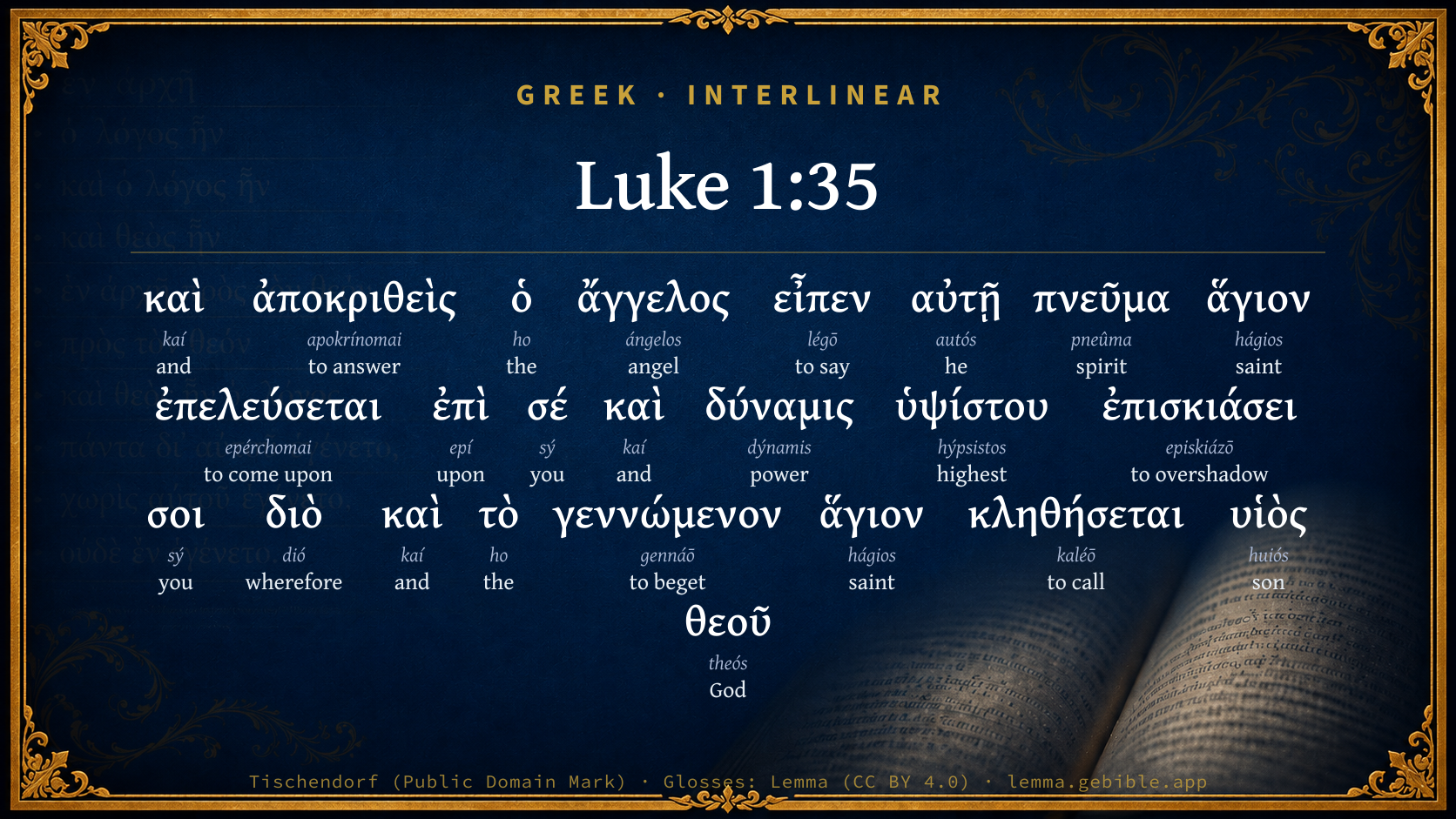
Download image
Cite this verse

Luke 1:35 (World English Bible). Public Domain. Lemma interlinear Bible study tool, https://lemma.gebible.app/v/luke/1/35.

Show BibTeX & RIS
BibTeX
RIS
English Translation
The angel answered her, "The Holy Spirit will come on you, and the power of the Most High will overshadow you. Therefore also the holy one who is born from you will be called the Son of God.
World English Bible · Public Domain
Highlights
  • 1 first appearance in the Greek New Testament
Full analysis ↓
Download a study sheet

One document with this verse’s original text, its word-by-word gloss line, the meaning frame, cross-references with their text, attributed commentary, and full source and license credits — printable, and it pastes into notes with its structure intact.

This verse Autodidact and up

Study sheet (.html) Plain text (.txt)

A passage Seminary Student

Up to 50 verses in one chapter. A passage sheet keeps up to 6 commentary sources and 12 cross-references per verse, in the order this page ranks them, and says so on the sheet whenever that leaves anything out. Ask for a single verse and you get the Autodidact verse sheet above.

Everything on this page stays free to read, with no account — the sheet is a download of what is already on screen, not access to it.

Want to remove ads? Support Godless Engineer
Compare translations 3

The same verse in 3 English versions, stacked beneath the original-language interlinear above. Click any original word for its lexicon entry.

Each is an independent rendering of the whole verse — the interlinear is not word-aligned to these translations.

Highlighted words mark where these versions differ — a whole-verse word diff, not a word-by-word alignment.

  • World English Bible Public Domain
    The angel answered her, "The Holy Spirit will come on you, and the power of the Most High will overshadow you. Therefore also the holy one who is born from you will be called the Son of God.
  • King James Version Public Domain
    And the angel answered and said unto her, The Holy Ghost shall come upon thee, and the power of the Highest shall overshadow thee: therefore also that holy thing which shall be born of thee shall be called the Son of God.
  • unfoldingWord Literal Text CC BY-SA 4.0
    And answering, the angel said to her, “The Holy Spirit will come upon you, and power of the Most High will overshadow you. Therefore, the holy one being born will be called the Son of God.

unfoldingWord Literal Text — © unfoldingWord, licensed CC BY-SA 4.0. Word-aligned USFM3 via Door43 (git.door43.org/unfoldingWord/en_ult).

Versions to compare (up to 4)

3 of 4 selected

Show all 19 translations

Every available English version of this verse, each an independent rendering of the whole verse.

  • World English Bible Public Domain
    The angel answered her, "The Holy Spirit will come on you, and the power of the Most High will overshadow you. Therefore also the holy one who is born from you will be called the Son of God.
  • Berean Standard Bible Public Domain
    The angel replied, “The Holy Spirit will come upon you, and the power of the Most High will overshadow you. So the Holy One to be born will be called the Son of God.
  • Majority Standard Bible Public Domain
    The angel replied, “The Holy Spirit will come upon you, and the power of the Most High will overshadow you. So the Holy One to be born will be called the Son of God.
  • King James Version Public Domain
    And the angel answered and said unto her, The Holy Ghost shall come upon thee, and the power of the Highest shall overshadow thee: therefore also that holy thing which shall be born of thee shall be called the Son of God.
  • American Standard Version (1901) Public Domain
    And the angel answered and said unto her, The Holy Spirit shall come upon thee, and the power of the Most High shall overshadow thee: wherefore also the holy thing which is begotten shall be called the Son of God.
  • Revised Version (1885) Public Domain
    And the angel answered and said unto her, The Holy Ghost shall come upon thee, and the power of the Most High shall overshadow thee: wherefore also that which is to be born shall be called holy, the Son of God.
  • Geneva Bible (1599) Public Domain
    And the Angel answered, and said vnto her, The holy Ghost shall come vpon thee, and the power of the most High shall ouershadowe thee: therefore also that holy thing which shall bee borne of thee, shall be called the Sonne of God.
  • Douay-Rheims (1899) Public Domain
    And the angel answering, said to her: The Holy Ghost shall come upon thee, and the power of the most High shall overshadow thee. And therefore also the Holy which shall be born of thee shall be called the Son of God.
  • Young's Literal Translation Public Domain
    And the messenger answering said to her, `The Holy Spirit shall come upon thee, and the power of the Highest shall overshadow thee, therefore also the holy-begotten thing shall be called Son of God;
  • Literal Standard Version CC BY-SA 4.0
    And the messenger answering said to her, “The Holy Spirit will come on you, and the power of the Highest will overshadow you, therefore also the holy-begotten thing will be called Son of God;
  • Unlocked Literal Bible CC BY-SA 4.0
    The angel answered and said to her, “The Holy Spirit will come upon you, and the power of the Most High will come over you. So the holy one to be born will be called the Son of God.
  • unfoldingWord Literal Text CC BY-SA 4.0
    And answering, the angel said to her, “The Holy Spirit will come upon you, and power of the Most High will overshadow you. Therefore, the holy one being born will be called the Son of God.
  • Darby Bible Public Domain
    And the angel answering said to her, [The] Holy Spirit shall come upon thee, and power of [the] Highest overshadow thee, wherefore the holy thing also which shall be born shall be called Son of God.
  • World Messianic Bible Public Domain
    The angel answered her, “The Holy Spirit will come on you, and the power of the Most High will overshadow you. Therefore also the holy one who is born from you will be called the Son of God.
  • Webster's Bible Public Domain
    And the angel answered and said to her, The Holy Spirit will come upon thee, and the power of the Highest will overshadow thee: therefore also that holy thing which shall be born of thee shall be called the Son of God.
  • Free Bible Version CC BY-SA 4.0
    He replied, “The Holy Spirit will come upon you, and the power of the Most High will cover you. The baby who is to be born is holy, and will be called the Son of God.
  • Bible in Basic English Public Domain
    And the angel in answer said to her, The Holy Spirit will come on you, and the power of the Most High will come to rest on you, and so that which will come to birth will be named holy, Son of God.
  • Text-Critical English NT CC BY 4.0
    The angel answered her, “The Holy Spirit will come upon yoʋ, and the power of the Most High will overshadow yoʋ; therefore the holy child that is to be born will be called the Son of God.
  • Tyndale New Testament (1534) Public Domain
    And the angell answered and sayd vnto her: The holy goost shall come apon the and the power of the hyest shall over shaddowe the. Therfore also the holy thinge which shalbe borne shalbe called the sonne of god.

Literal Standard Version (2020), Covenant Press — licensed CC BY-SA 4.0. Text via the HelloAO Bible API (eBible.org). Unlocked Literal Bible (unfoldingWord) — licensed CC BY-SA 4.0. Text via the HelloAO Bible API (eBible.org). unfoldingWord Literal Text — © unfoldingWord, licensed CC BY-SA 4.0. Word-aligned USFM3 via Door43 (git.door43.org/unfoldingWord/en_ult). Free Bible Version, Dr. Jonathan Gallagher — licensed CC BY-SA 4.0. Text via the HelloAO Bible API (eBible.org).

Word by word

More ways to search: Search by grammar → Find every occurrence → Compare this word →

Practice this passage: Drill this verse → Learn its vocabulary →

ἐπισκιάσει
episkiázō
G1982
“to overshadow”
Verb, Future, Active, Indicative, 3rd person, Singular
Part of Speech
Verb
Tense
Future
Voice
Active
Mood
Indicative
Person
3rd person
Number
Singular
Full Thayer's Definition

Origin: from G1909 and a derivative of G4639

TDNT: 13:39,1

1. to throw a shadow upon, to envelop in a shadow, to overshadow
  1. καὶ kaí G2532 “and” Conjunction
  2. ἀποκριθεὶς apokrínomai G611 “to answer” Verb, Aorist, Passive deponent, Participle, Nominative, Singular, Masculine
  3. ὁ ho G3588 “the” Article, Nominative, Singular, Masculine
  4. ἄγγελος ángelos G32 “angel” Noun, Nominative, Singular, Masculine
  5. εἶπεν légō G3004 “to say” Verb, Aorist, Active, Indicative, 3rd person, Singular
  6. αὐτῇ autós G846 “he” Personal pronoun, Dative, Singular, Feminine
  7. πνεῦμα pneûma G4151 “spirit” Noun, Nominative, Singular, Neuter
  8. ἅγιον hágios G40 “saint” Adjective, Nominative, Singular, Neuter
  9. ἐπελεύσεται epérchomai G1904 “to come upon” Verb, Future, Middle deponent, Indicative, 3rd person, Singular
  10. ἐπὶ epí G1909 “upon” Preposition
  11. σέ sý G4771 “you” Personal pronoun, 2nd person, Accusative, Singular
  12. καὶ kaí G2532 “and” Conjunction
  13. δύναμις dýnamis G1411 “power” Noun, Nominative, Singular, Feminine
  14. ὑψίστου hýpsistos G5310 “highest” Adjective, Genitive, Singular, Masculine, Superlative
  15. σοι sý G4771 “you” Personal pronoun, 2nd person, Dative, Singular
  16. διὸ dió G1352 “wherefore” Conjunction
  17. καὶ kaí G2532 “and” Conjunction
  18. τὸ ho G3588 “the” Article, Nominative, Singular, Neuter
  19. γεννώμενον gennáō G1080 “to beget” Verb, Present, Passive, Participle, Nominative, Singular, Neuter
  20. ἅγιον hágios G40 “saint” Adjective, Nominative, Singular, Neuter
  21. κληθήσεται kaléō G2564 “to call” Verb, Future, Passive, Indicative, 3rd person, Singular
  22. υἱὸς huiós G5207 “son” Noun, Nominative, Singular, Masculine
  23. θεοῦ theós G2316 “God” Noun, Genitive, Singular, Masculine

About this verse

These counts appear in no published source. They are computed here, from the morphology-tagged text and Lemma’s own curated glosses. What Lemma adds →

24
words
19
distinct lemmas
Gospels
section

Notable vocabulary

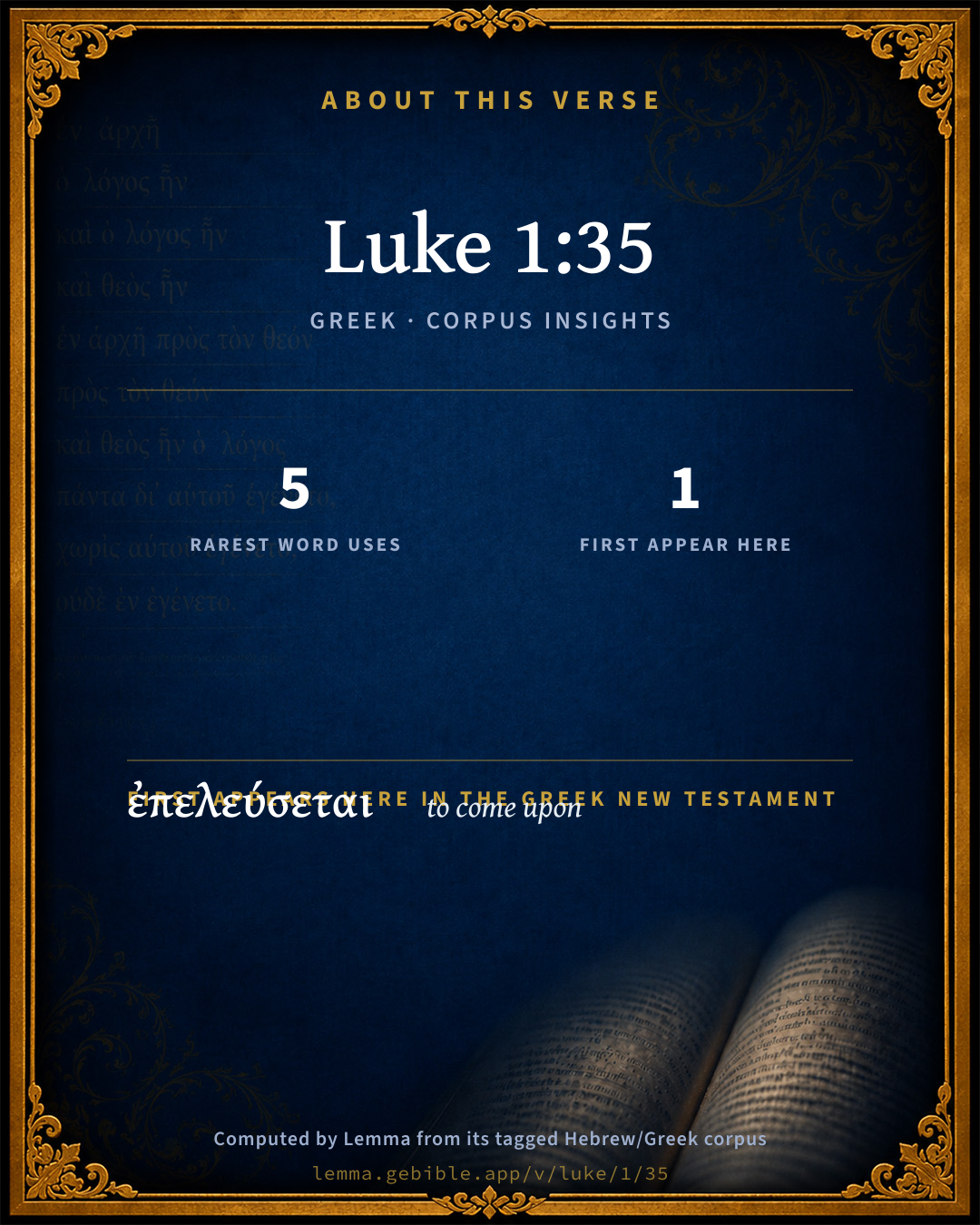
The rarest word here is ἐπισκιάσει to overshadow G1982 — appearing just 5 times in the whole Greek New Testament.

First appearance in Scripture

This word makes its first canonical appearance in the Greek New Testament here:

  • ἐπελεύσεται to come upon G1904

Shared distinctive vocabulary

ἐπισκιάσει to overshadow G1982 occurs in 5 verses of the Greek New Testament. Also found in:
Repetition

Words recur within this verse:

Cross-references

24

Topical passages linked to Luke 1:35 in the Treasury of Scripture Knowledge — connected by theme and wording, ordered by reader-vote popularity; previews shown in the World English Bible.

  • Matthew 1:18 Now the birth of Jesus Christ was like this; for after his mother, Mary, was engaged to Joseph, before they came together, she was found pregnant by the Holy Spirit.
  • John 1:49 Nathanael answered him, "Rabbi, you are the Son of God! You are King of Israel!"
  • Matthew 1:20 But when he thought about these things, behold, an angel of the Lord appeared to him in a dream, saying, "Joseph, son of David, don't be afraid to take to yourself Mary, your wife, for that which is conceived in her is of the Holy Spirit.
  • John 1:34 I have seen, and have testified that this is the Son of God."
  • Luke 1:31–32 Behold, you will conceive in your womb, and bring forth a son, and will call his name 'Jesus.'
  • Romans 1:4 who was declared to be the Son of God with power, according to the Spirit of holiness, by the resurrection from the dead, Jesus Christ our Lord,
  • Hebrews 4:15 For we don't have a high priest who can't be touched with the feeling of our infirmities, but one who has been in all points tempted like we are, yet without sin.
  • Matthew 26:63–64 But Jesus held his peace. The high priest answered him, "I adjure you by the living God, that you tell us whether you are the Christ, the Son of God."
  • Mark 1:24 saying, "Ha! What do we have to do with you, Jesus, you Nazarene? Have you come to destroy us? I know you who you are: the Holy One of God!"
  • Acts 8:36 As they went on the way, they came to some water, and the eunuch said, "Behold, here is water. What is keeping me from being baptized?"
  • Matthew 27:54 Now the centurion, and those who were with him watching Jesus, when they saw the earthquake, and the things that were done, feared exceedingly, saying, "Truly this was the Son of God."
  • Luke 1:27 to a virgin pledged to be married to a man whose name was Joseph, of the house of David. The virgin's name was Mary.
  • Job 25:4 How then can man be just with God? Or how can he who is born of a woman be clean?
  • John 20:31 but these are written, that you may believe that Jesus is the Christ, the Son of God, and that believing you may have life in his name.
  • Galatians 2:20 I have been crucified with Christ, and it is no longer I that live, but Christ living in me. That life which I now live in the flesh, I live by faith in the Son of God, who loved me, and gave himself up for me.
  • Job 14:4 Who can bring a clean thing out of an unclean? Not one.
  • Psalms 2:7 I will tell of the decree. Yahweh said to me, "You are my son. Today I have become your father.
  • Matthew 14:33 Those who were in the boat came and worshiped him, saying, "You are truly the Son of God!"
  • Mark 1:1 The beginning of the Gospel of Jesus Christ, the Son of God.
  • Hebrews 7:26–28 For such a high priest was fitting for us: holy, guiltless, undefiled, separated from sinners, and made higher than the heavens;
  • Job 15:16 How much less one who is abominable and corrupt, A man who drinks iniquity like water!
  • Matthew 4:3 The tempter came and said to him, "If you are the Son of God, command that these stones become bread."
  • Ephesians 2:3 among whom we also all once lived in the lust of our flesh, doing the desires of the flesh and of the mind, and were by nature children of wrath, even as the rest.
  • Psalms 51:5 Behold, I was brought forth in iniquity. In sin my mother conceived me.

Cross-references courtesy of OpenBible.info (CC BY 4.0).

Commentary

Notes on Luke 1:35 from classic Christian and Jewish commentators (each source and its license shown beneath its notes). The classic Christian expositions comment on the surrounding passage and are grouped to its opening verse, so a note may address several verses; the Jewish commentaries on the Tanakh (Rashi and others) are per-verse, so they appear only where the commentator wrote on this verse.

Lemma curates 59 commentaries, every one of them public domain or Creative Commons licensed, each selected and text-cleaned for this edition rather than reprinted as found. About our sources →

Tyndale Open Study Notes

Tyndale Open Resources

1:35 The Holy Spirit will come upon you: Jesus’ conception was miraculous, by the power of the Most High. No further detail is provided as to how this happened.

Tyndale Open Study Notes — © Tyndale Open Resources, licensed CC BY-SA 4.0. Text via the HelloAO Bible API.

Bengel's Gnomon

Johann Albrecht Bengel

Luk 1:35. Δύναμις ὑψίστου, the power of the Highest) Often these words are put in conjunction, Spirit and Power, as in Luk 1:17; but in this passage the Power of the Highest rather denotes, by Metonymy,[9] the Highest, whose Power is infinite. So we have the expression, the power of our Lord Jesus Christ, 1Co 5:4. The coming of the Holy Ghost upon Mary made her fit for receiving the overshadowing of the power of the Highest.—ἐπισκιάσει σοι, shall overshadow thee) This overshadowing denotes the mildest and most gentle [most modified] operation of the Divine power, whereby it was effected that the Divine Fire did not consume Mary, but made her fruitful. Comp. Mar 9:7 [the cloud overshadowed them at the transfiguration]; Exo 33:22. Many suppose allusion is here made to חפה, veiled, as a bride. It was not fitting that the will of man or of the flesh should help towards this [the Saviour’s incarnation]. It was from the substance of Mary that the elements were taken, whatever contributed not only to the ΣΎΛΛΗΨΙς, the conception, but also to the nourishment of the holy fetus [embryo]. And this is considered [is to be viewed so], either antecedently to the moment of actual union with the Λόγος, or else in the very act and state of union. Antecedently to the union, it [what was taken from the substance of the mother] no otherwise than the mother herself, required to be redeemed by virtue of the λύτρον, redemption, about to be effected through the ΘΕΆΝΘΡΩΠΟΝ, God-man, Christ, and was sanctified by the Holy Spirit; and thus it was that the union of the ΛΌΓΟς and the flesh, now [made] holy, had place. I may purchase a farm: and out of the produce of that farm, when subsequently well cultivated, I may pay the price for the farm itself, which has become much more valuable since its cultivation. David bought the area [site] of the temple for a few shekels of silver [2Sa 24:24]; but the same area became inestimably valuable, when the temple was built upon it.[10]—διὸ καὶ, wherefore also) Thus the Angel gives a satisfactory answer to the question, How, Luk 1:34.—τὸ γεννώμενον,[11] which is being conceived [given birth to; not as Engl. Vers. Which shall be born]) in this new and extraordinary manner. Abstract terms, and such as are expressed in the neuter gender, are very much in consonance with those first beginnings of the Gospel revelation; Luk 1:68; Luk 1:71; Luk 1:78; Luk 2:25; Luk 2:30; Luk 2:38.—ἅγιον, Holy) This word is regarded by Tertullian, the Syr[12] Version, the author of the discourse against all heresies in Athanasius, and others of the ancients, as part of the predicate, It shall be called Holy, (and) the Son of God. At all events, the sense of the sentence is most full and compressed: There is a something which is to be given birth to: that which is being given birth to, shall be holy; this holy thing shall be called the Son of God. The whole is inferred from the immediately preceding words of the angel, and that in some such way as the following: The Holy Spirit shall come upon thee; wherefore that, which is being given birth to, shall be Holy. The Power of the Highest shall overshadow thee; wherefore that Holy thing shall be called the Son of God. Luk 1:32 is parallel to this: Thy Son shall be great, and shall be called the Son of the Highest. In Divine things, greatness and holiness very much harmonize. It was concerning this Holy One that the same angel spake in Dan 9:24.

[9] See Append. Here the substitution of the Adjunct (the Power) for the Subject (the Highest).—ED. and TRANSL.

[10] So Jesus purchased our flesh (humanity) by the redemption about to be made by Him, and then afterwards, by the union of the Λόγος to it, and by the actual paying of the price of His blood, as God-man, made it infinitely more precious.—ED. and TRANSL.

[11] The words ἐκ σοῦ, of thee, subjoined to this participle, had been declared in the margin of the larger Ed. to be an improbable reading; but in Ed. 2 the reading is raised to the sign δ, and is given in the Vers. Germ., though enclosed in brackets. Therefore Bengel ought not to have been reckoned, in the Bibl. Theol. Tom. viii. p. 106, among those who have omitted these words.—E. B.

[12] yr. the Peschito Syriac Version: second cent.: publ. and corrected by Cureton, from MS. of fifth cent.

Lachm. reads ἐκ σοῦ (though in brackets), with C corrected later, ac, some MSS. of Vulg. Iren. Cypr.: and, before γεννώμενον, Hil. ABDb omit the words; and so Tischend.—ED. and TRANSL.

Bengel's Gnomon of the New Testament — English translation (T&T Clark, Edinburgh, 1860) — public domain. Text from a community e-Sword module.

Expositor's Greek Testament

ed. W. Robertson Nicoll

Luk 1:35 . Πνεῦμα Αγιον : without the article because a proper name = the well-known Holy Spirit, say some (Meyer, Farrar), but more probably because the purpose is not to indicate the person by whom, etc., but the kind of influence: spirit as opposed to flesh, holy in the sense of separation from all fleshly defilement (Hofmann, J. Weiss, Hahn). δύναμις ὑψίστου : the power of the Most High, also without article, an equivalent for π . ἄ ., and more definite indication of the cause, the power of God. Note the use of ὕψιστος as the name of God in Luk 1:32 , here, and in Luk 1:76 . Feine ( Vorkanonische Überlieferung des Lukas , p. 17) includes ὁ ὕψιστος , ὁ δυνατός (Luk 1:49 ), ὁ δεσπότης (Luk 2:29 ), ὁ κύριος (Luk 1:6 ; Luk 1:9 ; Luk 1:11 , etc.), all designations of God, among the instances of a Hebraistic vocabulary characteristic of chaps. 1 and 2. The first epithet recurs in Luk 6:35 in the expression “sons of the Highest,” applied to those who live heroically, where Mt. has “children of your Father in heaven”. ἐπελεύσεται , ἐπισκιάσει : two synonyms delicately selected to express the divine substitute for sexual intercourse. Observe the parallelism here: “sign of the exaltation of feeling. The language becomes a chant,” Godet. Some find poetry throughout these two first chapters of Lk. “These songs … doubtless represent reflection upon these events by Christian poets, who put in the mouths of the angels, the mothers and the fathers, the poems which they composed” (Briggs, The Messiah of the Gospels , p. 42. Even the address of Gabriel to Zechariah in the temple, Luk 1:13-17 , is, he thinks, such a poem). τὸ γεννώμενον ἄγιον , the holy thing holy product of a holy agency which is being, or about to be, generated = the embryo, therefore appropriately neuter. υἱὸς Θεοῦ , Son of God; not merely because holy, but because brought into being by the power of the Highest.

The Expositor's Greek Testament, edited by W. Robertson Nicoll (1897–1910) — public domain. Text from a community e-Sword module.

Geneva Bible (1599)

Geneva Bible translators

Declared and showed to the world, to be the Son of God.

That is, the holy Ghost shall cause thee to conceive by his mighty power.

That pure thing and void of all spot of uncleanness: for he that was to take away sin, must needs be void of sin.

Geneva Bible (1599) marginal notes — public domain. Text via Bolls.life.

Jamieson, Fausset & Brown

Robert Jamieson, A. R. Fausset & David Brown

Holy Ghost--(See on Mat 1:18).

power of the highest--the immediate energy of the Godhead conveyed by the Holy Ghost.

overshadow--a word suggesting how gentle, while yet efficacious, would be this Power [BENGEL]; and its mysterious secrecy, withdrawn, as if by a cloud, from human scrutiny [CALVIN].

that holy thing born of thee--that holy Offspring of thine.

therefore . . . Son of God--That Christ is the Son of God in His divine and eternal nature is clear from all the New Testament; yet here we see that Sonship efflorescing into human and palpable manifestation by His being born, through "the power of the Highest," an Infant of days. We must neither think of a double Sonship, as some do, harshly and without all ground, nor deny what is here plainly expressed, the connection between His human birth and His proper personal Sonship.

Jamieson, Fausset & Brown — Commentary Critical and Explanatory on the Whole Bible (1871) — public domain (CC PDM 1.0). Text via the HelloAO Bible API.

Adam Clarke's Commentary

Verse 35. The Holy Ghost shall come upon thee] This conception shall take place suddenly, and the Holy Spirit himself shall be the grand operator. The power, δυναμις, the miracle-working power, of the Most High shall overshadow thee, to accomplish this purpose, and to protect thee from danger. As there is a plain allusion to the Spirit of God brooding over the face of the waters, to render them prolific, Ge 1:2, I am the more firmly established in the opinion advanced on Mt 1:20, that the rudiments of the human nature of Christ was a real creation in the womb of the virgin, by the energy of the Spirit of God.

Therefore also that holy thing (or person) - shall be called the Son of God.] We may plainly perceive here, that the angel does not give the appellation of Son of God to the Divine nature of Christ; but to that holy person or thing, τοαγιον, which was to be born of the virgin, by the energy of the Holy Spirit. The Divine nature could not be born of the virgin; the human nature was born of her. The Divine nature had no beginning; it was God manifested in the flesh, 1Ti 3:16; it was that Word which being in the beginning (from eternity) with God, Joh 1:2, was afterwards made flesh, (became manifest in human nature,) and tabernacled among us, Joh 1:14. Of this Divine nature the angel does not particularly speak here, but of the tabernacle or shrine which God was now preparing for it, viz. the holy thing that was to be born of the virgin. Two natures must ever be distinguished in Christ: the human nature, in reference to which he is the Son of God and inferior to him, Mr 13:32; Joh 5:19; Joh 14:28, and the Divine nature which was from eternity, and equal to God, Joh 1:1; Joh 10:30; Ro 9:5; Col 1:16-18. It is true, that to Jesus the Christ, as he appeared among men, every characteristic of the Divine nature is sometimes attributed, without appearing to make any distinction between the Divine and human natures; but is there any part of the Scriptures in which it is plainly said that the Divine nature of Jesus was the Son of God? Here, I trust, I may be permitted to say, with all due respect for those who differ from me, that the doctrine of the eternal Sonship of Christ is, in my opinion, anti-scriptural, and highly dangerous. This doctrine I reject for the following reasons: -

1st. I have not been able to find any express declaration in the Scriptures concerning it.

2dly. If Christ be the Son of God as to his Divine nature, then he cannot be eternal; for son implies a father; and father implies, in reference to son, precedency in time, if not in nature too. Father and son imply the idea of generation; and generation implies a time in which it was effected, and time also antecedent to such generation.

3dly. If Christ be the Son of God, as to his Divine nature, then the Father is of necessity prior, consequently superior to him.

4thly. Again, if this Divine nature were begotten of the Father, then it must be in time; i.e. there was a period in which it did not exist, and a period when it began to exist. This destroys the eternity of our blessed Lord, and robs him at once of his Godhead.

5thly. To say that he was begotten from all eternity, is, in my opinion, absurd; and the phrase eternal Son is a positive self-contradiction. ETERNITY is that which has had no beginning, nor stands in any reference to TIME. SON supposes time, generation, and father; and time also antecedent to such generation. Therefore the conjunction of these two terms, Son and eternity is absolutely impossible, as they imply essentially different and opposite ideas.

The enemies of Christ's Divinity have, in all ages, availed themselves of this incautious method of treating this subject, and on this ground, have ever had the advantage of the defenders of the Godhead of Christ. This doctrine of the eternal Sonship destroys the deity of Christ; now, if his deity be taken away, the whole Gospel scheme of redemption is ruined. On this ground, the atonement of Christ cannot have been of infinite merit, and consequently could not purchase pardon for the offences of mankind, nor give any right to, or possession of, an eternal glory. The very use of this phrase is both absurd and dangerous; therefore let all those who value Jesus and their salvation abide by the Scriptures. This doctrine of the eternal Sonship, as it has been lately explained in many a pamphlet, and many a paper in magazines, I must and do consider as an awful heresy, and mere sheer Arianism; which, in many cases, has terminated in Socinianism, and that in Deism. From such heterodoxies, and their abetters, may God save his Church! Amen!

Adam Clarke's Commentary on the Bible (1810–1826) — public domain. Text from a community e-Sword/MySword module.

Ellicott's Commentary for English Readers

(35) The Holy Ghost shall come upon thee.—See Note on Luk_1:15. Here, however, the context would suggest to one familiar with the sacred writings, another aspect of the Spirit’s work, as quickening the dead chaos into life (Gen_1:2), as being the source of life to all creation (Psa_104:30).

The power of the Highest shall overshadow thee.—The divine name is used in obvious harmony with “the Son of the Highest” in Luk_1:32.

Therefore also . . . shall be called the Son of God.—The words appear to rest the title, “Son of God,” rather on the supernatural birth than on the eternal pre-existence of the Son as the Word that was “in the beginning with God and was God” (Joh_1:1), and we may accept the fact that the message of the angel was so far a partial, not a complete, revelation of the mystery of the Incarnation. It gave a sufficient reason for the name which should be given to the Son of Mary, and more was not then required.

A Bible Commentary for English Readers, edited by Charles John Ellicott (1878–1897) — public domain. Text from a community e-Sword module.

The Cambridge Bible for Schools and Colleges

gen. ed. J. J. S. Perowne

35. shall overshadow thee] as with the Shechinah and Cloud of Glory (see on Luk_2:9, Luk_9:34). See the treatise on the Shechinah in Meuschen, pp. 701–739. On the high theological mystery see Pearson On the Creed, Art. iii. See on Luk_2:9.

that holy thing] “Holy, harmless, undefiled, separate from sinners,” Heb_7:26. “Who did no sin,” 1Pe_2:22.

which shall be born of thee] Rather, which is in thy womb. Gal_4:4, “born of a woman.”

the Son of God] This title is given to our Lord by almost every one of the sacred writers in the N. T. and in a multitude of passages.

The Cambridge Bible for Schools and Colleges (gen. ed. J. J. S. Perowne; Cambridge University Press, 1878–1918) — public domain. Text from a community e-Sword module.

John Gill's Exposition

And the angel answered and said unto her,.... The angel gave her an account of the manner in which what he had said should be effected, as well as observed some things for the strengthening of her faith,

The Holy Ghost shall come upon thee. The words, "upon thee", are left out in the Syriac and Persic versions; but are retained in others, and in all copies: the formation of Christ's human nature, though common to all the three persons, yet is particularly, and most properly ascribed to the Spirit; not to the first person, the Father, lest it should be thought that he is only the Father of him, as man; nor to the second person, the Son, since it is to him that the human nature is personally united; but to the third person, the Spirit, who is the sanctifier; and who separated, and sanctified it, the first moment of its conception, and preserved it from the taint of original sin. His coming upon the virgin must be understood in consistence with his omnipresence, and immensity; and cannot design any local motion, but an effectual operation in forming the human nature of her flesh and substance; and not in the ordinary manner in which he is concerned in the formation of all men, Job 33:4 but in an extraordinary way, not to be conceived of, and explained. The phrase most plainly answers to , in frequent use with the Jews (x), as expressive of coition,

And the power of the Highest shall overshadow thee. By "the power of the Highest" is not meant the Lord Jesus Christ, who is sometimes called the power of God; but rather the Holy Ghost, as before, who is styled the finger of God, and power from on high, Luk 11:20 unless it should be thought that the perfection of divine power common to all the three persons is intended: and so points out the means by which the wondrous thing should be performed, even by the power of God; and which should not only be employed in forming the human nature of Christ, but in protecting the virgin from any suspicion and charge of sin, and defending her innocence and virtue, by moving upon Joseph to take her to wife. In the word, "overshadow", some think there is an allusion to the Spirit of God moving upon the face of the waters, in Gen 1:2 when, he brooded upon them, as the word may be rendered; and which is the sense of it, according to the Jewish writers (y) as a hen, or any other bird broods on its eggs to exclude its young: and others have thought the allusion may be to , (z), "the nuptial covering": which was a veil, or canopy, like a tent, supported on four staves, under which the bridegroom and bride were betrothed; or, as Dr. Lightfoot thinks, it is a modest phrase alluding to the conjugal embraces, signified by a man's spreading the skirt of his garment over the woman, which Ruth desired of Boaz, Rut 3:9 though the Jewish writers say (a), that phrase is expressive of the act of marriage, or taking to wife. The phrase of being "overshadowed", or "covered with the spirit of prophecy", as the virgin also was, is used by the Targumist, on Ch1 2:55.

therefore also that holy thing which shall be born of thee shall be called the Son of God. The human nature of Christ is here called a "thing"; for it was not a person; it never subsisted of itself, but was taken at once into union with the person of the Son of God, otherwise there would be two persons in Christ, whereas he is God, and man, in one person; and it is said to be "holy", being free from that original pollution and sin, in which all that descend from Adam, by ordinary generation, are conceived, and brought forth; and is, moreover, said to be born of a virgin, "of thee", or "out of thee". Christ's flesh was formed out of the Virgin's; he took flesh of her; his body did not descend from heaven, or pass through her, as water through a pipe, as some heretics of old said: nor did his human nature, either as to soul or body, pre-exist his incarnation; but in the fulness of time he was made of a woman, and took a true body of her, and a reasonable soul, into union with his divine person; and "therefore should be called the Son of God": not that he was now to become the "the Son of God"; he was so before his incarnation, and even from all eternity; but he was now to be manifested as such in human nature: nor does the angel predict, that he should, for this reason, be called the Son of God; for he never was, on this account, so called, either by himself, or others: nor is the particle, "therefore", causal, but consequential: the angel is not giving a reason why Christ should be the Son of God, but why he should be owned, and acknowledged, as such by his people: who would infer, and conclude from his wonderful conception and birth, that he is the "Emmanuel", God with us, the child that was to be born, and the Son given, whose name should be Wonderful, Counsellor, the mighty God, &c. Isa 7:14. Moreover, the word, "also", is not to be overlooked; and the sense is, that seeing that human nature, which should be born of the virgin, would be united to the Son of God, it likewise should bear the same name, being in personal union with him, who was so from all eternity,

(x) Misn. Sanhedrin, c. 7, sect. 4. & passim alibi (y) R. Sol. Jarchi, R. Aben Ezra, & R. Levi ben Gerson in Gen. 1. 2. (z) T. Bab. Sota, fol. 49. 2. Vid. David de Pomis, Lex. Heb p. 67. 2. (a) Targum, Jarchi, & Aben Ezra in loc.

John Gill's Exposition of the Whole Bible (1746–1763) — public domain (CC PDM 1.0). Text via the HelloAO Bible API.

Trapp's Complete Commentary

John Trapp

35 And the angel answered and said unto her, The Holy Ghost shall come upon thee, and the power of the Highest shall overshadow thee: therefore also that holy thing which shall be born of thee shall be called the Son of God.

Ver. 35. The power of the Highest shall overshadow thee] As once he did the confused chaos in the creation. This very expression was a great confirmation to the Virgin’s faith, and may well serve for a caution to us not to be overcurious in searching into this secret.

John Trapp, A Commentary or Exposition upon All the Books of the Old and New Testament (1647–1656) — public domain. Text from a community e-Sword module.

Albert Barnes' Notes on the Bible

The Holy Ghost shall come upon thee - See Mat 1:20.

The power of the Highest ... - This evidently means that the body of Jesus would be created by the direct power of God. It was not by ordinary generation; but, as the Messiah came to redeem sinners - to make atonement for “others,” and not for himself it was necessary that his human nature should be pure, and free from the corruption of the fall. God therefore prepared him a body by direct creation that should be pure and holy. See Heb 10:5.

That holy thing ... - That holy progeny or child.

Shall be called the Son of God - This is spoken in reference to the human nature of Christ, and this passage proves, beyond controversy, that “one” reason why Jesus was called the Son of God was because he was begotten in a supernatural manner. He is also called the “Son of God” on account of his resurrection, Rom 1:4; Act 13:33, compared with Psa 2:7.

Albert Barnes' Notes on the Bible (1834–1885) — public domain. Text from a community e-Sword/MySword module.

Haydock's Catholic Bible Commentary

The Holy Ghost shall come upon thee, &c. By the divine power thou shalt bring forth, and yet remain always a pure virgin. --- And therefore also the Holy which shall be born of thee, shall be called (shall be) the Son of God. The second person of the ever blessed Trinity, being united to our human nature, remaining unchangeably the same God, and being born of the Virgin Mary; it must needs be true to say that God was born, that God suffered and died for us; and consequently that the blessed Virgin Mary was truly the mother of God, or of him that is truly God; though not the mother of the Godhead: as the Catholic Church declared in the council of Ephesus, (431) against the heretic Nestorius. (Witham) --- Seek not for natural order in things that transcend nature. You ask, how shall this be done, since you know not man? This, your ignorance of man, is the very reason why this will take place within you. For had you not been pure, you never would have been deemed worthy of so great a mystery. Not because marriage is bad, but because virginity is far more excellent. The common Lord of all ought in his birth to have something common with all mankind, and still something different. He was conceived and born in the womb like the rest of mankind, but he differed from them in being born of a virgin. (St. John Chrysostom, xlix. in Genes.)

George Leo Haydock (1774–1849), Haydock's Catholic Family Bible and Commentary, 1859 edition — public domain. Excludes Psalms (Douay-Rheims chapter numbering differs from Protestant) and Deuterocanonical books (Catholic canon only).

Matthew Poole's English Annotations

The Holy Ghost (who is also called here the power of the Highest) shall come upon thee; it is a phrase which signifieth a special and peculiar influence of the Holy Spirit: thus we read of the prophets, that the Spirit of the Lord came upon them, 2Ch 20:14, &c., which argued a special influence of the Holy Spirit on them, efficacious, so as it put them upon a present prophesying. There is a common influence of God upon the forming of all children in the womb, Job 10:8; Psa 139:15. But this phrase denotes an extraordinary special influence of the Spirit, changing the order and course of nature, and giving a power to the blood of the virgin by him sanctified, to coagulate alone to the forming of the body of a child: this is more mysteriously yet expressed, by the term overshadow thee, which I take to be a modest phrase, signifying only a supply of man’s act, by a Divine creating power, in a most miraculous manner.

Therefore also that holy thing which shall be born of thee shall be called the Son of God, as Adam was called the son of God, Luk 3:38, God (by his creating power) supplying as to him the place of father and mother, and to Christ supplying the place of the father, though not of the mother, for (saith the angel) he shall be

born of thee. But yet that mass of flesh shall be a holy thing, because, though born of thee, and flesh of thy flesh, yet of thy flesh first sanctified, by the Holy Ghost coming upon and overshadowing of thee. He shalt be called so, not that he was not so by eternal generation, (of which the angel here speaks not), but the Word, the eternal Son of God, which was in the beginning, being thus made flesh, and personally united to thy flesh, the whole person shall be called

the Son of God.

Matthew Poole's English Annotations on the Holy Bible (1683–1685) — public domain. Text from a community e-Sword/MySword module.

Whedon's Commentary on the Bible

Daniel D. Whedon

35. The Holy Ghost—The definite article is not in the Greek. The phrase holy spirit here designates not the third person in the trinity; for, then, he would be the Father of our Lord Jesus Christ; but the same holy spirit of Deity which brooded upon chaos and produced the creation.

Come upon thee—See Act_1:8.

The Holy Ghost shall come upon thee—The pure Spirit of God should sanctify her nature and render her the holy mother of the Son of God.

Overshadow thee—By an act of power as pure as the shadow of a cloud shed down upon thee, shall God be the creative father of thy holy son.

The holy thing—That totality which is born of thee, including both human and divine, is holy, a holy thing. Its human flesh and blood, though drawn from a fallen source, shall, as they form into his being, be pure as the first Adam, by association with the divine. Him hath God sanctified and sent through the ordinary pathway of birth into the world. Joh_10:36. So that Christ taking our nature took not its sin.

Shall be called the Son of God—Because the second person in the Trinity is by this divine operation, and this human conception and birth, incarnated in his person. Undoubtedly the production of the human birth by Deity entitles even the human person of our Saviour to the appellation Son of God. Yet primarily this title, taking its starting point from the divinity, descends to include the humanity. On the other hand, the title Son of man, beginning with his humble humanity, takes in its glorified state, and even its union with the divine.

The idea of a god become incarnate, and thus a god-man, it is often said abounds in heathen mythology, and so in Christianity is a plagiary. But though heathenism has her gods incarnate, she never rose to the thought of the infinite and eternal God assuming humanity upon his divinity. That Hercules should be begotten of Jove, or Achilles be born of the goddess Thetis, are small fables, bearing no analogy to the true Incarnation. And even the incarnations of Vishnu in Hindoo mythology are merely the goings forth of the god himself under the mere shape of animal or man. They are not a real divinity in a real humanity, a unity of the two complete personal natures, perfect God and perfect man, constituting one God-man.

Daniel D. Whedon (gen. ed.), Commentary on the Old and New Testaments (1874–1909) — public domain. Text from a community e-Sword module.

The Pulpit Commentary

The Holy Ghost shall come upon thee, and the power of the Highest shall overshadow thee. Again the angel makes use of the term "Highest" when alluding to the eternal Father. The expression of Gabriel, "the power of the Highest shall overshadow thee," reminds us of the opening words of Genesis, where the writer describes the dawn of life in creation in the words, "The Spirit of God moved or, "brooded over the face of the deep." "The Word was conceived in the womb of a woman, not after the manner of men, but by the singular, powerful, invisible, immediate operation of the Holy Ghost, whereby a virgin was, beyond the law of nature, enabled to conceive, and that which was conceived in her was originally and completely sanctified" (art. 3., Bishop Pearson on the Creed).

The Pulpit Commentary (1880–1919), ed. H.D.M. Spence-Jones & Joseph S. Exell — public domain. Text from a community e-Sword module.

John Wesley's Explanatory Notes

The Holy Ghost shall come upon thee, and the power of the Highest shall overshadow thee - The power of God was put forth by the Holy Ghost, as the immediate Divine agent in this work: and so he exerted the power of the Highest as his own power, who together with the Father and the Son is the most high God. Therefore also - Not only as he is God from eternity, but on this account likewise he shall be called the Son of God.

John Wesley, Explanatory Notes Upon the Whole Bible (1754–1765) — public domain. Text via the GEBible commentary corpus.

Cambridge Greek Testament for Schools and Colleges

35. ἐκ σοῦ omitted by nearly all the best MSS.

35. Πνεῦμα ἅγιον. The phrase is anarthrous (i.e. the article is omitted) because ‘Holy Spirit’ is here a proper name.

ἐπισκιάσει σοι, as with the Shechinah and Cloud of Glory (see on Luk 2:9, Luk 9:34). See the treatise on the Shechinah in Meuschen, pp. 701–739. On the high theological mystery see Pearson On the Creed, Art. 3. See on Luk 2:9.

τὸ ἅγιον. “Holy, harmless, undefiled, separate from sinners,” Heb 7:26. “Who did no sin,” 1Pe 2:22.

γεννώμενον. ‘Which is in thy womb.’ Gal 4:4, “born of a woman.”

υἱὸς θεοῦ. This title is given to our Lord by almost every one of the sacred writers in the N. T. and in a multitude of passages.

Cambridge Greek Testament for Schools and Colleges (Cambridge University Press, 1896; 21 vols, various authors incl. Carr, Maclear, Plummer, Farrar, Lumby, Moule, M. R. James, Simcox) — public domain. Text from a community e-Sword module.

Alford’s Greek Testament

Henry Alford

35.] This question differs from that raised by Zacharias above. It is merely an enquiry after the manner in which so wonderful a thing should take place; not, how shall I know this?—it takes for granted that it shall be, and only asks, How?

πνεῦμα ἅγ.] the Holy Spirit—the creative Spirit of God, of whom it is said, Gen 1:2, that He ἐπεφέρετο ἐπάνω τοῦ ὕδατος. But as the world was not created by the Holy Ghost, but by the Son, so also the Lord was not begotten by the Holy Ghost, but by the Father: and that, before the worlds. “No more is here to be attributed to the Spirit, than what is necessary to cause the Virgin to perform the actions of a mother.… As Christ was made of the substance of the Virgin, so He was not made of the substance of the Holy Ghost, Whose essence cannot at all be made. And because the Holy Ghost did not beget Him by any communication of His essence, therefore He is not the Father of Him, though He were conceived by Him.” (Pearson on the Creed, p. 165, 166.)

ἐπισκιάσει] The figure is perhaps from a bird (as Grotius: see ref. Ps.), or from a cloud: see the other reff.

ἅγιον] Some take this for the predicate of τὸ γενν., ‘shall be called holy, the Son of God.’ But it is more simple to take it as E. V., that holy thing, &c., making τὸ γενν. ἅγ. the subject, and υἱ. θ. the predicate. On the latter expression, see note on Mat 4:3.

Henry Alford, The Greek Testament (1849–1861) — public domain. Text from a community e-Sword module.

International Critical Commentary

35. Πνεῦμα ἄγιον ἐπελεύσεται ἐπὶ σέ. It may be doubted whether the article is omitted “because Holy Spirit is here a proper name”; rather because it is regarded impersonally as the creative power of God. Comp. καὶ πνεῦμα Θεοῦ ἐπεφέρετο ἐπάνω τοῦ τοῦ ὕδατος (Gen 1:2): the two passages are very parallel. See on ver. 15. Both πνεῦμα and ἅγιον have special point. It is spirit and not flesh, what is holy and not what is sinful, that is to produce this effect in her. With ἐπελεύσεται ἐπὶ σέ Comp. Act 1:8. Excepting Eph 2:7 and Jas 5:1, the verb is peculiar to Lk. (11:22, 21:26; Act 1:8, Act 8:24, Act 13:40, Act 14:19).

δύναμις γ̔ψίστου ἐπισκιάσει σοι. For δύναμις see on 4:14; for ἐπισκιάσει comp. the account of the Transfiguration (9:34), and for the dat. comp. the account of Peter’s shadow (Act 5:15). It is the idea of the Shechinah which is suggested here (Exo 40:38). The cloud of glory signified the Divine presence and power, and it is under such influence that Mary is to become a mother.

διό. This illative particle is rare in the Gospels (7:7 ; Mat 27:8); not in Mk. or Jn.

τὸ γεννώμενον ἅγιον κληθήσεται υἱὸς Θεοῦ. “The holy thing which shall be born shall be called the Son of God,” or, “That which shall be born shall be called holy, the Son of God.” The latter of these two renderings seems to be preferable. Comp. ἅγιον τῷ κυρίῳ κληθήσεται (2:22); Ναζωραῖος κληθήσεται (Mat 2:23); υἱοὶ Θεοῦ κληθήσονται (5:9); ἐλάχιστος κληθήσεται and μέγας κλ. (5:19). In all cases the appellation precedes the verb. The unborn child called ἅγιον as being free from all taint of sin. De hoc Sancto idem angelus est locutus, Dan 9:24 (Beng.). The ἐκ σοῦ, which many authorities insert after γεννώμενον, is probably an ancient gloss, derived perhaps from Mat 1:16: א A B C3 D and most versions omit.

The title “Son of God,” like “Son of Man,” was a recognized designation of the Messiah. In Enoch, and often in 4 Ezra, the Almighty speaks of the Messiah as His Son. Christ seldom used it of Himself (Mat 27:43; Joh 10:36). But we have it in the voice from heaven (3:22, 9:35); in Peter’s confession (Mat 16:16); in the centurion’s exclamation (Mar 15:39); in the devil’s challenge (4:3, 9); in the cries of demoniacs (Mar 3:11, Mar 5:7). Very early the Christian Church chose it as a concise statement of the divine nature of Christ. See on Rom 1:4, and Swete, Apost. Creed, p. 24. For ἂγιον see on Rom 1:7. The radical meaning is “set apart for God, consecrated.”

International Critical Commentary — older volumes (1896–1929), various authors — public domain. Text from a community e-Sword module.

Vincent's Word Studies in the New Testament

Marvin R. Vincent

Shall overshadow. "Denoting the mildest and most gentle operation of divine power, that the divine fire should not consume Mary, but make her fruitful" (Bengel). Compare Exo 33:22; Mr 9:7. Compare the classical legend of Semele, who, being beloved of Jove, besought him to appear to her as he appeared in heaven, in all the terrors of the thunderer, and was consumed by his lightning. The metaphor in the word is taken from a cloud, in which God had appeared (Exo 40:34; 1Ki 8:10).

Marvin R. Vincent, Word Studies in the New Testament (1887–1900) — public domain. Text from a community e-Sword/MySword module.

Lesson kit

Teaching starters — assembled from the data on this page, not authored interpretation. Every prompt links to the verse data it draws on. Edit before teaching.

Luke, in the Gospels, opens this verse with 24 words (19 distinct Greek lemmas). Its most distinctive word is episkiázō (“to overshadow”). A historical commentator’s framing appears above. Read the whole chapter for the surrounding context.

Discussion questions

  1. The word episkiázō carries the sense “to overshadow.” How does it shape the verse?
  2. The word “to come upon” first appears here in Scripture. What is being introduced at this debut?
  3. Matthew 17:5 shares the word «to overshadow» with this verse. How do the two illuminate each other?
  4. “saint” occurs 2× in this one verse. What is the effect of the repetition?
  5. The translations on this page render this verse differently — a whole-verse word diff, not a word-by-word alignment. What might account for the different wordings?
  6. Reading how Tyndale Open Study Notes and Bengel's Gnomon read this verse, where do the two commentators agree and where do they part?

Things to notice

  • 1 word makes its first canonical appearance in Scripture here.
  • These translations choose different wording for 18 words in this verse.
  • “saint” occurs 2× in this single verse.
  • 19 distinct Greek lemmas span 24 words in this verse.

Reading settings

Reading text

Shown beneath each verse's original-language words.

Old Testament
Old Testament edition

Read the OT as the Masoretic Hebrew (MT) or the Greek Septuagint (LXX).

English shown for the Greek Septuagint (in the Hebrew ↔ Greek comparison).

Comparing translations? Open the Compare panel on any verse page to stack up to four side by side.